#help-0
1 messages · Page 695 of 1
 fallen sentinel
 past sundial
Like I know it’s infinatly small, but idk about large
 ember lava
this is a test
fallen sentinel
ember lava
this is a test
It's over long ago
I just want a different approach to solve it
fallen sentinel
ember lava
idk about that
I have solved it .. want my solution!? .. then try another way to solve this
ember lava
what should i do
ember lava
ember lava
<@!625835036809101312>
what should i do
past sundial
ember lava
what should i do
If it is long overdo, ask for them to send full screenshot with proof that it’s long overdo
Simple 😄
ember lava
past sundial
If it is long overdo, ask for them to send full screenshot with proof that it’s ...
ohk
@fallen sentinel send an ss of entire screen
past sundial
If they don’t have proof, u may administrate punishment
fallen sentinel
past sundial
If it is long overdo, ask for them to send full screenshot with proof that it’s ...
😐 you want the source !?
past sundial
But if they are telling truth, that shouldn’t be a problem
ember lava
hmm
past sundial
fallen sentinel
😐 you want the source !?
I mean a not cropped screenshot
I THINK that might count as valid proof, they got from another source, so I think that’s fine
ember lava
ok ig
past sundial
Cause it doesn’t seem they cropped it themselves
fallen sentinel
So it's a question from a grp .. of my friends
And so I ended up with this q.
I'm Indian.. grp is for IIT jee people
fallen sentinel
Yes
ember lava
which grade are you in
fallen sentinel
12th .. 2022 my first attempt
ember lava
me too
fallen sentinel
Nice
ember lava
fallen sentinel
12th .. 2022 my first attempt
hmm
ember lava
..
 ember lava
..
 crystal tapir
is this yr 12?
ember lava
do u want soln of all questions?
 vagrant kayak
yes
ember lava
ok
vagrant kayak
be quick pls
fallen sentinel
crystal tapir
is this yr 12?
Highschool
ember lava
but i shouldnt tell u the answer
vagrant kayak
why?
ember lava
i'll help you get the idea
crystal tapir
fallen sentinel
Highschool
ah ok
vagrant kayak
its not my test
ember lava
you should also try solving it
crystal tapir
vagrant kayak
why?
good teacher fr
ember lava
so i'll just guide you
vagrant kayak
ok!
ember lava
ok
so
for the 15th one
so lets ignore the lines for now
so how many points of intersection will be there for circles?
2 are concentric
@vagrant kayak
ember lava
concentric will not have any point of intersectiion right?
vagrant kayak
yes
ember lava
ok
vagrant kayak
Omg exam in 10 mins
ember lava
so now take another circle and draw it such that it will intersect both the concentric circles
vagrant kayak
pls tell the answers
vagrant kayak
teacher said
past sundial
I guess summarize and lead miracle to answer, but don’t tell the answer
past sundial
Use time to explain now, don’t talk, explain, if time is short, best to explain then to talk
ember lava
k
ember lava
ember lava
so now take another circle and draw it such that it will intersect both the conc...
.
past sundial
Explain as in lead, but not give direct answer
past sundial
I don’t know what u are talking about so I can’t really help lol
I’m just taking notes on infinity and pondering about infinity lol
ember lava
@vagrant kayak draw circles and make them intersect the concentric circles. now draw lines that intersect the circles
do something like that
vagrant kayak
ok
fallen sentinel
Lol I have given up on PnC
fallen sentinel
These questions are still bit easier... but I literally haven't solved any PnC problem in months ..
ember lava
;-;
 frail anvil
vagrant kayak
i am gonna get bad marks in maths
frail anvil
vagrant kayak
i am gonna get bad marks in maths
Why man, STUDY HARD.
Is anybody is of Class 9 or below?
 noble crypt
just ask your question if you have one
 rich basin
I was wondering what is wrong with my query
,w solve ( 4 choose 3) * (3 choose 1) * (2 choose 1) + (4 choose 2) * (3 choose 2) * (2 choose 1) + (4 choose 2) * (3 choose 1) * (2 choose 2) + (4 choose 1) * (3 choose 2) * (2 choose 2) + (4 choose 1) * (3 choose 3) * (2 choose 1)
 ocean sealBOT

Wolfram Alpha doesn't understand your query!
Perhaps try rephrasing your question?
Click here to refine your query online
 Requested by Travelling Salesman#4998
rich basin
Requested by Travelling Salesman#4998
rich basin
,w solve (4 choose 1) * (3 choose 3) * (2 choose 1)
ocean sealBOT

 Requested by Travelling Salesman#4998
rich basin
Requested by Travelling Salesman#4998
rich basin
(4 choose 1) * (3 choose 2) * (2 choose 2) + (4 choose 1) * (3 choose 3) * (2 choose 1)
,w solve (4 choose 1) * (3 choose 2) * (2 choose 2) + (4 choose 1) * (3 choose 3) * (2 choose 1)
ocean sealBOT
 Requested by Travelling Salesman#4998
rich basin
Requested by Travelling Salesman#4998
rich basin
,w solve (4 choose 2) * (3 choose 1) * (2 choose 2) + (4 choose 1) * (3 choose 2) * (2 choose 2) + (4 choose 1) * (3 choose 3) * (2 choose 1)
ocean sealBOT
 Requested by Travelling Salesman#4998
 vivid breach
So, to solve the following a very convinient sol. has been given here : https://www.youtube.com/watch?v=ePIKlri8FYg
Instead of such calculations and me being in 8th grade I just verified that; lets assume 10 before the infinity radical then;
10x10 = 100 and sqrt.100 = 10 continuing this process the last ans comes as 10*10 = 100 hence, i replied for the following as x = 100 though the ans, was correct can we appreciate this as a solu. for such similar questions, also maybe this wont work with nums. in series such as the 2nd example from the vid. mentioned above,
where a series of nums. (3, 5) were used


A version of this problem appeared in a math competition for 16-17 year olds. Can you figure it out? Thanks to Abdelhakim in Algeria for suggesting this problem!
Subscribe: https://www.youtube.com/user/MindYourDecisions?sub_confirmation=1
Playlist to watch all videos on MindYourDecisions: https://www.youtube.com/playlist?list=UUHnj59g7jezwTy5G...
 distant violet
Geyo
ocean sealBOT


 thorn kindle
100 checks out
 rugged tide
 thorn kindle
Are we to assume Z+
Wait no nvm thats not possible
Assume a=b=c
3x=3x^2=1
No i dont think that works nvm
,w expand (a+b+c)^2
ocean sealBOT
 thorn kindle
2(ab+ac+bc)=0
fallen sentinel
thorn kindle
2(ab+ac+bc)=0
Divide by abc you have your ans
thorn kindle
Oh damn thats it
 teal epoch
Are we giving the answer now
thorn kindle
Fun problem
thorn kindle
Gg
vagrant kayak
almost every question is p&C
EEEEEEEE
IT WAS THE ONLY TOPIC I DIDNT STUDY'
UGHH
teal epoch
vagrant kayak
almost every question is p&C
ded
thorn kindle
vagrant kayak
just finished my exam
Its ok bro shit happens dont let it get you down
P&C?
vagrant kayak
p&C
teal epoch
thorn kindle
P&C?
permutations and combinations i think
thorn kindle
Lmao i hate that
vagrant kayak
ME 2
vagrant kayak
thorn kindle
Lmao i hate that
welp
thorn kindle
Its the only basic math topic i was never taught in school
vagrant kayak
thorn kindle
Its the only basic math topic i was never taught in school
when did they teach u that topic
thorn kindle
I was never taught it
teal epoch
vagrant kayak
when did they teach u that topic
p&c are taught starting at 8th Grade nowdays i think
thorn kindle
But its kind of intuitive and you can brute force it if all else fails
vagrant kayak
bruh
they taught me basics of pnc in 7th grade
now i am in 9th
still dont even understand the basics -_-.
 ivory otter
can i use this channel?
guess i can
So
if i get tan 270
what do i do in this case
since its undefined
 ionic jewel
,w tan(270 degrees)
ocean sealBOT

 ionic jewel
you say undefined
ivory otter
but
ok wait check this
show that: $\tan(v - 270) = - \frac{1}{\tan v}$
how do i add space
ocean sealBOT
MEOWBRO 父
 ivory otter
ye
ionic jewel

ivory otter
no idea how im supposed to solve this
ionic jewel
and what did you get

 alpine sable

I found the maximum possible no. of student using circle venn diagram.
how to find the minimum no. of student
ionic jewel
max I assume you got 85?
for minimum I get 60, but I'm not completely sure that's right
and sorry meowbro, idk how to finish your problem
 hasty hedge
 ivory otter
ionic jewel
and sorry meowbro, idk how to finish your problem
ivory otter
ionic jewel
and sorry meowbro, idk how to finish your problem
no problem!
<@&286206848099549185>
teal epoch
alpine sable
min. 48
same I got 48.
I don't know if there's anything lower than that
 strong furnace
ivory otter
strong furnace
ivory otter
tan(v-pi)=tan(v) , tan(pi/2-v)=cot(v) , cot(x)=1/tan(x) , this is what you need
alpine sable
teal epoch
same I got 48.
I don't know if there's anything lower than that
thanks
ivory otter
strong furnace
tan(v-pi)=tan(v) , tan(pi/2-v)=cot(v) , cot(x)=1/tan(x) , this is what you need
Not supposed to use any reciprocal identities
Like cot and sec
ivory otter
Interesting
ionic jewel
alpine sable
min. 48
wait how do you get 48
10 in all 3, then the best you can do is have everyone else in two clubs
oh
i see
i can't do mental math this late
 ornate grove
Can I convert inh2o to mmscfd
 vale wigeon
mmscfd?
 rocky cape
x = log3(6561)
The 3 is small and is on the bottom of the log
Does anyone know how to do this?
I can't find it anywhere, they are always slightly different.
Here's the screenshot.

How do I solve these two ?
teal epoch
rocky cape
x = log3(6561)
I don't know much about logarithms yet but it's easy to see that $3^8=6561$ if you haven't found yet
ocean sealBOT
Callaway
 rocky cape
Where did the X go
hm
other way around
its ddown arrow
if that even exists
like the small number is on the bottom
oh i got that too
idk what to do from there tho
can i put x in the power????????
damnn
im doing it wrong then
i used the solver on graphics calculateor
thats for X right
rule 5
wait no
ya but idk how to do in the calculator
but thats the power of be
B*
I dont understand 💀
teal epoch
wait are you new to logarithms
rocky cape
Nah
i literally did them like 9 weeks ago
i just forgot bruh 💀
i got an exam on wednesday
algebra + probabibility
it'll be fine tho
alpine sable
thanks mate for all the rules
 calm rock
can anyone here help me understand/clarify the concept of the principle argument in complex numbers? im more comfortable with DM's if it helps but im fine talking about it here.
its less of a question and more of a clarification on a topic if thats allowed. i do not understand the principal argument or how it works. all i know is that it helps somehow with dealing with the multiple angles that arise from computing the angle of a complex number.
alpine sable

I know if dot product of two vector is 0, then it means both are perpendicular to each other
but how to make it lie in the plane P ? or verify if it lies in the plane P
 lethal stump
a vector will lie on the plane P if it satisfies the equation for the plane P
i.e. the v = lambda(6,6,9) + mu(7,8,10)
soz i can't latex
umm
actually let me just see if i can do this q first
do you have answers @alpine sable
alpine sable
we get (1, 2, 1)
and scale it to unit vector by dividing by v/|v| i.e. root 6
well it lies in plane P, but how can i verify that and what if it does not lie?
lethal stump
well the way i verified it was by subbing it into the plane eqn
but i'm more curious as to how you got ur vector in the first place
because i had to dot product the plane and vector and find a lambda and mu value, which is already enough confirmation that it's on the plane
alpine sable
dot product should be 0
lethal stump
yea i got the right answer
(1/sqrt(6))(1,2,1)
but i doubt that you would need to confirm it given that you've already dotted the plane and the vector
unless ur teacher is super pedantic or smth
in that case you can sub ur vector back into the plane eqn and confirm that it satisfies all three simultaneous eqns
after you equate the x, y and z components
alpine sable
How can I justify part (a)?

For part (b), I think the acceleration is forward, since his cheeks are going back, so wind is hitting against them
lethal stump
yah you gots it
alpine sable
But how do I justify part (a)/
lethal stump
for part a i think you gotta assume that he's experiencing an unbalanced force
and objects that are moving at constant velocities do not experience any net force
like if ur in a car and the car is moving at 60kph without speeding up or slowing down, you don't feel like it's movingi
i.e. ur not experiencing any force
but then when the car speeds up or slows down you jerk back
i.e. ur experiencing a force
because ur acelerating
*accelerating
alpine sable
Yeah but we haven't been introduced to forces yet
lethal stump
wait so ur telling me that you learned acceleration before u learned forces?
 meager vault
alpine sable
For part (b), I think the acceleration is forward, since his cheeks are going ba...
meager vault
alpine sable
For part (b), I think the acceleration is forward, since his cheeks are going ba...
Well, the velocity is. Acceleration Depends if he's slowing down (braking or accelerating)
alpine sable
meager vault
Well, the velocity is. Acceleration Depends if he's slowing down (braking or acc...
Yeah, he is accelerating because his cheeks are backward.
So the acceleration is forward.
It wouldn't matter that the velocity is forward I think.
 slate kayak
lethal stump
wait so ur telling me that you learned acceleration before u learned forces?
slate kayak
lethal stump
wait so ur telling me that you learned acceleration before u learned forces?
I learned acceleration before forces too.
 blazing crater
whats 1 + 1?
alpine sable
A person standing on the edge of a cliff at some height above the ground throws one ball straight up with initial speed v0 and then throws another ball straight down with the same ini- tial speed. Which ball, if either, has the larger speed when it hits the ground? Neglect air resistance.
How do I build equations for this?
y = y0 + v0y * t - 9.8/2 t^2 is the position of the ball at time t, where y0 is the height of the cliff
So the velocity is y'(0) - 9.8t
I have no idea how to account for making it fall straight down or thrown up first, though
<@&286206848099549185>
vale wigeon
let $y_0$ be the starting height of both balls and let $v_0$ be the magnitude of the balls' initial velocities (the same for both balls as stated by the problem)
ocean sealBOT
Ann
 vale wigeon
then the equations of motion for our balls are:
$y_1(t) = y_0 + v_0t - \frac12 gt^2 \ \ y_2(t) = y_0 - v_0t - \frac12 gt^2$
 dull onyx
would i ask for help here or is this being used
ocean sealBOT
Ann
 dull onyx
kay nvm
vale wigeon
@dull onyx this channel is being used. ask in one that's free.
dull onyx
sorry!
alpine sable
How do I know this is true?
vale wigeon
one's going straight up, the other's going straight down...
they are subject to the same gravitational acceleration and start at the same height
all that differs is the direction of their initial velocity
do you have any objections to this?
alpine sable
No that makes sense
So we would be comparing |v_0 - gt| and |-v_0 - gt|
But when its position equal to 0
At some time t
vale wigeon
we would be comparing their velocities at the time of their landings
these are different
for the two balls
alpine sable
Oh
vale wigeon
but also i suppose we could cheat a little
alpine sable
Yes that is right
vale wigeon
and avoid the laborious computations
alpine sable
How?
vale wigeon
i'm making a picture, hold on
alpine sable
doing it this way (with minimizing the LP) is an overkill. At the moment I am very busy, maybe I can post al solution the next 24 hours
vale wigeon

the red and black parabolas are the position-time graphs for our two balls
the solid parts of them, in any case
ember lava
but the guy is throwing the ball straight up
vale wigeon
the horizontal axis is time.
alpine sable
ember lava
but the guy is throwing the ball straight up
It's up to scaling
vale wigeon
do you agree that for any parabola, the slopes of the two tangent lines at the x-intercepts are equal in magnitude (and opposite in sign)?
if your only objection is that you don't see how it relates to the problem, hold that thought. i'll get to it in a moment.
alpine sable
Yes of course, a parabola is a reflection of its other branch across a line going through its vertex
vale wigeon
okay great
well now here
the black parabola is a reflection of the red about the y-axis
alpine sable
Yes
vale wigeon
yeah so there you have it
alpine sable

vale wigeon
the slopes of the tangent lines at all four horizontal intercepts visible in the picture are the same (in magnitude)
alpine sable
Why would it be a reflection of the other parabola about the y-axis axis?
ocean sealBOT
Ann
 vale wigeon
if we ignore the restriction of t ≥ 0 for a moment
alpine sable
Makes sense, thanks
 spring harbor
vale wigeon
the slopes of the tangent lines at all four horizontal intercepts visible in the...
spring harbor
vale wigeon
the slopes of the tangent lines at all four horizontal intercepts visible in the...
Does this mean that both balls have same speed when they hit the ground?
vale wigeon
that's the conclusion i've been leading up to.
spring harbor
But I thought the one you threw up would have higher speed since the potential energy would be larger than the potential energy of the other ball
mgh=mv^2 /2
alpine sable
But what about reasoning it like this: The ball thrown directly up has more time to accelerate while coming downwards, since it'll be higher up?
spring harbor
yeah but the ball that's thrown down starts with a speed and keeps accelerating, while the other one decreases in speed and once v=0 it starts accelerating
or something at least from what I just understood
vale wigeon
alpine sable
But what about reasoning it like this: The ball thrown directly up has more time...
but it also starts with velocity going the wrong way
it has more time to accelerate, but that time will be spent getting its velocity to zero and then pointing downward
alpine sable
vale wigeon
it has more time to accelerate, but that time will be spent getting its velocity...
Thanks
That doesn't bother me now
vale wigeon
in fact, once the upward ball falls back to the same height it was thrown from, it behaves identically to the downward ball, only delayed in time
spring harbor
actually we can try this out, let's say we're at h=5 and the start v0 = 5m/s and both balls have m=2kg
We get for ball that's going down: 5.10.2 + 2.5^2/2 = 2.v^2 /2
<=> v ~ 11.18 m/s
For the second ball: mgh=mv^2 /2 + mgh
2.10.h = 2. 5^2 /2 + 2.10.5 or h = 6.25
so we get mgh = mv^2 /2 or 2.10.6,25 = 2.v^2/2 or 11.18m/s as well
damn that's sick
Physics 
 fathom jungle
The rules said not to allow 12 or younger than 12
I'm turning 13 in 6 days so... am I allowed?
 vale sapphire
unfortunately them's the rules
fathom jungle
ok Ill wait then
alpine sable
I feel like such a grandma when I read that people on here are like 12 or 13.
 storm stirrup
Ive been looking over this one question, as self study but I'm not able to figure out how regions in the venn diagram are being wrote as values of x

 sleek elbow
wtf dude
storm stirrup
???
 fading citrus
thanks
sleek elbow
🤔
 limpid spade
lol
sleek elbow
thanks dGhost
fading citrus
All good :)
sleek elbow
btw am I allowed to ping mods if stuff like this happens? @fading citrus
sleek elbow
okay ty
storm stirrup
storm stirrup
Ive been looking over this one question, as self study but I'm not able to figur...
If someone could answer my question, I would appreciate it
 lament wyvern
storm stirrup
If someone could answer my question, I would appreciate it
lament wyvern
storm stirrup
If someone could answer my question, I would appreciate it
x is the number who take all 3 languages.
we know that 25 take F and G. This covers 2 possible regions; (F, G) and (F, G, S).
so (F, G) + (F, G, S) = 25.
(F, G, S) is x, so (F, G) + x = 25.
(F, G) = 25 - x.
storm stirrup
Ohhh, thanks
teal epoch
storm stirrup
Ive been looking over this one question, as self study but I'm not able to figur...
Hmm, it seems it's too late for me to explain this for someone has already explained it, oh well
alpine sable
A second ball is dropped down an elevator shaft 1 s after the first ball is dropped. (a) What happens to the distance be- tween the balls as time goes on?
For ball 1 the distance from ground is y'(0)t - gt^2/2
For ball 2 it is y'(0)(t + 1) - g(t + 1)^2/2
Subtracting, we get -y'(0) + gt - g/2
So as t -> infinity, the distance -> infinity, right?
alpine sable
If x is a
prime number, then LCM of x2,x4,and x6 is. Please explain it throughly
 thorn vortex
$\text{You did an error in the equation}
\text{first ball has:}
y_1 = at^2 + y_0
\text{second ball has:}
y_2 = a(t-1)^2 + y_0
\text{so the distance between the two balls is:}
y1-y2 = at^2 - a(t-1)^2
= a(2t +1)
\text{so what you should say at the end is that the distance between the two balls is gradually increasing (as t is a positive variable) }
\text{also note that a = g}$
ocean sealBOT
Pealover
 alpine sable
If x is a
prime number, then LCM of x2,x4,and x6 is. Please explain it through...
alpine sable
alpine sable
If x is a
prime number, then LCM of x2,x4,and x6 is. Please explain it through...
Please answer this I have to complete my homework
 past thicket
Is it x multiplied with 2 or x to the power 2
alpine sable
thorn vortex
$\text{You did an error in the equation}
\text{first ball has:}
y_1 = at^2 + y_0...
you could note for the next time to just write $'s inside math code, and leaving the text outside, saves some time, as well as if you want to create a different line to use double \.
alpine sable
past thicket
Is it x multiplied with 2 or x to the power 2
X to the power 2
alpine sable
So the answer is x7
past thicket
X8
past thicket
U take x2 common so in first term there nothing left and in 2nd term x2 and 3rd x4 so when u multiply x2 x2 x4 = x8
Term them into fraction
alpine sable
past thicket
U take x2 common so in first term there nothing left and in 2nd term x2 and 3rd ...
 alpine sable
Ok my silly mistake
 glass lichen
what are you stuck on?
 glass lichen
stem is the start of the number
1st stem is 1
the leaves are just the ones digits
first line of the plot is 1 0
yeah, cause there's only 1 10..
glass lichen
alpine sable
since x is prime, you just need to consider the LCM of the powers themselves
alpine sable
glass lichen
since x is prime, you just need to consider the LCM of the powers themselves
Is answer x6?
glass lichen
you dont have any data that starts with 2, so clearly not
alpine sable
What does part (a) mean? I don't understand the English.
 alpine sable
glass lichen
write it properly, x^6.. but no
alpine sable
glass lichen
write it properly, x^6.. but no
If I consider x=2 that x^6 is the correct answer
glass lichen
actually yes it's x^6
alpine sable
glass lichen
since x is prime, you just need to consider the LCM of the powers themselves
But why does this logic fails
glass lichen
because you can make it smaller
the quick LCM is just multiply them all together
but you then check if it can be reduced via prime factorization
alpine sable
Ok
glass lichen
ex the LCM of (2,4,6) is 12 because 2=2, 4=2^2, 6=2*3, so the LCM has to be 2^2*3
alpine sable
glass lichen
ex the LCM of (2,4,6) is 12 because 2=2, 4=2^2, 6=2*3, so the LCM has to be 2^2\...
Ok thanks for your help
 glass lichen
yes, -1*-1=1
 dire pilot
even if it is in parenthesis
glass lichen
it's still -1*-1...
dire pilot
ok thanks m8
glass lichen
$-1\cdot -1\cdot 8q$
ocean sealBOT
Mosh

 glass lichen
looks like it
 alpine sable
dire pilot
can someone help me with ths
alpine sable
dire pilot
can someone help me with ths
33k-15 is the answer
glass lichen
alpine sable
33k-15 is the answer
that's not helping
alpine sable
dire pilot
8k +25k - 15
33k -15

 warped phoenix
Can someone help me on how to solve this?

 stiff moth
= RS

 muted crown
How do I find x here
X^5 +2x - 7 = 0
 shell widget
Either completing the square, factorization, quadratic formula
@stiff moth sec^2(x) = 1 + tan^2 (x) and cosec^2 (x) = 1 + cot^2 (x)
Use these identities
stiff moth
shell widget
<@!765775955716472853> sec^2(x) = 1 + tan^2 (x) and cosec^2 (x) = 1 + cot^2 (x)
im confused how would that work
shell widget
Start from LHS and write sec^2 (x) as 1 + tan^2 (x)
But for cot^2 (x), rearrange the identity cosec^2 (x) = 1 + cot^2 (x)
Plug in whatever u get for cot^2 (x) too
@warped phoenix What you basically have is $(81 x^6 y^7 )^{\frac{1}{3}}$ And recall that $(abc)^n = a^n b^n c^n$
ocean sealBOT
Sup?


 final viper
what function satisfies f(x+y) = f(x) + f(y)
alpine sable
alpine sable
Are they equal?
I am not talking about the results, ofc
just the syntax
shell widget
yes
 queen wigeon
yes, but usually its written like it is on the right side. however, rational functions with one in the numerator are written as, for example, $\int \frac{dx}{x}$
ocean sealBOT
mchen10
 alpine sable
Aight! Thank you both!
alpine sable
A school offers three subjects: Mathematics, Art and Science. At least 80% of students study both Mathematics and Art. At least 80% of students study both Mathematics and Science. Prove that at least 80% of students who study both Art and Science, also study Mathematics.
Students can study any combination of Art, Math and Science. Draw a Venn diagram and you see that the set of students can be split into 8 different groups. Now we introduce the following variables: none is the number of students that do not attend a course. a is the number of students that only attend art, but no other course. am is the number of students that attend art and mathematics but not science. ams is the number of students that attend arts, mathematics and science. m, s, ms, as are defined in a similar way.
From the Venn diagram we see, the number of all students is none+a+m+s+am+as+ms+ams. The number of art and science students that is attending the math course is ams, the number of art and science student that is not studiing math is as. The number of students that study at least math and science is ms+ams, the number of students that is studing math and arts is am+ams. So your problem can be stated in the following way:
Given the nonengartive integer numbers none, a,m,s,am,as,ms,ams.
if
am+ams\<= (80/100)*(none+a+m+s+am+as+ms+ams)
and
ms+ams >= (80/100)*(none+a+m+s+am+as+ms+ams),
then
ams >= (80/100)*(as+ams).
ProofWe have
none+a+m+s\>=0
and so
am+ams >= (80/100)*(am+as+ms+ams)
and
ms+ams >= (80/100)*(am+as+ms+ams).
These inequalities can be transformed to
-4am+ ms+ams >= 4as
ma-4ms+ams >= 4as
If we add these two equations and divide them by 2 we get (1/2)*(am+ms)+ams >= 4as. But -(1/2)* (am+ms)>= 0 and so
ams>= 4as. Adding 4ams and dividing by 5 gives
ams >= (80/100)*(as+ams).
 warped phoenix
Hey guys
what is domain and range?
I am learning to graph radical functions and its asking me what the domain and range is
how do i find it
from what i can tell its what x and y can be on a graph?
warped phoenix
so how do i find it
that could be any point on the graph
x and y
@velvet forum
 velvet forum
for domain
visual a straight horizontal line across anypoint of the graph
if the horizontal line only touch the graph once then it's domain function
called horizontal line test
vertical line test for range
for example a parabola have 2 roots or points that a horizontal line would touch
therefore it's not a domain function
but is a range
basically any x value that doesn't repeat is a domain
and of course y is range
at least that's what i can remember after a year out of school
makes sense?
warped phoenix
kinda
what does it mean when they say the domain is all real numbers
@velvet forum
 night token
who can help me with some statistics is something complicated
glass lichen
warped phoenix
what does it mean when they say the domain is all real numbers
it means any real number can be plugged into the function
warped phoenix
@glass lichen how would i figure that out?
glass lichen
you'd look at the function
warped phoenix
glass lichen
it means any real number can be plugged into the function
then its all real numbers?
alpine sable
@warped phoenix The domain of a function is the set of all x-values of a function, which gives the range. (Or, the set of y-values of a function from a given set of x-values.)
For example, let's take y = 2x + 3. This function has a domain and range all consisting of real numbers. When graphed, you can visually see this is true.
Let's take y = x^2 + 2x + 5. Just by looking at it, you can use any real number as an x-value. But, the output is not infinite. When graphed, you can see it has a minimum* value. of 4 when x = -1. Thus, the domain is (-∞, ∞), but the range is [4, ∞).
There are some functions that have restrictions with their domain. For example, y = sqrt(x). We know that the square root of a negative number creates imaginary or complex numbers, so anything x-value below 0 will give an imaginary output. Thus, the domain is [0, ∞). The range is also affected by this, and thus, the range is also [0, ∞). You can see this visually by graphing it.
So, in short, the domain is the set of x-values of a function/relation, and the range is the set of y-values of a function/relation.
warped phoenix
alpine sable
<@!745478303590383616> The domain of a function is the set of all x-values of a ...
Wdym by "the output is not infinite"?
glass lichen
the range isnt R
warped phoenix
so y is not guaranteed to a real number? @glass lichen
ionic jewel
i didn't read the question but I imagine he means the y is a real number, but not every real number is a possibility
read: a subset of reals
glass lichen
warped phoenix
so y is not guaranteed to a real number? <@!186109587366215691>
It is since functions map from R to R, it just means that maybe some real values wont be reached (the function isnt surjective is the proper phrasing)
warped phoenix
im...still confused
glass lichen
ok, are you gonna ask a meaningful question or just state you're confused?
warped phoenix
wow
 neat mesa
Hi, I am just starting geometry and I’m struggling to understand it and didn’t do so well on my last test. Any tips for understanding it and studying effectively???
sleek elbow
neat mesa
Hi, I am just starting geometry and I’m struggling to understand it and didn’t d...
main thing is probably practice
neat mesa
sleek elbow
main thing is probably practice
may I ask what kind of practice? Such as online worksheets or using the textbooks? But ty for your help!!
sleek elbow
first comes understanding tho
sleek elbow
neat mesa
may I ask what kind of practice? Such as online worksheets or using the textbook...
I imagine worksheets probably
neat mesa
Alright thank you so much!
sleek elbow
also if you have trouble understanding stuff, feel free to ask here @neat mesa
 arctic wren
So, how i can manipulate this limit to get the answer and dont fall on 0/0 ?

 hazy dome
arctic wren
So, how i can manipulate this limit to get the answer and dont fall on 0/0 ?
hazy dome
arctic wren
So, how i can manipulate this limit to get the answer and dont fall on 0/0 ?
You have to rationalize
Actually
Use L’Hôpital’s
Yea that’s easier
arctic wren
@hazy dome i don't know L'Hopital's
hazy dome
arctic wren
<@688914046963286129> i don't know L'Hopital's
Do you know what a derivative is?
arctic wren
It's before the book demonstrates L'Hopital's
arctic wren
hazy dome
Do you know what a derivative is?
Yes
hazy dome
arctic wren
Yes
Basically take the derivative of the top and bottom and reevaluate the limit
arctic wren
But i just saw y'=( f(h+x) - f(x) )/ h
velvet forum
@warped phoenix
 arctic wren
hazy dome
Basically take the derivative of the top and bottom and reevaluate the limit
arctic wren
hazy dome
Basically take the derivative of the top and bottom and reevaluate the limit
This is because i can found the derivate throughout the limits and vice versa?
neat mesa
sleek elbow
also if you have trouble understanding stuff, feel free to ask here <@!762028074...
In this chat right? Also again thank u for your help!!
hazy dome
arctic wren
This is because i can found the derivate throughout the limits and vice versa?
No. Basically L’Hôpital’s rule states that should a fractional limit yield an indeterminate form via direct substitution, that the limit of the derivative of the numerator divided by the derivative of the limit of the denominator will yield the same result
glass lichen
hazy dome
No. Basically L’Hôpital’s rule states that should a fractional limit yield an in...
or.. just dont resort to L'H
hazy dome
Don’t mind the sec stuff on the top. Just look at the limit stuff as a point of reference
 hazy dome
glass lichen
or.. just dont resort to L'H
hazy dome
glass lichen
or.. just dont resort to L'H
How else would you go about it?
glass lichen
rationalize
hazy dome
How? It seems very difficult and cumbersome to do
glass lichen
like any other rationalization.. just need to know difference of cubes and squares
hazy dome
glass lichen
like any other rationalization.. just need to know difference of cubes and squar...
But it’s the difference of cube roots and square roots
glass lichen
$\frac{\sqrt[3]{x}-1}{\sqrt{x}-1}\cdot\frac{\sqrt{x}+1}{\sqrt{x}+1}\cdot\frac{\sqrt[3]{x^2}+\sqrt[3]{x}+1}{\sqrt[3]{x^2}+\sqrt[3]{x}+1}=\frac{\sqrt{x}+1}{\sqrt[3]{x^2}+\sqrt[3]{x}+1}$
hazy dome
Oh wow
sleek elbow
neat mesa
In this chat right? Also again thank u for your help!!
yup
ocean sealBOT
Mosh
 arctic wren
The second one is the difference of cubes?
hazy dome
arctic wren
The second one is the difference of cubes?
The numerator is
At least it can be manipulated to be one
glass lichen
yeah the fraction w/ 3 terms is the congujate for difference of cubes
$(a-b)(a^2+ab+b^2)=a^3-b^3 \ a=\sqrt[3]{x} \ b=1$
arctic wren
I cant remeber that
hazy dome
Thanks for reteaching me that
ocean sealBOT
Mosh
 arctic wren

hazy dome
I prefer L’Hôpital’s in this case tho because it’s easier
arctic wren
glass lichen
if you dont know L'H you cant use it, plus this is more elegant imo
Yes
Thanks
 still jasper
why is sin of 2x 's period 2pi divided by 2 instead of 2pi multiplied by 2? Graphically it's obvious but wanted to know if there was a formula or something to reach this result
 gilded nova
hello

I have to clear the variable x from the function
so that i'm left with something like x=...y...
dull onyx
r u trying to find the solutions or something
 tawny condor
ohno he wants to isolate x
tawny condor
gilded nova
FROM THIS
gilded nova
sorry english isn't my main language
tawny condor
LEMME GRAB MY CUBIC FORMULA REAL QUICK
@gilded novar u trying to find the inverse maybe
gilded nova
not the inverse
gilded nova
I'm trying to solve a solid of revolution exercise
I'm given that function
And it rotates around x=0
tawny condor
wth
gilded nova
in the (0,1) interval
gilded nova
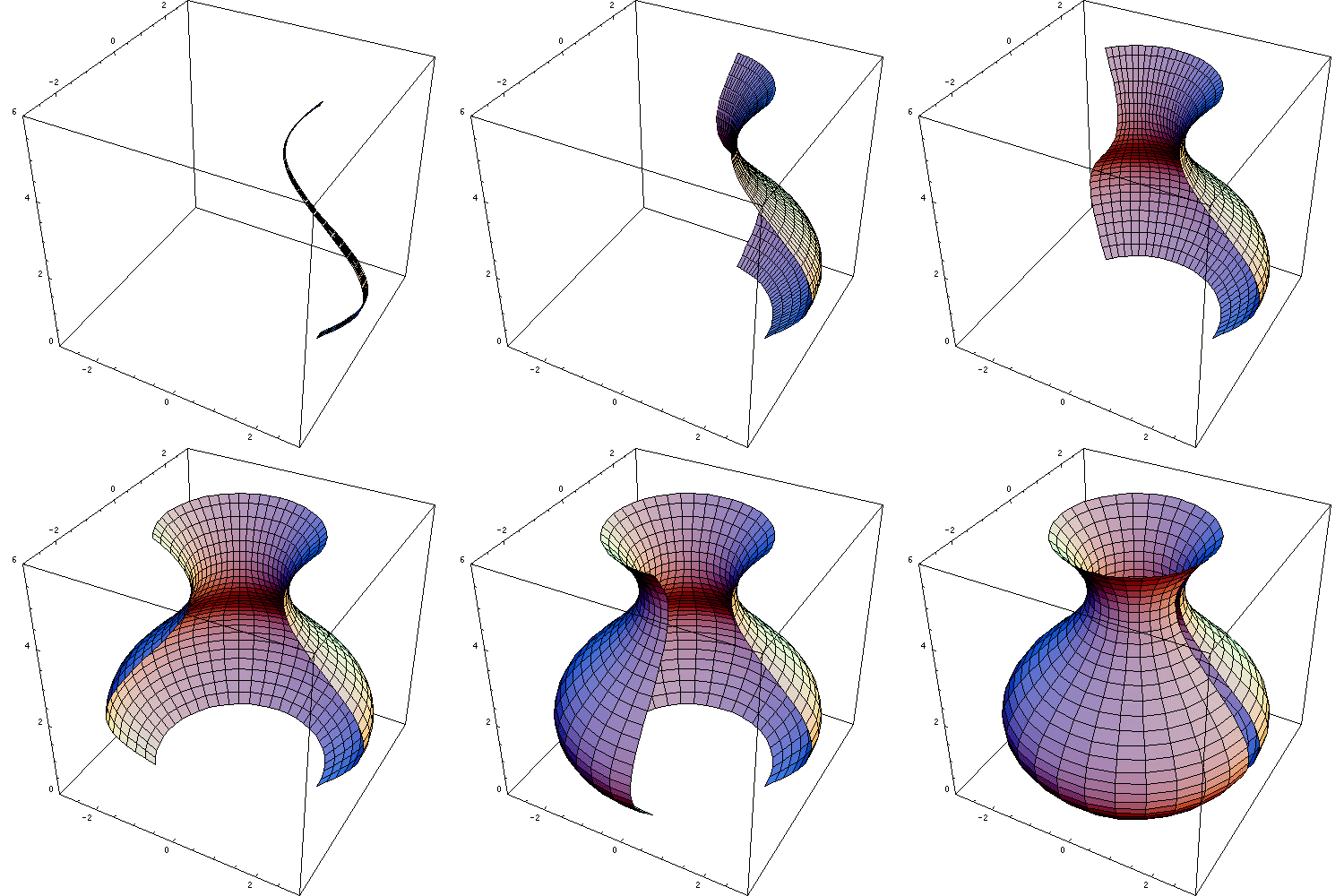
In mathematics, engineering, and manufacturing, a solid of revolution is a solid figure obtained by rotating a plane curve around some straight line (the axis of revolution) that lies on the same plane.
Assuming that the curve does not cross the axis, the solid's volume is equal to the length of the circle described by the figure's centroid mult...

 alpine sable
Hey guys, having a bit of trouble with this problem:
Find the equation of the tanget line to y = x^3 - 3x at x = 2.
Watching a video on it and I don't understand this one step.

Wouldn't it be (2 + h)^3 - 3(2 + h)? where did they get the end part from?
tawny condor
why are you using limits?
Are you allowed to differentiate normally?
if not,
then
the (2 + h)^3 - 3(2 + h) is like x^3 - 3x but u put in 2+h instead of x
thats f(2+h)
then they subtract f(2), which is 2^3 - 3 * 2
alpine sable
oh so its for the entire thing! got it, thanks
alpine sable
tawny condor
why are you using limits?
just following a tutorial currently
@alpine sable by definition, $f'(x_0) = lim_{h \to 0} \frac{f(x_0+h )-f(x_0)}{h}$
ocean sealBOT
magnos
 tawny condor
np
alpine sable

 harsh acorn
Simplify the expression, leaving your answer in its factorised form. 2(2x – y)² – 6x(2x – y)
can someone tell me how I can work this out?
arctic wren
Whats is the derivative of this function? The answer on my book is (e^x)(3x²+x-5) but my result is (e^x)(3x²+11x+5)
 glass lichen
$f'(x)=e^x(6x+5)+(3x^2+5x)e^x$
ocean sealBOT
Mosh
 glass lichen
your answer is correct.

 keen surge
how do i solve this?
105 = 25m + 9c + 16s
sleek elbow
keen surge
how do i solve this?
105 = 25m + 9c + 16s
what do you want to solve for?
keen surge
ok, so in order to solve for all 3, i need to solve 3 times?
sleek elbow
Im not sure you can
keen surge
?
keen surge
mm, lemme give a word problem, this was my attempt in coming up with an equation to solve
sleek elbow
keen surge
mm, lemme give a word problem, this was my attempt in coming up with an equation...
we have a case of https://xyproblem.info
Asking about your attempted solution rather than your actual problem
keen surge
was hoping it would help, but if not nw ill bounce
sleek elbow
keen surge
was hoping it would help, but if not nw ill bounce
add the original qquestion, might help
 noble sinew
What? 3380000 is what? And where does 105000000 come from? (It isn’t 3380000 * 5 * 6)
And right below you say they make another amount
keen surge
yes, thats where the 105 comes from
ocean sealBOT
Result:
1.014e+8
Notice that isn’t your number
keen surge
noble sinew
They aren’t equal
wdym
noble sinew
ocean seal
Result:
```
1.014e+8
```
.
noble sinew
noble sinew
And right below you say they make another amount
And why do you say a new amount just below?
keen surge
platinum is being converted into the other number
noble sinew
Instead post original question wording instead of this
noble sinew
noble sinew
What? 3380000 is what? And where does 105000000 come from? (It isn’t 3380000 * 5...
What?
keen surge
ah nw, i think since i wrote out the word problem myself i can probably solve now
thanks for the help!
idk how to close the channel if thats a thing here
noble sinew
The other thing still applies
keen surge
?
noble sinew
,w 338000065
ocean sealBOT

 Requested by ScapeProf#9427
noble sinew
Requested by ScapeProf#9427
noble sinew
Notice that isn’t 105,000,000
keen surge
o right, 😕 mb
this isnt in a book or anything, its a real world problem
but ye, ill just calc for the hour
instead of trying to calc for the whole thing at once
thanks 😄
mm, i lie, my math isnt good enough
18,200,000 = 25m + 9c = 16s
finding the lcd and solving for m [3600 is the lcd for 25, 9 and 16, and multiplying by 144 got me the next line], m, c and s being arbitrary
2,620,800,000 = 3600m + 153c + 2304s
 past minnow
Piper Nakamura Mawji
glass lichen
past minnow
Piper Nakamura Mawji
if you're not going to ask a question, dont type in the help channels. #❓how-to-get-help
past minnow
Did you get the job
glass lichen
again, only use the help channels if you have a math/math-related question
past minnow
Did you?
glass lichen
past minnow
Did you?
#❓how-to-get-help , this is a help channel.
If you are not going to follow the rules of the server, then stop typing.
glass lichen
Again, this is a help channel either use it properly or leave
 glass lichen
Yeah 
glass lichen
And can confirm they should be banned in ModMail / dms
past minnow
OH GOD NO
I AM GOING TO BE BANNED FROM THE MATHEMATICS DISCORD SERVER?!
WHAT WILL I DO
MY WORLD IS ENDING
 quaint trout
Hopefully look at yourself and the mirror and reflect on what your life is
past minnow
MY LIFE IS NOTHING WITHOUT THE MATHEMATICS DISCORD SERVER
PLEASE DONT BAN ME!
I WANT TO ROLEPLAY ON MINECRAFT WITH MOSH
 candid torrent
past minnow
I WANT TO ROLEPLAY ON MINECRAFT WITH MOSH
candid torrent
past minnow
I WANT TO ROLEPLAY ON MINECRAFT WITH MOSH
hi
why'd you guys ban them
they seems like a cool guy
👍
glass lichen
candid torrent
why'd you guys ban them
Not of your concern.
glass lichen
k

 mossy lion
we cant do it for you
do you mean you need help doing it or are you just looking for a calculator
 mossy lion
lmfao wtf. just read the conversation
mossy lion
alright is this a hw question?
warped phoenix
candid torrent
sure
We can move to a different channel
mossy lion
alright do you have your notes on polynomial long division? the textbook can help too
candid torrent
warped phoenix
We can move to a different channel
sure whcih one
warped phoenix
1 is free i think
mossy lion
warped phoenix
We can move to a different channel
thats very courteous of you. thanks
warped phoenix
ofc! ❤️
glass lichen
<@&268886789983436800> same person as Gombo
 tall wing

how do we know this is gombo again?
i mean i guess
"don't ban me again"
is obvious
but
glass lichen
they're saying the exact same stuff
 violet hemlock
Ty
 random talon
How would you prove the following limit? $lim_{m,n\rightarrow\infty}\frac{(-1)^n}{(-2)^m}=0$
ocean sealBOT
econguy

 glacial hedge
random talon
How would you prove the following limit? $lim_{m,n\rightarrow\infty}\frac{(-1)^n...
glacial hedge
random talon
How would you prove the following limit? $lim_{m,n\rightarrow\infty}\frac{(-1)^n...
set x = m= n;
because they both approach infinity
or wait
u mean like formal proof?
random talon
Formal proof. Epsilon style proof
glacial hedge
😦
glass lichen
F
glacial hedge
uno seconda
glass lichen
that's an F
glacial hedge
yo thats lame who would make u do that
for
epsilon > 0 and delta >0
$ 0 < \sqrt {(x-a)^2+(y-b)^2} < delta$
uh
$0 < \sqrt {(x-a)^2+(y-b)^2} < delta$
ocean sealBOT
Elonmosqito96
 glass lichen
\delta
 slow monolith
have a question
can yall help?

i need a run diwn on how to solve this and simplify
mossy lion
?
glacial hedge
then:
$|(-1)^n/(-2)^m-0|<\epsilon$
ocean sealBOT
Elonmosqito96
 slow monolith
run down
 sterile escarp
 glacial hedge
dafuq people stop spamming
slow monolith
pls i just need help man
mossy lion
jesus this is a mess
- Before asking a question, make sure that the channel you are using is not currently in use. An occupied channel would generally have an ongoing discussion or a trailing unanswered question. Likewise, when you are done using a channel, make this clear so that it's open for others to use.
afaik @zinc oar was here first but idk if they actually want to go through their problem or not
 solar tapir
Is this channel available?
slow monolith
can somone help me in channel one
mossy lion
solar tapir
Is this channel available?
no. there are like 3 people trying to ask questions at the same time lmao
glacial hedge
solar tapir
Is this channel available?
sorta being used rn
solar tapir
Sorry, will go to another
random talon
ocean seal
**Elonmosqito96**
Okay, so why this then?
glacial hedge
random talon
Okay, so why this then?
yikes man
im not very fluent with epsioln delta proofs in multi var case
😩
random talon
Haha neither am I. It’s kinda crazy. Otherwise any other kind of approach, I guess I can work with that
I used Matlab to kinda check if this was true, but that’s it
glacial hedge
were u not paying attention.....
this channel is sorta being used...
he asked way before u
glacial hedge
random talon
I used Matlab to kinda check if this was true, but that’s it
yeah man... u cant really use the like formal way because u cant plug in a and b in $ 0 < \sqrt {(x-a)^2 +(y-b)^2} < \delta$ because they are inf
$0 < \sqrt {(x-a)^2 +(y-b)^2} < \delta$
ocean sealBOT
Elonmosqito96
 mossy lion
yeah that looks great
mossy lion
glacial hedge
he asked way before u
actually it looks like aral was first
random talon
Thanks man, at least I don't feel dumb for not knowing how to do it @glacial hedge . Good to hear a second opinion
 mossy lion
ye that was the result
mossy lion
youre good
glacial hedge
i thought that was what he was dividing
 jagged pendant
what should i use for latex code inside of html for ease?
glacial hedge
um
jagged pendant
is there not a good browser extension or something?
glacial hedge
probably mathjax
jagged pendant
seems a lot of junk software out there
glacial hedge
mathjax is pretty well trusted and pretty good too
jagged pendant
i forgot i had that already lol
glacial hedge
not sure what that means but ok xD
 strong citrus
Twenty bored students take turns walking down a hall that con-
tains a row of closed lockers, numbered 1 to 20. The first student opens all the
lockers; the second student closes all the lockers numbered 2, 4, 6, 8, 10, 12, 14,
16, 18, 20; the third student operates on the lockers numbered 3, 6, 9, 12, 15, 18:
if a locker was closed, he opens it, and if a locker was open, he closes it; and so
on. For the ith student, he works on the lockers numbered by multiples of i: if a
locker was closed, he opens it, and if a locker was open, he closes it. What is the
number of the lockers that remain open after all the students finish their walks?
glacial hedge
strong citrus
Twenty bored students take turns walking down a hall that con-
tains a row of c...
draw a picture
alpine sable
alpine sable
<@456226577798135808> by definition, $f'(x_0) = lim_{h \to 0} \frac{f(x_0+h )-f(...
why is it as h approaches 0 again?
glass lichen
alpine sable
why is it as h approaches 0 again?
h is the distance b/w the 2 points you base the secant off
 obsidian juniper
 glass lichen
so to get the tangent you make the points get closer and closer
alpine sable
glass lichen
h is the distance b/w the 2 points you base the secant off
right right, its the run in rise/run i believe? so as it approaches 0.. it means, yeah, they get closer and closer (the points)
glass lichen
yes, h is the run
alpine sable
glass lichen
so to get the tangent you make the points get closer and closer
the slope of the tangent right?
glass lichen
yes
glacial hedge
random talon
Thanks man, at least I don't feel dumb for not knowing how to do it <@!624408029...
WaIt
I just had a flash of brilliance
the abs in the proof
removes the -'s
so
(-1)^n
doesn't affect the thing
so its really
1/2^m
which can be proven using single var stuff
random talon
Well, but holding m=1 and allowing n to vary we would have something (1/2 -1/2 1/2 -1/2...) so it diverges
But my apologies, what I want to prove is $\lim_{m,n\to\infty}\frac{(-2)^n}{(-3)^m}=0$
ocean sealBOT
econguy
 alpine sable
@glass lichen what does it mean when youre given a function and not 2 points? youre still trying to find the slope of the tangent line (the tangent line in this case is f(x) = 1/x right?), just without the 2 points?
 glass lichen
You have 2 points
(x,f(x)) and (x+h,f(x+h))
those are always the 2 points, which you can get by reading first principles
alpine sable
oh, it all clicked now. thanks
 full wasp
are all countably infinite sets numerically equivalent??
mossy lion
full wasp
are all countably infinite sets numerically equivalent??
i think the idea is that you can find a 1:1 correspondence but someone can correct me
 tired hamlet
How would I start this one?

 marble comet
P = principal amount
(20,000)
e I believe refers to Euler's natural number
r = rate which we have to find
A = 43,957.90
t = 15 years
tired hamlet
Yeah
marble comet
aight then rearrange the equation in terms of r
tired hamlet
How would I do that?
tired hamlet
Yeah
marble comet
great
so once u divide A/P
u get around 2.198 = e^(15r)
now take the log base e of each side
on the right side, according to the inverse property of logarithms u get 15r
and on the left side u get log base e of 2.198
so log _ e (2.198) = 15r
on a calculator, u input (log 2.198)/(log e)
u get .787547 so on
divide that by 15
and u get .0525 around
so 5.25 percent is the answer
tired hamlet
Thx so much
 acoustic bay
Can someone who knows R help me find the correlation values for my data set?
I have over 90 columns, I want to test the correlation between all of these variables against one other variable which is already contained in the 90.
This is what I have so far
for(col in 1:ncol(longitudinalbl)){
myCortest = cor.test((longitudinalbl)[col], IDE.BL$SSI_worst, na.action=TRUE, method = "sp")
myCortest$estimate
}
ocean sealBOT
kevinFDG
 alpine sable
Can someone give me a good math problem? (Of any topic)
 sullen karma
acoustic bay
sullen karma
acoustic bay
the one above, i was asking about how I can find the correlation values in R for my dataset. i posted the code I have so far above
 ocean sealBOT
Travelling Salesman
 acoustic bay
@rich basin you have to ask in a channel where someone hasnt asked a question, I just posted above.
acoustic bay
Your good, I dont think anyones gonna answer mine anyway so you can have it actually.
rich basin
Thanks
 tough hedge
where can i post my question?
rich basin
You can post on question 1
tough hedge
okay thanks!
rich basin
<@&286206848099549185>
 indigo storm


 hasty narwhal
I'm sorry. I didn't realise
ocean sealBOT
 Requested by Travelling Salesman#4998
rich basin
Requested by Travelling Salesman#4998
rich basin
,w solve 81/127
ocean sealBOT
 Requested by Travelling Salesman#4998
rich basin
Requested by Travelling Salesman#4998
rich basin
,w solve (8 choose 4) / ((2^8)/2-2)
ocean sealBOT
 Requested by Travelling Salesman#4998
 coral pagoda
Why the -2?
rich basin
,w solve ((10 permutate 6) + (10 permutate 5) + (10 permutate4) + (10 permutate 3) + (10 permutate 2) + (10 permutate 1))/ (15 permutate 6)
rich basin
coral pagoda
Why the -2?
@coral pagoda So this is all the combination minus the combination when one person hold all of it
ocean sealBOT
 Requested by Travelling Salesman#4998