#help-0
1 messages · Page 683 of 1
 covert breach
 mossy lion
yeah exactly its just sin(pi/6)
mossy lion
use the unit circle/special triangles
covert breach
i gotta remember the trig table too now 😩
so much shit to memorize
and when u go to a job, if u ever need this (probably wont, but if u do), u will use a computer/calculator 😂
sin(60)?
whatever that is
1/2 i think
 warped flower
yes so sin(x) = sin(pi-x)=cos(pi/2 -x)
covert breach
what?
warped flower
use all these to get the answer i guess
covert breach
didnt get u
lol
it takes long to find it, but at least i know how to find it now
covert breach
i dont wanna remember all the rules tho
warped flower
no x-2pi will give u a negative answer
covert breach
mossy lion
sin(pi/6) is a well known value
yeah but i dont memorize all this shit 😂
i use a formula booklet
warped flower
becasue sin is an odd fxn
covert breach
used to, at least
mossy lion
covert breach
yeah but i dont memorize all this shit 😂
i mean i dont know what to tell you then
mossy lion
im telling you how to solve it
covert breach
yeah thnx man
warped flower
covert breach
bro when the fuck will i ever use trig anyways
if ur going into civil eng i guess lol
covert breach
basically, i gotta memorize the trig table and the double angle/half angle rules
covert breach
warped flower
if ur going into civil eng i guess lol
im not tho 😂
thats the thing
lol
warped flower
its actually pretty useful for buildings and measurements and vectors
covert breach
why do u think i havent done, and wont be doing any trig for the next couple years? 😂
the only time i did do trig was for complex numbers
but it didnt need half angle rules and shit
warped flower
what are u doing now
covert breach
😂
warped flower
i mean ok then
mossy lion
covert breach
the only time i did do trig was for complex numbers
thats because trig is secretly all just complex numbers 👀
covert breach
mossy lion
thats because trig is secretly all just complex numbers 👀
opposite i think, but eh
warped flower
covert breach
that was too good of an opportunity to pass up
so was ur mom
covert breach
same shit more or less
 sleek elbow
mossy lion
thats because trig is secretly all just complex numbers 👀
sleek elbow
mossy lion
thats because trig is secretly all just complex numbers 👀
 dont you scare me, just started trig in school
covert breach
warped flower
so was ur mom
hah nice one
warped flower
yea but rs tho
covert breach
sleek elbow
<:monkagiga:651816911964995584> dont you scare me, just started trig in school
bro complex numbers + trig is 💀
warped flower
are u in school or uni
covert breach
add mathematical induction on top
warped flower
ahh
mossy lion
trig professors are lying to you and not telling you the easy way to do stuff (eulers formula)
warped flower
yea u dont need trig at all lmaoo
covert breach
warped flower
yea u dont need trig at all lmaoo
yeah 
covert breach
mossy lion
trig professors are lying to you and not telling you the easy way to do stuff (e...
hmm
no clue what that means
sleek elbow
we had tangent and my teacher just told us that the calculator knows all the pairs of the 2 triangle sides :/ I wanna know what tan actually does
like the function
covert breach
warped flower
yea u dont need trig at all lmaoo
i havent done trig in years
warped flower
makes sense dawg
covert breach

this could help
the lines AC and BC are tangent
which is why at 90*, the lines wouldnt intersect
 mossy lion
covert breach
no clue what that means
mossy lion
covert breach
no clue what that means
eulers formula simplifies pretty much everything in trig but in trig/precalc classes they give it a different name and basically pretend it doesnt exist or tell you whats really going on. then its an optional topic that people taking calc 2 arent even guaranteed to learn.
covert breach
tan is tangent to the circle (slope of the circle at that point)
covert breach
mossy lion
eulers formula simplifies pretty much everything in trig but in trig/precalc cla...
whats eulers formula?
he has many
which one u talkin?
e^ipi -1 = 0?
mossy lion
$e^{ix}=\cos(x)+i\sin(x)$
 ocean sealBOT
nix (@ me for the love of euler)
 covert breach
i have no clue about this one
oh ok
i know this one
yeah we had this
it was 💀
none of us could solve this 😂

and one of the students actually went to cambridge
still couldnt solve
mossy lion
thats a cool question
mossy lion
did people have trouble just with part a or what
mossy lion
going to try it now but from a glance it looks like just the geometric series/taking the real part of stuff.
covert breach
anyways, im glad i dont have to do much trig other than the occasional numerical analysis
warped flower
covert breach
none of us could solve this 😂
this looks like a GP
covert breach
warped flower
this looks like a GP
it is a gp
ofc
i think some of us got a few marks for simplifying it to that
but couldnt actually solve it
warped flower
true i mean im in uni too
covert breach
but none of us were able to
warped flower
elec eng
covert breach
when we did it in 11th
warped flower
true must be hard for 11th
covert breach
how do i solve this?

how do i come up with this -8 lol
oh wait, i think i got it
this problems fucked
bruh this ones hella fucked
why cant u just use log rule to take 2log_5(x+3) = 2?
and then log_5(x+3) = 1
warped flower
yea u can i think
mossy lion
covert breach
none of us could solve this 😂
just finished it and yeah its what i thought. just taking the real part
covert breach
warped flower
yea u can i think
that would give only one solution
covert breach
mossy lion
just finished it and yeah its what i thought. just taking the real part
u proved it?
mossy lion
yeah
covert breach
using mathematical induction?
mossy lion
induction what why
covert breach
i mean
mossy lion
its just algebra
covert breach
thats how the markscheme prooves it afaik
warped flower
instead do log(x+3)^2 = log(5) *2
mossy lion
 its just taking the real part. which becomes what they give when simplified
covert breach
covert breach
how do i solve this?
why is my method wrong?
covert breach
warped flower
instead do log(x+3)^2 = log(5) *2
what?
covert breach
covert breach
why cant u just use log rule to take 2log_5(x+3) = 2?
why cant u just do this?
sleek elbow
covert breach
Hmm so what does taking the tan of the far side divided by the close side mean, like lets say the far side is 7 units long and the close side is 2 units long. You would take tan(3.5), but what does tan() do to the 3.5 to find out the angle alpha?
covert breach
warped flower
I mean U can but youll get 1 answer with this I think
yeah u only get 1
mossy lion
covert breach
why cant u just do this?
youre applying the rule outside the log
covert breach
so why is that incorrect?
covert breach
mossy lion
youre applying the rule outside the log
?
covert breach
sleek elbow
Hmm so what does taking the tan of the far side divided by the close side mean, ...
whats far and close side?
mossy lion
if it was log(log5(x_3)^2) youd be right
 wraith cairn
covert breach
why cant u just do this?
wraith cairn
covert breach
why cant u just do this?
All the solutions for 2log_5(x+3)=2 is in the solutions for log_5(x+3)^2=2, but not all the solutions in log_5(x+3)^2=2 is in 2log_5(x+3)=2
similar to all solutions for x=5 is in x^2 = 25, but not all solutions for x^2=25 is in x=5
sleek elbow
mossy lion
if it was log(log5(x_3)^2) youd be right
I didnt know the translation
 covert breach
yeah but like why the fuck is that applying in logs?
wraith cairn
because log_5(-5)^2 = 2 and log_5(5)^2 = 2
covert breach
sleek elbow
I didnt know the translation
forget those, just think of the alpha and the hypotenuse intersecting the circle, then u can draw a tangent (slope) of the circle at that point
thats your tan
covert breach
wraith cairn
because log_5(-5)^2 = 2 and log_5(5)^2 = 2
this is fucked up shit man..
wraith cairn
why?
covert breach
these trick questions
covert breach
wraith cairn
why?
cuz if they ask something like this, ill probably fuck it up
mossy lion
is the squared inside the log or not
covert breach
covert breach
how do i solve this?
bro its this
mossy lion
because if its log5((x+3)^2) you can do 2log5((x+3))
covert breach
mossy lion
because if its log5((x+3)^2) you can do 2log5((x+3))
yeah its probably that
mossy lion
covert breach
bro its this
their parentheses are unclear
covert breach
but it only gives one solution
covert breach
mossy lion
their parentheses are unclear
not really
its pretty clear
anyways thnx
ill do another test
mossy lion
$\log_5(x+3)^2$ looks like $\left(\log_5(x+3)\right)^2$
ocean sealBOT
nix (@ me for the love of euler)
 covert breach
and lower my motivation even further with another bad grade
covert breach
ocean seal
**nix (@ me for the love of euler)**
not really, but ok
wraith cairn
no it doesn't
mossy lion
if its $\log_5\left((x+3)^2\right)$ they should write that
ocean sealBOT
nix (@ me for the love of euler)
 wraith cairn
they do not need to write that
mossy lion
its ambiguous
sleek elbow
covert breach
forget those, just think of the alpha and the hypotenuse intersecting the circle...
okay but like, I draw this circle, draw the tangent, but how do I get the angle alpha? Like where does that come from
covert breach
cos (x+3)^2 = cos ((x+3)^2)
covert breach
mossy lion
its ambiguous
nop
cuz any one thing after the function is considered as the input of the function
mossy lion


wraith cairn
ask anyone in the server.
it is a convention.
you absolutely do not need brackets.
also you can't just move down the 2 using the log rule because you'll miss a solution.
covert breach
mossy lion
because if its log5((x+3)^2) you can do 2log5((x+3))
btw, its not even that
mossy lion
its not clear if $\log_5(x+3)^2$ means $\left(\log_5(x+3)\right)^2$ or $\log_5\left((x+3)^2\right)$
ocean sealBOT
nix (@ me for the love of euler)
 covert breach
its (log_5(x+3))^2
mossy lion
then they should write that
covert breach
its obvious tbh
mossy lion
it could be either or
covert breach
based on conventions
mossy lion
$\sin x^2$ is equally ambiguous
covert breach
like consider x+3 to be z
ocean sealBOT
nix (@ me for the love of euler)
 mossy lion
there should be no room for mistaking it. if its possible to mistake it then its written poorly
covert breach
ok now im confused
ill move on
but i made a whole program on this (shunting yard algorithm)
and that was fun
as i said, now im myself confused mate
covert breach
wraith cairn
it's written like that everywhere else.
i think this guy is right but now im confused
so ill let it go
and move on
lol
wraith cairn
nix why don't you ask anyone else in the server.
covert breach
ok so these two arent equal
 mossy lion
wraith cairn
nix why don't you ask anyone else in the server.
mossy lion
wraith cairn
nix why don't you ask anyone else in the server.
im not going to ping someone for something so ridiculous. thats just rude
and against the rules im pretty sure
sleek elbow
covert breach
forget those, just think of the alpha and the hypotenuse intersecting the circle...
okay but like, I draw this circle, draw the tangent, but how do I get the angle alpha? Like where does that come from?


 covert breach
sleek elbow
whats that website btw?
covert breach
sleek elbow
whats that website btw?
desmos
sleek elbow
is that free?
covert breach
yes
mossy lion
well thats fine but i dont see how the way a website is programmed means anything to a conversation about humans mistaking the meaning when there is a lack of parentheses
covert breach
sleek elbow
okay but like, I draw this circle, draw the tangent, but how do I get the angle ...
thats your theta/alpha
your degrees/radians
u chose it
its the input
based on that, u get the lengths of the sides/tangent
sin of the angle is the height of the triangle, cos of the angle is the base
sleek elbow
wait I dont want the lengths, I want to go from the lengths to the angle
covert breach
mossy lion
well thats fine but i dont see how the way a website is programmed means anythin...
cuz the website follows order of operations
whether implicit or explicit ones
btw 2^-2 would also be just 2^- * 2
but u have implicit parenthesis added by each program
so it becomes 2^(-2)
its the same here
or similar, at least
covert breach
sleek elbow
wait I dont want the lengths, I want to go from the lengths to the angle
u use inverse trig functions
sleek elbow
covert breach
u use inverse trig functions
oh so I was confusing the two 😄
covert breach
sin^-1(x) or arcsin(x)
covert breach
sleek elbow
oh so I was confusing the two 😄
hmm
so if sinx = 1/2
x = 60*
(i think)
sleek elbow
I dont even know about sin and cos yet, so ye
covert breach
sleek elbow
I dont even know about sin and cos yet, so ye
they taught u tan before sin and cos?
sleek elbow
covert breach
they taught u tan before sin and cos?
yup
I was kinda confused as I thought sin was the most well known, but I figured well known doesnt mean best to learn first
covert breach
sleek elbow
I was kinda confused as I thought sin was the most well known, but I figured wel...
it is best to learn them first tbh
they are the most useful too
mossy lion
im not going to debate it anymore. the fact is that its ambiguous. i dont really care if youre okay with assuming where parentheses are supposed to be. im not because i think problems should have no room for confusion.
covert breach
mossy lion
im not going to debate it anymore. the fact is that its ambiguous. i dont really...
its not
sleek elbow
stop guys 😄
covert breach
but it doesnt matter
sleek elbow
its fine
covert breach
@mossy lion
 mossy lion
yeah there you go. theyre assuming the square is not on the inside. that was my position from the beginning
covert breach
its all the same thing log(x+3)^2 = log^2(x+3) = (log(x+3))^2
covert breach
mossy lion
yeah there you go. theyre assuming the square is not on the inside. that was my ...
ok lets drop it, imma go study other stuff
but this question was fucked
how do i solve this? (practice test btw)

not an actual test
who knows lol
dont think it would be a
cuz how would denom go to numer
wraith cairn
To rationalize the denominator. You have to multiply by 2^(3/4)/2^(3/4)
right now, you have a 2^(1/4) in your denominator.
wraith cairn
covert breach
how do i solve this?
Also, I want to clarify on the log((x+3)^2) = 2.
To apply the log rule, you need to prove it.
for log(a^n), let a = 10^k so log(a^n) = log(a^(kn)) = kn = nloga
But as you can see in this proof, we assumed a = 10^k so the proof does not hold when a is 0 or negative.
Using the log rule will only find you the solution when x+3 is positive
So you can't apply the log rule to that question and expect to find all the solutions
covert breach
bro with the log stuff im utterly confused between everything u said and nix said and shit
wraith cairn
Some conventions are different from others. log_5(x+3)^2 almost 100% meant log_5((x+3)^2) because that's the only way it gives nice solutions, but it's best to use brackets.
 lunar zenith
Imagine a random number generator
between 1-15 numbers
run it 15 times
if 3 or more numbers are between 1-5 than you win
what are the odds of winning?
duplicate numbers allowed ofc
wraith cairn
You would need 13 cases (probably)
 jagged imp
if thats all the case, the number of numbers between 1 and 5 in 15 trials is binomially distributed with p=1/3 and n=15
so you can use a calculator to do P(#ofnumbers between 1 and 3>=3) or do it by hand if you like suffering
covert breach
wraith cairn
Some conventions are different from others. log_5(x+3)^2 almost 100% meant log_5...
i thought it means (log_5(x+3))^2
wraith cairn
in this context, it means log_5((x+3)^2)
covert breach
wait lemme check on desmos and wolfram one last time
wraith cairn
wolfram alpha treats it like (log_5(x+3))^2
covert breach
so does desmos
wraith cairn
your teacher's notation is ambiguous to some people and most computers, but to solve the problem, just treat it as log_5((x+3)^2)
covert breach
wraith cairn
your teacher's notation is ambiguous to some people and most computers, but to s...
its not our teacher
u were saying its not ambiguous
wraith cairn
I was wrong. It is ambiguous to some people.
 wraith cairn
I was familiar with the convention logx^2 = log(x^2), because that's the way I've seen it.
covert breach
cuz none of the sites keep log (x+3)^2 = log ((x+3)^2)
wraith cairn
yes, but you'll have to do it that way because that's what your teacher meant.
covert breach
teachers an idiot
afai can tell, its not ambiguous at all, teachers just an idiot
unless thats not how u solve it
yeah nvm teacher is just an idiot
this is the answer

btw this is an entrance test, so not really homework or anything
(as u can imagine, we dont have trig being taught in comp sci  )
)
 remote heron
we cant help on tests 👀
remote heron
o idk what entrance exam means
remote heron
gib what

 covert breach
how would i solve stuff like this?

 tough hatch
very sus
covert breach
rationalizing the denominator didnt quite work
covert breach
tough hatch
`btw this is an entrance test` <:hmmCat:831508801646755850>
bruh
 jagged hemlock
show ur work
covert breach
covert breach
how do i solve this? (practice test btw)
look here
take a photo? the handwriting is shit tho
covert breach
jhust tried rationalising the denom
tough hatch
the fact that u added not an actual test after saying it's a practical test is sus 
covert breach
multiply by conjugate
jagged hemlock
yea
covert breach
tough hatch
the fact that u added `not an actual test` after saying it's a practical test is...
ok man
u keep sussing
jagged hemlock
what did you get
covert breach
tough hatch
the fact that u added `not an actual test` after saying it's a practical test is...
a test would last 3 hours + huh?
jagged hemlock
how did gou get 31 for denominator?
covert breach
and id be playing rocket league mid test too? I assume?
jagged hemlock
ok im not helping
jagged hemlock
it isnt 6
 placid zinc
Rationalizing the denominator should work
jagged hemlock
show your work again
covert breach
13?
placid zinc
I don't know how you got √5 when the question contains √3
jagged hemlock
show picture
covert breach
mb
covert breach
jagged hemlock
show picture
ok sec
 lusty pewter
A rectangular sandpit is shown on a map that has a scale of 1:100. On the map the sandpit has an area
of 20 cm2. What is its actual area?
jagged hemlock
gou scale it
lusty pewter
can i please have some help
jagged hemlock
yea what did you attempt
tough hatch
lusty pewter
A rectangular sandpit is shown on a map that has a scale of 1:100. On the map th...
channel is busy lol
lusty pewter
oh sorry
jagged hemlock
i dont mind
covert breach

this is what i did
i messed up when squaring 2 root(3)
anyways, thnx for the help
u can ask ur stuff @lusty pewter
tough hatch
why did u distribute 13?
covert breach
tough hatch
why did u distribute 13?
wdym by that?
covert breach
yeah yeah i got it
tough hatch
don't
lusty pewter
can i ask my question now ?
covert breach
yeah
lusty pewter
thans
thanks*
A rectangular sandpit is shown on a map that has a scale of 1:100. On the map the sandpit has an area
of 20 cm2. What is its actual area?
tough hatch
sure, just be sure no one else is busy getting their own answered first next time
lusty pewter
ok alr
tough hatch
the scale is meant to size things down to their respective sizes on the map
emphasis on down
lusty pewter
ok
tough hatch
so if u want to find the actual area
lusty pewter
oh do you times by 100
covert breach
lusty pewter
oh do you times by 100
yeah
tough hatch
i.e. scaling up
tough hatch
it could be
lusty pewter
or 10m x 2m
covert breach
basically x/100 = 20
tough hatch
but why does it matter lmao
lusty pewter
oh wait yeah it doesnt matter
tough hatch
u only need the area
lusty pewter
so its 20m^2?
tough hatch
sure
 halcyon nova
 remote heron
,rotate 1
ocean sealBOT
Retrieving the previous image failed.
remote heron
doesnt load
lusty pewter
can i haves some help with a question?/
 vague coral

 drifting scarab
Do I ask for help here? I need help with a few Calculus Homework questions.
vague coral

drifting scarab
Here?
vague coral

drifting scarab
I need to find the Antiderivative of (2x+3)^3

I tried doing it on the bottom half
vague coral
multiply the (2x+3)^3 by 2/2 before
You need this form : u'u^3 to get the antiderivative : 1/4 (u)^4
drifting scarab
@vague coral Would it be this?
 lusty pewter
a / K − y = b / K
[K]
can u help me isolate K
lusty pewter
@vague coral can i have some help with
a / K − y = b / K
[K]
can u help me isolate K
vague coral
lusty pewter
<@!411882877933060109> can i have some help with
stop spamming
lusty pewter
😦
vague coral
drifting scarab
<@!411882877933060109> Would it be this?
$f(x) = (2x+3)^3$
Let $u = 2x+3$, then $u' = 2$. We can multiply $f(x)$ by $\frac{2}{2}=1}$. We just want this form : $u'u^3$ to get the antiderivative in this form : $\frac{1}{4} u^4$
Then $f(x) = \frac{2]{2} u^3$. So The antiderivative $F(x)=\frac{1}{8} (2x+3)^4$
drifting scarab
vague coral
$f(x) = (2x+3)^3$
Let $u = 2x+3$, then $u' = 2$. We can multiply $f(x)$ by $\fra...
Oh thank you!!!
Btw I dont want to be spammy, but I have another question
Would this be an intergral?
 vague coral
the antiderivative
drifting scarab
Thank YOU! Herels!
Is this the formula I have to use? for this problem?
@vague coral

 leaden seal
Find the volume of the solid formed by revolving the region bounded by y = sin x, y = cos x, x = 0, and x = π
about the y-axis. Be sure to sketch the region first.
how do you solve this?
 heady gull
If theres a 0.1% chance of getting one thing and a 0.5% chance of getting another thing, whats the chance of getting both items at once.
 glacial hedge
Does anyone know why $F_n$ means 2 different thigns in physics and math? what monster is responsible for the naming?
ocean sealBOT
Elonmosqito96

 strong furnace
glacial hedge
Does anyone know why $F_n$ means 2 different thigns in physics and math? what mo...
strong furnace
glacial hedge
Does anyone know why $F_n$ means 2 different thigns in physics and math? what mo...
F_n without context does not mean anything to me -.-
glacial hedge
strong furnace
F_n without context does not mean anything to me -.-
F_n is partial derivative with respect to n in math and normal force in physics
strong furnace
both require context
glacial hedge
?
 muted pelican
what changes if 3 balls are selected
 jagged hemlock
wdym
muted pelican
the total number of possibilities are 14C3 rite
 ruby current
well for (i) you can do 1 - P(no red balls)
 merry willow
hi guys, how do you read this? probability of 3 intersect odd?
 muted pelican
o so we can do 1 - 11/14 ?
merry willow
merry willow
hi guys, how do you read this? probability of 3 intersect odd?
from throwing a dice
ruby current
P(no red balls) is not 11/14, you have to run through the choices at each step
when picking the first ball it's 11/14
then you have to multiply by 10/13
and then 9/12 for the last ball
to guarantee that you have three non-red balls
muted pelican
ah makes sense
ruby current
so just subtract from 1
muted pelican
muted pelican
what changes if 3 balls are selected
for the 2nd one
the total balls are now 13
so we can do 11/13*10/12 ?
ruby current
did you learn about bayes' theorem?
muted pelican
not yet
ruby current
i dont think you can do that
because it doesnt say that the first ball selected is red
only that one ball selected is red
P(at least 1 green | at least 1 red) = P(at least 1 green and at least 1 red) / P (at least 1 red)
this is the definition of conditional probability
muted pelican
what does that | mean
ruby current
you can just read it as "given"
so probability of at least 1 green given at least 1 red
muted pelican
alright
ruby current
you calculated the denominator in the first part
muted pelican
the P of at least 1 red ball is in the first answer previously yeah?
muted pelican
so the P of at least 1 green ball is 1 - 11/14 x 10/13 x 9/12 x 8/11 x 7/10
ruby current
should just be three fractions there, no?
probability of at least 1 green is 1 - 9/14 * 8/13 * 7/12
9/14 for the first non green ball and so on
muted pelican
oh
oh yeah 3 multiplicands bc only 3 turns
i got mixed up
so for 1G and 1R, how to do the probability
ruby current
we know the probability for at least 1 red, so to find at least 1 green and at least 1 red we can subtract the probability that we have all reds, or red-red-blue, red-blue-red, blue-red-red, red-blue-blue, blue-red-blue, and blue-blue-red
idk if there's a better way of doing this though

 thorn kindle
part b?
the red ball is a given
so you need to just calculate the dependent probability for the next two balls
muted pelican
thorn kindle
the red ball is a given
what do you mean by given
thorn kindle
you are given that the first ball is red
ruby current
i thought it doesn't say that the first ball is red, just that at least one is red
so it could be the second one selected for example
muted pelican
if the balls are picked without replacement
then what will it be
like the three balls are selected at the same time
for the first part
ruby current
i thought we're already assuming we're not replacing them
muted pelican
i think it is without replacement
ruby current
without replacement = not selected at once
with replacement = selected at once
by default we assumed the former
ruby current
yeah so thats what we already did
if we're replacing them back in then for part (i) you do 1 - P(no red balls) which becomes 1 - 11/14 * 11/14 * 11/14
thorn kindle
P(A and B) = P(A) * P(B given A). P(red and green) = P(red) * P(green given red). P(red) = 3/14. P(green given red) = 5/13. P(red and green) = 15/182
muted pelican
i see
thorn kindle
probability is a lot less confusing if you actually know the formulas
that was a 5 sec google search lmao
 umbral frigate
hi does anyone know how I can prove that a cubic is surjective?
thorn kindle
so what you're trying to say is that any cubic polynomial y = ax3 + bx2 + cx + d
from R->R
takes on every y value in R?
think about it
@umbral frigate
every cubic polynomial has at least one real root
umbral frigate
thorn kindle
so what you're trying to say is that any cubic polynomial y = ax3 + bx2 + cx + d
yep
so can I prove that its continuous
as it approaches -infinity and +infinity
thorn kindle
All polynomials are continuous
 vocal mesa
IVT + the limiting behavior of cubics sounds good. Note that not every cubic is surjective
umbral frigate
ok thanks I think I've got it 👍
vocal mesa
sorry, scratch the last sentence
thorn kindle
Every cubic is surjective from R to R
merry willow
help

i dont understand the implementation of 51-i
and 1/(51-i)
why not just say 50
 alpine sable

i'm very confused by this question
(from the sat lol)

here's what i did so far
the answer is supposed to be y = 68 but i have no idea how to get there
 gray isle
the wording in the question is a bit poor
Enrique has 20 more photos than half the photos that Sadie has on her phone
gray isle
context
jagged hemlock
the wording so bad
drifting scarab
Guys I have a Question!
I'm not 100% sure if the answer is correct, but I clearly remembered there was a problem similar to this one that would in no way shape or form would, accept it.
Is the answer correct?
If So, I would have to speak to my professor about this glitch.

 slim tangle
Why is 1 written there
drifting scarab
slim tangle
Why is 1 written there
I really can't answer.
The answer has to be written in such a weird way like in the pic. Most of the times it works, but for some reason, this one question just never seems to accept it. Even when I write it different way.
drifting scarab
slim tangle
Why is 1 written there
But is the Answer technically right?
(1/9)sin^9(x)?
slim tangle
Yes +c
 elder thunder
what is the sum of a rational number and an undefined e.g : 1+(1/0)
slim tangle
Its like what is 1+apple
elder thunder
so you cant really have a sum from those 2?
 buoyant kayak
not sure why that dude said apple, but from my knowledge, your answer will just be undefined
 ionic jewel
yes it's undefined
the others guys point is that it's equally valid as writing 1+apple
which is also undefined
 lime bronze
How can 1/3+1/5 result to 1.88?
gray isle
its not
 placid stag
is this channel available?

 vale wigeon
a mistake was made in the third line
they meant to write R_eq = 1.88 Ω, not 1/R_eq = 1.88 Ω
1/3 + 1/5 = 8/15, thus 1/R_eq = 8/15, thus R_eq = 15/8
and 15/8 is 1.875 which they rounded to two decimal places
@lime bronze does that help clarify things?
elder thunder
sorry to interrupt, but can I ask physic question here? regarding to the impedance formula of RLC circuit?
vale wigeon
there are 10 questions channels specifically so you never have to interrupt
lime bronze
I see thanks

 elder thunder
vale wigeon
there are 10 questions channels specifically so you never have to interrupt
elder thunder
vale wigeon
there are 10 questions channels specifically so you never have to interrupt
aight sorry bout that, what about my question, can i do that?
vale wigeon
elder thunder
aight sorry bout that, what about my question, can i do that?
yes
@placid stag tbh its not clear to me either
 vale wigeon
you haven't given us any instructions on what to do either
 pliant tundra
sorry
i have a different question now
finding the focus and directrix of this equation

i narrowed it down to
(y+7)^2=-1/3(x-8)
with my h and k being 8, -7

i’m trying to find the focus
but the thing is confused about is how to find p
they didn’t give me the focus or directrix
so i have no idea what to work with
oh shit i’m fucking stupid again
never mind
i found my p

can someone check my focus and directrix answers
 dawn wraith
Wait so X is the function, and Y is the variable?
@pliant tundra
I’ll suppose Y is the ‘function’ here, calculate the vertex using -b/2a for the X value of the vertex, then plug that into the ‘function’ to get its y, and you’re done.
Ah, didn’t notice the question
I thought he had wanted the vertex form of this ‘function’
Yeah, but I had thought that he only wanted the vertex form
Anyhow, someone answered his question in another chat, so there’s no use in answering it again
 harsh acorn
S(n) means the sum of n's digits. For example, $S(1507)=13$.If $S(n)=1274$ what is the possible value of $S(n+1)$? A)1 B)3 C)12 D)1239 E)1265
ocean sealBOT
Hyl1s
 harsh acorn
Hint I need
vale wigeon
S(n+1) is either S(n) + 1 (if n ends in anything but 9) or S(n) - 9k + 1 (if n ends in a 9, where k is the number of nines at the very end of n)
harsh acorn
vale wigeon
S(n+1) is either S(n) + 1 (if n ends in anything but 9) or S(n) - 9k + 1 (if n e...
tysm 
vale wigeon
in fact, generally, $$S(n+1) = S(n) + 1 - 9\max{k \in \bN : n/10^k \in \bN}$$
ocean sealBOT
Ann

 amber marsh
 harsh acorn
If $a_1<a_2<...<a_{2018}$ and $a_1+a_2+...+a_{2018}=2018^{2018}$
Find the remainder when $a^3_1+a^3_2+...+a^3_{2018}$is divided by 6
ocean sealBOT
Hyl1s
 harsh acorn
maybe if we increase the numbers by its cubes, then remainder should be increased by cube of mod 6,
Idk is it right
vale wigeon
are the a_k known to be integers?
vale wigeon
then maybe $\sum_{k=1}^{2018} a_k^3$ is not an integer at all
ocean sealBOT
Ann
 vale wigeon
and it makes no sense to speak of its remainder mod 6
harsh acorn
I tried to solve it with assuming numbers are integers, and tried to solve it
I get 4 as the answer
And answer sheet says it is 4
Idk is it coincidence but I get the right answer
 tiny oyster
ocean seal
**Hyl1s**
tiny oyster
ocean seal
**Hyl1s**
How to deal with it🥲

 strong furnace
alpine sable
strong furnace
alpine sable
this is a trick problem the range of x^2+1/x^2 is [2,inf)
warped flower
strong furnace
this is a trick problem the range of x^2+1/x^2 is [2,inf)
not really
range is [0,inf)
 warped flower
hmm true can’t be 0
alpine sable
strong furnace
this is a trick problem the range of x^2+1/x^2 is [2,inf)
how do you algebraically prove it's always greater than 2?
alpine sable
AM GM?
warped flower
thing is sinx lies between [-1,1]
so if LHS is [2, inf)
the answer should not exist right ?
alpine sable
yes
strong furnace
alpine sable
AM GM?
look it up you can also use derivatives for a simpler function x+1/x
alpine sable
ok thank you
strong furnace
derivatives work for this function as well
strong furnace
warped flower
but we wanna solve for x
we have shown that there is no solution to that equation(in reals) he just asked how you would prove range of x^2+1/x^2 is [2,inf)
warped flower
ohhh fax yea to show the range u would differentiate
 warped flower
tg ?
vale wigeon
tan
warped flower
ah
i don’t know if u can solve it just using algebra
can u ?
i mean yea that works
alpine sable
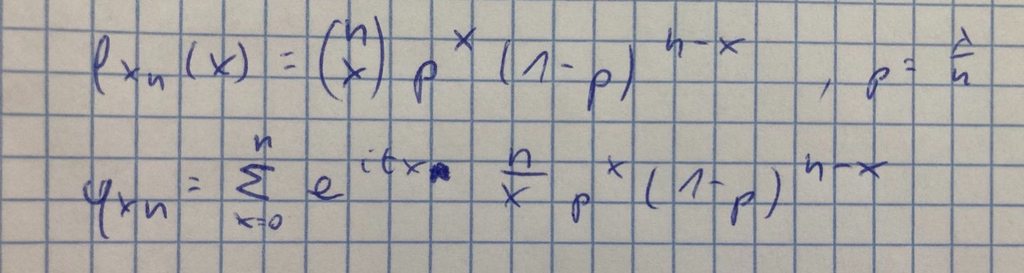
Hi folks! I'm trying to calculate the characteristic function of the binomial distribution
https://imgur.com/a/NeKlm21
I was trying to plug it into the taylor expansion, but it doesn't seem to work. Could you please provide me with some hints?
 strong furnace
alpine sable
strong furnace
alpine sable
did you get this right?
 alpine sable
(y-5)^2+y^2=13
Solve this
U will get value of y
Put in eq 2 u get value of x too
 visual furnace
alpine sable
(y-5)^2+y^2=13
visual furnace
alpine sable
(y-5)^2+y^2=13
i dont understand
please help me
im new to this
my teacher just gave me a random A* qu
harsh acorn
stop posting this everywere
ocean sealBOT
Thk
Hello, I've this problem :\\

“ Determine the polynomial $P \in \mathbb{C}[x]$ of degree 3 satisfying the following conditions:\\

• $-2i$ is a root of $P$.\\

• the other two roots of $P$ are complex conjugates of each other and of modulus equal to 2,\\

• the sum of the roots of $P$ is $1-2i$,\\

• the remainder of dividing $P$ by $x+1$ is $1 + 2i$. "\\

I dont know how to solve it.  I have that the 3 roots are complex, including 2 conjugates, and I have their sum.  how should I reason from there?
 vale wigeon
you have the roots as -2i, a+bi and a-bi
you know that a^2 + b^2 = 4 and that -2i + a + bi + a - bi = 1 - 2i
 paper parrot
why is R(3) <= 6 and not just R(3) = 6? Talking about ramsey's theorem
vale wigeon
did you read this somewhere? can you show us some context
 uneven garnet
vale wigeon
you know that a^2 + b^2 = 4 and that -2i + a + bi + a - bi = 1 - 2i
uneven garnet
vale wigeon
you know that a^2 + b^2 = 4 and that -2i + a + bi + a - bi = 1 - 2i
Okay thanks, I'm trying to solve it
 minor crypt
@vale wigeon u dutch?

 vale wigeon
out of curiosity, what made you think that
 dawn nova
Hey guys, which function hasn’t got this much immediate growth? I’m basically asking for a more smooth fade-in function, if it makes sense

 boreal sinew
What's the name of the operation on functions
$$
f: A \to B
$$
$$
g: C \to D
$$
such that
$$
f \times g: (A \times C) \to (B \times D);
f \times g = (a,c) \mapsto (f(a),g(c))
$$
 prisma loom
Cartesian product?
ocean sealBOT
JohnDark
 boreal sinew
Well, functions are usually defined as triples (D,C,G) where D is a domain, C is a codomain and G is a graph
dawn nova
Could you elaborate more, please? The sine seems definitely more smoother than the 4th root, I might go with sine
 spring harbor
When does a function have no tangent line that's parallel to the first bisector?
minor crypt
vale wigeon
out of curiosity, what made you think that
hmm well first of all, username (although I guess could be german too)
and you use the word 'that' in sentences where it could be left out, e.g. you know that a^2...
In Dutch, the 'that' would be necessary.
My second guess would be you're German. Not like it matters
spring harbor
Is this channel taken, perhaps?
vale wigeon
minor crypt
hmm well first of all, username (although I guess could be german too)
and you ...
i'm neither dutch nor german
 minor crypt
spring harbor
Is this channel taken, perhaps?
minor crypt
spring harbor
Is this channel taken, perhaps?
nah go ahead
spring harbor
When does a function have no tangent line that's parallel to the first bisector?
 spring harbor
Hmm
Well for context, it has given me this function

It's asking for what values a the function has no tangent line(s) parallel to the first bisector
minor crypt

spring harbor
I thought a<0
but I could be wrong
I don't really have argument to back up my claim
gray isle
bisector of what?
spring harbor
^^
placid zinc
I have also never heard of this haha
spring harbor
You mean the term "first bisector"?
placid zinc
What's the slope of the first bisector?
spring harbor
y=x so 1?
gray isle
^ never heard of "first bisector" being used in this context before
minor crypt
spring harbor
The derivative of this function is a parabola, so it can never be parallel to the first bissector?
spring harbor
gray isle
^ never heard of "first bisector" being used in this context before
My bad, I translated the question, could be due to that.
spring harbor
placid zinc
Notably, when can f'(x) never be 1?
When the discriminant of x^2 +2x + a + 1 <0?
minor crypt
$f'(x)=x^2+2x+a+2$
ocean sealBOT
Axhraf
 minor crypt
oh I think I got it
placid zinc
spring harbor
When the discriminant of x^2 +2x + a + 1 <0?
Yes exactly. Didn't need my help at all lol
spring harbor
But we get: 4 - 4a -4 < 0 or a>0 ?
minor crypt
he was a few steps ahead of us
spring harbor
oh shoot I actually thought it gives us something like a>(number) which is not between the options..
minor crypt
nvm
placid zinc
,w graph x^3/3 + xx + 2x + 1
ocean sealBOT


 Requested by Kaynex#7520
minor crypt
Requested by Kaynex#7520
minor crypt
it wouldnt make sense that for all a>0, the tangent line is parallel to y=x
or maybe it would
spring harbor
,w graph x^3/3 + xx + 7x + 25
ocean sealBOT

 Requested by Echo#1357
placid zinc
Requested by Echo#1357
placid zinc
b² - 4ac < 0
4 - 4(a + 2) < 0
4 - 4a - 8 < 0
a > 1
spring harbor
We had to use a+1 cause f'(x) shouldn't equal one
minor crypt
a+1
spring harbor
Also it's the correct answer thanks.
 placid zinc
Cool! Glad it works haha
minor crypt
DUTCH
spring harbor
dutch!
minor crypt

placid zinc
Just hard to see off the graph
spring harbor
yup
minor crypt
misschien dat ik daarom wel gelijk wist wat de eerste bissector is
minor crypt
mfw english×dutch 
 gray isle
nearest tenth means to 1 decimal place
(and should not be confused with nearest multiple of 10)
minor crypt
also found 69.8 with calculator
 hardy geyser
so it wouldnt be 69.8 >>> 70.0?
gray isle
no
minor crypt
hardy geyser
so it wouldnt be 69.8 >>> 70.0?
no, a tenth=0.1
hardy geyser
what if it was like 69.88 >>> 70? would that be correct?
minor crypt
easy way to remember: 1/10=0.1
gray isle
no
hardy geyser
i thought it was 5 and up you round 4 and below stay the same
gray isle
nearest tenth means to 1 decimal place
(and should not be confused with nearest multiple of 10)
minor crypt
hardy geyser
what if it was like 69.88 >>> 70? would that be correct?
not if you have to round up to a tenth, then that'd be 69.9
minor crypt
a hundreth is 0.01
gray isle
hundredths would be to 2dp
hardy geyser
0.06 >>> 0.07 yes?
gray isle
whut?
minor crypt

gray isle
no
hardy geyser
cause you said 69.8 would be >>> 69.9
minor crypt
hardy geyser
0.06 >>> 0.07 yes?
you cant just add a hundreth for no reason 
thats not what rounding up means
hardy geyser
no like an example
minor crypt
a better example would be 0.065>>>0.07
gray isle
69.8 is 69.8
it is already to 1dp,
and you don't need to do anything to it
hardy geyser
wait how come when u round to the nearest tenths you only add 1 like 69.8 >>> 69.9
gray isle
0.065>>>0.07
if you were rounding 0.065 to the nearest hundreth (2dp),
then yes, that would round to 0.07
wait how come when u round to the nearest tenths you only add 1 like 69.8 >>> 69.9
noone said that
minor crypt
we said 69.88>>>69.9
hardy geyser
oh for the hundreths
wait so shouldnt it be 69.8 >>> 69.9 than if you add 0.1 more or round to the nearest tenths?
gray isle
what are you adding 0.1?
hardy geyser
wait no i didnt mean to say that i mean to say 70
gray isle
69.8 is 69.8
it is already to 1dp, (inherently it is already to the nearest tenth)
and you don't need to do anything to it
hardy geyser
what if it was like 69.4
gray isle
it is already to 1dp, (inherently it is already to the nearest tenth)
and you don't need to do anything to it
hardy geyser
inherently? what does that word mean
ohhh i searched it up ok
numbers after the decimil like ones, tens is it the same logic so i wouldnt round up anything in the ones right
gray isle
whut?
hardy geyser
like u know how u have ones tens hundreds after the decimil point
gray isle
before or after
hardy geyser
after the decimil

like i wouldnt round up the ones right?
its the same logic on both sides?
gray isle
the ths are important
tens is different from tenths
round appropriately depending on what they ask for
hardy geyser
round to the nearest tens 34 >>>> 30? right?
gray isle
yes
hardy geyser
round to the nearest ones 7 >>> 7?
gray isle
yes
hardy geyser
oh ok i see the difference and similiarties thank you sensei ramonov
 twin condor

To my understanding since it said at x = 0 i can remove absoulte value and write it as x ² since 0 is not a negative number and then i would get 2 as the second derrivitave am i right?
 shell heron
yes
twin condor
Kk thx
shell heron
no worries
 ancient creek
twin condor
ancient creek
twin condor
wait but shouldn't this be indeterminate? cuz x*|x| can be written in piecewise form as:
f(x) = { x^2 x => 0
{ -x^2 x <= 0
thus,
f''(x) = { 2 x => 0
{ -2 x <= 0
lim x-> 0 of f''(x) should thus be indeterminate
(pls confirm my answer with others also)
 wise sigil
ancient creek
wait but shouldn't this be indeterminate? cuz x*|x| can be written in piecewise ...
wise sigil
ancient creek
wait but shouldn't this be indeterminate? cuz x*|x| can be written in piecewise ...
This shows that f'' can no tbe continuous at x = 0
But really f' isn't even differentiable there
twin condor
But it said at x = 0 ?
wise sigil
What you have is f'(x) = 2|x| and from this the whole situation should be pretty clear
twin condor
wise sigil
This shows that `f''` can no tbe continuous at `x = 0`
But really `f'` isn't eve...
So no soultion here ???
So 2 ??
ancient creek
wise sigil
This shows that `f''` can no tbe continuous at `x = 0`
But really `f'` isn't eve...
ah I see, thx
ancient creek
twin condor
So 2 ??
no there is no solution
ancient creek
it is not differentiable at x = 0 for f'(x)
 ancient creek
yes

 twin condor
So no solution for f’ and f’’ ?
 fringe yoke
f'(0)=0
f''(0) = DNE ( f'(0) is non differentiable at x=0)
ancient creek
Yup
fringe yoke
That's a great problem to think about
twin condor
Kk also just checking f’ of absolute value of x at x = 2017 is 1?
fringe yoke
??
twin condor
Anthor question unrelated to the one above
Wuts the 1st derrivitave of Absolute value of x at x =2017
Is it 1??
fringe yoke
f(x) = |x|
f(x) = {x for x>=0}
{-x for x<=0}
f'(x) = {1 for x>=0}
{-1 for x<=0
2017 >= 0. Yes
So:
f'(2017) = 1
f'(1241284180294812094812) = 1
f'(0.00001) = 1
twin condor
Kk thx alot
fringe yoke
In my calculus class we never learned about absolute values like this
this is so interesting
fringe yoke
But for that one you just sent, f''(0) = DNE
Yeah I am not comfortable with absolute values
I see them sometimes on harder problems
and I just give up
Problems like this are good to become more comfortable with them
Than kyou
twin condor
Bwt when i change absolute value to piece wise do i always do
{ blah blah. X>=blah
{blah blah x<= blah
Like the = i put on both ?
I used to only put on 1 so just cheacking
twin condor
fringe yoke
Idk either
Me during math class XD
thanks aloooot tho really helped me understand
fringe yoke
|x| = -x for negative values of x
= x for positive values of x
x|x| = -x^2 for negative values of x
= x^2 for positive values of x
fringe yoke
twin condor
Me during math class XD
thanks aloooot tho really helped me understand
This is probably more complicated than it seems
What grade math is this btw?
twin condor
12 ( finaly year of highschool)
My teacher taught us everything and even stuff outside of book but never seen this at all XD
 noble sinew
twin condor
Like the = i put on both ?
noble sinew
twin condor
Like the = i put on both ?
Only do on one
twin condor
I have something like a goverment exam done after u finsh highschool
twin condor
Kinda like a 3rd semester exept u only do exams and have 1month holiday to prepare
Pretty similare to gaoka (china college exam thingy)
Name probably wrong
 shut elk
hi guys, can someone elucidate differentiation for me? the kind folks of the discord have already helped me out a little but there's something i want to confirm/disconfirm
so for example, the first derivative of say.. the volume of a sphere is it's surface area.
and, a more appropriate example for my question is that of $d = 4.9t^2$
ocean sealBOT
ex
 shut elk
which i believe has first derivative of a linear proportionality $y=9.8x$
ocean sealBOT
ex
 shut elk
so the above was the freefall equation and its first derivative is this straight line passing through the origin with gradient 9.8
does this mean that.. the rate of change of d=4.9t^2 is the 9.8?
it's likely i am thinking about this all wrong, thank you for your patience in advance lol.
fringe yoke
shut elk
hi guys, can someone elucidate differentiation for me? the kind folks of the dis...
Would you mind watching a youtube video about it?
This guy does a great job
shut elk
i'd be very happy to
fringe yoke
Let me find it
shut elk
much obliged.
fringe yoke
@shut elk
here is the entire playlist of calculus intuition videos

YouTube
The goal here is to make calculus feel like something that you yourself could have discovered.
it takes around 4hrs
Here are some derivative specific ones
shut elk
many thanks, i was hoping it would be "Differentiation by Tim O'Brien"
fringe yoke

What is an "instantaneous rate of change" when change happens across time?
Help fund future projects: https://www.patreon.com/3blue1brown
This video was supported in part by Art of Problem Solving: https://aops.com/3blue1brown
An equally valuable form of support is to simply share some of the videos.
Special thanks to these supporters: http://3b...
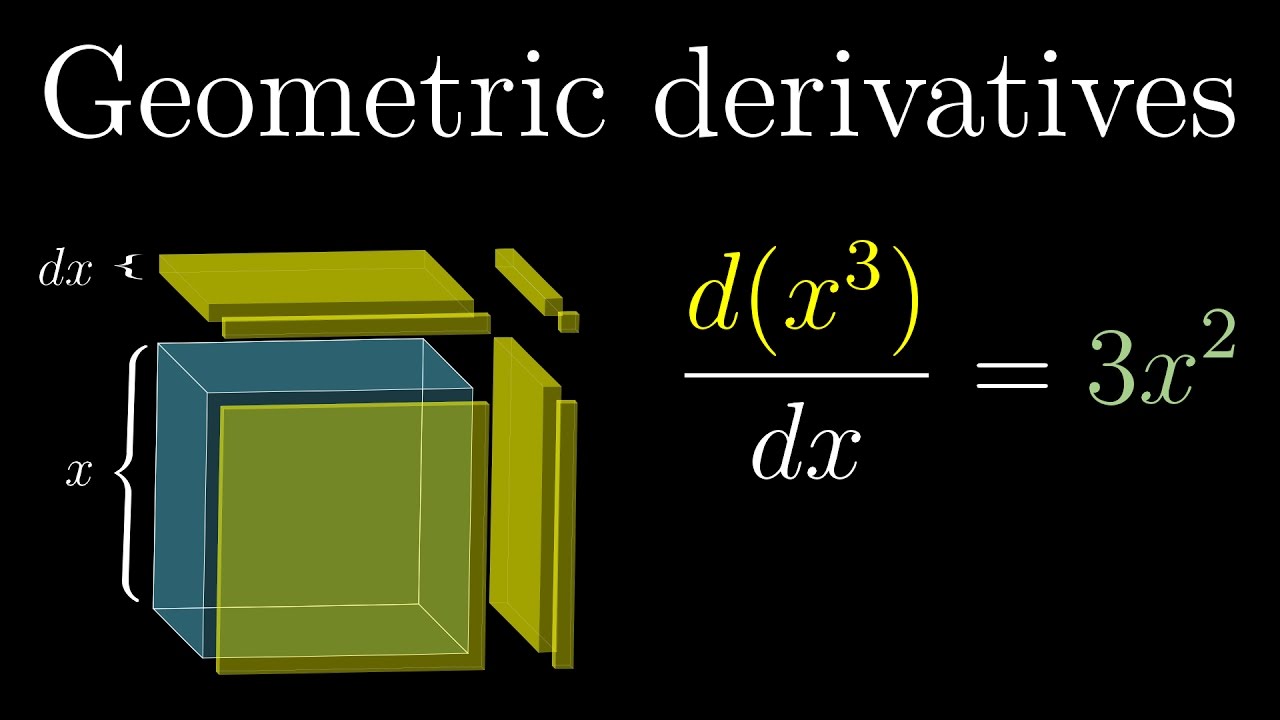
Some common derivative formulas explained with geometric intuition.
This video was sponsored by Brilliant: https://brilliant.org/3b1b
Help fund future projects: https://www.patreon.com/3blue1brown
An equally valuable form of support is to simply share some of the videos.
Special thanks to these supporters: http://3b1b.co/eoc3-thanks
Great video...
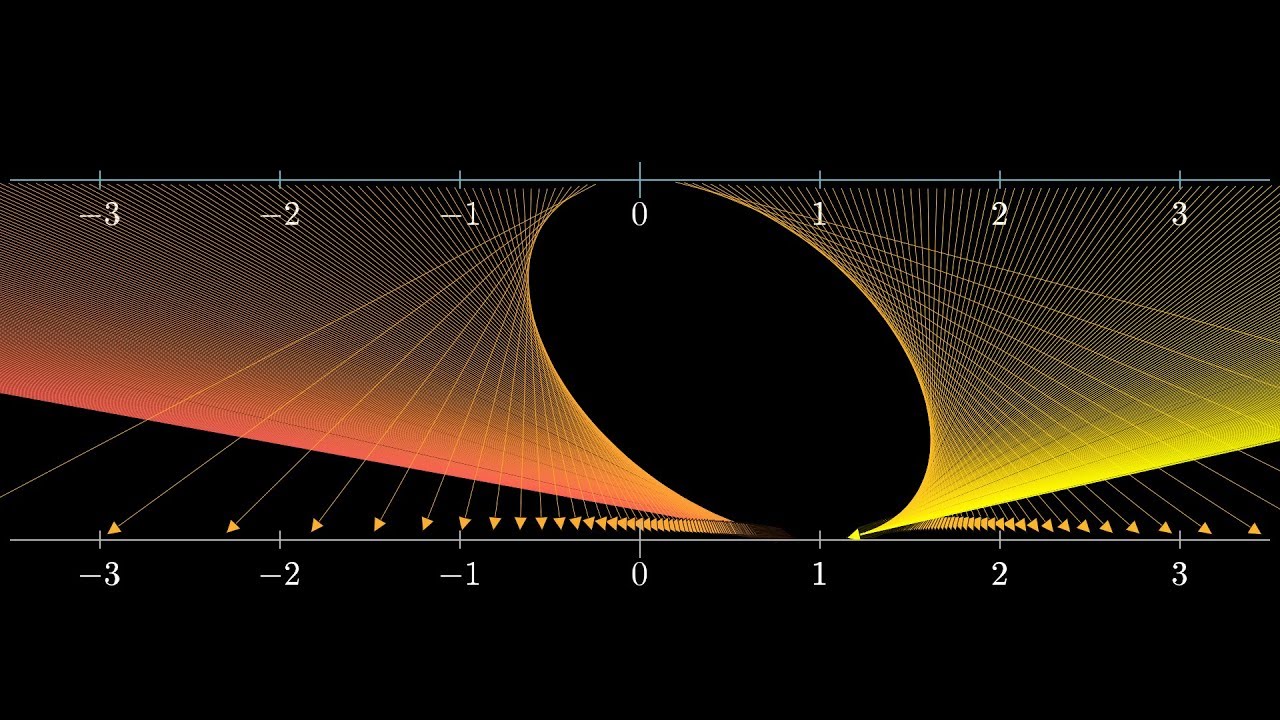
A visual for derivatives that generalizes more nicely to topics beyond calculus.
Help fund future projects: https://www.patreon.com/3blue1brown
An equally valuable form of support is to simply share some of the videos.
Special thanks to these supporters: http://3b1b.co/alt-calc-thanks
And by Brilliant: https://brilliant.org/3b1b
Home page: https...
shut elk
thanks again!
fringe yoke
Yeah make sure you watch them
If you want to UNDERSTAND
If something doesn't click immediately, you can rewatch a few times
alpine sable
Is the channel free now?
fringe yoke
go
alpine sable
So I have an arithemtic progression a1,a2,a3... and i got an equation a1+a3+...+a2019+a2021 = 2022 (this is a sum of elements with odd indexes) and now I need to calculate a2+a10+a1000+a2021+a2022. How do I do this?
strong furnace
alpine sable
Is the channel free now?
Did you get the trig question from earlier correct?
strong furnace
I would want to know how that worked out(in DMs) but let's get rid of this one first
alpine sable
actually I really need to do some other math problems
If you really want to I can tell you how it worked out tomorrow
strong furnace
I don't want the whole solution I solved it myself I just want your first few steps
Since my solution was a little iffy
strong furnace
alpine sable
So I have an arithemtic progression a1,a2,a3... and i got an equation a1+a3+...+...
The first expression is an AP with common difference 2d
2nd expression is a multiple of first expression
Just write it down in the form a_1+b*d for some b
 chrome monolith
Can i get help

 humble ore
What is the definition of modulus?
 glass lichen
yeah, cause you have 1/2(something on the unit circle of the complex plane)
chrome monolith
glass lichen
yeah, cause you have 1/2(something on the unit circle of the complex plane)
Uh
glass lichen
and unit circle is defined as |z|=1
chrome monolith
Does it have anything to do with the i