#help-0
1 messages · Page 674 of 1
 fickle pier
fickle pier
fickle pier
it can also be the other way around as well right?
 vale wigeon
yes
 lilac vault

 raven lodge
lost how do we factorise?
is it like
log(x)*log(y)+2log(x)?
 queen shale
How do you make this in index
vale wigeon
what do you mean by "make in index"?
queen shale

 cunning crow
latex?
vale wigeon
$3^{-1/3} = \frac{1}{\sqrt[3]{3}}$ i think this might be what you're looking for
 ocean sealBOT
Ann

 analog locust
from a single matrix transformation
can it be possible that there exist more than one non-linearly dependent eigenvectors??
raven lodge
Hi could I dm you for help 🙂

 minor crypt
use
$\frac{y_2-y_1}{x_2-x_1}=2$
ocean sealBOT
Axhraf

 alpine sable
,iam studying
ocean sealBOT
Gave you the studying! selfrole.
minor crypt
try to find a
alpine sable
,iam advanced
ocean sealBOT
Gave you the Advanced selfrole.
minor crypt
by doing basic algebra
 sharp sable
minor crypt
try to find a
sharp sable
minor crypt
try to find a
like an equation
minor crypt
yes
sharp sable
hmm
alpine sable
,iam talks
ocean sealBOT
Gave you the Talks selfrole.
minor crypt

minor crypt
you only really need to know:
y=mx+q
where m=gradient and q=y-intersect
sharp sable
minor crypt
you only really need to know:
y=mx+q
where m=gradient and q=y-intersect
ohh
yeah i do know that
minor crypt
and $m=\frac{y_2-y_1}{x_2-x_1}$
ocean sealBOT
Axhraf
 sharp sable
ok
 velvet oyster
Hi..
I have some thing to ask
Do you know how to find the center nucleus of the fan shape?
velvet oyster
The normal fan shape
alpine sable
Got like the question to show me
like take a screenshot or picture of it
and upload it here
velvet oyster
Ok wait for minits
Oh..Wait
I gat it!
@alpine sable Sorry for takeing time.
I don't know why but I gat it
alpine sable
wot
 harsh parrot
What is the correct answer out of the 4 according to you?

How is it onto?
I understand why its not one to one
But not why its not onto
Range of the function will be a set of even integers while codomain is set of integers so range != codomain?
ahhhhhhhhhhhh
My brain
Thanks a lot man!
alpine sable
why did you leave?
 flat pecan
hmmm, theory doubt: why is this true? Im especially confused from the first to second step: If i have a function f which associate each number N to either 0 or 1, shouldnt its cardinality be 2 x N ? Why do we get 2 ^N?
ù

@modest radish
 modest radish
okay
so
lets say i have a finite set
of cardinality N
errr
M
to avoid confusion
flat pecan
kk
modest radish
okay so how many do you think there are
flat pecan
isnt its combination total 6? {1,0}{2,0}{3,0},{1,1}{2,1}{3,1}
flat pecan
yes
modest radish
thats 2 choices for 1, 2 choices for 2 , 2 choices for 3
these dont sum
they multiply
do you see why?
modest radish
well lets build a function
okay so I make a choice for 1
okay i dont want to write the options once we compute it listing them all can be an exercise for you
so in order to define such a function
we can draw it as a tree
uh can i draw this on my phone
ill try
I cannot
okay ill find an image
ignore the labels here

each “level” in this pyramid is a us choosing either 0 or 1
for each element of X
flat pecan
yes i know where you are getting to but thats not what this function is
why would you combine them
each choice is separate
flat pecan
yes but theyre not related
modest radish
but they are all distinct
once i choose 0 or 1 for f(1)
its a different function
than if i made the other choice
flat pecan
hmmm can i give you some context on where this is from so that you can understand my doubts
modest radish
here
actually
i can write them all down for you
im going to write them like
101
modest radish
where the first number is f(1)
flat pecan
just gimme a sec
modest radish
and then the second is f(2)
and the third is f(3)
000,001,011,111,010,110,101,100
all distinct functions
and there arent any others
flat pecan
so basically its an algorithms course and we are making a bijection from each possible turing machine to natural numbers. The professor wants to show that the number of problems that there are, are much greater than the number of bijections (N), and as such many problems cannot be solved by algorithms and TM in generals
modest radish
lets not get more abstract
flat pecan
but thing is, given that each bijection is a turing machine
modest radish
do you agree that clearly its not 6?
flat pecan
yes but this is crucial
flat pecan
yes i know where you are getting to
its more like i dont make sense of it in the context its in
flat pecan
i do trust me
modest radish
anyway, my point here is simply that the 2N claim
doesnt make sense
because even for finite sets
its much larger than times 2
to see the infinite claim
i have a very different explanation
which it would help if you could be more patient about
flat pecan
its fine its not where im having issues understanding
modest radish
i am addressing your original question
as to why those functions are in bijection w powerset
flat pecan
ok so did you understand the part i posted about turing machines b4?
or should i explain it more
flat pecan
natural numbers to turing machines
modest radish
okay sure
flat pecan
we are enumerating all possible turing machines with natural numbers
modest radish
okay
flat pecan
so, the professor wants to show that the cardinality of this enumeration (which would be N) is much less than the number of problems
flat pecan
i mean like anything that needs to be solved
flat pecan
let me make it more specific
flat pecan
less than the number of functions which can be formed
each turing machine represents a function
modest radish
there are fewer turing machines than binary functions on N
flat pecan
yes
flat pecan
yes
modest radish
i agree
modest radish
can you he more specific
flat pecan
doesnt it just need to map each number individually to be able to map the combination?
modest radish
or at least more formal
flat pecan
 modest radish
yes
flat pecan
so we map each natural number to either 0 or 1
modest radish
okay
flat pecan
lets stop for a moment and consider each individual bijection
flat pecan
like natural number 3 to 0 {3,0}
modest radish
?
flat pecan
the natural number 3 gets mapped to 0
modest radish
thats not a bijection
flat pecan
why not?
modest radish
what do you think bijection means?
flat pecan
a mapping that is one to one
a function which relates each member of a set S (the domain) to a separate and distinct member of another set T
flat pecan
how am i misunderstanding?
modest radish
a bijection has to be injective (every element goes to a unique one) and surjective (every element in the target gets hit by something)
but you dont describe an individual value f(3)=1 as a “bijection”
modest radish
sure
flat pecan
at this point my question is, if theres a turing machine able to consider these individually
why do we consider 010101
modest radish
what does that mean
please try to write longer sentences and explain yourself better
flat pecan
like why do we consider all distinct possibilities and put them together
instead of just considering the distinct possibilities alone
modest radish
Again I dont know what you mean
flat pecan
like from before, if there are turing machines able to solve the 6 cases i proposed initially
modest radish
8
flat pecan
the turing machine can represent that function
modest radish
sure
modest radish
what combinations
flat pecan
yes so the cardinality of functions of a turing machine is just 2N
i dont get why 2^n
modest radish
not even a little bit
its 2^n
not 2n
if you dont understand that we have to go back
like i wanted to anyway
flat pecan
yes im not doubting that xd
modest radish
flat pecan
yes so the cardinality of functions of a turing machine is just 2N
you just said this
and you are putting very little effort into explaining yourself
flat pecan
yes i meant the cardinality that the turing machine needs, sorry english is not my home language
im studying in another language as well
what i mean is, if a turing machine can represent those 2N functions, then it should be able to represent the full cardinality of 2^N
modest radish
why
what
those 6 you wrote the first time
are not enough
to get the other 8
you need 8 machines
alpine sable
how would you find the area of the region of all points less than 2 units away from the parabola y=x^2 where -3<x<3 ?
https://www.desmos.com/calculator/ccy5vrvgr1
this is what i have so far
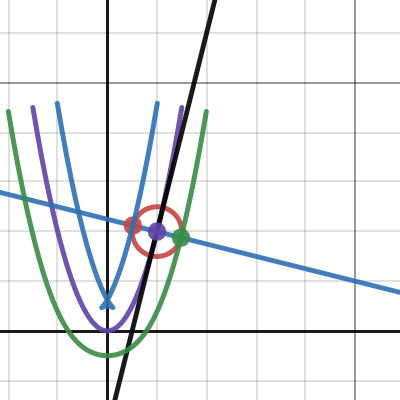
Desmos
 carmine ermine
ew
 lone cargo
i have a question (kinda dumb):
Did someone or Euclid himself prove the parallel postulate or people just consider it is right ?
alpine sable
can you repost it in an unoccupied channel?
 sick kelp
Can someone explain to me like mid point, magnitude,
 worn elbow
Hey, ya'll hoping some new friends can help with mean, median, mode, and some other fun calculations.
 gleaming granite
worn elbow
Hey, ya'll hoping some new friends can help with mean, median, mode, and some ot...
gleaming granite
worn elbow
Hey, ya'll hoping some new friends can help with mean, median, mode, and some ot...

worn elbow
I should ask the specific questions from my homework?
gleaming granite
yes sirr
worn elbow
Loool
All good.
Find the grade point average: four classes with the credit worth: 4,5,3,5 and the grades: A, B, B, C.
Possi, go have your fun, buddy. LOL
 viral rampart
so (4*(4.0)+5(3.0)+3(3.0)+5(2.0))/(4+5+3+5)
viral rampart
worn elbow
I'll hit you up for next week's homework tomorrow or so.
sure :3
worn elbow
 You can't resist me.
minor crypt

alpine sable
pls help, i lost sanity trying to solve it

 vague gate
 wary stream
alpine sable
pls help, i lost sanity trying to solve it
wary stream
alpine sable
pls help, i lost sanity trying to solve it
My step process is use law of sines to find either AC or CB then respectively finding AD or BD using law of sines again then pythagorean theorem for CD
alpine sable
but how will i find AC or CB if i dont know CD? sin α = CD/AC
 full dome
can someone tell me if my answer for this is correct? i need to find unknown angle which I got 13.38.
 alpine sable
wary stream
Law of sines to find AC or CB
alpine sable
wary stream
Law of sines to find AC or CB
the issue is that ABC is not rectangular triangle
wary stream
Law of sines works with any triangle @alpine sable
viral rampart
full dome
can someone tell me if my answer for this is correct? i need to find unknown ang...
a/sin(A)=c/sin(C)
full dome
ok
 wise jewel
hey can someone explain to me how "(bc)i + (ad)i = (bc + ad)i" ???
alpine sable
distributive property
alpine sable
wary stream
Law of sines works with any triangle <@456226577798135808>

i got it
thank you so much, @wary stream
gonna repost my question since it got pushed back
how would you find the area of the region of all points less than 2 units away from the parabola y=x^2 where -3<x<3 ?
https://www.desmos.com/calculator/ccy5vrvgr1
this is what i have so far
Desmos
<@&286206848099549185>
wise jewel
@alpine sable but then wouldnt it be (ibic) + (aidi) ?
alpine sable
i(bc+ad)=i(bc)+i(ad)
wise jewel
ohhhhhhhhh
you're right
im just stupid and ig the variables messed up my way of thinking LOL
ty!!
alpine sable
If in the expansion (2 x + 5)^10 the greatest term is equal to the middle term for x belongsto(a, b) then maximum value of 12|b – a| equals to (where a, b belongs to R+)
help
 wanton dune
how should i represent those symbols on paper? just "Q" and "R"?
 alpine sable
it doesn't hurt to add a few lines to make it clearer what you're representing
usually for the reals we use IR instead of that whole relining
 glass lichen
$\bQ$ i just add the 2 lines in the O part, and the | for $\bR$
ocean sealBOT
Mosh
 alpine sable
okay no yeah, i guess you can google it for a look on how it is usually drawn
wanton dune
i think you provided me with some useful answers
alpine sable
hello, where did 10 in power of 3/2 go? why is there 3/2 instead of 10 in power of 3/2?

 acoustic wharf
get a common denominator in the second factor and then multiply by the conjugate
acoustic wharf
alpine sable
hello, where did 10 in power of 3/2 go? why is there 3/2 instead of 10 in power ...
because... that's the definition of log; log_10(10^r)=r
acoustic wharf
👍
 acoustic wharf
what's the problem though exactly?
just substitute x+dx and x into the expressions and simplify

i used h here instead of deltax
@wispy swan
 wispy swan
ay thank you @acoustic wharf
acoustic wharf
👍
my turn now
can anyone help me with this question:
"an urn contains p red balls and q black ones, n are randomly picked. in how many ways can we get h red ones and k black ones?"
the answer is apparently (pChooseh)*(qChoosek)
but i dont fully understand how that's the answer
glass lichen
order the n are picked doesnt matter, so you need to pick h from the p red, then k from the q black
so (pCh)*(qCk)
alpine sable
It's two combinations
acoustic wharf
hmm
wispy swan
lag I feel like this should be an easy one lol. I might as well ask
 acoustic wharf
whats the domain of f
is it the positive real numbers or all of the real numbers?
wispy swan
Doesnt say! wish I knew. I believe all of the real numbers
acoustic wharf
your answer is probably correct
wispy swan
or is it x+4 😮
 fresh terrace
Not a question specifically about maths but is further maths gcse such a thing in the uk if anyone knows?
acoustic wharf
nooo
acoustic wharf
wispy swan
or is it x+4 😮
to this
wispy swan
ok ok
acoustic wharf
yeah yeah but they probably arent doing rigorous math anyway
glass lichen
wispy swan
lag I feel like this should be an easy one lol. I might as well ask
no inverse for f exists unless the domain is restricted
since x^4 is not injective on R
acoustic wharf
yep
wispy swan
I got the answer right! wo
acoustic wharf
see
 vital drift
By using the points, (3,1) and (20,9), would the approximate slope and y-intercept be y = 0.4 + 0?
 wanton dune
 wanton dune
wanton dune
wanton dune
What those symbols before "-2" and after "+infinite" mean?
 solar pebble
fresh terrace
Not a question specifically about maths but is further maths gcse such a thing i...
solar pebble
fresh terrace
Not a question specifically about maths but is further maths gcse such a thing i...
yeah it is
it's not really cared about tho
glass lichen
wanton dune
What those symbols before "-2" and after "+infinite" mean?
context?
wanton dune
glass lichen
context?
x>2
glass lichen
ok so it's an interval
wanton dune
yes
ocean sealBOT
Mosh
 wanton dune
so, when we have this kind of notation (-2, +2) for example, it means that the interval will not cointain neither -2 and 2, right?
glass lichen
$x\in (-2,2) \iff {x\in\mathbb{R}|-2<x<2}$
ocean sealBOT
Mosh
 wanton dune
wanton dune
wanton dune
And what is the name of this symbol, for sure?
glass lichen
that's not a thing
american intervals are () for unbounded, [] for bounded.
International just replaces unbounded with ][
 ionic jewel
I'll be real international unbounded looks way worse but makes way more sense
fresh terrace
solar pebble
it's not really cared about tho
Do you know any differences in terms of outcomes between doing the higher maths paper and the further maths one?
I am sure both are 1-9.
wanton dune
glass lichen
that's not a thing
Understood
 unkempt sigil
im not sure if I did this correctly. If im wrong, please tell me where i made the mistake
 alpine sable
What DA hek?
glass lichen
ignore it, random troll
 pulsar aspen
unkempt sigil
pulsar aspen
unkempt sigil
I don't think you inverted that csc into sin correctly.
alpine sable
glass lichen
ignore it, random troll
Fine can you help me in a little doubt?
pulsar aspen
ALso, you are supposed to solve it algebraically, not using a calculator.
unkempt sigil
pulsar aspen
I don't think you inverted that csc into sin correctly.
ow i see
unkempt sigil
pulsar aspen
ALso, you are supposed to solve it algebraically, not using a calculator.
wdym?
alpine sable
unkempt sigil
ow i see
Are you done?
 uncut monolith
 pulsar aspen
I meant, you are not supposed to use a calculator.
unkempt sigil
alpine sable
Are you done?
not yet lol
uncut monolith
help pls
unkempt sigil
pulsar aspen
I meant, you are not supposed to use a calculator.
owh so i use radicals then instead of decimals?
alpine sable
You wanna feud with me lad? You already killed my girlfriend as well
I have to prove value of a equation in a+b√3
But my answer is coming in form of a-b√3
glass lichen
Dont crosspost
alpine sable
Why don't you google it
uncut monolith
unkempt sigil
owh so i use radicals then instead of decimals?
decimals
unkempt sigil
w8 im confused lol
glass lichen
shut it, read the rules
pulsar aspen
- The question is unclear
- Why did you ping me?
uncut monolith
3
alpine sable
pulsar aspen
1. The question is unclear
2. Why did you ping me?
So can I ask now?
unkempt sigil
uncut monolith
decimals
w8, decimal or radicals?
uncut monolith
Finding the double integral
∫∫Rf (x, y) dA
Where f (x, y) = x2 + y2
y R is the region enclosed by y = 1 / x, y = 3 / x, x2 - y2 = 1, x2 - y2 = 4, in the first quadrant
we obtain:
pulsar aspen
alpine sable
So can I ask now?
I mean you can ask, but don't ping anyone first except you specifically want to ask me about my answer.
glass lichen
didnt ask
 subtle mantle
1, 50 makes 50
pulsar aspen
Also, please wait while Bruh Chan is still asking.
unkempt sigil
wait so xwtek said radicals and jamil said decimals so im kinda confuse now
alpine sable
pulsar aspen
Also, please wait while Bruh Chan is still asking.
XD lol I can hear you saying bruuhhhhh chan
What's this lol you gonna ban for sure still
pulsar aspen
his Discord name is literally Bruh Chan.
glass lichen
yeah he just got banned
unkempt sigil
lol
subtle mantle
You really do get some gremlins in the questions channels, very entertaining
glass lichen
mods were pinged in a different channel, then they felt the need to ping them individually
uncut monolith
OMG, the exercise is sending me
alpine sable
So can i ask
unkempt sigil
🥲
pulsar aspen
unkempt sigil
wait so xwtek said radicals and jamil said decimals so im kinda confuse now
I think you should revise how do you get sin theta correctly first
unkempt sigil
pulsar aspen
I think you should revise how do you get sin theta correctly first
aight, ima be back after, thanks
alpine sable
Okay so
I have to prove value of a equation in a+b√3
But my answer is coming in form of a-b√3
uncut monolith

pulsar aspen
alpine sable
I have to prove value of a equation in a+b√3
But my answer is coming in form of ...
do b really has to be positive number there?
alpine sable
pulsar aspen
do b really has to be positive number there?
Yes i have to prove
And I got value in negative of b so I'm kinda confuse
pulsar aspen
Full question please and how do you get that expression so far?
pulsar aspen
sorry. I mean expression.
alpine sable
 subtle mantle
Conjugate memes
pulsar aspen
alpine sable
I don't think b has to be actually positive there.
 alpine sable
pulsar aspen
I don't think b has to be actually positive there.
alpine sable
pulsar aspen
I don't think b has to be actually positive there.
I see thank you!!
I just wanted to make sure ❤
uncut monolith
 pulsar aspen
unkempt sigil
hows this?
pulsar aspen
unkempt sigil
hows this?
No. I mean correct the sin theta first before finding the theta.
unkempt sigil
pulsar aspen
No. I mean correct the sin theta first before finding the theta.
sorry but i dont see whats wrong on the sin theta 🥲
please tell me what i did wrong on the sin theta
pulsar aspen
you just have to flip the position the number to take the inverse.
i.e. numerator -> denumerator and denumerator -> numerator.
unkempt sigil
but the given is cosecant theta, doesnt that mean its 1/sin theta?
unkempt sigil
pulsar aspen
you just have to flip the position the number to take the inverse.
oh u mean i reverse them so that the negative below will be positive?
pulsar aspen
unkempt sigil
but the given is cosecant theta, doesnt that mean its 1/sin theta?
Yes, and you didn't calculate 1/csc theta correctly
pulsar aspen
unkempt sigil
oh u mean i reverse them so that the negative below will be positive?
No, don't change sign
 unkempt sigil
owh i think i get what you mean now lol
like this?

sorry if im wrong again lolol
unkempt sigil
like this?
 pulsar aspen
Yes.
 pulsar aspen
No, such special angle should have been a fractional multiple of pi.
And 60 is way bigger than 2pi
unkempt sigil
uh oh, i dont think my math teacher thought us something about pi on this topic
pulsar aspen
sin function takes an angle in radians. So, the resulting sin^-1 is also in radians.
sin(-60) is a positive real number, for example
as 60 is (19+n)pi for a real number n element of (0, 1)
unkempt sigil
wait wait wait im soo confuse now lol, my math teacher didn't teach me the things ur saying so i have no idea 🥲
so basically, i did my math wrong?
pulsar aspen
Remember the special angles:
sin(0)=sin(pi)=0
sin(pi/6)=sin(5pi/6)=1/2
sin(pi/3)=sin(2pi/3)=sqrt(3)/2
sin(pi/2)=1
so the answer should've been -pi/3 or -2pi/3
unkempt sigil
this is the only spewcial triangles he gave us
 pulsar aspen
that degrees is a unit.
Basically 1 degrees is actually pi/180
You can't omit the degrees.
unkempt sigil
pulsar aspen
so the answer should've been -pi/3 or -2pi/3
but he didn't theach us pi answers
pulsar aspen
-pi/3 = -60 degrees. But you shouldn't forget the degrees.
 humble terrace
can someone help
 unkempt sigil
pulsar aspen
-pi/3 = -60 degrees. But you shouldn't forget the degrees.
unkempt sigil
pulsar aspen
-pi/3 = -60 degrees. But you shouldn't forget the degrees.
oh so their the same?
glass lichen
humble terrace
can someone help
matrix addition is entry-by-entry
pulsar aspen
yes, but you omitted the degrees sign, which is important.
unkempt sigil
pulsar aspen
yes, but you omitted the degrees sign, which is important.
im sooo dumb kekw
pulsar aspen
That's like saying 160 m as your height
unkempt sigil
dam it that missing degree sparked a whole conversation which i had no idea what it about 🤣
like this then?

with the degree on 240 and 300
pulsar aspen
-60 degrees is definitely not the "related acute angle" here
pulsar aspen
If I interpreted the question correctly, theta would be the larger angle, so you have to find the smaller angle for that, then you find the other triangle angles
 gray isle
Including the degree symbols, the principal angles are correct
unkempt sigil
this are our reviews for this, i just based how i answered my questions off of this
 unkempt sigil
oh but if its 60, then wouldnt that make the principal angles different?
gray isle
and the principal angles using that would be
180° + 60° = 240°
360° - 60° = 300°
unkempt sigil
oh i see i see
gray isle
the end result is the same
the principle angles refer to the solutions between 0 and 360°
pulsar aspen
Sorry, I'm not a native English speaker.
So, I didn't know about principal angle as we called it differently
unkempt sigil
so the real answer of the equation is -60 but since it says 0<theta<360, we make it to absolute value?
unkempt sigil
pulsar aspen
So, I didn't know about principal angle as we called it differently
its cool bro, thanks for the help
unkempt sigil
but the answer of the theta is -60 tho right, we just change it to 60?
gray isle
taking the arcsin of (-sqrt(3)/2) gets you -60°
however the related acute angle would be 60°
unkempt sigil
oh so the negative is positive because its the acute angle itself
gray isle
uh yeh.
unkempt sigil
thank you my bruh
gray isle
when finding the related acute angle,
it'd be more reliable to take the absolute value of the ratio before applying the inverse trig ratio
unkempt sigil
oh i see
gray isle
though it doesn't really matter for sin and tan,
its quite useful when working with cosine
unkempt sigil
thanks for being patient with me guys 😁
unkempt sigil
gray isle
though it doesn't really matter for sin and tan,
its quite useful when working w...
noted
 spice crypt
how do I prove there's only a finite amount of ways to decompose some positive integer into a sum of multiples of 2 and 3?
it's pretty much showing the diophantine equation $2x+3y=n$ for some $n\in\mathbb{N}$ has only finitely many solutions for $x,y\in\mathbb{N}$
ocean sealBOT
(𒀭)
 spice crypt
pretty sure the diophantine equation solves to something like $x=2m+n$ and $y=-(3m+n)$ for some $m\in\mathbb{Z}$ over integers but I'm not sure where to go from there
ocean sealBOT
(𒀭)
 ionic jewel
spice crypt
it's pretty much showing the diophantine equation $2x+3y=n$ for some $n\in\mathb...
ionic jewel
spice crypt
it's pretty much showing the diophantine equation $2x+3y=n$ for some $n\in\mathb...
Since $x\leq \frac n2$ and $y\leq\frac n3$, and $x,y \in\bN$, assuming n is finite, there are only a finite number of integers between 0 and n, so there can at most be $\frac n2 \cdot \frac n3$ solutions.
ocean sealBOT
bunny
 ionic jewel
since n/2*n/3 is finite if n is finite
 rancid citrus
Hey, I have a question.
How to notate, write a conjunction point of two linear functions?
Specifically, I have two linear functions,
y=¾x+½
y=-2x+17
and I found that their conjunction point is (6, 5), but I don't know how to mathematically notate the conjunction.
Should it be like
y=¾x+½ ∩ y=-2+17 = (6, 5)
Also my English terminology in math isn't the best, so I hope I'm clear
Please try asking your question in an other room, I'm already waiting for an answer to my question.
Could I just give each of them a "name"?
A=y=¾x+½
B=y=-2+17
And then simply write A ∩ B = (6, 5) ?
rancid citrus
Aha, ok. I think that's correct because "lines" that go infinitely are marked with lowercase letters.
Thanks a bunch.
 covert berry
I assume you were writing a whole essay to disagree with that
Because that doesn't look like what you would take several minutes to write
😂
np
rancid citrus
I was just trying to remember what that "line" is called in English. 😅😅 In my native language it literally translates as "straight"
covert berry
Are you asian
rancid citrus
Nope, from the Balkans
rancid citrus
Thanks for that too, I am just now preparing for a final exam after finishing primary school of 8 years. It's in 3 days
 raven briar
Could someone help me to solve this problem?
In a game, there are two players, A and B, who take turns tossing a fair coin. The winner of a round is the first person to get a head. The loser of a round of the game goes first in the next round. To win the game, a player must be the first to win 3 rounds. If A goes first, what is the probability that they win?
pulsar aspen
raven briar
In a game, there are two players, A and B, who take turns tossing a fair coin. T...
Try to find out the probability of winning the first round first
pulsar aspen
Good, since the games is first 3 wins, the maximum number of wins is 5 rounds
pulsar aspen
raven briar
In a game, there are two players, A and B, who take turns tossing a fair coin. T...
Now lets look at each games, ignore the labelling AB, only first/second. What is the probability of a configuration wins?
raven briar
what do you mean by a 'configuration'?
pulsar aspen
example: 11001 (1 = second, 0 = first)
Then you find out how to map AB representation to first/second representation
raven briar
so would i have to consider every configuration possible?
e.g. 000, 111, 1000 and so on?
@pulsar aspen
so if 0 represents winning a round for A and 1 represents a loss
would i just consider 000, 1000, 0100, 0010, 11000, 10100, 10010, 01010
pulsar aspen
Well, not quite
Assume 0 is first player win, 1 second player win, A for a win, B for b win,
- How do you map (bijectively) a string from AABAB to a string like 01000?
- How do you determine a probability for an event like 01000?
pulsar aspen
Prepend the 01000 with 1 and group by pattern 1 + repeating 0. What does it relate to the winning condition?
raven briar
pulsar aspen
Prepend the 01000 with 1 and group by pattern 1 + repeating 0. What does it rela...
could you just explain the solution? i don't really understand what you mean
pulsar aspen
Assume that 0 = first player win, 1 = second player win. For a game configuration, prepend 1. Group by pattern 10*, Then we get a series of integer:
a0, b0, a1, b1, ...
Now sum a and b together, so we get
a = a0 + a1 + ...
b = b0 + b1 + ...
Now, a+b=6.
Probably I will solve it later. But for now, I have an important business.
raven briar
ok thank you
 vernal prawn
is this chat taken
 shut yoke
 shut yoke
general term formula is
un=u1+(n−1)d
i dont want to do it sneaky, i dont understand it and will run into it next year
 viral patio
shut yoke
i dont want to do it sneaky, i dont understand it and will run into it next year
viral patio
shut yoke
i dont want to do it sneaky, i dont understand it and will run into it next year
okay, i will give you the sneaky answer and the non-sneaky answer
viral patio
shut yoke
- Sneaky answer
S_n is the sum of the first n terms of the arithmetic sequence u_1 + u_2 + ... u_n
so S_1 is the sum of just the first time, i.e. S_1 = u_1
so plug n = 1 and see which of them agree - in this case, only one remains
viral patio
shut yoke
general term is the same as u_1 right
the general term is u_n
the first term is u_1
shut yoke
i plugged it into the top one and got
s_1 = 1/4(3-1)
the very top one not one of the options
viral patio
shut yoke
i plugged it into the top one and got
s_1 = 1/4(3-1)
yup, what does that simplify to?
(also please reply to my messages so i get ping'd)
shut yoke
viral patio
(also please reply to my messages so i get ping'd)
sorry
1/4*2
viral patio
shut yoke
sorry
1/4*2
which simplifies to?
shut yoke
viral patio
which simplifies to?
1/2
wait so do i plug 1 into the other and see which one solves to 1/2
viral patio
shut yoke
1/2
wait so do i plug 1 into the other and see which one solves to 1/2
exactly, that's the sneaky method
shut yoke
viral patio
exactly, that's the sneaky method
oh thats not sneaky thats just understanding thats just understanding that s_1=u_1
there is another way?
viral patio
shut yoke
oh thats not sneaky thats just understanding thats just understanding that s_1=u...
it's sneaky because you're taking advantage of the fact that it's multiple choice, the non-sneaky method is trying to directly find u_n
viral patio
shut yoke
there is another way?
the other way would be to use that:
s_n - s_(n-1) = u_n
or equivalently (might be easier to see why this is true)
s_n = s_(n-1) + u_n
since you're given the formula for s_n, you can work out s_(n-1) and subtract, giving you u_n

 shut yoke
lol im thinking
alpine sable
but for the normal vector
i dont have enough eqns to solve, only 2 eqns
$$4a - 3b - 5c = 0$$
$$3a + b - 3c = 0$$
ocean sealBOT
ajuze
 alpine sable
what am i missing here, where n = <a,b,c>
shut yoke
viral patio
the other way would be to use that:
s\_n - s\_(n-1) = u\_n
or equivalently (migh...
is it s_n - s_(n-1) = u_n
that is not writing normally
viral patio
shut yoke
is it s_n - s_(n-1) = u_n
am i blind or is that not the same thing as what i typed?
shut yoke
you are not blind lol
viral patio
use \ before underscore
shut yoke
is it s_(n-1)
or
s(n-1)
shut yoke
viral patio
use \ before underscore
^
viral patio
shut yoke
is it s\_(n-1)
or
s(n-1)
they're the same thing, it's just notation
we wrote s_n, u_1, etc. so we should stick with s_(n-1)
shut yoke
do i have to use one of the two equations for finding s_n
and use what i was given in that equation
shut yoke
viral patio
they're the same thing, it's just notation
we wrote s\_n, u\_1, etc. so we shoul...
gimme a few im gonna try to figure this out
alpine sable
Can u help my q while she is trying @viral patio
shut yoke
you should prolly go to a diff channel just for convenience
 sullen nova
,w 1+1
ocean sealBOT


 Requested by Le Vorn#7624
shut yoke
viral patio
they're the same thing, it's just notation
we wrote s\_n, u\_1, etc. so we shoul...
Requested by Le Vorn#7624
shut yoke
viral patio
they're the same thing, it's just notation
we wrote s\_n, u\_1, etc. so we shoul...
so i get n/2(u_1+u_n) = n/4(3n-1)
right
viral patio
shut yoke
so i get n/2(u\_1+u\_n) = n/4(3n-1)
where did u_1 + u_n come from?
i'm not sure i understand your question
shut yoke
s_n = n/2(u_1 + u_n)
viral patio
shut yoke
s\_n = n/2(u\_1 + u\_n)
is that true in general? i don't know off the top of my head and i don't have pen/paper on hand to run through the calculations and verify
viral patio
shut yoke
its the formula
okay, do you need anything more from this?
shut yoke
no, i get it thanks a lot
viral patio
shut yoke
no, i get it thanks a lot
🙂
 exotic mortar
The marketing department at DIBI Ltd. have determined that the demand, at $d per unit, for a product can be
modelled by the equation, , where x is the number of units produced and sold. The total cost, $C, of
producing x items given by .
What price will yield a maximum profit?
How do I do this
ionic jewel
there is definitely not enough information
looks like your math formatting didn't copy
exotic mortar
 ionic jewel
profit = earnings - production costs
so find the profit equation and the find the max
exotic mortar
does the profit equation equal to (80x/sqrt x)-(200+0.2x)
exotic mortar
ionic jewel
yes is it
?
ionic jewel
yes your profit eqn is right
exotic mortar
idk how to doo the next part
ionic jewel
find critical point(s), then check which is a maximum
exotic mortar
critical points?
 fading zephyr
ionic jewel
fading zephyr
ionic jewel
assuming this is calculus, critical points are points such that the derivative equals 0 or is undefined
ionic jewel
what's a gdc
exotic mortar
graphics calculator
ionic jewel
oh
then just graph it and find the max
your calculator can find the max automatically (it's under some menu)
exotic mortar
Ok tysm
 iron jolt
is anyone here?
covert berry
maybe you should just ask and someone may show up lol
iron jolt
if the number '1' is used to represent a THING, then that thing MUST fall under the rule of physics, and as such, the equation time=distance/speed must always be in place. if so, then how can 3x1 and 1x3 be the same exact thing if 3x1 is 3, one time , and 1 x 3 is one three times, so... 3x1= XXX, and 1x3 = X , X , X ... these two must have either been seperated in time, or space
am i wrong?
covert berry
wtf
 storm turret
What does that even mean
iron jolt
you cant create 3 one time, and one, 3 times, and call it the same, they are fundamentally different
covert berry
but they're the same value
i remember a guy writing a book about flaws of equality
something like that
maths have flaws
everyone agrees
iron jolt
what does value mean then, because 1 plus 2, and 2 plus 1, they both combine and then, yes, it can be the same
covert berry
yeah, read that book
iron jolt
haha will do
covert berry
it may have the answer to your question
iron jolt
thanks 🙂
 misty pebble
Why can I turn 1/3x^-2/3 into 1/3x^2/3?. Keeping the 1/3 is the same spot seems strange while moving the exponent and x
gray isle
you're gonna need some parentheses
did you mean
$$\frac13 x^{-2/3} = \frac{1}{3x^{2/3}}$$
ocean sealBOT
ℝamonov
 misty pebble
apologies
 ocean sealBOT
ℝamonov
 misty pebble
ty
 gray isle
,rotate
ocean sealBOT
 gray isle
what have you tried?
 onyx pier
where does those 45 comes from??
$\frac{5}{9}+\frac{2}{3}-1\frac{1}{5} = \frac{25}{45}+\frac{30}{45}-\frac{54}{45} = \frac{1}{45}$
ocean sealBOT
Rin
 gray isle
45 is the lcm of 3 , 5 and 9
vale wigeon
common denominator.
onyx pier
i'm sorry, what is lcm??
gray isle
lowest common multiple
onyx pier
i see, so basically 9 x 3 x 5?
onyx pier
uhm.. i dont understand, what is this kind of calculation called in english? let me google it 😅
oh nvm found it
thanks!
alpine sable
what am i doing wrong here?

$$\frac{\delta z}{\delta v} = \frac{\delta f}{\delta x}\frac{\delta x}{\delta v} + \frac{\delta f}{\delta y}\frac{\delta y}{\delta v}$$
ocean sealBOT
ajuze
 ocean sealBOT
Hyl1s

 harsh acorn
Can someone help me find x
 spare fern
Notice that 5!, 7!,9! And 11! All contain 3×4
 robust dagger

hi, so my teacher gave me this as an answer to revision, but when she moved the 20 over instead of minusing it she divided it
is this correct?
if so why?
since the 20 is on its own and clearly plused to the equation, wouldny you minus 20 from both sides
 sage summit
absolutely not
 ruby current
doesnt look correct
robust dagger
ok good
so just to clarify, the correct way to do this is
25 = -10cos(2t) + 20
5 = -10cos(2t)
-1/2 = cos(2t)
^-1cos - -1/2 = 2t
answer divided by 2 = T?
or is it -1/2 = -60 degrees
-60 degrees = cos2t
-30 degrees = cos t
find -30 degrees on unit circle for cos
4pi/6 , 7pi/6

 dusk orbit
Biggs
alpine sable

 jagged imp
those are all solved by integrating both sides wrt x
do you have a specific one you're struggling with or..?
jagged imp
 stark grail
i need help😭
stark grail
i need help😭
is Z distributed with standard normal dist?
also one of you needs to move
stark grail
jagged imp
is Z distributed with standard normal dist?
ya
ruby current
stark grail
i need help😭
P(-2.5 < Z < a) = P(Z < a) - P(Z < 2.5) = 0.6413
you can find P(Z < 2.5) from a z-score table
jagged imp
been a while since i worked with this but it should be doable by writing the prob on the lhs as P(-2.5<Z<0)+P(0<Z<a) and solving for a with symmetry and shit
stark grail
how to know whether the value a is negative or positive?
ruby current
so you're left with finding which value a has probability 0.6413+P(Z < 2.5)
stark grail
jagged imp
been a while since i worked with this but it should be doable by writing the pro...
Thanksss
jagged imp
yeah do what tushar said it'll be simpler i'm rusty on this
stark grail
ruby current
so you're left with finding which value a has probability 0.6413+P(Z < 2.5)
Thank you
sullen nova
it shifts to where?
jagged imp
a) thats chemistry and b) There's more moles of gas on the LHS so when increasing pressure it shifts to the right to produce more products
and something about le shitters chatlier's principle and the system trying to relieve the stress placed on it for your justification
sullen nova
jagged imp
a) thats chemistry and b) There's more moles of gas on the LHS so when increasin...
but the moles are equal
jagged imp
oh sorry i misread i thought there was a 2 in front of the H
vale wigeon
wait, why would pressure increase at all as a result of this reaction?
jagged imp
in that case, it doesn't affect the equilibrium position
jagged imp
the question is asking what happens if the pressure in the system increases
by air being pumped in or something
sullen nova
this is Chemical Equilibrium
jagged imp
not as a result of the system itself
vale wigeon
le vorn, why don't you post the full problem
i've known you to mangle wording before
sullen nova
I eat bread
jagged imp
fair
misty pebble
How do I do this?

Would it intercept in the middle? Do I need any other information?
solar pebble
fresh terrace
Do you know any differences in terms of outcomes between doing the higher maths ...
sorry not sure, I did it 4 years ago
sullen nova
Le Fishe Au Chocolat
 warm rain
misty pebble
How do I do this?
warm rain
misty pebble
How do I do this?
Yes, you're right it will intercept in the middle as there is a minimum there (gradient is zero). You should be able to do it by looking at the gradient of the function at each side of the minimum. Remember, f'(x) will be linear.
misty pebble
Does the gradient of the derivative line matter? I found the solution and it doesn't include it.

 lapis imp
Hello is this room occupied?
subtle mantle
lapis imp
Hello is this room occupied?
Doesn’t seem to be, b0ss
lapis imp
Ow ok ok thanks <3
Please help i just wanna ask that if doing linear regression
Ur data needs to be normal?
 shell heron
 gray isle
What do you have after factoring?
lapis imp
Sad
gray isle
express the numerator and denominator as products of linear factors
(similar to how I assumed you did parts a and b)
subtle mantle
lapis imp
Ur data needs to be normal?
If you’re just doing least squares regression then no I don’t think it does
lapis imp
Ow ok ok thanks!
 limpid stone
what is the cartesian equation for r = 1 - sintheta
the answer is (x^2+y^2+y)^2 = x^2 + y^2
but idk how u get it
 tired fox
sullen nova
H₂(g) + I₂(g) ⇄ 2HI(g) at 400⁰C
tired fox
sullen nova
H₂(g) + I₂(g) ⇄ 2HI(g) at 400⁰C
a change in pressure won't lead to any shift, because there are the same number of moles of gas on both sides

 upbeat gorge
Binomial expansion can help here
alpine sable
upbeat gorge
Binomial expansion can help here
Hmm, i haven't learned that yet in class
I suppose ill leave this question for now if it has to do with binomial expansion
wary stream
alpine sable
There's an x in there?
alpine sable
wary stream
There's an x in there?
In the powers
wary stream
But that's an x? Looks like an n or Greek eta with curl
 viscid basalt
"to teach is to learn twice" does that mean teach=2learn and learn=0.5teach
 stiff wraith

could someone help me with this
i know how to do it for numbers but im not sure how to do this with n
and how to prove :/
glass lichen
stiff wraith
could someone help me with this
what have you tried?
Note the fact you have prove the answer likely means there is 1 answer for all possible n values
glass lichen
ok well do you have a guess for what the gcd will be?
 velvet lotus
guys i need help
 knotty sleet
Channel occupied
knotty sleet
stiff wraith
tbh i dont know where to start
I would recommend reading up on the Euclidean algorithm
velvet lotus
whats 3\7 +2\3 devide 2\5-1\4
knotty sleet
You'll understand the general topic much better if you do that
 frank nacelle
knotty sleet
Channel occupied
frank nacelle
knotty sleet
Channel occupied
^
velvet lotus
srry
glass lichen
the channel wasnt occupied if they didnt respond
wary stream
knotty sleet
Channel occupied
There wasn't any activity for almost 30 minutes, so it's technically unoccupied
knotty sleet
Oops didn't see the time
 stray sand

 golden zodiac
is anyone here good at functions?
I can pay a bit of money if someone can help me out
not for hw or smth just revision
having a hard time understanding it
glass lichen
channel is in use, #❓how-to-get-help
golden zodiac
ok ty
 primal bridge
I need to draw a triangle inside of a square and make it so that all points of the triangle touches the sides of the square. I have something like this calculated with
x = r * cosθ
y = r * sinθ
but clearly this is not the solution as you can see in the image below. Last time i had math was in highschool a year ago so I don't understand everything.
does anyone know how I can achieve what I want?
ps. this is not an exercise bound to any school project.

I have to achieve something like this

 rigid smelt
hmm
are there any other conditions?
or you just want to have a triangle inscribed in a square?
stray sand
golden zodiac
is anyone here good at functions?
what kind of functions ?
primal bridge
rigid smelt
are there any other conditions?
This is what i need to achieve:
Draw a series of regular polygons, one inside the other. The innermost should be an equilateral triangel, enclosed by a square, enclosed by a pentagon, etc. Let all the points of each N-polygon touch sides of the (N+1)-polygon.
primal bridge
I work with a simple graphics program and need all the points of a polygon to draw it
but works like this so the topleft is the origin
 rigid smelt
well im thinking you should start with an easy model first, something like the vertices of the triangles are to be located at the midpoints of the sides of the squares
and then to a pentagon, the vertices of the squares are at the midpoints of the sides of the pentagon
hmm why do i have a feeling the golden ratio is gonna appear somewhere in the formula
primal bridge
ah, thank you i will try some more things
 minor aspen
Hopefully this is a math question; if not, lmk please:
I'm wondering how would I find an average (and RMS) value of this kind of signal, where the signal is not periodical?

Average value is the area divided by period as far as I know right now - and since there is no period here, can I even do it?
 proud burrow
stray sand
proud burrow
stray sand
Have you got your solution
stray sand
proud burrow
Have you got your solution
nope
proud burrow
Ohk message me question I will help you
stray sand
proud burrow
Ohk message me question I will help you
Thanks for your good will. It was my friend's homework question. He said he had it done.
proud burrow
stray sand
Thanks for your good will. It was my friend's homework question. He said he had ...
Ohk no problem
 sharp basalt
how do you do this 
 solar pebble
And since cos is an even function :^)
f(x-pi/2) is a shift by pi/2 to the right
so it'd be A
,w sin(x-(pi/2))
and just to make sure
ocean sealBOT

 Requested by Xetrov#0272
solar pebble
minor aspen
Hopefully this is a math question; if not, lmk please:
I'm wondering how would I...
Requested by Xetrov#0272
solar pebble
minor aspen
Hopefully this is a math question; if not, lmk please:
I'm wondering how would I...
by no means am I qualified to give this sort of advice but if you can do numerical integration divided by the domain size
that's the typical way to do it
@wanton smelt laws of logs and conversion
ionic jewel
how do you take log with two bases
solar pebble
specifically
ionic jewel
never seen that
ionic jewel
oh
alpine sable
i mean it's weird cause we've never seen it like that
 wanton smelt
nah we use commas there too
solar pebble
$\log_x y= \frac{\log_a y}{\log_a x}$
wanton smelt
its about context
solar pebble
is this right?
wanton smelt
think so
ocean sealBOT
Xetrov
 solar pebble
don't even remember
alpine sable
ionic jewel
(1.2)
I've seen someone use / or |
solar pebble
not touched logs for ages
 summer lava
Hey guys I need help with a problem I'm facing when modelling a system of sets
 trail epoch
2 (x2) is x4?
summer lava
So basically I have a system of a few sets (say 5), and I want to model the probability needed when choosing an item from a few sets among them
solar pebble
do you have the exact problem?
wanton smelt
ocean seal
**Xetrov**
a?
summer lava
So if I had 5 sets, each with 20 elements, and I needed to choose 1 item from 3 of said 5 sets, one of the three sets would then have 19 elements. When this is done again, if I chose 3 out of 5 sets is there a way to remember which particular set had 19 elements?
solar pebble
@wanton smelt to convert to a new base
wanton smelt
so i got log(64)/(log1-log5) now
summer lava
The problem I'm facing is the item is chosen randomly, so you cant really state exactly which set the item would have come from in the first place
wanton smelt
solar pebble
<@338642201057820673> to convert to a new base
any base?
solar pebble
any
wanton smelt
should i pick one in particular
wanton smelt
what would be best in this case
wanton smelt
wanton smelt
so i got log(64)/(log1-log5) now
what do I do now
wanton smelt
im so confused
solar pebble
OOH
I'm stupid
notice 64 = 2^6
root 5 = 5^0.5
and the bases are 0.2 and 0.5
0.1* 2 and 0.1 *5
solar pebble
you sure?
wanton smelt
sure of what
solar pebble
you got it?
wanton smelt
nope
solar pebble
...
wanton smelt
i understand what youre saying but i still dont know how to solve it
solar pebble
oh
mb I thought you said you know how to do it
$\log_{0.2} 2^6 = 6 \frac{\log 2}{\log 0.2}$
ocean sealBOT
Xetrov
 wanton smelt
how do I simplify it lol i havent excercised at all sorry
wanton smelt
lol ok ill try the next ex in the meantime
wanton smelt
log(xy)=logx+logy?
solar pebble
$\frac{\log 10 - \log 5}{\log 10 - \log 500}$