#help-0
1 messages · Page 666 of 1
 feral apex
 alpine sable
Because it don’t help 🤧
 gray isle
it seems you don't have a basic understanding of labeling conventions
feral apex
What are triangles with a side 90° known ?
alpine sable
@gray isle I don’t
I literally haven’t done any geometry this year
This the only thing I need to pass
gray isle
start by watching the vid provided
alpine sable
@gray isle be my friend :(
 hearty summit
can someone help me with 2 definitions? The median and perpendiucular bisector, I think its for triangles. It is some classwork I got
 fading rover
@alpine sable you kind of look like Kathy Clarke lol
 runic finch
 alpine sable
u cant
runic finch
why
 wary stream
runic finch
wary stream
runic finch
There's going to infinitely many solutions
alpine sable
how do i turn $\frac{\sqrt{2}}{2}$ into $\frac{1}{\sqrt{2}}$?
 ocean sealBOT
ajuze

 lethal stump
well you know that 2 = sqrt(2)*sqrt(2)
alpine sable
oh i see, thx!
 wraith cairn

I have a question about this question
the way I solved it was dotting a vector with (3,2,4) and (4,6,3)
which gives 2 planes in 3d space
then I found a point that lies on both planes
and then I got the vector equation and converted it.
apparently there is another way to do it. What do you do?
lethal stump
equate the lines?
and solve the three simultaneous equations?
you'll have two variables so you would want to use two of the three to solve for t and r
and then check if the values work for the third equation
if they dont then the lines are skew
@wraith cairn
wraith cairn
are you sure you have read the question or am I misunderstanding something
lethal stump
oh shit
feral apex
runic finch
Do you need to differentiate ?
wraith cairn
no worries.
 sage jacinth
runic finch
sage jacinth
runic finch
ah ive seen this problem before
the goal is to realize that 2y+1 is odd for integer values of y
then you can solve for a solution
 ionic jewel
2y+1 is not prime for integer values of y
it's true for some of them but not all
read: not all odd numbers are prime
sage jacinth

Can you solve this challenging problem? Thanks to Ramesh for the suggestion!
0:00 Problem
1:18 Method 1
4:11 Method 2
(Sorry about the repost! In the previous video I had m = -1 by mistake around 3:05. I thank Andy Chen for alerting me of the typo! This is the original video: https://youtu.be/w6xul7j4t_U)
Subscribe: https://www.youtube.com/us...
 weary lance
I have a multivariable calc question that's been troubling me. It seems pretty simple and straightforward, but I haven't found an answer
In curvillinear coordinates like spherical coordinates, the gradient is d/dr r-hat + 1/r d/dtheta theta-hat + 1/rsin(theta) d/dphi phi-hat. When you take the dot product between this and some vector valued function, you get a certain result, but this isn't equivalent to the divergence of that function! I don't understand why because I thought you can computed the divergence by dotting the gradient with a function. A similar thing is true for curl. Can anyone help?
 strong furnace
sage jacinth
https://www.youtube.com/watch?v=C8M_ErBgCV8&t
strong furnace
sage jacinth
https://www.youtube.com/watch?v=C8M_ErBgCV8&t
assumption : m and n are positive integers
 rose plover
can someone pls help me 😩 thanks
- determine the height of a tree if its casts a shadow of 5 m and the angle of elevation of the sun to the tree is 32degrees
a. Draw a sketch of the situation
b.Mark in the given angle of evelation or depression
c. Use trigometry to find the required missing length
2.To illuminate the entrance of a condominium a night light is mounted on a pole of the base of the pole is 25 m from the entrance and the angle of depression of the light is 16 degrees how high is the pole?
a. Draw a sketch of the situation
b.Mark in the given angle of evelation or depression
c. Use trigometry to find the required missing length - If you are 100cm tall and you cast a shodown 130 cm long. what is the angle of elevation of the sun?
a. Draw a sketch of the situation
b.Mark in the given angle of evelation or depression
c. Use trigometry to find the required missing length
wary stream
rose plover
1. determine the height of a tree if its casts a shadow of 5 m and the angle of ...
Literally draw the sketch, that simple
rose plover
wary stream
Literally draw the sketch, that simple
but what should i do about 5 m and 32 degrees
wary stream
Put it in the diagram
alpine sable
whats uhm 2+2?
rose plover
wary stream
Put it in the diagram
what is the height of a tree
wary stream
alpine sable
whats uhm 2+2?
Don't troll
wary stream
rose plover
what is the height of a tree
That's what you're finding
alpine sable
wary stream
Don't troll
no i actually dont know what it is
wary stream
Using trig
alpine sable
UR NO HELP
wary stream
alpine sable
UR NO HELP
Don't be trolling
alpine sable
wary stream
Don't be trolling
I dont be trolling tho
rose plover
wary stream
Using trig
how do i learn trigometry
wary stream
rose plover
how do i learn trigometry
Khan Academy
alpine sable
Its a simple question that I do not know the answer, what is 2+2?
wary stream
alpine sable
Its a simple question that I do not know the answer, what is 2+2?
Use a calculator
alpine sable
wary stream
Use a calculator
lemme use u ;))
wary stream
alpine sable
lemme use u ;))
No
alpine sable
wary stream
No
Why not
rose plover
wary stream
Khan Academy
can u do me atleast one out of 3 of my question, do it on a paper and send screen shot on my dm
ill take it as a guide
gray isle
have you been able to draw a diagram yet?
wary stream
rose plover
can u do me atleast one out of 3 of my question, do it on a paper and send scree...
Nope, we don't do people's work for them
gray isle
that part has nothing to do with trig
 near heron
ik im not supposed to ask to ask but if i asked something would it be cross posting or is this conversation over
rose plover
wary stream
Nope, we don't do people's work for them
how to get that 17.21 m
 wary stream
rose plover
how to get that 17.21 m
wary stream
rose plover
how to get that 17.21 m
Using trig functions
rose plover
wary stream
Using trig functions
show me how
gray isle
do you have a calculator?
rose plover
gray isle
do you have a calculator?
i do
rose plover
gray isle
do you have a calculator?
is scientific cal required?
gray isle
yes
rose plover
i have
gray isle
which steps don't you understand
rose plover
getting the 17.21 m
gray isle
so the last step only?
rose plover
i guess
 tough yacht
If y = x² - 6x + 15 find the coordinates of the point on the curve at which the tangent is parallel to the x-axis
can anybody help me

gray isle
what have you tried?
tough yacht
tough yacht
If y = x² - 6x + 15 find the coordinates of the point on the curve at which the ...
this @gray isle
actually i don't know what to do with it
gray isle
what types of lines are parallel to the x-axis
rose plover
gray isle
then enter in:
10.34/ tan(31)
how do i type it to a scientific cal
 tough yacht
If y = x² - 6x + 15 find the coordinates of the point on the curve at which the ...
tough yacht
tough yacht
If y = x² - 6x + 15 find the coordinates of the point on the curve at which the ...
this is all i got
tough yacht

rose plover
gray isle
assuming that calc is set to degrees
where's the option to set degrees
gray isle
well at the top left it says deg, so i'd assume its currently in degrees
by yes to having a calculator, I assumed you had a hand-held scientific calculator
rose plover
i got it
rose plover
thanks i was finding the answer for about an entire hour lmao
gray isle
(in 1 word)
rose plover
rose plover
1. determine the height of a tree if its casts a shadow of 5 m and the angle of ...
should i use the tan on all of those questions
gray isle
yes
ocean sealBOT
the
 ocean sealBOT
the
 alpine sable
if the first integral starts in 0, then why does it have less area than the one that starts in 1?
gray isle
it doesn't?
 covert berry
Solve the functional equation:
f( f(x) ) = f(x) + x
I used a method in which I predict f(x)'s form then prove that the found f(x)s were the only ones which satisfy it.
I predicted f(x) = ax + b and found
ocean sealBOT
rudy
 covert berry
The final step is to prove that those two are the only solutions to the equation.
How can I do that?
<@&286206848099549185>
 willow anvil
I don't understand how to answer question 20
19 is just showing the work for it
 alpine sable
im in tears i need a hero
wary stream
alpine sable
im in tears i need a hero
Would help if you asked a question
wary stream
alpine sable
how do i become smarter
Good luck
alpine sable
:(
wary stream
Did you have a specific question to ask?
 woven pollen
willow anvil
I don't understand how to answer question 20
19 is just showing the work for it
woven pollen
willow anvil
I don't understand how to answer question 20
19 is just showing the work for it
20 is the remainder of the division you did to get 18.
 night bramble
so i have this timeline

i dont get the part where it asks me to show

two different calculations at different times on the timeline
does it mean the amount?
and then after words i compare the interest of those amounts?
woven pollen
I agree that is a confusing question. But you have all the hard work completed. So just plod through each part of the question and reference your work. ok?
woven pollen
btw, to get the total amount of money you have at t=5, you can just add all those parts up.
willow anvil
woven pollen
20 is the remainder of the division you did to get 18.
Really sorry but could you help with 18
Help notils first if it is easier
woven pollen
willow anvil
Really sorry but could you help with 18
compute the volume of the cooler (a rectangle). Then compute the volume of a can (a cylinder). and divide the cooler by a can. this will be the number of whole cans you can fit inside the cooler. The remainder of this division will be fill up with the water, in the next part.
willow anvil
Thank you
 glacial hedge
I am a little confused with changing limits of integration, from fubini's theorem:

but why sometimes with a type 1 or type 2 integral
when we switch the order of integrals, **why ** do we change the limits??
woven pollen
the limits ride along with the dimension over which you are integrating, and by dimension I mean the "variable of integration", e.g. dx or dy.
glacial hedge
? i think i wasn't clear with something like

is equal to

but not
$\int _{\sqrt[3]{x}}^2\int _0^8:\frac{1}{y^4+1}dxdy$
ocean sealBOT
Elonmosqito96
 glacial hedge
does fubini's theorem not apply when there are variables in the limits?
woven pollen
Can you plot that volume and post it? It will be easier to explain with a visual example.
glacial hedge
uhhh i dont really have a good graphing software xD

the software cant actually do the [0,8], [2, cbrt(x)]
woven pollen
maybe I can find something. brb.
woven pollen
What is the name of this theorem?
glacial hedge
which theorem?
woven pollen
This one -->
 glacial hedge
thats fubini's theorem
woven pollen
oh. What is the name of the class you are taking?
glacial hedge
multivariable calclus?
woven pollen
huh.
glacial hedge
?
woven pollen
I'm studying it now.
glacial hedge
samez
alpine sable


 rigid smelt
basically they are just segments that have the same length
 silk coral
Would it be Lk and Nk
rigid smelt
no
silk coral
Oh it’s all
rigid smelt
theres no information given about those two segments
silk coral
Oh my bad
rigid smelt
look at the given information
see which one is related to segments
and use that to complete the question
silk coral
Ohh is it Ok and Kn
rigid smelt
yeah
 rigid smelt
sure
 orchid chasm
can someone double check my stuff? its multiple choice
covert berry


 orchid chasm
ah ok no worries
rigid smelt
is this a test?
orchid chasm
rigid smelt
is this a test?
No just a check up thing our teacher does to see if we know the material
<@&286206848099549185>
woven pollen
glacial hedge
does fubini's theorem not apply when there are variables in the limits?
Did you figure out why the limits changed?
 woven pollen
yay. just a sec.
alpine sable
what is the meaning of the single integral here?

shouldnt it be double integral or more for multivar functions?
woven pollen
 woven pollen
alpine sable
what is the meaning of the single integral here?
woven pollen
alpine sable
what is the meaning of the single integral here?
Yes, but. The dA lets you know it an "area" you are integrating over, and thus a double integral.
alpine sable
ah i see
woven pollen
It does look like a mis-print however.
I would have expected to see two itegral signs, too
woven pollen
 pine mantle
oops. I messed up my arithmatic at the end. but do you get it?
pine mantle
this is what i wrote down for my question? how did u get what u got and what led me to getting mine

im not quite sure
alpine sable
Hey what’s (6x+5)
woven pollen
if x= 1,000,000, then 6,000,005.
alpine sable
Ayo
In the question it says
These 2 boys went to get a burger
And there’s a table of prices
They ask this boy wants to get a burger from shack shack
But the price for it is
$(6x + 5 )
woven pollen
pine mantle
this is what i wrote down for my question? how did u get what u got and what led...
the ratio is 3. 1/9 * 3 = 1/3. 1/3 * 3=1. 1 * 3 = 3. 3 *3=9.
 woven pollen
alpine sable
Ayo
woven pollen
alpine sable
Ayo
x = 2 then. Because there are 2 boys.
 analog terrace
should i arrange the data numerically before solving for the quartiles or leave it be ?
 woven pollen
Yes, you must sort it.
analog terrace
i see. thank you
alpine sable
The width of a rectangle, in feet, is represented by (3x + 2). The length of the rectangle, in feet, is represented by (5x + 4). Find the perimeter of the rectangle.
woven pollen
 sterile beacon
4x^2 + 4x +4
sterile beacon
4x^2 + 4x +4
It has complex roots
analog terrace
sterile beacon
4x^2 + 4x +4
what are the two numbers that when added results to 4 and when multiplied also results to 4?
sterile beacon
woven pollen
It has complex roots
What does that mean
analog terrace
that should give you the answer
sterile beacon
analog terrace
what are the two numbers that when added results to 4 and when multiplied also r...
What
alpine sable
alpine sable
The width of a rectangle, in feet, is represented by (3x + 2). The length of the...
 woven pollen
alpine sable
The width of a rectangle, in feet, is represented by (3x + 2). The length of the...
woven pollen
alpine sable
The width of a rectangle, in feet, is represented by (3x + 2). The length of the...
how many widths and lengths are in the perimeter of the rectangle?
alpine sable
there
alpine sable
woven pollen
how many widths and lengths are in the perimeter of the rectangle?
they dont say. or atleast i dont think so.
im bad at math
woven pollen
Imagine walking your dog starting in one corner. You'll travel two widths and two lengths, right?
sterile beacon
fml
alpine sable
yep
woven pollen
ok, then you have two 5x+4's and two 3x+2's because those correspond to the lenght and width.
alpine sable
woven pollen
ok, then you have two 5x+4's and two 3x+2's because those correspond to the l...
yes so do we add them? (5x +4) + (3x + 2)
woven pollen
yes. but two times each.
alpine sable
so for the answer we get for each we multiply by 2?
woven pollen
(5x+4) + (5x+4) + (3x+2) + (3x+2)
woven pollen
mutiplying by 2 is good too
alpine sable
so how much is (5x+4)
woven pollen
5x+4 is just that. Unless you know what x is equal to, you have to leave it as 5x+4.
(5x+4) + (5x+4) = 10x+8. And, (3x+2)+(3x+2) = 6x+4. then, 10x+8 + 6x+4 = 16x+12.
alpine sable
so we just multiply 5x + 4 by 2
woven pollen
yes. 5x+4 * 2 = 10x+8
alpine sable
omg thanks u sm

i didnt understand this too
they didnt give us any number to work with
woven pollen
30% of m = 0.30 * m. So, we started with m peeps, then got 0.30 *m more peeps, so we ended up with m + 0.30 * m peeps.
btw, m + 0.30m = m(1 + 0.30) = m(1.3) or 1.3 * m.
woven pollen
if you increase 20% it is 1.2. if you increase by 60% it is 1.6. etc.
alpine sable
understood

i kept tryna think abt this but it kept not making sense
my teacher is trying to explain it
woven pollen
sterile beacon
What does that mean
the roots of 4x^2 + 4x + 4 are x = (-1 + 2i)/2 and (-1 - 2i)/2.
alpine sable
but i just cant find the connection
woven pollen
🤷♀️ I can't do those.
alpine sable
same lol
woven pollen
never could
alpine sable
haalf of my class is confused
sterile beacon
just replace a fruit with a variable letter
alpine sable
try it
woven pollen
I would write a bash script and brute force all the combinations....
i = sqrt( -1 )
sterile beacon
I see
alpine sable
i get in the first one that the 2 yellows = 5 but how does 1 get stacked on the apple and theres a yellow under it that equals to a yellow or 5
keep getting confused
sterile beacon
Right but you said two are 5
 toxic prairie
you subtracting though?
alpine sable
toxic prairie
you subtracting though?
adding
wait nvm
wtf
5 - 5
=
0
bruh
what abt the 2nd line in the middle
theres a apple and a yellow
the red cant be 5 cause if u did 5 - 5 its 0 but it made a 5
my brain cells
toxic prairie
lemon = 1, apple = 2, grapes = 3, the other one = 5
thats what Im seeing
you can verify
alpine sable
i think ur right
u just tested it out
let me look at the other one
yea ur right mate @toxic prairie thx sm
toxic prairie
np
alpine sable
https://i.imgur.com/wv3LAAi.png can someone help me with this
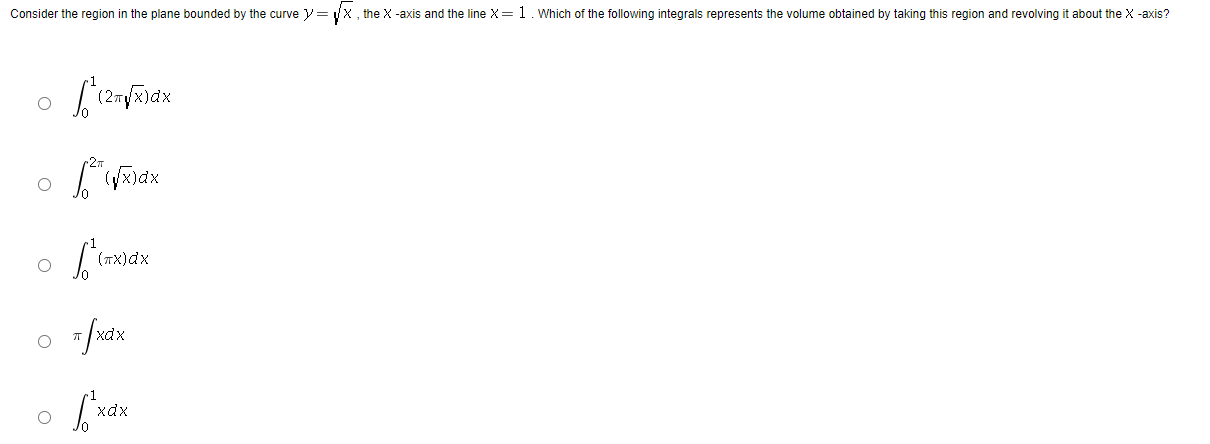
im really bad at volumes
toxic prairie
3rd one down
alpine sable
toxic prairie
3rd one down
thank you but can you explain it if you don't mind?
 tawny lion
there is a formula
integral of pi y^2 dx
so if y = root(x), your integral is x * pi
so make a bounded integral with x * pi
toxic prairie
the volume of a revolution is given by the integral of $\pi y^2$ (arrived at by considering the limit of cylinders) so the function $y = \sqrt{x}$ gives the integral $\pi x$
alpine sable
thank you guys so much
ocean sealBOT
holazach
 toxic prairie
np
tawny lion
if it asks for volume of revolution around y axis
then the formula is pi * x^2 dy
just remember those and you are good
alpine sable
 loud ivy
The number of arrangements of the letters in the word ZYZZYA is
loud ivy
The number of arrangements of the letters in the word ZYZZYA is
$\frac{6!}{1! * 2! * 3!}$
ocean sealBOT
omeganebula
 loud ivy
alpine sable
$\frac{6!}{1! * 2! * 3!}$
loud ivy
alpine sable
$\frac{6!}{1! * 2! * 3!}$
thank youuuuuuuu
alpine sable
np 
 alpine sable
calculus 
rigid smelt
 loud grove
Why is this true?
loud grove
Why is this true?
you have to find that out thru the derivative of C
just differentiate and set the derivative equal to 0
after that try solving the equation for k
or find some kind of conditions for the equation to have (a) solution(s)
loud grove
Ohh I think I got it, thanks
alpine sable
https://i.imgur.com/WGkpO4W.png the answer to this would be the third option right?
 alpine sable
plz
alpine sable
i not good at that one
 hearty flame
ok
hearty flame
who is really good at math here
toxic prairie
whats up with i
alpine sable
can someone correct me
 toxic prairie
64 x 30 = 1920 whats the problem
alpine sable
toxic prairie
64 x 30 = 1920 whats the problem
np

 vale wigeon
have you made any progress so far? @jaunty crane
sterile beacon
Use the curve to decide the velocity at the time period 4s
 vale wigeon
@sterile beacon channel busy please move
 jaunty crane
vale wigeon
have you made any progress so far? <@524763288597168129>
jaunty crane
vale wigeon
have you made any progress so far? <@524763288597168129>
not yet i dont how to do
sterile beacon
How rude
vale wigeon
@jaunty crane you have a right triangle with sides labeled as follows

there's this very famous theorem concerning the side lengths in a right triangle...
jaunty crane
c2=a2+b2?
vale wigeon
use this symbol for exponents: ^
jaunty crane
c^2=a^2+b^2
vale wigeon
but yes, the pythagorean theorem is what i am talking about.
write out the theorem as it applies to this triangle, in terms of x and y.
vale wigeon
what do you mean by "theres 2"
there will be two equations in your problem, yes
one of them will come from the pythagorean theorem
the other we'll get to later
vale wigeon
don't overthink it and don't do any algebra until i tell you to.
jaunty crane
c is the hypotenus right
vale wigeon
y ≠ 2x-1, so no, you should not replace y^2 with (2x-1)^2
vale wigeon
@sterile beacon to address your earlier remark, you were being rude by intruding on an occupied channel. all i did was redirect you.
vale wigeon
you're still missing one
jaunty crane
uhm
vale wigeon
doublecheck your equation, you're still missing a square somewhere
sterile beacon
vale wigeon
<@780004152452579354> to address your earlier remark, _you_ were being rude by i...
I can't deal with you right now
jaunty crane
y^2
vale wigeon
we are given one other piece of info about the triangle
the perimeter of our triangle is 40
jaunty crane
yes
vale wigeon
are you able to turn that into an equation in x and y?
vale wigeon
yes
jaunty crane
ohhh
vale wigeon
so you have two equations now: $\begin{cases} x^2 + (2x-1)^2 = y^2 \ 3x + y - 1 = 40 \end{cases}$
ocean sealBOT
Ann
 vale wigeon
can you continue from here?
sterile beacon
Use the curve to decide the velocity at the time period 4s
 vale wigeon
have you made any progress on this?
jaunty crane
who?
vale wigeon
crimespree
jaunty crane
ok
vale wigeon
who seems insistent that they get help in this channel specifically, because "channel busy please move" is apparently just too rude for them
 vale wigeon
x = 105/2 is an extraneous solution, precisely because it makes y negative (which for us makes no sense)
vale wigeon
it's not wrong
you solved the quadratic correctly
it's just that the solution x = 105/2 must be discarded
jaunty crane
what does that means
vale wigeon
i mean exactly what i said
the solution x = 105/2 must be discarded, since the resulting value of y is negative, but the problem tells us that y is a length
vale wigeon
just write "y = -233/2 => x = 105/2 is extraneous" or something...
like
it's not a Process or anything
you're overthinking it
jaunty crane
owh ok thank you so much
vale wigeon
unless your teacher is draconian about formatting and forces you to follow a fixed and predetermined format, in which case you should ask them and not me how they want it written
 brisk wedge
993
alpine sable
help
 brisk wedge
B OPTION CONFIRMED
alpine sable
help with that one plz

@alpine sable a
if you consider π as 3.14
2(3.14)×(47÷2)
P=2πR
thx
this is my lost question for today

91m-->170km
22m-->x
so x=22×170/91
=41.09 rounded to 41.1
so d
thx for the help alot i appreciated

 uncut depot
how do i get good at multiplication
 granite mountain
What kind of multiplication?
granite mountain
I mean, you just practice, that’s how you get good at everything
gray isle
set up a multiplication table
uncut depot
how does that help with 432*435
gray isle
 uncut depot
the way the teachers ask us to do it is "learn the multiplication table and spit it out now"
uncut depot
gray isle
mental math
like what about the human calculators
do they just practice that in their head so much that they become good?

 jaunty plover
I think there's also some tricks
uncut depot
i see
jaunty plover
you can search for "tricks" on youtube
uncut depot
okay
jaunty plover
uh if your case was 432*434 you can rewrite it as (433-1)(433+1) difference of squares. then you probably use a trick to square the number quickly and subtract one
uncut depot

granite mountain

Here is an interesting method to visualize multiplication that reduces it to simple counting!
Draw sets of parallel lines representing each digit of the first number to be multiplied (the multiplicand, see figs. 1 and 2 further below).
Draw sets of parallels, perpendicular to the first sets of parallels, corresponding to each digit of the secon...
This is one of the triks

This video shows the Chinese Method of Multiplication. Video has incorrect spelling of Lattice, my apologies.
And the Chinese way
uncut depot

 jagged imp
lettice
 still violet
How can I represent this code float actions[] = new float[2]; but with a mathematical expression/formula ?
being the float a real number
uncut depot
why do you wanna do new here
 stray notch
it looks like java to me
uncut depot
its C or C++
stray notch
it can be written the same in java
 covert berry
I think it's not C#
If you're using VS, types should be colored green.
unless that's modifiable
stray notch
ah no, this is java
 past bramble
the code is correct
stray notch
the screenshot i showed was to show that java accepts the same place for []
still violet
C#
past bramble
its java
still violet
but what about representing this in a mathematical formula?
covert berry
what do you mean?
stray notch
well
past bramble
You cant really
stray notch
a float is a decimal
past bramble
This just reserves space in your memory for 2 floats
stray notch
^
past bramble
You dont need to reserve memory in math
stray notch
do you wanna have 1 continuous float?
still violet
No no, just wanted to know if this can be represented mathematically, without code
stray notch
^
covert berry
what
still violet

still violet
ok ok, thank you guys! I appreciate your help
covert berry
arrays are stored as one dimension too, right
stray notch
the arrays are basically matrixes
covert berry
like, the memory allocated for 2ds, 3ds, are basically 1d with extra algorithm?
i heard that somewhere
covert berry
there is a Matrix type?
stray notch
depends on the language, c has a multi dimension array in a single line behind the scene
covert berry
what may be one that does it otherwise
stray notch
oop languages
stray notch
the second dimension is not initialized
and therefore can be initiated later
and because of that the memory addresses are not in a continuous format
covert berry
that sounds new for me tbh
i'm told that in C#, arrays are stored continously
therefore fixed
stray notch
i don't know about c#
covert berry
and they use algorithms to locate indeces if it's multi dimensional
stray notch
but in java this is how it works
stray notch
covert berry
and they use algorithms to locate indeces if it's multi dimensional
i know this is for sure in c and c++
alpine sable
this has been bugging me for a while now. when do I distribute the minus over the numerator and when do I not?
 past bramble
when you have a fraction it has brackets
so if you have a minus in front of a fraction
its like you have -(fraction)
some teachers want you to remove the minus to have the most simplified solution
but tbh it doesnt matter its the same
alpine sable
past bramble
but tbh it doesnt matter its the same
so if the minus sign is beside the fraction (the div line ____) it's like -(the fraction) ?
past bramble
yea like in exercise a
 sudden crater
Could I get help after this?
Any idea how to solve Q12 without calculus to graph the function?
 lethal stump
honestly i don't think there's any other way
past bramble
You got the answer by any chance?
vale wigeon
i don't think it's possible without calculus
you will need the turning points, one way or another
 woven sphinx
@sudden crater you could always use the discriminant of the quartic (which IIRC doesn't involve calculus), but considering the discriminant has 16 terms it seems quite unwieldly.
vale wigeon
i mean ok like
you can graph y = 3x^4 + 4x^3 - 12x^2
and this factors
...probably
,w factor 3x^2 + 4x - 12
wait no
ocean sealBOT


 vale wigeon
hrm. no nice factorization then.
woven sphinx
that, or you could use the general formula for the quartic if you're a maschoist.

have fun!
vale wigeon
@sudden crater is there a requirement not to use calculus?
woven sphinx
But seriously, if you cannot use calculus I would just stick with finding when discriminant of quartic<0.
sudden crater
vale wigeon
<@589524545577156639> is there a requirement not to use calculus?
Well someone else asked me this, and I don’t think they know calculus
It also came under the factor theorem remainder theorem chapter in their book for some reason
sudden crater
woven sphinx
that, or you could use the general formula for the quartic if you're a maschoist...
That could possibly work, but I don’t think the textbook would ask such a thing and not mention the discriminant at all
I’ll try it soon though
woven sphinx
 lunar vigil
1 +1
lunar vigil
1 +1
0 mod 2, duh
sudden crater
Duh
woven sphinx
did the textbook mention vieta? might be somehow related to that
 noble sinew
what is the problem with 3x^4+4x^3-12x^2=x^2(3x^2+4x-12) - here we notice that the only way it has more than 2 solutions is if k>=0 (if k<0 then x^2 would have to be negative for it to have more than 2 solutions - which isn't possible)
sudden crater
They aren’t online now though
noble sinew
if k=0 then it only has 3 solutions (zero rule - x^2=0 only has x=0 as solution)
if k>0 it can have 4
now we just need to find an upper bound on k
sudden crater
noble sinew
what is the problem with 3x^4+4x^3-12x^2=x^2(3x^2+4x-12) - here we notice that t...
Thanks, that makes sense!
How would you find the upper bound though?
lethal stump
lunar vigil
1 +1
😎
noble sinew
its something with 3x^2+4x-12-k=0 the positive solution is equal to 1 when k=5 and when k>5 the positive solution is <1 which then when you multiply by that by x^2 it makes it impossible to find such a solution - idk a good argument or even how you would think of that though - if you aren't allowed to use vertex/min and stuff like that
 nova anvil
bruh what
anyone can help for c? I am so far doing this

trying to show that A is the limit of the A_n

what i got so far but yea i cant show A is in A_n^\ep
 sullen nova
yeah
 minor heath
2 pins, thread, and a writing material if u want it to be perfectly drawn
 mortal wraith
https://cdn.discordapp.com/attachments/813008603363016737/854676518432014336/unknown.png which one convergent or divergent
 sullen nova
Who tf brings an entire set of tools to draw an ellipse on exam?
nova anvil
lol
vale wigeon
sullen nova
Who tf brings an entire set of tools to draw an ellipse on exam?
and who brings a compass?
on an exam a rough sketch is enough so long as you get shit like vertices right
woven sphinx
vale wigeon
and who brings a compass?
i do, its a must have for olys
cant actually solve a problem without making diagram as good as possible to find interesting observations n go from there
alpine sable
The sum of a number and its square is 16. Calculate this number.


what am i doing wrong?
 gray isle
what are all the choices
alpine sable
these are all choices
gray isle
1 2 and 0?
alpine sable
yep]
 high wolf
hi question, what does the square bracket and the ' represent?
$\frac d {dx} [cf(x)] = cf'(x)$
ocean sealBOT
plain
 gray isle
are you sure you copied the question down correctly? 0 ,1, 2 don't make any sense as answer options for that.
in this context, [] are used as grouping symbols
' is Lagrange notation for the derivative
in this case, f' is the derivative of f
high wolf
is f'(x) exactly the same as d/dx f(x)?
gray isle
yes
gray isle
no points system
high wolf
okay haha thanks
gray isle
thanks is good enough
 hollow peak
My teacher asked me why we could divide by dy and I have absolutely no idea? Can anyone explain?

he says it’s 0 so the proof is not complete
high wolf
is this the correct way to write this?
 sullen nova
My ellipse looks like a potato
 undone dock
The second derivite of f(x) is notated as [d^2/dx^2]f(x)
gray isle
$f''(x) = \dv[2]{x}f(x)$
ocean sealBOT
ℝamonov

 carmine lion
 hoary swallow
can anyone help pls?

 glass lichen
hoary swallow
can anyone help pls?
glass lichen
hoary swallow
can anyone help pls?
what have you tried?
 random pelican
Can anyone send me the name of this content? Than I can google it better

Or send a YT Link explaining it, ty
hoary swallow
glass lichen
what have you tried?
im not sure where to even start
glass lichen
ok well when you do the y=vx method, you differentiate both sides wrt x, treating v as a function of x
then turn the DE into one relating v and x
random pelican
random pelican
Can anyone send me the name of this content? Than I can google it better
Can anyone help? 
random pelican
random pelican
Can anyone send me the name of this content? Than I can google it better
<@&286206848099549185> Sorry for the ping, but could anyone send me the name of this content than I can learn it? I've googled alot of things that I tough was it but it wasnt
glass lichen
random pelican
<@&286206848099549185> Sorry for the ping, but could anyone send me the name of ...
wait 15 mins to ping helpers
random pelican
Ok

 rose imp
,rotate
ocean sealBOT

 sharp sable
So anyone knows?
rose imp
gradient is slope
sharp sable
Yes
sharp sable
Ok
hoary swallow
is there any way to do this without using binomial theorem (as it would take a while to do it that way i think)

 oak chasm
@hoary swallow If j is the square root of -1, you can convert to polar coordinates, take the radius to the 12th power, multiply the angle by 12, and convert to rectangular coordinates.
 frank knoll
 oak chasm
@frank knoll So, is the first statement consistent with the problem statement?
frank knoll

hoary swallow
oak chasm
<@!418451167815663636> If j is the square root of -1, you can convert to polar c...
so i got the polar coordinates as: (1.0296, -1.06°) where would i go from there?
do i multiply that by 12 and convert to rectangular form?
oak chasm
@hoary swallow Just so you know, it's -1.06 radians.
Now, you take the radius, 1.0296, and take it to the 12th power to get your new radius.
Then, you take the angle, -1.06, and multiply it by 12 to get your new angle.
Then you convert to rectangular.
hoary swallow
thank you i appreciate it ^^
oak chasm
No problem.
 marsh hornet
can somebody help me ?
 high wolf
why does b move to the fraction? any video for me to learn this?

 gentle flame
Let u = bx and then integrate
Look up integration by u substitution, that might help
oak chasm
@high wolf Sorry, channel is busy.
high wolf
sorry, didn't notice, also thanks
oak chasm
@marsh hornet You'll get this as n goes to infinity:
ocean sealBOT
Chai T. Rex

 unreal stream
Anyone know function like this f(g(x))
oak chasm
@fallen birch @unreal stream Sorry, channel is busy.
unreal stream
Okok
marsh hornet
@oak chasm I've found the value of x


 oak chasm
Oh, wait, that was the wrong question.
a is inside the square root, so we want a to be greater than or equal to zero.
ocean sealBOT
Chai T. Rex
 oak chasm
Solve that.
Oh, wait.
Never mind.
Don't solve that 🙂
Sorry, I'm getting tired.
The innermost square root has a in it.
a must therefore be at least zero.
If a is at least zero, all the other square roots will have something nonnegative plus sumething nonnegative.
So, isn't a being at least zero the answer to make it converge?
If it's less than zero, you get complex numbers.
Seems like an easier problem than I thought unless I'm misinterpreting it.
marsh hornet
oak chasm
Sorry, I'm getting tired.
it's okay, thank you for helping me
oak chasm
No problem, but is that the answer?
,w N[Sqrt[a + Sqrt[a + Sqrt[a + Sqrt[a + Sqrt[a + Sqrt[a + Sqrt[a]]]]]]]] where x = 12345 where a = x^2 - x
ocean sealBOT


 Requested by Chai T. Rex#7323
oak chasm
Requested by Chai T. Rex#7323
oak chasm
You can make it converge to lots of different numbers depending on the a value, but a has to be greater than or equal to zero.
marsh hornet
so every a greater than or equal to zero, makes x converge ?
oak chasm
x isn't involved.
ocean sealBOT
Chai T. Rex
 marsh hornet
oh i see
 pale terrace
The volume of a parallelepiped formed from vectors a, b, c can be found using the
formula V = a⋅ b×c. Determine the volume of a parallelepiped formed by
a = 1, −3, 4 , b= 0, 2, −8 , c = −3, −4, 7 .
Can I simply foil those three vectors to get my answer
 sharp basalt
how would you do this? 
 jaunty plover
I think I know a way but it's too messy
 ancient creek
sharp basalt
how would you do this? <:CursedFlushed:679473110956769300>
ancient creek
sharp basalt
how would you do this? <:CursedFlushed:679473110956769300>
draw a line from the top left vertex to the bottom right vertex. You will get two triangles. Use law of cosines to figure out the length of their sides. then use Heron's formula to find their areas
 jovial violet
Hi guys could I please have some assistance?
Given the equation r cos (180 - w) = y
Verify in no more than 4 steps the following identity by dragging the steps to be followed in order to show the L.H.s is equivalent to the R.H.S
r cos (180 - w) = y
r cos (180 - w) = -r cos w
I have no clue whats going on here
@gentle flame nvm its here
gentle flame
What is y? it doesn't feel like we have enough information
jovial violet
The angular velocity ω of each person riding a carousel is the number of degrees, or radians, that a point on the edge of the carousel moves in a unit of time. You can use the equation y = -r os w
 unique kayak
y shouldn't matter, but I recommend having a look at the cosine function and seeing how it changes in intervals of 180°
jovial violet
unique kayak
y shouldn't matter, but I recommend having a look at the cosine function and see...
where r is the radius of the circle, to sketch a graph representing the position of a person on the carousel with respect to a stationary point every 60 seconds. this has matters?
cause im suppose to say the steps
gentle flame
Yes, this most definitely matters
jovial violet
to proving
gentle flame
jovial violet
r cos (180 - w) = y
r cos (180 - w) = -r cos w
Are you sure it's not $\cos (180 - \omega t)$ here
ocean sealBOT
wermos
 jovial violet
or yall want me send the whole thing? T-T
The angular velocity ω of each person riding a carousel is the number of degrees, or radians, that a point on the edge of the carousel moves in a unit of time. You can use the equation y = -r os w
where r is the radius of the circle, to sketch a graph representing the position of a person on the carousel with respect to a stationary point every 60 seconds.
Given the equation r cos (180 - w) = y
Verify in no more than 4 steps the following identity by dragging the steps to be followed in order to show the L.H.s is equivalent to the R.H.S
r cos (180 - w) = y
r cos (180 - w) = -r cos w
gentle flame
Send it once, just to be safe
 jovial violet
gentle flame
Send it once, just to be safe
jovial violet
gentle flame
Send it once, just to be safe
IM suppose to list 4 steps
 hollow siren
letter F
unique kayak
Again, you should be able to prove that this is true without any other context
 jovial violet
unique kayak
Again, you should be able to prove that this is true without any other context
jovial violet
unique kayak
Again, you should be able to prove that this is true without any other context
ohh but they're asking me to tell them the steps
asking if step 1 is conjugate,double angel,trig ratio etc
here u go
 unique kayak
Oh, it's formulated like that
jovial violet
yeahhh
gentle flame
Yeah
unique kayak
Damn, that sucks
gentle flame
jovial violet
here u go
It's a lot simpler knowing this
gentle flame
jovial violet
The angular velocity ω of each person riding a carousel is the number of degrees...
And this
gentle flame
jovial violet
here u go
What is this "conjugate" identity? afaik, that's not standard terminology
jovial violet
gentle flame
What is this "conjugate" identity? afaik, that's not standard terminology
the conjugate of x+y is x−y . We can also say that x+y is a conjugate of x−y . In other words, the two binomials are conjugates of each other.
im as confused as u are
unique kayak
That's what you'd be using with complex numbers, why is that here?
jovial violet
I just think thats their for fodder but u have to pick the right 4 out of them
not that it may be correct
gentle flame
I'm not really sure what your teacher wants you to do. It's an identity that cos w = - cos (180 - w)
And this pretty much proves the proposition straight up
unique kayak
I'm terribly sorry, but none of those options make even the slightest sense to me
gentle flame
Same
jovial violet
could u help with this one instead?

cause that other one is confusing the shit out of m
gentle flame
Why are you asking Physics questions here 😂
Hold on, let me remember my AC stuff
It's been a while
jovial violet
bro im an electrical engineer lmao
gentle flame
What's the maximum value of sine?
jovial violet
well persuing it
gentle flame
gentle flame
What's the maximum value of sine?
That'll help you find the peak value of the current
jovial violet
gentle flame
What's the maximum value of sine?
it wasnt stated
unique kayak
We can try seeing which ones dont make any sense: conjugate doesn't make sense here, double angle doesnt, there's nothing we can cancel, trig ratio i don't know what it is, pythagorean identity won't help us equivalent fractions don't appear, there's nothing to calculate, FOIL I don't know, there's no perfvect squares involved, there's nothing to factorise, multiply might be something, co-function identity might be something, there's nothing to expand or simplify, nothing to distribute and compound identity i dont know
gentle flame
jovial violet
it wasnt stated
You should know
jovial violet
gentle flame
You should know
ohh lmao bet
unique kayak
yea, the maximum value for sine is 1
jovial violet
righttt
gentle flame
jovial violet
120 aint it ?
Correct
jovial violet
but Idk how its suppose to help me T-T
gentle flame
Yep
gentle flame
Amps
unique kayak
voltage isnt mentioned here lul
jovial violet
SO Thats the peak value? T-T
unique kayak
yea
gentle flame
$I = I_0 \sin (\omega t + \phi )$
ocean sealBOT
wermos
 gentle flame
That's the general formula
I_0 is the peak current, omega is the frequency, and phi is the phase
 ionic tartan
What is everyone’s background in maths? Are we all students or what.
jovial violet
ionic tartan
What is everyone’s background in maths? Are we all students or what.
We are
gentle flame
ionic tartan
What is everyone’s background in maths? Are we all students or what.
Hehe
Just ask
gentle flame
Freshman in math, almost a sophomore
ionic tartan
Is anyone from UK?
unique kayak
not me
gentle flame
Nah
ionic tartan
USA?
gentle flame
I wish lol
unique kayak
neither that
jovial violet
unique kayak
120V is the peak voltage
how do i find the frequency
ionic tartan
What level of math do you do? Like right now.
jovial violet
im on 30 minutes left
jovial violet
ionic tartan
What level of math do you do? Like right now.
physics and pure
unique kayak
you think about what the angle velocity is there
it's 2pi * frequency
turn it around and that's your frequency
gentle flame
jovial violet
could u help with this one instead?
The question isn't really well-formed. I mean, what is theta?
gentle flame
unique kayak
turn it around and that's your frequency
That's the angular frequency
$\omega = 2\pi f$
ionic tartan
I’ve just passed my engineering maths graded unit. Stuff like trig equations, integration, differentiation. What level of maths is that for you guys?
ocean sealBOT
wermos
 unique kayak
that's 1/3 theta
 winter rock
Hi,
gentle flame
ionic tartan
I’ve just passed my engineering maths graded unit. Stuff like trig equations, in...
High school, ngl
ionic tartan
Really?


 ionic tartan
That’s higher for me.
gentle flame
ionic tartan
Really?
Yes
jovial violet
unique kayak
it's 2pi * frequency
frequency * 2pi
 pliant estuary
ionic tartan
I’ve just passed my engineering maths graded unit. Stuff like trig equations, in...
pliant estuary
ionic tartan
I’ve just passed my engineering maths graded unit. Stuff like trig equations, in...
Use different channels please if you just want to talk to people
unique kayak
yes
ionic tartan
Okok my bad
winter rock
Am I right pls?
unique kayak
so divice the angular velocity by 2pi and you have your frequency
unique kayak
Use another channel pls
jovial violet
unique kayak
so divice the angular velocity by 2pi and you have your frequency
the angular velocity is there?
pliant estuary
winter rock
I wanna know if I understood that at least
move it to another channels, this one is occupied
unique kayak
jovial violet
the angular velocity is there?
(1/3 theta)/2pi
winter rock
K boss
jovial violet
unique kayak
(1/3 theta)/2pi
this is my final exam so thanks man im shitting bricks rn
unique kayak
periodic time is the inverse of frequency, the phase shift stuff is a bit weird
Wait that's an exam?
jovial violet
unique kayak
Wait that's an exam?
yuppp
unique kayak
 unique kayak
okay, then consider us a group
jovial violet
we're allowed to help eachother
yeah but my classmates dont know shit thats going on T-T
That's why im here
unique kayak
What exactly do they mean with magnitude and direction of phase shift?
jovial violet
2pi * frequency so this is the period calculation
unique kayak
the phase shift is +pi/6
jovial violet
unique kayak
the phase shift is +pi/6
the + is a typo?
period time 1/10pi in that case
unique kayak
the phase shift is independent from the period
it's like if you had a linear equation ax+b the phase shift is the b
jovial violet
oh but im saying i got 1/10pi for periodic time
unique kayak
Oh yea, that might be true, what's theta again?
jovial violet
unique kayak
the phase shift is +pi/6
so what does the + mean?
unique kayak
its positive
jovial violet
we dont know theta remember T-T
unique kayak
unique kayak
(1/3 theta)/2pi
but then your frequency is this
and the inverse is 2pi/(theta/3)
jovial violet
unique kayak
and the inverse is 2pi/(theta/3)
OH so thats the period time?
unique kayak
yea
or more simplified 6pi/theta
the phase shift is again, pi/6 and it's positive ( I hope that's what's meant by direction ) and I have no clue what's meant by vertical shift
jovial violet
unique kayak
the phase shift is again, pi/6 and it's positive ( I hope that's what's meant by...
and the magnitude would be?
unique kayak
No clue what's meant by that, honestly
jovial violet
the 6 is?
unique kayak
no it's pi divided by 6
the same with the others
I use / as "divided by" to imply a fraction
jovial violet
ohhh I understand
unique kayak
I don't wanna have to write $\frac{a}{b}$ everytime
ocean sealBOT
ΛV

 somber spoke
Can you solve this challenging problem? Thanks to Ramesh for the suggestion!
0:00 Problem
1:18 Method 1
4:11 Method 2
(Sorry about the repost! In the previous video I had m = -1 by mistake around 3:05. I thank Andy Chen for alerting me of the typo! This is the original video: https://youtu.be/w6xul7j4t_U)
Subscribe: https://www.youtube.com/us...
I understand the first solution until it says that there are only 2 solutions
I dont understand how he got that
unique kayak
There's question being asked here, please refer to another empty channel, or if none are available, please wait your turn
somber spoke
Ok
unique kayak
@jovial violet The vertical shift might mean the range in which the values of the exuation lie
equation
but then the direction doesn't make sense
gentle flame
The vertical shift, if I understood the question correctly, is 0
jovial violet
 jovial violet
unique kayak
Yea, what he's saying
jovial violet
unique kayak
Yea, what he's saying
huh
unique kayak
it's 0
jovial violet
jovial violet
The amplitude is 4 ii. The period is 2 pi
ii. Hence, the equation of the wave is Answer
?
jovial violet
y=4sin(θ) is what i have s ofar
unique kayak
Is this a new question?
jovial violet
gentle flame
The vertical shift, if I understood the question correctly, is 0
and the magnitude?
jovial violet
unique kayak
Is this a new question?
yup
unique kayak
did you get the other one
gentle flame
jovial violet
and the magnitude?
afaik, "vertical shift" is not a commonly-used term in the context of ac
unique kayak
ark, use cosine instead, it's much easier
jovial violet
 gentle flame
So I'm not sure what they mean, but if it means what I think it means, then "direction" makes no sense
unique kayak
if you're allowed to
jovial violet
unique kayak
ark, use cosine instead, it's much easier
okie
jovial violet
unique kayak
what did you put for frequency and periodic time
aww come on what did i do wrong
unique kayak
frequency is $\frac{theta}{6pi}$, periodic time is $\frac{6pi}{theta}$
ocean sealBOT
ΛV
 unique kayak
for the phase shift, I recommend writing it as pi/6, that's harder to misunderstand
jovial violet
but it never stated what theta was yk thats why im probably stuck
unique kayak
yea, so just write theta into your answer
if they don't care what theta is, neither do we
phase shift direction is "+", vertical shift is 0 and "+" again I hope
unique kayak
back to the second question: your answer is mostly right, but it's shifted