#help-0
1 messages · Page 648 of 1
 tender geyser
correect, its the same idea ^^
i can flip the graph above on its head and you can see the same ideas for max
np 🙂
 plush epoch
Hello
Context: I'm interested in generating curves that intuitively describe the surface of a 3d object. For example: Creating a spherical spiral based on a sphere. A bit like if a 3d printer would print a sphere. I'd like to do this not only for spheres, but all kinds of object. So I'm wondering.
My question: I this a specific case of problems or algorithms that are known in Math? If so, what are they called? I'm asking because my googling wasn't very successful so far because I don't really know what I should be googling for. What I've found are "slicers", which translate a mesh into motor instructions for a 3d printer, which must tackle the same problem, so I assume. But I would prefer looking in to the broader topic first (if it exists), before I start reading slicer code, hoping to stumble upon their solution of this.
while I'm sure I'd find spiraly functions for many 3d primitives, I'd also be interested in doing different things than spirals, and of course even use meshes instead of primitives if that would be possible as well :).
 alpine sable
h
 warm phoenix
Okay so sine of $240^{\circ}$ ($4{\pi}/3$) is $-\sqrt{3}/2$
cosecant is 1/sine right? Or well 1/sin($\theta$)
So it'd be $1/ (-\sqrt{3}/2$) right?
So how does it become positive $2/\sqrt{3}$? Why does the sign change?
Or am I wrong?
 ocean sealBOT
FloppyDingo

 velvet pelican
,w calculate csc(4pi/3)
ocean sealBOT


 Requested by Frosty_#7210
velvet pelican
warm phoenix
Okay so sine of $240^{\circ}$ ($4{\pi}/3$) is $-\sqrt{3}/2$
cosecant is 1/sine ...
Requested by Frosty_#7210
velvet pelican
warm phoenix
Okay so sine of $240^{\circ}$ ($4{\pi}/3$) is $-\sqrt{3}/2$
cosecant is 1/sine ...
I think you're wrong
warm phoenix
This online circle test is a big oof then: https://i.imgur.com/TXX0LWG.png
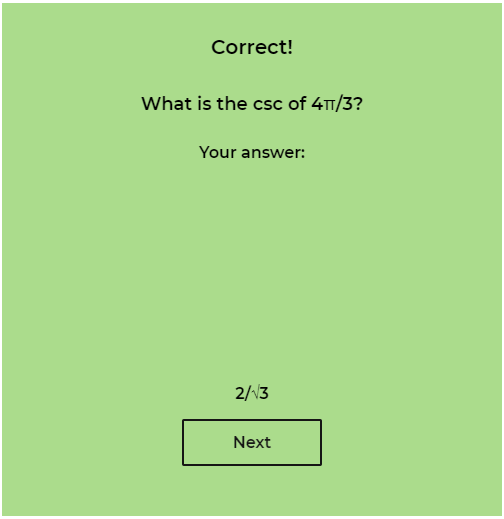
No wonder I was confused. Ty
ocean sealBOT
Please give me something to evaluate.
See ,help calc for usage details.
 rough spear

 empty moth
,calc csc(4π/3)
ocean sealBOT
The following error occured while calculating:
Error: Undefined symbol π
 vale wigeon
,calc csc(4*pi/3)
ocean sealBOT
Result:
-1.1547005383793
 tranquil tulip

 gusty gorge
write it as $\sqrt[4]{9^3}$ and simplify from there
ocean sealBOT
Saccharine
 gusty gorge
Note that $9^3 = 3^6$
ocean sealBOT
Saccharine

 sterile relic
say u have a^(b/c) the resulting radical will be $ \sqrt[c]{a^b}$
alpine sable

why is this the case?
wtf bro
Yeah but no
if f(x) = 3x +5 and g(x) = x then they aren't multiples no?
yes but in this case we have 3x and x, one grows 3* faster
ohhh
thx
 wet fulcrum

 somber shard

Did I do this right? Because they’re the same thing but different letters
Oh okay
ocean sealBOT
itsDaman ඞ

 glass lichen
factor
why did ln(x) become ln(1)?
"take e" is vague
Like I said "take e" is vague
alpine sable
how do i prove this?

 oak chasm
@alpine sable Use the associative and commutative properties.
alpine sable
oak chasm
<@456226577798135808> Use the associative and commutative properties.
i don't know how
it's all new to me
oak chasm
@alpine sable OK, what's the commutative property say?
alpine sable
 oak chasm
OK, what does the associative property say?
alpine sable
 ocean sealBOT
Chai T. Rex
 alpine sable
yes
ocean sealBOT
Chai T. Rex
 oak chasm
These are steps in proving it.
The commutative property and the associative property are generally things you don't have to prove.
These are just uses of them.
alpine sable
i don't understand what proving looks like
oak chasm
It's where you use the axioms you know to transform things.
The associative property and commutative property are generally used as axioms.
alpine sable
this is basic math though
oak chasm
Right, even more so then.
You use the commutative and associative properties to transform the starting expression into the ending expression, step by step.
We've done a few steps that way.
That's how you do the proof.
alpine sable
but i don't understand what a proof actually looks like
we can say these expressions are all equal to each other but how does that translate to an actual proof?
oak chasm
That doesn't translate to one. That is one.
alpine sable
?
oak chasm
You're asking how to translate from that to a proof.
You don't need to translate.
It's already a proof.
alpine sable
Hey guys can someone explain why the probability of only one cube being 6 is 10/36?
cant wrap my head around this, thanks
oak chasm
@alpine sable If you want to be more explicit, you can give what you used on each step, as in https://mathbitsnotebook.com/Algebra1/LinearEquations/LEjustify.html.
 summer parcel


 merry coral
back
wow looks like you solved it

credit to @noble sinew
odds of flipping a total, n, number of heads before flipping a total of 3 tails
 ashen wave
Can anyone tell me what the difference between each are 
 glass lichen
ashen wave
Can anyone tell me what the difference between each are <:pandaOhNo:513070260471...
glass lichen
ashen wave
Can anyone tell me what the difference between each are <:pandaOhNo:513070260471...
one is standard form, one is factored form and one is vertex form
ashen wave
.
 manic halo
its the same equation, just written differently
 knotty sleet
They're used for different things
ashen wave
what are the different things-
knotty sleet
Standard is standard, easy for differentiation
Factored can be used to find roots
Vertex is used to find extrema
ashen wave
knotty sleet
Factored can be used to find roots
wdym by roots?
knotty sleet
The x-axis intercepts
ashen wave
oh. wait I remmember talking about y=-b/2a what was that for?
knotty sleet
That's going from standard to vertex form
Basically if you are given standard form (which is most often the case), the 'b' in the vertex form is the -b/2a in standard
ashen wave
nvm I wasnt thinking straight
ashen wave
ohhh so that would also be the x value for the vertex
knotty sleet
Exactly
ashen wave
oh ok tysm!
knotty sleet
👍
 gloomy lintel
The integral from 2 to 0 is the same as the one from 4 to 0 minus the one from 4 to 2 as we only want 0 to 2
gloomy lintel
No, how are you getting 31?
Ahhhhh nvm I’m dumb I thought the limits read 2 to 4
lollll
I should read the q next time
knotty sleet
The area
Maybe
I've seen it used to mean area
Square brackets
Lol imagine naming an octagon TRIANGLE
 elfin snow
lol
 somber spoke

can someone help me wrap my head around this
im new to integration

if i did the integral of this graph between -1 and 7 then what bit would be shaded

would it be like this??

 vapid ermine
somber spoke
vapid ermine
somber spoke
but if you say between y=x²-4x-4 , x=-1 x=7 , then it would be like this
somber spoke
Yes but I was just confused cus I didnt know what the area under the curve between -1 and 7 was
 prime ice
Determine the coordinates of D
can someone help pls im new to this type of geometry
 vapid ermine
somber spoke
Yes but I was just confused cus I didnt know what the area under the curve betwe...
vapid ermine
somber spoke
Yes but I was just confused cus I didnt know what the area under the curve betwe...
you forgot using both of them so i think you know for now?
@prime ice first one 18-2x²=0
x²-9=0
prime ice
i finshed those sorry
vapid ermine
oh ok
prime ice
i need help for Determine the coordinates of D
vapid ermine
make equal them
somber spoke
vapid ermine
you forgot using both of them so i think you know for now?
I was trying to visualise them separately at first sorry I'm confused
 prime ice
yeah i got that
vapid ermine
ok then y=-x+3
and make equal them
18-2x²=-x+3
root are C and D
@prime ice 2x²-x-15=0
x=-2.5 x=3
-x+3= -(-2.5)+3=2.5+3=5.5
D is (-2.5; 5.5)
@prime ice did u found A or not?
if u didnt then
prime ice
yeah a is (0;18)
vapid ermine
ok so we found all of them?
prime ice
vapid ermine
D is (-2.5; 5.5)
.
prime ice
vapid ermine
-x+3= -(-2.5)+3=2.5+3=5.5
from here
vapid ermine
i found x is -2.5 for D from 18-x²=-x+3
cause other root is for C
so i put x in a place in -x+3
we found m=-1
little c is 3 from y=mx+c
then mx+c=-x+3
prime ice
so c + x gives us the y coordinate
vapid ermine
just put root in X
our roots are -2.5 and 3
3 is for C
so only -2.5 can be for D
 vapid ermine
yeah
prime ice
after they ask for this

sorry for troubling i just got exams comming up and im tryna prepare
vapid ermine
B was -3 0 right?
 vapid ermine
so if new graphix is y=kx+b then m=k for paralel to dc
and m was -1 so k=-1
-x+b=y -(-3)+b=0
b=-3
then y=-x-3
prime ice
sorry im confused
vapid ermine
oh ok again then
İf they want line through B
and line is y=kx+b when we put -3 in x then y should be 0
cause Line is on B also
also they want paralel to DC line
and we found DC line is -x+3
if New line and DC are paralel then in y=kx+b and in y=mx+c k should be equal to m
idk why but it's just rule
so new line is y=mx+b for now
and also it is on B and B is -3 0 so we can put -3 in X
also we can put 0 in y cause line is on B
so y= x=-3 then for y=-x+b 0=-(-3)+b 0=3+b and b=-3
vapid ermine
vapid ermine
if New line and DC are paralel then in y=kx+b and in y=mx+c k should be equal t...
k is -1 from his cause m also is -1
vapid ermine
vapid ermine
so y= x=-3 then for y=-x+b 0=-(-3)+b 0=3+b and b=-3
so line is y=-x-3
prime ice
vapid ermine
k is -1 from his cause m also is -1
what does k have to do with any of this though
vapid ermine
cause they say new line should be paralel to DC
vapid ermine
in my country time is 03:59 i have to sleep
prime ice
vapid ermine
in my country time is 03:59 i have to sleep
oh thanks alot man
have a good night
vapid ermine
if i could help, then i am happy and good bye
 wary stream
vapid ermine
idk why but it's just rule
wary stream
vapid ermine
idk why but it's just rule
It's not a rule, it's a known fact. Parallel lines have the same slope, while perpendicular lines have negative reciprocal slope
prime ice
what would i call the straight line through b
wary stream
prime ice
what would i call the straight line through b
What do you mean?
prime ice
Would I solve that like this ?
 prime ice
wary stream
What do you mean?
prime ice
wary stream
What do you mean?
.
wary stream
prime ice
Would I solve that like this ?
Yeah, that's right
prime ice
thanks
can someone explain how id go about doing this?

Draw the graphs of f and g on the same system of
axes.
wary stream
prime ice
Draw the graphs of f and g on the same system of
axes.
Just plot the functions on the same coordinate plane
prime ice
wary stream
Just plot the functions on the same coordinate plane
im lost sorry
wary stream
prime ice
heres the thing
Same coordinate plane, both functions should be in the same plane like this
Just plug in values into the functions
And plot the points
prime ice
wary stream
Just plug in values into the functions
how i do this
wary stream
prime ice
how i do this
Pick numbers as x values, to get a y value
prime ice
wary stream
Pick numbers as x values, to get a y value
could u please shoe me and example
wary stream
prime ice
could u please shoe me and example
If you don't understand how to draw a graph of the function by plugging in x values, and getting a y value, I suggest looking at resources on the internet
prime ice
ok ima do this tomorrow
let me do something i understand better for now

So I done this but is there a rule I can say to say AC=BD

 gray isle
from the midpoint alone, no
prime ice
prime ice
So I done this but is there a rule I can say to say AC=BD
and is this fine?
gray isle
from the midpoint alone, no
gray isle
yes
prime ice
ok thanks
glass lichen
change of base formula
gray isle
probably
merry coral
its trying to calculate log(2)
then is confused af when you have a 6 next to it with no operator
merry coral
odds of flipping a total, n, number of heads before flipping a total of 3 tails
so apparently
this is equal to
odds of flipping at least n heads in n + 2 tries
how do you calculate this lol
alpine sable
anyone know fourier series
 flat vale
When the question asks to answer to 2 decimal places do you use = or ≈
merry coral
flat vale
When the question asks to answer to 2 decimal places do you use = or ≈
I assume ≈ is better in general tho
flat vale
alr thx
 blazing rapids


i found the first three derivatives and their values
but im getting stuck trying to figure out how to convert this trend into a sum formula
bruh you couldnt have sent it in any of the other questions chats
i left the calc chat because you were getting help there
alpine sable
https://discord.gift/rztP3jyqJWsDvsd6
peepee poopoo
 steep briar
Careful. Make sure you're doing a Taylor series and not a Maclaurin series since you're centered at x=1.
Do you know the difference?
 fading jay
a series without minuses will obviously be more in modulus and it will converge to exponent-1, which means this will absolutely converge
steep briar
I ask because the equation you gave looks like a Maclaurin.
fading jay
and according to the Leibniz rule, the members of the series tend to zero and each next from the second is less than the previous one in absolute value
steep briar
Yeah, so what'd the skeletal Maclaurin series at x=1 look like?
(Idk why I added the adjective skeletal, don't think that's something special. The question just wants you to plug and chug the values from the table into the Taylor series at x=1, then you'll simplify by factoring the powers)
No that's a Maclaurin series, not a Taylor series
Yea
Did you try that originally?
One moment, I'll try to verify it's not a bugged question
 steep briar
(try to make due with this, it's especially useful in this question)

Could you show your attempt?
steep briar
fading jay
oops there near f '' '(1) should be (x-1) ^ 3, not (x-1) ^ 2
And the third term should be 2! not 1! again, heh
blazing rapids
blazing rapids
would anyone be able to help guide me in the right direction>
 rustic night
Anyone know how to solve this?

 jade sail
use proportions
steep briar
blazing rapids
would anyone be able to help guide me in the right direction>
Try not to simplify terms, that question is mainly about finding the pattern of the summation.
blazing rapids
so leave it in the form all the way to the left
i know im gonna need a (-1)^n to show the alternating sign
steep briar
Yeah a bit, let me see if it's right. I'm used to it being as a fraction.
Also a 3ⁿ term, you see why?
blazing rapids
umm not really, i see im going from 3 to 6 to 18, which wouldnt be 3^n
wouldnt a 3^n trend be 3 9 27
steep briar
Yea, lemme see how you got the 18.
blazing rapids
looking at how i wrote it i screwed it up
because originally i wrote it as (1+x) not (1+3x)
lemme redo it from the start and see if i get the same thing
blazing rapids
i got -3, 6, and -18 again
steep briar
blazing rapids
i got -3, 6, and -18 again
You did? Strange.
 blazing rapids
,rotate
ocean sealBOT
 blazing rapids
@steep briar am i doing something wrong
steep briar
I think your first derivative is wrong, it's missing the 3 coefficient from chain rule
steep briar
blazing rapids
ah yeah so -3 (-2) * 3 for the second derivative
Try to redo again keeping in mind what I said about chain rule since you seem to have the -2 a single derivative too early. Here's a really good piece that'll help you finish. I have to go so also see if someone else can help.

 light dirge
 blazing rapids
wait this is going to sound really stupid, but shouldnt it be -1, 0, 1, 2 ,3
ive been doing -1, -2, -3, -4
steep briar
Where'd you get -1,0,1,2,3 from? 0.o
steep briar
blazing rapids
the derivative of that should be -9(1+3x)^0
oh no
steep briar
It'd be -(3)²(1+3x)⁻² since you'd -1 from -1
blazing rapids
dang okay thanks
blazing rapids
ah this ones not bad
n=4 means you have 4 rectangles
can you please post this in questions #1 im tryna help this guy
@alpine sable so n=4 means you have 4 rectanges, since youre going from 0 to 2, you do 2/4 to get that each rectangle is 0.5 in width, or thats your delta x
so you have 4 rectangles 0.5 in width from 0-2, so now you figure out height
since they are right endpoint rectangles your rectangles height is determined by their right endpoints, so here if rectangle 1 is 0 to 0.5, your height is determined by the height of the curve at 0.5

like this
so to find the answer you do f(0.5) * delta x + f(1) * delta x + f(1) * deltax + f(2) * deltax
which is just [ f(0.5) + f(1) + f(1.5) + f(2)] * 1/2
 fast marsh
I have a wierd magic the gathering related question that pertains to math
blazing rapids
yep, did you get the answer?
 neon dome
Hi guys, hope you all are doing well.
I had a very basic question:
I wanted to determine ratio's between two numbers, that are high in value.
Now I know that the ratio for 10:2 would be 5:1, but can someone simplify this particular question for me:
Q) What is the ratio between 1.931 M: 945.79 K? (M = Million, K= Thousand)
Also do add the method for calculating the same.
 shell widget
@neon dome You can write 1.931M as 1,931,000 and M as 945,790, now they are both in thousands
and just divide them
 hearty ravine
guys whats 10 x 10
 warm smelt
no clue
 wispy helm
hearty ravine
guys whats 10 x 10
wispy helm
hearty ravine
guys whats 10 x 10
10 + 10 + 10 + 10 + 10 + 10 + 10 + 10 + 10 + 10 ?
hearty ravine
thanks dude
 blazing rapids
no
thats wrong @alpine sable
f(x) = sin(x)
so its sin(0.5) + sin(1) + sin(1.5) + sin(2)
*.5
type that into your calculator
yes
 thorn kindle
@warm smelt let girl = 0 and boy = 1. 00, 01, 10, 11
warm smelt
i get it now thanks
thorn kindle
Good job!
 fallen patio

 ionic jewel
warm smelt
ionic jewel
warm smelt
is this intentionally a troll problem
or did someone unironically give it to you
fallen patio
ionic jewel
or did someone unironically give it to you
They did😀
ionic jewel
your problem is either a trick I dont know or a higher level of math
fallen patio
thorn kindle
1 - 4/(x+1)
Wdym
thorn kindle
Ok. Do you know what a mixed number is?
Basic arithmetic but it's important.
1 2/5 is a mixed number
shell widget
$1 \frac{2}{5}$
ocean sealBOT
Sup?
 thorn kindle
Yes
shell widget
🙂
fallen patio
Are you talking bout the qns i asked?
thorn kindle
Yes i am
warm smelt
ionic jewel
is this intentionally a troll problem
nah not troll I just don't get how to do with with math
that's why I asked
thorn kindle
I am showing you a very important technique
warm smelt
like is there a formula to use?
ionic jewel
warm smelt
nah not troll I just don't get how to do with with math
look up the "boy girl problem"
warm smelt
okay thanks
ionic jewel
theres two answers for the problem depending on your interpretation
fallen patio
thorn kindle
I am showing you a very important technique
Ohk...
thorn kindle
7/5 = (5+2)/5 = 1 + 2/5
fallen patio
fallen patio
But how do I solve this?
thorn kindle
(x-3)/(x+1) = (x-3+4-4)/(x+1) = (x+1-4)/(x+1) = 1-4/(x+1)
Now the variable only appears once. Start by taking a composition or 2
1-4/((1-4/(x+1))+1)
fallen patio
fallen patio
But how do I solve this?
Um.....
fallen patio
But I am not understanding
fallen patio
fallen patio
Can you explain this one?
thorn kindle
That is what i am explaining. Or do you not understand what the problem is asking at all?
fallen patio
thorn kindle
That is what i am explaining. Or do you not understand what the problem is askin...
I didn't understand at all
thorn kindle
Do you understand what a composition is?
fallen patio
No
thorn kindle
Why are you doing this problem then?
fallen patio
Because it was assigned to us as h.w, even tho we weren't taught about this.
fallen patio
Thanks anyway
 thorny charm
If ∠𝑎 and ∠𝑏 are vertically opposite angles, where 𝑚∠𝑎 = (2𝑥−5)˚ and 𝑚∠𝑏 = (𝑥+6) ˚ , find 𝑚∠𝑎 and 𝑚∠𝑏.
fallen patio
thorny charm
If ∠𝑎 and ∠𝑏 are vertically opposite angles, where 𝑚∠𝑎 = (2𝑥−5)˚ and 𝑚∠𝑏 ...
Since both the angles are vertically opposite, they would have the same magnitude.
So,
(2x-5)=(x+6)
Solve this and you will get the values of angle a and b
ionic jewel
comedy gold
 vale wigeon
is that even true
cause i don't buy it
if the sum of all ten people's ages is odd there's no way to split them into two groups with the same total age, and nothing about the problem implies this can't happen
thorn kindle
You dont have to use all ten people though
thorn kindle
Min of the sum is 2, max is 540
Idk if that helps
Actually i think you can reduce that max to 300
ionic jewel
intuitively this doesn't seem like it should work but the Pidgeonhole principle had a way of making absurd looking stats actually right
i don't see a way to apply it though
thorn kindle
The sum of n numbers leq 60 is equal to the sum of 10-n-k numbers leq 60 for n geq 1 and k geq 0
Yeah thats a bit tricky
 vale wigeon
no the wording is fine
 final crag
this was the other question i was confused about
ionic jewel
okay i feel like the first problem is like infinitely harder
vale wigeon
two integers have an odd sum iff they have opposite parities
final crag
what does it mean by 1011 distinct integers?
ionic jewel
this one has the n/2+1 giveaway but i can't see anything like that in the other one
vale wigeon
...a thousand and eleven integers, all distinct from one another
final crag
oh i thought it was like some binary coding or something lol
ionic jewel

final crag
uh awkward
vale wigeon
so in order for no two of your integers to have an odd sum, your integers must all have the same parity
final crag
even then i prob still couldnt solve it if i wanted to ngl
vale wigeon
but there are only 1,010 odd integers and 1,010 even integers in your range
and you have 1,011 integers in your set
so there is bound to be at least one even and one odd
thorn kindle
Hmm, is there anything special about 10? Consider the list 60,1,30,2 of 4 people
ocean sealBOT
itsDaman ඞ
 vale wigeon
doesnt matter, you'll end up having to IBP twice anyway
ionic jewel
^
final crag
vale wigeon
1-2020.
okay thanks
ionic jewel
i still want to solve the age problem
ionic jewel
thorn kindle
Hmm, is there anything special about 10? Consider the list 60,1,30,2 of 4 people
where does this get us?
final crag
since i'm here, could i ask one last one?
vale wigeon
yes sure
let's all ignore itsdaman's kinda rude interruption
and let's all ignore the cesspool nature of questions-0
thorn kindle
ionic jewel
where does this get us?
There has to be a minimum number of people for which the statement is true.
Clearly not 4
My intuition tells me 6 but that could be wrong
final crag
okay last one haha
 ionic jewel
you could add "4" to your set and it would still be true
final crag
its okay for the first question, i'll ask my TA on monday
thorn kindle
ionic jewel
you could add "4" to your set and it would still be true
4 people do not always satisfy the claim is the point I'm making
ionic jewel
wait im an idiot
ionic jewel
thorn kindle
4 people do not always satisfy the claim is the point I'm making
yes i was giving a 5set that doesn't satisfy the claim too
thorn kindle
Mm good point
ionic jewel
wait maybe I'm not an idiot, does that 1,2,4 work?
i don't actually see a way to sum them to the right amount
,w log base 2 of 60
ocean sealBOT

 ionic jewel
you could do 5 people if that's true
 sterile beacon
At least i am not helper who is warned
sterile beacon
'
ionic jewel
final crag
so wait 1,2,4 works here?
it doesn't matter I was thinking about it wrong
 tawny cedar
this question has had me screatching my brain for a while
 ionic jewel
I'm not sure how to form it into 9 or fewer groups that would enforce the group sum property
sterile beacon
@ionic jewel what makes you trustworthy
ionic jewel
take the derivative of both and set them equal to each other i guess
sterile beacon
Wow so smart Damien
ionic jewel
,w derivative of tanx
ocean sealBOT
 sterile beacon
Well i guess is should cry now


 ionic jewel
ocean seal
**itsDaman ඞ**
ionic jewel
ocean seal
**itsDaman ඞ**
what is this step?
that's not a pythagoran identity but ok
and i meant the next step
where you decided to do different things to each side
no you didn't
you cancelled a cos(x) and a 1/cos(x)
by your math cos(x) = sec(x) is true for all x
ocean sealBOT
itsDaman ඞ
 ionic jewel
that is right this time
ocean sealBOT
itsDaman ඞ
$cos^{3}x =\frac 12$
 ionic jewel
what
just cube root both sides to get rid of it
then take the arccos of both sides to get rid of cos
wait
does that actually work?
ocean sealBOT
 ionic jewel
you can't just say "thing is basically equal to other thing"
those are not equal
yes
i really hope you meant $\sqrt[3]{2}$
ocean sealBOT
bunny

 acoustic shadow
Can someone please help me. Please dm me if you want to help me. I really need someone to help me.
 tight locust
let me define a concept i will call the "class" of a function. 0.1x, x, and 999x are all the same class. 0.1ln(x), ln(x), and 999ln(x) are all the same class. etc etc. what is the largest "class" of function whose infinite reciprocal sum still diverges?
O(f(x)) basically if you are familiar with that
x^3 + x and x^3 + x^2 would also both be in the same class of x^3
basically the fastest growing term, ignoring coefficients
alpine sable
can some check if i did correct answer or no
 alpine sable
was it correct
thorn kindle
Ye
alpine sable
okay
 tiny oyster
👍


 subtle smelt
looks good
thorn kindle
SUS
subtle smelt
have you learned about vectors
 jagged imp
when the
thorn kindle
AMOGUS
subtle smelt
cyan sus
prime ice
subtle smelt
have you learned about vectors
i have not no
subtle smelt
oh ok
thorn kindle
Vectors are sus!!!
subtle smelt

prime ice
what grade is vectors
alpine sable
@thorn kindle where have i seen you before
ionic jewel
prime ice
Guys pls check this
you proved like 4 things that each individually would prove they are collinear that's definitely enough
subtle smelt
prime ice
what grade is vectors
it's about 10-11 in my country?
prime ice
ionic jewel
you proved like 4 things that each individually would prove they are collinear t...
ok thanks
ionic jewel
i learned vectors in 7th? grade but obviously results vary wildly
prime ice
oh im in 11 so maybe ill learn later in this year
thorn kindle
Vectors are independent of transformation
You can't really use them in this problem
ionic jewel
i think real vector math comes up in linear algebra and or calc3 so that might be late highschool or somewhere in college depending
although they might briefly come up in algebra I or II (or even a "precalc" I suppose)
subtle smelt
thorn kindle
You can't really use them in this problem
Doesn't $\overrightarrow{AB}=4\overrightarrow{BC}$ proof this?
ocean sealBOT
Cyantist
 subtle smelt
ok
ionic jewel
thorn kindle
Lol nvm then
ionic jewel
okay back to this problem

how to solve
it would be more efficient to spend like 20 minutes writing a bot to check all the possibilities @ebon badge
modern problems require modern solutions
each possible sum requires a unique solution I think
 strong furnace
if we assume a set has k units in it then the total number of possible sets with non-common units would be 2^(10-k)-1 right?
ionic jewel
where did you pull that out of
strong furnace
adding them up gives some kind of binomial sum
ionic jewel
2^k -1 seemed closer
strong furnace
if you have k objects taken
then some object out of 10-k need to make up the other one
and for that number of ways of choosing r would c(10-k,r)
but r!=0
so 2^(10-k)-1 sum of c(10-k,r)
ionic jewel
and then how does this help us
strong furnace
I am just thinking out loud but I think I have the idea
strong furnace
I am stuck this is not going anywhere for me -.-
ionic jewel
I think i got something
using your math
maybe
the first number can be any of 60
the second number can be any of 59
the third number can't be either of the first two numbers or their sum, so only 57 choices
so it's the number of combinations? of previous elements
strong furnace
so 60c10 ways of having non-trivial people
ionic jewel
then you can sum those up and it'll be greater than 60 or whatever
subtle smelt
so we have 1023 methods to choose a group from the 10 people, and the sum of their ages can be 1 at minimum and 600 at maximum?
ionic jewel
I am fairly sure my binary approach does work. The numbers 1,2,4,8,16,32 can sum to any number (0,60), so you can't iinclude any other number
strong furnace
this problem is boiling down to how many different groups of people you need to choose so that you have atleast 2 groups of non-common people group
which is much more easier I guess
ionic jewel
there's no way to include the 7th number
thorn kindle
2 people can share the same age
ionic jewel
no
strong furnace
can you make why you can't include a 7th number more clear
thorn kindle
Can they?
thorn kindle
The wording is not clear on that
strong furnace
that would be a very trivial problem don't you think?
thorn kindle
It doesnt all fall apart. Thats not a given
strong furnace
yeah you can have {x},{x} as the two common groups
thorn kindle
But it is a possibility
strong furnace
and thats it
prime ice
yoh this all sounds like gibirish to me lmao
strong furnace
if their were two equal aged people they would make up 2 group that have equal sum
so that would be very trivial
ionic jewel
strong furnace
can you make why you can't include a 7th number more clear
the numbers given can uniquely sum to any number in 0 to 60, so if you add another number, you can set it in a group against whatever sums to it, making it break the problem
thorn kindle
The wording says nothing about whether or not multiple people can share the same age
strong furnace
ionic jewel
the numbers given can uniquely sum to any number in 0 to 60, so if you add anoth...
they don't have to sum to (0,60) they just have to be in(0,60 )
sum can be from (6,600)
thorn kindle
If they do that's the trivial case, so moot point
subtle smelt
yes every number can be expressed as sum of powers of 2
ionic jewel
also the difference in two people's pairs of ages can't be the same for obvious reasons
strong furnace
ionic jewel
the numbers given can uniquely sum to any number in 0 to 60, so if you add anoth...
I don't really understand what you are going for why are you considering powers of 2 for ages or am I misunderstanding what you are trying to do , can you explain what you're trying to do because its not hitting my head in the right way
ionic jewel
so starting at 1,2, then only way to continue picking the lowest numbers is the 2^n sequence
strong furnace
yeah continue
subtle smelt
subtle smelt
yes every number can be expressed as sum of powers of 2
oh I'm replying to nyann
ionic jewel
I don't know how to prove the 2^n series is the optimal way to express ages
I was merely showing that 1,2,4,8,16,32 is a "full" set such that you couldn't add a 7th element without breaking the sum rule
I suspect that it is the optimal way and 6 is the largest possible set, but i don't see a way to prove it
actually
i think i do know how to prove it
using Pidgeonhole actually if I'm right
strong furnace
I see what you are trying to do and if you're successful can you write the whole proof in what we would say a formal way?
ionic jewel
no because im awful at proofs but I can write it in an understandable way
lets see if this works
We know that each number we add must not be able to be summed to by any previous numbers in the set. Starting at 1 2, the next number we can add is 4 (which is 1 + 2 + 1). After that we get (1 + 2 + 4 + 1) = 8, and so on.
strong furnace
subtle smelt
yes every number can be expressed as sum of powers of 2
I am sorry was not paying attention what was this supposed to be?
ionic jewel
This isnt what i wanted to go for
and isnt a formal proof
ugh
the ohter one fell apart as I was typing it
ionic jewel
ionic jewel
We know that each number we add must not be able to be summed to by any previous...
I think this one does happen to be correct anyways
i just have to show its true for any two starting numbers
why do i feel like this is going to be something super trivial
subtle smelt
I mean, {1, 2, 4, 8, 16, 32} can sum to (0, 60)
strong furnace
I mean I have something which deals with worst case I think this might have a solution
ionic jewel
subtle smelt
I mean, {1, 2, 4, 8, 16, 32} *can* sum to (0, 60)
that just means you cant add anything to that set, it doesnt mean there isnt a set thats better than that
strong furnace
what I am going for is something like this , if we have 2^k-1 possible groups for k selection we just need to find how many groups do we need to select such that no 2 groups have anything non-common at max
strong furnace
I actually messed that up really bad
ok so here's where I am at
there are 1023 possible groups
and 594 possible values
so we split them as the worst case
594 and 1023-594=429
so 429 groups must have a common group
strong furnace
if I can show that no matter how many groups we select that have no non-common group
and it is less than 429
then by pidgeonhole
two non-ocmmon need to be
common
idk what I am saying anymore
strong furnace
but these 1023 also include groups which have common elements
ionic jewel
oh do they?
ionic jewel
$\sum_{n=1}^{10} {10 \choose n}$
ocean sealBOT
bunny
 strong furnace
yeah thats what I went for
strong furnace
that is how I got the number tho
ionic jewel
oh lmao
i got 2^n-1 a differnet way but thats ok
so we have 1023 groups possible groups, and only 594 possible sums, that means there have to be repeat groups on certain sums
$2^n-1 > 594$
ocean sealBOT
bunny
 alpine sable
plz
 strong furnace
the minimum number of groups that need to be selected
such that we have atleast 2
non-common element group
ionic jewel
that would support the theory that there is a 9set out there somewhere if im thinking about this right
strong furnace
9 set would be 511 so that eliminates any set < 10 out of the equation
ionic jewel
ionic jewel
so we have 1023 groups possible groups, and only 594 possible sums, that means t...
. doesnt this prove it
strong furnace
I don't think it does
strong furnace
they are not unique groups
they are unique in a way
but they share common element
ionic jewel
for the first group we choose n people where n <10, then the second group chooses m people where m <= 10-n
seems like some kinda janky double sum here
strong furnace
I will stop typing and think for some time because I have not been thinking ever since I got to this point
strong furnace
strong furnace
with at least 1023-2^(10-k)+1 group
I got this
strong furnace
ionic jewel
for the first group we choose n people where n <10, then the second group choose...
from this
ionic jewel
$\sum_{n=1}^9\sum_{m=1}^{10-n} { 10 \choose n} {10-n \choose m}$
ocean sealBOT
bunny
 subtle smelt
if they share common element
subtle smelt
subtle smelt
if they share common element
just eliminate them?
strong furnace
subtle smelt
just eliminate them?
its in the question
ionic jewel
ocean seal
**bunny**
is this what you simplified nyann?
strong furnace
nah , what are you going for?
ionic jewel
2 unique groups
subtle smelt
strong furnace
its in the question
wdym
strong furnace
ohh total number of possible ordered pairs of 2 unique groups?
strong furnace
subtle smelt
wdym
they need to be (non-common) its in the problem statement
wait if that is the value
ionic jewel
strong furnace
ohh total number of possible ordered pairs of 2 unique groups?
unordered
but i got a huge number
57002
strong furnace
still smaller than c(429,2)
ionic jewel
wait
when i run it on 6 i get 602
thats slightly too high isnt it
since we know theres a legal 6set
ionic jewel
ionic jewel
when i run it on 6 i get 602
this implies theres 602 ways to make groups, and only 600-1 possible sums, so there should be dupicates
so theres something wrong here
when i run it on 3 I get 12, which seem like too many groups by a bit
well i guess not
its exactly right
subtle smelt
strong furnace
they need to be (non-common) its in the problem statement
I mean if we found two groups A, B that have the same sum of ages but share common elements
then we can choose A\B and B\A, whose sums are the same and share no common elements
ionic jewel
so whats the soln
strong furnace
we don't need to find the worst case
if we have 2 sets with common elements with same sum
and remove the common elements
ocean sealBOT
Result:
127
any set less than 10 would be impossible
ionic jewel
{1} clearly works
strong furnace
how
ionic jewel
like I mean whats the lowest integer you could replace 10 with in the problem for it to still be provable/true
ionic jewel
so for 9 people you couldnt always split them into two groups such that the sums are even?
ah
i see
okay but that implies the existance of a 9set that works, which I have a hard time figuring out what they could be
strong furnace
maybe 9 is not so trivial
maybe not every value between 6 and 600 can be allowed
wait
I had the wrong thing from the start
possible values of subset were 1 to 600
strong furnace
so 600 possible values for groups
strong furnace
yeah 300
ionic jewel
,calc 2^9
ocean sealBOT
Result:
512
,calc 2^8
ocean sealBOT
Result:
256
hm
an 8set?
I doubt it
perhaps a 7set and an 8set dont exist due to a non-pidgeonhole related rule
strong furnace
is there no open problem thing , I want to try to solve this further and with more clarity but right now I have to leave :/
ionic jewel
i can dm it to you if you want to save it like that
strong furnace
that would be great 🙂
ionic jewel
ok
strong furnace
maybe we can discuss if we get any further results?
ionic jewel
of course
 prime temple
This empty right??
Can someone help me please
I am studying for my SAT and I came across this

Its a quiz I am taking and this is the question I got wrong and I cant figure it out
 uncut hull
@prime temple If I understood the question well, I believe it is C. When you "move" a function up by 2 units, you need to replace x with x + 2. Similarly, if you move it down, you replace it with x - 2.
Now, if it is transformed to move 4 units towards the left, you need to add 4. If the function is transformed towards the right by 4 units, you need to subtract 4.
Hence, your function should be $g(x) = (x + 2)^2 + 4$
ocean sealBOT
Nethiriel

 uncut hull
@mint bronze So, the chimney is comprised of two squares and its area is 1/8 in^2. Thus, the area of one square is 1/16 in^2. Now, this means that each side of the square is 1/4 of an inch.
To calculate Δ LMN, you need to use the formula area = 0.5 * height * base of the triangle.

 mint bronze
@uncut hull so whats the amswer
prime temple
Or @mint bronze
uncut hull
mint bronze
<@!365826900641185794> so whats the amswer
I am not here to solve it for you, I am only here to help you. It is fairly easy to find it now that I've explained how.
mint bronze
just this one i promise
uncut hull
mint bronze
just this one i promise
Calculate it first and send me the answer, then I'll tell you if it's correct or not.
 forest knot
prime temple
Can you explain mine please
forest knot
prime temple
Can you explain mine please
Bro just search it on google "Sphere surface area formula", plug in the numbers. You should be good.
uncut hull
I will explain it for you.
prime temple
Thank you
uncut hull
prime temple
The volume of a sphere is V = 4/3 * π * r^3. From there you will find the value of r, which is the radius of the ball. In order to find the surface, you use surface = 4 π r^2**. And that's it.
uncut hull
Sure, go ahead.
prime temple
I cant find r
 surreal linden
someone help me with the domain and range (interval notation) for the following equations https://www.desmos.com/calculator/kflj14wpnu

Desmos
 ocean sealBOT
King_ftw

 spare fern
,w x√2-x/√2=1/√2
ocean sealBOT

 Requested by The Godfather#1908
spare fern
Requested by The Godfather#1908
spare fern
You have made some calculation error somewhere
 obsidian crane
spare fern
,w x√2-x/√2=1/√2
obsidian crane
spare fern
,w x√2-x/√2=1/√2
I don't understand what happened here
I used the following method
ocean sealBOT
King_ftw
 obsidian crane
and
ocean sealBOT
King_ftw
 spare fern
Where did you get that???
obsidian crane
So half of 1/√2, that is : 1/2√2
spare fern
ocean seal
**King\_ftw**
This I mean
obsidian crane
It's a property of hyperbolas.
spare fern
Equation of directrix is x=a/e
Which means it's a/e distance from origin
Focus is ae
Hence the distance between directrix and focus is given by
ae-a/e
 sage brook
hi i solved a graph problem but im making a mistak and can find it
can you help if i send my ss
there are 3 line on the left . I multiplied them with 120 and 100. And found their common point. No problem until here.

but my intersection point of 3rd looks like this

what is my mistake can you tell me pls

 bitter kite
my brain hurts
 alpine sable
And how do we get to know ?
bitter kite
alpine sable
is r a radius?
bitter kite
oh
alpine sable
Rings
bitter kite
alpine sable
No no
do you have any ideas in my problem tho?
alpine sable
bitter kite
my brain hurts
This one right ?
bitter kite
yes
alpine sable
Ok see here
On the top of that 5×5 square
You can put another 5×5 square
You see that ?
Then it will cover the entire shaded region.
You getting the idea ?
bitter kite
its still loading
i know some parts that i can cover with the 5 by 5 square but what about the rest of the shade?

 alpine sable
bitter kite
its still loading
alpine sable
bitter kite
its still loading
.
 weary cipher
Maybe try counting for the triangle's length?
bitter kite
alpine sable
the shade in that square can be part of the 5 by 5 square tho
alpine sable
Here we have a big rectangle. Can you see ?
bitter kite
i can see it
alpine sable
bitter kite
i can see it
Ok
bitter kite
oh i get it
bitter kite
alpine sable
Find are of big rectangle first
50cm2
alpine sable
Then subtract the area of the half triangle
*half white triangle
From the big rectangle
bitter kite
how do i get the area of the white triangle-
alpine sable
bitter kite
how do i get the area of the white triangle-
The white rectangle below
10×(10+5)
bitter kite
thats 150
alpine sable
Divided by 2

From the big rectangle
Subtract the area of those two triangles
*two white triangles
You get the area of the shaded region
The white triangles are marked 1,2
And they are right angle triangles
So finding area is easy
(1/2)×(base×height)
bitter kite
how do we get the left side of triangle 2, then
bitter kite
triangle 2 is right triangle, right?
alpine sable
Yes
bitter kite
so that means axbdivided by 2
alpine sable
Bigger side is 5+5=10
alpine sable
bitter kite
so that means axbdivided by 2
That is the formula for finding area of right angle triangle
bitter kite
for triangle 2, 10x5 divided by 2 is 25. is area of triangle 2, 25cm2?
bitter kite
you can go now
alpine sable
Ok
bitter kite
i know it, thanks
alpine sable
You welcome
bitter kite
sorry if i dont answer your question, im not kinda use in algebra
 plucky crow

i dont get how they leave aremainder of 1
dont they leave a remainder of 1/p1+2+...
lets take 4 for example
thats 1 more than a prime
4 = 3+1
4/3 = 1+1/3
the remainder is 1/(the prime which is in this case 3)
elfin snow
well prime numbers can't be directly next to each other
and if X is composite (since it is made up of primes) then a number +1 is likely prime
I think
idk what the remainder argument is tho
elfin snow
yeah idk
plucky crow
how is it a remainder of 1
 pallid trout
plucky crow
pallid trout
plucky crow
X is the product of all primes + 1. X cannot be prime (it's not part of the list of finite primes). If X isn't prime then it must be divisible by a prime number.
 minor heath
plucky crow
how is it a remainder of 1
minor heath
plucky crow
how is it a remainder of 1
adding 1 makes the result not a multiple of any prime
if it were to add to 2, then it could be a multiple of 2, which is a prime
plucky crow
again i get that part
pallid trout
The second part if there is a prime divider
Then it would divide (X-(product of all primes))
So it would divide 1
Since X - product of all primes = 1
minor heath
plucky crow
again i get that part
the least prime number (from the finite number of primes) is 2
you factor that out from the product
this become 2(the rest of the primes)+1
now divide it by 2
this also applies to all primes
minor heath
plucky crow
(the rest of the primes) + 1/2
no what is 2(the rest of the primes)+1 mod 2?
lets say that the rest of the primes equal n
it becomes 2n+1
pallid trout
You're complicating this a lot more than it needs to be lol
plucky crow
2n+1/2 = 2n/2 + 1/2 = n + 1/2
minor heath
pallid trout
You're complicating this a lot more than it needs to be lol
because it had to