#help-0
1 messages · Page 647 of 1
 autumn apex
 native temple
IdK how to find vertex

 gloomy lintel
native temple
IdK how to find vertex
gloomy lintel
native temple
IdK how to find vertex
Complete the square on y and then that shows you the translation in the y direction for the vertex
autumn apex
yeah, so imagine rather than a particle moving around a circle you've got a piece of string that you're wrapping around a tube
the length of the string is what they mean when they say distance, i.e. the total PATH distance the particle has traveled
displacement though, you're not wrapping the string around, you're just holding the string tight between its start location and where the particle is after you've moved it
so you aren't measuring circles with displacement, just a line segment from position_old to position_new
so if you move the particle away from its starting position, then move it back, the total displacement is 0
but the path length it traveled isn't 0 if you ever moved it
 versed osprey
OHHHH
holy shit
wow
thanks, and thats what makes the 1.5 and the 2.5 displacement, 20m right?
autumn apex
yep, any 'half round' would put it at the maximum displacement it can be along the circle
displacement caps at the diameter of the circle
versed osprey
thanks so much
autumn apex
np
versed osprey
i might come back again with the same doubt, dumb ik, but i just get confused again sometimes.
mmmbyeeeeee
 dense badger
can someone help me in vc?
so i can screenshare
im doing a mini quiz on surface area and cant figure out some of the questions
 autumn apex
@obtuse cove still need help?
 obtuse cove
Yes.
autumn apex
so the costs of the cakes + cupcakes totals $420, right?
 surreal delta
@obtuse cove
X = amount of cakes sold
Y = amount of cupcakes sold
20x+15y=420
@autumn apex sorry
surreal delta
Yeah idk really how to explain that xd
autumn apex
yeah explaining it without giving away the answer is hard for this one
surreal delta
I'll try
obtuse cove
Lmao.
surreal delta
You need to have 2 variables
x and y cuz it's easy
You want an equation to know how many cakes you've sold (after looking at the data, this is the only possible equation situation thingy you can have)
Therefore you have
X + y = 420
But now you're saying that you sold 420 in total
You wanted it to be money
Now find a way to implement the price of them
Ayo hope that's a better answer 😄
obtuse cove
Ok.
 tranquil tulip
What is The probability of getting 60 questions right in a row and each question has 5 answers?
autumn apex
assuming you pick randomly?
tranquil tulip
Yes
autumn apex
so that'd be (1/5) 60 times in a row, right?
what would the answer be if it were only two in a row?
tranquil tulip
yes so 60/300?
autumn apex
try to answer the easy one first, what is your probability if you're only given ONE question
and then answer for two, then for 60
tranquil tulip
1/5, 2/10, and 60/300?
autumn apex
those are all the same number
tranquil tulip
oh wait so is it 1/5 * 1/60
autumn apex
if you have two trials in a row at 1/5 probability each, you get the probability of getting them both right by multiplying (1/5)*(1/5)
surreal delta
autumn apex
try to answer the easy one first, what is your probability if you're only given ...
I'd like to add that this is binomial, therefore required to add a combination in front
If I'm not mistaken
autumn apex
(1/5)^60
tranquil tulip
oh thank u so much
 random crypt
@autumn apex
autumn apex
I don't think so @surreal delta, but I could be doofing it up 😛
random crypt
I got that the abs max is f(4)=5

And no abs min
But I think I got the absolute maximum wrong because it says the value of F on the interval [2,5]
Does that matter
 autumn apex
abs max is at x=4
 ocean sealBOT
Result:
1.1529215046069e-42
wait s rhat the percent or the decimal
autumn apex
yeah that applies if you're counting successes out of some maximum, but the maximum is the number of successes which simplifies it (so this is a simpler special case)
surreal delta
Decimal
tranquil tulip
ohhh ok , so the % is 0.115
autumn apex
it's extremely improbable to get all 60 correct, that's a super small number
tranquil tulip
ok tysm
 charred heron

 gray isle
18/6 = ?
 alpine sable
Not 4
random crypt
What is the critical numbers here
 alpine sable
No tangent line in such a point
autumn apex
the 'empty circle' is the symbol for 'undefined at this value'
random crypt
Would it be at the dots that aren’t filled in??
autumn apex
random crypt
Would it be at the dots that aren’t filled in??
function is undefined at that value
surreal delta
That's with f', but that's just an explanation
You only have the graph
You have to look at the top and bottom of your graph
random crypt
Okay so then how do we find the derivative as 0
If we already got the undefined ones
autumn apex
in that example the empty circle can mean a discontinuity too
random crypt
How about that random dotthat isn’t even connected to the graph
autumn apex
derivative 0 means the tangent of the curve would be a horizontal line
and a discontinuity isn't differentiable
so the derivative isn't defined there
random crypt
Does the dot that’s underneath The graph that isn’t connected to anything is that a critical number or it doesn’t even matter
autumn apex
it can't be a critical point unless the derivative is defined there
random crypt
Ok
alpine sable
No tangent line on just a point
random crypt
How do you answer critical numbers. Can you answer like this (1,4) , (6,4), (6,2)
autumn apex
usually you'd just supply the x value that takes F to 0 (that is, y=0 for F)
random crypt
So x=1,6
random crypt
There’s an empty dot on 6,4
autumn apex
yep, empty dot means discontinuity
random crypt
So empty dot DOESNT mean a critical #???
autumn apex
correct, it can't be one
alpine sable
Empty doesnt mean critical
autumn apex
it explicitly means the opposite, empty dot strictly implies it is NOT a critical number
random crypt
random crypt
What is the critical numbers here
Talkin about this question
autumn apex
you listed discontinuities(empty dots) as critical numbers
there will be 2 critical numbers
random crypt
How. (6,4), (5,3), (2,2), (1,3) aren’t empty dots
autumn apex

(1,3) isn't a continuous portion of the graph, so the function is discontinuous at this value
random crypt
Ok
autumn apex
there being any empty dot in that vertical line counts
random crypt
As a critical #???
autumn apex
the opposite.
random crypt
So 1,4 is critical ??
Ohhhh
Wait
I thought we said empty dogs don’t ever count as critical numbers
autumn apex
there can't be a critical number on that vertical line (the vertical line through x=1)
random crypt
Ok ok
autumn apex
the graph needs to be differentiable at an x value to have a critical point there, among other conditions
they give you some examples of things that break differentiability, like discontinuities (x=1) and cusps (x=5)
autumn apex
yes
random crypt
(5,3)*^^^
autumn apex
yeah I just noticed that too 😛
random crypt
So the critical points are (6,4) and (2,2)
autumn apex
why do you think (6, 4) is one?
autumn apex
autumn apex
there can't be a critical number on that vertical line (the vertical line throug...
this
random crypt
So if there’s a cusp then that whole line doesn’t count ???
random crypt
Sorry I mean ...
autumn apex
there is a discontinuity at x=6
autumn apex
the empty dot tells you that it can't be differentiable for that x value, just like a cusp does
random crypt
That whole line has an empty dot
autumn apex
the whole vertical line, identified as x=6 for all y values, can't have a critical point
autumn apex
yes
autumn apex
even if it's defined somewhere on that line, it won't be continuous with the rest of the function, so its derivative becomes undefined
no you missed one of them
you only found a minimum at x=2, but there's a maximum too
random crypt
4,5
autumn apex
keep in mind you only need the x values
random crypt
So 4
autumn apex
yep
random crypt
So x=2,4
autumn apex
correct
 sharp harness
Can anyone help me with 2,3 and 4? Im stuck and dont have much time
 autumn apex
@sharp harness still need help?
 autumn apex
@raven crypt sure
so the exponent being negative -- do you know what that does?
if I have x^(-1), that's 1/x. Works the same if the -1 becomes a negative fraction
sharp harness
All good now, thank you
autumn apex
cool
 raven crypt
so it's -1?
autumn apex
no
the exponent you're dealing with is (-4/7), not (-1) (nor is -1 the answer)
I'm just checking you know what a negative exponent means
 slate fossil
show me the step, with explanations
 autumn apex
usually people ask for help 😛
but you're in luck, the answer I just started giving the last person is the same for you
slate fossil
thats good to hear
autumn apex
so, for example, do you know what number 5^-1 is?
slate fossil
5 power of Negative 1
autumn apex
yes, but what is it equal to

 devout tundra
autumn apex
devout tundra
autumn apex
haha, I was trying to socratic method him @devout tundra
 autumn apex
asking people questions so they reveal the answer to themselves
it's a way to avoid giving away the answer (and to get at where people are stuck)
 toxic cave
can someone help me out?
7000 people will ski each day at a local ski resort if tickets cost $75 each. Attendance will decrease by 150 people for each $5 increase in the ticket price. The ski resort needs to make a minimum of $300000.
What is the highest ticket price the ski resort can charge and still make at least the minimum amount of money desired?
Enter the ticket price (NOT the number of price increases!) to the nearest whole dollar (do not include the dollar sign)
question for systems of equations and inequalities
autumn apex
@toxic cave still need help?
 mossy basin
Would anyone be able to walk me through solving this so I have a better understanding to do the rest?:
Show that a ≡ b (mod m) if a mod m = b mod m
 finite spindle
mossy basin
Would anyone be able to walk me through solving this so I have a better understa...
finite spindle
mossy basin
Would anyone be able to walk me through solving this so I have a better understa...
first maybe use the definition of ≡:
a ≡ b (mod m) means that (a-b) is divisible by n, or equivalently, that a-b (mod m) = 0 (mod m)
 dusk basin
An airplane ticket has an area of 119 square centimeters. Its perimeter is 48 centimeters. What are the dimensions of the ticket?
 bold token
is the fundamental theorem of calculus, and finding the area under a curve the same formula?
bold token
dusk basin
An airplane ticket has an area of 119 square centimeters. Its perimeter is 48 ce...
axb=119, 2a+2b = 48?
 glass lichen
bold token
is the fundamental theorem of calculus, and finding the area under a curve the s...
glass lichen
bold token
is the fundamental theorem of calculus, and finding the area under a curve the s...
FTC II is the way to compute an integral
Integrals can be regarded as the signed area under a curve
bold token
glass lichen
FTC II is the way to compute an integral
Yeah, both are the same right? Def integ is the area?
glass lichen
yes, definite integral is the signed area under the curved bounded by the integration variable axis
bold token
welp thx
 ocean sealBOT
dumpling

 sick phoenix
then im not sure what to do next
gray isle
consider the result you reached in part a)
gray isle
-3 is miles away from what 5a) asked for
 pseudo summit
is it right to say that the decimal form of a fraction can never result in a number that is bigger than 1?
gray isle
-3 is NOT a proof of anything
sick phoenix
b^2-4ac<0
pseudo summit
sick phoenix
b^2-4ac<0
Imaginary numbers goes brrrr
gray isle
oh... you meant the value of the discriminant
that alone isn't enough to prove that x^2 + x + 1 is greater than 0
you'd need an additional statement.
however I was referring
to the fact that (x^2 + x + 1) was confirmed to be greater than 0
try and use that in b)

 merry coral
Super-basic question, but my brain is breaking rn:
probability of rolling n amount of heads without rolling 3 tails
 remote heron
its a binomial 
merry coral
yeah something like
merry coral
yeah
 spark ibex
can someone answer my question? i had my question first
merry coral
what is the probability of getting to a certain number of heads without hitting 3 tails
remote heron
oh geez sorry ak youre right
merry coral
spark ibex
can someone answer my question? i had my question first
il try
remote heron
@merry coral can you move to another channel
remote heron
spark ibex
bump
spark ibex
huh?
 remote heron
these are just two uhh
paraboloids right
have you looked at their traces at all?
yea

theyre the same surface right
well sort of
ones just rotated
idk what else youre supposed to say here 

 inner steeple
I think it's V(x) = (12-2x)(20-2x)x
 minor dagger
for the bottom one
 tight locust
inner steeple
I think it's V(x) = (12-2x)(20-2x)x
tight locust
inner steeple
I think it's V(x) = (12-2x)(20-2x)x
wow thanks for giving away the answer
inner steeple
you're welcome
 lost violet
how can i show that the sequence $a_n=\frac{k^3}{3^k}$ is monotonic decreasing?
minor dagger
inner steeple
I think it's V(x) = (12-2x)(20-2x)x
its finally correct
ocean sealBOT
alef0
 minor dagger
i need help with b and c tho as well
tight locust
lost violet
how can i show that the sequence $a_n=\frac{k^3}{3^k}$ is monotonic decreasing?
show that the derivative is always nonpositive
lost violet
the thing i cant use derivatives because we have not seen that topic i was trying by induction for im stuck haha
minor dagger
inner steeple
I think it's V(x) = (12-2x)(20-2x)x
can you help me with the last two
minor dagger
tight locust
for the V of a box?
or can you help me
inner steeple
if you paypal me $20
minor dagger
I wasnt done with my question
minor dagger
inner steeple
if you paypal me $20
I am unemployed.
minor dagger
tight locust
find when V(x) is greater than 210
how can i do that
tight locust
lazy bum
minor dagger
do. i plug numbers into the v(x) equation?
tight locust
what is V(x)
minor dagger
(12-2x)(20-2x)x
tight locust
(12-2x)(20-2x)x > 210
minor dagger
volume of the box
tight locust
expand the lhs
minor dagger
tight locust
expand the lhs
what
minor dagger
4x^2-64x+240
tight locust
now what is (4x^2-64x+240) * x
minor dagger
4x^3-64x^2+240x
tight locust
4x^3-64x^2+240x > 210
4x^3-64x^2+240x-210 > 0
now find the roots of that polynomial
in the context of the problem, only the positive real answers should make sense
minor dagger
tight locust
4x^3-64x^2+240x-210 > 0
so this. is tthe answr?
minor dagger
ok
merry coral
probability of rolling n amount of heads without rolling 3 tails
no one ever came to a good solution for this

 merry coral
wut
 merry coral
ok sure
 tight minnow
You can take the exponent and put it out in front
 pearl marlin
lost violet
how can i show that the sequence $a_n=\frac{k^3}{3^k}$ is monotonic decreasing?
pearl marlin
lost violet
how can i show that the sequence $a_n=\frac{k^3}{3^k}$ is monotonic decreasing?
try to solve $a_{n+1}-a_{n}$
ocean sealBOT
learn4math
 merry coral
tight minnow
You can take the exponent and put it out in front
merry coral
tight minnow
You can take the exponent and put it out in front
so this is b

thats cool
I learned something
merry coral

tight minnow
What grade are you in?
 ionic jewel
this is probably 6-9th grade somewhere
tight minnow
Alg 2
ionic jewel
might be alg 1 depending on curriculum
 hollow pelican
engineering math 1
tight minnow
You will learn it later
merry coral
I still have basic understanding of them
tight minnow
Thats good
merry coral
when doing charting / technical anylasis I use log charts a lot
tight minnow
Oh, cool
merry coral
 tight minnow
Seems complex
merry coral
for example
merry coral
8th grade btw
hollow pelican
oh i dont know whats that
 merry coral
yeet I boosted the server
pearl marlin
 vital ravine
$\sec(\theta)= \frac{1}{\cos(\theta)}$ can you use this
ocean sealBOT
learn4math
 vital ravine
ummm
yeah i mean got the answers
i just need to clarify whether its right or wrong
pearl marlin
vital ravine
ummm
$\sec (\theta) $ should be $\frac{25}{24}$
ocean sealBOT
learn4math
 vital ravine
oo
merry coral
-7/24 should be tan?
vital ravine
apart from that is everything good
pearl marlin
vital ravine
apart from that is everything good
nop
merry coral
 pearl marlin
vital ravine
apart from that is everything good
pearl marlin
vital ravine
apart from that is everything good
and this all happning in fourth quadrant because sin is negative and cos is positive
merry coral
sin fancy 0 is -7/25, cos fancy 0 is 24/25
merry coral
probability of flipping n amount of heads before flipping 3 tails
I'm trying to calculate odds in the form of 1:x for something
 vale wigeon
merry coral
sin fancy 0 is -7/25, cos fancy 0 is 24/25
vale wigeon
merry coral
sin fancy 0 is -7/25, cos fancy 0 is 24/25
it's not a fancy zero, it's the greek letter theta
vale wigeon
merry coral
`probability of flipping n amount of heads before flipping 3 tails`
this feels weird and undersrated. are you flipping n+3 times in all, or are you flipping indefinitely until you hit n heads or 3 tails, whichever comes first? does "3 tails" mean 3 tails consecutively or 3 tails anywhere in your flip sequence?
 brittle grove
why is √2/ 2 written as 1/ √ 2?
when in algebra I learnt about rationalization , that we have to eliminate √ from the denominator
vale wigeon
we do not.
brittle grove
What is the ratio of the side of a square that is inscribed in a circle , to that of the radius of the circle? if we let side of square = 1, then diagonal which is diameter of the circle = √2, so radius = √2/2..so the required ratio =
1 : √2/2
2 : √2
but answer is √2 : 1
vale wigeon
these three ratios are one and the same
vale wigeon
just as 5:7 is the same ratio as 500:700
so too are the ratios 1 : 1/sqrt(2), 2 : sqrt(2) and sqrt(2) : 1 all equivalent
brittle grove
yeah but my problem is I will calculate upto 2 : √2 then I won't find the answer,,how do I know these are the same..
vale wigeon
you already have the answer. 2 : sqrt(2) is the correct ratio.
you can multiply both sides of sqrt(2):1 by sqrt(2) and you will get 2:sqrt(2)
brittle grove
 vale wigeon
these ratios are all distinct
anyway, what you can do is write your ratio in the form 1:x
and compare against b and c
or write it in the form y:1 and compare against a and d
to see what matches
brittle grove
ok thank u ann
hollow pelican
 tight locust
then what can be said about f'(x) and g'(x)?
hollow pelican
guys how to simplify this?
 thorn kindle
is that a z or a 2
hollow pelican
2
thorn kindle
why would you lie to me?
hollow pelican
my bad i didnt see properly
thorn kindle
is this even your own work?
hollow pelican
yea
thorn kindle
log(x) + 2log(y) = 3log(z)
log(y^2) = log(z^3/x)
y^2 = z^3/x
yeah that's all you can say
!
brittle grove
when a chord intersect a tangent at the circumference ..does it make 90 degree angle ..or it's only true for the radius?
 brittle grove
yeah it looks like it does
tight locust
 tight locust
yeah that sure does look like a 90 degree angle
brittle grove
no it does not
tight locust
yes.
brittle grove
are u being sarcastic
tight locust
no
brittle grove
ok enough discord for me today 
tight locust
lol. you can actually prove that the only chord that makes a 90 degree angle with the tangent is the diameter
tight locust
i try my best

 jagged imp
squaring both equations might help you see more clearly how you could do it
 pearl marlin
 young ridge
On the interval 0<=t<=4
young ridge
On the interval 0<=t<=4
square both then add them
young ridge
oo thanks bruv
pearl marlin
 lean bramble
image is not clear.
 fading jay
 ionic jewel

the smart way to do this is just use the formula for the area of a circle
$\pi r^2$

 jagged imp
\theta and \frac{a}{b} for a/b
ocean sealBOT
bunny
 ionic jewel
is what you meant to type
not sure why you squared that or added the 1/2 i don't remember having to do that
alpine sable
2cos minus cos
 strong furnace
The squares should be seperated
ionic jewel
I'm ready not sure why we didn't just subtract the area of one circle from the other
pi(1)^2 - pi(1/2)^2 = 3pi/4
it's basic geometry
you want the area in between the two circles
take the area of the big circle, then subtract the area of the small circle
you definitely learned that stuff
just because you can solve something using a more complex method doesn't mean you have to
ionic jewel
strong furnace
The squares should be seperated
but either way (afaik) nyannn is right if you wanted to do it this way
alpine sable
You can argue that it wasnt stated which method you should use to solve
 pale merlin
Q- THE POINt P is on the intersection of the two planes given by x + y +z =1 and 3x + 2y +z = 6 which is closest to the origin.
My attempt
I've calculate intersection plane in parametric form like
x = 4 + t
y = -2t - 3
z = t
How do I convert parametric form of plane to standard form?
ocean sealBOT
itsDaman ඞ
 strong furnace
In case you want the way of doing it using integration the formula would be ((2cosx)^2-(cosx)^2))/2 integral of this from 0 to pi
pearl marlin
 errant dagger
how tf do i show
errant dagger
how tf do i show
$\frac{e^2+1}{e^{-2}+1}$ $\frac{e^2+1}{\frac{1}{e^{2}}+1}$\ $\frac{e^2+1}{1+e^2}\times e^2$
pale merlin
pls have a look at my ques
ionic jewel
it's not the same thing
pale merlin
i need just some tips
errant dagger
pale merlin
pls have a look at my ques
ask a question in a channel where a question was not asked 30 seconds before yours
strong furnace
No
pale merlin
oh ok
strong furnace
That would be freshman's dream
ionic jewel
$A=\frac12\int_0^\pi(2\cos\theta)^2-(\cos\theta)^2 , d\theta$

 strong furnace
,calc 3*pi/4
ionic jewel
,calc 3/4 *pi
alpine sable
You should listen to bunnies
strong furnace
Circle method is the better method
ionic jewel
took me about 5 seconds in my head and didn't have the trouble with all this
this is fair, but always be on the lookout for simpler solutions
alpine sable
Simple solutions is how the brain grows
ionic jewel
ngl my first thought when i read this was a double integral with f(x,y)=1
then i was like wait this is a circle
that's like saying all numbers are even
becuase it's true sometimes
yeah i suppose it actually makes sense when you derive it from the double integral
hmm
super interesting, just made that connection
you could also solve this problem with
$\int_0^\pi\int_{\cos\theta}^{2\cos\theta} r , dr , d\theta$
ocean sealBOT
bunny
 ionic jewel
so you can see how this simplifies into the "weird" 1/2 integral r^2 dr form
pearl marlin
c
alpine sable
He meant first
ocean sealBOT
itsDaman ඞ
 ionic jewel
alpine sable
He meant first
ionic jewel
alpine sable
He meant first
i know but I'm pointing out that it's wrong
your writing of it was wrong
x-1/4 is not the same as (x-1)/4
you use $\pm$
ocean sealBOT
bunny
 pearl marlin
wait i solve on paper
ionic jewel
$\pm(\frac{x-1}4)<1$
ocean sealBOT
bunny
 ionic jewel
so for positive we get x < 5, and for negative we get x > -3
 pearl marlin
that is (-1)^k not -1, alternating sequence of 1 and -1
not -4^k its (-4)^k
k with both -1 and 4
$(-4)^k = (-1)^k \times (4)^k$
ocean sealBOT
learn4math
 pearl marlin
alternating series test
sorry for typo, (great mathematician name its Leibniz's test,)
 uneven root
Need help, could someone explain my homework to me pls?
 uneven root
What's a nevair steak?
vale wigeon
you sound like a troll, soap.
 sly mantle
@uneven root don't post troll questions
uneven root
Aight
 uneven root
Ah hah! At least somebody doesn't mind helping XD
vale wigeon
@tight locust is that lowres on purpose?
alpine sable
Funny people 👏
tight locust

ocean sealBOT
Bleidorb
 alpine sable
my books says this is a perfect cube?
but I don't recognise it as a perfect cube?
alpine sable
but it does not have the form of
a^3 + b^3
or a^3 - b^3?
alpine sable
how did you get the x-1?
 delicate bear
Quick maths
vale wigeon
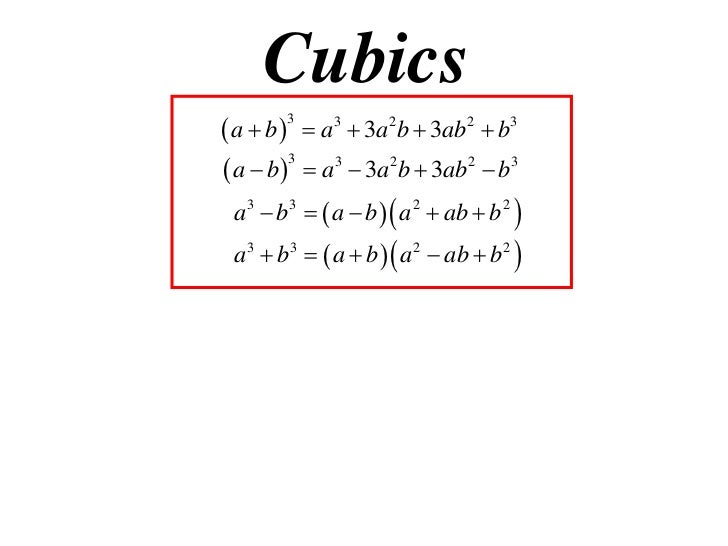
(a+b)^3 = a^3 + 3a^2 b + 3ab^2 + b^3
alpine sable
$(x - 1)^3 = x^3 - 3x^{2}(-1) + 3x(-1) + -1^{3}$
ocean sealBOT
Bleidorb
 alpine sable
I need to check this, if I am doing this right.
I forgot that
$a^2 + b^2 \neq (a + b)^2$
ocean sealBOT
Bleidorb
 alpine sable
 ocean sealBOT
Akhandanand Tripathi
 alpine sable
yup
 sacred vigil
alpine sable
sacred vigil
alpine sable
thanks man (:
Ann and Akhandanand .
https://www.dummies.com/education/math/algebra/how-to-factor-the-difference-of-two-perfect-cubes/
why is a^3 - b^3 called a perfect cube 🤔

To factor the difference of two perfect cubes, remember this rule: the difference of two perfect cubes equals the difference of their cube roots multiplied by the sum of their squares and the product of their cube roots. The binomial expression looks like this: The results of factoring the difference of perfect cubes are A […]
or is it just a mistake.
vale wigeon
a^3 - b^3 is not a perfect cube, it's a difference of cubes
 vague coral
Someone knows an easier way to prove that $(-1)^n$ diverges ?
ocean sealBOT
Herels
 vale wigeon
do you mean the sequence or the series
vague coral
the sequence
 woven sphinx
easier than what
alpine sable
If you accept the fact that if a sequence converges, then any subsequence of that sequence converges to the same thing as the original, then it’s easy
vale wigeon
vague coral
I just want a way to prove it that is easy to understand
is there a proof you're looking at rn which is hard to understand?
vague coral
vale wigeon
is there a proof you're looking at rn which is _hard_ to understand?
I saw a proof by contradiction but I didn't understand a single thing
vague coral
alpine sable
If you accept the fact that if a sequence converges, then any subsequence of tha...
oh I forgot about subsequence :o
yeah that must be a good idea
vale wigeon
did it not boil down to 'if the limit exists, all subsequences will have to approach it too. but the even subsequence is a constant 1 and the odd subsequence is a constant -1, and 1 ≠ -1'
vague coral
no it was using an other thing
If I want to prove those things now, I'll just use subsequences then
alpine sable
guys im having a very basic confusion
Should we put value of 0 normally here or instead ignore that
 pearl marlin
alpine sable
Should we put value of 0 normally here or instead ignore that
pearl marlin
alpine sable
Should we put value of 0 normally here or instead ignore that
hope this is question about rational number between -3/4 and 1/3 if yes then you can put zero there
 digital maple
Can someone help me with 3b)? I already finished 3a but i seem to be stuck on b.
 pearl marlin
digital maple
Can someone help me with 3b)? I already finished 3a but i seem to be stuck on b.
pearl marlin
digital maple
Can someone help me with 3b)? I already finished 3a but i seem to be stuck on b.
what problem you are facing while solving?
digital maple
Do you when you try to reduce the equation to like row echelon form?

It should look like this
but the top middle and middle right part cannot be reduced to 0
or at least i tried to reduce it to 0 but it just wont let me keep the whole thing as reduced echelon form


this is all the work i was able to do so far
pearl marlin
digital maple
Do you when you try to reduce the equation to like row echelon form?
no need to look like this just make 1 on piviot in each row
pearl marlin
digital maple
Do you when you try to reduce the equation to like row echelon form?
you are trying to make it identity matrix it may not be possible if matrix is singular.
digital maple
What does that mean?
are u saying this form can still be correct even if it doesn't look like that?
 pearl marlin
digital maple
What does that mean?
pearl marlin
digital maple
What does that mean?
you have solved the question
digital maple
Ohhhh. SO wait my teacher wont say anything if these aren't zeros?
 pearl marlin
remove the last coluom ,they just said to make rref of cofficient matrix
pearl marlin
digital maple
Ohhhh. SO wait my teacher wont say anything if these aren't zeros?
In linear algebra, a matrix is in echelon form if it has the shape resulting from a Gaussian elimination.
A matrix being in row echelon form means that Gaussian elimination has operated on the rows, and
column echelon form means that Gaussian elimination has operated on the columns. In other words, a matrix is in column echelon form if its tran...
digital maple
pearl marlin
remove the last coluom ,they just said to make rref of cofficient matrix
So my final answer should only look like this?
 pearl marlin
digital maple
So my final answer should only look like this?
pearl marlin
digital maple
So my final answer should only look like this?
made -2 zero
digital maple
-2 needs to be 0?
pearl marlin
yup
pearl marlin
digital maple
-2 needs to be 0?
i have not checked you calculations i am answering this question on the basis of your last step
digital maple
If i turn that -2 into 0 then the 0 next to it turns into 2
 strong furnace
if you are going fro the reduced row echelon form
only the columns with leading entry = 1 needs to have all other coefficients 0
pearl marlin
digital maple
If i turn that -2 into 0 then the 0 next to it turns into 2
its ok
pearl marlin
digital maple
If i turn that -2 into 0 then the 0 next to it turns into 2
that will be your final answer
 golden bridge
Hello I'm having troubles with this question
I need to find A,B the information I have are: A is y=2x + 1 and B is y= -0.5X-1 also the AB length is 6 and he answers are the following A ( 0.4,1.8) (-5.6,1,8)

 prime ice
so i figured out A,B,C but now they ask to determine the value of m and c. I dont fully understand what i have to do
 pearl marlin
prime ice
so i figured out A,B,C but now they ask to determine the value of m and c. I don...
pearl marlin
prime ice
so i figured out A,B,C but now they ask to determine the value of m and c. I don...
If line is intersection y axis at 3 ,then c is 3 , now y=mx+3, put this in function f , find m
prime ice
thanks let try
golden bridge
golden bridge
Hello I'm having troubles with this question
I need to find A,B the information ...
;-;
prime ice
should i put it in function f or g?
glass lichen
prime ice
should i put it in function f or g?
you have 2 points you know are on g(x): (0,3) and C
thus you can find the slope of the line m
golden bridge
golden bridge
Hello I'm having troubles with this question
I need to find A,B the information ...
can someone help me with this
glass lichen
golden bridge
Hello I'm having troubles with this question
I need to find A,B the information ...
distance formula
golden bridge
can you send it
oh
nvm I know it
But I don't have the Y or x for either of the points
glass lichen
right, yeah
pearl marlin
golden bridge
can you send it
Does they are making a right angle triangle?, Or something more instructions are given in question
prime ice
glass lichen
you have 2 points you know are on g(x): (0,3) and C
sorry but im still having issues
glass lichen
prime ice
sorry but im still having issues
slope formula.
prime ice
glass lichen
slope formula.
Like this ???
 glass lichen
how do you know (3,18) is on the line?
pearl marlin
golden bridge
No triangles
These are othogonal lines because their slop product is =-1 , may be we will get a hint from here
prime ice
glass lichen
how do you know (3,18) is on the line?
yoh im lost
glass lichen
ok well im asking about your work
so if you have no clue what you wrote, why did you write it?
prime ice
So I did this for the first question
 glass lichen
did you arbitrarily pick (3,18) out of thin air?
right.. so (3,0) and (0,3) are on the line
not (3,18) like you made up
 glass lichen
no
ocean sealBOT
Mosh
 prime ice
would -1 = m
ocean sealBOT
Mosh
 prime ice
im really sorry i took so long im genuinly lost my teachers are not the greatest
pearl marlin
prime ice
Both are intersecting at x axis where y is zero so put y=0 , in g it will give you X=+-3, take +3 , now point is (3,0) pUt in line 0= 3m+3 m= -1
prime ice
thanks guys sorry but ima be troubling u guys alot more
pearl marlin
prime ice
thanks guys sorry but ima be troubling u guys alot more
Its ok , atleast you are learning something
 reef karma
Which grade question was this?
prime ice
11
reef karma
Which country?
prime ice
south africa
prime ice
reef karma
Ig u have learned quadratic equations and linear equation s?
no not yet
prime ice
ill quicky google a tutorial thanks alot
glass lichen
reef karma
I solved this using quadratic equations
I wouldn't say using quadratics is easier, given they already had C...
 glass lichen
#old-network and ask in chemistry?
 strong wing
ah ok srry
prime ice
what formula do i have to apply to find D
 golden bridge
Hello I'm having troubles with this question
I need to find A,B the information ...
golden bridge
golden bridge
Hello I'm having troubles with this question
I need to find A,B the information ...
<@&286206848099549185> ;-;
glass lichen
Solve for the intersection of the line and quadratic
prime ice
glass lichen
Solve for the intersection of the line and quadratic
how do i do that
 worldly void
can anyone help me
 pearl marlin
prime ice
what formula do i have to apply to find D
pearl marlin
prime ice
what formula do i have to apply to find D
Intersection of both line and curve. Just put line in curve
worldly void
worldly void
can anyone help me
<@&286206848099549185>
pearl marlin
 fervent grail
6x⁴+x³-3x²-9x-4 = 0
fervent grail
6x⁴+x³-3x²-9x-4 = 0
Roots or factors ?
fervent grail
fervent grail
Rational roots
@pearl marlin
fervent grail
pearl marlin
I have sloved ,
Pls send the sol
prime ice
pearl marlin
Intersection of both line and curve. Just put line in curve
im so lost
fervent grail
pearl marlin
Just wait
Ohk
gray isle
solve
y = 18 - 2x^2 and
y = -x + 3
reef karma
glass lichen
I wouldn't say using quadratics is easier, given they already had C...
How did you already have 3
pearl marlin
fervent grail
Ohk
 prime ice
gray isle
solve
y = 18 - 2x^2 and
y = -x + 3
prime ice
gray isle
solve
y = 18 - 2x^2 and
y = -x + 3
first one is y=18
fervent grail
pearl marlin
How have you done the second step ?
pearl marlin
fervent grail
How have you done the second step ?
Rational root test,
After that division use karna
prime ice
i still dont undertsand
fervent grail
pearl marlin
After that division use karna
Long division method ?
pearl marlin
fervent grail
Long division method ?
Yes
gray isle
have you solved systems of equations before?
found where (in a simpler case) where two straight lines intersect algebraically?
prime ice
gray isle
have you solved systems of equations before?
found where (in a simpler case) whe...
i have not
gray isle
prime ice
i have not
that is a pretty big issue
fervent grail
pearl marlin
Rational root test,
Acc to rrt 6/4 ke factors uske roots ho skte hai pr uske baad ka smjh me nhi aya🥲
gray isle
have you solved quadratic equations before?
prime ice
gray isle
have you solved quadratic equations before?
no
fervent grail
fervent grail
Acc to rrt 6/4 ke factors uske roots ho skte hai pr uske baad ka smjh me nhi aya...
Uske baad ka thora sa explain kr skte ho pls🙃
prime ice
 fervent grail
Uske baad ka thora sa explain kr skte ho pls🙃
fervent grail
fervent grail
Uske baad ka thora sa explain kr skte ho pls🙃
@pearl marlin
gray isle
well what you did there was solving a relatively simple system of equations involving a quadratic
prime ice
gray isle
well what you did there was solving a relatively simple system of equations invo...
ok
gray isle
i.e for B, C,
you were effectively solving the system
y = 18-2x^2 and y=0
prime ice
ok let me quicky try
gray isle
similarly, here the system you want to solve is
y = 18-2x^2 and y=-x +3
prime ice
 alpine sable
hi
gray isle
ugh...
fervent grail
fervent grail
6x⁴+x³-3x²-9x-4 = 0
Ramanov can u pls help me in this.......
gray isle
you're going backwards
prime ice
what x value would i use
pearl marlin
fervent grail
Ramanov can u pls help me in this.......
It will take time , i have to make its rrots properly.
gray isle
the x value of D is what you're trying to find
have you done stuff with substitution before? or familiar with the transitive property of equality?
prime ice
i have
alpine sable
anyone here from malaysia I need help wit my math
gray isle
apply that to:
y = 18-2x^2 and y=-x +3
fervent grail
pearl marlin
It will take time , i have to make its rrots properly.
Okay pls send me when u will complete
 abstract breach
prime ice
so x is 3 right
reef karma
I got x as -5/2 in D
reef karma
reef karma
I got x as -5/2 in D
Is this correct?
gray isle
you are interested in finding the other solution (that's according to the graph, less than 0, for the coordinates of D)
have you done stuff with substitution before? or familiar with the transitive property of equality?
i have
apply that to:
y = 18-2x^2 and y=-x +3
currently what I'm asking of you requires a single step
don't overthink this part
prime ice
hmm
prime ice
gray isle
> have you done stuff with substitution before? or familiar with the transitive ...
yeah no i dont understand
gray isle
have you done stuff with substitution before? or familiar with the transitive property of equality?
you said you have
do you know the basic idea of substitution?
prime ice
gray isle
> have you done stuff with substitution before? or familiar with the transitive ...
no
gray isle
you can replace something with something of equivalent value
transitive property of equality
is pretty intuitive too
things equal to the same thing are equal
prime ice
ok
gray isle
and here since you are looking for values where:
y = 18-2x^2 and y=-x +3
and either by substituting the value of y from one equation into the other,
or noticing that both18-2x^2and-x +3are equal to y,
that logically leads to the equation
18-2x^2 = -x + 3
 plucky crow
ramonov
prime ice
gray isle
and here since you are looking for values where:
> y = 18-2x^2 and y=-x +3
and e...
ok i get this
gray isle
would you have been able to arrive at that without my explanation?
prime ice
gray isle
would you have been able to arrive at that without my explanation?
nope
Would I solve like this
 plucky crow
huh
gray isle
no wtf how
fervent grail
gray isle
no wtf how
6x⁴+x³-3x²-9x-4 = 0
How to factorise it ?
prime ice
Ok let me retry
gray isle
this is a quadratic equation
fervent grail
6x⁴+x³-3x²-9x-4 = 0
How to factorise it ?
plucky crow
you can not - x^2 and x
gray isle
you can rearrange into general form
and then factorise or be lazy and apply QF
but I'm highly recommend that you put this on hold, and go back and review basic algebra as you're heavily ill equipped to solve these types of problems
fervent grail
6x⁴+x³-3x²-9x-4 = 0
How to factorise it ?
 rocky tinsel
Hey, what's a one sentence answer as to why you cannot log negative numbers
gray isle
rational root theorem
combined with polynomial long division / synthetic division
uneven root
@prime ice basically, the variable AND power have to match to add or subtract
 torn glacier
can i ask a question here
prime ice
uneven root
<@419168224744177674> basically, the variable AND power have to match to add or ...
oh ok
rocky tinsel
hhiiii syphax :))
gray isle
logs aren't well defined for negative arguments
rocky tinsel
wdym by well defined
torn glacier
how can i calculate this if im given f(x)'s and f'(x)s graphs?
 uneven root
Substitute the equations for f' and f (please correct me if i'm wrong lol)
prime ice
would i factorize
plucky crow
rocky tinsel
wdym by well defined
you wouldnt get real solutions ig
prime ice
write it like this −2x^2 + x + 21 = 0
torn glacier
uneven root
Substitute the equations for f' and f (please correct me if i'm wrong lol)
wdym
uneven root
prime ice
would i factorize
You'd get 2 answers for x since it's quadratic so yeah, you need to factorize
prime ice
ok so x=-3 and x=3.5
gray isle
−2x^2 + x + 21 = 0
isn't right
prime ice
gray isle
> −2x^2 + x + 21 = 0
isn't right
eish
gray isle
how are you getting that from:
18-2x^2 = -x + 3
prime ice
−2x^2 + x + 15 = 0
gray isle
no
prime ice
is my eqaution even possible to factorise
gray isle
your quadratic is definitely factorisable
if you're not confident with your factorisation skills
be lazy and apply QF
uneven root
You're really really close, you just missed 2 things and you've got it
gray isle
wlog (2,4) and (4,2) would be considered the same solution
usually for something like this, you'd assume something like a > b or b > a
there are also infinitely many solutions if you're allowed a=b
prime ice
i factoised 2x^2+x+15=o
alpine sable
do you guys know any science server
looking for a specific science?
go to the explore public servers
and search science
we do have some connections
@alpine sable
i did
but i got banned lol
for no reason
from that stem thing
same
got banned last year
cause i evaded ban
messed with the mods
uh was being annoying
but i was popular with some people
ig
2 months ago when i needed help so i asked qs and they thought i was trolling
got a question to ask here though?
no
alpine sable
alpine sable
got a question to ask here though?
i'm writing a paper on dark matter
mk
what does that mean
@alpine sable join homework help server
thank
u
 pearl marlin
 brave fossil
$A^{3}+A^{2}=I$ \ take inverse on both sides we will get A^{2}+A=A^{-1}$ i'm considering that A is invertible
ocean sealBOT
learn4math
Compile Error! Click the  reaction for more information.
(You may edit your message to recompile.)
 pearl marlin
multiply inverse of A on both sides
 novel granite
X intercept is the point where the line touches X axis ie where y=0 and similarly for y intercept
 sudden tulip
ok
 lucid ember
can anyone explain how this is true?
 merry coral
probability of flipping a total of n amount of heads before flipping a total of 3 tails (you stop when either condition is met).
I need odds in the form of a decimal
 noble sinew
merry coral
`probability of flipping a total of n amount of heads before flipping a total of...
noble sinew
merry coral
`probability of flipping a total of n amount of heads before flipping a total of...
start for n=1,2,3 then deduce a general formula after
merry coral
ok bet here are some rough numbers
 noble sinew
I meant actual exact calculations not a simulation
merry coral
3 is obvi 50%
noble sinew
you can't deduce a formula from that
merry coral
you can check your work doe
 proven flare
Hey guys I have a question, why are power functions considered transcendental?
Also are all periodic functions trancedental?
merry coral
t t t
h
t h
t t h
proven flare
?
Also where do you place reciprocal functions?
Like is it under rational functions?
merry coral
noble sinew
I meant actual exact calculations not a simulation
this problem is harder than I thought

there are only 4 ending possibilitys:
zero tails (yay)
one tails (yay)
two tails (yay)
three tails (sad)
but the probability gets scewed
Going for one heads odds are 7/8
Three odds are 4/8
merry coral
noble sinew
heard of binomial distribution?
yesn't
that would be plotting all values of n right?
forming an arc I think
noble sinew
that would be calculating it exact instead of simulating it
and would allow us to find a formula for n
merry coral

proven flare
Oh well I guess my question is just there, do you guys know here I should post it?
*where
 prime badge
there are 3 positive outcomes (n+2 flips, n+1 flips and n flips) and a lot of negative ones (3, 3+1 ... 3 + n − 1)
tricky one
noble sinew
if you start calculating it exactly (not simulating!) for n=1,2,3
the answer should follow
prime badge
i mean it's a lot of work to do n = 1,2,3
merry coral

probability of flipping a total of n amount of heads before flipping a total of 3 tails (you stop when either condition is met).
I need odds in the form of a formula
prime badge
n=1 is 4 different lengths
merry coral
proven flare
https://www.quora.com/What-is-the-expected-number-of-coin-flips-until-you-get-3-...
we have another condition doe
noble sinew
im aware
prime badge
so, that's a lot of work
merry coral
yesn't
noble sinew
no
prime badge
i'm literally not gonna do it
noble sinew
didn't ask you to do it
prime badge
i mean it as evidence lol
noble sinew
and it would take me 1 min to find for n=1,2,3
merry coral
and....
just trying to calculate odds for a game I made lol
anyways, ping me I gtg
noble sinew
so for n=1 the prob of flipping 1 head before 3 tails is 1- the prob that we hit tails 3 times - agree?
that we can calculate with binomial distribution
1-dbinom(3,3,0.5) is for n=1
(or type pbinom(2,3,0.5))
merry coral
agreed
noble sinew
for n=2 you can do 1-(dbinom(3,4,0.5)+dbinom(4,4,0.5))
noble sinew
your probabilities are wrong and there is a pattern in the formula
prime badge
which one is the first wrong one?
noble sinew
4/5 is wrong

 drifting mural
alpine sable
noble sinew
drifting mural
alpine sable
noble sinew
What's this GUI?
noble sinew
RStudio
alpine sable
Thanks
 safe jacinth
This is probably more of an Excel question. But maybe not really... In Excel I can generate a random number with RANDBETWEEN(). But this will generate a number within the specified interval with an equal probability for any number. Is it possible to apply some kind of bell curve-like probability for the generation of numbers within the interval? For example If RANDBETWEEN(1;100), I would like 50 to be the most probable outcome and 1 or 100 to be the least probable. And if possible, I would like to be able to adjust the "probability curve" so that it isn't necessarily a normal distribution.
vale wigeon
youre gonna need to be a little more specific about what distribution you're looking for here.
safe jacinth
I don't know how to be more specific. Can you make an assumption and provide an example?
safe jacinth
Sure
vale wigeon
RANDBETWEEN(1,50) + RANDBETWEEN(0,50) will do the job, i think
tho it will have both 50 and 51 as modes
but it will have the property that values toward either end of 1:100 are less likely
safe jacinth
Damn that was not at all what I expected, but that might be quite genius.
I will test it out, Thanks
hollow pelican
guys how do u do this? im confuse


 abstract breach

 small pumice
<@&286206848099549185>
prime badge
noble sinew
thank you
for n=2 you can do 1-(dbinom(3,4,0.5)+dbinom(4,4,0.5))
was that wrong?
noble sinew
they are equivalent
prime badge
maybe i don't understand what's dbinom
noble sinew
just nicer to look at the other formula because otherwise for larger n it gives a very big expression
prime badge
is 1-(dbinom(3,4,0.5)+dbinom(4,4,0.5)) same as (dbinom(0,4,0.5)+dbinom(1,4,0.5)+dbinom(2,4,0.5))?
noble sinew
yes
 sly escarp
Hi, i need to find multiplicative inverse of 13 mod 79
Ive tried a method but am confused :- 79 = 13 * 6 + 1. where di I go from here?
prime badge
you write 6 as answer
sly escarp
oh that's it, thank you very much
sly escarp
I saw a lec on yt and it said you do this backward chaining till you hit 1 at the right, I hit in first step
prime badge
it has to be minus 1
sly escarp
any idea how can I get there?
 tender geyser
this might sound pretty dumb now but:
a local minimum is a minimum within a certain interval
whereas the minimum or global minimum is the minimum value across all numbers
gimme a second to illustrate it 😄
in this example, the global minimum is obviously to the left because its overall the lowest value
but lets say you only look at positive x
then the local minimum is to the right (because we dont care about anything thats to the left of x=0)

correct!
and the global minimum would be -inf because it goes to -infinity in one of the directions ^^