#help-0
1 messages · Page 638 of 1
 glass lichen
 round socket
whats wrong witha. 12 year old
 shrewd oracle
Also 12 is against discord regulations
shrewd oracle
Yes
glass lichen
TOS says 13+
 sly mantle
this would've been good to know
round socket
IM JOKING IM NOT 12
 vast blaze
iirc 12 y/o are against discord regulations yeah
shrewd oracle
13 is the ages for tod
 fading citrus

 alpine sable
show
shrewd oracle
I mean you just admitted you were?
 tepid otter
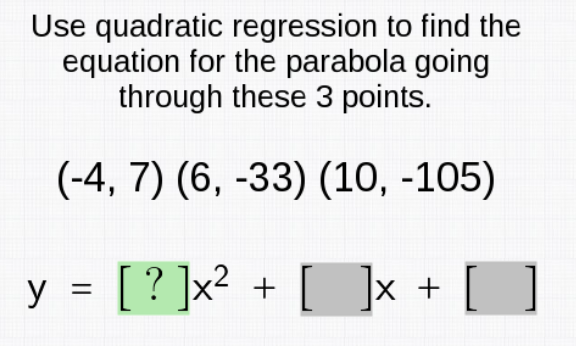 round socket
i was jokin.
tepid otter
can someone help me out with this question
shrewd oracle
round socket
i was jokin.
You mean lying
glass lichen
tepid otter
https://i.imgur.com/fwA0Idv.png
not 100% sure on regression, but you can get 3 equations and 3 unknowns for the co-efficients
round socket
let the MODS question me
shrewd oracle
Never claimed to be?
 sick kettle
can someone check this over
 round socket
let rokeppajanpu question me!
sly mantle
@round socket watch your language and your behavior
round socket
WHAT
 wary stream
tepid otter
https://i.imgur.com/fwA0Idv.png
wary stream
tepid otter
https://i.imgur.com/fwA0Idv.png
Is this linear algebra related? Because if it is, do you know how to do least squares?
round socket
nah uhhh bc they said some nasty stuff too
tepid otter
wary stream
Is this linear algebra related? Because if it is, do you know how to do least sq...
it's algebra 2
round socket
aww naw baby this aint gon work!
sly mantle
your chaotic behavior has made it very hard for helpers to interact with you
glass lichen
quadratic is defined by 3 points iirc, so the least squares would be the same as the regular solution
round socket
I LITERALLY
DID U EVEN SEE HOW THIS STARTED
i @ ed my friend to see if he was available to help me
alpine sable
just stfu
glass lichen
You pinged a random user instead of just posting the question like everyone else
glass lichen
the question did not get posted until long into the tantrum.
glass lichen
hi
sly mantle
admittedly some helpers have been a bit cold in their approach in helping you
shrewd oracle
round socket
AND I WANTED TO KNOW HE WAS AVAIBLE
Thats not what the question channel is for?
wary stream
round socket
i @ ed my friend to see if he was available to help me
Well, stop pinging people because people are busy all the time. They don't have to make time in their schedule just to help you
round socket
he was gonna help me with my math??
wym this isnt what this channel is for
HE IS MY FRIEND THO LOL
sly mantle
but you're not helping at all by blowing up chat with your all caps tantrum
wary stream
round socket
wym this isnt what this channel is for
You pinged specific people. Anyone can help you
shrewd oracle
round socket
wym this isnt what this channel is for
What i mean is this is for people who want to understand a question off of one of the helpers, if a friend wants to help then dm them
round socket
dm ISNT an option for us
shrewd oracle
Then go to math general and not clog up the channel for others
round socket
but..
sly mantle
everyone please drop this convo
round socket
i
was
gonna ask for help doe
and i dont wanan ask in general
rokeppa wanna help me with me test 😏
sly mantle
sigh
alpine sable
weirdo
glass lichen
No
sly mantle
you can if you want a ban
alpine sable
bruh
sly mantle
bye
shrewd oracle
He actually did it...
glass lichen
alpine sable
Oh I so sorry yes please I do need help
 mortal harbor
i have a question which i just thought and i have no idea how to approach it
lets say you have a random point p what is the average distance to the circumference of a circle

 ionic jewel
mortal harbor
i have a question which i just thought and i have no idea how to approach it
le...
ionic jewel
mortal harbor
i have a question which i just thought and i have no idea how to approach it
le...
im willing to bet its the radius
yeah
it is
mortal harbor
you see logically i get that however proof?
 fierce frigate
can anyone explain linear equations to me?
i havent used them in a long time
and i have a test about it tomorrow
ionic jewel
 foggy onyx
(sin(30)(cot(30)(?) = answer should be 1.
foggy onyx
(sin(30)(cot(30)(?) = answer should be 1.
ur missing some parenthesis, but just use a calculator/unit circle
foggy onyx
no-
 grand oasis
foggy onyx
no-
grand oasis
foggy onyx
no-
What's with that question mark next to cot(30)?
foggy onyx
im asking for help im not answering the previous question from the guy-
ionic jewel
mortal harbor
you see logically i get that however proof?
for each point on the circumference of the circle with distance to the point of d, there is a point directly opposite of it where the distance id the diameter - d
you can do this for points on one half of the circle, to get diameter distance across the circle, and therefore diameter/2 = radius average distance
unless you happen to mean closest point on the circle
mortal harbor
nah thats what i meant thank you
know to generalise my question is how do you get the average distance of a point to a function?
like 0,0 and x^2 from like x= 0 to 10
or something
mortal harbor
thank you
ionic jewel
do you know calculus
mortal harbor
i had that thought and its bugging me
somewhat
i know the basics
but im only year 12 in the uk
shrewd oracle
You do all diff calc in yr 12 no?
mortal harbor
no
shrewd oracle
Oh thought ya did
mortal harbor
well what does it consist of
like trig and stuff is year 13
and then we do some more in further maths in year 13 also
shrewd oracle
Ah
ionic jewel
so I suppose we are looking at a sum of the distances from the point to each point on the function
divided by the length of the function
$\int_a^b \sqrt{(x_0-x)^2 + (y_0-f(x))^2} , dx$
 ocean sealBOT
bunny
$\int_a^b \sqrt{(x_0-x)^2 + (y_0-f(x))^2} \, dx$
 mortal harbor
so thats the whole sqrt bit is the distance of a certain point?
ionic jewel
$\frac{1}{b-a} \int_a^b \sqrt{1+[f'(x)]^2} , dx$
ocean sealBOT
bunny
$\frac{1}{b-a} \int_a^b \sqrt{1+[f'(x)]^2} \, dx$
 ionic jewel
$\frac{\int_a^b \sqrt{(x_0-x)^2 + (y_0-f(x))^2} , dx}{\frac{1}{b-a} \int_a^b \sqrt{1+[f'(x)]^2} , dx}$
ocean sealBOT
bunny
 ionic jewel
you know i cant imagine this doesnt cancel at all
ionic jewel
mortal harbor
so thats the whole sqrt bit is the distance of a certain point?
hmm that was the idea yes
mortal harbor
you see i dont understand the second bit
mortal harbor
ocean seal
**bunny**
```latex
$\frac{1}{b-a} \int_a^b \sqrt{1+[f'(x)]^2} \, dx$
```
this one
ionic jewel
wait one second
mortal harbor
okay
ionic jewel
hmm i found a different formula thats slightly different
oh it might be the same
I feel like the one I wrote makes sense but feel free to read https://math.stackexchange.com/questions/2413594/average-distance-between-a-point-and-a-curve-segment

Mathematics Stack Exchange
I'm trying to find a formula for the average distance between a point,$\ P$ and a curve segment,$\ C$
When I tried to use the formule for the mean of a function with a distance function
$$\frac{1...
alpine sable
Yo can you help me? With my question?
ionic jewel
but they are using parametizations and integrating with respect to curve length which is a little out of what i can think through right now
mortal harbor
ionic jewel
I feel like the one I wrote makes sense but feel free to read https://math.stack...
yeah your one does make sense, i have a hard time following these ngl
 ionic jewel
alpine sable
<@456226577798135808> it's this one
ionic jewel
alpine sable
<@456226577798135808> it's this one
can only ronald help
ionic jewel
2L + W = 60
A = LW
ionic jewel
yep
 slow phoenix
anyone able help me through this?
 ionic jewel
$\sin\theta = \frac12$
ocean sealBOT
bunny
 ionic jewel
do you know the unit circle?
 sturdy fog

for question 5 the answer is 320 and i got 280 from 24.5tan85
why do we have to add 40m?
slow phoenix
is that the year 10 textbook
sturdy fog
could you tell me why we have to add the height of the shorter building?

 hidden horizon
bruh this is math server
 misty path
😂
 proud axle
 lunar vine
x+2yt3z=12
x-3y+4z=27
-x+y+2=7
lunar vine
x+2yt3z=12
x-3y+4z=27
-x+y+2=7
I would answer but just checking is the 2yt3z 2yt^3z=12?
alpine sable
How many baseball teams of 9 members can formed from 14 players?
proud axle
.-.
misty path
You computer has a virus
alpine sable
#2 lmao
 alpine sable
bc the question is non sense
alpine sable
or im just dumb lol
proud axle
alpine sable
How many baseball teams of 9 members can formed from 14 players?
only 1. So you can't play baseball
alpine sable
lol
proud axle
in order to play baseball you need two teams of 9
 karmic pewter
Bruh
The question is asking the arrangement of the team
Permutation and combination
alpine sable
ye
karmic pewter
14!/5!9!
alpine sable
karmic pewter
14C9 breh
btw how is it 14C9?
karmic pewter
karmic pewter
14!/5!9!
^
alpine sable
oh

 scarlet bluff
Bruh
 jagged imp
 plain dove
match coefficients on both sides
scarlet bluff
You go to the ten thousandths place
Then 5 and above add 1 to the thousandths
4 and below subtract one
alpine sable
When 149 is divided by a 2-digit number, it has a remainder of 5. Find all the 2-digit divisors
im confused
 bronze spade
jagged imp
match coefficients on both sides
bronze spade
jagged imp
match coefficients on both sides
No
slow phoenix
this is the most confusing question, anyone keen to help?
 bronze spade
plain dove
help please
bronze spade
plain dove
help please
If it’s true for all real values of x, then it is also true for x=0 right ? Then k=10a - 2a^4
jagged imp
you can get that result by matching coefficients in x
im not trying to be confrontational but I don't understand what's wrong with matching coefficients
bronze spade
What do you mean “matching coefficients” ?
It might be me that does not understand what your idea is. Could you explain ? 🙂
The only solution here is to have every single coefficients equal to 0.
jagged imp
the coefficient of x^2 on the LHS(a^2-3a-2) must be equal to the coefficient of x^2 on the RHS(0), a^2-a-2=0, and in specific for k=10a-2a^4 you're matching the constant term.
bronze spade
Sure, it works but you have to justify why you can use this method
jagged imp
"linear algebra basis blah blah(kinda circular ig)", or alternatively, assume some quadratic ax^2+bx+c is equal to another quadratic dx^2+ex+f for all values of x. Then, setting x=0 we have f=c, then write both f and c as one of the two, subtract from both sides. Then you can take the derivative of both and use the same principle
Its just common knowledge that this is true for polynomials in my school curriculum at least
your method is faster and fine too
and same argument for higher degree polynomials
bronze spade
Yea, what you’re invoking is the uniqueness of the writing of a polynomial, no need to derivate. Otherwise I also like this argument : you rewrite the equation putting everything in the left hand side. You get an polynomial that is null for every x. It has a infinite numbers of roots. It must be the nul polynomial. Then a^3-3a-2=0, a^2-a-2=0 and 2a^4-10a+k=0.
bronze spade
I guess solving those 3 equation might bring up a value of k 🙂
Yea, k = -12
I just wanted to know what was on your mind. The manners considered as common in your school might not be commonly shared by everyone. Thanks for sharing 🙏

 bronze spade
What did you try so far ?
alpine sable
A factor has a remainder of 2 when it is divided by 3. It has a remainder of 3 when it is divided by 4. Find two such numbers that are smaller than 30
 dire nacelle
bronze spade
What did you try so far ?
dire nacelle
bronze spade
What did you try so far ?
nothing
jagged imp
is this a test?
dire nacelle
homework
bronze spade
dire nacelle
nothing
Do you have any idea ?
dire nacelle
no
alpine sable
jagged imp
is this a test?
stop asking people that. why can't people learn math by themselves? Why do you never assume self-taught?
dire nacelle
🙇♂️ pls help with direct answer
alpine sable
@dire nacelle stupid you'll never learn that way
jagged imp
alpine sable
stop asking people that. why can't people learn math by themselves? Why do you n...
what does this question have to do with how a person learns math
alpine sable
choosing beggar
alpine sable
jagged imp
what does this question have to do with how a person learns math
u always assume they're "homework" or "test" or "quiz" and never "ohh so you want to learn math on khan academy cuz u wanna git smart??"
dire nacelle
alpine sable
choosing beggar
if you don't want to it's ok no need of judgeing
bronze spade
For the first one, I recommend considering the fact that $x^y = \exp(y \ln(x))$
ocean sealBOT
allevmelc
 dire nacelle
ohh
bronze spade
Use the same idea for the right hand side and then differentiate the equality. You’ll be able to determine dy/dx and evaluate it at x=e
For the second one, you could brutally apply Sarrus’ formula
“Rule of Sarrus”
 woven pollen
dire nacelle
woven pollen
dire nacelle
m/n = 1/4 ?
bronze spade
You’ll be able to write f and derivate it
dire nacelle
woven pollen
m/n = 1/4 ?
you sure
dire nacelle
bronze spade
Use the same idea for the right hand side and then differentiate the equality. Y...
ohh
woven pollen
nope. I'm doing it again now.

 shy tendon
Writes insane math stuff
"my best guess so far"
woven pollen
😆
 median cedar
What is the magnification when an object is placed at 2f from the pole of the convex mirror? *
1 point
-1
-1/3
-3/2
-2/ 3
hidden horizon
median cedar
What is the magnification when an object is placed at 2f from the pole of the co...
this is a test dont ask answers pls
 north hemlock

So uh
using volume of cone, $V=\pi r^2 \frac{h}{3}$ we get $V\approx 200$ but if we use the given equation and do $2\sqrt[3]{\frac{3V}{2\pi}}$ we get $V \approx 25$?
ocean sealBOT
Jukelyn
 north hemlock
this is a bit confusing
oh
I see
nvm
lol, I did 2 times that radical for some reason
nvm
 short void
Help

No calc question.
So.. my classmate signed me up for the Kenyan math Olympiad and I am screwed. This is an example of a past question. My biggest worry is that I have no calc. Apparently, round 1 is the easiest.
 echo spire
What grade are you in? @short void ?
short void
echo spire
What grade are you in? <@671645430148366347> ?
I am in 12th grade (I think).
jagged imp
Am i missing something here? Is an equals sign missing here or...
Its not bad cropping i just found the paper myself. question could just be a typo or i could be a dumbfuck somehow
echo spire
Well, the only answer that makes sense is B xD
Yeah, I think that I know a way to resolve it let me try
 orchid python
I don't get it, can any explain, thanks a lot:
e · d ≡ 1 (mod φ(n))
Then e * d becomes:
e · d = k · φ(n) + 1
Nam V. Do
 orchid python
for some integer k
short void
echo spire
Yeah, I think that I know a way to resolve it let me try
Thanks, pls let me know 🙂
short void
jagged imp
Am i missing something here? Is an equals sign missing here or...
What question?
echo spire
short void
I am in 12th grade (I think).
Try to raise the whole equation to the power of 8, it will be (x+1) at the power of 7. And maybe you can work something with it.
jagged imp
what equation
this this is just an expression there's no equation
I'm genuinely so confused
short void
I thought of putting (x+1)^1/2 and then solving, but still it doesn't work
orchid python
I got this now
echo spire
I should go back to my trigonometry
short void
echo spire
I should go back to my trigonometry
No, no, no. Help me out.. I will help you with trigs after.
echo spire
I got no other idea
orchid python
How can I prove
φ(n) ≡ k * φ(n) mod m
Nam V. Do
 echo spire
I got a question if a triangle has consecutive sides will it have consecutive angles as well?
 astral cipher
echo spire
I got a question if a triangle has consecutive sides will it have consecutive an...
astral cipher
echo spire
I got a question if a triangle has consecutive sides will it have consecutive an...
Not always
 gray isle
that statement is so vague
any two sides of a triangle are inherently consecutive
and technically any two angles in a triangle are also consecutive
why does that say test? <@&268886789983436800>
grand oasis
Hey, anyone have any idea what ¹𝟺9⠡ means?
I have a problem that require me to translate the hex code of UTF-8 characters to Unicode code points, and I also have to explain the message behind it. They give me a hint: "A well-known sequence", but I have no idea how is it related to this.
The original hex code is c2 b9 f0 9d 9f ba 39 e2 a0 a1.
 spice cape

 rocky dagger
grand oasis
Hey, anyone have any idea what ¹𝟺9⠡ means?
rocky dagger
grand oasis
Hey, anyone have any idea what ¹𝟺9⠡ means?
maybe that's some weird binary..? no idea
spice cape
spice cape
<@&286206848099549185>
 noble sinew
start with option A - she gets paid a flat 14.90 dollars per phone sold
so find how many she sold and then multiply those 2
spice cape
For second question
noble sinew
so how much did she earn for option A and B
for b) it doesn't matter on option A how much the phone costs. So just recalculate with option B with the new info
 spice cape
that is not a right angle btw
ocean sealBOT


 Requested by gang#5039
 upper kayak
not undefined so 0 <= x <= 3?
gray isle
no
the argument of the log needs to be greater than 0 too
and you should consider another inequality (or compound inequality)
upper kayak
i got
-1 <= x <= 3
x <= 1 - sqrt(3)
x >= 1 + sqrt(3)
,w -1 <= x <=3; x <= 1-sqrt(3); x >= 1+sqrt(3)
ocean sealBOT
 Requested by gang#5039
upper kayak
Requested by gang#5039
upper kayak
🙁
 rigid smelt
for the 1 plus minus sqrt(3) it should be a greater/less than sign, not greater\less than or equal to
and combine the solutions
exclude out the intervals doesnt fit into the domain
which is ( (1-sqrt3) , (1+sqrt(3) )
upper kayak
rigid smelt
for the 1 plus minus sqrt(3) it should be a greater/less than sign, not greater\...
why?
rigid smelt
because ln(0) is undefined
upper kayak
oh
rigid smelt
so if you put an equal there, you are basically including an output of 0

 stark rampart
 keen zephyr
what #
keen zephyr
12

I understood up to drawing the diagram
afterwards i don't know what to do with it
stark rampart
have u tried doing it algebraically
i think that's the most straightforward way to solve it
keen zephyr
Nope I didn't know you could do it algebraically
stark rampart
Let $r=|w|$:
ocean sealBOT
Armanzel (Ian)
 stark rampart
coz for a complex number, you need both the magnitude and the argument
u can find w+z in terms of r (since it's the only thing missing from the two numbers)
$w+z=5e^{\frac{\pi i}{10}} + re^{\frac{2\pi i}{5}} \$
$w+z=5(\cos\frac{\pi}{10} + i\sin\frac{\pi}{10}) + r(\cos\frac{2\pi}{5} + i\sin\cos\frac{2\pi}{5})$
ocean sealBOT
Armanzel (Ian)
 stark rampart
now u just group the real parts and the imaginary parts
then remember that
$$\tan(arg(w+z)) = \frac{Im(w+z)}{Re(w+z)}$$
ocean sealBOT
Armanzel (Ian)
 stark rampart
Im is imaginary part and Re is the real part
keen zephyr
Ah ok this is making way more sense. Thanks!
stark rampart
cheers!
 wet dragon
109 is 100% if 30 is 27.5% then 3 is %? how do you count it?
upper kayak
so the number these numbers are percentages of, is 109
that's because 109 is 100% of that number
you can verify that by checking that 30 is indeed 27.5% of 109
and you want to know what percent of 109 is 3
take it from there
 upper kayak
a percentage is just a fraction with denominator 100
upper kayak
so i want to know what percentage is 3 of 109
that's just a fraction
3/109
now make the denominator 100
to do that, divide both numerator and denominator by 1.09
2.75/100
rewrite as percentage
2.75%
you can round that to 2.8%

i rewrote them as f(g(x) + h(x)) = f(g(x)) + f(h(x))
no idea what to do next
 candid sluice
do you think its true
ocean sealBOT
Armanzel (Ian)
 ocean sealBOT
Armanzel (Ian)
 stark rampart
you aren't solving for x
 neat merlin
sorry im new at this server
stark rampart
oh hi im also new haha
you want to show that this works for all values of x
but since it doesn't, then it isn't tru
neat merlin
$\left{\begin{array}{l}1+x y=\frac{x^{2} y^{2}}{2 x-y}+\frac{2 x-y}{x y} \ \frac{2 x-y}{x y} \sqrt{2 x-y}=4-3 x y\end{array}\right.$
ocean sealBOT
qcanser

 golden arch
A 3 x 3 matrix |A| = 3. How much is |5A|? I expected it to be 15 but my correction key says 375
stark rampart
125 times 3
coz each term increases by a factor of 5
and to find |5A| you multiply three items at a time
neat merlin
Armanzel, where are you from and how old are you?
stark rampart
so each term is 5^3 times more than the original
im from the philippines and im 19
golden arch
Ah thanks i understand thanks!
stark rampart
cheers!
stark rampart
ocean seal
**qcanser**
find x and y?
neat merlin
Yup
stark rampart
oh i got a neat solution
neat merlin
No there are 2 real solution for x and y
stark rampart
Let $a = 2x-y, b = xy$ \
$1+b = \frac{b^2}{a} + \frac{a}{b}$ \
$\Rightarrow b^3-ab^2-ab+a^2 = 0$
u can factor
ocean sealBOT
Armanzel (Ian)
 stark rampart
$(b^2-a)(b-a) = 0$
ocean sealBOT
Armanzel (Ian)
 stark rampart
so two situtations: $b^2 = a, b = a$
ocean sealBOT
Armanzel (Ian)
 stark rampart
this simplifies the problem to some degree
second equation of the system is: \
$ \frac{a\sqrt{a}}{b} = 4-3b$
Letting b = a or b^2 = a arrives at answers for b and a
$ \frac{a\sqrt{a}}{b} = 4-3b$
neat merlin
@ocean seal
stark rampart
i got $(1,1)$ and $(-\frac{1}{2}, -2)$
candid sluice
you can just find a counterexample
ocean sealBOT
Armanzel (Ian)

 candid sluice
upper kayak
candid sluice
upper kayak
for a simple one, pick $f(x) = x^2$ and then try to find some h and g such that the statement isnt true
ocean sealBOT
Pappa
 upper kayak
ok
ocean sealBOT
Armanzel (Ian)
 neat merlin
$6x^5 - 30x^3 + 30x - 13 = 0$
ocean sealBOT
qcanser
$6x^5 - 30x^3 + 30x - 13 = 0$
 neat merlin
How to solve this?, I didn’t 😦
stark rampart
did rational roots work?
there's at least one negative root that
that's for sure
candid sluice
solving that equation by hand is going to be awful
it doesnt have rational roots
also the only real root is positive
 shrewd sable
stark rampart
that's for sure
shrewd sable
stark rampart
that's for sure
There isn't though
candid sluice
the root is $\sqrt[5]{\frac{2}{3}}+\sqrt[5]{\frac{3}{2}}$
ocean sealBOT
Pappa
 candid sluice
wolfram alpha
stark rampart
oh HAHAHAH
candid sluice
solving that thing by hand is probably a punishment in a circle of hell
candid sluice
working backwards maybe doing something like $x = y + \frac{1}{y}$ might help
stark rampart
and it's the only root
ocean sealBOT
Pappa
 stark rampart
good idea
candid sluice
but there arent any general techniques to solve $ax^5+bx^3+cx+d=0$
ocean sealBOT
Pappa

 hollow owl
how do I found AB?
 neat merlin
candid sluice
wolfram alpha
neat merlin
candid sluice
wolfram alpha
Genius wolfram...
 fading jay
hollow owl
how do I found AB?
fading jay
hollow owl
how do I found AB?
 neat merlin
Can anyone solve one from this? I really need help, I haven’t solve of this
 upper kayak
hahahahah
neat merlin

ocean sealBOT
qcanser
 neat merlin
Can anyone solve one from this? I really need help, I haven’t solve of this
neat merlin
neat merlin
Can anyone solve one from this? I really need help, I haven’t solve of this
By not using wolfram etc
stark rampart
mathway HAHAHHA
upper kayak
things like these is the reason wolfram was invented
anyway let me pull up desmos real quick
neat merlin
upper kayak
things like these is the reason wolfram was invented
Where are you from and how old are you?
upper kayak
why and why?
candid sluice
for the first one first factor out x^5 out of the first 4 terms
 hollow owl
fading jay
hollow owl
fading jay
and how do I found ab?
upper kayak
OA = 4
MB = 1
for the triangle formed by the red line and OM,
the short leg is OA - MB = 3
using pythagorean theorem, AB^2 = 4^2 - 3^2
hollow owl
OK OK thanks
 harsh acorn
$$x=2 (mod5)$$
$$x=1 (mod8)$$
$$x=3 (mod14)$$
ocean sealBOT
Hyl1s
 harsh acorn
asks for x's the smallest value
stark rampart
chinese remainder theorem
hahahaha
there is a straightforward way to solve this
since x = 2(mod 5), you can let x = 5a+2, where a is an integer
then subsitute in the next equation
$5a+2 \equiv 1(mod 8)$
ocean sealBOT
Armanzel (Ian)
 stark rampart
where u get $a\equiv3(mod 8)$
ocean sealBOT
Armanzel (Ian)
 stark rampart
then let a = 8b + 3 for some integer b
and just continue
17 is the answer
i thinks o
stark rampart
harsh acorn
asks for x's the smallest value
but u gotta let x be a positive number, or else you can have an immensely negative x
harsh acorn
@stark rampart Can you show me how to solve it with chinese theorem?
I tried but I stuck in
$$6x_2=1(mod 8)$$
stark rampart
okay so
harsh acorn
can't find x
ocean sealBOT
Hyl1s
 stark rampart
wait i think this is wrong
coz u divide an even number by an even number and u get an odd remainder
maybe backtrack
so the answer is generally in the form
harsh acorn
$$N_2*x_2 = 1(mod 8)$$
$$70x_2 = 1(mod 8)$$
$$6x_2 = 1 (mod 8)$$
stark rampart
560n + smth
ocean sealBOT
Hyl1s
 harsh acorn
Isn't it like that
harsh acorn
I get x_1= 6 in first one
harsh acorn
and as I know $$x= N_1X_1B_1+N_2X_2B_2...$$
stark rampart
the best way is to start with the one with the biggest divisor (which is 14)
ohhhhhh
oh i see
ocean sealBOT
Hyl1s
 harsh acorn
yea with that it looks easier for me :p
stark rampart
so like $N_1(5)(8) + N_2(8)(14) + N_3(14)(5)$
ocean sealBOT
Armanzel (Ian)
 stark rampart
this is good because
when we take mod 5 for example, the first and third term of this vanishes
since they are both divisible by 5
stark rampart
u can only use it if all divisors are coprime
harsh acorn
oh
stark rampart
yeah yeah
oh i got lucky with the 17 HAHAHHAH
that's whyyy i couldnt find solutions too
harsh acorn
so how can I get rid of 8 and 14?
stark rampart
u can split mod 14 into mod 7 since 3 mod 14 is same as 3 mod 7
obviously x is odd so no need to worry
$$x=2 (mod5)$$
$$x=1 (mod8)$$
$$x=3 (mod7)$$
maybe this one works
ocean sealBOT
Armanzel (Ian)
 harsh acorn
Let me try it now
stark rampart
this one's doable
 burnt pagoda
stark rampart
burnt pagoda
stark rampart
go ahead
 stark rampart
there's no third derivative?
i have a secret technique for this one hehehehe
$\tan(\frac{\pi}{4}-\frac{x}{2}) = \frac{1-\sin x}{\cos x}$
ocean sealBOT
Armanzel (Ian)
 stark rampart
this is a cool identity
the difficulty in differentiating becomes enormously easier
this can be derived from
$\tan{\frac{x}{2}} = \frac{1-\cos x}{\sin x}$
ocean sealBOT
Armanzel (Ian)
 ocean sealBOT
Armanzel (Ian)
 stark rampart
 scenic flame
the tangent identity will help find the derivative easier :3
harsh acorn
@stark rampart I get 569 but it is false
stark rampart
ohhhh
harsh acorn
,w 569 = 2 (mod 5)
ocean sealBOT

 Requested by Hyl1s#3863
stark rampart
Requested by Hyl1s#3863
stark rampart
what values of n1 n2 n3 did u get
harsh acorn
n1= 56 x1=2
n2= 35 x2=3
n3=40 x3=2
stark rampart
oh wait what is x1 x2 x3
harsh acorn
$$N_1X_1= 1(mod 3)$$
$$N_1= 56 , x_1=2$$
ocean sealBOT
Hyl1s
 harsh acorn
,w 56*2= 2 (mod 5)
ocean sealBOT
 Requested by Hyl1s#3863
scenic flame
stark rampart
the tangent identity will help find the derivative easier :3
Requested by Hyl1s#3863
scenic flame
stark rampart
the tangent identity will help find the derivative easier :3
thanks again @stark rampart
stark rampart
cheers!
alpine sable
How do I solve this?

 minor thorn
set them equal to each other and solve for x
 smoky snow
Hey guys, my question is easy to understand, but (imo) hard to solve. Here it is:
Imagine you have an N-sided regular polygon. Let's call the distance from the center of the polygon to one of the vertices A. At each vertex of that polygon, you center a square of side length B. Now, given a value for N and A, what is the largest B that does not let the squares overlap?
Note: all the squares are oriented in the same way.
Here's a drawing to better show what I mean

 stark wadi
Mike is running towards the last pie for sale at the school bake sale. Jack see Mike running and Jack decides to sprint for the pie. Mike runs at full speed, 5.3 meters/second, while Jack speeds up at a rate modeled by the function 1.5x^2 + 0.3x. The pie is 25 meters away from Jack when he begins to run. Mike is already 4 meters ahead. Who reaches the pie first? Explain how rounding an exact answer could affect the results.
Mike: y = 5.3x + 4
Jack: y = 1.5x^2 + 0.3x
Does anyone know how to determine when they reach the pie?
 upper kayak
stark wadi
Mike is running towards the last pie for sale at the school bake sale. Jack see ...
upper kayak
stark wadi
Mike is running towards the last pie for sale at the school bake sale. Jack see ...
mike's distance from the pie is 21 meters
set y = 21 and solve
that's how much time it takes mike to reach the pie
then in jack's equation, set y to 25
that's the time it takes him to reach the pie
 supple egret
Hey guys, can someone help me on how to compure a Fourier Series representation of f(x) = ch(x) on (-pi, pi) domain
I m struggling with calculating An
chx is an even function so that helps in a sense that i don't have to calculate Bn
I m not sure how to use $ syntax to present where i stopped
If i try to write it as text it will be too messy and unreadable probably.
smoky snow
smoky snow
Hey guys, my question is easy to understand, but (imo) hard to solve. Here it is...
any <@&286206848099549185> available for this? I'm still not sure how to solve it
 rugged ermine
um first off dont ping em they will come to you
 ivory grove
rugged ermine
um first off dont ping em they will come to you
ivory grove
rugged ermine
um first off dont ping em they will come to you
no his questions been there for 15 mins
 rich niche

 pliant estuary
Hey guys, can someone please show me, how can I simplify this equation?
$$U_2=U_1\frac{\frac{R\frac{1}{j\omega C}}{R+\frac{1}{j\omega C}}}{R+\frac{1}{j\omega C}+\frac{R\frac{1}{j\omega C}}{R+\frac{1}{j\omega C}}}$$
I´ve had some attempts but Im getting non senses. For context, $U_n$ are voltages, $j$ is imaginary unit, $\omega$ is angular frequency, $R$ is ohmic resistance and $C$ is capacitance. Any help would be appreciated (btw. this is a equation for output voltage of Wiens harmonic oscilator). Ive asked this question yesterday but Im dumb and made a typo in the equation.
ocean sealBOT
marejak023

 summer quiver
pliant estuary
Hey guys, can someone please show me, how can I simplify this equation?
$$U_2=U...
summer quiver
pliant estuary
Hey guys, can someone please show me, how can I simplify this equation?
$$U_2=U...
Didn't I help you simplify this already?
alpine sable
anyone to help in another channel?
pliant estuary
Yes, but today Ive noticed that Ive unfortunately made a typo 😬
ive typed jwC instead of 1/jwC
summer quiver
But I thought you wrote out the steps as we did them?
alpine sable
.
 summer quiver
So basically, for a function to have an inverse, it needs to be injective (or one-to-one), which means that for every argument x, f(x) has a unique output
For example, consider $f(x) = \ln x$ . This function is strictly increasing, so there are no two numbers $a,b,a \neq b$ such that $\ln(a) = \ln(b)$. Therefore $f(x) = \ln(x)$ is invertible, and its inverse is $f^{-1}(x) = e^x$.
ocean sealBOT
iateawalrus

 final crag
summer quiver
So basically, for a function to have an inverse, it needs to be _injective_ (or ...
final crag
summer quiver
So basically, for a function to have an inverse, it needs to be _injective_ (or ...
so the first one has an inverse?
alpine sable
How does this equal to 1/2
 summer quiver
Try l'Hopital's rule?
alpine sable
Is it the only option?
summer quiver
No idea
summer quiver
final crag
so the first one has an inverse?
Looks like it. Try creating the inverse
summer quiver
alpine sable
I hate l'Hopital for trigonometry
Sorry man :/
alpine sable
Np thanks
final crag
summer quiver
Looks like it. Try creating the inverse
can you give example of what inverse is
like inverse of abc is cba?
just work from the back of the string?
alpine sable
multiply top and bottom by the conjugate @alpine sable
final crag
write it backwards
summer quiver
Well, suppose we had a function f(abc) = cab
final crag
then it would be bac?
final crag
wait what
summer quiver
?
final crag
how is it bca
summer quiver
What did f do to abc?
final crag
it grabs one from the back and then one from the front
alpine sable
Thanks it worked
 summer quiver
Np
final crag
not sure im confused
final crag
i have to give a function
summer quiver
A property of an inverse function is that if f and g are inverses, then f(g(x)) = g(f(x)) = x
Let's try f(g(abc)) if g(abc) = bac
Then f(g(abc)) = f(bac)
What f does is, it rearranges the string in the order 3, 1, 2
final crag
f(cdeabfg) = abcdefg?
summer quiver
so that f(abc) = cab
So f(bac) = cba
cba is not the same as abc, so f(g(abc)) =/= abc, so g(abc) = bac is not an inverse of f(abc) = cab
 icy trail
alpine sable
how do i solve this
icy trail
alpine sable
how do i solve this
distribute the 4 into the second bracket and collect like terms
 gray oxide
An earthquake happens underneath the sea which creates a big wave. The water depth* d* (m) in a port that gets reached by the wave gets the formula
.....
$$d(t) =11-12sin((2pi*t) /15)$$
0<t<T
t= time in min
T = period? ( when a whole rotation happens?)
Between which timestamps is the port dry?
I've translated this so if this sounds strange I'll try using another word if u just ask me
The period is 15min
Beyond that I have no idea what to do
ocean sealBOT
!callidus
 gray oxide
<@&286206848099549185>
 kindred tartan
Let the coefficient of correlation of two variables X and Y be larger than zero. What will be the effect on it, if the data of X are multiplied by the factor of 2?
a) The effect depends on the data of X.
b) It depends on Y.
c) The coefficient will be doubled.
d) It will be increased fourfold.

 candid torrent
@tepid otter do you know completing the square method?
tepid otter
candid torrent
<@!791212045046382593> do you know completing the square method?
uhh no
i tried looking up but i found nothing
candid torrent
ok so basically it works by converting the function into vertex form by adding a term and subtracting the same term
wary stream
tepid otter
i tried looking up but i found nothing
There's tons of resources on completing the square
wary stream
tepid otter
i tried looking up but i found nothing
Like this

 lofty siren
Hey everyone, does anybody know the answer to this one? Solve the following 10 powers In this question, print all determinable decimals.

 zenith pagoda
use prime factors
15 = 3 × 5
10 = 2 × 5
thus, 2×15 = 10×3
then 3 × 10 × 10^(-9) = 3 × 10^(-8)
the result of this is 0.000 000 03
wary stream
zenith pagoda
then 3 × 10 × 10^(-9) = 3 × 10^(-8)
You realize you're not suppose to give full solutions, for your suppose to assist at the parts the people gets stuck, according to the #❓how-to-get-help rules
zenith pagoda
it doesn't say I'm not supposed to give full solutions
wary stream
"Try your best to explain and not give answers"
 zenith pagoda
yes
wary stream
zenith pagoda
the result of this is 0.000 000 03
You gave the answer here
zenith pagoda
I explained and elaborated.
It doesn't say "do not give away the answer"
get a mod to arbitrate or leave me alone
wary stream
And fully showed how to get to the solution
lofty siren
he was just trying to help why are u being so mean? and im still looking into it trying to learn
so technically i am still learning
cuz im trying to get to the conclusion
zenith pagoda
<@&268886789983436800> is backseat moderation against the rules? because that's what's happening right now
wary stream
lofty siren
he was just trying to help why are u being so mean? and im still looking into it...
I wasn't being mean. They showed the entire process on how to achieve the solution. We're here to assist on the parts you get stuck, not give full work
glass lichen
zenith pagoda
<@&268886789983436800> is backseat moderation against the rules? because that's ...
I mean, you did just post the solution
instead of asking what they were stuck on and explaining
gray oxide
So do I get to retag helpers after 50min or?.....
 fading zephyr
this isn't a big deal, you can just drop it. mosh and dldh06 are not wrong in that a more guided approach is preferred
mixolydian did at least provide the intermediate steps, which is nice, but it is indeed preferred to not just give out answers.
lofty siren
its not a biggie tho
fading zephyr
agreed
lofty siren
👍🏼
wary stream
lofty siren
its not a biggie tho
It's not, I was just saying, that they should teach/explain the parts that you got stuck on until you understand what the concept is, instead of showing the full work and solution
fading zephyr
everyone take it easy 😛 this just escalated a little due to the "tone" in which things were said
and yes, @gray oxide , you can first post your question again once this channel (or another one) is free, and if another 15 mins go by, you can ping again
gray oxide
If someone asks a question on the 15th minute do I wait or ping?
fading zephyr
you can ping, and/or tell them the channel is taken
gray oxide
Ok I see thank you
 sly halo
I'm playing this video game, and you can upgrade items. There is a .1% chance for an upgrade to be successful, 1 in 1000. However, on the 1000th try, it is a guaranteed upgrade. How do I find the average number of tries it will take to upgrade?
sly halo
all the tries have a .1% chance of success, but if you failed 999 times, the 1000th is guaranteed
so normally the avg would be 1000 times, but this guaranteed upgrade thing must make it lower, Im just not sure by how much
 wicked axle
can someone show how to do 4B?

 gaunt coyote
hello
anyone here is good at excel and math?
i have a very complicated question
tryd now like 4 ppl here they tryd it but no succes so far
best would be when u are a trader
glass lichen
wicked axle
can someone show how to do 4B?
draw it
then use cosine law/sine law
or convert it into cartesian vectors and add them
 wary stream
wicked axle
can someone show how to do 4B?
wary stream
wicked axle
can someone show how to do 4B?
Find the x and y components of each vector, sum up the like components, then use pythagorean theorem for the resultant
wary stream
wicked axle
this was my attempt
Where did the angle 70 come from?
wicked axle
yeah i think thats my biggest mistake
wary stream
Draw your x and y axes and plot on that
 wary stream
 barren torrent
https://cdn.discordapp.com/attachments/238956921581862913/848644781499482132/unk...
barren torrent
https://cdn.discordapp.com/attachments/238956921581862913/848644781499482132/unk...
Create proportions
wicked axle
so i tried again
but i still think that angle is 70
i feel like im missing something
180-50-60
wary stream
wicked axle
but i still think that angle is 70
The angle between the two vectors is definitely not 70
wicked axle
no the blue arrows are the two vectors
and that forms and angle of 110
the 70deg angle is the angle thats formed when drawing the parallelogram @wary stream
zenith pagoda
sly halo
all the tries have a .1% chance of success, but if you failed 999 times, the 100...
so the expected value is E = 1*p + 2(1-p)p + 3(1-p)²p + etc.... because you are basically expecting to fail n-1 times before getting it on the nth try
I will try to shortcut this https://www.geeksforgeeks.org/expected-number-of-trials-before-success/
Normally your answer would result in E = 1/p but we have to replace the 1000th value (subtract the usual and add the 100%) as such:
E = 1/p - (p)1000(1-p)^(999) + 1000

GeeksforGeeks
A Computer Science portal for geeks. It contains well written, well thought and well explained computer science and programming articles, quizzes and practice/competitive programming/company interview Questions.
now, just plug in the 0.1% as p = 0.001
sly halo
@zenith pagoda hmm that gave me 1999
sly halo
just thinking about it, my guess was it would be 750
wary stream
wicked axle
the 70deg angle is the angle thats formed when drawing the parallelogram <@!4859...
So I don't do parallelogram method, instead I break up the vectors into x and y components because then you can sum them up component wise and then use pythagorean theorem to get the resultant and then use arctan for the angle. I solved it myself, got the same r as you(which I didn't think I would) but the angle I got was different
sly halo
either that or 500
wicked axle
wary stream
So I don't do parallelogram method, instead I break up the vectors into x and y ...
ah okay
i'm not far into this unit yet so we didn't learn about that
are you familiar at all with the parallelogram method? because that's how we're expected to do it for these questions
at least for the time being i guess
wary stream
wicked axle
i'm not far into this unit yet so we didn't learn about that
It's just using sines and cosines
zenith pagoda
sly halo
either that or 500
I'm gonna get a piece of paper to work this out, I made a mistake bc I forgot that you basically have to ignore all values after 1000
 dusk coral


some someone please explain how they got the 0 and undefined im so confused
<@&286206848099549185>
wary stream
dusk coral
<@&286206848099549185>
Don't ping the helpers right away, you have to wait at least 15 minutes before pinging
zenith pagoda
sly halo
either that or 500

Wolfram|Alpha brings expert-level knowledge and capabilities to the broadest possible range of people—spanning all professions and education levels.
there was no simple solution I could find
zenith pagoda
hmm
sly halo
I feel like it has to be between 500 and 1000
zenith pagoda
yes thats for sure
 young arch
@dusk coral This is what the original tanx trig function looks like, hold on theres more to the explanation
 zenith pagoda
sly halo
I feel like it has to be between 500 and 1000
zenith pagoda
sly halo
I feel like it has to be between 500 and 1000
ah I found my mistake, I think. So I completely left out 1000 but the correct thing to do was to add on the final term as being 1000(1-p)^999
note that you do not multiply by p, because the probability is 1
young arch
so the amplitude is 4 for your graph y = 4tan2t and the period is going twice as fast (the 2t) so that means your function will go between the interval pi/4 to 3pi/4 as represented in your graph
if you plug in the initial point and the terminal points of the function y = 4tan2t then it would be 4tan2pi/4 = 4tanpi/2 and 4tan6pi/4 or 4tan3pi/2
so take a look at the unit circle and see where the values are, so for 4tanpi/2 focus on pi/2 on the unit circle and see the sine and cosine values, tangent = sin/cos so here it is (0,1) for the values of sine and cosine
so if tan = sin/cos then tan = 1/0 = undefined
zenith pagoda
zenith pagoda
ah I found my mistake, I think. So I completely left out 1000 but the correct th...
so add 368.0635 to the result, 264.241 + 368.0635 = 632.3045
zenith pagoda
sly halo
264?
this is it. the true final result
young arch
so 3pi/2 for tan would be -1 / 0 so undefined as well, not zero
sly halo
@zenith pagoda hmm, ty 🙂
kindred tartan
kindred tartan
Let the coefficient of correlation of two variables X and Y be larger than zero....
<@&286206848099549185> .
sly halo
@zenith pagoda this is what I was trying to do in excel

this is assuming a 10% chance of success
and hopefully my normal distribution is right
sly halo
so the first line is the different possible results, a result being "it took me 7 tries to get a successful upgrade"
the second line is me attempting a normal distribution. so for each possible result, how many times did it land on that many tries for a successful upgrade. you can see that 10 tries was the most common and 1 / 19 tries are the least.
noble sinew
zenith pagoda
so add 368.0635 to the result, 264.241 + 368.0635 = 632.3045
This is correct
sly halo
then the next two lines are the previous 2 lines multiplied together. one of them is simply multiplication, and the other has the values clamped at 10
given the scenario that after 9 upgrades, it is guaranteed
and then the green cells are the total number of tries / Total successful upgrades, the answer
the non clamped answer makes perfect sense
so I would think the clamped answer is right as well
noble sinew
it isn't - here is proof using simulation if you don't trust his valid calculations

drawing 10^7 from negative binomial (counts amounts of fail until 1st success with prob 0.001) - so we +1 to that since we want number of fails + the success one counted.
Then I show the mean and then replace all values where x>1000 with 1000 and take the mean
sly halo
ty 🙂 Its not that I didn't trust his work, just curious why mine was wrong
zenith pagoda
thanks
noble sinew
why would it be a normal distribution (first of all it isn't continious)
sly halo
ya, I was just thinking that
zenith pagoda
is that R
noble sinew
si
sly halo
I cant use the same distribution for both experiments
zenith pagoda
I gotta learn R
noble sinew
ye R is nice
alpine sable
alpine sable
a/b and b/a are called convalent?
<@&286206848099549185>
 sand mountain
lmfao i like them chem questions in math
 icy peak
is this the right way to right domain and range with the less than symbol?:
{x ∈ 𝑅|0<x}
{y ∈ 𝑅|0<y}
zenith pagoda
alpine sable
a/b and b/a are called convalent?
b/a is the multiplicative inverse of a/b
zenith pagoda
icy peak
is this the right way to right domain and range with the less than symbol?:
{x ...
sure, but x>0 is more conventional
 celest ledge
anyone want to take a crack at this? https://math.stackexchange.com/questions/4155551/sum-of-angles-extension-to-crossed-polygons
Mathematics Stack Exchange
Im trying to figure out the details of this algorithm posted here Extension to crossed polygons(Scroll down).
The algorithm states that the sum of angles of any polygon can be found by the formula ...
icy peak
zenith pagoda
sure, but x>0 is more conventional
bet but thats not incorrect right?
celest ledge
there is also this link which might be helpfull. I just cant get the java applets to work http://dynamicmathematicslearning.com/star_pentagon.html
zenith pagoda
icy peak
bet but thats not incorrect right?
they are both correct
icy peak
do you think professors would dock marks for that?
zenith pagoda
noble sinew
it isn't - here is proof using simulation if you don't trust his valid calculati...
what does replace do exactly
does it erase all values after 1000
noble sinew
noble sinew
Then I show the mean and then replace all values where x>1000 with 1000 and take...
replace values greater than 1000 with 1000
noble sinew
x is a vector that has 10^7 different values
depending on how long it took for each individual simulation for it to get the success
if we got a value above 1000 in x we then replace it with 1000 since that was the requirement we had that we always get a success at 1000
zenith pagoda
hmm
pretty impressive
so x is a kind of lazily evaluated thing or something?
is that how you can just add 1 to it
noble sinew
it looks like this

 terse merlin
Hi, is this where I get help?
zenith pagoda
of course
terse merlin
Do you know who could help me?
 sterile beacon
Can you draw the energy schedule for the following cases:
a Fredrick takes the elevator up in a house.
b A car increases speed.
terse merlin
I'm trying to relearn calc, so i have to do algebra
and for some reason numbers arent adding up and i would like help since i dont have any1 else atm
zenith pagoda
is it a specific problem? post it in here (or in one of the other questions channels) and someone will eventually help
terse merlin
okay
sterile beacon
You could help me in the meantime xD
terse merlin
I have to rewrite this in Standard Form. with the points being (0,-2) and the slope being (2/3).
(I know its a very basic problem but im having trouble with the 2/3 part because it always ends up as a fraction for me.
sterile beacon
~0.67?
zenith pagoda
y = ax
terse merlin
stand. requries it to be an integer
sterile beacon
Could you multiply everything with 3?
zenith pagoda
yeah basically thats the answer
zenith pagoda
well lets see
sterile beacon
/2?
sterile beacon
What
zenith pagoda
ehh I'll just try to work it out right now
sterile beacon
y = 2x/x - 2
zenith pagoda
ehm, standard form does not require that a is an integer..?
terse merlin
all numbers have to be integers
sterile beacon
the slope is 2/3
terse merlin
A is the only one that needs to be a positive
i get that the slope is 2/3 but what does taht do for me if i multipl it by 3
would it be easier if i showed me work?
sterile beacon
I didn't understand your question first
zenith pagoda
I'm not sure why the integer requirement
terse merlin
ok ill post my work
zenith pagoda
is it part of the question
terse merlin
cuz its standard form
sterile beacon
Yeah why is integer required?
terse merlin
or i have to convert it anyways
sterile beacon
What's that about
zenith pagoda
but standard form decidedly does not require that, right?
ok so
I just looked up what standard form is
 zenith pagoda
it's Ax + By = C
 zenith pagoda
y = 2/3x - 2
2 = 2/3x - y
6 = 2x - 3y
terse merlin
wait can i divide 2x entirely?
or wait
no its not division
is subtraction
🤦♂️
zenith pagoda
this is the answer, A is positive
terse merlin
2x-3y=6 is the answer
zenith pagoda
no I meant from wht you had on paper
zenith pagoda
noble sinew
it isn't - here is proof using simulation if you don't trust his valid calculati...
whats the interface youre using
noble sinew
RStudio
 livid lintel
does this server help with Stoichiometry
alpine sable
Just to make sure, vectors and matrix are pre calculus content, right?
zenith pagoda
yeah I thinj so
alpine sable
alr
 normal lava
Hello everyone, can anyone explain on how to answer this question?

Ping me if you have a solution, thank you!
<@&286206848099549185> ^^^
bronze spade
Have you tried something so far ?
 fresh parcel


 normal lava
bronze spade
Have you tried something so far ?
normal lava
bronze spade
Have you tried something so far ?
well Idk what to do to the x+2, but I do know how to expand the denominator
bronze spade
Wait, do you know how to expand 1/(2-x)^2 ? If that’s the case you’ve done the biggest part