#help-0
1 messages · Page 631 of 1
 oak chasm
Wht?
 maiden carbon
OH of the equation
oak chasm
Do you see triangles in the last step?
maiden carbon
right so no they are different then
oak chasm
What are different?
They is a pronoun, and we've talked about a lot of things, so they could mean anything.
maiden carbon
i am not understanding is all i can say because im not
oak chasm
Understanding what?
maiden carbon
i thought this was the next step
oak chasm
The step previous to that isn't this step.
 peak niche
@maiden carbon how old are u btw
maiden carbon
16
oak chasm
You say you don't understand this step, so I tell you to look at the step before that, right?
So then you tell me again that you don't understand this step.
I already know that.
Look at the step before that.
Look ONLY at that step
Do you see how the left sides are the same or not?
 alpine sable
@maiden carbon you can do it
maiden carbon
which left sides of what
of this ? https://cdn.discordapp.com/attachments/490557019623915520/847010556644163594/537482727557955597.png
 maiden carbon
 oak chasm
No.
maiden carbon
ah
oak chasm
Do you see how the left sides are the same or not?
maiden carbon
yes
 gilded cipher
 oak chasm
@gilded cipher Sorry, channel is obviously busy.
maiden carbon
oak chasm
a = b and a = c means b = c.
alright
i dont get how the right sides are equal though
OH wait yeah nvm
oak chasm
If two things are equal to the same number, they are equal to each other.
Do you understand how I got this?
maiden carbon
did you mean RSV or RVS btw
oak chasm
Which did I write?
maiden carbon
RSV but i dont get how sin(RSV)/RS makes sense
oak chasm
I don't care if it makes sense.
oak chasm
It doesn't matter if it makes sense by itself.
It matters if the steps I did make sense.
maiden carbon
yeah but i need to understand the steps first
peak niche
This is a calc question right
oak chasm
No, this is a trigonometry question.
maiden carbon
sin(RVS)/RS makes sense because RS is the opposite but i dont understand why sin(RSV)/RS as the opposite of RSV is 8
maiden carbon
or did i just do a stupid again
oak chasm
@maiden carbon It's a bit late to be doing this.
peak niche
Is it a calculator question
oak chasm
The law of sines was at the beginning.
peak niche
Or non calculator
oak chasm
This isn't law of sines anymore.
It doesn't matter if it's law of sines anymore since we've used algebra to move things around now.
It matters if we started correctly and did the algebra correctly.
Have we?
oak chasm
Calculators aren't useful here.
maiden carbon
this is not what i remember from law of sines
oak chasm
So what?
maiden carbon
so its confusing as hell doing it half a year later with the first problem being different too
maiden carbon
sure, but i dont get why at this point RS is here with TVS and RSV if none of those are opposites of RS
where did RS even come from
oak chasm
Do you think that every single fraction with sine in the top and a side in the bottom is the law of sines?
Because no.
That's not correct.
We're NOT dealing with the law of sines here.
So, if you would, please stop talking about how it doesn't match the law of sines.
Because it's irrelevant.
oak chasm
I did.
maiden carbon
the previous problem, sin(TVS)/6=sin(180-RSV)/12 does not have RS anywhere
oak chasm
The previous problem isn't this problem.
The previous problem is some other trigonometry problem.
maiden carbon
alright lets continue
oak chasm
We're talking about this problem:
https://i.kawaii.sh/q9EZFkm.png
 maiden carbon
im guessing its RSsin(RSV)/8=6sin(180-RSV)/12
maiden carbon
I got it, i looked back and its really throwing me off that you use TVS and not RVS
i forgot they are equal for a sec
so got confused
 ocean sealBOT
Chai T. Rex
 maiden carbon
sin(mRSV)
 tight locust
gg
alpine sable
maiden carbon
other side
bro your so close, keep going you got this
ocean sealBOT
Chai T. Rex
 oak chasm
What?
maiden carbon
since 180-RSV is TSV
maiden carbon
oh wait i misunderstood for a sec
yeah i gor it
it was 180-RSV before which is TSV and it became RSV since we dont want TSV i think
i cant solve this yet i dont think
aka, my calculator tells me no
oak chasm
When you're doing algebra, you generally want to reduce the number of variables as you go on.
ocean sealBOT
Chai T. Rex
 maiden carbon
i am going to cry
oak chasm
I didn't say to use your calculator.
Again, when a method doesn't work, you should use another.
I said to use algebra.
Do you know how to use algebra to solve an equation?
alpine sable
maiden carbon
i am going to cry
please dont give up
this is the most crucial learning moment
you must overcome it
and you can overcome it
maiden carbon
its 3 in the morning i have a stupid final exam tommorow, literally last test of the year and i dont need shit from geometry for alg 2 next year. I am contemplating just paying someone money to do the damn test for me
oak chasm
You need stuff from algebra for algebra 2 next year.
maiden carbon
yes but not geo
oak chasm
Yes, but you need stuff from algebra for algebra 2 next year.
I said to use algebra for this problem.
So you should know how to do this.
 pine herald
oak chasm
<@!321456680519073793> Sorry, channel is busy.
pine herald
oak chasm
<@!321456680519073793> Sorry, channel is busy.
oh mb
maiden carbon
i dont know the equation
oak chasm
ocean seal
**Chai T. Rex**
This
maiden carbon
yeah cant figure out how to solve for RS
oak chasm
Write the equation here.
maiden carbon
(RS*sin(RSV))/8=(6*sin(RSV))/12
oak chasm
OK.
Now RS side has a denominator.
Multiply both sides by it to get rid of it.
What do you get?
maiden carbon
RS*sin(RSV)=((6*sin(RSV))/12)*8
maiden carbon
RS*sin(RSV)=(6*sin(RSV))/96
oak chasm
Nope.
When you multiply a number by a fraction, do you multiply the number by the top or bottom?
@past adder Sorry, channel is busy.
maiden carbon
oak chasm
When you multiply a number by a fraction, do you multiply the number by the top ...
you multiply the whole thing
including top and bottom
oak chasm
No.
maiden carbon
huh?
ocean sealBOT
Chai T. Rex
 oak chasm
You need algebra practice.
oak chasm
maiden carbon
`RS*sin(RSV)=((6*sin(RSV))/12)*8`
What does this become?
peak niche
Isn't it half 3 in the morning for him
Wouldn't be surprised if they asleep to be honest
 wicked steeple
Sleep?
alpine sable
@maiden carbon get your ass back here
you must finish what you came for
this is very important learning moment
you will regret not finishing it
wicked steeple
Law of sines is important! You’ll never forgive yourself if you don’t finish this lesson
alpine sable
wicked steeple
Law of sines is important! You’ll never forgive yourself if you don’t finish thi...
hes right, im suffering in college rn bcz of it
is this channel busy rn?
oak chasm
No, it's open.

 lavish depot
| x - 4 | = 2x + 1
for this equation x=1 is the only solution, you get multiple solutions when you try;
Squaring both sides
| x - 4 | = 2x + 1
x^2 -8x + 16 = 4x^2 + 4x + 1
-3x^2 -12x + 15 = 0
x^2 + 4x - 5 = 0
b' = 4
c' = -5
m = -2
d = (4 + 5)^0.5 = 3
x = 1 or x = -5
Removing || directly
| x - 4 | = 2x + 1
x - 4 = 2x + 1, x = -5
- x + 4 = 2x + 1, x = 1
So the only way to verify is to substitute both the solutions and see which ones satisfy the original equation... Is there a way such that you can solve for x without requiring you to validate answers by substituting at the end?
oak chasm
@alpine sable That's more of a physics question. Try the physics server listed on #old-network.
alpine sable
oak chasm
<@456226577798135808> That's more of a physics question. Try the physics server ...
for sure thanks man
 oak chasm
@sick phoenix Sorry, channel is busy.
ocean sealBOT
Chai T. Rex
 lavish depot
I'm aware of that, and that's because of a wrong assumption made by the methods I provided
I'm just asking whether or not there's a way to avoid that bad assumption and just get only the correct solution, x=1, without having to substitute to check
 sick phoenix
oh sorry 😦
alpine sable
oak chasm
Yes, you do the absolute value by cases.
do u mind helping me #help-2
nvm i got it
ocean sealBOT
Chai T. Rex
 oak chasm
@lavish depot Here's a different method.
 frosty knot
how do i write this as an equation
 alpine sable
frosty knot
how do i write this as an equation
alpine sable
frosty knot
how do i write this as an equation
x+y=20
where x and y are the two no.
frosty knot
how do i do the second part?
alpine sable
frosty knot
how do i do the second part?
huh? It says the product.
So, it would be xy
lavish depot
yeah so try to find values for x and y such that xy gives the largest possible value
alpine sable
Yeah
 thorny panther
10,10 seems correct :/
alpine sable
frosty knot
so just 10 and 10?
Yep
thorny panther
Yeah
frosty knot
alright cheers
lavish depot
I think in the general case, given like a+b+c+d+... = x the answer to a*b*c*d*... being the largest is just all the values being x / no. variables right?
 sonic osprey
@craggy dirge first do the dot product you'll get 2t^2-t^4
Then differentiate it wrt t you'll get 4t -4t^3
Then substitute 1 in place of t
And you'll get a big fat 0
 vivid kayak
Outcomes of a sequence of events from tossing an unbiased (fair) coin are independent.
(i) State the Probability Rule for calculating the probability P[A and B] when A and B are
independent events.
(ii) Calculate the probability that in the first four (4) tosses of the coin you observe four
“Heads”
I know that the rule is multiplication
but I legitimately do not know for the second one
well what to do
 long bone
How would you characterize these two points?
vivid kayak
 craggy dirge
the second one is 0.5^4
craggy dirge
the second one is 0.5^4
Why?
craggy dirge
so its a 1/2 chance its head and 1/2 its taisl right
vivid kayak
yea
craggy dirge
u want to find the odds its 4 heads in a row
which means the 1/2 heads times 1/2 times 1/2 heads times 1/2 heads
idk how to explain it properly
i mean worst case scenario u can just write down all the possibilitys one by one and count
vivid kayak
prolly be 1/36


 agile compass
The statement is only true for even integers, not all
 rich basin
I mean the above statement is if they the integars have even squares hence they are even
and if they do not have even squares then it wouldn't go through
Nevermond, the universall quantifier "All" is hte first part
agile compass
a doesn't really make sense. It says all integers have even squares and are even. That's clearly false because odd integers exist
agile compass
f is only about even integers
rich basin
Yeah
agile compass
Maybe I'm being stupid but f should be correct
 upper kayak
rich basin
I'm really confused on why (a) is not similar to the above statement
upper kayak
rich basin
I'm really confused on why (a) is not similar to the above statement
well, the statement is that for all integers n, if its square is even, so is n
and a is saying all integers are even and have even squares
thats a completely different statement
rich basin
upper kayak
and a is saying all integers are even and have even squares
@upper kayak But what you said is different because "integars are even" is different to "Integars have even squares"
and this is basically the boolean logic for "and"
upper kayak
a. Al integere have even squares and are even.
The "are even" refers to the integers
rich basin
the and is basically the operator for ^
upper kayak
Doesnt make sense to say their squares are even twice
rich basin
no it is saying of how their squares are even and they are evan
oak chasm
@rich basin You have even squares -> even integers and even integers -> even squares.
rich basin
so this is basically what i think it is if you denote x being in the subset D. Such that the subset D is in the subset E in which the subset E which have integar numbers that have even square and ar eeven
oak chasm
They're not the same statement.
F is even integers -> even squares. The rest are even squares -> even integers.
oak chasm
No, the original statement isn't a biconditional.
rich basin
and is the (a) biconditional?
rich basin
and what about (f)
oak chasm
That's even integers -> even squares.
rich basin
but wouldn't if you use the exhaustation method. They would have the same logical equivalence
oak chasm
No, they don't.
rich basin
can you give me a counterexample?
oak chasm
You're not trying to prove statements.
You're trying to find statements that are of the same form.
That's what the question asks.
rich basin
So statements that have different forms may have the same logical equivalences
rich basin
Yes, but there exist biconditinoal statements that bend this rule
oak chasm
No.
You're not trying to prove the statement.
Stop trying to prove the statement.
Look at them formally.
What is F formally?
 rustic panther
Am I allowed to ask for help with my assignment?
rich basin
Wouldn't F be false?
oak chasm
No.
It doesn't matter if it's false.
It doesn't matter if it's true.
Stop trying to prove or disprove.
Find equivalent statements.
That's it.
@rustic panther Sorry, channel is busy.
rich basin
like i feel like things that have the are logically equivalent therefore have the same form
rustic panther
Np @oak chasm
oak chasm
@rich basin No.
For example, A -> B and not B -> not A have different forms.
They're also equivalent.
rich basin
But there are cases when they are not equivalent
oak chasm
No, there are never cases when they're not equivalent.
They're contrapositives.
Those are always equivalent.
rich basin
oh yeah, i thought that was b -> a
oak chasm
I miswrote it originally.
rich basin
but isn't this a converse?
oak chasm
No, it's a contrapositive. You change the order and not both things.
ocean sealBOT
Chai T. Rex
 rich basin
I can't really see the image by TeXit
oak chasm
A -> B is equivalent to not B -> not A
rich basin
I don't know how is this the contrapositive of the above statement
oak chasm
It isn't.
You were saying that different forms weren't equivalent.
Some are equivalent.
oak chasm
But F is even integers -> even squares while the original statement is even squares -> even integers.
Those aren't equivalent.
They may both be provable, but that's not logical equivalence.
Logical equivalence doesn't care about the real world.
rich basin
Looking at the question, it doesn't say that it is talkinga bout the form
it says equivalent
rich basin
Didn't you say how forms doesn't really mean that they are not equivalent
Because they can be equivalent when they have different forms
oak chasm
Different forms can be equivalent.
Right.
So, put them formally.
See if they're equivalent forms.
rich basin
What do you mean by put them formally?
rich basin
I don't really know how to put them into formal logic
unless you want me to do q then p
oak chasm
That's fine.
rich basin
and then the above one is p then q
but when making a truth set i feel like they have the same truth set
oak chasm
No.
rich basin
I might need a counterexample to explain this
oak chasm
,w A implies B
ocean sealBOT


 Requested by Chai T. Rex#7323
oak chasm
Requested by Chai T. Rex#7323
oak chasm
,w B implies A
ocean sealBOT
 Requested by Chai T. Rex#7323
oak chasm
Requested by Chai T. Rex#7323
oak chasm
@rich basin See how the truth tables are different?
rich basin
I don't quite see that. But i know for sure that the converse is different
but i need a less abstract example than this to get through with that
Need more concrete example than just learning from truth tables
oak chasm
This IS the converse.
rich basin
I know this is the converse. But then what is the concentrate proof that it is rather than knowing that the two subjects are swapped around
oak chasm
The proof is in the truth tables.
rich basin
like forexample chef -> is smart and is smart -> chef is different. Because you can be smart and not be a chef
oak chasm
NO!
rich basin
Something like that is what i don't get
oak chasm
Again, this is formal logic.
This isn't proving something.
Forget about proving statements about the world.
rich basin
what is exactly formal logic
oak chasm
It's logic where you have propositions connected by things like if A then B.
Or maybe A and B.
Or maybe A or B.
Or maybe not A or B.
It's like algebra.
rich basin
Yeah, and in what way can formal logic not be connected with less abstract scenarios
Like we use formal logic to intercept with real life variables
rich basin
Okay
oak chasm
First, you need to understand formal logic.
rich basin
I know what formal logic is
but why we use formal logic to find equivalence with such a statement like all even integars have even squares
Like this is not something like you get from not(p and q) or (p and q)
oak chasm
As I said, you need to understand formal logic.
I didn't say you need to know what it is.
The question is about formal logic, not about integers.
It wants to know what statements are formally equivalent.
It doesn't want to know which statements are equally true.
rich basin
okay
oak chasm
Whether it's true or false in the real world is irrelevant.
I could say all red balls are murderers. All murderers are green. Therefore all red balls are green.
That's formally correct.
rich basin
Then you don't know, because you don't have any background knowledge of it
oak chasm
I aced two classes in it.
So, good luck.
You can't answer the question and you're telling me I don't have knowledge of it.
rich basin
No, i mean for the statement above
rich basin
oak chasm
I could say all red balls are murderers. All murderers are green. Therefore all ...
This one
oak chasm
Oh, sorry.
Yes, it doesn't matter whether the statements are true in the real world.
It matters whether the formal logic works out.
rich basin
Just feels extremely odd, like what is the point of formal logic
when it is false in formal logic but true in the case of the real world
oak chasm
There's nothing false in the real world sense in formal logic.
There's nothing true in the real world sense in formal logic.
Well, if you use true statements and valid formal logic, you'll have true conclusions.
That's why formal logic is useful.
If you use false statements and valid formal logic, you might or might not have true conclusions.
Like I used false statements.
But let's say I use true statements.
rich basin
Okay thanks, I have to go now. I will be back soon

 glass lichen
Try and find a closed form of the big pi
sonic osprey
@lethal siren apply log
 lethal siren
okay so now im stuck on how to simplify the log terms
sonic osprey
Riemann summation @lethal siren 🙃
lethal siren
sonic osprey
Riemann summation <@651662212657709067> 🙃
will look it up
vivid kayak
We have a regular set of 52 playing cards, from which we draw 1 card.
Let events A and B be defined as follows:
A: the card is either an Ace, King, Queen or Jack
B: the card is a Heart
Events A and B are NOT mutually exclusive, i.e. they overlap, since a card can be both a
Heart, and a member of (Ace, King, Queen or Jack).
(i) Explain which Probability Rule you must use to calculate P[A or B]. i.e. the probability
that a single card drawn from the deck is either a Heart or Ace, King, Queen or Jack.
(ii) Calculate the probability: P[A or B].
 small flare
Could anyone help please

 noble sinew
vivid kayak
We have a regular set of 52 playing cards, from which we draw 1 card.
Let events...
noble sinew
vivid kayak
We have a regular set of 52 playing cards, from which we draw 1 card.
Let events...
inclusion exclusion
vivid kayak
noble sinew
inclusion exclusion
Oh we have the The Complement Rule
The Multiplication Rule
The Addition Rule
small flare
Oh ok
noble sinew
so prob look in your book again or look it up on wiki. It states P(A or B)=P(A)+P(B)-P(A and B)
sonic osprey
@noble sinew I like your dp
noble sinew
ty
noble sinew
vivid kayak
Oh we have the The Complement Rule
The Multiplication Rule
The Addition Rule
you need inclusion-exclusion no way around it
vivid kayak
noble sinew
you need inclusion-exclusion no way around it
What you've basically said is the addition rule
noble sinew
its not called that normally
so sure? But not a normal term so can't expect other people to know it
vivid kayak
yea truw
with ii)
hmm i want to see if im getting this right myslef
myself*

@noble sinew
Did I do it right?
noble sinew
looks good
 wet fulcrum
small flare
Could anyone help please
wet fulcrum
small flare
Could anyone help please
think my dude think
the coordinates are (x,y)
so when you put the coordinates in the equation they should be correct
do it
 noble sinew
how did you get X^9 * Y?
noble sinew
look again what it is
 young pond
=X^9Y
thorny panther
X^a x X^b = X^a+b
noble sinew
you got it?
noble sinew
maybe writing it as (X^2 * X^4) * (Y^3 * Y) makes it easier to see the answer
noble sinew
yep
young pond
thanks lol!
noble sinew
you can't just mix X exponents with Y exponents
young pond
yeah i dont know why i did it like that
noble sinew
remember (X^2 * X^4)=X * X * X * X * X * X for example
young pond
yeah
 marsh zodiac
 glass lichen
,rotate
ocean sealBOT

 rigid smelt
you can try expanding (a+b+c)^3
also while doing that, evaluate a^2 + b^2 + c^2 by using a+b+c and ab + bc + ac and the fact that (a+b+c)^2=a^2 + b^2 +c^2 + 2(ab + bc +ac)
for expanding (a+b+c)^3, theres a trinomial expansion formula online
you could do it by hand, but be careful in the process
also hint: in the process of expanding the cube, there will be terms like a^2b + a^2c + ab^2 + b^2c etc. I advise you to factor out the square, i.e. a^2(b+c) and then evaluate b+c from the given information a+b+c=5, so b+c=5-a and sub it back into a^2(b+c)

 plush epoch
with what question?
wet fulcrum
 hybrid moth
its pretty straight forward
 brazen harness
man this chat goes off at like 2 in the morning
hybrid moth
hybrid moth
It's a angles formed by parallel lines cut by a transversal by measurement
 crimson raven
wet fulcrum
the total angle of a line is 180 degrees
crimson raven
wet fulcrum
the total angle of a line is 180 degrees
180 degrees u mean
wet fulcrum
typo mb
crimson raven
anyways
wet fulcrum
and in a system with 2 parallel lines with a transversal going though it the alternate angles are equal
crimson raven
recaping 3 angles:
wet fulcrum
like angle 1 = angle 3
wet fulcrum
basically sum of all angles on a straight line = 180 degrees or pi radians
crimson raven
basically u can look at this notes for this question
 wet fulcrum
this chat is always active i spend about 18 hours a day online and this chat is always active
 worldly finch
if the curve C has parameterization r(t), a <= t <= b, then the 'reverse' curve -C has parameterization r(a+b-t), a <= t <= b. Why is this?
 void sphinx
does anyone know how to get T = 3/2mg, im stuck at the mathematical equations
 wet fulcrum
brazen harness
man this chat goes off at like 2 in the morning
wet fulcrum
brazen harness
man this chat goes off at like 2 in the morning
kinda gives away where you live
brazen harness
should I delete it?
it’s not like this chat is filled with 47 yr olds right
unless I’m wrong
wet fulcrum
no i dont think it is
brazen harness
I really hope not
void sphinx
void sphinx
does anyone know how to get T = 3/2mg, im stuck at the mathematical equations
i got this already dont mind it 
 versed estuary
Root (1+x^2) is said to be defined if and only if 1+x^2>=0 ; implying x^2>= -1 , i don't get what is the point of even writing this as if I take any negative number for x , the value of 1+x^2 will always remain positive ?
F(x)=root( 1+x^2) and f is from R to R+
 umbral pulsar
IDK if this question is relevant but Can Time take Imaginary Values. Means can time t = root(-1) ?
wet fulcrum

look at this circle youll undertstand why
the coordinates are in the form of (cosx , sinx)
umbral pulsar
sin(180-x)=sin x as x is in the 2nd quadrant
here sin 60 = sinx where 90<x<360
so sin 60 = sin (180-60) = sin 120.
umbral pulsar
umbral pulsar
IDK if this question is relevant but Can Time take Imaginary Values. Means can t...
can somoene answer this question please
wet fulcrum
umbral pulsar
IDK if this question is relevant but Can Time take Imaginary Values. Means can t...
no never
umbral pulsar
y?
alpine sable
umbral pulsar
IDK if this question is relevant but Can Time take Imaginary Values. Means can t...
ive never learned that sorry :(
wet fulcrum
dude wait
theres a much simpler way
u see the graph right
each unit on the x axis is how many degrees?
alpine sable

 stuck stratus
wet fulcrum
each unit on the x axis is how many degrees?
stuck stratus
wet fulcrum
each unit on the x axis is how many degrees?
should be 30
wet fulcrum
stuck stratus
should be 30
yes it is 30
so now the wave represents the values of sin x no?
stuck stratus
the wave is y=sinx yes
wet fulcrum
 umbral pulsar
alpine sable
umbral pulsar
alpine sable
it will 120 deg = 2pi/3 = 2.09 (approx)
alpine sable
umbral pulsar
it will 120 deg = 2pi/3 = 2.09 (approx)
tysmm 
 alpine sable
 wet fulcrum
: D
wet fulcrum
alpine sable
my guy solve for what
alpine sable
Fine the shaded part
umbral pulsar
area?
alpine sable
Yea
 green fable
no problem !
 umbral pulsar
alpine sable
umbral pulsar
alpine sable
This triangle will be equilateral so each angle is pi/3 rad.
alpine sable
So what is the answer
umbral pulsar
3pi should be the ans.
alpine sable
So 3pi is the answer
alpine sable
Can you explain to me why
umbral pulsar
area = (angle(in rad.) * r^2)/2
pi/3 * 9/2 = 3pi/2
sry 3pi/2 will be ans
sorry i am very confusing
wet fulcrum
@umbral pulsar dont answer
alpine sable
Me too it’s ok
umbral pulsar
wet fulcrum
hes going around spamming it
ohk i did not know tha
This gotta be test then
wet fulcrum
umbral pulsar
ohk i did not know tha
check other channels dude he dmed me too
stuck stratus
lol ye gl bro dont do that shit
wet fulcrum
also never give people answer s
you only guide them to it or explain till they understand
alpine sable
 stuck stratus
bro
brazen harness
bruh
 toxic drum
Hello Everyone
wet fulcrum
ugh
umbral pulsar
@alpine sable spamming isn't good!
brazen harness
toxic drum
Hello Everyone
hii
 wet fulcrum
toxic drum
can someone please help explain how I find the perimeter of this?
wet fulcrum
toxic drum
can someone please help explain how I find the perimeter of this?
yes sure
umbral pulsar
toxic drum
can someone please help explain how I find the perimeter of this?
use pythagorean theorem in triangle BEA
toxic drum
ooh I see
 willow bluff
Is this server busy?
umbral pulsar
then apply pythagoreas the other 3
wet fulcrum
no no dont tell him that tell him what values to find and hel him when hes stuck
wet fulcrum
willow bluff
Is this server busy?
this channel? yes but u can try channel 1
umbral pulsar
wet fulcrum
no no dont tell him that tell him what values to find and hel him when hes stuck
Ok, sry
i get exited
wet fulcrum
its fine you didnt help that much
ok see find BE then EC then BC then ED then CD then AD and add all perimeter lines
alpine sable
Are you supposed to convert an f(x) to an f(y) to revolve it around y-axis for volume of solid?
rigid smelt
yeah its referably so
alpine sable
what about 3x^4? I need to revolve it around x=1
rigid smelt
hmmm
alpine sable
Am I just supposed to do 2 calculations for each half of the function?
rigid smelt
actually, you only need to positive half
since thats the one that intersects x=1
tho im curious, there is no upperbound?
alpine sable
 toxic drum
bruh someone mute this unicorn dude
alpine sable
Sorry, I forgot to say that the bounds of the function is -1 and 1
wet fulcrum
<@&268886789983436800>
alpine sable
I need help with that
toxic drum
this Unicorn Lifetime kid needs a Unicorn Lifetime Ban
wet fulcrum

 fading zephyr
alpine sable
I need help with that
fading zephyr
alpine sable
I need help with that
please stop spamming in all the questions channels
just wait
rigid smelt
alpine sable
Sorry, I forgot to say that the bounds of the function is -1 and 1
yeah then find y in terms of x
fading zephyr
otherwise we will have to mute you
rigid smelt
and we only need to positive half because thats where it intersects x=1
rigid smelt
not sure, utsukushiii might still need it
 brittle grove
Ok so I have a question.. I came across this result being used in a question.. This was used in a right angled triangle, 4(Median1 ² + Median2 ²) = 5 (Hypotenuse) ²
rigid smelt
i think you need to move
alpine sable
It's fine now I'll just go with my 2 calculation idea
rigid smelt
right nvm then
rigid smelt
np
wet fulcrum
brittle grove
Ok so I have a question.. I came across this result being used in a question.. T...
yes i just worked it out its right
brittle grove
wet fulcrum
yes i just worked it out its right
would you mind sharing your proof please
wet fulcrum
brittle grove
would you mind sharing your proof please
ahh wait up then i gotta re do it in paint
brittle grove
wet fulcrum
ahh wait up then i gotta re do it in paint
cool thanks
wet fulcrum
 alpine sable
could someone help me with slopes? im having a hard time understanding it
brittle grove
wet fulcrum
thanks
wet fulcrum
 wet fulcrum
brittle grove
thanks
wet fulcrum
brittle grove
thanks
yep
brittle grove
I was wondering if there's a name to this, like some theorem

 indigo jetty
substitute x = -4 into the equation and evaluate it
 molten rose
I think maybe they're having a hard time wrapping their head around parameterization
 late tundra
indigo jetty
substitute x = -4 into the equation and evaluate it
late tundra
indigo jetty
substitute x = -4 into the equation and evaluate it
did u get the challenge i sent u yesterday ?
#help-2 message
alpine sable
Hey guys I need help finding if this integral converges
$$\int_{0}^{\infty}{\frac{\sqrt{x}\sin(\frac{\cos^3(x)}{x\sqrt x})}{\ln(x+1)}dx}$$
ocean sealBOT
macoro
 alpine sable
I have observed that this integral converges when its ln(x+2) in the bottom
Expansion of taylor series doesn't seem to help too
<@&286206848099549185>
 kind sequoia

 hollow pelican
hey guys does anyone know how to solve phase shift for cos graphs?

 pallid bough
I used to know
 bronze spade
alpine sable
Hey guys I need help finding if this integral converges
bronze spade
alpine sable
Hey guys I need help finding if this integral converges
I think it converges. Let’s try to prove it...
bronze spade
hollow pelican
hey guys does anyone know how to solve phase shift for cos graphs?
The plot corresponds to the graphic representation of a function that can be written as
$f(x)=A \cos(x + \varphi)$
ocean sealBOT
allevmelc
 bronze spade
Here you’d like to determine $A$ and $\varphi$
ocean sealBOT
allevmelc
 bronze spade
You need at least 2 equations to do so. I propose you to evaluate $f$ at the points given on your graph. That will lead to a system of two non linear equations with 2 unknowns. By solving it you’ll find $A$ and $\varphi$
ocean sealBOT
allevmelc
 bronze spade
The phase shift. The TeXit rendering didn’t display ?
hollow pelican
yea it did
bronze spade
Mh my bad, your equation is more like
hollow pelican
?
bronze spade
$f(x)=A \cos(x + \varphi) + B$
ocean sealBOT
allevmelc

 magic tiger
what is the answer to 2(3x - 1) = 4x + 7?
 bronze spade
magic tiger
what is the answer to 2(3x - 1) = 4x + 7?
bronze spade
magic tiger
what is the answer to 2(3x - 1) = 4x + 7?
$x=\frac{9}{2}$
ocean sealBOT
allevmelc
 bronze spade
hollow pelican
bronze spade
hollow pelican
I don’t think so
wet fulcrum
hollow pelican
hey guys does anyone know how to solve phase shift for cos graphs?
there is vertical and horizontal shift no?
hollow pelican
wet fulcrum
there is vertical and horizontal shift no?
yea
there is both vertical and horizontal shift
wet fulcrum
hollow pelican
hey guys does anyone know how to solve phase shift for cos graphs?
vertical shift is 4 im guessing
wet fulcrum
they havent given angle here in x axis so im guessing they want us to find it in numbers
hollow pelican
wet fulcrum
they havent given angle here in x axis so im guessing they want us to find it in...
i didnt know u can find phase shift with angles
 wind crypt
could someone help me with this question?
 wet fulcrum
wind crypt
could someone help me with this question?
wet fulcrum
wind crypt
could someone help me with this question?
channel busy
take it to #help-1 : )
wind crypt
ok thank u
alpine sable
@bronze spade have you got any hints?
hollow pelican
@wet fulcrum phase shift is -0.333 but i cant get it
wet fulcrum
yea wait
bronze spade
alpine sable
<@!341669503492423690> have you got any hints?
Sure, first let's study this integral between 0 and 1
$\left| \frac{\sqrt{x}\sin(\frac{\cos^3(x)}{x\sqrt x})}{\ln(x+1)} \right| <= \frac{\sqrt(x)}{\ln(x+1)}$
ocean sealBOT
allevmelc
 alpine sable
I think we can remove the absolute value there
bronze spade
No, you need it
alpine sable
ok
bronze spade
To use comparisons criteria you need to have something positive. Oh, well you're saying that between 0 and 1, the integrand is positive ?
alpine sable
Not always
bronze spade
Ok, then you need the absolute value
$\frac{\sqrt(x)}{\ln(x+1)} \underset{x \rightarrow 0^+}{\sim} \frac{\sqrt{x}}{x} = \frac{1}{\sqrt{x}}$
ocean sealBOT
allevmelc
 bronze spade
and
$\int_{0}^{1}{\frac{1}{\sqrt{x}}}$ is a well known Riemann integral that converges
ocean sealBOT
allevmelc
 bronze spade
You can even easily calculate it. Right ?
Then you know that
$$\int_{0}^{1}{\frac{\sqrt{x}\sin(\frac{\cos^3(x)}{x\sqrt x})}{\ln(x+1)}dx}$$ is absolutely convergent, thus it is simply convergent
ocean sealBOT
allevmelc
 bronze spade
Now, let's study this integral between 1 and infinity
hollow pelican
@wet fulcrum u managed to solve alr?
alpine sable
Hmm, I'm not sure if we can approximate ln(x+1) as x and leave out the -x^2/2+x^3/3...
etc
bronze spade
Sure we can, it's an equivalent
wet fulcrum
hollow pelican
<@563951269241421824> u managed to solve alr?
nope doing
alpine sable
Yep you can... I was skeptical because it was around 0 but nvm
bronze spade
Ok, let's go on
hollow pelican
wet fulcrum
nope doing
ok
alpine sable
I got it from here, thanks
 static pasture
can someone please help
 alpine sable
Each subsequent "area" approaches 0, and they are positive, then negative, then positive, then negative, etc.
thanks!
ocean sealBOT
allevmelc
 bronze spade
$\left| \frac{\sqrt{x}\sin(\frac{\cos^3(x)}{x\sqrt x})}{\ln(x+1)} \right| \underset{x \rightarrow \infty}{\sim} \left| \frac{\sqrt{x} \frac{\cos^{3}(x)}{x\sqrt{x}}}{\ln{x+1}}\right|$
ocean sealBOT
allevmelc
 alpine sable
Essentially the integrands limit as x approaches infinity is 0
bronze spade
And
bronze spade
No, we won't use this kind of criteria
alpine sable
ok
bronze spade
$\left| \frac{\sqrt{x} \frac{\cos^{3}(x)}{x\sqrt{x}}}{\ln(x+1)}\right| <= \frac{1}{x \ln(x+1)}$
ocean sealBOT
allevmelc

 sturdy cloud
Someone help pls
 ocean sealBOT
Πολλά άτομα είναι
 bronze spade
And $\frac{1}{x \ln(x+1)}$ converges
ocean sealBOT
allevmelc
 alpine sable
Also @sturdy cloud don't post in occupied channels
sturdy cloud
Ok
bronze spade
in the neighbourhood of infinity
alpine sable
yep
bronze spade
(Bertrand's integrals)
alpine sable
Thanks for breaking it down
wet fulcrum
hollow pelican
ok
i go0.3488
 rare hornet
i need an idea for my math project for Statistical calculations
bronze spade
@hollow pelican I'm on it too, you'll have an answer soon
hollow pelican
wet fulcrum
i go0.3488
did u get -0.3488
hollow pelican
bronze spade
<@!249469789578330133> I'm on it too, you'll have an answer soon
ohh ok thankss
wet fulcrum
hollow pelican
did u get -0.3488
sry tupe its minus
do want a written answer @hollow pelican
hollow pelican
wet fulcrum
do want a written answer <@!249469789578330133>
yea can i see ur working
sonic osprey

See if this helps@hollow pelican
Then do the translation as I told you there
And you'll get that equation
hollow pelican
sonic osprey
And you'll get that equation
okay
 woeful imp
can some one help


 bronze spade
Hum, erratum $\omega = \frac{\pi}{1.047}$ and not $\frac{2\pi}{1.047}$ 🙂
ocean sealBOT
allevmelc

 alpine sable
Yes
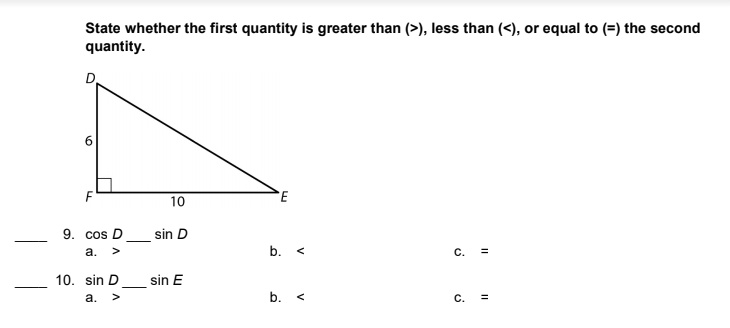
So here what are adj, opp and hyp ?
Relating to angle D
(sorry for my bad english)
 teal saddle
the sides of a triangle?
alpine sable
Yes
teal saddle
Ok
teal saddle
valors?
alpine sable
Values maybe ?
alpine sable
Yes
Hyp you can find it value with a very famous expression
Calculus
You know you are in a triangle with 90°
teal saddle
Yes
alpine sable
Pythagoras ? 👀
alpine sable
Yeess
teal saddle
ohh ok
alpine sable
Sorry I'm french and it's pretty difficult to write
teal saddle
all good
alpine sable
You don't have the same language for maths
teal saddle
Ok so I use pythagorean theorem?
 ashen tide
Hello
wet fulcrum
actually u dont need to use pythogoras
 teal saddle
Were using this
wet fulcrum
since in all cases hypotenuse is constant just check which has greater numerator
alpine sable
Yes
alpine sable
Very dumb I am 🙃
wet fulcrum
no dude dont waste time finding hypotenuse
teal saddle
yea
ashen tide
 teal saddle
This spot is in use
wet fulcrum
DF = 6 and FE = 10 right?
teal saddle
Yes
wet fulcrum
ashen tide
I need help
then ask someone else
wet fulcrum
which is greater 6/2 or 10/2
wet fulcrum
nope
teal saddle
bruh
teal saddle
Oh B
wet fulcrum
explain how then ill tell if its correct or not
teal saddle
Well Sin D greater
wet fulcrum
why do you think that
teal saddle
6/2 < 10/2
wet fulcrum
yesss
teal saddle
okk
wet fulcrum
now whats next answer
teal saddle
oh lmao ok
wet fulcrum
continue
teal saddle
umm
wet fulcrum
what is sin E
teal saddle
Sin is opp/hyp
wet fulcrum
what is opposite to angle E
teal saddle
10
wet fulcrum
umm dude
teal saddle
?
wet fulcrum
 teal saddle
6/h
wet fulcrum
so which is greater 6/h or 10/h
teal saddle
10
wet fulcrum
so sin e or sin d
teal saddle
so D greater
wet fulcrum
yes
teal saddle
A
wet fulcrum
there you go now you know trig
teal saddle
Ok thank youuu
wet fulcrum
: D

 lunar scarab
can anyone help me with my problem??
 hard thorn
can anybody help me with this pls
lunar scarab
hard thorn
too difficult
hard thorn
@lunar scarab i was before u 🙂
 vivid galleon
u try long div?
 rotund steeple
what did you try galaxy
 wet fulcrum
hard thorn
wet fulcrum
hard thorn
f(-x) = -f(x)
hard thorn
vivid galleon
u try long div?
long div wdym?
vivid galleon
long division
 haughty frigate
The points (-5,r) and (3,8) lie on a line with slope 5/4. Find the missing coordinate r.
vivid galleon
actually dont do long division my bad
rotund steeple
hmm btw the problem is wrong, its either a=d=0 or b=c=0
hard thorn
rotund steeple
hmm btw the problem is wrong, its either a=d=0 or b=c=0
ye that’s the question
prove that a=d=0
rotund steeple
well thats not the case, it can be eithert
hard thorn
c does not equal to 0
rotund steeple
oh so is c != 0 assumed?
 loud fiber
Is this room taken
?
rotund steeple
yes
loud fiber
Ok
hard thorn
rotund steeple
oh so is c != 0 assumed?
yes
rotund steeple
anyhow, how did you get that from f(x)= -f(-x)
remember this holds for all x in the domain
hard thorn
cuz f is an odd function
rotund steeple
hard thorn
right but what did you do here
alpine sable
what does {} mean in math?
rotund steeple
please stop giving out answers @wet fulcrum , thats not how we do things here
hard thorn
 wet fulcrum
hard thorn
wet fulcrum
hard thorn
simplify
rotund steeple
oh yeah i see i misread your handwriting, so how do you go from there do you think
the acx^2 = bd
hard thorn
 hard thorn
yes
rotund steeple
how do you proceed from here?
hard thorn
simplify these
 muted grail
there are 4 different sol to this prob and answer to prove is one of them.
rotund steeple
hard thorn
simplify these
think about how to do this
the key fact I will emphasize is that this needs to be true for all x
hard thorn
yes its true for all x
 wary stream
Please don't starting pinging people, when someone can help, they will


 glossy nymph
teal saddle
How do i do this?
glossy nymph
teal saddle
How do i do this?
Do you know Pythagoras theorem?
muted grail
yeah, by writing 3 pythagoras equations and solving them.
teal saddle
yes
muted grail
assume AD = x. find BC in outer trigangle. then find CD in right triangle. then write pythagoras eq in left triangle
muted grail
what? did u not get ?
teal saddle
How do I find BC?
muted grail
BC^2 = (1+X)^2 - 1
peak niche
@lavish mango dont put in multiple channels
 lavish mango
peak niche
<@!236022956487081984> dont put in multiple channels
lavish mango
peak niche
<@!236022956487081984> dont put in multiple channels
sorry ill delete
peak niche
Does anyone know a trick to factorise something into brackets more quickly when there is more x^2
process of elimination is annoying and boring
 mellow hearth
depends on the question
give me an example of a quadratic equation you wanma solve
there's some insight to certain cases
peak niche
12x^2-59x+72=0
mellow hearth
ok so first you look for reducing it (incase there are common factors)
hard thorn
use quadratic formula
peak niche
nah not to find answers
mellow hearth
hard thorn
use quadratic formula
best option tbh
peak niche
but to factorise it into brackets what do i do if theres multiple x^2
hard thorn
then you’ll get
mellow hearth
peak niche
to get into brackets
whatever you split 59 into will have multiple same as 72*12
mellow hearth
take an easier example for better understanding
mellow hearth
-4x² - 7x +12 = 0.
peak niche
lets say its algebraic fractions