#help-0
1 messages · Page 604 of 1
 alpine sable
 blazing oak
Wow
 reef olive
,w x'=t-x
 ocean sealBOT


 Requested by #5213
reef olive
Requested by #5213
reef olive
mens
 reef olive
draw line from D to midpoint
and then use the formula for arc pi*angle(rad) = arc length
so angle = 120 / pi and convert to degrees
and then from that u can work out all angles and all lengths using trig
theres probably an easier way to do it though 😦
 plucky seal
Ok ty
 hallow herald

 clever frigate
Can I get some help doing this partial fraction decomposition?

(i just need to decompose whats inside the angle brackets)
 velvet pelican
@clever frigate try the form A/s^2 + B/(s^2+a^2)
In this case, you don't actually have to square both sides. A transformation of 12cos(x) + 5sin(x) = 13cos(x - arctan(5/12)) works. In general, when you square both sides, you need to plug the solutions back into the equation to ensure they satisfy it.
 hollow zephyr
yeah but we didn't have arctan
I feel like in this case I just need to say that sin x > 0 and go from there
velvet pelican
I mean you can square it
just substitute the solutions back
to make sure they make sense
velvet pelican
welcome
alpine sable

apparently 1.5 is the incorrect answer, i thought the arc length is always the same as the inside angle
can someone explain or help what i do here?
velvet pelican
the arc length = radius * angle @alpine sable
alpine sable
?
ill just copy paste ur question if u care so much
if cot theta < 0 which quadrant does the terminal side of the angle lie
alpine sable
If a product has a 100% rating with 10 customers, the real rating could be something else than 100%, like 95% because the chances of getting the first 10 reviews 100% are still high. How can I calculate the range of what values the "real" rating most likely to be (100% is most likely mathematically, but there are also other values that are also likely)?
 real sinew
alpine sable
If a product has a 100% rating with 10 customers, the real rating could be somet...
real sinew
alpine sable
If a product has a 100% rating with 10 customers, the real rating could be somet...
I've heard a simple way to do so is to add on two more simulated ratings of 100 and 0
There's probably a better way though
 graceful bloom
I have a problem
alpine sable
Yeah I know but it feels like cheating because I don't know where it came from. I also can't find any other information to this.
Or maybe I have but they use anothef example and the math flew over my head
real sinew
You can really only go by past data.
If there is no past data, then it is kind of arbitrary
You could assume there is a normal distribution of ratings where the mean is near 100 but lower, and there is a chance that the normal curve intersects with 100.
But there's no way of knowing the mean
Without past data
It doesnt have to be normal either, it could be another distribution intersecting with 100
alpine sable
I know but you could calculate how likely it is to get 100% for your first 10 reviews if you have a lets say 95% rate
So 100% is most likely and then it goes down
real sinew
You could calculate it if it is purely random
If it isnt purely random, then you would need an idea of where the true rating would lie
alpine sable
Let's say purely random
real sinew
Then you have 10^10 for randomly getting 10 ten times
So not likely lol
Oh I just saw the 95 percent rate
So say you are using a normal distribution, that would be the mean but you still dont know the standard deviation
Let's say we go with the 100 and 0 idea I said earlier, that would give you an estimated rating of 11/12
,calc 11/12
ocean sealBOT
Result:
0.91666666666667
Is there a formula to plot all the chances from 1-100% of getting the first 10 reviews 100%
Yeah but he never said where he got that "add 2 true and one false" thing from
real sinew
There is no formula unless you have a distribution (normal distribution is a safe bet here), mean (which could be 95%) and standard deviation (which we have no clue here)
alpine sable
I don't think it would be a normal distribution because the chances of the seller having 100% is most likely
real sinew
If you had a percentage in mind, (say 1 in x times you will get 100% rating) we could calculate the standard deviation
Oh I see
Possibly a normal curve with a mean at 100% and anything higher rounds to 100%
alpine sable
Hmm
Yeah possibly. I'm going to watch 1b3b video again and see if I can get some more clues. I'll come back
 slate marsh
Hey guys, is there a way to quickly find a number who's product has a certain remainder ? for example x*(2^32) must have a remainder of 0.5, what would be x
real sinew
Alright good luck
real sinew
slate marsh
Hey guys, is there a way to quickly find a number who's product has a certain re...
You're not dividing anything so there's no remainder
slate marsh
sorry I meant decimals
real sinew
Oh ok
Are you working with floating point decimals on a computer? Or just in general?
slate marsh
yeah on excel at the moment
real sinew
Hm
slate marsh
im just trying to reverse engineer a sequence of number because Solver can't solve this
real sinew
Ok
What I would do is solve x for various examples. Like solve x for 0.5, 1.5, -0.5, and look for a pattern in x values
slate marsh
the other thing i noticed is that a single digit change can vary totally the resulting decimals, like even one digit change on a 32 digit number
and there is no actual way of seeing progress
like if im getting closer or further from the correct number
real sinew
Multiplying anything by 2^32 makes it hard to get precise values
Because that number is so large
slate marsh
im wondering if maybe we could do this by step
real sinew
A computer will likely round the number
slate marsh
because mutiplying by 2 is easy
real sinew
Ok. x*2 has a decimal of 0.5
So some examples are x=0.25, 0.75, 1.25, etc
So the formula is 0.25 + n/2
Where n is any integer
slate marsh
alright I see
real sinew
If you try it with x*(2^2), and want 0.5 in the decimal, then you get 0.125, 0.375. So In that case the formula is 0.125 + 0.25n
slate marsh
interesting so there is actually a pattern
real sinew
So it seems the formula in general is (0.25/p) + 0.5pn, where p is the power that 2 is raised to
So for 2^32 you get 0.25/32 + 0.5n/32
Where n is any integer
slate marsh
so now i can use solver to test some options ?
real sinew
Yes
slate marsh
is it (0.5n)/32 or 0.5(n/32) ?
real sinew
Yeah you multiply that by 2^32
real sinew
Oh wait
slate marsh
yes
real sinew
I did 2n when I think it should be n^2
In several places
Let's try 2^3
2^3 times x = something.5
That's what you want right? A number with .5 at the end?
slate marsh
yeah
real sinew
I'm busy atm
real sinew
So I'm getting 0.0625, 0.1875
slate marsh
so that i can choose the exponent
real sinew
That's what I'm hoping to find
So when exponent is 3 you get 0.0625 + .125n
.25 .125 .0625 for the first number and .5 .25 .125 for the second
So lemme think this through
real sinew
0.5^(1+p) + n* 0.5^p
I believe that is it
Where p is the value in 2^p
And n is any integer
So for 2^32 you have 0.5^33 + n*(0.5^32)
slate marsh
trying to make it work but havent managed to find a number n yet
real sinew
I'm trying it in wolfram alpha and that formula is correct
ocean sealBOT

 Requested by crabchurch#2749
real sinew
Requested by crabchurch#2749
real sinew
In goes n, out goes n.5
slate marsh
this seems perfect
let me plug this through to my python program
for some reason i get 10.000000000116415
ah got it
but when i think about it it's not exactly what i had in mind
although this is very useful for me
but for an other case
let me give you an example
 bronze pawn
any idea about an identity for α^2 +b^2 +gamma^2 in terms of the coefficients of a cubic equation
real sinew
This channel is occupied atm
slate marsh
3648289171/(2^32) is 0.84 something
now if I divide this big figure by 2, the remainder is 0.5, if i do it again it is 0.75, and the third time is 0.375
now my problem is that i wanted to find this big number given the decimals
and the resulting division
 haughty plaza

 solar tapir
Not gonna tell you the answer
But
IQR = 3rd quartile - 1st quartile
Median= 2 quartile
Work from there
A symmetric distribution is a type of distribution where the left side of the distribution mirrors the right side
 strong furnace
distribution should be symmetric about mean/median
alpine sable
a=1000+50w is this linear?
 naive belfry
alpine sable
a=1000+50w is this linear?
naive belfry
alpine sable
a=1000+50w is this linear?
yes
there's a constant rate of change (y =mx+b)
alpine sable
thx
 oak chasm
@lucid shuttle You generally don't. You usually combine them to eliminate both of them. What problem are you solving?
oak chasm
Are the xs multiplication? If so, no need for them.
oak chasm
You start with this?
$$N = 4500 e^{0.046t}$$
ocean sealBOT
Chai T. Rex
 oak chasm
OK, so solve for t by getting t alone on one side.
What can you do first to get it closer to t on one side by itself?
ocean sealBOT
Chai T. Rex
 oak chasm
OK, what next?
 lucid shuttle
uhm
I think there is a special rule I need to apply
a^x = q
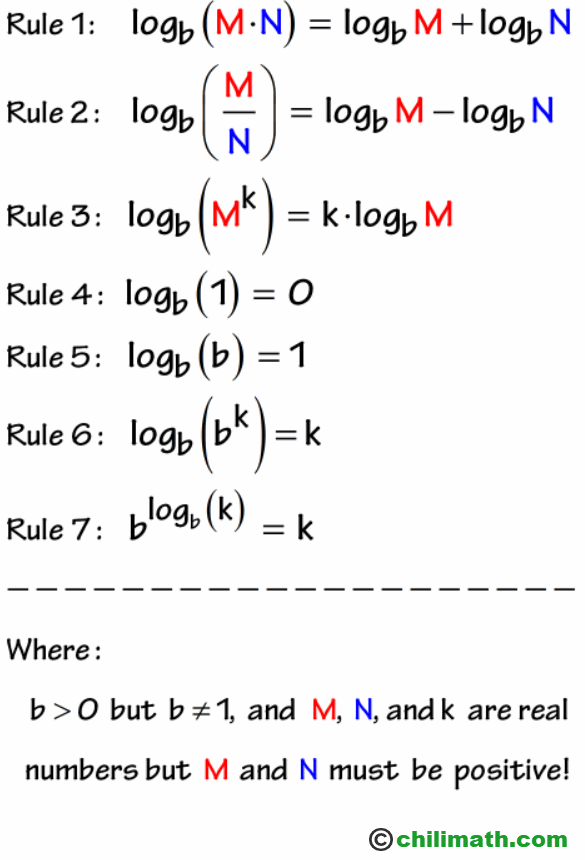
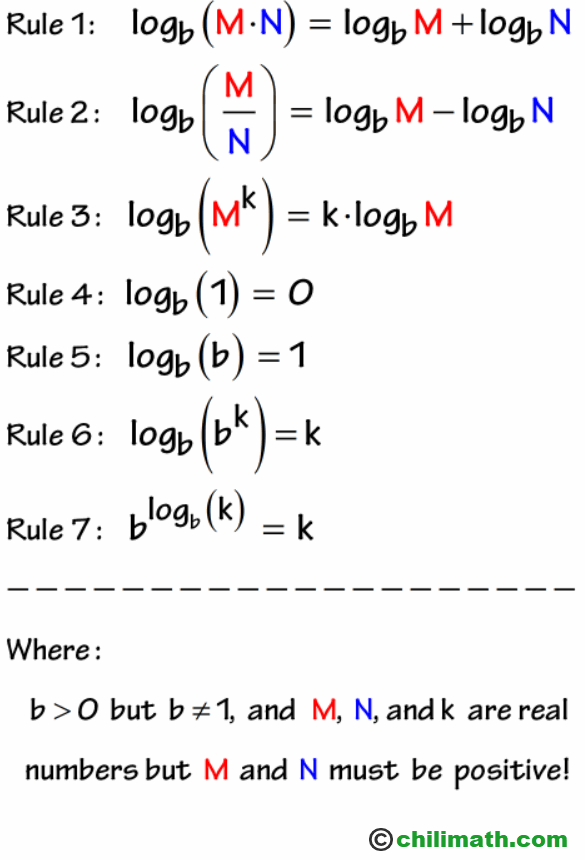
is x = ^a log (q)
?
or nah?

 oak chasm
Does that make sense?
lucid shuttle
how nice
well, following the rules I assume yes
Without the rule I would have never came up with that
oak chasm
Yeah, the rules are nice.
lucid shuttle
but the question is not finished yet I believe
lucid shuttle
lucid shuttle
t = a x ln( b x N)
I need this form
oak chasm
OK, what do you need to do next to get t by itself?
ocean sealBOT
Chai T. Rex

 oak chasm
No problem. So, it's just normal algebra with the new log rules.
lucid shuttle
oak chasm
No problem. So, it's just normal algebra with the new log rules.
I see
Have a nice day
oak chasm
You too.

 charred marlin
Hey, would this be 6/10 or 6/26 I’m confused if I should be finding the answer out of all males or of all students

 night sinew
for this problem. wouldn't it be a positive degree?
night sinew
night sinew
for this problem. wouldn't it be a positive degree?
since the reference angle has to be always positive. but i'm not sure if its either 30 or -30 because it's directly asking us to calculate sin^-1(-1/2)
oak chasm
@night sinew What angle gives a sine of 1/2?
night sinew
30 degrees
oak chasm
Do you know the unit circle?
night sinew
i don't have it memorized but i can understand it well
oak chasm
OK, so sine is the y value when it hits the circle.
So, you get 1/2 at an angle of 30 degrees counterclockwise from 0 degrees.
You get -1/2 at an angle 30 degrees clockwise from 360 degrees.
So, 360 - 30 = 330 degrees is one place.
You also get -1/2 at an angle 30 degrees counterclockwise from 180 degrees.
So, 180 + 30 = 210 degrees.
Does that make sense?
night sinew
yeah, like it's coterminal angles?
night sinew
so it would still equal to +30 degrees?
oak chasm
No, what's the sine of 30 degrees?
oak chasm
Yes, that's right.
night sinew
thank you
oak chasm
No problem.
 radiant elk
does anyone know how to start this problem? i don't really know where to begin

#21 btw
radiant elk
not sure if i'm allowed to ping <@&286206848099549185>
oak chasm
@radiant elk You asked the question and waited 15 minutes, so it's fine.
radiant elk
ok
 amber mountain

Im verifying identities and dont recognize these symbols
can I see them as variables?
 tawdry pollen
 wary stream
amber mountain
can I see them as variables?
wary stream
amber mountain
can I see them as variables?
Those are Greek letters, alpha and beta, and yes you can use them as variables
tawdry pollen
I would use this website it has all the formula and identities
wary stream
tawdry pollen
I would use this website it has all the formula and identities
They weren't referring to not knowing the identities. They didn't know what the Greek letters meant
tawdry pollen
wary stream
They weren't referring to not knowing the identities. They didn't know what the ...
I realized that as soon as I sent the message lol
amber mountain
Oh ok so its the same an X and Y
wary stream
amber mountain
Oh ok so its the same an X and Y
Yes
amber mountain
its just to establish two different thetas, ok got it
 mighty sinew
@radiant elk are we assuming the circle has unit radius?
radiant elk
uh what does that mean- sorry I dont understand
mighty sinew
Radius = 1
radiant elk
sure i guess, I think I just have to prove that the triangles are similar tho
mighty sinew
Ahh thought its 22 mb
radiant elk
oh ok
mighty sinew
hint: prove that the two triangles have the same angles. Ah, and BAC = 90 degrees @radiant elk
radiant elk
i think there is a theorem to prove that angle BAD and angle DAC are congruent, but in order to prove that the triangles are similar, don't I have to prove two pairs of congruent angles?
nvm i figured it out, thx anyways
 fallen night

Hello, I need to solve this for a and b
I've split it into three equations

but now i can't isolate the variables
hmm
could I maybe divide the first by [1]?
wary stream
fallen night
I would use elimination/substitution to find a and b
Like set one equation equal to a, and plug it into another to find b
fallen night
yes that is what i am trying to do
i just don't know how to get a you know
or how to get b either
wary stream
So for equation 1, set that equation to a
wary stream
Given $$ a + 2b = 0$$, set that equation to a
ocean sealBOT
dldh06
 wary stream
It's a constant
wary stream
Yeah
That's a constant
Like I don't have to do [2]*x every time, right? I can say 2x
fallen night
oh you mean (2)*x
fallen night
no these are equivalence classes on modulo 5
which i don't know what that means either
so [2] is all numbers that are 2 if you divide them by 5
wary stream
They're brackets, it's just a notation. So technically [2] * x, (2) * x, and 2x, all mean the same

 subtle mantle
you could rewrite each equivalence class as [a] = (5k_1+a), [b] = (5k_2+b) for some k_1, k_2 in Z if you want to move the problem into Z
subtle mantle
alternatively you could just treat them as normal numbers and divide/multiply keeping in mind that 0=5
cause Z/5Z is a field so division is all fine
fallen night
alright
 lunar garden
does anyone know how to solve this?
 radiant elk
sides of similar triangles are proportional
try to figure it out using that information?
@lunar garden
radiant elk
uh
i dont know what that is sorry
but how I did it was
NL / LH = ML / LG
so if NL is 10 x more than LH
then ML is 10x more than GL
idk if that makes sense to u
radiant elk
uh sorry
ok i wil try to explain it better
if you put the side lengths into a fraction
you would get 70/x = 7/10
wary stream
lunar garden
Yeah im no sure how to find the missing sides
Set proportions $$\frac{NL}{ML} = \frac{HL}{GL}$$, right?
radiant elk
then cross multiply to find x
ocean sealBOT
dldh06
 lunar garden
Ok so i cross multiply them to get the answer?
wary stream
Plug in the values that you know
wary stream
$$\frac{NL}{ML} = \frac{HL}{GL}$$
$$\frac{70}{x} = \frac{HL}{GL}$$
ocean sealBOT
dldh06
 wary stream
lunar garden
and ML is unknown
wary stream
lunar garden
and ML is unknown
So far so good, right?
lunar garden
yeah
wary stream
What other values do you know?
lunar garden
HL is 7? and GL is 10
wary stream
$$\frac{NL}{ML} = \frac{HL}{GL}$$
$$\frac{70}{x} = \frac{HL}{GL}$$
$$\frac{70}{x} = \frac{7}{10}$$
ocean sealBOT
dldh06
 lunar garden
do i divide it
lunar garden
Cross multiply?
wary stream
Yep
lunar garden
ok so 700 on the top side then
wary stream
What about the other side?
lunar garden
7x
wary stream
$$\frac{70}{x} = \frac{7}{10}$$
$$700 = 7x$$
ocean sealBOT
dldh06
 wary stream
So how would you find x?
lunar garden
now i divide?
wary stream
Yep
lunar garden
by 7 so is x 100?
wary stream
Yep,x = 100
lunar garden
Thank you!
 cyan fractal
I'm currently second guessing myself, so a bit of a basic question.
Does foh(x) = 4(x^3) simplify to foh(x) = 4x^3?
 woeful pulsar
$f\circ h(x)=4(x^3)$ is the same as $f\circ h(x)=4x^3$ because of PEDMAS, yeah
ocean sealBOT
Element118
 cyan fractal
Alright, thanks!
 vagrant pier
can someone help me on this
 woeful pulsar
vagrant pier
can someone help me on this
woeful pulsar
vagrant pier
can someone help me on this
what have you tried?
woeful pulsar
vagrant pier
i know it's -2 and 1
what is -2 and 1?
woeful pulsar
the answer is not a pair of numbers
you need to come up with the values x such that f(x) is well defined
 dawn frigate
Hello can anyone help me in a voice channel
vagrant pier
ok so can you walk me through the problem
woeful pulsar
vagrant pier
ok so can you walk me through the problem
what are -2 and 1?
they are where the expression (x+2)/(x-1) changes sign, right?
so what happens around them?
vagrant pier
ok thank u
 ocean sealBOT

 spark shadow
Is this correct.?
 muted raft
I don't think so.
 woeful pulsar
what is the question?

 bold silo
Can someone give me the answer to a question
 glacial pier
can someone check 10 calculus questions for me?
glacial pier
dm ok?
 full canopy
sure
woeful pulsar
why not here lol
woeful pulsar
bold silo
Can someone give me the answer to a question
probably not
woeful pulsar
 whole meteor
okay definitely wouldn't have guessed the question.
So you want P(z<=2.15), for that you can just lookup your standard distribution table or tap that into a calculator
 faint root
what is 30cm2
glacial pier
woeful pulsar
why not here lol
10 question
need to put 10 photos out
because i need to take them seperately
cyan fractal
Currently calculating the inverse of a function. I've got x = 3y-7 / y+1, how do I isolate the Y in this case?
Intuitively, I already want to try to do:
x(y+1) = 3y-7
xy+x = 3y-7
xy+x+7 = 3y
But I'm kinda stuck tryting to get that y out of the left side of the equation. I'm making some glaring mistake, but I don't know what it is.
Woop, figured it out
cyan fractal
Indeed, thanks!
 quaint crater
Hi! I was wondering if I had sin2x = 1/2 and I was looking for values of x in radians within a range of 0-2pi would my possible answer be pi/2 or pi/12?
woeful pulsar
cyan fractal
Currently calculating the inverse of a function. I've got `x = 3y-7 / y+1`, how ...
did you forget your brackets?
remember your brackets next time
 native brook
anyone know how to put v sub 1 into something like scilab (reference photo): https://gyazo.com/1b17ae95923c51966842deddb19a65c6
 woeful pulsar
quaint crater
Hi! I was wondering if I had sin2x = 1/2 and I was looking for values of x in ra...
woeful pulsar
quaint crater
Hi! I was wondering if I had sin2x = 1/2 and I was looking for values of x in ra...
sin 2x=1/2? when you solve it you are solving for x
quaint crater
woeful pulsar
sin 2x=1/2? when you solve it you are solving for x
yes, I am trying to solve it in terms of pi (in radians)
woeful pulsar
yeah so pi/12 would be one solution
quaint crater
Hmm ok so why cant I just divide the whole thing by 2 to get sinx=1, aka x= pi/2?
@woeful pulsar
 dusk smelt
It's sin(2x)=1/2
2x is the argument of sin, you can't just divide by 2
You need to get rid of the sin first
oak chasm
@quaint crater When you have an input to a function, you can't easily take things inside or outside of it unless you have a good reason.
So, with sin(input), you can't touch the input (taking something out of it or putting something into it) unless you have a good reason.
Pretend the numbers are stuck in there.
quaint crater
I c ok, thanks!
alpine sable

Hello, I am having problems understand orthogonal in linear algebra!
I must determine coordinates of a vector with respect to a basis...but I'm completely lost where to even start.
muted raft
The $\textbf{unqiue representation theorem}$ tells us that for any vector $\vb{v} \in \mathbb{F}^{n}$, there exists unique scalars from $\mathbb{F}$ such that $\vb{v}=c_1v_1 + c_2v_2 + \cdots + c_nv_n$ where $v_1, v_2, \cdots, v_n$ are the basis for $\mathbb{F}^{n}$. Recall that those unique scalars, $c_1, c_2, \cdots, c_n$ are the coordinates of the vector $\vb{v}$.
ocean sealBOT
zslya
 alpine sable
I need to understand this...
oak chasm
@alpine sable Orthogonal means at a right angle to all the vectors it's orthogonal to.
alpine sable
So, the theorem is telling me that to find the equation is to simply multiply the given vector with each vector?
And then, the results of each multiplication are the coordinates?
muted raft
This basically means that you need find a way to write vector $\vb{v}$ as a linear combinations of vectors of basis $B$.
ocean sealBOT
zslya
 muted raft
Not really.
muted raft
You are already given the basis. So just create an augmented matrix and apply elementary row operations to find the solution.
alpine sable
Okay >_<
I am the worst at memorizing these concepts. Honestly on the verge of flunking this class >O<
alpine sable
So, I just need to get the augmented matrix, solve down to echelon form, then solve from there?
(I wished I knew what I was doing xD)
ocean sealBOT
zslya
 alpine sable
Thank you! Now I know I set it up right.
I kept mixing up ranges and basis >_<
Honestly not sure when it's supposed to be in the matrix as shown, or when I have to solve for variables.
muted raft
range and basis are not the same.
Range of some function T means the set of image points of T. Whereas basis means a set of linearly independent vectors that span some vector space.
alpine sable
Okay, so far I got $\bmqty{1 & 0 & 8 & 6 \ 0 & 1 & 0 & 1 \ 0 & 0 & -22 & -10}$
ocean sealBOT
Tofu
 alpine sable
I might need to double-check with octave...
alpine sable
I just did
Using octave
Hmmm, I think I need general help doing elementary operationgs
Every time I do this, it's hit and miss

So, I believe I got the answer?
Thank you so much @muted raft
I would've never figured it out without you!
But now, I need to figure out why I never get the elementary operations right on paper.
How can i factor this?

Ive done similar questions where I start by common factoring out one of the terms but since one term is squared in this idk where to start
muted raft
alpine sable
So, I believe I got the answer?
yeah looks correct.
Just take it slowly.
RREF just requires practice.
oak chasm
@alpine sable First, expand everything.
There's no factor common to all three terms right now.
alpine sable
i need the area of this shape. no steps needed. just one answer. plz
 alpine sable
oak chasm
There's no factor common to all three terms right now.
alpine sable
oak chasm
There's no factor common to all three terms right now.
Oh ok i thought the 3m-n would be
oak chasm
@alpine sable Sorry, channel is busy.
alpine sable
oak chasm
<@456226577798135808> Sorry, channel is busy.
D:
 willow wolf
Hi, I was wondering if someone could help me with what i'm doing wrong here? I thought you multiplied the top exponents, and then subtracted the bottom from the top
 oak chasm
@alpine sable No, factoring means from the whole thing.
@willow wolf Sorry, channel is busy.
alpine sable
I mean the 3m-n
oak chasm
There are two ways, expand everything and then collect like terms and then factor from there.
Or use the quadratic formula, I think.
Not sure on that last one.
Yeah, that'll work.
alpine sable
but the quadratic formula wouldnt be factoring which i was instructed to do here right
oak chasm
No, it can be used for factoring.
First, check the discriminant.
What's the discriminant?
alpine sable
lol i dont think we learned this yet
oak chasm
OK, have you done the quadratic formula yet?
oak chasm
OK, the part under the square root is called the discriminant.
What's the value of the discriminant here?
alpine sable
so -3(3m-n) * 4(2(3m-n)(-5))
oak chasm
Nope, a, b, and c are the coefficients of the "variable" (3m - n).
oak chasm
So, a = 2, b = -3, c = -5.
alpine sable
9+40
oak chasm
Right.
alpine sable
49
oak chasm
So, is that at least zero?
If it was less than zero, you can't take the square root, right?
So we need it to be at least zero.
And 49 is at least zero.
Does that make sense?
oak chasm
OK, so do the quadratic formula.
What two results do you get?
$$\frac{3 \pm 7}{4}$$
$$\frac52 \mbox{ or } -1$$
alpine sable
2.25 is one

 alpine sable
isnt a=2?
oak chasm
Yep.
alpine sable
3m-n?
ocean sealBOT
Chai T. Rex
 oak chasm
The roots are the answers you get from the quadratic formula.
alpine sable
ohhh
ocean sealBOT
Chai T. Rex
 alpine sable
yup n then x 2 to make it so its not a decimal
alpine sable
it is like that in the answer key tho
oak chasm
Put a k out front.
Yeah, but we have to solve for it too.
$k \left((3m - n) - \left(\frac52\right)\right)((3m - n) - (-1))$
ocean sealBOT
Chai T. Rex
 oak chasm
See the k out front?
alpine sable
yh but idk what that means?
oak chasm
It means fill it in with a number so that when you expand, you get your original expression.
alpine sable
so in our case 2
oak chasm
So, how can we expand the two parenthesized factors to get just the (3m - n)^2 term?
You know FOIL, right?
alpine sable
yeah
oak chasm
So, first will give us what?
alpine sable
lol i havnt used foil foil ina while but isnt it jus solving the binomials
oak chasm
Yes, but we only need one term of the binomial expansion.
alpine sable
so (3m-n)(3m-n) which is 9m^2-6mn+n^2
alpine sable
yea
oak chasm
We don't want to do that.
See how no other pair of one from the first binomial and one from the second make (3m - n)^2?
alpine sable
lol honestly im quite confused but ik for a fact that she probably will just want us to factor I understand most of this and got the same answer if i make it so it isnt a decimal I think ill jus try to expand n solve
oak chasm
$$\mbox{First: } (3m - n)(3m - n) = (3m - n)^2$$
$$\mbox{Inner: } \left(-\frac52\right)(3m - n) = -\frac52 (3m - n)$$
$$\mbox{Outer: } (3m - n)\cdot 1 = (3m - n)$$
$$\mbox{Last: } \left(-\frac52\right)\cdot 1 = -\frac52$$
ocean sealBOT
Chai T. Rex
 alpine sable
1 sec lemme read it rq lol
lol honestly i dont get it but fr man thx for the help i got to what i needed im gonna continue reviewing the other concepts for now if thats finee tysmm for clearin it up
 stark gate
I need help with this question pretty difficult for me to solve
the line y=(3)/(4)x+A passes through the points (B,-3) and (9,c). Determine tha values of A,B, and C
I asked a few hours ago no one responded
<@&286206848099549185>
alpine sable
btw @oak chasm i think i got how my teacher does it just assigns a variable to the common term aka a=3m-n and then it factors normally off that n rewrites a in its full form at the end if that makes sense
 raven plaza

 vital delta
can i ask matlab questions here ?
muted raft
#computing-software might be better choice @vital delta
 harsh acorn
what does question mean as "type of triangle" does it means that is it right , isso, acute or other triangle?

or it asks for how much side length combinations does this triangle have?
dusk smelt
harsh acorn
or it asks for how much side length combinations does this triangle have?
I think it means this
Based on the example they provided
harsh acorn
then how can i solve it?
all i know is side's length cant be bigger then other side's sum and cant be smaller than other length's difference
dusk smelt
That's a combination question I believe
 obsidian mango
can anybody teach me this quesiton
harsh acorn
channel is occupied
obsidian mango
i am not getting the logic of this one
obsidian mango
dusk smelt
This channel is in use
i don't understand i mean does this channel is made for only one quesion...where i am wrong...
harsh acorn
dusk smelt
Facepalm
obsidian mango
so like when one question isn't solved till then i can't ask any other quesiton right?
oak chasm
Right, you have to find a channel that's not busy.
muted raft
Move to another channel which is not on use.
obsidian mango
ok...great....
muted raft
Pick a channel and ping me
harsh acorn
$$ x+y+z= 26$$
$$ |x-y|<z<x+y$$
ocean sealBOT
Hyl1s
 harsh acorn
$$z_{max}=12$$
ocean sealBOT
Hyl1s
 harsh acorn
and $$z_{min}= 2$$
ocean sealBOT
Hyl1s
 harsh acorn
so i just put numbers and count them?
alpine sable
Guys

The answer says its over 12
hi

is this a combination
and should it be 5C2?
<@&286206848099549185>
 stable umbra
alpine sable
is this a combination
stable umbra
alpine sable
is this a combination
Yes
alpine sable
is my 5c2 correct tho
stable umbra
alpine sable
is my 5c2 correct tho
It's correct
alpine sable
thank you anand babu
harsh acorn

 toxic dust
I always find these questions confusing, with the quotient rule. Can someone help me clear that

<@&286206848099549185>
alpine sable
you should've waited 15 minutes to use that tag breh
harsh acorn
and channel is occupied 
stable umbra
toxic dust
I always find these questions confusing, with the quotient rule. Can someone hel...
@toxic dust are you talking about differentiation using quotient rule?
toxic dust
Yeah
stable umbra
 stable umbra
stable umbra
stable umbra
Here
"u" is the function in the numerator
and
"v" is the function in the denominator
alpine sable
Ye
 tardy scarab
alpine sable
tardy scarab
alpine sable
??
 nimble frost
$$2$$
ocean sealBOT
Destreaux

 charred raft
Could someone help me answer
-17(-9)
 floral jungle
charred raft
Could someone help me answer
-17(-9)
floral jungle
charred raft
Could someone help me answer
-17(-9)
i got priority, the answer is 153

could someone help me through with this problem
ik the speed is dy/dx, we know dx, but how do we get dy with the cos(0.5x)
since its not the same variable
alpine sable
use chain rule
alpine sable
yep u can , but when differentiating the term cos x/2
u get a term of dx/dt
by chain rule
now sub the value of dx/dt given to u seperately
Plug t =2, x =-3
U get dy/dt
floral jungle
so derivative of cos x/2 = -1/2 sin x/2 right?
alpine sable
Ye
floral jungle
yeah
alpine sable
solving this big derivative u will get
dy/dt
U then find dx/dt
and then speed is resultant of these two, use pythagoras
floral jungle
so if you find the derivative of cos1/2x what do you do with the rest of the equation
cuz like don't u needto find the derivative as a whole
not part by part
alpine sable
Rest of equation is in t
u r differentiating wrt t!
So the other terms would only be in t
 jaunty sierra
Express cos162 in terms of cosine of another angle between o and 180 degrees
floral jungle
hm ok gimme a sec
 upper kayak
is this channel open?
In a box, there are red, green, blue, yellow and black marbles. There are 200 marbles of each color. At least how many marbles do you have to pick from the box to guarantee that you have picked 100 marbles of the same color?
i'm terrible at stats
strong furnace
consider the worst case for such problems
 misty quiver
help

 rich kestrel
upper kayak
In a box, there are red, green, blue, yellow and black marbles. There are 200 ma...
rich kestrel
upper kayak
In a box, there are red, green, blue, yellow and black marbles. There are 200 ma...
worst case scenario: you pick 99 of each color; then the next marble u pick will satisfy 100 marbles of the same color
so 99*5 + 1 i think
woeful pulsar
rich kestrel
so 99*5 + 1 i think
don't just give answers
rich kestrel
sorry
you have 5 colors; worst case you pick 99 of each, missing one from each
then the next marble will have to be part of those 5 colors, and one of the colors will have 100 in them
 vale wigeon
upper kayak
i'm terrible at stats
vale wigeon
upper kayak
i'm terrible at stats
this is not stats, this is basic counting / pigeonhole principle
upper kayak
Ok
vale wigeon
but yes, thelonewolf has explained the reasoning behind the answer here
 wispy olive
How is the line it passes through = 8,5.
It's slope is obvious but can you explain me how the line it passes through has the point 8,5?
 wispy olive
How is the line it passes through = 8,5.
It's slope is obvious but can you expla...
wispy olive
wispy olive
How is the line it passes through = 8,5.
It's slope is obvious but can you expla...
Ummm anyone?
harsh acorn
$$y=-4(x-8)+5$$
ocean sealBOT
Hyl1s
 harsh acorn
and in (8,5) $$x= 8$$
ocean sealBOT
Hyl1s
 ocean sealBOT
Hyl1s
 harsh acorn
if u try other points like (5,8) or (-5,-8) and put x in the equation you will not get the y
so they are wrong
 formal edge
anyone understand this? I don't really get how to change it from a series to the sigma notation
 wispy olive
ocean seal
**Hyl1s**
wispy olive
ocean seal
**Hyl1s**
I see.
wispy olive
ocean seal
**Hyl1s**
Okay.
harsh acorn
formal edge
anyone understand this? I don't really get how to change it from a series to the...
why questions has marks 
wispy olive
ocean seal
**Hyl1s**
Woahhhhhhhh.
formal edge
cuz it a two part question ://
wispy olive
Oh crap what a huge mistake I made.
I thought we have to find the values.
Instead of substituting the values from the answers.
Ahhh.
What an idiot I am.
alpine sable

how does that even happen
there’s no info abt any of their current or past ages
my brain cells are fried
formal edge
K = 4d <--- kevin is 4x daniel
K = d + 6 <--- kevin is 6 years older than daniel
4d = d + 6 <--- They both equal K, so they're equal
alpine sable
ik but
alpine sable
 formal edge
kevin is 8 and daniel is 2
alpine sable
these are only options
formal edge
put 8
harsh acorn
anyway it is course challange
you should do it by yourself
so you can know your weakness
harsh acorn
answers and solutions are given after the questions tho
alpine sable
i just never heard of that
wispy olive
But how do we know that it passes through (1,7)!?
 alpine sable
formal edge
kevin is 8 and daniel is 2
alpine sable
formal edge
kevin is 8 and daniel is 2
how abt the plus 6 years?
wispy olive
wispy olive
But how do we know that it passes through (1,7)!?
Anyone?
formal edge
@alpine sable
 alpine sable
formal edge
<@456226577798135808>
alpine sable
formal edge
<@456226577798135808>
after that we ain’t gotta add 6?
alpine sable
oh okay
alpine sable
wispy olive
I have to make the graph.
do that then
 wispy olive
But how do we know that it passes through (1,7)!?
wispy olive
wispy olive
But how do we know that it passes through (1,7)!?
@harsh acorn ?
formal edge
wispy olive
But how do we know that it passes through (1,7)!?
have u ever heard of desmos?
wispy olive
formal edge
have u ever heard of desmos?
I want to do it myself.
formal edge
you are, you're plugging in the numbers yourself 🤣
harsh acorn
wispy olive
But how do we know that it passes through (1,7)!?
just check it in equation
put 1 in x
alpine sable
you need to simplify the equation
wispy olive
harsh acorn
put 1 in x
Huh?
alpine sable
why didn’t i think of that 💀
harsh acorn
(1,7)
alpine sable
replace the x and y
alpine sable
with the cords you wanna check
alpine sable
if the equation works out it is
harsh acorn
wispy olive
Why that number of all numbers?
actually there are infinite possible points
but in answers
there are only 1 right
wispy olive
Yeah I know.
alpine sable
bc your looking if the line passes thru those points right
wispy olive
But why should I try substituting (1,7) out of all?
wispy olive
Here we are just given the equation.
harsh acorn
when u find the right one
wispy olive
wispy olive
Here we are just given the equation.
Not MCQ.
harsh acorn
just take it
wispy olive
How do we know that (1,7) passes through y−7=−3(x−1) ?
 vestal widget
formal edge
anyone understand this? I don't really get how to change it from a series to the...
vestal widget
formal edge
anyone understand this? I don't really get how to change it from a series to the...
 harsh acorn
just put them in the equation
harsh acorn
vestal widget
dont give the exact answer tho
wispy olive
alpine sable
7 is x and 1 is y
😒
harsh acorn
alpine sable
7 is x and 1 is y
wrong lol
harsh acorn
x is 1 and y is 7
alpine sable
yea
harsh acorn
first one is x
alpine sable
other way around
harsh acorn
second one is y
alpine sable
i keep mixing that up 😭
harsh acorn
it is the order
(1,7)
first x always
and second y
if there are z coordinate, z is 3rd
wispy olive
How do we know that particular point passes through the line made when the equation is graphed?
harsh acorn
wispy olive
How do we know that particular point passes through the line made when the equat...
you need to know that particular point's coordinate first and check in the equation
or
you can draw the graph
and look at the point's place
try in desmos
alpine sable
what does that even mean
 harsh acorn
perpendicular
wispy olive
alpine sable
what does that even mean
Line OA is perpendicular to line OC.
Are you in grade 6th or 7th or something, just asking.
 topaz cosmos
can someone help me out
harsh acorn
stop multiposting
alpine sable
wispy olive
Are you in grade 6th or 7th or something, just asking.
no
wispy olive
alpine sable
no
Then?
alpine sable
8th
wispy olive
Same.
formal edge
vestal widget
do you know how to do b? 🥺
vestal widget
formal edge
do you know how to do b? 🥺
yes i'll try
harsh acorn
i tried to say that lol
formal edge
vestal widget
yes i'll try
arigato gozaimasu 
muted raft
Just apply ratio test
It is not that hard....
If you actually put in some effort...
formal edge
im still a beginner im sorry
muted raft
don't be sorry but put in some work...
muted raft
no space before and after $
vestal widget
formal edge
arigato gozaimasu <:happy_cry_cat:636407813144576010>
??
formal edge
thank you in japanese hehe
vestal widget
formal edge
thank you in japanese hehe
For b goto https://youtu.be/yYxzq_O18Mg

Thanks to all of you who support me on Patreon. You da real mvps! $1 per month helps!! :) https://www.patreon.com/patrickjmt !!
Sum of an Infinite Geometric Series, Ex 1. In this video, I show how to find the sum of a convergent infinite series.


 wheat prawn
oh
 warm iron
Since the value for y is simultaneous for both of the equations, you can equate them
Then simplify the whole square terms
wheat prawn
@warm iron i dont like fractions
vestal widget
wheat prawn
On 2nd equation multiply 2 on both side then add it with 1st one
 ruby parcel
ik my question was stupid but can someone answer it please
isnt it right cause multiplication is commutative
 vestal widget
wheat prawn
vestal widget
wheat prawn
Don't open square.....
wheat prawn
y
vestal widget
Just add it with 1st equation then u got y value

 glossy current
Yes
 glossy current
Yes
 glossy current
No
wheat prawn
what did i do wrong
warm iron
You can't distribute the -2 since the expression is inside of the square


 ocean sealBOT
Darkness
 glossy current
There are 2 ways to solve it
One way is to break $(x-2)^2$
Second way is to substitute $t= (x-2)^2$
ocean sealBOT
Darkness
 vestal widget
I think finding y value first is easy
wheat prawn
glossy current
Why do you need to throw -2 in
wdym
vestal widget
Afterthat put the y value anyone equation and find x value
vestal widget
So there's no problem
wheat prawn
yea but its really confusing
we learnt the whole unit in 3 days
and you adding this
makes it more confusing
wheat prawn
yea
ocean sealBOT
Darkness
 wheat prawn
wdym
glossy current
$-2(7-(x^2-4x+4))=(x^2-4x+4)+2$
ocean sealBOT
Darkness
 wheat prawn
ok
ocean sealBOT
Darkness
 vestal widget
$-2(x-2)^2+14 = (x-2)^2+2$
ocean sealBOT
Aman Verma
 vestal widget
$3(x-2)^2 = 12$;
$(x-2)^2=4$;
$x-2=+-2$;
$x=2+-2$;
$x=4,0$
wheat prawn
glossy current
What is $-(x^2-4x+4)$
$-x^2+4x-4$

 ocean sealBOT
Darkness

 modern aurora

 feral pine
I cant rlly read the question, can you send a better image @modern aurora
also what is 'desi' supposed to be?

 wheat prawn
@glossy current $-14-2x^2-8x+8=x^2-4x+4+2$
modern aurora
open original
ocean sealBOT
Roberttt
 wheat prawn
$-2x^2-8x-6=x^2-4x+6$
ocean sealBOT
Roberttt
 wheat prawn
$-x^2+4x=0$
ocean sealBOT
Roberttt
 glossy current
solve it
wheat prawn
$0=x^2-4x$
ocean sealBOT
Roberttt
 glossy current
bruh
glossy current
solve it
wheat prawn
factor?
wheat prawn
(x-2)(x-2)
ocean sealBOT
Darkness
