#help-0
1 messages · Page 577 of 1
 vast ether
Nah I've been spongebob my whole life. I'll let you be squidard tho
 vast ether
-
Give each side of the triangle a label
-
Use that label to decide which trigonometric identity to use
ULULULULULULULULULUL
 alpine sable
ULULULULULULULULULUL
vast ether
Those jellyfish dont stand a chance
alpine sable
fax

 vast ether
Damn look at him go

 vast ether
Me & the bois all hate plankton
 vast ether
Everyone's secret crush
 ashen wave
that dump truck tho 😩
 sly mantle
@alpine sable @vast ether keep offtopic posts away from the help channels
alpine sable
sorry
ashen wave
is anyone here good with quadratic functions?
vast ether
ashen wave
is anyone here good with quadratic functions?
Hit me
ashen wave
vast ether
Hit me
A rectangular pen is to be built along a wall from 72 yards of fencing. Find the maximum area that can be enclosed and the dimensions of the pen.
vast ether
sly mantle
<@456226577798135808> <@!296676313484361728> keep offtopic posts away from the h...
Understood
vast ether
 halcyon cloud
can u help with something else?
halcyon cloud
can u help with something else?
Yes

 frank cave
is this channel occupied?
ashen wave
no one is rlly on here :/
frank cave
i know 1, 4, and 25 are squares but idk how I get a recursive sequence from that
 gray isle
consider (-2 +1)^2 = 1
etc
 frank cave
gray isle
consider (-2 **+1**)^2 = 1
etc
frank cave
gray isle
consider (-2 **+1**)^2 = 1
etc
wdym?
 hybrid pike
Ping me if you have time to help me. Sorry, I don't know how this server works
 glass lichen
frank cave
gray isle
consider (1 **+ 1**)^2 = 4
glass lichen
frank cave
gray isle
consider (1 **+ 1**)^2 = 4
wait so its like a_n = (a_n-1 + 1)^2 ?
gray isle
use appropriate parentheses pls
ashen wave
glass lichen
<#488120190538743810>
Hi moshill!
gray isle
a_n = (a_(n-1) + 1)^2
frank cave
gray isle
a_n = (a_**(**n-1**)** + 1)^2
?
ashen wave
And i need help with word problems rip
gray isle
fk discord formatting
ashen wave
A rectangular pen is to be built along a wall from 72 yards of fencing. Find the maximum area that can be enclosed and the dimensions of the pen.
frank cave
$a_n = (a_{n-1} + 1)^@$
 ocean sealBOT
oof
 gray isle
yes
frank cave
aight thanks
glass lichen
then also you need to write a_1
gray isle
that too
 wild shard
How would I solve for ray torus intersections
frank cave
glass lichen
then also you need to write a_1
yea a_1 is just -2 right
ashen wave
glass lichen
then also you need to write a_1
could you help me T-T
A rectangular pen is to be built along a wall from 72 yards of fencing. Find the maximum area that can be enclosed and the dimensions of the pen.
ocean sealBOT
moshill1
 frank cave
ashen wave
A rectangular pen is to be built along a wall from 72 yards of fencing. Find the...
frank cave
ashen wave
A rectangular pen is to be built along a wall from 72 yards of fencing. Find the...
let length be x width be y
2x+2y = 72 so x+y=36
so x=36-y
ashen wave
frank cave
let length be x width be y
how do you know which is which?
frank cave
and the area is x*y correct?
frank cave
ashen wave
wait did you use ax^2+bx+c?
no
ashen wave
A=L*W?
ashen wave
frank cave
and the area is x*y correct?
then yeah
gray isle
setup is wrong
frank cave
its been a while since i've done this lmaoo
gray isle
built along a wall implies that only 3 sides need fencing
ashen wave
right
gray isle
drawing a diagram also helps
ashen wave
okk so like a square with a wall instead of the 4th side
gray isle
not a square, rectangle
gray isle
A rectangular pen is to be built along a wall
gray isle
have you drawn your diagram
ashen wave
yep
 stable dune
 gray isle
can you show what you've drawn
stable dune
isnt it a^2+b^2=c^2
ashen wave
hold on let me go get my phone
stable dune
but 20^2+b^2=29^2?
 gaunt sparrow
stable dune
gaunt sparrow
stable dune
Is the answer 21?
stable dune
gaunt sparrow
Is the answer 21?
im not sure
gray isle
but 20^2+b^2=29^2?
hopefully this will be very short.
yes continue
 next lynx
de(mod x)=1 is there a way i can find d given the values for e and x ?
frank cave
is there another way to do part b without using the graph as justification?
gray isle
evaluate the limit algebraically
frank cave
what limit would i evaluate?
ocean sealBOT
ℝamonov
 frank cave
gray isle
$\lim_{n \to \infty} b_n$
frank cave
gray isle
$\lim_{n \to \infty} b_n$
ah ok how would i do part c?
 gray isle
well since you're dealing with a sequence, n will be an integer
cos(pi * n) will alternate between -1 and 1
alpine sable
do you know how to use a notpad
like a whiteboard that is online
just draw it out and send it pls
frank cave
gray isle
well since you're dealing with a sequence, **n** will be an integer
cos(pi * n) ...
but how would that change if n >= 4?
gray isle
doesn't change much
frank cave
so how would i write the explicit formula?
frank cave
gray isle
doesn't change much
since it cant be recursive right
gray isle
it isn't really clear what they actually want
frank cave
gray isle
it isn't really clear what they actually want
i thought like explicit formula works for every b_n term
ashen wave
shoot I forgot about discord
gray isle
well you're already given an explicit formula
gray isle
by rewrite, the best i can infer is rewrite the cos(pi * n) as a power of (-1)
frank cave
gray isle
by rewrite, the best i can infer is rewrite the cos(pi * n) as a power of (-1)
yea i dont think it would change much for N >= 4.
frank cave
gray isle
by rewrite, the best i can infer is rewrite the cos(pi * n) as a power of (-1)
wdym. how would i rewrite it?
ashen wave
gray isle
by rewrite, the best i can infer is rewrite the cos(pi * n) as a power of (-1)
sorry I took so long but could you still help me?

 hollow grove
 gray isle
label your length and width
ashen wave
 gray isle
cos(pi * n) will alternate between -1 and 1
specifically cos(pi * n) will be 1 for even n
and -1 for odd n
ok using those dimensions set up an equation for the amount of fencing
hollow grove
hollow grove
guys?
hollow grove
can y'all help me how to draw this thing
ashen wave
A=L*W?
gray isle
that's the equation for area which will be useful later
frank cave
gray isle
> cos(pi * n) will alternate between -1 and 1
specifically cos(pi * n) will be 1...
but for N>= 4 theres both odd and even n right?
gray isle
according to your diagram, how much fencing will there be?
use something like (-1)^(n)
gray isle
that's my guess at what the question wants
frank cave
aight thanks
ashen wave
im confused :/
gray isle
according to your diagram, how much fencing will there be?
(in terms of L and W)
don't overthink this
it's not supposed to be a trick question
ashen wave
wait give me a sec
ashen wave
gray isle
> according to your diagram, how much fencing will there be?
idk W+W+L
idk
oh wait
aren't we supposed to be talking about perimeter?
72 yards of fencing
gray isle
yes
i'm leading up to that
according to your diagram the amount of fencing will be
W+W+L
and you are told that the numerical value will be 72 (yards)
hence the equation you would set up is
W + W + L = 72
ashen wave
oh ok but when it talks about 72 yeards of fencing is that referring to the area orr?
gray isle
72 yards of fencing refers to the amount of fencing
says nothing about area
Area is what you're trying to optimise
yards is a measurement for distance not area
ashen wave
wait so 72 is the width and the length added up?
gray isle
72 is the sum of the lengths of your 3 fences
ashen wave
ohh ok
gray isle
W + W + L = 72
ashen wave
oh ok
gray isle
now
A=L*W
ideally you want to get the area in terms of 1 variable
so you could isolate W or L from W + W + L = 72
and then sub that into your equation for area
here it seems isolating/substituting L would be less tedious
gray isle
the end result will be the same
ashen wave
oh ok
gray isle
calculations using 1 may be less tedious than the other
gray isle
replace L with whatever L is
ashen wave
but what is L?
A rectangular pen is to be built along a wall from 72 yards of fencing. Find the maximum area that can be enclosed and the dimensions of the pen.
it doesn't give it to you
gray isle
W + W + L = 72
is one of your equations
ashen wave
right
gray isle
what happens when you isolate L
gaunt sparrow
Um........whats the question again?
ashen wave
A rectangular pen is to be built along a wall from 72 yards of fencing. Find the maximum area that can be enclosed and the dimensions of the pen.
gray isle
you're doing optimisation and quadratics now
you should definitely be capable of isolating a certain variable
are you able to solve something like
x + 4 = 5
(for x)
gaunt sparrow
ashen wave
A rectangular pen is to be built along a wall from 72 yards of fencing. Find the...
Wdym by 72 yards of fencing? Is that the perimeter?
ashen wave
yeah I assume
gray isle
and what's stopping you from applying the exact same principles for
isolating L for
W + W + L = 72
gray isle
now sub that into your equation for area
ashen wave

my teacher used X tho
that's the answer key
She usually defines the variables to the side as well
gray isle
use whatever variables you initially chose,
be consistent
it's all personal preference
very similar to the other one you had earlier
yes, +2 then square
frank cave
aight thanks man
ashen wave
gray isle
use whatever variables you initially chose,
alright now what should I do?
gray isle
what do you have atm
 gray isle
use whatever variables you initially chose,
be consistent
ashen wave
oh alright so is it ok if I erase the L and W in the beginning and keep X and Y
gray isle
your labels on your diagram should match everything else you're writing down
ashen wave
oh ok ill change that too
gray isle
don't feel the need to follow your teacher's use of variables
use whatever feels natural and are most comfortable with
gray isle
identify the location of your vertex of your quadratic
ashen wave
X=-b/(2a)???
gray isle
parentheses in the wrong location
and also use lowercase a and b
parentheses still in the wrong location
x = -b/(2a)
gray isle
alternatively you could also identify the roots from the factored form and take the average
 gray isle
for the purposes of this question you don't need that
 dusk panther
Can someone explain how to do this?
I’m supposed to use inverse trig but I’m confused
 ashen wave
gray isle
for the purposes of this question you don't need that
ashen wave
gray isle
for the purposes of this question you don't need that
is the width 18
gray isle
yards, yes
sly mantle
$\trig$
ocean sealBOT
RokabeJintaro
 sly mantle
ocean seal
**RokabeJintaro**
gray isle
sly mantle
ocean seal
**RokabeJintaro**
gray isle
@dusk panther do you know your sohcahtoa?
dusk panther
Yes
gray isle
first, use the appropriate trig function to relate your given sides and angle
 marble panther
 muted raft
because thats not in vertex form.
gray isle
well firstly you didn't do anything for the vertex form
alpine sable
do u guys know how to solve trig equations
 cerulean slate
gray isle
well firstly you didn't do anything for the vertex form
cerulean slate
gray isle
well firstly you didn't do anything for the vertex form
I thought it was already in vertex form
alpine sable
alpine sable
do u guys know how to solve trig equations
kinda, change the question channel to unoccupied one, i'll try to help you
dusk panther
gray isle
first, use the appropriate trig function to relate your given sides and angle
I was given a new formula to use but it’s not working so I think I did it wrong
gray isle
start with the basics
gettin so crowded here
everyone except for jasmine should move
gaunt sparrow
Where
sly mantle
jasmine was here 1st?
gray isle
start with the basic trig function to relate your angle and given sides
sly mantle
ram are you handling axelle too?
gray isle
can't multitask atm
dusk panther
Ok so I’m supposed to use one of the three either sin/cos/tan for the triangle depending on the sides
gaunt sparrow
gray isle
can't multitask atm
Can I help?
sly mantle
ax is in q3 if you can help
gray isle
yes. you said you knew your sohcahtoa so you should know which would be the most appropriate function to use here
dusk panther
Yeah that bit I can understand but when it comes to actually putting in the new stuff that’s where I start to mess up
gray isle
like I said. start with the basic first
start with what you know
the basic trig function to relate your angle and given sides
can't really move on if you don't do that first
ashen wave
gaunt sparrow
Can I help?
i need help
dusk panther
Yeah ok I’m gonna send the picture again
 ashen wave
the sum of a number and its square is 72. What is the number?
alpine sable
@dusk panther check trigonometry rules for triangles
dusk panther
So I labeled the sides on paper the opposite/adjacent/hypotenuse
alpine sable
@ashen wave set up an equation to solve
gaunt sparrow
ashen wave
the sum of a number and its square is 72. What is the number?
x + x^2 = 72
x + x^2 -72 = 0
Solve fornx
gray isle
what's the position of the 15 (relative to theta)?
ashen wave
how did you get x^2 tho
gray isle
what's the position of the 19
gaunt sparrow
ashen wave
how did you get x^2 tho
It's in the question. The sum of a number and it's square. Let the number be x. It's square will be x^2
dusk panther
19 is the hypotenuse
alpine sable
What about the 15
 rough spear
adjposite
dusk panther
Isn’t 15 the opposite
ashen wave
gaunt sparrow
It's in the question. The sum of a number and it's square. Let the number be x. ...
is there going to be more than one answer then?
gray isle
no. the side with length 15 is NOT opposite theta
dusk panther
So it’s the adjacent which would mean that you would use cos for the triangle?
gray isle
yes
dusk panther
I don’t know what I’m supposed to do after that. I know that I have cos^-1 (15/19)
alpine sable
<@&268886789983436800>
 chilly hatch
thank you
alpine sable
👍
 crimson summit
does someone know how to find a derivation of the formula ¬¬P ∧ ¬Q in natural deduction so that ¬Q ∧ P is the only open assumption in the derivation?
 heavy otter
@fast vigil get a better nickname
crimson summit
someone who may know how to do it and can explain me?
 shrewd oracle
 fast vigil
what kinda math is dat
fast vigil
what kinda math is dat
logic
 mellow anchor
 alpine sable
mellow anchor
alpine sable
mellow anchor
take square roots of both sides
alpine sable
mellow anchor
do i add the plus or minus sign?
yes
x+9=+-6
split it up into two cases
mellow anchor
mhm
mellow anchor
x=3 and x=-3
alpine sable
no
mellow anchor
wait
alpine sable
x+9=6
what is the solution for this case?
mellow anchor
x=-3 x=-15
alpine sable
correct
mellow anchor
thank you
mellow anchor
alpine sable
correct

alpine sable
can someone help

 ionic jewel
what have you done so far?
 latent pendant


 ionic jewel
i think yours is right
ionic jewel
alpine sable
and then i put them equal so e^x + e = 2e
is there a reason solving this for x doesn't work?
 glass tide
thanks bunny
 oak chasm
No, but $d \ne 0$ is now required.
glass tide
I don't understand
ocean sealBOT
Chai T. Rex
 oak chasm
It was in the denominator of a fraction before, right?
And denominators can't be zero, even if they're later not denominators.
alpine sable
@vivid comet number 1 isn't correct.
assuming you're looking for... domains of these functions?
in math i don't recommend you memorising methods like a robot.
nor this server supports it.
so let's step back first, do you know what the domain of a function is?
can you try to define it for me with your words? just to be sure.
i'm interpeting this as you have the right idea of it but you don't know how to word it.
the domain is pretty much the set of all x allowable values in this context.
instead of running around through these without a proper grasp of what a domain is, let's have an example. do you know what we can't have in the denominator of a fraction?
right. bc we don't want to be dividing by 0.
and in an example, f(x)=1/x, what would you do to find the domain?
i mean, what did you do to solve it. what was your thinking process to arrive to that?
no. on this example i just gave you
ok. if you had a function like g(x)=1/(x-3), i'm guessing you'd probably solve for x-3=0, right?
yeah.
do you know and understand why do we do this?
if you don't, please tell me, i want to build a base before moving onto the problems.
ok that's fine.
by equating the denominator to 0 on a fraction, like you just did on x-3!=0, you are solving for the values of x that make the denominator to be 0.
 rapid pecan
how do you find x?

 somber stone
rapid pecan
how do you find x?
somber stone
rapid pecan
how do you find x?
With ease
alpine sable
@rapid pecan please read #❓how-to-get-help , this channel is occupied.
you don't just randomly find a fraction and think oh you equate it to 0, you want to think why you do it, once you understand the reason of methods, not doing this it's pretty much what's causing you all the issues.
what is this?
no, read what i say carefully. we want to know which values of x make the denominator to be 0. hence solving the equation of denominator=0. if you solve the eqn you will get all the x values that make the denominator to be 0 and hence, the values of x that are excluded from the domain.
$$\overbrace{{\color{green}{x-3}}}^{\text{we want to know which values of}\ x \text{ make the {\color{green}{denominator}}}}\overbrace{=0}^{\text{to be 0}}$$
ocean sealBOT
Al𝟛dium
 alpine sable
no, x is a variable, take a few minutes to try to understand what and why we are doing this.
by solving $x-3=0$, we are solving for the values of x that will make the denominator to be 0. $x-3=0 \implies x=3$. and you can check by yourself that by inputting $x=3$ into the function will make the denominator to be 0. $$g(3)=\frac{1}{3-3}=\frac10$$
ocean sealBOT
Al𝟛dium
 alpine sable
okay. we don't give away answers here, so i can't do much about the time except for you to try to grasp a good concept of this.
 flat estuary
Is algebra important???
alpine sable
flat estuary
Is algebra important???
..yeah. if you don't have any math question but you want to discuss about math, please move to #math-discussion
as i said, i can't do much about the time.
are you willing to continue this?
think of it. is there anything that you want to avoid when there's polynomials like 1?
oh no worries, an example of a polynomial is number 1, another examples could be: x²+1, x³-7x+4, 8x+2, etc.
involves not having fractional exponents, ie not having fractions or roots.
can you really think of any restriction that we want to avoid in polynomials like 1?
tell me what you think, don't worry of being wrong.
you are here to learn.
well, i have to go in 10 minutes precisely to go sleep. if you are interested, we can proceed tomorrow if you tag me to ask any doubts or anything, or you can as well ask away here.
yeah.
 limpid spade
No
alpine sable
you may want to errase the black ink parts though.
limpid spade
Nvm
alpine sable
yeah no, there's a mistake at 2.
alpine sable
when dividing both sides by a negative number, you want to flip the inequality sign.
and you can take an example to understand why, let's say 5>4, this is totally correct, now let's multiply both sides by a negative number like -1, -5>-4, would you say this is correct? no, you want to flip it, -5<-4.
limpid spade
, <, etc
alpine sable
no worries, i'll just leave a wall of text before heading to sleep.
whenever you read this, read it carefully, it will help build intuition you are missing of right now.
what do we want to avoid ranges with examples like:
- dividing by 0
- having a negative number inside a square root or an even-th root.
- having a non-positive number inside a logarithm.
these are the basic ones, and you want to remember them whenever you're finding domains of functions, but most importantly why. takeh(x)=sqrt(x-3), now think, what do we want to avoid? having negative numbers inside square roots, hence we want to find the values of x that are allowed, the non-negative numbers. and we are going to find this precisely by solving x-3≥0. finding where the inside (x-3) is a non-negative (≥0) number, hence x-3≥0. you can apply this logic for each, just be sure you think why you are doing each thing.

 shell widget
No
 north hemlock
I'm not sure what else it'd be
$$\frac{d^2y}{dx^2}=\frac{d}{dx}[3y-x]=\frac{d}{dx}[3y]-\frac{d}{dx}[x]=3y'-1$$ and then just simplifying $$3\cdot (3y-x)-1=6y-3x-1$$
ocean sealBOT
Jukelyn

 violet storm
Hello anyone here?
 stiff vortex

Can someone help
i cant get the right answer
i keep getting 3000
and using the exact formulas
oak chasm
@stiff vortex Find the surface area of the two circles (top and bottom). Find the surface area of the curved rectangle that's its side.
oak chasm
Yes, the side is a rectangle that's bent into a circle.
stiff vortex
pretty sure it's a cylinder
oak chasm
Right, and if you take a rectangle of steel and bend it into a circle, that's how they make cylidrical cans.
oak chasm
So, the width of the rectangle is the circumference of the circle. The height is 14.
oak chasm
OK, show your work. Let's see.
stiff vortex
bet
 manic quail
oak chasm
OK, show your work. Let's see.
manic quail
oak chasm
OK, show your work. Let's see.
,w 216^2 pi+32pi14
ocean sealBOT


 Requested by veryhappyperson#1152
manic quail
Requested by veryhappyperson#1152
manic quail
I get 3000 too, what do I do wrong here?
stiff vortex
Samee
 violet jetty
You used diameter instead of radius
manic quail
violet jetty
You used diameter instead of radius
Where?
ocean sealBOT
Chai T. Rex
 manic quail
I did that.
violet jetty
Yeah, answer is like 3015, question is wrong.
stiff vortex
exactly
ocean sealBOT

 Requested by Chai T. Rex#7323
oak chasm
Requested by Chai T. Rex#7323
oak chasm
,w 32 pi 14
ocean sealBOT
 Requested by Chai T. Rex#7323
stiff vortex
Requested by Chai T. Rex#7323
stiff vortex
yyep
oak chasm
Not even leaving out a part helps.
 alpine sable
make up an equation
stiff vortex
let me show u how i got to 3.29 hold on
i may get a different answer in the process lol
oak chasm
@stiff vortex No, it's somewhat higher.
oak chasm
Oh, wait
alpine sable
@manic quail no, it's the surface area.
manic quail
alpine sable
<@549947977448554517> no, it's the surface area.
You forgot adding the 2 circles, didn't you?
stiff vortex
holy shit reading the formula and not figuring it out myself is so unintuitive
oak chasm
@stiff vortex That can can't exist.
stiff vortex
wdym
alpine sable

oak chasm
,w height of cylinder surface area 180.64cm^2 diameter 5 in
ocean sealBOT
 Requested by Chai T. Rex#7323
oak chasm
Requested by Chai T. Rex#7323
oak chasm
A 5 inch diameter makes the bottom and top take more area than the can's area.
,w 5 in to cm
ocean sealBOT
 Requested by Chai T. Rex#7323
stiff vortex
Requested by Chai T. Rex#7323
stiff vortex
wow
oak chasm
,w 2 (12.7/2)^2 pi
ocean sealBOT
 Requested by Chai T. Rex#7323
stiff vortex
Requested by Chai T. Rex#7323
stiff vortex
yeah this is some weird homework lol
even worse theres no multiple choice on the question
making it way harder
oak chasm
Yeah, I'd just show that the area of the top and bottom is greater than the area of the whole can and then say the can can't exist.
stiff vortex
@oak chasm so ur saying that it's practically impossible for me to get an answer
oak chasm
Yeah, the height is negative.
So, the can can't exist.
Don't forget to convert the 5 inches to centimeters, though.
They're being tricky.
stiff vortex
oh shit
oak chasm
The area is in square centimeters, but the diameter is in inches.
 icy wadi
hello could someone help me with this? i'm not sure how to start
 oak chasm
@icy wadi Do you understand how they start with a square, and then cut isosceles triangles from the corners of the square and how that makes an octagon?
icy wadi
yes i get that
oak chasm
OK, it's a regular octagon, so all its sides are the same length.
OK, so draw that on a diagram.
The top side of the octagon will be $2000 - 2 \times $ the leg length of one of the isosceles triangles, right?
icy wadi
yea, i got x sqrt(2) for the hypot lengths of the isoceles triangles, i used x for the leg lengths
oak chasm
OK, and that equals the hypotenuse of an isosceles triangle, since the hypotenuses are octagon sides too.
ocean sealBOT
Chai T. Rex
 oak chasm
So, solve for the leg length.
ocean sealBOT
Chai T. Rex

 next void
Can I get some help with parts b and c?
There are about 3 million births per year in a certain country and about 4800 hospitals. For the sake of simplicity, suppose the births over a ten-year period were evenly distributed over all the hospitals, and suppose each of those hospitals divided their births into strings of 19 consecutive births. Assume that boy and girl births are equally likely.
(a) What is the probability of 19 births in a row being boys?
(b) What is the probability, in any one of those hospitals, of having a string of all boys?
(c) Based on your answer to part (b), what is the probability that at least one of those
4800 hospitals would have a string of all boys?
I already solved part a and got 1.907x10^-6. I am not sure how to solve b or c.
next void
<@&286206848099549185>
 keen sluice
 muted raft
no

 misty moat
can any1 help me with Geometric probability?
 charred flint
sure

 knotty garnet
Imagine that every point has an equal chance of being selected
That means that the more area, the higher the probability
Twice the area, twice the probability
Does that give you a hint?
ionic jewel
he pretty much gave you the answer
that area of the blue over the area of the whole circle
ionic jewel
how many degrees is a full circle
how many degrees is your section
whats the ratio
ionic jewel
great now whats that as a percent
misty moat
21.66666667%
ionic jewel
,calc 78/360
ocean sealBOT
Result:
0.21666666666667
yep
misty moat
then?
ionic jewel
then what?
misty moat
is that the area of the blue?
ionic jewel
no thats the percent of the circle thats blue
misty moat
@sullen nova whats the answer then
misty moat
k
misty moat
how do i get the area of the whole circle?
misty moat
yeah
ionic jewel
you literally came in here, called someone elses problem easy, then broke the rules
misty moat
,calc 74/360
ocean sealBOT
Result:
0.20555555555556
dont expect immediate help
 sullen nova
you already answered it
misty moat
0.206
misty moat
i got it wrong so i have a dif question
ionic jewel
whats your new question
misty moat
 ionic jewel
👍
sullen nova
<@&286206848099549185>
sullen nova

 low geyser
i got a question
ionic jewel

low geyser
lol
ight ight
answer dis
C=
5
9
(F−32)
The equation above shows how temperature F, measured in degrees Fahrenheit, relates to a temperature C, measured in degrees Celsius. Based on the equation, which of the following must be true?
A temperature increase of 1 degree Fahrenheit is equivalent to a temperature increase of
5
9
degree Celsius.
A temperature increase of 1 degree Celsius is equivalent to a temperature increase of 1.8 degrees Fahrenheit.
A temperature increase of
5
9
degree Fahrenheit is equivalent to a temperature increase of 1 degree Celsius.
A) I only
B) II only
C) III only
D) I and II only
i need it
sullen nova
i need too
low geyser
i needs
sullen nova
Why are you using Fahrenheit
ionic jewel
you could at least bother to format the fractions without just posting it
ionic jewel
at least he didnt ping helpers a bunch of times
 twilit sierra
i have maths exam on monday 💔😥
low geyser
lol
twilit sierra
xD
low geyser
enjoy
twilit sierra
thx xd
low geyser
i succ at math
answer da question
wait
If 3x−y=12, what is the value of 8x/2y?
A) 212
B) 44
C) 82
D) The value cannot be determined from the information given.
charred flint
think about this problem:
If x+1=y, what is the value of x/y?
 acoustic shadow
low geyser
Pain 😦
acoustic shadow
low geyser
Pain 😦
You can’t find the value of an equestion with 2 variable with only 1 equation
acoustic shadow
Ping me if you’re asking me lol
low geyser
acoustic shadow
Ping me if you’re asking me lol
i jus wanted to get a problem off da web idk wat to ask
;-;
acoustic shadow
The value be determined
Because you need ATLEAST 2 equations to find the values of x and y
You can solve equations by either substitution or elimination of the variable
acoustic shadow
Ok 😂
low geyser
lol
im jus bored low key
Points A and B lie on a circle with radius 1, and arc AB has a length of π/3
. What fraction of the circumference of the circle is the length of arc AB?
can you answer dat
 teal frigate
hey is this channel busy
low geyser
acoustic shadow
Ok 😂
hey hey
sullen nova
sullen nova
Yo halp
 fickle dock
Hey, so I ended up with an undefined answer but the answer is -infinity -you can tell by looking at the graph), but I was wondering if there's a way to find it purely algebraically?
 charred flint
you got rid of the limit too early
limit of tan(x) as x approaches pi/2 from the right is -infinity
fickle dock
Right, but is there no way to algebraically determine that instead of having to look at the graph?
Like sometimes I get an answer that’s 1/infinity, that way I know the limit is 0, but with this I don’t have much to work with other than plugging in small values and evaluating them with a calculator or graphing
 charred flint
b would be right if it was asking where the velocity is positive
 upbeat shadow
How do you tell when the velocity is increasing?
charred flint
that's related to if the graph is curving upward or downward
and the inflection point tells you when it switches between the two
upbeat shadow
Ok so E?
charred flint
 upbeat shadow
E, no? I just want to make sure
upbeat shadow
So the orange would represent decreasing
charred flint
right
upbeat shadow
Ok thanks
 hot osprey
hello
What's the fastest way to find the real zero? since it's both plus & minus values, I don't want to go through the hassle of trying every possible zero.....
for example if i get a possible zero question with 36 as a constant.... yeah no, i'm skipping.
Also is there a way to determine whether it would be pos or neg for sure?
if i have a question where f(x)= x^3+x^2-5x-5, where none of the possible zeros give me a linear factor, what do i do?
hot osprey
Really could use some helping hand....
 worthy kelp
I have a question. If I am asked how many ways I can get 25 cents with pennies nickels and dimes, is there any way to solve that without writing out all the possibilities?
charred flint
not really, but you'll see a pattern when you count them
you want to go case by case on the biggest denomination, so like 0 dimes 1 dime 2 dimes
 cold roost
hot osprey
if i have a question where f(x)= x^3+x^2-5x-5, where none of the possible zeros ...
cold roost
hot osprey
if i have a question where f(x)= x^3+x^2-5x-5, where none of the possible zeros ...
Can you elaborate? Trying to find a zero through rational zero theorem it sounds like
hot osprey
oh i solved it now, i was able to factor it into x^2(x+1) -5(x+1) then solved it
but now i am stuck again lol
x^3+4x^2-5x-14. same thing, gotta find real zeros and linear factors
 meager cedar
Can someone give me the answer i got 56 i wanna confirm it

 wicked drum
Omg even though I live half the earth away from india, this question is exactly the same as the one I got in my final last year. You can do it in your head once you know the shortcut. Log (final balance/starting balance)/log (the % p.a in decimal)
So it's.. log (10000/1250)/ log (1.125)
hot osprey
<@&286206848099549185>
wicked drum
@meager cedar it's 17.65 years
muted raft
meager cedar
Can someone give me the answer i got 56 i wanna confirm it
Yeah, i think its 56.
wicked drum
56 years my dam broke ass
meager cedar
Thank u
wicked drum
Np

 cinder sundial
this is the original from my teacher
but how'd you know that without lookin at the right side
i mean it could be 10*2/5 or 10+2/5 or mixed number which gives you 52/5
if the result (108+4/25) of the question didnt being written on the paper, ppl might get mixed up
i wanna know how to distinguish them
wicked drum
@cinder sundial don't worry about getting them mixed up. There's no way your teacher would want you to think that it is 10x2/5 instead of 10+2/5, otherwise, it would instead be (10x2)/5. The same can be applied to all number, is that 21 really 21 or just 2x1
gray isle
when given positive integers, a mixed fraction is implied
ocean sealBOT
bunny
 gray isle
the point is mixed fractions are stupid
ionic jewel
i agree
gray isle
and you won't have to deal with them after this
but for the purposes of what you're doing,
$$10 \frac 25 = 10 + \frac 25$$
ocean sealBOT
ℝamonov
 gray isle
when you have stuff like variables then multiplication is implied
$$2\frac k5 = \frac{2k}{5}$$
though ideally they'd still include a multiplication dot
$$2\cdot \frac k5$$
ocean sealBOT
ℝamonov

 lunar relic
How do I solve this differential equation for y? A video or article showing the steps would be much appreciated since I'm trying to understand where some of the equations in my course are coming from.

 hollow atlas
whats your question ? @sullen nova
 vale wigeon
there is a general method for guessing the form of y_p when the RHS of your equation is made of polynomials, exponentials and trig
in general, assuming no resonance:
RHS = polynomial => y_p = polynomial of the same degree
RHS = exponential (e^{kx}) => y_p = Ae^{kx}
RHS = trig (sin(kx) or cos(kx) ) => y_p = A sin(kx) + B cos(kx)
there are a lot of caveats that i didn't cover here
you may want to look up the method of undetermined coefficients @sullen nova
sullen nova
how do you come up with those?
vale wigeon
i'm not sure what kind of answer you're looking for
if you want some intuition on why it's like this, you might consider how polynomials, exponentials and trig behave when you plug them into the LHS (which im assuming is the LHS of a linear constant-coefficient equation)
 spring harbor
Given two figures with equal area, calculate the sum of the diagonals of the rhombus. Cos alpha = 0.6

I thought area = 24
so we can say that D+d / 2 = 24 or D + d = 48
but that's not between the options
 novel crag
How to do this ?
 spring harbor
channel taken
vale wigeon
D+d / 2 = 24
missing parentheses here...
spring harbor
vale wigeon
> D+d / 2 = 24
missing parentheses here...
sorry
i know
vale wigeon
also what does the sum of the diagonals have to do w/ anything here?
spring harbor
The question is asking to calculate it
vale wigeon
no i mean why are you just claiming it to be twice the area
spring harbor
the areas of the two figures are equal
vale wigeon
the area is 24 here as far as i can tell
yeah but the area of a rhombus is not equal to 2 times the sum of its diagonals
even the units don't check out
spring harbor
yeah but isn't the area of the rhombus (D+d)/2 = A?
vale wigeon
no it's not. it doesn't even make sense when you consider the units.
(D+d)/2 is in meters while A is in square meters
spring harbor
Ohhh wait it's D * d
vale wigeon
yes, the area of a rhombus is half the product of its diagonals
spring harbor
So D.d = 48 or D= 48/d
now we use pythagoras
ok i think i have it thanks
dont we get like 4 solutions for d? @vale wigeon
-8, -6, 6, 8
so either 6 or 8
vale wigeon
how can a length be negative 
6 and 8 are the values of your diagonal
d is one, D is the other
 hexed glacier
before anyone accuses me of asking for help to solve hw questions, my question proper is as below:
why is the question correct? As in, why can't i draw a straight line, m>0, with an open point(?) on the line where x=c.
in drawing, it would be a straight line with a circle at a point.

as far as i know, the conditions of continuity is as follows:
- limit of f(x) exist for all relevant points
- f(x) exist for all relevant x
- limit of f(x) = f(x) for each corresponding x
if i "teleport" a point, it wouldn't be continuous right?
oh...is it because it is monotone
if i teleport it above(where it should be), the next point is below, therefore, it isn't monotone increasing?
but what if i just delete that point then
 rugged peak
Anyone have some idea to prove this problem
 alpine sable
#competition-math @rugged peak maybe?
I would multiply whole equasion with x^2*y^2(x+y)^2
and then maybe you can quadratic equation
@rugged peak is it working?
rugged peak
I'm stuck
after I multiply with x^2*y^2(x+y)^2
will get
(x^2+y^2)(x+y)^2 + x^2y^2 = 2021 x^2y^2 (x+y)^2
I have no idea to reduce as quardaric equation
@alpine sable
spring harbor
Given sin(x) = 1/3 and pi/2 < x < pi, what is sin 2x?
sin 2x = 2sinx cosx
cos x should be sqrt(8)/2
so is my answer 1/3 * 2 * sqrt(8)/2?
alpine sable
yes
spring harbor
I feel like it's wrong because of the pi/2 < x < pi
 alpine sable
np np
d=[v²sin(2x)]/g
g = fall acceleration
v = 60m/s
x = initial horizontal angle
^=Hight
=time
Im using meters and second and am trying to create a function out of this.
Could someone please help me?
alpine sable
<@&286206848099549185>
Please excuse me if Im unclear.
I will try to add any information you may need.
 errant robin
Please help me at this
a, b, c, d E R prove that (ab+cd)^2 ≤ (a^2+c^2)(b^2+d^2) (sorry I have poor grammar)

 rigid smelt
bạn đã thử gì rồi?
alpine sable
???
rigid smelt
translation: what have you tried? (in his native language)
seems like it would be easier for them to use their own language
and also, try not to cross-post next time euroking
 steel scaffold
How can I know the difference
between the graphs of C and D? https://i.imgur.com/vViJAqr.png
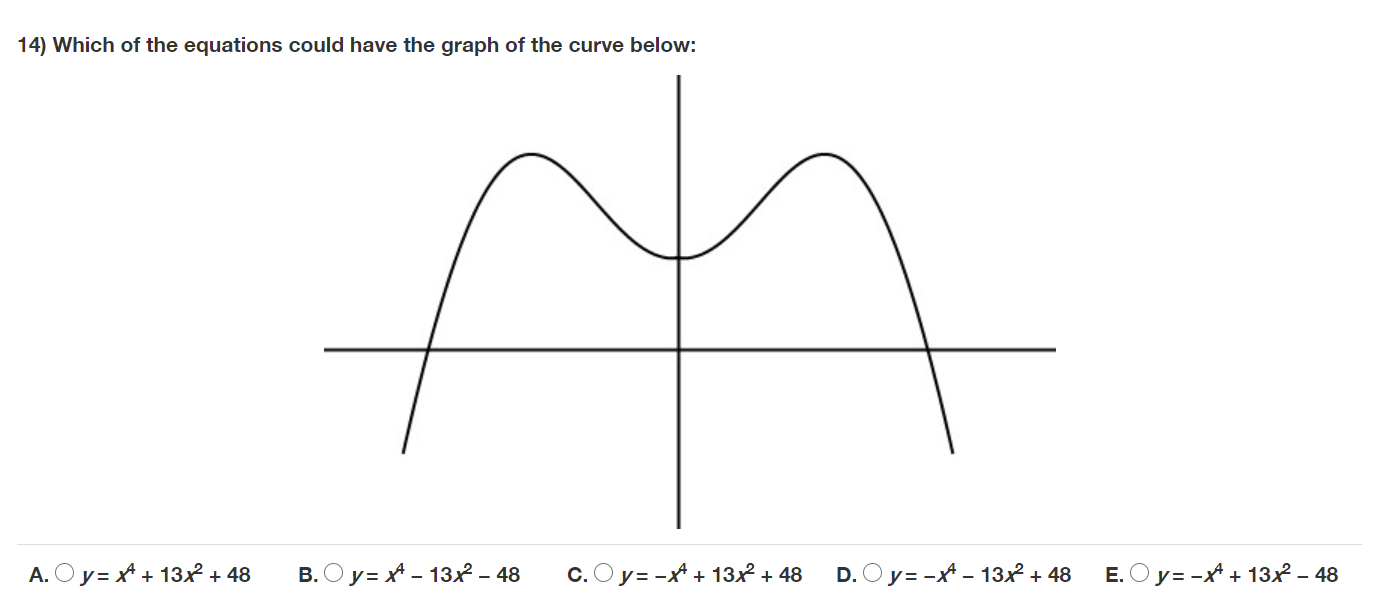
what difference does the sign of 13x^2 make
vale wigeon
close to the y-axis (x=0) the graph will look like an upward or a downward parabola, accordingly
hot osprey
I don’t understand how to find a real zero from these polynomials in order to do the division process to find the answer. And the linear factoring thing confuses me as well. As for 8, I just need help with 8a

 jagged imp
Where's 8
 glass lichen
remainder theorem
hot osprey
For 8? Or the one above
jagged imp
remainder theorem is for 8.
hot osprey
What about 4 & 5?
Tbh I’m bad at math so a little explanation would be very much helpful and appreciated
jagged imp
So as for the process for factoring a polynomial like in the earlier questions, you'll want to find a zero(there are ways to help you guess a zero, but i doubt that's within your curriculum), generally just by guessing small integers until you find a zero. For 4 for instance, -1 was the second number i tried and it ended up being a zero. Then, since we know -1 is a zero, factor theorem tells us that (x+1) is a factor. Then you can divide out (x+1) using synthetic division to express your polynomial as (x+1)*some lower degree polynomial and repeat this process until you get to something like a quadratic that you know how to factor, and then factor that and you're done. In the case of 4 and 5 just being cubic polynomials, you'll only have to go through that process once
that explanation could be worded poorly or whatever but i can reference you to a source that'll explain it better than me
hot osprey
so i had (x+1)(x^2-5)
jagged imp
thats correct so far
jagged imp
sure, but its a quadratic, which you can factor by completing the square
or even easier, difference of squares(although this wont always work)
jagged imp
using a^2-b^2=(a-b)(a+b) with a=x and b=5, we can write x^2-5=(x-sqrt(5))(x+sqrt(5))
hot osprey
oh, so it's ok to have a sq rt?
when it ask me linear factor
i was so lost in how i could write it w/o radicals
jagged imp
if you had something like sqrt(x)-5 that would'nt be linear (edit)
but x-sqrt(5) is perfectly linear
linear just means you have something that looks like mx+c for constants m and c
hot osprey
ah, i see
so for 5, i got -2 as a real zero
and got x^2+6x+7
...i am guessing quadratic formula
jagged imp
sorry, im back
hot osprey
all good, much thanks for your help brother
jagged imp
should have been +2 as a zero but ik thats a typo because you have the right quadratic
yeah, quadratic formula or complete the square
jagged imp
wym
jagged imp
I promise you completing the square here works, you might not know what it means
you dont have to, you can use quadratic formula
for completing the square, x^2+6x+7=x^2+6x+9-2=(x+3)^2-2
thats "where the square is"
but again if you havent learnt completing the square you dont have to understand that
hot osprey
so i got
-3 (+-) sqrt of 2
how do i write the equation into the linear factor as asked? (x-2)(?)(?)
jagged imp
by factor theorem, -3-sqrt(2) being a zero means (x-(-3-sqrt(2)) is a factor, and the same for the other root
hot osprey
really sorry to ask dumb Qs, i recently got back from the army
koreans have mandatory service T.T
jagged imp
which can get a bit ugly if your poly isn't monic but it is here so w/e
i know about that from seeing my favourite league players get drafted 😢
hot osprey
i have no clue how to express it
jagged imp
yeah that'd be hard though, did you have to stop uni?
hot osprey
would you mind showing me?
jagged imp
yeah sure
hot osprey
no, i went to the army as soon as I turned of age 19, finished it in late 2019. Then I worked for a bit to pay for my tuition and stuff, then got back into college this sem
and i tell ya, nothing makes sense no more
jagged imp
so we know those factors are (x+sqrt(3)+2) and (x+sqrt(3)-2) by factor theorem
hot osprey
yep
hot osprey
 jagged imp
only thing to be careful of is if the leading coefficient of the quadratic isn't one you'll need to multiply one of those factors by that leading coefficient to make it work
hot osprey
Is this it?
jagged imp
that is it
hot osprey
wow
i thought when they said linear factor
it has to be like a function of a straight line
so i was frying, melting, boiling, liquifying my fkin brain
ocean sealBOT

 Requested by Sneaky#0928
jagged imp
Requested by Sneaky#0928
jagged imp
and so is the other one
hot osprey
by golly, i am a retard lmao
jagged imp
lmao dw its very easy to get confused what it means with all those square roots floating around
hot osprey
oh man, you can't fathom how much of a help you've been bro
jagged imp
nah dw
hot osprey
thank you so much brother
if you are ok, would it be ok to ask you more Questions if I have so?
like later on down the line
you explain things better than my shitty professor
 tawny lion
can someone take me through this? i know the steps but i fuck up after i take arcsin of 1.7/4
 jagged imp
Sure, but no guarantee I'll answer at any given time with timezone issues and my own life. Explanations by other people on this server will mostly be good if you wanna ask here again i'm sure.
tawny lion
tawny lion
can someone take me through this? i know the steps but i fuck up after i take ar...
2x+30 = arcsin(1.7/4) or 180-arcsin(1.7/4)
hot osprey
jagged imp
Sure, but no guarantee I'll answer at any given time with timezone issues and my...
thanks man, have a great day!
ocean sealBOT
The current time for Sneaky is 10:10 PM (AEST) on Sat, 24/04/2021.
hot osprey
Ah AU?
jagged imp
ya
 novel quest
You roll 3 6-sided dice, what is the probability that at least 2 of them are sixes?
I found an online calculator for solving this but I’m wondering about how to solve it without it. I tried to find a formula but my search was unsuccessful.
Thanks in advance
 kindred helm
do you know the correct answer?
novel quest
The calculator said “0.07407”
shell widget
Which calculator did u use
novel quest

With this dice probability calculator, you can easily find the various probabilities related to the rolling of a set of dice.
And I used these settings
 kindred helm
ah i messed up in my calc
thats right
at least 2 sixes can mean there can be 2 or 3 sixes
odds for 3 sixes is 1/216
odds for at least 2 is 1/6 * 1/6 * 5/6 and it comes out to 5/216. now you can get 2 sixes in a 3 different way so use nCr(3,2) = 3.
then you add 1/216 + 15/216 and u get 2/27 after u simplify it
and its 0.074074
someone check if i did it right
it should be correct
novel quest
Thanks!
 tight basin
how do u work this out on a calculator

i know ncd mode but what are upper/lower values
 mystic sinew
depends on the calculator I think
tight basin
i got a classwiz

 left frigate
I'm trying to improve my paper by writing how each variable is calculated specifically, and I'm struggling with writing down clean and good looking mathematical interpretations of variables. How do I do this cleanly and professionally?
For instance, a simple example: I have a variable called 'familiar distance' that is calculated for each item i, by summing all participant's p estimates of the items familiar distance, divided by the number of participants. Simple, but what would be the profesionnal way to write this?
Here's my attempt

I know its kinda a trivial question, but I want to get good at writing concise and beautiful equations for more complex constructions
how about this?


 indigo jetty
@alpine sable find the coordinates of P, Q and R first, then sketch them on a graph to find out how to get your base and height of the triangle
shell widget
@sullen nova whats ur question
sullen nova
on line 3, Do we use { or [ ?
shell widget
who cares what bracket is used
sullen nova
how don't you know?
shell widget
not sure

 sullen nova
bruh
muted raft
I always used { for every cases?
sullen nova
lmao
alpine sable
does {a,b} mean a or b
indigo jetty
if you use those braces, you must have an expression on the left side
otherwise it means nothing
if you simply want to express an 'or', you might as well just use the word 'or' instead
 dawn wraith
Oi people, just making sure, how many bisectors that intersect at the same point in a quadrilateral do we need in order to prove that the quadrilateral is tangential again?