#help-0
1 messages · Page 569 of 1
 woeful pulsar
it doesn't say much though
 upbeat gorge
it is 14, yes
woeful pulsar
you have to infer what it's asking which is urgh
 ruby plover
(3*3)+1
upbeat gorge
there's a formula for this btw
ruby plover
please show me
ruby plover
woeful pulsar
you have to infer what it's asking which is urgh
It really doesn't have any text
But the correct solution was 14 indeed
ruby plover
Answer :) ty for correcting me
upbeat gorge
if you have an $n\times n$ grid of squares, then there are $$n^2+(n-1)^2+...+2^2+1^2=\frac{(n)(n+1)(2n+1)}{6}$$ squares in the grid
 ocean sealBOT
CST

 upbeat gorge
it's a signal for texit to format it
ruby plover
Thank you for the formula, sir. Did you whip it up on the spot?
upbeat gorge
no, I've seen it done before
ruby plover
I've seen people who can make formulas of their own to make their maths life easier and for others as well
one day i will be like that
 modern tree
is there such thing as amgm for real numbers
 charred flint
uh what part being real numbers
modern tree
n
charred flint
so like the average of 5.4 numbers?
modern tree
mhm
 split summit
anyone good at stats?
modern tree
@charred flint so is this a valid proof of holders
 charred flint

modern tree

charred flint
oh you mean just the set of numbers in AM-GM can be real lol
yea sure, the mean of 2.4 and 2.8 follows amgm
modern tree
no
i mean the index
because i want this to be true for all real pq
so a+b/a should be real
its like my index
charred flint
I'm not completely following, maybe you mean weighted am-gm
modern tree
no the stackexchange you linked is what im talking about
 foggy crypt
Is virtually worth doing something that can give you from 5 to 5000 earnings but it has a 35% chance to fail and lost you from 2000 to 5000?
charred flint
I'm pretty sure you don't mean the stackexchange 
you can prove holders with weighted amgm like the proof here https://artofproblemsolving.com/wiki/index.php/Hölder's_Inequality
 tight locust
rational will work. think about it
if you terminate the decimal expansion of any real number at any finite number of digits you get a rational number
also infinite number of digits if it's a repeating sequence
like 1/7 = 0.142857...
 hardy patrol
I'm studying for a placement test and a question of this nature is given. I know e has something to do with ln/natural log, but I'm not sure what type of question this is or how to solve it. can anyone point me to the right direction?

 alpine sable
hmm this is a quadratic in e^x
so you'll have e^x = something by quadratic formula
and then you can carry on with ln
hardy patrol
is there a khan academy video on this? I'm having trouble visualizing the process
 grave matrix
Try substituting y = e^x into this
grave matrix
(Further, note that e^(2x) = (e^x)²)
 grave matrix
nps
 alpine sable
so we have 8 ways to pick the breads
and after you pick your bread you can pick the cheeses in 5 ways
you can make a table to visualise
 golden sluice
Table?
alpine sable
will look something like this

sorry for the crude drawing
but do you know what i mean?
hopefully this makes it clear that there are 8*5=40 ways to pick the bread and the cheese
does that make sense?
alpine sable
yeah but we're not done yet
golden sluice
Do we need to count each?
alpine sable
because then we want to pick the topping and sauce
you just need to multiply 8*5*3*4
hopefully that seems intuitive
alpine sable
golden sluice
120
multiplication mistake
 unique kiln
why is f(x,y,z) = z^(x+y) defined at z=0 but the equivalent f(x,y,z) = exp((x+y)ln(z)) is not defined there?
for x+y>0
 silent path
Anyone know what to do in this problem?

 raven mica
Guys, i need to find the nuclear charge of an element which doesn't exist, how do i do that?

 vale wigeon
what's that 121 there?
is that its atomic number?
element 121?
how many protons do you think it has in its nucleus?
raven mica
121
vale wigeon
so
 wild needle
Can someone help me with this
 vale wigeon
@wild needle channel busy
raven mica
wild needle
Can someone help me with this
go to a different channel
wild needle
Oh ok
raven mica
vale wigeon
so
ok so?
vale wigeon
so what exactly is the issue, zenia
you know this element has 121 protons in its nucleus
the only other thing in the nucleus is neutrons, which have no charge
raven mica
i need to find the nuclear charge but i know that u need to substract electrons from protons but they're equal?
raven mica
why is it so high lol
vale wigeon
because 121 protons?
 raven mica
vale wigeon
the nuclear charge of gold is +79
raven mica
vale wigeon
the nuclear charge of gold is +79
that cant be correct
raven mica
cuz nuclear charge isnt literally just thte atomic number
vale wigeon
then what is the nuclear charge according to you
raven mica
i watched multiple videos on youtube it says u have to subtract the electrons from protons and that gives u the answer
vale wigeon
are you sure you didn't mishear anything
vale wigeon
"the answer" is vague
Nuclear charge is the electric charge of a nucleus of an atom, equal to the number of protons in the nucleus times the elementary charge.
from wikipedia

 vale wigeon
atom ≠ nucleus
raven mica
 raven mica
 raven mica
vale wigeon
an atom isnt the same thing as a nucleus
raven mica
vale wigeon
an atom isnt the same thing as a nucleus
wdym
vale wigeon
an atom isnt the same thing as a nucleus
i mean exactly what i said
the nucleus does not include electrons
the electrons are AROUND the nucleus not IN the nucleus
vale wigeon
no it isnt!
vale wigeon
no
i'm not saying that
i'm saying that the video is irrelevant
because you're not finding the total charge of an atom
but only of its nucleus
which doesnt have any electrons
 vale wigeon
yes
the charge of the NUCLEUS
the nucleus doesnt include the electrons
am i not getting through to you w/ that ????
raven mica
ok sure, so how do i find the answer now?
vale wigeon
yes
 vale wigeon
yes
 pulsar pollen
can anyone help me w this problem 🙂

someone give me a hint or clue what to do, my mind is lagging rn
<@&286206848099549185>
what formula should i use?
principal(1+rate)^years or (p)(rate)(time)
vale wigeon
you've got compound interest going on here
but also you don't have a single investment but an annuity
 pulsar pollen
vale wigeon
but also you don't have a single investment but an annuity
pulsar pollen
vale wigeon
but also you don't have a single investment but an annuity
meaning i have to add up the money per year to make it an investment? or principal?
vale wigeon
i mean exactly what i said
alpine sable
 austere thorn
ask in an unoccupied channel please
vale wigeon
try to think about whats really going on instead of just applying formulas blindly
brb class
pulsar pollen
ahhhh yes okay
 grand jolt
if cos(x) = -1/2 how do i find x?
 night blade
you can draw the unit circle
alpine sable
before the restock, there were 200-68=132 cans
before the restock, half the canned drinks in stock were sold out, and the other half remained
the other half (132 cans) remained
132 is half of the total cans before any cans were sold
multiply by 2 to get the whole, 132*2=264
 mossy oracle
Ohhh, thank you! You've taught me more than my teacher could in 2 weeks xd
 south stream
Is factorial of 5: 5*4*3*2*1?

 echo spire

Okay so there is a triangle ABC, with C1 the middle of AB, B1 the middle of AC and A1 the middle of BC.
I need to find where the point O is located to get this equation valid
OA + OB + OC=OA1 + OB1 + OC1
I have been thinking about placing O as the center of gravity
Like OA = 2/3 AA1
And OA1 = 1/3 AA1
alpine sable
echo spire
Okay so there is a triangle ABC, with C1 the middle of AB, B1 the middle of AC a...
intersection of the 3 medians is the centroid, which is also the center of mass of the triangle
echo spire
alpine sable
intersection of the 3 medians is the centroid, which is also the center of mass ...
Thanks, I didn't know how to translate that. I am now stuck on what to do next
alpine sable
Like OA = 2/3 AA1
And OA1 = 1/3 AA1
these are also correct
what do you want to do next?
echo spire
Prove that this
OA + OB + OC=OA1 + OB1 + OC1
Is valid ((p.s they are vectors))
I got stuck here
echo spire
Well, yeah but we are supposed to don't do coordinate bashing.
alpine sable
ok i think i've got an idea
we wanna prove the sum of the circle vectors = the sum of the square vectors

lets consider adding the two bottom circle vectors

this is going to be double the bottom square vector
 echo spire
Well, I got an idea as well?
From yours
We could try and write them until we get AB + CB like substitute them
 alpine sable
oh, does this work out to prove OA + OB + OC=OA1 + OB1 + OC1?
echo spire
Let's hope? So far it's going okay
alpine sable
alpine sable
this is going to be double the bottom square vector
well my idea was to take this and apply it to all 3 pairs of circle vectors and the square vector between them
 echo spire
The circle inside triangle theory?
alpine sable
B+C=2E
A+C=2F
A+B=2D
add them all up
2(A+B+C)=2E+2F+2D
A+B+C=E+F+D which was what we wanted

 golden arch
Is there a formula to calculate the distance between a Point and they yz plane?
vale wigeon
yes, it's the absolute value of the point's x coordinate.
 short turtle
short turtle
short turtle
nvm i got it
vale wigeon
the distance from the point (x,y,z) to the yz plane is |x|
golden arch
Ah okay thanks!
vale wigeon
idk what else there is to elaborate on
 sharp anchor
Hey im not really sure where to go from here

 left spear
golden arch
<@183668144404037632> can you elaborate?
left spear
golden arch
<@183668144404037632> can you elaborate?
Behold, my amazing art skills
 left spear
sharp anchor
Hey im not really sure where to go from here
left spear
sharp anchor
Hey im not really sure where to go from here
Me neither, that's the full solution is it not
sharp anchor
left spear
Me neither, that's the full solution is it not
Perhaps i just wanted to try it and it looks like it could be simplified, guess not


 alpine sable
austere thorn
alpine sable
austere thorn
ask in an unoccupied channel
alpine sable
 swift chasm
from here use special right triangles to solve for x


so start with the area of the whole sector CAD (r*theta) then subtract off the right triangle and the circular sector with central angle 150 deg
@swift chasm
short turtle
 alpine sable
are you having trouble setting up the integral?
short turtle
how to find area? by using intergral or finding the area of trapezium?
short turtle
alpine sable
are you having trouble setting up the integral?
yea the intergrall
alpine sable
trapeziums won't help here
you need to use an integral
all these blue lines are just the height of the line - the height of the parabola
 short turtle
so use intergral to find the area
alpine sable
yes, but the integral of what?
short turtle
this?
3 2 12 5 xx x − += +
wait i cant pres
3x^2-2x+1 = 2x +5
then use the values of x ?
alpine sable
the area we want is the difference in height
height of the line - height of the parabola

does that make sense?
then we need to find the lower and upper bounds
short turtle
Yeah got it thanks
swift chasm
alpine sable
so start with the area of the whole sector CAD (r*theta) then subtract off the r...
got it now thanks c;;;
 alpine sable
 crystal cape
area of shaded = area of isosceles triangle - area of white circular sector
crystal cape
alpine sable
area of shaded = area of isosceles triangle - area of white circular sector
But i dont know height of the triangle
How do I calculate the area?
Cause I don't have either base or height
alpine sable
crystal cape
But i dont know height of the triangle
 crystal cape
Right yeah
alpine sable
you can find base as well similarly

 alpine sable
 lethal lichen
how to do part b?
lethal lichen
how to do part b?
did you do part a? it should help with part b
alpine sable
correct
now we can set that equal to 2
then from there we can solve for x in terms of a
alpine sable
are you familiar with converting log notation to exponential notation?
lethal lichen
i think so
alpine sable
 lethal lichen
ahh i see thanks
alpine sable
you can also think about it as going from
log_3(x^2 a) = 2
to
3^ [log_3(x^2 a) ] = 3^2
and on the left you end up with x^2 *a
alpine sable
correct, now solve for x
lethal lichen
so x = sqrt (9/a)
alpine sable
yup
 glass lichen
lethal lichen
(3-sqrt(3)) / 6
glass lichen
lethal lichen
(3-sqrt(3)) / 6
that's pretty much simplified unless you mean rationalize the numerator
glass lichen
multiply by $\frac{3+\sqrt{3}}{3+\sqrt{3}}$
ocean sealBOT
moshill1
 lethal lichen
ok

how would i do part b?
i was trying 1 - (0.49^2 + 0.38^2 + 0.10^2 + 0.03^2)
but do i need to account for getting the same blood group twice, twice for each goroup
like 1 - (2 * 0.49^2 + 2 * 0.38^2 + 2 * 0.10^2 + 2 * 0.03^2)
i hope that makes sense
alpine sable
1 - (0.49^2 + 0.38^2 + 0.10^2 + 0.03^2)
yes this is exactly correct
p(different)=1-p(same)
well you don't have to ping me specifically
how would I proceed here
also you're kind of interrupting the conversation
you can post your question in an unoccupied channel
alpine sable
alpine sable
p(different)=1-p(same)
so the probability that both people have the same blood type = P(both have O)+P(both have A)+P(both have B)+P(both have AB)
but do i need to account for getting the same blood group twice, twice for each goroup
no, you can label the two people person 1 and person 2 , and we just need the probability that both of them have the same blood type
P(both have O) = p(1st has O AND 2nd has O)
=p(1st has O) * p(2nd has O)
=(0.49)^2
lethal lichen
alpine sable
> but do i need to account for getting the same blood group twice, twice for eac...
Ok thanks
 copper thicket
This might be (definitely is lol) a stupid question but can someone explain how one read this kind of notation

 sly mantle
the notation reads as "function name:domain->codomain"
so this states a function f with R\{0} as its domain & R as its codomain
copper thicket
oh ok and what exactly does it mean by R/{0}
is it just that the domain does not include 0 ?
sly mantle
R\{0} is the set of real numbers excluding 0
copper thicket
yeah perfect. Thanks 🙂
lethal lichen
OK, so i have the equations
y=3sin^2(&)
y=2cos(&)
where & = theta
how would i find the points where they intersect
i tried simultaneous equations but struggling to solve them
vale wigeon
$3\sin^2(\theta) = 2\cos(\theta)$ is the equation you're interested in here
 ionic jewel
2 cos theta ^
lethal lichen
vale wigeon
$3\sin^2(\theta) = 2\cos(\theta)$ is the equation you're interested in here
ok
im trying to solve it but i just can't
ocean sealBOT
Ann
 vale wigeon
can you show an attempt you made?
lethal lichen
ok
i want to make it into 2 brackets
and then solve from there

sorry if its messy
vale wigeon
so you got to 3cos^2(θ) + 2cos(θ) - 3 = 0?
and then you tried to factor manually without success
vale wigeon
so why not do that
lethal lichen
because it seems to me that i would just run into roots
it seems unpractical to do like that since i never have done this question without being able to solve manually
vale wigeon
you would run into roots yes
 quick talon
is y= 3x -2 and** 9x -3y =6** equivilant???
vale wigeon
this channel is occupied. please don't intrude on ongoing convos in questions channels in the future.
but yes, y=3x-2 is equivalent to 9x-3y=6.
quick talon
can u explain why and im sorry
 barren sinew
https://i.redd.it/jq9q3qnknrr61.jpg
somebody tell me if there is any maths from calculus 3 in this question paper
 lethal lichen
-_-
@hollow oyster @barren sinew please go to another question channel
and delete your messages
np
 wary harness
A river in normal condition is 28 cm deep. After a rainstorm, its level increased by 3 1 / 2m. At 3.89 m, he is in danger of getting out of bed.
a) How much more can the water level rise before it gets out of bed?
b) The record height is 5.18 m. How much higher than the normal river level is this height?
Can some1 pls help me with this ASAP?
lethal lichen
anyways, Ann i found the solution to the question
so no longer need help for now
thank you
 hollow oyster

If i could get some assistance for this question that would be greatly appreciated
ionic jewel
barren sinew
https://i.redd.it/jq9q3qnknrr61.jpg
somebody tell me if there is any maths from...
doesnt look like it
barren sinew
ionic jewel
doesnt look like it
so its only calculus 1 and 2 right?
ionic jewel
I learned everything I would need in calc 1 and 2 from that, the educational cutoffs may vary
alpine sable
 ionic jewel
alpine sable
ionic jewel
alpine sable
set up an equation
ionic jewel
f = 69
f = 4s-3
barren sinew
This is a final term question for my upcoming semester. So I am assuming that learning up to calculus 2 is enough for the semester
ionic jewel
barren sinew
This is a final term question for my upcoming semester. So I am assuming that le...
wait i lied no its not
the first problem is calc 3
it was crossed off so I skipped over it before
partial derivatives & 3 dimensional stuff is all calc 3
barren sinew
except the first one, all are calculus 2?
ionic jewel
yes
barren sinew
god damn. I have a long way to go then. haven't even started with calculus 1 yet
ionic jewel
good luck w that
barren sinew
thank you so much for the help
hollow oyster
@ionic jewel any chance you can help me out?
ionic jewel

 frail viper
ionic jewel
frail viper
ionic jewel
dont ping me specifically who knows if i could answer
frail viper
i know all the answers in the world
so ping me anytime
my daddy actually invented maf
jk
frail viper
hello!!!
 sacred otter
What to do xD?
sacred otter
Wru from?
sacred otter
Where u live
frail viper
u?
sacred otter
Pakistan
frail viper
nice!
alpine sable
The total area of the yellow rectangle and the blue triangle is

 limpid spade
You can already find the area of the rectangle
 lost steeple
What do you mean by reduce
ionic jewel
$2a\times b + 2b\times 2a \times 0.5$
ocean sealBOT
bunny
 lost steeple
Do you mean simplify?
ionic jewel
$= 2ab + (0.5)(4ab) = 2ab + 2ab = 4ab$
ocean sealBOT
bunny
 ionic jewel
pushing two variables together implies multiplication
alpine sable
2a * b = 2ab
2a * 2b = 2ab
lost steeple
2 * a * b = 2 * a * b
lost steeple
2 * a * b = 2ab
ionic jewel
its 2*a*2*b = 4ab
ionic jewel
yes
lost steeple
when they are next to each other it implies multiplication
alpine sable
wait
so bunny
and mystifine
when you have like 2a * 2b
u do 2 * 2 and a * b
4ab
same with 2a * b
you do 2 * nothing
and a * b
2ab
lost steeple
When you have 2a another way to represent it is 2 * a
when you have 2a * 2b
you can do
2 * a * 2 * b
ionic jewel
that is not the right intuition but you get them right so
alpine sable
How's it wrong
lost steeple
and in terms of multiplication it doesn't matter what order you multiply
so you can group like constants
2 * 2
and the rest just comes along
ionic jewel
you dont think of it as "2 * nothing"
lost steeple
2a * b is not 2 * 1
alpine sable
how would you do it then
ionic jewel
2ab = 2 * a * b = 2ab = 2ab
alpine sable
It's the same
ionic jewel
yes but theres no "1" coming in anywhere
it gets the same answer but thinking about it is different
you are just doing extra thinking for no reason
alpine sable
2a*b = 2 * a * b = moved space = logic confirmed
Lmao
2a * 2b = 2 * a * 2 * b /// 2 * 2 * a * b
2a * b = 2 * a * b /// 2 * a * b
@ionic jewel
ionic jewel
yea
 lost steeple
Bedmas
lost steeple
I'm canadian 😦
ionic jewel
okay budget british guy
lost steeple
What does P stand for
ionic jewel
parenthesis
lost steeple
oh
ionic jewel
brackets are [] to me
lost steeple
Brackets 💀
ionic jewel
not ()
 lost steeple
yes
alpine sable
of yeah i just overlooked it before

circumference and area
Is the answer the third one

 drowsy scroll
lost steeple
I call those square brackets
drowsy scroll
lost steeple
I call those square brackets
Programmers
alpine sable
circumference: a + a + b + a + b + a = 4a + 2b
area: a^2 + ab
ionic jewel
alpine sable
Is the answer the third one
looks like it
 alpine sable
is 1ab the same as ab
ionic jewel
yes
lost steeple
yes
alpine sable
ok
lol
Thanks for helping me

can anyone help me with this have no clue
<@&286206848099549185>

simplify
 amber marsh
a^4?
amber marsh
cos u add the powers then take them away?
alpine sable
alpine sable
are you familiar with the exponent multiplication/division rules?
amber marsh
laws of indeces
alpine sable
no
amber marsh
ye u should learn them first
alpine sable
^
amber marsh
then u will be able to do them, it’s called laws of indices
alpine sable
ok
 alpine sable
amber marsh
then u will be able to do them, it’s called laws of indices
alpine sable
amber marsh
then u will be able to do them, it’s called laws of indices
also called exponent properties
amber marsh
why is the last line like that
amber marsh
omggggg
alpine sable
-cos/cos=-1
 junior warren

how would i solve this?
im also confused because there is a negative side length i think
junior warren
thats the trig identity right?
so i take that identity
solve for sin
and then solve for thetea
theta
alpine sable
(sintheta)^2+(costheta)^2=1
pythagorean identity
tan =sin/cos
definition of tangent
alpine sable
junior warren
and then solve for thetea
they don't ask for theta
 viral owl
hey guys
alpine sable
find sin, then divide that by cos
junior warren
ok thx
viral owl
im 13 years old so please dont laugh if this is "easy" for you, im doing a kangaroo test and i really need help
geometry test
lost steeple
I think it's against the rules
alpine sable
if it's a test then we can't help you there
lost steeple
oh #❓how-to-get-help 6
alpine sable
but if its a practice test/worksheet/hw then it is perfectly fine
junior warren
wait dan one thing
lost steeple
dansman help me 
junior warren
with the sin and cos idenity
viral owl
its not an test, i just dont understand it because the test is in english
and im spanish
junior warren
does the fact that its squared matter at all?
alpine sable
junior warren
does the fact that its squared matter at all?
yeah, you will get 2 possible values for sin(theta)
viral owl
its a quiz
alpine sable
so 2 different values for tan(theta)
junior warren
so will i have to square -3/8 when subbing in?
lost steeple
@viral owl If it's for marks we simply can't help
alpine sable
viral owl
its a quiz
don't expect help with quizzes/tests
viral owl
ok
 alpine sable
junior warren
so will i have to square -3/8 when subbing in?
alpine sable
junior warren
so will i have to square -3/8 when subbing in?
(sintheta)^2+(-3/8)^2=1
alpine sable
junior warren
so i have sintheta^2=55/64
square root both sides, the pos and negative solution for sin are both valid
junior warren
so i dont have to square root the 55/64 before plugging into sin/cos?
alpine sable
sintheta^2=55/64
first you need to square root both sides to get sintheta
then plug into tantheta=sintheta/costheta
wary harness
wary harness
A river in normal condition is 28 cm deep. After a rainstorm, its level increase...
<@&286206848099549185> can some1 help me with this pls?
junior warren
@alpine sable im stuck now lol, so i just multiply the fractions sqrt55/64 and 8/-3?
alpine sable
junior warren
<@456226577798135808> im stuck now lol, so i just multiply the fractions sqrt55/...
sintheta^2=55/64
first you need to square root both sides to get sintheta
so sintheta=+-sqrt(55/64)
alpine sable
sintheta=(sqrt55)/8 or -(sqrt55)/8
alpine sable
so now, [(sqrt55)/8] / [-3/8] and [-(sqrt55)/8] / [-3/8]
alpine sable
then you just simplify
junior warren
yeah its +-sqrt55/3
alpine sable
correct
junior warren
thx
 cold roost
wary harness
<@&286206848099549185> can some1 help me with this pls?
cold roost
wary harness
<@&286206848099549185> can some1 help me with this pls?
In the future, go to a channel that isn’t in use when you present your question. As well as pinging helpers while people are still working on a question. It’s viewed as rude / interrupting and you’re less likely to be helped. Try posting in #calculus
wary harness
cold roost
In the future, go to a channel that isn’t in use when you present your question....
I said please and Its not that I interrupted anyone
I didnt say
Oh leave him
Dont help him
Help me
I said please and I respected the 15 minutes rule
So Im not being rude
cold roost
The rules says to not ask a question in a channel that’s in use as well as what you just mentioned.
 wild shard

 viral crag
i have a question that goes like this if a-b=b-c=7 then what is the value of c^2-2b^2+a^2 ?
 tulip bear
how do i find this
 wild shard
viral crag
i have a question that goes like this if a-b=b-c=7 then what is the value of c^2...
wild shard
viral crag
i have a question that goes like this if a-b=b-c=7 then what is the value of c^2...
use subsitution
wild shard
viral crag
and i only have 2 equations
no u have 3
viral crag
wild shard
no u have 3
how ?
 strong smelt
tru
viral crag
wait yea thats true
wild shard
the easiest way is often the most clever
but besides
there is no other way
in your case
 steady frost
can y'all explain how can i find the area of a isosceles triangle with just knowing that the hypotenuse is 25, and the altitude's bigger than the base by 10 cm?
just a hint would do cause i've been struggling
viral crag
wild shard
use subsitution
when i try it just return to the same equations
wild shard
ill try rq
wild shard
steady frost
can y'all explain how can i find the area of a isosceles triangle with just know...
pythag, 25 = (10+x)^2 + (x/2)^2
where x is the base of triangle
steady frost
lemme tryyy
when using pythag staring with the hypotenuse does the hypotenuse not get squared?
 loud kayak

 unreal forum
viral crag
wild shard
a-b=7
how to solve these 3 equations
loud kayak
😐
wild shard
viral crag
how to solve these 3 equations
im lost now lol
wild shard
steady frost
when using pythag staring with the hypotenuse does the hypotenuse not get square...
it doea mb
wild shard
x should be equal to 14 or -30 @steady frost
 woven shoal
hey guys, i need help for some homework
i dont even understand it, if someone can explain?
wild shard
just post someone may or may not help
 manic quail
Sure, it would be better if you posted in another channel though, @woven shoal
alpine sable
i need help badly i have no clue

 wild shard
yep thats corrext
steady frost
what's nextttttttttttTT
wild shard
solving for x gets you 14 or -30
steady frost
quadratic?
wild shard
ofc
steady frost
sheesh this teacher dude
wild shard
but use 14 as -30 will get you complex numbers
 dapper patio
Adam and Kevin are standing 35 metres apart, on opposite sides of a flagpole. From Adam’s position, the angle of elevation of the top of the flagpole is 36°. From Kevin’s position, the angle of elevation is 50°. How high is the flagpole?
ionic jewel
draw it and use trig
 spare hill
i think you use the sum of two tangents for that problem
dapper patio
aight ill have a look ty :)
spare hill

so i did this in class
teacher was watching over and didn't disprove it
but
the last two equalities now look sus to me'
<u,u> + <u,v> + <v,u> + <v,v> = <u,u> + 2<u,v> + <v,v>
is this actually true?
it would mean that <v,u> = <u,v> but i dont think that's the case
charred flint
yea inner products are commutative
spare hill
oh?
https://math.stackexchange.com/questions/1311394/why-conjugate-when-switching-order-of-inner-product

Mathematics Stack Exchange
There is an axiom of inner product spaces that states:
$\overline{\langle x,y\rangle } = \langle y,x\rangle$
Basically (without any conceptual understanding) it seems like all you have to do when...
i saw this earlier
so i'm overthinking it?
i'm not sure what conjugation does for inner product :/
charred flint
oh I mean specifically dot products sorry
 obsidian laurel
Plur
charred flint
if you're using real numbers it's fine
spare hill
so in my case, it's still commutative?
charred flint
I'm assuming you're doing real vectors so yea
conjugation just changes complex numbers
spare hill
ok thanks
obsidian laurel
You know how to do Law of Sines? Plur
charred flint
I know there's a formula for it 


 tough tangle
uhm
 hexed glacier
sine rule?
tough tangle
no
hexed glacier
can't remember
tough tangle
cos 30 = x/7
hexed glacier
$z^2 - z +1 = 0$
ocean sealBOT
zyzt
 ocean sealBOT


 Requested by Plurmorant#1811
charred flint
Requested by Plurmorant#1811
charred flint
since it doesn't touch the x-axis
alpine sable
well you could always factor it over the complex numbers
hexed glacier
yeah, that's what i am trying to do
quadratic formula is only for real(side question)?
 crude nacelle
no, you'd just get a negative discriminate and you can get an imaginary solution (2)
alpine sable
you can use quadratic formula to find complex zeroes as well
hexed glacier
yeah, i thought it works for complex too
this is what i get(next post)
ocean sealBOT
zyzt
 hexed glacier
which is not the answer i believe, which is cube root of -1
(editing the post above)
$\frac{-(-1) +- \sqrt{(-1)^2 - 4(1)(1)}}{2} = \frac{-(-1) +- i *\sqrt{3}}{2}$
ocean sealBOT
zyzt
 ionic jewel
you are looking for $\pm$
ocean sealBOT
bunny
 ocean sealBOT
Bardak
 limpid spade
Integral by parts
f(x)=cos^2x and g'(x)=e^x
Formule is f(x)*g'(x)-integral((f'(x) *g(x))
@smoky skiff
 smoky skiff
limpid spade
Integral by parts
smoky skiff
limpid spade
Integral by parts
Ok I tried that what then?
limpid spade
Show me
hexed glacier
ionic jewel
you are looking for $\pm$
yeah, thank you. i think my mistake is not checking if their absolute value equals to 1
and then factorizing them, and then using euler formula...etc etc...
and get my anwer
smoky skiff
limpid spade
Show me
$\int e^x\cdot cos^2x = e^x\cdot cos^2x + \int e^x\cdot 2cos(x)sin(x)$
ocean sealBOT
Bardak
 unreal forum

Hello my dear friends
Well, here I am on record at last
And it feels so wonderful to be here with you on my first album
I'm so happy
Aha! Happy go lucky me
I just go my way
Living everyday
I don't worry
Worrying don't agree
Things that bother you
Never bother me
Things that bother you
Never bother me
I feel happy and fine
Aha
Living in the sunlight
Loving in the moonlight
Having a wonderful time
smoky skiff
limpid spade
It's Formule is f(x)*g(x)-integral((f'(x) *g(x))
so what's the problem?
limpid spade
smoky skiff
$\int e^x\cdot cos^2x = e^x\cdot cos^2x + \int e^x\cdot 2cos(x)sin(x)$
2cosxsinx is sin2x try to redo per partes with f(x)=sin2x and g'(x) =e^x
limpid spade
So e^xcos^2x-new per partes
limpid spade
Show me what u get
 limpid spade
It's occupied
alpine sable
my bad
limpid spade
Occupied
smoky skiff
limpid spade
Show me what u get
$e^x\cdot cos^2x + \int e^x\cdot sin(2x) = e^x\cdot cos^2x + e^x\cdot sin(2x) - \int e^x\cdot 2cos(2x)$
ocean sealBOT
Bardak
 limpid spade
Mhhh
I see
cos^2x is the same as (1+cos2x)/2
Write as (1/2)+(cos2x/2) integral will be 1/2integral((e^x(cos2x+1))
Then u choose f(x) as 1+cos2x and g(x) as e^x
U would apply per partes 2 times
And u will see at 2nd time that the integral will be the same as the original integral
I'll explain what to do next when u do per partes 2 times first
cos^2x=(1+cos2x)/2 because of product to addition Sampson formula. It's an identity
limpid spade
Okie
 tacit breach
does this mean ur done? @smoky skiff
smoky skiff
limpid spade
I'll explain what to do next when u do per partes 2 times first
$\frac{1}{2}e^x\cdot (1+cos(2x)) + e^x\cdot 2sin(2x) - \int e^x\cdot 4cos(2x)$
ocean sealBOT
Bardak

 old quarry
Oh sorry, there was a gap with 5 mins
limpid spade
U should become this
 final acorn
idk what im doing, can someone tell me what ones go where?
 limpid spade
$=\mathrm{e}^x\sin\left(2x\right)-\left(2\mathrm{e}^x\cos\left(2x\right)+\class{steps-node}{\cssId{steps-node-10}{4}}{\displaystyle\int}\mathrm{e}^x\sin\left(2x\right)$
ocean sealBOT
The Fractalogist
Compile Error! Click the  reaction for more information.
(You may edit your message to recompile.)

 smoky skiff
I don't understand u
manic quail
,w e^x sin(2x)=e^x cos^2(x)
ocean sealBOT

 Requested by veryhappyperson#1152
manic quail
Requested by veryhappyperson#1152
manic quail
you mean this, @limpid spade ?
limpid spade
Yeah
manic quail
Wolfram doesn't think it is true.
limpid spade
Veryhappyperson how would u solve integral of cos^2xe^x
manic quail
Maybe by parts?
smoky skiff
lol
manic quail
Sorry, I was never good at solving integrals xD
limpid spade
Doing it 2nd time u get e^xsin2x
Which is not equal to e^xcos^2x or integrable (without per partes)
Weirds
 pallid horizon
Is anyone good with finding perimeters using angles?
alpine sable
pallid horizon
Is anyone good with finding perimeters using angles?
of a circle?
pallid horizon
Triangles
alpine sable
send ur problem rq

 daring violet
aight so yeah you could see that they're both right triangles
and the left triangle is 45 45 90 and the right one is 30 60 90
pallid horizon
Right
 terse iron
pallid horizon
terse iron
pallid horizon
do you know any methods ?
alpine sable
pallid horizon
do you know the ratios for special right triangles
daring violet
there's certain ratios
pallid horizon
Really?
daring violet
for 30 60 90 triangles the ratios for them are
terse iron
i used pythagorean theorem
daring violet
short leg: x
long leg: x*sqrt3
hypotenuse: 2x
pallid horizon
That sounds familiar the short leg
daring violet
legs are the two sides that aren't the hypotenuse
terse iron
dont
 polar gull
???
daring violet
JEEZ what kind of math is that? i'm in geometry
pallid horizon
@daring violet so what do I do with that knowledge of the legs and hypotenuse
terse iron
5
daring violet
pallid horizon
<@599698594542518273> so what do I do with that knowledge of the legs and hypote...
so from the 45 45 90 triangle (the left one) there are also ratios for that which someone had said but in case you forgot they're
legs: x
hypotenuse: x*sqrt2
terse iron
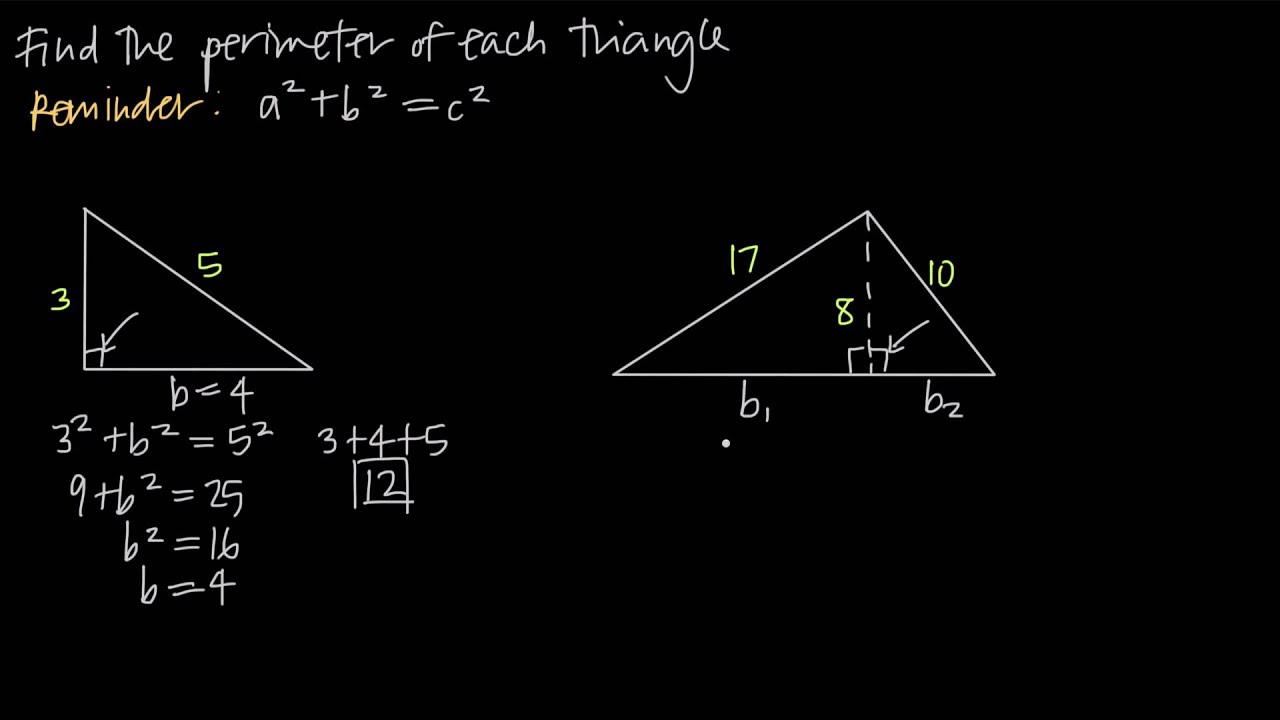
► My Geometry course: https://www.kristakingmath.com/geometry-course
In this video we'll learn how to use the pythagorean theorem to find the lengths of the sides of a right triangle, and then add the side lengths together to find the perimeter of the triangle.
● ● ● GET EXTRA HELP ● ● ●
If you could use some extra help with your math class, ...
watch this
daring violet
terse iron
https://www.youtube.com/watch?v=OE2g2SgPC6s&t=36s
nice vid
pallid horizon
Ok give me a second to watch
The video doesn’t show how to do it with only 1 side and the rest angles
So what do I do with the legs
alpine sable
@pallid horizon
 pallid horizon
Is there an equation I have to use
 tender glacier
yo can someone help me with a few problems
woven shoal
tender glacier
yo can someone help me with a few problems
yes i can
 primal tiger
Hi. If I have the equations of a line (a) x=2, y =3z and a line (b) x=2z, y=3 and I want to find the angle θ. between them using the formula a*b=|a| |b| cos θ.
Is it correct to say that the direction vector of the first line (a) is (0,3,1) and the direction vector of the second (b) line is (2,0,1).
So a*b=1
And |a| =sqrt(10), |b|=sqrt(5)
so cos θ = 1/5sqrt(2) ?
tender glacier
woven shoal
yes i can
can i dm
woven shoal
tender glacier
can i dm
sure
alpine sable
pallid horizon
So the perimeter is 34.76 <@456226577798135808>
8+4sqrt2+4sqrt6+8sqrt2 would be the perimiter idk what that is
pallid horizon
K
alpine sable
Hey, let's say 42 = 100, what is 13 out of the 42 in percentage then? Can you show me the calculations?
alpine sable
alpine sable
Hey, let's say 42 = 100, what is 13 out of the 42 in percentage then? Can you sh...
13/42 x 100
Is it seriously that fucking simple

yes
I did this shit and I was struggling with that

You know you hit rock bottom when you're that fucked.
😂
alpine sable
alpine sable
You know you hit rock bottom when you're that fucked.
when u overwork ur brain and have to put 1+1 in the calculator during a test

 alpine sable
pallid horizon
I have to find x
alpine sable
pallid horizon
I have to find x
x is the short line segment on the bottom or the whole thing
pallid horizon
Short line
daring violet
30 60 90 triangles
pallid horizon
Both are?
pallid horizon
Yea
alpine sable
i would say use x to get the length of the line in the middle in terms of x
then use that to get the line on the very right
pallid horizon
How would I go about that
daring violet
use the triangle ratios
you could see that the short leg is 18/2 since the hypotenuse is 2*short leg
oh yeah and it's similar triangles
pallid horizon
For the overrall triangle?
alpine sable
alpine sable
when u overwork ur brain and have to put 1+1 in the calculator during a test
Haha! Exactly
daring violet
the overall triangle and the little one
terse iron
 daring violet
heh that's what i'm doing rn
alpine sable
shi hold on
terse iron
lol
alpine sable
nvm it was right
alpine sable
pallid horizon
How would I go about that
 daring violet
terse iron
daring violet
terse iron
yeah i forgot
terse iron
same
alpine sable
terse iron
do u know the radius or is it just r
terse iron
just r
pallid horizon
Just two more and then tell me if I did another one the right way
alpine sable
daring violet
isn't arcPQ just 110?
no thats for radians
terse iron
daring violet
isn't arcPQ just 110?
no
alpine sable
arc length is only the same as the angle when it's radian