#help-0
1 messages · Page 563 of 1
 alpine sable
 upbeat stone
Ok
alpine sable
for every loss, she loses 2 points
upbeat stone
Ok
alpine sable
if she loses L times, she loses 2*L points
upbeat stone
Ok
alpine sable
so the total points she is left with after winning W times and losing L times is points won - points lost
upbeat stone
Ok
upbeat stone
Yes
alpine sable
so 3W-2L=25
alpine sable
yes solve the system
upbeat stone
Ok
upbeat stone
Ok
 noble sinew
Arguably faster to just guess than doing this (but knowing how to solve this without guessing is very important)
(took around 20 sec to guess the solution)
 rare bough
yes
upbeat stone
noble sinew
Arguably faster to just guess than doing this (but knowing how to solve this wit...
I got 13
Wins
noble sinew
Yep
rare bough
right now I am doing 1 + sin(theta)
upbeat stone
Lets goooooooo
upbeat stone
@noble sinew @alpine sable thx for the help

 harsh silo
how would i figure out the piece wise function to this
 upbeat stone
rare bough
upbeat stone
rare bough
That looks weird weird what grade is that for
rare bough
10th
noble sinew
harsh silo
how would i figure out the piece wise function to this
Find when 2x-5 is positive aka for what values of x
|2x-5|=2x-5 and same for the other abs value
rare bough
uhh im trying to plot points below 0 but I can't find any
noble sinew
Then you can make a piecewise function without abs value using the intervals you find
 pearl wraith
how do you find UV i tried so many times but cant figure it out
 upbeat stone
rare bough
10th
upbeat stone
rare bough
10th
2 grades 
noble sinew
pearl wraith
how do you find UV i tried so many times but cant figure it out
Find angle T in triangle SRT then you know a line is 180 and we have angle T (from SRT) and 93, so T(SRT)+93+T(UTV)=180, so
T(UTV)=180-93-T(SRT)
Then you have 2 angles and a side in triangle UTV and can find UV from there
harsh silo
noble sinew
Find when 2x-5 is positive aka for what values of x
|2x-5|=2x-5 and same for the...
wdym
noble sinew
You want your piecewise function to be without |...| stuff
So eg if x=100 then|2* 100-5|=2* 100-5
So if we find all values of x where 2x-5>=0 then we know for those values that |2x-5|=2x-5
harsh silo
i got to this
 noble sinew
You have 2 abs value so you end up with 4 different expressions
But solve them 1 at a time
So solve when is |2x-5|=2x-5
And then do the same with the the other abs value term
noble sinew
noble sinew
So solve when is |2x-5|=2x-5
(So solve 2x-5>=0)
 stray prism
I can go up, down, or right.
this grid:
e f
⬛⬛⬛⬛... ⬛⬛⬛⬛
S
how many ways can I go from S, go to E, or F?
 upbeat gorge
Seems vague
stray prism
meaning I can go
⬆️ , ➡️ , then 🔽
stray prism
upbeat gorge
Seems vague
oop
noble sinew
stray prism
meaning I can go
⬆️ , ➡️ , then 🔽
You need to clarify what is allowed. Can you go up then down (so same spot twice)? Is it 3 tall and x long (so you want the answer in terms of x?)
 proven basin
I got a equation here: 4x^2 -3x-7 and I am stuck on how to solve it. Factoring it ofc
proven basin
thats what i did i ran into the problem of 4x not being able to factor with 7
 ruby current
 flat gust
It's possible
 thorn kindle
why are you taking 4x
proven basin
let me show u a pic
proven basin
 proven basin
no shit thats why im askin help tf
thorn kindle
no you did it right
proven basin
then wat
thorn kindle
you're just missing a step at the end there
proven basin
do i do
thorn kindle
$4x^2+4x-7x-7$
 ocean sealBOT
AMD
 thorn kindle
do you know how to factor by grouping?
proven basin
yes
thorn kindle
do it
thorn kindle
that's not what factoring by grouping is
proven basin
o
thorn kindle
basically, split the expression into two parts. let's look at the first half for now
4x^2 + 4x
can you factor that
?
thorn kindle
not even close
proven basin
oof
thorn kindle
what are the common factors that 4x^2 and 4x share?
proven basin
2?
thorn kindle
ok let's try this a different way.
4x^2 = 4 times x times x
4x = 4 times x
what factors do they share?
proven basin
4?
proven basin
4x
thorn kindle
yes.
proven basin
ok ok wats next
thorn kindle
did you need to actually solve it? or just factor
proven basin
just factor it
thorn kindle
ok then you're done
proven basin
real quick wat if there is only 1 variable with 1 real number ? or like if theres like 3 variable?
do i do the same thing?
thorn kindle
huh?
thorn kindle
ok that second expression is multivariable so you might not be able to factor it as easily
have you done multivariable equations?
thorn kindle
ok then don't worry about that for now
but that first equation is simple
if you have ax^2-c then x = +-sqrt(c/a)
proven basin
its still factoring it right?
 ashen wave
is anyone good with chemistry? I really need the help
 sly mantle

ashen wave
ok thanks your a life savor
Which group of elements would group 2 elements bond well with and why?
ashen wave
sly mantle
<:JustAsk:614266041383780353>
Are you still here rip
alpine sable
Can someone help me pls
Trying to figure out how many combinations of discord invites there can be
sly mantle
ashen wave
Are you still here rip
i meant this server isn't where you ask to ask, just ask and wait for a helper
alpine sable
there's 8 spaces, 27 lowercase letters, 27 uppercase, and 10 digits
How would this be calculated?
sly mantle
@ashen wave i'll also say this server primarily helps with math. there's a chem server in #old-network, and remember to just, don't ask to ask (but don't ask on top of a convo)
 waxen lichen
Can someone help me with this?
 stray prism
noble sinew
You need to clarify what is allowed. Can you go up then down (so same spot twice...
stray prism
noble sinew
You need to clarify what is allowed. Can you go up then down (so same spot twice...
You cannot go in same vertex twice, you can go up, down, or right. it's 2x20 long in terms of squares, and the line passes on the lines.
 white stump
does physics count as mathmatics if it has a formula
idk what specific type of physics it is
but i can post the equations and question
 normal lagoon
waxen lichen
Can someone help me with this?
normal lagoon
waxen lichen
Can someone help me with this?
at step n, there are n rows and n +1 columns of tiny squares
white stump
uh here
- Chris is playing baseball and pops the ball straight up into the air. It has a hang-time of 5.2 s. What is the initial velocity in mph of the ball off his bat?

here are the equations
waxen lichen
normal lagoon
at step n, there are n rows and n +1 columns of tiny squares
Thank you
 gleaming granite
white stump
18. Chris is playing baseball and pops the ball straight up into the air. It has...
gleaming granite
white stump
18. Chris is playing baseball and pops the ball straight up into the air. It has...
This is physics?
well
I guess it doesn't really matter
gleaming granite
 gleaming granite
white stump
18. Chris is playing baseball and pops the ball straight up into the air. It has...
gleaming granite
white stump
18. Chris is playing baseball and pops the ball straight up into the air. It has...
What variables are given to you?
white stump
white stump
18. Chris is playing baseball and pops the ball straight up into the air. It has...
this the question
well thats all the varibles i could idenify
gleaming granite
what about the acceleration?
white stump
i couldnt for anything else
gleaming granite
gleaming granite
what about the acceleration?
You can assume that this takes place on earth so what would the acceleration be?
@white stump
gleaming granite
okay
so you have:
t = 5.2
a = 9.8
v0 = ?
change in y
vf
does it say anywhere in the problem how much it travels vertically?
white stump
no

well these are the eautions our teacher gave to us
so
t=5.2
a = 9.8
vi= ?
vi =v0
i is initial
f is final
gleaming granite
yes I know
white stump
yep
gleaming granite
can you predict the final velocity?
gleaming granite
white stump
t=5.2
a = 9.8
vf=0
yep
ocean sealBOT
keto11
 white stump
0= vi + 9.8*5.2
gleaming granite
,w 9.8*5.2
ocean sealBOT


 Requested by keto11#8349
gleaming granite
Requested by keto11#8349
gleaming granite
hmmm
 normal lagoon
final velocity is not 0. Also hang time is not well-defined here. If hang-time means the time the ball takes to return to the same height where it started off the bat, then the final and initial velocities would be the same just opposite signs
white stump
- Chris is playing baseball and pops the ball straight up into the air. It has a hang-time of 5.2 s. What is the initial velocity in mph of the ball off his bat?
hmm
gleaming granite
normal lagoon
final velocity is not 0. Also hang time is not well-defined here. If hang-time m...
huh
I shouldn't be helping with physics
LMAO
lemme check
white stump
brain ded
normal lagoon
Let's denote by $v_i$ and $v_f$ the initial and final velocities of the ball. We have the equation $$v_f^2 = v_i^2 + 2gh $$where $g$ is the acceleration due to gravity (we are considering downward direction as positive) and $h$ is the displacement. If $v_i $ and $v_f$ are the initial and final velocities at the same level then $h = 0$ and we have $v_i^2 = v_f^2$
ocean sealBOT
andreO

 white stump
oh ok
alpine sable
 white stump
lol
 white stump
gleaming granite
<@!550674285560332298> just ask ur teacher
white stump
gleaming granite
<@!550674285560332298> just ask ur teacher
schools over lol
i would
but yeah
i was sleeping in class
gleaming granite
w8
white stump
still got 6 weeks
gleaming granite
nvm i'm brain ded
normal lagoon
well if the answer is in mph you can't be using 9.8m/s^2
white stump
i had a 2nd question but imma keep that to myself after seeing the struggle
white stump
normal lagoon
well if the answer is in mph you can't be using 9.8m/s^2
ah shoot
gleaming granite
normal lagoon
well if the answer is in mph you can't be using 9.8m/s^2
 normal lagoon
the standard g often used is 32 ft/s^2
white stump
g force
so
t= 5.2
wait lemme post again
- Chris is playing baseball and pops the ball straight up into the air. It has a hang-time of 5.2 s. What is the initial velocity in mph of the ball off his bat?

t=5.2
vf=0
normal lagoon
So assuming hang-time means the time it takes the ball to return to the same level, we have $v_f = v_i + gt$ That is, $$v_f - v_i = gt$$
$$2v_f = 32\times 5.2$$
$$v_f = 83.2 ft/s = 56.7 mph$$ and $$v_i = -v_f$$
ocean sealBOT
andreO
 normal lagoon
no, v_f here means the velocity right before colliding with the ground
what happens after collision is not out concern
white stump
ocean seal
**andreO**
then answer was 57 but i think thats close enough
normal lagoon
also by hang time I am guessing your teacher meant returning to the same level where itt started off the bat
should have been more clear
white stump
wait what does the 32 mean
 sage jacinth
in ft/s
white stump
oh
sage jacinth
i think its 32.2, which may explain why the answer is a bit off
sage jacinth
yea
normal lagoon
yeah
white stump
oh my gosh...
sage jacinth
i still cant get over how people use ft/s^2 for acceleration
white stump
wait lemme think
sage jacinth
i always thought people used m/s^2
 stuck plinth
 white stump
its 2vi
stuck plinth
whats that symbol called?
normal lagoon
stuck plinth
whats that symbol called?
room in use
stuck plinth
ty
normal lagoon
no
sage jacinth
@stuck plinth i think he meant room in use as in this room is currently being used
white stump
velocity
sage jacinth
or she
stuck plinth
ye i got that my ty was sarcastic
white stump
oh so even
normal lagoon
so if we consider that the positive direction
white stump
when its going up
normal lagoon
upwards is negative
sage jacinth
v = a * t
white stump
gravitational forces are still being applied
sage jacinth
since a is a constant and you are given time you can just multiply to get your answer
normal lagoon
the direction gravity acts is always the same whether the ball is going up or down
normal lagoon
indeed
 sage jacinth
rip vo :/
white stump
16.62
sage jacinth
i havent seen people use vi in so long
white stump
wait no
alpine sable
Those are functions
white stump
first one should be 62 right
white stump
yeah
sage jacinth
for the variable ones you have to put everything in terms of a variable
white stump
ok so
wait
back to the same problem
so
the gravitational forces
on the object
is both applied going up
then when it goes down right?
@sage jacinth
thats y its 2vi?
sage jacinth
i think so
white stump
cuz
sage jacinth
you might want to double check with andre i havent been following along with this problem that much
sage jacinth
any time
alpine sable
umm i need the answers as my reviewer.. and i still can’t understand
sage jacinth
alpine sable
umm i need the answers as my reviewer.. and i still can’t understand
Let's say you have the function $f\left(x\right)=x^2$, then you would be plugging in x for the x in the $x^2$. However, if you are given more than one variable in the input, then you have to plug in that whole input for "x."
ocean sealBOT
(バカ) baka
 alpine sable
😭So what’s the answer?
sage jacinth
If $f\left(x\right)=x^2$ and $g\left(x\right)=5x$, then $f\left(g\left(x\right)+5\right)=\left(g\left(x\right)+5\right)^2=\left(5x+5\right)^2$
ocean sealBOT
(バカ) baka
 sage jacinth
im not telling you what your answer is
alpine sable
glad I deleted it
sage jacinth
im here to help you not do your homework
alpine sable
okii tysm..
sage jacinth
if you really want answers that bad go to symbolab or wolframalpha and plug those numbers in
white stump
uh i got another problem

- If Zion Williamson has a vertical leap of 43 inches, then what is his total hang time (total time in the air) ?
ok so d=43
and a=32.2 cuz its the customary system
sage jacinth
32.2 if you want complete accuracy
white stump
we are solving for the time
alpine sable
sage jacinth
if you really want answers that bad go to symbolab or wolframalpha and plug thos...
Not answerss for all of that 😭 haha i only need questions one then I’ll figure it out
Tysm thoo have a great day
sage jacinth
f(2) means you are plugging in 2 for x. if y = 25x+15, then f(x) means y=25(2)+15 @alpine sable
white stump
would the initial velocity be 0
alpine sable
sage jacinth
f(2) means you are plugging in 2 for x. if y = 25x+15, then f(x) means y=25(2)+1...
Oki oki got it thankkkssss
sage jacinth
i think we should put everything in the same units @white stump
43 inches would be around 3.58 feet
white stump
k
sage jacinth
i think his initial velocity would be zero
white stump
and final right
white stump
wha
sage jacinth
think about it this way
normal lagoon
nope initial velocity is not 0. If it was he wouldn't be able to jump in the air
sage jacinth
when the guy jumps
white stump
normal lagoon
nope initial velocity is not 0. If it was he wouldn't be able to jump in the air
but isnt he still b4 he jumps
sage jacinth
oh i put in 0 for the initial and i got the answer
normal lagoon
you got the answer because you used 0 for both initial and final
white stump
which equation did you use
normal lagoon
again, initial and final are the same but opposite signs but no 0
 thorny lily
 normal lagoon
white stump
but isnt he still b4 he jumps
normal lagoon
white stump
but isnt he still b4 he jumps
his muscles work to impart an initial velocity to him for the jump. The initial velocity here means after that has happened, the veocity with which he left the ground
thorny lily
lowkey confused
white stump
oh you got to draw a function for that qustion
it basically
between those points
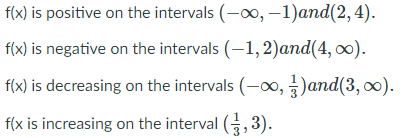
-infinity to -1 and 2, 4
its got to be abovey=0
and then vise verse for the negative
alpine sable
f(x) is positive on the intervals (-00, -1) and (2,4)
thorny lily
isnt the f(x) the y axis?
sage jacinth
is this wrong?
normal lagoon
forgot the dollars
sage jacinth
oh
Equation: $d=vi:\cdot :t:+:\frac{\left(a\cdot :t^2\right)}{2}$
Since when you jump you have to come down the guy is actually traveling a distance of 3.583, so the equation becomes: $3.583=\frac{1}{2}\left(32.2\cdot ::t^2\right)$
Solving for t we get: t=0.4717, and since the guy has to come down you must double that, so the final answer is 0.9434
ocean sealBOT
(バカ) baka
 sage jacinth
ignore the colons
alpine sable
thorny lily
https://i.imgur.com/5c0BsEm.png
(-00, -1) and (2,4)
this is curve positive on the line
while the others are negative
yes, you will draw both x and y axis
normal lagoon
you are calculating the time it would take him to fall through 3.583 ft if he jumped off a building or wall
if his v_i was 0 , since gravity works in downward direction, he would be falling
not going up
normal lagoon
because the roles of the velocities were reversed
when he reaches his max height his velocity is 0

 clever frigate
hey, how do i solve this diff eq?
$$y'' + 3y' + 2y = 2t^2 + 4t, y(0) = 1, y'(0) = 0$$
ocean sealBOT
Doukutem

 worn nimbus
how do i properly solve this? like the formula for it
clever frigate
<@&286206848099549185>
alpine sable
i can help you with this one, but please ask in an unoccupied channel
 umbral pecan
Can someone explain on the steps to decide if H0 should be accepted or rejected on a two tailed test?
I understand for a two tailed test using p value approach, we find the critical Z value, find the area on the left or the right depending on negative or positive z value, then multiply it by 2 (since this is two tailed) and compare it with the alpha value.
What do I do if I don’t want to use the p value approach but just the Z value approach?
Is it the same step as a one tailed z value approach?
 foggy onyx
Quick question, does the sequence have a ellipsis on the set of numbers
or the Series has the ellipsis
 south marsh
how do u solve this?
How many odd 2-digit positive integers greater than 30 are there?
 charred flint
try to write a list of those integers, including the lowest and highest one
like (4,6,8..., 36)
south marsh
oh i think i kinda get it
How many positive odd integers less than 10,000 can be written using the digits 3, 4, 7, 8, and 0?
my answer in here is 200, is it correct?
my sol. is
4 * 5 * 5 * 2 = 200
charred flint
almost
charred flint
er I think there's a lot of pitfalls here
south marsh
5 * 5 * 5 * 2 = 250
charred flint
wait I misread
south marsh
ohh okaay take ur time
charred flint
yea 250 looks good
south marsh
south marsh
how do u solve this?
How many odd 2-digit positive integers greater than 30 are ...
thanks sorry but in here i don't really get it, the easiest way i mean w/o listing it
 ancient sphinx
はたはたはたはま
charred flint
oh by listing I don't mean just counting
just say the lowest is 31 and the highest is 99, and it skips by 2
so like (31,33,35,..99)
and you want to convert it to counting numbers 1 to n
 native temple
hello
charred flint
so you subtract by 29 and divide by 2
31 goes to 2, 99 goes to 70
(2,4,6,...70)
and divide by 2 for
(1,2,3...35)
so there's 35 because this list has the same # of elements
south marsh
ohh thanks
 elder viper
 charred flint
I think you have to realize it as a binomial expansion
 tough ether
Given 40 vertices, such that for any 3 chosen vertices, at least two of them are connected, what is the minimum number of edges such a graph can have?
charred flint
try to find a lower bound then build it
alpine sable
I need help with this

Also can relative max also be absolute max because for this it looks like two maxes
tough ether
The trivial lower bound is 39

 sand oak
@alpine sable I think the result comes from applying the method of differences
alpine sable
thank you!
sand oak
np!
 small flame
how do i find the regression coefecient
sorry for poop grammar, and can you please provide an example
 turbid kindle
if $\sum_{i \in X} i = \sum_{i \in Y} i $ and $\prod_{i \in X} i = \prod_{i \in Y} i $ does that imply $X = Y$?
ocean sealBOT
QuAnTuM
 alpine sable
Hey anyone know what the answer for this is the answer I got is
wait let me post the question first
Give an expression for the number of different race results there are in a horse race of h horses if any ties -- up to all h horses -- are possible. Explain your reasoning
(h, h - (h+1)) x (h-1)!
any help?
casework by # of ties?
ya number of ties but there can't be multiple sets of ties basically
need to gibe an equation
oh ok then i think i know how to do it
I got (h/(h-(h-1)(h-1)!
is that off?
oh ill see if i get the same
okay let me know what you ge
get

,rotate
ocean sealBOT
 alpine sable
casework on ties
0-way tie, 2-way tie, 3-way tie, etc
for the case of 5 horses
you can generalize this pretty easily to h horses
the summation bit simplifies to this

we can check this with your formula
 alpine sable
I got (h/(h-(h-1)(h-1)!
alpine sable
alpine sable
I got (h/(h-(h-1)(h-1)!

lmao
no the h-1 would be at the top
yours seems more correct

Mathematics Stack Exchange
How many ways are there for N=4 horses to finish if ties are allowed?
Note that order does matter!
One of my friends solved this problem in the following way and he told answer for N=5 will be 541....
What do you think of this?

welp
the horses are distinct right
yes
The answers for 0, 1, 2, 3, or 4 horses are 1, 1, 3, 13, and 75.
looks like we both messed up somewhere

Ya i know that sequence is ordered bell numbers
Can someone check my answers please
 alpine sable
ya number of ties but there can't be multiple sets of ties basically
alpine sable
alpine sable
ya number of ties but there can't be multiple sets of ties basically
answer to this on stackexchange assumes that there can be multiple sets of ties

Dan can u help me
ask in an unoccupied channel
there's plenty of people here that can help
I didn’t think this was occupied
alpine sable
alpine sable
ya number of ties but there can't be multiple sets of ties basically
i assumed there could not be multiple sets of ties cuz of this
so my cases for h=5 were no ties, a two-way tie, a three-way tie, a four-way tie, and a five-way tie
cuz i assumed there could only be one "set" of ties
@alpine sable do you have any more questions about that combo problem or are you good?
 severe quarry
oh nvm
 elfin matrix

 alpine sable
np
 vagrant heart
i dont know how to solve x and y

i know how to figure out the rest of angles
but that's about it
vagrant heart
ohhh equation system
 small stag
Np hope you get good sleep
 vagrant heart
i'm in 11th and i just learnt derivation so it might get ... messy
small stag
Oh no no no
Not like
Take the derivatives
Just like prove the identities
Sorry about the confusion
vagrant heart
np, but how do i prove identities?
small stag
Double angle is easy you just substitute
For half angles
Basically like
Say 2x = A
And x = A/2
And change only one side of the equation
Until you get to the other
That’s proving it
Here I’ll do the first
Sin(x) = sqrt ( 1-cos(2x) / 2 )
Sin(x) = sqrt ( 1- (cos^2(x) -sin^2(x) / 2 )
Sin(x) = sqrt ( 2sin^2(x) / 2 )
Sin(x) = sin(x)
And also they all have +/- I’m just too lazy to do that
Oh yeah finally
vagrant heart
okay, but if i disappear it's because i have to play asleep
small stag
Basically half angles makes use of the cos(2x) identity
So to see it clearly I’m gonna substitute a for 2x
So we have this right?
Sin(x) = sqrt ( 1-cos(2x) / 2 )
Same thing just a different variable
Okay i think yoh left
vagrant heart
Just got back
vagrant heart
small stag
Basically half angles makes use of the cos(2x) identity
In what way?
vagrant heart
Oh sorry
small stag
It’s all good don’t worry
So plug it back in
And in the numerator of the fraction we have
1 - ( cos^2(x) - sin^2(x) )
Distribute and we get
1 - cos^2(x) + sin^2(x)
1 - cos^2(x) = sin^2(x)
So that’s 2sin^2(x)
Divide that by 2
And take the square root
Plus minus
And voila sin(x)
vagrant heart
Ohhhhh
small stag
But let’s change back into a
vagrant heart
Okay, I see it
small stag
So sin(a/2)
But remembering that process is time consuming
So what I do is
When I need cos(a/2)
I want to add cos(a)
And when I need sin(a/2)
I do the opposite
vagrant heart
This could be one of those "prove that (trigonometric expression) = (trigonometric expression)" exercised
small stag
Yeah
Lucky
The sum to product and product to sum ones are inverses of eachother
But I can’t get it down ever
vagrant heart
Then again i dont remember Peoples names or my mom's birthday (a soul for a soul)
small stag
So I have to rederive them all the time
I’m bad with names
But I’ll never forget a face
vagrant heart
I dont remember the face of my therapist and k see her every 15 days lmao
A soul for a soul, again
Anyway
Thank you so much
Now i understand and i learnt a way to remember these wack formulas
<3
I'd give you a cookie but, yknow.
small stag
That’s gooddddd
vagrant heart
Gotta go to school but ill check this out again when I've slept
small stag
vagrant heart
I'd give you a cookie but, yknow.
Too kind
small stag
Lmk know how you do on the test if you want to do something tho
Also I would learn how to derive product to sum first
vagrant heart
I suck at trigonometry and ill prolly make small dumb mistakes
small stag
Then use that to make sum to product
vagrant heart
Lol
alpine sable
If something that weighs 150 g costs 12 dollars, how do I find out how much something that weighs 1 kg costs?
 vale wigeon
are we assuming that price is proportional to weight?
alpine sable
I'm not sure, it's not said
vale wigeon
are you rephrasing the question in any way
alpine sable
Not really
vale wigeon
okay so like, if we're buying a good that's sold by weight
like cheese or meat or homemade butter or something
and if you're not afraid of decimals and/or fractions
then this is literally just a matter of dividing 12 USD by 0.15 kg to get the price per kilogram
vale wigeon
notably, price need not scale with weight in general. you could have a 200ml carton of juice sell for, say, $1.20 and a 1L carton for $5.50 (instead of the 6 you would expect if price were proportional to volume)
ocean sealBOT
Ann
 vale wigeon
yes?
 alpine sable
 balmy light
any help will be great
balmy light
any help will be great
yeah i can help
balmy light
yes please
alpine sable
for problems like this you'd probably find it helpful to draw a timeline
ill send a visual
balmy light
sure
alpine sable
 balmy light
okay yeah makes sense
alpine sable
so now we convert this to algebra
balmy light
yes
alpine sable
start of 2018 value is x dollars
and we have a 15% decrease
x-15%x=85%*x=0.85x
so that's the price at the start of 2019
you follow?
balmy light
yeah okay i see
alpine sable
so now let's go from 2019 to 2020
balmy light
increase in a%
alpine sable
we have an a% price increase
balmy light
yeah
alpine sable
(0.85x)+a%(0.85x)=(1+a%)(0.85x)
balmy light
uhm, how about we keep our starting value thats x as 100? wount that make it a bit easier?
alpine sable
yeah that would help
percentage increase would be the same no matter the starting value
balmy light
alpine sable
percentage increase would be the same no matter the starting value
yeahh
so year 2018 we have 85
alpine sable
so start of 2019 it'd be 85 dollars
balmy light
yes
alpine sable
85+a%*85=(1+a%)*85=(1+a/100)*85
same thing for 2020-2021
(1+a/100)*85 + a%[(1+a/100)*85]
balmy light
wait but dont we have to use the new value of 2019?
balmy light
yeah
alpine sable
start of 2019 you have 85
balmy light
yes
alpine sable
start of 2020 you have (1+a/100)*85
balmy light
yeah
alpine sable
start of 2021 you have (1+a/100)*85 + a%[(1+a/100)*85]=
(1+a/100)[(1+a/100)*85]
balmy light
$$(1+a/100)*85 + a%[(1+a/100)*85]=(1+a/100)[(1+a/100)*85]$$
ocean sealBOT
ツ A*ツ
Compile Error! Click the  reaction for more information.
(You may edit your message to recompile.)
 alpine sable
so this value is 2.85% greater than the starting value
balmy light
ocean seal
**ツ A\*ツ**
Compile Error! Click the <:errors:504266556054962196> reaction for mo...
is this right?
alpine sable
ocean seal
**ツ A\*ツ**
Compile Error! Click the <:errors:504266556054962196> reaction for mo...
compile error, it's messed up
balmy light
alpine sable
so this value is 2.85% greater than the starting value
yeah so equate it to 2.85% of 2018
which is 100
alpine sable
ocean seal
**ツ A\*ツ**
Compile Error! Click the <:errors:504266556054962196> reaction for mo...
would look like this

yeah i'm here
so (1+a/100)[(1+a/100)*85]=85+2.85%*85
balmy light
yeah
alpine sable
=87.4225
balmy light
uhun
alpine sable
alpine sable
so (1+a/100)[(1+a/100)*85]=85+2.85%\*85
wait actually first we should divide by 85
(1+a/100)[(1+a/100)*85]=85+2.85%*85
(1+a/100)[(1+a/100)]=1+2.85%*1
balmy light
okay so from here
alpine sable
(1+a/100)^2=1.0285
balmy light
yes
alpine sable
square root both sides solve for a
balmy light
uhm thats gonna be wrong
its supposed to be 10
i actually got that before
but wel doesnt add up if we put it in the equation
alpine sable

Wolfram|Alpha brings expert-level knowledge and capabilities to the broadest possible range of people—spanning all professions and education levels.
oh wait i see what went wrong
he paid 100 for the house at the start of 2018
Wolfram|Alpha brings expert-level knowledge and capabilities to the broadest possible range of people—spanning all professions and education levels.
so yeah you should get a=10%
@balmy light
alpine sable
Can anyone tell me why B isn't congruent to the figure shown?

 jade birch
The answer is in the definition of congruent figures: Two figures are congruent if they have the same size and same angle (measures).
B is the not same size as the figure shown, however, it has the same angle measures, therefore it's only similar
alpine sable
So because the perimeter of A is the same as the perimeter of the figure, they're congruent?
 mystic crown
Anyone here able to help me ?
jade birch
alpine sable
So because the perimeter of A is the same as the perimeter of the figure, they'r...
Not at all what I said
alpine sable
What makes A different from B then?
jade birch
Different angles and sizes
however
you are not comparing B to A or A to B
Youre comparing A to the figure shown and B to the figure shown
alpine sable
I don't understand
I understand that I'm comparing to the figure shown, but I don't understand what makes A congruent and not B, when none of the sides are alike to those of the figure shown
 gray isle
who's saying A is congruent
alpine sable
The answer
gray isle
A is neither similar NOR congruent
jade birch
Just because one figure is similar but not congruent DOES NOT IMPLY that the other is congruent but not similar
 austere thorn
 alpine sable
Thank you
 obsidian crane
It's a quadratic function's graph (if im not wrong) @austere thorn
austere thorn
Yea
obsidian crane
The general equation for a quadratic is this :
x^2 - Sx + P = 0
S is sum of the roots
P is product of the roots
austere thorn
Ok
obsidian crane
You know the roots from the graph.
austere thorn
Nope
obsidian crane
Roots are the points (on x-axis) where the graph crosses the x-axis.
obsidian crane
They are -8 and 4
austere thorn
Yes
obsidian crane
Now find their sum, and their product. Put it in the equation.
austere thorn
Can I dm you
austere thorn
Ok
obsidian crane
Putting these values in x^2 - Sx + P = 0 will give you the quadratic.
 verbal ermine
can someone help with the last part

thats what i did

but i get a quadratic when i should just get one answer?
i skipped that step btw

isnt the sum from r = n+1 to infinity the sum from 1 to infinity - the sum from 1 to n?
 sage summit
have you tried solving the quadratic ?
sage summit
well then you got a wrong quadratic equation
verbal ermine
ik but i dont see anything wrong
verbal ermine
wouldnt it be 3/2 - (3/2 ...
sage summit
a-b-c = a-d is not equivalent to b-c = d
verbal ermine
sum from r = n+1 to infinity the sum from 1 to infinity - the sum from 1 to n?
sage summit
actually you wrote so little stuff it's hard to tell what you are doing
ocean sealBOT

 Requested by ScapeProf#9427
noble sinew
Requested by ScapeProf#9427
noble sinew
the sum from 1 to inf is 3/2
noble sinew
the sum from r=n+1 to inf we want to be 3/2-11/30
sage summit
no ?
mystic crown
Anyone here free to help ?
sage summit
there are like 5 other question channels that are not in use right now
 noble sinew
then the sum from r=n+1 to inf is then 11/30
sage summit
what's the question again
mystic crown
A two-payment stream consisting of $1750 due today and $2900 due in 18 months is to be replaced by an economically equivalent stream comprised of an undetermined payment due in 9 months and a payment of $3000 due in 19 months. Calculate the unknown replacement payment if money is worth 9% compounded monthly and focal date is in nine months from today.
 noble sinew
oh
sage summit
so yes you have to solve 3/2 - (3/2 - 1/(n+1) - 1/(n+2)) = 11/30
noble sinew
typed wrong but solution right
verbal ermine
sage summit
so yes you have to solve 3/2 - (3/2 - 1/(n+1) - 1/(n+2)) = 11/30
i think
verbal ermine
yeah im trying again
mystic crown
Can anyone help me plz.
noble sinew
sage summit
so yes you have to solve 3/2 - (3/2 - 1/(n+1) - 1/(n+2)) = 11/30
this equivalent to what I wrote yep
 sage summit
yes ?
 sage summit
no ???

 indigo jetty
how did u get 4.1
sage summit
n=4.1 is wrong the rest is okay
indigo jetty
because i got 4 with the exact same equation
sage summit
also, since you know the solution has to be an integer, it's not that difficult to solve 1/(n+1) + 1/(n+2) = 11/30
verbal ermine
how come?
sage summit
n+1 and n+2 are coprime, so (n+1+n+2) and (n+1)(n+2) are coprime, and so you must have n+1+n+2 = 11 and (n+1)(n+2) = 30
now try to factor 30
30=5*6 is the only way to get two factors that are consecutive integers
verbal ermine
haha im not a problem solver man
sage summit
and 5+6=11 so it works out
verbal ermine
i see
can you see what cancels here

circled is what should be left
i dont see a pattern
sage summit
I'm not sure what I'm looking at
verbal ermine
method of differences
 woeful pulsar
did you forget to square the (n-1)
verbal ermine
 verbal ermine
woeful pulsar
did you forget to square the (n-1)
verbal ermine
woeful pulsar
did you forget to square the (n-1)
wdym
verbal ermine
verbal ermine
part ii
woeful pulsar
1/2-1/16?
verbal ermine
i didnt square
damn
in part iii

why have they done 1- 1/4 in the brackets


i did 1 + 1/4
woeful pulsar
wait why is there squared in the denominator?
verbal ermine
thats answer to part 2
woeful pulsar
because if 8i is true, then the things should cancel out mostley?
okay for part 8iii you just need to get rid of the r=2 and r=3 term
verbal ermine
sum from 1 to infinity - 1 to 3
but inside the bracket would be 1 + 1/4 no?

they did 1 - 1/4
woeful pulsar
verbal ermine
sum from 1 to infinity - 1 to 3
substituting 1 doesn't make sense
we should be continuing from part 8ii
verbal ermine
the sum from 4 to infinity
is the sum from 1 to infinity - the sum from 1 to 3
right?
just like if i have the sum from 30 to 50 its the sum from 1 to 50 - the sum from 1 to 29
woeful pulsar
verbal ermine
is the sum from 1 to infinity - the sum from 1 to 3
the term doesn't make sense when r=1
 woeful pulsar
verbal ermine
but my part ii is right
woeful pulsar
verbal ermine
but my part ii is right
yeah, so your part 8ii sums from r=2
woeful pulsar
verbal ermine
so how do i do it now?
just remove r=2 and r=3
verbal ermine
woeful pulsar
just remove r=2 and r=3
like that?
 woeful pulsar
hmm might want to use the actual terms, that might make the calculation easier
woeful pulsar
how did you get (5/4-1/9-1/16)?

 woeful pulsar
where did you get that from?
verbal ermine
the answer to part ii
woeful pulsar
oh,
no wonder
your answer to part to is about n if the summation ended there
if your summation went to infinity, then you need n to go to infinity
verbal ermine
yeah i used the answer to part ii
 acoustic bay
Can someone please help me, I dont understand the proof for how we find the moment generating function of a gamma distribution?
verbal ermine
 acoustic bay
I dont understand how to show the mgf here
 woeful pulsar
verbal ermine
yeah i used the answer to part ii
woeful pulsar
verbal ermine
yeah i used the answer to part ii
so how did you use the answer in 8ii?
verbal ermine
i found the expression from r = 2