#help-0
1 messages · Page 536 of 1
 kind trellis
look at this (x^2 - p^2) + (x - p) = 0
kind trellis
when is the entire thing true
 vale wigeon
its impossible to overstate how simple this is
 delicate prawn
Yeah!
 lunar saddle
delicate prawn
Yeah!
lunar saddle
delicate prawn
Yeah!
but you understand right
vale wigeon
you can use vieta (either one of the two) to find the other root
but like this one small thing
highkey surprised you managed to miss it
 ancient temple
why did you not use quadratic formula?
its the method to solve quadratic equations
delicate prawn
ancient temple
why did you not use quadratic formula?
What?
vale wigeon
QF is a nuke
not worth even a quarter of the effort you'd need to put into it
esp. when one of the roots is so spottable
 lone anvil
ancient temple
why did you not use quadratic formula?
lone anvil
ancient temple
why did you not use quadratic formula?
💀
delicate prawn
Can we start from beginning @vale wigeon
vale wigeon
ok sure
ancient temple
vale wigeon
esp. when one of the roots is so spottable
if OP is having THIS MUCH trouble eyeballing roots, id say that is the next option?
delicate prawn
What question is asking
vale wigeon
it's asking you to solve the quadratic
and i am telling you the beginning is that x=p is a root that can (and should) be eyeballed
delicate prawn
I will ask regarding to the question and answer it
lone anvil
ancient temple
if OP is having THIS MUCH trouble eyeballing roots, id say that is the next opt...
U can see the factorisation with ur eyes

ancient temple
lone anvil
U can see the factorisation with ur eyes
you are brilliant, im sure you can, its not about you or me. did you even read the message i sent?
 potent mirage
ancient temple
you are brilliant, im sure you can, its not about you or me. did you even read t...
potent mirage
ancient temple
you are brilliant, im sure you can, its not about you or me. did you even read t...
its about me
delicate prawn
@vale wigeon
vale wigeon
idk what you mean by "is that written"
delicate prawn
vale wigeon
idk what you mean by "is that written"
In the question
vale wigeon
no, it's not written directly in that question
but im telling you that if you think about the equation itself and don't try to do overcomplicated nonsense
you can see it
delicate prawn
Oh yes finally
Only variables are different
But meaning is same
@vale wigeon
x=p
Now clear
 ebon patrol
a+a - b+b = 0
|a|=|b|
 alpine sable
Option C
delicate prawn
.close
 lone heartBOT
Channel closed
Closed by @delicate prawn
Use .reopen if this was a mistake.
vale wigeon
alpine sable
Option C
!nosols
lone heartBOT
alpine sable
Option C
As a helper, please do not give out answers that could be copied as a homework solution. Have the student work through the problem themselves and guide them along the way.
 signal jackal
Well, i guess you have your answer so you closed the thread?
delicate prawn
signal jackal
Well, i guess you have your answer so you closed the thread?<:joia:1376070667174...
Hell naah, I already have answers
I need solutions
It's not my homework
 vale wigeon
alpine sable
vale wigeon
alpine sable
!nosols
lone heartBOT
alpine sable
As a helper, please do not give out answers that could be copied as a homework solution. Have the student work through the problem themselves and guide them along the way.
alpine sable
!yessols
lone heartBOT
 Available help channel!
Send your question here to claim the channel.
Remember:
• Ask your math question in a clear, concise manner.
• Show your work, and if possible, explain where you are stuck.
• After 15 minutes, feel free to ping <@&286206848099549185>.
• Type the command .close to free the channel when you're done.
• Be polite and have a nice day!
Read #❓how-to-get-help for further information on how to ask a good question, and about conduct in the question channels.
 proper marsh
Please someone help me on this one, I cant do it however hard I try
 proper marsh
 hallow vessel
do u know what those transformations mean
hallow vessel
do u know what those transformations mean
Yea like moving but I dont understand anything of it
hallow vessel
well
proper marsh
and i only got like 30 mins to do it
hallow vessel
a rotation is to make it spin
proper marsh
Ahh yea.
 winter light
proper marsh
Yea like moving but I dont understand anything of it
winter light
proper marsh
Yea like moving but I dont understand anything of it
Have you studied the theory behind it?
hallow vessel
translation is to keep its orientation the same and move it
what do u think a->b is
proper marsh
winter light
Have you studied the theory behind it?
Nope its just homework and one of like 30 questions
proper marsh
hallow vessel
what do u think a->b is
Hmm
 raw edge
Can anybody help me find the skewness of these two box plots?

 proper marsh
hallow vessel
translation is to keep its orientation the same and move it
proper marsh
hallow vessel
translation is to keep its orientation the same and move it
I have no clue tbh
hallow vessel
raw edge
Can anybody help me find the skewness of these two box plots?
make a new chat lol
raw edge
How?
hallow vessel
take a guess
proper marsh
(2,0)?
hallow vessel
raw edge
How?
click on help 5
hallow vessel
proper marsh
(2,0)?
is it a rotate or translate
hallow vessel
yep
proper marsh
90 the first bit?
proper marsh
 hallow vessel
where is the point of rotation
hallow vessel
how do u go from b -> c
proper marsh
tbh
hallow vessel
thoink of how to line up b to turn it into c
proper marsh
hallow vessel
thoink of how to line up b to turn it into c
5 dwon 1 side?
proper marsh
idk how to do that
hallow vessel
honestly im not 100% sure (which is embarrassing)
but
in the vector
the top value is x, bottom is y
proper marsh
Ohh
hallow vessel
so what is the x value movement
proper marsh
cuz even ai cant solve this one
proper marsh
I tried gauth like 100 times none work
hallow vessel
whats the x value
proper marsh
up
hallow vessel
yep
so
x movement is?
which way
and what is the number translation for x here?
how much does it move
hallow vessel
the translation is to the right?
u said in simple terms how it moves already
describe how much it moves, the b, to get to c
@proper marsh
u got this smelly!
hallow vessel
not quite unfortunately
proper marsh
5 down 1 across
proper marsh
5,1)
proper marsh
(5,1)?
proper marsh
BRU I AM HORRIBLE 😭
proper marsh
1 y 5 x
proper marsh
side
proper marsh
1[]
hallow vessel
so, whats the x value?
proper marsh
no 1
hallow vessel
yep positive is right and up
negative is left and down
so is the x value +1 or -1
hallow vessel
and the number?>
proper marsh
bottom
proper marsh
waittt thats all of it?
lets gooo
hallow vessel
yepp
hallow vessel
90 degrees around (-3,2)
(1, -5)
90 degrees anticlockwise
@proper marsh
those r what u said
ill save u the trouble
hallow vessel
all good :P
proper marsh
it was amazing
hallow vessel
gl :)
lone heartBOT
@proper marsh Has your question been resolved?
Channel closed
Closed by @proper marsh
Use .reopen if this was a mistake.
proper marsh
hallow vessel
gl :)
ty
lone heartBOT
Available help channel!
Send your question here to claim the channel.
Remember:
• Ask your math question in a clear, concise manner.
• Show your work, and if possible, explain where you are stuck.
• After 15 minutes, feel free to ping <@&286206848099549185>.
• Type the command .close to free the channel when you're done.
• Be polite and have a nice day!
Read #❓how-to-get-help for further information on how to ask a good question, and about conduct in the question channels.
 gloomy tangle
v(x)=a*k*(1-k^x)/(1-k)
v(x) is the usual formula for velocity in the game.
You can manipulate the engine power from 0 to 1.
Need to make velocity function linear
V(x, f)=int 0 -> x f(t)*a*k^t*dt // velocity. f - power function
I have tried to set the functional V, but I am not sure that this is correct. But then I have no idea what to do.
lone heartBOT
gloomy tangle
```
v(x)=a*k*(1-k^x)/(1-k)
```
v(x) is the usual formula for velocity in the ga...
@gloomy tangle Has your question been resolved?
 thick lynx
gloomy tangle
```
v(x)=a*k*(1-k^x)/(1-k)
```
v(x) is the usual formula for velocity in the ga...
thick lynx
gloomy tangle
```
v(x)=a*k*(1-k^x)/(1-k)
```
v(x) is the usual formula for velocity in the ga...
What exactly are you trying to do?
 red nacelle
what
thick lynx
v(x) is the velocity, what do you want to do with it?
gloomy tangle
thick lynx
v(x) is the velocity, what do you want to do with it?
I want to make it linear
thick lynx
gloomy tangle
I want to make it linear
Why?
gloomy tangle
Also if we set f(x) as 1/v'(x), then it really becomes linear. But f is not between 0 and 1, how to fix this?
gloomy tangle
thick lynx
Why?
According to the problem statement
gloomy tangle
gloomy tangle
Also if we set f(x) as 1/v'(x), then it really becomes linear. But f is not betw...
In this case, I want the derivative of the new linear function to be maximal.
gloomy tangle
gloomy tangle
In this case, I want the derivative of the new linear function to be maximal.
there is also a velocity v, up to which it is important to maintain linearity, after which it is no longer important.
<@&286206848099549185>
lone heartBOT
@gloomy tangle Has your question been resolved?
lone heartBOT
@gloomy tangle Has your question been resolved?
gloomy tangle
gloomy tangle
```
v(x)=a*k*(1-k^x)/(1-k)
```
v(x) is the usual formula for velocity in the ga...
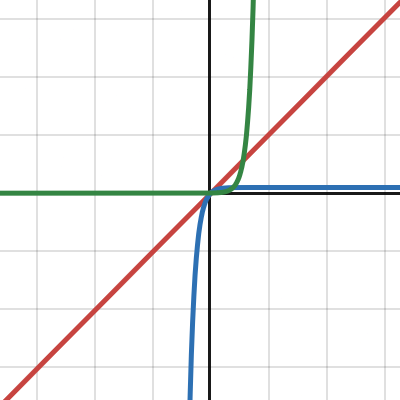
Desmos
lone heartBOT
Someone else is already using this help channel. If you need help with a question, please open your own help channel/thread (see #❓how-to-get-help for instructions).
 glad terrace
my bad
lone heartBOT
@gloomy tangle Has your question been resolved?
 mortal magnet
gloomy tangle
```
v(x)=a*k*(1-k^x)/(1-k)
```
v(x) is the usual formula for velocity in the ga...
mortal magnet
gloomy tangle
```
v(x)=a*k*(1-k^x)/(1-k)
```
v(x) is the usual formula for velocity in the ga...
can you be more specific on what it means for the velocity function to be linear
gloomy tangle
mortal magnet
can you be more specific on what it means for the velocity function to be linear
The derivative is equal to a constant
mortal magnet
That’s not the area you need to elaborate in
A line can be defined through two points
You need to pick two good points for the line
gloomy tangle
mortal magnet
That’s not the area you need to elaborate in
????
mortal magnet
Consider the following
You could draw a line through the beginning and end
I’m assuming that’s from x=0 to x=1 since you didn’t specify what variable the domain is applying to
gloomy tangle
mortal magnet
I’m assuming that’s from x=0 to x=1 since you didn’t specify what variable the d...
from 0 to v
gloomy tangle
gloomy tangle
there is also a velocity v, up to which it is important to maintain linearity, a...
.
mortal magnet
What variable is the engine power
gloomy tangle
mortal magnet
What variable is the engine power
In desmos?
gloomy tangle
mortal magnet
What variable is the engine power
V(x, f)=int 0 -> x f(t)*a*k^t*dt // velocity. f - power function
f - power function
mortal magnet
Are you allowed to use piecewise functions?
gloomy tangle
mortal magnet
Are you allowed to use piecewise functions?
The main thing is that they are set on the interval from 0 up to the x_v
x_v - point where velocity becomes equal to v
mortal magnet
x_0 is not a good variable name, that signifies “initial position” which is incorrect for your case
try x_v instead
To be clear, you are saying that, given a power function f and final velocity v_f, we need V(x, f) to look like a line for x > x_v?
gloomy tangle
mortal magnet
x_0 is not a good variable name, that signifies “initial position” which is inco...
Yes
mortal magnet
Does the power function f ever decrease as x increases?
Wait wrong question mb, is the power function f ever negative?
gloomy tangle
mortal magnet
Wait wrong question mb, is the power function f ever negative?
0 < f(x) <= 1
gloomy tangle
Fixed
mortal magnet
In that case we already know where V has to become a line, which is at x = x_f
gloomy tangle
mortal magnet
x_0 is not a good variable name, that signifies “initial position” which is inco...
wait not
gloomy tangle
mortal magnet
x_0 is not a good variable name, that signifies “initial position” which is inco...
for x <= x_v and x >= 0
mortal magnet
so for 0 <= x <= x_v, you want V(x, f) to be a line?
gloomy tangle
mortal magnet
so for 0 <= x <= x_v, you want V(x, f) to be a line?
yes
mortal magnet
What additionally do you need out of this line?
You could just draw a line from (0, V(0, f)) to (x_f, V(x_f, f))
This is the only line that can be drawn which I don’t think you like
gloomy tangle
mortal magnet
What additionally do you need out of this line?
Its derivative needs to be as large as possible. This seems to be possible to achieve by making the power function in x_v become 1
mortal magnet
Suddenly we’re changing only f instead of only V?
You’re asking for a function then
gloomy tangle
???
mortal magnet
What are you allowed to modify in the problem? We just agreed that the power function f cannot be changed by saying “given f”
You need to be clear with your problem statement
gloomy tangle
No, only the power function can be changed.
gloomy tangle
mortal magnet
What are you allowed to modify in the problem? We just agreed that the power fun...
Maybe the translator screwed up
Sorry
mortal magnet
Alr
We can always modify f to accommodate any x_f of choice we want
Sorry I meant x_v
I think x_v can be freely chosen just as v_f is
gloomy tangle
mortal magnet
We can always modify f to accommodate any x_f of choice we want
Yes, if it satisfies the constraints. Well, we need the smallest possible x_v
gloomy tangle
gloomy tangle
0 < f(x) <= 1
.
 hasty falcon
can anyone help me with 12.1 probibilty events
gloomy tangle
hasty falcon
can anyone help me with 12.1 probibilty events
mortal magnet
Last question, 0 < f(x) <= 1 has to apply for just 0 <= x <= x_v or for any x in general?
gloomy tangle
mortal magnet
Last question, 0 < f(x) <= 1 has to apply for just 0 <= x <= x_v or for any x in...
for just 0 <= x <= x_v
mortal magnet
That’s good
Now what we can do is first consider drawing a line from (0,0) to (x_v, v_f)
Then finding the correct f that can do that
(This is from that V(0,f) is always 0 and V(x_v, f) = v_f)
Now that line would be L(x) = v_f x / x_v
It’s possible this line is too steep and it’ll be bigger than 1, but we find that out later
So integral from 0 to x of f(t) a k^t dt = v_f x / x_v
We can d/dx both sides to get
f(x) a k^x = v_f / x_v
then solve for f(x) to get
f(x) = v_f / (x_v a k^x)
Since a > 0, k > 0, v_f >= 0, x_v > 0, we have it guaranteed that f cannot be negative
Also keep in mind that f can’t be 0 either, since we’re dividing a positive by a positive
We last need f(x) <= 1 for 0 <= x <= x_v
For this, we can write f(x) as v_f / (a x_v) * (1/k)^x
This is the same thing as f(x) but it’s clearer to see that f is exponential
Now exponential functions are always increasing or always decreasing
They don’t ever go up and then down as x increases, for example
These are called “monotonic” functions
That tells us that, to find the highest value of f, we just need to check f(0) and f(x_v)
so that to enforce f(x) <= 1, we only need f(0) <= 1 and f(x_v) <= 1
Now
f(0) = v_f / (a x_v) <= 1, so v_f / a <= x_v
f(x_v) = v_f / (a x_v) * (1/k)^(x_v) <= 1, which is harder to solve
So then
v_f / a = x_v * k^(x_v)
v_f / a = x_v * e^(x_v ln(k))
v_f ln(k) / a = x_v ln(k) * e^(x_v ln(k))
From here, we would need the Lambert W function, which is a special function where W(xe^x) = x
we can W both sides
gloomy tangle
mortal magnet
So then
v_f / a = x_v * k^(x_v)
v_f / a = x_v * e^(x_v ln(k))
v_f ln(k) / a = x_...
From that moment on I stopped understanding
gloomy tangle
mortal magnet
Oh is k >= 1?
k > 0 and k < 1
mortal magnet
So that tells us 1/k > 1
mortal magnet
mortal magnet
For this, we can write f(x) as v_f / (a x_v) * (1/k)^x
So this exponential is always increasing and so we just check f(x_v)
From f(x_v) <= 1,
v_f / a <= x_v * k^(x_v)
v_f / a <= x_v * e^(x_v ln(k))
Since 0 < k < 1, we know that ln(k) is negative
Multiplying both sides by ln(k),
v_f ln(k) / a >= x_v ln(k) * e^(x_v ln(k))
There might be an issue with this now
gloomy tangle
mortal magnet
There might be an issue with this now
?
mortal magnet
@gloomy tangle so it turns out this f we found only works for particular v_f
gloomy tangle
mortal magnet
<@1368632946927599636> so it turns out this f we found only works for particular...
?
gloomy tangle
mortal magnet
<@1368632946927599636> so it turns out this f we found only works for particular...
particular?
mortal magnet
Alr worked it out,
If v_f > a / (e ln(1/k)), then the f we found doesn’t work
During then, f(x_v) will always exceed 1 no matter what x_v > 0 we choose
gloomy tangle
mortal magnet
Alr worked it out,
If v_f > a / (e ln(1/k)), then the f we found doesn’t work
what is the full definition of f?
gloomy tangle
mortal magnet
Alr worked it out,
If v_f > a / (e ln(1/k)), then the f we found doesn’t work
And if we multiply this function by some number, then the limit will change, but V will remain linear. We just need to find a number so that when multiplied by it, the limit is equal to v_f
mortal magnet
gloomy tangle
And if we multiply this function by some number, then the limit will change, but...
If you do that, then f will no longer reach v_f, but we can certainly fix the problem by using that
from earlier, we wanted V(x, f) to be a line from (0,0) to (x_v, v_f)
a, k, v_f are positive constants with k < 1
The resulting f we got is f(x) = v_f / (a x_v k^x) which can also be written as the growing exponential 1/a * (v_f)/(x_v) * (1/k)^x
However if v_f > a / (e ln(1/k)), then f(x_v) > 1 no matter what value of x_v we choose
gloomy tangle
mortal magnet
from earlier, we wanted V(x, f) to be a line from (0,0) to (x_v, v_f)
a, k, v_f ...
Is there no way to fix this?
gloomy tangle
mortal magnet
If you do that, then f will no longer reach v_f, but we can certainly fix the pr...
why
mortal magnet
Because you are literally dividing f by a number to make it smaller, so V will correspondingly also be smaller
mortal magnet
gloomy tangle
Is there no way to fix this?
You can see how the work we did got to where we are,
You could try bending the rules we set up to allow for more options
gloomy tangle
mortal magnet
You can see how the work we did got to where we are,
You could try bending the ...
Then how to find the minimum x_v if v_f <= a / (e ln(1/k))
mortal magnet
gloomy tangle
Then how to find the minimum x_v if v_f <= a / (e ln(1/k))
To do that, we need to use lambert W
I want to show you a graph to show you where I’m getting this from but I gotta sign in first
https://www.desmos.com/calculator/m64va6pvq5
there we go

Desmos
gloomy tangle
mortal magnet
https://www.desmos.com/calculator/m64va6pvq5
there we go
I don't quite understand
mortal magnet
The blue line is V and (x_v, v_f)
The black line is the f we found
The red area represents (x_v, v_f)
If the point is inside the area, then 0 < f(x) <= 1 for 0 <= x <= x_v
If the point is outside the area, then f(x_v) > 1 which we don’t want
brb, it’s up to you to figure out a workaround
gloomy tangle
mortal magnet
To do that, we need to use lambert W
This is not clear
gloomy tangle
.close
lone heartBOT
Channel closed
Closed by @gloomy tangle
Use .reopen if this was a mistake.
gloomy tangle
mortal magnet
To do that, we need to use lambert W
Thank
lone heartBOT
Available help channel!
Send your question here to claim the channel.
Remember:
• Ask your math question in a clear, concise manner.
• Show your work, and if possible, explain where you are stuck.
• After 15 minutes, feel free to ping <@&286206848099549185>.
• Type the command .close to free the channel when you're done.
• Be polite and have a nice day!
Read #❓how-to-get-help for further information on how to ask a good question, and about conduct in the question channels.
 raw jetty
 raw jetty

say the point X is on (x,y), if a point is 100-ray partitional then that means that the yellow region can be divided into a total of 50 regions
let a be number of regions the righter yellow triangle can be divided by,
the height of the triangles and the amount of regions it must be divided by are proportional, so we get that x/(1-x)=a/(50-a)
rearranging we get x=a/50
brb
raw jetty
raw jetty
rearranging we get x=a/50
for a point to be 60-ray partitional we can do thesame to get it to be x=b/30
for it to be both 100 and 60 ray partitional you can see a has to be a multiple of 5, which there are 9 of in the square {5,10,...,45}
raw jetty
raw jetty
rearranging we get x=a/50
so here theres 49, 49-9=40
so there is 40 possible x coordinates for the point, doing the same for the y coordinates you also get 40 (its symmetrical)
so the total points are 40×40=1600, but the answer is C? where did i go wrong
 rigid tree
raw jetty
let a be number of regions the righter yellow triangle can be divided by,
rigid tree
raw jetty
let a be number of regions the righter yellow triangle can be divided by,
which right triangle
raw jetty
rigid tree
which right triangle
the yellow triangle thats more right than the othwr
raw jetty
no
rigid tree
so half of the yellow triangle?
raw jetty
the righter yellow triangle
rigid tree
huh
raw jetty
i shouldve given a diffrent color :p
rigid tree
isoke (btw i prob cant help too much i just wanted to see your solution for inspo)
 rigid tree
lunar saddle
is this amc 12
rigid tree
lunar saddle
is this amc 12
bro do u get which right triangle he is talking about because i dont see it
raw jetty
the red triangle
 lunar saddle
rigid tree
bro do u get which right triangle he is talking about because i dont see it
lunar saddle
rigid tree
bro do u get which right triangle he is talking about because i dont see it
I am reading the question.
And yes i did get it
rigid tree
raw jetty
the red triangle
but it isnt a must it has a right angle right?
lunar saddle
raw jetty
no
He said this
lunar saddle
...
rigid tree
its fine speed reading issues
raw jetty
rigid tree
i misread "righter triangle" as "right triangle"
it was right triangle at the start i edited it, mb
rigid tree
raw jetty
it was right triangle at the start i edited it, mb
oh no wonder
rigid tree
lunar saddle
think we can wlog let the square to be 600x600 for ease
are you saying you want to use coordinates?
lunar saddle
rigid tree
are you saying you want to use coordinates?
He did that
lunar saddle
raw jetty
say the point X is on (x,y), if a point is 100-ray partitional then that means t...
didnt you see
rigid tree
he didnt use exact numbers
raw jetty
there were exact numbers i just didnt bother to write it down as it was irrelevanr
rigid tree
exactly
lunar saddle
Ah
rigid tree
i dont think we would need to set it to sidelength 600 but carbon is more professioanl than me so idk
raw jetty
lunar saddle
think we can wlog let the square to be 600x600 for ease
so the possible x coordinates are multiples of 12 excluding multiples of 60, which is symmetrical to the possible y coordinates
lunar saddle
raw jetty
so the possible x coordinates are multiples of 12 excluding multiples of 60, whi...
This is for both 100 and 60?
raw jetty
lunar saddle
This is for both 100 and 60?
for 100 ray partitional, its every multiple of 12, for both 60 and 100, its every multiple of 60
lunar saddle
raw jetty
for 100 ray partitional, its every multiple of 12, for both 60 and 100, its ever...
ah yes ok
sry cant really think combi rn
rigid tree
raw jetty
for it to be both 100 and 60 ray partitional you can see a has to be a multiple ...
wait why only 9 (sorry jadi beban)
😦
raw jetty
rigid tree
wait why only 9 (sorry jadi beban)
5,10,15,20,25,30,35,40,45 (your indonesian?)
rigid tree
raw jetty
5,10,15,20,25,30,35,40,45 (your indonesian?)
why not a= 50 tbh i dont know
and yes i am indonesian too
raw jetty
rigid tree
why not a= 50 tbh i dont know
it has to be in the interior of the square right?
raw jetty
rigid tree
and yes i am indonesian too
:0 what grade?
rigid tree
raw jetty
it has to be in the interior of the square right?
huh lemme process
ok i get it now
i found how they got c
what you did -> (49 - 9)^2
but the actual way is 49^2 - 9^2
it makes a lot of sense, you just messed up at the end
lunar saddle
raw jetty
so there is 40 possible x coordinates for the point, doing the same for the y co...
This was his reasoning
lunar saddle
rigid tree
man i want to eat es krim
pov related convos
lunar saddle
rigid tree
it comes from (49-9)^2
But can you find the flaw
rigid tree
@raw jetty u got it?
raw jetty
why would it be 49^2-9^2
rigid tree
lunar saddle
But can you find the flaw
i sent it up there
lunar saddle
where
rigid tree
49^2 - 9^2 is the real way
lunar saddle
rigid tree
49^2 - 9^2 is the real way
Yes but why
raw jetty
and why would it not be like 48^2-8^2
rigid tree
raw jetty
why would it be 49^2-9^2
wait i need to write on paper
lunar saddle
rigid tree
raw jetty
and why would it not be like 48^2-8^2
because there are 9 of the points? (5,10, blah blah, 45)
wait guys let me write
raw jetty
rigid tree
because there are 9 of the points? (5,10, blah blah, 45)
oop
OOOH wait it just clicked in me
rigid tree
ok
i wwas just thinking "how do i explain my thought process"
well close the help channel
its just intuitive right?
idk how to explain it tbh
raw jetty
rigid tree
i wwas just thinking "how do i explain my thought process"
i guess you couldve said (5/50,1/50) is 100 partitional and isnt 60 partitional
alr ty!
.solved
lone heartBOT
Channel closed
Closed by @raw jetty
Use .reopen if this was a mistake.
lunar saddle
raw jetty
i guess you couldve said (5/50,1/50) is 100 partitional and isnt 60 partitional
oh
ok noted
lone heartBOT
Available help channel!
Send your question here to claim the channel.
Remember:
• Ask your math question in a clear, concise manner.
• Show your work, and if possible, explain where you are stuck.
• After 15 minutes, feel free to ping <@&286206848099549185>.
• Type the command .close to free the channel when you're done.
• Be polite and have a nice day!
Read #❓how-to-get-help for further information on how to ask a good question, and about conduct in the question channels.
 silver tinsel
Needed some help with 10 i
The period of the graph in the answer key is π/12, but I keep getting π/9?
 lone heartBOT
silver tinsel
Needed some help with 10 i
The period of the graph in the answer key is π/12, bu...
lone heartBOT
silver tinsel
Needed some help with 10 i
The period of the graph in the answer key is π/12, bu...
 tacit arch
silver tinsel
Needed some help with 10 i
The period of the graph in the answer key is π/12, bu...
tacit arch
silver tinsel
Needed some help with 10 i
The period of the graph in the answer key is π/12, bu...
!show
lone heartBOT
silver tinsel
Needed some help with 10 i
The period of the graph in the answer key is π/12, bu...
Show your work, and if possible, explain where you are stuck.
silver tinsel
the distance between the points marked by two lines is 18.
So I did 2π/18 to get b, and simplified it to become π/9
tacit arch
Did you mark those lines or were they given
silver tinsel
Nah, had to mark them
tacit arch
Did you also mark the -5, 5, and 10
silver tinsel
Nah, those were already there
tacit arch
Those axes look wrong for the B value of π/12
And so do your lines
Some functions (like Sine and Cosine) repeat forever and are called Periodic Functions.
I don't see how you can find the peak to peak distance from such poorly labeled x axes
The only point you can infer is on the curve is (0,0)
silver tinsel
Yeah no it is kinda weird
silver tinsel
tacit arch
https://www.mathsisfun.com/algebra/amplitude-period-frequency-phase-shift.html
I'll check this out, thanks!
No. 12, I keep getting 15.6s, when it's actually 18.6s. I don't understand what I'm doing wrong
 lone heartBOT
@silver tinsel Has your question been resolved?
lone heartBOT
@silver tinsel Has your question been resolved?
silver tinsel
.close
lone heartBOT
Channel closed
Closed by @silver tinsel
Use .reopen if this was a mistake.
Available help channel!
Send your question here to claim the channel.
Remember:
• Ask your math question in a clear, concise manner.
• Show your work, and if possible, explain where you are stuck.
• After 15 minutes, feel free to ping <@&286206848099549185>.
• Type the command .close to free the channel when you're done.
• Be polite and have a nice day!
Read #❓how-to-get-help for further information on how to ask a good question, and about conduct in the question channels.
rigid tree
Can someone explained the underlined ones

 lone heartBOT
rigid tree
Can someone explained the underlined ones
rigid tree
lone heartBOT
rigid tree
Can someone explained the underlined ones
rigid tree
Why must it be a, b and c?
rigid tree
Wait lemme process
 jaunty olive
Okay
rigid tree
Did you mean substitute 0 for y?
jaunty olive
rigid tree
Did you mean substitute 0 for y?
Yeah
So f(0) = 0 + a
And a is f(0) which is given
rigid tree
that means c-b = f(a-c-a) = f(-c)
jaunty olive
???
rigid tree
jaunty olive
So f(0) = 0 + a
huh wait lemme think
jaunty olive
Didn’t you only ask about the underlined stuff
jaunty olive
So underlined stuff is f(y) = y + a
rigid tree
f(y) = y+a, etc
rigid tree
jaunty olive
So underlined stuff is f(y) = y + a
yes
jaunty olive
And you’re asking why must it be a
rigid tree
wwhy does it have to be +a?
rigid tree
jaunty olive
And you’re asking why must it be a
yes
jaunty olive
rigid tree
yes
Let it be some constant k
rigid tree
ok
jaunty olive
F(y) = y + k correct
rigid tree
yes
jaunty olive
Now sub y = 0
rigid tree
ok wait
jaunty olive
rigid tree
a = y+k?
Yeah
lone heartBOT
Channel closed
Closed by @rigid tree
Use .reopen if this was a mistake.
jaunty olive
That’s what I was thinking as well
Cuz you’re solving very tough questions
But it happens to everybody
All this in another help channel
vale wigeon
!occupied
lone heartBOT
Someone else is already using this help channel. If you need help with a question, please open your own help channel/thread (see #❓how-to-get-help for instructions).
jaunty olive
This one has not opened yet
lone heartBOT
Available help channel!
Send your question here to claim the channel.
Remember:
• Ask your math question in a clear, concise manner.
• Show your work, and if possible, explain where you are stuck.
• After 15 minutes, feel free to ping <@&286206848099549185>.
• Type the command .close to free the channel when you're done.
• Be polite and have a nice day!
Read #❓how-to-get-help for further information on how to ask a good question, and about conduct in the question channels.
 median oar
on today's episode of frosst vs algebra we have...
median oar
$\alpha\in\bC$ is algebraic $\iff [\bQ(\alpha):\bQ]$ is finite
 ocean sealBOT
frosst
 median oar
Def: $\alpha\in \bC$ is algebraic if $\alpha$ is a root of some $p(x)\in\bQ[x]$
ocean sealBOT
frosst
 median oar
so, if $\alpha\in\bC$ is algebraic, then let $p(x)\in\bQ[x]$ be a polynomial such that $p(\alpha) \equiv 0$, and that for all other $q(x)\in\bQ[x]$ with $q(\alpha) \equiv 0$, $\partial(p) \leq \partial(q)$, then $\bQ(\alpha) \cong \bQ^{\partial(p)} \implies [\bQ(\alpha) : \bQ] = [\bQ^{\partial(p)}:\bQ] = \partial(p) < \infty$
ocean sealBOT
frosst
 median oar
but idk how to do the backwards direction
okay im cooking
Suppose $[\bQ(\alpha):\bQ] = n$, then ${\alpha^0, \ldots,\alpha^n}$ has $n+1$ elements and can't be $\bQ-$linearly independent. Hence $\exists p(x)\in\bQ[x]$ with $\partial(p)\leq n+1$ where $p(\alpha)\equiv 0$, hence $\alpha$ is algebraic.
ocean sealBOT
frosst
 lone heartBOT
@median oar Has your question been resolved?
lone heartBOT
Channel closed
Closed due to timeout
Use .reopen if this was a mistake.
Available help channel!
Send your question here to claim the channel.
Remember:
• Ask your math question in a clear, concise manner.
• Show your work, and if possible, explain where you are stuck.
• After 15 minutes, feel free to ping <@&286206848099549185>.
• Type the command .close to free the channel when you're done.
• Be polite and have a nice day!
Read #❓how-to-get-help for further information on how to ask a good question, and about conduct in the question channels.
median oar
okay polynomial time again
lone heartBOT
median oar
okay polynomial time again
median oar

so im thinking, $F[x]$ is a ring, let $I$ be the ideal generated by $x^3-x-1$, then $F[x]/I$ is a ring
ocean sealBOT
frosst
 median oar
okay, now define $\pi:F[x]\to F[x]/I$ where $\pi(p(x)) \mapsto [p(x)]$, we have a theorem that $\pi$ is surjective and $\ker(\pi) = I$.
ocean sealBOT
frosst
 median oar
now since $P_2 \subseteq F[x]$, we can restrict $\pi$ to just $P_2$ and ive shown that $\pi|_{P_2}$ is injective
ocean sealBOT
frosst
 median oar
so i've tried to turn P_2 into a ring by looking at F[x]/I
my worry is that π|_P_2 is not surjective which would mean maybe that there isn't a 1 to 1 correspondence of elements in F[x]/I with P_2
vale wigeon
it is surjective
median oar
if i can show that π|_P_2 is bijective, then i've turned P_2 into a ring by a ring isomorphism to F[x]/I
something about this doesn't make sense because to turn P_2 into a ring, shouldn't i need to define the operations on P_2? or should i be thinking of it as, F[x] is a ring, F[x]/I is a ring, i can induce the ring structure onto P_2 via the homomorphism π?
vale wigeon
every element of F[x]/I has a unique representative of degree leq 2 -- the remainder on division by x^3-x-1
median oar
i can't really claim π to be a ring isomorphism if P_2 isn't a ring to begin with
vale wigeon
i mean yeah you can define operations on P_2 if you want
à la direct construction of C
median oar
C?
 mortal trellis
you dont need pi to be a ring homomorphism
a bijection is enough
you just pull the operations back
vale wigeon
median oar
C?
complex numbers
median oar
push them over then do the operation in F[x]/I land then pull them back
vale wigeon
\mathbb C i meant
median oar
ocean seal
**frosst**
do i actually need this part?
median oar
ocean seal
**frosst**
also for this, my proof goes like this: Suppose $\pi|{P_2}(p_1) = \pi|{P_2}(p_2)$, then $[p_1] = [p_2] \implies p_1-p_2 \in I \implies p_1-p_2 = r(x)(x^3-x-1)$, but $\partial(p_1-p_2) \leq 2$ and $\partial(r(x)(x^3-x-1)) \geq 3$ for all $r(x)\not\equiv 0$, hence $r(x) \equiv 0$, then $p_1 = p_2$, i.e., $\pi|_{P_2}$ is injective.
ocean sealBOT
frosst
 median oar
that's the notation they gave us
ok good
i feel like this is a lot of work for a part a for a 3 part quesiton that's only worth 8 marks
mortal trellis
its not
its just "identify the set with F[x]/I in the obvious way and you are done"
median oar
i suppose i've just chosen to very much write out the obvious way in excrutiating detail
okay, now where in my proof have i said that this is unique
mortal trellis
nowhere
median oar
or is it more like if Z is a ring where this P_2 is ring isomorphic to (with say 𝜑), then i can just do π o 𝜑^-1 and that's an isomorphism to F[x]/I
mortal trellis
why would you choose Z as a name for a ring
mortal trellis
you just have to realize that the multiplication of two elements in the set is already forced
what are x*x^2 and x^2*x^2 in the ring
median oar
x+1 and x^2 + x?
median oar
i dont really get it
mortal trellis
what is (a+bx+cx^2)*(d+ex+fx^2)
 median oar
no that's part b
median oar
median oar
no that's part b
are you saying that if x^3 = x + 1 then in P_2, p1 * p2 must already obey this expansion, and F[x]/I does obey this by definition, so if R was some other ring where 𝜑 : P_2 -> R, then the induced multiplication from F[x]/I to P_2 to R would be the same?
i dont really know what im saying
i dont know how it means to show that this construction of P_2 is unique
mortal trellis
did you cover some universal property of factor rings or something?
median oar
im guessing it's supposed to mean unique up to ring isomorphism, so if there is another construction of P_2, then there exists a ring isomorphism between this new ring and F[x]/I
no
i dont thing we covered the word factor ring
mortal trellis
quotient ring?
median oar
oh yeah
same thing ok
no i've never covered anything that had to do with universal property
mortal trellis
hmm not sure what answer they are expecting
if not that the product is already forced
median oar
does it have to do with this paragraph
 mortal trellis
yeah
median oar
ok let me try to undersand it
okay so if you pick an I, then every f : R -> S with I in ker(f) corresponds with a unique g such that g([a]) = f(a)?
mortal trellis
basically. I'm actually not sure right now how exactly to use this formalism tho. it was just where my thoughts went
on second thought I also see a different problem
we dont even actually know that x*x has to be x^2
we could in theory just act as if x^2 was some other random symbol, not connected to x
median oar
so like a + bx + cy
median oar
but then how does one ever get x^3
median oar
when it says P_2 is an abelian group of polynomials over F
median oar
i suppose that means a subset of F[x] where its degree is less than 2, and inherits addition
im still not sure how this unique part works
median oar
median oar
push them over then do the operation in F[x]/I land then pull them back
i mean by this construction, i have now forced that x * x = x^2
mortal trellis
well I dont know what they want to hear except that (a+bx+cx^2)*(e+dx+fx^2)=ae+adx+afx^2+bex+bdx^2+bfx*x^2+cex^2+cdx^2*x+cfx^2*x^2
independent of what the actual * is
but the terms x*x^2, x^2*x, x^2*x^2 are fixed
so if ° is another multiplication, then x*x^2=x°x^2 and so on
median oar
and you mean that any other construction will just be renaming these guys
but the coefficeints will have to stay in that way
median oar
so suppose R is a ring such that 𝜑 is a bijection to P_2, then the ° on R induces a multiplication on P_2, but it has to obey the same rules?
mortal trellis
well more directly, let * and ° be two multiplications on P_2 such that P_2 is a ring with respect to either. then * = °
median oar
huh
is that what it means to be constructed uniquely
i guess if i can put 2 ring structures on P_2 and they do the same thing to every pair of inputs then they are just a renamed version of the other?
mortal trellis
well two rings with the same addition and same multiplication, whats the difference between them
median oar
is there an example where this doesn't work
median oar
mortal trellis
so if ° is another multiplication, then x\*x^2=x°x^2 and so on
because it all seems very trivial here
mortal trellis
depends on what you mean by "this"
median oar
it just looks like you're replacing 1 symbol with another then say hey look it's fixed
mortal trellis
but I'm not
x*x^2 = x+1 = x° x^2
I'm not just replacing the symbol
I am forced to define x*x^2 and x°x^2 that way
median oar
why is x+1 = x° x^2 true
mortal trellis
x^3=x+1
median oar
x*x^2 = x+1 this we defined from F[x]/I right?
median oar
okay so if we are given some way to multiply these x's together, then when i see x something x something x i replace it with x + 1
and that's precisely the structure of the ring
mortal trellis
the factor ring just tells us "well this will work and we dont get into annoying problems and we dont have to check all the ring axioms"
median oar
oh so it's like a short cut
mortal trellis
basically
median oar
i still kinda fail to see how the 2 multiplications could possibly be different
even without the x^3 = x + 1 restriction
mortal trellis
but then x*x^2 could be x^2+1 and x°x^2 could be x-17x^2
median oar
does it just need a restrictionn?
is x^3 = x+1 special
if i change it to x^4 = x + 1 does that break
mortal trellis
well x^3 is not in P_2
median oar
somehow the x^3 looks special because it's the next thing that isn't in P_2
median oar
again could be anything
is what you mean
if i dont force it
so then x^2 * x^2 isn't defined???
mortal trellis
I'm not actually sure how well it works out if you are forced into x^2*x^2 = x+1
you shouldnt be able to let x*x^2 be anything I suppose
median oar
okay so if x*x^2 is forced like in this question
doesn't taht still ask what is x^2 * x^2
or is it associative because it needs to be a ring
mortal trellis
yes its associative
median oar
so no problems there
but if i lose the x^3 condition and give x^4
you run into issues of 2 multiplications could define x*x^2 differently
but i feel like the x^2 * x^2 might still force some restriction onto x^3
median oar
okay story for another time then
lone heartBOT
@median oar Has your question been resolved?
lone heartBOT
Channel closed
Closed due to timeout
Use .reopen if this was a mistake.
Available help channel!
Send your question here to claim the channel.
Remember:
• Ask your math question in a clear, concise manner.
• Show your work, and if possible, explain where you are stuck.
• After 15 minutes, feel free to ping <@&286206848099549185>.
• Type the command .close to free the channel when you're done.
• Be polite and have a nice day!
Read #❓how-to-get-help for further information on how to ask a good question, and about conduct in the question channels.
 coarse crag
how do we simplify this?
 lone heartBOT
coarse crag
how do we simplify this?
lone heartBOT
coarse crag
how do we simplify this?
 rustic mist
does it just say simplify or expand and simplify
coarse crag
simplify
mortal trellis
this is simplified
coarse crag
actually it doesnt say anything im trying to just sole it
 lavish cave
Solve for what?
coarse crag
solve it
mortal trellis
you can solve an equation
lavish cave
What do you mean by solve
rustic mist
like solve for x?
mortal trellis
you cant solve a single expression
coarse crag
coarse crag
how do we simplify this?
because ik this isnt simplified
lavish cave
Then you mean simplify
coarse crag
yes
lavish cave
lavish cave
2x / (x^2 + 1)
.
 south ether
coarse crag
actually it doesnt say anything im trying to just sole it
south ether
coarse crag
actually it doesnt say anything im trying to just sole it
You can’t solve it
There’s no equal sign
Also it’s simplified to the max
You can’t simplify it more
coarse crag
shoudnt it be multipied to the denominator since the denominaotr gets cancled when they both have the same number (for example, 5 times 3/5)
 sturdy blade
nah just PFD in ℂ
lavish cave
Where do you see the same number here?
coarse crag
lavish cave
Where do you see the same number here?
there isnt the same number here, ik that but im saying shoudnt it have the same principle?
instead of it getting cancelled, it should be multiplied to the denominator
mortal trellis
completely different situation but should have the same principle?
lone heartBOT
Channel closed
Closed by @coarse crag
Use .reopen if this was a mistake.
lone heartBOT
Available help channel!
Send your question here to claim the channel.
Remember:
• Ask your math question in a clear, concise manner.
• Show your work, and if possible, explain where you are stuck.
• After 15 minutes, feel free to ping <@&286206848099549185>.
• Type the command .close to free the channel when you're done.
• Be polite and have a nice day!
Read #❓how-to-get-help for further information on how to ask a good question, and about conduct in the question channels.
 crisp summit
i personally got D 25 but i ask chatgpt even math solver online they all gave diff answer and it lead me here for help 😭
 lone heartBOT
crisp summit
i personally got D 25 but i ask chatgpt even math solver online they all gave di...
lone anvil
lone heartBOT
crisp summit
i personally got D 25 but i ask chatgpt even math solver online they all gave di...
lone anvil
D is correct
crisp summit
thanks for much 🙏
lone heartBOT
 wise junco
Im nee here
wise junco
Im nee here
Someone else is already using this help channel. If you need help with a question, please open your own help channel/thread (see #❓how-to-get-help for instructions).
crisp summit
what about this how to understand sets in a form of word 😭
 crisp summit
i think yes
crisp summit
so anwer will be 5 2 6 ?
crisp summit
then why is 5 count as intersects
crisp summit
lone anvil
1 also
but 1 is R complement no>?;-
lone anvil
R complement is 6 2 5
That union with q is
6 2 5 1 4
Intersection with p is
5 2 1
lone heartBOT
@crisp summit Has your question been resolved?
Channel closed
Closed by @crisp summit
Use .reopen if this was a mistake.
Available help channel!
Send your question here to claim the channel.
Remember:
• Ask your math question in a clear, concise manner.
• Show your work, and if possible, explain where you are stuck.
• After 15 minutes, feel free to ping <@&286206848099549185>.
• Type the command .close to free the channel when you're done.
• Be polite and have a nice day!
Read #❓how-to-get-help for further information on how to ask a good question, and about conduct in the question channels.
 barren oar
Need help
lone heartBOT
barren oar
Need help
barren oar

 toxic verge
barren oar
toxic verge
barren oar
What have you tried
 barren oar
I've tried to write it as a polynomial and use remainder theorem
barren oar
vale wigeon
let's just cut away the black bands which are 2.4 times taller than the image
Sure sorry next time 😭

Here
But idk what to do now
barren oar
How do I find Q
barren oar
vale wigeon
well, can you compare 3^200 against 10^100+3?
It should be smaller than 1
So that will become zero
vale wigeon
the fraction should be smaller than 1.
vale wigeon
anyway, consider: $t^{200} = t^{200} - (-3)^{200} + (-3)^{200}$
ocean sealBOT
Ann
 barren oar
Right
vale wigeon
do you know how to factorize a^n - b^n
vale wigeon
i would not call that "expansion"
vale wigeon
nice jargon you're throwing around
lone anvil
Idk we solve those with binomial at my institute
toxic verge
Binomial LMAO
vale wigeon

toxic verge
lone anvil
Idk we solve those with binomial at my institute
Uh huh where's the binomial at
lone anvil
toxic verge
Uh huh where's the binomial at
I’ll have to think abt this question
but I’m 90% sure
U can
vale wigeon
lone anvil
I’ll have to think abt this question
think before you speak m8
vale wigeon
t^200 - 9^100 more like?
well, you have to do some kind of geometric-progression magic
barren oar
Man this seems like some work
lone heartBOT
@barren oar Has your question been resolved?
lone heartBOT
Channel closed
Closed by @barren oar
Use .reopen if this was a mistake.
Available help channel!
Send your question here to claim the channel.
Remember:
• Ask your math question in a clear, concise manner.
• Show your work, and if possible, explain where you are stuck.
• After 15 minutes, feel free to ping <@&286206848099549185>.
• Type the command .close to free the channel when you're done.
• Be polite and have a nice day!
Read #❓how-to-get-help for further information on how to ask a good question, and about conduct in the question channels.
 north grail
factorization
lone heartBOT
north grail
factorization
north grail
someone help me plesae
ong
i have a big test in a day or two
i did everything
just cant understand this
 nimble sleet
What's your question
north grail
i just need to understand factorization
all of it
i just cant understand even w youtube videos
9th grade
red nacelle
ok
north grail
2x2yz + 2xy2z + 4xyz.
red nacelle
do you know the distributive property
north grail
red nacelle
do you know the distributive property
yes
so
for
2x2yz + 2xy2z + 4xyz.
what i did was
red nacelle
factoring is the reverse of distribution
north grail
i take
2xyz as a common factor
and
write the final equstion as
2xyz(x+y+z)
is this correct
north grail
sorry
red nacelle
north grail
2xyz(x+y+z)
it's 12xyz
north grail
red nacelle
it's 12xyz
how
red nacelle
north grail
2x2yz + 2xy2z + 4xyz.
was this what you were solving
north grail
yes
red nacelle
multiply the 2s then factor it so it's less confusing
so you end up with 4xyz + 4xyz + 4xyz
alpine sable
north grail
2x2yz + 2xy2z + 4xyz.
Please typeset properly
$2x^2yz + 2xy^2z + 4xyz$
ocean sealBOT
à뜜
 red nacelle
ok you can factor out an xyz
red nacelle
yeah that's the factored form
north grail
no
- Common Factors, 2) Regrouping of Terms, 3) Factorization using Identities, and 4) Splitting the Middle Term.
red nacelle
oh
red nacelle
- was what you just did
ok so
- just involves you using multiplication's commutative property to reorder terms
- is just using formulas like
difference of perfect squares, difference of perfect cubes and sum of perfect cubes
north grail
wait so this question is
red nacelle
were you mayhaps talking about "factoring by grouping" in 2.
north grail
30xy – 12x + 10y– 4.
red nacelle
?
red nacelle
yes
red nacelle
it's correct
north grail
i think
its wrong
cus i checked and its wrong
so i did it again
and my answer came as
red nacelle
you need parentheses whenever you do like factoring
is it a factoring by grouping problem
north grail
i grouped the
red nacelle
i'll try to see if there's a common ratio rq
red nacelle
oh it is
red nacelle
you need to factor by grouping
north grail
so i did
10y(3x+y)
for first group
and second group
idk if i take 04
-4
or -4x
as my factor
i think i should take
-4
because they need to be same right?
red nacelle
north grail
30xy – 12x + 10y– 4.
ok so
north grail
but then it comes as
red nacelle
this is actually a factoring by grouping problem
north grail
-4(3x+1) which isnt the same
red nacelle
hold on my dumbass needs to gcf allat
6x(5y - 2) + 2(5y - 2)
ok so you just have to consider 6x + 2
and 5y - 2
so your factors are (5y - 2)(6x + 2)
north grail
but why 6x
red nacelle
@north grail ok so whenever you see two of the same linear factors repeating in the left and right half
it is a factoring by grouping problem
north grail
shouldnt i take 2 or 10
red nacelle
yes but that doesn't narrow it down
red nacelle
you're supposed to like see a common ratio between two sides
if the left side has a gcf different from the entire expression's gcf
and the right side also has a gcf that is different
you can identify it as a factoring by grouping problem
red nacelle
north grail
30xy – 12x + 10y– 4.
alright so you said that the gcf of this entire thing was like
north grail
see
red nacelle
2 right
red nacelle
the gcf of the left side (30xy - 12x) is 6x
north grail
wait can i send a picture of my working
red nacelle
yes
north grail
lemme just write it neatly again
red nacelle
and gcf of the right side is 2
