#help-0
1 messages · Page 414 of 1
 summer dirge
i always called it ΔL, if that looks familiar?
alternatively, perhaps you've seen it as |S_1P_1 - S_2P_1|?
 alpine sable
 summer dirge
yes
summer dirge
you want the difference in the length between the two lines
alpine sable
can anyone answer this for mr
 summer dirge
alpine sable
can anyone answer this for mr
summer dirge
alpine sable
can anyone answer this for mr
!occupied
 lone heartBOT
alpine sable
can anyone answer this for mr
lone heartBOT
alpine sable
can anyone answer this for mr
Someone else is already using this help channel. If you need help with a question, please open your own help channel/thread (see #❓how-to-get-help for instructions).
summer dirge
alpine sable
so hypotenuse minus opposite
no
alpine sable
actually no it would be
adjacent
sorry
hypotenuse minus adjacent gives us difference
lets do that real quick
summer dirge
alpine sable
hypotenuse minus adjacent gives us difference
what is "adjacent"
alpine sable
bottom one is assumed to be lambda distance greater
just for description sake
it would be the top wavelength
above the hypotenuse
summer dirge
my issue is with your wording
the lines need not form a right triangle
this is your situation

it is not a right triangle, as you can see
theres no "hypotenuse" or "adjacent" side
summer dirge
path length difference is just |S_1P_1 - S_2P_1|
 alpine sable
summer dirge
path length difference is just |S_1P_1 - S_2P_1|
alpine sable
summer dirge
path length difference is just |S_1P_1 - S_2P_1|
how would this
formula work
just asking from a point of wanting to understand
alpine sable
oh completely looked over 10cm and 11 cm lol
let me update the labelling then

is the formula
alpine sable
okay so the absolute value part is essentially describing how the path length difference is equals to the set of variables
path length difference being the difference between the first distance indicated by PnS1 and the second distance PnS2
summer dirge
alpine sable
you may use this to solve for lambda though
alpine sable
so in terms of visuals we're looking for the yellow line?
 summer dirge
essentially yeah
alpine sable
why though
what significance does that serve
I would understand if we were looking for "L" being the distance between the points and the screen
idk im a total physics noob so
I'm just trying to understand why formulas are
summer dirge
hmm
alpine sable
also from what I'm seeing "n" is some form of constant
summer dirge
let's see if i can describe this to you
i havent done physics explaining for a bit
please bear with me
alpine sable
haha yeah no problem
summer dirge
alpine sable
also from what I'm seeing "n" is some form of constant
n is the nodal line number
okay, here goes nothing
summer dirge
when you're looking at a nodal line, you're looking at the line where the waves generated by S1 and S2 destructively interfere
alpine sable
okay I get destructive interference
where it makes a flat line because both amplitudes add up to that
summer dirge
since P1 and P2 generate waves at the same rate, this must occur at a half-integer multiple of the wave lengths of one of them
alpine sable
mhm because being 1/2 lambda more would cause destructive interference
summer dirge
yes
alpine sable
while 1 lambda more would cause constructive interference
summer dirge
so the path length difference between the two sources and the point on the nodal line must be equal to a half-integer multiple of the wavelength
alpine sable
but is this under the assumption that destructive interference is happening between the two points?
or does it always happen when you have two waves
summer dirge
alpine sable
but is this under the assumption that destructive interference is happening betw...
this is what "nodal" line means!
destructive interference
all along the line
 summer dirge
mhm
summer dirge
it turns out that you can take the number of the nodal line, cut 1/2 off of it, multiply it by lambda, and get the path length difference between the two sources and any point on the nodal line
i cannot exactly remember why, but it seems intuitively clear to me now
alpine sable
summer dirge
so the path length difference between the two sources and the point on the nodal...
a lot of words here but I'll try clarifying:
so what your saying is the difference in between the two lines (path length difference) must be equal to a half integer multiple of the wave length
- my question is which wave length are we referring to
summer dirge
the wavelength of the waves generated by S1 and S2!
summer dirge
the path length difference is a bit more general than that
when you have constructive interference, the path length difference has to be equal to an integer multiple of the wavelength
does that make sense?
alpine sable
summer dirge
when you have constructive interference, the path length difference has to be eq...
yep
agreed
summer dirge
so when you have destructive interference, the PLD has to be equal to a half integer multiple of the wavelength
alpine sable
correct
summer dirge
right, so what is the issue you're having rn?
alpine sable
so what I'm trying to understand is, what is the overall thing being formed from PS1-PS2
alpine sable
alpine sable
is it just a general wave length as shown here
probably shouldn't focus on that part too much then, in that instance lol
summer dirge
alpine sable
this picture makes it a bit hard to see what we mean by PLD
lemme see if i can find a more intuitive picture
i dont expect to though, since this idea isnt a very "clean" one to look at
okay nvm, this may work
 alpine sable
summer dirge
this is what "nodal" line means!
alpine sable
summer dirge
this is what "nodal" line means!
now a nodal line would be as indicated by the image right here

where the red lines are the nodal line
aka where it's consistently destructive interference
alpine sable
summer dirge
okay nvm, this may work
what am i looking at
summer dirge
point C is on an anti-nodal line where constructive interference occurs
alpine sable
okay
summer dirge
you can physically count the number of crests to get there from both S1 and S2
summer dirge
yeah
for a nodal line, you'd count half-integer multiples
the path length difference is just that
the difference in path length from S1/S2 to P
summer dirge
thats right
alpine sable
okay perfect
summer dirge
in our question, they explicitly give you the distance from the sources to the point
summer dirge
summer dirge
okay nvm, this may work
i.e. they given you something like this
just on a nodal line instead

 summer dirge
i.e. they given you something like this
summer dirge
summer dirge
i.e. they given you something like this
and instead of 6 lambda and 4 lambda, they've given you 10cm and 11cm
summer dirge
so now you can use this information to get lambda
alpine sable
so then our new formula is $1= (n-\frac{1}{2})\lambda$
 ocean sealBOT
mj
 alpine sable
cm
alpine sable
okay
summer dirge
okay, so lambda = what?
alpine sable
so we have now $\frac{1 cm}{(n-\frac{1}{2})}=\lambda$
ocean sealBOT
mj
 alpine sable
$\frac{1 cm}{(1e-9-\frac{1}{2})}=\lambda$
summer dirge
it's the number of the nodal line we're interested in
alpine sable
wait so it's not
ocean sealBOT
mj
 summer dirge
where did that come from
alpine sable
hmmmm
I'm looking at what you sent

this here
there are multiple nodal lines though
alpine sable
okay we're given information
5 cm and 8 hz being
the frequency
and the distance between the two
summer dirge
 alpine sable
which isn't important

redrew it
with out variables
our*
so why does the first nodal line matter, but not the second
 summer dirge
yeah we have no info on the 2nd nodal line or 3rd, etc
 summer dirge
yes, the nodal line number
the first nodal line is always in the centreish
the other ones are further out
summer dirge
summer dirge
the first nodal line is always in the centreish
why? because the path length difference is minimal in the centre, so we call it the first
summer dirge
alpine sable
or the line that holds P
this
summer dirge
well, not quite
it's always about PLD, as i've said before
the nodal line is not necessarily dead centre
it could be in some cases, but it's very likely not in ours
alpine sable
hm okay
alpine sable
$\frac{1 cm}{(n-\frac{1}{2})}=\lambda$
ocean sealBOT
mj
 summer dirge
because we know which nodal line we're working with
alpine sable
summer dirge
because we know which nodal line we're working with
first one?
alpine sable
oh
I had thought of n being
the value
of the nodal line
not the nth nodal line
summer dirge
theres no definition of the "value" of a nodal line
alpine sable
yeah
summer dirge
nodal lines are nodal lines, we only given them numbers for convienence
alpine sable
so it's just 1 because it's the first nodal line
summer dirge
correct
if it were the 2nd, we would have n = 2, but the path length difference would also change in tandem
alpine sable
so if in the question it told us the second nodal line is located 10 cm from... we would use 2?
okok
alpine sable
$\frac{1 cm}{(1-\frac{1}{2})}=\lambda$
ocean sealBOT
mj
 alpine sable
summer dirge
and you'd get the same lambda in the end anyway
alpine sable
summer dirge
and you'd get the same lambda in the end anyway
it does
summer dirge
the wavelength doesnt change just because you sit on a diff nodal line
summer dirge
so you have 1cm/unitless
alpine sable
finding lambda
summer dirge
yeah
summer dirge
correct
ocean sealBOT
mj
 alpine sable
equation?
summer dirge
here's my advice for high school physics problems
ALWAYS write down ALL of your givens first
alpine sable
yep, I even highlight them lol
alpine sable
well thanks for your help 🙂
alpine sable
haha atleast you won't have to relearn how to do it lol
always good to refresh
your memory
summer dirge
indeed
lone heartBOT
Channel closed
Closed by @glad vessel
Use .reopen if this was a mistake.
lone heartBOT
 Available help channel!
Send your question here to claim the channel.
Remember:
• Ask your math question in a clear, concise manner.
• Show your work, and if possible, explain where you are stuck.
• After 15 minutes, feel free to ping <@&286206848099549185>.
• Type the command .close to free the channel when you're done.
• Be polite and have a nice day!
Read #❓how-to-get-help for further information on how to ask a good question, and about conduct in the question channels.
 hot bison
So for my math test I am allowed an 8.5 x 11 formula sheet. But no worked out examples or procedural steps, ect. Would the image below be considered a formula or something else?
 lone heartBOT
hot bison
So for my math test I am allowed an 8.5 x 11 formula sheet. But no worked out ex...
lone heartBOT
hot bison
So for my math test I am allowed an 8.5 x 11 formula sheet. But no worked out ex...
 flint sonnet
since there is no numbers ig its not an example
hot bison
so I could write that down?
flint sonnet
well the picture is not really necessary unless you really need it
lone heartBOT
Channel closed
Closed by @hot bison
Use .reopen if this was a mistake.
lone heartBOT
Available help channel!
Send your question here to claim the channel.
Remember:
• Ask your math question in a clear, concise manner.
• Show your work, and if possible, explain where you are stuck.
• After 15 minutes, feel free to ping <@&286206848099549185>.
• Type the command .close to free the channel when you're done.
• Be polite and have a nice day!
Read #❓how-to-get-help for further information on how to ask a good question, and about conduct in the question channels.
 mystic holly
im not sure where i went wrong
 lone heartBOT
mystic holly
im not sure where i went wrong
lone heartBOT
mystic holly
im not sure where i went wrong
 fallen verge
what is the antiderivative of 1/x
 echo socket
Integrating x^{-1} should not yield 1
alpine sable
x^(-1) is not integrable via the common integration method for polynomials
mystic holly
well i dont have 1/x anythere
alpine sable
as i told you in your earlier help channels
fallen verge
mystic holly
well i dont have 1/x anythere
you have (1/3)*(1/x)
alpine sable
,, \int x^n \dd x = \f{x^{n+1}}{n+1} + C \qq n \in \R\setminus\set{-1}
ocean sealBOT
 alpine sable
note the setminus of -1
mystic holly
fallen verge
you have (1/3)*(1/x)
so bascially we split it up into 2
alpine sable
mystic holly
so bascially we split it up into 2
elaborate.
mystic holly
you split up 1/3x into (1/3) and (1/x)
and then you took the intergral
true or false?
fallen verge
i guess
mystic holly
well then true or false
 fallen verge
not how integration works
fallen verge
\int f(x)g(x) dx \neq (\int f(x) dx)(\int g(x) dx)
$\int f(x)g(x) dx \neq (\int f(x) dx)(\int g(x) dx)$
ocean sealBOT
ニンニク狼
 ocean sealBOT
ニンニク狼
 mystic holly
im not good at understanding letters notations
but basically, if its a constant you can split it and if it is not then you dont split it
yes no?
fallen verge
yes
mystic holly
mystic holly
im not sure where i went wrong
alright, so goign back to the problem, uhh
(resending for convinence)

so i should split first and then integrate?
fallen verge
wdym by split
mystic holly
how does this look
 fallen verge
thats good!
mystic holly
fallen verge
you have (1/3)*(1/x)
split like this
it does not look like any of these

closest seems like a
but we just imported an aboslute value sign
ocean sealBOT
ニンニク狼
 fallen verge
the negative side has to have an antiderivative too
flint sonnet
the integral of 1/x is equal to ln|x|
mystic holly
.close
lone heartBOT
Channel closed
Closed by @mystic holly
Use .reopen if this was a mistake.
lone heartBOT
Available help channel!
Send your question here to claim the channel.
Remember:
• Ask your math question in a clear, concise manner.
• Show your work, and if possible, explain where you are stuck.
• After 15 minutes, feel free to ping <@&286206848099549185>.
• Type the command .close to free the channel when you're done.
• Be polite and have a nice day!
Read #❓how-to-get-help for further information on how to ask a good question, and about conduct in the question channels.
 lethal spade
hello I have to deal with the social surplus the problem is Prices and quantities demanded at dates t = 0, 1 are as follows:
P0 = 8, P1 = 10 and Q0 = 30, Q1 = 20.
What is the arc elasticity of demand?
I found 3.37
lone heartBOT
lethal spade
hello I have to deal with the social surplus the problem is Prices and quantitie...
Please don't occupy multiple help channels.
alpine sable
@lethal spade close either one of the channels
lethal spade
yes
lone heartBOT
@lethal spade Has your question been resolved?
lethal spade
<@&286206848099549185>
 tacit arch
lethal spade
hello I have to deal with the social surplus the problem is Prices and quantitie...
tacit arch
lethal spade
hello I have to deal with the social surplus the problem is Prices and quantitie...
Send the formulas for elasticity and work you did
lone heartBOT
@lethal spade Has your question been resolved?
lone heartBOT
Channel closed
Closed due to timeout
Use .reopen if this was a mistake.
Available help channel!
Send your question here to claim the channel.
Remember:
• Ask your math question in a clear, concise manner.
• Show your work, and if possible, explain where you are stuck.
• After 15 minutes, feel free to ping <@&286206848099549185>.
• Type the command .close to free the channel when you're done.
• Be polite and have a nice day!
Read #❓how-to-get-help for further information on how to ask a good question, and about conduct in the question channels.
 quasi sonnet

 lone heartBOT
quasi sonnet
lone heartBOT
quasi sonnet
 lone heartBOT
Channel closed
Closed by @quasi sonnet
Use .reopen if this was a mistake.
lone heartBOT
Available help channel!
Send your question here to claim the channel.
Remember:
• Ask your math question in a clear, concise manner.
• Show your work, and if possible, explain where you are stuck.
• After 15 minutes, feel free to ping <@&286206848099549185>.
• Type the command .close to free the channel when you're done.
• Be polite and have a nice day!
Read #❓how-to-get-help for further information on how to ask a good question, and about conduct in the question channels.
 silent sundial
Could someone help me with this problem: -5x^2-18xy+50x+8y^2-20y
tacit arch
silent sundial
Could someone help me with this problem: -5x^2-18xy+50x+8y^2-20y
What's the question
tacit arch
silent sundial
you have to factorize
This is important to the question
silent sundial
Yeah
lone heartBOT
@silent sundial Has your question been resolved?
lone heartBOT
@silent sundial Has your question been resolved?
silent sundial
.close
lone heartBOT
Channel closed
Closed by @silent sundial
Use .reopen if this was a mistake.
lone heartBOT
Available help channel!
Send your question here to claim the channel.
Remember:
• Ask your math question in a clear, concise manner.
• Show your work, and if possible, explain where you are stuck.
• After 15 minutes, feel free to ping <@&286206848099549185>.
• Type the command .close to free the channel when you're done.
• Be polite and have a nice day!
Read #❓how-to-get-help for further information on how to ask a good question, and about conduct in the question channels.
 scenic wing
where did the 2x and divided by 2 come from
 lone heartBOT
scenic wing
where did the 2x and divided by 2 come from
scenic wing
lone heartBOT
scenic wing
where did the 2x and divided by 2 come from
scenic wing
i thought sin^2x +cos^2x = 1
lone heartBOT
@scenic wing Has your question been resolved?
lone heartBOT
Channel closed
Closed due to timeout
Use .reopen if this was a mistake.
Available help channel!
Send your question here to claim the channel.
Remember:
• Ask your math question in a clear, concise manner.
• Show your work, and if possible, explain where you are stuck.
• After 15 minutes, feel free to ping <@&286206848099549185>.
• Type the command .close to free the channel when you're done.
• Be polite and have a nice day!
Read #❓how-to-get-help for further information on how to ask a good question, and about conduct in the question channels.
 austere compass
Can someone help me go through this IVP exercise?\
\
\
Show that there's an interval $I \subseteq \mathbb{R}$ with $3 \in I$, so that the initial value problem
$$
\begin{cases}
x'(t) = (x(t) - t)e^{t^2+x(t)}\
x(3) = 7
\end{cases}
$$
has a unique solution.
lone heartBOT
austere compass
Can someone help me go through this IVP exercise?\\
\\
\\
Show that there's an i...
ocean sealBOT
Levens
 austere compass
I tried having a go but I didn't get anywhere
lone heartBOT
@austere compass Has your question been resolved?
lone heartBOT
Channel closed
Closed by @austere compass
Use .reopen if this was a mistake.
alpine sable
i was about to take a look at this 💀
lone heartBOT
Available help channel!
Send your question here to claim the channel.
Remember:
• Ask your math question in a clear, concise manner.
• Show your work, and if possible, explain where you are stuck.
• After 15 minutes, feel free to ping <@&286206848099549185>.
• Type the command .close to free the channel when you're done.
• Be polite and have a nice day!
Read #❓how-to-get-help for further information on how to ask a good question, and about conduct in the question channels.
 vital wind
 lone heartBOT
vital wind
vital wind
lone heartBOT
vital wind
vital wind
I understand what the question is asking me to do, I just dont know how to do it.
Like I understand that I wont get an actual value for p so it will be in the answer I just dont get how im supposed to represent the area of the triangle.
vital wind
alpine sable
i was about to take a look at this 💀
Poor dude was waiting for an hour 😭
alpine sable
vital wind
Poor dude was waiting for an hour 😭
i know 😭
vital wind
<@&286206848099549185>
lone heartBOT
@vital wind Has your question been resolved?
lone heartBOT
Channel closed
Closed by @vital wind
Use .reopen if this was a mistake.
lone heartBOT
Available help channel!
Send your question here to claim the channel.
Remember:
• Ask your math question in a clear, concise manner.
• Show your work, and if possible, explain where you are stuck.
• After 15 minutes, feel free to ping <@&286206848099549185>.
• Type the command .close to free the channel when you're done.
• Be polite and have a nice day!
Read #❓how-to-get-help for further information on how to ask a good question, and about conduct in the question channels.
alpine sable
 lone heartBOT
alpine sable
lone heartBOT
lone heartBOT
alpine sable
lone heartBOT
Channel closed
Closed by @urban thistle
Use .reopen if this was a mistake.
Available help channel!
Send your question here to claim the channel.
Remember:
• Ask your math question in a clear, concise manner.
• Show your work, and if possible, explain where you are stuck.
• After 15 minutes, feel free to ping <@&286206848099549185>.
• Type the command .close to free the channel when you're done.
• Be polite and have a nice day!
Read #❓how-to-get-help for further information on how to ask a good question, and about conduct in the question channels.
 wooden topaz
need help
lone heartBOT
wooden topaz
need help
 tacit arch
wooden topaz
have no idea what to do
tacit arch
wooden topaz
have no idea what to do
Calculate the derivative piecewise, then evaluate the one sided limits of the derivative
wooden topaz
tacit arch
Calculate the derivative piecewise, then evaluate the one sided limits of the de...
could you explain
 left isle
wooden topaz
find the derivative of each equation ?
left isle
wooden topaz
find the derivative of each equation ?
yes
wooden topaz
4x-4 would be the answer ?
left isle
first find the derivatives of each, then plug in x=1 for each
if the answer is the same for both, then it exists and that's your answer
 tacit arch
wooden topaz
tacit arch
wooden topaz
Pictures of screens are bad. Upload a screenshot instead
 wooden topaz
left isle
yes
wooden topaz
left isle
yes
lost on this one
<@&286206848099549185>
due at 11:59!
um
ok ig i fail
left isle
wooden topaz
-4x-4
that isnt the derivative
 charred jewel
wooden topaz
charred jewel
wooden topaz
since you have a 8^h there, your guess should be an exponential function
you also have a 1 there
so what should your x be for your exponential function to be 1
or rather your a
wooden topaz
0 ?
charred jewel
ok good
now the first part of the limit definition of a derivative has a f(x+h)
since your x = a = 0, what should your f(x) be
remember you have a 8^h there
wooden topaz
0 ??
charred jewel
no...
wooden topaz
1?
wooden topaz
1 + 0 ?
charred jewel
no..
ok here we'll do a little guessing
since you have a 8^h there
lets guess that f(x) = 8^x
does that work?
charred jewel
really?
charred jewel
its not h
wooden topaz
a= 1
wooden topaz
oh
charred jewel
wooden topaz
a= 1
and a is also not 1
charred jewel
wooden topaz
0 ?
what did you tell me here before?
wooden topaz
a is 0 ??
charred jewel
yes
wooden topaz
do you know a good calc channel
calc 1 channel
i missed class last week
and also my professor isnt the best
charred jewel
organic chem tutor maybe
 charred jewel
yeah
charred jewel
its f(3)
wooden topaz
?
oh ok

sorry for pic but im in a rush
last attempt and last question
so this is correct
wooden topaz
3
charred jewel
yeah
(but if you still get it wrong then im so sorry the question didnt really specify what it wants)
wooden topaz
its okay thanks for helping
left isle
wooden topaz
ok ig i fail
is this a test?
lone heartBOT
Channel closed
Closed by @wooden topaz
Use .reopen if this was a mistake.
lone heartBOT
Available help channel!
Send your question here to claim the channel.
Remember:
• Ask your math question in a clear, concise manner.
• Show your work, and if possible, explain where you are stuck.
• After 15 minutes, feel free to ping <@&286206848099549185>.
• Type the command .close to free the channel when you're done.
• Be polite and have a nice day!
Read #❓how-to-get-help for further information on how to ask a good question, and about conduct in the question channels.
 jovial flax
6a)
 lone heartBOT
jovial flax
6a)
lone heartBOT
lone heartBOT
jovial flax
6a)
lone heartBOT
@jovial flax Has your question been resolved?
lone heartBOT
@jovial flax Has your question been resolved?
lone heartBOT
Channel closed
Closed due to timeout
Use .reopen if this was a mistake.
Available help channel!
Send your question here to claim the channel.
Remember:
• Ask your math question in a clear, concise manner.
• Show your work, and if possible, explain where you are stuck.
• After 15 minutes, feel free to ping <@&286206848099549185>.
• Type the command .close to free the channel when you're done.
• Be polite and have a nice day!
Read #❓how-to-get-help for further information on how to ask a good question, and about conduct in the question channels.
 west brook
I know this might be the wrong topic to ask, but is anyone here familiar with Digital Logic in computer science/engineering? This is a circuit and problem that I am working with, but I just need help understanding it

 lone heartBOT
west brook
I know this might be the wrong topic to ask, but is anyone here familiar with Di...
lone heartBOT
west brook
I know this might be the wrong topic to ask, but is anyone here familiar with Di...
 median oar
Are you trying to make a full adder?
west brook
yeah
median oar
Did you try the hint
 west brook
but im just having trouble just understand how to get that into the whole circuit thing
median oar
Is that short for karnaugh
alpine sable
yes
west brook
uhh i dont think i learned k map or i mightve not reviewed it yet
alpine sable
well okay i guess we are doing the standard way then.
are you familiar with sum-of-products representation of boolean functions
median oar
(Karnaugh maps was invented to make this part of the problem easier)
west brook
alpine sable
are you familiar with sum-of-products representation of boolean functions
yes
alpine sable
okay. So lets focus on the sum output for now. Write the 'sum' as a sum of products
west brook
you can just do this right:
A’ B’ C-IN + A’ B C-IN’ + A B’ C-IN’ + A B C-IN = sum
west brook
alright
alpine sable
you have [
A'B'C + A'BC'+AB'C'+ABC
]
ocean sealBOT
 west brook
a little bit
alpine sable
here is a good starting hint
west brook
you can end up getting
C(A'B' + AB) + C'(A'B + AB')
alpine sable
yeah
west brook
and then C XOR (A XOR B).....?
alpine sable
yes!
that's the sum indeed
okay so we are going to do the same thing for C-out
list it out
west brook
so if you look back at this chart, you can derive
A'BC + AB'C + ABC' + ABC

and then you can simplify to AB + BC + AC
alpine sable
yeah
so the thing is though
what you wrote is correct
but there is a simpler way to view the circuit for the C output
We need to view the full adder as two half adders that are connected
which is true
do you know the logic diagram for a half adder?
 alpine sable
yeah it is that
a full adder is basically two half adders constructed together
but anyways i guess this will be a bit hard to explain
alpine sable
west brook
and then you can simplify to AB + BC + AC
this form is fine
alpine sable
what do you need
west brook
i was still stuck on the problem because i still dont really understand how making that truth table would go to the circuit
because im having trouble understanding the circuit
alpine sable
like just draw out the logic diagram now
you have the equations for both output minimised
west brook
.close
lone heartBOT
Channel closed
Closed by @west brook
Use .reopen if this was a mistake.
Available help channel!
Send your question here to claim the channel.
Remember:
• Ask your math question in a clear, concise manner.
• Show your work, and if possible, explain where you are stuck.
• After 15 minutes, feel free to ping <@&286206848099549185>.
• Type the command .close to free the channel when you're done.
• Be polite and have a nice day!
Read #❓how-to-get-help for further information on how to ask a good question, and about conduct in the question channels.
 fathom ravine
Hi, could you help me please? How can I resolve this exercise?

 exotic canopy
fathom ravine
exotic canopy
fathom ravine
use the right hand side of this rule on each of the fractions
 fathom ravine
Hm, I still don't understand, could you write it out?
exotic canopy
81=ln(e^81)
lone heartBOT
@fathom ravine Has your question been resolved?
fathom ravine
Could you write it out on paper? Like the whole resolved exercise, so I would be able to analyse it, because I still dont understand
lone heartBOT
Channel closed
Closed due to timeout
Use .reopen if this was a mistake.
Available help channel!
Send your question here to claim the channel.
Remember:
• Ask your math question in a clear, concise manner.
• Show your work, and if possible, explain where you are stuck.
• After 15 minutes, feel free to ping <@&286206848099549185>.
• Type the command .close to free the channel when you're done.
• Be polite and have a nice day!
Read #❓how-to-get-help for further information on how to ask a good question, and about conduct in the question channels.
 cerulean junco
What do i do next , ....
 lone heartBOT
cerulean junco
What do i do next , ....
lone heartBOT
cerulean junco
What do i do next , ....
 mortal trellis
multiply out the middle two brackets
and then immediately factor them again, but this time in the other order
(or in other words, just switch the two terms)
cerulean junco
mortal trellis
multiply out the middle two brackets
ok ,but what is the logic behind taking out the "middle 2 brackets" ?
mortal trellis
well you want to switch them so that they will cancel with the other terms
either you know that you are allowed to do this if you only have combinations of A and I
or you do it the slow way by multiplying out and then factoring again, but in the other way around
cerulean junco
mortal trellis
either you know that you are allowed to do this if you only have combinations of...
didn't get this point .....
mortal trellis
then ignore it
cerulean junco
mortal trellis
or you do it the slow way by multiplying out and then factoring again, but in th...
u mean expanding !?
mortal trellis
yes
cerulean junco
,rotate
 ocean sealBOT
 cerulean junco
mortal trellis
yes
cerulean junco
mortal trellis
yes
.
mortal trellis
no
not sure what you did there
I mean only (I-A)(I+A)
show that it is equal to (I+A)(I-A)
cerulean junco
mortal trellis
show that it is equal to (I+A)(I-A)
oh okay i get that ....
cerulean junco
mortal trellis
either you know that you are allowed to do this if you only have combinations of...
got it ,
but can you tell what you said here ,i guess i missed some concepts ..
mortal trellis
notice that while you expanded, you only ever got terms of the form A^(i+j)
which is the same as A^(j+i)
so you know that you will be able to undo all the expanding, but with writing the terms the other way around
this will always happen if you multiply terms looking like this
like a polynomial in A, if that means something to you
some linear combination of I, A, A^2, A^3,...
lone heartBOT
@cerulean junco Has your question been resolved?
lone heartBOT
Channel closed
Closed due to timeout
Use .reopen if this was a mistake.
Available help channel!
Send your question here to claim the channel.
Remember:
• Ask your math question in a clear, concise manner.
• Show your work, and if possible, explain where you are stuck.
• After 15 minutes, feel free to ping <@&286206848099549185>.
• Type the command .close to free the channel when you're done.
• Be polite and have a nice day!
Read #❓how-to-get-help for further information on how to ask a good question, and about conduct in the question channels.
 warped topaz
 lone heartBOT
warped topaz
https://i.imgur.com/EGnG5jz.png
warped topaz
lone heartBOT
warped topaz
https://i.imgur.com/EGnG5jz.png
warped topaz
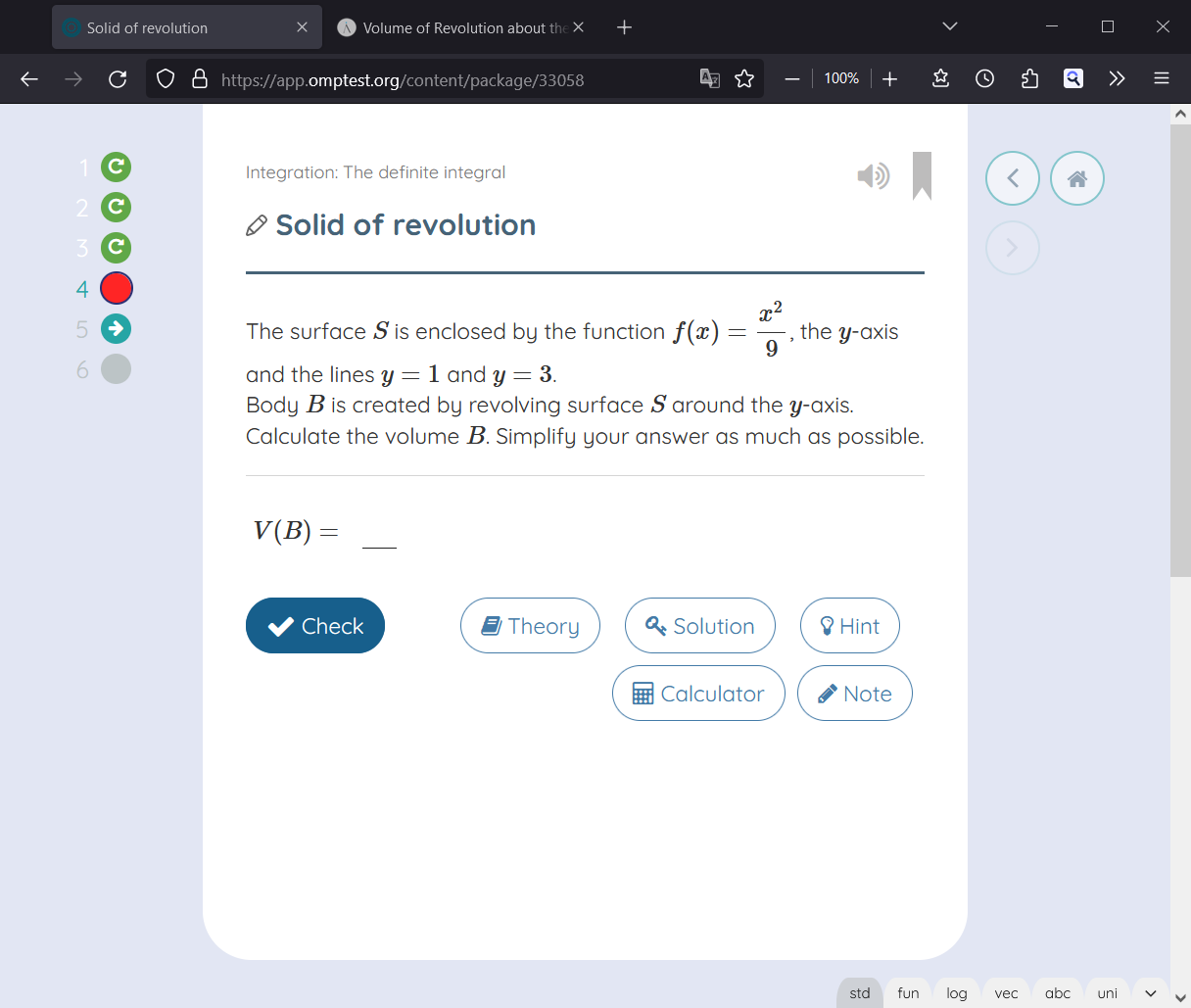
Im confused about the bit where you change from x to y
Like at which point do you do it
After you square f(x)?
After you integrate the squared f(x)?
CHARTBIT!!!!!!
😍
WELCOME BACK
 pseudo ice
Why thank you 
pseudo ice
warped topaz
Im confused about the bit where you change from x to y
Also how do you mean here?  as in where you need to rearrange your function for $\pi \int x^2 \dd y$?
ocean sealBOT
@pseudo ice
 warped topaz
pseudo ice
Also how do you mean here? <:RooThink:532310138439073792> as in where you need t...
warped topaz
pseudo ice
Also how do you mean here? <:RooThink:532310138439073792> as in where you need t...
I think so
I just know that its x and we need to change it to y
Something like that
I dont really remember
pseudo ice
Yep, you’d need to change it to x = … before you put it in the integral, before you put it in the bit where you square it preferably
pseudo ice
Yep like that  then you put that as your x and square it (again
  )
)
As a “cheat” as well…
warped topaz
I like cheats...
pseudo ice
warped topaz
So (x^2)/9 = y?
As the formula has an $x^2$ in it, you could just instantly say that $x^2 = 9y$ and then the integral $\pi \int x^2 \dd y = \pi \int 9y \dd y$ (with the limits of course)
warped topaz
 😝
😝
pseudo ice
Hahah it is I’m lacking today 
ocean sealBOT
@pseudo ice
 pseudo ice
What i get for choosing to do tex halfway through a message 
pseudo ice
warped topaz
So (x^2)/9 = y?
Multiply by 9 here
warped topaz
Omg 🤦♂️
Okkkkk
I understand the trick
Cause it needs to be squared anyways 😄
So saves time
Thank you sooooo much!!!
You are still the best helper ❤️
Really glad you are back
❤️
.close
lone heartBOT
Channel closed
Closed by @warped topaz
Use .reopen if this was a mistake.
lone heartBOT
Available help channel!
Send your question here to claim the channel.
Remember:
• Ask your math question in a clear, concise manner.
• Show your work, and if possible, explain where you are stuck.
• After 15 minutes, feel free to ping <@&286206848099549185>.
• Type the command .close to free the channel when you're done.
• Be polite and have a nice day!
Read #❓how-to-get-help for further information on how to ask a good question, and about conduct in the question channels.
 loud monolith
i have a question about area under curve
lone heartBOT
loud monolith
i have a question about area under curve
loud monolith
the formula for area under curve of two functions has a modulus if you dont want to graph em
is it okay to put the modulus outside the integral?
 livid sage
i might be misunderstanding your question but i am pretty sure no
lone heartBOT
@loud monolith Has your question been resolved?
lone heartBOT
Channel closed
Closed due to timeout
Use .reopen if this was a mistake.
lone heartBOT
Available help channel!
Send your question here to claim the channel.
Remember:
• Ask your math question in a clear, concise manner.
• Show your work, and if possible, explain where you are stuck.
• After 15 minutes, feel free to ping <@&286206848099549185>.
• Type the command .close to free the channel when you're done.
• Be polite and have a nice day!
Read #❓how-to-get-help for further information on how to ask a good question, and about conduct in the question channels.
 deft vigil
Geometric Arithmetic
t3 = root2
t8 = 8
Find S8
lone heartBOT
deft vigil
Geometric Arithmetic
t3 = root2
t8 = 8
Find S8
 urban talon
breh
urban talon
i was mid typing out my question
anyway
its very clearly just doubling it each time
deft vigil
You can type it here I guess
urban talon
just do your typical steps
deft vigil
Yeah but I don't know my GP's
urban talon
aight so do you know how to find the progression
t3 is surd2, or 2^1/2, and t8 is 8, or 2^3
deft vigil
?
urban talon
its not doubling mb
i
i feel like its obvious enough that i should just say the answer
urban talon
but at the same time idk what the process is like here
in your syllabus
cuz id just write the answer out personally
deft vigil
I'll work backwards from the answer
Something got to do with a(1-r^n)/(1-r) or without the denominator
urban talon
nah way simpler
urban talon
just find any function f(n) where f(3)=surd2 and f(8)=8
hint is that both of those numbers are 2 to the power of something
urban talon
why not
urban talon
tell them to stick it where the sun dont shine
deft vigil
lol
He gives us basic examples so we can get use to it
Then we apply it to hardcore questions in the future
And I can't even solve a simple one bc I wasn't there 😔
urban talon
why hassle yourself with the way that is both more specific, and more of a hassle
o well
urban talon
deft vigil
Something got to do with a(1-r^n)/(1-r) or without the denominator
anyway i havent touched that equation in like years so imma leave that to someone else to teach
i got my own questions n shit
urban talon
you have n and term n for 2 equations
and a general formula
if you know how to sim eq that shit you can find both a and r
deft vigil
But I don't have t1
urban talon
you dont need t1
urban talon
do you know simultaneous equations?
deft vigil
Yes
deft vigil
Yeah yesyes
deft vigil
Yeah that's right
urban talon
if a(1-r^3)/(1-r)=surd2 and a(1-r^8)/(1-r)=8
thats 2 equations and 2 unknowns
and you can sim eq that shit
lone heartBOT
@deft vigil Has your question been resolved?
Channel closed
Closed by @deft vigil
Use .reopen if this was a mistake.
Available help channel!
Send your question here to claim the channel.
Remember:
• Ask your math question in a clear, concise manner.
• Show your work, and if possible, explain where you are stuck.
• After 15 minutes, feel free to ping <@&286206848099549185>.
• Type the command .close to free the channel when you're done.
• Be polite and have a nice day!
Read #❓how-to-get-help for further information on how to ask a good question, and about conduct in the question channels.
 dusk wraith
does anyone know how to find the range
 lone heartBOT
dusk wraith
does anyone know how to find the range
dusk wraith
lone heartBOT
dusk wraith
does anyone know how to find the range
dusk wraith
like the steps
summer dirge
If you can find the global minimum, you can use that to see that the range is all numbers greater than said global min
Alternatively, it’s probably possible to find the range of this graph by inspection
lone heartBOT
Channel closed
Closed by @dusk wraith
Use .reopen if this was a mistake.
Available help channel!
Send your question here to claim the channel.
Remember:
• Ask your math question in a clear, concise manner.
• Show your work, and if possible, explain where you are stuck.
• After 15 minutes, feel free to ping <@&286206848099549185>.
• Type the command .close to free the channel when you're done.
• Be polite and have a nice day!
Read #❓how-to-get-help for further information on how to ask a good question, and about conduct in the question channels.
 rocky cloak
Can a second order voronoi diagram be created using a first order voronoi diagram algorithm applied to a transformed version of the points?
lone heartBOT
rocky cloak
Can a second order voronoi diagram be created using a first order voronoi diagra...
@rocky cloak Has your question been resolved?
lone heartBOT
Channel closed
Closed due to timeout
Use .reopen if this was a mistake.
Available help channel!
Send your question here to claim the channel.
Remember:
• Ask your math question in a clear, concise manner.
• Show your work, and if possible, explain where you are stuck.
• After 15 minutes, feel free to ping <@&286206848099549185>.
• Type the command .close to free the channel when you're done.
• Be polite and have a nice day!
Read #❓how-to-get-help for further information on how to ask a good question, and about conduct in the question channels.
 clear tendon
 lone heartBOT
clear tendon
lone heartBOT
clear tendon
Please only use the <@&286206848099549185> ping once if your question has not been answered for 15 minutes. Please do not ping or DM individual users about your question.
lone heartBOT
@clear tendon Has your question been resolved?
lone heartBOT
Channel closed
Closed due to timeout
Use .reopen if this was a mistake.
Available help channel!
Send your question here to claim the channel.
Remember:
• Ask your math question in a clear, concise manner.
• Show your work, and if possible, explain where you are stuck.
• After 15 minutes, feel free to ping <@&286206848099549185>.
• Type the command .close to free the channel when you're done.
• Be polite and have a nice day!
Read #❓how-to-get-help for further information on how to ask a good question, and about conduct in the question channels.
 winter fable
Guys how am i supposed to understand this sequence:
winter fable
2,2,4,6,10,16 ...
what is the nth term here
or ttt rule
and how am i even supposed to understand this
lone heartBOT
@winter fable Has your question been resolved?
 brittle ember
I think it is fibonacci sequence doubled
winter fable
Huh
brittle ember
do you know the rules of fibonacci sequence?
winter fable
nope
can you explain please
@brittle ember
oh
yeah i searched it up
yeah it does
tho how does that explain the sequence?
btwhow to get a helper role t
.close
lone heartBOT
Channel closed
Closed by @winter fable
Use .reopen if this was a mistake.
lone heartBOT
✅
winter fable
sorry yeah @brittle ember wat u sayin?
 swift grail
$F_n = F_{n - 1} + F_{n - 2}$ where $F_0 = 0$ and $F_1 = 1$
ocean sealBOT
casework
 winter fable
swift grail
$F_n = F_{n - 1} + F_{n - 2}$ where $F_0 = 0$ and $F_1 = 1$
winter fable
swift grail
$F_n = F_{n - 1} + F_{n - 2}$ where $F_0 = 0$ and $F_1 = 1$
what the fu-
swift grail
Fibonacci sequence
brittle ember
so 2+2=4, 2+4=6, 4+6=10...
on your sequence
winter fable
yeah
winter fable
brittle ember
so 2+2=4, 2+4=6, 4+6=10...
on your sequence
OHHHHHHHHHHHHHHH
brittle ember
adding up before 2 terms
brittle ember
i forgor
winter fable
bru
brittle ember
idk in english
swift grail
You just get it from the roles button in the settings of the server
winter fable
oh
brittle ember
if you're done please close this thread
lone heartBOT
Channel closed
Closed by @winter fable
Use .reopen if this was a mistake.
lone heartBOT
Available help channel!
Send your question here to claim the channel.
Remember:
• Ask your math question in a clear, concise manner.
• Show your work, and if possible, explain where you are stuck.
• After 15 minutes, feel free to ping <@&286206848099549185>.
• Type the command .close to free the channel when you're done.
• Be polite and have a nice day!
Read #❓how-to-get-help for further information on how to ask a good question, and about conduct in the question channels.
 robust light
Hi, question coming up, gonna try LaTex to make it readable... 1 sec
robust light
Let
$$T : \text{P}_2(\C) \to \C^2$$ be defined by
$$[ T(p) = \bigl(p(0), p'(0)\bigr). ]$$
Further define the following ordered bases for $$\text{P}_2(\C) \C^2$$ respectivly.
ocean sealBOT
binnet
Let
$$T : \text{P}_2(\C) \to \C^2$$ be defined by
$$\[ T(p) = \bigl(p(0), p'(0)\bigr). \]$$
Further define the following ordered bases for $$\text{P}_2(\C) \C^2$$ respectivly.
```Compilation error:```! Undefined control sequence.
l.50 $$T : \text{P}_2(\C
                        ) \to \C^2$$ be defined by
The control sequence at the end of the top line
of your error message was never \def'ed. If you have
misspelled it (e.g., `\hobx'), type `I' and the correct
spelling (e.g., `I\hbox'). Otherwise just continue,
and I'll forget about whatever was undefined.```
 golden canyon
I think it's $\mathbb{C}$
ocean sealBOT
Jelle
 robust light
thanks,,,, writing the question is half the struggle... lol
Let
$$T : \text{P}_2(\mathbb{C}) \to \mathbb{C}^2$$ be defined by
$$[ T(p) = \bigl(p(0), p'(0)\bigr). ]$$
Further define the following ordered bases for $$\text{P}_2(\mathbb{C}) \C^2$$ respectivly.
\text{P}_2(\mathbb{C})&:\ B = (2+2x+x^2, 1-x, 1), &&E = (1,x,x^2), \
\mathbb{C}^2&: \mathbb{C} = \bigl((1,1), (0,-1)\bigr), &&F = \bigl((1,0), (0,1)\bigr).
ocean sealBOT
binnet
Compile Error! Click the  reaction for more information.
(You may edit your message to recompile.)
 robust light
i) SHow that T in a linear transformation
ii) Calculate the matrixrepresentation of T och T from the definition.
iii)Calculate the base change matrix id_(P_2(C)) and id_(C^2).
iv) Verify that the clause of base change for linear transformations is fulfilled for …
Let's see is this does it:
Let $$T : \text{P}_2(\mathbb{C}) \to \mathbb{C}^2$$ be defined by
$$[ T(p) = \bigl(p(0), p'(0)\bigr). ]$$.
Further define the following ordered bases for $$\text{P}_2(\mathbb{C}) \C^2$$ respectivly.
\text{P}_2(\mathbb{C})&:\ B = (2+2x+x^2, 1-x, 1), &&E = (1,x,x^2),
\mathbb{C}^2&: \mathbb{C} = \bigl((1,1), (0,-1)\bigr), &&F = \bigl((1,0), (0,1)\bigr).
i) Show that T is a linear transformation
ii) Calculate the matrixrepresentation of $$\matrixrep{T}{B}{C}$$ och $$\matrixrep{T}{E}{F}$$ from the definition.
iii) Calculate the base change matrix $$\matrixrep{\id_{\text{P}2(\C)}}{B}{E}$$ and $$\matrixrep{\id{\C^2}}{C}{F}$$.
iv) Verify that the clause of base change for linear transformations is fulfilled for $$\matrixrep{T}{B}{C}$$ och $$\matrixrep{T}{E}{F}$$ by comparing both sides of the equation in the clause.
(suggestion: i’ts easier to find the inverse of a 2x2 matrix than a 3x3 matrix).
ocean sealBOT
binnet
Compile Error! Click the reaction for more information.
(You may edit your message to recompile.)
 robust light
nope...
 twin nimbus
If you want inline equations use $ instead of $$
ocean sealBOT
全能の存在
Compile Error! Click the reaction for more information.
(You may edit your message to recompile.)
 robust light
I should have practiced this somewhere bforre.... oh, thanks! that helps!
How do you type a base change matrix on here?
I.e. [A]_B ^C if you get what ia mean...
twin nimbus
${[A]}_B^C$ doesn't work?
ocean sealBOT
全能の存在
 twin nimbus
I'm not certain what you're wanting the typesetting to look like, so
robust light
How ddid you write that?
twin nimbus
${[A]}_B^C$ doesn't work?
\matrixrep{T}{E}{F} is what i am used to, but it didnt work here... 1 sec cleanign up my question so it's readable...
twin nimbus
That's probably provided by some package that you have in your normal latex environment, but not in your texit preamble
You can add it to your texit preamble using the preamble command
robust light
yeah sfor sur
elemme close this until I got my text formating sorted and purmed myself some coffee...
.close
lone heartBOT
Channel closed
Closed by @robust light
Use .reopen if this was a mistake.
robust light
Ops, did I do this wrong too..? i meant to close my question not the room...
twin nimbus
You did it correct
lone heartBOT
Available help channel!
Send your question here to claim the channel.
Remember:
• Ask your math question in a clear, concise manner.
• Show your work, and if possible, explain where you are stuck.
• After 15 minutes, feel free to ping <@&286206848099549185>.
• Type the command .close to free the channel when you're done.
• Be polite and have a nice day!
Read #❓how-to-get-help for further information on how to ask a good question, and about conduct in the question channels.
robust light
Okay I am back, same proble, better formating!
lone heartBOT
robust light
Okay I am back, same proble, better formating!
robust light
Let $T : \text{P}_2(\mathbb{C}) \to \mathbb{C}^2$ be defined by
$$T(p) = \bigl(p(0), p'(0)\bigr)$$
Further define the following ordered bases for $\text{P}_2(\mathbb{C}) and \mathbb{C}^2$ respectively.
$$P_2(\mathbb{C}): B = (2+2x+x^2, 1-x, 1), E = (1,x,x^2) ,$$
$$\mathbb{C}^2 : \mathbb{C} = ((1,1), (0,-1)), F = ((1,0), (0,1)) .$$
i) Show that $T$ is a linear transformation.
ii) Calculate the matrix representation of ${[T]}_B^C$ och ${[T]}_E^F$ from the definition.
iii) Calculate the base change matrix
${[id_{P_2(\mathbb{C})}]}B^E$ and ${[id(\mathbb{C}^2)]}_C^F$
iv) Verify that the clause of base change for linear transformations is fulfilled for ${[T]}_B^C$ and ${[T]}_E^F$ by comparing both sides of the equation in the clause.
(suggestion: it’s easier to find the inverse of a 2x2 matrix than a 3x3 matrix)
ocean sealBOT
binnet
 robust light
I am stuggeling with these LA proofs 😦
Hopefulle having a readble question should make it a bit less of a stuggle though...
summer dirge
Have you done part i)?
robust light
Nope, I have done nothing on this problem yet, as I am stuck, sad and frustrated. I do have decent understanding but I am just not sure of how to approach this
summer dirge
okay, do you know the conditions you have to check to show that T is linear?
robust light
So the transformation T is a transformation of polynomials of degree 2 of less with complex coefficients? to what exactly though?
summer dirge
robust light
So the transformation T is a transformation of polynomials of degree 2 of less w...
to C^2
robust light
TOocheck linearity do somehting like check that is associative and ...
summer dirge
robust light
TOocheck linearity do somehting like check that is associative and ...
not quite
robust light
like, check the 8 conditions?
summer dirge
I think you’re getting confused with the axioms of a vector space
robust light
oh, shit, yeah i am, spot on!
isn't it somehting like check that T(a+b) = T(a)+ T(b)
summer dirge
We say a function that maps between vector spaces V and W is linear if for all x,y in V and c in F, we have T(x+y) = T(x) + T(y) and T(cx) = cT(x)
robust light
and check that cT(a) = T(ca)
summer dirge
yup
robust light
okay, this is all good, but I have no clue what the vector space C^2 is tbh...
summer dirge
think of it like R^2
But instead of having real numbers, you have complex numbers instead
summer dirge
it’s the set of all possible ordered pairs of complex numbers
summer dirge
robust light
impossible to visualise but sure
Indeed, but that’s how it goes sometimes lol
robust light
okay, got it
summer dirge
alright, let’s check the first condition
Let’s pick some random x and y in P_2(C)
This means that x and y are both polynomials of degree 2, with complex coefficients
robust light
okay
summer dirge
let’s let x = ax^2 + bx + c and y = dx^2 + ex + f
 fiery halo
can someone help me solve this im clueless.
A cone has its height x and radius y. if the value of x + y = s Find its height and radius when its volume is maximum for the different values of s
summer dirge
summer dirge
let’s let x = ax^2 + bx + c and y = dx^2 + ex + f
So now we get T(x+y) = T(ax^2 + bx+ c + dx^2 + ex + f)
summer dirge
fiery halo
A cone has its height x and radius y. if the value of x + y = s Find its height ...
!occupied
lone heartBOT
fiery halo
A cone has its height x and radius y. if the value of x + y = s Find its height ...
Someone else is already using this help channel. If you need help with a question, please open your own help channel/thread (see #❓how-to-get-help for instructions).
summer dirge
summer dirge
So now we get T(x+y) = T(ax^2 + bx+ c + dx^2 + ex + f)
Do we get this point? @robust light
robust light
yeah, seems correct
so we need to also prove it is linear with multiplication with a scalar then?
summer dirge
okay, now the map says that we must send this to ((x+y)(0), (x+y)’(0))
summer dirge
robust light
so we need to also prove it is linear with multiplication with a scalar then?
Yes, in principle we can do both checks at once
robust light
sorry, hwere is this from?
summer dirge
summer dirge
okay, now the map says that we must send this to ((x+y)(0), (x+y)’(0))
This?
robust light
yeah, gimmi a sec

 robust light
using the E to F ?
summer dirge
oh nono
robust light
sorry, you've lost me a bit 😦
robust light
oh, that means polynomial and it's derivative at x= 0 right
robust light
okay okay.. i'm back in it
robust light
should be add coefficients first maybe?
summer dirge
you may if you’d like, but in my opinion, you can do this more easily than that
(x+y)(0) = c + f, if you notice that
and (x+y)’(0) = b + e
summer dirge
okay, so we have (c+f, b+e)
robust light
and now I would just do the same, but separately? to show that they are equal?
T(x) + T(y)
summer dirge
you can, or you can keep going this way
robust light
okay, tell me 🙂
summer dirge
Either way is totally valid
summer dirge
robust light
okay, tell me 🙂
okay, so imo the quicker way is to not compute T(x) + T(y) because that’s painful
we left off with (c+f, b+e)
let’s split this apart
robust light
(c, b) + (f, e)?
robust light
oh, wow, on mobile! o_O that's fast for mobile!!!
summer dirge
summer dirge
to (c,b) + (f,e)
notice that this is actually equal to T(ax^2 + bx+ c) + T(dx^2 + ex + f)
which is T(x) + T(y)!
robust light
is this not also equal to T(Qx^2 + bx+ c) + T(Sx^2 + ex + f) ?
can i really go in that direction for the proof?
summer dirge
robust light
is this not also equal to T(Qx^2 + bx+ c) + T(Sx^2 + ex + f) ?
yes, but that doesn’t matter
robust light
okay, as long as I show that linearity was preserved it follows I guess
summer dirge
the goal is just to show that T(x) = T(y), what you’re asking is whether T is injective
which is a different story
robust light
oh, okay cool
summer dirge
It’s okay if multiple elements get mapped to the same thing, because that doesn’t change the fact that those elements were mapped in a linear fashion
robust light
true true!
summer dirge
alright, condition 2 is very much the same
summer dirge
try it out
robust light
Feels like part i) should be done with then. I think I need to take a pause, and write down this answer nice and tidy, will come back for part ii) - iv).
Thank you, HUGE HELP!
summer dirge
robust light
Feels like part i) should be done with then. I think I need to take a pause, and...
okay, I’ll be back later if you still need help, or perhaps others can help you with those parts
I’ve got a class in 5 min
robust light
thank you! should I maybe close this room for now then 🙂