#help-0
1 messages · Page 407 of 1
 sand hatch
Ya it's hard
 lone heartBOT
Channel closed
Closed by @hollow bay
Use .reopen if this was a mistake.
 hollow bay
.reopen
lone heartBOT
✅
 sand hatch
😆
sand hatch
No i can give you the answer
hollow bay
dude i nneed help solving inot the answer
hollow bay
ya i want to be able to do them on my tests and shit
sand hatch
Limits are like heart of mathmatics
lone heartBOT
Channel closed
Closed by @hollow bay
Use .reopen if this was a mistake.
 noble totem
HELP PLS
draw the parallelogram ABCD in the figure; O is the intersection point of its diagonals. The point K is outside the plane of the parallelogram. KA=KC and KB=KD. Prove that KO is perpendicular to (ABCD).
lone heartBOT
 Available help channel!
Send your question here to claim the channel.
Remember:
• Ask your math question in a clear, concise manner.
• Show your work, and if possible, explain where you are stuck.
• After 15 minutes, feel free to ping <@&286206848099549185>.
• Type the command .close to free the channel when you're done.
• Be polite and have a nice day!
Read #❓how-to-get-help for further information on how to ask a good question, and about conduct in the question channels.
 idle prawn
hi
lone heartBOT
idle prawn
hi


 slender gull
which is the same as what you got.
idle prawn
what
slender gull
sin(2t) = 2sin(t)cos(t)
 alpine sable
idle prawn
alpine sable
idle prawn
this is correct
idle prawn
What?
alpine sable
slender gull
sin(2t) = 2sin(t)cos(t)
do u know this
alpine sable
ok i mean
idle prawn
🥹
alpine sable
you should
slender gull
Do you know sin(A+B) = sin(A)cos(B) + cos(A)sin(B)
alpine sable
it can be derived from this ^
idle prawn
slender gull
Do you know sin(A+B) = sin(A)cos(B) + cos(A)sin(B)
Yes i kn ow that
slender gull
Then use that, A = x = B
alpine sable
you kinda forgot the 2 that was already there
idle prawn
damn
alpine sable
you had a 2 in the denominator
 grand tiger
alpine sable
grand tiger
alpine sable
,, \dv[y]x = \f{\m\cos t}{-2\m\sin{2t}}
 ocean sealBOT
 alpine sable
this is what you had previous
idle prawn
ye
alpine sable
then you evaluate sin(2t) = 2sin(t)cos(t)
so, the 2's multiply
,, \dv[y]x = \f{\m\cos t}{-2\m\sin{2t}} = \f{\m\cos t}{-2\p{2\m\sin t\m\cos t}}
ocean sealBOT
 idle prawn
.close
lone heartBOT
Channel closed
Closed by @idle prawn
Use .reopen if this was a mistake.
lone heartBOT
Available help channel!
Send your question here to claim the channel.
Remember:
• Ask your math question in a clear, concise manner.
• Show your work, and if possible, explain where you are stuck.
• After 15 minutes, feel free to ping <@&286206848099549185>.
• Type the command .close to free the channel when you're done.
• Be polite and have a nice day!
Read #❓how-to-get-help for further information on how to ask a good question, and about conduct in the question channels.
lone heartBOT
 final magnet
how does this work
final magnet
how does this work

 sterile turtle
lone heartBOT
sterile turtle
lone heartBOT
Channel closed
Closed by @final magnet
Use .reopen if this was a mistake.
Available help channel!
Send your question here to claim the channel.
Remember:
• Ask your math question in a clear, concise manner.
• Show your work, and if possible, explain where you are stuck.
• After 15 minutes, feel free to ping <@&286206848099549185>.
• Type the command .close to free the channel when you're done.
• Be polite and have a nice day!
Read #❓how-to-get-help for further information on how to ask a good question, and about conduct in the question channels.
 strange fractal
hello
lone heartBOT
strange fractal
hello
strange fractal
@pallid scarab
 limpid turret
strange fractal
hello
limpid turret
strange fractal
hello
Did you have a question?
strange fractal
so is this wrong?

am i not supposed to include i because its a vector
it should jus tbe x - 1 = 5?
ocean sealBOT
The current time for nutgun. is 03:15 AM (AWST) on Tue, 23/01/2024.
strange fractal
its very late
 pallid scarab
strange fractal
so is this wrong?
pallid scarab
strange fractal
so is this wrong?
I mean xi - 1i = 5i is correct
but what interests us is to find x
so we have to look at the coefficients
so "without i"
strange fractal
pallid scarab
I mean xi - 1i = 5i is correct
so they are both correct?
how come yj = xj - 4j isnt correct then?
 unkempt sundial
how is it wrong
pallid scarab
strange fractal
how come yj = xj - 4j isnt correct then?
it's correct too
again, we're interested in the coefficients only though
so we want to look at it "without j"
unkempt sundial
look at both?
pallid scarab
you want to solve for y correct?
strange fractal
yes
pallid scarab
you don't want to solve for yj correct?
unkempt sundial
mhm

 unkempt sundial
unkempt sundial
unkempt sundial
im say yes smh
strange fractal
 unkempt sundial

strange fractal
unkempt sundial
im say yes smh
what
unkempt sundial
stop the bullying
strange fractal
im confused on what comes next
 unkempt sundial
what are you doing
strange fractal
what uglyyyy
unkempt sundial
after you grouped them just equate the coefficients
why did you develop then group the same thing 3 times
unkempt sundial
right what else
pallid scarab
?
unkempt sundial
pallid scarab
0 is undefined?
pallid scarab
so
strange fractal
x-y = 0
pallid scarab
not that hard, we can do substitution easily
if you look at second equation, x = y
so going back on the first one...
unkempt sundial
just solve the system, do it whatever way you want
 unkempt sundial
you're welcome
strange fractal
thx
unkempt sundial
alpine sable

strange fractal
.close
lone heartBOT
Channel closed
Closed by @strange fractal
Use .reopen if this was a mistake.
Available help channel!
Send your question here to claim the channel.
Remember:
• Ask your math question in a clear, concise manner.
• Show your work, and if possible, explain where you are stuck.
• After 15 minutes, feel free to ping <@&286206848099549185>.
• Type the command .close to free the channel when you're done.
• Be polite and have a nice day!
Read #❓how-to-get-help for further information on how to ask a good question, and about conduct in the question channels.
 sly rapids
How did they get -6? I get (+)5
 lone heartBOT
sly rapids
How did they get -6? I get (+)5
lone heartBOT
lone heartBOT
sly rapids
How did they get -6? I get (+)5
lone heartBOT
@sly rapids Has your question been resolved?
sly rapids
@craggy dagger Sorry for the ping  Ik you guys don't like the pings but the bot timed out the question request yesterday

 tawny relic
how can y and z have the same value
sly rapids
You're asking me .......
I dont know anything about this module...
This is like the full slide thingy
 tawny relic
do you know how they got all the way up to equation 4?
sly rapids
That's all they gave...
tawny relic
yes but there are 3 simultaneous equations and through substitution they got the fourth one. Is that clear to you?
sly rapids
I don't understand anything about simultaneous equations so im gonna say no
tawny relic
all they did was make x the subject in equation 1 by rearranging for the first step, you can do that right?
sly rapids
tawny relic
all they did was make x the subject in equation 1 by rearranging for the first s...

Im still new at this so there's a lot of things I don't understand...
Sorry...
tawny relic
it's ok, you need to practice once you get this. Now, we found an equation for one variable which is x and we can substitute the value of x into equation 2 as they did here.
so instead of x - 2y + 3z = 6, it becomes (4-y + z) - 2y + 3z = -6
sly rapids
OH SO THATS WHERE THE BRACKETS CAME FROM... I was curious on that one too
But why do I get (+)5?
tawny relic
now, simplifying that equation gives -3y + 4z = -10
tawny relic
sly rapids
But why do I get (+)5? <a:uhhh:1159426953816842270>
because you plot in the wrong numbers
now I would like to work with the first equation as much as possible becuase it is easier to deal with than the others.
sly rapids
I've got a quick question about the simplifying
tawny relic
yes...
tawny relic
so it was (4-y + z) - 2y + 3z = -6
then, 4 - y + z - 2y + 3z = -6
next, take like terms. 4z - 3y = -6 - 4
4z - 3y = -10
sly rapids
Wait... I just checked with the x,y and z answers. It makes -6 now so if I have this right, -6 is kinda undetermined until we have x, y and z?
tawny relic
-6 is for what
sly rapids
The answer? 
tawny relic
is it part of an equation or a value of a specific variable?
sly rapids
I dont know simultaneous equations 
tawny relic
ok
sly rapids
tawny relic
is it part of an equation or a value of a specific variable?
It's the answer to equation 4... That's all I can see......
Did I break you?
tawny relic
you are meant to get 3 answers, each for the value of a variable
you know that value of x you got, substitute in to equation 3
sly rapids
I would get y + 3z = -1 which would make it equation 5?
tawny relic
rearrange equation 5 to get the equation for y
sly rapids
I DONT UNDERSTAND 
sly rapids
tawny relic
y + 3z = -1
Thats 5
tawny relic
yh
sly rapids
But don't you need 5 to substitute the answer from the isolation into 4?
tawny relic
you are getting the equation for y, so y not?
sly rapids
Haha I see what you did there 🤣
sly rapids
tawny relic
you are getting the equation for y, so y not?
Ok but
If we isolate y from 4, ok. We get y = 10/3 + 4z/3 because 4 is -3y + 4z = 10 so 10 and 4z goes over -3y. Then with that equation, we take equation 5 which will only be 3z because y is isolated and then we get -1
sly rapids
Ok so z
Subs into an equation with 3... 2... 3 or 2 variables?
Cause z = -1
I think its 2 variables?
tawny relic
rearrange that -3y + 4z = 10 for y and sub in -1 to find y
tawny relic
sly rapids
I think its 2 variables?
yes
tawny relic
it has 2 variables
sly rapids
We used it to get z
tawny relic
yes and you can rearrange it to get y
that's you need that equation in the first place
tawny relic
sly rapids
Didnt we already use it for another equation?
you can substitute for different variables in the same equation
sly rapids
tawny relic
rearrange that -3y + 4z = 10 for y and sub in -1 to find y
Ok so the sum would be -3y + 4(-1)?
tawny relic
yes
sly rapids
I get -7 
tawny relic
sly rapids
I get -7 <:NM_Wut:729788071666778266>
recheck and redo
tawny relic
but we also have x to deal with
sly rapids
y + 3(-1) = -1 and then we -3 - -1 which gives gives - 2 and it goes to the right side of the = and becomes a plus
So then y = 2
tawny relic
ur talking about equation 5
sly rapids
Yes
tawny relic
I thought u didn't like the idea of having equation 5 that's why I considered equation 4.
but yh, that's why we got equation 5 into the game
sly rapids
The lecturer told us that when you use an equation, avoid it as much as possible and only use it if there's no other equation and we eliminated x in 4
tawny relic
that's some piece of advice
it probably means to find the shortcut for things
we only did what was necessary
sly rapids
Well she did say that elimination method is the easiest and fastest
OK BUT
So far, we have z and y
sly rapids
WHY EQUATION 4?
tawny relic
then u choose
sly rapids
Arent we working back on 1 to 3?
Im gonna take the easiest one with is one
so it would be uh x + y - z = 4 SOOOOOOOOOO
x + what was y?
Y = 2
z = -1
Soooo
x + 2 - -1 = 4 ok sooooooooo
4 - 3 (BC 2 - -1 = 3) = 1
So x is 1?
tawny relic
yes
if you want to check, sub all three into eq 1( or u choose before you start attacking me) and you should have both sides true
sly rapids
I DID IT? 
tawny relic
yes
sly rapids
tawny relic
if you want to check, sub all three into eq 1( or u choose before you start atta...
Lemme try
x = 1
y = 2
z = -1
Let's see
One works out
Two works out
I GOT IT 
THANK YOU @tawny relic
tawny relic
good job!
sly rapids
This was thrilling 
tawny relic
I enjoyed it too.
sly rapids
Thank you  I understand more now... I'll go over some examples and then if I get stuck again, I'll open a ticket channel thingy
Now next is word problems I see you're a bit stuck with that too...
sly rapids
You literally gave me the confidence to do word problems now and see what to do there
So thank you
You're amazing!
tawny relic
Thanks
sly rapids
Is the bot gonna close it?
tawny relic
you need to write .close
sly rapids
.close
lone heartBOT
Channel closed
Closed by @sly rapids
Use .reopen if this was a mistake.
tawny relic
sly rapids
.close
👍🏻
lone heartBOT
Available help channel!
Send your question here to claim the channel.
Remember:
• Ask your math question in a clear, concise manner.
• Show your work, and if possible, explain where you are stuck.
• After 15 minutes, feel free to ping <@&286206848099549185>.
• Type the command .close to free the channel when you're done.
• Be polite and have a nice day!
Read #❓how-to-get-help for further information on how to ask a good question, and about conduct in the question channels.
 ebon sparrow
how did they got 10 period if i got -9?
 lone heartBOT
ebon sparrow
how did they got 10 period if i got -9?
lone heartBOT
ebon sparrow
how did they got 10 period if i got -9?
 worn fox
how did you get -9
ebon sparrow
-8-1
 amber nymph
Calculate the distance between +cos and -cos and double it
amber nymph
ebon sparrow
-8-1
The first top is at x=-8.5 and the second top (labeled as +cos) is at x=1.5
amber nymph
What formula are you using for distance
Distance between point A and point B is B-A
So 1.5-(-8.5)=10
ebon sparrow
oh i never knew this formula before
now it makes sense
thank you for your help
.close
lone heartBOT
Channel closed
Closed by @ebon sparrow
Use .reopen if this was a mistake.
lone heartBOT
Available help channel!
Send your question here to claim the channel.
Remember:
• Ask your math question in a clear, concise manner.
• Show your work, and if possible, explain where you are stuck.
• After 15 minutes, feel free to ping <@&286206848099549185>.
• Type the command .close to free the channel when you're done.
• Be polite and have a nice day!
Read #❓how-to-get-help for further information on how to ask a good question, and about conduct in the question channels.
 unique lichen
This question has me a bit worried since I'm not sure if my approach is correct, I feel my proof is wordy and a little hand-wavy. I will post my attempt at a proof in raw text with some latex, any feedback would be greatly appreciated.
 lone heartBOT
unique lichen
This question has me a bit worried since I'm not sure if my approach is correct,...
unique lichen
lone heartBOT
unique lichen
This question has me a bit worried since I'm not sure if my approach is correct,...
unique lichen
(a) Let us denote the boundary of a set $A$ as $B(A)$. By definition, $B(A)$ is the set of all $x\in\mathbb{R}$ such that every neighborhood $U$ of $x$ contains points in $A$ and in $A^c$, i.e, $\forall\varepsilon>0$,
$$
B(A):={x\in\mathbb{R}:((x+\varepsilon)\in A\land ((x-\varepsilon)\in A^c))\lor((x-\varepsilon)\in A\land ((x+\varepsilon)\in A^c))}
$$
Now, let us look at $B(A^c)$.
$$
B(A^c):={x\in\mathbb{R}:((x+\varepsilon)\in A^c\land ((x-\varepsilon)\in (A^c)^c)\lor((x-\varepsilon)\in A^c\land ((x+\varepsilon)\in (A^c)^c)}
$$
And since $(A^c)^c = A$, we have that
$$
B(A^c)={x\in\mathbb{R}:((x+\varepsilon)\in A^c\land ((x-\varepsilon)\in A))\lor((x-\varepsilon)\in A^c\land ((x+\varepsilon)\in A))}
$$
It is now easy to see that $B(A)$ and $B(A^c)$ are logically the same set.
(b) In an arbitrary metric space $(X,d)$, let $A\subseteq X$ and let $x\in X$ be an arbitrary point in the boundary of $A$. We can represent an arbitrary neighborhood of such a point $x$ with an arbitrary open ball $B(x,\varepsilon):={y\in X:d(x,y)<\varepsilon}$. Notice then that by definition of boundary of $A$, any arbitrary open ball around a point $x$ in the boundary will contain points in $A$ and in $A^c$, which is logically the same as containing points in $A^c$ and in $A$. So any arbitrary point $x$ in the boundary of $A$ is necessarily also a point in the boundary of $A^c$, and vice-versa.
ocean sealBOT
nicolala
 unique lichen
The latex doesnt seem to have rendered correctly in certain parts, I'll post a pdf file with a correct rendering just in case
decided to provide an image instead
 worn fox
really what you want to say in part a is $(x-\varepsilon,x+\varepsilon) \cap A \neq \emptyset$ and $(x-\varepsilon,x+\varepsilon) \cap A^c \neq \emptyset$
ocean sealBOT
ΣAC
 worn fox
its the same as what you've written just possibly more clear and easier to read
and then in part b you're just replacing (x-eps,x+eps) with B_eps(x)
lone heartBOT
@unique lichen Has your question been resolved?
unique lichen
worn fox
and then in part b you're just replacing (x-eps,x+eps) with B_eps(x)
would you say this makes sense as a proof?
worn fox
yeah the argument is essentially the same, replacing A with A^c result in the same set
unique lichen
Thank you!
lone heartBOT
Channel closed
Closed by @unique lichen
Use .reopen if this was a mistake.
Available help channel!
Send your question here to claim the channel.
Remember:
• Ask your math question in a clear, concise manner.
• Show your work, and if possible, explain where you are stuck.
• After 15 minutes, feel free to ping <@&286206848099549185>.
• Type the command .close to free the channel when you're done.
• Be polite and have a nice day!
Read #❓how-to-get-help for further information on how to ask a good question, and about conduct in the question channels.
 glacial fog
How exactly do I use methods on trig integrals for the integral of 5 (tanx)^2 secx dx? I'm getting 5/2(tan (x) sec (x)+log (cos (x/2)-sin (x/2))-log (sin (x/2)+cos (x/2)))+C
lone heartBOT
glacial fog
How exactly do I use methods on trig integrals for the integral of 5 (tanx)^2 se...
 lethal solstice
glacial fog
How exactly do I use methods on trig integrals for the integral of 5 (tanx)^2 se...
lethal solstice
glacial fog
How exactly do I use methods on trig integrals for the integral of 5 (tanx)^2 se...
what method did u use?
$\int 5\tan^2 x\sec xdx$
ocean sealBOT
znsn
 glacial fog
lethal solstice
what method did u use?
glacial fog
lethal solstice
what method did u use?
shouldnt it be using the formula?
of sec^2 = 1 + tan^2?
 hushed locust
the pythagorean identity may not work for even powers of tan(x) & odd powers of sec(x); i would start with integration by parts
lone heartBOT
@glacial fog Has your question been resolved?
lethal solstice
glacial fog
of sec^2 = 1 + tan^2?
you could do this and use reduction formula for sec
lethal solstice
hushed locust
the pythagorean identity may not work for even powers of tan(x) & odd powers of ...
i think u sub is easier here
wait im tripping
i misread powers
yeah you could do $5\int \sec^3x-\sec xdx$
ocean sealBOT
znsn
 lethal solstice
and do reduction formula for secant
lone heartBOT
Channel closed
Closed due to timeout
Use .reopen if this was a mistake.
Available help channel!
Send your question here to claim the channel.
Remember:
• Ask your math question in a clear, concise manner.
• Show your work, and if possible, explain where you are stuck.
• After 15 minutes, feel free to ping <@&286206848099549185>.
• Type the command .close to free the channel when you're done.
• Be polite and have a nice day!
Read #❓how-to-get-help for further information on how to ask a good question, and about conduct in the question channels.
Channel closed
Channel closed due to the original message being deleted.
If you did not intend to do this, please open a new help channel,
as this action is irreversible, and this channel may abruptly lock.
 digital leaf
 lone heartBOT
Available help channel!
lone heartBOT
Available help channel!
Send your question here to claim the channel.
Remember:
• Ask your math question in a clear, concise manner.
• Show your work, and if possible, explain where you are stuck.
• After 15 minutes, feel free to ping <@&286206848099549185>.
• Type the command .close to free the channel when you're done.
• Be polite and have a nice day!
Read #❓how-to-get-help for further information on how to ask a good question, and about conduct in the question channels.
 left zealot
x + y = 10
2x+3y = 5
how would i do this by system of equations?
left zealot
can i use substitution or elimination?
alpine sable
left zealot
can i use substitution or elimination?
both
lone heartBOT
@left zealot Has your question been resolved?

 shut marten
Yeah
lone heartBOT
Channel closed
Closed by @left zealot
Use .reopen if this was a mistake.
Available help channel!
Send your question here to claim the channel.
Remember:
• Ask your math question in a clear, concise manner.
• Show your work, and if possible, explain where you are stuck.
• After 15 minutes, feel free to ping <@&286206848099549185>.
• Type the command .close to free the channel when you're done.
• Be polite and have a nice day!
Read #❓how-to-get-help for further information on how to ask a good question, and about conduct in the question channels.
 sleek lantern
just had my first uni eq class, where does the c1_x_ comes from?
 sleek lantern
that gives x^3/3
 sour dove
$\int (2x) dx = x^2 + c_1$
$\ \int (x^2 + c) dx = \frac{x^3}{3} + c+1x + c_2$
sleek lantern
oh i see you integrate the c1 as well
ocean sealBOT
MellowDramaLlama
 sleek lantern
yeah ty that makes so much sense
sour dove
yep no problem! 🙂
sleek lantern
.close
lone heartBOT
Channel closed
Closed by @sleek lantern
Use .reopen if this was a mistake.
Available help channel!
Send your question here to claim the channel.
Remember:
• Ask your math question in a clear, concise manner.
• Show your work, and if possible, explain where you are stuck.
• After 15 minutes, feel free to ping <@&286206848099549185>.
• Type the command .close to free the channel when you're done.
• Be polite and have a nice day!
Read #❓how-to-get-help for further information on how to ask a good question, and about conduct in the question channels.
 royal kiln
Hi, I'm trying to do this
lone heartBOT
royal kiln
Hi, I'm trying to do this
royal kiln

where a step function [x] = m =< x < m + 1 where m is an integer
with some algebra we get [x] + [-x] evaluates to 0 or -1
and the sum of those 2 integrals is the integral of ([x] + [-x]) so we have to show why the integral from a to b of [x] + [-x] evaluates to a - b
this is from Apostol's calculus and it's right before the real integral definition so I'm not trying to use too much calculus here yet
but the only solution I came up with is basically a calculus arguement
saying that the integral evaluates to either 0 or -1, but it only evaluates to 0 when x is exactly an integer, but since we can partition any two points a, b as finely as we want, there will be infinitely more partition instances where x is not exactly an integer, so we can calculate the area based on the value of -1
in which case the area is the (-1)(b-a) = a - b
so my questions are, is this even a correct line of arguement, how can it be stronger, and is there actually a non-calculus answer to this?
I found this answer which is not using the word infinite which I like
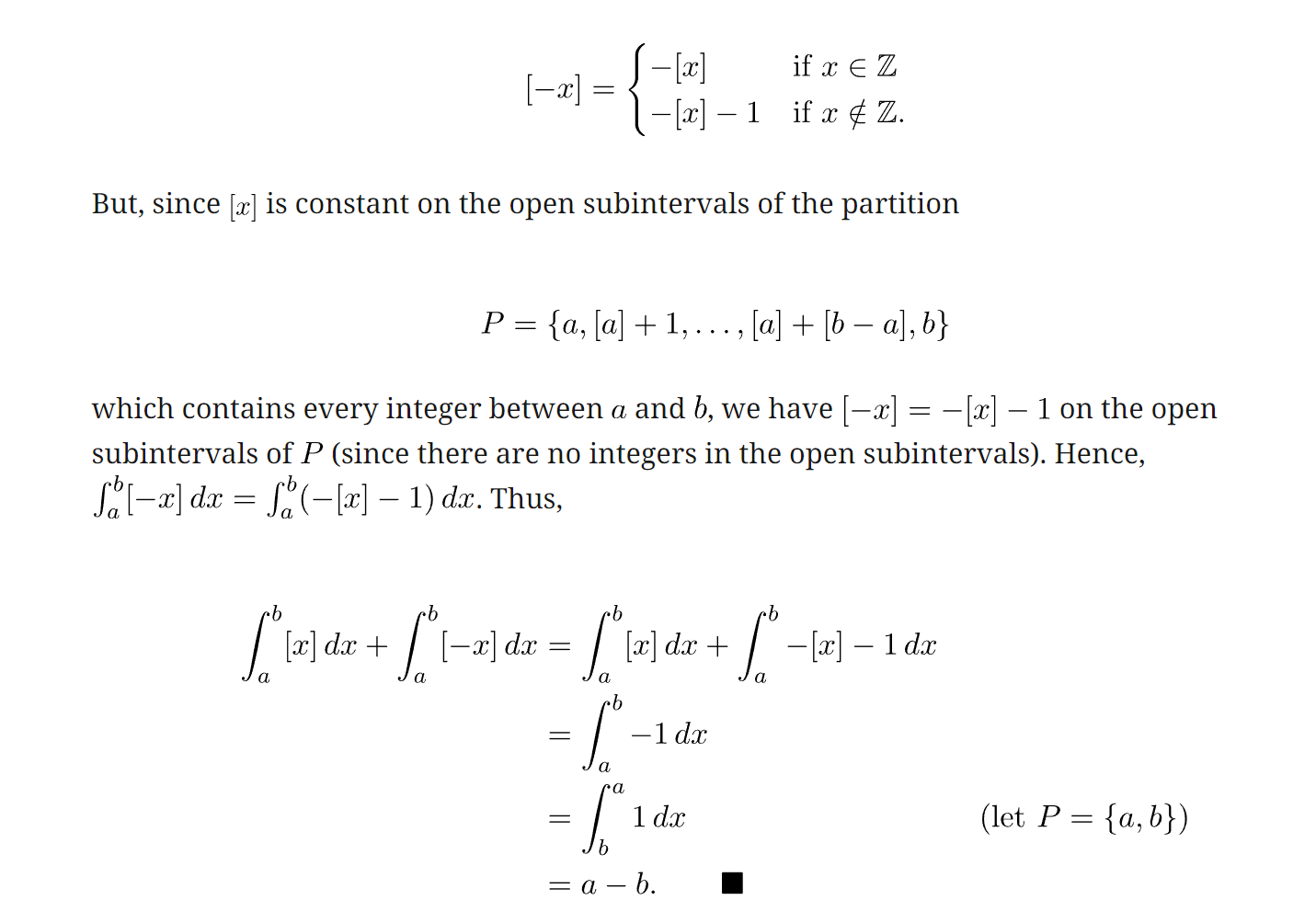
but I'm not sure what it means by open subinterval
lone heartBOT
@royal kiln Has your question been resolved?
royal kiln
.close
lone heartBOT
Channel closed
Closed by @royal kiln
Use .reopen if this was a mistake.
Available help channel!
Send your question here to claim the channel.
Remember:
• Ask your math question in a clear, concise manner.
• Show your work, and if possible, explain where you are stuck.
• After 15 minutes, feel free to ping <@&286206848099549185>.
• Type the command .close to free the channel when you're done.
• Be polite and have a nice day!
Read #❓how-to-get-help for further information on how to ask a good question, and about conduct in the question channels.
 stiff hare
Hello hi I’m sure this is a silly question but how do I get a to turn into b
 lone heartBOT
stiff hare
Hello hi I’m sure this is a silly question but how do I get a to turn into b
stiff hare
lone heartBOT
stiff hare
Hello hi I’m sure this is a silly question but how do I get a to turn into b
stiff hare
I know that they do (and that a definitely needs to be simplified)
But I’m struggling to actually understand how .. to get it to work 
Or even if b is wrong, i just need help finding how to go about simplifying a
 modern skiff
first apply the square to both the numerator and denominator of the whole denominator
$1/(x+2)^2/(3^2) - 4$
ocean sealBOT
スウェリー
 stiff hare
 modern skiff
stiff hare
Or even if b is wrong, i just need help finding how to go about simplifying a
modern skiff
stiff hare
Or even if b is wrong, i just need help finding how to go about simplifying a
u can get a to b
modern skiff
stiff hare
yeah
stiff hare
I’m sure it’s super simple and that I’ve learned it before I just can’t remember 
 nocturne vapor
stiff hare
Hello hi I’m sure this is a silly question but how do I get a to turn into b
nocturne vapor
stiff hare
Hello hi I’m sure this is a silly question but how do I get a to turn into b
(z/y) = (1/y) times z
modern skiff
now there's a thing that denominator of denominator becomes numerator
nocturne vapor
when z is divided by y, it is the same as z being multiplied by the reciprocal of y
stiff hare
modern skiff
now there's a thing that denominator of denominator becomes numerator
Oooh is that so
nocturne vapor
stiff hare
There isn’t a z ..
im expressing the concept in variables
stiff hare
I gotta write that down ty
modern skiff
stiff hare
Oooh is that so
yeah it's derived from here
stiff hare
nocturne vapor
im expressing the concept in variables
Ooh that makes sense too mb
Ty guys sorry abt that
nocturne vapor
 modern skiff
$x/y/z= x/y * z/1$
ocean sealBOT
スウェリー
 nocturne vapor
stiff hare
Ooh that makes sense too mb
nocturne vapor
stiff hare
Ooh that makes sense too mb
it's alr
stiff hare
.close
lone heartBOT
Channel closed
Closed by @stiff hare
Use .reopen if this was a mistake.
Available help channel!
Send your question here to claim the channel.
Remember:
• Ask your math question in a clear, concise manner.
• Show your work, and if possible, explain where you are stuck.
• After 15 minutes, feel free to ping <@&286206848099549185>.
• Type the command .close to free the channel when you're done.
• Be polite and have a nice day!
Read #❓how-to-get-help for further information on how to ask a good question, and about conduct in the question channels.
 cunning comet
is the asnwer a or c, i set x to 0 and solved and got c but im not sure
 lone heartBOT
cunning comet
is the asnwer a or c, i set x to 0 and solved and got c but im not sure
lone heartBOT
cunning comet
is the asnwer a or c, i set x to 0 and solved and got c but im not sure
 modern skiff
 scenic sequoia
you can find x by this- the opposite angles are equal in a parallelogram
 ruby current
scenic sequoia
can anyone help
ruby current
scenic sequoia
can anyone help
!occupied
lone heartBOT
scenic sequoia
can anyone help
Someone else is already using this help channel. If you need help with a question, please open your own help channel/thread (see #❓how-to-get-help for instructions).
 plush glade
Yep
scenic sequoia
modern skiff
you can find x by this- the opposite angles are equal in a parallelogram
yup just trying to find y and z
plush glade
scenic sequoia
yup just trying to find y and z
Bro use another help channel
modern skiff
ask in another channel I'll help you
plush glade
Someone's using this rn
ruby current
cunning comet
is the asnwer a or c, i set x to 0 and solved and got c but im not sure
you can start by finding the roots, what are they?
lone heartBOT
@cunning comet Has your question been resolved?
cunning comet
ruby current
you can start by finding the roots, what are they?
1,4 and -2
ruby current
cunning comet
1,4 and -2
so now, using the fact that the sign of a polynomial does not change in between two roots, you simply need to test out a value in each interval
lone heartBOT
Channel closed
Closed due to timeout
Use .reopen if this was a mistake.
ruby current
.reopen
lone heartBOT
✅
cunning comet
ruby current
so now, using the fact that the sign of a polynomial does not change in between ...
oh so its d
ruby current
yes
cunning comet
-2<x<1, x>4
ocean sealBOT


 Requested by tusharmurali
lone heartBOT
Requested by tusharmurali
lone heartBOT
@cunning comet Has your question been resolved?
Channel closed
Closed by @cunning comet
Use .reopen if this was a mistake.
Available help channel!
Send your question here to claim the channel.
Remember:
• Ask your math question in a clear, concise manner.
• Show your work, and if possible, explain where you are stuck.
• After 15 minutes, feel free to ping <@&286206848099549185>.
• Type the command .close to free the channel when you're done.
• Be polite and have a nice day!
Read #❓how-to-get-help for further information on how to ask a good question, and about conduct in the question channels.
 sonic hull
check pls
 lone heartBOT
sonic hull
check pls
lone heartBOT
sonic hull
check pls
 ocean whale
sonic hull
check pls
ocean whale
sonic hull
check pls
No not correct
This step, where you multiplied by 2 on both sides, to remove that fraction, it was suppose to be applied to all of the terms on the left hand side
 ocean whale
The overall answer is wrong because you messed up there
sonic hull
do i multiple the entire thing by 2 or just the left side by 2?
ocean whale
You multiply both sides by 2
sonic hull
okay thanks
ocean whale
You applied the logic correctly, you just didn't apply it to all the terms on the left
ocean whale
Looks good now
lone heartBOT
Channel closed
Closed by @sonic hull
Use .reopen if this was a mistake.
Available help channel!
Send your question here to claim the channel.
Remember:
• Ask your math question in a clear, concise manner.
• Show your work, and if possible, explain where you are stuck.
• After 15 minutes, feel free to ping <@&286206848099549185>.
• Type the command .close to free the channel when you're done.
• Be polite and have a nice day!
Read #❓how-to-get-help for further information on how to ask a good question, and about conduct in the question channels.
 stoic cloud
 lone heartBOT
stoic cloud
stoic cloud
lone heartBOT
stoic cloud
stoic cloud
Why when deriving with respect to t the F is derived?
 rustic coral
Firstly, it's "differentiate", not "derive" ("derive" refers to when you come up with a result)
Anyway, they're doing implicit differentiation
stoic cloud
rustic coral
Anyway, they're doing implicit differentiation
I get the point of inflection is found with the second derivative and that the greatest rate is found at the POI but why in the first equations it has limits of 100 and 500?
Because isnt a logistics differential equation
 rustic coral
imma be honest idk about this logistic diff eq stuff
just note that rate of change is F'
to maximize that, we need to take the derivative of F' and set it = 0
stoic cloud
Alright
rustic coral
which is how you get F'' = 0
stoic cloud
.close
lone heartBOT
Channel closed
Closed by @stoic cloud
Use .reopen if this was a mistake.
Available help channel!
Send your question here to claim the channel.
Remember:
• Ask your math question in a clear, concise manner.
• Show your work, and if possible, explain where you are stuck.
• After 15 minutes, feel free to ping <@&286206848099549185>.
• Type the command .close to free the channel when you're done.
• Be polite and have a nice day!
Read #❓how-to-get-help for further information on how to ask a good question, and about conduct in the question channels.
 tulip oasis
 lone heartBOT
tulip oasis
tulip oasis
lone heartBOT
tulip oasis
tulip oasis
Am i allowed to multiply both
i am rusty in algebra
15 x 75
then cube root of 1125?
 naive valley
yes
tulip oasis
wow i am not allowed to use calculator too _-
prob will be either like 9 10 or 11 or smth
naive valley
on the order of 10.4, but i assume you can just leave it as cube root of 1125
tulip oasis
o
naive valley
or maybe factor out any perfect cubes
lone heartBOT
Channel closed
Closed by @tulip oasis
Use .reopen if this was a mistake.
Available help channel!
Send your question here to claim the channel.
Remember:
• Ask your math question in a clear, concise manner.
• Show your work, and if possible, explain where you are stuck.
• After 15 minutes, feel free to ping <@&286206848099549185>.
• Type the command .close to free the channel when you're done.
• Be polite and have a nice day!
Read #❓how-to-get-help for further information on how to ask a good question, and about conduct in the question channels.
 stark bolt
just a quick clarifier, if on a cubic function, the a value is greater than 1 then the graph becomes thinner right, but if its less than one, it becomes wider, but if the B value is greater than one it becomes thicker and if the B value is less than 1 it becomes thinner
lone heartBOT
stark bolt
just a quick clarifier, if on a cubic function, the a value is greater than 1 th...
lone heartBOT
Channel closed
Closed by @stark bolt
Use .reopen if this was a mistake.
Available help channel!
Send your question here to claim the channel.
Remember:
• Ask your math question in a clear, concise manner.
• Show your work, and if possible, explain where you are stuck.
• After 15 minutes, feel free to ping <@&286206848099549185>.
• Type the command .close to free the channel when you're done.
• Be polite and have a nice day!
Read #❓how-to-get-help for further information on how to ask a good question, and about conduct in the question channels.
 mint kindle
The question is asking, "Is ∀x∃y∃z(y ≠ z → P (x, y) ∧ P (x, z)) true or false?" where the domain of x, y, and z is all people (and there's the assumption that no one is considered to be friends with themselves). I converted this to "∀x∃y∃z(y = z ∨ (P (x, y)∧ P (x, z))).
P (x, y) ∧ P (x, z) wouldn't hold for all values of x since some people don't have friends.
But would y = z ever be true? Because on the one hand you could translate as, "there exists two people that are the same person", which is obviously false. But would it be more correct to say, "there exists a selction of two people where the same person got selected twice?"
lone heartBOT
mint kindle
The question is asking, "Is ∀x∃y∃z(y ≠ z → P (x, y) ∧ P (x, z)) true or false?" ...
mint kindle
oh sorry I forgot to mention that P(x, y) = x is friends with y
I think this is more of a semantics question then a help question so I'll ask in #proofs-and-logic
.close
lone heartBOT
Channel closed
Closed by @mint kindle
Use .reopen if this was a mistake.
Available help channel!
Send your question here to claim the channel.
Remember:
• Ask your math question in a clear, concise manner.
• Show your work, and if possible, explain where you are stuck.
• After 15 minutes, feel free to ping <@&286206848099549185>.
• Type the command .close to free the channel when you're done.
• Be polite and have a nice day!
Read #❓how-to-get-help for further information on how to ask a good question, and about conduct in the question channels.
alpine sable
How do you find the y-value of a removable discontinuity in a rational function?
lone heartBOT
alpine sable
How do you find the y-value of a removable discontinuity in a rational function?
 buoyant saddle
so it’s not a piece wise function?
 tardy stag
alpine sable
How do you find the y-value of a removable discontinuity in a rational function?
tardy stag
alpine sable
How do you find the y-value of a removable discontinuity in a rational function?
emove the discontinuity
alpine sable
tardy stag
emove the discontinuity
how does that help?
tardy stag
like
alpine sable
Removing the discontinuity doesn't correlate with getting the y-value at all though
tardy stag
if you have $\frac{(x+1)(x-1)}{x-1}$
ocean sealBOT
ヘイリー
 tardy stag
you have a removable discont at x=1, so if you cancel the yeah
alpine sable
tardy stag
you have a removable discont at x=1, so if you cancel the yeah
Thats getting the x value of the hole, i'm looking for the y.
buoyant saddle
this is what the limit approaches
tardy stag
$\frac{(x+1)\cancel{(x-1)}}{\cancel{x-1}} = x+1$
ocean sealBOT
ヘイリー
 buoyant saddle
it really isn’t defined at the point for a reason because it’s a discontinuity
but u can find what the limit approaches this way
alpine sable
buoyant saddle
it really isn’t defined at the point for a reason because it’s a discontinuity
Would I just put it along where it falls on the line?
and give it an estimate?
buoyant saddle
alpine sable
Would I just put it along where it falls on the line?
it isn’t defined there tho
it’s an open circle
alpine sable
yeah, but the open circle has to fall on the line right?
ruby current
alpine sable
How do you find the y-value of a removable discontinuity in a rational function?
cancel all common factors of (x-a) from the numerator and denominator and substitute x = a
buoyant saddle
there technically is no y value at that point unless there’s some sort of piece wise functuon which defines the function at the point of discontinuity
lone heartBOT
Channel closed
Closed by @obsidian gust
Use .reopen if this was a mistake.
Available help channel!
Send your question here to claim the channel.
Remember:
• Ask your math question in a clear, concise manner.
• Show your work, and if possible, explain where you are stuck.
• After 15 minutes, feel free to ping <@&286206848099549185>.
• Type the command .close to free the channel when you're done.
• Be polite and have a nice day!
Read #❓how-to-get-help for further information on how to ask a good question, and about conduct in the question channels.
 winged rover
 lone heartBOT
winged rover
winged rover
lone heartBOT
winged rover
winged rover
In stuck on 1
Im*
Finding a function that is dne for fx is the easy part
But for f(x)^2 is the hard part
<@&286206848099549185>
 abstract pivot
-
An example of such a function could be ( f(x) = \frac{x^2}{x^2+1} ). The limit as ( x ) approaches infinity exists, but the limit as ( x ) approaches 2 does not.
-
The information provided is incomplete. Please clarify the functions ( f(x) ) and ( g(x) ) to proceed with finding the limits.
-
To find the values of ( a ) and ( b ) such that ( \lim_{{x \to c}} f(x) ) exists for all ( c \in \mathbb{R} ), additional information is needed about the functions ( f(x) ) and ( g(x) ). Please provide more details or clarify your question.
XD
winged rover
Was this gpt?
winged rover
xd
tardy stag
buoyant saddle
maybe a square root function
something like that yeah
winged rover
Gpt sucks for math anyway
buoyant saddle
winged rover
Gpt sucks for math anyway
true
winged rover
tardy stag
something like that yeah
Im thinking about this rn
tardy stag
you want the square to like patch the function back together again
abstract pivot
does not exist
winged rover
winged rover
√(x-3)
This is wrong?
abstract pivot
even more gpt chat is for noop
winged rover
tardy stag
you want the square to like patch the function back together again
I cant seem to think of anything
tardy stag
absolutely nothing?
tardy stag
use the fact that negative squared and positive squared are both positive
abstract pivot
and I have a question, is this server not illegal?
winged rover
tardy stag
use the fact that negative squared and positive squared are both positive
So x-5
This works?
tardy stag
winged rover
So x-5
i would just do a piecewise function that jumps to negative above x = 3
winged rover
So
As x approach from the left it can be like x^2 and the x from the right x-7 ?
@tardy stag
tardy stag
so it approaches 9 from the right and -4 from the left? doesn't seem to help
tardy stag
it's positive but like
now you've got one side limit going to 16 and one side going to 81
so they don't match
tardy stag
buoyant saddle
yo
you can/should tag Moderators for things like that
tardy stag
buoyant saddle
because ur in chat
i'm bouncing around a lot and am in danger of falling asleep
winged rover
What happened
tardy stag
winged rover
What happened
some idiot posted slurs
buoyant saddle
tardy stag
i'm bouncing around a lot and am in danger of falling asleep
i just didn’t want to ping u if u were in chat already and handling it
winged rover
Idkk im mental boomed rn
Would that be discontinuous
And then its dne
@tardy stag
tardy stag
i think of squaring as like swinging the bottom half of the plane up to meet the top half
winged rover
tardy stag
i think of squaring as like swinging the bottom half of the plane up to meet the...

tardy stag
 winged rover
Hoe would you write the function out
tardy stag
those black shapes can really be anything
winged rover
Does f(x) =-2 work
tardy stag
sure
tardy stag
oh just like on its own? well no i mean f(x) = -2 has a limit at x=3

 winged rover
{x = 2, x> 3
fx { x = -2, x<3
winged rover
tardy stag
it's a piecewise function
That?
winged rover
tardy stag
and then what's f(x)^2?
4 = 4
winged rover
tardy stag
ok and does that have a limit at x=3?
No?
Since both left and right are not equal
tardy stag
what about f(x)^2?
lone heartBOT
@winged rover Has your question been resolved?
winged rover
Yes
lone heartBOT
Channel closed
Closed by @winged rover
Use .reopen if this was a mistake.
Available help channel!
Send your question here to claim the channel.
Remember:
• Ask your math question in a clear, concise manner.
• Show your work, and if possible, explain where you are stuck.
• After 15 minutes, feel free to ping <@&286206848099549185>.
• Type the command .close to free the channel when you're done.
• Be polite and have a nice day!
Read #❓how-to-get-help for further information on how to ask a good question, and about conduct in the question channels.
 cinder agate
 lone heartBOT
cinder agate
cinder agate
lone heartBOT
cinder agate
cinder agate
what is the answer for this ?
the main relation or should i remove the loops ( reflexivity ) and transitive
<@&286206848099549185>
lone heartBOT
@cinder agate Has your question been resolved?
cinder agate
.close
lone heartBOT
Channel closed
Closed by @cinder agate
Use .reopen if this was a mistake.
Available help channel!
Send your question here to claim the channel.
Remember:
• Ask your math question in a clear, concise manner.
• Show your work, and if possible, explain where you are stuck.
• After 15 minutes, feel free to ping <@&286206848099549185>.
• Type the command .close to free the channel when you're done.
• Be polite and have a nice day!
Read #❓how-to-get-help for further information on how to ask a good question, and about conduct in the question channels.
 queen lagoon
If rps 3000 amount to rps 4320 at compund intrest in a certain time , then rps 3000 amount to what in half of time?
lone heartBOT
queen lagoon
If rps 3000 amount to rps 4320 at compund intrest in a certain time , then rps 3...
 viral wasp
when calculating area under graph with integral under two functions intersectinfg, and f(x) is greater than g(x), do you do f - g or g - f?
buoyant saddle
viral wasp
when calculating area under graph with integral under two functions intersectinf...
!occupied
lone heartBOT
viral wasp
when calculating area under graph with integral under two functions intersectinf...
Someone else is already using this help channel. If you need help with a question, please open your own help channel/thread (see #❓how-to-get-help for instructions).
buoyant saddle
viral wasp
when calculating area under graph with integral under two functions intersectinf...
but it’s f-g
queen lagoon
<@&286206848099549185>
 vapid shuttle
queen lagoon
<@&286206848099549185>
vapid shuttle
queen lagoon
<@&286206848099549185>
!15mins
lone heartBOT
queen lagoon
<@&286206848099549185>
Please only use the <@&286206848099549185> ping once if your question has not been answered for 15 minutes. Please do not ping or DM individual users about your question.
queen lagoon
What's the point
I tried opening a channel once and waited for like an hour
And no one helped
 shrewd prism
what is rps
 tacit arch
queen lagoon
I tried opening a channel once and waited for like an hour
tacit arch
queen lagoon
I tried opening a channel once and waited for like an hour
!volunteers
lone heartBOT
queen lagoon
I tried opening a channel once and waited for like an hour
Helpers are just people volunteering their time to help you. Be polite and patient.
queen lagoon
shrewd prism
what is rps
Rupees
lone heartBOT
@queen lagoon Has your question been resolved?
queen lagoon
<@&286206848099549185>
shrewd prism
queen lagoon
If rps 3000 amount to rps 4320 at compund intrest in a certain time , then rps 3...
oh
well i guess if you phrase it differently
if I compound 1 by 100% every day
1*2^n where n is the amount of days
so if we had half the days
1*2^(n/2)
so in half time, it increased sqrt(x) relative to the increase in normal time which is x
so 3000*x=4320
x = 4320/3000
but since we compound in half of the time, it's square rooted
x = sqrt(4320/3000)
1.2
shrewd prism
queen lagoon
If rps 3000 amount to rps 4320 at compund intrest in a certain time , then rps 3...
it amounts to 3600 i guess
lone heartBOT
Channel closed
Closed by @queen lagoon
Use .reopen if this was a mistake.
Available help channel!
Send your question here to claim the channel.
Remember:
• Ask your math question in a clear, concise manner.
• Show your work, and if possible, explain where you are stuck.
• After 15 minutes, feel free to ping <@&286206848099549185>.
• Type the command .close to free the channel when you're done.
• Be polite and have a nice day!
Read #❓how-to-get-help for further information on how to ask a good question, and about conduct in the question channels.
 stable grotto
 lone heartBOT
stable grotto
lone heartBOT
stable grotto

 mortal trellis
in the next line where it says eps->0 for deltax->0
its generally a good idea for zero to be in the domain of your function if you wanna say stuff like that
stable grotto
mortal trellis
in the next line where it says eps->0 for deltax->0
there is no need for a function to have value on a point where we are calculating its limit
stable grotto
mortal trellis
in the next line where it says eps->0 for deltax->0
limit of epailon will be 0, the way it is defined, even if it has no value in 0
mortal trellis
well yes but its nicer that way
mortal trellis
like for example in the last line you can just plug deltax=0 in. just slightly more convenient to do
you can capture the behaviour of eps->0 when deltax->0 just by saying that eps is a continuous function of deltax and that eps(0)=0
stable grotto
mortal trellis
like for example in the last line you can just plug deltax=0 in. just slightly m...
i do not know which line , but i can argue that in mathematical proofs, the information is used is always minimal
mortal trellis
no
stable grotto
mortal trellis
no
so lets see
 rain holly
stable grotto
i do not know which line , but i can argue that in mathematical proofs, the info...
rain holly
stable grotto
i do not know which line , but i can argue that in mathematical proofs, the info...
you can use a different method to proove too
prove
stable grotto
if i do not define eps(0)=0 , I will still be able to proof right ??
stable grotto
rain holly
you can use a different method to proove too
i know but i am interested in thin proof
mortal trellis
proofs should not be written with as few details as possible
like sure, dont make a novel out of it
but dont act like this single sentence suddenly makes the proof unreadable
to me it adds to the proof
stable grotto
stable grotto
if i do not define eps(0)=0 , I will still be able to proof right ??
are you agree on this?
mortal trellis
it gives more information about what is going on
stable grotto
stable grotto
are you agree on this?
@mortal trellis
stable grotto
so it is not needed
mortal trellis
just in the prequel
stable grotto
stable grotto
so it is not needed
but i believe there is need for eps(0)=0 in this proof. and i say this because i saw similar proof in wikipedia and there also esp(0) was defined to be equal to 0 . So it is urgent i think
mortal trellis
well its a difference of whether you can just plug in deltax=0 in the limits later or if you actually have to consider the limits
either work
I would argue the first one is nicer
but lets not act like its a big difference
stable grotto
mortal trellis
but lets not act like its a big difference
i belive it is ablsolutle necessary to include eps(0)=0 in this proof. and also believe there is nothing extra in math proofs, definitions
mortal trellis
so you started this thinking it was not necessary and now it is necessary. why
also like I said before, its not even in the proof itself. its before that. when you are rewriting what it means to have a derivative
its just generally nice to be able to quickly say that you can have some continuous function eps like that
and of course doesnt hurt that the equation is then also still true for deltax=0, instead of being undefined
stable grotto
stable grotto
where in this proof is that necessary that epsilon(0)=0 ?
@mortal trellis i did not said that it is not necessary,i said where it is necessary
mortal trellis
stable grotto
i belive it is ablsolutle necessary to include eps(0)=0 in this proof. and also ...
literally in the line above mine
stable grotto
mortal trellis
and of course doesnt hurt that the equation is then also still true for deltax=...
and i see your opinion about math proofs, that you can include "nice things" in them, which i do not agree. idk you can proof me wrong if you can show me some simple example where extra, not necessary things are included in
stable grotto
mortal trellis
literally in the line above mine
yes i always thought it was necessary
mortal trellis
I dont have an example right now. I am not saying to include more information just for the sake of including more. but especially later proofs get much more complicated. and it can help tremendously to write more instead of less. so that people can understand the proofs better
proof writing is not only about being correct, its also about being understood
stable grotto
I understand well your opinion. tnx for your time
lone heartBOT
@stable grotto Has your question been resolved?
lone heartBOT
Channel closed
Closed due to timeout
Use .reopen if this was a mistake.
Available help channel!
Send your question here to claim the channel.
Remember:
• Ask your math question in a clear, concise manner.
• Show your work, and if possible, explain where you are stuck.
• After 15 minutes, feel free to ping <@&286206848099549185>.
• Type the command .close to free the channel when you're done.
• Be polite and have a nice day!
Read #❓how-to-get-help for further information on how to ask a good question, and about conduct in the question channels.
 unkempt jasper
Hey! I want to prove that if you have E, a measurable subset of R^d with finite measure, you can always find F, a finite union of dyadic cubes, such that the symmetric difference between F and E has measure less than an arbitrarily small epsilon
lone heartBOT
unkempt jasper
Hey! I want to prove that if you have E, a measurable subset of R^d with finite ...
unkempt jasper
The gist of it should be that you can cover any open set with a countable union of dyadic cubes
And that for every arbitrarily small epsilon E is a subset of an open O such that the measure of their difference is less than epsilon
So you begin to cover O in dyadic cubes until the measure of O minus their union is small enough, after that you can stop
But I have to show that such a point eventually comes
unkempt jasper
Yeah in R^d it's a d-dimensional cube with side length 2^-n (n natural) and with the coordinates of each vertex being an integer multiple of 2^-n
lone heartBOT
@unkempt jasper Has your question been resolved?
unkempt jasper
In the end the solution is that you take the infinite series of the measures of the cubes making up O and truncate it arbitrarily close to the true measure of O
So yes
lone heartBOT
Channel closed
Closed by @unkempt jasper
Use .reopen if this was a mistake.
Available help channel!
Send your question here to claim the channel.
Remember:
• Ask your math question in a clear, concise manner.
• Show your work, and if possible, explain where you are stuck.
• After 15 minutes, feel free to ping <@&286206848099549185>.
• Type the command .close to free the channel when you're done.
• Be polite and have a nice day!
Read #❓how-to-get-help for further information on how to ask a good question, and about conduct in the question channels.
 void sedge
I have the function $g: \mathbb{Z} \to \mathbb{N}$ that satisfies the relation $g(x) = x^2$. I have to show if it is injective or not. So I took two elements from the codomain and ended up showing that $x = y$ or $x = - y$. Why is it the case that this is not an injection?
lone heartBOT
void sedge
I have the function $g: \mathbb{Z} \to \mathbb{N}$ that satisfies the relation ...
ocean sealBOT
Forsaken
 alpine sable
because for injective function f(x)=f(y) => x=y
void sedge
Okay but why is it a problem for a function to have two separate outputs. It can either be f(x) = f(y) => x=y or x=-y
 upper vector
If f(x) = f(y) and x is not y then it's not an injection per definition
alpine sable
void sedge
Okay but why is it a problem for a function to have two separate outputs. It can...
it’s not a problem for function but it violates definition of injective function
void sedge
Yes but it isn't x=y and x=-y
That doens't make much sense
But what I am trying to say is that it has only one possible output, not both at the same time
I understand your reasoning but something just doesn't sit right with me
It makes sense I guess
Thanks
.close
lone heartBOT
Channel closed
Closed by @void sedge
Use .reopen if this was a mistake.
Available help channel!
Send your question here to claim the channel.
Remember:
• Ask your math question in a clear, concise manner.
• Show your work, and if possible, explain where you are stuck.
• After 15 minutes, feel free to ping <@&286206848099549185>.
• Type the command .close to free the channel when you're done.
• Be polite and have a nice day!
Read #❓how-to-get-help for further information on how to ask a good question, and about conduct in the question channels.
 lapis valley
what do these statement mean?
 lone heartBOT
lapis valley
what do these statement mean?
lone heartBOT
lapis valley
what do these statement mean?
 golden canyon
The first one is the intersection of all closed supersets of A and the second one is the union of all open subsets of A
the 'closed' and 'open' mean that F and G are closed and open respectively
lone heartBOT
@lapis valley Has your question been resolved?
lone heartBOT
Channel closed
Closed due to timeout
Use .reopen if this was a mistake.
Available help channel!
Send your question here to claim the channel.
Remember:
• Ask your math question in a clear, concise manner.
• Show your work, and if possible, explain where you are stuck.
• After 15 minutes, feel free to ping <@&286206848099549185>.
• Type the command .close to free the channel when you're done.
• Be polite and have a nice day!
Read #❓how-to-get-help for further information on how to ask a good question, and about conduct in the question channels.
 regal orchid
I hope everything is translated correctly!
Hi there, i am struggling with a problem in math, it goes like this.:
"Derivation of a formula for optimizing the gutter using differential calculus to minimize material usage.
Explain why, mathematically, it is sufficient to consider the cross-sectional profile when the gutter is a three-dimensional object.
This picture also comes along with it.
Information: "The profile of a gutter should be dimensioned as shown in the picture. The gutter needs to accommodate a given maximum amount of water. Distances EF and DC are constant. y and x are variables. Segment AB forms a semicircle, where x represents the diameter of the circle."
 lone heartBOT
regal orchid
I hope everything is translated correctly!
Hi there, i am struggling with a pr...
regal orchid
lone heartBOT
regal orchid
I hope everything is translated correctly!
Hi there, i am struggling with a pr...
regal orchid
<@&286206848099549185>
lone heartBOT
@regal orchid Has your question been resolved?
regal orchid
I just need help with the formular for optimizing the gutter using differential calculus to minimize matrial usage-
lone heartBOT
@regal orchid Has your question been resolved?
regal orchid
.close
lone heartBOT
Channel closed
Closed by @regal orchid
Use .reopen if this was a mistake.
Available help channel!
Send your question here to claim the channel.
Remember:
• Ask your math question in a clear, concise manner.
• Show your work, and if possible, explain where you are stuck.
• After 15 minutes, feel free to ping <@&286206848099549185>.
• Type the command .close to free the channel when you're done.
• Be polite and have a nice day!
Read #❓how-to-get-help for further information on how to ask a good question, and about conduct in the question channels.
 fallow wadi
given a_n = 2n - 1
lone heartBOT
fallow wadi
given a_n = 2n - 1
fallow wadi
is b_n = 2^n - 1 selected sequence from a_n?
i think yes
Let ((a_n){n \in \mathbb{N}}) be an arbitrary sequence and let ((k_n){n \in \mathbb{N}}) be a strictly increasing sequence of natural numbers. Then the sequence ((a_{k_n}){n \in \mathbb{N}}) is called a subsequence selected from the sequence ((a_n){n \in \mathbb{N}}).
ocean sealBOT
Fate

 thorny patio
It is a sub sequence but i couldnt prove it
2n - 1 would give you all odd natural numbers
2^n - 1 would include, in the same order of appearance as a_n, a sequence of some odd natural numbers
fallow wadi
well you can prove it
@thorny patio the definition of vthis is basically combining functions together
(a ◦ k)(n) = a(k(n)) = a_kn
u see
(a ◦ k)(n) = a(k(n)) = a(n^2) = 2n^2 - 1
is it correct?
thorny patio
Unfortunately the most i can offer for sure is that it is a subsequence I'll defer to someone else for the rest
lone heartBOT
@fallow wadi Has your question been resolved?
lone heartBOT
Channel closed
Closed due to timeout
Use .reopen if this was a mistake.
Available help channel!
Send your question here to claim the channel.
Remember:
• Ask your math question in a clear, concise manner.
• Show your work, and if possible, explain where you are stuck.
• After 15 minutes, feel free to ping <@&286206848099549185>.
• Type the command .close to free the channel when you're done.
• Be polite and have a nice day!
Read #❓how-to-get-help for further information on how to ask a good question, and about conduct in the question channels.
 somber jungle
The line 2x-3y+4=0 intersects the parabola γ² = 4x at points A and B. Show that the perpendiculars of the parabola at A and B intersect on the parabola. so i found points A and B and im thinking i need to find the tangents on A and B then the perpendicular tangents and pluck them on the equation of the parabola to see if they equal but i dont know how to find the tangents since i only have one point
lone heartBOT
somber jungle
The line 2x-3y+4=0 intersects the parabola γ² = 4x at points A and B. Show that ...
 rare gale
can you use derivatives or is this a before calculus class?
rare gale
huh?
somber jungle
i can find the tangents
i dont need two points
i can differentiate the equation of the parabola
rare gale
yes
somber jungle
i think i can solve it now thanks haha
rare gale
ok 👍
lone heartBOT
@somber jungle Has your question been resolved?
lone heartBOT
Channel closed
Closed due to timeout
Use .reopen if this was a mistake.
Available help channel!
Send your question here to claim the channel.
Remember:
• Ask your math question in a clear, concise manner.
• Show your work, and if possible, explain where you are stuck.
• After 15 minutes, feel free to ping <@&286206848099549185>.
• Type the command .close to free the channel when you're done.
• Be polite and have a nice day!
Read #❓how-to-get-help for further information on how to ask a good question, and about conduct in the question channels.
 green sandal
 lone heartBOT
green sandal
lone heartBOT
green sandal
 olive yarrow
hint $\sin(2x)=2\sin(x)\cos(x)$
ocean sealBOT
The Great D
 olive yarrow
yes perfect
green sandal
.close
lone heartBOT
Channel closed
Closed by @green sandal
Use .reopen if this was a mistake.
Available help channel!
Send your question here to claim the channel.
Remember:
• Ask your math question in a clear, concise manner.
• Show your work, and if possible, explain where you are stuck.
• After 15 minutes, feel free to ping <@&286206848099549185>.
• Type the command .close to free the channel when you're done.
• Be polite and have a nice day!
Read #❓how-to-get-help for further information on how to ask a good question, and about conduct in the question channels.
Channel closed
Channel closed due to the original message being deleted.
If you did not intend to do this, please open a new help channel,
as this action is irreversible, and this channel may abruptly lock.
pallid scarab
based on experiments
and because we need to make it homogeneous
Why would there not be an r^2 is my question to you?
tardy stag
it was closed earlier when you deleted your first message
 strange zenith
griffith
lone heartBOT
Available help channel!
Send your question here to claim the channel.
Remember:
• Ask your math question in a clear, concise manner.
• Show your work, and if possible, explain where you are stuck.
• After 15 minutes, feel free to ping <@&286206848099549185>.
• Type the command .close to free the channel when you're done.
• Be polite and have a nice day!
Read #❓how-to-get-help for further information on how to ask a good question, and about conduct in the question channels.
 inland harness
 lone heartBOT
inland harness
tardy stag
lone heartBOT
inland harness
tardy stag
please stop pinging helpers, once is enough and you should wait a while anyway
inland harness
myb
tardy stag
in the meantime,
- try some things on your own and explain what you've tried
- clean up your handwriting and stray pencil marks
- draw a diagram
inland harness
ok
lone heartBOT
@inland harness Has your question been resolved?
lone heartBOT
Channel closed
Closed due to timeout
Use .reopen if this was a mistake.
Available help channel!
Send your question here to claim the channel.
Remember:
• Ask your math question in a clear, concise manner.
• Show your work, and if possible, explain where you are stuck.
• After 15 minutes, feel free to ping <@&286206848099549185>.
• Type the command .close to free the channel when you're done.
• Be polite and have a nice day!
Read #❓how-to-get-help for further information on how to ask a good question, and about conduct in the question channels.
 modern hedge
 lone heartBOT
modern hedge
lone heartBOT
modern hedge
 undone ledge
what have you tried
modern hedge
the left side in my solution is 3/2 1/√1-(1-x^2)^2 •1 -1/2
how to do the right side
 agile grove
do u know abt the chain rule?
modern hedge
yep and i dont know how to do that when it comes that with a hard problem
agile grove
Well essentially, let me explain the chain rule to you and I don’t want you to memorize it so ima do my best to give an intuitive explanation.
Its just on essentially why we have to use the chain rule,
Would you like me to explain?
modern hedge
yes please
i think i need to find the derivative of (x+3) and √2x-x first?
to chain rule?
agile grove
Mk so the importance of the chain rule is:
lets say I have a composite function f(g(x)).
If I just do df(g(x))/g(x) = f’(g(x)) this is an issue because what its saying is the derivative is with respect to g(x) as our input. So essentially what is happening any x we plug in it would result in an output of g(x) and the output of g(x) would then be treated by the function as the input. So essentially what would happen is we would be finding a derivative relative to the output of g(x), but that doesn’t make much sense as our goal is to find the derivative for any x value we plug into the function.
This is the importance of the chain rule. We want the derivative to be wrt x as thats what we input.
So then what we would do is
d(f(g(x))/d(g(x)) * d(g(x))/dx = df(g(x))/dx
modern skiff
agile grove
do u know abt the chain rule?
why the chain rule..u could simply apply the product rule for the second term and there's a direct formula for arc sin
modern hedge
the left side in my solution is 3/2 1/√1-(1-x^2)^2 •1 -1/2
agile grove
for the second half of the equation.
modern hedge
is my left side is correct?
agile grove
it would involve the chain rule, the stuff under the sqrt.
agile grove
modern hedge
is my left side is correct?
hmm, im on phone so this is a lik hard but ima do my best.
modern hedge
 agile grove
modern hedge
the left side in my solution is 3/2 1/√1-(1-x^2)^2 •1 -1/2
agile grove
modern hedge
the left side in my solution is 3/2 1/√1-(1-x^2)^2 •1 -1/2
Part of it is incorrect.
modern hedge
it would be like this the left side
agile grove
modern hedge
yes.
good.
Now lets deal with the right side
look at what i wrote above and it should make sense. Dw if u don’t get it after reading this it did take me some time to understand it myself.
Are you familiar with Leibniz’s notation for derivative? d/dx, dy/dx, etc.
agile grove
modern hedge
Because we are differentiating make sure you say y’ or dy/dx =
modern hedge
agile grove
Are you familiar with Leibniz’s notation for derivative? d/dx, dy/dx, etc.
yes im familliar with it
agile grove
modern hedge
yes im familliar with it
alright good. Take a second and lmk If you want me to show an example.
agile grove
just thinking of making an intuitive example. Lets say I have a velocity function:
v(g(t)) = sqrt(1 + t^2)
We know g(t) = 1 + t^2
Lets say I want to find the acceleration at t = 2s.
FIRST (INCORRECT METHOD) WHAT HAPPENS IF WE DON’T USE CHAIN RULE.
dv(g(t))/d(g(t)) = (1/2) * (1+t^2)^(-1/2)
a(g(t)) = (0.5) * (1+t^2)^(-1/2)
a(g(2)) = ?
g(2) = 1 + t^2 = 1 + (2)^2 = 5
a(g(2)) = a(5) = 0.5 * (5)^(-1/2)
the problem with this is its going to tell us the acceleration at some other time than 2 seconds actually. If you want to find what time specifically just do g(2) = 1 + t^2 and solve for t and you will see that we would be finding the derivative for some random time.
CORRECT METHOD:
v(g(t)) = sqrt(1+t^2)
dv(g(t))/dt = dv(g(t))/d(g(t)) * (d(g(t))/dt)
dv(g(t))/dt = (1/2)(1 + t^2)^((-1/2) * d/dt [1 + t^2]
=> (0.5)(1+t^2)^(-1/2) * (2t)
=> t/(1+t^2)^(1/2)
a(g(2)) = 2/((5)^(1/2))
whatever a(g(2)) will give us the acceleration at 2 seconds for this derivative here.
agile grove
modern hedge
mk so what you will have to do is d/dx [ x(sqrt(2x-x^2)) + 3(sqrt(2x-x^2))]
You will have to apply the product rule.
Now just differentiating sqrt(2x - x^2) = (1/(2(sqrt(2x - x^2)))) * (2 - 2x) => (2-2x)/(2(sqrt(2x - x^2)))
Your going to have to do the upper part yourself where you apply the product rule.
Lets say we want to differentiate
d/dx [ x(sqrt(2x - x^2)) ] => f’g + fg’
Let f = x and g = sqrt(2x - x^2)
lone heartBOT
@modern hedge Has your question been resolved?
lone heartBOT
Channel closed
Closed due to timeout
Use .reopen if this was a mistake.
Available help channel!
Send your question here to claim the channel.
Remember:
• Ask your math question in a clear, concise manner.
• Show your work, and if possible, explain where you are stuck.
• After 15 minutes, feel free to ping <@&286206848099549185>.
• Type the command .close to free the channel when you're done.
• Be polite and have a nice day!
Read #❓how-to-get-help for further information on how to ask a good question, and about conduct in the question channels.
 signal geode
I have to solve this using the square root property and I'm confused where to start
 lone heartBOT
signal geode
I have to solve this using the square root property and I'm confused where to st...
alpine sable
lone heartBOT
signal geode
I have to solve this using the square root property and I'm confused where to st...
alpine sable
whats the "square root property" exactly
 lone heartBOT
@signal geode Has your question been resolved?
Channel closed
Closed by @signal geode
Use .reopen if this was a mistake.
Available help channel!
Send your question here to claim the channel.
Remember:
• Ask your math question in a clear, concise manner.
• Show your work, and if possible, explain where you are stuck.
• After 15 minutes, feel free to ping <@&286206848099549185>.
• Type the command .close to free the channel when you're done.
• Be polite and have a nice day!
Read #❓how-to-get-help for further information on how to ask a good question, and about conduct in the question channels.
 north hemlock
my understanding is that it's an extension of the notion of an arclength to 3d
so instead of an arc, we get an area
and the solid angle is like the ratio of that to the radius (squared)
similar to how an angle in 2d is the ratio of arc length to radius
what about it
spheres have 4pi uhh
i forget the name
"radians"
steradians
^ that's what I was lookin for
alr I gtg to class now, cya around
lone heartBOT
@alpine sable Has your question been resolved?
Channel closed
Closed by @brave plover
Use .reopen if this was a mistake.
lone heartBOT
Available help channel!
Send your question here to claim the channel.
Remember:
• Ask your math question in a clear, concise manner.
• Show your work, and if possible, explain where you are stuck.
• After 15 minutes, feel free to ping <@&286206848099549185>.
• Type the command .close to free the channel when you're done.
• Be polite and have a nice day!
Read #❓how-to-get-help for further information on how to ask a good question, and about conduct in the question channels.
 waxen turtle
 lone heartBOT
waxen turtle
waxen turtle
lone heartBOT
waxen turtle
waxen turtle
are there 2 real positive and 2 imaginary idk
or all imaginary
wat is the difference between a rational zero and zero
limpid turret
waxen turtle
wat is the difference between a rational zero and zero
A rational zero is a zero that can be expressed as a rational number.
I believe they want you to use the rational root theorem
waxen turtle
o


