#help-0
1 messages · Page 329 of 1
 alpine sable
 median oar
So dashed lines is like open circles
Have you seen open and closed circles on intervals?
alpine sable
no
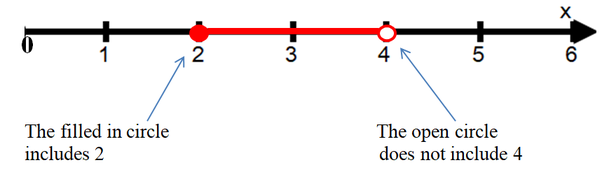 alpine sable
ohh yes i have
 gritty wave
u know the > and >= signs
alpine sable
yess
median oar
Ok dashed vs solid lines is a 2 dimensional version of the open and closed circle
Cos how can we “open” the boundary of a line
It’s hard to even think about how to draw that
So we denote it with a dashed line
alpine sable
ohh okay yk how u said the line w y=x thingy, how do we know which side of it would be shaded?
alpine sable
no
median oar
So is (6,6) coloured in
I had the inequality sign the wrong way but it’s still correct
median oar
Well do you colour in (6, 6)?
alpine sable
is it d and b??
median oar
👍
alpine sable
i was stuck on that questuion fir so longg
median oar
Sometimes it does get confusing with all the letters and pictures
 lone heartBOT
Channel closed
Closed by @wet jay
Use .reopen if this was a mistake.
 Available help channel!
Send your question here to claim the channel.
Remember:
• Ask your math question in a clear, concise manner.
• Show your work, and if possible, explain where you are stuck.
• After 15 minutes, feel free to ping <@&286206848099549185>.
• Type the command .close to free the channel when you're done.
• Be polite and have a nice day!
Read #❓how-to-get-help for further information on how to ask a good question, and about conduct in the question channels.
 zealous lichen
you can't just add them
when sinx is negative, |7sinx| becomes positive and the result is positive
it's easy after removing the absolute value btw
gritty wave
(the function will always be positive)
 weak field
gritty wave
(*the function will always be positive*)
weak field
gritty wave
(*the function will always be positive*)
*non negative
zealous lichen
yep
lone heartBOT
Channel closed
Closed by @silver pond
Use .reopen if this was a mistake.
Available help channel!
Send your question here to claim the channel.
Remember:
• Ask your math question in a clear, concise manner.
• Show your work, and if possible, explain where you are stuck.
• After 15 minutes, feel free to ping <@&286206848099549185>.
• Type the command .close to free the channel when you're done.
• Be polite and have a nice day!
Read #❓how-to-get-help for further information on how to ask a good question, and about conduct in the question channels.
 formal wraith
can someone help me with this?:
 lone heartBOT
formal wraith
can someone help me with this?:
lone heartBOT
formal wraith
can someone help me with this?:
 upbeat gorge
Think of properties of squares
formal wraith
@upbeat gorge

I've done this, I gathered the distance of one side of the square, and drawed a diagonal line from point B, with the value that the distance gave me
I don't know if this good, or I just misunderstood everything
upbeat gorge
Yeah this doesn’t look right
Not sure why your D is on the x-axis
And yeah AC isn’t right
formal wraith
I draw it there because, i just drawed a diagonal from b
upbeat gorge
The length of BC and the observation that AB is a diagonal are the only correct things there
formal wraith
Okey, but i'm going on the correct way or this is just wrong?
upbeat gorge
Here’s the thing: there’s a locus (set) of points that are distance 5 from B
Like, it’s a circle
formal wraith
mmm
So i have to do the distance formula but with x and Y as incognita?
I mean, something like:
 upbeat gorge
Yeah you can do that
Do that with both BD and AD and you have a system of equations you can solve
formal wraith
I haven't done that yet, im still in the term 1 of the book szprecalculus, and I just have seen the cartesian plane, and distance, midpoint formulas
lone heartBOT
@formal wraith Has your question been resolved?
lone heartBOT
Channel closed
Closed due to timeout
Use .reopen if this was a mistake.
Available help channel!
Send your question here to claim the channel.
Remember:
• Ask your math question in a clear, concise manner.
• Show your work, and if possible, explain where you are stuck.
• After 15 minutes, feel free to ping <@&286206848099549185>.
• Type the command .close to free the channel when you're done.
• Be polite and have a nice day!
Read #❓how-to-get-help for further information on how to ask a good question, and about conduct in the question channels.
 fast crypt
Is this wrong? According to a calculator it’s wrong but I’m not sure where it went awry
 lone heartBOT
fast crypt
Is this wrong? According to a calculator it’s wrong but I’m not sure where it we...
alpine sable
lone heartBOT
fast crypt
Is this wrong? According to a calculator it’s wrong but I’m not sure where it we...
alpine sable
shouldn't this be [
\f{2c^{-1}}{ab} \divisionsymbol \f{3ab^{-2}}{c^{-2}} = \f{2c^{-1}}{ab} \by \f{c^{-2}}{3ab^{-2}}
]

 worn fox
f
 ocean sealBOT
 alpine sable
[
\f ab \divisionsymbol \f cd = \f ab \by \f dc
]
is true. What you did meanwhile is [
\f ab \divisionsymbol \f cd = \f ab \by \f{d^{-1}}{c^{-1}}
]
ocean sealBOT
 fast crypt
im quite stumped about it
because i was taught that when a neg indice gets put on the bottom it becomes a positive
alpine sable
yes this is true. [
a^{-1} = \f 1 a \tss{and} \f1{a^{-1}} = a
]
but what you did is that you double "switched" the signs
ocean sealBOT
 fast crypt
so wait
i get what youre trying to get across
i j dont understand why it doesnt apply here
alpine sable
okay let me notate it
alpine sable
,tex \env{alignat*}{{1}
&\f{2c^{-1}}{ab} \divisionsymbol \f{3ab^{-2}}{c^{-2}} \
={}& \f{2c^{-1}}{ab} \divisionsymbol \f{3ac^2}{b^2} \tqs{(from the fact that} a^{-1} = \f 1 a \tss{and} \f1{a^{-1}} = a) \
={}& \f{2c^{-1}}{ab} \by \f{b^2}{3ac^2} \tqs{(from the fact that} \f ab \divisionsymbol \f cd = \f ab \by \f dc)
}
@fast crypt
wait I messed up sorry
ocean sealBOT
 alpine sable
okay yes this is correct
@fast crypt
take Ur time to digest this
I gtg but someone else can continue helping if u may
lone heartBOT
@fast crypt Has your question been resolved?
Channel closed
Closed by @fast crypt
Use .reopen if this was a mistake.
lone heartBOT
Available help channel!
Send your question here to claim the channel.
Remember:
• Ask your math question in a clear, concise manner.
• Show your work, and if possible, explain where you are stuck.
• After 15 minutes, feel free to ping <@&286206848099549185>.
• Type the command .close to free the channel when you're done.
• Be polite and have a nice day!
Read #❓how-to-get-help for further information on how to ask a good question, and about conduct in the question channels.
 low frigate
I've been able to understand every question up until (bii).
I figured out that the inverse function = -f(-x) of the original function.
However, when I do the translation on paper, the signs of the numerator don't match to the inverse function.
Could someone please help me with this?
 lone heartBOT
low frigate
I've been able to understand every question up until (bii).
I figured out that ...
lone heartBOT
low frigate
I've been able to understand every question up until (bii).
I figured out that ...
 astral cloud
How to get (a+b/2 ,c/2) and (b-a/2,c/2)
 zealous lichen
low frigate
I've been able to understand every question up until (bii).
I figured out that ...
zealous lichen
low frigate
I've been able to understand every question up until (bii).
I figured out that ...
show your work please
zealous lichen
astral cloud
How to get (a+b/2 ,c/2) and (b-a/2,c/2)
find anther channel
low frigate
zealous lichen
show your work please
Alright, might take a minute.
low frigate
zealous lichen
show your work please
Is this alright?
 zealous lichen
the last step wron
g
you distributed the minus sign to both numerator and denominator
low frigate
zealous lichen
you distributed the minus sign to both numerator and denominator
Was I meant to do it to just the denominator?
I don't see how else it would match the inverse function.
lone heartBOT
@low frigate Has your question been resolved?
lone heartBOT
@low frigate Has your question been resolved?
lone heartBOT
@low frigate Has your question been resolved?
lone heartBOT
Channel closed
Closed due to timeout
Use .reopen if this was a mistake.
Available help channel!
Send your question here to claim the channel.
Remember:
• Ask your math question in a clear, concise manner.
• Show your work, and if possible, explain where you are stuck.
• After 15 minutes, feel free to ping <@&286206848099549185>.
• Type the command .close to free the channel when you're done.
• Be polite and have a nice day!
Read #❓how-to-get-help for further information on how to ask a good question, and about conduct in the question channels.
 left scarab
can anyone explain this?
 lone heartBOT
left scarab
can anyone explain this?
left scarab
lone heartBOT
left scarab
can anyone explain this?
left scarab
idk how to really read it
I understand the symbols
but like is this how it's read?
"q is not q, and p will be true if q is true, therefore p is not p" ?
i do not even understand it even as i typed it
lone heartBOT
@left scarab Has your question been resolved?
lone heartBOT
Channel closed
Closed due to timeout
Use .reopen if this was a mistake.
Available help channel!
Send your question here to claim the channel.
Remember:
• Ask your math question in a clear, concise manner.
• Show your work, and if possible, explain where you are stuck.
• After 15 minutes, feel free to ping <@&286206848099549185>.
• Type the command .close to free the channel when you're done.
• Be polite and have a nice day!
Read #❓how-to-get-help for further information on how to ask a good question, and about conduct in the question channels.
 quick egret
Solving for y
 lone heartBOT
quick egret
Solving for y
quick egret
lone heartBOT
quick egret
Solving for y
quick egret
I don’t know exactly how to set it up
 fleet spire
my best guess would be cross-multiplying
quick egret
Yeah, but when I do that the answer is wrong
fleet spire
that means 3*(y+13) = 1*(16y)
quick egret
Alright
quick egret
So the answer is 1 = y
quick egret
Oh
lone heartBOT
Channel closed
Closed by @quick egret
Use .reopen if this was a mistake.
Available help channel!
Send your question here to claim the channel.
Remember:
• Ask your math question in a clear, concise manner.
• Show your work, and if possible, explain where you are stuck.
• After 15 minutes, feel free to ping <@&286206848099549185>.
• Type the command .close to free the channel when you're done.
• Be polite and have a nice day!
Read #❓how-to-get-help for further information on how to ask a good question, and about conduct in the question channels.
 thick lynx
 lone heartBOT
thick lynx
thick lynx
lone heartBOT
thick lynx
thick lynx
Find the equations of the lines, calculate their intersection and determine the areas a, b, c and d.

How would we determine the areas though?
<@&286206848099549185>
 slate bane
thick lynx
How would we determine the areas though?
slate bane
thick lynx
How would we determine the areas though?
Carefully defined integrals could do the job
thick lynx
slate bane
Carefully defined integrals could do the job
Can we do it without integrals though?
slate bane
thick lynx
Can we do it without integrals though?
cant see how so i let that to other people
thick lynx
.close
lone heartBOT
Channel closed
Closed by @thick lynx
Use .reopen if this was a mistake.
Available help channel!
Send your question here to claim the channel.
Remember:
• Ask your math question in a clear, concise manner.
• Show your work, and if possible, explain where you are stuck.
• After 15 minutes, feel free to ping <@&286206848099549185>.
• Type the command .close to free the channel when you're done.
• Be polite and have a nice day!
Read #❓how-to-get-help for further information on how to ask a good question, and about conduct in the question channels.
 serene pilot
3:6=12:24
lone heartBOT
serene pilot
3:6=12:24
serene pilot
true or false
serene pilot
im not sure
 vale wigeon
can you put both ratios in lowest terms?
serene pilot
i dont know at all
vale wigeon

Welcome to How to Simplify a Ratio with Mr. J! Need help with ratios? You're in the right place!
Whether you're just starting out, or need a quick refresher, this is the video for you if you're looking for help with how to write ratios in simplest form (aka how to write ratios in lowest terms). Mr. J will go through examples of simplifying rati...
serene pilot
so would both ratios equal 2?
vale wigeon
1 : 2
lone heartBOT
Channel closed
Closed by @serene pilot
Use .reopen if this was a mistake.
Available help channel!
Send your question here to claim the channel.
Remember:
• Ask your math question in a clear, concise manner.
• Show your work, and if possible, explain where you are stuck.
• After 15 minutes, feel free to ping <@&286206848099549185>.
• Type the command .close to free the channel when you're done.
• Be polite and have a nice day!
Read #❓how-to-get-help for further information on how to ask a good question, and about conduct in the question channels.
 warm forge
How can I simplify this further?
 lone heartBOT
warm forge
How can I simplify this further?
vale wigeon
lone heartBOT
warm forge
How can I simplify this further?
vale wigeon
can factor out (1-3x)(x^2-2)^2 by the looks of it
lone heartBOT
@warm forge Has your question been resolved?
 unkempt robin
warm forge
im not used to factoring big polynomials like this
unkempt robin
warm forge
im not used to factoring big polynomials like this
Try replacing terms with letters for a nicer visual look
Let's say
$a = (1-3x)$
ocean sealBOT
USS-Enterprise
 ocean sealBOT
USS-Enterprise
 ocean sealBOT
USS-Enterprise
 unkempt robin
Do you see how you can factor out 3 things here
 ocean sealBOT
USS-Enterprise
 unkempt robin
What is being multiplied by this
warm forge
I dont understand
unkempt robin
Can we return to the simple letters
warm forge
Sure
unkempt robin
ocean seal
**USS\-Enterprise**
What can you factor out here
ocean sealBOT
OT
 warm forge
$a$
ocean sealBOT
OT
 unkempt robin
Do you see that both terms also share a 6
unkempt robin
Yeah, so we can factor out $6ab^2$
ocean sealBOT
USS-Enterprise
 unkempt robin
Now this needs to multiply something
warm forge
Let me try again
unkempt robin
$6ab * (something ± something else)$
ocean sealBOT
USS-Enterprise
 unkempt robin
We use distributivity; when we multiply 6ab by something we have to get the first term
So what is something that when multiplied by 6ab gives us $-6ab^3$
ocean sealBOT
USS-Enterprise
 warm forge
$-1(x^2-2)$?
ocean sealBOT
OT
 unkempt robin
Correct!
unkempt robin
Now do the same for somethingelse
warm forge
$x(1-3x)$ for the other term?
ocean sealBOT
OT
 unkempt robin
Correct
warm forge
thats it?
ocean sealBOT
USS-Enterprise
 warm forge
looks good to me
Thank you stranger!! Next time, I will replace stuff with variables. It really does help.
Have a good day!
unkempt robin
We aren't over yet!
 unkempt robin
You see how terrible everything looks in the second parenthesis
We must simplify that
ocean sealBOT
OT
 warm forge
$-4x^2+x+2$
ocean sealBOT
OT
 warm forge
Dont tell me we have to multiply with the other side
unkempt robin
No, we would be reversing the work
warm forge
ok good
unkempt robin
Now sometimes, though this is isn't as necessary
That 6 at the start is kind of ugly so we might want to distribute it to one of the paranthesis
Maybe distribute 6*(1-3x)
So we und up with this:
$(x^2-2)^2(-18x+6) \cdot (-4x^2 + x + 2)$
And there's your result
ocean sealBOT
USS-Enterprise
 unkempt robin
No problem 🙂
warm forge
have a good day now
unkempt robin
You too
warm forge
.close
lone heartBOT
Channel closed
Closed by @warm forge
Use .reopen if this was a mistake.
Available help channel!
Send your question here to claim the channel.
Remember:
• Ask your math question in a clear, concise manner.
• Show your work, and if possible, explain where you are stuck.
• After 15 minutes, feel free to ping <@&286206848099549185>.
• Type the command .close to free the channel when you're done.
• Be polite and have a nice day!
Read #❓how-to-get-help for further information on how to ask a good question, and about conduct in the question channels.
 quick moth
 lone heartBOT
quick moth
quick moth
lone heartBOT
quick moth
quick moth
Is this correct
 fiery forge
Should be
 mellow knoll
its correct
quick moth
Thanks
lone heartBOT
@quick moth Has your question been resolved?
Channel closed
Closed by @quick moth
Use .reopen if this was a mistake.
Available help channel!
Send your question here to claim the channel.
Remember:
• Ask your math question in a clear, concise manner.
• Show your work, and if possible, explain where you are stuck.
• After 15 minutes, feel free to ping <@&286206848099549185>.
• Type the command .close to free the channel when you're done.
• Be polite and have a nice day!
Read #❓how-to-get-help for further information on how to ask a good question, and about conduct in the question channels.
 rustic notch

 nocturne lily
first find the value of x
rustic notch
then set it up
nocturne lily
yuh
lone heartBOT
Channel closed
Closed by @rustic notch
Use .reopen if this was a mistake.
Available help channel!
Send your question here to claim the channel.
Remember:
• Ask your math question in a clear, concise manner.
• Show your work, and if possible, explain where you are stuck.
• After 15 minutes, feel free to ping <@&286206848099549185>.
• Type the command .close to free the channel when you're done.
• Be polite and have a nice day!
Read #❓how-to-get-help for further information on how to ask a good question, and about conduct in the question channels.
 proven robin
how to prove that the product always converges to 0?
 proven robin
<@&286206848099549185>
lone heartBOT
@proven robin Has your question been resolved?
 muted hornet
first, write out a few terms. say, $$\prod_{n = 1}^3 \frac{x + 2n - 1}{x + 2n}$$
ocean sealBOT
ves
 ocean sealBOT
skittle
 muted hornet
wait i should have written out a few terms before i helped  this isn't what i thought it was
i will think, or maybe someone else will help before i'm done thinking
proven robin
oh
muted hornet
do you have any theorems that might help prove this? is it for a class :o
lone heartBOT
@proven robin Has your question been resolved?
muted hornet
okay i THINK i have something
but i might have made some mistakes, and i haven't checked it over too much yet
You can write each term of your product as $$\left(1 - \frac{1}{x + 2n}\right).$$ So the question is really does $$\prod_{n = 1}^\infty \left(1 - \frac{1}{x + 2n}\right)$$ converge.
If you write it out, you see that \begin{aligned*} \prod_{n = 1}^N \left(1 - \frac{1}{x + 2k}\right) &= 1 - \sum_{n = 1}^N \frac{1}{x + 2k} + \dotsb &\quad+ (-1)^N \sum_{1 \leq n_1 < \dotsb < n_N \leq N} \frac{1}{(x + 2n_1)\dotsb(x + 2n_N)}\end{aligned*}
ocean sealBOT
ves
Compile Error! Click the  reaction for more information.
(You may edit your message to recompile.)
 muted hornet
good enough
you can write this last sum as $$1 + \sum_{k = 1}^N (-1)^k \sum_{1 \leq n_1 < \dotsb < n_k \leq N} \frac{1}{(x + 2n_1) \dotsb (x +2n_k)}$$
ocean sealBOT
ves
 muted hornet
and i think that if you set $$ b_k = \sum_{1 \leq n_1 < \dotsb < n_k \leq N} \frac{1}{(x + 2n_1)\dotsb(x + 2n_k)},$$ then $\sum_{k = 1}^N (-1)^k b_k$ satisfies the alternating series test
ocean sealBOT
ves
 muted hornet
hmmmmmm this doesn't give that it's limit zero though  just that it's convergent
maybe someone else will come in and tell me i'm bad and give the gigachad way to solve it
muted hornet
muted hornet
and i think that if you set $$ b_k = \sum_{1 \leq n_1 < \dotsb < n_k \leq N} \fr...
this is sort of weird to define because b_k depends on N
yeah its probably super bad actually. nevermind
good luck 
lone heartBOT
Channel closed
Closed due to timeout
Use .reopen if this was a mistake.
Available help channel!
Send your question here to claim the channel.
Remember:
• Ask your math question in a clear, concise manner.
• Show your work, and if possible, explain where you are stuck.
• After 15 minutes, feel free to ping <@&286206848099549185>.
• Type the command .close to free the channel when you're done.
• Be polite and have a nice day!
Read #❓how-to-get-help for further information on how to ask a good question, and about conduct in the question channels.
 tight blaze
Not sure where to start
 lone heartBOT
tight blaze
Not sure where to start
tight blaze
lone heartBOT
tight blaze
Not sure where to start
tight blaze
i got the answer but honestly I forgot how to do it
tight blaze
ok
 jagged cobalt
when the coefficient of x^2 isnt 1 theres an extra step but not too different overall
tight blaze
ok how about to get -11
was it -4 -7
ohhhhhhhhhhhhhhhh ok i see it cancelled
alright cool thanks
.close
lone heartBOT
Channel closed
Closed by @tight blaze
Use .reopen if this was a mistake.
Available help channel!
Send your question here to claim the channel.
Remember:
• Ask your math question in a clear, concise manner.
• Show your work, and if possible, explain where you are stuck.
• After 15 minutes, feel free to ping <@&286206848099549185>.
• Type the command .close to free the channel when you're done.
• Be polite and have a nice day!
Read #❓how-to-get-help for further information on how to ask a good question, and about conduct in the question channels.
 vernal hinge
 lone heartBOT
vernal hinge
vernal hinge
lone heartBOT
vernal hinge
vernal hinge
Needing help with class work
median oar
,rotate
ocean sealBOT
 median oar
Is -4 <=2 or > 2
vernal hinge
huh?
median oar
Your function’s definition depends on the value of x
When x <= 2 it’s the top one
When x > 2 it’s the bottom one
We want to find f(-4) so we want to first check if -4 belongs to the first part or 2nd part
vernal hinge
Oh
vernal hinge
median oar
We want to find f(-4) so we want to first check if -4 belongs to the first part ...
My teacher tried helping me but I still don’t get it
lone heartBOT
@vernal hinge Has your question been resolved?
lone heartBOT
@vernal hinge Has your question been resolved?
lone heartBOT
Channel closed
Closed due to timeout
Use .reopen if this was a mistake.
Available help channel!
Send your question here to claim the channel.
Remember:
• Ask your math question in a clear, concise manner.
• Show your work, and if possible, explain where you are stuck.
• After 15 minutes, feel free to ping <@&286206848099549185>.
• Type the command .close to free the channel when you're done.
• Be polite and have a nice day!
Read #❓how-to-get-help for further information on how to ask a good question, and about conduct in the question channels.
alpine sable
 lone heartBOT
alpine sable
alpine sable
lone heartBOT
alpine sable
alpine sable
why does the expansion go like that


its similar to this
i just wanna know how can u expand these
<@&286206848099549185>
i get how the quadratic work
just higher degree expansion, i cant wrap my head
 wanton umbra
to find all coefficients of x^(n-1) take r1 and at the rest factors take x, take r2 and at the rest x etc
alpine sable
wanton umbra
to find all coefficients of x^(n-1) take r1 and at the rest factors take x, take...
wdym? cam u rephrase
wanton umbra
so u get (r1+r2+...+rn)x^(n-1)
alpine sable
lemme try to understand
srry
"take r1 and at the rest factors take x, take r2 and at the rest x etc"
i dont get this part
oh
so i first take r1
and multiply r1 by the rest of x
wanton umbra
yup
alpine sable
wanton umbra
for x^(n-2)
yes i understand it
this is better than all trash explanations online
ty
.close
lone heartBOT
Channel closed
Closed by @glass kite
Use .reopen if this was a mistake.
Available help channel!
Send your question here to claim the channel.
Remember:
• Ask your math question in a clear, concise manner.
• Show your work, and if possible, explain where you are stuck.
• After 15 minutes, feel free to ping <@&286206848099549185>.
• Type the command .close to free the channel when you're done.
• Be polite and have a nice day!
Read #❓how-to-get-help for further information on how to ask a good question, and about conduct in the question channels.
 fresh rune
need help
lone heartBOT
fresh rune
need help
fresh rune

i know its chain rule but the question is confusing me
is f' = cos(cosx) since y=sin u and u = cos x ?
 dim oasis
Mhm
fresh rune
im right??
dim oasis
then add g'(x) to the end of that
 wary stream
fresh rune
would it be dy/dx=-cos(cosx)sinx?
wary stream
fresh rune
would it be dy/dx=-cos(cosx)sinx?
Yes
fresh rune
thank you
how would I do 16?
do I just use y=u^2 and find f' and do the same thing as the last question?
wary stream
Yes
wary stream
Why did there a u still?
fresh rune
im not sure
wary stream
Take it one step at a time, you have f(u) and g(x), find f'(u) and g'(x)
fresh rune
what is f'(u)?
wary stream
The derivative of f(u)
 fresh rune
then what is?
wary stream
Do you know power rule?
fresh rune
wait so its 2u^1?
wary stream
Yes
wary stream
wary stream
Take it one step at a time, you have f(u) and g(x), find f'(u) and g'(x)
.
fresh rune
ok
fresh rune
g'(x) is 6
wary stream
Now plug that into the f'(g(x)) * g'(x)
fresh rune
yea
fresh rune
so its dy/dx=72x-48?
wary stream
Yes
 wary stream
s stands for position, what is the derivative of position?
fresh rune
uhh
wary stream
Perhaps you should look it up
fresh rune
look up what?
wary stream
what is the derivative of position
wary stream
Yes
The question is asking for the velocity at t = 1
If you are given position, what should you do to get velocity?
fresh rune
idk..
 wary stream
Either way it's mentioned it that screenshot
fresh rune
do I differentiate?
wary stream
s stands for position, what is the derivative of position?
what is the derivative of position
is it velocity?
Yes
If you are given position, what should you do to get velocity?
wary stream
fresh rune
do I differentiate?
Yes
fresh rune
so I differentiate sqrt5+4t?
wary stream
Yes
fresh rune
not sure how to
differentiate sqrt
;-;
my teacher said it can be rewritten
as (5+4t)^1/2
but then its like
fractions ;-;
wary stream
Fractions are numbers too
wary stream
Power/chain rule
wary stream
Because there's an inner function
fresh rune
there is?
wary stream
Yes
fresh rune
is it the 5+4t?
wary stream
Yes
fresh rune
so do i write 1/2(5+4t)^-1/2 * (4)
wary stream
Yes that's the derivative of position
wary stream
You can but it's not necessary
Because the problem asks for the velocity at t = 1
You have the function for velocity, now you need to do t = 1
wary stream
And that simplifies to?
wary stream
fresh rune
would it be 1/2(5+4(1))^-1/2 * 4?
Actually what happened to the ^-1/2?
fresh rune
18^-1/2?
wary stream
No
fresh rune
sqrt 18?
wary stream
Where did 18 come from?
wary stream
What happened to the (9)^-1/2?
fresh rune
i did 2 * (9)^-1/2
fresh rune
idk..
fresh rune
yea but fractions ;-;
wary stream
wary stream
Do you know what 9^1/2 means?
.
fresh rune
no
wary stream

You made sqrt(5 + 4t) be (5 + 4t)^1/2
You can do the reverse process and make 9^1/2 have a sqrt
wary stream
What is 9^1/2?
fresh rune
but its ^-1/2
fresh rune
wary stream
What is 9^1/2?
sqrt 9
wary stream
fresh rune
but its ^-1/2
$a^{-n} = \frac{1}{a^{n}}$
ocean sealBOT
dldh06
 fresh rune
so
wary stream
So 9^-1/2 what does that become if you apply that rule?
fresh rune
1/sqrt 9?
fresh rune
1/3
wary stream
Now don't forget the 2
fresh rune
yea
wary stream
fresh rune
i did 2 * (9)^-1/2
.
 real ice
sorry to bother but do u guys know the formula for the pythagorean theorem?
lone heartBOT
real ice
sorry to bother but do u guys know the formula for the pythagorean theorem?
Someone else is already using this help channel. If you need help with a question, please open your own help channel/thread (see #❓how-to-get-help for instructions).
wary stream
real ice
sorry to bother but do u guys know the formula for the pythagorean theorem?
And google it
wary stream
fresh rune
i did 2 * (9)^-1/2
So what does this equal to?
fresh rune
2/3
wary stream
Yes
 wary stream
Find the derivative
wary stream
Yes
fresh rune
so chain rule ?
wary stream
Yes
 wary stream
Multiply that altogether, apply that exponent rule
wary stream
Yes
wary stream
I'm not sure where you are confused, you have (1/2)(19r - r^3)^-1/2 * (19 - 3r^2). Apply that exponent rule to the (19r - r^3)^-1/2, mulitply everything together, that's your answer
fresh rune
its just the part where I multiply everyhthing by 1/2
 round geyser
fresh rune
round geyser
fresh rune
that is the answer. you just have to express it in the same way as the options given to you
fresh rune
im lost
round geyser
look you have found $\frac{1}{2} (19r - r^3)^{-\frac{1}{2}} (19 - 3r^2)$
ocean sealBOT
nalin
 fresh rune
yea
round geyser
how do you express (19r - r^3)^{-1/2} as a square root
cause the answers are all in sqrts
wary stream
round geyser
how do you express (19r - r^3)^{-1/2} as a square root
Basically apply that exponent rule
fresh rune
1/sqrt(19r-r^3)^2?
fresh rune
idk
round geyser
just dont square the whole thing in the end for no reason and you'll have your denominator
fresh rune
so just 1/(19r-r^3)^2
round geyser
no
1/sqrt(19r - r^3)
think about the power of -1/2 in 2 steps, first a 1/2 then a -1
so the 1/2 means you square root it
and then the -1 mean flip it into the denominator
fresh rune
1/2 * 1/sqrt(19r-r^3)
round geyser
yeah that's the first part and then you also have to multiply by (19 - 3r^2) cause of chain rule
fresh rune
how do I do that
 weak seal
You actually already have it. Your second term of (19-3r^2)^1/2 is correct you just need to rewrite the first term
fresh rune
???
round geyser
$\frac{1}{2\sqrt{19r - r^3}} (19-3r^2) = \frac{19-3r^2}{2\sqrt{19r - r^3}}$
weak seal
Yes like that
ocean sealBOT
nalin
 fresh rune
how does it be like that?
weak seal
Its the sqrt x identity
weak seal
That's just multiplying the numerator by 1 so you'll get (19-3r^2)
weak seal
Yeah
fresh rune
thx

i tried but failed at answering this one
the derivative of log b is 1/xln b right
<@&286206848099549185>
round geyser
the answer is 4/(4x-3)ln10
you cant cancel the 4 in the numerator with the 4 in 4x - 3
fresh rune
oh ok
can I get help with this question

<@&286206848099549185>
<@&286206848099549185>
You know what I'll deal with these later
.close
lone heartBOT
Channel closed
Closed by @fresh rune
Use .reopen if this was a mistake.
Available help channel!
Send your question here to claim the channel.
Remember:
• Ask your math question in a clear, concise manner.
• Show your work, and if possible, explain where you are stuck.
• After 15 minutes, feel free to ping <@&286206848099549185>.
• Type the command .close to free the channel when you're done.
• Be polite and have a nice day!
Read #❓how-to-get-help for further information on how to ask a good question, and about conduct in the question channels.
 magic ore
How would I find the range of this
 lone heartBOT
magic ore
How would I find the range of this
magic ore
lone heartBOT
magic ore
How would I find the range of this
magic ore
<@&286206848099549185>
lone heartBOT
@magic ore Has your question been resolved?
lone heartBOT
@magic ore Has your question been resolved?
lone heartBOT
Channel closed
Closed due to timeout
Use .reopen if this was a mistake.
Available help channel!
Send your question here to claim the channel.
Remember:
• Ask your math question in a clear, concise manner.
• Show your work, and if possible, explain where you are stuck.
• After 15 minutes, feel free to ping <@&286206848099549185>.
• Type the command .close to free the channel when you're done.
• Be polite and have a nice day!
Read #❓how-to-get-help for further information on how to ask a good question, and about conduct in the question channels.
 cinder sundial
given a bag have 7 balls, each of them are being named as number 1,2,3,4,5,6,7 respectively
lone heartBOT
cinder sundial
given a bag have 7 balls, each of them are being named as number 1,2,3,4,5,6,7 r...
cinder sundial
now we pick 3 balls in sequence from the bag, and with each picks we dont put the ball chosen back into the bag
what's the probability for the second ball to be 5 in the order of quantities?
cinder sundial
cinder sundial
now we pick 3 balls in sequence from the bag, and with each picks we dont put th...
the number of sample space would be C7_3 * 3!
cinder sundial
cinder sundial
the number of sample space would be C7_3 * 3!
is this correct?
lone heartBOT
@cinder sundial Has your question been resolved?
lone heartBOT
Channel closed
Closed due to timeout
Use .reopen if this was a mistake.
Available help channel!
Send your question here to claim the channel.
Remember:
• Ask your math question in a clear, concise manner.
• Show your work, and if possible, explain where you are stuck.
• After 15 minutes, feel free to ping <@&286206848099549185>.
• Type the command .close to free the channel when you're done.
• Be polite and have a nice day!
Read #❓how-to-get-help for further information on how to ask a good question, and about conduct in the question channels.
 timber bramble
How can i get the adjescent value?
 lone heartBOT
timber bramble
How can i get the adjescent value?
timber bramble
lone heartBOT
timber bramble
How can i get the adjescent value?
timber bramble
is it
opposite × tan50
?
No no
Opposite × (1/tan50)
So we get the cos
How tf
I forgot
alpine sable
timber bramble
How can i get the adjescent value?
adjacent to what
Law of sines maybe
You have all three angles and a side
alpine sable
so?
alpine sable
Yeah, use law of sines
alpine sable
adjacent to the bar idk
 alpine sable
law of sines
Or sohcahtoa
just set up equality using cosine of the angle and solve for x
 unkempt vapor
alpine sable
just set up equality using cosine of the angle and solve for x
unkempt vapor
alpine sable
just set up equality using cosine of the angle and solve for x
why cos?
tan 50 = 69/x
or ctg 50 = x/69
alpine sable
unkempt vapor
tan 50 = 69/x
yes tangent is best option
median oar
Sin cos and tan all work
unkempt vapor
median oar
Sin cos and tan all work
-_-
median oar
But yes tan is the simplest one
unkempt vapor
median oar
Sin cos and tan all work
then not using trig also works
lone heartBOT
@timber bramble Has your question been resolved?
lone heartBOT
Channel closed
Closed due to timeout
Use .reopen if this was a mistake.
Available help channel!
Send your question here to claim the channel.
Remember:
• Ask your math question in a clear, concise manner.
• Show your work, and if possible, explain where you are stuck.
• After 15 minutes, feel free to ping <@&286206848099549185>.
• Type the command .close to free the channel when you're done.
• Be polite and have a nice day!
Read #❓how-to-get-help for further information on how to ask a good question, and about conduct in the question channels.
lone heartBOT
@cloud fox Has your question been resolved?
lone heartBOT
@cloud fox Has your question been resolved?
 placid zinc
@cloud fox
It's been a little while, where are you at with it?
So note that if you do "plug (α,β,γ) in", and search for zero solutions, you get:
α + 2β + 7γ = 0
4β - γ = 0
lone heartBOT
Channel closed
Closed due to timeout
Use .reopen if this was a mistake.
placid zinc
Not hard to reverse that, now that it's row reduced. Let γ be free. We get:
β = γ/4
α = 15γ/2
Infinite solutions, just plug in a γ
lone heartBOT
Available help channel!
Send your question here to claim the channel.
Remember:
• Ask your math question in a clear, concise manner.
• Show your work, and if possible, explain where you are stuck.
• After 15 minutes, feel free to ping <@&286206848099549185>.
• Type the command .close to free the channel when you're done.
• Be polite and have a nice day!
Read #❓how-to-get-help for further information on how to ask a good question, and about conduct in the question channels.
thick lynx
 lone heartBOT
thick lynx
worn fox
lone heartBOT
thick lynx
worn fox
Are you forgetting to provide some extra information
thick lynx
worn fox
Are you forgetting to provide some extra information
The radius of the big circle is 1
1 - r = 2/3 * h, right?
That's how you would approach it, right?
h being sqrt(3)/2 * (2r)
1 - r = sqrt(3)/3 * 2r
r = 2sqrt(3) - 3
Is that correct?
worn fox
Not exactly easy to follow a string of equations that are presumably coming from geometric arguments without seeing those geometric arguments
thick lynx
thick lynx
1 - r = sqrt(3)/3 * 2r
wait
 noble sail
This might help you
 thick lynx
1 - r = 2/3 * h, right?
thick lynx
thick lynx
1 - r = 2/3 * h, right?
this should be the correct approach
Thanks
.close
lone heartBOT
Channel closed
Closed by @thick lynx
Use .reopen if this was a mistake.
Available help channel!
Send your question here to claim the channel.
Remember:
• Ask your math question in a clear, concise manner.
• Show your work, and if possible, explain where you are stuck.
• After 15 minutes, feel free to ping <@&286206848099549185>.
• Type the command .close to free the channel when you're done.
• Be polite and have a nice day!
Read #❓how-to-get-help for further information on how to ask a good question, and about conduct in the question channels.
fleet spire
"For how many natural numbers n does the following identity hold?"
I know through my factorization that 7 , 9 , 1 + sqrt2 and 1 - sqrt2 are solutions but found 2 as a solution through substitution.
I don't know where i lost this solution in my calculations. Any ideas?
https://cdn.discordapp.com/attachments/1018703193473024061/1156287827345166409/453cbc8c-a7cc-4f81-9d76-5f1e13ab5940.png?ex=65151534&is=6513c3b4&hm=a09af57727edb807ddfb9ea596b9a78a79b7d76305f70fd3634663ac87ed6cf4& https://cdn.discordapp.com/attachments/1018703193473024061/1156287827772981339/IMG_0247.png?ex=65151534&is=6513c3b4&hm=30e8f37a6f2543976e310a9200c6f1e275e44f8f70ba4ff671003482d4c5c535&µ


 lone heartBOT
fleet spire
"For how many natural numbers n does the following identity hold?"
I know throu...
cinder sundial
fleet spire
"For how many natural numbers n does the following identity hold?"
I know throu...
lone heartBOT
fleet spire
"For how many natural numbers n does the following identity hold?"
I know throu...
cinder sundial
fleet spire
"For how many natural numbers n does the following identity hold?"
I know throu...
What’s the language
Using to describe the question
fleet spire
dutch
 languid bolt
fleet spire
"For how many natural numbers n does the following identity hold?"
I know throu...
languid bolt
fleet spire
"For how many natural numbers n does the following identity hold?"
I know throu...
Why can't you just take log_(n^2 - 2n) ?
so you'' get
n^2 + 47 = 16n - 16
 finite flax
(x^2 - 2x)^{x^2 + 47} = (x^2 - 2x)^{16x - 16}
(x^2 - 2x)^{x^2 - 16x + 63} = 1
(x^2 - 2x)^{(x - 9)(x - 7)} = 1
(x - 9)(x - 7)log(x^2 - 2x) = 0
log(x^2 - 2x) = 0
x^2 - 2x = 1
x^2 - 2x - 1 = 0
(x - 1 - sqrt(2))(x - 1 + sqrt(2)) = 0
x = 7, 9, 1-sqrt(2), 1+sqrt(2)
You are correct I think
@fleet spire
Yeah I messed it up one sec
finite flax
languid bolt
1 is correct no?
No, b.c. negative times negative is positive
languid bolt
(1^2 - 2)^48 = (1 - 2)^0
1 = 1
1 should be correct
haven't did the working tho. 
finite flax
languid bolt
(1^2 - 2)^48 = (1 - 2)^0
Agreed, this is interesting
languid bolt
1-sqrt(2), 1+sqrt(2) is correct tho
it makes (x^2 - 2x) = 0
i was just questioning you removing 1
finite flax
I wonder what demos says is happening at x=1
languid bolt
finite flax
I wonder what demos says is happening at x=1

the line doesn't load.....
in between 0 and 2
languid bolt
fleet spire
he said 7 , 9 , 1 and 2 are natural solutions
ah yes 2
(x^2 - 2x) = 0
if x = 1 or 2
finite flax
I really just wonder how we properly factor the 1
lone heartBOT
@fleet spire Has your question been resolved?
lone heartBOT
@fleet spire Has your question been resolved?
lone heartBOT
@fleet spire Has your question been resolved?
lone heartBOT
Channel closed
Closed due to timeout
Use .reopen if this was a mistake.
lone heartBOT
Available help channel!
Send your question here to claim the channel.
Remember:
• Ask your math question in a clear, concise manner.
• Show your work, and if possible, explain where you are stuck.
• After 15 minutes, feel free to ping <@&286206848099549185>.
• Type the command .close to free the channel when you're done.
• Be polite and have a nice day!
Read #❓how-to-get-help for further information on how to ask a good question, and about conduct in the question channels.
 trim tendon
Can someone please check if my answer to a multivariable limit question is ok?
lone heartBOT
trim tendon
Can someone please check if my answer to a multivariable limit question is ok?
trim tendon
using the squeeze law


I'm not actually sure if my case-work is okay or not
since I'm breaking it up depending on the magnitude of the denominator relative to 1
|denom| ≥ 1 and |denom| < 1
lone heartBOT
@trim tendon Has your question been resolved?
lone heartBOT
@trim tendon Has your question been resolved?
lone heartBOT
Channel closed
Closed due to timeout
Use .reopen if this was a mistake.
Available help channel!
Send your question here to claim the channel.
Remember:
• Ask your math question in a clear, concise manner.
• Show your work, and if possible, explain where you are stuck.
• After 15 minutes, feel free to ping <@&286206848099549185>.
• Type the command .close to free the channel when you're done.
• Be polite and have a nice day!
Read #❓how-to-get-help for further information on how to ask a good question, and about conduct in the question channels.
 lusty nimbus
Can anyone check if my solving was correct
This is pre cal ellipse lesson (Stand Form to Gen Form)
 lone heartBOT
lusty nimbus
Can anyone check if my solving was correct
This is pre cal ellipse lesson (Stand...
lusty nimbus
lusty nimbus
Can anyone check if my solving was correct
This is pre cal ellipse lesson (Stand...
lone heartBOT
lusty nimbus
Can anyone check if my solving was correct
This is pre cal ellipse lesson (Stand...
lusty nimbus
lusty nimbus
Can anyone check if my solving was correct
This is pre cal ellipse lesson (Stand...
The no 2 problem only
<@&286206848099549185>
wanton umbra
!15min
lone heartBOT
Please only use the <@&286206848099549185> ping once if your question has not been answered for 15 minutes. Please do not ping or DM individual users about your question.
lusty nimbus
.close
lone heartBOT
Channel closed
Closed by @lusty nimbus
Use .reopen if this was a mistake.
Available help channel!
Send your question here to claim the channel.
Remember:
• Ask your math question in a clear, concise manner.
• Show your work, and if possible, explain where you are stuck.
• After 15 minutes, feel free to ping <@&286206848099549185>.
• Type the command .close to free the channel when you're done.
• Be polite and have a nice day!
Read #❓how-to-get-help for further information on how to ask a good question, and about conduct in the question channels.
 ocean depot
How do i write a system of linear equations and solve a system of linear equations to find the values of x and y

 lone heartBOT
ocean depot
How do i write a system of linear equations and solve a system of linear equatio...
lone heartBOT
ocean depot
How do i write a system of linear equations and solve a system of linear equatio...
 fickle sandal
property of cointerior angles
ocean depot
what is that 😭
fickle sandal
 fickle sandal
you have two pairs of cointerior angles in the question
lone heartBOT
Channel closed
Closed by @ocean depot
Use .reopen if this was a mistake.
Available help channel!
Send your question here to claim the channel.
Remember:
• Ask your math question in a clear, concise manner.
• Show your work, and if possible, explain where you are stuck.
• After 15 minutes, feel free to ping <@&286206848099549185>.
• Type the command .close to free the channel when you're done.
• Be polite and have a nice day!
Read #❓how-to-get-help for further information on how to ask a good question, and about conduct in the question channels.
 woeful ridge
 lone heartBOT
woeful ridge
woeful ridge
lone heartBOT
woeful ridge
woeful ridge
How would you describe the shape of this distribution? Like a skew? How do I know which way it goes? This is for b
lone heartBOT
@woeful ridge Has your question been resolved?
lone heartBOT
@woeful ridge Has your question been resolved?
lone heartBOT
Channel closed
Closed due to timeout
Use .reopen if this was a mistake.
lone heartBOT
Available help channel!
Send your question here to claim the channel.
Remember:
• Ask your math question in a clear, concise manner.
• Show your work, and if possible, explain where you are stuck.
• After 15 minutes, feel free to ping <@&286206848099549185>.
• Type the command .close to free the channel when you're done.
• Be polite and have a nice day!
Read #❓how-to-get-help for further information on how to ask a good question, and about conduct in the question channels.
 onyx hound
FP = fixed payments. It's about a fixed payment loan. I can't seem to find the right formula 😭 LV = loan value
 lone heartBOT
onyx hound
FP = fixed payments. It's about a fixed payment loan. I can't seem to find the r...
onyx hound
lone heartBOT
onyx hound
FP = fixed payments. It's about a fixed payment loan. I can't seem to find the r...
onyx hound
I end up finding that the annual FP is 598,95 euro which is not possible when the loan itself is 450 euro
I don't get it
And I find that the loan value is 150,26 euro when the year payment is 200 euro
i don't get it
<@&286206848099549185>
lone heartBOT
@onyx hound Has your question been resolved?
lone heartBOT
@onyx hound Has your question been resolved?
lone heartBOT
Channel closed
Closed due to timeout
Use .reopen if this was a mistake.
Available help channel!
Send your question here to claim the channel.
Remember:
• Ask your math question in a clear, concise manner.
• Show your work, and if possible, explain where you are stuck.
• After 15 minutes, feel free to ping <@&286206848099549185>.
• Type the command .close to free the channel when you're done.
• Be polite and have a nice day!
Read #❓how-to-get-help for further information on how to ask a good question, and about conduct in the question channels.
 last umbra
A stone is thrown vertically upwards with a speed of 20 m/s from the ground. and at the same time a second stone is thrown vertically downwards from a sight of 40 m along the same line of motion. Find the point of collision
can someone help?
lone heartBOT
last umbra
> A stone is thrown vertically upwards with a speed of 20 m/s from the ground. a...
last umbra
this is what i did
s = ut + ½at²
S1 = 20t - 5t²
S2 = ut + 5t²
S1 + S2 = 40
t (20 + u) = 40..?
lone heartBOT
@last umbra Has your question been resolved?
lone heartBOT
@last umbra Has your question been resolved?
lone heartBOT
Channel closed
Closed due to timeout
Use .reopen if this was a mistake.
lone heartBOT
Available help channel!
Send your question here to claim the channel.
Remember:
• Ask your math question in a clear, concise manner.
• Show your work, and if possible, explain where you are stuck.
• After 15 minutes, feel free to ping <@&286206848099549185>.
• Type the command .close to free the channel when you're done.
• Be polite and have a nice day!
Read #❓how-to-get-help for further information on how to ask a good question, and about conduct in the question channels.
 minor steppe
how do i do this? im confused as shouldnt the double end up as -25?
 minor steppe
 lone heartBOT
@minor steppe Has your question been resolved?
minor steppe
<@&286206848099549185> pls help
 safe fog
minor steppe
<@&286206848099549185> pls help
safe fog
minor steppe
<@&286206848099549185> pls help
what's the question?
minor steppe
minor steppe
how do i do this? im confused as shouldnt the double end up as -25?
this
im kinds unsure how to approach the problem
i can do these type of problems with 3 sets but not 4
im confused as it says a pair of sets share 50
but wouldnt that result in 50 - (25+25+4)
 cosmic tartan
minor steppe
<@&286206848099549185> pls help
cosmic tartan
minor steppe
<@&286206848099549185> pls help
What are the asking in the que??
cosmic tartan
minor steppe
do you want me to check it?
Yes
cosmic tartan
minor steppe
it doesnt make much sense if its 50 imo but i could be wrong
Ik but whats wrong in giving a try
minor steppe
 cosmic tartan
Idk dude
minor steppe
lol ty anyways
safe fog
is it 59?
minor steppe
 safe fog
damn
lone heartBOT
@minor steppe Has your question been resolved?
lone heartBOT
@minor steppe Has your question been resolved?
minor steppe
No help?
lone heartBOT
@minor steppe Has your question been resolved?
minor steppe
I give up
lone heartBOT
Channel closed
Closed by @minor steppe
Use .reopen if this was a mistake.
Available help channel!
Send your question here to claim the channel.
Remember:
• Ask your math question in a clear, concise manner.
• Show your work, and if possible, explain where you are stuck.
• After 15 minutes, feel free to ping <@&286206848099549185>.
• Type the command .close to free the channel when you're done.
• Be polite and have a nice day!
Read #❓how-to-get-help for further information on how to ask a good question, and about conduct in the question channels.
 junior warren
 lone heartBOT
junior warren
junior warren
lone heartBOT
junior warren
junior warren
not sure if we can get help for matlab
but
i need to solve 3, ive made this logical array, and i need to somehow find the 75th even number
which would be the 75th logical 1 in a
nvm!
.close
lone heartBOT
Channel closed
Closed by @junior warren
Use .reopen if this was a mistake.
Available help channel!
Send your question here to claim the channel.
Remember:
• Ask your math question in a clear, concise manner.
• Show your work, and if possible, explain where you are stuck.
• After 15 minutes, feel free to ping <@&286206848099549185>.
• Type the command .close to free the channel when you're done.
• Be polite and have a nice day!
Read #❓how-to-get-help for further information on how to ask a good question, and about conduct in the question channels.
 wide marlin
 lone heartBOT
wide marlin
wide marlin
lone heartBOT
wide marlin
wide marlin
isnt the answer b and c?
dim oasis
What's your reasoning?
lone heartBOT
@wide marlin Has your question been resolved?
wide marlin
dim oasis
What's your reasoning?
both equal infinity
dim oasis
Now let's consider which would be bigger before x reaches infinity
A limit, of course, describes a variable approaching a number, not necessarily equaling that number
If x were 10 for example, what would they be?
wide marlin
ok
dim oasis
Likewise for 100, 10000, 1000000, so on
One of those two will almost always be bigger, even though they both eventually diverge to infinity
lone heartBOT
@wide marlin Has your question been resolved?
wide marlin
.close
lone heartBOT
Channel closed
Closed by @wide marlin
Use .reopen if this was a mistake.
Available help channel!
Send your question here to claim the channel.
Remember:
• Ask your math question in a clear, concise manner.
• Show your work, and if possible, explain where you are stuck.
• After 15 minutes, feel free to ping <@&286206848099549185>.
• Type the command .close to free the channel when you're done.
• Be polite and have a nice day!
Read #❓how-to-get-help for further information on how to ask a good question, and about conduct in the question channels.
 warm brook
 lone heartBOT
warm brook
warm brook
lone heartBOT
warm brook
warm brook
im lost.
alpine sable
warm brook
im lost.
What does the value of y approach as x gets closer and closer to 4
Did you read anything about limits?
warm brook
alpine sable
Did you read anything about limits?
not really, im watching some videos for it but, still feeling confused
alpine sable
warm brook
-3?
yes
alpine sable
warm brook
not really, im watching some videos for it but, still feeling confused
read book
lone heartBOT
@warm brook Has your question been resolved?
lone heartBOT
Channel closed
Closed due to timeout
Use .reopen if this was a mistake.
Available help channel!
Send your question here to claim the channel.
Remember:
• Ask your math question in a clear, concise manner.
• Show your work, and if possible, explain where you are stuck.
• After 15 minutes, feel free to ping <@&286206848099549185>.
• Type the command .close to free the channel when you're done.
• Be polite and have a nice day!
Read #❓how-to-get-help for further information on how to ask a good question, and about conduct in the question channels.
 livid grotto
Hey - I'm trying to see if I'm missing something, here, but this summation seems way harder than I think my professor may have intended it to be. When I try to evaluate this (first picture), I always end up with something like the second picture, and I have no idea how to do it. Apparently the third image is correct according to WolframAlpha but I have no idea how it gets there.


 lone heartBOT
livid grotto
Hey - I'm trying to see if I'm missing something, here, but this summation seems...
livid grotto
lone heartBOT
livid grotto
Hey - I'm trying to see if I'm missing something, here, but this summation seems...
livid grotto
(sorry for the extremely pixellated images, I am screenshotting this from MathJax in obsidian because the assignment was in that format for some reason)
I do remember going over summation, nested summation, etc. in Calculus 2, which was a prereq to this compsci course, but I don't remember anything about adding up polynomials like that.
 pallid horizon
I guess you're right for the 2nd picture
And then you can split up this second sum into a sum of squares and a sum of just i. The second may be easier and for the first one (the sum of squares) there still is a formula
You've to use the linearity of the sum
lone heartBOT
@livid grotto Has your question been resolved?
livid grotto
Ah, yeah, thanks
lone heartBOT
Channel closed
Closed by @livid grotto
Use .reopen if this was a mistake.
Available help channel!
Send your question here to claim the channel.
Remember:
• Ask your math question in a clear, concise manner.
• Show your work, and if possible, explain where you are stuck.
• After 15 minutes, feel free to ping <@&286206848099549185>.
• Type the command .close to free the channel when you're done.
• Be polite and have a nice day!
Read #❓how-to-get-help for further information on how to ask a good question, and about conduct in the question channels.
 olive solar
Im confused
 lone heartBOT
olive solar
Im confused
pallid horizon
lone heartBOT
olive solar
Im confused
pallid horizon
!status
lone heartBOT
What step are you on?
1. I don't know where to begin
2. I have begun but got stuck midway
3. I got an answer but I'm told it's wrong
4. I got an answer and would like my work checked
5. I have a question about someone else's worked solution
6. None of the above
I don't know where to begin
ocean sealBOT
Statufi
 pallid horizon
Or at least how to prove it has a solution? a unique solution?
pallid horizon
Yes, but actually when you have such a polynomial + ln, you can't really solve it explicitely generally... You have to use theorems to say if it has a solution or not
And if it is unique
Do you know the intermediate value theorem or Bolzano's theorem?
lone heartBOT
@olive solar Has your question been resolved?
lone heartBOT
Channel closed
Closed due to timeout
Use .reopen if this was a mistake.
Available help channel!
Send your question here to claim the channel.
Remember:
• Ask your math question in a clear, concise manner.
• Show your work, and if possible, explain where you are stuck.
• After 15 minutes, feel free to ping <@&286206848099549185>.
• Type the command .close to free the channel when you're done.
• Be polite and have a nice day!
Read #❓how-to-get-help for further information on how to ask a good question, and about conduct in the question channels.
 errant dagger
 lone heartBOT
errant dagger
lone heartBOT
errant dagger
 barren portal
Yep
you have to do some work with me to see it.
take a=2, and modulo 4
can you evaluate the powers of 2 modulo 4?
@errant dagger
errant dagger
barren portal
can you evaluate the powers of 2 modulo 4?
yeah
barren portal
Can you type out the pattern you see?
errant dagger
1, 2, 4, 8, 16, 32, 64, 128
barren portal
modulo 4
barren portal
yes
errant dagger
2^2 is 0 mod 4
errant dagger
2^3 is 0 mod 4
barren portal
I didn’t mean mutliply
errant dagger
im not really following haha