#help-0
1 messages · Page 308 of 1
 winter light
Nooo, this is one of the worst mistakes you can do in math 😭
$$\frac{A}{B + C} \neq \frac{A}{B} + \frac{A}{C}$$
 ocean sealBOT
Alberto Z.
 winter light
Instead, this rule is correct: $$\frac{B+C}{A} = \frac{B}{A} + \frac{C}{A}$$
ocean sealBOT
Alberto Z.
 winter light
If $y = \frac{1}{2 - x}$, what is $y'$ (or if you prefer $\frac{dy}{dx}$)?
ocean sealBOT
Alberto Z.
 winter light
$$y = \frac{1}{2 - x} \implies y' = \frac{dy}{dx} = \frac{1}{{\left(2-x\right)}^2} $$
ocean sealBOT
Alberto Z.
 winter light
ocean seal
**Alberto Z.**
winter light
ocean seal
**Alberto Z.**
Do you agree with this?
Chain rule
Because you have to multiply by the derviative of 2 - x, which is -1 (and this minus cancels the previous one)
Yes
$\frac{d^2y}{dx^2} = y''$ simply
ocean sealBOT
Alberto Z.
 winter light
It's another notation for the second derivative
Nope
$$\frac{dy}{dx} = \frac{1}{{\left(2-x\right)}^2} \implies \frac{d^2y}{dx^2} = \frac{2}{{\left(2 - x\right)}^3}$$
ocean sealBOT
Alberto Z.

 lone heartBOT
@alpine sable Has your question been resolved?
lone heartBOT
Channel closed
Closed due to timeout
Use .reopen if this was a mistake.
 Available help channel!
Send your question here to claim the channel.
Remember:
• Ask your math question in a clear, concise manner.
• Show your work, and if possible, explain where you are stuck.
• After 15 minutes, feel free to ping <@&286206848099549185>.
• Type the command .close to free the channel when you're done.
• Be polite and have a nice day!
Read #❓how-to-get-help for further information on how to ask a good question, and about conduct in the question channels.
 crimson tundra
How do I find the quantile value of chi square with 5 degrees of freedom and 0.1 significance level
lone heartBOT
crimson tundra
How do I find the quantile value of chi square with 5 degrees of freedom and 0.1...
crimson tundra
Using table
 zealous lichen

 lone heartBOT
@crimson tundra Has your question been resolved?
lone heartBOT
@crimson tundra Has your question been resolved?
crimson tundra
.close
lone heartBOT
Channel closed
Closed by @crimson tundra
Use .reopen if this was a mistake.
Available help channel!
Send your question here to claim the channel.
Remember:
• Ask your math question in a clear, concise manner.
• Show your work, and if possible, explain where you are stuck.
• After 15 minutes, feel free to ping <@&286206848099549185>.
• Type the command .close to free the channel when you're done.
• Be polite and have a nice day!
Read #❓how-to-get-help for further information on how to ask a good question, and about conduct in the question channels.
 vapid shuttle

 lone heartBOT
vapid shuttle
vapid shuttle
lone heartBOT
vapid shuttle
vapid shuttle
I'm having trouble understanding this proof
particularly starting at the last line, when it says, U intersect S closure is a subset of U intersect V closure equals the emptyset

Also, I don't see why they ignore this case. How is it demonstrated that neither set intersects the closure of the other?

this is my other confusion
vapid shuttle
are you explaining the top image cogwheels
vapid shuttle
ah
and U intersected with the closure of V is empty why?
because we suppose U and V form a disconnection of S closure
nevermind
 oak perch
Because closure of S is disconnected
vapid shuttle
okay so what about the first confusion then, I understand that part now
oak perch
Still I prefer to transform your condition of being connect to a equivalent but more convenient form
What is your version of definition of being connected again?
vapid shuttle
it is connected if it is not disconnected, and it is disconnected if it is the union of two nonempty sets that do not intersect the closure of eachother
vapid shuttle
no
oak perch
This gives us U contained in X-cl(V)
vapid shuttle
that can't be true
because U and V form a disconnection of S closure
oh sorry you are right
oak perch
I mean the condition of disconnectness
Then X-V=U in X-cl(V) in X-V
Therefore U=X-cl(V), meaning U is open
vapid shuttle
what is X
vapid shuttle
total set?
oak perch
oak perch
Therefore U=X-cl(V), meaning U is open
Then this shows U is open in X
Similar V is open
vapid shuttle
I'm not following this
I don't know what X is, or why it matters that any of our sets are open
oak perch
… never mind then I use your notation then
vapid shuttle
okay
oak perch
Because if they are both not non-empty, and it isn’t a disconnection of S
Then we have S=(S intersection U) union (S intersection V). S is union of two non-empty subsets. This isn’t a disconnection meaning
Cap is notation for intersection, cup union right?
vapid shuttle
yes
oak perch
Then
cl(S cap U) cap (S cap V) is non-empty or (S cap U) cal cl(S cap V) is non-empty
Contradiction
vapid shuttle
what is that contradicting?
oak perch
Because cl(S cap U) cap (S cap V) is contained in cl(U) cap V
The latter is empty
So the former can’t be non-empty
Similar for the another one
vapid shuttle
why is it contained in cl(U) cap V
oak perch
S cap U in U
S cap V in V
oak perch
Yeah
vapid shuttle

so then from this earlier
we conclude that
this means that U must be empty
and that contradicts U union V forming a disconnection for S closure
right?
oak perch
That’s why I was
Trying to give you a more convenient equivalent definition of being disconnect
But anyway you can prove it yourself
X is disconnected <-> X is disjoint union of two non-empty open subsets <-> X is disjoint union of two non-empty closed subsets <-> X is disjoint union of two non-empty subsets who are both open and closed <-> X has a proper subset that is both open and closed
But anyway, they are all equivalent, it’s just I personally feel these are more convenient to use
vapid shuttle
Sorry Cogwheels I was just trying to completely wrap my mind around what'd we just done and get the proof all settled
reading now
ty
oak perch
Np
lone heartBOT
@vapid shuttle Has your question been resolved?
Channel closed
Closed by @vapid shuttle
Use .reopen if this was a mistake.
vapid shuttle

@oak perch my completed proof if you were interested in seeing it
ty again for your help
I was having lots of trouble on that one
lone heartBOT
Available help channel!
Send your question here to claim the channel.
Remember:
• Ask your math question in a clear, concise manner.
• Show your work, and if possible, explain where you are stuck.
• After 15 minutes, feel free to ping <@&286206848099549185>.
• Type the command .close to free the channel when you're done.
• Be polite and have a nice day!
Read #❓how-to-get-help for further information on how to ask a good question, and about conduct in the question channels.
 rancid tartan
construct a box and whisker plot to display the number of pets owned by a number of randomly chosen students. The data are, 2, 0, 5, 1, 2, 1, 0, 8, 4, 3, 9, 1, 2, 3, and 1
lone heartBOT
rancid tartan
construct a box and whisker plot to display the number of pets owned by a number...
Please don't occupy multiple help channels.
@rancid tartan Has your question been resolved?
Channel closed
Closed by @rancid tartan
Use .reopen if this was a mistake.
Available help channel!
Send your question here to claim the channel.
Remember:
• Ask your math question in a clear, concise manner.
• Show your work, and if possible, explain where you are stuck.
• After 15 minutes, feel free to ping <@&286206848099549185>.
• Type the command .close to free the channel when you're done.
• Be polite and have a nice day!
Read #❓how-to-get-help for further information on how to ask a good question, and about conduct in the question channels.
 worn hinge
 lone heartBOT
worn hinge
worn hinge
lone heartBOT
worn hinge
worn hinge
...
 tropic grail
Nevermind, we posted a problem at the same time
worn hinge
worn hinge
Hi, so why was ls 2 delta r^2 like that? shouldn't it have a pi as well?
when it was distributed?
or there is some rule I don't lnow about this
it should be pi delta r^2

this part
tropic grail
Why is the left part delta A / delta x?
tropic grail
I thought so
lone heartBOT
@worn hinge Has your question been resolved?
worn hinge
<@&286206848099549185>
lone heartBOT
@worn hinge Has your question been resolved?
lone heartBOT
@worn hinge Has your question been resolved?
lone heartBOT
Channel closed
Closed due to timeout
Use .reopen if this was a mistake.
Available help channel!
Send your question here to claim the channel.
Remember:
• Ask your math question in a clear, concise manner.
• Show your work, and if possible, explain where you are stuck.
• After 15 minutes, feel free to ping <@&286206848099549185>.
• Type the command .close to free the channel when you're done.
• Be polite and have a nice day!
Read #❓how-to-get-help for further information on how to ask a good question, and about conduct in the question channels.
 flat roost
is this the most simplified form or is there anything more i can do?

 tacit arch
That's fine as is
flat roost
oh ok
i have another problem
The cells in a culture in a lab grow according to the logistic equation dP/dt=0.02P(1-(P/2000)). Initially the population of cells is 300. Estimate the amount of cells after 3 hours.
I got 315.6, but the answer says its 315
here are my steps

,rotate
ocean sealBOT
 lone heartBOT
@flat roost Has your question been resolved?
lone heartBOT
@flat roost Has your question been resolved?
flat roost
 nimble fern
except the part written p=1/2000
which should be B=1/2000
nimble fern
except the part written p=1/2000
which should be B=1/2000
oops my bad
did you get 315.6 too?
nimble fern
,calc 6000*e^0.06/(17+3e^0.06)
ocean sealBOT
Result:
315.62340475972
yea
lone heartBOT
Channel closed
Closed by @flat roost
Use .reopen if this was a mistake.
Available help channel!
Send your question here to claim the channel.
Remember:
• Ask your math question in a clear, concise manner.
• Show your work, and if possible, explain where you are stuck.
• After 15 minutes, feel free to ping <@&286206848099549185>.
• Type the command .close to free the channel when you're done.
• Be polite and have a nice day!
Read #❓how-to-get-help for further information on how to ask a good question, and about conduct in the question channels.
 faint frost
i have a lot of problems in geoemtry specifically triangle congruence. i have a worksheet that i have left mostly blank cuz i dont understand how to do anything at all.
lone heartBOT
faint frost
i have a lot of problems in geoemtry specifically triangle congruence. i have a ...
faint frost


 nimble fern
wow so many
faint frost
i just dont get it
for the proof problem 7, i know i have to prove the triangles are congruent then use cpctc
and for everything else i have aboslutely no idea
nimble fern
oh okay, i never heard of cpctc
faint frost
nimble fern
oh okay, i never heard of cpctc
corresponding parts of congruent triangles are congruent
 nimble fern
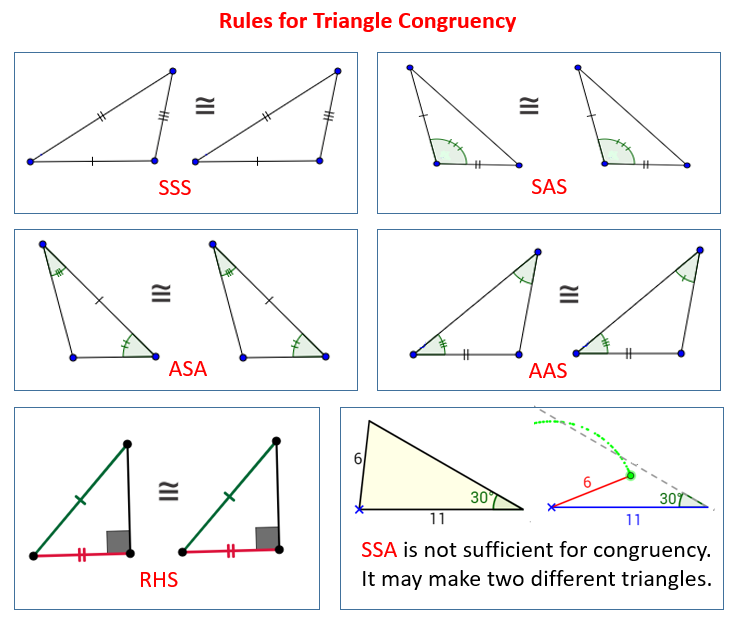
https://www.onlinemathlearning.com/image-files/congruent-triangles.png
nimble fern
nimble fern
https://www.onlinemathlearning.com/image-files/congruent-triangles.png
do you know these? @faint frost
nimble fern
that's good!
nimble fern
let's start with Q7
what do we need to prove BD=EA?
(i use = instead of the congruence sign for ease of typing)
nimble fern
nimble fern
what do we need to prove BD=EA?
like which pair of triangles should we use?
faint frost
nimble fern
(i use = instead of the congruence sign for ease of typing)
sure thas fine
nimble fern
so, what info will we need?
nimble fern
faint frost
bdc and aec
for this to happen
faint frost
nimble fern
for this to happen
i think its one of the angles right
its gotta be the included angle
nimble fern
nah, we need to angle between 2 lines
faint frost
between the 2 corrosponding congruent lines
faint frost
which one tho
oh wait
nvm
bcd and ace
wait a second
@nimble fern since we already know that the corrosponding lines are congruent, bcd = ace
right
what reason is that tho
not sure what the postulate or theorom would be
nimble fern
faint frost
but what reason would that be on the proof
good question, do you know angle sum of triangle / exterior angle of triangle?
faint frost
nimble fern
good question, do you know angle sum of triangle / exterior angle of triangle?
the exterior angle is the sum of the 2 remote interior angles?
is that what ur talking about?
nimble fern
yea
faint frost
how would i use that
nimble fern
like we know, for now, the base angles of the inner triangle are same
and base angles of the outer triangles are same
nimble fern
faint frost
the exterior angle is the sum of the 2 remote interior angles?
we can use this to prove
angle BCD = angle ACE
faint frost
how do we know that the base angles of the outer triangles are the same
and bcd and ace arent exteroir angles
so i dont get it still
nimble fern
ok, I'll go through step by step then
ah, btw can you repost Q7 for easier reading?
angleCDE = angleCED (base angles, isos triangle)
angleCBD=angleCAE (base angles, isos triangle)
angleCDE=angleCBD+angleBCD (exterior angle of triangle)
angleCED=angleCAE+angleACE (exterior angle of trianlge
all good till here?
faint frost
yeah i got it
nimble fern
good
next step will be
angleCDE-angleCBD=angleBCD
angleCED-angleCAE=angleACE
now that since
angleCDE=angleCED
and
angleCBD=angleCAE
we have
angleCDE-angleCBD=
angleCED-angleCAE
therefore
angleBCD=angleACE
therefore we can finally prove triangle BCD congruent to triangle ACE
all good till here?
lone heartBOT
@faint frost Has your question been resolved?
lone heartBOT
Channel closed
Closed due to timeout
Use .reopen if this was a mistake.
Available help channel!
Send your question here to claim the channel.
Remember:
• Ask your math question in a clear, concise manner.
• Show your work, and if possible, explain where you are stuck.
• After 15 minutes, feel free to ping <@&286206848099549185>.
• Type the command .close to free the channel when you're done.
• Be polite and have a nice day!
Read #❓how-to-get-help for further information on how to ask a good question, and about conduct in the question channels.
 vivid basin
If a²+1/a² = 786, then a-1/a = ?, I know it can be solved by adding/subtract 2 on both sides, but can it be solved by finding out the value of a, from the first eqn
lone heartBOT
vivid basin
If a²+1/a² = 786, then a-1/a = ?, I know it can be solved by adding/subtract 2 o...
ocean sealBOT
Jshy

 gray isle
some people respect the order of operations
vapid shuttle
I am not one of those people
vivid basin
It's a²+(1/a²) and a-(1/a) sry
vivid basin
As I'm good in just solving by linear equations in 2 variables that's why I asked to find a firs
gray isle
you could convert the first equation to a quartic equation
for which you'd get 4 solutions, which may not necessaily be nice
and end up doing something like 4 cases
vivid basin
I'm not so good in maths so I just know some basic techniques like solving using 2 vars, it would be very helpful if you could solve it using an efficient method and a method which would be in my context of understand like using linear eqns
 tardy stag
gray isle
you could convert the first equation to a quartic equation
for which you'd get 4...
tardy stag
gray isle
you could convert the first equation to a quartic equation
for which you'd get 4...
it's a biquadratic so it wouldn't be impossible just annoying
lone heartBOT
@vivid basin Has your question been resolved?
 alpine sable
what part of your question hasn't been resolved
vivid basin
alpine sable
what part of your question hasn't been resolved
I want know the methods by which it can be solved, till now I know just the method of solving it by adding 2 on both sides
alpine sable
vivid basin
I'm not so good in maths so I just know some basic techniques like solving using...
the most efficient way to solve this problem is subtracting 2 on both sides
vivid basin
If I solve the first eqn for a I get √343
Ok np I will use the efficient method
.close
lone heartBOT
Channel closed
Closed by @vivid basin
Use .reopen if this was a mistake.
Available help channel!
Send your question here to claim the channel.
Remember:
• Ask your math question in a clear, concise manner.
• Show your work, and if possible, explain where you are stuck.
• After 15 minutes, feel free to ping <@&286206848099549185>.
• Type the command .close to free the channel when you're done.
• Be polite and have a nice day!
Read #❓how-to-get-help for further information on how to ask a good question, and about conduct in the question channels.
 vague iris
Do we always get the same derivative if we simplify the function first before getting its derivative in multiplication and division, and if we use the rules first before simplifying?
lone heartBOT
vague iris
Do we always get the same derivative if we simplify the function first before ge...
vague iris
like f(x)=(x-4)^2 (2x=3)
nimble fern
vague iris
like f(x)=(x-4)^2 (2x=3)
does the 2x=3 a condition for the f'(x)?
I don't get it 😔
lone heartBOT
@vague iris Has your question been resolved?
tardy stag
vague iris
like f(x)=(x-4)^2 (2x=3)
i suspect you meant (2x-3)
and yes you'll get the same answer
although you may have to factor one or expand the other, to easily see that they're the same
lone heartBOT
Channel closed
Closed due to timeout
Use .reopen if this was a mistake.
Available help channel!
Send your question here to claim the channel.
Remember:
• Ask your math question in a clear, concise manner.
• Show your work, and if possible, explain where you are stuck.
• After 15 minutes, feel free to ping <@&286206848099549185>.
• Type the command .close to free the channel when you're done.
• Be polite and have a nice day!
Read #❓how-to-get-help for further information on how to ask a good question, and about conduct in the question channels.
 high mauve
Hey
lone heartBOT
high mauve
Hey
high mauve
Trigger Warning: Arachnophobia

A spider wants to crawl the shortest way from corner a to corner b
So my book says 64 cm
Idk how it got to that
 pulsar laurel
Is it like a box
pulsar laurel
So then it can go up then across diagonally
pulsar laurel
Maybe it can go straight from a to b
high mauve
sqrt(40^2+20^2)=44.72
pulsar laurel
Pythogoras in 3d
high mauve
No it can't, spiders can't fly 😅
pulsar laurel
Webs
high mauve
Besides, 50^2(diagonal of box) +20^2 (height) is 53.85, so shorter than 64
pulsar laurel
64 doesn't sound right
high mauve
I have no idea what the book wants me to do
It's a chapter about repeating the Pythagoras
Nothing advanced
pulsar laurel
Is there like a solution at the back of the book
pulsar laurel
high mauve
Do you think 64 is an error?
Sounds like it
 lone heartBOT
Channel closed
Closed by @high mauve
Use .reopen if this was a mistake.
Available help channel!
Send your question here to claim the channel.
Remember:
• Ask your math question in a clear, concise manner.
• Show your work, and if possible, explain where you are stuck.
• After 15 minutes, feel free to ping <@&286206848099549185>.
• Type the command .close to free the channel when you're done.
• Be polite and have a nice day!
Read #❓how-to-get-help for further information on how to ask a good question, and about conduct in the question channels.
 chrome dagger
 lone heartBOT
chrome dagger
alpine sable
lone heartBOT
chrome dagger
alpine sable
\dm
I think it is to safe to start with the fact that
[
\s{a+b+c} \mathbin{\c r \ne} \s a + \s b + \s c
] in general
ocean sealBOT
 alpine sable
\dm
horizontal asymptotes are defined by an asymptotic/convergent behaviour in the function as it approaches $\pm \infty$
ocean sealBOT
 chrome dagger
yeah
alpine sable
\dm i.e. check if $\ds \lim_{x \to \pm \infty} \map f x$ exists
ocean sealBOT
 lone heartBOT
@chrome dagger Has your question been resolved?
lone heartBOT
Channel closed
Closed due to timeout
Use .reopen if this was a mistake.
Available help channel!
Send your question here to claim the channel.
Remember:
• Ask your math question in a clear, concise manner.
• Show your work, and if possible, explain where you are stuck.
• After 15 minutes, feel free to ping <@&286206848099549185>.
• Type the command .close to free the channel when you're done.
• Be polite and have a nice day!
Read #❓how-to-get-help for further information on how to ask a good question, and about conduct in the question channels.
 simple saddle
how interquartile range is calculated here?
 lone heartBOT
simple saddle
how interquartile range is calculated here?
simple saddle
lone heartBOT
simple saddle
how interquartile range is calculated here?
simple saddle
here in image 1st one denominator is always 365 why so and in second case with replacement approach is used ? what is the reason for this denominator thing


please help!
 heady pollen
how is interquartile range defined?
or is that the question
hmm
are your messages getting deleted?
simple saddle
yeah
heady pollen
odd
simple saddle
why so
 charred summit
simple saddle
simple saddle
how interquartile range is calculated here?
charred summit
simple saddle
simple saddle
how interquartile range is calculated here?
here how they found inter q range i did't understand
charred summit
This is a good video for your question
simple saddle
charred summit
This is a good video for your question
no but how to find that if only 2 or 3 terms are there
its understood for 10 and so terms but this i didn't understand
charred summit
If there is 2 terms
Then it is simply the difference between them
If it's for 3 terms then it is the difference between the final and the first one
simple saddle
charred summit
If there is 2 terms
Then it is simply the difference between them
If it's for 3...
oh just like range?
okk
charred summit
Yeah
simple saddle
simple saddle
here in image 1st one denominator is always 365 why so and in second case with r...
can you help with this too @charred summit
charred summit
simple saddle
here in image 1st one denominator is always 365 why so and in second case with r...
What is the question of the left one?
simple saddle
charred summit
What is the question of the left one?
oh wait
simple saddle
charred summit
What is the question of the left one?

so instructor showed an exaple for 6 people
charred summit
To solve this we need to know how many ways can 2 persons have birthdays
So do you know about combination?
simple saddle
charred summit
To solve this we need to know how many ways can 2 persons have birthdays
So do ...
yes i do
but i was thiking it would be like (365/ 365) *( 364/364)... like that as without replacement it is? right?
charred summit
Nice
So to get all the ways for their birthdays
We do a little easy equation
,calc 365 * 365
ocean sealBOT
Result:
1.33225e+5
,calc 365^2
ocean sealBOT
Result:
1.33225e+5
but why then the denominator is all 365?
charred summit
simple saddle
but why then the denominator is all 365?
I don't understand anything about the solution you gave to be honest
So now we want to know how many ways they can have the same birthday which will be
365 ways
simple saddle
charred summit
I don't understand anything about the solution you gave to be honest
this they did after that using the logic
 simple saddle
charred summit
So now we want to know how many ways they can have the same birthday which will ...
simple saddle
charred summit
So now we want to know how many ways they can have the same birthday which will ...
ya the first person
charred summit
Getting the probability of two having the same birthday is
$\frac{1}{365}$
ocean sealBOT
Sherif Player
 simple saddle
bro my doubt was why denominator was not altered like it is when no replacemnet case is there in the second q that happend
charred summit
Which gives us the percentage 0.274%
Meaning to get a 100%
That there is at least 2 people have the same birthday
We do
,calc 2 / 0.274%
ocean sealBOT
Result:
729.92700729927
So we need 730 people just to get 100 percent probility to have 2 people of the Same birthday
simple saddle
charred summit
So I can't solve it ?
you tried man
but the ans is 23 thats what
i wasn't asking the ans just the denominator concept
noo need to solve
charred summit
Hmm I think that it is 365 which represents the year days
simple saddle
charred summit
Hmm I think that it is 365 which represents the year days
no why not like this (365/ 365) *( 364/364)...
charred summit
Do you mean the way he said
$$\frac{364}{365} \times \frac{364}{365}$$?
ocean sealBOT
Sherif Player
 charred summit
Look I think I understand it now
When
To calculate the probability that bunch of people doesn't share any birthday is easy
We will just take one out of them then say that
The second one needs to be different than this person so it will be
$$\frac{364}{365}$$
Then the third one needs to differ from both of these guys so
And as both of the conditions needs to be applied we will use multiplication
$$\frac{364}{365} \times \frac{363}{365}$$
ocean sealBOT
Sherif Player
 charred summit
And so on
Now to get that at least 2 of them has the same birthday we will just say
1 - the result
So we get
$$1 - \frac{364!}{(365-K)! \times 365^{k-1}}$$
As K is the number of people
ocean sealBOT
Sherif Player
 lone heartBOT
@simple saddle Has your question been resolved?
lone heartBOT
Channel closed
Closed due to timeout
Use .reopen if this was a mistake.
Available help channel!
Send your question here to claim the channel.
Remember:
• Ask your math question in a clear, concise manner.
• Show your work, and if possible, explain where you are stuck.
• After 15 minutes, feel free to ping <@&286206848099549185>.
• Type the command .close to free the channel when you're done.
• Be polite and have a nice day!
Read #❓how-to-get-help for further information on how to ask a good question, and about conduct in the question channels.
vague iris
Where did I go wrong?
 lone heartBOT
vague iris
Where did I go wrong?
lone heartBOT
vague iris
Where did I go wrong?
 hot snow
honestly looks alright to me
vague iris
i think there was a mistake in the answer key. The denominator was raised to positive 2.
Thanks!
.close
lone heartBOT
Channel closed
Closed by @vague iris
Use .reopen if this was a mistake.
Available help channel!
Send your question here to claim the channel.
Remember:
• Ask your math question in a clear, concise manner.
• Show your work, and if possible, explain where you are stuck.
• After 15 minutes, feel free to ping <@&286206848099549185>.
• Type the command .close to free the channel when you're done.
• Be polite and have a nice day!
Read #❓how-to-get-help for further information on how to ask a good question, and about conduct in the question channels.
 lethal belfry
I would like some advice on how to solve the following diophantine equation $x^2+y^2+x-y= 2021$( The question is actually to find the number of diophantine roots, but I would like to find the roots first
lone heartBOT
lethal belfry
I would like some advice on how to solve the following diophantine equation $x^2...
ocean sealBOT
physicsrocks

 mellow grail
ocean seal
**physicsrocks**
mellow grail
ocean seal
**physicsrocks**
dont take my advice too seriously, but solving for either variable in terms of the other using quadratic formula should allow u to place a few bounds on the values
lethal belfry
mellow grail
dont take my advice too seriously, but solving for either variable in terms of t...
Yeah, I'm aware of that, but I was hoping for an alternate solution
I have tried a few tricks. Like$(x+0.5)^2+(y-0.5)^2= 2020.5$ and $(x+y)(x+y-1)-2xy=2021$ But neither seem to help
ocean sealBOT
physicsrocks
 mellow grail
in this case its possible your only option is my way
reason being its not factorizable
 wind cloak
I mean isn't this just the equation to a circle
mellow grail
wind cloak
I mean isn't this just the equation to a circle
u sure?
wind cloak
You can find the length of the intercept made on the x axis and calculate the distance from the x coordinate of the center
wind cloak
mellow grail
u sure?
well yeah it clearly is
mellow grail
wind cloak
well yeah it clearly is
+x-y doesnt matter?
wind cloak
ocean seal
**physicsrocks**
He's even got it in center-radius form here
wind cloak
mellow grail
+x-y doesnt matter?
why would it
mellow grail
wind cloak
why would it
hmm
mellow grail
ocean seal
**physicsrocks**
well then u have radius as sqrt(2020.5)
lethal belfry
wind cloak
You can find the length of the intercept made on the x axis and calculate the di...
oh yeah, I don't know how I missed that . Thanks!
lethal belfry
.close
lone heartBOT
Channel closed
Closed by @lethal belfry
Use .reopen if this was a mistake.
Available help channel!
Send your question here to claim the channel.
Remember:
• Ask your math question in a clear, concise manner.
• Show your work, and if possible, explain where you are stuck.
• After 15 minutes, feel free to ping <@&286206848099549185>.
• Type the command .close to free the channel when you're done.
• Be polite and have a nice day!
Read #❓how-to-get-help for further information on how to ask a good question, and about conduct in the question channels.
 frosty swift
I have doubts in this question's solution I found online.
 frosty swift
Somebody did this:


Where did x + 1/x come from?
This is ref page I found from that person.
 alpine sable
frosty swift
Where did x + 1/x come from?
alpine sable
frosty swift
Where did x + 1/x come from?
they're using the fact that if f(x)=x+(1/x) then the range of f(x) is [2,infinity)
that's smart actually damn
frosty swift
But why though?
alpine sable
using the information from the four equations, you can see how they got to l+(1/l)=q-2
frosty swift
Yeah.
alpine sable
so they see that l+(1/l) is f(l) in this case and its range is [2,infinity)
frosty swift
Ok I see.
alpine sable
and then they're substituting for l+(1/l) in that inequality to get the range of q
frosty swift
But wait, shouldn't the range by -1 to infinity taking only natural numbers?
Or I'm mistaken?
(probably).
alpine sable
you can find the range of x+(1/x) by completing the square
frosty swift
alpine sable
you can find the range of x+(1/x) by completing the square
Oh ok.
alpine sable
wait yeah
im right
ok no i was half right the range also includes the interval (-infinity,-2]
frosty swift
But wait, you can't complete the square for this I don't think so.
alpine sable
yeah that part was wrong
if l+(1/l) was less than -2, it would imply q-2 was less than -2 or q was less than 0
which isnt possible because q is given to be natural
frosty swift
Yeah I got that.
Oh wait.
1/x is a rational function.
So the minimum val. is 1 for natural numbers.
for f(x) = x + 1/x => f(1) = 2
So that's why they did that.
Ah that's acutally smart.
(That's what you said in the beginning).
lone heartBOT
@frosty swift Has your question been resolved?
Channel closed
Closed by @frosty swift
Use .reopen if this was a mistake.
Available help channel!
Send your question here to claim the channel.
Remember:
• Ask your math question in a clear, concise manner.
• Show your work, and if possible, explain where you are stuck.
• After 15 minutes, feel free to ping <@&286206848099549185>.
• Type the command .close to free the channel when you're done.
• Be polite and have a nice day!
Read #❓how-to-get-help for further information on how to ask a good question, and about conduct in the question channels.
 final mural
Hello, is this the right drawing of the situation
 final mural
Orthogonal means independent here
lone heartBOT
@final mural Has your question been resolved?
lone heartBOT
@final mural Has your question been resolved?
lone heartBOT
Channel closed
Closed due to timeout
Use .reopen if this was a mistake.
Available help channel!
Send your question here to claim the channel.
Remember:
• Ask your math question in a clear, concise manner.
• Show your work, and if possible, explain where you are stuck.
• After 15 minutes, feel free to ping <@&286206848099549185>.
• Type the command .close to free the channel when you're done.
• Be polite and have a nice day!
Read #❓how-to-get-help for further information on how to ask a good question, and about conduct in the question channels.
 humble leaf
Let v1, v2 and v3 be distinct elements of a vector space V over a field F and let c1, c2, c3 ∈ F . Under what conditions is the subset {c2v3 −c3v2, c1v2 −c2v1, c3v1 −c1v3} of V linearly independent?
lone heartBOT
humble leaf
Let v1, v2 and v3 be distinct elements of a vector space V over a field F and le...
humble leaf
i think the answer is never cause c1(c2v3 −c3v2)+c3(c1v2 −c2v1)+c2(c3v1 −c1v3) is always 0
so they're always a linearly dependent set
someone pliz sanity check, thanks!
oak perch
$\begin{pmatrix}v_{1}&v_{2}&v_{3}\end{pmatrix}\begin{pmatrix}0&-c_{2}&c_{3}\-c_{3}&c_{1}&0\c_{2}&0&-c_{1}\end{pmatrix}$
ocean sealBOT
Cogwheels of the mind
 oak perch
So only when v_i are linear independent and that matrix is invertible
Calculate its determinant
Oh seems like you did
oak perch
humble leaf
so they're always a linearly dependent set
You are correct
humble leaf
oak perch
Oh seems like you did
thats where i got the idea yea
cool thanks 🫡
.close
lone heartBOT
Channel closed
Closed by @humble leaf
Use .reopen if this was a mistake.
oak perch
Np
lone heartBOT
Available help channel!
Send your question here to claim the channel.
Remember:
• Ask your math question in a clear, concise manner.
• Show your work, and if possible, explain where you are stuck.
• After 15 minutes, feel free to ping <@&286206848099549185>.
• Type the command .close to free the channel when you're done.
• Be polite and have a nice day!
Read #❓how-to-get-help for further information on how to ask a good question, and about conduct in the question channels.
alpine sable
hi can anyone help me with this probabilities question
 alpine sable
hi
i know this is related to pascals triangle and ncr but i dont fully understand how to do it
 waxen flame
alpine sable
i know this is related to pascals triangle and ncr but i dont fully understand h...
waxen flame
alpine sable
i know this is related to pascals triangle and ncr but i dont fully understand h...
I think the setup was a bit confusing.
The first sentence basically tells that you are using combinations of four fruit so 4C1 + 4C2 + 4C3 + 4C4.
The next line does not clearly define if Olivia is just adding one fruit to each of the possible combinations or there is an additional fruit to consider in the combinations above. The explanation given would indicate they intended the former.
lone heartBOT
@alpine sable Has your question been resolved?
alpine sable
thank you sm
i just got one more question, it might be dumb
but what i did was i looked at pascals triangle and i included 4c0 and 5c0 in my calculations so i did 32-16=16, why did you leave out 0?
4c0?
so i did (1+5+10+10+5+1)-(1+4+6+4+1)
lone heartBOT
@alpine sable Has your question been resolved?
lone heartBOT
Channel closed
Closed due to timeout
Use .reopen if this was a mistake.
Available help channel!
Send your question here to claim the channel.
Remember:
• Ask your math question in a clear, concise manner.
• Show your work, and if possible, explain where you are stuck.
• After 15 minutes, feel free to ping <@&286206848099549185>.
• Type the command .close to free the channel when you're done.
• Be polite and have a nice day!
Read #❓how-to-get-help for further information on how to ask a good question, and about conduct in the question channels.
 viscid lynx
how do you do this starting with dy first? (It will be two integrals added together), what are the limits for dy?
https://cdn.discordapp.com/attachments/689915677431169069/1146997301240397834/image.png
 lone heartBOT
viscid lynx
how do you do this starting with dy first? (It will be two integrals added toget...
oak perch
lone heartBOT
viscid lynx
how do you do this starting with dy first? (It will be two integrals added toget...
oak perch
I would do it like this:
y=rcos(u), z=rsin(u), 0<=r<=3, u from 0 to 2π, x>=0
The 3x-y+z=6 condition becomes sqrt(2)rsin(u-π/4)=6-3x
dxdydz=rdxdrdu
lone heartBOT
@viscid lynx Has your question been resolved?
lone heartBOT
Channel closed
Closed due to timeout
Use .reopen if this was a mistake.
lone heartBOT
Available help channel!
Send your question here to claim the channel.
Remember:
• Ask your math question in a clear, concise manner.
• Show your work, and if possible, explain where you are stuck.
• After 15 minutes, feel free to ping <@&286206848099549185>.
• Type the command .close to free the channel when you're done.
• Be polite and have a nice day!
Read #❓how-to-get-help for further information on how to ask a good question, and about conduct in the question channels.
 raven coral
Hi, I have a question about the definition of a gradient vector field. I know that $for a C^{1}$ vector field F, we have that $F = \nabla f$ (i.e F is a gradient vector field), then for any simple closed curve $C$, we have that
$$\int_{C} \textbf{F} \cdot d\textbf{S} = 0$$ . However; what if F is not $C^{1}$ continuous? For example, consider $$\textbf{F} = \frac{-y}{x^2 + y^2} \textbf{i} + \frac{x}{x^2 + y^2} \textbf{j}$$. When $C$ is the unit circle, $\int_{C} \textbf{F} \cdot d\textbf{S} = 2\pi \neq 0$. And yet, ... F is the gradient of -arctan(x/y).
lone heartBOT
raven coral
Hi, I have a question about the definition of a gradient vector field. I know th...
ocean sealBOT
Maria
 lone heartBOT
@raven coral Has your question been resolved?
lone heartBOT
@raven coral Has your question been resolved?
Channel closed
Closed by @raven coral
Use .reopen if this was a mistake.
lone heartBOT
Available help channel!
Send your question here to claim the channel.
Remember:
• Ask your math question in a clear, concise manner.
• Show your work, and if possible, explain where you are stuck.
• After 15 minutes, feel free to ping <@&286206848099549185>.
• Type the command .close to free the channel when you're done.
• Be polite and have a nice day!
Read #❓how-to-get-help for further information on how to ask a good question, and about conduct in the question channels.
 winter current
Hi, guys! If someone could help me with this, that’d be amazing I’m so confused.
 lone heartBOT
winter current
Hi, guys! If someone could help me with this, that’d be amazing I’m so confused.
winter current
lone heartBOT
winter current
Hi, guys! If someone could help me with this, that’d be amazing I’m so confused.
winter current
I thought I was supposed to use the contribution margin ratio but I’m not sure 🥲
lone heartBOT
@winter current Has your question been resolved?
winter current
I’m not even sure where to start if I’m being honest
lone heartBOT
Channel closed
Closed due to timeout
Use .reopen if this was a mistake.
Available help channel!
Send your question here to claim the channel.
Remember:
• Ask your math question in a clear, concise manner.
• Show your work, and if possible, explain where you are stuck.
• After 15 minutes, feel free to ping <@&286206848099549185>.
• Type the command .close to free the channel when you're done.
• Be polite and have a nice day!
Read #❓how-to-get-help for further information on how to ask a good question, and about conduct in the question channels.
 weak ridge
 lone heartBOT
weak ridge
weak ridge
lone heartBOT
weak ridge
weak ridge
PLease how do you solve
oak perch
It’s the same as (2r+4)+(r-2)=18
weak ridge
how
oak perch
Because C(n,a)=C(n,b) iff a+b=n
weak ridge
What
weak ridge
oak perch
It’s the same as (2r+4)+(r-2)=18
Why 19
oak perch
oak perch
Because C(n,a)=C(n,b) iff a+b=n
n=18 here
Wait sorry
n
Editing
18 not 19 my bad
Edited
weak ridge
Why do you have to add
 twin nimbus
You familiar with pascals triangle and the relationship between it and the binomial coefficients?
weak ridge
What do you mean
twin nimbus
In mathematics, Pascal's triangle is a triangular array of the binomial coefficients arising in probability theory, combinatorics, and algebra. In much of the Western world, it is named after the French mathematician Blaise Pascal, although other mathematicians studied it centuries before him in Persia, India, China, Germany, and Italy.The rows...
twin nimbus
So the coefficients of (1+x)^n are the nth row of this
weak ridge
ok
twin nimbus
For instance, the third row is 1 3 3 1, and (1+x)^3 is x^3 + 3x^2 + 3x + 1
Each entry of Pascal's triangle is C(n, k)
Where n is the row and k is the column
And it's symmetric
Meaning that C(n, k) = C(n, n-k)
So we know n = 18, because (1+x)^18
So we just need to find the appropriate k
weak ridge
why n-k
twin nimbus
Symmetry
weak ridge
from where
twin nimbus
Pascal's triangle
weak ridge
twin nimbus
Where n is the row and k is the column
What do you mean
winter light
weak ridge
from where
Or simply by definition of binomial coefficient, you can easily show C(n,k) = C(n, n-k)
weak ridge
how
winter light
Using the definition of binomial coefficient (if you know it of course, otherwise forget it for now)
The one with the factorials
weak ridge
which one
twin nimbus
n!/(k!(n-k)!)
weak ridge
twin nimbus
n!/(k!(n-k)!)
What i do then
weak ridge
winter light
The one with the factorials
what am i doing with this
winter light
weak ridge
what am i doing with this
Write, using that definition, what C(n, n-k) is equal to
winter light
twin nimbus
n!/(k!(n-k)!)
This one! This is the definition of C(n, k)
weak ridge
2 and 18
winter light
Don't think about numbers for now
winter light
winter light
Write, using that definition, what C(n, n-k) is equal to
This...
Btw I'm going to bed now cause it's quite late
There is for sure someone available to help you
weak ridge
winter light
There is for sure someone available to help you
how does symmetry deal with this
winter light

I was saying that in few minutes I'm going sleeping and I wanted to let you know that you aren't left alone, but instead a lot of helpers are available to help you
weak ridge
no sorry wrong reply
winter light
I thought @twin nimbus wanted to make you note that C(n, k) and C(n, n - k) are equal to eachother
And what I was telling you is one way to prove that
weak ridge
twin nimbus
Meaning that C(n, k) = C(n, n-k)
How is this possible
how are they equal
What does the k even mean
winter light
weak ridge
how are they equal
You have to prove that they are equal if you don't know it
weak ridge
but how
winter light
And I'm trying to tell you how to do that 😅
winter light
weak ridge
but how
Oh my god
winter light
winter light
Write, using that definition, what C(n, n-k) is equal to
This...
weak ridge
What does th k mean
winter light
I don't know how to explain you if not in this way
weak ridge
is it 18
winter light
twin nimbus
Where n is the row and k is the column
@weak ridge
winter light
weak ridge
is it 18
No, n is 18
winter light
@twin nimbus can you explain it again please? I don't know how to help him 
weak ridge
please explain the relationship between the equality and the symmetry
winter light
<@&286206848099549185>
winter light
weak ridge
please explain the relationship between the equality and the symmetry
I don't think I'm good enough to explain that
weak ridge
just try please
winter light
The only thing I can suggest is going back to the messages and restart to read carefully what @twin nimbus told you
winter light
twin nimbus
So the coefficients of (1+x)^n are the nth row of this
Starting from here
 junior citrus
weak ridge
junior citrus
weak ridge
this?
weak ridge
yes
junior citrus
do you know binomial theorem?
weak ridge
yes
junior citrus
then whats the issue?
junior citrus
if the term you are expanding is 1+x, then the coefficient would not change from either the a or b terms
therefore you could just set the nCr terms equal to each other and solve for r
weak ridge
why
so they are the same
;but term 2 and 18 are the same
but they dont give me same r
junior citrus
weak ridge
why
well each term, according to the binomial theorem, could be written as nCr (1)^r*x^n-r
and you want to find out the coefficients of the (2r+4)th term and the (r-2)th terms
since no matter what 1^r * x^n-r will not have a coefficient
you can ignore those
and you just focus on the nCr terms
so you would set them equal to each other
18C2r+4 = 18Cr-2
weak ridge
18C1 is the same as 18C18
weak ridge
Hello
weak ridge
junior citrus
oh
Are you there
junior citrus
weak ridge
please explain the relationship between the equality and the symmetry
if the binomial is raised to the nth power, the coefficient of the rth term will be equal to the coefficient of the (n-r)th term, given that r starts at 0
junior citrus
like
weak ridge
why is that a condition
junior citrus
weak ridge
why is that a condition
i mean then if you want r to start at 1 you could have the coefficient of the rth term to be equal to the coefficient of the (n-r+1)th term doesn't really matter
junior citrus
weak ridge
but how is thata useful
i mean you wanted the relationship between equality and symmetry of the coefficients didn't you?
weak ridge
why does be n-r+1 be equals to r
weak ridge
junior citrus
i mean then if you want r to start at 1 you could have the coefficient of the rt...
why does this have to be so please
weak ridge
junior citrus
i mean then if you want r to start at 1 you could have the coefficient of the rt...
why are the equal please
junior citrus
nCr = nC(n-r) => n!/r!(n-r)! = n!/(n-r)!(n-n+r)! => n!/r!(n-r)! = n!/r!(n-r)!
weak ridge
why are we substracting r from n
weak ridge
junior citrus
nCr = nC(n-r) => n!/r!(n-r)! = n!/(n-r)!(n-n+r)! => n!/r!(n-r)! = n!/r!(n-r)!
why
junior citrus
weak ridge
why are the equal please
i just proved that nCr is equal to nC(n-r)
weak ridge
where
junior citrus
junior citrus
nCr = nC(n-r) => n!/r!(n-r)! = n!/(n-r)!(n-n+r)! => n!/r!(n-r)! = n!/r!(n-r)!
here
weak ridge
junior citrus
nCr = nC(n-r) => n!/r!(n-r)! = n!/(n-r)!(n-n+r)! => n!/r!(n-r)! = n!/r!(n-r)!
please explain
junior citrus
$nCr = \frac{n!}{r!(n-r)!}$
$nC(n-r) = \frac{n!}{(n-r)![n-(n-r)]!} = \frac{n!}{(n-r)!(n-n+r)!} = \frac{n!}{(n-r)!r!} = \frac{n!}{r!(n-r)!} = nCr$

 junior citrus
@weak ridge
lone heartBOT
@weak ridge Has your question been resolved?
lone heartBOT
@weak ridge Has your question been resolved?
oak perch
oak perch
Because C(n,a)=C(n,b) iff a+b=n
It’s simply C(n,a)<C(n,a+1), strictly increases for a<[n/2], because the latter is the former multiplied by (n-a)/(a+1)>1. And C(n,a)=C(n,n-a). So increases then decreases, So C(n,a)=C(n,b) we have only a+b=n
lone heartBOT
Channel closed
Closed due to timeout
Use .reopen if this was a mistake.
Available help channel!
Send your question here to claim the channel.
Remember:
• Ask your math question in a clear, concise manner.
• Show your work, and if possible, explain where you are stuck.
• After 15 minutes, feel free to ping <@&286206848099549185>.
• Type the command .close to free the channel when you're done.
• Be polite and have a nice day!
Read #❓how-to-get-help for further information on how to ask a good question, and about conduct in the question channels.
 terse fable
Can someone explain how I get from point a to b
 lone heartBOT
terse fable
Can someone explain how I get from point a to b
terse fable
lone heartBOT
terse fable
Can someone explain how I get from point a to b
terse fable
a being where the arrow starts and b the equation its pointing to
or if anything how I get (a^2-2a-2) from combining the two fractions
oh wait never mind
.close
lone heartBOT
Channel closed
Closed by @terse fable
Use .reopen if this was a mistake.
lone heartBOT
Available help channel!
Send your question here to claim the channel.
Remember:
• Ask your math question in a clear, concise manner.
• Show your work, and if possible, explain where you are stuck.
• After 15 minutes, feel free to ping <@&286206848099549185>.
• Type the command .close to free the channel when you're done.
• Be polite and have a nice day!
Read #❓how-to-get-help for further information on how to ask a good question, and about conduct in the question channels.
terse fable
 lone heartBOT
terse fable
terse fable
lone heartBOT
terse fable
terse fable
how does factoring the denominator end up with (2a+5)(a+5)?
I'm referring to the second denominator btw
nevermind
my brain is being dumb today
.close
lone heartBOT
Channel closed
Closed by @terse fable
Use .reopen if this was a mistake.
Available help channel!
Send your question here to claim the channel.
Remember:
• Ask your math question in a clear, concise manner.
• Show your work, and if possible, explain where you are stuck.
• After 15 minutes, feel free to ping <@&286206848099549185>.
• Type the command .close to free the channel when you're done.
• Be polite and have a nice day!
Read #❓how-to-get-help for further information on how to ask a good question, and about conduct in the question channels.
 lavish kelp
Ok ok this is a little dumb
lone heartBOT
lavish kelp
Ok ok this is a little dumb
lavish kelp
Me and my friend have been so confused on what to do
EVEN THOUGH WEVE DONE STUFF ABOVE OUR GRADE LVL
cnr+r/n
Can you reduce that into
Cr+r/n
 near apex
c, n, r are variables?
lavish kelp
Yes
near apex
Then no. Not unless n is 1 which then makes division by n in second term redundant.
Wait...
c and C are same. Right?
 fallen verge
ocean sealBOT
fallen verge
ocean sealBOT
GarlicB
 near apex
Lol. True. Maybe, they had the first one and ended up with cr + r/n.
lone heartBOT
@lavish kelp Has your question been resolved?
Channel closed
Closed by @lavish kelp
Use .reopen if this was a mistake.
Available help channel!
Send your question here to claim the channel.
Remember:
• Ask your math question in a clear, concise manner.
• Show your work, and if possible, explain where you are stuck.
• After 15 minutes, feel free to ping <@&286206848099549185>.
• Type the command .close to free the channel when you're done.
• Be polite and have a nice day!
Read #❓how-to-get-help for further information on how to ask a good question, and about conduct in the question channels.
alpine sable
hay
lone heartBOT
alpine sable
hay
alpine sable
i wanted do dicusses about roudning to the next dollor but it doesnt add up
 median oar
What is the issue?
 fierce prairie
send your problem?
lone heartBOT
@alpine sable Has your question been resolved?
Channel closed
Closed by @olive pine
Use .reopen if this was a mistake.
Available help channel!
Send your question here to claim the channel.
Remember:
• Ask your math question in a clear, concise manner.
• Show your work, and if possible, explain where you are stuck.
• After 15 minutes, feel free to ping <@&286206848099549185>.
• Type the command .close to free the channel when you're done.
• Be polite and have a nice day!
Read #❓how-to-get-help for further information on how to ask a good question, and about conduct in the question channels.
 pale granite
i need help
lone heartBOT
pale granite
i need help
pale granite
i got a calculus problem but idk if yall can do it in this section

this is the very last problem of the summer hw and me and my classmates (7 of us) dk how to even approach this
tardy stag
pale granite
what are some observations you can make about the limit on the left?
pale granite
its approaching 0
i got to the point where i canceled out the x, but idk where to go from there
tardy stag
pale granite
its approaching 0
well the overall limit should be approaching sqrt3
but do you mean the denominator is approaching 0?
pale granite
mb
the x is towards 0
which means that we have to somehow cancel out the x in the denominator with another x in the numerator otherwise this limit would be DNE
tardy stag
well... it means that the numerator has to approach 0 as well
or else yes it would be DNE (or infinite, and certainly not sqrt3)
pale granite
what i did was multiply by the opposite thingy
so instead of a+bx- root 3
i did + root 3
lemme send a picture of my messy work
tardy stag
i thought about doing that but i wasn't sure if it'd be useful
 tardy stag
i just used l'hopital's rule but your way is probably better
pale granite
i didn't solve for a and b tho
we arent allowed to use l'hopital's rule
because we havent learned it yet
tardy stag
so you ended up with $\lim \frac{b}{\sqrt{a+bx}+\sqrt3}$ if i'm reading that right?
ocean sealBOT
hayley!
 tardy stag
yeah
pale granite
then that is equal to root 3
and idk where to go from there because there isn't a system of equations i can use to solve for a or b
after that im just rearranging the equation
tardy stag
yeah you only found one equation so far
i used the fact that the original numerator had to = 0 to get another equation
pale granite
could u pls explain why it has to =0
the numerator specifiaclly
specifically
w9
w8
a+bx=3
a=3
then solve for b
and you get b -6
b=6
tardy stag
pale granite
could u pls explain why it has to =0
imagine if it didn't
then what would our limit be
pale granite
w8
this got me confuzzled
lol
but wouldnt that be the function
aka the y-value
and the y-value has to equal root 3
tardy stag
hmm?
pale granite
the thing is = to f(x)
aka y
which is root 3
so why does the numerator of it have to = 0
tardy stag
well
pale granite
is it a special rule idk
tardy stag
what's $\lim_{x\to 0} \frac{x^2+1}{x}$?
ocean sealBOT
hayley!
 tardy stag
how do you know that?
pale granite
cuz you cant get rid of the 0 in the denominator
tardy stag
why not?
tardy stag
you are correct that it's DNE
pale granite
bet
pale granite
yea
if i plug in 0 to the originial one its also gonna be DNE
but we know its not
tardy stag
pale granite
if i plug in 0 to the originial one its also gonna be DNE
right, we have to stop it from being DNE
pale granite
yea
tardy stag
thankfully we have some knobs to turn
 tardy stag
right, we have to stop that limit from not existing
we know the denominator is going to 0, we can't do anything about that
and if the denom goes to 0 but the numerator goes to some number that isn't 0, then the limit will not exist (or will be infinite)
pale granite
w8 no thats only if there is an x in the numeraot
numerator
when the function is heading towards positive or negative infinity
w8
im so lost
is this a rule idk?
that the numerator and denominator have to approach the same number?
cuz how cany they both approach 0 if it says = to 3
ocean sealBOT
hayley!
 pale granite
w88888
thats when you plug in for x
then it is approaching 0
is there a yt vid i can watch
tardy stag
probably
pale granite
so
basically
just write the numerator = 0
solve for a
plug into other one for b
rightttttttttttttt???
pale granite
tardy stag
probably
.
tardy stag
that is what i did yes
pale granite
ok perf
what is the thing u were talking abt
what is it called
so i can search it up
lone heartBOT
@pale granite Has your question been resolved?
Channel closed
Closed by @pale granite
Use .reopen if this was a mistake.
Available help channel!
Send your question here to claim the channel.
Remember:
• Ask your math question in a clear, concise manner.
• Show your work, and if possible, explain where you are stuck.
• After 15 minutes, feel free to ping <@&286206848099549185>.
• Type the command .close to free the channel when you're done.
• Be polite and have a nice day!
Read #❓how-to-get-help for further information on how to ask a good question, and about conduct in the question channels.
@trail summit Has your question been resolved?
lone heartBOT
Channel closed
Closed by @trail summit
Use .reopen if this was a mistake.
Available help channel!
Send your question here to claim the channel.
Remember:
• Ask your math question in a clear, concise manner.
• Show your work, and if possible, explain where you are stuck.
• After 15 minutes, feel free to ping <@&286206848099549185>.
• Type the command .close to free the channel when you're done.
• Be polite and have a nice day!
Read #❓how-to-get-help for further information on how to ask a good question, and about conduct in the question channels.
 lone heartBOT
 rapid gate
 pulsar aspen
!status
lone heartBOT
What step are you on?
1. I don't know where to begin
2. I have begun but got stuck midway
3. I got an answer but I'm told it's wrong
4. I got an answer and would like my work checked
5. I have a question about someone else's worked solution
6. None of the above
@rapid gate
lone heartBOT
@rapid gate Has your question been resolved?
rapid gate
so
so either
i dont understand the english part
or the math part
but when it saids 13-19 inclusively
does it mean numbers 14-18 including 14,18
lone heartBOT
@rapid gate Has your question been resolved?
lone heartBOT
@rapid gate Has your question been resolved?
rapid gate
,w x^2-6x-27=0
ocean sealBOT


 rapid gate
,w log_3 (x-6)+log_3 (x)=3
ocean sealBOT
 rapid gate
.close
lone heartBOT
Channel closed
Closed by @rapid gate
Use .reopen if this was a mistake.
Available help channel!
Send your question here to claim the channel.
Remember:
• Ask your math question in a clear, concise manner.
• Show your work, and if possible, explain where you are stuck.
• After 15 minutes, feel free to ping <@&286206848099549185>.
• Type the command .close to free the channel when you're done.
• Be polite and have a nice day!
Read #❓how-to-get-help for further information on how to ask a good question, and about conduct in the question channels.
 waxen seal
 lone heartBOT
waxen seal
lone heartBOT
waxen seal
 sour verge
Give me 15 minutes, Ill come back to it if nobody answered
 sour verge
I'm still doing something, but at first glance it seems you have the preimage definition a bit wrong for a)
(g dot f)-1 (E) = {a in A | g(f(a)) in E}
 sour verge
That seems about right. Now I'd advise trying to pick an element from the first set and show that it must be in the second.
 sour verge
I get what you're trying to write down, but there's some things a bit iffy with it. I'll annotate it just give me a minute
waxen seal
sour verge
I get what you're trying to write down, but there's some things a bit iffy with ...
ok thank you ill try proving b and c atm

 sour verge
Again, x is not in g-1(E) since x is in A and g-1(E) is a subset of B.
waxen seal
ohhhh
sour verge
However, you can say that if (g dot f) (x) = e in E, then you have g(f(x)) in E, so f(x) is in g-1(E)
waxen seal
f(x) is in g(-1)(E)
sour verge
Yeah
But then that means this x is in A
With f(x) in g(-1)(E)
So it's also in f-1(g-1(E))
Makes sense?
It's not as short a proof as it could be, but it should do the trick.
 sour verge
Yeah the x you picked to begin with is that specific x actually
But that's the reason yes
waxen seal
is it correct now?
sour verge
Yeah looks good
waxen seal
i can draw it or visualized it but i cannot say it mathematically
can i send more proofs?
waxen seal
ok thank you very much im proving b and c now
lone heartBOT
@waxen seal Has your question been resolved?

 lone heartBOT
Channel closed
Closed by @waxen seal
Use .reopen if this was a mistake.
Available help channel!
Send your question here to claim the channel.
Remember:
• Ask your math question in a clear, concise manner.
• Show your work, and if possible, explain where you are stuck.
• After 15 minutes, feel free to ping <@&286206848099549185>.
• Type the command .close to free the channel when you're done.
• Be polite and have a nice day!
Read #❓how-to-get-help for further information on how to ask a good question, and about conduct in the question channels.
 wind hill
hello guys
lone heartBOT
wind hill
hello guys
wind hill
i want to learn, is there a way to answer rational function inequality fast?
like is there a shortcut?
 vale wigeon
shortcut compared to what
wind hill
compared to the conventional, just a curious question, im fine with the conventional it's just that it takes me so much time when answering quizzes and test
for example let's have this

and this
 vale wigeon
wind hill
compared to the conventional, just a curious question, im fine with the conventi...
vale wigeon
wind hill
compared to the conventional, just a curious question, im fine with the conventi...
what's "the conventional"?
everything to one side then factorization?
wind hill
I just watched organic chemistry, i thought that was conventional sorry ^_^
any method you do?
vale wigeon
no, there is no shortcut around that.
wind hill
do you ahve a method u can share with me?
tardy stag
wind hill
and this
well like in this case you can use the fact that a square is always ≥ 0
wind hill
ok ok thank you
im sorry if im asking too much can u show how that works, i do promise i'm just advance studying, this isn't out homework!
ocean sealBOT
hayley!
 tardy stag
you can just multiply both sides by (x-5)^2; because it's always positive we don't have to change the sign of the inequality
so we get $(x-7)(x-3) > 0$ and we can easily solve that
ocean sealBOT
hayley!
 tardy stag
and remember that 5 can't be a solution since it's not valid in the original expression (because it would be dividing by 0)
wind hill
thank you!
gray isle
that's applicable more generally too
wind hill
how did the answer went to this?
 gray isle
e.g. in that first example you can multiply both sides by
(x+5)^2(x+6)^2
after multiplying both sides by (x-5)^2,
you'd get
(x+7)(x-3) > 0, (make sure to remember to exclude 5 from the solution set)
and the most intuitive way to identify the solution to that would be the wavy method where you draw a rough sketch of y=(x+7)(x-3)
alpine sable
ocean seal
**hayley!**
ah this is wrong
gray isle
where the main features you care about are just the direction and x-intercepts
alpine sable
it's x + 7
wind hill
ok ok i see
gray isle
just a typo, idea still stands