#help-0
1 messages · Page 287 of 1
 fresh parcel
 alpine sable
its pretty thick and its honestly pretty interesting
fresh parcel
this is why intuition is also pretty important
 young finch
people think calculus is so hard because they are never taught why things work the way it does
if you understand it intuitively though, its easier to memorize the formulas
alpine sable
yep
thanks for the enlightenment, I'm less confused about calculus now
can I close this?
I assume I can
.close
 lone heartBOT
Channel closed
Closed by @obsidian cloak
Use .reopen if this was a mistake.
 Available help channel!
Send your question here to claim the channel.
Remember:
• Ask your math question in a clear, concise manner.
• Show your work, and if possible, explain where you are stuck.
• After 15 minutes, feel free to ping <@&286206848099549185>.
• Type the command .close to free the channel when you're done.
• Be polite and have a nice day!
Read #❓how-to-get-help for further information on how to ask a good question, and about conduct in the question channels.
 vapid steppe
$\int{2^{\ln{x}}dx}$
lone heartBOT
vapid steppe
$\int{2^{\ln{x}}dx}$
 ocean sealBOT
Jash

 vale wigeon
!status
lone heartBOT
What step are you on?
1. I don't know where to begin
2. I have begun but got stuck midway
3. I got an answer but I'm told it's wrong
4. I got an answer and would like my work checked
5. I have a question about someone else's worked solution
6. None of the above
i think i have an idea of how to do it but idk if its gonna work
im pretty sure u can write 2 as e^ln(2)
and then substitute it
 modern sedge
vapid steppe
im pretty sure u can write 2 as e^ln(2)
modern sedge
vapid steppe
im pretty sure u can write 2 as e^ln(2)
This should work
Try this together with some manipulation, you should eventually get to really simple expression
vale wigeon
you can do what's called a pro gamer move: ||write 2^ln(x) as x^ln(2)||
vapid steppe
vale wigeon
you can do what's called a pro gamer move: ||write 2^ln(x) as x^ln(2)||
Idk how tho
vapid steppe
modern sedge
Try this together with some manipulation, you should eventually get to really si...
so can i write 2^lnx as (e^ln2)^lnx
ocean sealBOT
Ann
 modern sedge
yh
lone heartBOT
Channel closed
Closed by @vapid steppe
Use .reopen if this was a mistake.
Available help channel!
Send your question here to claim the channel.
Remember:
• Ask your math question in a clear, concise manner.
• Show your work, and if possible, explain where you are stuck.
• After 15 minutes, feel free to ping <@&286206848099549185>.
• Type the command .close to free the channel when you're done.
• Be polite and have a nice day!
Read #❓how-to-get-help for further information on how to ask a good question, and about conduct in the question channels.
alpine sable
I have y = x(x+2)^3, and I'm supposed to find which stationary point is a point of inflection
lone heartBOT
alpine sable
I have y = x(x+2)^3, and I'm supposed to find which stationary point is a point ...
alpine sable
I've calculated that dy/dx = (4x+2)(x+2)^2
and d2y/dx2 = 6(4x+2)(x+2)
and since point of inflection is when d2y/dx2 = 0, so I know that x=-2, x=-1/2 are both points of inflections
but the answer tells me only x=-2 is a point of inflection
is the answer wrong or am I wrong?
 tacit arch
points of inflection don't always occur when the second derivative is zero
alpine sable
huh?
tacit arch
the second derivative just tells you candidates for inflection points
use the original definition of inflection point
alpine sable
which is?
tacit arch

Khan Academy
Learn for free about math, art, computer programming, economics, physics, chemistry, biology, medicine, finance, history, and more. Khan Academy is a nonprofit with the mission of providing a free, world-class education for anyone, anywhere.
alpine sable
is it when x<a, f''(x)>0 and x>a, f''(x)<0?
where a is either -2 or -1/2
is that the original definition of an inflection point?
tacit arch
alpine sable
is it when x<a, f''(x)>0 and x>a, f''(x)<0?
yes
as long as concavity changes
alpine sable
right but I threw in -2 and -1/2 into f''(x)
no wait
I threw in -2.1 and -1.9 along with -1/3 and -2/3 into f''(x)
alpine sable
alpine sable
is it when x<a, f''(x)>0 and x>a, f''(x)<0?
and both candidate x fulfilled this ^
how is that possible?
tacit arch
alpine sable
and d2y/dx2 = 6(4x+2)(x+2)
,w diff (4x+2)(x+2)^2
ocean sealBOT


 tacit arch
,w does 6(4x+2)(x+2) equal 12(x^2 + 3x +2)
ocean sealBOT
 tacit arch
your second derivative is wrong
alpine sable
oh
hmmm
let me take a photo of my workings
ohhhh
i know where i messed up
my bad
oh actually i wanted to confirm another thing

there
is the notation du/dx and dv/dx here correct?
since it's now going from dy/dx to d2y/dx2 and not y to dy/dx
should it be something like d2u/dx2?
tacit arch
that all looks right
alpine sable
tacit arch
that all looks right
so i dont need something like d2u/dx2 and d2v/dx2?
tacit arch
nope
lone heartBOT
Channel closed
Closed by @obsidian cloak
Use .reopen if this was a mistake.
Available help channel!
Send your question here to claim the channel.
Remember:
• Ask your math question in a clear, concise manner.
• Show your work, and if possible, explain where you are stuck.
• After 15 minutes, feel free to ping <@&286206848099549185>.
• Type the command .close to free the channel when you're done.
• Be polite and have a nice day!
Read #❓how-to-get-help for further information on how to ask a good question, and about conduct in the question channels.
 paper sage
 lone heartBOT
paper sage
lone heartBOT
paper sage


 lime bobcat
The change is not that polar coordinates
It can be
$$\begin{cases}x=2rcos(\theta)\ y=r\sin(\theta)\end{cases}$$
ocean sealBOT
Categorist
 lime bobcat
Because you want to simplify
paper sage
how do you mean by simplifying
lime bobcat
$\frac{x^2}{4}+y^2 = \frac{4r^2\cos^2(\theta)}{4}+r^2\sin^2(\theta)=r^2$
ocean sealBOT
Categorist
 lime bobcat
If you don't put 2, then 4 does not appear so the 4 in the denominator is not simplified.
lime bobcat
(2rcos(§))²=4r²cos²(§)
It's x² with x=2rcos(§)
If you want a name to this. It's called elliptic coordinates.
paper sage
where did the 4 come in the numerator
lime bobcat
paper sage
where did the 4 come in the numerator
2²=4
paper sage
oh yeah you put the 2 so they can cancel out each other
lime bobcat
If x=2rcos(§) then x²=4r²cos²(§)
paper sage
thank you so much brother
lime bobcat
Exactly
paper sage
lime bobcat
If x=2rcos(§) then x²=4r²cos²(§)
now I understand
Thanks so much brother @lime bobcat
lime bobcat
It's the same for eliptic coordinates, hyperbolic coordinates and so on
paper sage
I really got stuck on this for almost 2 hours
paper sage
lime bobcat
It's the same for eliptic coordinates, hyperbolic coordinates and so on
indeed
lime bobcat
No problem, it happens to everyone
lone heartBOT
Channel closed
Closed by @paper sage
Use .reopen if this was a mistake.
Available help channel!
Send your question here to claim the channel.
Remember:
• Ask your math question in a clear, concise manner.
• Show your work, and if possible, explain where you are stuck.
• After 15 minutes, feel free to ping <@&286206848099549185>.
• Type the command .close to free the channel when you're done.
• Be polite and have a nice day!
Read #❓how-to-get-help for further information on how to ask a good question, and about conduct in the question channels.
 wicked harness
I tried to do ii
lone heartBOT
wicked harness
I tried to do ii
 lone heartBOT
@wicked harness Has your question been resolved?
wicked harness
<@&286206848099549185>
wicked harness
<@&286206848099549185>
lone heartBOT
@wicked harness Has your question been resolved?
lone heartBOT
Channel closed
Closed due to timeout
Use .reopen if this was a mistake.
Available help channel!
Send your question here to claim the channel.
Remember:
• Ask your math question in a clear, concise manner.
• Show your work, and if possible, explain where you are stuck.
• After 15 minutes, feel free to ping <@&286206848099549185>.
• Type the command .close to free the channel when you're done.
• Be polite and have a nice day!
Read #❓how-to-get-help for further information on how to ask a good question, and about conduct in the question channels.
 wide imp
 wide imp
need help with this, im not sure on how to differentiate when i get 2x^2y
 carmine reef
Use product rule, like (2x^2)(y)
 hot bluff
d/dx x^2 = 2x right
wide imp
yup
hot bluff
you can do the same with the parantheses here, but since there's an inner function you must also use chain rule.
wide imp
so i should take y-x^2 as the chain rule subject?
hot bluff
f'(g(x)) * g'(x)
wide imp
g(x) = y-x^2 or?
hot bluff
yes
wide imp
ohh alright
hot bluff
honestly you might not even need to solve completely for y', but after differentiating just plug in x and y
wide imp
kk gotchu
hot bluff
looking at it, solving for y' is probably easier.
wide imp
i am lost man
hot bluff
break the problem down into steps
wide imp
sometimes i would just get stuck on a certain question and wouldnt be able to solve it for like an hour lmao
wide imp
so first g(x) = y-x^2
hot bluff
what is f(x)
wide imp
3x^2
hot bluff
weird way to write it, but i understand what you are trying to say, yes.
what is our g'
wide imp
(y-x^2)'
hot bluff
prime notation is when we are speaking of a definition or unknown derivative, we don't know what g' is yet, show me d/dx ( y - x^2 )
hot bluff
where did y go
wide imp
-3x^2 * y' - 2x ?
wide imp
okay give me a sec
wide imp
-3x^2 = y' - 2x ?
hot bluff
you are forgetting the rest of the derivative.
hot bluff
break down RHS into two functions. f(x) and g(x). f will be the outer function.
f(x) = ?
you need to be able to recognize inner and outer functions pretty much immediately, otherwise you need to review composition of functions.
wide imp
is it 2y-2x^2 * y'-2x
hot bluff
yes
wide imp
finally haha
wide imp
3x^2 = 2y-2x^2 * y' - 2x
hot bluff
fully expand RHS, then solve for y'
hot bluff
wide imp
3x^2 = 2y-2x^2 * y' - 2x
3x^2 = (2y-2x^2)(y' - 2x) remember your groupings. you could make mistakes writing like that.
wide imp
yes, wrote it like that in my copybook
hot bluff
cool, so expand and solve. lmk if you get stuck.
hot bluff
you got the spirit, but no. can you show me your work?
 hot bluff
you should fully expand RHS instead of trying to move the factors around
wide imp
hmm okay
hot bluff
good practice for the future. there will be... so much expanding in later calculus. 
wide imp
yep... expecting it haha
is this how you expand it

I just don’t understand how this helps
hot bluff
looks good
now factor out y' from the terms that contain it.
then solve for y' from there.
with more practice you'll realize that sometimes you gotta make a mess before cleaning up. i had the same instinct you did in calc 1
wide imp
 hot bluff
why the parantheses
hot bluff
no fun, only math  and you got a sign wrong i believe.

did you do something differently from this?
hot bluff
see, be careful. always write things out fully even though you're gonna write it 80 times throughout the problem
wide imp
yeah got it
hot bluff
can you find the slope now?
hot bluff

hot bluff
sure why not
hot bluff
👍
wide imp
.close
lone heartBOT
Channel closed
Closed by @wide imp
Use .reopen if this was a mistake.
Available help channel!
Send your question here to claim the channel.
Remember:
• Ask your math question in a clear, concise manner.
• Show your work, and if possible, explain where you are stuck.
• After 15 minutes, feel free to ping <@&286206848099549185>.
• Type the command .close to free the channel when you're done.
• Be polite and have a nice day!
Read #❓how-to-get-help for further information on how to ask a good question, and about conduct in the question channels.
 maiden swift
 lone heartBOT
maiden swift
lone heartBOT
maiden swift
 west girder
use remainder theorem
maiden swift
Ye but how do I solve for m and n
 tardy stag
you'll have two variables (m and n) and two equations
maiden swift
so what would the 2 equations look like
 winter light
maiden swift
so what would the 2 equations look like
winter light
maiden swift
so what would the 2 equations look like
What does the remainder theorem state?
maiden swift
r = 14 and r = 68
winter light
maiden swift
r = 14 and r = 68
I mean the general statement of the theorem
maiden swift
idk im learning it myself
winter light
maiden swift
Ye but how do I solve for m and n
Here you said you know it, right?
maiden swift
i js know that divisor would turn into 1 and 2 when u change the root
winter light
MMh I don't know what you're talking about actually
maiden swift
x-1 would turn into 1
and x-2 would turn into 2
do i solve this twice
or is this possible with one equation
so one with x-1
and one with x-2
winter light
If you have a polynomial P(x), when it is divided by (x - A) it gives a remainder of what? @maiden swift
No, you are forgetting what the theorem states
maiden swift
it would be equal to P(x) right?
winter light
maiden swift
it would be equal to P(x) right?
A remainder can't contain an x, so no
maiden swift
then idk
winter light
What remainder theorem did you learn? Maybe it's in a different version of the one I know
Can you send the statement if you have it in your notes?
winter light
Ok, send that one
maiden swift
 winter light
However, do you have any book which you are following? If yes, I'm pretty sure there is the statement
maiden swift
mcgraw-hill workbook grade 12
winter light
maiden swift
No, this is not about that theorem (moreover I can't read well there)
I'll better tell it you, the remainder theorem states that if you have a polynomial $P(x)$, when it is divided by $\left(x - A\right)$ it gives a remainder of $P(A)$
ocean sealBOT
Alberto Z.
 winter light
Go on page 123, on the top there's this version of the theorem
winter light
maiden swift
i think the way u worded it made it sound weird
Yes, I've just searched your book online and your version is a little different, but still the same
You should have this in your book, do you? @maiden swift
 winter light
maiden swift
is that the actual textbook
winter light
maiden swift
is that the actual textbook
You told me you follow mcgraw hill workbook grade 12 math textbook, didn't you?
winter light
 fervent root
maiden swift
fervent root
maiden swift
here @maiden swift \
 maiden swift
fervent root
here <@649348008076509215> \
maiden swift
fervent root
here <@649348008076509215> \
oh ty
maiden swift
winter light
https://www.creativebookpublishing.ca/books/McGraw-Hill-Ryerson-Advanced-Functio...
yea its different than the workbook
winter light
fervent root
here <@649348008076509215> \
!nosols
lone heartBOT
fervent root
here <@649348008076509215> \
As a helper, please do not give out answers that could be copied as a homework solution. Have the student work through the problem themselves and guide them along the way.
winter light
maiden swift
yea its different than the workbook
Ah ok sorry
 fervent root
lone heart
As a helper, please do not give out answers that could be copied as a homework s...
fervent root
lone heart
As a helper, please do not give out answers that could be copied as a homework s...
sure
 winter light
winter light
winter light
@maiden swift is this on your book?
winter light
maiden swift
Its not the same lol
It's McGraw hill
There's 2 versions
One is the actual textbook
And one is a workbook
winter light
Oh my god lol
maiden swift
I'm using the workbook one lol
winter light
Ok, in general I believe it's much better if you study from a theory book, not only the workbook
lone heartBOT
@maiden swift Has your question been resolved?
Channel closed
Closed by @maiden swift
Use .reopen if this was a mistake.
lone heartBOT
Available help channel!
Send your question here to claim the channel.
Remember:
• Ask your math question in a clear, concise manner.
• Show your work, and if possible, explain where you are stuck.
• After 15 minutes, feel free to ping <@&286206848099549185>.
• Type the command .close to free the channel when you're done.
• Be polite and have a nice day!
Read #❓how-to-get-help for further information on how to ask a good question, and about conduct in the question channels.
 opaque skiff
Hi, I need help to find a solution to this depressed cubic equation (or reduced cubic as some call it)
 lone heartBOT
opaque skiff
Hi, I need help to find a solution to this depressed cubic equation (or reduced ...
opaque skiff
lone heartBOT
opaque skiff
Hi, I need help to find a solution to this depressed cubic equation (or reduced ...
opaque skiff
I didn't quite understand how I can do it
 drifting seal
first take the RHS to LHS
RHS should be equal to 0
next step is to take a way the dominator
which we can multiply the whole equation 32
then u can do it
cuz after that it will be friendlier to do
opaque skiff
So 32x^3 - 22w - 11 = 0
drifting seal
x?
opaque skiff
I'm sorry, w xd
lone heartBOT
Channel closed
Closed by @opaque skiff
Use .reopen if this was a mistake.
Available help channel!
Send your question here to claim the channel.
Remember:
• Ask your math question in a clear, concise manner.
• Show your work, and if possible, explain where you are stuck.
• After 15 minutes, feel free to ping <@&286206848099549185>.
• Type the command .close to free the channel when you're done.
• Be polite and have a nice day!
Read #❓how-to-get-help for further information on how to ask a good question, and about conduct in the question channels.
 chilly quiver
Can someone please help
lone heartBOT
chilly quiver
Can someone please help
chilly quiver
How do I differentiate x = 2^t
 shy dove
do you know how to differentiate e^t? and use the chain rule?
shy dove
I guess that's one way? I was thinking of something else
You can use the fact that $a = e^{\ln a}$
ocean sealBOT
imTypθ
 shy dove
replace a with 2^t and you should get something familiar to differentiate
 raven rover
d/dx a^x = a^x ln a
 gray isle
chilly quiver
from there i get stuck
gray isle
chilly quiver
from there i get stuck
from there differentiate both sides. chain rule will be needed for the left side
chilly quiver
gray isle
from there differentiate both sides. chain rule will be needed for the left side
can you please teach me how to use chain rule with logs
gray isle
the same way you'd use it for any other type of function
raven rover
d/dt ln x = ?
chilly quiver
so you let x = u?
chilly quiver
ln x is the same is 1/x right?
gray isle
because supposedly you want to differentiate wrt t, not x
chilly quiver
okay
so after you let x = u you get ln (u)
u = x
du/dx = 1
i still dont get it
gray isle
do you know the chain rule?
gray isle
that rule doesn't tell you how to differentiate logs, rather what to suffer
since you're differentiating wrt t, you'll have
$$\dv{y}{t} = \dv{y}{x}\dv{x}{t}$$
ocean sealBOT
ℝam()n()v
 gray isle
with y being the ln(x)
chilly quiver
okay so quickly differentiate ln(x) using chain rule
I want to see something
what do you get?
gray isle
what do you get
gray isle
d/dx of ln(x) is 1/x
dy/dx = 1/x if y = ln(x)
(NOT what you wrote)
dx/dt, the derivative of x wrt t is ultimately what you wanted to find, unknown atm and can be left as is
thus
d/dt ln(x) = 1/x dx/dt
chilly quiver
oh okay
chilly quiver
ocean seal
**imTypθ**
@shy dove can you explain this to me?
i think that's what they used

this is what i'm trying to solve
gray isle
that property is the end result of applying chain rule
shy dove
chilly quiver
<@348607914375905290> can you explain this to me?
Of course. The point is to transform $2^t$ into something of the form $e^{bx}$, which you said you were familiar with. It's a simple case of doing:
$\ a = e^{\ln a} \ a = 2^t \ 2^t = e^{\ln 2^{t}} \ \dv{t}(2^t) = \dv{t}(e^{t\cdot \ln 2})$
(sorry for latex fails)
There it should be good >_>
ocean sealBOT
imTypθ
 shy dove
See how I used the log rule in the last step? So now you just have e^t, but with a constant, so you need to use the chain rule
 shy dove
Because they differentiated 2^t
shy dove
ocean seal
**imTypθ**
if you look at this and continue the work, you too will get 2^t * ln2
 shy dove
what exactly do you find confusing?
shy dove
they are inverse functions, they cancel eachother
shy dove
yes
chilly quiver
So it's always like that?
 pale kestrel
technically
you can only take ln of positive numbers
e^ln(-1) is not -1, its undefined.
shy dove
For the sake of not confusing them more, can we not?
chilly quiver
So this is how i get confused
pale kestrel
I think it's an important point, sorry
shy dove
I mean, it is, but not in this context
I don't think they intend to take the ln of a negative number for this problem
chilly quiver
ocean seal
**imTypθ**
why do i keep 2^t when differentiating?
shy dove
that's the point of the trick, you use the log rule so it's not 2^t anymore, it's e^(something*t)
chilly quiver
ocean seal
**imTypθ**
okay i kinda get it now
because when there's an equation like 2^t i know of the log trick to bring down the t
by using ln
but the confusing part is differentiating e^t ln 2
do i use chain rule?
shy dove
chilly quiver
but the confusing part is differentiating e^t ln 2
I thought you said you were familiar with that? What if I told you to differentiate e^(2t)?
chilly quiver
wrt t?
shy dove
yes
chilly quiver
you get 2e^2t
shy dove
Alright, now what's confusing you about ln2 instead of just 2?
chilly quiver
there's ln
shy dove
well, it shouldn't confuse you, because ln(2) is really just a number
so you can deal with it just like you would with 2
shy dove
Okay so, what would be the result of d/dt (2^t)?
shy dove
almost
chilly quiver
ln 2 e^t ln 2?
shy dove
technically yes, but the right bit simplifies if you use a log rule :)
chilly quiver
these log rules are going to be the death of me
ocean sealBOT
imTypθ
 shy dove
(if you forgot them)
shy dove
Did you find which log rule to use?
chilly quiver
Power rule?
shy dove
yup!
it might seem tedious now, but once you're done, you'll be able to find a generalization, and know the derivative to (any number)^x
chilly quiver
the method i know or learned is taking ln on both sides
but your method is kinda easier to understand
shy dove
honestly, whatever works best for you. I showed you that method because I think I helped you before and I knew you were ok with differentiating e^x.
chilly quiver
yeah i have one last question tho
do you know how to differentiate ln x using chain rule?
shy dove
I assume you would do something like
$y = \ln x \ e^y = x \ $ implicit differentiation $\ e^y \cdot \dv{y}{x} = 1 \ \dv{y}{x} = \frac{1}{e^y} \$ replace y in equation $\dv{y}{x} = \frac{1}{e^{\ln x}} = \frac{1}{x}$
ocean sealBOT
imTypθ
 shy dove
Does this make sense to you?
shy dove
no problem :) Also now that you did it once by hand, the generalization for $\ \dv{x} (b^x) = b^x \cdot \ln b$
ocean sealBOT
imTypθ
 shy dove
just copy hole thing + ln(base)
easy to remember :)
That also shows you how the derivative of e^x is just e^x
chilly quiver
ocean seal
**imTypθ**
you made me understand this which i appreciate
can i ask another question?
shy dove
of course!
 shy dove
You would use implicit differentiation and chain rule yes. I also recommend squaring both sides beforehand
shy dove
not sure, I never used subs to differentiate
but maybe your way can work too
i don't know how you get back to x from u though
The way I was suggesting was this:
$x = \sqrt{1-e^{4t}} \ x^2 = 1-e^{4t} \ \dv{t} (x^2 = 1-e^{4t})$
ocean sealBOT
imTypθ
 shy dove
This looks much more enjoyable than dealing with square roots
chilly quiver
ooh
shy dove
,w d/dt sqrt(1-e^{4t})
ocean sealBOT

 shy dove
Yeah you get this result pretty easily with my method. Idk about yours though. What did you get taught in class
shy dove
well I'm not saying it's not a thing, I just have never used it, therefore can't help you with it
chilly quiver
okay teach me your method
shy dove
Well, are you familiar with the terms implicit differentiation?
chilly quiver
yeah
shy dove
ocean seal
**imTypθ**
Well, the goal is just to make both sides of the equation into something easily differentiable. Since square roots don't behave too nice, I squared both sides, and now I get something much nicer to work with
chilly quiver
ah okay
shy dove
ocean seal
**imTypθ**
Just try and work from here, send a screenshot of your work when you're done. I'm certain you can do it :)
chilly quiver
using implicit differentiation?
shy dove
Yeah! I don't really see another good way of doing it
and if implicit differentiation is something you're good at, then trying to use it often will make solving problems easier for you
 maiden glen
you can also turn the sqrt into a power of 1/2 (which power rule applies to), then chain rule a few more times
shy dove
oh good point
chilly quiver
maiden glen
you can also turn the sqrt into a power of 1/2 (which power rule applies to), th...
i think this makes more sense
chilly quiver
ocean seal
this is how you get this
shy dove
chilly quiver
this is how you get this
you would get the same result with any method you tried
shy dove
it's alright! If you can remember a thing or two for tonight it'll already be progress! As long as you practice a bit every day you'll be fine!
shy dove
for sure! Taking breaks is important
lone heartBOT
Channel closed
Closed by @chilly quiver
Use .reopen if this was a mistake.
Available help channel!
Send your question here to claim the channel.
Remember:
• Ask your math question in a clear, concise manner.
• Show your work, and if possible, explain where you are stuck.
• After 15 minutes, feel free to ping <@&286206848099549185>.
• Type the command .close to free the channel when you're done.
• Be polite and have a nice day!
Read #❓how-to-get-help for further information on how to ask a good question, and about conduct in the question channels.
 worn fox
<@&268886789983436800>
 real gazelle
.close
lone heartBOT
Channel closed
Closed by @real gazelle
Use .reopen if this was a mistake.
Available help channel!
Send your question here to claim the channel.
Remember:
• Ask your math question in a clear, concise manner.
• Show your work, and if possible, explain where you are stuck.
• After 15 minutes, feel free to ping <@&286206848099549185>.
• Type the command .close to free the channel when you're done.
• Be polite and have a nice day!
Read #❓how-to-get-help for further information on how to ask a good question, and about conduct in the question channels.
 grand hornet
 lone heartBOT
grand hornet
grand hornet
lone heartBOT
grand hornet
grand hornet
Is there a way to do this algebraically?
Besides just inputting the functions into my calculator?
young finch
well start with what a log actually is
grand hornet
I think you could convert all of the functions into exponential form and solve.
young finch
the base to a power of something, which is the value of the entire log expression, is equal to the other numbe
not sure what to call its placement
but log_5(125) the 125 part for example
so 5 to the power of what gives you 125
grand hornet
3
grand hornet
4
young finch
this is essentially what putting it into exponential form means
just you dont have to write it out
grand hornet
Hm okay.
young finch
and i would assume its easier to compute than trying to remember how to convert it to exponential form then figuring it out
at least when youre first starting out
grand hornet
So option A would be 4 > 3?
 tribal elk
lone heartBOT
tribal elk
lone heartBOT
Channel closed
Closed by @grand hornet
Use .reopen if this was a mistake.
lone heartBOT
Available help channel!
Send your question here to claim the channel.
Remember:
• Ask your math question in a clear, concise manner.
• Show your work, and if possible, explain where you are stuck.
• After 15 minutes, feel free to ping <@&286206848099549185>.
• Type the command .close to free the channel when you're done.
• Be polite and have a nice day!
Read #❓how-to-get-help for further information on how to ask a good question, and about conduct in the question channels.
 main granite
My topology professor gave me this problem and I keep running into a wall trying to solve it. “The Mississippi river is said to be 6400 kilometers long. What does this mean?”
lone heartBOT
main granite
My topology professor gave me this problem and I keep running into a wall trying...
 remote heron
this is a topology question?
pale kestrel
it means
remote heron

main granite
Yeah, I asked my prof about it. He said something about cohomology. Idk
 remote heron
👀
 vocal quiver
is said to be 6400km long
but that's what they want you to think
worn fox
Lmao fucking with surely with cohomology
remote heron
your professor has a good sense of humor
worn fox

A look at topological data analysis with interesting connections to the ecology of large river systems. Part of this came from an REU project of the speaker.
 lavish ether
maybe your professor was thinking about the cohomology of the mississippi river as a topological space. possibly use cohomology classes with characteristic classes to compute the volume of the mississippi river as a manifold with finite singularities
maybe the length given in the problem statement is measured naively, and topological analysis is necessary to compute to correct length
worn fox
That's cool I had no idea, still how did he expect you to know that from what he asked lol
main granite
Ahh, I see!
lavish ether
maybe ultimately the problem is a critique of the river length measuring methods used by the National Park Service
main granite
No, i thought about that but I don’t think that’s what the professor was trying to get at
Ok I think I got it
Thanks
.close
lone heartBOT
Channel closed
Closed by @main granite
Use .reopen if this was a mistake.
Available help channel!
Send your question here to claim the channel.
Remember:
• Ask your math question in a clear, concise manner.
• Show your work, and if possible, explain where you are stuck.
• After 15 minutes, feel free to ping <@&286206848099549185>.
• Type the command .close to free the channel when you're done.
• Be polite and have a nice day!
Read #❓how-to-get-help for further information on how to ask a good question, and about conduct in the question channels.
 median oar
Some nice easy pde questions
lone heartBOT
median oar
Some nice easy pde questions
median oar
How do I proceed from here?
 lone heartBOT
@median oar Has your question been resolved?
lone heartBOT
Channel closed
Closed due to timeout
Use .reopen if this was a mistake.
Available help channel!
Send your question here to claim the channel.
Remember:
• Ask your math question in a clear, concise manner.
• Show your work, and if possible, explain where you are stuck.
• After 15 minutes, feel free to ping <@&286206848099549185>.
• Type the command .close to free the channel when you're done.
• Be polite and have a nice day!
Read #❓how-to-get-help for further information on how to ask a good question, and about conduct in the question channels.
 timber flint
I need help
 mental flame
!15mins
lone heartBOT
Please only use the <@&286206848099549185> ping once if your question has not been answered for 15 minutes. Please do not ping or DM individual users about your question.
timber flint

 late agate
 timber flint
oh damn sorry
lone heartBOT
Channel closed
Closed due to the original message being deleted
mental flame
Deleting the ping won't unping them lol, anyways you should open a new channel this one is closed now because you deleted the original message
timber flint
Massive L for me
mental flame
Lol dw, just post your question and explain where ur stuck
lone heartBOT
Available help channel!
Send your question here to claim the channel.
Remember:
• Ask your math question in a clear, concise manner.
• Show your work, and if possible, explain where you are stuck.
• After 15 minutes, feel free to ping <@&286206848099549185>.
• Type the command .close to free the channel when you're done.
• Be polite and have a nice day!
Read #❓how-to-get-help for further information on how to ask a good question, and about conduct in the question channels.
 royal kiln
can someone give me a hint for this
lone heartBOT
royal kiln
can someone give me a hint for this
royal kiln

I've been randomly moving numbers around
without any real direction/plan
but I've got these results idk if they're helpful
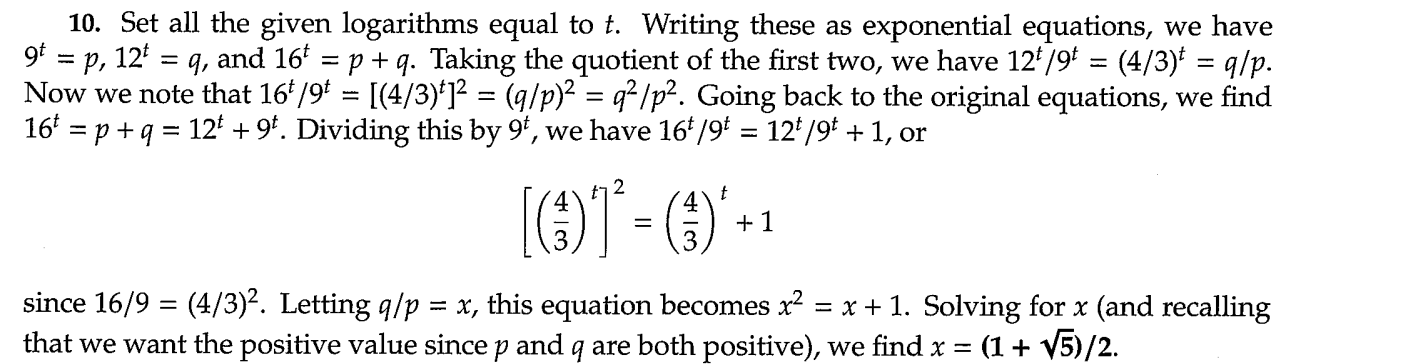
$\log_{9} p = \log_{12} q = x,(\frac{4}{3})^x = \frac{q}{p} = \frac{p + q}{q}$
ocean sealBOT
nchoosek
 royal kiln
a nudge pls
tardy stag
i think what i'd probably do is try and convert everything to the same base
royal kiln
yeah I haven't tried that
vale wigeon
royal kiln
$\log_{9} p = \log_{12} q = x,(\frac{4}{3})^x = \frac{q}{p} = \frac{p + q}{q}$
assuming this is true, you now have q/p = (p+q)/q
which is enough to solve for q/p
royal kiln
well
thats the bit I got stuck on 😄
everything is a variable and the same variable, how do I solve it there?
tardy stag
oh i misread what you had yeah that should be almost there
starting with $\f q p = \f{p+q}q$
ocean sealBOT
Hayley
 royal kiln
yeah and that is $(q + p)(q - p) = pq$
ocean sealBOT
nchoosek
 tardy stag
that might not help you much, factoring doesn't tend to do all that much when it's not = 0
this isn't super easy to see
i think if you split up that second fraction it might be useful?
royal kiln
I tried looking at that
tardy stag
tardy stag
i think i know how i would
so splitting up the second fraction you get what like
$\f q p = \f p q + \f q q$ right?
ocean sealBOT
Hayley
 royal kiln
yeah
 royal kiln
when in doubt
make something a variable
lemme scribble
lmfao im getting a really weird number
I think I was probably wrong about q/p = p+q/q 🤦♂️
I mean fuck it
might as well check the solution
I've spent 45 mins on this already
tardy stag
i get a number involving $\sqrt5$
ocean sealBOT
Hayley
 royal kiln
ye
I mean after change of variable its super simple
I just didn't see that for 25 mins 🤦♂️
but ok checking if my math before was right
tardy stag
royal kiln
I just didn't see that for 25 mins 🤦♂️
it's one of those tricks that once you see one time you start to recognize it everywhere
 tardy stag
nice job! you did most of the log work i just came in to help with the weirdo equations
by the way this equation is the golden ratio https://cdn.discordapp.com/attachments/490557019623915520/1139423591344123924/246857845285453824.png
 royal kiln
thanks
and neat, I actually have seen that before
just forgor
ok gonna close this out
.close
lone heartBOT
Channel closed
Closed by @royal kiln
Use .reopen if this was a mistake.
lone heartBOT
Available help channel!
Send your question here to claim the channel.
Remember:
• Ask your math question in a clear, concise manner.
• Show your work, and if possible, explain where you are stuck.
• After 15 minutes, feel free to ping <@&286206848099549185>.
• Type the command .close to free the channel when you're done.
• Be polite and have a nice day!
Read #❓how-to-get-help for further information on how to ask a good question, and about conduct in the question channels.
 subtle birch
If the line $x+y=a$ touches the circle $x^{2}+y^{2}-λx=0$ where $\left(a,λ>0\right)$ then find the minimum value of $λ+\frac{1}{a}$
lone heartBOT
subtle birch
If the line $x+y=a$ touches the circle $x^{2}+y^{2}-λx=0$ where $\left(a,λ>0\rig...
ocean sealBOT
B-eard
 subtle birch
What I've tried is\
$x^{2}+\left(x+a\right)^{2}-λx=0$\
$\left(2\right)x^{2}+\left(2a-λ\right)x+a^{2}=0$\
$-4a^{2}-4aλ+λ^{2}\ge0$\
ocean sealBOT
B-eard
 tardy stag
you should recognize the numbers 4, 4, 1 in the context of a quadratic
but dividing by \lambda^2 could work as long as you know that's never 0
subtle birch
tardy stag
you should recognize the numbers 4, 4, 1 in the context of a quadratic
I tried that and I know it is like (2a+b)^2
But look which coeff is negative and which is positive
it is in the form -(4a^2+4ab-b^2)
tardy stag
oh yeah oops
subtle birch
<@&286206848099549185>
subtle birch
I get a quadratic like
4q+4-1/q<=0
Idt that would help
For context I have the answer (just the answer, no process) which is $\sqrt{8\sqrt{2}-8}$
ocean sealBOT
B-eard
 subtle birch
so it seems to me that
there is some square root stuff here
Like we find (λ+1/a)^2
lone heartBOT
@subtle birch Has your question been resolved?
lone heartBOT
Channel closed
Closed due to timeout
Use .reopen if this was a mistake.
Available help channel!
Send your question here to claim the channel.
Remember:
• Ask your math question in a clear, concise manner.
• Show your work, and if possible, explain where you are stuck.
• After 15 minutes, feel free to ping <@&286206848099549185>.
• Type the command .close to free the channel when you're done.
• Be polite and have a nice day!
Read #❓how-to-get-help for further information on how to ask a good question, and about conduct in the question channels.
alpine sable
We know that the shaded area = 10unit^2

 lone heartBOT
alpine sable
We know that the shaded area = 10unit^2
alpine sable
lone heartBOT
alpine sable
We know that the shaded area = 10unit^2
alpine sable

but the answer states that it should be -2(-10) rather than -2(10)
why?
how can the area be negative?
<@&286206848099549185>
 gleaming granite
,rotate
ocean sealBOT
 gleaming granite
the area is negative because it's below the x axis
alpine sable
gleaming granite
the area is negative because it's below the x axis
I dont understand?
lime bobcat
The integral is negative, but most commonly we consider the areas to be positive so you have to take absolute value of the negative integral
But why you don't simply calculate this
alpine sable
lime bobcat
But why you don't simply calculate this
?
so it's like a fact that any area below x-axis is negative?
or what
because I still dont understand why I need to add a negative to 10
lime bobcat
$$A=-\int_1^3 g(x)dx$$
ocean sealBOT
Categorist
 lime bobcat
I'd calculate the area this way
ocean sealBOT
Sir Edgar
 lime bobcat
That would be negative because g(x) is negative on (1,3).
alpine sable
lime bobcat
That would be negative because g(x) is negative on (1,3).
huh?
lime bobcat
$$A=\left|\int_1^3 g(x)dx\right| = -\int_1^3g(x)dx$$
ocean sealBOT
Categorist
 alpine sable
lime bobcat
That would be negative because g(x) is negative on (1,3).
alpine sable
lime bobcat
That would be negative because g(x) is negative on (1,3).
g(x) is positive at (1,3)

how can g(x) be possibly negative on (1,3)?
alpine sable
yep
i am equally as confused as before
never mind I guess I'll just go search and internet and hope I can understand
.close
lone heartBOT
Channel closed
Closed by @obsidian cloak
Use .reopen if this was a mistake.
Available help channel!
Send your question here to claim the channel.
Remember:
• Ask your math question in a clear, concise manner.
• Show your work, and if possible, explain where you are stuck.
• After 15 minutes, feel free to ping <@&286206848099549185>.
• Type the command .close to free the channel when you're done.
• Be polite and have a nice day!
Read #❓how-to-get-help for further information on how to ask a good question, and about conduct in the question channels.
 keen wharf
can someone help for a
 lone heartBOT
keen wharf
can someone help for a
lone heartBOT
lone heartBOT
keen wharf
can someone help for a
lone heartBOT
Channel closed
Closed by @keen wharf
Use .reopen if this was a mistake.
lone heartBOT
Available help channel!
Send your question here to claim the channel.
Remember:
• Ask your math question in a clear, concise manner.
• Show your work, and if possible, explain where you are stuck.
• After 15 minutes, feel free to ping <@&286206848099549185>.
• Type the command .close to free the channel when you're done.
• Be polite and have a nice day!
Read #❓how-to-get-help for further information on how to ask a good question, and about conduct in the question channels.
 olive stirrup

 lone heartBOT
olive stirrup
olive stirrup
lone heartBOT
olive stirrup
olive stirrup
How to solve this please i need answer for olimpiad
I does not need the answer like yes or no but just need like how to do that
And the biggest problem is how to solve int2sqrt multiplied by root of x
Remember dont give the instant answer but i want step by step
Owh yea integral x/x+1 is x-ln(x+1)+c so what happen if i change to x/x+2
 ionic jewel
olive stirrup
And the biggest problem is how to solve int2sqrt multiplied by root of x
ionic jewel
olive stirrup
And the biggest problem is how to solve int2sqrt multiplied by root of x
this is just the normal power rule
the 1/(2+x) is u-sub
olive stirrup
Owh so its the step one?
ionic jewel
I don't know what that means
ionic jewel
olive stirrup
Owh yea integral x/x+1 is x-ln(x+1)+c so what happen if i change to x/x+2
this one has a kinda fun algebra trick where you can split it into 2 easy integrals
olive stirrup
olive stirrup
U-sub? <@153882568322711553> uh can you explain this more soorry
My brain not fluent for some slang
ionic jewel
olive stirrup
U-sub? <@153882568322711553> uh can you explain this more soorry
Sorry I'm on my phone so itd be a pain, but "u-sub" is a super common integration technique, you should be able to find good guides online
olive stirrup
Okay
Wait
Owh
Its differential?
Or wait i forgot turunan in english
Owh okay so u-sub is derivative?
Owh my god how stupid im
Owh nope thats not derivative but substitution
This is more complex than what i ask but..... I'll learn step by step by seeing the part
Learned from yt

So for integral 2^2✓x
Let see the x
u=x
x=u
<@&286206848099549185> someone please help abaut u subtitution im new at this
Im highschool teenager so the teacher didn't teached u subtitution
Imagine grade 11 stuck on limit
 covert hinge
olive stirrup
<@&286206848099549185> someone please help abaut u subtitution im new at this
covert hinge
olive stirrup
<@&286206848099549185> someone please help abaut u subtitution im new at this
I am not good at math, but I think You should substitute X value in the equation you got
winter light
olive stirrup
How to unuse help channel?
Write .close
olive stirrup
.close
lone heartBOT
Channel closed
Closed by @olive stirrup
Use .reopen if this was a mistake.
Available help channel!
Send your question here to claim the channel.
Remember:
• Ask your math question in a clear, concise manner.
• Show your work, and if possible, explain where you are stuck.
• After 15 minutes, feel free to ping <@&286206848099549185>.
• Type the command .close to free the channel when you're done.
• Be polite and have a nice day!
Read #❓how-to-get-help for further information on how to ask a good question, and about conduct in the question channels.
 hidden widget
dunno how to start
 lone heartBOT
hidden widget
dunno how to start
ocean sealBOT
lone heartBOT
hidden widget
dunno how to start
ocean sealBOT

 echo socket
Have you tried anything so far?
modern sedge
hidden widget
dunno how to start
There is a nice substitution u can do
lone heartBOT
@hidden widget Has your question been resolved?
hidden widget
echo socket
Have you tried anything so far?
no, i cant think of any sub
wait can i sub 2sint?
holy smokes ok
lone heartBOT
Channel closed
Closed by @hidden widget
Use .reopen if this was a mistake.
Available help channel!
Send your question here to claim the channel.
Remember:
• Ask your math question in a clear, concise manner.
• Show your work, and if possible, explain where you are stuck.
• After 15 minutes, feel free to ping <@&286206848099549185>.
• Type the command .close to free the channel when you're done.
• Be polite and have a nice day!
Read #❓how-to-get-help for further information on how to ask a good question, and about conduct in the question channels.
alpine sable
Hey i want a book that covers math from grade 1 to college
I am in bca degree program
I had mathematics in school but
I was not good i would like to study everything from basic to advance
lone heartBOT
alpine sable
Hey i want a book that covers math from grade 1 to college
I am in bca degree pr...
winter light
Post the message in #book-recommendations
I think you could have a lot of answers there
modern sedge
you could try khan academy if you dont mind it being online
winter light
alpine sable
Hey i want a book that covers math from grade 1 to college
I am in bca degree pr...
If you want some YouTube channels to look or follow here are some
lone heartBOT
@alpine sable Has your question been resolved?
lone heartBOT
Channel closed
Closed due to timeout
Use .reopen if this was a mistake.
Available help channel!
Send your question here to claim the channel.
Remember:
• Ask your math question in a clear, concise manner.
• Show your work, and if possible, explain where you are stuck.
• After 15 minutes, feel free to ping <@&286206848099549185>.
• Type the command .close to free the channel when you're done.
• Be polite and have a nice day!
Read #❓how-to-get-help for further information on how to ask a good question, and about conduct in the question channels.
 warped topaz
 lone heartBOT
warped topaz
https://i.imgur.com/iWT7BBj.png
warped topaz
lone heartBOT
warped topaz
https://i.imgur.com/iWT7BBj.png
warped topaz
I integrated the first half of this but I foget how to do the 2nd half, I currently have -4u/(u^2 + 5)
gray isle
can you show the work you've written out
warped topaz
Im pretty sure everything before this is correct, most of it was just solving the 1st half which I wrote in the answer box
warped topaz
warped topaz
I integrated the first half of this but I foget how to do the 2nd half, I curren...
I dont think I can solve this by changing it to arctan like I did with the first half
gray isle
pls just show
makes it much easier to see what issues there are if any and how to continue
warped topaz
Can we just pretend -4u/(u^2 + 5) is the question? It will take a long time to type and I am confident with my work, my only issue is idk what to do next with what I have
gray isle
pls just show the work you've done
is there a reason why you're unable to do that
take a pic if possible
or reproduce it in paint
do you know how to integrate stuff in the form
$$\int \frac{g'(x)}{g(x)} \dd{x}$$
ocean sealBOT
ℝam()n()v
 warped topaz
Ah yes it becomes a log
Oke I think I see what I need to do now 1 moment
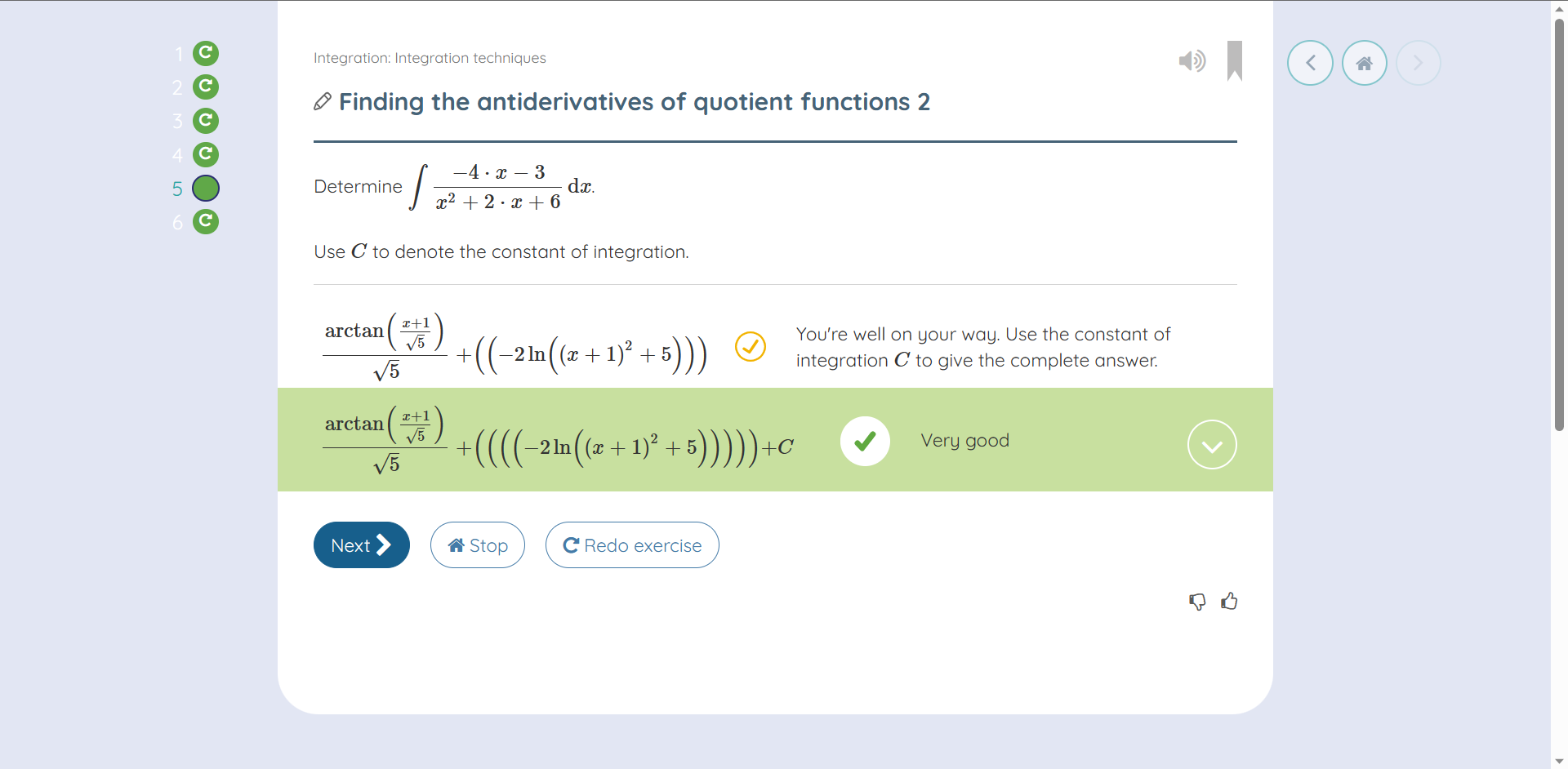
Yes I got it thank you!
❤️
.close
lone heartBOT
Channel closed
Closed by @warped topaz
Use .reopen if this was a mistake.
Available help channel!
Send your question here to claim the channel.
Remember:
• Ask your math question in a clear, concise manner.
• Show your work, and if possible, explain where you are stuck.
• After 15 minutes, feel free to ping <@&286206848099549185>.
• Type the command .close to free the channel when you're done.
• Be polite and have a nice day!
Read #❓how-to-get-help for further information on how to ask a good question, and about conduct in the question channels.
 fervent narwhal
if I'm on an equator and I throw a ball west side at the speed of rotation will the ball appear motion less from space (let's assuem there is no atmosphere and the ball does not touch the ground)
lone heartBOT
fervent narwhal
if I'm on an equator and I throw a ball west side at the speed of rotation will ...
fervent narwhal
rotation of earth of course
vale wigeon
depends on your frame of reference
fervent narwhal
the ball is moving at the speed of earth's rotation relative to me
vale wigeon
sure is
but like
from which point 'in space' are you looking at the ball
are you looking at it from a point that's like.. stationary relative to the earth's axis or something
in this case yes the ball will also appear stationary
while if you were in the ISS you probably would not see it as such
lone heartBOT
Channel closed
Closed by @fervent narwhal
Use .reopen if this was a mistake.
Available help channel!
Send your question here to claim the channel.
Remember:
• Ask your math question in a clear, concise manner.
• Show your work, and if possible, explain where you are stuck.
• After 15 minutes, feel free to ping <@&286206848099549185>.
• Type the command .close to free the channel when you're done.
• Be polite and have a nice day!
Read #❓how-to-get-help for further information on how to ask a good question, and about conduct in the question channels.
 indigo storm

 lone heartBOT
indigo storm
lone heartBOT
lone heartBOT
indigo storm
lone heartBOT
@indigo storm Has your question been resolved?
winter light
I would try adding and subtracting cosAcosB in the numerator, while in the denominator I believe it's useful to use the fact "a² - b² = (a - b)·(a + b)"
indigo storm
Will it help me to prove?
winter light
Let me try it

 winter light
Sorry, it seems it didn't work, I think of another way to do it
winter light
Yep, let me see it
 velvet oar


 winter light
$\frac{cosA}{1+sinA} \overset{t = tan\left(\frac{A}{2}\right)}{=} \frac{\frac{1-t^2}{1+t^2}}{1+\frac{2t}{1+t^2}} = \frac{\frac{1-t^2}{1+t^2}}{\left(\frac{1+t^2+2t}{1+t^2}\right)}=\frac{\frac{1-t^2}{1+t^2}}{\frac{(t+1)^2}{1+t^2}}=$
ocean sealBOT
Alberto Z.
 winter light
$\frac{\frac{1-t^2}{1+t^2}}{\frac{(t+1)^2}{1+t^2}}=\frac{\frac{1-t^2}{\cancel{1+t^2}}}{\frac{(t+1)^2}{\cancel{1+t^2}}}=\frac{\left(1+t\right)\cdot\left(1-t\right)}{(t+1)^2}=\frac{ \cancel{\left(1+t\right)} \cdot \left(1-t\right) }{ (t+1) ^ {\cancel{2}}}=$
indigo storm
What?
ocean sealBOT
Alberto Z.
 winter light
$=\frac{1-t}{1+t} \overset{t = tan\left(\frac{A}{2}\right)}{=} \frac{1 - tan\left(\frac{A}{2}\right)}{1+ tan\left(\frac{A}{2}\right)} = \frac{tan\left(\frac{\pi}{4}\right) - tan\left(\frac{A}{2}\right)}{1+tan\left(\frac{\pi}{4}\right) \cdot tan\left(\frac{A}{2}\right)} = tan\left(\frac{\pi}{4}-\frac{A}{2}\right)$
ocean sealBOT
Alberto Z.
 winter light
ocean seal
**Alberto Z.**
winter light
ocean seal
**Alberto Z.**
First step @indigo storm
winter light
ocean seal
**Alberto Z.**
Second step
winter light
ocean seal
**Alberto Z.**
Third step
That's one way to do it, if you know the parametric formulas with tan(x/2)
indigo storm
winter light
That's one way to do it, if you know the parametric formulas with tan(x/2)
Parametric formula?
What are they.
?
winter light
These ones, I don't know how you call them
 indigo storm
I have never learnt these
winter light
I put the wrong image sorry
winter light
winter light
These ones, I don't know how you call them
These are the ones I'm talking about
indigo storm
But I know only
sin2A = 2sinA.cosA
Cos2A
Tan2A
Yesh
I solved it
Finally
.close
lone heartBOT
Channel closed
Closed by @indigo storm
Use .reopen if this was a mistake.
Available help channel!
Send your question here to claim the channel.
Remember:
• Ask your math question in a clear, concise manner.
• Show your work, and if possible, explain where you are stuck.
• After 15 minutes, feel free to ping <@&286206848099549185>.
• Type the command .close to free the channel when you're done.
• Be polite and have a nice day!
Read #❓how-to-get-help for further information on how to ask a good question, and about conduct in the question channels.
 cedar juniper
!status
lone heartBOT
What step are you on?
1. I don't know where to begin
2. I have begun but got stuck midway
3. I got an answer but I'm told it's wrong
4. I got an answer and would like my work checked
5. I have a question about someone else's worked solution
6. None of the above
 molten mountain
i don't know if it could be 0 or
 lone heartBOT
@molten mountain Has your question been resolved?
ocean sealBOT
Result:
1.4411985e+13
@molten mountain Has your question been resolved?
lone heartBOT
@molten mountain Has your question been resolved?
 grizzled ingot
@molten mountain What have u tried?
molten mountain
grizzled ingot
<@1058658403033038848> What have u tried?
pv formula
grizzled ingot
you working out?
tacit arch
molten mountain
pv formula
show all your work
molten mountain
tacit arch
show all your work
nty
either u know how to solve or dont
- I got an answer and would like my work checked
tacit arch
molten mountain
4. I got an answer and would like my work checked
that's easiest if you show your work
tacit arch
lone heart
read the guidelines here
tacit arch
uh no you didn't
tacit arch
you wrote more words claiming you showed work than your actual "work"
molten mountain
yeah, so can u confirm that my answer is correct?
or do u not know how to solve it?
tacit arch
tacit arch
show all your work
.
tacit arch
lone heart
.
molten mountain
answer the question
tacit arch
tacit arch
that's easiest if you show your work
.
molten mountain
so u dont know how to solve it
tacit arch
and now you've written more words claiming i don't know how to do the problem than actually showing your work
tacit arch
tacit arch
show all your work
i was willing to review your work
but you chose to argue
molten mountain
no ur arguing with me
tacit arch
who's the troll ¯_(ツ)_/¯
molten mountain
im not going through the hassle with someone who isnt willing to tell me if they know how to solve it or not
tacit arch
great just waste your time then
molten mountain
<@&286206848099549185>
lone heartBOT
Channel closed
Closed due to the original message being deleted
Available help channel!
Send your question here to claim the channel.
Remember:
• Ask your math question in a clear, concise manner.
• Show your work, and if possible, explain where you are stuck.
• After 15 minutes, feel free to ping <@&286206848099549185>.
• Type the command .close to free the channel when you're done.
• Be polite and have a nice day!
Read #❓how-to-get-help for further information on how to ask a good question, and about conduct in the question channels.
 craggy crystal
Help
lone heartBOT
craggy crystal
Help
craggy crystal
I know we’re not here to get the answers but this is a really old past exam on my proctored lockdown browser I just wanna know what the answer was cuz I had no idea of solving it <@&286206848099549185>
 tacit arch
craggy crystal
I know we’re not here to get the answers but this is a really old past exam on m...
tacit arch
craggy crystal
I know we’re not here to get the answers but this is a really old past exam on m...
!15m
lone heartBOT
craggy crystal
I know we’re not here to get the answers but this is a really old past exam on m...
Please only use the <@&286206848099549185> ping once if your question has not been answered for 15 minutes. Please do not ping or DM individual users about your question.
craggy crystal
tacit arch
!15m
Sorry
tardy stag
craggy crystal
I know we’re not here to get the answers but this is a really old past exam on m...
every intersection is an equation, and each one needs to have vehicles in = vehicles out
additionally the network as a whole needs to satisfy vehicles in = vehicles out
lone heartBOT
@craggy crystal Has your question been resolved?
lone heartBOT
Channel closed
Closed due to timeout
Use .reopen if this was a mistake.
lone heartBOT
Available help channel!
Send your question here to claim the channel.
Remember:
• Ask your math question in a clear, concise manner.
• Show your work, and if possible, explain where you are stuck.
• After 15 minutes, feel free to ping <@&286206848099549185>.
• Type the command .close to free the channel when you're done.
• Be polite and have a nice day!
Read #❓how-to-get-help for further information on how to ask a good question, and about conduct in the question channels.
 lost inlet
How can I calculate the smallest 4 digit number divisible by 3 and when divided by 35 then remainder is 1?
lone heartBOT
lost inlet
How can I calculate the smallest 4 digit number divisible by 3 and when divided ...
vale wigeon
do you have access to the chinese remainder theorem
vale wigeon
rip
lost inlet
What do you mean by condenders?
vale wigeon
what can the last digit be
lost inlet
I mean i know the answear, I’m just not sure how to get there
1086
1056 doesnt have the remainder 1 when deviding by 35
lone heartBOT
@lost inlet Has your question been resolved?
 nimble fern
lost inlet
1056 doesnt have the remainder 1 when deviding by 35
nimble fern
lost inlet
1056 doesnt have the remainder 1 when deviding by 35
did you try listing out the first few mutliples of 35 after 1000 and then +1 to check if it is divisible by 3?
lone heartBOT
@lost inlet Has your question been resolved?
nimble fern
lost inlet
Is guessing the only way?
note that 35 and 3 are co-prime, so you would just have to check at most 3 terms
lone heartBOT
Channel closed
Closed by @lost inlet
Use .reopen if this was a mistake.
lost inlet
.reopen
lone heartBOT
✅
 tardy tapir
type .close
lost inlet
.close
lone heartBOT
Channel closed
Closed by @lost inlet
Use .reopen if this was a mistake.
Available help channel!
Send your question here to claim the channel.
Remember:
• Ask your math question in a clear, concise manner.
• Show your work, and if possible, explain where you are stuck.
• After 15 minutes, feel free to ping <@&286206848099549185>.
• Type the command .close to free the channel when you're done.
• Be polite and have a nice day!
Read #❓how-to-get-help for further information on how to ask a good question, and about conduct in the question channels.
alpine sable
Line m has an x-intercept of -4 and a y-intecept of 10. What is the slope of line m
lone heartBOT
alpine sable
Line m has an x-intercept of -4 and a y-intecept of 10. What is the slope of lin...
 lethal belfry
!status
lone heartBOT
What step are you on?
1. I don't know where to begin
2. I have begun but got stuck midway
3. I got an answer but I'm told it's wrong
4. I got an answer and would like my work checked
5. I have a question about someone else's worked solution
6. None of the above