#help-0
1 messages · Page 282 of 1
 ruby elbow
 lethal belfry
yeah, pretty much
lethal belfry
yup
ruby elbow
lethal belfry
yup
and that as he only answer?
not x = 6
cause x = 6 is y = 4
and its not asking for y = 4
its asking for y = 2
lethal belfry
the only input which ouputs 2 as far as I can see is x=4
ruby elbow
lethal belfry
the only input which ouputs 2 as far as I can see is x=4
yeah
👍
.close thanks I was understanding till the part about the "= 2"
 lone heartBOT
Channel closed
Closed by @ruby elbow
Use .reopen if this was a mistake.
 Available help channel!
Send your question here to claim the channel.
Remember:
• Ask your math question in a clear, concise manner.
• Show your work, and if possible, explain where you are stuck.
• After 15 minutes, feel free to ping <@&286206848099549185>.
• Type the command .close to free the channel when you're done.
• Be polite and have a nice day!
Read #❓how-to-get-help for further information on how to ask a good question, and about conduct in the question channels.
 cold pumice
How can I find the value of alpha?
 lone heartBOT
cold pumice
How can I find the value of alpha?
cold pumice
lone heartBOT
cold pumice
How can I find the value of alpha?
cold pumice
I got a partial work, in order to complete it I need to find BD/CK but idk how, or maybe there is much simpler way
 somber eagle
i would say the sin rule if you know it
cold pumice
somber eagle
i would say the sin rule if you know it
Where specifically?
somber eagle
actually i dont think its even necessaru
since the triangle is isosceles
the one with side length 8
 tall talon
Did you notice this triangle? You can work out alpha from there
 cold pumice
somber eagle
the one with side length 8
cold pumice
somber eagle
the one with side length 8
I don't see how can it help
somber eagle
wait what im stupid
cold pumice
tall talon
Did you notice this triangle? You can work out alpha from there
How? Notice that the 82 degree angle is ABE, not ABC
tall talon
Since the sum of angles is 180
somber eagle
you know 2 angles in the triangle
cold pumice
somber eagle
you know 2 angles in the triangle
I don't
tall talon
cold pumice
I don't
There is 82 and 90 (the right angle)
cold pumice
At the picture
the 82 degree
Is
ABD
NOT
ABC
The angle inside the triangle is 82 minus something
somber eagle
oh my mistake
tall talon
cold pumice
At the picture
Do you mean ABD = 82 deg ?
cold pumice
tall talon
Do you mean ABD = 82 deg ?
Yes
tall talon
my bad
cold pumice
Maybe it wasn't clear as I thought
somber eagle
ok once again i suggest the sin rule
tall talon
somber eagle
ok once again i suggest the sin rule
Good recommendation
somber eagle
with the entire triangle
cold pumice
somber eagle
with the entire triangle
What triangle
cold pumice
Which
tall talon
cold pumice
What triangle
He/ she/ it meant ABE
cold pumice
tall talon
He/ she/ it meant ABE
You could just use "they"
somber eagle
oh yeah i forgot i set that
tall talon
cold pumice
You could just use "they"
I'm not into the "pronouns" thing
cold pumice
So if I use the sine rule
somber eagle
honestly speedran the enter to the server
cold pumice
tall talon
I'm not into the "pronouns" thing
It's not about pronouns, if you don't know someones gender you can call them as "they" and it will be grammatically valid
That's just how English works
somber eagle
sorry i'll actually set them, i thought they were mandatory so i just picked at random
cold pumice
cold pumice
So if I use the sine rule
Yea I can find angle BEA
And then the other angle
I can't believe I didn't see that
I am so stupid
tall talon
And when you find AEB , what do you do? (just to see if you need further assistance)
Azu?
tall talon
Yup
lone heartBOT
Channel closed
Closed by @cold pumice
Use .reopen if this was a mistake.
Available help channel!
Send your question here to claim the channel.
Remember:
• Ask your math question in a clear, concise manner.
• Show your work, and if possible, explain where you are stuck.
• After 15 minutes, feel free to ping <@&286206848099549185>.
• Type the command .close to free the channel when you're done.
• Be polite and have a nice day!
Read #❓how-to-get-help for further information on how to ask a good question, and about conduct in the question channels.
 viscid dock
 lone heartBOT
viscid dock
viscid dock
lone heartBOT
viscid dock
viscid dock
3^x=2
2^[(x-1)/x]=?
 tacit arch
,rotate
 ocean sealBOT

 tardy tapir
!status
lone heartBOT
What step are you on?
1. I don't know where to begin
2. I have begun but got stuck midway
3. I got an answer but I'm told it's wrong
4. I got an answer and would like my work checked
5. I have a question about someone else's worked solution
6. None of the above
2
tardy tapir
what have you tried?
tardy tapir
you are
viscid dock
can you show the steps
tardy tapir
sub the value of x
tardy tapir
viscid dock
can you show the steps
!nosols
lone heartBOT
viscid dock
can you show the steps
As a helper, please do not give out answers that could be copied as a homework solution. Have the student work through the problem themselves and guide them along the way.
viscid dock
did that then?
tardy tapir
show me
viscid dock
bad writing but
tardy tapir
no worries
 viscid dock
2 is the base
tardy tapir
why is 2 in the air
tardy tapir
you got x as?
viscid dock
log3(2)
tardy tapir
now use loga-logb = log(a/b)
viscid dock
hmm
tardy tapir
now again use base change property
viscid dock
so write it as a-b?
tardy tapir
nah
viscid dock
what is base change proprty
tardy tapir
whats logc(a)/logc(b)
tardy tapir
 viscid dock
oh
tardy tapir
use this
viscid dock
so its logb(a)
tardy tapir
yes
 tardy tapir
2/3
viscid dock
how
tardy tapir
tardy tapir
its log3(2/3)
.
tardy tapir
tardy tapir
not 3/2
.
viscid dock
oh lol thanks
 low glen
viscid dock
low glen
viscid dock
3/2 or 2/3?
viscid dock
its supposed to be 3/2
low glen
im confused a lil bit
low glen
i think its 3/2
tardy tapir
it is 2/3
viscid dock
is the right answer i made the mistakes
viscid dock
low glen
i think its 3/2
no i wrote it wrongly
low glen
how how
viscid dock
look up
tardy tapir
try to solve it again, with a nice pencil
viscid dock
tardy tapir
try to solve it again, with a nice pencil
yeah thanks for the help i need to write better
viscid dock
.close
lone heartBOT
Channel closed
Closed by @viscid dock
Use .reopen if this was a mistake.
Available help channel!
Send your question here to claim the channel.
Remember:
• Ask your math question in a clear, concise manner.
• Show your work, and if possible, explain where you are stuck.
• After 15 minutes, feel free to ping <@&286206848099549185>.
• Type the command .close to free the channel when you're done.
• Be polite and have a nice day!
Read #❓how-to-get-help for further information on how to ask a good question, and about conduct in the question channels.
ruby elbow
simplify it to 30 * -3f * -7g
 lone heartBOT
ruby elbow
simplify it to 30 * -3f * -7g
ruby elbow
lone heartBOT
ruby elbow
simplify it to 30 * -3f * -7g
ruby elbow
?
 worn fox
f(-3) means the value of the function f at the point x=-3
worn fox
So you can replace f(-3) with -3
ruby elbow
and if g(-7) then 7
ruby elbow
worn fox
Its -6f(-3) take away 5g(-7)
oh
oops
sso
-6(-3) @worn fox
and 5(7)
if replacing them
worn fox
What is g(-7)?
ruby elbow
worn fox
What is g(-7)?
its y = 7
ruby elbow
ruby elbow
simplify it to 30 * -3f * -7g
look
worn fox
Are you sure
worn fox
worn fox
Its -6f(-3) take away 5g(-7)
Again^
ruby elbow
worn fox
Its -6f(-3) take away 5g(-7)
uh
worn fox
Youre conjuring a multiplication out of thin air :p
ruby elbow
are we just forgetting about 5g(-7)?
worn fox
You have $(-6f(-3)) - (5g(-7))$
ocean sealBOT
ΣΑC
 worn fox
Its -6f(-3) take away 5g(-7)
worn fox
worn fox
Its -6f(-3) take away 5g(-7)
Precisely this
ruby elbow
ocean seal
**ΣΑC**
this is all we are doing?
but then why would we need the entire graph
worn fox
To find the values of f(-3) and g(-7)
ruby elbow
worn fox
To find the values of f(-3) and g(-7)
we did tha
and it came out as y = -3 and y = 6
so where do we put the -3 and the 6
worn fox
ocean seal
**ΣΑC**
Right so you plug those into here
ruby elbow
into the f and g??
worn fox
You have found that f(-3) = -3 and g(-7) = 6
ruby elbow
yes
worn fox
ocean seal
**ΣΑC**
So that is what you replace in here
ruby elbow
worn fox
So that is what you replace in here
so
(-6(-3)(-3))-(5(6)(-7))
that doesnt make sense
ruby elbow
worn fox
So that is what you replace in here
we ae replacing f with -3
and g with 6?
is what your saying
worn fox
You replace f(-3) with -3
f(-3) is not f times (-3)
It's the value of f at the point x=-3
ruby elbow
so (-6(-3)) - (5(6))
worn fox
Yes
ruby elbow
worn fox
Yes
i thought thats what i said though
replace the f(-3) with -3
and replace g(-7) with 6
worn fox
Yes but then you multiplied instead of taking away and then asked why we needed the whole graph
-12 is correct
ruby elbow
worn fox
Yes but then you multiplied instead of taking away and then asked why we needed ...
oh
ruby elbow
worn fox
Yes but then you multiplied instead of taking away and then asked why we needed ...
why did we take it away though
how do I see next time that I'm suppose to take it away instead of doing other things with it
worn fox
ocean seal
**ΣΑC**
Because this is what the question says
They are using a dot when there is multiplication
ruby elbow
worn fox
Because this is what the question says
i thought that was negative 5 

it was but I didn't know
I was suppose to combine
5 with g
worn fox
You thought it was $(-6\cdot f(-3))\cdot (-5\cdot g(-7))$
ocean sealBOT
ΣΑC
 ruby elbow
ocean seal
**ΣΑC**
ruby elbow
ocean seal
**ΣΑC**
yeah
worn fox
But see i had to add brackets and another mult symbol to make it that
ruby elbow
i see
ruby elbow
worn fox
But see i had to add brackets and another mult symbol to make it that
so thats wht you meant by "summoning an equation out of nothing"
worn fox
Right you added a multiplication that didn't exist
 worn fox
Remember your orders of operations too
Do the multiplications first and then addition or subtraction
ruby elbow
worn fox
Do the multiplications first and then addition or subtraction
yeah I know that but I just got confused with the -5 lol
worn fox
It's okay now hopefully you won't be
ruby elbow
 lone heartBOT
Channel closed
Closed by @ruby elbow
Use .reopen if this was a mistake.
Available help channel!
Send your question here to claim the channel.
Remember:
• Ask your math question in a clear, concise manner.
• Show your work, and if possible, explain where you are stuck.
• After 15 minutes, feel free to ping <@&286206848099549185>.
• Type the command .close to free the channel when you're done.
• Be polite and have a nice day!
Read #❓how-to-get-help for further information on how to ask a good question, and about conduct in the question channels.
 weak ridge
 lone heartBOT
weak ridge
weak ridge
lone heartBOT
weak ridge
weak ridge
How to integrate this by substitution the eight part is what i am not getting
Should i do 8u
 minor needle
what have you tried
weak ridge
Sending bpictrue
 weak ridge
there is to be an 8x
minor needle
it looks correct, now just come back to the original variable x
weak ridge
minor needle
it looks correct, now just come back to the original variable x
but i need the 8x
minor needle
why 8x
 minor needle
answer might be different due to constant
according to this
8(x-2) = 8x - 16
we can "remove" -16 (derivative of a constant = 0)
so it becomes 8x
weak ridge
minor needle
we can "remove" -16 (derivative of a constant = 0)
im integrating
weak ridge
Why derivative
minor needle
int of 2x = x^2 + C, yes?
we can say answer is x^2 + 1, x^2 + 2, x^2 + 3, x^2 - 1000 etc.
and we're still right
lone heartBOT
Channel closed
Closed by @weak ridge
Use .reopen if this was a mistake.
Available help channel!
Send your question here to claim the channel.
Remember:
• Ask your math question in a clear, concise manner.
• Show your work, and if possible, explain where you are stuck.
• After 15 minutes, feel free to ping <@&286206848099549185>.
• Type the command .close to free the channel when you're done.
• Be polite and have a nice day!
Read #❓how-to-get-help for further information on how to ask a good question, and about conduct in the question channels.
 warped topaz
 lone heartBOT
warped topaz
https://i.imgur.com/QDpQPdv.png
warped topaz
lone heartBOT
warped topaz
https://i.imgur.com/QDpQPdv.png
warped topaz
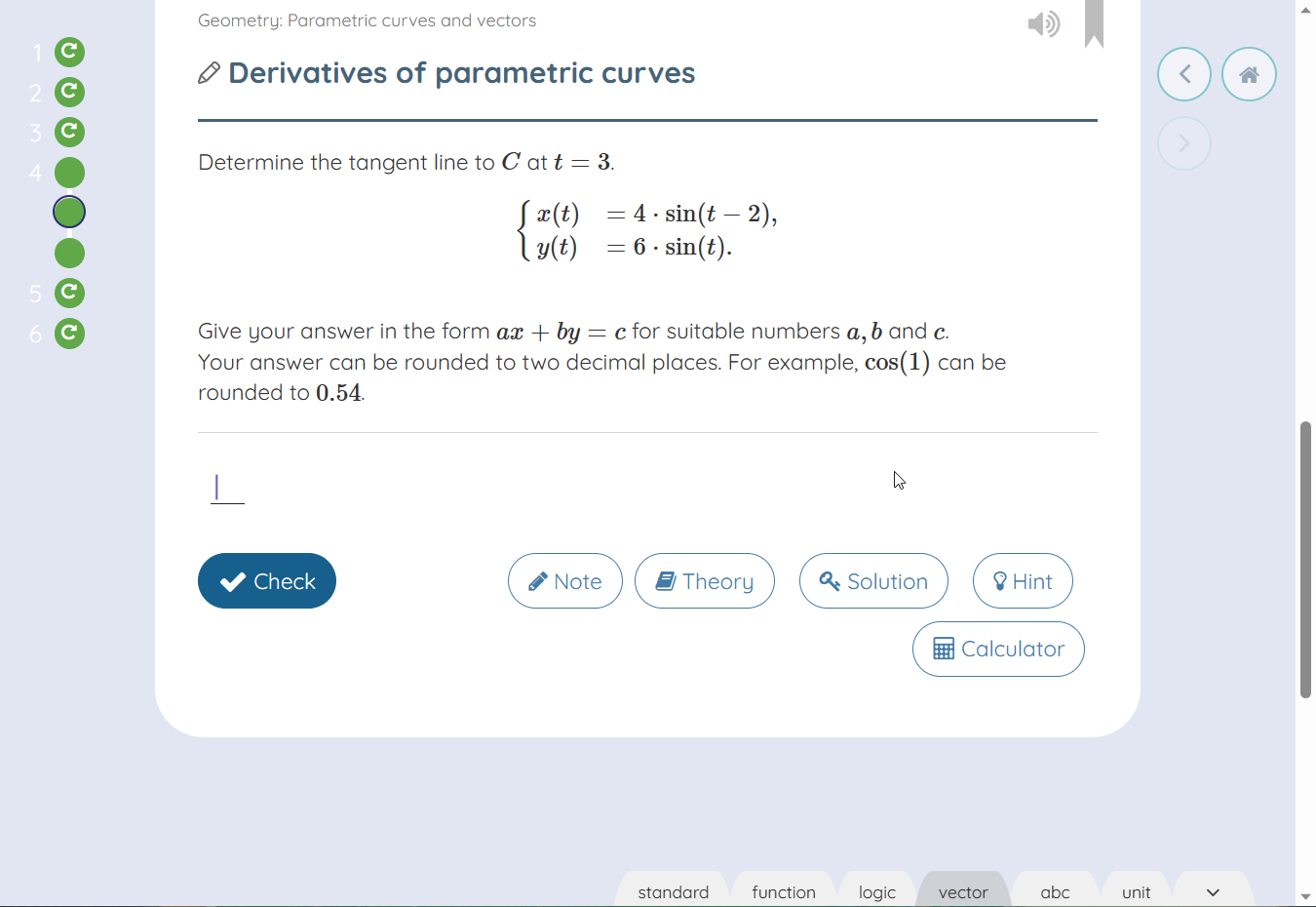
I remember how to solve this but I dont really understand the logic
I just replace a with y'(t), b with x'(t) and replace x with x(t) and y with y(t)
I dont really remember why I replace a with y'(t) or b with x'(t)
 marsh rapids
dy/dx = dy/dt * 1/ (dx/dt)
warped topaz
marsh rapids
dy/dx = dy/dt * 1/ (dx/dt)
What does this come from sry
marsh rapids
derivative rules
we already went over this something like 2 or 3 weeks ago I think
if y = ax+b, then you can rewrite this as y - ax = b
so it's enough to find the slope
oh wait
in this case
nice little linalg trick
marsh rapids
warped topaz
I just replace a with y'(t), b with x'(t) and replace x with x(t) and y with y(t...
oh well you already know
but there's a similar proof to the one for the normal vector and the plane equation
because it's basically the same thing
 near apex
marsh rapids
but there's a similar proof to the one for the normal vector and the plane equat...
near apex
marsh rapids
but there's a similar proof to the one for the normal vector and the plane equat...
I don't think OP is there yet. Maybe keep it simple.
warped topaz
Ye im dumb 😂
near apex
Lol. No. Not that.
marsh rapids
because if a line has directing vector (a, b) then (-b, a) (90° rotation) is orthogonal to the line.
So all vectors of the line are described as being orthogonal to (-b, a), which means (-b, a) . (x, y) = 0, i.e. -bx + ay = 0
which gives back y = b/a x, with b/a = dy/dx
so you can take b = y'(t), a = x'(t)
(and it turns out there's a very similar proof to why a plane with normal vector (a, b, c) can be described by ax+by+cz = d)
warped topaz
But what has this got to do with orthogonal lines sry
marsh rapids
just using the dot product as a way of describing lines
like you can say "the x-axis is the line of all points orthogonal to (0, 1)"
every line, as such, has a set of orthogonal vectors
warped topaz
OHHHH WAIT
marsh rapids
marsh rapids
because if a line has directing vector (a, b) then (-b, a) (90° rotation) is ort...
if (a, b) is a directing vector, then every point is of the form L(t) = (at + a0, bt + b0)
Then (-b, a) . L(t) = -bat -ba0 + bat + ab0 = ba0 + ab0 is constant
warped topaz
I just got it
So all vectors of the line are described as being orthogonal to (-b, a), which means (-b, a) . (x, y) = 0, i.e. -bx + ay = 0
This makes sense
marsh rapids
that one is a result you'd only really see when studying linalg an euclidian spaces
warped topaz
I had to reread all your messages like 10 times hahahaha but I finally got it
marsh rapids
because then you prove it for any dimension
so it's fair that it's hard to understand for you
warped topaz
marsh rapids
that one is a result you'd only really see when studying linalg an euclidian spa...
Hopefully I never have to do that 😓
marsh rapids
depends on how much math you come to do
warped topaz
This is hard enough hahaha
marsh rapids
but don't worry, you'll be a lot more mature when you get there
marsh rapids
math is about understanding and visualizing sometimes
warped topaz
I am just a square brain
warped topaz
marsh rapids
math is about understanding and visualizing sometimes
Yeye makes so much more sense now
marsh rapids
high school is crunching numbers, undergrad is having intuition to carry you
warped topaz
I miss when all I had to do was crunching numbers 😅
marsh rapids
the great students are the ones that manage to get that intuition in high school
warped topaz
True tbh
marsh rapids
and there aren't exactly many
at least not in your standard school with your standard teacher
where the objective is just to know the few techniques needed to pass the exam
(this is not india btw)
warped topaz
I dont need to just pass my exam I need 70% minimum to get accepted 💀
marsh rapids
US ?
marsh rapids
I forgor
marsh rapids
warped topaz
I dont need to just pass my exam I need 70% minimum to get accepted 💀
that's "passing" if you define it conveniently
warped topaz
I guess haha
marsh rapids
marsh rapids
that's "passing" if you define it conveniently
who cares if the bar for success is 50% or 70%, it's a bar
warped topaz
Yeye true, a high bar tho lol
marsh rapids
didn't say it was easy
warped topaz
And its a hard test (for me anyway)
marsh rapids
if you got an translated version I might enjoy taking a look at it
unless it's transparent enough
warped topaz
I actually do 1 moment
I think youre on my friends list so I will just dm it
.close
lone heartBOT
Channel closed
Closed by @warped topaz
Use .reopen if this was a mistake.
Available help channel!
Send your question here to claim the channel.
Remember:
• Ask your math question in a clear, concise manner.
• Show your work, and if possible, explain where you are stuck.
• After 15 minutes, feel free to ping <@&286206848099549185>.
• Type the command .close to free the channel when you're done.
• Be polite and have a nice day!
Read #❓how-to-get-help for further information on how to ask a good question, and about conduct in the question channels.
 lean wraith
I have a question about about a Fourier Transform
 lament forge
well nobody will be able to answer the question if you don't ask it
lean wraith
Technology being difficult one sec


I am stuck at the end part here
The provided answer looks like this

And I have gotten it to here

Did I go wrong somewhere or are these actually equal
 ancient saddle
lone heartBOT
ancient saddle
lone heartBOT
@lean wraith Has your question been resolved?
lean wraith
.close
lone heartBOT
Channel closed
Closed by @lean wraith
Use .reopen if this was a mistake.
lone heartBOT
Available help channel!
Send your question here to claim the channel.
Remember:
• Ask your math question in a clear, concise manner.
• Show your work, and if possible, explain where you are stuck.
• After 15 minutes, feel free to ping <@&286206848099549185>.
• Type the command .close to free the channel when you're done.
• Be polite and have a nice day!
Read #❓how-to-get-help for further information on how to ask a good question, and about conduct in the question channels.
 violet bear
I need help with this question
 lone heartBOT
violet bear
I need help with this question
violet bear
lone heartBOT
violet bear
I need help with this question
violet bear
was thinking of deriving the cosine using triangles and the pythagorean theorem but i don't know
 lone heartBOT
@violet bear Has your question been resolved?
lone heartBOT
@violet bear Has your question been resolved?
lone heartBOT
Channel closed
Closed by @violet bear
Use .reopen if this was a mistake.
lone heartBOT
Available help channel!
Send your question here to claim the channel.
Remember:
• Ask your math question in a clear, concise manner.
• Show your work, and if possible, explain where you are stuck.
• After 15 minutes, feel free to ping <@&286206848099549185>.
• Type the command .close to free the channel when you're done.
• Be polite and have a nice day!
Read #❓how-to-get-help for further information on how to ask a good question, and about conduct in the question channels.
 median oar
ok, given $B^TB=n, B, X \in \mathbb{R}^n\$
show $\frac{1}{n}||X-\frac{1}{n}(B\cdot X)B||^2=\frac{1}{n}||X||^2-\left(\frac{1}{n}(B\cdot X)\right)^2$
lone heartBOT
median oar
ok, given $B^TB=n, B, X \in \mathbb{R}^n\\$
show $\frac{1}{n}||X-\frac{1}{n}(B\c...
 tardy stag
you should probably have an equals sign or something
ocean sealBOT
Frosst
 tacit arch
 do you just open up the parentheses with dot product
median oar
now if we ignore the 1/n and expand the norm on the left $\left(X^T-\frac{1}{n}(B\cdot X)B^T\right)\left(X-\frac{1}{n}(B\cdot X)B\right)$
ocean sealBOT
Frosst
 median oar
that gives $X^TX - \frac{1}{n}(B\cdot X)X^TB - \frac{1}{n}(B\cdot X)B^TX + \frac{1}{n^2}(B\cdot X)^2B^TB$
ocean sealBOT
Frosst
 median oar
now since both X and B are R^n vectors, X^TB is X • B and B^TX is B • X and we know those are the same
$||X||^2 - \frac{2}{n}(B\cdot X)^2 + \frac{1}{n^2}(B\cdot X)^2 B^TB$
ocean sealBOT
Frosst
 median oar
then we use the identity of B^TB = n to simplify it to
$||X||^2 - \frac{1}{n}(B\cdot X)^2$
ocean sealBOT
Frosst
 median oar
now if we ignore the 1/n and expand the norm on the left $\left(X^T-\frac{1}{n}(...
median oar
median oar
now if we ignore the 1/n and expand the norm on the left $\left(X^T-\frac{1}{n}(...
i get the 1/n i left in this step
$\frac{1}{n}\left(||X||^2 - \frac{1}{n}(B\cdot X)^2\right)$
ocean sealBOT
Frosst
 median oar
ok i just needed to use latex to figure this out i think this is right
@mellow grail if u wanted to see
(except i need to go the other direction but that should be trivial)
ok thank you for the help channel and latex bot
.close
lone heartBOT
Channel closed
Closed by @median oar
Use .reopen if this was a mistake.
Available help channel!
Send your question here to claim the channel.
Remember:
• Ask your math question in a clear, concise manner.
• Show your work, and if possible, explain where you are stuck.
• After 15 minutes, feel free to ping <@&286206848099549185>.
• Type the command .close to free the channel when you're done.
• Be polite and have a nice day!
Read #❓how-to-get-help for further information on how to ask a good question, and about conduct in the question channels.
 crystal lotus
IM trying to solve this question.
 lone heartBOT
crystal lotus
IM trying to solve this question.
lone heartBOT
crystal lotus
IM trying to solve this question.
 near apex
Do you know what's slope of a tangent?
crystal lotus
I know you can obtain the equation of a tan line by using Y - y1 = m(x-x1) when given a value, thats what I was doing up until now. But this is a bit different which is why I thought to ask. My work here is based off the tutorial the webassign gave me... Unfortunatley its not very helpful though.
OH, wait.

NVM. i was just writing my answer wrong.
.close
lone heartBOT
Channel closed
Closed by @crystal lotus
Use .reopen if this was a mistake.
Available help channel!
Send your question here to claim the channel.
Remember:
• Ask your math question in a clear, concise manner.
• Show your work, and if possible, explain where you are stuck.
• After 15 minutes, feel free to ping <@&286206848099549185>.
• Type the command .close to free the channel when you're done.
• Be polite and have a nice day!
Read #❓how-to-get-help for further information on how to ask a good question, and about conduct in the question channels.
 chilly idol
 lone heartBOT
chilly idol
lone heartBOT
chilly idol
 upbeat gorge
Be more specific
chilly idol
ok
so for example, n=1 is the first term
a_n is the number of quilts
quilt squares
 thorny patio
There's a more explicit pattern emerging i think
Take a look at n = 3 in particular
chilly idol
ok
thorny patio
What does 5 mean in that photo
thorny patio
Number of blue squares for sure
chilly idol
yup
thorny patio
If i had to describe it in words
chilly idol
n is the term number, while a_n is the number of blue squares in the quilt
thorny patio
How to tell if a square would be blue or not is tougher to describe
thorny patio
I definitely think so too but i really am not sure what pattern the blue squares follow
upbeat gorge
I mean, the upper-rightmost and the lower-leftmost square are always blue so you can set either one as a baseline and say the rest follows a checkerboard pattern
chilly idol
yeah, we could also say that
what if the pattern is
the n term value divided by the total squares
for example
4 (the total squares in the quilt) divided by 2 (the term number)
4/2
which gets you 2
upbeat gorge
Well that fails with n=3
upbeat gorge
I think you have to state what n represents in terms of the quilt
We already have a_n as the number of blue squares in the design
chilly idol
yup
upbeat gorge
But we may have to be more specific than stating n as the index number
upbeat gorge
Well, in n=2, are there 2 squares in the quilt?
chilly idol
nope
maybe the n value represents the side of the quilt
for n=2, their are two squares at the side of the quilt
and for n=3 there are 3 squares at the side of the quilt
upbeat gorge
Yep, this works!
chilly idol
yay
 upbeat gorge
You theoretically can just bash it
chilly idol
oh
alr i shall do that
so i got a_n = 13
for n=5
im trying to figure out a pattern
upbeat gorge
Yeah sounds right
 upbeat gorge
Yeah, what part of the question do you need help for now
upbeat gorge
Yeah just plug in n
chilly idol
yup
@upbeat gorge alr i gotta go, this looks pretty simple enough so i think i can finish this on my own
thanks for your help!
upbeat gorge
Ok, no problem 
chilly idol
.close
lone heartBOT
Channel closed
Closed by @chilly idol
Use .reopen if this was a mistake.
Available help channel!
Send your question here to claim the channel.
Remember:
• Ask your math question in a clear, concise manner.
• Show your work, and if possible, explain where you are stuck.
• After 15 minutes, feel free to ping <@&286206848099549185>.
• Type the command .close to free the channel when you're done.
• Be polite and have a nice day!
Read #❓how-to-get-help for further information on how to ask a good question, and about conduct in the question channels.
 vagrant agate
for b is it just 3000(1+0.005)^2
 lone heartBOT
vagrant agate
for b is it just 3000(1+0.005)^2
lone heartBOT
vagrant agate
for b is it just 3000(1+0.005)^2
 solemn juniper
lone heartBOT
solemn juniper
lone heartBOT
Channel closed
Closed by @vagrant agate
Use .reopen if this was a mistake.
Available help channel!
Send your question here to claim the channel.
Remember:
• Ask your math question in a clear, concise manner.
• Show your work, and if possible, explain where you are stuck.
• After 15 minutes, feel free to ping <@&286206848099549185>.
• Type the command .close to free the channel when you're done.
• Be polite and have a nice day!
Read #❓how-to-get-help for further information on how to ask a good question, and about conduct in the question channels.
 alpine sable
 lone heartBOT
alpine sable
alpine sable
lone heartBOT
alpine sable
alpine sable
AD is parallel to BC not not equivalent?
at least i think that’s what the arrows mean
fuck
geometry exam tomorrow lol, i’m doing last minute studying
i don’t think that that necessarily proves it but i just want someone to check me
 royal socket
It does prove it since AD = BC as well
alpine sable
explain?
royal socket
Construct AC
alpine sable
?
royal socket
Draw AC
alpine sable
ok?
lone heartBOT
Channel closed
Closed by @upbeat dome
Use .reopen if this was a mistake.
Available help channel!
Send your question here to claim the channel.
Remember:
• Ask your math question in a clear, concise manner.
• Show your work, and if possible, explain where you are stuck.
• After 15 minutes, feel free to ping <@&286206848099549185>.
• Type the command .close to free the channel when you're done.
• Be polite and have a nice day!
Read #❓how-to-get-help for further information on how to ask a good question, and about conduct in the question channels.
tardy stag
differential geometry -
Is there some metric space where all geodesics (in any direction) converge to a point, or at least converge together? 
I'm thinking of a black hole and how "all paths lead to the singularity" but I don't think that's an accurate statement
lone heartBOT
tardy stag
differential geometry -
Is there some metric space where all geodesics (in any ...
tardy stag
this started because someone said all roads lead to rome and my mind got a little distracted
 carmine reef
I don't suppose spherical counts
tardy stag
I would also settle for all geodesics getting arbitrarily close to a target point an infinite number of times
tardy stag
yeah I want all of them
carmine reef
something involving projective geometry and infinity maybe?
tardy stag
one basic issue here is that going "backwards" on a geodesic would, in theory, take you away from whatever point
double sided Gabriel's horn seems neat but has some issues
alpine sable
i am very much enjoying following along on this conversation
carmine reef
I'm imagining starting with a euclidean disc and using a metric where distances are larger the further from the center you are
I feel like that would have a tendency to suck in geodesics towards the center but I don't really know how any of this stuff works
tardy stag
I think you could easily construct orbits or something on that, and if you go directly away from center you're not coming back
but that's a good start! this problem seems fun
carmine reef
One note with orbits is that there's no inherent notion of velocity
So I don't know that a periapsis and an apoapsis should really behave differently
And it feels like a circular orbit is only stable for a very specific metric
or well, perhaps there's a lot of metrics where a circular orbit is stable for one specific r but it feels like by making the metric extreme enough we can fix that
Maybe we could base it on elliptical geometry instead of euclidean to get rid of the problem of a line leading directly away from the hole
Or well, just spherical
carmine reef
Is it allowed to start with a Euclidean disc and identify antipodal boundary points with each other
lone heartBOT
@tardy stag Has your question been resolved?
tardy stag
i guess if we start with the euclidean disk and tie all the edges together it technically works but that absolutely feels like cheating so hmm
tardy stag
okay if we just want a space where every geodesic crosses over a certain point we have that it's called a circle
ugh i don't feel like i'm qualified to answer this question anymore
 bold pollen
lone heartBOT
bold pollen
lone heartBOT
@tardy stag Has your question been resolved?
tardy stag
not going to leave this open for too long because it's both specific and ill-defined and i really need to re-learn differential geometry before i can get an answer to it, but essentially:
I'm looking for a metric space such that all geodesics, starting at any location except perhaps the point P, have the same limit of P
this may be impossible
 summer dirge
tardy stag
this may be impossible
summer dirge
tardy stag
this may be impossible
just a suggestion, but maybe the folks at MathStackExchange or MathOverflow can help you with your question
tardy stag
yeah that's probably the next step
that, or actually figuring out what i'm asking lol
.close
lone heartBOT
Channel closed
Closed by @tardy stag
Use .reopen if this was a mistake.
Available help channel!
Send your question here to claim the channel.
Remember:
• Ask your math question in a clear, concise manner.
• Show your work, and if possible, explain where you are stuck.
• After 15 minutes, feel free to ping <@&286206848099549185>.
• Type the command .close to free the channel when you're done.
• Be polite and have a nice day!
Read #❓how-to-get-help for further information on how to ask a good question, and about conduct in the question channels.
 vapid steppe
Approximate $\sqrt{\pi}$ using the local linearization of $f(x)=\sqrt{x}$ at the point where $x=3$.
lone heartBOT
vapid steppe
Approximate $\sqrt{\pi}$ using the local linearization of $f(x)=\sqrt{x}$ at the...
ocean sealBOT
Jash

 echo socket
!status
lone heartBOT
What step are you on?
1. I don't know where to begin
2. I have begun but got stuck midway
3. I got an answer but I'm told it's wrong
4. I got an answer and would like my work checked
5. I have a question about someone else's worked solution
6. None of the above
 remote heron
hmm whered you get stuck?
remote heron
this means to assume that, near to some point, the function is just a line
vapid steppe
oh
remote heron
mechanically it means constructing the tangent line
vapid steppe
so i find the tangent line of f at x=pi?
remote heron
not quite
vapid steppe
x=3
remote heron
yea, construct the linearization at x=3
then you just assume that for values near 3, like say pi, the approximation will be OK
vapid steppe
so like f(3)=sqrt(3) and f'(3)=1/(2sqrt(3))
so y=(1/(2sqrt(3))) (x-3)+sqrt(3)
so do i just plug in pi?
remote heron
yea, into your line
vapid steppe
vapid steppe
so y=(1/(2sqrt(3))) (x-3)+sqrt(3)
can i just use this to approximate any value of f
echo socket
No, not any
remote heron
vapid steppe
can i just use this to approximate any value of f
well it doesnt make sense for every value
the domains dont match up
but otherwise yea, the approximation just gets poorer and poorer
its pretty good here
vapid steppe
oh ok
uh so the next part is Determine if your approximation is an underestimate or overestimate of the actual value of sqrt(pi). Justify your answer.
remote heron
there are a few ways you could go about this, whats your thought
vapid steppe
vapid steppe
so do i just plug in pi?
can i use a calculater to just like compare this value to the actual value
vapid steppe
how would i do it otherwise
remote heron
you have a few ways
one would be to take a number ||a little smaller than your estimate, square it, and show that this squared is still xyz||
alternatively, you can look at derivatives
you know your approximation is equal to the function at x=3
vapid steppe
my teacher was talking about like using the concavity of the function
remote heron
whats happening from there
yea
you can show that sqrt is pulling away from this line
remote heron
,w second derivative sqrt(x)
ocean sealBOT


 remote heron
clearly the second derivative of the line is 0
vapid steppe
ye
vapid steppe
ocean seal
would i evaluate at pi or 3?
remote heron
just make an argument for an x in the area
vapid steppe
i mean ik it doesnt matter in this case
remote heron
the rate of change of our line isnt changing
but for the sqrt line, its decreasing
that seems sufficient to me  is anybody watching
vapid steppe
oh so like the line is always increasing at a constant rate but the sqrt graph increases at a decreasing rate
vapid steppe
implying that the line is above the sqrt near x=3
remote heron
sqrt increases less than your line
because its derivative will have decreased when you moved rightwards of x=3
remote heron
ocean seal
this is always negative if its not clear that part of the argument

 remote heron
can you argue it?
vapid steppe
since S is concave down, the approximation will be an overestimate
remote heron
that seems fair to me
lone heartBOT
Channel closed
Closed by @vapid steppe
Use .reopen if this was a mistake.
Available help channel!
Send your question here to claim the channel.
Remember:
• Ask your math question in a clear, concise manner.
• Show your work, and if possible, explain where you are stuck.
• After 15 minutes, feel free to ping <@&286206848099549185>.
• Type the command .close to free the channel when you're done.
• Be polite and have a nice day!
Read #❓how-to-get-help for further information on how to ask a good question, and about conduct in the question channels.
 simple saddle
 lone heartBOT
simple saddle
simple saddle
lone heartBOT
simple saddle
simple saddle
how to do this?
 vale wigeon
you have 101 numbers, one of them is 10,000,000 and the rest are 2, their average is?
lone heartBOT
@simple saddle Has your question been resolved?
simple saddle
vale wigeon
you have 101 numbers, one of them is 10,000,000 and the rest are 2, their averag...
but how can i do without calculator?
vale wigeon
do you know how to divide numbers without a calculator?
long division, etc?
you have here an eight digit long number but dividing by 101 is not even that much time consuming or painful.
simple saddle
vale wigeon
do you know how to divide numbers without a calculator?
ya but won't it be still time consuming
can we estimate using the data
vale wigeon
well maybe if you have 5 seconds to solve this question
then yeah it will be time consuming
are you at least able to write down the exact value of the average as a fraction Y/N
simple saddle
vale wigeon
are you at least able to write down the exact value of the average as a fraction...
yeah
simple saddle
10,000,200/ 101
vale wigeon
ok great
do you know how to do long division
i promise you this is not any harder than any other long division problem
simple saddle
vale wigeon
i promise you this is not any harder than any other long division problem
okk
vale wigeon
trying to do some big brain estimation gymnastics will be harder
simple saddle
vale wigeon
trying to do some big brain estimation gymnastics will be harder
okay ann
thanks
.close
lone heartBOT
Channel closed
Closed by @simple saddle
Use .reopen if this was a mistake.
Available help channel!
Send your question here to claim the channel.
Remember:
• Ask your math question in a clear, concise manner.
• Show your work, and if possible, explain where you are stuck.
• After 15 minutes, feel free to ping <@&286206848099549185>.
• Type the command .close to free the channel when you're done.
• Be polite and have a nice day!
Read #❓how-to-get-help for further information on how to ask a good question, and about conduct in the question channels.
 fallow solar
'
 lone heartBOT
fallow solar
'
fallow solar
lone heartBOT
fallow solar
'
fallow solar
Where will the friction force go ?
 vapid shuttle
please don't close and reopen a new channel just to ask the same question
fallow solar
vapid shuttle
please don't close and reopen a new channel just to ask the same question
ok sry
summer dirge
fallow solar
Where will the friction force go ?
is the applied force just 8N?
 naive valley
what is going on in this photo
fallow solar
summer dirge
is the applied force just 8N?
yes
summer dirge
fallow solar
yes
then my intuition says friction force points up
fallow solar
and also the weight
fallow solar
summer dirge
then my intuition says friction force points up
but how
summer dirge
is the box at rest?
fallow solar
summer dirge
is the box at rest?
it's about to move
summer dirge
fallow solar
it's about to move
??
fallow solar
summer dirge
??
sry I edited
summer dirge
i mean it doesn't matter tbh
friction points up here I'm 95% sure
the gravitational force exerts 10N on the block downwards
while the applied force exerts only 8sin30 N on the block upwards
so friction should point up
to help the applied force counter gravity
fallow solar
summer dirge
friction points up here I'm 95% sure
You're right but how? doesn't friciton work in the opposite direction of the estimated direction of motion?
summer dirge
fallow solar
You're right but how? doesn't friciton work in the opposite direction of the est...
what do you mean?
friction opposes movement
fallow solar
summer dirge
friction opposes movement
yes
summer dirge
so then, what's the issue?
fallow solar
when the object moves it will move upwards right?
summer dirge
fallow solar
when the object moves it will move upwards right?
how would it move upwards?
fallow solar
the force F points in that way
summer dirge
yeah but you can't ignore gravity
who is stronger than the y component of the applied force here
so w/o friction, the expected result is that the block falls
summer dirge
fallow solar
'
the 10N is Fg, yes?
fallow solar
aha now I get it
summer dirge
or am i wrong
fallow solar
summer dirge
the 10N is Fg, yes?
What's Fg
summer dirge
gravitational force
fallow solar
yup
summer dirge
👍
lone heartBOT
Channel closed
Closed by @fallow solar
Use .reopen if this was a mistake.
Available help channel!
Send your question here to claim the channel.
Remember:
• Ask your math question in a clear, concise manner.
• Show your work, and if possible, explain where you are stuck.
• After 15 minutes, feel free to ping <@&286206848099549185>.
• Type the command .close to free the channel when you're done.
• Be polite and have a nice day!
Read #❓how-to-get-help for further information on how to ask a good question, and about conduct in the question channels.
 naive gale
hello every1
lone heartBOT
naive gale
hello every1

 lone heartBOT
@naive gale Has your question been resolved?
lone heartBOT
@naive gale Has your question been resolved?
lone heartBOT
Channel closed
Closed due to timeout
Use .reopen if this was a mistake.
naive gale
.reopen
lone heartBOT
✅
lone heartBOT
@naive gale Has your question been resolved?
Show your work, and if possible, explain where you are stuck.
lone heartBOT
Channel closed
Closed due to timeout
Use .reopen if this was a mistake.
Available help channel!
Send your question here to claim the channel.
Remember:
• Ask your math question in a clear, concise manner.
• Show your work, and if possible, explain where you are stuck.
• After 15 minutes, feel free to ping <@&286206848099549185>.
• Type the command .close to free the channel when you're done.
• Be polite and have a nice day!
Read #❓how-to-get-help for further information on how to ask a good question, and about conduct in the question channels.
 jolly pilot
Hi could someone help me with this problem
 lone heartBOT
jolly pilot
Hi could someone help me with this problem
jolly pilot
lone heartBOT
jolly pilot
Hi could someone help me with this problem
jolly pilot
We have to find the percentage of shaded area for the shape
It seems basic ik, but I have no clue what to do without assuming anything
echo socket
Are you familiar with the formula for the radius of the circle inscribed in a right triangle?
weak ridge
 echo socket
weak ridge
echo socket
weak ridge
Wrong channel
jolly pilot
echo socket
Are you familiar with the formula for the radius of the circle inscribed in a ri...
No i'm not
never heard of it
echo socket
It's equal to (a + b - c)/2 where a and b are the legs and c is the hypotenuse of the right triangle
Want to see how this formula is proven?
jolly pilot
Yeah that would be great
echo socket
Okay, let me draw a diagram
jolly pilot
Wait so we simply have to substitute a value for the legs, calculate the hypotenuse and then divide by two to get the radius
jolly pilot
echo socket
Okay, let me draw a diagram
alright thanks
 jolly pilot
Yep
echo socket
Let's call the horizontal leg a and vertical leg b for convenience
jolly pilot
Alright
jolly pilot
oh yh thats true
echo socket
echo socket
So we have IH = a - r and EF = b - r
jolly pilot
yep
echo socket
echo socket
Now, thanks to the symmetry, we can say that FJ = FE and HI = HJ
But FJ and HJ add up to the hypotenuse, c
jolly pilot
echo socket
Now, thanks to the symmetry, we can say that FJ = FE and HI = HJ
wait so we can just assume that
echo socket
So c = FJ + HJ = FE + HI = a - r + b - r
echo socket
jolly pilot
wait so we can just assume that
The symmetry can be proven, you would just need to show that the right triangles are the same
jolly pilot
oh alright
echo socket
echo socket
So c = FJ + HJ = FE + HI = a - r + b - r
So here you isolate r and get r = (a + b - c)/2
jolly pilot
alright yeah i follow
echo socket
echo socket
The symmetry can be proven, you would just need to show that the right triangles...
E.g. the right triangles JDH and DIH have the same hypotenuse and legs (DJ and DI) are equal, meaning the other legs (HI and HJ) are also equal
Similar argument for the other ones
echo socket
jolly pilot
Hi could someone help me with this problem
Okay, so, using Pythagorean theorem, you can show that the hypotenuse here is x * sqrt(2)
And simply apply the formula
That's it
jolly pilot
alright wait
so (1+1+sqrt(2))/2 = r
then r^2 x pi equals the area
and then u just divide that by 1/2 to get the percentage
echo socket
Yeah, x shouldn't have disappeared though
jolly pilot
what do u mean by that
echo socket
jolly pilot
so (1+1+sqrt(2))/2 = r
Should be $r = \frac{x + x - x\sqrt{2}}2$
ocean sealBOT
A Lonely Bean
 echo socket
Oh and the minus sign too yeah
jolly pilot
oh ok mb
yh i screwed that up
but you can still substitute 1 right
or any number and u would get the right answer
echo socket
Not really, you can't assume the answer is a constant no matter the value of x yet
Unless you realize that when you divide, the x^2 terms cancel out
Then sure
echo socket
ocean seal
**A Lonely Bean**
Anyway, this means that $r = x\frac{2 - \sqrt2}2$ and $\pi r^2 = x^2 \frac{3 - 2\sqrt{2}}2$
ocean sealBOT
A Lonely Bean
 jolly pilot
alright so ((2x - x * sqrt(2)/2)^2 x pi) / 0.5 would get me the percentage
echo socket
echo socket
And you get 3 - 2sqrt(2)
Oh I forgot about pi here my bad
echo socket
jolly pilot
so is the answer 53.9%
Yeah
jolly pilot
echo socket
Yeah
dam
thank u so much
i've been stuck on that for half and hour
ur actually a life saver
.close
lone heartBOT
Channel closed
Closed by @jolly pilot
Use .reopen if this was a mistake.
Available help channel!
Send your question here to claim the channel.
Remember:
• Ask your math question in a clear, concise manner.
• Show your work, and if possible, explain where you are stuck.
• After 15 minutes, feel free to ping <@&286206848099549185>.
• Type the command .close to free the channel when you're done.
• Be polite and have a nice day!
Read #❓how-to-get-help for further information on how to ask a good question, and about conduct in the question channels.
 steel olive
 lone heartBOT
steel olive
steel olive
lone heartBOT
steel olive
steel olive
I didn't get the bottom right part
vale wigeon
it's a sleight of hand
vale wigeon
yeah, exactly. they're doing black magic.
i mean here you can substitute t := 2^(1/x) and acknowledge t -> +∞
then you have (t-1)/(t+1) = (1 - 1/t)/(1 + 1/t) -> 1
lone heartBOT
Channel closed
Closed by @steel olive
Use .reopen if this was a mistake.
Available help channel!
Send your question here to claim the channel.
Remember:
• Ask your math question in a clear, concise manner.
• Show your work, and if possible, explain where you are stuck.
• After 15 minutes, feel free to ping <@&286206848099549185>.
• Type the command .close to free the channel when you're done.
• Be polite and have a nice day!
Read #❓how-to-get-help for further information on how to ask a good question, and about conduct in the question channels.
 safe tartan
 lone heartBOT
safe tartan
safe tartan
lone heartBOT
safe tartan
safe tartan
how do i draw y^2=x^2-1
safe tartan
yes , how is this a hyperbola thouhg
vale wigeon
it's a hyperbola aligned differently wrt the axes
 buoyant storm
x^2-y^2=1 is easier to understand
safe tartan
is it the same as y=+-sqrt(x^2-1)
by graphing both of those
no it is not
lmao
oh wait it is
lone heartBOT
@safe tartan Has your question been resolved?
safe tartan
.close
lone heartBOT
Channel closed
Closed by @safe tartan
Use .reopen if this was a mistake.
lone heartBOT
Available help channel!
Send your question here to claim the channel.
Remember:
• Ask your math question in a clear, concise manner.
• Show your work, and if possible, explain where you are stuck.
• After 15 minutes, feel free to ping <@&286206848099549185>.
• Type the command .close to free the channel when you're done.
• Be polite and have a nice day!
Read #❓how-to-get-help for further information on how to ask a good question, and about conduct in the question channels.
 flint inlet
how tf am i supposed to makje this a fraction
lone heartBOT
flint inlet
how tf am i supposed to makje this a fraction

 echo socket
By doing it without a graphing calculator? Consider integrating
echo socket
flint inlet
What exactly is the teacher asking for? The same as what's asked for here?
echo socket
Well some of the coefficients will be fractions
flint inlet

something like this
with 0,2 being a postivive integral subtracted from 2,3
positive
echo socket
Yeah for part d you don't need to have bounds of integrations, just integrate indefinitely and choose the value of +C correctly so that s(0) = 1
flint inlet
i did d already
just c mb
but my brain hurts trying to turn that into a fraction
like how
i only need to integrate 0, .55 - .55,5 right?
 echo socket
This is really weird, they give v(t) only at the end?
Anyway, to get the distance travelled you need to integrate the absolute value of v(t) rather than v(t) itself
So $\int_0^5(2t^2 - 12t + 6)\dd{t} = \frac{2\cdot5^3}3 - 6\cdot5^2 + 6\cdot5$
Wait no
ocean sealBOT
A Lonely Bean
 echo socket
The antiderivative is 2t^3/3 - 6t^2 + 6t and when you plug in t = 0, it's 0, so just plug in t = 5
echo socket
ocean seal
**A Lonely Bean**
So this is just 250/3 - 120, can you make the denominators common here?
Damn I made the very mistake I warned you from doing lol
echo socket
Yeah but that's gonna be irrelevant as we have to integrate |v(t)| here
So integrate $\int_0^5\abs{2t^2 - 12t + 6}\dd{t}$
ocean sealBOT
A Lonely Bean
 echo socket
No
flint inlet
im stupid
echo socket
You are gonna have to break up the interval depends on the roots
Alternatively you could take your answer from b and just add $2\int_{t_1}^{t_2}(-2t^2 + 12t - 6)\dd{t}$
flint inlet
hm
echo socket
Where t_1 and t_2 are the roots
ocean sealBOT
A Lonely Bean
 echo socket
I think this is easier yeah
flint inlet
roots of what though?
flint inlet
so like 0 and -110/3
echo socket
0 is not a root of v(t)
 winter light
Do you know how to solve that quadratic equation? v(t) = 0
echo socket
Solve 2t^2 - 12t + 6 = 0 using quadratic formula or whatever method you want
flint inlet
yeah
.5505
and 5.449
when i get the decimals i get stumped
as she wants a pure fraction answer
echo socket
So you just don't approximate, leave the roots as $3+\sqrt6$ and $3-\sqrt6$
ocean sealBOT
A Lonely Bean
 flint inlet
OHHHHHHHHHHHH
echo socket
So we can now calculate $2\int_{3-\sqrt6}^{3+\sqrt6}(-2t^2 + 12t - 6)\dd{t}$
ocean sealBOT
A Lonely Bean
 echo socket
Eh, which gets really messy unless we complete the square
So -2t^2 + 12t - 6 is the same as -2(t - 3)^2 + 12, meaning that's symmetrical around t = 3
And we can rewrite that integral as $4\int_3^{3+\sqrt6}(-(t - 3)^2 + 6)\dd{t}$
ocean sealBOT
A Lonely Bean
 flint inlet
I see it
echo socket
Can you integrate this or do I continue?
echo socket
Okay, don't forget that you have to add this to -110/3
flint inlet
thank you sm
echo socket
You are welcome
echo socket
The entire interval, yeah
flint inlet
so it means i dont need the 3+sqrt6
echo socket
flint inlet
So, when are take the absolute value of this function, everything that is below the x-axis gets flipped around the x-axis and becomes positive
flint inlet
kk
echo socket
In terms of the area, it stays the same except we add twice the geometric area of the part of the graph that used to be below the x-axis
That's basically what we did here
lone heartBOT
@flint inlet Has your question been resolved?
Channel closed
Closed by @flint inlet
Use .reopen if this was a mistake.
Available help channel!
Send your question here to claim the channel.
Remember:
• Ask your math question in a clear, concise manner.
• Show your work, and if possible, explain where you are stuck.
• After 15 minutes, feel free to ping <@&286206848099549185>.
• Type the command .close to free the channel when you're done.
• Be polite and have a nice day!
Read #❓how-to-get-help for further information on how to ask a good question, and about conduct in the question channels.
warped topaz
 lone heartBOT
warped topaz
https://i.imgur.com/rc5KI4d.png
lone heartBOT
warped topaz
https://i.imgur.com/rc5KI4d.png


 near apex
Why are you even doing that ?
warped topaz
Doing which sry?
near apex
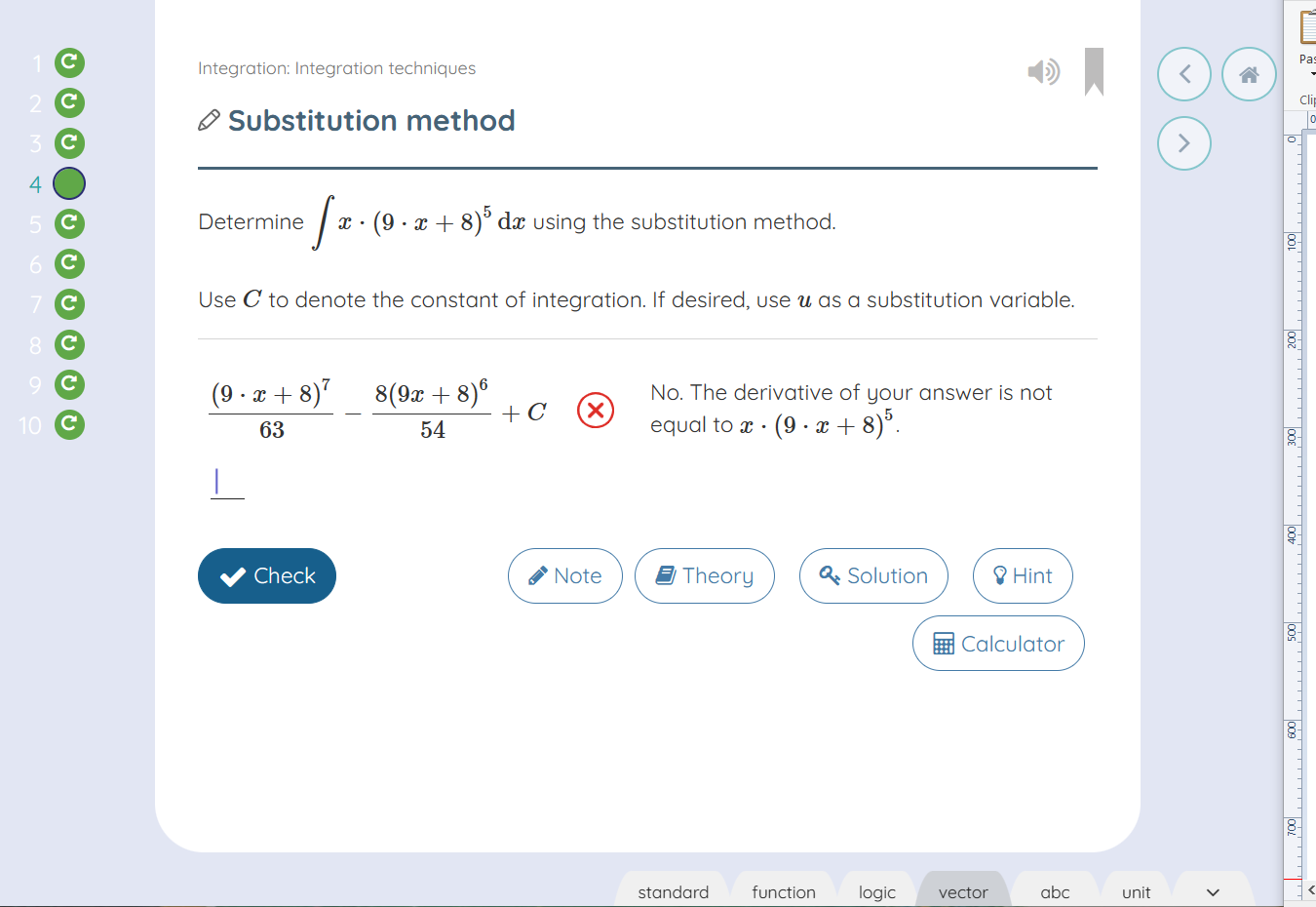
Never mind. You can do that however you have made a big blunder.
Firstly, do you think that you can simply take 1/9 out from ((u-8)/9)^5 ?
warped topaz
Ah yes true
warped topaz
oh haha
near apex
What's wrong with me? 🤦♂️
near apex
No.
Firstly, du can never just be a number. 😐
du will always be of form (some expression)dx.
near apex
Why don't you try doing du business more systematically?
Always write u = (whatever expression you assume as u)
differentiate w.r.t. x(or whichever variable you have).
you'll get, du/dx = (some expression)
So, you have du = (some expression * dx)
warped topaz
Yep my lazyness is a problem