
#help-0
1 messages · Page 266 of 1
 tiny aspen
i tried to do it but there is one step in it that my friend did that doesnt make sense
 west girder
Make everything powers kf 3
tiny aspen
ok wait

this is how one of my friends did ti
can you explain the two steps i have marked
@west girder ?
west girder
a/a=1
tiny aspen
did we take 3^4n and -3^4n in common?
 lone heartBOT
@tiny aspen Has your question been resolved?
lone heartBOT
Channel closed
Closed due to timeout
Use .reopen if this was a mistake.
 Available help channel!
Send your question here to claim the channel.
Remember:
• Ask your math question in a clear, concise manner.
• Show your work, and if possible, explain where you are stuck.
• After 15 minutes, feel free to ping <@&286206848099549185>.
• Type the command .close to free the channel when you're done.
• Be polite and have a nice day!
Read #❓how-to-get-help for further information on how to ask a good question, and about conduct in the question channels.
 past seal

 slender gull
||L'hopital's||?
 naive valley
the numerator is going to zero extremely rapidly as x->0 from the negative side
much more rapidly than the denominator
(i'm referring to the first one)
 rigid prawn
1/e^0=1?
naive valley
where is there an e^0
rigid prawn
e^(x(x+1)) with x going to 0 is e^0
past seal
naive valley
much more rapidly than the denominator
ik but i need a rigorous demonstration
naive valley
it's not e to that power, it's e to one over that
past seal
I think it is useful to try to bring the function to the form e^f/f
past seal
:))
rigid prawn
1 more time
past seal
e^(1/x(x+1)) = e^1/x * e^(-1/(x+1))
rigid prawn
yeah thats not that correct lol
past seal
beacose 1/x(x+1) = 1/x - 1/(x+1)
rigid prawn
oh
naive valley
rigid prawn
yeah thats not that correct lol
that last one is correct
rigid prawn
yeah nice one
then everything i said works
now we can just assume that s what i meant all along
imma go to sleep bye guys
rigid prawn
nah i just misstyped lmao
past seal
ok
naive valley
past seal
e^(1/x(x+1)) = e^1/x * e^(-1/(x+1))
that second factor just goes to e^-1 as x->0 so it doesn't affect anything.. so now you can focus on e^(1/x) / x
past seal
yes
naive valley
perhaps make it a bit less messy by letting y = 1/x
past seal
its 0/0
naive valley
then it becomes ye^y, as y -> -infinity
there are various ways you could proceed from there, perhaps use the taylor series for e^y?
past seal
I know what the taylor series is, but I still don't know how to use it (I'm 15 years old)
can you show me?
naive valley
ah ok maybe try something more elementary, can you show that e^y < 1/y^2 for all y<0 ?
if so, then you can argue like this:
ye^y < y/y^2 = 1/y -> 0 as y->-infinity
naive valley
naive valley
ah ok maybe try something more elementary, can you show that e^y < 1/y^2 for all...
^ to show this, maybe show that it holds for say y=-1, and then show that they're never equal for y < 0
past seal
naive valley
^ to show this, maybe show that it holds for say y=-1, and then show that they'r...
I think that proving this is more difficult than solving the problem itself
naive valley
hmm possibly
ok what facts do you know about the exponential function?
we're not gonna use taylor series if you don't know about that yet
past seal
naive valley
we're not gonna use taylor series if you don't know about that yet
I would like to learn how to use the taylor series, especially since I have encountered problems with it before (I only know the general formula)
naive valley
hmm ok, well the taylor series for e^y looks like:
e^y = 1 + y + y^2/2 + y^3/6 + ...
naive valley
yea you can try that
if you get stuck, you can check out the answers here, this is basically the same problem: https://math.stackexchange.com/questions/2702698/prove-that-fracxex-tends-to-zero-as-x-to-infty
(to express your problem in that form, change y to -y and let y -> +infinity instead of -infinity)
the first answer in particular uses the first few terms of the taylor series
past seal
ok
lone heartBOT
@past seal Has your question been resolved?
lone heartBOT
@past seal Has your question been resolved?
Channel closed
Closed by @past seal
Use .reopen if this was a mistake.
Available help channel!
Send your question here to claim the channel.
Remember:
• Ask your math question in a clear, concise manner.
• Show your work, and if possible, explain where you are stuck.
• After 15 minutes, feel free to ping <@&286206848099549185>.
• Type the command .close to free the channel when you're done.
• Be polite and have a nice day!
Read #❓how-to-get-help for further information on how to ask a good question, and about conduct in the question channels.
 warped topaz
 lone heartBOT
warped topaz
https://i.imgur.com/qCZps47.png
warped topaz
lone heartBOT
warped topaz
https://i.imgur.com/qCZps47.png
warped topaz
Not sure what I did wrong here
I divided 3x^2 into x^3 - 10x^2 + 28x - 24 and got x/3 + 1, so that should just be my answer, right?
 tardy stag
$\polylongdiv{x^3 -10x^2 +28x -24}{3x^2}$
 ocean sealBOT
Hayley
 warped topaz
oh oops
Yep that was the answer haha
wait no

Oh yeah cause of the +5
okok makes sense
Thank you!
❤️
.close
lone heartBOT
Channel closed
Closed by @warped topaz
Use .reopen if this was a mistake.
Available help channel!
Send your question here to claim the channel.
Remember:
• Ask your math question in a clear, concise manner.
• Show your work, and if possible, explain where you are stuck.
• After 15 minutes, feel free to ping <@&286206848099549185>.
• Type the command .close to free the channel when you're done.
• Be polite and have a nice day!
Read #❓how-to-get-help for further information on how to ask a good question, and about conduct in the question channels.
 chrome sorrel
 lone heartBOT
chrome sorrel
chrome sorrel
lone heartBOT
chrome sorrel
chrome sorrel
Hi Im confused how to find the 2nd derivative for this one
Like I know that the first derivative is negative before/after. x=5
 echo socket
chrome sorrel
Like I know that the first derivative is negative before/after. x=5
echo socket
chrome sorrel
Like I know that the first derivative is negative before/after. x=5
Hopefully you are aware that f'(5) is nonetheless 0
chrome sorrel
yes
echo socket
Right, back to the main question
echo socket
chrome sorrel
Hi Im confused how to find the 2nd derivative for this one
Aren't you given that x = 5 is an inflection point?
chrome sorrel
Does that mean the second derivative. is also equal to 0?
echo socket
Yup
lone heartBOT
Channel closed
Closed by @chrome sorrel
Use .reopen if this was a mistake.
 harsh pewter
lone heartBOT
Available help channel!
harsh pewter
lone heartBOT
Available help channel!
Send your question here to claim the channel.
Remember:
• Ask your math question in a clear, concise manner.
• Show your work, and if possible, explain where you are stuck.
• After 15 minutes, feel free to ping <@&286206848099549185>.
• Type the command .close to free the channel when you're done.
• Be polite and have a nice day!
Read #❓how-to-get-help for further information on how to ask a good question, and about conduct in the question channels.
 bitter cedar
Hello I have this equation , and I dont understand how to solve it for q1 so it looks like this

 lone heartBOT
bitter cedar
Hello I have this equation , and I dont understand how to solve it for q1 so it ...
lone heartBOT
bitter cedar
Hello I have this equation , and I dont understand how to solve it for q1 so it ...
@bitter cedar Has your question been resolved?
 lilac brook
If the exercise was solving it for q1 then you're done, you did it correctly
bitter cedar
but this solution isnt mine
I need help understanding how he did it
can you help me please?
lilac brook
Yes, do you know the basic rules of equations?
Like the fact that you can sum something on both sides of the equation, or the fact that you can multiply the same number on both sides of the equation?
bitter cedar
yes , the first thing I did was to divide q1 left and right. At the end it was like : a/q1 - 2b - bq2/q1 = 1/q1
lilac brook
it's not quite correct, you can do it, but it's not very helpful
try to find some way of getting rid of everything else, except q1
what could you do? For example by subtracting
bitter cedar
| -a,+bq2 so then its = -2bq1 = 1-a+bq2 right?
lilac brook
perfect!
You're doing very good, now you have to isolate q1 even more
now adding and subtracting isn't useful anymore, what could you do?
bitter cedar
so now I can divide by -2b
then its q1 = 1/-2b + a/-2b + bq2/-2b
were coming closer to the solution
ah I made a mistake
now
lilac brook
how would you proceed?
bitter cedar
we can cut b out
then its 1/-2b + a/-2b + q2/-2 = 1
I wonder where I made a mistake ,because substractions are missing
lilac brook
you're doing very good, there is a small mistake however
what happens to the term "-a" when you divide this 1-a+bq2 by (-2b) ?
bitter cedar
ahh it gets positive
bitter cedar
Have a nice day 🙂
lilac brook
You too!
lone heartBOT
@bitter cedar Has your question been resolved?
lone heartBOT
Channel closed
Closed due to timeout
Use .reopen if this was a mistake.
Available help channel!
Send your question here to claim the channel.
Remember:
• Ask your math question in a clear, concise manner.
• Show your work, and if possible, explain where you are stuck.
• After 15 minutes, feel free to ping <@&286206848099549185>.
• Type the command .close to free the channel when you're done.
• Be polite and have a nice day!
Read #❓how-to-get-help for further information on how to ask a good question, and about conduct in the question channels.
 alpine sable
 lone heartBOT
alpine sable
alpine sable
lone heartBOT
alpine sable
alpine sable
i did all this but the result isn’t on my answer key so i’m wondering if i did it right
 tawny condor
lone heartBOT
tawny condor
lone heartBOT
@alpine sable Has your question been resolved?
alpine sable
<@&286206848099549185>
 whole otter
What does it mean by pulled?
whole otter
But what does it mean by pulled?
whole otter
Ok
But pulled?
What do you mean by pulled?
Do you mean the length of the height?
alpine sable
im sorry english isnt really my first language
whole otter
alpine sable
sure
Ok
Give me a moment
I’ll try to solve this
And explain how late
Later
If I can solve it lol
whole otter
What grade are you learning this?
whole otter
Wow
alpine sable
but idk what grade this is im practicing for an entrance exam
whole otter
Is this actually high school stuff ?
alpine sable
yea
whole otter
This is a very interesting practice question
This seems more like the stuff yiu learn in middle school
Could be just me tho
alpine sable
bahahahahahahaha oh realllyy
alpine sable
dunno then
alpine sable
whole otter
7th grade my school taught algebra already
i seee
whole otter
My 8th grade ap class learns similar stuff to this
So I supposed that the entrace exam standards are high
alpine sable
ur in 8th grade?
alpine sable
whole otter
If I can solve it lol
could u?
alpine sable
okaay
whole otter
Ok so
For the length of AB
You don’t need to go through all of that
Do you know Pythagoras?
A square + b square = c square?
What?
Is D the midpoint between a and b?
alpine sable
whole otter
Is D the midpoint between a and b?
no lmaooo
its a random triangle so
we dont know if it is
i drew it myself to kinda visualize it
whole otter
Oh
The information here is not enough
Atleast to me it isn’t
Idk
This is a very interesting question
But H is almost impossible to find without more information
alpine sable
well i think its because u learn some more stuff in hs that helps u solve this
whole otter

Is triangle CBD right angled?
Is triangle CAD right angled?
Lots of questions that are left unanswered
alpine sable
we dont knoww
whole otter
Is D the midpoint?
alpine sable
no
whole otter
Ok
whole otter
So this question is pretty much impossible
alpine sable
thanks for ur help tho
whole otter
Ur welcome
lone heartBOT
@alpine sable Has your question been resolved?
lone heartBOT
Channel closed
Closed due to timeout
Use .reopen if this was a mistake.
Available help channel!
Send your question here to claim the channel.
Remember:
• Ask your math question in a clear, concise manner.
• Show your work, and if possible, explain where you are stuck.
• After 15 minutes, feel free to ping <@&286206848099549185>.
• Type the command .close to free the channel when you're done.
• Be polite and have a nice day!
Read #❓how-to-get-help for further information on how to ask a good question, and about conduct in the question channels.
alpine sable
Maybe this is a silly question, but... Okay, consider P: I live in the US and Q: I live in California. Now consider the statement If P then Q. Applying directly truth table "rules" for the case P is false and Q is true, P --> Q should be true, which doesn't make sense (If I don't live in the US, then I live in California should be a "true" sentence). Is that because the statement doesn't even make sense from the beginning, or how does it work? I don't know if something like "consistence of a proposition" has to be considered before that
lone heartBOT
alpine sable
Maybe this is a silly question, but... Okay, consider P: I live in the US and Q:...
alpine sable
Btw, is there something like vacuously false ?
Rephrasing the first question, is it even valid to claim P implies Q ? why or why not
 merry depot
it's 'true' because the premise is false. When you start with a false assumption, you can kind of prove anything is true.
another way to think about it is that if the premise is false, then no counter example exists.
 worn fox
your example is kind of a bit misleading too as living in america doesn't directly imply you live in california in any case
merry depot
and no, your original statement isn't generally true anyway. there are states other than california in the US. so P does not imply Q anyway.
Q implies P though.
worn fox
heres a good link: https://math.stackexchange.com/questions/1583209/false-implies-true-is-a-true-statement

Mathematics Stack Exchange
In algebra, one lesson we took was about logic.
We learned that it is a true statement or logical expression to say that if a Beijing was the capital of the US then the moon existed last night, as ...
 prime badge
it's just a statement, it makes natural sense, I can be sure that you don;t live in any other state, maybe i checked somehow
i didn;t check california, so if you live in US, you live in california
i don't understand your issue
implication is basically "less than or equal" arithmetically, it's strange to be so confused about ≤
alpine sable
There's something I still missing. Now, this example, I live in France if and only if I live in Europe. Is it the "move" of connecting I live in France and I live in Europe with <--> even valid ? I think "I live in France if and only if I live in Europe" is a valid proposition. How would you determine the truth of that proposition? I mean, considering the very case I do live in France and I do live in Europe, the mechanical way to do it is P evaluates for T | Q evaluates for T | P <--> Q evaluates for T, but I can still think of the case that I live in another country in Europe that is not France. Or perhaps I'm confusing the meaning of proposition and the meaning of an argument or something else. I don't know
prime badge
consider P: I'm older than 29 and Q: I have no siblings
now consider the statement P ↔ Q
you can't determine if they are equal, you don't know if it's true or false that P = Q
you didn;t tell us if you live in US or California, so we don't know that either
that's all
it's just comparison operators
 surreal meadow
one more thing worth noting is the universe over which we evaluate these statements
consider your original statement
P(x): x lives in the US, Q(x): x lives in california
if we consider only the people that live in california, then P(x) -> Q(x) is true
Q(x) is always true
however if we now let x be any person in the whole world
well then P(x) -> Q(x) is obviously not true sometimes
e.g. if someone, call them y, lives in flordia, then P(y) is true, but Q(y) isn't
alpine sable
Is there anything like absolute truths and relative truths? For example If x = 5, then x^2 = 25, x^2=25 would still be true starting with x = -5. In the case x = 4 x^2 = 25 would be false, completing the truth table as the usual way, F | T and get T. But in the example of California, that wouldn't be true for everybody, even though there would be a group of people where that would work ?
And, are all propositions "logically consistent"?
surreal meadow
for any statement P, P or (not P) is always true (within the usual logic model we use)
x = 5 or x is not 5
that statement is always true
that's something you could call an "objective truth"
there are also more grounded examples:
if x is an integer, then 2x is even
that is objectively true. you may want to change what "integer" or "even" mean to make it false, but that's just being uncooperative
i don't think we should define something like "relative" and "absolute" truths at this very moment
but i think quantification like i mentioned above is a good way to approach these questions
as for logical consistency, i don't know what you mean
alpine sable
With logical consistency I meant another thing. It was like, If x lives in the USA, then x lives in California. Examinating for the "combinations of x" (I don't how to refer to that formally), well, if x is a person from Florida, P is true and Q is false. If x is a person from canada, P is false and Q is false. However, I cannot think of an x that could evaluate P to false and Q to true simultaneously, and that's where I have my doubt
surreal meadow
well there are definitely statements like that
consider x being in the set of odd integers. then
"if x is even, then x is odd" is a F -> T statement
and these are vacuously true
alpine sable
That's the last thing I wanted to understand. In that case, I'm not sure if you could logically state If z doesn't live in the USA, then z lives in California is a vacously true sentence for: z satisfies not living in the USA, z satisfies lives in California
 surreal meadow
F -> T is true
alpine sable
wut
surreal meadow
idk
but yeah, F -> T is true
and it should make some sense as to why
consider
"if x is an integer, then x * 0 is an integer"
actually that's a bad example
there we go
now let's say we pick x = 1/2
notice we still have 0 * 1/2 = 0
so we arrive at F -> T
now does the statement "if x is an integer, then x * 0 is an integer" make sense to you, outside of truth tables? do you think that statement should be true or false?
alpine sable
should be true
surreal meadow
right
so the fact that it Q may be true even if P is not met should not affect the truth value
similarly, if P is not met and Q is not met, we should still not affect the truth value
which is why F -> F is true
alpine sable
Okay, I get that part. But I feel there's an assumption that there exists another y, not an integer, that satisfies that expression. However, I cannot think of any element, or person that could make the California thing true
I would say now I understand that when it's for a math example
surreal meadow
the thing is we don't care about that case
if there is some element y
such that the premise P(y) is false
but Q(y) is true
we don't really mind
P -> Q is meant to be a statement about things that satisfy P
for example
"if n is even, then n + 2 is even"
here we only care about what happens when n is even
if n is odd, imaginary, not an integer, etc.
we just throw it away, we don't care
alpine sable
Okay, that makes sense. But, now I have another question. When you can evaluate directly a proposition? Say 2+3 = 5 is a true propostion. Now 2+3 = 5 if and only if 3 + 2 = 5 would be... what
surreal meadow
alpine sable
Okay, I get that part. But I feel there's an assumption that there exists anothe...
also one final note about this
that's just the behavior of your statement/set
if your statement is
"if n is an integer, then n is an integer"
you're not going to find an n so that F -> T
the california thing is kinda the same thing. a more similar example would be
"if n is an integer, n is even"
you're not going to find something that is not an integer and even
much like you're not going to find someone living in california but not in the US
alpine sable
That's clear and... last thing, can you evaluate directly the truth of "If I live in the US, then I live in California" the same way we can evaluate 2 + 3 = 5 is a true proposition
surreal meadow
these statements are still "consistent"
yes
but usually you want to have some kind of universe where you're evaluating things
alpine sable
This example might clarify that: I live in the US if and only if I live in California. What would be the straightforward way to evaluate that ?
surreal meadow
it depends what kind of proposition this is
alpine sable
It would be true if I previously knew I live in California?
surreal meadow
if you're just evaluating it for yourself, and you live in california
then this is a true statement
alpine sable
So it changes depending on the context, or assumptions?
surreal meadow
it changes depending on the model we're working with
the model dictates what is true and what is not
so here in particular our "model" dictates whether
"i live in the US" and "i live in california" are true, independently
the model you are using is your real life observations
so each of those has a truth value. all that's left is to compute P <-> Q
but you could also interpret "i live in california" as if to mean california in Peru
in which case your statements would take on different truth values
that's sort of "switching the model", though it's really just switching what Q is
alpine sable
So it is not possible determinate the truth of a composite proposition without analyzing the truth of its components? Unlike 2 + 3 = 5 that is assumed true straightforward ?
surreal meadow
well 2 + 3 = 5 is a "prime" statement
you can't break it down into "or"s and "and"s and other logical operators
so "2 + 3 = 5" is like a P, whereas the other statement took the form P <-> Q
alpine sable
So, saying just "If I live in the US, then I live in California" doesn't contain any information without doing the truth table, or analyzing what is the truth of each simple statements together? You cannot say "If I live in the US, then I live in California" is T, or "If I live in the US, then I live in California" is F just the way it is written ?
surreal meadow
yes. what is your goal with that question
alpine sable
Nothing related to the previous thing, just checking something
surreal meadow
if you want to decide the truth of P <-> Q, you need the truth value of both P and Q
there's no way around it
lone heartBOT
Channel closed
Closed by @keen fiber
Use .reopen if this was a mistake.
Available help channel!
Send your question here to claim the channel.
Remember:
• Ask your math question in a clear, concise manner.
• Show your work, and if possible, explain where you are stuck.
• After 15 minutes, feel free to ping <@&286206848099549185>.
• Type the command .close to free the channel when you're done.
• Be polite and have a nice day!
Read #❓how-to-get-help for further information on how to ask a good question, and about conduct in the question channels.
alpine sable
OOPS, sorry
lone heartBOT
alpine sable
OOPS, sorry
alpine sable
I remembered what was my original thought about logically consistent
E.g. If 2+x = 5, then x =3
you could say 2+x is not equal to 5, but x does equal 3 independently, and get (something false) then x = 3. Which now consider something false, 2 + x = 6. The consistent way to express it should be if and only if and not using if...then, which I'm not sure if the sentence for the case (something false) then x = 3 would be considered true, which is not... or is it?
alpine sable
Okay I'm lost, could you rewrite it the literally English way please?
I think I don't know how to read F -> T is true altogether
surreal meadow
"if (something false), then (something true)"
is a true statement
the truth table for P -> Q says that if P is false, and if Q is true, then (P -> Q) as a statement is true
alpine sable
I think Im reading something like " if 2 + x is different from 5, then x = 3". Which is not true
I'm confusing how to read that
surreal meadow
well the thing is
now we can say x = 6, for example
then 2 + x =/= 5 is true: clearly 2 + 6 = 8 =/= 5
but x is not 3
so we have
T -> F
which by definition evaluates as false
alpine sable
Even though it might be considered vacuously true, I don't see the reason how 2+x being different from 5, then x =3 makes sense, cuz the first proposition would be refused... ?
surreal meadow
it doesn't
let's take a step back
the truth table for P -> Q is as follows
P | Q | P -> Q
--------------
T | T |   T
T | F |   F
F | T |   T
F | F |   T
this is the definition of "P -> Q"
when we write "P -> Q", we refer to the above table to decide if "P -> Q" is true or not
is that clear
we will get to the specific statements soon
i just want to make sure you are clear on that
alpine sable
okay, that's the definion, but why it holds
surreal meadow
why what holds
alpine sable
There are another cases where the vacously true thing seems to be straightforward. But in this case, I'm reading "if 2 + x is different from 5, then x =3" which... Nevermind
First one thing happens
Then the other
surreal meadow
alpine sable
There are another cases where the vacously true thing seems to be straightforwar...
this is not true
that is not a true statement
 surreal meadow
let's continue the train of thought from above
and i ask that we refrain from looking at examples for a few minutes
to get some things clear
surreal meadow
surreal meadow
is that clear
did you understand what i said above this
alpine sable
Just the definition ?
surreal meadow
everything
the fact that the validity of P -> Q
is determined by the truth table
alpine sable
Well, yeah, except for the sentence of the image above
surreal meadow
i am not going to talk about that right now
so
let's discuss what it means for P -> Q to be true
in full generality
your statement above is different from P -> Q
the statement is now of the form
P(x) -> Q(x)
and we would need to quantify this to have an actual truth value
what your sentence is structured as is
alpine sable
Oh
surreal meadow
(\forall x\in\mathbb{R}(P(x)\implies Q(x)))
ocean sealBOT
maximo
 surreal meadow
the "x is a real number" part is implicit
surreal meadow
ocean seal
**maximo**
this statement is true
when P(x) -> Q(x) is true for all x in R
so for it to be false
it suffices to find a single counter example
let x = 0
(2 + 0 \ne 5), so (P(0)) is true, yet (0 \ne 3), so (Q(0)) is false.
ocean sealBOT
maximo
 surreal meadow
this gives us T -> F
which by the truth table, is false
so the quantified statement is false
alpine sable
Yeah, I forgot about that Q would be false too
Now again, is there any y such that P(y) is false and Q(y) is true altogether?
Or here just comes the vacuously true part
surreal meadow
does it matter?
alpine sable
Well, no
surreal meadow
ok, with that out of the way
yes
x = 3
2 + 3 = 5, so P(3) is false
and 3 = 3, so Q(3) is true
alpine sable
is there another "model" where things evaluate vacuously false? I don't get especifically that part, why if it doesn't matter then P --> Q is true. Except with mathematical context, say x=-5 when considering if x=5, then x^2=25. P is true and F is false. However, how we know we can generalize that to "normal propositions", everyday propositions, like living in a fixed place or something
surreal meadow
you don't need a new model for that
rather you need a different operation
call it *
surreal meadow
actually that's just P and Q
lol
it's only true when both are true, and false otherwise
alpine sable
oops
surreal meadow
but yeah it's not model-bound, it's just another operation
alpine sable
alpine sable
is there another "model" where things evaluate vacuously false? I don't get espe...
It was P is false and Q is true... -5=5 and (-5)^2=25 but still holds. Anyways... That way it wouldn't matter, but it can be seen that F | T makes T
So, assuming F | T makes T is a generalization or something?
for any kind of propositions now, not only mathematical propositions
surreal meadow
is "|" the "or" operation
alpine sable
just imagine is the line of the truth table
surreal meadow
oh
ok
the thing is vacuous truth is useful in mathematics
we don't want our statement to be false just because the premise wasn't met
that's what "and" is for
"->" is good for when we want to say one thing implies another
i.e., if x is odd, then x + 1 is even
we don't care about what happens when that first part is false
that's why the vacuous truth of "->" is useful
alpine sable
If I live in the USA, then I live in California
F | T is somehow meaningless... but suppose there exists a person that satifies P, Q criteria
is it just a generalization?
alpine sable
The other way around is clear, If I live in California, then I live in the USA
Supposing P is F and Q is T, the whole sentence is T
but this way... If I live in the USA, then I live in California
surreal meadow
this is again just a very specific case
the set of people in cali are a subset of the set of people in the usa
so you will just not find someone in cali but outside the us
that's why this doesn't make sense
there's not anything more to it
alpine sable
so its not logically consistent to mention that
surreal meadow
don't use that terminology
alpine sable
both simple propositions need to evaluate its true independentely of each other?
surreal meadow
there's nothing inconsistent here
alpine sable
but If I live in the USA, then I live in California doesn't make sense... but can still be formed?
surreal meadow
this is back to the models
we can make a model where "i live in the USA" is false, but "i live in california" is true
there's nothing inconsistent here
alpine sable
if im honest I don't see that last part why it is not inconsistent
isn't it like assuming that model can be made ?
surreal meadow
yes
a model just assigns to some random assortment of letters a truth value
my model could evaluate: "asduiofnas odinfasodi fnaosidfn oaisdnf" as true
the real world meaning is irrelevant
a model is a mathematical construct
it may be inconsitent with your world view, but it is logically sound
alpine sable
alpine sable
It was P is false and Q is true... -5=5 and (-5)^2=25 but still holds. Anyways.....
what I feel is like that model is some generalization of what works for math sentences, and examples like If I live in California, then I live in the USA is not that hard to notice there are cases where F | T makes T
surreal meadow
you are again focusing on meta language vs math language
alpine sable
I don't know if I explained well
surreal meadow
the "if... then..." is nothing more than verbiage
all it is
is an operation between two propositions
"->" is literally a matrix of values
the fact that we give it some "meaning" by how it behaves
is something that helps us understand these matrices
but we could have, just as well, defined the operation
P -> Q
to have the truth table where it's always F
"->" is just a symbol
alpine sable
Okay so last thing. So the model dictates that, if there doesn't exist any value or element that satisfy both conditions F then V, you would just suppose it exists?
alpine sable
The previous example, if then...
Can you create another "logic" system, not this kind of logic, with other rules, and make from it another "model" ?
surreal meadow
let's back up again
a model determines "existence" of objects in a less precise manner than what you are imagining
if a model evaluates the statement "there is a set containing 1" as true
that's just the model assigning to that very specific arrangement of letters the value "T"
the same model could just as well evaluate the statement "there is not a set containing 1" as "T"
now
when i say a model exists
i mean that there is a model where a specific string of letters is evaluatated as true
in particular, if P is some proposition
we can make a model where P is true
alpine sable
Now that's clear... However, I don't see why it couldn't exist another "logical system" so to speak, where you can evaluate to 3 different things and not just 2, and make another set of rules out of it?
surreal meadow
you can
alpine sable
what
surreal meadow
In logic, a three-valued logic (also trinary logic, trivalent, ternary, or trilean, sometimes abbreviated 3VL) is any of several many-valued logic systems in which there are three truth values indicating true, false and some third value. This is contrasted with the more commonly known bivalent logics (such as classical sentential or Boolean logi...
you can have n-valued logic
alpine sable
Well, in summary. It's vacuously true, the model the way it is for that case
alpine sable
yup i should
give me a moment
harder than i thought...
Nevermind
What for cases if P(x), then Q(y) ?
Well, I'm consulting further later, I have to go
Anyways, thanks
.close
lone heartBOT
Channel closed
Closed by @keen fiber
Use .reopen if this was a mistake.
Available help channel!
Send your question here to claim the channel.
Remember:
• Ask your math question in a clear, concise manner.
• Show your work, and if possible, explain where you are stuck.
• After 15 minutes, feel free to ping <@&286206848099549185>.
• Type the command .close to free the channel when you're done.
• Be polite and have a nice day!
Read #❓how-to-get-help for further information on how to ask a good question, and about conduct in the question channels.
 granite dagger
could someone please check my work to see If I've completed it correctly. my math course is covering the factoring of trinomials and polynomials
lone heartBOT
granite dagger
could someone please check my work to see If I've completed it correctly. my mat...
 left isle
Looks great! Just don't forget your end parentheses for questions D and E
lone heartBOT
Channel closed
Closed by @granite dagger
Use .reopen if this was a mistake.
Available help channel!
Send your question here to claim the channel.
Remember:
• Ask your math question in a clear, concise manner.
• Show your work, and if possible, explain where you are stuck.
• After 15 minutes, feel free to ping <@&286206848099549185>.
• Type the command .close to free the channel when you're done.
• Be polite and have a nice day!
Read #❓how-to-get-help for further information on how to ask a good question, and about conduct in the question channels.
 inner agate
Hi, is there a way to solve x^(4^x) = 4 without relying on numeric solution?
lone heartBOT
inner agate
Hi, is there a way to solve x^(4^x) = 4 without relying on numeric solution?
 shy dove
Probably using the Lambert W function but I'm not sure
lone heartBOT
Channel closed
Closed by @inner agate
Use .reopen if this was a mistake.
Available help channel!
Send your question here to claim the channel.
Remember:
• Ask your math question in a clear, concise manner.
• Show your work, and if possible, explain where you are stuck.
• After 15 minutes, feel free to ping <@&286206848099549185>.
• Type the command .close to free the channel when you're done.
• Be polite and have a nice day!
Read #❓how-to-get-help for further information on how to ask a good question, and about conduct in the question channels.
 scenic wing
why is the -1 necessary ?
 lone heartBOT
scenic wing
why is the -1 necessary ?
lone heartBOT
scenic wing
why is the -1 necessary ?
 wary stream
scenic wing
why is the -1 necessary ?
wary stream
scenic wing
why is the -1 necessary ?
Here?
 wary stream
Because n = 1
The first term of the sequence is when n = 1
And the way you can get 1, is 1/3^0
And to get zero you need 1 - 1
Because n = 1, that means n - 1
scenic wing
why can't n=0
scenic wing
wary stream
Because default sequences start at 1
ok
 rustic cypress
scenic wing
why can't n=0
rustic cypress
scenic wing
why can't n=0
u can technically but its just the software does it starting with n=1
lone heartBOT
@scenic wing Has your question been resolved?
Channel closed
Closed by @scenic wing
Use .reopen if this was a mistake.
lone heartBOT
Available help channel!
Send your question here to claim the channel.
Remember:
• Ask your math question in a clear, concise manner.
• Show your work, and if possible, explain where you are stuck.
• After 15 minutes, feel free to ping <@&286206848099549185>.
• Type the command .close to free the channel when you're done.
• Be polite and have a nice day!
Read #❓how-to-get-help for further information on how to ask a good question, and about conduct in the question channels.
granite dagger
could someone please check my answers before I hand them in to my teacher
lone heartBOT
granite dagger
could someone please check my answers before I hand them in to my teacher
 sour dove
can you do screenshots? Most here won't trust downloading a file on the server


 sour dove
for context can you provide what the question is asking for?
granite dagger
Right sorry
For questions a and be I have to first change the equation into a vertex form and then find the vertex
And for C I have to figure out wether or not the parabola that the given equation makes has an x intercept
sour dove
(a) and (b) are correct 
sour dove
also correct
lone heartBOT
Channel closed
Closed by @granite dagger
Use .reopen if this was a mistake.
Available help channel!
Send your question here to claim the channel.
Remember:
• Ask your math question in a clear, concise manner.
• Show your work, and if possible, explain where you are stuck.
• After 15 minutes, feel free to ping <@&286206848099549185>.
• Type the command .close to free the channel when you're done.
• Be polite and have a nice day!
Read #❓how-to-get-help for further information on how to ask a good question, and about conduct in the question channels.
 weary violet
 lone heartBOT
weary violet
weary violet
lone heartBOT
weary violet
weary violet
I know the answer to this question, but i dont understand why A and C are not true
weary violet
Um
 long axle
weary violet
Um
long axle
weary violet
Um
?
weary violet
1=2/3^x?
long axle
Do u think there’s a vertical asymptote somewhere?
long axle
weary violet
1=2/3^x?
Where’s this coming from
long axle
weary violet
i think so
Why
weary violet
im guessing the horizontal asymptote is 0?
weary violet
long axle
Why
i thought every graph has one?
long axle
weary violet
im guessing the horizontal asymptote is 0?
Yes, but no need to guess
Set the horizontal asymptote y = 0
And you’ll see
weary violet
long axle
Asymptote there?
i honestly dont know
long axle
Maybe watch a yt video on asymptotes
weary violet
I did
 grand girder
weary violet
grand girder
weary violet
We say that $y = k$ is a horizontal asymptote if either or both of the following limits are true: $\lim_{{x \to \infty}} f(x) = k$or $\lim_{{x \to -\infty}} f(x) = k$
We say that $x = h$ is a vertical asymptote if either or both of the following limits are true: $\lim_{{x \to h^-}} f(x) = \infty$ or $-\infty$ or $\lim_{{x \to h^+}} f(x) = \infty$ or $-\infty$
Calculate the limits for the given situations yourself and observe if they fit the description.
ocean sealBOT
adzetto
 long axle
It wouldn’t make sense for them to know limits if they don’t know about linear equations
long axle
U know what limits are?
lone heartBOT
Channel closed
Closed by @weary violet
Use .reopen if this was a mistake.
lone heartBOT
Available help channel!
Send your question here to claim the channel.
Remember:
• Ask your math question in a clear, concise manner.
• Show your work, and if possible, explain where you are stuck.
• After 15 minutes, feel free to ping <@&286206848099549185>.
• Type the command .close to free the channel when you're done.
• Be polite and have a nice day!
Read #❓how-to-get-help for further information on how to ask a good question, and about conduct in the question channels.
 queen jay
 queen jay
i should be right
right
but like its not proportional
its weird
can someone just confirm that im right
or correct me
HUH
i saw that for like 2 seconds
then it got deleted
ocean sealBOT


 Requested by _basudev#0
 naive crystal
3×6+2 = 20
lone heartBOT
Channel closed
Closed by @queen jay
Use .reopen if this was a mistake.
Available help channel!
Send your question here to claim the channel.
Remember:
• Ask your math question in a clear, concise manner.
• Show your work, and if possible, explain where you are stuck.
• After 15 minutes, feel free to ping <@&286206848099549185>.
• Type the command .close to free the channel when you're done.
• Be polite and have a nice day!
Read #❓how-to-get-help for further information on how to ask a good question, and about conduct in the question channels.
 dawn quail
 lone heartBOT
dawn quail
dawn quail
lone heartBOT
dawn quail
dawn quail
are we not doing this calculation on this question?
 slender gull
Divided by integral dt
 last ether
Average velocity is just the slope of the secant line
alpine sable
By integrating you are finding the change in position
alpine sable
dawn quail
lol, alright 3 different answers to this
Not really exclusive at all lol
dawn quail
slender gull
Divided by integral dt
so it's 17 divided by something?
slender gull
dawn quail
so it's 17 divided by something?
Yes it's net displacement/TIME
dawn quail
so I should do F(b) - F(a) on this question?
FTC Part 2
since no variable in the limit
 young finch
whats the formula for slope
slender gull
You've calculated the rise.
young finch
right are you doing rise over run?
slender gull
Yes.
young finch
yeah
young finch
try it
dawn quail

thank you
so how do you know to do this extra step?
according to integral calculator 17 is the final answer
dawn quail
young finch
its not an extra slope
extra step
slender gull
17 IS the integral.
young finch
$\frac{f(b)-f(a)}{b-a}$
ocean sealBOT
Arctic
 dawn quail
oh
slender gull
It's just there's more to it.
young finch
its just the formula for slope
dawn quail
ah
young finch
$\frac{y_2-y_1}{x_2-x_1}$
ocean sealBOT
Arctic
 lone heartBOT
@dawn quail Has your question been resolved?
lone heartBOT
Channel closed
Closed due to timeout
Use .reopen if this was a mistake.
 wild trail
.reopen
lone heartBOT
Channel closed
Closed due to timeout
Use .reopen if this was a mistake.
Available help channel!
Send your question here to claim the channel.
Remember:
• Ask your math question in a clear, concise manner.
• Show your work, and if possible, explain where you are stuck.
• After 15 minutes, feel free to ping <@&286206848099549185>.
• Type the command .close to free the channel when you're done.
• Be polite and have a nice day!
Read #❓how-to-get-help for further information on how to ask a good question, and about conduct in the question channels.
 obtuse folio
hello, I'm not sure what to do
 lone heartBOT
obtuse folio
hello, I'm not sure what to do
obtuse folio
lone heartBOT
obtuse folio
hello, I'm not sure what to do
obtuse folio
I can send a picture of what I tried doing...
I'm not sure what the question means

I think I gotta first find the line of W perp
so W im thinking is the plane and the two vectors are in the plane..
I don't understand the question actually
oh also in my picture w perp = proj_u1(v)+proj_u2(v) is supposed to be vector w, not w perp
hey @vale wigeon do you think you can help me on this?
 vale wigeon
..... don't ping individual helpers like this
lone heartBOT
@obtuse folio Has your question been resolved?
obtuse folio
.close
lone heartBOT
Channel closed
Closed by @obtuse folio
Use .reopen if this was a mistake.
Available help channel!
Send your question here to claim the channel.
Remember:
• Ask your math question in a clear, concise manner.
• Show your work, and if possible, explain where you are stuck.
• After 15 minutes, feel free to ping <@&286206848099549185>.
• Type the command .close to free the channel when you're done.
• Be polite and have a nice day!
Read #❓how-to-get-help for further information on how to ask a good question, and about conduct in the question channels.
 faint idol
Why is this wrong?
lone heartBOT
faint idol
Why is this wrong?
faint idol

 gray isle
35?
why do you have x
lone heartBOT
@faint idol Has your question been resolved?
 split lichen
you solve wrong the binomial square and have a typo i think
lone heartBOT
Channel closed
Closed due to timeout
Use .reopen if this was a mistake.
Available help channel!
Send your question here to claim the channel.
Remember:
• Ask your math question in a clear, concise manner.
• Show your work, and if possible, explain where you are stuck.
• After 15 minutes, feel free to ping <@&286206848099549185>.
• Type the command .close to free the channel when you're done.
• Be polite and have a nice day!
Read #❓how-to-get-help for further information on how to ask a good question, and about conduct in the question channels.
alpine sable
need help with 8,9,10,13
lone heartBOT
alpine sable
need help with 8,9,10,13
alpine sable

Do you know the “formula” for the graph of a circle
(x-0)squared+(y-0)squared =radius squared
Exactly
 echo stirrup
is there a science channel here
alpine sable
Do you also need help with 7?
alpine sable
alpine sable
(x-0)squared+(y-0)squared =radius squared
so i put x=1 into the formula and go from there?
alpine sable
alpine sable
Do you also need help with 7?
no
alpine sable
alpine sable
so i put x=1 into the formula and go from there?
Yes
alr thanks
So what will you get for 8a?
y =root 3, so (1,root3)
wait no
Yes but there is another one
1 because 4 is 2squard
1+y=2
y=1
No the radius is indeed 2, but that doesnt matter. You just fill it in the given formula
so the formula i messged earlier or the one in the question
alpine sable
alpine sable
y =root 3, so (1,root3)
This one was correct answer for 8a, but there is another one
im not sure how to get another one
You have to solve y^2=3 right
oh plus minus
Yess
always forget that one haha
thank you, ill do 8 and then try 9
Okay, ping me if you neer help with them
alr thanks
answer to c is 1/4, plus minus root15/14 @alpine sable
Not 1/4
The x-coordinate is just 1/2 as given in the question
do i not have to square it?
You need to square it to find the y-coordinate with the equation but the coordinate remains 1/2
so 1/2, plus minus root 15/4
and d would be the same answer i think @alpine sable
just with minus in front of 1/2
f is (2,0)
Yes and careful becasue there the y-coordinate is given instead of the x
so it would be the other way around?
alpine sable
alpine sable
f is (2,0)
This is right for f
alpine sable
alpine sable
This is right for f
perfect, thank you
Or wait
For f you also have -2,0
yep yep
9a should be (1,0), (-1,0), (0,1), (0,-1)
as the circle interecepts at those points based on the radius
✅
10 a) 8, c) 9, e) 12
Not exactly. Because as you said before the formula is x^2+y^2=radius^2
ahh so root them
Yes
alr so, root 8, 3 and 2root3
Yes
ty
Np
finding 13 hard, graphed it on the computer but not sure how to get there

@alpine sable
Do you know how to solve the intersection point of 2 lines
no
Do you know how to solve a system of equations?
could you give an example
For example:
Y=3x+5
X=2y-1
no
Then 13 is gonna be a hard question
what grade do you generally learn that stuff
But wait how did you do 12?
i didnt, only supposed to do the highlited ones
Oh okay
alpine sable
alpine sable
what grade do you generally learn that stuff
In the Netherlands we learn this when we are 14 or 15 I think
alr let me check on google for australia
But you definitely need that knowledge to solve 13. So its weird that you have to do this but havent learned how to solve systems of equations
tbh i probably did learn it i just forgot
But I will try my best to help you
could you run me through it quickly
In the intersection points both equations should hold right?
hold?
So x^2+y^2=6 and y=-1/2x
alpine sable
alpine sable
hold?
It means to be true
so they would equal?
Sort of
can i show you what i did perhaps, in my book
You can substitute (replace) the y value in x^2+y^2=6 with y=-1/2x
alpine sable
alpine sable
can i show you what i did perhaps, in my book
Yes ofcourse
my circles are bad so it will be hard to tell sorry

unsure how to put the equation into it
alpine sable
alpine sable
You can substitute (replace) the y value in x^2+y^2=6 with y=-1/2x
So after this you get the equation x^2+1/4x^2=6. Do you understand this?
wait can i put them into the same equation
Yes because the equations are both true
Its like saying if x=y and y=3 then x has to be 3
ok so i got 2x^2 +25/4=0
wait no that doesnt work
because the 1/4 and xsquared are together
alpine sable
alpine sable
So after this you get the equation x^2+1/4x^2=6. Do you understand this?
So after this you will get:
$\frac{5}{4}x^2=6$\
$x^2=\frac{24}{5}$\
$x=\sqrt(\frac{24}{5}) or x=-\sqrt(\frac{24}{5})$
ocean sealBOT
ryanstaal2006
 alpine sable
ok so i got 2x^2 +25/4=0
alpine sable
alpine sable
ok so i got 2x^2 +25/4=0
I dont know how you got this, but It isnt right
How did you get your answer?

I dont understand how you got 2x^2+25/4=0
Above that equation you do all good steps
the one under the line is for my answer
left isle
the equation above it is where you made a mistake
alpine sable
yes
You just have to add x^2 and 1/4x^2 which gives 5/4x^2
Then you get the -6 to the pther side
Then you multiply both sides with 4 and dovide both side by 5
Then you take the sqaure root and the negative square root to find the x
so 2x squared + 1/4
alpine sable
x squared plus x squared is 2x squared no?
left isle
x squared plus one-fourth x squared
you don't have 2 x squared's
you have a 1 and a 1/4
alpine sable
ok
left isle
you see the 1/4 that you wrote in front of the x squared right?
second equation up from the line you drew
alpine sable
alpine sable
Then you multiply both sides with 4 and dovide both side by 5
24/5?
so x squared is alone without a number next to it
oh yes I see it now thanks
plus minus root 24/5
left isle
happens to the best of us!
left isle
sure can!
lone heartBOT
@alpine sable Has your question been resolved?
lone heartBOT
Channel closed
Closed due to timeout
Use .reopen if this was a mistake.
Available help channel!
Send your question here to claim the channel.
Remember:
• Ask your math question in a clear, concise manner.
• Show your work, and if possible, explain where you are stuck.
• After 15 minutes, feel free to ping <@&286206848099549185>.
• Type the command .close to free the channel when you're done.
• Be polite and have a nice day!
Read #❓how-to-get-help for further information on how to ask a good question, and about conduct in the question channels.
warped topaz
 lone heartBOT
warped topaz
https://i.imgur.com/CfNDxkn.png
alpine sable
lone heartBOT
warped topaz
https://i.imgur.com/CfNDxkn.png
alpine sable
Do you know whats special about the slope of perpendicular lines?
warped topaz
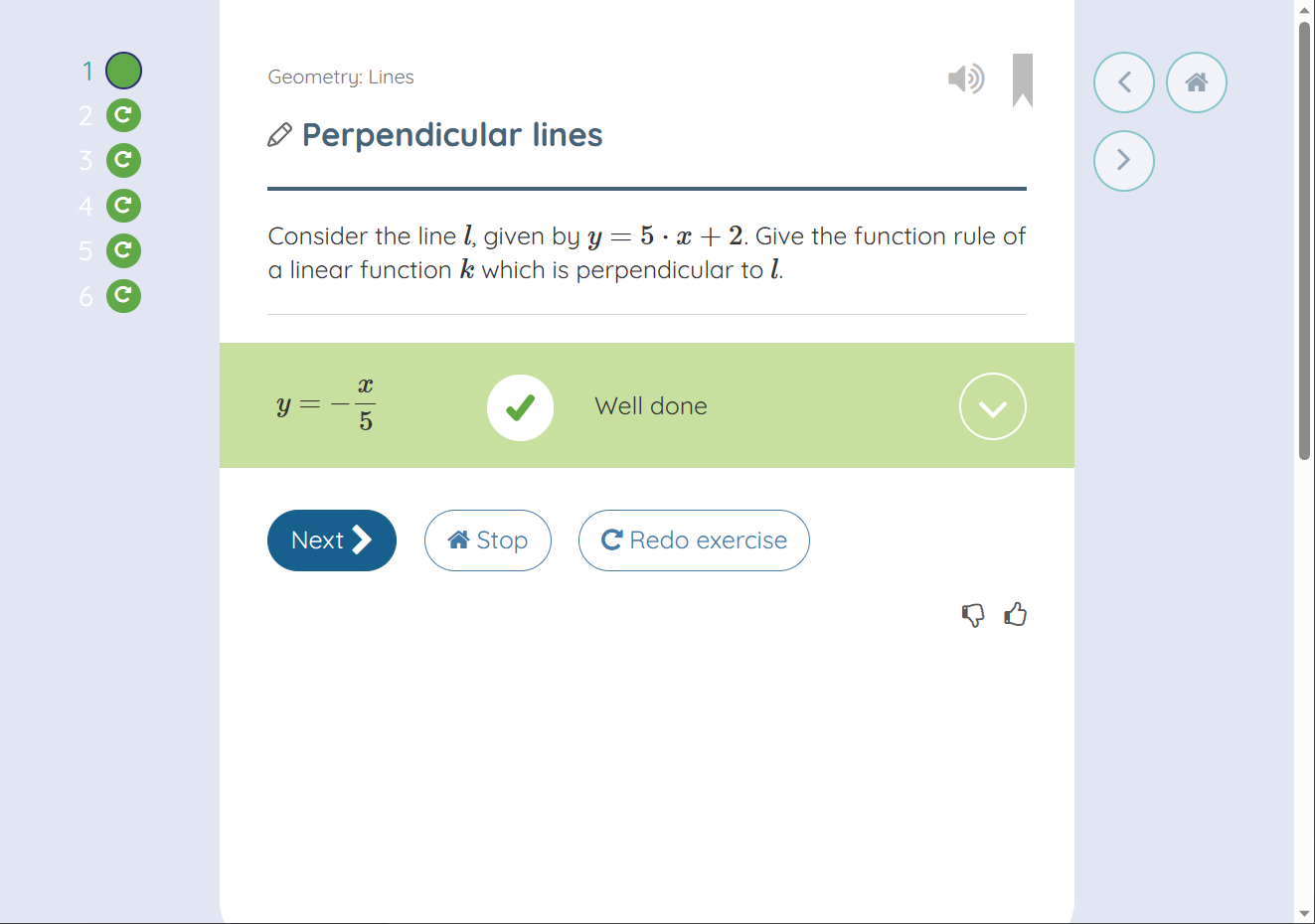
So the slope is obviously -x/5, but what is the y intercept? How can I get that without any points?
alpine sable
I was asking myself the same thing haha
warped topaz
Is it even possible?
alpine sable
You cant know the b in y=ax+b
No its impossible
Maybe the solution is just $y=-\frac{1}{5}x+b$
ocean sealBOT
ryanstaal2006

 alpine sable
Oh weird haaha
warped topaz
Weird question though haha
lone heartBOT
Channel closed
Closed by @warped topaz
Use .reopen if this was a mistake.
Available help channel!
Send your question here to claim the channel.
Remember:
• Ask your math question in a clear, concise manner.
• Show your work, and if possible, explain where you are stuck.
• After 15 minutes, feel free to ping <@&286206848099549185>.
• Type the command .close to free the channel when you're done.
• Be polite and have a nice day!
Read #❓how-to-get-help for further information on how to ask a good question, and about conduct in the question channels.
 true sandal
Find $f_{x}$ and $f_{y}$ by recalling the Fundamental Theorem of Calculus
$f(x,y) = \int_{y}^{x} \ln(t^3+2) dt$\\
$f_{x} = \ln(x^3+2) - 0$\\
$f_{y} = 0-\ln(y^3+2)$\\
Anything I did wrong?
casiofx991exz
 true sandal
,w partial derivative with respect tox of f(x,y) = integral from y to x of ln(t^3+2)dt
wtf
tardy stag
,w d/dx[ int from y to x of ln(t^3+2) dt ]
ocean sealBOT
Wolfram Alpha doesn't understand your query!
Perhaps try rephrasing your question?
Click here to refine your query online
 Requested by kitten.in.a.teacup#0
Failed to get a response from Wolfram Alpha.
If the problem persists, please contact support.
true sandal
whyy
ocean sealBOT
Hayley
 true sandal
tardy stag
idk but your soln seems correct to me
true sandal
tardy stag
idk but your soln seems correct to me
it don't work too on the website
of wolfram

do you know what's wrong

😦
tardy stag
it's probably trying to actually do the integral first and is unable
and somehow doesn't recognize FTC
true sandal
😦
 lone heartBOT
@true sandal Has your question been resolved?
 long quarry

RUSTA NASIL BAŞLARSINIZ | 2023 BAŞLANGIÇ REHBERİ
Discord = discord.gg/2DcBGNjk5
lone heartBOT
Channel closed
Closed due to timeout
Use .reopen if this was a mistake.
Available help channel!
Send your question here to claim the channel.
Remember:
• Ask your math question in a clear, concise manner.
• Show your work, and if possible, explain where you are stuck.
• After 15 minutes, feel free to ping <@&286206848099549185>.
• Type the command .close to free the channel when you're done.
• Be polite and have a nice day!
Read #❓how-to-get-help for further information on how to ask a good question, and about conduct in the question channels.
 rich moth
hello, I'm tryna learn my math lessons and Im stuck in this.
shouldnt it be positive 5i multiplied by negative 7i ?
i need an explanation as to why the sign beside "35" becomes a plus sign and not a minus sign. Thanks!
 lone heartBOT
rich moth
hello, I'm tryna learn my math lessons and Im stuck in this.
shouldnt it be pos...
rich moth
lone heartBOT
rich moth
hello, I'm tryna learn my math lessons and Im stuck in this.
shouldnt it be pos...
rich moth
OH
 sharp sail
i hope you got your answer
sharp sail
welcome
lone heartBOT
Channel closed
Closed by @rich moth
Use .reopen if this was a mistake.
Available help channel!
Send your question here to claim the channel.
Remember:
• Ask your math question in a clear, concise manner.
• Show your work, and if possible, explain where you are stuck.
• After 15 minutes, feel free to ping <@&286206848099549185>.
• Type the command .close to free the channel when you're done.
• Be polite and have a nice day!
Read #❓how-to-get-help for further information on how to ask a good question, and about conduct in the question channels.
warped topaz
 lone heartBOT
warped topaz
https://i.imgur.com/kSMuCeF.png
warped topaz
lone heartBOT
warped topaz
https://i.imgur.com/kSMuCeF.png
warped topaz
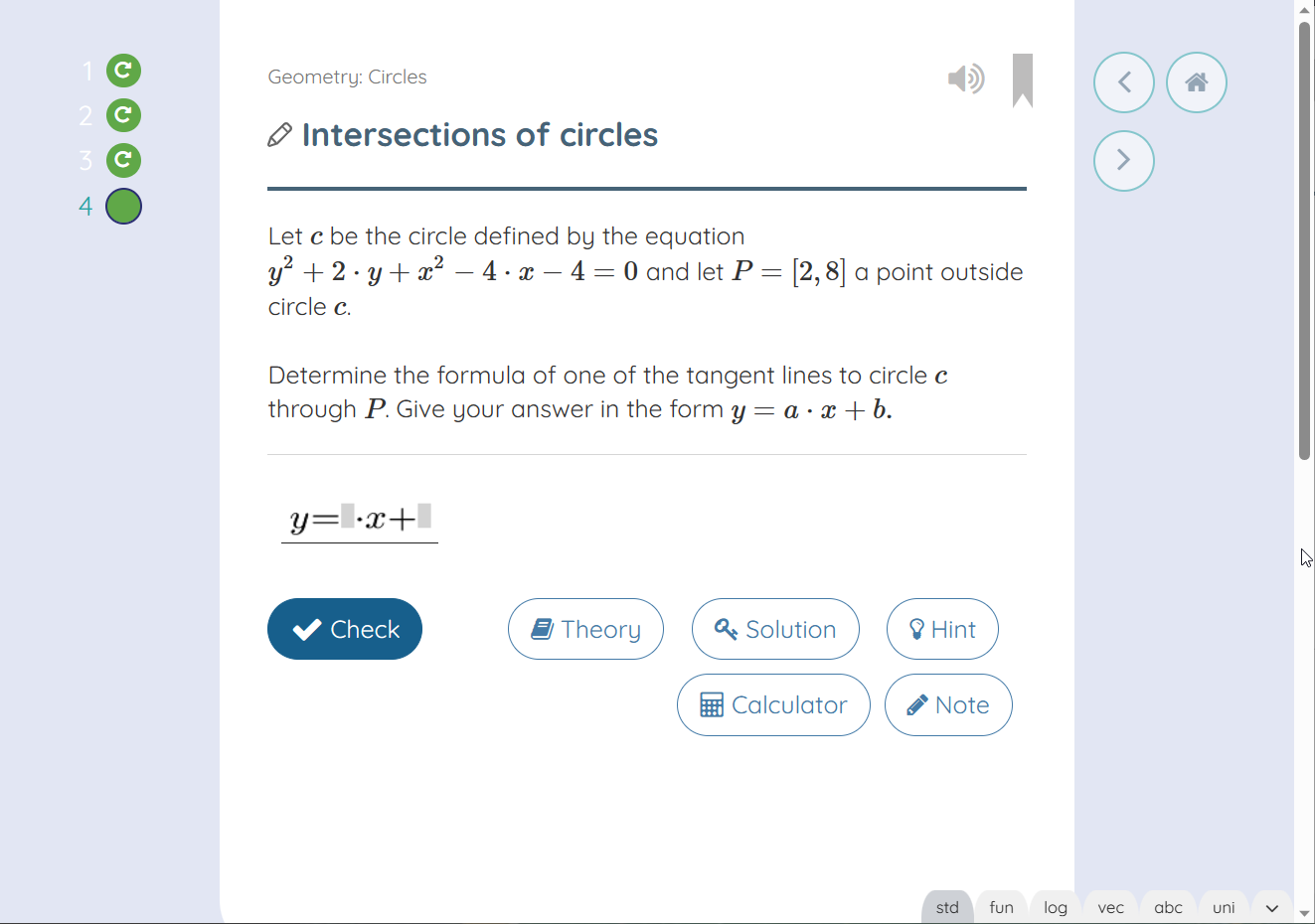
So for this one I just get the midpoint M, use that to get the equation of PM, then take the slope of that m and change it to -1/m to get the slope of the tangent, then use the points (2,8) in y=mx+c to get the equation im looking for, right?
Thats the way to do it, right? ^^
warped topaz
 near apex
Midpoint of what ?
near apex
Midpoint of what ?
Midpoint of the circle* sry
near apex
Oh. You mean center.
near apex
warped topaz
Is it incorrect to call it a midpoint? Or just weird?
technically incorrect.
warped topaz
near apex
technically incorrect.
Oh oops haha
near apex
Or just difficult to understand what one would mean by midpoint of a circle.
near apex
warped topaz
So for this one I just get the midpoint M, use that to get the equation of PM, t...
I think you are imagining the figure wrong. Slope of line joining center and P wouldn't be negative reciprocal of the slope of tangent.
If two lines have slope m and -1/m, they are perpendicular to each other.
Think which lines will be perpendicular here.
warped topaz
Oooooh I just noticed
I thought P was on the circle
I think I can still solve this though haha
near apex
Okay. Try then. You can let us know if you get stuck or have some issue.
warped topaz
Thank you! It will take me a few mins so I will ping you if I have trouble
near apex
Or share you approach with us if you need that checked, of course.
 crimson carbon
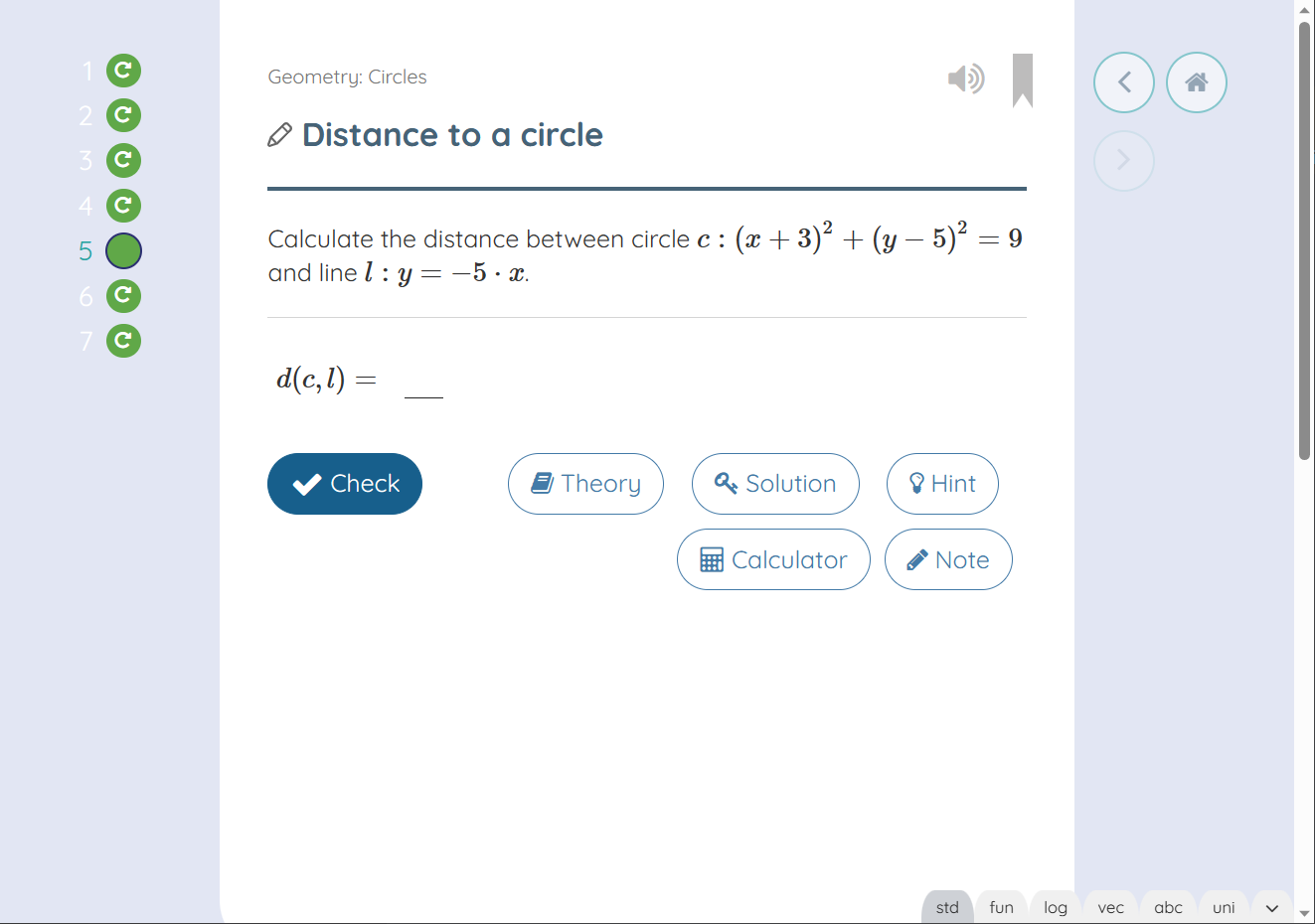
Do you know how to find the shortest distance from a point to a line?
warped topaz
For this one I take -1/m of line l to get slope of the perpendicular line
I then use the points of the centre of the circle (-3,5) and sub them in to y=x/5 + C get the equation of out perpendicular line
set that line = -5x to get the x coordinate of the closest point to the circle on line l
sub that x coordinate into -5x to get the y coordinate
then use the distance formula to get the distance between the centre of the circle and the new point we just got
then take away the radius 3 to get my answer
Thats the method, right?
crimson carbon
Find the distance between the centre of the circle and the line
Then take (subtract) the length of r from that distance
warped topaz
warped topaz
For this one I take -1/m of line l to get slope of the perpendicular line
I then...
I have done this question so many times that I already know what the answer is, but checking that my method is correct to make sure I understand it ^^
near apex
warped topaz
For this one I take -1/m of line l to get slope of the perpendicular line
I then...
Yeah. That works.
lone heartBOT
Channel closed
Closed by @warped topaz
Use .reopen if this was a mistake.
Available help channel!
Send your question here to claim the channel.
Remember:
• Ask your math question in a clear, concise manner.
• Show your work, and if possible, explain where you are stuck.
• After 15 minutes, feel free to ping <@&286206848099549185>.
• Type the command .close to free the channel when you're done.
• Be polite and have a nice day!
Read #❓how-to-get-help for further information on how to ask a good question, and about conduct in the question channels.
 pine meadow
What happens to the negative sign?
 lone heartBOT
pine meadow
What happens to the negative sign?
lone heartBOT
pine meadow
What happens to the negative sign?
 opal pendant
it cancelled with the other minus sign
pine meadow
.close
lone heartBOT
Channel closed
Closed by @pine meadow
Use .reopen if this was a mistake.
Available help channel!
Send your question here to claim the channel.
Remember:
• Ask your math question in a clear, concise manner.
• Show your work, and if possible, explain where you are stuck.
• After 15 minutes, feel free to ping <@&286206848099549185>.
• Type the command .close to free the channel when you're done.
• Be polite and have a nice day!
Read #❓how-to-get-help for further information on how to ask a good question, and about conduct in the question channels.
 coral cipher
need help
 lone heartBOT
coral cipher
need help
lone heartBOT
coral cipher
need help
 subtle birch


 coral cipher
