#help-0
1 messages · Page 265 of 1
 short blaze
 remote heron
they did like this
$2 \sqrt[5]{\frac 23} = 2 \sqrt[5]{\frac{2 \cdot 3^4}{3 \cdot 3^4 } }$
multiply by 1
under the radical
pretty sneaky
short blaze
im about to jump out of a window
remote heron
oop sorry
 ocean sealBOT
janniku
 remote heron
there we go
short blaze
oh
short blaze
u get 3^5
short blaze
wait how did they get 4c
remote heron
c to the fourth?

 short blaze
oh
remote heron
sorry i cant count to 3 
but, if you were looking at the third answer
i think if you played around with it a bit, youd notice how hard it was to get rid of the 3 entirely
because there is no factor of 3 left at all
short blaze
ok
remote heron
(there is no factor of 3 in the number four, and there are no other numbers)
remote heron
yes 
short blaze
and 3^5 to the fifth root is just 3
but then
why is it 2c/3
why does the 3 still have to be dividing

 short blaze
yes
remote heron
and then we played with the numbers
$2 \sqrt[5]{\frac 23} = 2 \sqrt[5]{\frac{2 \cdot 3^4}{3 \cdot 3^4 } } = 2\sqrt[5]{ \frac{ 2 \cdot 3^4 }{ 3^5 } } = \frac23 \sqrt[5]{2 \cdot 3^4 }$
short blaze
yeah so when we multiply by 3^4
we turn the denominator into 3^5
so when we simplify that into 3
how come its 2c/3 and not like 2c+3 or 2c times 3
ocean sealBOT
janniku
 short blaze
does the 3 have to stay in the denominator?
remote heron
short blaze
how come its 2c/3 and not like 2c+3 or 2c times 3
its the denominator coming out
yea
short blaze
ok
remote heron
you could split it back into the quotient
if its helpful to you
i mean, with a root on the top and the bottom
remote heron
$2\sqrt[5]{ \frac{ 2 \cdot 3^4 }{ 3^5 } } = 2 \frac{ \sqrt[5]{2 \cdot 3^4} }{ \sqrt[5]{3^5} }$
ocean sealBOT
janniku
 remote heron
short blaze
ok thanks
remote heron
short blaze
ok thanks
short blaze
ocean seal
**janniku**
so are we allowed to move the denominator from there to there
remote heron
yea, this is fraction properties
when everything is a product like this
with no plusses or minuses
you have a lot of freedom to rearrange things
remote heron
exponent and fraction stuff for sure
but you can boil them down a good amount
it just takes time to get used to them and to see what people are doing
theyll always skip a step or two that is hard to track
youll get it
 lone heartBOT
Channel closed
Closed by @short blaze
Use .reopen if this was a mistake.
 Available help channel!
Send your question here to claim the channel.
Remember:
• Ask your math question in a clear, concise manner.
• Show your work, and if possible, explain where you are stuck.
• After 15 minutes, feel free to ping <@&286206848099549185>.
• Type the command .close to free the channel when you're done.
• Be polite and have a nice day!
Read #❓how-to-get-help for further information on how to ask a good question, and about conduct in the question channels.
 lime sluice
 lone heartBOT
lime sluice
lime sluice
lone heartBOT
lime sluice
lime sluice
give me some hints to solve these types of questions within seconds
 young finch
this is physics right
lime sluice
Nope
young finch
oh
lime sluice
Time speed work
young finch
cause centripetal and linear speed are different
lime sluice
I guess I should have posted it in competition maths
young finch
id start by finding their speeds in meters per second
lime sluice
Multiply with 5/18
 modern pelican
Can anyone help me🥲
young finch
remote heron
modern pelican
Can anyone help me🥲

modern pelican
Thanks
 vale wigeon
open your own channel lol
young finch
lime sluice
Multiply with 5/18
now you can use an equation to find distance in terms of time
d=vt
lone heartBOT
@lime sluice Has your question been resolved?
vale wigeon
lime sluice
give me some hints to solve these types of questions within seconds
eh??? i think the marked answer is wrong too
hold on
,calc 27/3.6
45/3.6
ocean sealBOT
Results:
7.5
12.5
so these are X and Y's speeds resp in m/s
after 720 seconds, we have their distances travelled as:
,calc 7.5 * 720
12.5 * 720
ocean sealBOT
Results:
5400
9000
which differ by one lap, so they do meet
but they don't meet at the starting point
they meet diametrically opposite the start
since they've done 1.5 and 2.5 laps respectively by that point
 fossil latch
since the two should meet at the starting point after time t(unit: hour, since the time is in kilometers per hour)
45km/h × t = 27km/h × t + 3.6km ×n, n is a positive interger(1)
Description: since the two meets, the total distance that y ran should be the total distance x ran + n times the length of the circular track.
27km/h × t= 3.6km × p ,p is a positive interger (2)
We can use these two terms
I'd start by applying p= 1, 2, 3, and so on to find the value of t, on (2)
And then check if it doesn't contradict (1)
Do be careful though that I set the unit of t to be in hours and the track length is in meters instead of kilometers, and the speed is in km/h.
Hmm... if we change (1), 18km/h × t = 3.6km × n
my insticts tell me that for the minimum value of t, n=2 and p=3
But that's my instincts because I don't have a paper rn
lone heartBOT
Channel closed
Closed due to timeout
Use .reopen if this was a mistake.
Available help channel!
Send your question here to claim the channel.
Remember:
• Ask your math question in a clear, concise manner.
• Show your work, and if possible, explain where you are stuck.
• After 15 minutes, feel free to ping <@&286206848099549185>.
• Type the command .close to free the channel when you're done.
• Be polite and have a nice day!
Read #❓how-to-get-help for further information on how to ask a good question, and about conduct in the question channels.
 cerulean herald
 lone heartBOT
cerulean herald
cerulean herald
lone heartBOT
cerulean herald
cerulean herald
im confused on how to solve this
"Classify each conic section adn write its equation in standard form"
is this an Ellipses
 tight locust
To classify just ignore lower order terms
Like for instance the form of that first equation is just -x^2 + y = c, for some constant c which we don't care about yet. Then y = c + x², which is the form of a?
cerulean herald
cerulean herald
so what do i do from here
tight locust
What shape is it?
cerulean herald
parabola?
tight locust
Yes
cerulean herald
because only one side is squared
tight locust
Yes
cerulean herald
so do I do + 75 to both sides
tight locust
Let's rewrite so that x² is positive
cerulean herald
so I multiply everything by -1
tight locust
y - 21 = x^2 - 10x
cerulean herald
ok
tight locust
Then complete the square on the right side

 tight locust
Yep
cerulean herald
is that it
cerulean herald
 tight locust
Yeah, that's good
tight locust
Ok
 tight locust
To classify just ignore lower order terms
cerulean herald
so ignore terms with no variable
tight locust
Do you understand what is meant by a lower order term?
cerulean herald
ignore terms with no variable?
tight locust
Not quite
Ignore terms with small exponents
Or rather of smaller algebraic degree
So the form of this equation is just
x^2 + y^2 = c
cerulean herald
ok
cerulean herald
✅
tight locust
What does this mean physically
cerulean herald
Wdym
tight locust
If you were to draw this
tight locust
Yes
cerulean herald
Ok!
cerulean herald
Hm Ok
tight locust
So we have equal scaling along the vertical and horizontal axes
cerulean herald

tight locust
Does that make sense?
fossil latch
4x²+4y²=1 is also an equation of a circle
tight locust
So something like
2x^2 + y^2 = c
Would be an ellipse
But something like
10x^2 + 10y^2 = c
Is a circle
cerulean herald
Okay
fossil latch
fossil latch
4x²+4y²=1 is also an equation of a circle
Because if you divide each side with 4, it becomes x²+y²= 1/4
cerulean herald
Ok!
tight locust
What can we do with
x^2 + 6x
tight locust
Yes, complete the square
 tight locust
The point is to create an equal expression
So you want to solve:
(x+3)² - k = x^2 + 6x
tight locust
Yes
cerulean herald
 tight locust
Yes
fossil latch
We can still factor y
tight locust
Now you can cancel the 9s
cerulean herald
✅
fossil latch
Same thing with what you did with x
tight locust
And then complete the square for the y terms by pretending the x terms aren't there
 tight locust
Let's make it simple
cerulean herald
how do i factor this
tight locust
What can you do with y² - 2y
tight locust
Let's back up
cerulean herald
(y-2)(y+1)
cerulean herald
Yes
tight locust
What did I do there?
cerulean herald
u got y
tight locust
Where did I get y^2 - 2y
cerulean herald
 tight locust
Yes. So just like we ignore y terms to complete the square for x
We ignore x terms to complete the square for y

 tight locust
Be careful with signs
cerulean herald
Wdym
tight locust
The box method isn't bad, but you're ignoring signs
Notice how we have -2y
Not 2y
 tight locust
We have to again solve:
(y-1)^2 - k = y^2 - 2y
And make sure this is a true statement
cerulean herald
 tight locust
Right. So you've added 1 by making it a square. Now you must subtract 1
cerulean herald
 tight locust
Yes
 tight locust
Yes
tight locust
Remember
cerulean herald
Thank you
tight locust
You have the = 0
cerulean herald
Oh ye
tight locust
(x+3)^2 + (y-1)^2 - 1 = 0
 fossil latch
With a radius of 1
 lone heartBOT
Channel closed
Closed by @cerulean herald
Use .reopen if this was a mistake.
Available help channel!
Send your question here to claim the channel.
Remember:
• Ask your math question in a clear, concise manner.
• Show your work, and if possible, explain where you are stuck.
• After 15 minutes, feel free to ping <@&286206848099549185>.
• Type the command .close to free the channel when you're done.
• Be polite and have a nice day!
Read #❓how-to-get-help for further information on how to ask a good question, and about conduct in the question channels.
 alpine sable
Hello
lone heartBOT
alpine sable
Hello
alpine sable
f:R+->R continuous and bounded
If x integral from x to x+1 f(t) dt = integral from 0 to x f(t) dt for every x in R+
Show f constant
Let F be a primitive of f with F(0)=0
So we havs x(F(x+1)-F(x))=F(x)
And from here
I have two options
To use lagrange or to see that F(x+1)/(x+1)=F(x)/x
I know the second solution
But what if we use lagrange
So we can say f(c_x)=f(d_x) with c_x in (x,x+1) and d_x in (0,x) for fixed x
I guess the Lagrange idea is harder
 quartz oxide
Let me provide another approach
Let G(x) = (integrate f(t) dt, t from 0 to x)/x
(which is the average value of f(t) from 0 to x)
We can rewrite the condition as G(x+1)=G(x)
quartz oxide
Then G must be constant because if not (suppose G(a) - G(b) = d > 0) we can assume that a and b is arbitrarily large, then produce arbitrary large f(x) contradicting the fact that f is bounded
Maybe?
alpine sable
Hmm
quartz oxide
alpine sable
Yes I did it
Is this how you did it
alpine sable
I took g(x)=F(x)/x, again g(x+1)=g(x), g is differentiable g'(x)=(f(x)x-F(x))/x^2 so f(x)=g(x)+xg'(x). From g(x)=g(x+1) we jave g'(x)=g'(x+1) so g' is periodic with T=1 as g. By induction f(x+n)=g(x+n)+(x+n)g'(x+n).
Suppose there is x0>0 with g'(x0)≠0
So we get f(x0+n) when n tends infinity is {+-inf}
So we have a contradiction
so g is constant and we get f is constant
But I want to know if the Lagrange idea works somehow
 lone heartBOT
@alpine sable Has your question been resolved?
lone heartBOT
Channel closed
Closed due to timeout
Use .reopen if this was a mistake.
lone heartBOT
Available help channel!
Send your question here to claim the channel.
Remember:
• Ask your math question in a clear, concise manner.
• Show your work, and if possible, explain where you are stuck.
• After 15 minutes, feel free to ping <@&286206848099549185>.
• Type the command .close to free the channel when you're done.
• Be polite and have a nice day!
Read #❓how-to-get-help for further information on how to ask a good question, and about conduct in the question channels.
 last shale
A research had found that 40% of people in a particular small city hate having pineapple on a
pizza. Fifty people of the city were taken randomly. Find the probability that from twelve to
twenty-one people hate having pineapple on a pizza.
lone heartBOT
last shale
A research had found that 40% of people in a particular small city hate having p...
vale wigeon
!status
lone heartBOT
What step are you on?
1. I don't know where to begin
2. I have begun but got stuck midway
3. I got an answer but I'm told it's wrong
4. I got an answer and would like my work checked
5. I have a question about someone else's worked solution
6. None of the above
@last shale Has your question been resolved?
 native cave
i don't know how English maths denotes probability but it's a binomial distribution as far as I can see
lone heartBOT
Channel closed
Closed due to timeout
Use .reopen if this was a mistake.
Available help channel!
Send your question here to claim the channel.
Remember:
• Ask your math question in a clear, concise manner.
• Show your work, and if possible, explain where you are stuck.
• After 15 minutes, feel free to ping <@&286206848099549185>.
• Type the command .close to free the channel when you're done.
• Be polite and have a nice day!
Read #❓how-to-get-help for further information on how to ask a good question, and about conduct in the question channels.
 potent flame
 lone heartBOT
potent flame
young finch
lone heartBOT
potent flame
young finch
whats row echelon form
potent flame
idk
young finch
compared to reduced row echelon form
young finch
yea
potent flame
but i wasnt sure so i put it here
young finch
REF means there a leading coefficient in each row
RREF means there are only the pivot points in the matrix
no
thats not true
its when there are 0s above and below each pivot point as well
potent flame
so this would be REF
potent flame
oh i see
potent flame
young finch
since the entry above the 2nd rows pivot point is 3 not 0
how would we do smth like this then
 young finch
each column represents a variable right
potent flame
yea
young finch
column 1 is x_1
potent flame
is the last column the solutions
young finch
col 2 is x_2 and so on
young finch
potent flame
is the last column the solutions
yes
since its in RREF the answers are right there
potent flame
young finch
since its in RREF the answers are right there
oh so x=4?
potent flame
young finch
since its in RREF the answers are right there
but if the last column is the solutions since its in RREF wouldnt it be x=4 y=-10 and z=-8?
therefore making the correct option x=4?
potent flame
yea
young finch
sure
potent flame
so x=4?
potent flame
yea because u take system of equations with x y and z
potent flame
young finch
usually I see it as x_1 x_2 and x_3
this would be correct right

just like the last question
young finch
yes cause z=0
potent flame
so that makes y=20
young finch
yup
potent flame
but what if there are 4 values in the last column
like rn we only see 3
but what if there are 4
young finch
wdym
young finch
thats not how matrices work
 young finch
yeah its the same thing
potent flame
and they ask for x1
young finch
just 4 dimensionsal
potent flame
so x1 x2 x3 and x4?
young finch
x_1=0 cause x_4=0
potent flame
then x2 = -7 and x3 = 10?
young finch
since x+4=0 every entry in the 4th column should be 0
young finch
potent flame
then x2 = -7 and x3 = 10?
yep
potent flame
young finch
since x+4=0 every entry in the 4th column should be 0
but x1 is also 0 but not everything in the 1st column is 0
young finch
thats only cause the rightmost column is 0 in the first row
potent flame
oh
potent flame
young finch
thats only cause the rightmost column is 0 in the first row
so x1 in this case would still be 0?
like for the question x1 = 0?
young finch
ye
potent flame
alr thanks
potent flame
young finch
ye
also so RREF always has the solutions on the right sides while REF doesnt?
like this would be RREF?
 potent flame
young finch
yeah thats RREF but you see how x_2 doesnt equal 0
potent flame
young finch
yeah thats RREF but you see how x_2 doesnt equal 0
but the solution set on the right has 0 for x_2
potent flame
it has to be 0?
young finch
yep
potent flame
so this is just REF
young finch
yea
potent flame
ok ok thanks
potent flame
young finch
yea
What about smth like this where they ask for x4 but there isnt even an x4
 young finch
x_4 is the 4th column
potent flame
oh
so is it just 0?
or is it written as inconsistent
because there is no x4 in the solution column
young finch
no its a free variable
potent flame
so we just write 0 for x4=?
young finch
i think so
potent flame
young finch
i think so
aight ill check it out once more but thanks for all the help
.close
lone heartBOT
Channel closed
Closed by @potent flame
Use .reopen if this was a mistake.
young finch
np
lone heartBOT
Available help channel!
Send your question here to claim the channel.
Remember:
• Ask your math question in a clear, concise manner.
• Show your work, and if possible, explain where you are stuck.
• After 15 minutes, feel free to ping <@&286206848099549185>.
• Type the command .close to free the channel when you're done.
• Be polite and have a nice day!
Read #❓how-to-get-help for further information on how to ask a good question, and about conduct in the question channels.
 warped topaz
 lone heartBOT
warped topaz
https://i.imgur.com/Zgbw363.png
warped topaz
lone heartBOT
warped topaz
https://i.imgur.com/Zgbw363.png
warped topaz
x(t) = 80t^3 + 144t^2 + 36t
y(t) = 60t^3 +102t^2 + 18t +1
and
x'(t) = (12)(20t^2 + 24t + 3)
y'(t) = (60t)(3t+4)
I dont really know what to do next though...
alpine sable
The question is the tangent line at the origin
So x=0 and y=0
Now what do you think you have to calculate?
warped topaz
So x'(t) and y'(t) = 0?
alpine sable
No those are the derivatives. Its good that you already calculate them but you will need them for the slope of the tangent
The origin is just x(t)=0 and y(t)=0
warped topaz
And calculate t?
alpine sable
Exactly
alpine sable
You need to find the t so you can use the derivative to find the slope in the origing
alpine sable
Do you know how to find the t?
warped topaz
alpine sable
Do you know how to find the t?
For x(t) the values of t = 0 and -3/2 and -3/10
For y(t) the values of t = (-6-√21)/10 and (-6+√21)/10
alpine sable
For x you did it correct. How did you do it for y? Because they are incorrect
warped topaz
Oh
Just used the quadratic formula
I probably made a mistake those were some annoying numbers haha
alpine sable
And how did you do it for x?
warped topaz
I dont see my mistake 😓
warped topaz
alpine sable
And how did you do it for x?
Just factored out t and then factorized
alpine sable
Its already a hint in how the equations are given. Because they are both already factored for you
warped topaz
Oh
alpine sable
So that makes it much easier because you dont have to factor them yourself
Do you see how you can get the values for t for the y(t)=0?
warped topaz
-3/2
alpine sable
👍
warped topaz
alpine sable
So now for what t does x=y=0?
Why were we looking for this
Its the only real solution?
alpine sable
Because you are looking for the t for which it goed through the origin so x=0 and y=0
alpine sable
warped topaz
Its the only real solution?
Yes
alpine sable
No now you have to use the derivative
warped topaz
alpine sable
No now you have to use the derivative
Oh I replace t with 3/2 right?
alpine sable
Exactly, just dont forget the minus
warped topaz
Oh ye haha
warped topaz
alpine sable
Exactly, just dont forget the minus
With both? Or just 1?
Like will I get the same answer if I put it in either?
alpine sable
No you have to do it in both
alpine sable
The slope is deltay/deltax right?
warped topaz
yeye
alpine sable
So you divide the y value by the x value
warped topaz
Ah ok
 rotund laurel
I need help with maths problem please help it's urgent
warped topaz
rotund laurel
I need help with maths problem please help it's urgent
Then go to #❓how-to-get-help
rotund laurel
Tried it but don't even know how to do it
warped topaz
rotund laurel
Tried it but don't even know how to do it
Go to #help-12 and type your question
When youre finished type .close
 alpine sable
If this is the slope you have to put it in the formula of the form y=ax+b
warped topaz
ooooooooh yeye
warped topaz
alpine sable
If this is the slope you have to put it in the formula of the form y=ax+b
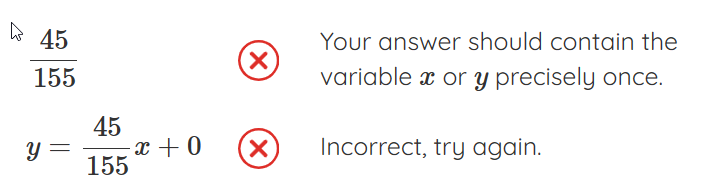
What did I do wrong now haha
alpine sable
And if my calculations are right x’(-3/2)=144 and not 155
And you also dont need to put the +0 because +0 is nothing
alpine sable
alpine sable
And you also dont need to put the +0 because +0 is nothing
I dont know if this matters
warped topaz
alpine sable
And if my calculations are right x’(-3/2)=144 and not 155
ohhhhhh I misstyped haha
Hmmm still incorrect
Did I make a mistake somewhere else?
I dont think so...
Not sure what im doing wrong
alpine sable
Im going to check the derivatives
warped topaz
I mean we got -3/2 for both right? so they should be correct no?
unless it was a coincidence
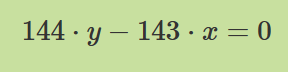
I checked the solution ^^ apparently I did make a mistake with my calculations somewhere haha
But its fine cause I think I understand the method now 😄
warped topaz
alpine sable
Im going to check the derivatives
I will some more examples haha
But I think I know how to do it!
Thank you for your help, you explained it really well!!
❤️
.close
lone heartBOT
Channel closed
Closed by @warped topaz
Use .reopen if this was a mistake.
Available help channel!
Send your question here to claim the channel.
Remember:
• Ask your math question in a clear, concise manner.
• Show your work, and if possible, explain where you are stuck.
• After 15 minutes, feel free to ping <@&286206848099549185>.
• Type the command .close to free the channel when you're done.
• Be polite and have a nice day!
Read #❓how-to-get-help for further information on how to ask a good question, and about conduct in the question channels.
 strange fractal
how do i know
lone heartBOT
strange fractal
how do i know

 near apex
Try making use of points you know from graph.
Like you must have used point (-3,8) to find the constant term.
Similarly, do you know any other point on the graph whose value you can plug in to find the coefficient of first term?
strange fractal
near apex
Similarly, do you know any other point on the graph whose value you can plug in ...
im confused
it looks as fat as like
-1/3 ig
near apex
Wait... You need the find the value inside that box before (x+3)^2 term. Right?
strange fractal
near apex
Wait... You need the find the value inside that box before (x+3)^2 term. Right?
OHHHY ES
YES
SORYR
yes
also if this says 0 is greater than h doesnt that mean h is a negative number
 native cave
yes
strange fractal
and when it is negative it goes to da right?
near apex
strange fractal
also if this says 0 is greater than h doesnt that mean h is a negative number
Yes. It does.
native cave
is the formula (x-h)²
strange fractal
Yes
native cave
if h<0 then you get (x+...)² which would make it to the left
if h = - 2 you'd get (x-(-2))² = (x+2)²
maybe @near apex needs to confirm because I'm not very sure
 fiery salmon
native cave
maybe <@1116326425088241714> needs to confirm because I'm not very sure
fiery salmon
native cave
maybe <@1116326425088241714> needs to confirm because I'm not very sure
it will go to right
it is (x+k)^2 where k is positive
near apex
native cave
if h<0 then you get (x+...)² which would make it to the left
No. It's left only.
native cave
wait i said it was left
near apex
fiery salmon
it is (x+k)^2 where k is positive
yes. Think now. The value which was earlier achieved at x = 2 will now be achieved at x = 2-k. So, graph shifts by k unit to the left.
near apex
native cave
wait i said it was left
yes. Sorry. I meant to reply to him.
native cave
no worries 👍
fiery salmon
near apex
yes. Think now. The value which was earlier achieved at x = 2 will now be achiev...
yea
silly mistake
sorry
near apex
It's okay. It happens.
strange fractal
U GUYS ARE CONFUSING
near apex
@strange fractal Did you get it ?
near apex
strange fractal
U GUYS ARE CONFUSING
Wait. I'll explain from the start.
strange fractal
native cave
if h<0 then you get (x+...)² which would make it to the left
wdym i thought it now means h is negative so we get (x -...)^2
near apex
So you have (x - h)^2, where h is negative.
native cave
yeah
near apex
Yes.
native cave
and positive is to the left
strange fractal
the question is worded badly yeah
native cave
yup, kinda theoretical and useless imo
near apex
So, did you get it? @strange fractal
fiery salmon
think of it like
where origin originally was
it is now at x=h
and h=negative
so it goes to left
native cave
true
strange fractal
near apex
So, did you get it? <@491595139966566400>
yh
native cave
@strange fractal type .close
strange fractal
.close
lone heartBOT
Channel closed
Closed by @strange fractal
Use .reopen if this was a mistake.
lone heartBOT
Available help channel!
Send your question here to claim the channel.
Remember:
• Ask your math question in a clear, concise manner.
• Show your work, and if possible, explain where you are stuck.
• After 15 minutes, feel free to ping <@&286206848099549185>.
• Type the command .close to free the channel when you're done.
• Be polite and have a nice day!
Read #❓how-to-get-help for further information on how to ask a good question, and about conduct in the question channels.
 trim sail
 lone heartBOT
Channel closed
Closed by @trim sail
Use .reopen if this was a mistake.
Available help channel!
Send your question here to claim the channel.
Remember:
• Ask your math question in a clear, concise manner.
• Show your work, and if possible, explain where you are stuck.
• After 15 minutes, feel free to ping <@&286206848099549185>.
• Type the command .close to free the channel when you're done.
• Be polite and have a nice day!
Read #❓how-to-get-help for further information on how to ask a good question, and about conduct in the question channels.
warped topaz
is -2^(1/2) = -√2? Or DNE?
lone heartBOT
warped topaz
is -2^(1/2) = -√2? Or DNE?
fiery salmon
warped topaz
is -2^(1/2) = -√2? Or DNE?
not defined
 tawny condor
$-2^{\frac{1}{2}} = -\sqrt{2}$
ocean sealBOT
redstoneplayz09
 tawny condor
it is defined
tawny condor
as you wrote it, the exponentiation is only applied on the 2
fiery salmon
or is it?
tawny condor
it's not on (-2), no
if you wanted it to be, you'd have to put parenthesis around it
lone heartBOT
Channel closed
Closed by @warped topaz
Use .reopen if this was a mistake.
Available help channel!
Send your question here to claim the channel.
Remember:
• Ask your math question in a clear, concise manner.
• Show your work, and if possible, explain where you are stuck.
• After 15 minutes, feel free to ping <@&286206848099549185>.
• Type the command .close to free the channel when you're done.
• Be polite and have a nice day!
Read #❓how-to-get-help for further information on how to ask a good question, and about conduct in the question channels.
strange fractal
Hi
lone heartBOT
strange fractal
Hi
 fiery salmon
strange fractal
The final answer to 12 +/- root 540?
fiery salmon
strange fractal
The final answer to 12 +/- root 540?
my answer is coming x=12(plus minus ) root(5/3)
fiery salmon
strange fractal
I need to simplify the root before?
i did 9/15(x-12)^2=1
native cave
strange fractal
The final answer to 12 +/- root 540?
no you can write it as 12 ± (root 540)/2
(root 540)= root(135*4) = 2 root(135)
so it can be simplified as 12 ± root(135)
strange fractal
.close
lone heartBOT
Channel closed
Closed by @strange fractal
Use .reopen if this was a mistake.
Available help channel!
Send your question here to claim the channel.
Remember:
• Ask your math question in a clear, concise manner.
• Show your work, and if possible, explain where you are stuck.
• After 15 minutes, feel free to ping <@&286206848099549185>.
• Type the command .close to free the channel when you're done.
• Be polite and have a nice day!
Read #❓how-to-get-help for further information on how to ask a good question, and about conduct in the question channels.
 formal tide
Hi I need some help, i've been given a few details of a parabola and i must determine its equation. Could I have some help as to explain how to get its equation?
lone heartBOT
formal tide
Hi I need some help, i've been given a few details of a parabola and i must dete...
vale wigeon
depends on the details
formal tide
the details ive been given are that it has a turning point at (-3, 5)
and the parabola passes through the point (1, 13)
vale wigeon
may i suggest vertex form then
formal tide
no idea what that is but sure
oh by the way in case thats a bit complicated
im currently in year 10
in case theres another wya to do it thats way more advanced
@vale wigeon uhhhhh you there?
vale wigeon
$y = a(x-h)^2 + k$
ocean sealBOT
Ann

 fickle sentinel
turning point is the deepest / highest point right?
formal tide
yep
fickle sentinel
you need to know that h is -3 and k = 5
fickle sentinel
yes
vale wigeon
formal tide
i just got ghosted
5 min delay is not ghosting come on
fickle sentinel
mhm
vale wigeon
formal tide
be y = a ( x +3 ) ^2 +5
yes now find a using the other point
formal tide
hmmmm
fickle sentinel
simultaneous equation if im not wrong
formal tide
so do i insert
OHHHH
OH MY GOD
I GET IT
SO I JUST PUT
13 = A ( 1 + 3) ^ 2 + 5
is that right
fickle sentinel
which means A is not 1
formal tide
oh
fickle sentinel
did you forget a exists
formal tide
yeah
can i ask
what does a stand for
does it stand for any thing
or is it just a variable
like how h and k stand for x and y
fickle sentinel
a is multiplied by the square
a(x-3)^2 = ax2 - 6ax + 9a
think of it like this
now a(1+3)^2 should equal 13-5
should be an easy solve afterwards
fickle sentinel
no
vale wigeon
fickle sentinel
simultaneous equation if im not wrong
you kind of are
formal tide
( x - (-3)
fickle sentinel
yes
formal tide
so wouldnt it be x + 3
fickle sentinel
yes
vale wigeon
formal tide
so wouldnt it be x + 3
always has been 

fickle sentinel
idk what changed your mind
formal tide
then why did you put x -3
fickle sentinel
formal tide
so a = 1 half?
correct
fickle sentinel
where's a?
formal tide
in the front
fickle sentinel
yeah then you got it
formal tide
ok thanks a lot man
fickle sentinel
ok
formal tide
but i can tell you what details i have
fickle sentinel
sure
formal tide
but really the nonly details i can give you
is a point where its passing and its x intercepts
it has no y intercept
fickle sentinel
ok no problem ill see what i can do
formal tide
tp and AOS are unknown
fickle sentinel
aos?
fickle sentinel
oh ok
formal tide
oiginally i thought i could do
y = (x-2) ( x -5)
but doesnt work
cause theres a y intercept
fickle sentinel
axis of symmetry, what does symmetry mean?
formal tide
fickle sentinel
axis of symmetry, what does symmetry mean?
its just the x of the turning point
its like cutting it in half
fickle sentinel
exactly
fickle sentinel
midpoint
formal tide
AOS is directly in between
fickle sentinel
 fickle sentinel
mhm
formal tide
hold on a sec lemme erase soem stuff
fickle sentinel
is there any other info given
formal tide
none that i can see
formal tide
if i remember correctly
we learnt that the axis of symmetry is
-b/2a
and also
y = ( x - h) ^ 2 + k
or something like that
fickle sentinel
ignore the a(x-3.5)

no dont think about conpleting the square
all line points are relative to their initial equation
fickle sentinel
did they ask for an equation?
formal tide
yep
fickle sentinel
ok what info do you have so far
formal tide
"Determine the equation of the following parabolas"
x intercepts
and the axis of symmetry
fickle sentinel
isnt the equation (x-2)(x-5)
fickle sentinel
you said it yourself unless they wanted you to complete the square
formal tide
but that would have a y intercept
formal tide
fickle sentinel
you said it yourself unless they wanted you to complete the square
i mean we did learn that
we cna try
fickle sentinel
but here's the thing
you could have found the minimum point by just expanding (x-2)(x-5) and completing the square
in a(x-h)^2 + k, (h,k) is the min point.
formal tide
uh huh
so i expand
then complete the square
and through that
i can find the turning point
gotcha
formal tide
quick question though
fickle sentinel
shoot
formal tide
x^2 - 7x + 10
fickle sentinel
uh huh
fickle sentinel
not really, they love decimals
formal tide
btw would that be
- ( 3 1/2)
like in there
idk why it became point
but that was a minus smbol
or would.i put it in as
( x + 3 1/2) ( x - 3 1/2


 formal tide
btw
fickle sentinel
see the 3.5? that number sounds familiar to another answer we just had
formal tide
would the - 3. 5 squared
be minus or postivie
like on the outside
where it adds together witht he 10
formal tide
yep
formal tide
oh ok
fickle sentinel
its more complicated when i use b/2a, im simplifying
formal tide
so is the entire equation just
fickle sentinel
but it has something to do with it
formal tide
y = ( x- 3.5) squared - 2.25?
fickle sentinel
Yes
formal tide
thanks man
fickle sentinel
np
fickle sentinel
okay
formal tide
like translations
reflections
i kinda forgot how they look like in equations
ok so the question is
"Describe the transformations required to ahcieve the following when starting from y = x^2"
fickle sentinel
okay
fickle sentinel
the following hen?
formal tide
describe the transformations
like show what transformations occured
for example reflected by 2
fickle sentinel
to get to what
formal tide
scaled by -2
formal tide
fickle sentinel
to get to what
nothing
just show what happened
like what transformations happened
if the original thing
is just
y = x^ 2
fickle sentinel
this is what i understand
 formal tide
do you know what a transofrmation is
fickle sentinel
you bracket x
square symbol remains outside
add one inside the bracket (x+1)^2
scale by -2
fickle sentinel
no, thats the constant
wait my mistake, yes
the constant affects y-intercept

it translates to the left
formal tide
ohhhh
fickle sentinel
y-intercept is 1, and since the coefficient of x^2 is unchanged, the curve's translation left/right corresponds to the y-intercept
(For (x+1)^2)
is that all?
formal tide
wait
fickle sentinel
looks like someone has ghosted me
formal tide
no i havent
i was trying
to set up my airpods
wouldnt connect
but uh wait
can you tell me how horizontal translations vertical dilation scale factor reflections in the x axis and vertical translation look like in an equation
like how to find them
fickle sentinel
side note my country doesnt teach transformation, im just using what i know
fickle sentinel
oh im doomed
formal tide
ohhh
fickle sentinel
i think desmos . com solves everything you need for translation
do 3 equations with different factors changing and how it relates to horizontal/vertical translation
@formal tide uh i think you should look at #help-14
formal tide
ok
fickle sentinel
did you find what you needed?
fickle sentinel
no just ping another helper
fickle sentinel
equation of circle?
formal tide
im very confident about this one
but ima just make sure
Determine the centre and radisu for each of the following circles, then graph
(x -3) ^ 2 + (y + 1) ^2 = 9
if im correct
fickle sentinel
im 100% not graphing but ok lets see
fickle sentinel
yes
because (x-a)^2 + (y-b)^2 = r^2
hence you get the point
and since r > 0, reject negatives obviously
formal tide
ok
thanks
@fickle sentinel
yo for the axes intercepts
how do i solve them
if i had to guess
if i remember correctly
you can input the numbers from the original formula
into another
to create a normal one
but i forgot how it should normally look like
.close
lone heartBOT
Channel closed
Closed by @formal tide
Use .reopen if this was a mistake.
Available help channel!
Send your question here to claim the channel.
Remember:
• Ask your math question in a clear, concise manner.
• Show your work, and if possible, explain where you are stuck.
• After 15 minutes, feel free to ping <@&286206848099549185>.
• Type the command .close to free the channel when you're done.
• Be polite and have a nice day!
Read #❓how-to-get-help for further information on how to ask a good question, and about conduct in the question channels.
 wanton pebble
 lone heartBOT
wanton pebble
wanton pebble
lone heartBOT
wanton pebble
wanton pebble
can anyone explain what to do
wanton pebble
i can't find weather it is convegent at A=0
alpine sable
What does a_n become when A=0?
 lilac brook
Hi! Solution : ||You have to take the limit as n goes to infinity to check for convergence or divergence of a sequence. In this case you have an infinity - infinity kind of indeterminate form. To deal with this we can multiply and divide by [sqrt (A^2n^2+n+1)+n], thus obtaining an infinity/infinity indeterminate form, which is easier to deal with, because we only need to care about the terms with the highest exponent. So we get n^2(A^2+1)/(n(|A|+1)), which we can simplify and get n(|A|-1). So we understand that as n goes to infinity, we get infinity * (|A|-1), and we can only hope it doesn't diverge when A is either 1 or -1, because we'd get an indeterminate form of the kind infinity * 0. And after checking with the value for A = -1 or 1, we get that the sequence converges to 1/2. Thus the sequence is convergent for exactly two real values of A, which are 1 or -1.||
alpine sable
!nosols
lone heartBOT
As a helper, please do not give out answers that could be copied as a homework solution. Have the student work through the problem themselves and guide them along the way.
alpine sable
lilac brook
Oh sorry, I'm super new here
I also made that mistake when I was new
I thunk you can give the solution but you should say that you are giving the solution and censor it
So people can decide for themselves if they want to read it or not
lilac brook
Done.
lone heartBOT
@wanton pebble Has your question been resolved?
Channel closed
Closed by @wanton pebble
Use .reopen if this was a mistake.
Available help channel!
Send your question here to claim the channel.
Remember:
• Ask your math question in a clear, concise manner.
• Show your work, and if possible, explain where you are stuck.
• After 15 minutes, feel free to ping <@&286206848099549185>.
• Type the command .close to free the channel when you're done.
• Be polite and have a nice day!
Read #❓how-to-get-help for further information on how to ask a good question, and about conduct in the question channels.
 ashen niche
2x/5 = 10
lone heartBOT
ashen niche
2x/5 = 10
 broken raft
hey @ashen niche
u multiply the 5 on both sides
u get 2 x = 50
and then u devide by 2 on both sides
to get x = 25
 buoyant storm
broken raft
to get x = 25
buoyant storm
broken raft
to get x = 25
!nosols
lone heartBOT
broken raft
to get x = 25
As a helper, please do not give out answers that could be copied as a homework solution. Have the student work through the problem themselves and guide them along the way.
broken raft
got it
lone heartBOT
@ashen niche Has your question been resolved?
lone heartBOT
Channel closed
Closed due to timeout
Use .reopen if this was a mistake.
Available help channel!
Send your question here to claim the channel.
Remember:
• Ask your math question in a clear, concise manner.
• Show your work, and if possible, explain where you are stuck.
• After 15 minutes, feel free to ping <@&286206848099549185>.
• Type the command .close to free the channel when you're done.
• Be polite and have a nice day!
Read #❓how-to-get-help for further information on how to ask a good question, and about conduct in the question channels.
 tiny aspen
i need help
lone heartBOT
tiny aspen
i need help