#help-0
1 messages · Page 252 of 1
 warped topaz
 tardy stag
look where the limit is going
 lone heartBOT
Channel closed
Closed by @warped topaz
Use .reopen if this was a mistake.
 Available help channel!
Send your question here to claim the channel.
Remember:
• Ask your math question in a clear, concise manner.
• Show your work, and if possible, explain where you are stuck.
• After 15 minutes, feel free to ping <@&286206848099549185>.
• Type the command .close to free the channel when you're done.
• Be polite and have a nice day!
Read #❓how-to-get-help for further information on how to ask a good question, and about conduct in the question channels.
warped topaz
 lone heartBOT
warped topaz
https://i.imgur.com/nKqvXqT.png
warped topaz
lone heartBOT
warped topaz
https://i.imgur.com/nKqvXqT.png
warped topaz
(x-5)(x+3)/(x-5)(x+8)
(x+3)/(x+8)
Wait
I made a miscalculation ahha
nvm sry
.close
lone heartBOT
Channel closed
Closed by @warped topaz
Use .reopen if this was a mistake.
 last ether
warped topaz
(x-5)(x+3)/(x-5)(x+8)
last ether
warped topaz
(x-5)(x+3)/(x-5)(x+8)
Goofy
lone heartBOT
Available help channel!
Send your question here to claim the channel.
Remember:
• Ask your math question in a clear, concise manner.
• Show your work, and if possible, explain where you are stuck.
• After 15 minutes, feel free to ping <@&286206848099549185>.
• Type the command .close to free the channel when you're done.
• Be polite and have a nice day!
Read #❓how-to-get-help for further information on how to ask a good question, and about conduct in the question channels.
 full eagle

 lone heartBOT
full eagle
lone heartBOT
full eagle
 north canopy
 full eagle
okok
 primal lance
!15m
lone heartBOT
Please only use the <@&286206848099549185> ping once if your question has not been answered for 15 minutes. Please do not ping or DM individual users about your question.
@full eagle Has your question been resolved?
Channel closed
Closed by @full eagle
Use .reopen if this was a mistake.
lone heartBOT
Available help channel!
Send your question here to claim the channel.
Remember:
• Ask your math question in a clear, concise manner.
• Show your work, and if possible, explain where you are stuck.
• After 15 minutes, feel free to ping <@&286206848099549185>.
• Type the command .close to free the channel when you're done.
• Be polite and have a nice day!
Read #❓how-to-get-help for further information on how to ask a good question, and about conduct in the question channels.
 torn isle


 ocean sealBOT
 torn isle
I start with something like this
Or what value should I let u? Because initially I let you be ln x, let ignore the negative where I put
 winter bison
Can anyone explain me what is Laplace Transform and what does it actually do?
torn isle
winter bison
Can anyone explain me what is Laplace Transform and what does it actually do?
Another channel pls as I’m asking here
winter bison
I don't know what is meant by channel I am new to Discord can you explain me
torn isle
torn isle
Can anyone teach me how to express b in gamma function, the answer is provided
<@&286206848099549185>
lone heartBOT
@torn isle Has your question been resolved?
 jolly isle
$\int_{0}^{1} \sqrt[3]{\ln x} , dx = -\int_{\infty}^{0} (-v)^{\frac{4}{3}-1} , e^{-v} , (-dv) = \int_{0}^{\infty} v^{\frac{4}{3}-1} , e^{-v} , dv = -\Gamma\left(\frac{4}{3}\right)$
ocean sealBOT
sotpau
 lone heartBOT
@torn isle Has your question been resolved?
torn isle
jolly isle
$\int_{0}^{1} \sqrt[3]{\ln x} \, dx = -\int_{\infty}^{0} (-v)^{\frac{4}{3}-1} \,...
May I know what you have done here?
What do you let u to be?
jolly isle
is it not similar to what you have done?
torn isle
jolly isle
is it not similar to what you have done?
I got u^2/3
jolly isle
yes
jolly isle
yup I did it wrong in my head
torn isle
jolly isle
yup I did it wrong in my head
How you wake v becomes negative?
jolly isle
ok so what you did wrong is that you found that 2/3
you should have wrote 1/3
I did it correctly
$\sqrt[3]\ln x = (\ln x)^{1/3}$
torn isle
jolly isle
you should have wrote 1/3
Oh yea
jolly isle
I cant type today sorry
ocean sealBOT
sotpau
 torn isle
I wonder how you change the e^v into -ve
And all others to negative

I think the problem now with me is e^u
I need to get something like e^-u then onky I can convert to gamma
jolly isle
look at what you wrote for x
and what you found for dx
you had a $e^{-u}$ and changed it
ocean sealBOT
sotpau
 jolly isle
then how did you get those limits of integration?
torn isle
 torn isle
jolly isle
then how did you get those limits of integration?
torn isle
jolly isle
then how did you get those limits of integration?
That one is the wrong part where I purposely simply put -ve
This is the one I’m working with
jolly isle
it should got to $-\infty$
ocean sealBOT
sotpau
 jolly isle
not $\infty$
ocean sealBOT
sotpau
 jolly isle
$\lim_{x\to 0} \ln{x} =-\infty$
ocean sealBOT
sotpau
 jolly isle
you did the limits of integration wrong
and in the wrong order
by letting $u=\ln x$ you get as $x=-0 \implies u\to -\infty$ and as $x=1 \implies u=0 $
ocean sealBOT
sotpau

 jolly isle
yes and now let $v=-u$
ocean sealBOT
sotpau

 jolly isle
yes!
jolly isle
you're welcome!
lone heartBOT
Channel closed
Closed by @torn isle
Use .reopen if this was a mistake.
Available help channel!
Send your question here to claim the channel.
Remember:
• Ask your math question in a clear, concise manner.
• Show your work, and if possible, explain where you are stuck.
• After 15 minutes, feel free to ping <@&286206848099549185>.
• Type the command .close to free the channel when you're done.
• Be polite and have a nice day!
Read #❓how-to-get-help for further information on how to ask a good question, and about conduct in the question channels.
 marsh cape
Could please explain what I need to do to draw the graph according to the question with examples. Question (All is just one question): (a) Draw an x(t) graph for a particle moving in 1 dimension of your choice.
(b) Choose t1 and t2 times on this graph. Draw a line that represents the average velocity between these two times.
(c) Show a time t3 between t1 and t2 where the instantaneous velocity is greater than the average velocity found in (b). Draw a line representing this instantaneous velocity.
(d) Show a time t4 between t1 and t2 where the instantaneous velocity is less than the average velocity found in (b). Draw a line representing this instantaneous velocity.
(e) Under what condition can't you answer (c) and (d)?
lone heartBOT
marsh cape
Could please explain what I need to do to draw the graph according to the questi...
 nimble fern
marsh cape
Could please explain what I need to do to draw the graph according to the questi...
nimble fern
marsh cape
Could please explain what I need to do to draw the graph according to the questi...
I would love to help, but this involves so many concepts behind. I don't know how well you know about movement of 1-D particles, have you tried something that can be shown?
marsh cape
nimble fern
I would love to help, but this involves so many concepts behind. I don't know ho...
I am actully a highschool 1 student and I am taking a course I know a bit as the teacher told me but I couldn't be sure how to do it.
Because of that I could ask some questiones but eventually I will understand
marsh cape
nimble fern
so, have you drawn a graph, like a draft one, as a start?
I did draw like 12 graphs but they did not accuire the enough information for the rest of the question
then I got mad and threw the unfortunately
nimble fern
ouch
marsh cape
I waited lke 15 minutes watching anime to calm
and now I am fine
I decided to take some help
 marsh cape
nimble fern
try start with this one
marsh cape
nimble fern
try start with this one
ok wait let me draw it fastly
nimble fern
sure
marsh cape
ok dd it
marsh cape
nimble fern
sure
you fine?
nimble fern
back, wife gotta sleep, i was preparing
marsh cape
nimble fern
back, wife gotta sleep, i was preparing
oh, ok fine np. Though life is going on
nimble fern
take t1=0, t2=4
marsh cape
1 sec
nimble fern
so what is the average velocity
marsh cape
I lost there. ||sorry||
Just dont know the functions in my memory
I wll look it from the internet fastly
marsh cape
nimble fern
btw x is the displacement
yeah I know delta x as another name
marsh cape
nimble fern
btw x is the displacement
owh ok ok I caugth on I didnt write t1,t2 in the graph because of that I was confused
V = x/t
then avarage velocity for it is 2/4?
nimble fern
nah, the average would be
(ending displacement - starting displacement)/(total time)
which is just
(0-0)/4=0
marsh cape
nimble fern
nah, the average would be
(ending displacement - starting displacement)/(total ...
owh I thought the avarage for t1 and t2
nimble fern
nah, it's between t1 and t2
marsh cape
nimble fern
nah, it's **between** t1 and t2
isnt ending displacement 2 and starting 0?
nimble fern
both are zero
marsh cape
sorry for many questiones I am really trying hard to learn it but why
nimble fern
brb wife's crying
marsh cape
nimble fern
brb wife's crying
owh, ok
lone heartBOT
@marsh cape Has your question been resolved?
nimble fern
marsh cape
owh, ok
sorry for the wait
marsh cape
nimble fern
sorry for the wait
No problem she is your wife. She is more precious for you then everything
marsh cape
marsh cape
sorry for many questiones I am really trying hard to learn it but why
Lastly asked this
 marsh cape
nimble fern
x representing displacement
marsh cape
nimble fern
x representing displacement
Yes
Owh ok I now get it
Ok ok
Then what do I need to do
nimble fern
marsh cape
Could please explain what I need to do to draw the graph according to the questi...
lemme direct myself back to the question
(a), (b) done
now (c)
now it's about instantaneous velocity
so, can you tell from the graph which times are of velocity non-zero?
marsh cape
2-3 I guess
nimble fern
hmmm, for t=2 to 3,
the partical is always 2 units from the original place
so technically it didn't move
so the velocity is 0
nimble fern
marsh cape
Not very sure but isnt t1 and t2 these
yea
marsh cape
Sorry I mis understood your tezxt
nimble fern
marsh cape
Sorry I mis understood your tezxt
no worries
marsh cape
nimble fern
no worries
Wait isnt it 0 everytime
Because we start from 0 and end with 0 x
nimble fern
marsh cape
Because we start from 0 and end with 0 x
lemme try and draw it out

from t=0 to 1, the partical moved from 0 to 2, that's why the velocity during that time is non-zero
same as when t=3 to 4, also non-zero
nimble fern
it's okay
sometimes, i have to draw it out to figure what's happening
okay, so (c)
marsh cape
nimble fern
sometimes, i have to draw it out to figure what's happening
Same as my old teacher
nimble fern
which t would you choose which is greater than the average velocity?
marsh cape
nimble fern
which t would you choose which is greater than the average velocity?
Avarage velıcity of all yes?
nimble fern
i would choose t=0.5
as the particle is moving from 0 to 1 uniformly at a speed of 2units per second
marsh cape
Cause 1 is the best thing that we can divide something and take the biggest result am I right
 marsh cape
nimble fern
marsh cape
nimble fern
İt is saying between t1 and t2 in the question though
I guess
Maybe I am misunderstanding
nimble fern
marsh cape
İt is saying between t1 and t2 in the question though
find a t such that it is between t1 and t2 meaning
find a time t which is greater or equal to t1 and smaller or equal to t2
which is any number between 0 to 4
marsh cape
nimble fern
so, is it okay for (c)?
Yes
nimble fern
now (d) is very similar
marsh cape
Now we find less then avarage
marsh cape
Then we gotta find a negative number
nimble fern
yes
marsh cape
But can V get below 0
marsh cape
I guess we can choose a negative direction
nimble fern
yes
marsh cape
Then we can choose -t as the previous one?
nimble fern
nah
nimble fern
nimble fern
try reading this again to see which times it's moving backwards
marsh cape
Between T3 T4
marsh cape
3.5
nimble fern
nice
marsh cape
Because othervise it will be 0
nimble fern
and the velocity is ?
marsh cape
And it is nonzerp
marsh cape
nimble fern
the velocity this time is -2units/s
About to say that
I dropped my notebook
Found the page and you wrote
:D
marsh cape
Then we found d as well
nimble fern
marsh cape
Could please explain what I need to do to draw the graph according to the questi...
now (e)
there are many conditions, to be honest, that we can "make" (c) and (d) fail
but the easiest for me would be changing t1 and t2
marsh cape
nimble fern
now (e)
Hmmm I guess the most pbvious one is to form a new value to t1 and t2
nimble fern
high five
marsh cape
(Trying to find gif
nimble fern
😆
marsh cape

Yeah found the mood
@nimble fern I am about to finish another question when I am finished with it can I send it to you for you to say me either it is wrong or true
By opening a new help request
 marsh cape
nimble fern
maybe next time <:hype:484391278704853022>
marsh cape
nimble fern
maybe next time <:hype:484391278704853022>
Ok had a great time
Would you mind adding friends I liked your mood very much
nimble fern
marsh cape
Would you mind adding friends I liked your mood very much
sure, I won't mind
marsh cape
Send it
nimble fern
accepted
marsh cape
Have a nice night see you another time
nimble fern
cya!
marsh cape
.close
lone heartBOT
Channel closed
Closed by @marsh cape
Use .reopen if this was a mistake.
Available help channel!
Send your question here to claim the channel.
Remember:
• Ask your math question in a clear, concise manner.
• Show your work, and if possible, explain where you are stuck.
• After 15 minutes, feel free to ping <@&286206848099549185>.
• Type the command .close to free the channel when you're done.
• Be polite and have a nice day!
Read #❓how-to-get-help for further information on how to ask a good question, and about conduct in the question channels.
 sand pawn
help
lone heartBOT
sand pawn
help

 minor needle
you mean proving it's true
sand pawn
minor needle
you mean proving it's true
yeah
minor needle
some trig identities required, I'd start from tan(2A)
sand pawn
ok
minor needle
well, you can only solve this starting from the one side and getting the another?
or you can manipulate both
sand pawn
minor needle
or you can manipulate both
manipulate both sides till both sides are equal to each other'
minor needle
okay
so first step should be taking tan( . ) of both sides
and using fact that tan(arctan(x)) = x
sand pawn
ok, then?
minor needle
RHS is obvious then (just the fraction under arctan)
LHS requires double tan identity
$\DoubleTan$
ocean sealBOT
modus7591

 proper vine
Can anyone help me in gradee 11 functions?
sand pawn
proper vine
Can anyone help me in gradee 11 functions?
use another channel
sand pawn
minor needle
RHS is obvious then (just the fraction under arctan)
ok dude, what's next?
minor needle
it leaves you with
ocean sealBOT
modus7591
 sand pawn
minor needle
it leaves you with
sand pawn
minor needle
it leaves you with
then?
minor needle
now some algebra stuff, apply tan = sin/cos
and try to do something
also tan(A-B) could be useful
sand pawn
minor needle
also tan(A-B) could be useful
did that, but it went to look horrible quick
@minor needle what to do actually?
<@&286206848099549185>
 tacit arch
sand pawn
did that, but it went to look horrible quick
tacit arch
sand pawn
did that, but it went to look horrible quick
Show it
 last mural
this smells like a weierstrass sub
last mural
yep it works and is probably cleaner than what youre doing
sub x=tan(alpha/2) and y=tan(pi/4-beta/2)
and solve for sin, cos
last mural
for example, if x=tan(alpha/2) then sin(alpha)=2x/(1+x^2)
try to also find formulas for sin(beta) and the cosines
then just fill it in and it becomes an identity of rational functions which is much easier
last mural
minor needle
LHS requires double tan identity
after also doing this
last mural
yes
last mural
last mural
sub x=tan(alpha/2) and y=tan(pi/4-beta/2)
this one
sand pawn
how do I solve for sin and cos?
it's one equation only
I need to prove left hand side is equal to right hand side
last mural
The Weierstrass substitution is the trigonometric substitution t=tan(theta/2) which transforms an integral of the form intf(costheta,sintheta)dtheta into one of the form intf((1-t^2)/(1+t^2),(2t)/(1+t^2))(2dt)/(1+t^2). According to Spivak (2006, pp. 382-383), this is undoubtably the world's sneakiest substitution. The Weierstrass substitut...
here they give half already
I'm not going to type it out
sand pawn
last mural
I'm not going to type it out
it's very hard for me still
I still am not able to understand how to correlate with that
last mural
What do you mean?
Here, it's also on wikipedia with some more steps apparently: https://en.wikipedia.org/wiki/Tangent_half-angle_substitution#The_substitution

In integral calculus, the tangent half-angle substitution is a change of variables used for evaluating integrals, which converts a rational function of trigonometric functions of
    x


{\textstyle x}
into an ordinary rational function of
    t


{\textstyle t}
by setting...
lone heartBOT
@sand pawn Has your question been resolved?
sand pawn
last mural
Here, it's also on wikipedia with some more steps apparently: https://en.wikiped...
still I don't get it
how to prove that problem?
<@&286206848099549185>
oh I get it
so anyways
.close
lone heartBOT
Channel closed
Closed by @sand pawn
Use .reopen if this was a mistake.
Available help channel!
Send your question here to claim the channel.
Remember:
• Ask your math question in a clear, concise manner.
• Show your work, and if possible, explain where you are stuck.
• After 15 minutes, feel free to ping <@&286206848099549185>.
• Type the command .close to free the channel when you're done.
• Be polite and have a nice day!
Read #❓how-to-get-help for further information on how to ask a good question, and about conduct in the question channels.
 fervent ferry
i know i can use the reverse chain rule for 2 functions, but how would it work if i wanted to reverse it for multiple functions? all the examples i've encountered so far only deals with reversing the chain rule once.
lone heartBOT
fervent ferry
i know i can use the reverse chain rule for 2 functions, but how would it work i...
fervent ferry
is it even a thing?
 alpine sable
Integration by parts isn't reverse chain rule, though, is it? It's u-substitution.
fervent ferry
i mean u substitution yes
alpine sable
Yes, can you send a concrete example?
 alpine sable
Oh, I see what you mean
fervent ferry
and in u subst exercises i only do it once
i've never seen a situation where i have to reverse it more than 1
alpine sable
You have $f(x) = e^x, g(x) = \sin(x), and h(x) = x^2$. And you are looking at integrating functions of the form $f(g(h(x))$?
ocean sealBOT
kenfps
 fervent ferry
yea yea
alpine sable
Well first off, your example is not integrable using elementary functions, so I think we should choose a better one.
 mortal trellis
these integrals turn impossible very quickly
alpine sable
Yeah.
fervent ferry
if i were to recognize the pattern i could reverse though , no?
because i guess this is what u subst is teaching: recognize the pattern
alpine sable
But to be honest, you can decompose some functions into a multiple chain of functions. For example, let $f(x) = x^2, g(x) = \sin(x),$ and $h(x) = 2x$.
ocean sealBOT
kenfps
 alpine sable
Then you have $\sin^2(2x)$.
ocean sealBOT
kenfps
 alpine sable
Which is really just f(g(h(x)))
fervent ferry
mmm not following

this should be the function i want to back integrate
so i dont know the 3 original functions
i mean, yes i can see the functions as decomposed like that as explained on wiki
if i only had
cos(x^2)2x i could do usubst
but in this case i have another level basically.
are those patterns simply too complex for the human brain to recognize?
lone heartBOT
@fervent ferry Has your question been resolved?
 placid zinc
Do you have much experience with u-sub? Try starting by setting u = x²
This is a pretty easy example of u-sub.
lone heartBOT
Channel closed
Closed due to timeout
Use .reopen if this was a mistake.
Available help channel!
Send your question here to claim the channel.
Remember:
• Ask your math question in a clear, concise manner.
• Show your work, and if possible, explain where you are stuck.
• After 15 minutes, feel free to ping <@&286206848099549185>.
• Type the command .close to free the channel when you're done.
• Be polite and have a nice day!
Read #❓how-to-get-help for further information on how to ask a good question, and about conduct in the question channels.
 junior kraken
can someone help me out with this, I asked my teacher for help and all she did was repeat the questions to me 


 lone heartBOT
junior kraken
can someone help me out with this, I asked my teacher for help and all she did w...
junior kraken
lone heartBOT
junior kraken
can someone help me out with this, I asked my teacher for help and all she did w...
junior kraken
If anyone could help It would be greatly appreciated
lone heartBOT
@junior kraken Has your question been resolved?
lone heartBOT
@junior kraken Has your question been resolved?
lone heartBOT
@junior kraken Has your question been resolved?
lone heartBOT
Channel closed
Closed due to timeout
Use .reopen if this was a mistake.
Available help channel!
Send your question here to claim the channel.
Remember:
• Ask your math question in a clear, concise manner.
• Show your work, and if possible, explain where you are stuck.
• After 15 minutes, feel free to ping <@&286206848099549185>.
• Type the command .close to free the channel when you're done.
• Be polite and have a nice day!
Read #❓how-to-get-help for further information on how to ask a good question, and about conduct in the question channels.
 novel oriole
My math question is for a game that I'm making, and I need a way to calculate the probabilities of some things, maybe in an excel spreadsheet if necessary, so that I can model the problem and determine the probabilities of some things when I add modifiers to it
lone heartBOT
novel oriole
My math question is for a game that I'm making, and I need a way to calculate th...
novel oriole
I will show the problem along with the details
Here we have 8 elements, and they are aligned at north, south, east, west, and the in-between diagonals. The lines represent interactions between these elements

 fallen verge
Oh jeez
novel oriole
I have reduced those to this set of dominos

Each tile is a combination that represents mutual participation in an interaction
then we have "pure" and a 9th element if necessary
I have already found the abstracted forms here
1.2
1.3
1.4
1.5
1.6
1.7
1.8
2.3
2.4
2.5
2.6
2.7
2.8
3.4
3.5
3.6
3.7
each number represents a tile, where each color has been replaced arbitrarily with a number
here is the question
given a random draw from this set of tiles, if a player draws 3 tiles from another set comprised of an arbitrary selection of these tiles (their build), what is the chance that they draw a tile that shares a color/number with the tile shown
for example, if Re/Con was shown, then Re/Fa would be an acceptable play, as would Re/For, Con/Fa, Con/Dri, and so on, like Dominos
 surreal meadow
so they have 1 tile from that list
and you get to see 3 more
and what is the chance one of those 3 shares a color with your tile
novel oriole
i'll give you the greater picture so it makes sense
the DM is a fortune teller
they are presenting a challenge with a tile that is the issue at hand, representationally
the player needs to ~draw upon themselves~
they are able to draw 3 tiles from their build, which is the collection of tiles they chose to represent their personal leanings
they are seeking to draw a tile that is appropriate for the task
i can tell you that for the corner colors, they're represented 7 times, and N/S/E/W are represented 5 times each
i'm trying to make something such that I can view the mathematical probability of getting a success, given a challenge and build
I can see that the number of tiles drawn matters, not only because it increases chances, but also because you can't draw the same tile twice
additionally, i want this to be a game with multiple players, and you can choose to not participate in a challenge, so it would be nice to be able to consider the chances with multiple decks available
i don't really know how to consider the math on this, the most i can do is painstakingly create lookup tables or something
surreal meadow
so they have 1 tile from the list
and they get to see three more
and you want to find the chance that at least one shares a color
novel oriole
the dm has a separate set. they can show any tile
but the player has a collection from that full set, that they chose
they draw 3 from their own set
then what is the chance that at least one shares a color
if possible, what is the chance you have multiple matches
surreal meadow
so there is 1 tile present, and they get to draw 3
what is the chance you have a color match
novel oriole
yes but it is important to note that although you can have the same tile as the one that is shown originally, you cannot duplicate within the set you draw 3 from
that's the distinction i was trying to make
surreal meadow
i am aware
novel oriole
ok cool
surreal meadow
you are drawing without replacement
novel oriole
then yes
surreal meadow
then you have one tile with colors x and y
how many times are in the deck we draw from
novel oriole
Undetermined at this point, but for an arbitrary count, I will say 10.
novel oriole
right on
surreal meadow
do we know ahead of time how many tiles have the color x or y
in the deck that is
novel oriole
the player's deck is made by the player, as a way of making them more likely to be successful at one thing over another
novel oriole
in this way, it seems to me that when thinking about it more, the question is "how many tiles are relevant vs how many tiles are not"
novel oriole
aha
surreal meadow
then do 1 - the chance of pulling 3 of those
novel oriole
ah so, it is the chance of pulling for one color, but also the chance of pulling for another color
each challenge is two challenges
surreal meadow
let’s say you know for sure that in your deck
n of the tiles contain the color x or y
then we have that the chance of pulling at least 1 match is
novel oriole
( 1 - (n(x) + 1 - (n(y) ) / 2 ?
ocean sealBOT
maximofs
 novel oriole
yo is that a in-discord latex parser
surreal meadow
oh let me change the variable meaning
n is the number of tiles that don’t contain the colors x or y
novel oriole
omg
surreal meadow
then that fraction is the probability of drawing something without the colors
to find the probability that you do draw the colors
do 1 - the fraction there
this is also given by $\frac{{n\choose 3}}{{d\choose 3}}$
ocean sealBOT
maximofs
 surreal meadow
and then 1 - that
novel oriole
hrmmmm
surreal meadow
ocean seal
**maximofs**
this reads:
(how many ways we can pick out 3 tiles that have no color matches)/(how many ways to pick out 3 tiles)
novel oriole
ok, so the number of tiles not containing an accompanying color, in the whole set, is 19 for each NESW direction, and 17 for each diagonal
but among d it'll be known for you how much you have of each thing
surreal meadow
say you have an 18 tile deck
and you are shown a tile with colors x and y
and the deck has 12 tiles that do show those colors
then n = 18 - 12 = 6
then the probability is
,w 1-(6 choose 3)/(18 choose 3)
ocean sealBOT


 Requested by maximofs#0
surreal meadow
Requested by maximofs#0
surreal meadow
so we have a 97% chance to see our color
novel oriole
damn
i did not know about this choose 3 function but I bet it's in excel or something, and that I can even find a way to just use it within an array
thank you, you've been so helpful
lone heartBOT
@novel oriole Has your question been resolved?
Channel closed
Closed by @novel oriole
Use .reopen if this was a mistake.
Available help channel!
Send your question here to claim the channel.
Remember:
• Ask your math question in a clear, concise manner.
• Show your work, and if possible, explain where you are stuck.
• After 15 minutes, feel free to ping <@&286206848099549185>.
• Type the command .close to free the channel when you're done.
• Be polite and have a nice day!
Read #❓how-to-get-help for further information on how to ask a good question, and about conduct in the question channels.
 eager shell
How are these equations the same?
lone heartBOT
eager shell
How are these equations the same?
eager shell

 wary stream
eager shell
wary stream
eager shell
Distribute (h + 1)^2 to each term inside the parentheses
eager shell
How?
 naive crystal
Its like a(a+b) => a²+ab
Consider (h+1)^2 as "a"
ocean sealBOT
mellowdramallama

 sour dove
beat me to it 🙂
 fathom grove
nah you got the full explanation
lone heartBOT
Channel closed
Closed by @eager shell
Use .reopen if this was a mistake.
Available help channel!
Send your question here to claim the channel.
Remember:
• Ask your math question in a clear, concise manner.
• Show your work, and if possible, explain where you are stuck.
• After 15 minutes, feel free to ping <@&286206848099549185>.
• Type the command .close to free the channel when you're done.
• Be polite and have a nice day!
Read #❓how-to-get-help for further information on how to ask a good question, and about conduct in the question channels.
 carmine bronze
hola. Some discrete math help por favor
 lone heartBOT
carmine bronze
hola. Some discrete math help por favor
lone heartBOT
carmine bronze
hola. Some discrete math help por favor
 young finch
i like your name
carmine bronze
sorry but it's not for sale
young finch
keep it then
carmine bronze
IT crowd reference
tardy stag
carmine bronze
I have
p->(qvr)
q
-----------------
∴ ¬q->r
that's correct
i mean, that's the right translation
carmine bronze
Well now I gotta prove it using rules of inference and laws of logic
tardy stag
yep either prove or disprove it
carmine bronze
I was gonna go with domination law or something but idk that may not work
I know I gotta use q somehow
was gonna do modus tollens
wait a minute...double negation?
placid zinc
Note the question is a true/false
tardy stag
idk what laws you have to work with but I normally just translate all the -> into conjunctions
carmine bronze
well I think it's true, tryna prove it now
righto. sooo alright I got ¬p v(qvr)
conditional identity
placid zinc
Note that v is associative, so you can drop those last parenthesis. Writing this is valid:
~p v q v r
This means at least one of the following is true:
- I don't study hard
- I get A's
- I get rich
Why does the second line kind of "eliminate" the first?
lone heartBOT
@carmine bronze Has your question been resolved?
carmine bronze
placid zinc
Why does the second line kind of "eliminate" the first?
can't q happen even if p is false?
if p is false, q can be either T or F, doesn't matter
lone heartBOT
@carmine bronze Has your question been resolved?
carmine bronze
anybody?
carmine bronze
hmm double negation path didn't work out
tardy stag
carmine bronze
hola. Some discrete math help por favor
here's a foolproof way to do it, if a bit annoying
you have {[p -> (q + r)] & q} -> [~p -> r]
so you can prove that by again just converting all of the implications into their logical equivalents and seeing if everything falls away or if you're left with something
tardy stag
oh i'm using + and & instead of V and /\
because I hate those symbols
but I took your entire setup, with both premises and the conclusion, and translated it into logic
carmine bronze
so far I just have
- p->(q&r) Hypothesis
- ~p+(q+r) conditional identity, 1
tardy stag
what do you get if you combine that with your other premise?
carmine bronze
I can just chuck q in there? wouldn't I need to follow some laws or something?
I was looking at how I can do it with disjunctive syllogism but it doesn't seem like it would work
wait a minute
I can do addition? so q+r
nah that wouldn't do anything
carmine bronze
well slap my ass and fuck me sideways it was false all along
ended up doing a truth table
is false
thanks for the help guys
.close
lone heartBOT
Channel closed
Closed by @carmine bronze
Use .reopen if this was a mistake.
Available help channel!
Send your question here to claim the channel.
Remember:
• Ask your math question in a clear, concise manner.
• Show your work, and if possible, explain where you are stuck.
• After 15 minutes, feel free to ping <@&286206848099549185>.
• Type the command .close to free the channel when you're done.
• Be polite and have a nice day!
Read #❓how-to-get-help for further information on how to ask a good question, and about conduct in the question channels.
 iron oasis
I have a question. I'm not sure if it belongs here, but I'll try. I have two curves. One is the circular arc curve y1 = sqrt(1 - (x - 1)^2) and the other is the identity function y2 = x. I would like a set of curves that "interpolates" between these. You can imagine the circular arc curve slowly flattening to meet the identity function. What's the best way to achieve this? I could use Cartesian coords or polar, but in the end, I would like to have something relatively simple I can program. Please help if you can.
lone heartBOT
iron oasis
I have a question. I'm not sure if it belongs here, but I'll try. I have two cur...
 waxen flame
Off the top of my head, treat the semicircle like an ellipse that flattens onto the x-axis. As it flattens, rotate that equation 45 degrees.
iron oasis
waxen flame
Off the top of my head, treat the semicircle like an ellipse that flattens onto ...
I'm not sure how to translate that into a function, but I'll think about it. Thanks for your help.
 sly mantle
iron oasis
I have a question. I'm not sure if it belongs here, but I'll try. I have two cur...
sly mantle
iron oasis
I have a question. I'm not sure if it belongs here, but I'll try. I have two cur...
we can define d=y2-y1 and plot y1+cd for values of c between 0 and 1
iron oasis
sly mantle
we can define d=y2-y1 and plot y1+cd for values of c between 0 and 1
I believe that makes the curve quite flat near x = 1 though correct? I was hoping for a circular shape that sort of "deflates" (uniformly?) towards the identity function.
I was thinking a polar function might be good? Not sure how to define a polar function for a line though. It's been a while since I studied that stuff.
Here's the plot of the function. It's not exactly circular but it's close.
 tardy stag
a polar function can't make a line that goes through the origin
iron oasis
tardy stag
a polar function can't make a line that goes through the origin
Good to know thank you
If we consider (1, 0) in the graph I posted as the origin, is it possible to get the in-between curves as a polar function?
tardy stag
how much do you care about where it is located?
it's not possible like that since the same radius would have multiple points
iron oasis
I don't care at all, I just need the shape
tardy stag
ok hang on let me try something
iron oasis
Please and thank you!
tardy stag
going to move it to quadrant 2
iron oasis
Any rigid transformation would be lovely
sly mantle
iron oasis
I believe that makes the curve quite flat near x = 1 though correct? I was hopin...
im not sure what you mean
iron oasis
sly mantle
im not sure what you mean
Imagine a line of symmetry that runs through y3 = 1 - x. I want the curve to flatten so it stays symmetric
tardy stag
this can probably be simplified but https://www.desmos.com/calculator/91tu3uqczh

Desmos
iron oasis
tardy stag
this can probably be simplified but https://www.desmos.com/calculator/91tu3uqczh
WOAH DUDE! YOU'RE THE BEST
This is for an image processing app. Would you like a demo when it's done or nah?
tardy stag

yes ofc!
i'm very curious how the points move on that curve so an image would be helpful
iron oasis
tardy stag
yes ofc!
Can I friend you to DM you an image or short video? Or can you just DM anybody out here?
tardy stag
right now i have my DMs turned on but I might turn them off so just ping me in #discussion or whatever
iron oasis
What channel is that? It says No Access for me
tardy stag
oh it's # discussion
iron oasis
Gotcha. I'll do that. Thank you so much. That would've taken me hours surely
tardy stag
why don't you have access  whatever
iron oasis
I disabled social channels when I joined. I can probably just turn that back on
tardy stag
smart
 lone heartBOT
Channel closed
Closed by @iron oasis
Use .reopen if this was a mistake.
Available help channel!
Send your question here to claim the channel.
Remember:
• Ask your math question in a clear, concise manner.
• Show your work, and if possible, explain where you are stuck.
• After 15 minutes, feel free to ping <@&286206848099549185>.
• Type the command .close to free the channel when you're done.
• Be polite and have a nice day!
Read #❓how-to-get-help for further information on how to ask a good question, and about conduct in the question channels.
Channel closed
Closed due to the original message being deleted
 nocturne robin
.close
 gilded magnet
Nice name
nocturne robin
gilded magnet
Nice name
Thanks
nocturne robin
gilded magnet
It's Felix ryt
what does ryt mean?
gilded magnet
Right
nocturne robin
gilded magnet
Without the yn
Yes, without yn, it's Felix
lone heartBOT
Available help channel!
Send your question here to claim the channel.
Remember:
• Ask your math question in a clear, concise manner.
• Show your work, and if possible, explain where you are stuck.
• After 15 minutes, feel free to ping <@&286206848099549185>.
• Type the command .close to free the channel when you're done.
• Be polite and have a nice day!
Read #❓how-to-get-help for further information on how to ask a good question, and about conduct in the question channels.
 sterile storm
Can anyone recommend a website to take a complete course in python?
tacit arch
sterile storm
Can anyone recommend a website to take a complete course in python?
Don't use help channels for non math things
.close
lone heartBOT
Channel closed
Closed by @tacit arch
Use .reopen if this was a mistake.
Available help channel!
Send your question here to claim the channel.
Remember:
• Ask your math question in a clear, concise manner.
• Show your work, and if possible, explain where you are stuck.
• After 15 minutes, feel free to ping <@&286206848099549185>.
• Type the command .close to free the channel when you're done.
• Be polite and have a nice day!
Read #❓how-to-get-help for further information on how to ask a good question, and about conduct in the question channels.
 fading ivy
determine the formula of function f(x) indicated by the blue line
 tacit arch
Pretty similar to
https://en.m.wikipedia.org/wiki/Sawtooth_wave
Modify sawtooth to fit your function
fading ivy
tacit arch
Modify sawtooth to fit your function
sorry i dont get how it works
tacit arch
fading ivy
sorry i dont get how it works
What part
You just need the function definition

This precalculus video tutorial provides a basic introduction on evaluating piecewise functions. It contains plenty of examples and practice problems.
My E-Book: https://amzn.to/3B9c08z
Video Playlists: https://www.video-tutor.net
Homework Help: https://bit.ly/Find-A-Tutor
Subscribe: https://bit.ly/37WGgXl
Support & Donations: https://w...
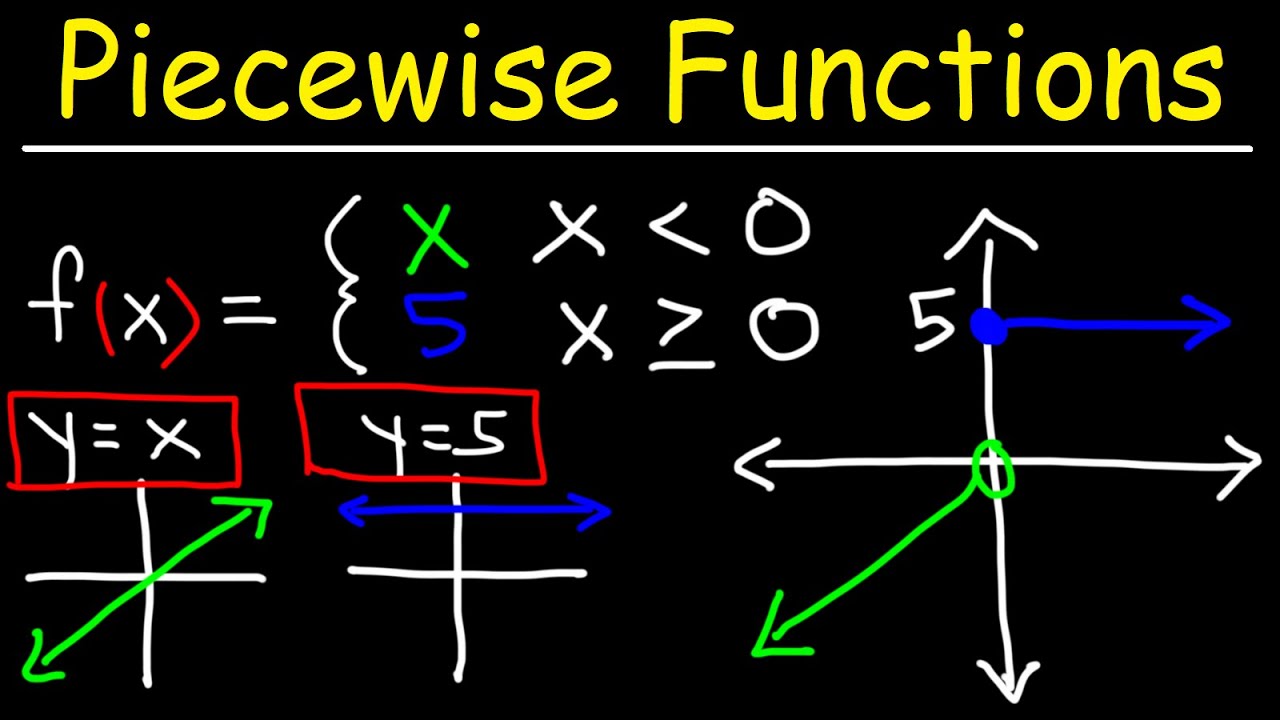
This precalculus video tutorial provides a basic introduction on graphing piecewise functions. It contains linear functions, quadratic functions, radical functions, and rational functions. This video contains plenty examples and practice problems on how to graph piecewise functions.
My E-Book: https://amzn.to/3B9c08z
Video Playlists: https:...
Watch those two
lone heartBOT
@fading ivy Has your question been resolved?
Channel closed
Closed by @fading ivy
Use .reopen if this was a mistake.
fading ivy
tacit arch
Watch those two
thanks
lone heartBOT
Available help channel!
Send your question here to claim the channel.
Remember:
• Ask your math question in a clear, concise manner.
• Show your work, and if possible, explain where you are stuck.
• After 15 minutes, feel free to ping <@&286206848099549185>.
• Type the command .close to free the channel when you're done.
• Be polite and have a nice day!
Read #❓how-to-get-help for further information on how to ask a good question, and about conduct in the question channels.
fallen verge
.close
lone heartBOT
Channel closed
Closed by @fallen verge
Use .reopen if this was a mistake.
fallen verge
No trolling
lone heartBOT
✅
lone heartBOT
Channel closed
Closed by @fallen verge
Use .reopen if this was a mistake.
fallen verge
Lol thanks
lone heartBOT
Available help channel!
Send your question here to claim the channel.
Remember:
• Ask your math question in a clear, concise manner.
• Show your work, and if possible, explain where you are stuck.
• After 15 minutes, feel free to ping <@&286206848099549185>.
• Type the command .close to free the channel when you're done.
• Be polite and have a nice day!
Read #❓how-to-get-help for further information on how to ask a good question, and about conduct in the question channels.
 distant meteor
Chemistry question: how do I transform cubical decimeters in liters? And how do I know if and when I have to do it? Also after finding something, how do I know the measuring unit?
lone heartBOT
distant meteor
Chemistry question: how do I transform cubical decimeters in liters? And how do ...
 wind cloak
,w cubic decimeters to litres
ocean sealBOT

 Requested by neonperseus#0
wind cloak
distant meteor
Chemistry question: how do I transform cubical decimeters in liters? And how do ...
Requested by neonperseus#0
wind cloak
distant meteor
Chemistry question: how do I transform cubical decimeters in liters? And how do ...
depends on the units you used to find it
If I say $m_1V_1 = m_2V_2$
ocean sealBOT
neonperseus
 distant meteor
ocean seal
distant meteor
ocean seal
Also, does it change between different fluids?
wind cloak
And I plug in mass in kg, and volume in cubic lightyears, my answer would be in cubic lightyears and kg
wind cloak
distant meteor
Also, does it change between different fluids?
nope
distant meteor
wind cloak
nope
😯
wind cloak
The density may change but 1 l of liquid is always 1 l of liquid
distant meteor
So, 3,45 dm^3 of nitrogen are 3,45 L?
wind cloak
yes
distant meteor
Thanks
Oh another thing
How do I know which measuring unit do I have to use to have a correct result
For example, do I have to use liters or m^3? pascals, ectopascals, bars or atmospheres
wind cloak
it's a matter of convience
chemistry uses CGS a lot since it makes sense
also a bar and an atm is basically the same thing
wind cloak
well the quantity doesn't change
But there will be a difference with different units
1 m != 1 cm
distant meteor
I suck at maths
😭
Basically I have this

And I need to find the final temperature
M remains stable, and density too (I think)
Also it’s nitrogen
Temperature and pressure change
And seems like V changes too, but I know only the final one
What can I do to find the final temperature
lone heartBOT
@distant meteor Has your question been resolved?
lone heartBOT
@distant meteor Has your question been resolved?
tardy stag
if you don't know the initial volume I don't think this is solvable 
oh you can use m and d to get the volume maybe?
and then $PV = nRT$ for the start to calculate $n$ and then use $PV = nRT$ again to calculate $T_2$
ocean sealBOT
Hayley
 distant meteor
Thanks
lone heartBOT
@distant meteor Has your question been resolved?
Channel closed
Closed by @distant meteor
Use .reopen if this was a mistake.
Available help channel!
Send your question here to claim the channel.
Remember:
• Ask your math question in a clear, concise manner.
• Show your work, and if possible, explain where you are stuck.
• After 15 minutes, feel free to ping <@&286206848099549185>.
• Type the command .close to free the channel when you're done.
• Be polite and have a nice day!
Read #❓how-to-get-help for further information on how to ask a good question, and about conduct in the question channels.
 prisma tulip
Yo, anyone help me;
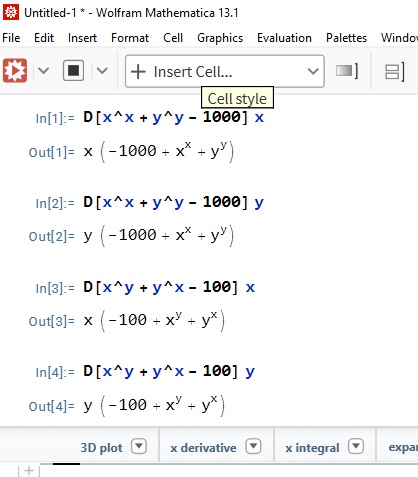
using mathmatica to calculate these partial derivatives but they seem wrong?
https://gyazo.com/d17c20c02107cdf16c8f4d3ec81a0af5
 lone heartBOT
prisma tulip
Yo, anyone help me;
using mathmatica to calculate these partial derivatives but ...
lone heartBOT
prisma tulip
Yo, anyone help me;
using mathmatica to calculate these partial derivatives but ...
 tardy stag
prisma tulip
Yo, anyone help me;
using mathmatica to calculate these partial derivatives but ...
tardy stag
prisma tulip
Yo, anyone help me;
using mathmatica to calculate these partial derivatives but ...
not quite sure how that even gave you anything
the syntax is D[x^x + y^y - 1000, x]
lone heartBOT
Channel closed
Closed by @prisma tulip
Use .reopen if this was a mistake.
prisma tulip
.reopen
lone heartBOT
✅
 tardy stag
surprised you're not using Mathematica's formatted input
that was my favorite thing about it
i think you might need to say b*z - b*c*t in that mode?? not sure
or it might not recognize sech? probably capitalized Sech
lone heartBOT
@prisma tulip Has your question been resolved?
lone heartBOT
Channel closed
Closed due to timeout
Use .reopen if this was a mistake.
Available help channel!
Send your question here to claim the channel.
Remember:
• Ask your math question in a clear, concise manner.
• Show your work, and if possible, explain where you are stuck.
• After 15 minutes, feel free to ping <@&286206848099549185>.
• Type the command .close to free the channel when you're done.
• Be polite and have a nice day!
Read #❓how-to-get-help for further information on how to ask a good question, and about conduct in the question channels.
 placid swallow
hi
lone heartBOT
placid swallow
hi
 cinder thicket
Hello Thomas
placid swallow
Can anybody help me figure out whats the time complexity of the following algorithm? G is a graph, w : V -> R is a function that maps every node to a weight, pop is theta(1).

this the work ive done so far
placid swallow
cinder thicket
Hello Thomas
Hello
cinder thicket
Damn can't help with whatever that is
wary stream
placid swallow
Can anybody help me figure out whats the time complexity of the following algori...
You might be better off asking in a computer science server, check #old-network
 torn elk
the while loop should be O(V^2) i think
lone heartBOT
@placid swallow Has your question been resolved?
tardy stag
torn elk
the while loop should be O(V^2) i think
specifically O(|E|)
which is probably O(V^2)
lone heartBOT
Channel closed
Closed due to timeout
Use .reopen if this was a mistake.
Available help channel!
Send your question here to claim the channel.
Remember:
• Ask your math question in a clear, concise manner.
• Show your work, and if possible, explain where you are stuck.
• After 15 minutes, feel free to ping <@&286206848099549185>.
• Type the command .close to free the channel when you're done.
• Be polite and have a nice day!
Read #❓how-to-get-help for further information on how to ask a good question, and about conduct in the question channels.
 brave junco
I'm having some trouble with this one
 lone heartBOT
brave junco
I'm having some trouble with this one
brave junco
lone heartBOT
brave junco
I'm having some trouble with this one
brave junco
I've gotten that C_n+1 = (C_n-1)/(n+1), where plugging in for n=1 solves for C_2
so n=3 -> C_4 = C_2/4 = C_0/8
but I'm not sure how so solve for even values of n other than filling in the blanks based on C_2,4, and 6 since n=2 results in C_3 = C_1/3
and I have no idea what C_1 is
 upbeat hornet
this equation is separable, you could solve it the normal way to check your answers
alpine sable
Yeah, but I think the question is asking for a series' solution
In that case, we have $\sum_{n=1}^\infty n a_n x^{n-1} =\sum_{n=0}^\infty a_n x^{n+1}$, I think?
tardy stag
a_n but yes
alpine sable
oops!
ocean sealBOT
breathe88rising
 alpine sable
So, then we can do $\sum_{n=1}^\infty \left(n a_n x^{n-1} - a_n x^{n+1}\right) - a_0 x = 0.$
ocean sealBOT
breathe88rising
 tardy stag
yes... that doesn't seem to help us much though
alpine sable
The tricky part is rearranging this sum so that we can obtain a recursive sequence
tardy stag
oh i see it
alpine sable
You do? Go on then
tardy stag
you have two seeds, the linear term and the constant term
brave junco
Fellas, I'm sorry but what you guys are saying is math jargon to me right now
alpine sable
Have you done series' solutions to differential equations before?
brave junco
Just now learning it, I think
tardy stag
start with the series on both sides (either use sigma notation or write out the first like 4 terms) and ask "how does the constant term get balanced" then "how does the x term get balanced" then "how does the x^2 term get balanced" etc
brave junco
if it helps, this is the method the textbook is applying

that's kinda what this is doing, right? ^
alpine sable
ocean seal
**breathe88rising**
I see it too. The left sum becomes $\sum_{n=1}^\infty n a_n x^{n-1} = \sum_{n=0}^\infty (n+1) a_{n+1} x^n$.
ocean sealBOT
breathe88rising
 alpine sable
By shifting the index of the sum
brave junco

oh I forgot to add 1 to the n in the first series
but how can I use that so solve c_1 or c_3 in terms of something that can be plugged in back for c_0?
tardy stag
well... it doesn't have to depend on c0 it just can't depend on anything else
alpine sable
brave junco
but how can I use that so solve c_1 or c_3 in terms of something that can be plu...
$\sum_{n=0}^\infty (n+1) a_{n+1} x^n = \sum_{n=0}^\infty a_n x^{n+1}$
ocean sealBOT
breathe88rising
 alpine sable
Now you need to balance the powers of $x$
ocean sealBOT
breathe88rising
 alpine sable
I fear I've done too much and you won't learn if I do the rest for you
 alpine sable
I don't know. I haven't done the work necessary to come to that conclusion. But if you think that's right, then all you need to do is just plug in numbers
brave junco
uhh one sec I'll upload my current work
brave junco
trying to rotate it one sec

took out the n=1 for the first series (c_1)
shifted them to have the same starting value for the series and same x^n
then combining them I got the c_1 (series bracket)[C_n+1(n+1)-c_n-1)x^n]=0
so dividing x^n and c_1 over I was left with
C_n+1(n+1) - c_n-1 = 0
into

but I'm still not sure how I'm supposed to solve even values of n in terms of c_0

since plugging in for n=2 -> c_3 = c_1/3
and I don't have values to plug into c_1 to get back to terms of c_0
tardy stag
what are the first few terms of y'?
what are the first few terms of xy?
tardy stag
ye
brave junco
okidoki, I think I got it, thanks
tardy stag

brave junco
.close
lone heartBOT
Channel closed
Closed by @brave junco
Use .reopen if this was a mistake.
Available help channel!
Send your question here to claim the channel.
Remember:
• Ask your math question in a clear, concise manner.
• Show your work, and if possible, explain where you are stuck.
• After 15 minutes, feel free to ping <@&286206848099549185>.
• Type the command .close to free the channel when you're done.
• Be polite and have a nice day!
Read #❓how-to-get-help for further information on how to ask a good question, and about conduct in the question channels.
 pastel prism
what is the formula i need to find c, i dont remember
 lone heartBOT
pastel prism
what is the formula i need to find c, i dont remember
lone heartBOT
pastel prism
what is the formula i need to find c, i dont remember
@pastel prism Has your question been resolved?
fathom grove
i believe it’s the formula for the barycenter which i do not know and recommend you google it
lone heartBOT
Channel closed
Closed by @pastel prism
Use .reopen if this was a mistake.
Available help channel!
Send your question here to claim the channel.
Remember:
• Ask your math question in a clear, concise manner.
• Show your work, and if possible, explain where you are stuck.
• After 15 minutes, feel free to ping <@&286206848099549185>.
• Type the command .close to free the channel when you're done.
• Be polite and have a nice day!
Read #❓how-to-get-help for further information on how to ask a good question, and about conduct in the question channels.
 somber nimbus
Can anyone please help me understand how they get the eigenvectors for lambda = -2 in this example
 lone heartBOT
somber nimbus
Can anyone please help me understand how they get the eigenvectors for lambda = ...
alpine sable
lone heartBOT
somber nimbus
Can anyone please help me understand how they get the eigenvectors for lambda = ...
alpine sable
Do you know how to find eigenvectors?
somber nimbus
I thought by just solving for x1 x2 and x3 and putting them into parametric form
alpine sable
Yes, you do solve for x_1, x_2, and x_3
somber nimbus
Then x_1 = -x_2 -x_3 etc, right
alpine sable
You are given $A = \begin{bmatrix} 1 & 3 & 3 \ -3 & -5 & -3 \ 3 & 3 & 1 \end{bmatrix}$. To find the $\emph{eigenvalues}$, you find the determinant of the matrix $A - \lambda I$ and solve the characteristic polynomial. Then, once you've the eigenvalues you subtract them from A using the identity matrix and then solve $A\mathbf{x} = 0$. Does that make sense?
ocean sealBOT
breathe88rising
 somber nimbus
It does yeah
alpine sable
So, you basically are stuck with the final step? (Solving Ax = 0)
I shouldn't call it A... It's $(A - \lambda I)\mathbf{x} = 0$.
somber nimbus
Yeah, I don't get how they end up with the v2's
ocean sealBOT
breathe88rising
 alpine sable
For the lambdas you've found
somber nimbus
(-1, 1, 0) and (-1, 0, 1)
 tardy stag
,rccw
ocean sealBOT
 lone heartBOT
@somber nimbus Has your question been resolved?
somber nimbus
@alpine sable
 worn fox
none of your vectors satisfy x1 + x2 + x3 = 0
somber nimbus
What should I do?
worn fox
well for example you let x3 = 0 and see what that results in
somber nimbus
Then x1 is just -x2?
worn fox
yeah
worn fox
somber nimbus
Can anyone please help me understand how they get the eigenvectors for lambda = ...
note thats the first option here
then you're looking for another independent solution, setting a different variable = 0 will do that for you
somber nimbus
I don't really get why the top entries of the v2 vectors are -1 though
 lone heartBOT
Channel closed
Closed by @somber nimbus
Use .reopen if this was a mistake.
Available help channel!
Send your question here to claim the channel.
Remember:
• Ask your math question in a clear, concise manner.
• Show your work, and if possible, explain where you are stuck.
• After 15 minutes, feel free to ping <@&286206848099549185>.
• Type the command .close to free the channel when you're done.
• Be polite and have a nice day!
Read #❓how-to-get-help for further information on how to ask a good question, and about conduct in the question channels.
warped topaz
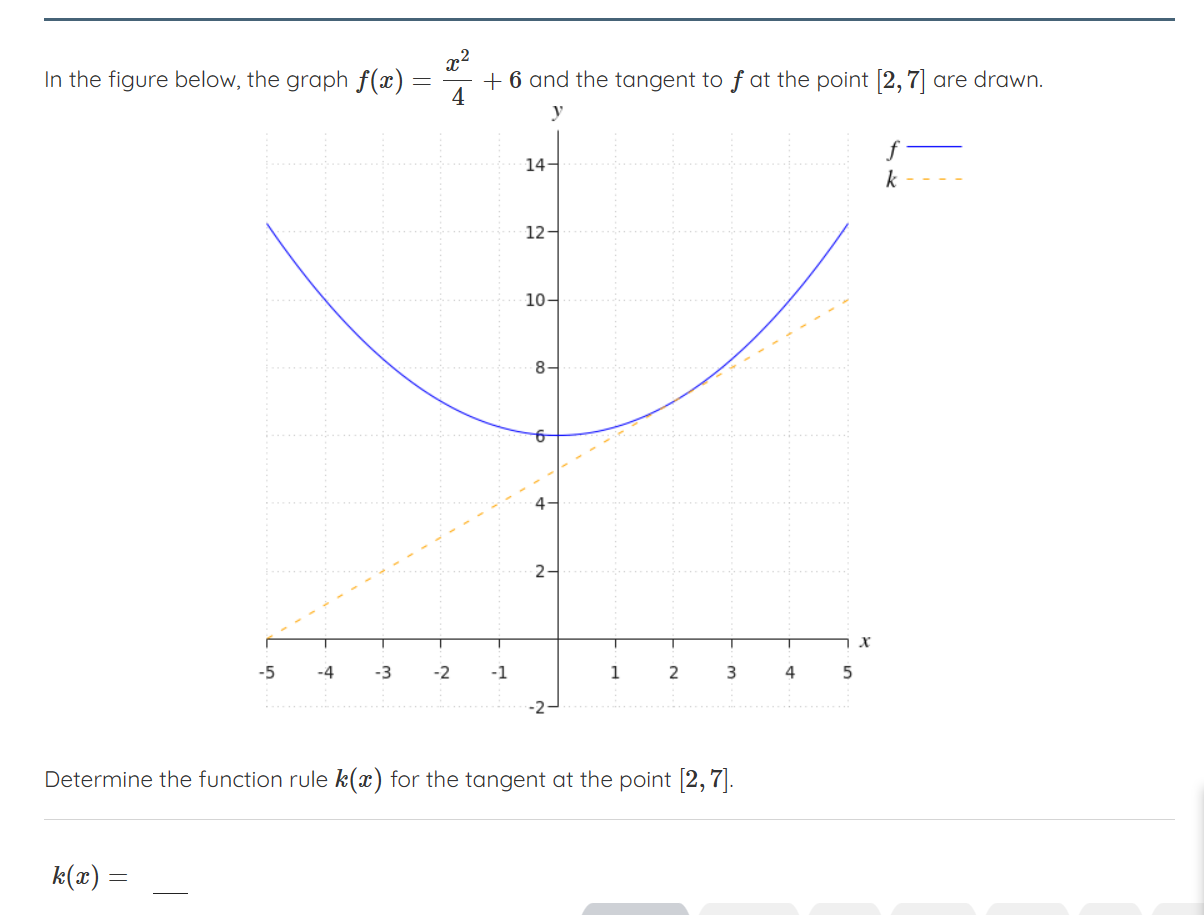 lone heartBOT
warped topaz
https://i.imgur.com/SalqO8s.png
lone heartBOT
warped topaz
https://i.imgur.com/SalqO8s.png
 long axle
It just means the function
k(x) is the function tangent to the curve at (2,7)
Just that dotted line
warped topaz
long axle
It just means the function
Ok, so wouldnt it just be x/2?
Cause its the derivative
 indigo lotus
they are asking for the equation of that dotted line
warped topaz
And the function tangent is just the derivative
long axle
That’s the function that represents the slope of any point on f(x)
somber nimbus
y = ax + b
warped topaz
Oh so I just plug in the values to find the y intercept?
long axle
But u have to plug into the derivative x/2 to find the slope at (2,7)
warped topaz
Ok I will try 1 moment
indigo lotus
long axle
But u have to plug into the derivative x/2 to find the slope at (2,7)
could do that without too as we know the two points the line passes through
long axle
Yep
warped topaz
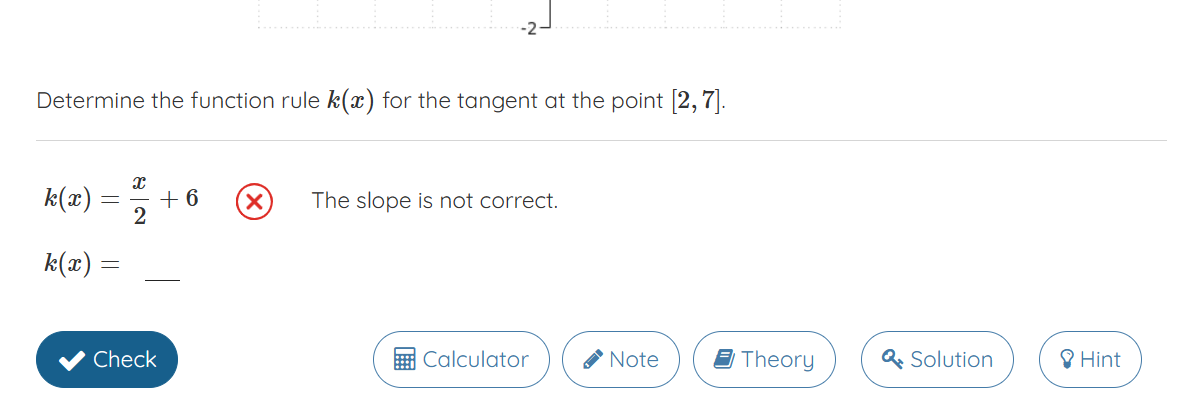
Why is my slope not correct
I subbed in 7=(2)(x/2)+c to get c=6
So then the equation should be x/2+6, no?
warped topaz
long axle
But u have to plug into the derivative x/2 to find the slope at (2,7)
I did this but apparently its wrong? Or did I make a mistake?
I got it
.close
lone heartBOT
Channel closed
Closed by @warped topaz
Use .reopen if this was a mistake.
Available help channel!
Send your question here to claim the channel.
Remember:
• Ask your math question in a clear, concise manner.
• Show your work, and if possible, explain where you are stuck.
• After 15 minutes, feel free to ping <@&286206848099549185>.
• Type the command .close to free the channel when you're done.
• Be polite and have a nice day!
Read #❓how-to-get-help for further information on how to ask a good question, and about conduct in the question channels.
alpine sable
How do I do this question
 lone heartBOT
alpine sable
How do I do this question
lone heartBOT
alpine sable
How do I do this question

 lone heartBOT
@alpine sable Has your question been resolved?
lone heartBOT
Channel closed
Closed by @native radish
Use .reopen if this was a mistake.
Available help channel!
Send your question here to claim the channel.
Remember:
• Ask your math question in a clear, concise manner.
• Show your work, and if possible, explain where you are stuck.
• After 15 minutes, feel free to ping <@&286206848099549185>.
• Type the command .close to free the channel when you're done.
• Be polite and have a nice day!
Read #❓how-to-get-help for further information on how to ask a good question, and about conduct in the question channels.
 tender anchor
Did I do this right?

 lone heartBOT
tender anchor
Did I do this right?
tender anchor
lone heartBOT
tender anchor
Did I do this right?
tender anchor
LHS meaning left hand slope
 crimson totem
tender anchor
LHS meaning left hand slope
crimson totem
tender anchor
LHS meaning left hand slope
i think 4th point is diffrentiable
crimson totem
i might be wrong though, but i highly believe 4th point is diffrentiable

 wet nest
lone heartBOT
wet nest
lone heartBOT
Channel closed
Closed by @tender anchor
Use .reopen if this was a mistake.
Available help channel!
Send your question here to claim the channel.
Remember:
• Ask your math question in a clear, concise manner.
• Show your work, and if possible, explain where you are stuck.
• After 15 minutes, feel free to ping <@&286206848099549185>.
• Type the command .close to free the channel when you're done.
• Be polite and have a nice day!
Read #❓how-to-get-help for further information on how to ask a good question, and about conduct in the question channels.
 round wind
hi
lone heartBOT
round wind
hi
round wind
the q
 lavish sedge
hi
 gilded magnet
Were not ur workers
lavish sedge
multiply each fraction by its conjugate and simplify
crimson totem
gilded magnet
Were not ur workers
brother chill
round wind
gilded magnet
Were not ur workers
who asked u to help baka
gilded magnet
crimson totem
brother chill
Ok
gilded magnet
round wind
who asked u to help baka
!status
lone heartBOT
round wind
who asked u to help baka
What step are you on?
1. I don't know where to begin
2. I have begun but got stuck midway
3. I got an answer but I'm told it's wrong
4. I got an answer and would like my work checked
5. I have a question about someone else's worked solution
6. None of the above
!show
lone heartBOT
Show your work, and if possible, explain where you are stuck.
round wind
lol
crimson totem
brother chill
gilded magnet
And √5+√3


 round wind
thanks
lavish sedge
should simplify pretty nicely
lavish sedge
round wind
thanks
np
gilded magnet
This server ain't meant for spoonfeeding
lavish sedge
gilded magnet
This server ain't meant for spoonfeeding
can you shut up
crimson totem
gilded magnet
This server ain't meant for spoonfeeding
True. +1
round wind
damn
gilded magnet
lavish sedge
can you shut up
Bruh it's what all mods point out u should shut up
lone heartBOT
Please read #❓how-to-get-help
crimson totem
hm
lavish sedge
gilded magnet
Bruh it's what all mods point out u should shut up
🤓 👆
crimson totem
there was a command for this
gilded magnet
You can Google that but I'll shut up now
lone heartBOT
As a helper, please do not give out answers that could be copied as a homework solution. Have the student work through the problem themselves and guide them along the way.
round wind
@lavish sedge thank u
lone heartBOT
@round wind Has your question been resolved?
Channel closed
Closed by @round wind
Use .reopen if this was a mistake.
Available help channel!
Send your question here to claim the channel.
Remember:
• Ask your math question in a clear, concise manner.
• Show your work, and if possible, explain where you are stuck.
• After 15 minutes, feel free to ping <@&286206848099549185>.
• Type the command .close to free the channel when you're done.
• Be polite and have a nice day!
Read #❓how-to-get-help for further information on how to ask a good question, and about conduct in the question channels.
 hollow zephyr
how to prove that the directional cosine matrix is orthonormal?
lone heartBOT
Channel closed
Closed by @hollow zephyr
Use .reopen if this was a mistake.
Available help channel!
Send your question here to claim the channel.
Remember:
• Ask your math question in a clear, concise manner.
• Show your work, and if possible, explain where you are stuck.
• After 15 minutes, feel free to ping <@&286206848099549185>.
• Type the command .close to free the channel when you're done.
• Be polite and have a nice day!
Read #❓how-to-get-help for further information on how to ask a good question, and about conduct in the question channels.
tender anchor
Derivative of f(x) = 3 / 5x^3
lone heartBOT
tender anchor
Derivative of f(x) = 3 / 5x^3
tender anchor
How do i start it?
 gray isle
do you mean
$$\frac35 x^3$$
or
$$\frac{3}{5x^3}$$
ocean sealBOT
ℝamonov
 surreal meadow
!nosols
lone heartBOT
As a helper, please do not give out answers that could be copied as a homework solution. Have the student work through the problem themselves and guide them along the way.
tender anchor
could u explain how you got that please
surreal meadow
ocean seal
**ℝamonov**
@tender anchor answer this
tender anchor
o second one
surreal meadow
what differentiation rules do you know
tacit arch
can you not copy paste from ai engines like chatgpt
round wind
Which class is this from
round wind
Chill who cares
tender anchor
surreal meadow
what differentiation rules do you know
only the power rule
 ebon sparrow
?
 surreal meadow
tender anchor
only the power rule
surreal meadow
tender anchor
only the power rule
do you know another way to write x^-3
tender anchor
surreal meadow
do you know another way to write x^-3
-3x^-2?
 safe tartan
Lol caught red handed
surreal meadow
tender anchor
-3x^-2?
well that’s the derivative
sly mantle
@stray hearth please dont post full solutions. instead talk with them to guide them to an answer
surreal meadow
i’m asking more like
sly mantle
@ebon sparrow gpt doesnt actually answer whether they wrote a response
ebon sparrow
I see
surreal meadow
tender anchor
wait
do you know what a negative exponent represents
can you guys take the gpt convo elsewhere
round wind
What country
sly mantle
ok so now thats out of the way, lets move on from here
tender anchor
like if its x^-2 its 1/x^2?
round wind
Trust her
surreal meadow
tender anchor
like if its x^-2 its 1/x^2?
yeah that’s the idea
sly mantle
only block and those wanting to help should talk here
surreal meadow
so try writing your original function in that form
tender anchor
so like do the inverse of that kinda
surreal meadow
yep
can you try that
also don’t worry too much about the 3/5, if you recall we can pull out the constants before we take the derivative
tender anchor
so it turns to x^-3?
tender anchor
yeah
surreal meadow
so now we have a new form
where we can just apply the power rule
what would the derivative of (3/5) * x^-3 be
tender anchor
-3(3/5)x^-2
surreal meadow
yep
tender anchor
since u -1 but its a negative