#help-0
1 messages · Page 251 of 1
 warped kindle
 onyx swallow
warped kindle
Not sure what is that?😂
onyx swallow
warped kindle
Not sure what is that?😂
ok, then in this case the problem is a bad problem

warped kindle
Ooo sure. I think by then i would need to learn it
Ahh
There is another question i can't seem to do

 warped kindle
onyx swallow
warped kindle
onyx swallow
Wow. Omg thank you!! Ya i have not learnt it
onyx swallow
warped kindle
(p/q)^(r-1)=p^(r-1)/q^(r-1)
this is yet another bad problem as it gives lots of solution lol
best to switch book
warped kindle
Haha, all the teachers would say that as long as your final answer is correct. Anything is acceptable
So what is r?
onyx swallow
warped kindle
for example, if p=q, any r works
onyx swallow
warped kindle
So what is r?
try and simplify it first
warped kindle
I seee
onyx swallow
put p on one side and q on the other
 onyx swallow
warped kindle
Like this?
onyx swallow
warped kindle
Like this?
yes, this is the left hand side of the equation, can you do the same for the right hand side?
warped kindle
Sorry, not so sure what you meant by right hand side of the equation.
onyx swallow
warped kindle
Sorry, not so sure what you meant by right hand side of the equation.
you have (p/q)^(r-1)=(q/p)^(r-4)
warped kindle
Ya
onyx swallow
warped kindle
Ya
you can simplify this equation to p^(r-1)/q^(r-1)=q^(r-4)/p^(r-4)
onyx swallow
warped kindle
But then what do i do?
you can use cross product!
if a/b=c/d then ad=bc
warped kindle
Can't seem to get the answer
Well never mind thrn, i'll just leave thid question out
Thanks for helping though
Highly appreciated
onyx swallow
 safe tartan
Can’t you just make one of the sides negative exponent
safe tartan
Can’t you just make one of the sides negative exponent
yeah
 lone heartBOT
@warped kindle Has your question been resolved?
warped kindle
onyx swallow
p^(2r-5)=q^(2r-5)
Oof, i already got the answer but i thought was wrong.
So it was correct all this while, haha.
lone heartBOT
Channel closed
Closed by @warped kindle
Use .reopen if this was a mistake.
warped kindle
Anyway thanks
lone heartBOT
 Available help channel!
Send your question here to claim the channel.
Remember:
• Ask your math question in a clear, concise manner.
• Show your work, and if possible, explain where you are stuck.
• After 15 minutes, feel free to ping <@&286206848099549185>.
• Type the command .close to free the channel when you're done.
• Be polite and have a nice day!
Read #❓how-to-get-help for further information on how to ask a good question, and about conduct in the question channels.
 bright parrot
Can someone explain me what A should look like?

 vale crag
darn that's a mouthful lol
anyway
wdym by "look like" ?
what are you looking for ?
@bright parrot
bright parrot
I can not really imagine what is in this shit
Normally the languages are so simple that you can understand what you could build from them but with this task I don't even know what kind of subwords I can make from A
{001} is maybe in there bec it is |w| mod 2 = 1 is true and
(w)n = 1 -> (w)n-1 = 0 is also true
but what dose the ∨ |w| = 0 is doing there
vale crag
bright parrot
{001} is maybe in there bec it is |w| mod 2 = 1 is true and
it's |w|_0 = 1 mod 2
it's talking about the number of zeros in the word
bright parrot
oh
vale crag
here you got 2 zeros
bright parrot
ahhh so {10} and {0100} ... is in there
vale crag
and |w| = 0 is prolly just a weird edge case they need idk
vale crag
bright parrot
ahhh so {10} and {0100} ... is in there
yes
vale crag
.close
lone heartBOT
Channel closed
Closed by @vale crag
Use .reopen if this was a mistake.
lone heartBOT
Available help channel!
Send your question here to claim the channel.
Remember:
• Ask your math question in a clear, concise manner.
• Show your work, and if possible, explain where you are stuck.
• After 15 minutes, feel free to ping <@&286206848099549185>.
• Type the command .close to free the channel when you're done.
• Be polite and have a nice day!
Read #❓how-to-get-help for further information on how to ask a good question, and about conduct in the question channels.
 radiant dragon
can someone give me step by step guide on how to find the inverse of a 3x3 matrix
lone heartBOT
radiant dragon
can someone give me step by step guide on how to find the inverse of a 3x3 matri...
 wet wigeon
ok
wet wigeon
radiant dragon
can someone give me step by step guide on how to find the inverse of a 3x3 matri...
i can
show me it
do you mean inverse function or just function
 mortal trellis
do you know how to row reduce/gaussian elimination
 sharp panther
radiant dragon
can someone give me step by step guide on how to find the inverse of a 3x3 matri...
sharp panther
radiant dragon
can someone give me step by step guide on how to find the inverse of a 3x3 matri...
There are two ways of doing that
- Using row and column transformation and this step is very tedious so I prefer never to do it
- Inverse of A = 1/|A| * adj(A)
mortal trellis
not like calculating 9 2x2 dets is that much nicer
and for 4x4 or bigger the adj(A) is even worse
lone heartBOT
@radiant dragon Has your question been resolved?
vale crag
mortal trellis
not like calculating 9 2x2 dets is that much nicer
more like 65487587412682615 2x2 dets
lone heartBOT
Channel closed
Closed due to timeout
Use .reopen if this was a mistake.
Available help channel!
Send your question here to claim the channel.
Remember:
• Ask your math question in a clear, concise manner.
• Show your work, and if possible, explain where you are stuck.
• After 15 minutes, feel free to ping <@&286206848099549185>.
• Type the command .close to free the channel when you're done.
• Be polite and have a nice day!
Read #❓how-to-get-help for further information on how to ask a good question, and about conduct in the question channels.
 static burrow
Hello i need help with trigonometry i don't know how and what stuff means and that trigonometric syrcle is wierd to me cold someone help me with it?
lone heartBOT
static burrow
Hello i need help with trigonometry i don't know how and what stuff means and t...
static burrow
this

look i get the red and the top pi/180 and things
i dont understand the formulas on the botom
this sin^2a...
are those formulas
 tardy stag
Most people (including me) don't really know how to prove that $\sin(2\theta) = 2\sin(\theta)\cos(\theta)$
 ocean sealBOT
Hayley
 tardy stag
that's one of those formulas that's easiest to memorize, or you're often given it on tests and things
static burrow
what is theta?
tardy stag
any angle
you could use whatever variable you wanted but theta is a standard "angle" variable name
static burrow
look these are some of the questions on my exams that i could have
ill send them in a sec

and for the question 13. i have next answers to check in1, 1, 1/3, 1/9, 2/9, 7/9
tardy stag
these are somewhat challenging problems! First of all, do you understand what sin/cos/tg actually mean? Does the fact that they're restricting the first problem to an interval make sense to you?
static burrow
i think they do i do understand somewhat what they are and for what you use them for
tardy stag
and would you be able to fill this out? https://media.discordapp.net/attachments/1064643750493691967/1119874751561744404/Screen_Shot_2023-06-18_at_2.22.14_AM.png
you don't have to do it for me right now but it's a good idea to make something like this

oh and do you understand that when we say $\sin^2 x$ it's just a simpler way to write $(\sin x)^2$
ocean sealBOT
Hayley
 static burrow
 static burrow
ocean seal
**Hayley**
static burrow
ocean seal
**Hayley**
this i do yes
this math stuff is exosting ive been studding some stuff from the scratch and thankfully the exam is in monday
been looking at math for way to long for my likeing (45days) straight
tardy stag
static burrow
okay great (there is one error, tan(pi) is +infinity but I usually just say undefined)
let's look at that second one
can you rewrite $\sin(2a) = \frac23$ using those double angle formulas?
ocean sealBOT
Hayley
 tardy stag
you're replying to something from like four hours ago
static burrow
ocean seal
**Hayley**
but i dont get this
static burrow
tardy stag
you're replying to something from like four hours ago
my bad
tardy stag
static burrow
but i dont get this
hmm. let's remind ourselves of the double angle formulas
,tex .double angle
ocean sealBOT
Hayley
 static burrow
so this 0 with the - over it is alpha?
tardy stag
this symbol is called theta $\theta$
ocean sealBOT
Hayley
 tardy stag
this is alpha $\alpha$
ocean sealBOT
Hayley
 static burrow
so its cos^2 (example. 90) -1
tardy stag
uh, sure, if you had $cos(180)$ that would be equal to $2cos^2(90) - 1$
ocean sealBOT
Hayley
 tardy stag
and you can check that with your chart you just made

 plain wave
tardy stag
plain wave
tardy stag
okay, I see a sin(2a) on the left, how about we rewrite that using our formulas
static burrow
its sin 2*alpha
tardy stag
if you solve that for cos(a) you might be able to evaluate the thing on the right
static burrow
so i need to find cosx
 static burrow
damn nice
could you explain to me how did you get rid of sin2a=2/3
and what did you do with it
 unreal phoenix
static burrow
could you explain to me how did you get rid of sin2a=2/3
unreal phoenix
static burrow
could you explain to me how did you get rid of sin2a=2/3
Get rid of it from where?
static burrow
is the sin^2a+cos^2a in the () rewritten sin2a=2/3
i mean how did you rewrite sin2a=2/3
unreal phoenix
No. Sin^2 a + cos^2 a =1, right?
tardy stag
unreal phoenix
yeah that's the solution I had in mind but you need some practice to see it I think
unreal phoenix
static burrow
i mean how did you rewrite sin2a=2/3
sin2a=2sin a cos a
unreal phoenix
tardy stag
yeah that's the solution I had in mind but you need some practice to see it I th...
Yeah ig. Initial practice for students is just calculating sin and cos explicitly, but looking at the degree of exponent, ig it wasn't supposed to be solved by finding the trig ratios explicitly.
static burrow
oooo
i see
im not the best at reading mathematic problems with text our teachers always just gave us the problem with nothing else and we had to solve it
tardy stag
these problems are pretty challenging especially if you've just started learning about double angle formulas
static burrow
yeah somewhat i just started
but
yall cleared it up for me a lot
thanks for this @tardy stag and @unreal phoenix meant a lot
its hard on me from all the pressure from the university exam
i had to learn like 60 different matematic problems, still there is some left but this one is the worst,
,close
how do i do it
.close
lone heartBOT
Channel closed
Closed by @static burrow
Use .reopen if this was a mistake.
Available help channel!
Send your question here to claim the channel.
Remember:
• Ask your math question in a clear, concise manner.
• Show your work, and if possible, explain where you are stuck.
• After 15 minutes, feel free to ping <@&286206848099549185>.
• Type the command .close to free the channel when you're done.
• Be polite and have a nice day!
Read #❓how-to-get-help for further information on how to ask a good question, and about conduct in the question channels.
 willow brook
 lone heartBOT
willow brook
willow brook
lone heartBOT
willow brook
willow brook
I thought that $p(n) = (1-p)^2 p^n$
ocean sealBOT
jobo6

 lone heartBOT
@willow brook Has your question been resolved?
 vale wigeon
@willow brook think about what X=n means
X=n means that, up until you had your second failure, you had exactly n successes
you also had 1 failure to make the 2nd failure the 2nd
1 failure and n successes -- there are (n+1) ways for these outcomes to be arranged in a row
willow brook
vale wigeon
1 failure and n successes -- there are (n+1) ways for these outcomes to be arran...
Wouldnt it be $(n+1)!$ than for the permutations
ocean sealBOT
jobo6
 ocean sealBOT
Ann
 lone heartBOT
Channel closed
Closed by @willow brook
Use .reopen if this was a mistake.
Available help channel!
Send your question here to claim the channel.
Remember:
• Ask your math question in a clear, concise manner.
• Show your work, and if possible, explain where you are stuck.
• After 15 minutes, feel free to ping <@&286206848099549185>.
• Type the command .close to free the channel when you're done.
• Be polite and have a nice day!
Read #❓how-to-get-help for further information on how to ask a good question, and about conduct in the question channels.
 patent swallow
lone heartBOT
patent swallow
https://cdn.discordapp.com/attachments/326138772477575180/1124786428350574654/rn...
patent swallow
patent swallow
lone heartBOT
patent swallow
https://cdn.discordapp.com/attachments/326138772477575180/1124786428350574654/rn...
patent swallow
didnt work

can someone help me with the R part? idk what I'm doing rly
basically I've this function

I need to develop Taylor of order 2 in x = 8
and prove that with this taylor I can estimate 2ln(1,3) with an error smaller than 0.02
lone heartBOT
@patent swallow Has your question been resolved?
lone heartBOT
@patent swallow Has your question been resolved?
lone heartBOT
Channel closed
Closed due to timeout
Use .reopen if this was a mistake.
Available help channel!
Send your question here to claim the channel.
Remember:
• Ask your math question in a clear, concise manner.
• Show your work, and if possible, explain where you are stuck.
• After 15 minutes, feel free to ping <@&286206848099549185>.
• Type the command .close to free the channel when you're done.
• Be polite and have a nice day!
Read #❓how-to-get-help for further information on how to ask a good question, and about conduct in the question channels.
 dawn quail
why are brackets required on third line?
 lone heartBOT
dawn quail
why are brackets required on third line?
dawn quail
lone heartBOT
dawn quail
why are brackets required on third line?
dawn quail
I thought addition was commutative
unreal phoenix
It still is
 tacit arch
-(2+3) = ?
dawn quail
oh, it should really be -ln2 -lny^2 if we remove the brackets?
distribute the -
got it
that's why brackets are not needed for first part
only second
interesting..
thank you!
.close
lone heartBOT
Channel closed
Closed by @dawn quail
Use .reopen if this was a mistake.
Available help channel!
Send your question here to claim the channel.
Remember:
• Ask your math question in a clear, concise manner.
• Show your work, and if possible, explain where you are stuck.
• After 15 minutes, feel free to ping <@&286206848099549185>.
• Type the command .close to free the channel when you're done.
• Be polite and have a nice day!
Read #❓how-to-get-help for further information on how to ask a good question, and about conduct in the question channels.
 rotund crater
someone can explain me this
 lone heartBOT
rotund crater
someone can explain me this
mortal trellis
lone heartBOT
rotund crater
someone can explain me this
mortal trellis
explain what about it
graphically, your function increases or decreases with a few saddle points. so it passes the horizontal line test and is injective
and if you then restrict the codomain to the image you are automatically surjective, so you have an inverse
lone heartBOT
@rotund crater Has your question been resolved?
rotund crater
mortal trellis
explain what about it
i dont understand
 trim heron
Start from this: if a function is increasing (or decrasing) then it is a one-to-one function.
Then the inverse of it is also defined.
like f(x) = 4x
rotund crater
yes i know but why is f"(x) >= 0 why has equal or f'(c)=0
trim heron
rotund crater
yes i know but why is f"(x) >= 0 why has equal or f'(c)=0
this was not included in your screenshot
what do you mean?
rotund crater
this part
 trim heron
There is no f''(x), that was what I mean
rotund crater
i accedently put double comma
trim heron
consider $f(x)=x^3$ so f'(x)>0 when $x \neq 0$
ocean sealBOT
ertansinansahin
 rotund crater
Sooo if stricly positive must be f'(x)>0 no f'(x) >=0
trim heron
then it is still increasing function but it will just stop for a while at x=0 just for one point
rotund crater
 rotund crater
and has inverse
trim heron
consequently it will be invertible function, yes
rotund crater
soo thex for the help
trim heron
bu if it stays here for more than one point, then it is not invertible
 rotund crater
wdym?
trim heron
I just wanted to explain why "infinitely many point" is stressed.
trim heron
rotund crater
someone can explain me this
here
this is also an increasing fuction's graph

but in the yellow region there are infinitely many points with zero derivatives.
trim heron
these points will yield zero for the derivatives since the slope is zero there
lone heartBOT
@rotund crater Has your question been resolved?
lone heartBOT
Channel closed
Closed by @rotund crater
Use .reopen if this was a mistake.
Available help channel!
Send your question here to claim the channel.
Remember:
• Ask your math question in a clear, concise manner.
• Show your work, and if possible, explain where you are stuck.
• After 15 minutes, feel free to ping <@&286206848099549185>.
• Type the command .close to free the channel when you're done.
• Be polite and have a nice day!
Read #❓how-to-get-help for further information on how to ask a good question, and about conduct in the question channels.
 tacit jewel
$$ {R} \ {0, 1} $$
Does this mean all reals excluding 0 and 1

 tacit jewel
Yes sorry dont know how to properly type stuff
 blissful temple
tacit jewel
$$ {R} \ {0, 1} $$
Does this mean all reals excluding 0 and 1
blissful temple
tacit jewel
$$ {R} \ {0, 1} $$
Does this mean all reals excluding 0 and 1
Yes
lone heartBOT
Channel closed
Closed by @tacit jewel
Use .reopen if this was a mistake.
Available help channel!
Send your question here to claim the channel.
Remember:
• Ask your math question in a clear, concise manner.
• Show your work, and if possible, explain where you are stuck.
• After 15 minutes, feel free to ping <@&286206848099549185>.
• Type the command .close to free the channel when you're done.
• Be polite and have a nice day!
Read #❓how-to-get-help for further information on how to ask a good question, and about conduct in the question channels.
 chrome sorrel
 lone heartBOT
chrome sorrel
chrome sorrel
lone heartBOT
chrome sorrel
chrome sorrel
For #1.
I graphed the regulra function 4/(x^2+1). because i dont think its possible to graph integrals on graphing calcs right?
blissful temple
You only need to graph the integrand - that's what's inside the integral
chrome sorrel
Yes I graphed that
But like how does that tell me if the integral is positive/negative, or zero
chrome sorrel
area under curve
blissful temple
Right
blissful temple

lone heartBOT
Channel closed
Closed by @chrome sorrel
Use .reopen if this was a mistake.
Available help channel!
Send your question here to claim the channel.
Remember:
• Ask your math question in a clear, concise manner.
• Show your work, and if possible, explain where you are stuck.
• After 15 minutes, feel free to ping <@&286206848099549185>.
• Type the command .close to free the channel when you're done.
• Be polite and have a nice day!
Read #❓how-to-get-help for further information on how to ask a good question, and about conduct in the question channels.
 median oar
 lone heartBOT
median oar
median oar
lone heartBOT
median oar
median oar
Is there an intuitive understanding for the covariance metric of a vector parameter estimate?
lone heartBOT
@median oar Has your question been resolved?
lone heartBOT
@median oar Has your question been resolved?
 sand pawn
median oar
Is there an intuitive understanding for the covariance metric of a vector parame...
sand pawn
median oar
Is there an intuitive understanding for the covariance metric of a vector parame...
dude u must be insane. Asking a advanced math question in such help channels is just ridiculus.
You should better ask in advanced section
lone heartBOT
@median oar Has your question been resolved?
median oar
Perhaps a different perspective on the question is what is the use for the variance of a vector parameter estimate?
I think the covariance here is the MSE of an MVU estimate

If that is so, it answers the question what the covariance means, but then it raises the question of what the variance means
lone heartBOT
@median oar Has your question been resolved?
 warm raven
helo
mortal trellis
random message
lone heartBOT
@median oar Has your question been resolved?
 subtle birch
Meth
 raven haven

 jolly widget
 lime kindle
use a separate channel
lime kindle
which one ma'am?
 echo socket
Any available help channel below #❓how-to-get-help
(Currently the ones with numbers 6, 7, 11, 13 and 14 are open)
lime kindle
pretty compilacted nvm
echo socket
Just read #❓how-to-get-help if you haven't yet
lone heartBOT
@median oar Has your question been resolved?
 sinful star
yo
median oar
How do I differentiate with respect to a vector
Is that even a thing

Look at the regularity condition it says that the expectation of derivative with respect to θ is 0
But θ here is a vector
 solemn juniper
given that it appends "for all theta" I wonder if it's just sketchy notation and saying for every element in theta
 keen plinth
grad = 0
median oar
Hmm I don’t really get the regularity condition
That line is saying that the expectation of the gradient of my log likelihood function is 0
So does that mean it’s a stationary point?
keen plinth
yes
the expectation log-likelihood function as a function of theta should have a stationary point at the true value of the parameter
keen plinth
this is just to ensure that the MLE comes from a stationary point of the log-likelihood function i guess
rather than some boundary point
that notation C_theta - I^-1 is really cursed
since they're both matrices
median oar
Is this better

It’s using >= to represent that last line on the LA recap on the bottom right
keen plinth
it's meant to mean pos semi definite
 ocean sealBOT
 median oar
That right side looks kinda weird
Perhaps the pdf part isn’t correct?
My friend said that the goal of the condition is to be able to interchange the integral from the expectation operator and the derivative from the gradient operator
keen plinth
yes that is the point of the condition
otherwise you don't really have a good way of calculating the derivatives
median oar
Could you elaborate on what exactly we want to find the derivative of, maybe I can see why we wouldn’t have a good way of doing it
keen plinth
uh
let's see
[ \nabla_\theta \E_\vartheta l(X, \theta) = \E_\vartheta \nabla_\theta l(X, \theta) ]
ocean sealBOT
 median oar
The subscript on expectation is for the likelihood function?
keen plinth
the subscript is for the X
i'm saying i'm taking the expectation with X distributed wrt the distribution using the true parameter value vartheta
median oar
So the expectation of X, when our pdf of X has θ = true parameter value
keen plinth
yes
keen plinth
sample space?
median oar
Like possible realisations of the distribution
keen plinth
the expectation is of a real function of X
you take the expectation of X plugged into the log likelihood for the density associated with parameter theta
and treat that whole thing as a function of theta
but the expectation is for X
X is the RV
keen plinth
no theta is a constant
median oar
keen plinth
you take the expectation of X plugged into the log likelihood for the density as...
Isn’t the density associated with parameter θ a pdf
keen plinth
theta parametrises a family a distributions
each distribution has a density so theta parametrises those as well
but theta is not a random variable
 analog gull
In theory the theta could be random by law
median oar
I thought it would be in the sense that for some given realisation of the data, what is θ
keen plinth
this is not how it is modelled mathematically
median oar
Wait no that means θ is deterministic
analog gull
Correct
keen plinth
the true parameter value is a constant
median oar
Since it would otherwise make no sense to estimate it
analog gull
Perhaps a different perspective on the question is what your looking for
median oar
ocean seal
Ok let’s back up then, we want to do this
analog gull
Let's do this!!!
median oar
Ok let me write on paper
analog gull
Same with me
median oar
Ok this is this goal right?
 keen plinth
uh no
median oar
I’m still not exactly sure why we want that condition to be met, the swapping of expectation and gradient but let’s run with it for now
analog gull
Okay I think the we should initialize θ, and gather demonstrations x then solve for optimal policy for pi(a|s) w.r.t cθ with value iteration then solve for state visitasion frequencies p(s | θ,T)
median oar
What’s pi(a|s)
analog gull
and then compute gradient of the equation on what we have so far and update θ with one gradient step of using nabla θ vartheta
median oar
And what’s cθ
analog gull
okay well i see that you are not as smart as me
 analog gull
I have multiple degrees in Advanced Calculus and Advanced Physics
median oar
median oar
Ok this is this goal right?
Ok if this isn’t the goal what is the goal
Isn’t this the point of checking the regularity condition?
analog gull
I mean it could be just takes some time
median oar
Because if it satisfies the condition then something cool happens (the ability swap the operators)
keen plinth
median oar
the first equation is still kinda sus, i'm pretty sure the usual assumption is that you can interchange derivatives and integrals
analog gull
Okay um mods
median oar
Well both these videos seem to suggest it as the condition


 median oar
Daniel Romero
keen plinth
the notation is also sus
median oar
Ok what’s a better notation then
keen plinth
i can't tell what they're saying with the for all theta
 opal relic
guys I'm a little bit lost here
keen plinth
because if it holds that the gradient is 0 for all theta your function should be constant
median oar
Let me see if he says anything specific about it
 rose sigil
analog gull
Okay I think the we should initialize θ, and gather demonstrations x then solve...
rose sigil
analog gull
Okay I think the we should initialize θ, and gather demonstrations x then solve...
that sounds like an amazing idea to me
analog gull
Thank youu
rose sigil
yea i wanna hear it explained too
median oar
Nothing in the scalar case either
analog gull
another day I would love to
rose sigil
i wasn't smart enough to understand it all but it sounds so interesting
median oar

But I see your point snow
If the likelihood had 0 gradient everywhere then it’s just a flat line
keen plinth
my notes on cramer rao are not very comprehensive unfortunately 
median oar
Ok let’s back up even further then
Back to Wikipedia

Some condition allows for the top and bottom to be the same
Surely that statement is correct
keen plinth
yeah im pretty sure thats a consequence of being able to interchange derivatives and integrals
keen plinth
uh no its a slightly non trivial calculation
median oar
I don’t see how the derivatives combine and where the - comes from
keen plinth
let me see if i can find it in my notes
median oar

keen plinth
the univariate case is relatively painless to show
multivariate will probably get a bit awful
median oar
Well it seems I don’t get the univariate case either so that’s probably a good place to start
keen plinth
okay so
keen plinth
median oar
this notation is slightly terrible
lets use a slightly different notation
median oar
Sure
keen plinth
so we'll have a random vector $X$ which will represent our sample, and the underlying distribution of $X$ will be $X \sim \P_\theta$, where i'm using $\P_\theta$ to denote the probability measure, and $\theta \in \Theta$ is the parameter which varies over the parameter space $\Theta$
ocean sealBOT
 keen plinth
then we can call the true parameter value $\vartheta$
ocean sealBOT
 keen plinth
so when i write something like $\P_\theta(X \in B)$ i mean $X \sim \P_\theta$, the distribution picked out by $\theta \in \Theta$, and $\E_\theta g(X)$ will be the expectation taken wrt to this distribution
ocean sealBOT
 median oar
ocean seal
median oar
ocean seal
Expectation of g(X) on the bottom here?
keen plinth
yes
just some random function g
so here we can assume $X$ has a density $f_\theta$, so the log-likelihood function will be
[
l(x; \theta) = \log f_\theta(x)
]
ocean sealBOT
 median oar
ocean seal
median oar
ocean seal
And P_θ here means a distribution with parameter equal to θ, which is some element of all possible parameters
median oar
ocean seal
What’s B
keen plinth
a set
median oar
Any set?
keen plinth
a measureable set lol
median oar
The sample space?
median oar
Should we use omega
keen plinth
[
\P_\theta(a \le X < b) = \P_\theta(X \in \coi ab)
]
ocean sealBOT
 median oar
So a subset of omega
keen plinth
yes
so we want to show that
[
I(\vartheta) = -\dnv 2 \theta\biggr\rvert_\vartheta \E_\vartheta l(X; \theta) = \E_\vartheta \biggl(\dv\theta\biggr\rvert_\vartheta , l(X; \theta)\biggr)^2
]
ocean sealBOT
 keen plinth
notation gets kinda confusing
but the equality only holds when $\theta = \vartheta$, so when the parameter is set to the true value
ocean sealBOT
 median oar
We want to find some condition that implies the equality?
ocean sealBOT
 keen plinth
i've just given it to you
i'm using the notation
[
\dv x\biggr\vert_a f(x) = f'(a)
]
so evaluating the derivative of $f$ at $a$
theres kinda
no good way to write this lol
median oar
What’s the p got to do with a
ocean sealBOT
 median oar
Oh lmao
keen plinth
me being a dum dum switching notation halfway through typing
okay so
if we just assume these conditions
we should be able to evaluate these things
 median oar
Right good
keen plinth
so basically we just expand out the integrals
assume you can interchange derivatives and integrals
and then it should work
keen plinth
keen plinth
assume you can interchange derivatives and integrals
so theses are the regularity assumptions you'll find on wikipedia i think
maybe
if it isnt well at least itll give you an idea of how it works lol
median oar
Ok I’ll have a go at it
keen plinth
\begin{align*}
  \MoveEqLeft
  \dnv2\theta \E_\vartheta l(X; \theta) \\
  & = \dnv2\theta \int (\log f_\theta(x)) \, f_\vartheta(x) \, dx \\
  & \overset{!!}= \int \pdnv2\theta \Bigl(\log f_\theta(x)\Bigr) \, f_\vartheta(x) \, dx \\
  & = \int \biggl(\f {f_\theta''(x)} {f_\theta(x)} - \Bigl(\f {f_\theta'(x)} {f_\theta(x)}\Bigr)^{\!2}\biggr) \, f_\vartheta(x) \, dx
\end{align*}
 keen plinth
so the !! is where you need to assume you can bring the derivative inside
 ocean sealBOT
 median oar
What happens to the limits
keen plinth
which limits?
median oar
Cos now that function isn’t a function of θ anymore it’s a function of some constant \vartheta
keen plinth
you have to take the derivative wrt theta
so the notation gets really really messy
but like
median oar
And then evaluate it at vartheta no?
keen plinth
yeah
median oar
ocean seal
From this
keen plinth
yes
keen plinth
but here we're gonna use [ f_\theta'(x) = \dv\theta , f_\theta(x) ] rather than [ f_\theta'(x) = \dv x , f_\theta(x) ]
median oar
And I need to differentiate it again with respect to θ
Yeah but where does vartheta go
ocean sealBOT
 median oar
Does the evaluate only happens after 2 derivatives
keen plinth
yes
median oar
Oh
That’s where I went wrong
I shouldn’t evaluate it yet
It’s the evaluation of the 2nd derivative
keen plinth
what i meant by the second derivative was you do the derivatives first
yeah
notation is bad
but i dont know of another way to write it that isnt worse
 ocean sealBOT
 median oar
Missing - signs at the front
keen plinth
yeah alright
so we can just like
take that
\begin{align*}
  \dnv2\theta\biggr|_\vartheta \E_\vartheta l(X; \theta)
  & = \int \biggl(\f {f_\vartheta ''(x)} {f_\vartheta (x)} - \Bigl(\f {f_\vartheta '(x)} {f_\vartheta (x)}\Bigr)^{\!2}\biggr) \, f_\vartheta(x) \, dx \\
  & = \int f_\vartheta''(x) \, dx - \int \Bigl(\f {f_\vartheta '(x)} {f_\vartheta (x)}\Bigr)^{\!2} \, f_\vartheta(x) \, dx \\
  & = \int f_\vartheta''(x) \, dx - \int \biggl(\dv\theta\biggr\rvert_\vartheta \log f_\theta(x)\biggr)^{\!2} \, f_\vartheta(x) \, dx \\
  & = \int f_\vartheta''(x) \, dx - \E_\vartheta \biggl(\dv\theta\biggr\rvert_\vartheta l(X; \theta)\biggr)^{\!2}
\end{align*}

 ocean sealBOT
 keen plinth
so this is the question we need to answer
keen plinth
what we're assuming is the ability to interchange derivatives and integrals
median oar
It’ll mean we can swap the order of operators?
keen plinth
so this is actually just a result of f being a density
[
\int \pdnv2\theta , f_\theta(x) , dx = \dnv2\theta \int f_\theta(x) , dx = \dnv2\theta , 1 = 0
]
ocean sealBOT

 ocean sealBOT
 median oar
So we have this then
keen plinth
ye
median oar
So now the problem has moved to why can we swap the operators
Or how do we know we can swap it
keen plinth
the answer to that is we cant in general
we have to assume that the density is nice enough
 keen plinth
the derivative is defined through a limit
median oar
So we have that x and θ are unrelated?
keen plinth
so you basically need to know that you can interchange limits and integrals
and there are a whole bunch of theorems which tell you when you can
keen plinth
well
median oar
Since it’s definite no?
median oar
Great, that sounds like a detour for another time
keen plinth
lol
keen plinth
yeah
but this is like
part of interpreting what the fisher information actually means
[ \dnv2\theta \E_\vartheta l(X; \theta) ]
ocean sealBOT
 keen plinth
this quantity is the second derivative of like
your MLE essentially
when you evaluate at the true parameter vartheta
you get the curvature of the curve
keen plinth
second derivative is curvature
median oar
The more negative the better
keen plinth
yes
median oar
Since it’ll mean it’s more “correct”
keen plinth
that corresponds to having a sharp point
median oar
Hence we want with the - at the front
And the inverse of the fisher information to be big
keen plinth
when you graph the function $\E_\vartheta l(X; \theta)$ as a function of $\theta$ and the curvature at $\theta = \vartheta$ is very large
ocean sealBOT
 keen plinth
then the graph will be a sharp point
median oar
And that’s a good estimate
median oar
It’ll use a lot of the information
keen plinth
you won't hover around a flat bit of the graph essentially
median oar
The more the merrier
keen plinth
because like say you're doing an optimisation problem
median oar
keen plinth
you won't hover around a flat bit of the graph essentially
As in I won’t get a big interval of same ish possible values?
keen plinth
yeah
like
if there was a large flat region
near your max
then there would be a whole bunch of values of theta that are all "pretty" good
but they might be quite far from vartheta just because you have a large flat region
median oar
Right right
keen plinth
but if you have a sharp pointy region
theres gonna only be a small patch of theta that are good
median oar
Ok so I just need to understand this in higher dimensions
It sounds like I need multivariate calculus
keen plinth
in higher dimensions you have to look at the hessian
median oar
Isn’t \nabla^2 the hessian
keen plinth
no thats laplacian
median oar
Oh
median oar
I saw something about the trace
Something about the variance is the trace of the covariance matrix
So maybe the covariance of the estimate vector is the hessian
(Now I am just saying words that I don’t understand)
keen plinth
its the one with the mixed 2nd derivatives
hessian should be neg semidefinite or something at the true parameter value
for the log likelihood function
so then if you take its trace you get sum of eigenvalues, which will all be negative
and that sum can tell you about how sharp that max is
median oar
Something eigenvalues something I haven’t really delved into yet
Which I’m thinking should be the next topic I look at
keen plinth

median oar
Look there’s only so much I can delve into with 24 hours in a day and I only started really going at it a few months ago
keen plinth
this is true
rose sigil
snow has like 60 hours every day to devote to math
keen plinth
this is false
median oar
ok LA time
looking at "similarity of matrices" here
so for context, e1, e2, e3 are the standard bases of R^3, and f1, f2, f3 are on top, them being (1, 1, 0), (1, 0, 1) and (0, 1, 1)

Does it make sense to write this?

The e’s here are basis vectors themselves…
median oar
f is a vector
 acoustic wharf
just any vector in R^3?
median oar
hmm
yes
f is a vector of R^3 written as a linear combination of f1, f2, f3 which are linearly independent and form a basis of R^3
in this specific case it is (1,1,0), (1,0,1) and (0,1,1)
acoustic wharf
is I supposed to be the identity matrix?
median oar
yes
acoustic wharf
bruh then that last equality doesn't make any sense
because to the right you've got a constant vector, whilst to the left you've got f
median oar
hmm
acoustic wharf
can you send the video?
median oar
well the goal here is to "define" P

Algebra 1M - international
Course no. 104016
Dr. Aviv Censor
Technion - International school of engineering
vale crag
median oar
Does it make sense to write this?
yeah why are you multiplying by (e_1, e_2, e_3) on your pic ?
your input vector is in basis F
median oar
ok
vale crag
(looking at the I(f) = ... part)
median oar
then where does P come from
surely it must be because i have a system of linear equations
that i can form a matrix out of
and here I(f_1), I(f_2), I(f_3) are equations
and it would give me the right numbers for P
but im not too sure what's happening with the f and the e
vale crag
[I]_F^E is a change of basis matrix
i.e. it's the identity transformation I, but it takes a vector in basis F, and outputs its representation in basis E
if you remember, last time we talked about the [v]_B notation, for representation of vector v in basis B
vale crag
vale crag
i.e. it's the identity transformation I, but it takes a vector in basis F, and o...
if we write that in equation we get, [v]_E = [I]_F^E [v]_F
just trying to explain the [I]_F^E notation a bit
you alright ? @median oar
median oar
ngl i nearly fell asleep
 median oar
vale crag
just trying to explain the [I]_F^E notation a bit
median oar
vale crag
just trying to explain the [I]_F^E notation a bit
does "same vector" mean if i translated both to the same basis i get the same vector
keen plinth
its 4 in the morning 
median oar
that's the point right?
vale crag
median oar
does "same vector" mean if i translated both to the same basis i get the same ve...
well it's supposed to be the identity transformation yeah
so you put them back in the same basis
you get the same vector yes
median oar
ok so [v]_E = [I]_F^E [v]_F
and we want to know what [I]_F^E is
well i know $[v]_E = a_1e_1 + a_2e_2 + a_3e_3$
ocean sealBOT
frosst
 median oar
then $[v]_F=b_1f_1+b_2f_2+b_3f_3$
ocean sealBOT
frosst
 median oar
hmm, that's not very helpful
vale crag
ocean seal
**frosst**
if you're able to write the e_i's in terms of the f_i you're pretty much done (1st pic)
median oar
let's instead have $[I]_F^E(f_1)=(x_1, y_1, z_1)^T$
ocean sealBOT
frosst
 vale crag
since you'll have something of the form [v]_E = (...)f_1 + (...)f_2 + (...)f_3
and you can construct the [I]_F^E matrix from there
median oar
then we get
$[I]_F^E(f_1)=(x_1, y_1, z_1)^T\$
$\left[I\right]_F^E(f_2)=(x_2, y_2, z_2)^T\$
$\left[I\right]_F^E(f_3)=(x_3, y_3, z_3)^T$
ocean sealBOT
frosst
 median oar
ok anyway
vale crag
ocean seal
**frosst**
well actually no your notation is a bit improper
[v]_E = (a_1, a_2, a_3)^T means that v itself = a_1e_1 + a_2e_2 + a_3e_3
[v]_E is just a coordinate representation of v
I agree it's easy to confuse them if you're working with R^n
median oar
ah
in the video it says we are only working in R^n
but i suppose you can extend this to any finite dimensional vector space
vale crag
yeah
median oar
hmm how is that wrong
median oar
ocean seal
**frosst**
i wrote this to represent that some vector v, in the basis of E, is a linear combination of the basis vectors
median oar
ahhh
vale crag
if you think V = polynomials
median oar
that's a bit comfusing
median oar
so [v]_E and v are not the same
median oar
[v]_E is just the coefficients
vale crag
yup exactly
if you don't differentiate those, you're bound to confuse shit
and not be able to go where you want to go
ocean sealBOT
frosst
 vale crag
yup
median oar
ok
vale crag
so now our goal is to write v = (...)f_1 + (...)f_2 + (...)f_3
like that we can get [v]_F
and we'll be able to link the two coordinate vectors [v]_E and [v]_F
and find [I]_F^E
median oar
so then consider a vector $v$, where $v = b_1f_1 + b_2f_2 + b_3f_3$, then $[v]_F = (b_1, b_2, b_3)^T$
ocean sealBOT
frosst
 vale crag
yup
vale crag
median oar
now we need to find out what the b's are
and the b's will depend on the a's we have (for basis E)
median oar
so the identity is going to send b_1f_1 to some LC of e_1, e_2, e_3's
median oar
and same for b_2f_2 and b_3f_3
vale crag
exactly
median oar
hmm
so what would we denote the identity with
would it be [I]_F^E
noting that it sends a vector from F to the same vector but in E
vale crag
the identity map itself is just I
[I]_F^E is the matrix representation of I
for input basis F and output basis E
median oar
yeah im kinda lost there lol
vale crag
it's a bit like the v vs [v]_B
given a choice of basis, you can map a vector (which might not even be from R^n) to R^n
now for I vs [I]_F^E
you have a linear map (let's say V->V)
given a choice of 2 bases (one for input, one for output), you can represent this linear map as a matrix
(when you interpret the input vectors and output vectors correctly, i.e. with the correct bases)
and this representation is not unique
still depends on the choice of bases (like for [v]_B)
@median oar
median oar
wdym it's not unique
given 2 basis
how would the matrix representation not be unique
vale crag
vale crag
still depends on the choice of bases (like for [v]_B)
^
ofc if you give 2 bases it's unique
median oar
oh
yeah right
for every 2 basis vector set, there's a unique matrix that maps vectors between the 2 basis
vale crag
yep
so yeah to come back to our problem
let's actually go about it the other way
i.e. start from [v]_F
(figured out it's a pain in the butt if you start from [v]_E, you're computing the inverse transformation instead)
median oar
ok this is what i got

so the b's are known because that's what [v]_F is
we just need to find out what x y z's are
and those corresponds to where the identitiy is sending the vector to, in terms of the other basis, E

so then this would make sense
vale crag
yep exactly
median oar
i've used P here but i guess it should be [I]_F^E?
vale crag
if you want to keep the notation yes
median oar
that's wack
instead of having the values of our vector in the argument of the matrix
we have instead the coefficients
and this is about what happens to the coefficients
vale crag
you've done this all the time
it's just that if you work in the standard basis for R^n, the two notions coincide
median oar
i suppose it actually never mattered
all the LA i've done could've been for a vector space of polynomials and i wouldn't have known
median oar
all the x y z's could've been the coefficients of the variables
vale crag
everything depends on the basis you're looking at
median oar
right
so if i wanted to find I(f_1) = x_1e_1 + x_2e_2 + x_3e_3
do i just bang my head against the wall to get that
median oar
then i match each component and solve the system?
so i'd be solving 3 3x3 augmented matrices for the identity from F to E
like suppose f_1 was (1, 3, -2)
and i had e_1 = (-2, 0 3), e_2 = (1, 1, 0), e_3 = (4, 2, -1)
vale crag
median oar
so i'd be solving 3 3x3 augmented matrices for the identity from F to E
yeah the coefficients of your system would be the same each time tho
those are your e_i
median oar
but i'd be solving for different f's
vale crag
yup
median oar
$\begin{pmatrix}
-2 & 1 & 4 & | & 1 \
0 & 1 & 2 & | & 3 \
3 & 0 & -1 & | & -2
\end{pmatrix}$
man i have no idea how to do augmented matrices
vale crag
yeah you'd have to do a table for the ccc|c I guess
,tex \left(\begin{tabular}{ccc|c}
-2 & 1 & 4 & 1 \
0 & 1 & 2 & 3 \
3 & 0 & -1 & -2
\end{tabular}\right)
fu
median oar
ok it's scuffed but we know what i mean
vale crag
wtf
ocean sealBOT
frosst
 median oar
dont let snow see it
vale crag
ah alright
median oar
ok that works too
ocean sealBOT
_aplatypus
Compile Error! Click the  reaction for more information.
(You may edit your message to recompile.)
 median oar
ok
median oar
median oar
like suppose f_1 was (1, 3, -2)
so let's say we have this set up
median oar
median oar
and i had e_1 = (-2, 0 3), e_2 = (1, 1, 0), e_3 = (4, 2, -1)
and this
then i need to pretty much solve for
,tex \left(\begin{tabular}{ccc|c}
-2 & 1 & 4 & 1 \
0 & 1 & 2 & 3 \
3 & 0 & -1 & -2
\end{tabular}\right)
ocean sealBOT
frosst
Compile Error! Click the reaction for more information.
(You may edit your message to recompile.)
 vale crag
yeah
median oar
then if f_2 = (-2, 0, 3)
then solve
,tex \left(\begin{tabular}{ccc|c}
-2 & 1 & 4 & -2 \
0 & 1 & 2 & 0 \
3 & 0 & -1 & 3
\end{tabular}\right)
ocean sealBOT
frosst
Compile Error! Click the reaction for more information.
(You may edit your message to recompile.)
 median oar
and whatever the 3rd one is
vale crag
ya
median oar
and that's whatever's in my matrix [I]_F^E
vale crag
yeah the augmented col you get after RREF'ing (for example), goes in your [I]_F^E
vale crag
since I has full rank yea
median oar
since if it weren't something must've been a linear combination of what we started
but we started with basis vectors
which are by definition linearly independent
so it's not possible, after a transformation to suddenly have "lost" dimensions
median oar
ocean seal
**frosst**
Compile Error! Click the <:errors:504266556054962196> reaction for mo...
since this left side here also is full rank
vale crag
median oar
so it's not possible, after a transformation to suddenly have "lost" dimensions
yea if your linear transformation has full rank, its matrix rep will also have full rank
median oar
well we're going from V to W where dim(V) = dim(W)
so i'd hope i dont lose vectors lol
i hope they dont just disappear into thin air
median oar
yeah for anything else it can
vale crag
I sure hope you lose vectors
vale crag
yea
median oar
like if i lost 2 dimensions using basis E i should as well in basis F
ok this makes more sense
although it's still a bit rough to wrap my head around tbh
vale crag
now for more general transformations it's almost the same thing
median oar
it being 5:30am might have something to do about that
vale crag
ah yeah
vale crag
vale crag
now for more general transformations it's almost the same thing
anyway the technion guy will prolly talk about it soon after
median oar
well, for any other transformation that's not the identity
vale crag
go to sleep now
median oar
i can probably apply the transformation to the identity right?
like suppose i have A[v]_F
and [I]_F^E[v]_F = [v]_E
vale crag
the basic equation would be [Tv]_E = [T]_F^E [v]_F
i.e. the matrix of T in bases F and E takes the coordinate rep of v in basis F
median oar
then A[I]_F^E[v]_F = A[v]_E
vale crag
and sends it to Tv in basis E
median oar
median oar
then A[I]_F^E[v]_F = A[v]_E
this sounds right to me
anyway i'll probably go  for now
 stark tiger
hello can i get some help?
 tight locust
 upbeat hornet
stark tiger
hello can i get some help?
upbeat hornet
stark tiger
hello can i get some help?
!help
lone heartBOT
stark tiger
hello can i get some help?
Please read #❓how-to-get-help
lone heartBOT
@median oar Has your question been resolved?
lone heartBOT
Channel closed
Closed by @median oar
Use .reopen if this was a mistake.
Available help channel!
Send your question here to claim the channel.
Remember:
• Ask your math question in a clear, concise manner.
• Show your work, and if possible, explain where you are stuck.
• After 15 minutes, feel free to ping <@&286206848099549185>.
• Type the command .close to free the channel when you're done.
• Be polite and have a nice day!
Read #❓how-to-get-help for further information on how to ask a good question, and about conduct in the question channels.
 wide trout
 lone heartBOT
wide trout
wide trout
lone heartBOT
wide trout
wide trout
.close
lone heartBOT
Channel closed
Closed by @wide trout
Use .reopen if this was a mistake.
lone heartBOT
Available help channel!
Send your question here to claim the channel.
Remember:
• Ask your math question in a clear, concise manner.
• Show your work, and if possible, explain where you are stuck.
• After 15 minutes, feel free to ping <@&286206848099549185>.
• Type the command .close to free the channel when you're done.
• Be polite and have a nice day!
Read #❓how-to-get-help for further information on how to ask a good question, and about conduct in the question channels.
 alpine sable
Hi so the volume of a cylinder was 43.6577cm^3, and question was to round it off to 3 significant digits
lone heartBOT
alpine sable
Hi so the volume of a cylinder was 43.6577cm^3, and question was to round it off...
alpine sable
my answer was 43.6 cm^3
because of the odd-even rule
but my physics teacher said taht its 43.7 cm^3
is he right in saying so?
if yes, then why?
vale wigeon
odd-even rule?
alpine sable
like where we have
numbers like 3.55 or 3.65, where you are to round off to say 2 significant digits. 3.55 rounds to 3.6 and 3.65 to 3.6
 cinder thicket
lone heartBOT
cinder thicket
lone heartBOT
Channel closed
Closed by @vivid walrus
Use .reopen if this was a mistake.
lone heartBOT
Available help channel!
Send your question here to claim the channel.
Remember:
• Ask your math question in a clear, concise manner.
• Show your work, and if possible, explain where you are stuck.
• After 15 minutes, feel free to ping <@&286206848099549185>.
• Type the command .close to free the channel when you're done.
• Be polite and have a nice day!
Read #❓how-to-get-help for further information on how to ask a good question, and about conduct in the question channels.
 warped topaz
 lone heartBOT
warped topaz
https://i.imgur.com/fLGsc1p.png
warped topaz
lone heartBOT
warped topaz
https://i.imgur.com/fLGsc1p.png
warped topaz
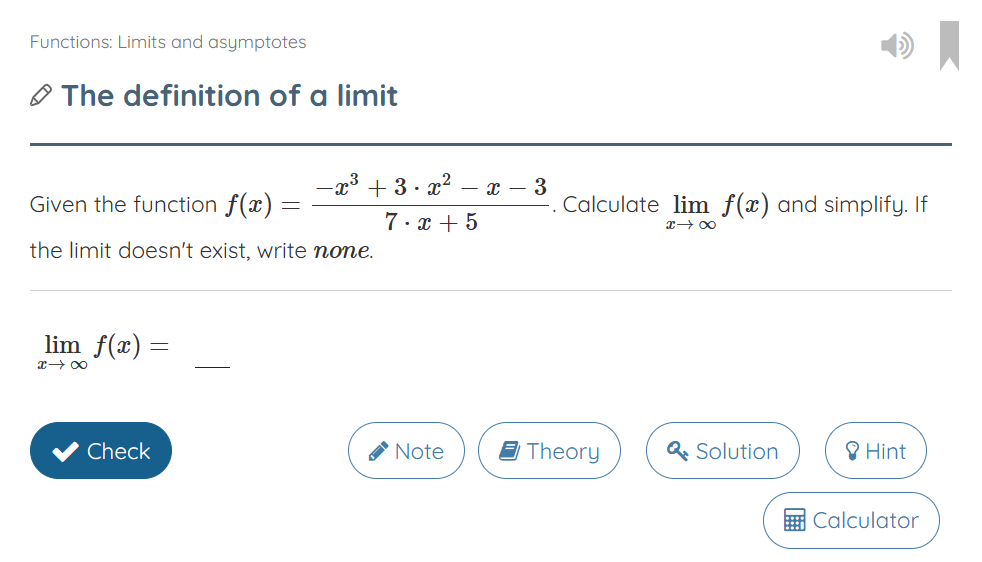
I remember how to do these but I just forget the last bit
Like how do I decide whether its positive or negative infinity
I know its (-x + 3 - (1/x) - (3/x^2)) / ((7/x) + (5/x^2))
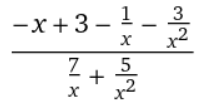
Which becomes (-x+3)/0 so its DNE
But I forget what to do next to figure out if its positive infinity or negative infinity
tardy stag
essentially is f(99999) positive or negative?
tardy stag
that's the expression "at infinity" but the original function very much has a value at 99999
warped topaz
Wym sry I dont understand
tardy stag
this thing here? if you put x = (whatever number) into that then a number will come out
 warped topaz
Ok makes sense
warped topaz
warped topaz
https://i.imgur.com/T5x6eK6.png
But from what I remember doing these questions I need to do something like this no?
tardy stag
sure, yeah, that's one way to do it as well
 tardy stag
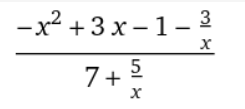
everything that is over x can just be canceled to 0
warped topaz
tardy stag
everything that is over x can just be canceled to 0
(-x+3)/0 Thats how I got this
warped topaz
Positive right?
tardy stag
correct since 7/x is positive and 5/x^2 is positive
warped topaz
Wait
I think I misunderstood the question and just got lucky haha
where do you see 7/x and 5/x^2
tardy stag
in the denominator 
warped topaz
Ohhh yeyeye
tardy stag
so you can think of it as $\frac{\text{a really big negative number}}{\text{a really tiny positive number}}$
ocean sealBOT
Hayley
 warped topaz
How did you get that the numerator is a really big negative number
tardy stag
oh because it's (-x + 3) and as x -> +inf that becomes a pretty big negative number!
warped topaz
But its negative no?
warped topaz
Oh hahaha oops
Im blind today
Bro now im confused
What would $\frac{\text{a really big negative number}}{\text{a really tiny positive number}}$ be
ocean sealBOT
odietje
 warped topaz
Positive or negative infinity
It would be negative right?
Yep I got the answer!!
Thank you
❤️
.close
lone heartBOT
Channel closed
Closed by @warped topaz
Use .reopen if this was a mistake.
warped topaz
.reopen
lone heartBOT
✅