#help-0
1 messages · Page 248 of 1
 mystic comet
 tardy stag
$\lim_{n\to\infty} (-1)^n$ is undefined yeah (can you explain why?)
 ocean sealBOT
Hayley
 mystic comet
it's always going to go from 1 and -1 depending of the n if it's pair or impair
so this should be 0 since the denominator is bigger
 mystic comet
it's always going to go from 1 and -1 depending of the n if it's pair or impair
mystic comet
mystic comet
it's always going to go from 1 and -1 depending of the n if it's pair or impair
even or odd**
tardy stag
just because the denominator is bigger doesn't mean it'll be zero
eg $\lim \frac{n}{2n}$
ocean sealBOT
Hayley
 mystic comet
1/2
tardy stag
yeah not zero
does something similar apply here? does the limit even converge?
mystic comet
it doesn't since we have (-1)^n
 ruby current
you can also add and subtract 0.5 from the numerator
 gray isle
just because a certain component doesn't converge doesn't make the whole thing diverge
tardy stag
mystic comet
it doesn't since we have (-1)^n
that's not necessarily true either, $\lim\frac{(-1)^n}{(-1)^n)}$ very much converges!
ocean sealBOT
Hayley
 tardy stag
the extra parenthesis is free
mystic comet
ohh i see your point
ruby current
you can also try approaching +infty by using the sequence of even numbers/odd numbers
mystic comet
lim to infinity
 ruby current
i.e. changing variables to 2t = n or 2t + 1 = n
mystic comet
ruby current
i.e. changing variables to 2t = n or 2t + 1 = n
why not t=2n for example?
 gleaming ridge
You could have from the start divided both the numerator and the denominator by n
Then take the limit, it's quick!
mystic comet
ah yes
ruby current
mystic comet
why not t=2n for example?
because you want to simplify (-1)^n
 vale crag
you could also factor (-1)^n from the numerator and denominator
then squeeze it (théorème des gendarmes pour alitoo si tu connais)
ruby current
good method
vale crag
it's pretty much your idea tushar
mystic comet
vale crag
then squeeze it (théorème des gendarmes pour alitoo si tu connais)
yes i know it
his idea devided the squeeze in two pieces
i think
vale crag
$$\frac{n - 1}{2n + 3} \leq u_n \leq \frac{n + 1}{2n - 3}$$
ocean sealBOT
_aplatypus
 vale crag
then it's easy peasy
mystic comet
I'm used to only use squeeze with cos and sin that's why i didn't notice it :/
.close
 lone heartBOT
Channel closed
Closed by @mystic comet
Use .reopen if this was a mistake.
 Available help channel!
Send your question here to claim the channel.
Remember:
• Ask your math question in a clear, concise manner.
• Show your work, and if possible, explain where you are stuck.
• After 15 minutes, feel free to ping <@&286206848099549185>.
• Type the command .close to free the channel when you're done.
• Be polite and have a nice day!
Read #❓how-to-get-help for further information on how to ask a good question, and about conduct in the question channels.
 tribal valve
Find all complex numbers $z$ such that $|z-1|=|z+3|=|z-i|$.
ocean sealBOT
dabbbingpotato
 tribal valve
i tried replacing z with a+bi
tardy stag
this has a very beautiful geometric interpretation but algebraic should work as well
tribal valve
on a complex plane?
 median oar
yeah
consider what it means for the absolute value of z - 1 to be some particular value
tribal valve

okay so isn't the point just moving left by 1 unit
and |z+3| would move right 3 points
and |z-i| would move down 1 point
median oar
no no
median oar
let's maybe try consider what |z| means
tribal valve
magnitude right
median oar
what does |z| = c look like (for some real value c)
 molten pivot
that's not always defined
tribal valve
isn't it just $\sqrt{a^2 + bi^2}$
median oar
good catch
ocean sealBOT
dabbbingpotato
 median oar
what does |z| = c (for some positive real c) look like
molten pivot
c has to be nonnegative
median oar
0 is degenerate and doesn't really matter in this case so i've chosen positive c
median oar
tribal valve
isn't it just $\sqrt{a^2 + bi^2}$
i mean what does |z| = 1 look like
what kind of complex numbers satisfy |z| = 1
tribal valve
1
median oar
what else
tribal valve
-1
median oar
if u plot every complex value that satisfies |z| = 1 you get a unit circle in the Re, Im plane
molten pivot
😮
 wind cloak
Argand plane
median oar
yeah i know
wind cloak
ReIm plane sounds better though
median oar
it seems they dont know it
wind cloak

tribal valve

median oar
the Real/Imaginary plane is normally referred to as the argand plane or an argand diagram
tribal valve
oki
median oar
so if |z| = c (for some positive c) gives you a circle centered at the origin
tribal valve
right
median oar
what would |z - w| = c (for some positive c, complex w) give you?
tribal valve
and c would be the radius?
median oar
yes
tribal valve
median oar
what would |z - w| = c (for some positive c, complex w) give you?
it would give you a circle thats offset
median oar
offset by how much
tribal valve
w
tribal valve

median oar
 tribal valve
wait so its the overlapping parts of the three circles?
 tribal valve
:0
median oar
that's what hayley meant by "a very beautiful geometric interpretation"
tribal valve
it is indeed beautiful
better than the algebra solution
okay so three circles
one of them is centered at 1+0i
wait
-1+0i
another is at 3+0i
median oar
tribal valve
one of them is centered at 1+0i
it's this one
tribal valve
and then the last one is 0-i
 median oar
wait what
tribal valve
huh
median oar
z = 1 gives you the center for the first one
because |1-1| = 0 so that's the center
,w graph x-3
ocean sealBOT


 median oar
x-3 means you move it to the right
median oar
median oar
same here z-1 means you move to the right by 1
so the center is at 1+0i
-3 + 0i
and 0 + i
tribal valve
ah ok
i get it
(i have a doctors appointment in like 5 minutes do you think we could pick back up on this later its been a ton of help, if not thanks so much for your help so far)
median oar
have a think about it, i probably will be asleep by then
but there'll be others to help you
lone heartBOT
Channel closed
Closed by @tribal valve
Use .reopen if this was a mistake.
lone heartBOT
Available help channel!
Send your question here to claim the channel.
Remember:
• Ask your math question in a clear, concise manner.
• Show your work, and if possible, explain where you are stuck.
• After 15 minutes, feel free to ping <@&286206848099549185>.
• Type the command .close to free the channel when you're done.
• Be polite and have a nice day!
Read #❓how-to-get-help for further information on how to ask a good question, and about conduct in the question channels.
 barren scroll

can someone explain why they are sitting g(x)=2
ill screenshot original problem too
lone heartBOT
Channel closed
Closed due to the original message being deleted
barren scroll
.reopen
lone heartBOT
Available help channel!
Send your question here to claim the channel.
Remember:
• Ask your math question in a clear, concise manner.
• Show your work, and if possible, explain where you are stuck.
• After 15 minutes, feel free to ping <@&286206848099549185>.
• Type the command .close to free the channel when you're done.
• Be polite and have a nice day!
Read #❓how-to-get-help for further information on how to ask a good question, and about conduct in the question channels.
 turbid root
 lone heartBOT
turbid root
lone heartBOT
turbid root

 timber latch
turbid root
timber latch
turbid root
Seems like you solved it
Does the answer not match?
Wait what even is that method
The coordinates of c will be something of the form (x,0)
Since BC is 10 and lies on the x axis
It must be (x-10,0)
turbid root
timber latch
Does the answer not match?
yea it doesn't 😦
lone heartBOT
Channel closed
Closed by @turbid root
Use .reopen if this was a mistake.
Available help channel!
Send your question here to claim the channel.
Remember:
• Ask your math question in a clear, concise manner.
• Show your work, and if possible, explain where you are stuck.
• After 15 minutes, feel free to ping <@&286206848099549185>.
• Type the command .close to free the channel when you're done.
• Be polite and have a nice day!
Read #❓how-to-get-help for further information on how to ask a good question, and about conduct in the question channels.
median oar
if $\underline \theta = (\theta_\mu, \theta_\sigma)^T$ and $X \sim N(\theta_\mu, \theta_\sigma)$
lone heartBOT
median oar
if $\underline \theta = (\theta_\mu, \theta_\sigma)^T$ and $X \sim N(\theta_\mu,...
ocean sealBOT
frosst
 median oar
how do we know that $\mathbb{E}[(x-\theta_\mu)^4]=\theta_\sigma^2$
ocean sealBOT
frosst

 naive valley
is $\theta_\sigma$ the standard deviation of $X$?
ocean sealBOT
Bungo
 median oar
no it's the variance of X
ocean sealBOT
Bungo
 naive valley
offhand I'd think the moment generating function?
 naive valley
i mean you could just brute force the math for the special case of the 4th moment
it'll probably be very grungy

 naive valley
what's the left hand side of that first screenshot?
median oar

 naive valley
ha, i call bs on their magically writing 3sigma^4 there
median oar
exactly
naive valley
the expression on the previous line is actually more complicated
median oar
where did it come from
naive valley
because it involves the non-central 4th moment
median oar
idk how we can evaluate E[x^4]
median oar
when in the previous case i had E[x^2] it was not too hard
i just expanded E[(x-mu)^2] = Var(x)
naive valley
here's a MSE answer that looks elementary enough (no MGF): https://math.stackexchange.com/a/1917666
median oar
and i just simply used the fact Var(x) is defined to be the 2nd central moment
ok lets see
FUCK
IBP
lmao
naive valley
twice, always fun haha
median oar
man whoever came up with this stuff is smart
naive valley
turns out easier than i thought
naive valley
well remember this is for the central moment (the MSE question assumes mean zero)
 vapid shuttle
naive valley
vapid shuttle
naive valley
so you don't actually need that complicated expression in your screenshot
median oar
oh
naive valley
doing the central moment directly is almost always easier
because you can assume it's zero mean
naive valley
then if you want the noncentral moment, you can do like:
Y = X + mu, where X is zero mean and mu is the mean of Y
median oar
doing E[(x-mu)^4] is the same as doing E[(x)^4] with 0 mean
so i can kinda just sub say Y = x-mu
naive valley
so E[Y^3] = E[(X + mu)^3] = E[X^3] + 3E[X^2]mu + 3E[X]mu^2 + mu^3
median oar
then go E[Y^4]
naive valley
where everything on the RHS are central moments
and similarly for the 4th moment
i once had this question on a midterm exam, still sticks in my memory for some reason
median oar
naive valley
so E[Y^3] = E[(X + mu)^3] = E[X^3] + 3E[X^2]mu + 3E[X]mu^2 + mu^3
ah same idea but you have the letters the other way
naive valley
"express the nth moment of a random variable in terms of its nth central moments"
binomial theorem ftw
median oar
naive valley
i once had this question on a midterm exam, still sticks in my memory for some r...
i just know mgfs are in next year's sem 1 class
naive valley
median oar
ah same idea but you have the letters the other way
yep
median oar
this year they had an assignment question about a trinomial expansion
naive valley
oh fun
median oar
idk what i was doing but i tried my best to help the 2nd year students
by sheer will power and algebra without knowing what the symbols meant

naive valley
haha nice
naive valley
median oar
i just know mgfs are in next year's sem 1 class
mgfs are cool because some distributions are harder than the normal one for computing their moments, but the mgf lets you do it in a nice albeit indirect way
median oar
mgfs are cool because they exist in physics too
naive valley
that's beyond my pay grade haha
but the idea behind them is similar to various tricks for computing tricky integrals as well
median oar
In mathematics, the moments of a function are certain quantitative measures related to the shape of the function's graph. If the function represents mass density, then the zeroth moment is the total mass, the first moment (normalized by total mass) is the center of mass, and the second moment is the moment of inertia. If the function is a probab...
naive valley
ah yeah, physical moments that makes sense
defined basically the same way as the probabilistic ones
naive valley
yep cool indeed
median oar
they just mean different things
super cool
Hmm something happened

I’ve managed to lose the expectation on the first part
also the 3 disappeared??
naive valley
hmm, lemme check what you did
i don't really get your integration by parts
shouldn't it be:
hmm one moment i'm gonna write it out instead of trying to do it in tex
median oar
integration in tex
naive valley
lol
median oar
Ok now I got this

Still looks wrong
It looks closer than before I guess
i have a feeling my first ibp is wrong
FUCK
shouldn't the ∫yf_Y dy = 0
cos that's the expectation of Y
noooooo
(Also I’m so tired it’s 6am)
naive valley
hmm, let's be explicit here with the integration by parts:
$\int y^4 f(y)\ dy = \int y^4 c\exp(-y^2/2)\ dy$, where $c = 1/\sqrt{2\pi}$
ocean sealBOT
Bungo
 naive valley
let $u = y^3$, $dv = yc\exp(-y^2/2)\ dy$, then $du = 3y^2\ dy$, $v = -c\exp(-y^2/2)$
ocean sealBOT
Bungo
 naive valley
then integration by parts gives $\left.uv\right|{-\infty}^{\infty} - \int{-\infty}^{\infty} v\ du$
ocean sealBOT
Bungo
 naive valley
the first term is zero since exp(-y^/2) goes to zero faster than y^3 goes to infinity
so you're left with
$\int_{-\infty}^{\infty}3cy^2 \exp(-y^2/2)\ dy$
ocean sealBOT
Bungo
 naive valley
which integrates to $3\sigma^4$
ocean sealBOT
Bungo
 lone heartBOT
@median oar Has your question been resolved?
lone heartBOT
Channel closed
Closed due to timeout
Use .reopen if this was a mistake.
Available help channel!
Send your question here to claim the channel.
Remember:
• Ask your math question in a clear, concise manner.
• Show your work, and if possible, explain where you are stuck.
• After 15 minutes, feel free to ping <@&286206848099549185>.
• Type the command .close to free the channel when you're done.
• Be polite and have a nice day!
Read #❓how-to-get-help for further information on how to ask a good question, and about conduct in the question channels.
 pale rock
What is 362/20 equiv to
lone heartBOT
pale rock
What is 362/20 equiv to
 torn elk
it's equiv to a lot of things, you have to be more precise in your question.
pale rock
Ok what's 362/20 simplified as much as possible if that makes sense
torn elk
Do you know what simplified refers to?
When you simplify something, what you're doing is making it easier to work with.
Right now you have 362/20, which is a big fraction and hard to work with. The exercise is telling you to make an equivalent fraction whose numbers are smaller or even solve the fraction and use decimals.
pale rock
Like common denominators for example 5/10 is equiv to 1/2
torn elk
Yes.
Or writting as 0.5
That depends on what's the best way you put something to work with.
pale rock
I write fractions
lone heartBOT
@pale rock Has your question been resolved?
 gilded vessel
pale rock
I write fractions
gilded vessel
pale rock
I write fractions
do you still need help simplifying the fraction
pale rock
No I figured it out by division but thanks anyways!
gilded vessel
alrighty
lone heartBOT
@pale rock Has your question been resolved?
lone heartBOT
Channel closed
Closed due to timeout
Use .reopen if this was a mistake.
lone heartBOT
Available help channel!
Send your question here to claim the channel.
Remember:
• Ask your math question in a clear, concise manner.
• Show your work, and if possible, explain where you are stuck.
• After 15 minutes, feel free to ping <@&286206848099549185>.
• Type the command .close to free the channel when you're done.
• Be polite and have a nice day!
Read #❓how-to-get-help for further information on how to ask a good question, and about conduct in the question channels.
 hot bluff
quick partial fraction decomp question. part b
 lone heartBOT
hot bluff
quick partial fraction decomp question. part b
lone heartBOT
hot bluff
quick partial fraction decomp question. part b
 tardy stag
PFD doesn't work if the numerator is the same degree or higher than the denominator
you need to do polynomial division first
hot bluff
ummm
naive valley
or you could write the numerator as $x^3 + 1 = (x^3 - 3x^2 + 2x) + (3x^2 - 2x + 1)$
ocean sealBOT
Bungo
 hot bluff
 naive valley
which amounts to the same thing
hot bluff
is this right?
naive valley
yep
hot bluff
this would be the end of it, since i get a remainder that isn't easily reached with x^3 right?
naive valley
yes correct
hot bluff
so what does the result look like? 1 + 3x^2 - 2x + 1?
naive valley
1 + (3x^2 - 2x + 1)/(x^3 - 3x^2 + 2x)
hot bluff
ah
naive valley
now do partial fractions on the fraction
naive valley
sure
hot bluff
.close
lone heartBOT
Channel closed
Closed by @hot bluff
Use .reopen if this was a mistake.
Available help channel!
Send your question here to claim the channel.
Remember:
• Ask your math question in a clear, concise manner.
• Show your work, and if possible, explain where you are stuck.
• After 15 minutes, feel free to ping <@&286206848099549185>.
• Type the command .close to free the channel when you're done.
• Be polite and have a nice day!
Read #❓how-to-get-help for further information on how to ask a good question, and about conduct in the question channels.
 vapid steppe
$\lim_{x\to 1}{\frac{xe^x-e}{x^2-1}}$
lone heartBOT
vapid steppe
$\lim_{x\to 1}{\frac{xe^x-e}{x^2-1}}$
ocean sealBOT
jashxdlol
 vapid steppe
how to do
 plain flame
are you allowed to use lhopital?
vapid steppe
no we havent learned it
im just wondering if i have to use my calculater to do it
since i looked it up and it turns out to be just e
vapid steppe
so i guess there must be a algebraic way to do it
vapid shuttle
does 362 and 20 have any common factors?
vapid steppe
also i was wondering can u use lhopitals rule when x is approaching one of the infinities
 raven rover
You could factor out an e and try a substitutiton?
plain flame
vapid shuttle
does 362 and 20 have any common factors?
2
plain flame
vapid steppe
also i was wondering can u use lhopitals rule when x is approaching one of the i...
only for 0/0 or inf/inf
vapid steppe
i was wondering if i could use lhopitals to solve $\lim_{x\to -\infty}{\frac{3-2^x}{4-5^x}}$
ocean sealBOT
jashxdlol
 raven rover
No
vapid steppe
doesnt the denominater decay faster tho
raven rover
Doesn’t matter
plain flame
this is abuse of notation but $2^{-\infty} = 5^{-\infty} = 0$
ocean sealBOT
heavy0201
 vapid steppe
so when do i have to compare the dominant function
 proven leaf
plain flame
this is abuse of notation but $2^{-\infty} = 5^{-\infty} = 0$
proven leaf
plain flame
this is abuse of notation but $2^{-\infty} = 5^{-\infty} = 0$
$\lim_{x\to-\infty}2^{x}=\lim_{x\to-\infty}5^{x}=0$
wouldn't that be better 
vapid shuttle
no
ocean sealBOT
XxMrFancyu2xX
 plain flame
negative
vapid shuttle
yes
plain flame
yeah
proven leaf
ye i messed up lol
plain flame
thats better
vapid steppe
cuz like if u have polynomial/polynomial u have to compare the degrees
wait is that only when u get an indeterminate form
when u compare the dominance
proven leaf
vapid shuttle
sorry my screen was showing an old question apparently
happens all the time when I first boot up discord  someone will be asking a question about circles and I say "use the quadraric formula"
plain flame
vapid steppe
$\lim_{x\to 1}{\frac{xe^x-e}{x^2-1}}$
ngl i still havent figured this one out
 fallen verge
You sure it isnt xe^x-e^x?
vapid steppe
this was a khan academy question and the answer was to approximate
proven leaf
plain flame
ngl i still havent figured this one out
l'hopitals?
fallen verge
Bleh
plain flame
proven leaf
l'hopitals?
well hes not allowed to so i am trying without
proven leaf
plain flame
well hes not allowed to so i am trying without
 interesting...
fallen verge
Sure you can do numerical approximarion
plain flame
well yes the answer is e
vapid steppe
fallen verge
You sure it isnt xe^x-e^x?
it isnt since the answer is e and not some random number
plain flame
but algebraically
fallen verge
vapid steppe
it isnt since the answer is e and not some random number
The answer would be e/2 instead if this were the case not some "random number" lol
vapid steppe
fallen verge
The answer would be e/2 instead if this were the case not some "random number" l...
the answer to the one i sent is e
fallen verge
I know
vapid steppe
i swear it wasnt that lol i wish i took a screenshot but this was a couple hours ago
fallen verge
I dont think its possible algebraically
vapid steppe
i mean the question was what are the steps to find this limit and the answer ended up being approximation
vapid steppe
and if it was the one u sent u could have done it algebraically
lone heartBOT
Channel closed
Closed by @vapid steppe
Use .reopen if this was a mistake.
Available help channel!
Send your question here to claim the channel.
Remember:
• Ask your math question in a clear, concise manner.
• Show your work, and if possible, explain where you are stuck.
• After 15 minutes, feel free to ping <@&286206848099549185>.
• Type the command .close to free the channel when you're done.
• Be polite and have a nice day!
Read #❓how-to-get-help for further information on how to ask a good question, and about conduct in the question channels.
 frank quail
When you have two well ordered sets with greatest elements but one's least element is removed and to find a contradiction we suppose we have an order isomorphism between them. How do you find the contradiction?
lone heartBOT
frank quail
When you have two well ordered sets with greatest elements but one's least eleme...
molten pivot
There is no bijective function between the two sets once you remove the endpoint
frank quail
I doubt that, the theorem is that there's no is order preserving bijection
molten pivot
How would you construct a bijection at all between [0,1] and (0,1]?
frank quail
I am pretty sure you can with uncountable sets
molten pivot
Try it. Lol
 worn fox
molten pivot
How would you construct a bijection at all between [0,1] and (0,1]?
worn fox
molten pivot
How would you construct a bijection at all between [0,1] and (0,1]?
they have the same cardinality so there is a bijection between them, lots in fact
lone heartBOT
@frank quail Has your question been resolved?
Channel closed
Closed by @frank quail
Use .reopen if this was a mistake.
Available help channel!
Send your question here to claim the channel.
Remember:
• Ask your math question in a clear, concise manner.
• Show your work, and if possible, explain where you are stuck.
• After 15 minutes, feel free to ping <@&286206848099549185>.
• Type the command .close to free the channel when you're done.
• Be polite and have a nice day!
Read #❓how-to-get-help for further information on how to ask a good question, and about conduct in the question channels.
 toxic elk
 toxic elk
Hello
From the last line i wrote, x = 1
And then we drew that on the graph
In red, x < 1, or x > 1
But which of those two are the answer?
And why
lone heartBOT
@toxic elk Has your question been resolved?
toxic elk
<@&286206848099549185>
 rancid granite
toxic elk
In red, x < 1, or x > 1
rancid granite
toxic elk
In red, x < 1, or x > 1
x<1 if you look at your graph you can see that the line for y=|x+2| is above the line for y=2x+1 for values of x to the left of x=1
toxic elk
rancid granite
x<1 if you look at your graph you can see that the line for y=|x+2| is above the...
okay okay
thanks
.close
lone heartBOT
Channel closed
Closed by @toxic elk
Use .reopen if this was a mistake.
Available help channel!
Send your question here to claim the channel.
Remember:
• Ask your math question in a clear, concise manner.
• Show your work, and if possible, explain where you are stuck.
• After 15 minutes, feel free to ping <@&286206848099549185>.
• Type the command .close to free the channel when you're done.
• Be polite and have a nice day!
Read #❓how-to-get-help for further information on how to ask a good question, and about conduct in the question channels.
 dapper lynx
I could use a hand with this...
lone heartBOT
dapper lynx
I could use a hand with this...
dapper lynx

I can feel, on the tip of my frontal cortex, the direction this is pointing me in
But I'm a bit lost
 surreal meadow
do you know how to, in general, show things are linearly independent?
dapper lynx
There can only be a nontrivial solution to av1 + bv2 = 0
surreal meadow
yes
dapper lynx
Sorry, more generally, there cannot exist a nontrivial solution to Ax=0 where the columns of A are the vectors in question
dapper lynx
Oh
Simple enough, I suppose
Lemme try that
One thing that's sorta throwing me is that
In the context of av1 + bv2 = 0
a and b are known to be zero and only zero
surreal meadow
the direction of implication is
av + bu = 0
implies
a = b = 0
your goal is to rearrange terms so you reach
(some constant) * v + (some other constant) * u = 0
the conclusion will then be clear
surreal meadow
surreal meadow
the direction of implication is
av + bu = 0
implies
a = b = 0
note that this comes from the independence of {u,v}
 surreal meadow
that works, i was hinting at going the other way though
surreal meadow
surreal meadow
so assume there exist a and b so that
a(2u) + b(u - v) = 0
starting with this assumption
and arriving at a = b = 0
dapper lynx
Hmmm
surreal meadow
dapper lynx
actually this doesn’t work i don’t think
ok nvm it should work
but yeah i was still trying to get you to go the other way
dapper lynx
I'm not entirely sure HOW it would work
I've proved that some constant times 2a fits nicely into this
surreal meadow
so
dapper lynx
But I'd somehow need to prove that a = b in order to wrap (v-u) into a single term
surreal meadow
we assume
a(2u) + b(v - u) = 0
then we get
2a * u - b * u + b * v = 0
(2a - b) * u + b * v = 0
what do we know about u and v
oh i had it slightly backwards sorry
let me edit
surreal meadow
ok should be good now
surreal meadow
surreal meadow
(2a - b) * u + b * v = 0
note this equation is of the form
c * u + d * v = 0
what do we know about c and d in this case
dapper lynx
Well, we know the must be zero by the definition of linear independence
lone heartBOT
Channel closed
Closed by @dapper lynx
Use .reopen if this was a mistake.
Available help channel!
Send your question here to claim the channel.
Remember:
• Ask your math question in a clear, concise manner.
• Show your work, and if possible, explain where you are stuck.
• After 15 minutes, feel free to ping <@&286206848099549185>.
• Type the command .close to free the channel when you're done.
• Be polite and have a nice day!
Read #❓how-to-get-help for further information on how to ask a good question, and about conduct in the question channels.
 scenic wing
$x^3-8$
lone heartBOT
scenic wing
$x^3-8$
ocean sealBOT
putridplanet
 scenic wing
how do you factor this
 long axle
Do u know difference of cubes factorization
scenic wing
no
 oblique whale
Hi people I need help about eigenvalues and eigenvector, what book do you recomend me to learn this topic?
long axle
 long axle
oblique whale
Hi people I need help about eigenvalues and eigenvector, what book do you recome...
long axle
oblique whale
Hi people I need help about eigenvalues and eigenvector, what book do you recome...
Use that image to help u factor @scenic wing
long axle
ab = 8x ? U sure?
scenic wing
long axle
ab = 8x ? U sure?
2x
long axle
And b^2 ?
ocean sealBOT
putridplanet
 long axle
Yep
scenic wing
long axle
Yep
and ab doesnt become negative because its x-2
long axle
Yea ab isn’t negative
lone heartBOT
@scenic wing Has your question been resolved?
lone heartBOT
Channel closed
Closed due to timeout
Use .reopen if this was a mistake.
lone heartBOT
Available help channel!
Send your question here to claim the channel.
Remember:
• Ask your math question in a clear, concise manner.
• Show your work, and if possible, explain where you are stuck.
• After 15 minutes, feel free to ping <@&286206848099549185>.
• Type the command .close to free the channel when you're done.
• Be polite and have a nice day!
Read #❓how-to-get-help for further information on how to ask a good question, and about conduct in the question channels.
 lapis fractal
I need help with this geometry question:
 lone heartBOT
lapis fractal
I need help with this geometry question:
lone heartBOT
lapis fractal
I need help with this geometry question:
What step are you on?
1. I don't know where to begin
2. I have begun but got stuck midway
3. I got an answer but I'm told it's wrong
4. I got an answer and would like my work checked
5. I have a question about someone else's worked solution
6. None of the above
 lone heartBOT
@lapis fractal Has your question been resolved?
 foggy current
You should extend PK to A and QK to C
lapis fractal
I dont think PK can be extended to A
at least doesnt look like it can
I can however join A to K and K to C
Oh wait, I got the answer!
K is the circumcentre of ABC
thus AK = KB = KC
Hence proved
.close
lone heartBOT
Channel closed
Closed by @lapis fractal
Use .reopen if this was a mistake.
Available help channel!
Send your question here to claim the channel.
Remember:
• Ask your math question in a clear, concise manner.
• Show your work, and if possible, explain where you are stuck.
• After 15 minutes, feel free to ping <@&286206848099549185>.
• Type the command .close to free the channel when you're done.
• Be polite and have a nice day!
Read #❓how-to-get-help for further information on how to ask a good question, and about conduct in the question channels.
 vital oriole
Rational Equation
 lone heartBOT
vital oriole
Rational Equation
vital oriole
lone heartBOT
vital oriole
Rational Equation
vital oriole

 tacit arch
What is the question
tacit arch
You're on the right track, you just left out parentheses
vital oriole
So far but i’m sure it ain’t right

 median oar
Nope
You didn’t expand it properly
The reason you need the bracket is because it expands differently
vital oriole
O
lapis fractal
did you get the answer?
lapis fractal
Did you get x=2, 0.5?
lone heartBOT
@vital oriole Has your question been resolved?
lone heartBOT
Channel closed
Closed due to timeout
Use .reopen if this was a mistake.
Available help channel!
Send your question here to claim the channel.
Remember:
• Ask your math question in a clear, concise manner.
• Show your work, and if possible, explain where you are stuck.
• After 15 minutes, feel free to ping <@&286206848099549185>.
• Type the command .close to free the channel when you're done.
• Be polite and have a nice day!
Read #❓how-to-get-help for further information on how to ask a good question, and about conduct in the question channels.
 granite rapids
Hi
lone heartBOT
granite rapids
Hi


 vale wigeon
6 times more lines than necessary
and in your quantifier-y statement the word "where" is unnecessary
$\forall n \exists p( p \text{ is prime} \land p>n)$
ocean sealBOT
Ann
 granite rapids
xD
vale wigeon
also you are not yet showing anything just restating it
 granite rapids
vale wigeon
also you are not yet showing anything just restating it
granite rapids
vale wigeon
also you are not yet showing anything just restating it
Is that better?
vale wigeon
granite rapids
so (a) is not correct
it was correct all along just excessively wordy!!
erase everything except the quantifier-y statement
vale wigeon
suit yourself
the more you write the more chances you give yourself to make mistakes
tacit arch
Nobody can read your teacher's mind
granite rapids
What about b
I already got the answer but im not sure if its right
(b) To negate the expression in (a) and simplify it to resemble the logic used in the proof of Euclid's Theorem, we need to negate the quantifiers and change the logical connectives. The negation of the original statement would be:
Explanation:
∃n ∀p (p is a prime number → p ≤ n)
This negation can be read as "There exists a natural number n such that for every prime number p, p is less than or equal to n." This negation essentially claims that there exists a natural number n for which all prime numbers are less than or equal to n.
This negation contradicts Euclid's Theorem, which states that there are infinitely many prime numbers, as it suggests that there is a maximum prime number (represented by n) that bounds all prime numbers.
granite rapids
granite rapids
Is this correct for (b)?
lone heartBOT
@granite rapids Has your question been resolved?
lone heartBOT
Channel closed
Closed due to timeout
Use .reopen if this was a mistake.
Available help channel!
Send your question here to claim the channel.
Remember:
• Ask your math question in a clear, concise manner.
• Show your work, and if possible, explain where you are stuck.
• After 15 minutes, feel free to ping <@&286206848099549185>.
• Type the command .close to free the channel when you're done.
• Be polite and have a nice day!
Read #❓how-to-get-help for further information on how to ask a good question, and about conduct in the question channels.
 safe tartan
What transformation is applied when 2^x becomes 2^xsquared-4x+3
 upbeat hornet
Do you mean $$ 2^{x^2} or (2^x)^2 $$
ocean sealBOT
even order group => solvable
 vale wigeon
2^(x^2) - 4x + 3?
 lament forge
$2^{x^2-4x+3}$?
ocean sealBOT
bee [it/its]
 safe tartan
Yep
upbeat hornet
You can complete the square in the exponent
lone heartBOT
@safe tartan Has your question been resolved?
lone heartBOT
Channel closed
Closed due to timeout
Use .reopen if this was a mistake.
Available help channel!
Send your question here to claim the channel.
Remember:
• Ask your math question in a clear, concise manner.
• Show your work, and if possible, explain where you are stuck.
• After 15 minutes, feel free to ping <@&286206848099549185>.
• Type the command .close to free the channel when you're done.
• Be polite and have a nice day!
Read #❓how-to-get-help for further information on how to ask a good question, and about conduct in the question channels.
vapid shuttle
Let ${x_n}$ and ${y_n}$ be bounded sequences s.t. $x_n \leq y_n \forall n \in \mathbb{N}$ Then, show that $$\limsup{x_n} \leq \limsup{y_n}$$
lone heartBOT
vapid shuttle
Let $\{x_n\}$ and $\{y_n\}$ be bounded sequences s.t. $x_n \leq y_n \forall n \...
ocean sealBOT
austinu
 vapid shuttle
I was hoping someone could check my proof for this. I will be typing it out below
$\limsup{x_n}=\lim_{n \to \infty} {\sup{{x_k:k\geq n }}}$ $\newline$ and $\newline$ $\limsup{y_n}=\lim_{n \to \infty} {\sup{{y_k:k\geq n }}}$ $\newline$ Then we want to show that $\newline$ $\sup{{x_k:k\geq n }} \leq \sup{{y_k:k\geq n}}$ $\newline$ $\forall k \in \mathbb{N}$
 rose sigil
lots of typos?
vapid shuttle
Since $x_n \leq y_n \forall n \in \mathbb{N} \implies x_k \leq y_k \forall k \in \mathbb{N}$ $\newline$ Then $\implies \sup{{x_k:k\geq n }} \leq \sup{{y_k:k\geq n}}$ $\newline$ Then $\implies \limsup{x_n} \leq \limsup{y_n}$
rose sigil
does this make sense to you?
 vapid shuttle
it did, but now I see it should be n-> inf
 mortal trellis
have you shown before that a<=b implies lim a <= lim b?
vapid shuttle
mortal trellis
have you shown before that a<=b implies lim a <= lim b?
yes
and also that limits respect inequalities (if that is the right way to word that)
ocean sealBOT
austinu
 vapid shuttle
Without the typos now (hopefully that was the only typos?)
ocean sealBOT
austinu
 naive valley
since the whole content of the proof is to show that inf and sup respect inequalities, maybe it is worth elaborating slightly on that
mortal trellis
imo you don't spend enough time on showing that the supremums follow the inequality. by def you only know that x<=y pointwise (local) but you want to establish some global property
vapid shuttle
so
in the second textbox of mine
the step in between the end of the first line
and second line
I need to elaborate more there?
mortal trellis
why can't it be that eg x100 is the supremum of the xs and y200 is the supremum of the ys and x100>y200
vapid shuttle
is there where the bounded part comes in
mortal trellis
no
vapid shuttle
I see what you are getting at, but I'm not sure what to do about it Denascite
mortal trellis
the bounded part comes in when limsup is defined in the first place
naive valley
no, sups and infs respect inequalities even without the boundedness assumption
vapid shuttle
naive valley
no, sups and infs respect inequalities even without the boundedness assumption
yeah I have proven this before
naive valley
i think taking an extra step when you go from x_n <= y_n to sup x_n <= sup y_n is warranted
like do one sup at a time
just to make it crystal clear why it's true
vapid shuttle
okay well
whatever the sup of x_n is
y_n at that n must be greater than or equal to it
so y_n necessarily has an element that is greater than or equal to the sup of x_n
naive valley
what do you mean "at that n"
vapid shuttle
whatever nth element
wherever the sup is
(how do we even know that the sup exists tbh?)
bounded isn't enough
we don't know that xn isn't nonempty?
naive valley
sup always exists in the extended reals
vapid shuttle
extended reals?
naive valley
how could it be empty?
naive valley
i mean you are given sequences haha
vapid shuttle
I was thinking sets
naive valley
extended reals = real line along with +inf and -inf
ocean sealBOT
austinu
 mortal trellis
vapid shuttle
bounded isn't enough
mortal trellis
vapid shuttle
bounded isn't enough
its not?
mortal trellis
vapid shuttle
wherever the sup is
reminder that the sup doesnt have to be attained for a certain value of n. it doesnt have to be a max
vapid shuttle
that's true
hmm
Okay
I think I got it
so
sup y_k is greater than or equal to all y_m
and y_m is greater than or equal to all x_m
naive valley
y_m is greater than or equal to x_m for that m
vapid shuttle
which
naive valley
vapid shuttle
then sup y_k >= y_m >= x_m
^
vapid shuttle
well
I was going to just insert sup x_k
in between the y_m and x_m
and then that would give what I wanted
mortal trellis
well sup x_k could be bigger than the particular y_m
vapid shuttle
you guys are having fun with this aren't you
mortal trellis
yes
vapid shuttle
XD
naive valley
i am for sure
mortal trellis
but thats the hard part of real analysis
mortal trellis
these little questions
mortal trellis
these are the questions you have to ask yourself when doing any proofs. are these inequalities true for all m? for a single m? can it be that its true for some and not true for others? and so on
lets take a step back and try to see the bigger picture. what is the definition of sup
vapid shuttle
least upper bound
mortal trellis
ok so it fulfills two things, its an upper bound and its the smallest one of those
vapid shuttle
yes
mortal trellis
how can you show that a sup is smaller than some other number
vapid shuttle
that number is another upper bound?
vapid shuttle
so we want to show that
naive valley
yep look back at that inequality
vapid shuttle
sup x_k is an upper bound of y_k?
mortal trellis
yes!
naive valley
and just for reference, recall that you have x_m <= y_m <= sup y_k
mortal trellis
yes!
mortal trellis
its easy to get lost in the inequalities. often its good to try take a step back like this to see whats going on
vapid shuttle
true
okay so
sup y_k >= y_m for all m
and y_m >= x_m
then
x_m <= y_m <= sup y_k
then sup y_k is an upper bound of x_k
then sup x_k <= sup y_k
naive valley
yes perfect!
vapid shuttle
then limsup x_k <= limsup y_k
naive valley
which is actually another application of the same technique
because as you probably know,
limsup is actually inf sup
vapid shuttle

mortal trellis
limsup is the smallest one of these supremums sup x_k for k->infty
"smallest" of course in the sense of inf, not necessarily attained
because the sequence sup x_k is decreasing
naive valley
and since the sequence of supremums is decreasing, the inf and the lim of that sequence are the same thing
vapid shuttle
why is hte sequence of supremums decreasing
naive valley
because you're taking supremums of smaller sets as n increases
naive valley
haha sry
vapid shuttle
XD
naive valley
but the characterization of limsup as inf sup is often useful
because arguments that work for sup also work for inf with small modifications
that's the end of my soapbox for now, i have to go and wash dishes haha
gl with the rest
naive valley
tx! cheers
mortal trellis
whenever you use any "obvious" implication in your proof, like you did in your line 2. think really about why its true. if you cant find an idea (you dont need to find the details yet), then you need to spend more time on that step
also the implication in line 3. you say you have proven it before, so it should not take long to think about the idea of that proof. if you cant, again spend more time on it. you will need that practice
vapid shuttle
Okay that is good advice
TY Denascite!
I revisted that proof
and I just proved the other way that they wanted of me too, that liminf xn <= liminf y_n much easier the second time around lol
mortal trellis
half the time when I speak with a friend and we are using some basic result of linear algebra or something, we will stop for a few seconds and think about why its true. you need to get in the habit of doing that
yes also good to prove the symmetrical version explicitly
vapid shuttle
Okay great
thanks alot
I should be doing that
studying is hard, and it is easier to ignore the difficult bits like that and kind of kid yourself
but you learn less that way
lone heartBOT
Channel closed
Closed by @vapid shuttle
Use .reopen if this was a mistake.
Available help channel!
Send your question here to claim the channel.
Remember:
• Ask your math question in a clear, concise manner.
• Show your work, and if possible, explain where you are stuck.
• After 15 minutes, feel free to ping <@&286206848099549185>.
• Type the command .close to free the channel when you're done.
• Be polite and have a nice day!
Read #❓how-to-get-help for further information on how to ask a good question, and about conduct in the question channels.
 nocturne niche
 lone heartBOT
nocturne niche
nocturne niche
lone heartBOT
nocturne niche
nocturne niche
help pls 😦
vale wigeon
show progress?
nocturne niche
 nocturne niche
 vale wigeon
also 3^[-2 log_3(1-x)] is (1-x)^-2 anyway
so you're going to be in medium-large amounts of pain and suffering with a 4th degree equation on your hand
nocturne niche
I don't know how to continue
vale wigeon
backtrack, divide both sides by 2 before incorporating the 2 into the log on the left.
get log_3(x+3) = -log_3(1-x)
and now raise 3 to the power of both sides to get x+3 = 1/(1-x)
lone heartBOT
Channel closed
Closed by @nocturne niche
Use .reopen if this was a mistake.
lone heartBOT
Available help channel!
Send your question here to claim the channel.
Remember:
• Ask your math question in a clear, concise manner.
• Show your work, and if possible, explain where you are stuck.
• After 15 minutes, feel free to ping <@&286206848099549185>.
• Type the command .close to free the channel when you're done.
• Be polite and have a nice day!
Read #❓how-to-get-help for further information on how to ask a good question, and about conduct in the question channels.
 distant frost
is there anyone who is willing to hop in a vc with me to explain this
distant frost
i have to calculate the formula from the graph

but i don't fully understand how and this also applies for the parabola version
distant frost
distant frost
i have to calculate the formula from the graph
what i mostly don't understand about this one is
i know that the formula is y = ax + b and B is the point where the lines intercepts the y axes but here i don't have a nice point on the y axes that intercepts it how do i calculate the b here?
mortal trellis
you can calculate the a first
a is the slope
rise/run if you heard that before
after that you can calculate b by plugging in one of the points
distant frost
mortal trellis
rise/run if you heard that before
yeah that would be y/x
distant frost
ohh so i would first need to difference between 10 and 14 / differnce between -3 and -4
so then i would end up with 4/-1
mortal trellis
which is?
distant frost
-4
distant frost
how would i exactly do that?
mortal trellis
what does it mean for (-3, 10) to be on the line
distant frost
like in those are coordinates of the line so they are on the line at a given point
or more they indicate a point where the line is
mortal trellis
yes. and in terms of x and y, it means that x=-3 and y=10 satisfy the equation y=ax+b
so 10=(-4)(-3)+b
mortal trellis
yes
distant frost
so then b would be 3 right
distant frost
would i neet to multiply the -4 and -3
distant frost
12
distant frost
2
distant frost
oh yeah since you kinda want to end with -2 = b right?
mortal trellis
yes
distant frost
so then the formula would be y =-4x -2
mortal trellis
and you can compare with the graph that the y intercept is at -2. so thats reassuring
yes
lone heartBOT
Channel closed
Closed by @distant frost
Use .reopen if this was a mistake.
Available help channel!
Send your question here to claim the channel.
Remember:
• Ask your math question in a clear, concise manner.
• Show your work, and if possible, explain where you are stuck.
• After 15 minutes, feel free to ping <@&286206848099549185>.
• Type the command .close to free the channel when you're done.
• Be polite and have a nice day!
Read #❓how-to-get-help for further information on how to ask a good question, and about conduct in the question channels.
 grim berry
HI
lone heartBOT
grim berry
HI

 naive crystal
Do you know distributive property?
grim berry
wat about the 7'
naive crystal
We distribute 7a
naive crystal
naive crystal
Well basically
a(a+b) = a×a + a×b
This was just an example
If there is 45a(a+b), we distribute 45a
naive crystal
Alr
grim berry
so lets do it step by step now
naive crystal
Yes
grim berry
21a^2b^2?
naive crystal
Yep
You distributited 7a to the first term... you need to distribute it to evry term
naive crystal
Yes
naive crystal
You second term is not 8ab rather its -8ab
grim berry
naive crystal
You second term is not 8ab rather its -8ab
so its -56a^2b?
naive crystal
grim berry
so its -56a^2b?
Yes
ocean sealBOT


 Requested by _basudev#0
 naive crystal
,w simplify (-16a²b⁵+12a³b⁴+4a⁶b³)/(4a²b³)
ocean sealBOT
 Requested by _basudev#0
grim berry
Requested by _basudev#0
grim berry
so do i get it wrong
grim berry
oof
grim berry
naive crystal
Re check it
help pls
naive crystal
Wolfram is telling some other stuff so I though so it must be wrong dude, I didn't check manually
grim berry
oh word
lone heartBOT
@grim berry Has your question been resolved?
Channel closed
Closed by @grim berry
Use .reopen if this was a mistake.
Available help channel!
Send your question here to claim the channel.
Remember:
• Ask your math question in a clear, concise manner.
• Show your work, and if possible, explain where you are stuck.
• After 15 minutes, feel free to ping <@&286206848099549185>.
• Type the command .close to free the channel when you're done.
• Be polite and have a nice day!
Read #❓how-to-get-help for further information on how to ask a good question, and about conduct in the question channels.
lone heartBOT
@acoustic cedar Has your question been resolved?
Channel closed
Closed due to the original message being deleted
Available help channel!
Send your question here to claim the channel.
Remember:
• Ask your math question in a clear, concise manner.
• Show your work, and if possible, explain where you are stuck.
• After 15 minutes, feel free to ping <@&286206848099549185>.
• Type the command .close to free the channel when you're done.
• Be polite and have a nice day!
Read #❓how-to-get-help for further information on how to ask a good question, and about conduct in the question channels.
 torpid kestrel
I have 2 non-linear functions f and g that don't cross each other. How can I find the 2 points x_1 and x_2 on those functions that form a line with the shortest distance?
See example in desmos:
https://www.desmos.com/calculator/5r9f3b2mj3
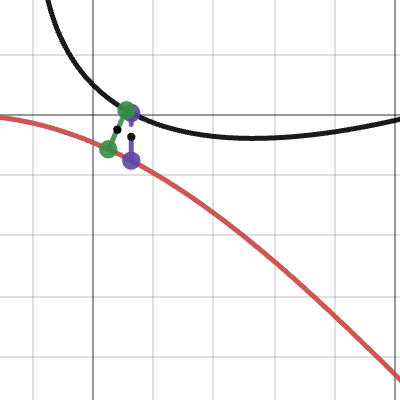
Desmos
lone heartBOT
torpid kestrel
I have 2 non-linear functions f and g that don't cross each other. How can I fin...
torpid kestrel
I'm looking for the green line and not the purple one
In other words, for vectors v_1 = [x_1, f(x_1)] and v_2 = [x_2, g(x_2)], I wish to minimize the L2 norm v_1-v_2
upbeat hornet
torpid kestrel
I have 2 non-linear functions f and g that don't cross each other. How can I fin...
have you tried setting the derivatives equal
 late mango
torpid kestrel
I have 2 non-linear functions f and g that don't cross each other. How can I fin...
late mango
torpid kestrel
I have 2 non-linear functions f and g that don't cross each other. How can I fin...
what are the functions
torpid kestrel
So far, I've come up with the following loss function:
$$
L = (x_1-x_2)^2 + (f(x_1)-g(x_2))^2
$$
ocean sealBOT
lucasyerz
 torpid kestrel
$$
f\left(x\right)=\sin\left(x\right)
$$
ocean sealBOT
lucasyerz
 late mango
and g(x)?
torpid kestrel
$$
P\left(x\right)=x+\frac{\sqrt{2}}{2}-\sqrt{2\sqrt{2}x+0.5} \
$$
$$
g\left(x\right)=P\left(x-2\right)+1.1
$$
late mango
and g(x) = P(x-2)?
ocean sealBOT
lucasyerz

 modern sedge
ocean seal
**lucasyerz**
modern sedge
ocean seal
**lucasyerz**
Can't you just set it's gradient to 0? It will be a lot of painful work but it should work
torpid kestrel
modern sedge
Can't you just set it's gradient to 0? It will be a lot of painful work but it s...
you can see in the desmos example that I tried, but question is, derivate with respect to what?
torpid kestrel
ocean seal
**lucasyerz**
maybe I should solve L for both x_1 and x_2.
modern sedge

Gradient is a vector, in your case it would be vector of derivative wrt x and derivative wrt y
both of these should equal 0
Lemme try it....
torpid kestrel
I just came up with that formulation, so haven't tried it yet, just figured there'd be a known famous solution. Anyway
lone heartBOT
@torpid kestrel Has your question been resolved?
torpid kestrel
So after getting a numerical solution I get this red line:
https://www.desmos.com/calculator/ljxomc7rue

Desmos
I'm not sure if there is a general solution for any function, but doing:
$$
L = (x_1-x_2)^2 + (f(x_1)-g(x_2))^2\
\frac{\partial }{\partial :x_1}(L)=0\
\frac{\partial }{\partial :x_2}(L)=0\
$$
lone heartBOT
@torpid kestrel Has your question been resolved?
 mellow grail
torpid kestrel
So after getting a numerical solution I get this red line:
https://www.desmos.co...
mellow grail
torpid kestrel
So after getting a numerical solution I get this red line:
https://www.desmos.co...
Couldn't you define d(x) to get the distance between f(x) and g(x) (using distance formula) and find the minima using derivatives
 harsh swallow
that's the gradient
the distance formula is a function of x and y
and by doing the gradient and setting that to 0 you find a peak or a valley
torpid kestrel
$$
L = (x_1-x_2)^2 + (f(x_1)-g(x_2))^2
$$
$$
\frac{\partial }{\partial :x_1}(L)=0
$$
$$
\frac{\partial }{\partial :x_2}(L)=0
$$
ocean sealBOT
lucasyerz
 torpid kestrel
harsh swallow
and by doing the gradient and setting that to 0 you find a peak or a valley
torpid kestrel
harsh swallow
and by doing the gradient and setting that to 0 you find a peak or a valley
yeah, that's pretty much what I did, it's just that I was wondering that the solution for x_1 and x_2 can be writting as a function of f and g.
harsh swallow
you have the formulae
to do that
by just filling in f and g
into L
and then doing the derivative
you get the two equations you need to find x1 and x2
torpid kestrel
the f and g here are just example functions.
harsh swallow
yes but you can fill the functions you want to find in
 keen plinth

Desmos
harsh swallow
the problem is whenever there is no solution it might be funky
actually i think there's always a solution
torpid kestrel
keen plinth
https://www.desmos.com/calculator/yac0illz0o
Yup, exactly what I needed. Ty so much
$$
\left(f'\left(a\right)-g'\left(b\right)\right)^{2}+\left(g'\left(b\right)+\frac{a-b}{f\left(a\right)-g\left(b\right)}\right)^{2}=0
$$
ocean sealBOT
lucasyerz
 torpid kestrel
harsh swallow
actually i think there's always a solution
torpid kestrel
harsh swallow
actually i think there's always a solution
yeah, ts just a vector so there will always be a solution and if there are many solutions you can always introduce bounds.
keen plinth
note that this is actually two equations wrapped into one
harsh swallow
i wonder what happens if the solution is at a point where the derivative doesn't exist
keen plinth
[
f'(a) = g'(b) = -\f {a - b} {f(a) - g(b)}
]
ocean sealBOT
 keen plinth
this is what you actually want to solve
torpid kestrel
keen plinth
this is what you actually want to solve
well, I'll be putting it into an optimizer, with an arbitrary f and g, so defining it as a single function is preferred.
keen plinth
sure
[2\textwidth] results may vary depending on if you do
[
(f'(a) - g'(b))^2 + \parens {g'(b) + \f {a - b} {f(a) - g(b)}}^2 = 0 \textqq{or}
(f'(a) - g'(b))^2 + \parens {f'(a) + \f {a - b} {f(a) - g(b)}}^2 = 0
]
ocean sealBOT
 keen plinth
if you're solving numerically
keen plinth

keen plinth
ocean seal
this is the only condition that matters
torpid kestrel
keen plinth
this is the only condition that matters
Ow, ok, nvm
keen plinth
you do need to make sure that you find a global min rather than a local min/max though