#help-0
1 messages · Page 245 of 1
 alpine sable
 subtle birch
Welcome
alpine sable
.close
 lone heartBOT
Channel closed
Closed by @mint jungle
Use .reopen if this was a mistake.
lone heartBOT
 Available help channel!
Send your question here to claim the channel.
Remember:
• Ask your math question in a clear, concise manner.
• Show your work, and if possible, explain where you are stuck.
• After 15 minutes, feel free to ping <@&286206848099549185>.
• Type the command .close to free the channel when you're done.
• Be polite and have a nice day!
Read #❓how-to-get-help for further information on how to ask a good question, and about conduct in the question channels.
 charred plank
Hey guys, Any help with this one?
The question is -
Calculate E[Y] given that $X\sim exp(2)$
 lone heartBOT
charred plank
Hey guys, Any help with this one?
The question is -
Calculate E[Y] given that $...
lone heartBOT
charred plank
Hey guys, Any help with this one?
The question is -
Calculate E[Y] given that $...
 ocean sealBOT
meitar5674
 lone heartBOT
@charred plank Has your question been resolved?

 vale crag
 amber steeple
you should go find another channel, see #❓how-to-get-help
but for your question you can prolly go to #real-complex-analysis
vale crag
charred plank
Hey guys, Any help with this one?
The question is -
Calculate E[Y] given that $...
wdym X \sim Exp(2) ?
your image says X \sim Exp(1)
lone heartBOT
@charred plank Has your question been resolved?
lone heartBOT
Channel closed
Closed due to timeout
Use .reopen if this was a mistake.
Available help channel!
Send your question here to claim the channel.
Remember:
• Ask your math question in a clear, concise manner.
• Show your work, and if possible, explain where you are stuck.
• After 15 minutes, feel free to ping <@&286206848099549185>.
• Type the command .close to free the channel when you're done.
• Be polite and have a nice day!
Read #❓how-to-get-help for further information on how to ask a good question, and about conduct in the question channels.
 strong schooner
**In a certain group, every person has exactly 3 acquaintances. Prove that we can place all the people from that group into two rooms in such a way that each person has at most one acquaintance in the same room. ** It is a discrete math problem, and I'm not sure where to start. As far as I can see, the graph is 3-regular (every vertex in the graph has 3 other vertices connected to it), and we are supposed to divide them to two partitions ( it is not a bipartite graph because we can have connections in the same partition, therefore it cannot be bipartite). Chatgpt offered me a solution that isn't correct, using some methods such as graph coloring, but in my discrete math book this task is under subgraphs, so I'm guessing it has something to do with that.
lone heartBOT
strong schooner
**In a certain group, every person has exactly 3 acquaintances. Prove that we ca...
 vale wigeon
gpt's not to be trusted for sure
but like it does have it right that this could be restated as a certain coloring problem
strong schooner
Start with any person and place them in the first room.
Place all their immediate acquaintances (neighbors in the graph) in the second room.
For each acquaintance in the second room, check their immediate acquaintances and place them in the first room.
Continue this process until all people are placed in the appropriate rooms. gpt told me this, but by doing this, say we have nodes a, b, c, d and b, c, d are aquaintances of a, that means a is going to be placed in the first room, and b, c and d in the second, but then a has no aquaintances in the first room when it should have at most one
so that is what is confusing me
 lament forge
well no acquaintances is at most one
the thing that wouldn't be at most one is having two or three acquaintances in the same room, like what you would get if you put everyone in the same room
(or more than 3 but that's not possible with each person only having 3 acquaintances in total)
strong schooner
ohh we could look at it that way for sure, didn't even cross my mind, you are right
this discrete math is going to be the end of my braincells
lament forge
although gpt's approach is indeed incorrect here
if we have 4 people who are all acquaintances with each other, we must put two of them in one room and two in the other room (which it isn't doing)
because otherwise we would have a group of 3 people who all know each other in the same room, meaning any person in that group knows the other two which is more than one
strong schooner
yes, that could happen with a complete K4 graph, because it is 3-regular, so it is incorrect, yes, and for 5 nodes a 3-regular graph doesn't exist
i think it needs to be greater than or equal to 6 nodes, and that the number of nodes should be even for us to be considering it
because if we have say 7 nodes, the sum of degrees is 7*3 and that is 21, but the sum of degrees should be a even number because it's 2 times the number of edges
lament forge
...yep, that's true
so yeah there must be an even number of nodes
strong schooner
but does the algorithm work for these condiditons now?
 lament forge
yeah this would break it

this isn't actually a 3-regular graph but i think you can probably add more vertices so it is...?
yep you can

you start the algorithm at the vertex with an arrow, i've colour-coded them according to which room they end up in (black = doesn't matter), and you end up with a red triangle at the right which means it's incorrect
strong schooner
so this should serve right as a counter example that we probably cannot solve this task
or is it just for the algorithm
lament forge
this just shows that chatgpt's approach doesn't work
here's a colouring that does work

(ignore the fact that i made both the circles and the lines black and therefore couldn't use a bucket tool to properly recolour them)
lament forge
they are, but that's fine
we just need a red to have at most one red neighbour
two is too many, but one is allowed
lament forge
lament forge
we just need a red to have *at most one* red neighbour
alternative way to view this: we want to remove at most one edge from each vertex, such that in the result no two edges vertices the same colour are connected (or equivalently, the graph is bipartite)
i don't know if that's helpful but it is different
strong schooner
thank youu for your time and consideration, it is helpful
lone heartBOT
@strong schooner Has your question been resolved?
lone heartBOT
Channel closed
Closed due to timeout
Use .reopen if this was a mistake.
Available help channel!
Send your question here to claim the channel.
Remember:
• Ask your math question in a clear, concise manner.
• Show your work, and if possible, explain where you are stuck.
• After 15 minutes, feel free to ping <@&286206848099549185>.
• Type the command .close to free the channel when you're done.
• Be polite and have a nice day!
Read #❓how-to-get-help for further information on how to ask a good question, and about conduct in the question channels.
 lone atlas
 lone heartBOT
lone atlas
lone atlas
lone heartBOT
lone atlas
lone atlas
how was this equation written before it was simplified
i don't know where the 10h came from
lone atlas
$$\sqrt{10(10+h)+21}$$
ocean sealBOT
v3ryberry
 lone heartBOT
Channel closed
Closed by @lone atlas
Use .reopen if this was a mistake.
Available help channel!
Send your question here to claim the channel.
Remember:
• Ask your math question in a clear, concise manner.
• Show your work, and if possible, explain where you are stuck.
• After 15 minutes, feel free to ping <@&286206848099549185>.
• Type the command .close to free the channel when you're done.
• Be polite and have a nice day!
Read #❓how-to-get-help for further information on how to ask a good question, and about conduct in the question channels.
 polar ravine
Hi! In the theorem of Existence & Uniqueness, why does a defined partial derivative imply uniqueness?
lone heartBOT
polar ravine
Hi! In the theorem of Existence & Uniqueness, why does a defined partial derivat...
polar ravine
My intuition is that you can't have two different ways of defining solutions for the same initial condition and have them have continuous derivatives, because then they would be describing the same solution
or something like that
What is the correct intuition?
 mortal trellis
that's a very unspecific theorem name
can you give more context what you are referring to?
polar ravine
The most basic interpretation, for ode's
It says that is a function is continuous then it exists, and if it has a continuous partial derivative, then its unique
here,
 mortal trellis
ok some version of picard lindelöf I guess? I did not know that is also known as uniqueness and existence theorem. what an absolutely terrible name
or at least without further context
well ok, have you seen the proof?
lone heartBOT
@polar ravine Has your question been resolved?
Channel closed
Closed by @polar ravine
Use .reopen if this was a mistake.
Available help channel!
Send your question here to claim the channel.
Remember:
• Ask your math question in a clear, concise manner.
• Show your work, and if possible, explain where you are stuck.
• After 15 minutes, feel free to ping <@&286206848099549185>.
• Type the command .close to free the channel when you're done.
• Be polite and have a nice day!
Read #❓how-to-get-help for further information on how to ask a good question, and about conduct in the question channels.
 steady portal
On every one of 10 lessons the teacher is choosing randomly exactly one student to ask,
Calculate the probability that every student will be asked at least once.```
How can I solve this task?Please don't occupy multiple help channels.
 steel oyster
Hello.
First you need to calculate the total number of outcomes.
 quiet vector
and there are what 9 ways ur condition gets satisfied
so 9/total no of outcomes should give u ur solution
(not considering order coz not sure if ure supposed to)
steel oyster
The total number of outcomes, (How many different ways of choosing 9 people over 10 lessons are there), is 9 the first lesson, 9 the second lesson.....
So 9^10
steel oyster
steady portal
```There is a group of 9 students.
On every one of 10 lessons the teacher is cho...
If youre still here. Let us know where youre at.
quiet vector
so well there will be 9 combinations at least right?
and permuting those would give no favorable events
steady portal
steel oyster
The total number of outcomes, (How many different ways of choosing 9 people over...
Why 9^10 and not the opposite?
steel oyster
steady portal
Why 9^10 and not the opposite?
Because each lesson the teacher has 9 people to pick from. 9 the first lesson, 9 the second, and so on
That means you multiply 9 by 9 by 9 and so on. (10 times because of the 10 lessons).
 steady portal
Okay
I have 9^10
What to do next?
steel oyster
Now you need to find in how many of those (9^10) different outcomes, 9 different people will be chosen
Aka. number of favorable outcomes if youre familliar with that
steel oyster
steady portal
Okay
I have 9^10
What to do next?
Tell me whenever you need more in depth
lone heartBOT
@steady portal Has your question been resolved?
steady portal
steel oyster
Now you need to find **in how many of those (9^10) different outcomes, 9 differe...
Like on different lessons the person cannot be the same?
steel oyster
steady portal
Like on different lessons the person cannot be the same?
The person can be the same in different lessons, but not too many, otherwise the others will be less likely to get chosen.
I want you to figure out how many different ways there are of 9 different students getting chosen
Ill simplify.
We have 9 students that we will name: A,B,C,D,E,F,G,H,I
We have 10 lessons that the students can be chosen.
How many ways can the students be chosen, if the order doesnt matter
(Binomial coefficient, if youre familiar with that)
Ill give 2 examples where 9 different people are chosen.
A A B C D E F G H I
A B D C E A F G H I
Feel free to ask if you need me to rephrase or clarify
steady portal
steel oyster
The person **can** be the same in different lessons, but not too many, otherwise...
If the order doesn't matter they can be chosen 9! times?
wait no, 9^10 times
lone heartBOT
Channel closed
Closed due to timeout
Use .reopen if this was a mistake.
steady portal
.reopen
lone heartBOT
✅
steel oyster
steady portal
If the order doesn't matter they can be chosen 9! times?
Yes. 9 times
A A B C D E F G H I
A B B C D E F G H I
A B C C D E F G H I
A B C D D E F G H I
A B C D E E F G H I
A B C D E F F G H I
A B C D E F G G H I
A B C D E F G H H I
A B C D E F G H I I
steady portal
And I want to find out the probability that every student will be chosen at least once
steel oyster
steady portal
And I want to find out the probability that every student will be chosen at leas...
Yes.
Now we have the total amount of outcomes (9^10)
We also have the number of outcomes where "every student will be chosen at least once", which is 9
Do you know what to do with this
steady portal
So will it be 9 / 9^10?
steel oyster
steady portal
So will it be 9 / 9^10?
There you go, problem solved
That is the probability
steady portal
Thanks @steel oyster !
lone heartBOT
@steady portal Has your question been resolved?
Channel closed
Closed by @steady portal
Use .reopen if this was a mistake.
Available help channel!
Send your question here to claim the channel.
Remember:
• Ask your math question in a clear, concise manner.
• Show your work, and if possible, explain where you are stuck.
• After 15 minutes, feel free to ping <@&286206848099549185>.
• Type the command .close to free the channel when you're done.
• Be polite and have a nice day!
Read #❓how-to-get-help for further information on how to ask a good question, and about conduct in the question channels.
 full horizon
Hi i’m taking calc 1 right now and i’m confused about one thing
full horizon
can anyone explain to me in what order i’m supposed to use the quotient, product, and chain rule for derivatives?
 worn fox
There is no "order" that you must follow everytime; you use them as and when you need to
full horizon
quiet vector
also do u know what these rules are?
yeah i do
full horizon
worn fox
There is no "order" that you must follow everytime; you use them as and when you...
ohh ok
I was confused because i was told that you have to do it in a specific order depending on the type of question
 tacit arch
full horizon
I was confused because i was told that you have to do it in a specific order dep...
tacit arch
full horizon
I was confused because i was told that you have to do it in a specific order dep...
Just do actual problems
Preferably one that conveys what you're trying to say
worn fox
There are plenty of examples where you have to do them in different orders
full horizon
so how would i do this one?

do i need to take the derivative of each and then use the rules?
 dusky kraken
I usually first get them out of fraction form to make it simpler
But for these ones you just multiply down and subtract one from the indice
full horizon
dusky kraken
But for these ones you just multiply down and subtract one from the indice
ok so would the answer be d/dx = -2/x^2 + 6/x^4 - 4/x^5?
 exotic citrus
full horizon
ok so would the answer be d/dx = -2/x^2 + 6/x^4 - 4/x^5?
exotic citrus
full horizon
ok so would the answer be d/dx = -2/x^2 + 6/x^4 - 4/x^5?
yes
dusky kraken
One second lad
I'm not sure your signs are right @full horizon
Actually yk what
when you put them into fractions then you are right
nvm
you all good
full horizon
dusky kraken
you all good
alright thank you!
lone heartBOT
@full horizon Has your question been resolved?
lone heartBOT
Channel closed
Closed due to timeout
Use .reopen if this was a mistake.
Available help channel!
Send your question here to claim the channel.
Remember:
• Ask your math question in a clear, concise manner.
• Show your work, and if possible, explain where you are stuck.
• After 15 minutes, feel free to ping <@&286206848099549185>.
• Type the command .close to free the channel when you're done.
• Be polite and have a nice day!
Read #❓how-to-get-help for further information on how to ask a good question, and about conduct in the question channels.
 nimble island
 lone heartBOT
nimble island
nimble island
lone heartBOT
nimble island
nimble island
how did they get the last step of simplifying?
this is for rate of change
they made it so r = x^2 + y^2
but additionally where is the square root from
nimble island
did they just not include it in the work?
nimble island
vale crag
r = sqrt(x^2+y^2)
oh I guess you are right nvm thank you
lone heartBOT
@nimble island Has your question been resolved?
lone heartBOT
Channel closed
Closed due to timeout
Use .reopen if this was a mistake.
Available help channel!
Send your question here to claim the channel.
Remember:
• Ask your math question in a clear, concise manner.
• Show your work, and if possible, explain where you are stuck.
• After 15 minutes, feel free to ping <@&286206848099549185>.
• Type the command .close to free the channel when you're done.
• Be polite and have a nice day!
Read #❓how-to-get-help for further information on how to ask a good question, and about conduct in the question channels.
 frosty isle
need helo
lone heartBOT
frosty isle
need helo
 carmine sage
What is your question
lone heartBOT
@frosty isle Has your question been resolved?
lone heartBOT
Show your work, and if possible, explain where you are stuck.
frosty isle
i got my bounds, which are x=4,-4 and then i did the area of the surface of revolution which is S= 2pi interal -4 4 (16-x^2)(sqrt1+(-2x)^2)
i am stuck in taking the integration
lone heartBOT
@frosty isle Has your question been resolved?
Channel closed
Closed by @frosty isle
Use .reopen if this was a mistake.
Available help channel!
Send your question here to claim the channel.
Remember:
• Ask your math question in a clear, concise manner.
• Show your work, and if possible, explain where you are stuck.
• After 15 minutes, feel free to ping <@&286206848099549185>.
• Type the command .close to free the channel when you're done.
• Be polite and have a nice day!
Read #❓how-to-get-help for further information on how to ask a good question, and about conduct in the question channels.
 late parcel
 lone heartBOT
late parcel
lone heartBOT
late parcel
 surreal meadow
where do you see 1.6 * 10^(-8)
late parcel
Sorry it’s actually to the -19
surreal meadow
that's the charge of an electron
surreal meadow
don't know how your class works
late parcel
Why is it squared
surreal meadow
don't know
surreal meadow
i understand the problem, and it would seem as if the formula is k * e^2 / r^2
specifically why we square the electron charge, no idea
late parcel
Ok cool
late parcel
Ok makes sense, thx
lone heartBOT
@late parcel Has your question been resolved?

 surreal meadow
they showed the work
F = qE
so they multiplied the charge of the particle at P times the electric field at P
lone heartBOT
@late parcel Has your question been resolved?
lone heartBOT
Channel closed
Closed due to timeout
Use .reopen if this was a mistake.
lone heartBOT
Available help channel!
Send your question here to claim the channel.
Remember:
• Ask your math question in a clear, concise manner.
• Show your work, and if possible, explain where you are stuck.
• After 15 minutes, feel free to ping <@&286206848099549185>.
• Type the command .close to free the channel when you're done.
• Be polite and have a nice day!
Read #❓how-to-get-help for further information on how to ask a good question, and about conduct in the question channels.
 polar vortex
Can someone please help me solve the following problem ?
 surreal meadow
!status
lone heartBOT
What step are you on?
1. I don't know where to begin
2. I have begun but got stuck midway
3. I got an answer but I'm told it's wrong
4. I got an answer and would like my work checked
5. I have a question about someone else's worked solution
6. None of the above
1
surreal meadow
do you understand the question
polar vortex
not really
polar vortex
3c=B
polar vortex
c=b/3
polar vortex
b/3 + 3 ?
surreal meadow
yes
lone heartBOT
Channel closed
Closed by @polar vortex
Use .reopen if this was a mistake.
lone heartBOT
Available help channel!
Send your question here to claim the channel.
Remember:
• Ask your math question in a clear, concise manner.
• Show your work, and if possible, explain where you are stuck.
• After 15 minutes, feel free to ping <@&286206848099549185>.
• Type the command .close to free the channel when you're done.
• Be polite and have a nice day!
Read #❓how-to-get-help for further information on how to ask a good question, and about conduct in the question channels.
 marble swallow
 lone heartBOT
marble swallow
marble swallow
lone heartBOT
marble swallow
marble swallow
i need help with this question
 shy dove
ah. Then I guess you can find the equation of line ab, bc, cd, ad
and see which is different
lone heartBOT
Channel closed
Closed by @marble swallow
Use .reopen if this was a mistake.
Available help channel!
Send your question here to claim the channel.
Remember:
• Ask your math question in a clear, concise manner.
• Show your work, and if possible, explain where you are stuck.
• After 15 minutes, feel free to ping <@&286206848099549185>.
• Type the command .close to free the channel when you're done.
• Be polite and have a nice day!
Read #❓how-to-get-help for further information on how to ask a good question, and about conduct in the question channels.
 dawn quail
 lone heartBOT
dawn quail
dawn quail
lone heartBOT
dawn quail
dawn quail
Why no distribution for (1-λ)?
Algebra shows brackets around these terms, no?

But then magically the square brackets are removed and I don’t understand the math involved to do so?
 tawny condor
3 * 0 = 0
dawn quail
Yes I understand that
tawny condor
And then you subtract 0
dawn quail
But what about the other 2 factors?
tawny condor
which leaves you with just (-2-λ)(4-λ)
dawn quail
[(-2-λ)(4-λ)]
dawn quail
Why no distribution?
dawn quail
Oh
tawny condor
2 * (3 * 3)
dawn quail
Right
dawn quail
18
dawn quail
Wait but there is addition involved
tawny condor
where
only inside the parenthesis
we dont care about that
you have (1-λ) as one thing
times
(-2-λ) * (4-λ)
dawn quail
Those are Binomials
tawny condor
just view them as 2 things being multiplied
dawn quail
tawny condor
(-2-λ) * (4-λ)
Aren’t you supposed to do FOIL?
tawny condor
if you expand them, THEN you will have addition to distribute over
dawn quail
First outside inside last
tawny condor
but we aren't expanding them
dawn quail
To find product
tawny condor
we dont have to
dawn quail
Why?
tawny condor
because we don't need to
if your choice whether to expand or not
in this case we dont need to
dawn quail
We removed the square brackets and I feel like it’s breaking a law. It says to distribute
tawny condor
It's not
dawn quail
So it will get the same answer either way?
tawny condor
tawny condor
(-2-λ) * (4-λ)
If you expand the parenthesis here
dawn quail
Yes
dawn quail
Yes
Gotta deal with brackets first
That’s why it looks weird to just remove them like that
tawny condor
no you dont
tawny condor
rule to what
dawn quail
Removing the square brackets
tawny condor
x * (yz) = xyz is associativity
dawn quail
dawn quail
Removing the square brackets
Before expanding
dawn quail
tawny condor
x * (yz) = xyz is associativity
But that doesn’t include +-
tawny condor
like, it's your choice whether you want to expand the polynomial or keep it as multiplication of its factors
dawn quail
dawn quail
But that doesn’t include +-
This example does
tawny condor
dawn quail
But that doesn’t include +-
yeah it doesnt
y = -2-λ
z = 4-λ
x = 1-λ
all of these have parenthesis around them
so you just look at them without caring whats inside
its SOME value, but whatever it is
dawn quail
So you can move them abc or cad or bac
tawny condor
yes
tawny condor
If you want to expand them, yes
but we're just looking at them as factors right now
dawn quail
But it’s also associativity, I have never done that before
dawn quail
Right
tawny condor
look, another example:
dawn quail
If there was a +- in between the brackets we could not do this
lament forge
dawn quail
I always see the multiplication of binomials as FOIL
...the fact that things happen to be written as binomials in this case doesn't mean that they're not numbers
dawn quail
But since there isn’t we are free to move around
tawny condor
(x + 1) * [x * (2x + 1)]
for example
this is equal to
(x+1) * x * (2x + 1)
you dont care about the brackets
you can ignore them
dawn quail
tawny condor
(x+1) * x * (2x + 1)
(1/x)(2x + 1)(x^3 + x^2)
tawny condor
1/x?
dawn quail
Wow
So we are adding domain restriction by writing it this way
Something that isn’t in the original problem
dawn quail
So this is considered kinda a bad thing?
dawn quail
Before x could equal 0
But now it cannot
tawny condor
yeah and
you need to give a more specific examples
but usually its not a good idea to just randomly do that
unless you have a reason
dawn quail
lol
I guess it could be x^-1 instead of 1/x.. but yeah.. writing it this way brings about domain restriction.. gotta be careful
tawny condor
or just note that x = 0 gives u a value of 0
dawn quail
Hmmm
lament forge
dawn quail
I guess it could be x^-1 instead of 1/x.. but yeah.. writing it this way brings ...
...that wouldn't change anything...?
dawn quail
I will have to be careful because if I ever introduce a negative variable.. risky stuff…
dawn quail
lament forge
...that wouldn't change anything...?
Yeah exactly just a different way to write it
dawn quail
dawn quail
I will have to be careful because if I ever introduce a negative variable.. risk...
For domain restriction I mean
What once had full domain is now restricted due to this
tawny condor
so do you have anymore questions
dawn quail
Nope
tawny condor
or you got it
lament forge
basically don't divide by a thing that might be zero
tawny condor
alright good
dawn quail
And a variable can always be 0
tawny condor
i mean, not if 0 isn't in ur domain
if you're dealing with natural numbers for examples
(without 0)
or primes
or whatever
dawn quail
But now you are setting new rules by saying 0 is not in domain lol.. before it was..
tawny condor
yeah
dawn quail
I find it interesting how division by 0 is actually used on the determinant for solving eigenvalues
This is to avoid inverse if the determinant is 0
Wait sorry
Wrong words
We set the determinant itself equal to 0
To avoid inverse
That’s what it is
Not division by 0
tawny condor
you SET the determinant?
dawn quail
Yes
dawn quail
We don’t wanna cancel (A-λI) with an inverse
So we have to set the determinant to 0
To avoid inverse
tawny condor
you can get it easily by starting with the definition of an eigenvector
Av = λv
λv - Av = 0
(λI - A)v = 0
dawn quail
But behind the scenes that’s why we set it to 0
0 is the value of the determinant
Non invertible
tawny condor
uh yes I guess
 carmine reef
why do we want the matrix to be non-invertible?
dawn quail
It’s the only reason it’s 0
dawn quail
dawn quail
We don’t wanna cancel (A-λI) with an inverse
Because of this
carmine reef
what happens if we cancel it with an inverse?
carmine reef
no solution for an eigenvector?
tawny condor
(λI - A)v = 0
is a system. you want it to have nontrivial solutions which means the matrix λI - A needs to be noninvertible
dawn quail
(A-λI)(A-λI)^-1
dawn quail
tawny condor
(λI - A)v = 0
is a system. you want it to have nontrivial solutions which means ...
Yes. Better wording
dawn quail
dawn quail
(A-λI)(A-λI)^-1
We don’t want this to happen
So if we set the determinant to = 0, it resolves that
|(A-λI)| = 0
Now we can’t invert
tawny condor
tawny condor
well you need to know that being singular means there is a nonzero solution
(λI - A of course)
dawn quail
I think that’s the reason why we set the algebra = 0 when finding eigenvalues
Anyways
I think I can visualize it but probably explaining it wrong
It’s tricky
But not too bad.. I think lol..
Don’t wanna overthink it.. just memorize the steps for eigens
tawny condor
ok.
lone heartBOT
Channel closed
Closed by @dawn quail
Use .reopen if this was a mistake.
tawny condor
np
lone heartBOT
Available help channel!
Send your question here to claim the channel.
Remember:
• Ask your math question in a clear, concise manner.
• Show your work, and if possible, explain where you are stuck.
• After 15 minutes, feel free to ping <@&286206848099549185>.
• Type the command .close to free the channel when you're done.
• Be polite and have a nice day!
Read #❓how-to-get-help for further information on how to ask a good question, and about conduct in the question channels.
 brisk quest
wanna ask
lone heartBOT
brisk quest
wanna ask
 vale wigeon
do we know what Δ and δ stand for?
brisk quest
change in variable
vale wigeon
??
brisk quest
nvm let's skip to 2nd question
vale wigeon
ok so do you know what lagrange's interpolation formula is
lone heartBOT
Channel closed
Closed by @brisk quest
Use .reopen if this was a mistake.
Available help channel!
Send your question here to claim the channel.
Remember:
• Ask your math question in a clear, concise manner.
• Show your work, and if possible, explain where you are stuck.
• After 15 minutes, feel free to ping <@&286206848099549185>.
• Type the command .close to free the channel when you're done.
• Be polite and have a nice day!
Read #❓how-to-get-help for further information on how to ask a good question, and about conduct in the question channels.
 deft python
 lone heartBOT
deft python
deft python
lone heartBOT
deft python
deft python
I dunno how b is. Done

That’s what I did
The real part is correct but the complex is 3i not 5i
I dunno how

This is all the he;p the mark scheme gives lol
deft python
Mb sry bro im new to this stuff
vale wigeon
as for how it's done: in short, the point z - (3+2i) has modulus 2 and argument 5pi/6
vale wigeon
deft python
Mb sry bro im new to this stuff
please don't call me bro
deft python
Ok sry
deft python
vale wigeon
as for how it's done: in short, the point z - (3+2i) has modulus 2 and argument ...
I’m still kinda lost
Is my diagram even drawn correctly?
vale wigeon
it's a bit shoddy, is how i would describe it
like it's vaguely correct it's just not very good quality
deft python
Would you possibly be able to write a written solution on paper ?
To the question that would be a life saver
vale wigeon
don't have the energy to do that sorry
deft python
Oh ok it’s cool
I don’t rly understand what to do tho
Sry I’m new to this stuff so I’m a bit slow
vale wigeon
the point z that lies on both curves satisfies |z - (3+2i)| = 2 and arg(z - (3+2i)) = 5pi/6
so for the number z - (3+2i) you know its modulus and argument
vale wigeon
yeah so
do you know how to write down a complex number in terms of its modulus and argument
deft python
R(sin theta + cos theta )
?
Cos and sin other way around
And isintheta
How does it help doe?
.close
lone heartBOT
Channel closed
Closed by @deft python
Use .reopen if this was a mistake.
Available help channel!
Send your question here to claim the channel.
Remember:
• Ask your math question in a clear, concise manner.
• Show your work, and if possible, explain where you are stuck.
• After 15 minutes, feel free to ping <@&286206848099549185>.
• Type the command .close to free the channel when you're done.
• Be polite and have a nice day!
Read #❓how-to-get-help for further information on how to ask a good question, and about conduct in the question channels.
 crimson totem
Can anyone link me to a source or tell me how to prove this?
 vale wigeon
are you ok with induction
 placid zinc
If
f(n) = n(n + 1)(2n + 1)/6
Then f(n) - f(n - 1) = n²
Which is easy enough to do algebraically
 wet nest
crimson totem
Can anyone link me to a source or tell me how to prove this?
wet nest
crimson totem
Can anyone link me to a source or tell me how to prove this?
You forgot /6
crimson totem
vale wigeon
are you ok with induction
what is induction
crimson totem
wet nest
You forgot /6
wdym
wet nest
 vale wigeon
crimson totem
what is induction
vale wigeon
crimson totem
what is induction
Mathematical induction is a method for proving that a statement
    P
    (
    n
    )


{\displaystyle P(n)}
is true for every natural number
    n


{\displaystyle n}
, that is, that the infinitely many cases
    P
    (
    0
...
6 was multiplied to the sum...
wet nest
crimson totem
6 was multiplied to the sum...
Oh. Didn't noticed
lone heartBOT
Channel closed
Closed by @crimson totem
Use .reopen if this was a mistake.
Available help channel!
Send your question here to claim the channel.
Remember:
• Ask your math question in a clear, concise manner.
• Show your work, and if possible, explain where you are stuck.
• After 15 minutes, feel free to ping <@&286206848099549185>.
• Type the command .close to free the channel when you're done.
• Be polite and have a nice day!
Read #❓how-to-get-help for further information on how to ask a good question, and about conduct in the question channels.
deft python

 lone heartBOT
deft python
deft python
lone heartBOT
deft python
deft python
How to do b?
I got a but and got a bit through b

This is the markschem but not very helpful lol
@crisp iron
<@&286206848099549185>
lone heartBOT
@deft python Has your question been resolved?
 gleaming ridge
I checked your answer in (a), it is correct, nice
deft python
🙂
gleaming ridge
For (b), you are looking for a vector perpendicular to the two vectors, but which has x-component = 1
You see the vector you found in (a)
deft python
Ye
deft python
Gotcha
gleaming ridge
but its x-component is not 1
gleaming ridge
To make it one, why did you think of doing magnitude? :o
gleaming ridge
deft python
Divide by 4?
Exactlyyy
deft python
Ohh right
deft python
I thought it said shortest distance
So tried the Pythag stuff
But it’s that simple
lone heartBOT
Channel closed
Closed due to timeout
Use .reopen if this was a mistake.
deft python
.reopen
lone heartBOT
✅
deft python
Wait do u mind sending ur solution to b
If that’s okay wit u


Wat did I do wrong 😭
Again lol
gleaming ridge
deft python
Wait do u mind sending ur solution to b
I did the same way
Just divide by 4 every component
gleaming ridge
deft python
What is this?
 deft python
Suii
gleaming ridge
😆
deft python
Please do tell Luna
gleaming ridge
Okay, so, from (a) you have the cross product of them
Which is perpendicular to both vectors
deft python
Yepp
gleaming ridge
But, its not the shortest
deft python
Fax
gleaming ridge
And when we say "short", we talking about magnitude
gleaming ridge
Yes
So, we need to know which value of x makes the magnitude of our vector the minimum possible
or.. makes the square of the magnitude of our vector the minimum possible
basically same leads to the same thing, just ease of calculation (no sqrt)
deft python
So we ignore the square root ?
gleaming ridge
deft python
So we ignore the square root ?
Yes, we do magnitude squared better
When the mag² is the minimum possible
Then automatically mag would be minimum possible too
Find me the expression of the mag²
 gleaming ridge
Yess, nicely done
gleaming ridge
$||\overrightarrow{V(x)}||² = 2x²-32x+176$
ocean sealBOT
luna7427
 gleaming ridge
Can you, using calculus, find at which x the minimum of this function is achieved?
deft python
Why we make =0 doe?
gleaming ridge
We have a critical point (global minimum)
gleaming ridge
you remember that stuff :P
deft python
Yehhh lmao
gleaming ridge
First derivative = 0 with sign change
gleaming ridge
Waaait, we not done yet
deft python
Just sub back in no
deft python
Nah
gleaming ridge
Yes
gleaming ridge
I meant after substitution (4 4 -4)
deft python
Oh yeh
gleaming ridge
And then yes, divide by 4
gleaming ridge
So, they made a little mistake
gleaming ridge
it's (1 1 -1)
gleaming ridge
France
deft python
High school?
lone heartBOT
Channel closed
Closed by @deft python
Use .reopen if this was a mistake.
Available help channel!
Send your question here to claim the channel.
Remember:
• Ask your math question in a clear, concise manner.
• Show your work, and if possible, explain where you are stuck.
• After 15 minutes, feel free to ping <@&286206848099549185>.
• Type the command .close to free the channel when you're done.
• Be polite and have a nice day!
Read #❓how-to-get-help for further information on how to ask a good question, and about conduct in the question channels.
 mossy creek
 lone heartBOT
mossy creek
gleaming ridge
lone heartBOT
mossy creek
gleaming ridge
Do you know the general formula for the regression line?
Precisely, the formula for its slope
lone heartBOT
@mossy creek Has your question been resolved?
mossy creek
gleaming ridge
Precisely, the formula for its slope
uh yea
essentially cov (x,y)/var(x)
gleaming ridge
Yes, y on x
Cov(X,Y) / V(X)
and x on y
Cov(X,Y) / V(Y)
Here, you have been given that
Cov(X,Y) / V(X) = 0.9
Cov(X,Y) / V(Y) = 0.1
What can we do from here?
lone heartBOT
Channel closed
Closed due to timeout
Use .reopen if this was a mistake.
mossy creek
thanks man appreciate it
lone heartBOT
Available help channel!
Send your question here to claim the channel.
Remember:
• Ask your math question in a clear, concise manner.
• Show your work, and if possible, explain where you are stuck.
• After 15 minutes, feel free to ping <@&286206848099549185>.
• Type the command .close to free the channel when you're done.
• Be polite and have a nice day!
Read #❓how-to-get-help for further information on how to ask a good question, and about conduct in the question channels.
 cinder sundial
 lone heartBOT
cinder sundial
cinder sundial
lone heartBOT
cinder sundial
cinder sundial
Is that true
ocean sealBOT
austinu
 cinder sundial
Infinity
ocean sealBOT
austinu

 vapid shuttle
we want to say yes, because we like to think that we can just combine them into x-x=0
cinder sundial
Yes
vapid shuttle
yet, algebraic operations on limits like that are only allowed if the limit exists
cinder sundial
Is there a specific reason that explain it do not exists

 vapid shuttle
and such that adding and subtracting it around willy nilly doesn't really work
cinder sundial
I got it.
Those calculation rule we using in numbers doesn’t works on infinity. Since infinity is a concept not numbers
ocean sealBOT
austinu
 vapid shuttle
I can provide an example
cinder sundial
ocean seal
**austinu**
It’s one of the indeterminate forms
vapid shuttle
Think about natural numbers, 1,2,3,....
there are an infinite amount of them
but what about real numbers?
cinder sundial
Which the limit may exist or may not
vapid shuttle
also an infinite amount of those
if we take the real numbers, and subtract the natural numbers, (infinite amount - infinite amount) we are still left with an infinite amount of numbers
not 0 numbers
vapid shuttle

lament forge
(...i feel like using \infty to refer to an infinite cardinal is a bit of a stretch...?)
 fallen verge
But if you replace one of the x's with an x^2 it would be a different story
 mellow grail
vapid shuttle
if we take the real numbers, and subtract the natural numbers, (infinite amount ...
mellow grail
vapid shuttle
if we take the real numbers, and subtract the natural numbers, (infinite amount ...
I know about this exampple from Vsauce
fallen verge
Dont limits combine? Or is this a "garlic needs to take analysis" moment
vapid shuttle
I was under the impression that you can only add/subtract/multiple/divide limits if they are determinate
they only combine if they exist
fallen verge
Crap
lament forge
if it was $\lim_{x\to 0} (x-x)$ then that's 0 \ \
but $\lim_{x\to 0}x - \lim_{x\to 0}x$ = $\infty - \infty$ isn't anything
vapid shuttle
techinically a limit going to infinity, isn't a limit existing
cinder sundial
vapid shuttle
if we take the real numbers, and subtract the natural numbers, (infinite amount ...
I’m not sure what u mean by real number minus natural numbers
ocean sealBOT
bee [it/its]
 vapid shuttle
this is what I said 
lament forge
if you allowed operating on limits like this you'd get contradictions pretty easily
on one hand, $\lim_{x\to \infty}2x - \lim_{x\to \infty}x ``=" \lim_{x\to \infty}x = \infty$
vapid shuttle
huh
mellow grail
huh...?
vapid shuttle
XD
mellow grail
isnt $\lim{x\to0}x = 0$?
lament forge
i'm saying if you could combine limits like that (which you can't)
ocean sealBOT
itzkraken.
 vapid shuttle
wha
lament forge
whoops
mellow grail
ignore my bad tex skills
 ornate ginkgo
$\lim_{x\to0}x = 0$?

 mellow grail
ocean seal
**coldtee**
mellow grail
ocean seal
**coldtee**
isnt it?
mellow grail
lol
lament forge
ocean seal
**bee [it/its]**
on the other hand, $\lim_{x\to\infty}2x = \infty = \lim_{x\to\infty}x$, and $\lim_{x\to\infty}x - \lim_{x\to\infty}x$ is supposedly $0$
ocean sealBOT
bee [it/its]
 mellow grail
cinder sundial
mellow grail
cinder sundial
this should be valid as long as the two cardinal infinities are equal
lament forge
why would cardinals be relevant here
vapid shuttle
mellow grail
this should be valid as long as the two cardinal infinities are equal
no
lament forge
you can't even subtract cardinals
mellow grail
ocean seal
**bee [it/its]**

mellow grail
lament forge
why would cardinals be relevant here
idk i forgot the term from the video
 viscid timber
I think you want to do $\lim_{x\to\infty}x-\lim_{x\to\infty}=\lim_{x\to\infty}(x-x)$.
but $\lim_{t\to \infty}t = \lim_{t\to\infty}$ .because $\lim_{x\to \infty}x$ is not closed x.
thus $\lim f(x)-\lim g(x)$ can be calculated only if $\lim_{\substack{x\to\infty\t\to\infty}$ exists.
ocean sealBOT
開集合
Compile Error! Click the  reaction for more information.
(You may edit your message to recompile.)
 lament forge
mellow grail
idk i forgot the term from the video
lament forge
mellow grail
idk i forgot the term from the video
from what video...?
mellow grail
lament forge
from what video...?
VSauce has a couple on the topic afair
lament forge
on what topic
mellow grail
sizes of infinity
lament forge
this isn't about sizes of infinity though
it's about an unrelated thing that's also called infinity because mathematicians are bad at naming things
mellow grail
why not? if they are equal in size it should be 0
mellow grail
lament forge
it's about an unrelated thing that's also called infinity because mathematicians...

vapid shuttle
what do you mean by "equal in size"
lament forge
for which "infinity"
vapid shuttle
how might you define that
how would you show that they are
hence the problem arises
lament forge
infinite cardinals, the sizes of infinite sets, do have a notion of "equal size", but don't have subtraction
mellow grail
lament forge
infinite cardinals, the sizes of infinite sets, do have a notion of "equal size"...
Oh 💀
lament forge
the \infty in limits is something completely unrelated that arguably isn't really a thing at all, it's just a way to write "unbounded" or something like that
ocean sealBOT
austinu
 vapid shuttle
and infinity isn't a real number that we can set "equal" to some value
so we can't treat it like that
lament forge
yeah \infty isn't a real number
vapid shuttle
( should we close this now? )
mellow grail
ig
vapid shuttle
.close
lone heartBOT
Channel closed
Closed by @vapid shuttle
Use .reopen if this was a mistake.
Available help channel!
Send your question here to claim the channel.
Remember:
• Ask your math question in a clear, concise manner.
• Show your work, and if possible, explain where you are stuck.
• After 15 minutes, feel free to ping <@&286206848099549185>.
• Type the command .close to free the channel when you're done.
• Be polite and have a nice day!
Read #❓how-to-get-help for further information on how to ask a good question, and about conduct in the question channels.
 cunning trout
I have the gradients, i’m confused about the points
 fallen verge
!show
lone heartBOT
Show your work, and if possible, explain where you are stuck.
cunning trout
well I just have a thought process, so the gradient m= 4 and -1/4
I was thinking of differentiating y and setting the gradient/s equal to that to get the x value/s
and then plugging the x values to the original function to get the y values?
idk something like that
fallen verge
Start with the tangent first
cunning trout
so m=4
fallen verge
Do you know how to find when m=4
fallen verge
Derivative?
fallen verge
You need to fknd when the tangent line has m=4
The slope of the tangent line is given by the derivative
Do you know how to find the derivative first?
cunning trout
yes
 thorn tapir
lament forge
the \infty in limits is something completely unrelated that arguably isn't reall...
thorn tapir
lament forge
the \infty in limits is something completely unrelated that arguably isn't reall...
yes, infty is not a value lole
oop
ignore me
fallen verge
What is the derivative
cunning trout
y’=4x-4
fallen verge
What do you need to set it equal to?
cunning trout
so I plug the x value in the original equation
fallen verge
Yup
cunning trout
meaning y=1
fallen verge
Do you know how to get the equation from here?
cunning trout
does that mean (2,1) is a point for the gradient m=4
fallen verge
Indeed
cunning trout
right
cunning trout
fallen verge
Do you know how to get the equation from here?
yep
thank you
.close
lone heartBOT
Channel closed
Closed by @cunning trout
Use .reopen if this was a mistake.
fallen verge
What about the normal
The normal is the line perpendicular to the tangent at the same point of tangency
I.e. at the point (2,1) with gradient m=-1/4
@cunning trout
lone heartBOT
Available help channel!
Send your question here to claim the channel.
Remember:
• Ask your math question in a clear, concise manner.
• Show your work, and if possible, explain where you are stuck.
• After 15 minutes, feel free to ping <@&286206848099549185>.
• Type the command .close to free the channel when you're done.
• Be polite and have a nice day!
Read #❓how-to-get-help for further information on how to ask a good question, and about conduct in the question channels.
cunning trout
fallen verge
What about the normal
ya i got dat
lone heartBOT
cunning trout
ya i got dat
fallen verge
Ok just making surw
cunning trout
np, thanks again
 storm pewter
help?
lone heartBOT
Channel closed
Closed by @cunning trout
Use .reopen if this was a mistake.
lone heartBOT
Available help channel!
Send your question here to claim the channel.
Remember:
• Ask your math question in a clear, concise manner.
• Show your work, and if possible, explain where you are stuck.
• After 15 minutes, feel free to ping <@&286206848099549185>.
• Type the command .close to free the channel when you're done.
• Be polite and have a nice day!
Read #❓how-to-get-help for further information on how to ask a good question, and about conduct in the question channels.
 warped topaz
 lone heartBOT
warped topaz
https://i.imgur.com/QrS9RkX.png
warped topaz
lone heartBOT
warped topaz
https://i.imgur.com/QrS9RkX.png
warped topaz
Not sure what to do here
fallen verge
which one?
warped topaz
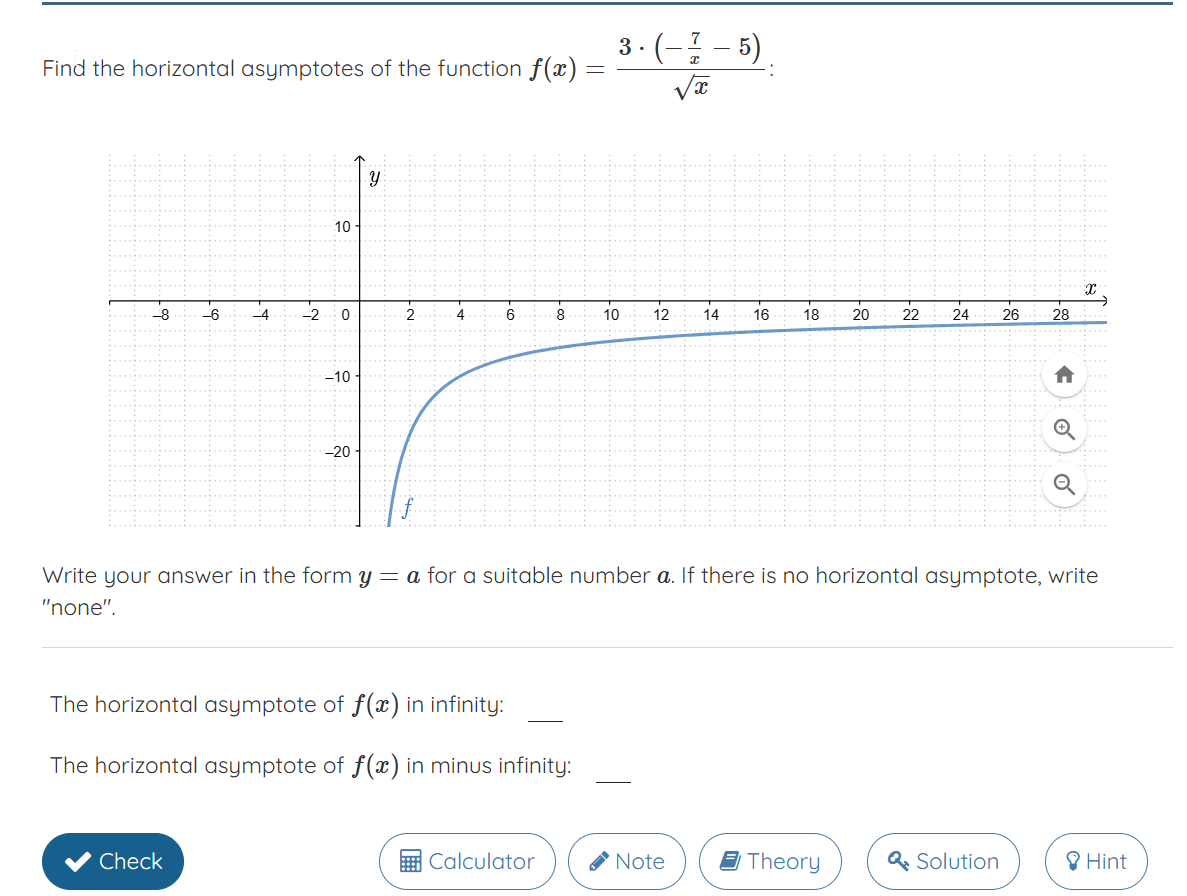
Normally I would divide everything by x or x^2 then I can just ignore the 6/x or 18/x etc since they go to zero and just read the answer (it will usually be something like 5/(6+1) etc), but with this everything is already a bit messed up, like I already have -21/x and √x so not really sure what im supposed to do
warped topaz
fallen verge
which one?
Both of them kinda, usually the method is the same for both
or similar
fallen verge
You can take the limit for the num and dem separately
warped topaz
Sorry I didnt explain my method so good but I think you know which method im talking about haha
mortal trellis
remember that $x = (\sqrt x)^2$. so it kind of looks like $\frac{3\left(-\frac{7}{t^2}-5)}{t}$ where $t=\sqrt{x}$
ocean sealBOT
denascite
Compile Error! Click the reaction for more information.
(You may edit your message to recompile.)
 mortal trellis
maybe you can work with that
warped topaz
fallen verge
You can take the limit for the num and dem separately
What do you mean sry? How do I do this?
warped topaz
mortal trellis
maybe you can work with that
Ok but usually I get a number on the denominator... so I guess it would just be zero in this case?
mortal trellis
$\lim \frac a b = \frac{\lim a }{\lim b}$
ocean sealBOT
denascite
 mortal trellis
(as long as you dont run into 0/0 or infty/infty kind of situations)
warped topaz
ocean seal
**denascite**
Hmm ok I wil try this 1 moment
I got it thanks!!
❤️
.close
lone heartBOT
Channel closed
Closed by @warped topaz
Use .reopen if this was a mistake.
Available help channel!
Send your question here to claim the channel.
Remember:
• Ask your math question in a clear, concise manner.
• Show your work, and if possible, explain where you are stuck.
• After 15 minutes, feel free to ping <@&286206848099549185>.
• Type the command .close to free the channel when you're done.
• Be polite and have a nice day!
Read #❓how-to-get-help for further information on how to ask a good question, and about conduct in the question channels.
warped topaz
Is it possible to have jump discontinuity AND hole discontinuity?
warped topaz
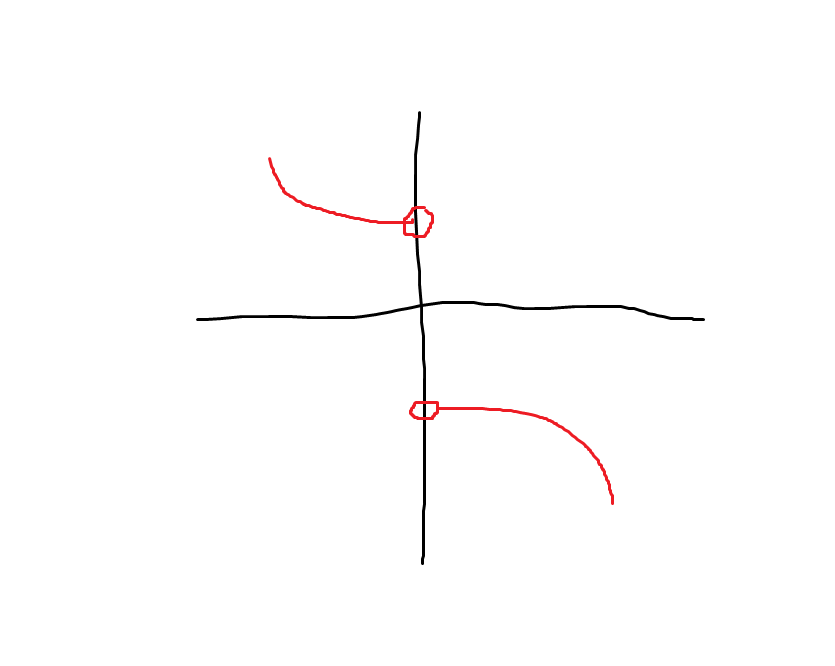


I dont see why not, but someone told me that the definition of hole discontinuity is 'Left limit = right limit but function value DNE'
If left limit = right limit then there cannot be jump discontinuity, right?
lone heartBOT
@warped topaz Has your question been resolved?
 timber latch
warped topaz
I dont see why not, but someone told me that the definition of hole discontinuit...
timber latch
warped topaz
I dont see why not, but someone told me that the definition of hole discontinuit...
Yup
Hole discontinuity means that if you can fill the hole in with some value and make it continuous
Not possible for jump
@warped topaz
timber latch
timber latch
Hole discontinuity means that if you can fill the hole in with some value and ma...
Ie. Left limit = right limit
That is the standard definition I believe
And I don't believe there is another common used one
warped topaz
timber latch
Ie. Left limit = right limit
So its not possible to have both on the same graph?
warped topaz
warped topaz
https://i.imgur.com/AEE53DW.png
Seems really weird, like I just drew an example graph here so I dont see why it shouldnt be possible
Its not like a graph that has both infinite discontinuity and jump discontinuity where you literally cant draw it
timber latch
You are confused about definitions
timber latch
warped topaz
So its not possible to have both on the same graph?
You can
Not at the same point tho
A graph can be hole discontinuous at one point
And jump at other
Same point is not possible
Jump discontinuity just means left and right limits are unequal
It doesn't matter if the function at that point is defined or not
Hole means it's not defined st that pt
And left = right
warped topaz
timber latch
Same point is not possible
Ah ok that what I was trying to figure out
But now im curious, what would the function look like of a graph that has both hole and jump (at different points)
Cause the left limit cannot equal right (for jump) but the left HAS to equal right (for hole), no?
timber latch
Here is one
If x<0 f(x)=x
Undefined at 0
For x in (0,5)
f(x)=0
And 5 everywhere else
timber latch
Ol reliable
There might be some way to express such a function purely elementarily
Say
Ah
Go it
(x-3)/[(x-3)x]
Rationals
Wait
Does jump require left and right limit to exist
Let me check
Ya it does
But the principle is same
Find a jump discontinuity function
Multiply by (x-k)/(x-k)
warped topaz
timber latch
Does jump require left and right limit to exist
You mean like does it require them to be finite?
warped topaz
Ah ok
warped topaz
Yeye I think I get you
Thank you, you explained it really well
That was all I wanted to ask haha
❤️
.close
lone heartBOT
Channel closed
Closed by @warped topaz
Use .reopen if this was a mistake.
Available help channel!
Send your question here to claim the channel.
Remember:
• Ask your math question in a clear, concise manner.
• Show your work, and if possible, explain where you are stuck.
• After 15 minutes, feel free to ping <@&286206848099549185>.
• Type the command .close to free the channel when you're done.
• Be polite and have a nice day!
Read #❓how-to-get-help for further information on how to ask a good question, and about conduct in the question channels.
 rugged crescent
if i have an event A that has a 32% chance of occuring, and event B that has a 16% chance of occuring, and I run both events A and B 3 times, what are the odds that at least one of the events occurs? in other words, what is 1-(odds of neither event to occur)?
lone heartBOT
rugged crescent
if i have an event A that has a 32% chance of occuring, and event B that has a 1...
rugged crescent
is 1-((1-0.32)*(1-0.16))^3 correct?
lone heartBOT
@rugged crescent Has your question been resolved?
rugged crescent
<@&286206848099549185>
if anyone does answer pls ping i just need to know cuz im building a chance calculator for a game xd
 rose temple
rugged crescent
is 1-((1-0.32)*(1-0.16))^3 correct?
rose temple
rugged crescent
is 1-((1-0.32)*(1-0.16))^3 correct?
true
both are running 3 times?
in that case true
rugged crescent
ye
rose temple
yeah tahn true
rugged crescent
what if they run 3.3 times (3 times with 30% chance for 4th time)
can i just use 3.3 instead of 3
rose temple
raise power 3.3
rose temple
but
logically
how can u run an event in decimal
has to be a whole number
but in some other case where u can use fraction
than raise power fraction
rugged crescent
and for every time i re run this experiment it would just be 1-((1-0.32)*(1-0.16))^(3*n) where n is # events right?
rugged crescent
rose temple
how can u run an event in decimal
cuz on average
rugged crescent
over a large amount of time running this experiment it will average to 3.3
even tho its 3 with 30% chance of 4
rose temple
ya in that case power 3.3
rugged crescent
kk ty
rose temple
wlcm
rugged crescent
.close
lone heartBOT
Channel closed
Closed by @rugged crescent
Use .reopen if this was a mistake.
Available help channel!
Send your question here to claim the channel.
Remember:
• Ask your math question in a clear, concise manner.
• Show your work, and if possible, explain where you are stuck.
• After 15 minutes, feel free to ping <@&286206848099549185>.
• Type the command .close to free the channel when you're done.
• Be polite and have a nice day!
Read #❓how-to-get-help for further information on how to ask a good question, and about conduct in the question channels.
 magic pollen
Hello, I need help i forgot my notes and didn't really paid attention on my math teacher I want to learn this probability with explanation I've only learn the basic ones
 lone heartBOT
magic pollen
Hello, I need help i forgot my notes and didn't really paid attention on my math...
timber latch
magic pollen
Hello, I need help i forgot my notes and didn't really paid attention on my math...
lone heartBOT
magic pollen
Hello, I need help i forgot my notes and didn't really paid attention on my math...
timber latch
magic pollen
Hello, I need help i forgot my notes and didn't really paid attention on my math...
Assume that all little slices have equal probability of landing
Now you can see that since there are 9 triangles
Each has P=1/9
Then just do some counting
magic pollen
On?
I'm sorry I really didn't paid attention much
Can u give me example?
like what is the form of solving ?
timber latch
You understand that there is a 1/9 probability to land in any one of the triangles
?
magic pollen
Oh yeah
I misread
I thought it was fraction smth
sorry
So the blue is 2?
like 2/9 or no?
I didn't see the outcome or event my bad
How bout fractions,decimal and percentage
timber latch
magic pollen
I thought it was fraction smth
It is
timber latch
magic pollen
like 2/9 or no?
It is
timber latch
magic pollen
How bout fractions,decimal and percentage
Fraction is 2/9
timber latch
Decimal is just 0.22
timber latch
magic pollen
I thought it was outcome
Probability are represented by a fraction
Ie. If you do N spins, and A of them land on triangle 1
P(land on triangle 1) = A/N
This is experimental probability
As we do more spins
(Make N larger)
We expect this fraction to approach a certain value
In this case it's 1/9
magic pollen
magic pollen
so the green is 3/9 then what is the outcome?
still the same on this?
timber latch
P(Green) means the outcome when the spinner lands on green
The odds of that happening are 3 out of 9
Written as 3/9
Or 1/3
magic pollen
Yeah so the fraction is still the same
magic pollen
timber latch
Fraction is 2/9
Blue = 2/9 fraction = 2/9 decimal = 0.22 percent = ?
Is this correct?