
#help-0
1 messages · Page 241 of 1
 ocean sealBOT
 shadow sparrow
I reduced it down with the product rule to this point
$(t^3)(\frac{4}{t}) + (3t^2)(1+4lnt)$
ocean sealBOT
huntifer
 shadow sparrow
I'm confused at what I do at this point, I guess, I have an idea of what to do; but I'm not really that sure.
Factor out t^2?
$t^2(t\frac{4}{t} + (3)(1+4lnt))$
ocean sealBOT
huntifer

 placid zinc
ocean seal
**huntifer**
placid zinc
ocean seal
**huntifer**
If your question is the second derivative, you're done here
shadow sparrow
Weirdly enough, it says to reduce further in the example?

Not sure if that isn't applicable to my formula
placid zinc
Okay, if you want to simplify we can. Pulling out the t² is a solid plan, but I'd also consider expanding fully to also work
ocean sealBOT
huntifer
 shadow sparrow
The only other thing I coud think of to do at this point would be to factor the t from 4t?
But that wouldn't work I think
Actually, wait
$t\frac{4}{t} = \frac{4t}{t} = \frac{4}{1}\frac{t}{t} = 4 \cdot 1$
ocean sealBOT
huntifer
 ocean sealBOT
huntifer
 ocean sealBOT
huntifer
 shadow sparrow
I think the form of this equation is different when solved versus the example, no?
Because we're working with 3t^2 instead of like 3t
So you have to take the t^2 out
shadow sparrow
I actually have another similar question in terms of clarifying

I've found the derivative using the quotient rule, after finding R(x)
$\frac{50lnx-\frac{50x}{x}}{(lnx)^2}$
ocean sealBOT
huntifer
 shadow sparrow
Would 50x/x turn into 50?
Or basically I guess, would there be any more simplification done here before plugging in x=40?
Because the next possible step in my mind would be:
$\frac{50lnx-\frac{50}{1}\frac{x}{x}}{(lnx)^2}$
 trim sorrel
What's marginal revenue
shadow sparrow
Nvm ignore the entire second half of that
ocean sealBOT
huntifer
 shadow sparrow
Marginal revenue is the derivative of the revenue function
shadow sparrow
And the R(x) in this instance is $R(x) = x \cdot p$
ocean sealBOT
huntifer
 shadow sparrow
Yes
trim sorrel
Right so u quotient ruled it
trim sorrel
ocean seal
**huntifer**
Looks right
ocean sealBOT
huntifer
 trim sorrel
Just simplify from here
shadow sparrow
I guess the question is, would I reduce any further before plugging in?
trim sorrel
Well yeah you can reduce here
shadow sparrow
To this?
trim sorrel
To what?
shadow sparrow
$\frac{50lnx-50}{(lnx)^2}$
ocean sealBOT
huntifer
 trim sorrel
Solve for x?
Wdym
I think it just says put in the function
And then plug in x = 40 for the second part
trim sorrel
Yea
trim sorrel
Yea for the scond part
 trim sorrel
Where did 65 come from??
shadow sparrow
 trim sorrel
Right
shadow sparrow
I think they're equivalent
trim sorrel
Well yeah
shadow sparrow
this is just how they want it written
shadow sparrow
hmm... I wonder if it'd mark me down for not writing it this way
shadow sparrow
This is just a practice exam
So I'll put it in as is
and see if it marks it wrong
trim sorrel
If it does thats a terrible grading system
trim sorrel
Was it wrong
shadow sparrow
I wont know until I finish the entire exam's worth of questions lol
trim sorrel
Oh lol
 lone heartBOT
Channel closed
Closed by @shadow sparrow
Use .reopen if this was a mistake.
 Available help channel!
Send your question here to claim the channel.
Remember:
• Ask your math question in a clear, concise manner.
• Show your work, and if possible, explain where you are stuck.
• After 15 minutes, feel free to ping <@&286206848099549185>.
• Type the command .close to free the channel when you're done.
• Be polite and have a nice day!
Read #❓how-to-get-help for further information on how to ask a good question, and about conduct in the question channels.
 tiny terrace
Stats & probabilities
lone heartBOT
tiny terrace
Stats & probabilities
tiny terrace

Im trying to find nCr
But i dont even know if its correct that its nCr(6,4)
Also trying to find samples too
<@&286206848099549185>
 stone oxide
uh
hi
so what is the problem
im not sure i understand what the question is asking u\
 shadow sparrow
tiny terrace
shadow sparrow
tiny terrace
It would probably help to type it out, preferably using latex so people could more easily see whats going on
and what you've done so far
Latex is putting numbers and formulas between the $ sign
$4x+3$ like so
ocean sealBOT
huntifer
 tiny terrace
Complete the table
- (2,2,2,5,3,4) sample size of 4
My mine problem is that it has repeating number
$2,2,2,5,3,4 sample size of 4$
ocean sealBOT
Thoughts_In_The_Shower
 lone heartBOT
@tiny terrace Has your question been resolved?
 gleaming ridge
So here you want to determine all the possible numbers with 4 digits
That you can construct with the set of numbers {2,2,2,5,3,4}
is that it??
 ornate ginkgo
If that's the case it should be 6C4 × 4!
lone heartBOT
@tiny terrace Has your question been resolved?
lone heartBOT
Channel closed
Closed due to timeout
Use .reopen if this was a mistake.
Available help channel!
Send your question here to claim the channel.
Remember:
• Ask your math question in a clear, concise manner.
• Show your work, and if possible, explain where you are stuck.
• After 15 minutes, feel free to ping <@&286206848099549185>.
• Type the command .close to free the channel when you're done.
• Be polite and have a nice day!
Read #❓how-to-get-help for further information on how to ask a good question, and about conduct in the question channels.
 amber plover
f(x)=-2x^3(x-2)^2 is decreasing on the interval (0,2) is there a way to solve this without graphing or taking derivatives?
lone heartBOT
amber plover
f(x)=-2x^3(x-2)^2 is decreasing on the interval (0,2) is there a way to solve th...
amber plover
this question is for advanced functions
 proven leaf
solve what exactly?
amber plover
if that function is decreasing on that interval or not
increasing or decreasing i guess
 naive valley
have you tried plotting it?
proven leaf
"without graphing"
naive valley
proven leaf
"without graphing"
sure, but at least graph it first to see if you think it's true or not
before deciding whether it's something you need to prove or disprove
amber plover
its not true its only decreasing till 1.2
well on my exam i wont be able to graph it
on desmos or anything
naive valley
simplest way to show it without taking derivatives would be, find three points x < y < z where for which you do not have f(x) < f(y) < f(z) or f(x) > f(y) > f(z)
amber plover
uh i dont think i should be needing to take z
we didnt work with z on my course
would i just need to plot this down using transformations or something?
naive valley
without a third point, how will you know? With two points you always have either f(x) <= f(y) or f(x) >= f(y)
amber plover
i thought there was a way to solve it algebraically
naive valley
how about looking at the roots
amber plover
would doing transformations work?
naive valley
what sort of transformation?
amber plover
nah nevermind it doesnt work
naive valley
look at the roots and reason about how the function must behave between consecutive roots
it's a polynomial already in factored form, so this should be easy
amber plover
so the root is x=2 right
amber plover
and x=0
naive valley
yep
and conveniently you're interested in the interval (0,2)
the function is 0 at x=0 and x=2
and nowhere else
so, can it be monotone between 0 and 2?
amber plover
it had to increase and decrease by that point i think if both of those are x intercepts right
naive valley
yes
it can't only increase because then f(2) would be bigger than f(0)
for the same reason, it can't only decrease
lone heartBOT
Channel closed
Closed by @amber plover
Use .reopen if this was a mistake.
lone heartBOT
Available help channel!
Send your question here to claim the channel.
Remember:
• Ask your math question in a clear, concise manner.
• Show your work, and if possible, explain where you are stuck.
• After 15 minutes, feel free to ping <@&286206848099549185>.
• Type the command .close to free the channel when you're done.
• Be polite and have a nice day!
Read #❓how-to-get-help for further information on how to ask a good question, and about conduct in the question channels.
 ashen lance
https://math.stackexchange.com/questions/4722734/group-selection-problem-based-on-the-score-of-each-element-of-the-group?noredirect=1#comment10006256_4722734
Will anyone kindly read my question in the math exchange and help me by giving an answer?

Mathematics Stack Exchange
I have encountered a problem that I collected and noted from an online source. However, I am unable to find the specific link for reference at the moment. The problem is described as follows:
A lis...
lone heartBOT
ashen lance
https://math.stackexchange.com/questions/4722734/group-selection-problem-based-o...
@ashen lance Has your question been resolved?
lone heartBOT
Channel closed
Closed due to timeout
Use .reopen if this was a mistake.
Available help channel!
Send your question here to claim the channel.
Remember:
• Ask your math question in a clear, concise manner.
• Show your work, and if possible, explain where you are stuck.
• After 15 minutes, feel free to ping <@&286206848099549185>.
• Type the command .close to free the channel when you're done.
• Be polite and have a nice day!
Read #❓how-to-get-help for further information on how to ask a good question, and about conduct in the question channels.
 hollow iron
Ok I think I got the answer
lone heartBOT
hollow iron
Ok I think I got the answer
hollow iron
 ashen lance
lone heart
<@488312086695510021> Has your question been resolved?
ashen lance
lone heart
<@488312086695510021> Has your question been resolved?
No
I have encountered a problem that I collected and noted from an online source. However, I am unable to find the specific link for reference at the moment. The problem is described as follows:
A list of 500 student scores(out of 100) in a contest is given, represented as [92.77, 87.67, 83.03, 81.80, 80.24, 78.66, 78.48, 78.27, 77.98, 77.63, 77.36, 77.34, 76.37,...,68.19]. Note: scores are sorted in descending order.
An event is being organized for the participants, and the event organizer wishes to select students based on the n highest scores.
Please note the following:
The event organizers are selecting students solely based on their scores.
The selection criteria do not depend on a student's ability to pay for the event, the event's capacity, or any other factors.
Now, the question is: In how many ways can the event organizer select students based on the highest score? Do they need to choose the first 50% of the students, the first 40%, or are there other methods of selection? What are the available methods or statistical tools that can help in choosing the students?
I tried using the median, Took all scores present on the left side of the median value. But, in the end, it does not make any sense.
lone heartBOT
@hollow iron Has your question been resolved?
lone heartBOT
@hollow iron Has your question been resolved?
 rose temple
ashen lance
I have encountered a problem that I collected and noted from an online source. H...
rose temple
ashen lance
I have encountered a problem that I collected and noted from an online source. H...
well if the data is arranged in descending that means the first studets have higher number
now it depends how many studnets the organizer is looking for
is he wants maybe lets say 10 studentss that the 10 first studnets would be taken
and if he he says 10% than we would take 10% of 500 and that number of studnets would be taken
 tardy stag
hollow iron
tardy stag
hollow iron
remember you need to flip around inequalities when you multiply or divide by a negative number!
lone heartBOT
@hollow iron Has your question been resolved?
lone heartBOT
Channel closed
Closed due to timeout
Use .reopen if this was a mistake.
Available help channel!
Send your question here to claim the channel.
Remember:
• Ask your math question in a clear, concise manner.
• Show your work, and if possible, explain where you are stuck.
• After 15 minutes, feel free to ping <@&286206848099549185>.
• Type the command .close to free the channel when you're done.
• Be polite and have a nice day!
Read #❓how-to-get-help for further information on how to ask a good question, and about conduct in the question channels.
 prime badge
no, you multiply all the way
tardy stag
yeah it has that word and that threw me off for a second
but it's not using it in the same way as most, assuming it matters who is the president and who is the vice president
i'm assuming the trailers are all the same as each other

Statistics LibreTexts
lone heartBOT
@wind dagger Has your question been resolved?
lone heartBOT
@wind dagger Has your question been resolved?
Channel closed
Closed due to the original message being deleted
Available help channel!
Send your question here to claim the channel.
Remember:
• Ask your math question in a clear, concise manner.
• Show your work, and if possible, explain where you are stuck.
• After 15 minutes, feel free to ping <@&286206848099549185>.
• Type the command .close to free the channel when you're done.
• Be polite and have a nice day!
Read #❓how-to-get-help for further information on how to ask a good question, and about conduct in the question channels.
ashen lance
rose temple
well if the data is arranged in descending that means the first studets have hig...
So, that means there is no specific methods or tool with which I could determine how many of students organizer could select.
lone heartBOT
ashen lance
So, that means there is no specific methods or tool with which I could determine...
 mellow grail
if u want to discuss an old question, pls use personal channels, dont use help channels. or post the question again
rose temple
ashen lance
So, that means there is no specific methods or tool with which I could determine...
yup but i do beleive question is missing detail here because there can only be a finite nmber of members in any event and it has to be speciefed how many is=f not specified than we should assume that organizer will take x% than we take the first x%number of students
lone heartBOT
@ashen lance Has your question been resolved?
lone heartBOT
Channel closed
Closed due to timeout
Use .reopen if this was a mistake.
Available help channel!
Send your question here to claim the channel.
Remember:
• Ask your math question in a clear, concise manner.
• Show your work, and if possible, explain where you are stuck.
• After 15 minutes, feel free to ping <@&286206848099549185>.
• Type the command .close to free the channel when you're done.
• Be polite and have a nice day!
Read #❓how-to-get-help for further information on how to ask a good question, and about conduct in the question channels.
 open temple
Help
lone heartBOT
open temple
Help
open temple
.clear
mellow grail
help what
open temple
.close
lone heartBOT
Channel closed
Closed by @open temple
Use .reopen if this was a mistake.
open temple
.help
lone heartBOT
Commands:
clopen: .close, .reopen, .solved, .unsolved
consensus: .poll
factoids: .tag
help: .help
Type .help <command name> for more info on a command.
lone heartBOT
✅
mellow grail
u have a question..?
open temple
mellow grail
help what
How many digits are there in the solution to the following calculation:
2^3^4^5^6^7^8^9
How can I find the solution?
 mortal trellis
you could try to find log_10(...)
open temple
mortal trellis
you could try to find log_10(...)
Log_10 from?
mellow grail
open temple
**How many digits are there in the solution to the following calculation:**
2^3^...
$2^{3456789}$ or $2^{3^{4^{5^{6^{7^{8^{9}}}}}}}$
ocean sealBOT
itzkraken.
 open temple
ocean seal
**itzkraken.**
open temple
ocean seal
**itzkraken.**
The right lol
mellow grail
the first one suggests that u can do a^b^c^d = a^bcd
okay thats what i was expecting
i basically made a mistake like in my test, i comprehended the question as on the right but it was the left 😐
mortal trellis
open temple
Log_10 from?
log_10 of the number. but hmm doesn't look that nice either on second thought
mellow grail
open temple
**How many digits are there in the solution to the following calculation:**
2^3^...
take the ln 7 times?
that gets rid of the exponents
$ln(2^{3^{4^{5^{6^{7^{8^{9}}}}}}})$= $9*ln(2^{3^{4^{5^{6^{7^{8}}}}}}})$
ocean sealBOT
itzkraken.
Compile Error! Click the  reaction for more information.
(You may edit your message to recompile.)
 mellow grail
i think u get what i mean, @open temple
open temple
mellow grail
i think u get what i mean, <@700779432897544244>
No lol
mellow grail
😐
mellow grail
ocean seal
**itzkraken.**
Compile Error! Click the <:errors:504266556054962196> reaction fo...
do u get what i did here
i used the following property: $ln(a^b) = b*ln(a)$
ocean sealBOT
itzkraken.
 mellow grail
a is $2^{3^{4^{5^{6^{7^{8}}}}}}$, b=9
ocean sealBOT
itzkraken.
 open temple
Okay, you mean the first steep would be $ln(2^3^4^5^6^7^8^9) = 9*$ln(2^3^4^5^6^7^8)
ocean sealBOT
redstoneking18
Compile Error! Click the reaction for more information.
(You may edit your message to recompile.)
 mellow grail
open temple
Okay, you mean the first steep would be $ln(2^3^4^5^6^7^8^9) = 9*$ln(2^3^4^5^6^7...
mellow grail
open temple
Okay, you mean the first steep would be $ln(2^3^4^5^6^7^8^9) = 9*$ln(2^3^4^5^6^7...
u have to add {} around every number
mellow grail
ocean seal
**redstoneking18**
Compile Error! Click the <:errors:504266556054962196> reactio...
but yes
can u try doing this once again?
open temple
mellow grail
u have to add {} around every number
Bruh why?
mellow grail
open temple
Bruh why?
i didnt make the latex bot 😐
ocean sealBOT
redstoneking18
 open temple
9*$ln(2^{3^{4^{5^{6^{7^{8}}}}}})$=$ln(2^{3^{4^{5^{6^{7^{8^{9}}}}}}})$
mellow grail
ocean seal
**redstoneking18**
uhh how do u get that?
no its not equal to anything
remove =1, theres no way thats true
ocean sealBOT
redstoneking18
 mellow grail
ocean seal
**redstoneking18**
mellow grail
ocean seal
**redstoneking18**
Yes
open temple
$ln(9*$ln(2^{3^{4^{5^{6^{7^{8}}}}}})$)$=8*$ln(9*$ln(2^{3^{4^{5^{6^{7}}}}})$)$
mellow grail
open temple
$ln(9*$ln(2^{3^{4^{5^{6^{7^{8}}}}}})$)$=8*$ln(9*$ln(2^{3^{4^{5^{6^{7}}}}})$)$
i recommend u do this on paper
and give me the final result as a photo
or just the final result
its easier
ocean sealBOT
redstoneking18
Compile Error! Click the reaction for more information.
(You may edit your message to recompile.)
 open temple
mellow grail
or just the final result
open temple
mellow grail
or just the final result
You mean it like this?
And then again and again?
open temple
Okay, and can the calculator calculate this?
open temple
3*$ln(4*$ln(5*$ln(6*$ln(7*$ln(8*$ln(9*$ln(2)$)$)$)$)$)$)$
ocean sealBOT
redstoneking18
 mellow grail
perfect
open temple
What is ln?
open temple
e is 10?
open temple
mellow grail
e is eulers number
What is a eulers number?
 mellow grail
open temple
What is a eulers number?
mellow grail
open temple
What is a eulers number?
2.718 numerically (approximation)
open temple
Okay, how can I calculate the thing now?
mellow grail
open temple
Okay, how can I calculate the thing now?
open up ur calculator, the ln function should be there
open temple
mellow grail
open up ur calculator, the ln function should be there
There is no ln..
mellow grail
open temple
There is no ln..
use the logarithm with some other base (greater than 1)
this is the windows one, can usee the ln in the bottom left?
 open temple
mellow grail
use the logarithm with some other base (greater than 1)
open temple
mellow grail
use the logarithm with some other base (greater than 1)
It doesn't work..
The calculation is wrong:
I did the test with 2^3^4
mellow grail
open temple
If you want to get the length of the result from 2^3^4
oh i forgot to ask, have u been taught any formula
open temple
You would type 3ln(4ln(2))
ocean sealBOT
The following error occured while calculating:
Error: Undefined function ln
open temple
ocean seal
**redstoneking18**
You told me that this would be the solution
open temple
mellow grail
4ln(3ln(2))
Why now 4 before 3?
open temple
mellow grail
ur right
Okay, what would be the calculation to get the digits from the solution of 2^3^4?
mellow grail
2^3^4 is 2^81, yes?
mellow grail
let me think..
open temple
mellow grail
let me think..
I'm wrong lol
Solution would be 2417851639229258349412352
mellow grail
the answer is $log_{10} {a} + 1$
ocean sealBOT
itzkraken.
 mellow grail
where a is your number
open temple
Which number?
open temple
mellow grail
till atleast 3
Okay, why you don't use ceil?
mellow grail
open temple
Okay, why you don't use ceil?
ceil? u mean the ceiling function? how would that help?
open temple
mellow grail
ceil? u mean the ceiling function? how would that help?
Idk?
ocean sealBOT
Result:
2.3605344e+5
bruh 😐
open temple
mellow grail
<@700779432897544244> is the answer 9*8*7*6*5*4*3*1.301
Its wrong
mellow grail
open temple
Its wrong
236053
mellow grail
open temple
For?
number of digits
mellow grail
open temple
2^3^4^5^6^7^8^9?
yeah
open temple
mellow grail
yeah
Wrong
mellow grail
open temple
Wrong
54618?
open temple
mellow grail
what is it then???

The length should be this...
Told me a other person lol
mellow grail
open temple
**How many digits are there in the solution to the following calculation:**
2^3^...
ur answer is incorrect
its highly likely that ur answer is a decimal
when it should be a whole number
 jolly widget
open temple
Told me a other person lol
jolly widget
open temple
Told me a other person lol
?
open temple
mellow grail
this is from wolfarmalpha
Yes
open temple
mellow grail
this is from wolfarmalpha
The other person use wolfram alpha?
jolly widget
wdym?
mellow grail
open temple
The other person use wolfram alpha?
who is the other person
open temple
mellow grail
who is the other person
A person from ouer school?
mellow grail
open temple
A person from ouer school?
Yeah well iam 99% sure
mellow grail
open temple
btw. 54618?
this
open temple
mellow grail
this
To less?
mellow grail
open temple
To less?
eh its lesser than wolfarm alpha
but its the only thing that makes sense mathematially
mellow grail
since log(2^3^4^5^6^7^8^9) = 9!/2 * log(2)
it took me wayy too long to realize that
open temple
mellow grail
since log(2^3^4^5^6^7^8^9) = 9!/2 * log(2)
Oh, wolframalpha can't calculate lol
Because the count of digits for 2^3^4 would be ceil(3^4 * log(2)) = 25?
But the AI isn't smart...
 mellow grail
open temple
Because the count of digits for 2^3^4 would be ceil(3^4 * log(2)) = 25?
mellow grail
open temple
Because the count of digits for 2^3^4 would be ceil(3^4 * log(2)) = 25?
yes which is 81*log(2)
81*0.301
mellow grail
okay 😐
open temple
So Wolfram alpha is fine...
mellow grail
$log = log_{10}$
ocean sealBOT
itzkraken.
 open temple
mellow grail
$log = log_{10}$
open temple
mellow grail
$log = log_{10}$
Look
For 2^3^4^5 would the solution be ceil(3^4^5 * log(2)) = 1'049'626'694
mellow grail
open temple
For 2^3^4^5 would the solution be ceil(3^4^5 * log(2)) = 1'049'626'694
uh huh
Oh
its not 9!
open temple
mellow grail
uh huh
Or is my calculation wrong?
mellow grail
its 3^4^5^6^7^8^9
mellow grail
open temple
Or is my calculation wrong?
no its right
open temple
mellow grail
no its right
Okay, so your solution maybe is wrong?
mellow grail
but..okay i dont think i can help
i have to go anyways
sorry 😔
but someone should come come eventually
open temple
mellow grail
i have to go anyways
Thx anyways lol
lone heartBOT
@open temple Has your question been resolved?
open temple
Help pls
lone heartBOT
@open temple Has your question been resolved?
lone heartBOT
Channel closed
Closed due to timeout
Use .reopen if this was a mistake.
Available help channel!
Send your question here to claim the channel.
Remember:
• Ask your math question in a clear, concise manner.
• Show your work, and if possible, explain where you are stuck.
• After 15 minutes, feel free to ping <@&286206848099549185>.
• Type the command .close to free the channel when you're done.
• Be polite and have a nice day!
Read #❓how-to-get-help for further information on how to ask a good question, and about conduct in the question channels.
 marsh echo
if the p.d.f of X is given by $f(x) = (1-p)^{x-1} p, 0 < p < 1$, where x is all real positive numbers, determine the cumulative function of X.
lone heartBOT
marsh echo
if the p.d.f of X is given by $f(x) = (1-p)^{x-1} p, 0 < p < 1$, where x is all ...
ocean sealBOT
Big Chicken
 marsh echo
pls
ashen lance
rose temple
yup but i do beleive question is missing detail here because there can only be a...
,I see, Actually this is the whole question. Thank you for giving time to my problem though.
 teal plaza
Just integrate this pdf to get the cdf
Also this is a geometric distribution if it matters
marsh echo
i cant integrate im afraid
as we havent learnt that yet inclass
also what a geometric distribution
teal plaza
Ohhhh shit I'm sorry
marsh echo
algs
rose temple
ashen lance
,I see, Actually this is the whole question. Thank you for giving time to my pro...
👍
marsh echo
<@&286206848099549185>
teal plaza
Honestly I don't know lol, how to get Cdf by pdf without integration
marsh echo
oh
teal plaza
Maybe it's asking you to recognise it's a geometric distribution and just memorise it's cdf
marsh echo
what about if its from a probability distributiont table
lone heartBOT
@marsh echo Has your question been resolved?
teal plaza
marsh echo
what about if its from a probability distributiont table
Wdym?
 ocean sealBOT
 marsh echo
how did u figure that uot
wait nvm i get the cumulaitve part
but im confused with the restrictions for the picewise functions
lone heartBOT
@marsh echo Has your question been resolved?
Channel closed
Closed by @marsh echo
Use .reopen if this was a mistake.
Available help channel!
Send your question here to claim the channel.
Remember:
• Ask your math question in a clear, concise manner.
• Show your work, and if possible, explain where you are stuck.
• After 15 minutes, feel free to ping <@&286206848099549185>.
• Type the command .close to free the channel when you're done.
• Be polite and have a nice day!
Read #❓how-to-get-help for further information on how to ask a good question, and about conduct in the question channels.
 haughty valve
 lone heartBOT
haughty valve
haughty valve
lone heartBOT
haughty valve
haughty valve
I think uh to solve it you use triangle similarity and lining AF?
But idk whats next
marsh echo
the fomrula
for DC
is 1/2 (a+b)
where a and b are the bases
the entire thing is a scalene trapezium
lone heartBOT
Channel closed
Closed by @haughty valve
Use .reopen if this was a mistake.
Available help channel!
Send your question here to claim the channel.
Remember:
• Ask your math question in a clear, concise manner.
• Show your work, and if possible, explain where you are stuck.
• After 15 minutes, feel free to ping <@&286206848099549185>.
• Type the command .close to free the channel when you're done.
• Be polite and have a nice day!
Read #❓how-to-get-help for further information on how to ask a good question, and about conduct in the question channels.
 compact hawk
I have a doubt :
I am currently studying trigonometry again (for passion) and i was thinking about the first fundamental relation of trigonometry which is : sin^2(a) + cos^2(a) = 1 [F1]
Which formula comes from the equation (or the definition) of "x^2 + y^2 = 1" [F2] (that's what's written in my school book.
So my question is :
How can i identify this equation as?
I mean, the formula F2 could be both a Pitagora equation as the number 1 can be also be written as 1^2 (and so this equation represent a number but with x,y parameters) or the equation of a circle (a unit circle to be more precise).
So, what i am thinking is : 'Aren't these both formulas representing (or sharing) the same equation but with different meaning?
I mean, when can i assume to use that formula to represent a circle and when to represent a number with Pitagora?
(I am italian, so the translation might not be so good)
lone heartBOT
compact hawk
I have a doubt :
I am currently studying trigonometry again (for passion) and i...
mortal trellis
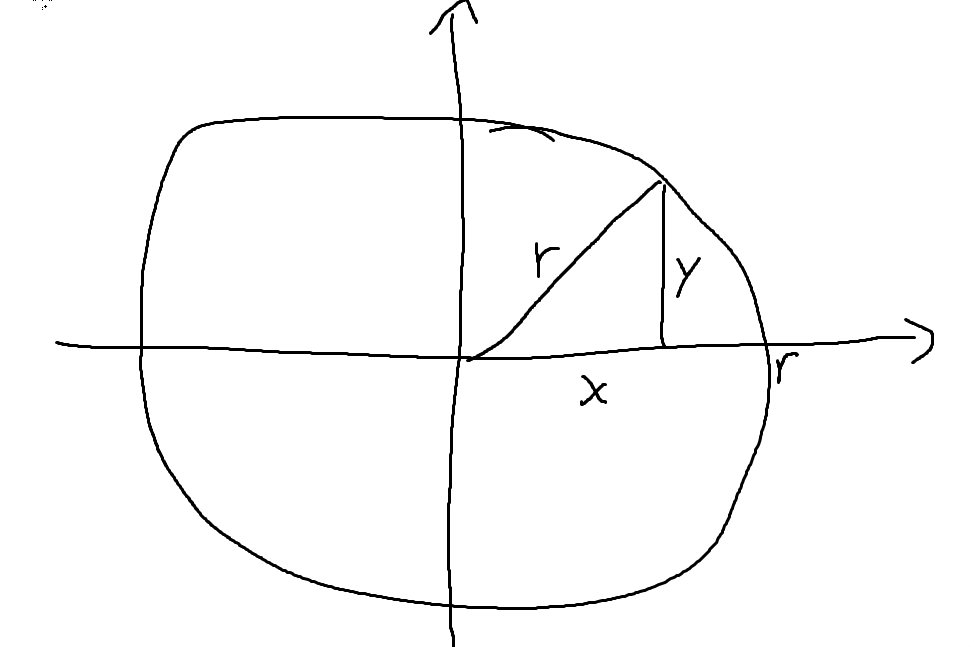
well in general the equation for a circle of radius r is x^2+y^2=r^2 and it comes from pythagoras
 compact hawk
ok, but so, doesn't it mean that a circle equation means also a number?
so, what concept do i have to attribute to that formula?
That formula represent a circle or a segment?
mortal trellis
the point (x,y) is on the circle if it satisfies x^2+y^2=r^2 which comes directly by considering the triangle I drew
compact hawk
or, do i have to specify also the Domain (if it's so called in english) of which number r can be?
I mean : 1 is the square or 1, but, for example, there is no number which square gives 2. this means that, now that the r is 2, the formula represent a circle
mortal trellis
sqrt(2) is such a number
r should be positive but that is a reasonable demand cause r is a length which should be positive
compact hawk
mortal trellis
sqrt(2) is such a number
but sqrt(2) is an infinite decimal number and that shouldn't be really a number. i mean : 1.41... is not a number until we consider a limit of decimal points
mortal trellis
sqrt(2) is a real number
compact hawk
for example : (1.41142135)^2 doesn't not give exactly the number 2
mortal trellis
so?
compact hawk
so, what sense does it do to consider a segment as sqrt(2)
let's see it :
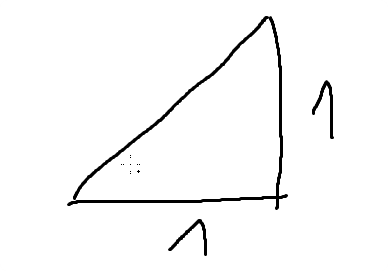
x^2 + y^2 = sqrt(2)
What does this equation represent?
mortal trellis
 compact hawk
let's see it :
x^2 + y^2 = sqrt(2)
What does this equation represent?
compact hawk
compact hawk
let's see it :
x^2 + y^2 = sqrt(2)
What does this equation represent?
a segment or a circle?
mortal trellis
what is the length of that third side
compact hawk
mortal trellis
what is the length of that third side
the sum of x and y squared both
mortal trellis
and then the sqrt of that
mortal trellis
which is?
compact hawk
r, the radius
mortal trellis
I mean the actual number
compact hawk
sqrt(2)
mortal trellis
ok. and do you now want to tell me that its nonsense to have this triangle
cause sqrt(2) is not a "proper" number in the sense that you want?
compact hawk
hmm, this makes sense but then i cannot 'render' that idea. i mean : how can i draw a segment which continues to the infinity of 0? (i mean the infinity decimal numbers)
the segment shouldn't have an 'end' point
while a segment of value of 2 has a start and an end point
mortal trellis
this also has a start and endpoint. the vertices of that triangle
compact hawk
(in this 'discussion' i don't want to consider approximations of decimal nunmbers)
compact hawk
mortal trellis
this also has a start and endpoint. the vertices of that triangle
ahahaha
as i said, i cannot render the idea of representing an irrational number on the cartesian plane
i mean, how can you draw a point which actual x (let's say y = 0) value has an infinite decimal numbers?
teal plaza
Bruh
compact hawk
i mean, once i drew a point on (1.4114, 0), then i can draw a more precise point on (1.411421, 0)
and so on
mortal trellis
well there is a whole field which concerns these so-called "constructible" numbers which can be constructed with just a compass and straightedge
teal plaza
We use approximtion
mortal trellis
which is more complicated and not all numbers can be done constructed like that
compact hawk
teal plaza
We use approximtion
i said that i don't want to consider approximations
mortal trellis
but that said, to draw (sqrt(2), 0), you draw a triangle like I did and then just take that length and rotate it to the x-axis
compact hawk
mortal trellis
which is more complicated and not all numbers can be done constructed like that
i surely have no idea on how these concepts works as i just know 4th high school math concepts but i wanna understand these
 worn fox
A circle of radius 1 has area π, does that also trouble you?
compact hawk
worn fox
A circle of radius 1 has area π, does that also trouble you?
yes
i just don't understand how can an infinite number represent a finite area
mortal trellis
1 is also an infinite number. 1.000000000
worn fox
It's not an infinite number, π is less than 4. It just has an infinite decimal representation
compact hawk
mortal trellis
1 is also an infinite number. 1.000000000
yes but no (i think), as 0s do not mean nothing
mortal trellis
are you fine with stuff like 1/3 = 0.3333...?
compact hawk
mortal trellis
are you fine with stuff like 1/3 = 0.3333...?
these are periodic number and are less complicate than irrational numbers
mortal trellis
still infinite
compact hawk
however, let's go back over the first question :
x^2 + y^2 = 2
What does that equation mean?
Does it represent a circle in the cartesian plane or a segment?
In case it represent both (as the segment is the radius of the circle), then what does this mean?
Does it mean that the radius is the circle?
 acoustic beacon
compact hawk
a segment or a circle?
acoustic beacon
compact hawk
a segment or a circle?
Circle?
compact hawk
why?
Why cannot it represent a segment because of Pitagora?
Pitagora says that the hypotenus (a segment) is equal to: x^2 + y^2 = i
acoustic beacon
Oh hypotenuse.
mortal trellis
segment is a different thing btw in english
compact hawk
mortal trellis
segment is a different thing btw in english
? what does it mean?
mortal trellis
well the equation is related to the triangle. sure
acoustic beacon
compact hawk
Pitagora says that the hypotenus (a segment) is equal to: x^2 + y^2 = i
Yeah it represents both. But the implicit equation for values of x and y represents a circle.
mortal trellis
but as a general equation it represents the circle
compact hawk
so, with parameters this equation represent a circle and by inserting the parameters values it represent a lenght?
mortal trellis
 acoustic beacon
Yes.
acoustic beacon
mortal trellis
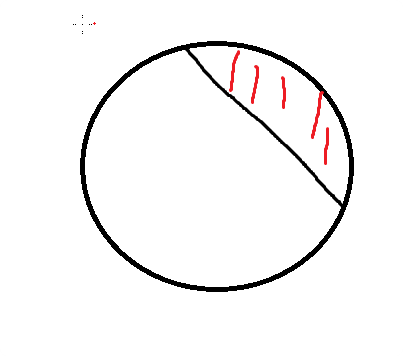
https://i.imgur.com/5Ui5T7l.png
They meant hypotenuse.
compact hawk
i still cannot idealize.
i mean, i am not acepting that fact
acoustic beacon
Imagine a triangle with a fixed hypotenuse and change the values of the other 2 sides and plot one of the vertices that's with the hypotenuse, you'll get a circle.
compact hawk
i don't understand what you wrote
acoustic beacon
compact hawk
i don't understand what you wrote

Now on changing those x and y values, you will see it makes a circle.
compact hawk
Wait, i think i have understood my main question :
The equation x^2 + y^2 = 2 represents both the circle on the Cartesian plane and the radius of that circle, as it represent a circle once i do not 'input' the parameters of the equation and it represents a radius lenght once i input these parameters.
Is that right?
compact hawk
acoustic beacon
Now on changing those x and y values, you will see it makes a circle.
i don't want to think in a graphic way but only with an analytic way, with formulas
mortal trellis
but at the same time you arent ok with "analytically drawing" something with length sqrt2
compact hawk
compact hawk
i don't want to think in a graphic way but only with an analytic way, with formu...
oh, that's also thinking in an analytic
acoustic beacon
compact hawk
Wait, i think i have understood my main question :
The equation x^2 + y^2 = 2 re...
I didn't understand what you meant here.
compact hawk
because you are changing x and y, while in the graph you are likely changing the B point along (?) the O point
compact hawk
acoustic beacon
I didn't understand what you meant here.
it's hard to explain what i am doubting about...
i mean :
x^2 + y^2 = 2
represents both a circle and a lenght of a segment (which is the radius of the circle)
acoustic beacon
compact hawk
i mean :
x^2 + y^2 = 2
represents both a circle and a lenght of a segment (whic...
2 is not the length, it's sqrt(2).
compact hawk
because the circle exists when i do not input the x and y parameters, and the lenght exists once i input these parameters.
Am i right?
compact hawk
so, i am defining the radius and the circle at the same time with the same formula?
this means that a circle is also a lenght?
acoustic beacon
Radius = length
General form of circle: x^2+y^2=r^2
Where r is the length of radius.
acoustic beacon
compact hawk
this means that a circle is also a lenght?
The radius of the circle is the length.
compact hawk
compact hawk
because the circle exists when i **do not** input the x and y parameters, and th...
so that's right.
acoustic beacon
compact hawk
so that's right.
No, the length always exists.
compact hawk
i define a lenght once a circle exists. This means that a lenght is correlated to a circle. means that if a lenghe exists, then a circle exists. means that the formula (pitagora and circle formula (which is defined trought pitagora)) represents both a circle and a lenght
compact hawk
So a lenght exists only if a circle exists and a circle exists only if a lenght exists or does the circle exists even if the lenght doesn't exists?
This should mean that the equation represents both a circle and a lenght as a circle cannot exists without a lenght and a lenght cannot exists without a circle. am i right?
acoustic beacon
compact hawk
but it's a point
The radius is zero in that case. I am talking about something undefined.
https://www.desmos.com/calculator/npckjkftdq Try this graph.

Desmos
compact hawk
0 means that the radius doesn't exists. has the 'undefined' word the same mean of 'unexiststance'?
compact hawk
acoustic beacon
https://www.desmos.com/calculator/npckjkftdq Try this graph.
what do i have to try?
acoustic beacon
compact hawk
0 means that the radius doesn't exists. has the 'undefined' word the same mean o...
Yes but I meant you can't make a circle without being given the knowledge of the length of the radius.
compact hawk
compact hawk
0 means that the radius doesn't exists. has the 'undefined' word the same mean o...
this means that the circle exists even if the lenght doesn't exists but this point is a specific concept of the definition of a circle
acoustic beacon
compact hawk
what do i have to try?
You can see how triangles are related to circles.
compact hawk
acoustic beacon
Yes but I meant you can't make a circle without being given the knowledge of the...
right. but as the radius is 0, then the radius doesn't exists. we are talking about the existence of a circle with and without the existence of a radius. we are not talking about 'defining' the circle
what a brain fk i am having
i think i lost the point of what we are talking about
acoustic beacon
compact hawk
right. but as the radius is 0, then the radius doesn't exists. we are talking ab...
A circle can't exist without a given radius. You need to know the radius to define ( make it come into existence) a circle.
compact hawk
acoustic beacon
A circle can't exist without a given radius. You need to know the radius to defi...
we are going into philosophy now
acoustic beacon
compact hawk
what a brain fk i am having
Happens. I suggest you familiarize yourself more with analytical geometry and trigonometry.
acoustic beacon
compact hawk
we are going into philosophy now
This is math, sir.
compact hawk
a radius of lenght 0 means that is defined but it doesn't exists
acoustic beacon
Language barrier is really fricking us over.
compact hawk
acoustic beacon
Happens. I suggest you familiarize yourself more with analytical geometry and tr...
that's my intent for this summer (not only these 2 subjects)
compact hawk
acoustic beacon
Language barrier is really fricking us over.
yes
acoustic beacon
compact hawk
a radius of lenght 0 means that is defined but it doesn't exists
Yeah but if you don't know the radius how will you even think of the circle?
I am not talking about radius = 0
By undefined radius I mean a radius that we don't know.
compact hawk
a circle of radius 0 is by definition a point.
But this allows us to say that a circle exists even if a radius doesn't exists. but this is likey a 'special' definition to explain that : 'Can a circle exists without the existence of a lenght (radius) and viceversa?'
compact hawk
acoustic beacon
By undefined radius I mean a radius that we don't know.
and what's the point of that?
acoustic beacon
compact hawk
a circle of radius 0 is by definition a point.
But this allows us to say that a ...
It satisfies x^2+y^2=r^2 so it does exist in technicality.
acoustic beacon
compact hawk
and what's the point of that?
You asked that can a circle be possible if we didn't know the length.
compact hawk
compact hawk
a circle of radius 0 is by definition a point.
But this allows us to say that a ...
i am asking that
acoustic beacon
Actually let's start over.
Ask your question in a precise manner.
I'll try to answer/
compact hawk
normally a circle exists if exists a lenght (radius). but if a radius exists, this means that a circle also exists.
This is not true in the special case in which the lenght of the radius is 0 which means that the radius exists (is defined) and so the circle exists but the radius graphically doesn't exists but so, in this case, a circle can exists even if the radius doesn't exist
compact hawk
acoustic beacon
Actually let's start over.
Ask your question in a precise manner.
yes, that's the best way but to discuss about it we had to discuss about the smallest doubt
acoustic beacon
compact hawk
normally a circle exists if exists a lenght (radius). but if a radius exists, th...
They both exist in technicality. But both can't be represented on a graph. The circle also doesn't exist in this case because if the radius doesn't exist then the circle doesn't exist and vice versa. They exist in technicality only. It's trivial to be concerned with this circle because it's only zero.
compact hawk
my question is :
**What does this equation mean?
x^2 + y^2 = r^2
By Pitagora it is the implicit way to express a value which represents the lenght of a segment (with a start point A and an endpoint B).
By the definition of a circle it represents a circle in the Cartesian plane. This definition (by the way) has been extracted from Pitagora.
So : Does this equation represent both a lenght of a segment and a circle or only one of them?
**
acoustic beacon
It represents both.
But to define a circle using the pythagoras theorem, you need to know the radius.
That's it.
compact hawk
that's then what i firstly tought at the start.
NOW, my question is : When do i have to consider that equation as a lenght and when as a circle?
I mean : if someone asks me : draw that equation on the Cartesian plane.
What do i draw?
A circle or a CASUAL lenght of a segment (which could be the radius)?
acoustic beacon
compact hawk
that's then what i firstly tought at the start.
**NOW**, my question is : When d...
Ah. You draw the circle because the radius would be given in the equation.
x^2+y^2=4
Here radius = 2
compact hawk
acoustic beacon
Ah. You draw the circle because the radius would be given in the equation.
x^2+y...
Ok, then i have not clear what 'inserting any value instead of x and y to get R' means.
For example, 4 + 9 = R.
What does this mean in the graph?
acoustic beacon
compact hawk
Ok, then i have not clear what 'inserting any value instead of x and y to get R'...
This means you know the x and y value of a point on the circle.
compact hawk
acoustic beacon
This means you know the x and y value of a point on the circle.
isn't it the lenght of the radius?
compact hawk
compact hawk
isn't it the lenght of the radius?
oh, this means that the radius has lenght from (0, 0) to (2, 3)? (as x^2 = 4 and y^2 = 9)
acoustic beacon
compact hawk
isn't it the lenght of the radius?
x and y represent the sides of a triangle and also a point, now you know pythagoras's formula so you can calculate for the length or radius, they are the same.
acoustic beacon
compact hawk
oh, this means that the radius has lenght from (0, 0) to (2, 3)? (as x^2 = 4 and...
Yeah.
compact hawk
my brain is now likely trying to not accept what we have discussed now.
I feels like it has nonsense but it has sense
acoustic beacon

You can see.
2 and 3 are lengths of sides.
Which can be represented by (2,3) on the circle.
acoustic beacon
compact hawk
Ok, then i have not clear what 'inserting any value instead of x and y to get R'...
Also it's not R it's R^2
compact hawk
so, let's resume up.
x^2 + y^2 = r^2
and
a^2 + b^2 = i^2
are not the same thing, as the first one represent an equation to represent the circle on the Cartesian plane, while the second one represent the lenght of the hypotenusa.
I mean that the first equation has 3 parameters that change and are not constant, while the second equation has 3 parameters that can be taken in input and represent a lenght and a and b are constant
compact hawk
acoustic beacon
Also it's not R it's R^2
yes
compact hawk
compact hawk
so, let's resume up.
x^2 + y^2 = r^2
and
a^2 + b^2 = i^2
are not the same thi...
cry me. i still do not understand what's the difference between Pitagora formula (a^2 + b^2 = i^2) and circle formula (x^2 + y^2 = r^2).
FINALLY. That's what i meant to ask
acoustic beacon
compact hawk
so, let's resume up.
x^2 + y^2 = r^2
and
a^2 + b^2 = i^2
are not the same thi...
Yeah, you're pretty much right. They're the same thing, they can be understood in different contexts.
compact hawk
acoustic beacon
Yeah, you're pretty much right. They're the same thing, they can be understood i...
OOOh, finally. that's what i mean and i wasn't able to express that out of my brain
 subtle birch
.
 tacit arch
.close
lone heartBOT
Channel closed
Closed by @tacit arch
Use .reopen if this was a mistake.
Available help channel!
Send your question here to claim the channel.
Remember:
• Ask your math question in a clear, concise manner.
• Show your work, and if possible, explain where you are stuck.
• After 15 minutes, feel free to ping <@&286206848099549185>.
• Type the command .close to free the channel when you're done.
• Be polite and have a nice day!
Read #❓how-to-get-help for further information on how to ask a good question, and about conduct in the question channels.
Channel closed
Closed due to the original message being deleted
Available help channel!
Send your question here to claim the channel.
Remember:
• Ask your math question in a clear, concise manner.
• Show your work, and if possible, explain where you are stuck.
• After 15 minutes, feel free to ping <@&286206848099549185>.
• Type the command .close to free the channel when you're done.
• Be polite and have a nice day!
Read #❓how-to-get-help for further information on how to ask a good question, and about conduct in the question channels.
 alpine sable
Hello. Problem is as follows.
Given n+1 boxes, with box i containing n-i+1 black balls and i-1 white balls. Aka box 1 has n black balls and 0 white balls; box 2 has n-1 black balls and 1 white balls, etc
So, given a random box, the probability to pick 3 white balls
lone heartBOT
alpine sable
Hello. Problem is as follows.
Given n+1 boxes, with box ``i`` containing ``n-i+...
alpine sable
@surreal crystal srry i was afk and bot closed channel
 surreal crystal
are you familiar with the large product notation?
alpine sable
i know this is
P(3 whites | box k) = P(box k) * P(box k | 3 whites)
P(box k) = 1/(n+1)
but idk what is P(box k | 3 whites)
i know for k = 1, 2, 3, it is 0
cuz there arent enough white balls
on box 1 u have n black and 0 white
on box 2 u have n-1 black and 1 white
on box 3 u have n-2 black 2 and whites
So on box 4, n-3 black and 3 whites
so the probability here is i dont know XD
but on box n+1 u have 0 blacks and n whites, so the prob is 1
surreal crystal
i believe you should be able to simply multiply the probabilities of each box
nevermind
compact hawk
is that a high school problem?
alpine sable
not rlly
surreal crystal
the total balls in each box is n
alpine sable
ye
compact hawk
cause i did probability but i understand quite nothing. or at least i should spend some time to understand what the problem means
alpine sable
what is that exactly? i know that nC3 means
surreal crystal
n choose 3
alpine sable
but in our problem, what does this represent exactly?
surreal crystal
the probability of choosing any three of any of the balls
surreal crystal
we arent done
we have to choose 3 white balls from them, which is i-1 whites
so the probability of choosing 3 white balls from a box is C(i-1,3)/C(n,3)
rose temple
compact hawk
my question is :
**What does this equation mean?
x^2 + y^2 = r^2
By Pitagora i...
its a very interesting case of pythogoras where the hypoteneous is the radius which remains the same but with increasing angle the perpendicular and base change ther values to satisfy it
alpine sable
rose temple
its a very interesting case of pythogoras where the hypoteneous is the radius wh...
??? this channel is already occupied. Previous topic no longer belongs here
alpine sable
surreal crystal
so the probability of choosing 3 white balls from a box is C(i-1,3)/C(n,3)
okey, thats the solution but i dont quite see it
is this Laplace thingie?
surreal crystal
now we sum i=1 to n+1, P(box i) * P(3 white balls from box i)
alpine sable
must be but i cant see at all
i see nC3 is all the possibles scenarios of picking 3 balls out of n
rose temple
alpine sable
??? this channel is already occupied. Previous topic no longer belongs here
ohh
alpine sable
but why the succeds are i-1C3?
alpine sable
aaaaaaaaaaaaaaaaaaaaaaaaaa
we are only interested on picking white balls
and doesnt matter the order or something
just picking 3 of them
aaaaaaaaaa
surreal crystal
surreal crystal
now we sum i=1 to n+1, P(box i) * P(3 white balls from box i)
P(box i) = 1/(n+1), P(3 white balls from box i)= (C(i-1, 3) / C(n, 3))
this should give you the answer you want
alpine sable
yeah well
last step would be
1/(n+1) * sum from k=4 to n+1 (k-1)C3 / nC3
to sum this thing XD
which im not sure how to
surreal crystal
k-3?
alpine sable
1 srry
surreal crystal
yeah
surreal crystal
$nCr = \frac{n!}{r!(n-r)!}$
ocean sealBOT
Cycadellic
 surreal crystal
use this to simplify
then, since n is not specified, i doubt the summation must be simplified
alpine sable
well
surreal crystal
but if you necessarily have to, i think you can use the binomial theorem to get a polynomial of n
alpine sable
the answer is 1/4
so idk XD
but idk how is the sum done

P(Ck) is the box
and P(B3) is 3 whites


this is what u said
so far so good

i gtg rlly quick, but ill read u after. Thanks very much for u help tho ^^
alpine sable
yeah, but idk how to xD
ocean sealBOT
Cycadellic
 surreal crystal
write out the summation, im sure the pattern will jump out
binomial theorem

this one
with finite bound
set a=1, b=1
$2^n = \sum_{k=0}^{n} nCr(n,k)$ follows
ocean sealBOT
Cycadellic
 lone heartBOT
@alpine sable Has your question been resolved?
lone heartBOT
Channel closed
Closed due to timeout
Use .reopen if this was a mistake.
lone heartBOT
Available help channel!
Send your question here to claim the channel.
Remember:
• Ask your math question in a clear, concise manner.
• Show your work, and if possible, explain where you are stuck.
• After 15 minutes, feel free to ping <@&286206848099549185>.
• Type the command .close to free the channel when you're done.
• Be polite and have a nice day!
Read #❓how-to-get-help for further information on how to ask a good question, and about conduct in the question channels.
 shrewd ruin
I need help with Matrix questions
lone heartBOT
shrewd ruin
I need help with Matrix questions
tacit arch
shrewd ruin
I need help with Matrix questions

 alpine sable
ok looks just like subtraction
so each element is P gets subtracted by each corresponding element in R
I think
trim sorrel
I dont think thats it
trim sorrel
P is a separate matrix from (4 6 3 -2)
shrewd ruin
that projects vectors onto 2;3
trim sorrel
Its being multiplied
shrewd ruin
right right
shrewd ruin
ok
 trim sorrel
All generic matrices
trim sorrel
trim sorrel
If AB = C where A B and C are all matrices this holds
How can you use that to help
shrewd ruin
i mean
i think
i know how to do
matrix multiplications
it's just
I don't know how to get P and R
shrewd ruin
huh
trim sorrel
Try to do it without finding P and R explicitly
shrewd ruin
how will i do that
trim sorrel
Just knowing what P and R do is enough
trim sorrel
trim sorrel
Using this
We know that Px = y where y is the projection of x onto (2 3)
shrewd ruin
right
trim sorrel
trim sorrel
Now use this
trim sorrel
Wdym
trim sorrel
We want to find $$P \begin{pmatrix} 4 & 3 \ 6 & -2\end{pmatrix}$$
shrewd ruin
should we set it as like
trim sorrel
Don't set it as anything
shrewd ruin
oh ok
ocean sealBOT
wakebloom
 trim sorrel
ocean seal
**wakebloom**
trim sorrel
ocean seal
**wakebloom**
Let this product be the matrix Q
trim sorrel
trim sorrel
Find each column of the matrix Q using this
trim sorrel
trim sorrel
We know that Px = y where y is the projection of x onto (2 3)
And this
trim sorrel
trim sorrel
Each column of a matrix is a vector
^
trim sorrel
Yea
shrewd ruin
and y is the projection of x to 2,3
trim sorrel
trim sorrel
With this
shrewd ruin
matrix A multiplied by column of B
right?
wais so here
the matrix is A
wait no is that right?
is P same as A here?
trim sorrel
shrewd ruin
matrix A multiplied by column of B
Yes but whats A and B
shrewd ruin
right
trim sorrel
And AB = C
shrewd ruin
so the matrix would be B
shrewd ruin
right
trim sorrel
So the first column of Q is what?
shrewd ruin
P(4, 6)?
trim sorrel
Yesssssss
You got it
Now just apply that logic to each column
And then do the same for R
shrewd ruin
ok
trim sorrel
Then you subtract and youre done
shrewd ruin
shrewd ruin
(4,6) onto (2,3)
is that just 4, 6?
trim sorrel
Ya
shrewd ruin
and the second is 0, 0?
trim sorrel
I believe so cause its orthogonal
shrewd ruin
ok
lemme try
i don't really know how to do that
does that mean
we reflect (1, 4) across a line with direction (1,4)
trim sorrel
Yea
shrewd ruin
and we reflect (0, 0) across a line with direction (1,4)
trim sorrel
Yea
shrewd ruin
i don't know how to do that
trim sorrel
Where r u getting that from?
trim sorrel
Yup
shrewd ruin
so wouldn't that just equal itself?
trim sorrel
What about 0, 0
trim sorrel
Yup
shrewd ruin
oh
trim sorrel
Subtract the resulting matrices
Cause youve found P(4 6 3 -2) and R(1 4 0 0)
So yea
shrewd ruin
ok
trim sorrel
Was it right
shrewd ruin
yep
it is
i have 2 more
question
is that ok to ask?

they are similar i think but then different
trim sorrel
Sure
trim sorrel
How would you approach this using the same method
trim sorrel
Remember, matrix multiplication is associative
trim sorrel
Yup
shrewd ruin
then A?
shrewd ruin
ok
shrewd ruin
right
how do i work out A
cus B is like the same as the last problem
A says rotate clockwise by a right angle
trim sorrel
I think you can visualize it and find it intuitively
shrewd ruin
let's say we get (a, b, c, d) after we do B(-4, 1, 1, 4)
trim sorrel
Rotation by right angle is not hard
trim sorrel
Right
shrewd ruin
and (b, d) by 90 degrees right?
trim sorrel
I think thats correct yeah


 trim sorrel

trim sorrel
Dilate means scale
shrewd ruin
and how an inverse of that works
shrewd ruin
divide by 3?
trim sorrel
Right
Basically the same thing but in matrix form
In fact you can find what D is very trivially
And D^-1
trim sorrel
Wdym
shrewd ruin
i did like the first part
trim sorrel
shrewd ruin
E(matrix)
Like you got the resulting matrix from this?