#help-0
1 messages · Page 222 of 1
 alpine sable
 grim pelican
ooos
i wasnt paying attention
so
do we have to shade the most in?
wait i meed to go
ika be bakc tho
.quit
uh
.close
 lone heartBOT
Channel closed
Closed by @grim pelican
Use .reopen if this was a mistake.
 Available help channel!
Send your question here to claim the channel.
Remember:
• Ask your math question in a clear, concise manner.
• Show your work, and if possible, explain where you are stuck.
• After 15 minutes, feel free to ping <@&286206848099549185>.
• Type the command .close to free the channel when you're done.
• Be polite and have a nice day!
Read #❓how-to-get-help for further information on how to ask a good question, and about conduct in the question channels.
 oblique stirrup
how does the amount of moles for Cr increase to 2?

 wild trail
chemistry question 
wild trail
oblique stirrup
how does the amount of moles for Cr increase to 2?
probably cause of balancing
lhs has 2 Cr in the form of $Cr_2 O_7^{2-}$
 ocean sealBOT
numbpy (anti glomed)

 lament forge
yeah you start with Cr_2, which contains 2 of Cr, so you have to still have 2 of Cr at the end, because reactions don't destroy atoms
oblique stirrup
ok ill try again real quikc
lament forge
and since the thing we're getting out is Cr^3+ which only contains 1, we therefore have two of it, so that there's 2 of Cr
oblique stirrup


idk this is what i did just to get the bare half reaction from the previous lesson
- balance oxygen and hydrogen by adding H20
- add H^+ castions to whatever side has too few hydrogen atoms
- Add electrons to balance charge
when should I balance the equation @lament forge @wild trail
 queen river
Why
Why don't you first compare the oxidation number then add correct mole of electrons
oblique stirrup
queen river
Why don't you first compare the oxidation number then add correct mole of electr...
oxidation number where?
lone heartBOT
@oblique stirrup Has your question been resolved?
lone heartBOT
Channel closed
Closed due to timeout
Use .reopen if this was a mistake.
Available help channel!
Send your question here to claim the channel.
Remember:
• Ask your math question in a clear, concise manner.
• Show your work, and if possible, explain where you are stuck.
• After 15 minutes, feel free to ping <@&286206848099549185>.
• Type the command .close to free the channel when you're done.
• Be polite and have a nice day!
Read #❓how-to-get-help for further information on how to ask a good question, and about conduct in the question channels.
 restive dock
yo
lone heartBOT
restive dock
yo
restive dock

I dont understand this qustion
I got a completely different answer
than the one in the solution sheet
This is what they said

I did the length = theater times radius
i converted the 71 to radians
and times it by 1.6
 coarse peak
restive dock
coarse peak
restive dock
There's no way this is right, they must have mixed this up with another question
Your method is correct
lone heartBOT
@restive dock Has your question been resolved?
lone heartBOT
Channel closed
Closed by @restive dock
Use .reopen if this was a mistake.
lone heartBOT
Available help channel!
Send your question here to claim the channel.
Remember:
• Ask your math question in a clear, concise manner.
• Show your work, and if possible, explain where you are stuck.
• After 15 minutes, feel free to ping <@&286206848099549185>.
• Type the command .close to free the channel when you're done.
• Be polite and have a nice day!
Read #❓how-to-get-help for further information on how to ask a good question, and about conduct in the question channels.
 stuck herald
 lone heartBOT
stuck herald
stuck herald
lone heartBOT
stuck herald
stuck herald
I need help with 4B
let me know if you can't read my shitty handwriting
I'm pretty sure 4A is correct, but please check it too
I have no idea how to even do 4B my answer is a total guess
lone heartBOT
@stuck herald Has your question been resolved?
stuck herald
<@&286206848099549185>
lone heartBOT
@stuck herald Has your question been resolved?
stuck herald
helpppp
lone heartBOT
@stuck herald Has your question been resolved?
 lavish dagger
.reopen
 upbeat hornet
stuck herald
I have no idea how to even do 4B my answer is a total guess
upbeat hornet
stuck herald
I have no idea how to even do 4B my answer is a total guess
you can rescale the distribution and then look up in tables if you have them
lone heartBOT
Channel closed
Closed due to timeout
Use .reopen if this was a mistake.
Available help channel!
Send your question here to claim the channel.
Remember:
• Ask your math question in a clear, concise manner.
• Show your work, and if possible, explain where you are stuck.
• After 15 minutes, feel free to ping <@&286206848099549185>.
• Type the command .close to free the channel when you're done.
• Be polite and have a nice day!
Read #❓how-to-get-help for further information on how to ask a good question, and about conduct in the question channels.
 somber skiff
Hello, can anyone help? (this is a rough translation of the problem)
With the numbers 0,1,2,3,4,5,6,7
how many 4-digits numbers can be formed?
(numbers starting with 0 does not count)
Did I do anything wrong?
my workings:
 lone heartBOT
somber skiff
Hello, can anyone help? (this is a rough translation of the problem)
With the n...
lone heartBOT
somber skiff
Hello, can anyone help? (this is a rough translation of the problem)
With the n...
 vale wigeon
those =>'s should be just =
also a rough translation isn't good enough
show the problem in its original language
 barren shuttle
why did you subtract 7^2
barren shuttle
and does 0 count or not
somber skiff
barren shuttle
why did you subtract 7^2
because i thought the permutations would include 49 numbers that starts with 0
somber skiff
barren shuttle
and does 0 count or not
yes but numbers starting with zeros doesn't
vale wigeon
show the problem in its original language
somber skiff
is there anything wrong with my logic?
vale wigeon
what's wrong is that we don't know the problem statement
as is, the problem sounds like:
"How many 4-digit numbers can be formed from the digits 0 through 7, with the first digit not equal to 0?"
and the answer to that is 7 * 8 * 8 * 8 by counting the number of options per place
vale wigeon
somber skiff
because i thought the permutations would include 49 numbers that starts with 0
how did you get that the count of numbers that do start with 0 is 49?
somber skiff
vale wigeon
as is, the problem sounds like:
"How many 4-digit numbers can be formed from th...
yes this is what i mean, sorry
somber skiff
vale wigeon
and the answer to that is 7 * 8 * 8 * 8 by counting the number of options per pl...
sorry i dont get what you mean by options per place, also why is it 7 * 8 * 8 * 8
lone heartBOT
Channel closed
Closed by @somber skiff
Use .reopen if this was a mistake.
Available help channel!
Send your question here to claim the channel.
Remember:
• Ask your math question in a clear, concise manner.
• Show your work, and if possible, explain where you are stuck.
• After 15 minutes, feel free to ping <@&286206848099549185>.
• Type the command .close to free the channel when you're done.
• Be polite and have a nice day!
Read #❓how-to-get-help for further information on how to ask a good question, and about conduct in the question channels.
 steel cape
can someone tell me how 51+65+ angle x is equal to 180?

 vague coral
a straight line has an angle of 180
lone heartBOT
Channel closed
Closed by @steel cape
Use .reopen if this was a mistake.
Available help channel!
Send your question here to claim the channel.
Remember:
• Ask your math question in a clear, concise manner.
• Show your work, and if possible, explain where you are stuck.
• After 15 minutes, feel free to ping <@&286206848099549185>.
• Type the command .close to free the channel when you're done.
• Be polite and have a nice day!
Read #❓how-to-get-help for further information on how to ask a good question, and about conduct in the question channels.
 summer stratus
 lone heartBOT
summer stratus
summer stratus
lone heartBOT
summer stratus
summer stratus

do i make the last line=0?
25x³+59x²-149x-759=0
ik it's long division after but idk what to divide the equation by
 echo socket
I would take a different approach to (x + 7)/(x + 1)^(3/2) = 5/4
Note that (x + 7)/(x + 1)^(3/2) has to be a rational number (since it is equal to 5/4)
Meaning (x + 1) has to be a square of some rational number
Otherwise the root is irrational
So you can say x = k^2 - 1 for some rational number k
And solve for k
The equation then turns into (k^2 + 6)/k^3 = 5/4
Or 5k^3 - 4k^2 - 24 = 0
If you apply the rational root theorem, the rest is really easy
summer stratus
what if i continue it my way
echo socket
Then rational root theorem I guess
summer stratus
i was told i can use long division but idk to divide by what
echo socket
But you will have unnecessary work done that way
echo socket
summer stratus
i was told i can use long division but idk to divide by what
Yeah you can't use long division unless you know a root or some of the roots
echo socket
echo socket
Then rational root theorem I guess
So just use this
But I wouldn't recommend continuing that way
summer stratus
echo socket
Note that (x + 7)/(x + 1)^(3/2) has to be a rational number (since it is equal t...
i dont rly understand this tho
echo socket
Which bit?
summer stratus
echo socket
So you can say x = k^2 - 1 for some rational number k
.
what does k represent
echo socket
Just a rational number
If it was irrational then the entire expression would be irrational
Or you could think of that as a substitution
summer stratus
summer stratus
can u teach me continuing this?so i wont be confused
echo socket
According to the rational root theorem, the rational roots of 25x^3 + 59x^2 - 149x - 759 = 0 (if there are any) will be the divisors of 759 (negatives one included)
The prime factorisation of 759 is 3 * 11 * 23
summer stratus
so what would i be doing next💀💀💀😭
echo socket
So you first check if ±1 is a root
Then ±3, ±11, ±23
If none of those happen to be roots
Then ±33, ±253, ±69, ±759
But you will see that x = 3 is a solution
And you can stop there
summer stratus
wait how do u get ±33 and so on
echo socket
Those are just 3 * 11, 11 * 23 and 3 * 23
summer stratus
oh😭
summer stratus
summer stratus
so this cant be done with long division?
echo socket
Well after dividing by (x - 3) you will see that other solutions don't work though
echo socket
Generally if the polynomial equation P(x) = 0 has a solution a, then P(x) is divisible by (x - a)
This helps a lot while dealing with cubics
Because if you happen to know one of the solutions
Then you can turn the equation into a quadratic one
lone heartBOT
@summer stratus Has your question been resolved?
lone heartBOT
Channel closed
Closed due to timeout
Use .reopen if this was a mistake.
Available help channel!
Send your question here to claim the channel.
Remember:
• Ask your math question in a clear, concise manner.
• Show your work, and if possible, explain where you are stuck.
• After 15 minutes, feel free to ping <@&286206848099549185>.
• Type the command .close to free the channel when you're done.
• Be polite and have a nice day!
Read #❓how-to-get-help for further information on how to ask a good question, and about conduct in the question channels.
 high quail
a) Find the radius of the circle
b) Find the Angle of ABC
c) Find the area of the shaded area
 lone heartBOT
high quail
a) Find the radius of the circle
b) Find the Angle of ABC
c) Find the area of th...
lone heartBOT
high quail
a) Find the radius of the circle
b) Find the Angle of ABC
c) Find the area of th...
 gray isle
is AC supposed to be a tangent to the circle
 heady void
I don;t think so
high quail
im not sure
thats a question from my test
and the instrunctions are just a-c
but the drawing, I drew it from memory
gray isle
do you have the original image
high quail
No, I dont have the Original image
gray isle
for the question to make sense,
AC should be a tangent
high quail
then it probably is
gray isle
what did you try
high quail
guessing method
(12+?)2 - 182 = radius
so i changed the "?" until it matches with the radius
gray isle
there shouldn't be any guessing involved
high quail
and I got:
(12+8)2 - 182 = 8.07 square
high quail
gray isle
there shouldn't be any guessing involved
yea thats the point
gray isle
where's 182 coming from
high quail
the 2 is the square
gray isle
use ^ to denot exponentiation
gray isle
where's 12+8 coming from
gray isle
introduce a variable to represent the radius
high quail
i started from 12+5 until 12+8
high quail
gray isle
introduce a variable to represent the radius
(12+r)^2 - 18^2 = r^2
gray isle
yes, then expand/simplify/solve that equation
high quail
so I used different numbers of r until both radius matched
gray isle
are you able to expand (12+r)^2
high quail
I dont know how to
high quail
how do you expand the equation where there is ^2?
or do you have a video that can help me?
the videos I find follow the format (x+y) (x+y)
its completely different from (12+r)^2 - 18^2 = r^2
@gray isle
 subtle birch
high quail
its completely different from (12+r)^2 - 18^2 = r^2
subtle birch
high quail
its completely different from (12+r)^2 - 18^2 = r^2
just expand (12+r)^2 using (a+b)^2=a^2+2ab+b^2
and try to solve for r
high quail
where did a+b come from?
subtle birch
(12+r)^2 is in the form (a+b)^2
gray isle
the videos I find follow the format (x+y) (x+y)
use that to expand the (12+r)^2 component
just because there are other things present doesn't make that inapplicable
gray isle
(12+r)^2 = (12+r)(12+r)
yes
high quail
gray isle
specifically where 114 coming from
12x12
gray isle
isn't 114
 teal bronze
144*
gray isle
(12+r)^2 = 12^2+24r+r^2
yes
high quail
so what next?
gray isle
you'll now have
12^2+24r+r^2 - 18^2 = r^2
the simplify that equation and solve for r
high quail
is 15/2 correct?
gray isle
yes
high quail
so the radius is 7.5?
gray isle
yes
lone heartBOT
Channel closed
Closed by @high quail
Use .reopen if this was a mistake.
Available help channel!
Send your question here to claim the channel.
Remember:
• Ask your math question in a clear, concise manner.
• Show your work, and if possible, explain where you are stuck.
• After 15 minutes, feel free to ping <@&286206848099549185>.
• Type the command .close to free the channel when you're done.
• Be polite and have a nice day!
Read #❓how-to-get-help for further information on how to ask a good question, and about conduct in the question channels.
 balmy schooner
could someone help me out whether I have done the question right?
sorry for the mess, third time I rewrote it ...
I've got a feeling that I am not doing the proof tree correctly, especially when making assumptions
oh and just realised that I forgot to do the boxes for assumptions. So assumption (1) would end at (6), assumption (2) would end at (5), and assumption (5) would end at ... (7) ?
lone heartBOT
Channel closed
Closed due to the original message being deleted
balmy schooner

Definitely the biggest emphasis would need to be put on the proof tree. The way prof does it is so damn weird and I am learning from the book, but the book doesn't actually present a way to make proof trees, only sequent proof tree (on the left I think that was the name)
(... and the prof just ignored my email in regards to my query)
lone heartBOT
Available help channel!
Send your question here to claim the channel.
Remember:
• Ask your math question in a clear, concise manner.
• Show your work, and if possible, explain where you are stuck.
• After 15 minutes, feel free to ping <@&286206848099549185>.
• Type the command .close to free the channel when you're done.
• Be polite and have a nice day!
Read #❓how-to-get-help for further information on how to ask a good question, and about conduct in the question channels.
 remote iron
I've got another question for proof by induction. am stuck : _ )
remote iron

I've done the base case.
and p(n) => n! > n^2
p(n+1) => (n+1)! > (n+1)^2
(n+1)! = n! * (n+1)
n! * (n+1) > (n+1)^2
not sure where to go from here.
alpine sable
Okay so if you divided both sides of that with n+1 what do you get
remote iron
n! > (n+1)
alpine sable
Okay and what did we also say about n! In our basis step
remote iron
inductive hypothesis states n! > n^2
I see where you are going. I thought of this too, but is it that simple? I thought it would be more complex considering it's a 4 mark q
@alpine sable
ah. I think they disappeared.
anyways, if I continue.
we know ('assuming') n! > n^2.
in our working we have n! > n+1
we know n^2 > n + 1
n! > n^2 > n+1
hence, proven?
 rigid smelt
firstly, yes, if you chose to start with (K+1)!>(k+1)^2 and then work your way down to some kind of identity by using your assumption that k!>k^2 for any k>=4 then your proof is considered incorrect, as the statement k!>k^2 for any k>=4 is just an assumption
and secondly, your train of thoughts above are going in the correct direction
however, you just stopped a few steps short from proving the whole identity itself
lone heartBOT
@remote iron Has your question been resolved?
remote iron
rigid smelt
firstly, yes, if you chose to start with (K+1)!>(k+1)^2 and then work your way d...
but in induction, aren't we meant to use the assumption?
similar to gauss induction proof, where we do 1 + 2 + 3 ... k + (k+1) => gauss_formula_assumptoin + (k+1)
remote iron
rigid smelt
however, you just stopped a few steps short from proving the whole identity itse...
could you guide me please?
rigid smelt
yes we indeed use the assumption to prove the statement P(k+1), but not the other way around
remote iron
other way around?
rigid smelt
for example, let's take the gauss induction proof you mentioned above. We start with assuming 1+2+3+...+k=k(k+1)/2.
Afterwards, we use the assumption above along with algebra (adding k+1 to both sides of the equation) to prove that 1+2+...+ (k+1) = (k+1)(k+2)/2
However, one could also have gone this way, by first using [1+2+3+...+k] + (k+1) = (k+1)(k+2)/2
Since 1+2+3+...+k = k(k+1)/2 (original assumption)
Which implies k(k+1)/2 + k+1 = (k+1)(k+2)/2
And the equation above is true for all k, hence [1+2+3+...+k] + (k+1) = (k+1)(k+2)/2 is true for all k
As you can see, the second proof didn't make much logic
how do we know that [1+2+3+...+k] + (k+1) = (k+1)(k+2)/2 this is true to begin with in the first place, unless we are assuming it is?
rigid smelt
remote iron
could you guide me please?
Your work should be in some form of:
Check P(4) is true.
Assume P(k) is true (for some k>=4)
k!>k^2
...use algebra manipulation...
(k+1)!>(k+1)^2
Conclusion
remote iron
don't we put our assumption of p(n) being correct into 1 + 2 .... k. [for gauss]
so I am confusing what exactly we have to prove?
if we have a statement p(n)
rigid smelt
remote iron
don't we put our assumption of p(n) being correct into 1 + 2 .... k. [for gauss...
Yes, that's what the first proof did, it used that assumption to get to 1+2+...+(k+1)=(k+1)(k+2)/2
and the way it got to that is through algebra manipulation
The second proof on other hand, just out of nowhere got the equation 1+2+3+....+(k+1)=(k+1)(k+2)/2 and then algebraically manipulated it to prove that the equation is always true
remote iron
rigid smelt
Your work should be in some form of:
Check P(4) is true.
Assume P(k) is true (fo...
then why start with k! > k^2 here.
rigid smelt
again, just like how I explained with the gauss induction proof, we dont know that (k+1)!>(k+1)^2 is true or not, we only assumed that k!>k^2
rigid smelt
you know that 4!>4^2, however you dont know 5!>5^2
remote iron
so we want to use our assumption
and algebraic manipulation
to get to p(n+1) is that correct?
rigid smelt
yes
remote iron
Is this always the case with induction?
rigid smelt
kind of, this is one way to get to proving P(n+1)
but there are other ways too, one that i have on mind is proving n!<n^n
remote iron
because I swear, my lecturer at time starts with p(n+1)
rigid smelt
for that one, you would use the expression (n+1)! and then prove that this expression is larger than (n+1)^(+1)
(n+1)! = (n+1) * n!
< (n+1) * n^n
< (n+1) * (n+1)^n
< (n+1) * (n+1)^(n+1)
this is the algebra manipulation that you would go through to prove P(n+1) for this problem
remote iron
for n!<n^n ?
rigid smelt
yes
remote iron
one sec let me have a proper read.
rigid smelt
as you can see, we never started with (n+1)! < (n+1)^(n+1), but we got to it through using the assumption and some algebra
remote iron
I am confused, what did you do here to get this
< (n+1) * n^n
rigid smelt
by using the assumption that n!<n^n
because n!<n^n, (n+1) * n!<(n+1)*n^n
of course, you can also have started with n!<n^n, multiplied both sides by (n+1) and will have the same thing
remote iron
my brain isn't algebraing. let me write this on pen and paper one second.
wait is this right
n^n * (n+1) < (n+1) * n!
remote iron
rigid smelt
because n!<n^n, (n+1) * n!<(n+1)*n^n
oh that's what u wrote here
yup.
how do you do that in your head so fast
rigid smelt
uh no, just a proof that i remember
remote iron
okay one sec i still need to understand it completely
rigid smelt
but i also have missed out on the fact that you can do a pretty similar thing here with your problem
remote iron
rigid smelt
of course, you can also have started with n!<n^n, multiplied both sides by (n+1)...
oh that's what i did just now. makes sense. for this problem.
rigid smelt
you could try proving (k+1)! > (k+1)^2 by starting with (k+1)! and using the assumption k!>k^2 here
its quite similar to the algebraic manipulation above
remote iron
how did u go from
< (n+1) * n^n
to
< (n+1) * (n+1)^n
remote iron
rigid smelt
you could try proving (k+1)! > (k+1)^2 by starting with (k+1)! and using the ass...
yup il attempt that as soon as I understand this one u showed me.
rigid smelt
n+1>n, hence (n+1)^n > n^n, and hence (n+1)*n^n < (n+1)*(n+1)^n
rigid smelt
1>0
rigid smelt
add n to both sides
well i guess one of the thought process would be "I have (n+1)*n^n but i want (n+1)^(n+1), so I need the base to be n+1..."
remote iron
rigid smelt
n+1>n, hence (n+1)^n > n^n, and hence `(n+1)*n^n < (n+1)*(n+1)^n`
that algebra is going over my head.
remote iron
rigid smelt
well i guess one of the thought process would be "I have (n+1)*n^n but i want (n...
we want (n+1)^(n+1), to come to p(n+1) correct?
rigid smelt
yes
remote iron
christ that's confusing.
let me try apply it to my question
please guide me in the right direction if I do something wrong
so our problem is similar to your proof u showed
we can start with (n+1)!
(n+1)! = n! * (n+1)
rigid smelt
(just to remind you we have assumed that n!>n^2 here)
remote iron
yes. we are assuming n! > n^2
(n+1)! = n! * (n+1)
lets try use our assumption
give me a sec to think
in your proof u had
(n+1) * n!
and assumption n!<n^n
so u did
(n+1) * n! < n^n * (n+1)
u multiplied by the extra n+1
in our proof we can
n! * (n+1) > n^2 * (n+1)
correct?
rigid smelt
yes very good
remote iron
sorry that took eons
rigid smelt
take your time
remote iron
n! * (n+1) > n^2 * (n+1)
now we can divide by n+1 on both sides
n! > n^2
is that all?
rigid smelt
eh dont do that
remote iron
oh hm.
rigid smelt
you know that n!*(n+1)>n^2*(n+1) and you have (n+1)! = (n+1)*n!
so basically (n+1)!>n^2 * (n+1)
(the goal now is to make the right side turn into (n+1)^2)
rigid smelt
yes
remote iron
nonw lets try this
n^2 * (n+1)
n^3 + n^2
wait don't tell me
give me a sec im thinking
rigid smelt
rigid smelt
well i guess one of the thought process would be "I have (n+1)*n^n but i want (n...
try thinking something similar to this
rigid smelt
well is it true that n^2>n+1?
remote iron
Yes.
rigid smelt
not really
n^2-n-1>0 is not true for all integer n, however it is true for n>=4
but that is a good thing, since in our problem we only need to prove the identity for n>=4
anyway, we know that n^2>n+1, and so we know that n^2(n+1)>(n+1)(n+1)
and if a>b, b>c, that would imply a>c. This means (n+1)! > (n+1)^2
remote iron
I gotta think again. one sec.
rigid smelt
sure
remote iron
(n+1)!>n^2 * (n+1)
we had this.
we want to make n^2 * (n+1) into (n+1)^2
woahhh wtf it just struck me what u did
that's so clever
u said that we know n^2 > n + 1 for when n >=4
and then u made the statement n^2 > n + 1
into n^2(n+1)>(n+1)(n+1) by multiplying both sides by (n+1)
which gives u n^2(n+1)>(n+1)^2
rigid smelt
yes, that's the main idea
remote iron
one sec
and we know (n+1)!>n^2 * (n+1)
and we know that n^2(n+1)>(n+1)(n+1)
and since (n+1)! is bigger than n^2 * (n+1)
and n^2(n+1) is bigger than (n+1)(n+1)
we can write (n+1)!> (n+1)^2
correct?
that is super clever.
rigid smelt
yes that is correct
remote iron
WOW
I am genuinely massively impressed.
Thank you so much
so let me tell you what I understood from this chat
we have to derive p(n+1) using our assumption, rather than stating p(n+1) and then using pointless algebra on it with our assumption
its sorta like doing x + 1 - 1, which is pointless.
man these induction questions will kill me one day
rigid smelt
yes, basically the point is that we know the P(initial value) is true, and we assumed P(n) is true, so now by using P(n) to prove P(n+1) is true, all we are saying is P(n) => P(n+1)
so just say we know P(0) is true, then P(1) must be true, since P(n) => P(n+1), and then P(1) is true, so must be P(2) and so on
remote iron
ah so proving 'p(n+1) is true using p(n)'
so we know that if p(n) is true, p(n+1) is true, and so on
rigid smelt
yes, this is why it is really important to not start with P(n+1) to prove itself
remote iron
understood
remote iron
no?
I thought we know p(n) is true
we don't know p(n+1) is true. we are trying to prove that, no?
rigid smelt
yes
remote iron
ah u were trying to trick me. sneaky
rigid smelt
oh i just realised i typo'ed
rigid smelt
oh
rigid smelt
ok anyway, i suppose you have no further question
rigid smelt
np
lone heartBOT
@remote iron Has your question been resolved?
Channel closed
Closed by @remote iron
Use .reopen if this was a mistake.
Available help channel!
Send your question here to claim the channel.
Remember:
• Ask your math question in a clear, concise manner.
• Show your work, and if possible, explain where you are stuck.
• After 15 minutes, feel free to ping <@&286206848099549185>.
• Type the command .close to free the channel when you're done.
• Be polite and have a nice day!
Read #❓how-to-get-help for further information on how to ask a good question, and about conduct in the question channels.
 sick gulch
how do I find the Cauchy product of $\left( \sum_{r=0}^n \binom n r (-t^m)^r \right)\left(\sum_{r=0}^\infty \binom {n+r} {n} t^r \right)$
lone heartBOT
sick gulch
how do I find the Cauchy product of $\left( \sum_{r=0}^n \binom n r (-t^m)^r \ri...
ocean sealBOT
bostock
 sick gulch
since one is an infinite power series and the other is a finite expansion
context: I need to get the cdf of a random variable $S_n$, the sum of n observations of a discrete uniform random variable $X \sim U[1,m]$
ocean sealBOT
bostock
 sick gulch
This is from generatingfunctionology so I use a pgf approach, finding that $G_{S_n}(t) = \frac {t^n} {m^n} (1-t^m)^n (1-t)^{-n-1} = \frac {t^n} {m^n} \left( \sum_{r=0}^n \binom n r (-t^m)^r \right) \left(\sum_{r=0}^\infty \binom {n+r} {n} t^r \right)$ by applying the binomial and general binomial expansions
ocean sealBOT
bostock
 lone heartBOT
@sick gulch Has your question been resolved?
sick gulch
.close
lone heartBOT
Channel closed
Closed by @sick gulch
Use .reopen if this was a mistake.
Available help channel!
Send your question here to claim the channel.
Remember:
• Ask your math question in a clear, concise manner.
• Show your work, and if possible, explain where you are stuck.
• After 15 minutes, feel free to ping <@&286206848099549185>.
• Type the command .close to free the channel when you're done.
• Be polite and have a nice day!
Read #❓how-to-get-help for further information on how to ask a good question, and about conduct in the question channels.
alpine sable
I must prove that every power series is continuous at all points within its radius of convergence
function defined.
lone heartBOT
alpine sable
I must prove that every power series is continuous at all points within its radi...
alpine sable
My idea: I have given a general form of the power series and have already proved that it is absolutely convergent. I assumed there was a point inside the radius of convergence and wanted to show that the power series is continuous at that point. I have represented the power series as individual terms and since each term is a polynomial function and polynomials are a finite sum of monomials, these are continuous. In other words, the summation of continuous functions is continuous again, which means that the function of the power series is continuous again.
alpine sable
Not extensively
 surreal meadow
saying that each term is continuous for an infinite sum does not guarantee continuity of the infinite sum, or even existence
if i’m understanding correctly
alpine sable
hmmm
surreal meadow
i was going to suggest that you show the partial sums converges uniformly to the function
alpine sable
But doesn't matter since my point is inside the convergence radius right?
or am i misunderstanding smt
surreal meadow
alpine sable
But doesn't matter since my point is inside the convergence radius right?
well what does the radius of convergence give you?
alpine sable
I think you're right
surreal meadow
surreal meadow
i was going to suggest that you show the partial sums converges uniformly to the...
following this:
if you do show it, then continuity of each partial sum implies continuity of the whole function
which is exactly what you were describing above i believe
alpine sable
Ok I'll give it a shot
surreal meadow
do you know how to show a sequence of functions converges uniformly to another function?
alpine sable
All I know is that the composition of continuous functions is continuous
But I've heard of it
surreal meadow
is this for an analysis course?
alpine sable
Yes
but it's called different since it is for physicist
@surreal meadow Ok I've done it and it's more understandable. Thank you!
.close
lone heartBOT
Channel closed
Closed by @lavish axle
Use .reopen if this was a mistake.
Available help channel!
Send your question here to claim the channel.
Remember:
• Ask your math question in a clear, concise manner.
• Show your work, and if possible, explain where you are stuck.
• After 15 minutes, feel free to ping <@&286206848099549185>.
• Type the command .close to free the channel when you're done.
• Be polite and have a nice day!
Read #❓how-to-get-help for further information on how to ask a good question, and about conduct in the question channels.
 rotund sonnet
hi
lone heartBOT
rotund sonnet
hi
 lone heartBOT
Channel closed
Closed by @rotund sonnet
Use .reopen if this was a mistake.
Available help channel!
Send your question here to claim the channel.
Remember:
• Ask your math question in a clear, concise manner.
• Show your work, and if possible, explain where you are stuck.
• After 15 minutes, feel free to ping <@&286206848099549185>.
• Type the command .close to free the channel when you're done.
• Be polite and have a nice day!
Read #❓how-to-get-help for further information on how to ask a good question, and about conduct in the question channels.
 dapper python
How do I approach this problem? I gotta show that it's continious <=> a1/b1 + a2/b2 > gamma
 lone heartBOT
dapper python
How do I approach this problem? I gotta show that it's continious <=> a1/b1 + a2...
dapper python
lone heartBOT
dapper python
How do I approach this problem? I gotta show that it's continious <=> a1/b1 + a2...
dapper python
Like it worked for the sequences (1/n^b2, 1/n^b1), but that's not enough and gotta use the definitions which I'm struggling with as to how to make use of them
surreal meadow
what is gamma?
surreal meadow
oh i didn't see it in the pic
dapper python
ye it's small
surreal meadow
we can rewrite this as $\frac{(|x|^{\frac{\alpha_1}{\gamma}}|y|^\frac{\alpha_2}{\gamma})^\gamma}{(|x|^{\beta_1} + |y|^{\beta_2})^\gamma}$
ocean sealBOT
maximo
 surreal meadow
im trying to manipulate it to get what we want, don't know if it'll go there or not
hm yeah im not liking this tbh
dapper python
Hmm
I had an idea of using squeeze theorem and trying to make that < than something we know like making the denom with AM-GM inquality, but i dont think that helped either that much
lone heartBOT
@dapper python Has your question been resolved?
lone heartBOT
@dapper python Has your question been resolved?
lone heartBOT
@dapper python Has your question been resolved?
 modern sinew
guys can someone give me an example of solving and creating equations?
dapper python
@surreal meadow I got it, in case you're interested in the solution
0) Let gamma = c for the sake of not messing up gamma and y
- Let |y|^b1 < |x|^b1 => |y| <= |x|^(b1/b2)
- Rewrite that equation as <= (|x|^a1|y|^a2)/|x|^(b1c) = |x|^(a1-b1c)|y|^a2| <= |x|^(a1-b1c)|x|^(a2b1/b2), which gives us our a1/b1 + a2/b2 > c if we wanna go to 0. We can do the same assuption as x < y but then we gotta leave the y in the denominator
p.s. i suppose it didn't really make sense, but yeah, thanks for trying to help ❤️
.close
lone heartBOT
Channel closed
Closed by @dapper python
Use .reopen if this was a mistake.
Available help channel!
Send your question here to claim the channel.
Remember:
• Ask your math question in a clear, concise manner.
• Show your work, and if possible, explain where you are stuck.
• After 15 minutes, feel free to ping <@&286206848099549185>.
• Type the command .close to free the channel when you're done.
• Be polite and have a nice day!
Read #❓how-to-get-help for further information on how to ask a good question, and about conduct in the question channels.
 delicate geyser
How do i solve an equation like x - 1 = 1/x - 1/(x^2) algebraically
vague coral
multiply the whole thing by x^2 I guess
lone heartBOT
Channel closed
Closed by @delicate geyser
Use .reopen if this was a mistake.
 lone heartBOT
Available help channel!
lone heartBOT
Available help channel!
Send your question here to claim the channel.
Remember:
• Ask your math question in a clear, concise manner.
• Show your work, and if possible, explain where you are stuck.
• After 15 minutes, feel free to ping <@&286206848099549185>.
• Type the command .close to free the channel when you're done.
• Be polite and have a nice day!
Read #❓how-to-get-help for further information on how to ask a good question, and about conduct in the question channels.
 steel hollow
 lone heartBOT
steel hollow
steel hollow
lone heartBOT
steel hollow
steel hollow
i am msorry its german
ill translate
AC[A(-11|-1),C(7|5)] is a Diagonal of rhombus ABCD, the Diagonal BD has a value of 3*wurzel(10) . what are the missing coordinates (B,D)?
its vectors
i calculate the Middle point using 1/2(OA + OC)
M= (-2|2)
 harsh merlin
the missing coordinates are:
B(-2, 2)
D(-2, 2)
steel hollow
how did u calculate
and thats wrong i think
cuz its the same
<@&286206848099549185>
 spare tiger
i got the same midpoint as you
spare tiger
im thinking we can use pythag
lone heartBOT
Channel closed
Closed by @steel hollow
Use .reopen if this was a mistake.
Available help channel!
Send your question here to claim the channel.
Remember:
• Ask your math question in a clear, concise manner.
• Show your work, and if possible, explain where you are stuck.
• After 15 minutes, feel free to ping <@&286206848099549185>.
• Type the command .close to free the channel when you're done.
• Be polite and have a nice day!
Read #❓how-to-get-help for further information on how to ask a good question, and about conduct in the question channels.
 patent swallow
 lone heartBOT
patent swallow
patent swallow
lone heartBOT
patent swallow
patent swallow
I feel like Im doing something wrong
 tacit arch
What's the question
tacit arch
patent swallow
isnt it enough to say I feel I'm doing something wrong? <:shruggie:6986831471346...
No it isn't
You're only wasting more time by arguing
patent swallow
lmao
patent swallow
patent swallow
I feel like Im doing something wrong
Idk I would like someone to kindly tell me if I'm doing something wrong, seems pretty obvious 
but sorry for wasting your time 😉
steel hollow
.reopen
 copper delta
steel hollow
.reopen
copper delta
steel hollow
.reopen
you have to get a new channel unfortunately
lone heartBOT
@patent swallow Has your question been resolved?
lone heartBOT
Channel closed
Closed due to timeout
Use .reopen if this was a mistake.
Available help channel!
Send your question here to claim the channel.
Remember:
• Ask your math question in a clear, concise manner.
• Show your work, and if possible, explain where you are stuck.
• After 15 minutes, feel free to ping <@&286206848099549185>.
• Type the command .close to free the channel when you're done.
• Be polite and have a nice day!
Read #❓how-to-get-help for further information on how to ask a good question, and about conduct in the question channels.
 sterile bramble
 lone heartBOT
sterile bramble
sterile bramble
lone heartBOT
sterile bramble
sterile bramble
so so far for the MLE I found the log of the likelihood function to be -nlog(2theta+1)
now when i take the derviative and set that equal to zero
shouldn't it be -n(2/(2thetaln10+ln10))?
I see in another post they have -n(2/(2theta+1)) only
where does the ln10 go
 solemn juniper
i'm more curious where your ln10 terms come from
when you took your log, was it log_10?
it doesn't matter either way, ln(10) is just a constant so it won't affect the mle
lone heartBOT
@sterile bramble Has your question been resolved?
sterile bramble
solemn juniper
when you took your log, was it log_10?
yes log base 10
solemn juniper
they took ln instead
sterile bramble
solemn juniper
they took ln instead
yea but didn't just do deriviate of log base 10 as
log(2theta+1)' = ((ln(2theta+1))/ln(10))'
lone heartBOT
@sterile bramble Has your question been resolved?
Channel closed
Closed by @sterile bramble
Use .reopen if this was a mistake.
lone heartBOT
Available help channel!
Send your question here to claim the channel.
Remember:
• Ask your math question in a clear, concise manner.
• Show your work, and if possible, explain where you are stuck.
• After 15 minutes, feel free to ping <@&286206848099549185>.
• Type the command .close to free the channel when you're done.
• Be polite and have a nice day!
Read #❓how-to-get-help for further information on how to ask a good question, and about conduct in the question channels.
 amber atlas
Is this true?
 lone heartBOT
amber atlas
Is this true?
amber atlas
lone heartBOT
amber atlas
Is this true?
amber atlas
say dy/dx is the derivative of a function, then 1/dy/dx = dx=dy
surreal meadow
only if y(x) is injective
surreal meadow
let y = y(x)
saying 1/(dy/dx) = dx/dy is asking for dx/dy to be defined
where dx/dy = x'(y)
this only exists if the inverse function theorem is satisfied
(and that inverse is differentiable, but that's kind of besides the point)
lone heartBOT
Channel closed
Closed by @amber atlas
Use .reopen if this was a mistake.
Available help channel!
Send your question here to claim the channel.
Remember:
• Ask your math question in a clear, concise manner.
• Show your work, and if possible, explain where you are stuck.
• After 15 minutes, feel free to ping <@&286206848099549185>.
• Type the command .close to free the channel when you're done.
• Be polite and have a nice day!
Read #❓how-to-get-help for further information on how to ask a good question, and about conduct in the question channels.
 serene coral
If the decrease in percentage is 26% how would get the sale price?
 alpine sable
serene coral
If the decrease in percentage is 26% how would get the sale price?
alpine sable
serene coral
If the decrease in percentage is 26% how would get the sale price?
what is 100% decreated by 26%
the answer is the percentage price during the sale
serene coral
alpine sable
what is 100% decreated by 26%
I think it's
 placid zinc
One way to talk about this question is to use this equation:
1488x = 1100
Sorry, I am looking at iia)
You might not be there yet
serene coral
It's 1.13 of the percentage
serene coral
placid zinc
One way to talk about this question is to use this equation:
1488x = 1100
Ahh okay
placid zinc
To "decrease the price by 26%", is to "multiply by 0.74".
I got the 0.74 by subtracting 100% - 26%.
serene coral
ohhh okay
 sour dove
placid zinc
To "decrease the price by 26%", is to "multiply by 0.74".
I got the 0.74 by su...
sour dove
placid zinc
To "decrease the price by 26%", is to "multiply by 0.74".
I got the 0.74 by su...
To emphasize this, consider thinking of it like this. We want the final price with the discount. So we’d have $x - x(.26)$ to get the final price with the discount. Factor out x and we get $x(1 - .26) = .74x$
ocean sealBOT
MellowDramaLlama
 lone heartBOT
Channel closed
Closed by @serene coral
Use .reopen if this was a mistake.
Available help channel!
Send your question here to claim the channel.
Remember:
• Ask your math question in a clear, concise manner.
• Show your work, and if possible, explain where you are stuck.
• After 15 minutes, feel free to ping <@&286206848099549185>.
• Type the command .close to free the channel when you're done.
• Be polite and have a nice day!
Read #❓how-to-get-help for further information on how to ask a good question, and about conduct in the question channels.
 round valley
for this question can someone check my answer?
 lone heartBOT
round valley
for this question can someone check my answer?
placid zinc
lone heartBOT
round valley
for this question can someone check my answer?
placid zinc
Well, we can check that by plugging in x = 0
round valley
so
placid zinc
Which, something weird happens if we do
round valley
y = -0/1
 proven leaf
round valley
for this question can someone check my answer?
proven leaf
round valley
for this question can someone check my answer?
$x^2-x=x(x-1)$ what happens when you divide out an $x$?
round valley
which is y=0
ocean sealBOT
XxMrFancyu2xX (anti glomed)
 placid zinc
Recheck your arithmetic
placid zinc
0×0 = 0
placid zinc
If I plug x = 0, I get y = 0/0. But that makes no sense.
So there is no y-intercept. The function is not defined at x = 0.
placid zinc
"that"?
round valley
like
is d true then?
o wait
i figured it out
its b right?
cuz u get x(x-1) = 0
so x = 1 or 0
for asymptote
placid zinc
That's good logic! But there's a catch to this question
y = x / (x² - x)
If we factor x out of the denominator:
y = x / x(x - 1)
Then cancel x out from numerator and denominator:
y = 1/(x-1)
If you can cancel x from the denominator like that, then x = 0 is no longer an asymptote, but becomes a "hole".
round valley
u mean discontinuity?
placid zinc
,w graph x / (x^2 - x) between -1 and 2
ocean sealBOT


 Requested by Kaynex#7520
placid zinc
Requested by Kaynex#7520
placid zinc
As you can see, there is no asymptote at x = 0
There is a "hole" there, which my graphing program can't really show.
round valley
oh wait
bruh
i thought it meant horizontal asymptote
so then the answer must be a?
placid zinc
Yeah. a is the right answer, a "point of discontinuity" there.
lone heartBOT
Channel closed
Closed by @round valley
Use .reopen if this was a mistake.
Available help channel!
Send your question here to claim the channel.
Remember:
• Ask your math question in a clear, concise manner.
• Show your work, and if possible, explain where you are stuck.
• After 15 minutes, feel free to ping <@&286206848099549185>.
• Type the command .close to free the channel when you're done.
• Be polite and have a nice day!
Read #❓how-to-get-help for further information on how to ask a good question, and about conduct in the question channels.
 cerulean herald
 lone heartBOT
cerulean herald
lone heartBOT
lone heartBOT
cerulean herald
lone heartBOT
@cerulean herald Has your question been resolved?
lone heartBOT
Channel closed
Closed by @cerulean herald
Use .reopen if this was a mistake.
Available help channel!
Send your question here to claim the channel.
Remember:
• Ask your math question in a clear, concise manner.
• Show your work, and if possible, explain where you are stuck.
• After 15 minutes, feel free to ping <@&286206848099549185>.
• Type the command .close to free the channel when you're done.
• Be polite and have a nice day!
Read #❓how-to-get-help for further information on how to ask a good question, and about conduct in the question channels.
alpine sable
Hi i need help
lone heartBOT
alpine sable
Hi i need help
alpine sable

pls
someone
im begging
@placid zinc
pls
someone
@proven leaf
bruh
someone
pls
proven leaf
alpine sable
<@761761166841872424>
Please don't @ random people, be patient all of the helpers are volunteers, wait 15 minutes and ping @helpers
alpine sable
can i have help pls
bruh
hello
anyone?
<@&286206848099549185>
bro
@
<@&286206848099549185>
everyone else has got ghelp
except for me
YO
HRLLO
<@&286206848099549185>
<@&286206848099549185>
<@&286206848099549185>
ive asked
multiple times
for the pastt 30 mins
please
 versed crater
dont ping this much please
alpine sable
bro
just help
its ythat sim-pel
you guys have helped everyone else
excepty me
and ibe waotyerd
and waited
like whatr
versed crater
what part are stuck with
If you have some graph paper
this should be fairly easy

 long axle
versed crater
long axle
versed crater
lmao yeh npc
 versed crater
!show
lone heartBOT
Show your work, and if possible, explain where you are stuck.
versed crater
if i tell you how to solve it what will you learn from it , i can help or give you hints if youre stuck on apart but cant just give you the answer id urge you to try and spend some time thinking about the question first
expecially if its homework
alpine sable
pls give hinys
ok well i start with -7,8
90 degrees ccw is -y,x
so
I have -8,-7 so far
is this right so far @versed crater
versed crater
i dont knwo what level of education youre at, wether youve done linear transfomrations or not so i would suggest using grpah paper at this stage
versed crater
the x and y differnces are 9 and 7 yes
alpine sable
then what do i do
alpine sable
yes
versed crater
good
ok so draw your points on the graph paper
and a hint think of the siginifiance of he 90 degrees

now try and use the information you have to find the corridnates of the rotated image
ok ive got to go now @wraith gust please dont ping like you did before in the future. Just think through the question and if youre really stuck patiently ask
lone heartBOT
@alpine sable Has your question been resolved?
lone heartBOT
Channel closed
Closed due to timeout
Use .reopen if this was a mistake.
Available help channel!
Send your question here to claim the channel.
Remember:
• Ask your math question in a clear, concise manner.
• Show your work, and if possible, explain where you are stuck.
• After 15 minutes, feel free to ping <@&286206848099549185>.
• Type the command .close to free the channel when you're done.
• Be polite and have a nice day!
Read #❓how-to-get-help for further information on how to ask a good question, and about conduct in the question channels.
lone heartBOT
@raw fern Has your question been resolved?
lone heartBOT
@raw fern Has your question been resolved?
lone heartBOT
@raw fern Has your question been resolved?
lone heartBOT
@raw fern Has your question been resolved?
lone heartBOT
Channel closed
Closed due to the original message being deleted
lone heartBOT
Available help channel!
Send your question here to claim the channel.
Remember:
• Ask your math question in a clear, concise manner.
• Show your work, and if possible, explain where you are stuck.
• After 15 minutes, feel free to ping <@&286206848099549185>.
• Type the command .close to free the channel when you're done.
• Be polite and have a nice day!
Read #❓how-to-get-help for further information on how to ask a good question, and about conduct in the question channels.
wild trail
,w 1/3 3^(3003)
ocean sealBOT

 Requested by numbpy#2527
 sharp thorn
$3^{3002}$


 fallen verge
lone heartBOT
fallen verge
lone heartBOT
Channel closed
Closed by @sleek oasis
Use .reopen if this was a mistake.
Available help channel!
Send your question here to claim the channel.
Remember:
• Ask your math question in a clear, concise manner.
• Show your work, and if possible, explain where you are stuck.
• After 15 minutes, feel free to ping <@&286206848099549185>.
• Type the command .close to free the channel when you're done.
• Be polite and have a nice day!
Read #❓how-to-get-help for further information on how to ask a good question, and about conduct in the question channels.
 wanton cosmos
i forgor how to do this
lone heartBOT
wanton cosmos
i forgor how to do this

 sterile mirage
wanton cosmos
sterile mirage
wanton cosmos
well its 3 copies of it yeah
vague coral
huh its equal to 3*3^{4x+1}
sterile mirage
factor it
3*(3^(4x+1))
notice that its times by 3
what can you do when the bases are the same and you multiply?
 vague mirage
wanton cosmos
vague mirage
wanton cosmos
Factor it
3^(4x+1)(1+1+1)
sterile mirage
vague mirage
Factor it
3^(4x+1)(1+1+1)
eh???
wanton cosmos
sterile mirage
3^(4x+2)
thanks alot
wanton cosmos
u know how to do logathrims?
vague mirage
vague mirage
Factor it
3^(4x+1)(1+1+1)
It's the same thing 3×3^(4x+1))
wanton cosmos
 sterile mirage
aight let me get my pen and paper xD
sterile mirage
ehh still a good test for me
lone heartBOT
Channel closed
Closed by @wanton cosmos
Use .reopen if this was a mistake.
Available help channel!
Send your question here to claim the channel.
Remember:
• Ask your math question in a clear, concise manner.
• Show your work, and if possible, explain where you are stuck.
• After 15 minutes, feel free to ping <@&286206848099549185>.
• Type the command .close to free the channel when you're done.
• Be polite and have a nice day!
Read #❓how-to-get-help for further information on how to ask a good question, and about conduct in the question channels.
 fathom tundra
 lone heartBOT
fathom tundra
https://i.imgur.com/KaUDIq1.png
fathom tundra
lone heartBOT
fathom tundra
https://i.imgur.com/KaUDIq1.png
fathom tundra
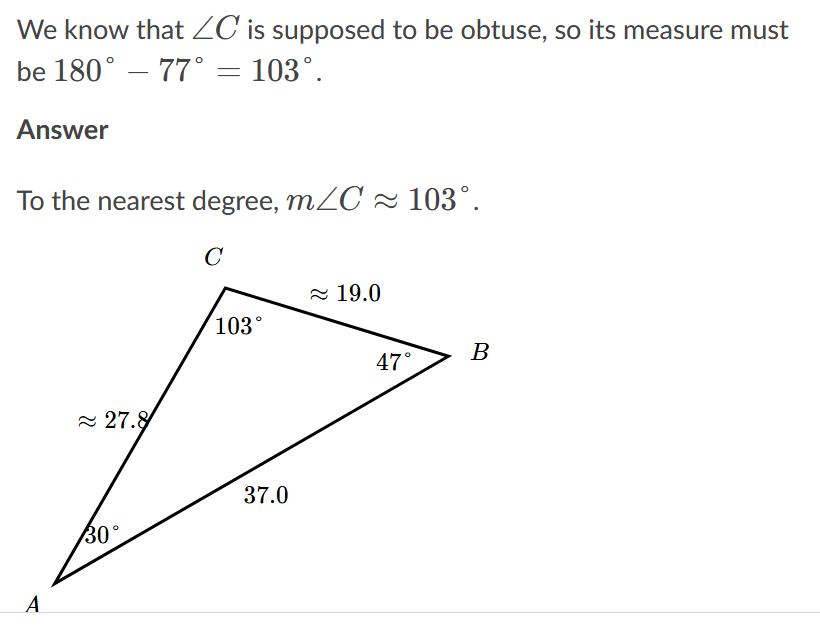
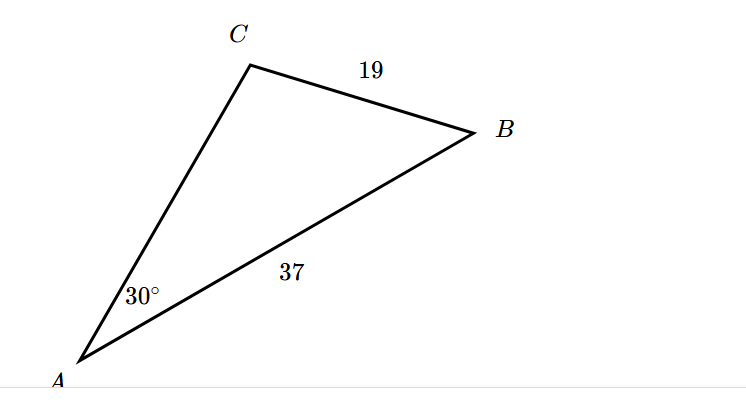
why in the law of sines would measure of C be 180 degrees minus 77?
sin c / 37 = sin 30 / 19
sin c = 37sin30 / 19
sin c = 37/38
sin^-1(37/38) = approximately 77
you would think it would be 180-30-77 = angle B
aka 73 degrees angle B
 plush ice
whats the que??
fathom tundra
I just want to know how it makes sense
plush ice
tell me the que
alpine sable
Ambiguous case
alpine sable
U can have two triangles
fathom tundra
to nearest tenth
plush ice
fathom tundra
well I just need to find angle C
and what was given?
fathom tundra
oh my ba
fathom tundra
plush ice
and what was given?
 alpine sable
Ambiguous case bro
fathom tundra
I thought I found the degree for C which I thought was 77 but somehow it's 103
it's confusing to me
alpine sable
180-77
You can have two triangles ambiguous case
The angle is supposed to be obtuse
fathom tundra
oh.
alpine sable
77 is the acute my friend
U need to do the ambiguous case
The requirements are
h<a<b
H being height
A being the side opposite given angle
And b the side adjacent given angle
@fathom tundra
fathom tundra
makes sense that one of the angles must be obtuse
alpine sable
yep
alpine sable
Ask your teacher
fathom tundra
seems simple enough though just seems liek common sense though but weird
180 - angle
the normal angle would be normal I guess idk
alpine sable
fathom tundra
seems simple enough though just seems liek common sense though but weird
Sometimes common sense in math is 10 pages proof
fathom tundra
alpine sable
Sometimes common sense in math is 10 pages proof
yeah makes sense lol
people like isaac newton simplified it for me

ty
fathom tundra
alpine sable
Issac newton stole work
what
but didn't he independently create calculus
 alpine sable
fathom tundra
but didn't he independently create calculus
alpine sable
fathom tundra
but didn't he independently create calculus
He’s responsible for some but not all
He stole some physics stuff
fathom tundra
damn
alpine sable
It’s interesting
fathom tundra
so how about the other guy
alpine sable
Leibniz
alpine sable
Idk I dont really care I just like math
fathom tundra

alpine sable
fathom tundra
indepndently that is
Calculus wasn’t invented or created
It was discovered
fathom tundra
well yeah I was gonna say nothing new under the sun but figured that's common sense.. lmao
alpine sable
At least thats how I think of it
alpine sable
fathom tundra
well yeah I was gonna say nothing new under the sun but figured that's common se...
Exactly
fathom tundra
I mean it's a way of finding answers that are objective
otherwise we wouldn't be able to do what we do
alpine sable
There’s probably some math that no one is aware of but it’s there
fathom tundra
it may appear in different ways to other beings but at the end of the day there's gotta be something fundamental about it.
alpine sable
fathom tundra
otherwise we wouldn't be able to do what we do
We don’t have to do anything it’s always there
We can utilize it to make things more feasible and create new things using the help
Like Calculus optimization
lone heartBOT
Channel closed
Closed by @fathom tundra
Use .reopen if this was a mistake.
Available help channel!
Send your question here to claim the channel.
Remember:
• Ask your math question in a clear, concise manner.
• Show your work, and if possible, explain where you are stuck.
• After 15 minutes, feel free to ping <@&286206848099549185>.
• Type the command .close to free the channel when you're done.
• Be polite and have a nice day!
Read #❓how-to-get-help for further information on how to ask a good question, and about conduct in the question channels.
 tepid edge
hi
lone heartBOT
tepid edge
hi
tepid edge
im doing boolean algebra
just wanted to ask about this question here
Z = A V A ^ B
using the Idempotent law for A V A it should just be Z = A ^ B
but people are getting simply A
 odd depot
depend on the order of operations, which I forgot for Boolean algebra
lament forge
A v (A ^ B) would be A
(A v A) ^ B would be A ^ B
odd depot
yeah, that
 crystal mason
google tells me that AND comes before OR, but just use brackets
 odd depot
stackexchange says there isn't an agreed upon order
so it probably depends on the textbook
crystal mason
yeah, just use brackets tbh
but if you use american signs you use + for or and * for AND, so you may depend on that
tepid edge
does this mean I cant work on any of the operators with the laws until the one with the highest precedence is completed first?
tepid edge
crystal mason
yeah, just use brackets tbh
but if you use american signs you use `+` for `or` a...
I put 2 terms in brackets before using the laws for every question? 🤔
crystal mason
Preferably you don't get questions without brackets unless the prof/teacher explicitly tells you which order they want
but you can just convert to american signs, then you would get A + A * B, where its a bit more intuitive that * comes first
odd depot
I agree, that notation makes it easier for me to simplify
tepid edge
I understand
since there are no sets rules for this
A v (A ^ B) would be A
(A v A) ^ B would be A ^ B
that would mean these are both correct?
crystal mason
no
lament forge
"A v (A ^ B) is A" and "(A v A) ^ B is A ^ B" are both correct
crystal mason
I would say that AND takes higher precendence
if you are in a CS course this would make sense
 lament forge
there isn't really a "correct answer" to "A v A ^ B" unless you know what precedence is intended
if you do know that then exactly one of "A" or "A ^ B" is the correct answer
lone heartBOT
Channel closed
Closed by @tepid edge
Use .reopen if this was a mistake.
Available help channel!
Send your question here to claim the channel.
Remember:
• Ask your math question in a clear, concise manner.
• Show your work, and if possible, explain where you are stuck.
• After 15 minutes, feel free to ping <@&286206848099549185>.
• Type the command .close to free the channel when you're done.
• Be polite and have a nice day!
Read #❓how-to-get-help for further information on how to ask a good question, and about conduct in the question channels.
 native granite
This is an english question rather than a math one but :
How would you call an area with a cross hatch pattern ? Hatched area ? Cross-hatched area ? Or something else ?
lone heartBOT
native granite
This is an english question rather than a math one but :
How would you call an a...
native granite
example :

 worn fox
People would likely just call it shaded
Unless you have something else that you call shaded
vale wigeon
yeah shaded
or hatched, if there's already something else done with a solid color rather than these lines
lone heartBOT
@native granite Has your question been resolved?
lone heartBOT
Channel closed
Closed due to timeout
Use .reopen if this was a mistake.
Available help channel!
Send your question here to claim the channel.
Remember:
• Ask your math question in a clear, concise manner.
• Show your work, and if possible, explain where you are stuck.
• After 15 minutes, feel free to ping <@&286206848099549185>.
• Type the command .close to free the channel when you're done.
• Be polite and have a nice day!
Read #❓how-to-get-help for further information on how to ask a good question, and about conduct in the question channels.
 winter ivy
Can someone come in clutch for a question related to my exam in couple of hours?
lone heartBOT
winter ivy
Can someone come in clutch for a question related to my exam in couple of hours?
winter ivy
When doing Lagrange multipliers
To find point on a plane closest to amother point
We use the distance formula right?
Can I square the distance formula and get the same result?
I saw it in a video
vale wigeon
yes bc the squaring function is monotone on [0,+∞)
winter ivy
Is it because the plane is technically endless?
winter ivy
vale wigeon
yes bc the squaring function is monotone on [0,+∞)
I don’t understand the reasoning but I’ll take the yes
Can you try explaining a bit more elaborately please?
So that I can apply it onto another problem
Okay final
So I can just use the distance formula without the square root?
But what happens to the other side of the distance formula?
d^2?
Do I need to take the sqrt again somewhere?
Plss
Can I just use f(x,y)= (x-x2)^2+(y-y2)^2 as the function for Lagrange
@vale wigeon
Sorry that I’m tagging
vale wigeon
do you care about the min value itself or about where it happens
if the latter then you can use the squared distance function as your objective
if the former then you will also have to take the root at the end
 vale wigeon
as in why am i asking you that?
vale wigeon
if you only care about where the min happens, then you don't need to take the root at the end.


 lone heartBOT
@winter ivy Has your question been resolved?
winter ivy
What is upside down A?
vale wigeon
for all