#help-0
1 messages · Page 199 of 1
 gray isle
 wheat isle
how would I make it in that form
gray isle
isolate y...
 gray isle
yes
 gray isle
no
first identify the slope of the original line from the slope intercept form
remember, NO x in the slope itself
if i seen an x in your response, its an immediate no
slope of y=mx+b isn't mx
wheat isle
gray isle
first identify the slope of the original line from the slope intercept form
it would be 5 right
gray isle
no
are you implying
$$y = \frac{x}{2} + 5$$
$$y = \frac{x}{7} + 5$$
$$y = \frac{x}{123} + 5$$
$$y = \frac{x}{53445} + 5$$
$$y = \frac{x}{\text{this doesn't matter}} + 5$$
all have the same slope?
 ocean sealBOT
ℝamonov
 wheat isle
no
gray isle
(you actually did something worse)
try identifying the slope again
don't overthink
you've done stuff like this many times already
wheat isle
what i thought is just that whatever m value replaces the m in y=mx+b would be the slope
gray isle
m represents the entire value being multiplied to x
$$5 \cdot x \redneq \frac{-5x}{3}$$
5 is NOT the slope of $y = \frac{-5x}{3} + \frac83$
ocean sealBOT
ℝamonov
 wheat isle
o
Wouldn't I need to use the slope formula to find the slope of original linear eq
and if thats the case I only have one x value and one y value
gray isle
no
you have you equation in the form
$$y = mx + b$$
identify the coefficient of $x$, the value being multiplied to $x$ and that's your slope. don't overthink
ocean sealBOT
ℝamonov
 gray isle
$\red{\text{what?}} \cdot x = \frac{-5x}{3}$
ocean sealBOT
ℝamonov
 wheat isle
-5/3 is the slope
gray isle
yes
now that you have the slope of the original line
apply
I know perpendicular lines have the product of the slope as -1
to get the slope of the desired perp line
 gray isle
remember, NO x in the slope itself
if i seen an x in your response, its an immediate no
wheat isle
wheat isle
how about this without the x
gray isle
then, yes.
simplify that
gray isle
simplify further
gray isle
yes

 lone heartBOT
@wheat isle Has your question been resolved?
Channel closed
Closed by @wheat isle
Use .reopen if this was a mistake.
 Available help channel!
Send your question here to claim the channel.
Remember:
• Ask your math question in a clear, concise manner.
• Show your work, and if possible, explain where you are stuck.
• After 15 minutes, feel free to ping <@&286206848099549185>.
• Type the command .close to free the channel when you're done.
• Be polite and have a nice day!
Read #❓how-to-get-help for further information on how to ask a good question, and about conduct in the question channels.
lone heartBOT
lone heartBOT
@alpine sable Has your question been resolved?
lone heartBOT
@alpine sable Has your question been resolved?
lone heartBOT
Channel closed
Closed due to timeout
Use .reopen if this was a mistake.
Available help channel!
Send your question here to claim the channel.
Remember:
• Ask your math question in a clear, concise manner.
• Show your work, and if possible, explain where you are stuck.
• After 15 minutes, feel free to ping <@&286206848099549185>.
• Type the command .close to free the channel when you're done.
• Be polite and have a nice day!
Read #❓how-to-get-help for further information on how to ask a good question, and about conduct in the question channels.
wheat isle
Are there any key properties or like characteristics of circles and semicircles I should know in context with relations and functions, etc?
lone heartBOT
wheat isle
Are there any key properties or like characteristics of circles and semicircles ...
wheat isle
and do semi-circles always have a minus term inside the radical
lone heartBOT
@wheat isle Has your question been resolved?
Channel closed
Closed by @wheat isle
Use .reopen if this was a mistake.
Available help channel!
Send your question here to claim the channel.
Remember:
• Ask your math question in a clear, concise manner.
• Show your work, and if possible, explain where you are stuck.
• After 15 minutes, feel free to ping <@&286206848099549185>.
• Type the command .close to free the channel when you're done.
• Be polite and have a nice day!
Read #❓how-to-get-help for further information on how to ask a good question, and about conduct in the question channels.
 tawdry echo
Can someone help me with finding the equation
 lone heartBOT
tawdry echo
Can someone help me with finding the equation
lone heartBOT
tawdry echo
Can someone help me with finding the equation
 golden canyon
Well, where does the graph 'end'?
normally for y = sqrt(x) you have the point (0, 0)
if x is any lower then the sqrt is undefined
lone heartBOT
@tawdry echo Has your question been resolved?
tawdry echo
this is all im givewn
lone heartBOT
@tawdry echo Has your question been resolved?
lone heartBOT
Channel closed
Closed due to timeout
Use .reopen if this was a mistake.
Available help channel!
Send your question here to claim the channel.
Remember:
• Ask your math question in a clear, concise manner.
• Show your work, and if possible, explain where you are stuck.
• After 15 minutes, feel free to ping <@&286206848099549185>.
• Type the command .close to free the channel when you're done.
• Be polite and have a nice day!
Read #❓how-to-get-help for further information on how to ask a good question, and about conduct in the question channels.
 celest perch
how is factorial of negative numbers defined
lone heartBOT
celest perch
how is factorial of negative numbers defined
 echo socket
With gamma function
 marsh rapids
Gamma function. Defined for everything but negative integers
 frank apex
celest perch
how is factorial of negative numbers defined
frank apex
celest perch
how is factorial of negative numbers defined
factorial of negative integers are all infinity/-inf any way you extend it
echo socket
frank apex
factorial of negative integers are all infinity/-inf any way you extend it
Negative integers*
marsh rapids
Generalizes the factorial
frank apex
echo socket
Negative integers*
am I supposed to capitalize negative or
marsh rapids
Btw what's the "not very ppl" role ?
echo socket
marsh rapids
Btw what's the "not very ppl" role ?
It sets your nickname colour to white
Take it if you wanna remove your role's colour
celest perch
i see imm a high school student, so i was just curious about the factorial oof -ve integers
frank apex
because x! = (x+1)!/(x+1)
so (-1)! = 0!/0 = 1/0
echo socket
celest perch
i see imm a high school student, so i was just curious about the factorial oof -...
If you aren't in calc, then don't bother for now
marsh rapids
one sec
Gonna find a vid on the topic
celest perch
echo socket
If you aren't in calc, then don't bother for now
ok thanks man
frank apex
frank apex
because x! = (x+1)!/(x+1)
so (-1)! = 0!/0 = 1/0
then every other negative integer is some finite number times 1/0
marsh rapids
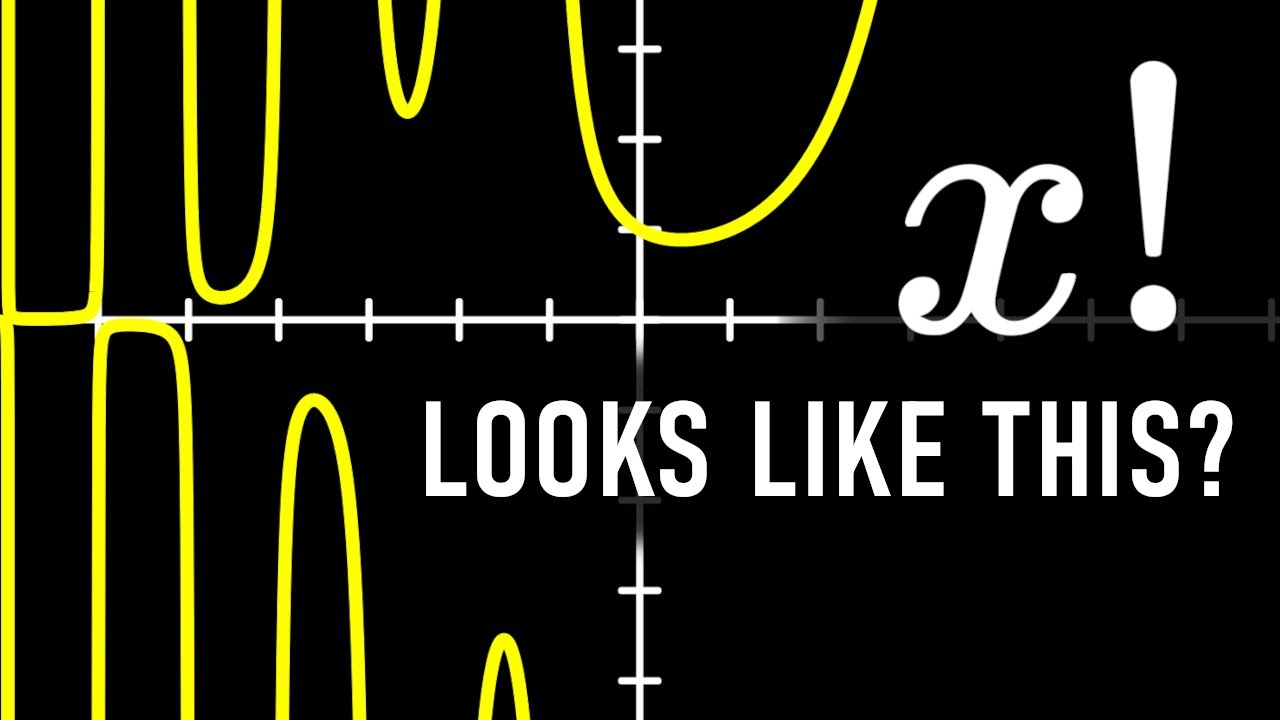
In this video, I walk through the derivation of an extension of the factorial function that works for any number: fractional, irrational, and even complex! This turns out to be a very important function, known as the gamma function, which has many surprising connections, one of which I explore in the last chapter of the video.
The animations in...
echo socket
celest perch
ok thanks man
Although the proof that @frank apex provided works for your level too
marsh rapids
It's not gamma, but it's another formula
celest perch
.close
lone heartBOT
Channel closed
Closed by @celest perch
Use .reopen if this was a mistake.
marsh rapids
echo socket
If you aren't in calc, then don't bother for now
But that's the correct answer imo
lone heartBOT
Available help channel!
Send your question here to claim the channel.
Remember:
• Ask your math question in a clear, concise manner.
• Show your work, and if possible, explain where you are stuck.
• After 15 minutes, feel free to ping <@&286206848099549185>.
• Type the command .close to free the channel when you're done.
• Be polite and have a nice day!
Read #❓how-to-get-help for further information on how to ask a good question, and about conduct in the question channels.
 lost flax
which method is fit to solve this?
 lone heartBOT
lost flax
which method is fit to solve this?
echo socket
lone heartBOT
lost flax
which method is fit to solve this?
echo socket
Isn't that just 1/n + 6/n^4 though?
frank apex
every term is > 1/n
echo socket
And the series of 1/n diverging is an already famous fact
lost flax
harmonic
frank apex
most famous fact of all math
echo socket
 Quite debatable
lost flax
frank apex
every term is > 1/n
i prove this ?
frank apex
echo socket
Isn't that just 1/n + 6/n^4 though?
^
frank apex
echo socket
<:thonk:406575732563902485> Quite debatable
I am objectively always correct
lost flax
thanks u two lol u guys have been helping me a lot tonight
echo socket
frank apex
I am objectively always correct
I don't think that would come as a surprise to non-math people though
They may say "Oh, you are adding infinitely many numbers, why would you expect to get a finite result"
 lost flax
okayy
lost flax
frank apex
telescoping
how do you know when to use telescoping?
frank apex
when you have sum of f(n) - f(n + x)
frank apex
frank apex
when you have sum of f(n) - f(n + x)
or similar
lost flax
what do u help ppl on here for?
just curious
i greatly appreciate it
but i was like damn
frank apex
I enjoy helping, I also enjoy being right
lone heartBOT
Channel closed
Closed by @lost flax
Use .reopen if this was a mistake.
Available help channel!
Send your question here to claim the channel.
Remember:
• Ask your math question in a clear, concise manner.
• Show your work, and if possible, explain where you are stuck.
• After 15 minutes, feel free to ping <@&286206848099549185>.
• Type the command .close to free the channel when you're done.
• Be polite and have a nice day!
Read #❓how-to-get-help for further information on how to ask a good question, and about conduct in the question channels.
 civic ivy
Could someone tell me what function you use to see if this integral converges?
lone heartBOT
civic ivy
Could someone tell me what function you use to see if this integral converges?
civic ivy

You need to use the comparison theorem but I don't know what function would be bigger/smaller so that I can prove it converges/diverges
lost flax
could you not use the method where you solve the integral using a variable in place of infinity for the upper bound and then finding the limit of that as the variable approaches infinity? thats how i learned it
civic ivy
lost flax
could you not use the method where you solve the integral using a variable in pl...
you can but you can't integrate this function so you need to use the comparison theorem
 atomic shore
I'm sadly on the buss so can't double check but wouldnt it be possible to integrate if it was x to the power of 2 instead of 4. And this would be a smaller function. So maybe works
Since the nominator would be the inner derivitive of the denominator?
lost flax
numerator?
civic ivy
I've checked the answer it's divergent
so you need a function smaller than the one given
would using x^2 not produce a function that is bigger than a function with x^4?
or would it be smaller?
atomic shore
Yes it would sorry I was thinking too fast XD. Can you adjust the numerator so it becomes the inner derivative?
civic ivy
atomic shore
Yes it would sorry I was thinking too fast XD. Can you adjust the numerator so i...
how would i do that exactly?
atomic shore
So x to the power to 3 in the numerator might work
civic ivy
okay
i see
but would that not still produce a function bigger than the one we started off with?
atomic shore
Damn that's true... I should stop doing maths on the buss XD
It's not as simple as removing the squreroot right?
civic ivy
i was just thinking about that
let me see
but would that be integratable function?
actually we could get rid of the x right
so just x^4 on the bottom
atomic shore
Sorry was no help but I gotta run. I hope you find your answer. There are online integrators that explain steps sometimes. You can always try one of those and see if it knows what to do
civic ivy
atomic shore
Sorry was no help but I gotta run. I hope you find your answer. There are online...
don't worry about it, I think that should work thought with the x^4
 rigid smelt
something as simple as 1/x should work just fine
if you observe carefully, you can see that (x-1)/sqrt(x^4-x) is asymptotically equivalent to 1/x near very large x
the hard part left (which actually can be proved using the fact above) is to prove that (x-1)/sqrt(x^4-x) is larger than 1/x for x in(1, infty)
civic ivy
rigid smelt
if you observe carefully, you can see that (x-1)/sqrt(x^4-x) is asymptotically e...
because at 1 they both tend to infinity?
civic ivy
rigid smelt
the hard part left (which actually can be proved using the fact above) is to pro...
alright, but you could kind of just brute force some values in near and further away from 1 if you wanted though right?
rigid smelt
no, they both tend to 0 when x tends to infty, but that's not how you prove asymptotic equivalence
sure that's also a good idea, but that idea is not foolproof yet
civic ivy
rigid smelt
no, they both tend to 0 when x tends to infty, but that's not how you prove asym...
but they are both undefined at x = 1 right
rigid smelt
dont forget about the monotonicity of functions
civic ivy
rigid smelt
no, they both tend to 0 when x tends to infty, but that's not how you prove asym...
how would you prove this
rigid smelt
civic ivy
but they are both undefined at x = 1 right
no, 1/x is perfectly defined at x=1
civic ivy
ohhh yeah your right sorry
rigid smelt
basically, with some algebra, you can prove that the integrand will behave like x/sqrt(x^4), which is just 1/x
but anyway, you already got an idea of how to prove that (x-1)/sqrt(x^4-x) is larger than 1/x, you should go with yours
civic ivy
alright, I'm only a year 1 undergrad so I'm guessing I won't quite need to look into this yet
rigid smelt
sure
anyway, with your idea, you would need to also proof that both functions are monotonic on (1, infty)
civic ivy
rigid smelt
anyway, with your idea, you would need to also proof that both functions are mon...
just to double, you mean that both functions are increasing
rigid smelt
(or decreasing)
a better statement would be both functions are always/strictly increasing or decreasing
civic ivy
awesome thank you
lone heartBOT
@civic ivy Has your question been resolved?
Channel closed
Closed by @civic ivy
Use .reopen if this was a mistake.
lone heartBOT
Available help channel!
Send your question here to claim the channel.
Remember:
• Ask your math question in a clear, concise manner.
• Show your work, and if possible, explain where you are stuck.
• After 15 minutes, feel free to ping <@&286206848099549185>.
• Type the command .close to free the channel when you're done.
• Be polite and have a nice day!
Read #❓how-to-get-help for further information on how to ask a good question, and about conduct in the question channels.
 summer cobalt
 marsh rapids

In combinatorial mathematics, the hockey-stick identity, Christmas stocking identity, boomerang identity, Fermat's identity or Chu's Theorem, states that if
    n
    ≥
    r
    ≥
    0


{\displaystyle n\geq r\geq 0}
are integers, then
...
@summer cobalt Has your question been resolved?
lone heartBOT
Channel closed
Closed due to timeout
Use .reopen if this was a mistake.
Available help channel!
Send your question here to claim the channel.
Remember:
• Ask your math question in a clear, concise manner.
• Show your work, and if possible, explain where you are stuck.
• After 15 minutes, feel free to ping <@&286206848099549185>.
• Type the command .close to free the channel when you're done.
• Be polite and have a nice day!
Read #❓how-to-get-help for further information on how to ask a good question, and about conduct in the question channels.
 sleek wyvern
 lone heartBOT
sleek wyvern
lone heartBOT
sleek wyvern
 lone heartBOT
@sleek wyvern Has your question been resolved?
 hybrid sinew
average increase = total increase / how ever many increments time
lone heartBOT
Channel closed
Closed by @sleek wyvern
Use .reopen if this was a mistake.
Available help channel!
Send your question here to claim the channel.
Remember:
• Ask your math question in a clear, concise manner.
• Show your work, and if possible, explain where you are stuck.
• After 15 minutes, feel free to ping <@&286206848099549185>.
• Type the command .close to free the channel when you're done.
• Be polite and have a nice day!
Read #❓how-to-get-help for further information on how to ask a good question, and about conduct in the question channels.
 cold gyro
 cold gyro
cold gyro
cold gyro
Hi guys, my professor asked to solve this problem, step by step, making it all clear. Is it good enough?
 ocean hawk
looks OK to me, assuming that is 4x - 11 and not 4x - 77
cold gyro
Yeah its 11 😂
lone heartBOT
@cold gyro Has your question been resolved?
lone heartBOT
Channel closed
Closed due to timeout
Use .reopen if this was a mistake.
lone heartBOT
Available help channel!
Send your question here to claim the channel.
Remember:
• Ask your math question in a clear, concise manner.
• Show your work, and if possible, explain where you are stuck.
• After 15 minutes, feel free to ping <@&286206848099549185>.
• Type the command .close to free the channel when you're done.
• Be polite and have a nice day!
Read #❓how-to-get-help for further information on how to ask a good question, and about conduct in the question channels.
 urban girder
 lone heartBOT
urban girder
urban girder
lone heartBOT
urban girder
urban girder
just by substituing in pi/11 I can prove its a root
but Im not sure how to find the second one
I know by taking away pi from the first root, will give you an equal root, and by adding 2pi to every root gets you consecutive ones
but ive tried doing that with pi/11 but it doesnt give a correct answer
and ive tried doing that with the sin() i get in the RHS when i substitute in pi/11
but nothing gets the correct answer, so im unsure of what to do
lone heartBOT
@urban girder Has your question been resolved?
urban girder
<@&286206848099549185>
 chrome salmon
urban girder
just by substituing in pi/11 I can prove its a root
chrome salmon
urban girder
just by substituing in pi/11 I can prove its a root
That's not proof, that's verifying
urban girder
chrome salmon
That's not proof, that's verifying
I meant 'show' as the question asked, its just a figure of speech I didnt mean it in that way
urban girder
chrome salmon
Sorry
no you dont need to apologize, I understand that in maths everything is much more specific, so I should be more careful with my language
chrome salmon
urban girder
no you dont need to apologize, I understand that in maths everything is much mor...
So anyway did you try letting rhs equal to 0?
chrome salmon
Ok and
urban girder
and then i took arcsin of both sides to get 21theta/2 = theta/2
then that leaves 21theta = theta
and that just simplifies to 20 theta = 0
chrome salmon
Theta can't be 0 for that formula
chrome salmon
The formula doesn't work for any theta value that is kf the form 2npi
Alright don't worry
urban girder
If you like i can send a picture of thr markscheme
I dont understand what they did
but it probably would help you
chrome salmon
When A≠B then sin A = sin B implies pi-A=B
urban girder
yes
chrome salmon
urban girder
yes
So
urban girder
pi - 21theta/2 = theta/2?
or vice versa
so pi = 11theta
so theta = pi/11
or
pi -1/2theta = 21theta/2
wait that gives the same thing
urban girder
2pi + 21theta/2 = theta/2
maybe?
because the value would be equal
that would give 2pi = -10theta
so theta = -pi/5
chrome salmon
urban girder
maybe?
Not that too
urban girder
or we could do 2pi + theta/2 = 21theta/2
but that would be the same methodology as the above
that would give theta = pi/5
which is the right answer!
urban girder
so the reason that worked, is because you had to change one value of sin, but not the other
so they both dont stay equivalent?
so thats why i cant add 2pi to both sides
so -pi/5 i assume is a root
just not in the domain given in the question
chrome salmon
Yeah it's not in domain
urban girder
what other cases would that method be used?
is it just for questions like that where it wants extra roots of a fraction with sin on the top and bottom
lone heartBOT
@urban girder Has your question been resolved?
Channel closed
Closed by @urban girder
Use .reopen if this was a mistake.
Available help channel!
Send your question here to claim the channel.
Remember:
• Ask your math question in a clear, concise manner.
• Show your work, and if possible, explain where you are stuck.
• After 15 minutes, feel free to ping <@&286206848099549185>.
• Type the command .close to free the channel when you're done.
• Be polite and have a nice day!
Read #❓how-to-get-help for further information on how to ask a good question, and about conduct in the question channels.
 peak stag
is this definition of an upper bound using logic symbols correct? the double arrow is used to indicate a biconditional (not logical equivalence).
 lone heartBOT
peak stag
is this definition of an upper bound using logic symbols correct? the double arr...
lone heartBOT
peak stag
is this definition of an upper bound using logic symbols correct? the double arr...
 alpine sable
looks fine
peak stag
alpine sable
looks fine
or should i use logical equivalence instead of biconditional? because it must be a tautology, right?
like it must be true
lone heartBOT
Channel closed
Closed by @peak stag
Use .reopen if this was a mistake.
Available help channel!
Send your question here to claim the channel.
Remember:
• Ask your math question in a clear, concise manner.
• Show your work, and if possible, explain where you are stuck.
• After 15 minutes, feel free to ping <@&286206848099549185>.
• Type the command .close to free the channel when you're done.
• Be polite and have a nice day!
Read #❓how-to-get-help for further information on how to ask a good question, and about conduct in the question channels.
 echo belfry
Make a simple program for the antidifferencing of x^-m , m= 0, 1, 2, …,20.
Can someone help me what's the formula of finding the antidifference of x^-m where m = 0,1,2,3,...20. Forget the coding, I'm just having a problem on finding the actual formula for that
lone heartBOT
echo belfry
Make a simple program for the antidifferencing of x^-m , m= 0, 1, 2, …,20.
Ca...
Please only use the <@&286206848099549185> ping once if your question has not been answered for 15 minutes. Please do not ping or DM individual users about your question.
lone heartBOT
@echo belfry Has your question been resolved?
Channel closed
Closed by @echo belfry
Use .reopen if this was a mistake.
Available help channel!
Send your question here to claim the channel.
Remember:
• Ask your math question in a clear, concise manner.
• Show your work, and if possible, explain where you are stuck.
• After 15 minutes, feel free to ping <@&286206848099549185>.
• Type the command .close to free the channel when you're done.
• Be polite and have a nice day!
Read #❓how-to-get-help for further information on how to ask a good question, and about conduct in the question channels.
 normal grotto
how did he go from from the right side of the equation (summation notation) to the (n+1)^(k+1) form?
 lone heartBOT
normal grotto
how did he go from from the right side of the equation (summation notation) to t...
alpine sable
lone heartBOT
normal grotto
how did he go from from the right side of the equation (summation notation) to t...
alpine sable
telescoping sum
normal grotto
ye
but how do you see it
I've been sitting here for minutes
how can I cancel the terms?
middle terms
alpine sable
write out a few summands
alpine sable
yup
lone heartBOT
Channel closed
Closed by @normal grotto
Use .reopen if this was a mistake.
Available help channel!
Send your question here to claim the channel.
Remember:
• Ask your math question in a clear, concise manner.
• Show your work, and if possible, explain where you are stuck.
• After 15 minutes, feel free to ping <@&286206848099549185>.
• Type the command .close to free the channel when you're done.
• Be polite and have a nice day!
Read #❓how-to-get-help for further information on how to ask a good question, and about conduct in the question channels.
 noble frost
m
lone heartBOT
noble frost
m
Please only use the <@&286206848099549185> ping once if your question has not been answered for 15 minutes. Please do not ping or DM individual users about your question.
noble frost
<@&286206848099549185>
lone heartBOT
@noble frost Has your question been resolved?
lone heartBOT
Channel closed
Closed due to timeout
Use .reopen if this was a mistake.
Available help channel!
Send your question here to claim the channel.
Remember:
• Ask your math question in a clear, concise manner.
• Show your work, and if possible, explain where you are stuck.
• After 15 minutes, feel free to ping <@&286206848099549185>.
• Type the command .close to free the channel when you're done.
• Be polite and have a nice day!
Read #❓how-to-get-help for further information on how to ask a good question, and about conduct in the question channels.
 rotund crater
how i can verify this indenty
 lone heartBOT
rotund crater
how i can verify this indenty
gray isle
lone heartBOT
rotund crater
how i can verify this indenty
gray isle
what have you tried so far?
 gray isle
1 - cos(2x) isn't the same as 1 - cos^2(x)
consider the double angle identity for cosine
rotund crater
gray isle
consider the double angle identity for cosine
this ?
 gray isle
that's one of the forms
there are 3 main ones, (potentially some obscure ones)
your source should have all 3
rotund crater
 gray isle
though equivalent, one of the forms,
the form that leads to the cancellation of the constant will be most efficient here
rotund crater
gray isle
though equivalent, one of the forms,
the form that leads to the cancellation of ...
I don't understand
gray isle
which part
rotund crater
how i get /2
gray isle
plug the form with sine only into
1 - cos(2x)
and what do you get
rotund crater
1-2sin^2z?
rotund crater
x
rotund crater
1-cos8x
gray isle
no
forget about your problem for a sec
and focus only on the question i'm asking you
rotund crater
i cant see
gray isle
cos(2x) = 1 - 2sin^2(x)
plug that into
1 - cos(2x)
and what do you get
these are simple instructions, don't overthink what I'm asking you to do
since
cos(2x) = 1 - 2sin^2(x)
replace the cos(2x) in 1 - cos(2x) with (1 - 2sin^2(x))
and simplify
and tell me what you get
gray isle
not helping
 magic bison
Cos²x-sin²x
gray isle
they already have that stuff
gray isle
they already have that stuff
 wet nest
1-cos2theta = 2sin^2 theta
rotund crater
how i can simoplify this sin^2(8x) = (1 - cos(8x))/(1 + cos(8x))
rotund crater
gray isle
is this a new question
is the same
magic bison
Oh wait
rotund crater
sin^2(8x) = 4sin^2(4x)cos^2(4x)
magic bison
Do the right side
gray isle
uh huh...that's true and then?
rotund crater
sin^2(8x) = (1 - cos(8x))/(1 + cos(8x)) ?
magic bison
rotund crater
how i can simoplify this sin^2(8x) = (1 - cos(8x))/(1 + cos(8x))
I don't think they are equal
rotund crater
sin^2(8x) = 4(1 - cos(8x))/4(1 + cos(8x))
magic bison
Multiply numerator and denominator by 1-cos8x
gray isle
where's division coming from
magic bison
You get sin²8x/(1+cos8x)²
gray isle
why is
(1 - cos(8x)) being divided by (1 + cos(8x))
4(1 - cos(8x))/4*(1 + cos(8x))
simplifies to
(1 - cos(8x))(1 + cos(8x))
and what happened to the task i set for you
why did you go off on your own and do something else
magic bison
Chill
gray isle
don't tell me to chill
rotund crater
I really didn't understand and I asked chat gpt to help me, I don't understand trigometry
magic bison
Ok then
gray isle
don't use chatgpt for math
magic bison
Umm
gray isle
these are simple instructions, don't overthink what I'm asking you to do
since
cos(2x) = 1 - 2sin^2(x)
replace the cos(2x) in 1 - cos(2x) with (1 - 2sin^2(x))
and simplify
and tell me what you get
which part of that don't you understand
do that and only that and nothing else, don't go off on your own and do other stuff
rotund crater
gray isle
> these are simple instructions, don't overthink what I'm asking you to do
> sin...
1 - cos(2x) = 2sin^2(x) ?
rotund crater
dividing
rotund crater
a
gray isle
$\sin^2(x) = \frac{1-\cos(2x)}{2}$
ocean sealBOT
ℝamonov
 gray isle
for these types of proofs, its usually easier to start from the side that looks more complex, in this case the right side
$$\frac{1-\cos(8x)}{2}$$
apply the same identity as before, simplify and you should get the desired result
ocean sealBOT
ℝamonov
 lone heartBOT
Channel closed
Closed by @rotund crater
Use .reopen if this was a mistake.
Available help channel!
Send your question here to claim the channel.
Remember:
• Ask your math question in a clear, concise manner.
• Show your work, and if possible, explain where you are stuck.
• After 15 minutes, feel free to ping <@&286206848099549185>.
• Type the command .close to free the channel when you're done.
• Be polite and have a nice day!
Read #❓how-to-get-help for further information on how to ask a good question, and about conduct in the question channels.
 primal galleon
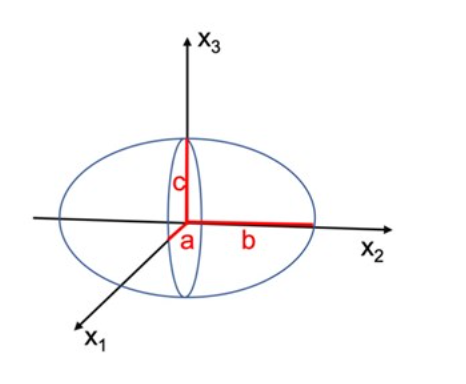
I am working on a linear transformation problem and could use some help. The problem involves finding a matrix for a linear transformation from $\mathbb{R}^{3}$ to $\mathbb{R}^{3}$ that maps the unit sphere $x^{2}+y^{2}+z^{2}=1$ onto the spheroid in the attached figure. The problem has two parts:
(a) Finding the volume of the spheroid.
(b) Determining the value of $c$ for which the transformation leaves the volume unchanged when $a=3/4$ and $b=2/3$.
I have attempted to solve the problem by finding the equation of the spheroid and then using it to find the matrix of the transformation. However, I am stuck on finding the equation of the spheroid and would appreciate any guidance on how to proceed.
Thank you in advance for any help you can provide!
 lone heartBOT
primal galleon
I am working on a linear transformation problem and could use some help. The pro...
ocean sealBOT
lone heartBOT
primal galleon
I am working on a linear transformation problem and could use some help. The pro...
ocean sealBOT
dgh
 lone heartBOT
@primal galleon Has your question been resolved?
lone heartBOT
@primal galleon Has your question been resolved?
 vast ore
primal galleon
vast ore
primal galleon
@ocean hawk
I'm trying to understand how to map the unit sphere onto a spheroid, but I'm having trouble following the advice I was given. They mentioned that I should think about stretching or shrinking the unit sphere along the x, y, and z axes by factors of a, b, and c, respectively. The equations they provided are:
x' = ax
y' = by
z' = cz
They also mentioned that I can express this using a matrix A. To check that I'm calculating the volume correctly using the determinant, I should use the formula for the volume of a spheroid, which is:
(4/3)πabc
To keep the volume unchanged during the mapping, abc=1, and I have the values of a and b for the problem.
ocean hawk
I did a similar problem to this but in 2D, and stretching the unit circle to an ellipse
for that, the matrix is simply $\begin{pmatrix} p & 0 \ 0 & q \end{pmatrix}$. arguably it is about the same except your matrix will be 3x3
ocean sealBOT
cwatson
 primal galleon
ocean hawk
for that, the matrix is simply $\begin{pmatrix} p & 0 \\ 0 & q \end{pmatrix}$. a...
primal galleon
ocean hawk
for that, the matrix is simply $\begin{pmatrix} p & 0 \\ 0 & q \end{pmatrix}$. a...
So if I understand correctly, the reason why that matrix is used is that it represents a diagonal matrix with the scaling factors along the x and y axes. In other words, it stretches or shrinks the circle along the x and y directions independently, with a factor of p along the x-axis and q along the y-axis?
For the 3D case, the matrix would be a diagonal matrix with scaling factors along the x, y, and z axes. This is because the matrix needs to describe how the unit sphere is stretched or shrunk along each of these axes to become the desired spheroid shape.
ocean hawk
yes. if p = q, it will still be a circle, just w/ a different radius
primal galleon
So if p=q, then the matrix becomes a scalar multiple of the identity matrix, which means that the scaling factors along the x and y directions are equal. In other words, the circle is stretched or shrunk by the same factor in both the x and y directions.
primal galleon
@ocean hawk So we can construct the diagonal matrix A as:
A =
|a 0 0|
|0 b 0|
|0 0 c|
So, the matrix A for the given transformation is:
A =
|3/4 0 0 |
|0 2/3 0 |
|0 0 c |
To find the volume of the spheroid, we can use the formula given in the question:
V = (4/3)πabc
Substituting the given values, we get:
V = (4/3)π(3/4)(2/3)c = (1/2)πc
Therefore, the volume of the spheroid is (1/2)πc.
Is this correct?
primal galleon
So the question was for which value of c the volume of the spheroid will be unchanged. Since we have 2/3 * pi * c, how do we know there’s no change?
ocean hawk
unchanged from the unit sphere's volume.
lone heartBOT
@primal galleon Has your question been resolved?
primal galleon
@ocean hawk Let me know if this is correct:
The vectors $\mathbf{e}_1 = (1,0,0)$, $\mathbf{e}_2 = (0,1,0)$, and $\mathbf{e}_3 = (0,0,1)$. So any vector in $\mathbb{R}^3$ can be expressed as a linear combination of these vectors.
The first column of A is the image of $\mathbf{e}_1$, the second column is the image of $\mathbf{e}_2$, the third column of A is the image of $\mathbf{e}_3$. So, the image of $\mathbf{e}_1$ is $(a,0,0)$, the image of $\mathbf{e}_2$ is $(0,b,0)$, and the image of $\mathbf{e}_3$ is $(0,0,c)$.
From the figure, we can see that the spheroid has been stretched along the $x$-axis by a factor of $a=3/4$, along the $y$-axis by a factor of $b=2/3$, and along the $z$-axis by a factor of $c$. Therefore, the matrix $A$ is given by:
$$A=\left(\begin{array}{lll}
a & 0 & 0 \
0 & b & 0 \
0 & 0 & c
\end{array}\right)=\left(\begin{array}{ccc}
3 / 4 & 0 & 0 \
0 & 2 / 3 & 0 \
0 & 0 & c
\end{array}\right)$$
To find the value of $c$ such that the volume of the unit sphere is mapped onto the spheroid without changing, we need to find the determinant of $A$ which represents the scaling factor for the volume. Since we want the volume to remain the same, this determinant must be equal to 1. Thus, we have:
$$\begin{aligned}
& \operatorname{det}(A)=\operatorname{det}\left(\begin{array}{ccc}
3 / 4 & 0 & 0 \
0 & 2 / 3 & 0 \
0 & 0 & c
\end{array}\right)=(3 / 4) . \
& (2 / 3) \cdot c=1
\end{aligned}$$
So c = 2.
Therefore, the matrix $A$ for the linear transformation that maps the unit sphere onto the spheroid is:
$$A=\left(\begin{array}{ccc}
3 / 4 & 0 & 0 \
0 & 2 / 3 & 0 \
0 & 0 & 2
\end{array}\right)$$
The volume of the spheroid can then be found using the formula for the volume of an ellipsoid:
$$V=\frac{4}{3} \pi a b c=\frac{4}{3} \pi\left(\frac{3}{4}\right)\left(\frac{2}{3}\right)(2)=\frac{4}{3} \pi$$
ocean sealBOT
dgh
 primal galleon
I forgot we're not supposed to use a=3/4, b=2/3 until part b, but only want an expression for volume in terms of a, b, c.
$$A=\left(\begin{array}{lll}
a & 0 & 0 \
0 & b & 0 \
0 & 0 & c
\end{array}\right)$$
$$\operatorname{det}(A)=a b c=1$$
$$c=\frac{1}{a b}$$
$$A=\left(\begin{array}{ccc}
a & 0 & 0 \
0 & b & 0 \
0 & 0 & \frac{1}{a b}
\end{array}\right)$$
$$V=\frac{4}{3} \pi a b c=\frac{4}{3} \pi\left(\frac{1}{a b}\right)=\frac{4}{3 a b} \pi$$
ocean sealBOT
dgh
 ocean hawk
I think that all looks right
primal galleon
ocean hawk
I think that all looks right
I was told “part a doesn't give you anything that would suggest abc = 1”
What am I doing wrong
primal galleon
They said remove c = 1/(ab), since that's wrong, and also remove A = [a 0 0; 0 b 0; 0 0 1/ab] since that depends on c=1/(ab) and is thus also wrong. Just stop at V = (4/3) pi abc. You did write the correct answer, you just also have a lot of incorrect stuff in the middle and also after it.
I don't understand what this means
primal galleon
I suspect they just want me to write this: @ocean hawk

Where det(A) is just abc, where the volume of the image of the unit sphere is (4/3)πabc. If I'm still interpreting it wrong then I'll just return to this problem later.
lone heartBOT
@primal galleon Has your question been resolved?
ocean hawk
yes I think the volume of the spheroid for part (a) should just be (4/3) pi * abc. I overlooked that you set c = 1/(ab)
I think c=2 is correct, though
lone heartBOT
@primal galleon Has your question been resolved?
lone heartBOT
Channel closed
Closed due to timeout
Use .reopen if this was a mistake.
lone heartBOT
Available help channel!
Send your question here to claim the channel.
Remember:
• Ask your math question in a clear, concise manner.
• Show your work, and if possible, explain where you are stuck.
• After 15 minutes, feel free to ping <@&286206848099549185>.
• Type the command .close to free the channel when you're done.
• Be polite and have a nice day!
Read #❓how-to-get-help for further information on how to ask a good question, and about conduct in the question channels.
 flat vale
how is
lone heartBOT
flat vale
how is
flat vale
${A \in \mathcal{M}_{n \times n}(\mathbb{R}) \mid \text{det}(A)=0 }$
closed under vector addition and scaler multiplicaiton?
ocean sealBOT
TheWhiteShadow
 marsh rapids
Is this how the problem was phrased ?
flat vale
marsh rapids
Is this how the problem was phrased ?
it says that set is a subspace of $\mathcal{M}_{n \times n}(\mathbb{R})$
ocean sealBOT
TheWhiteShadow
 lone heartBOT
Channel closed
Closed by @flat vale
Use .reopen if this was a mistake.
marsh rapids
Remember that det(A+B) != det A + det B
flat vale
marsh rapids
Remember that det(A+B) != det A + det B
yep cheers
lone heartBOT
Available help channel!
Send your question here to claim the channel.
Remember:
• Ask your math question in a clear, concise manner.
• Show your work, and if possible, explain where you are stuck.
• After 15 minutes, feel free to ping <@&286206848099549185>.
• Type the command .close to free the channel when you're done.
• Be polite and have a nice day!
Read #❓how-to-get-help for further information on how to ask a good question, and about conduct in the question channels.
 sand raptor
 lone heartBOT
sand raptor
sand raptor
lone heartBOT
sand raptor
sand raptor
how do i prove its convergence/divergence
<@&286206848099549185>
what test am i supposed to use here
 modern sedge
try to take limit of that as n approaches infinity
should be enough
$\lim_{n\to\infty}\sin\left(\tan^{-1}\left(n\right)\right)$
ocean sealBOT
MathIsAlwaysRight
 modern sedge
you sure?
modern sedge
tan^-1(n) isnt 1
sand raptor
oh pi/2
modern sedge
and sin(pi/2)?
sand raptor
1
modern sedge
yep, so at infinity it will be summing up ones
sand raptor
so via divergence test divergent?
modern sedge
I'm not sure how is this test called, but I know it exists and proves divergence
sand raptor
btw dyk the different tests to prove convergence/divergence
modern sedge
oh yeah, its called divergence test
sand raptor
there's alot, and I need to know which expressions r best to use what test
modern sedge
yeah, I know I just dont remember those names
anyways this test is probably the easiest
sand raptor
Divergence Test, Integral Test, Comparison Test, Limit Comparison Test, Alternating Series Test, Root and Ratio Test
sand raptor
modern sedge
anyways this test is probably the easiest
our first exam half the class failed
modern sedge
thats a lot
sand raptor
btw when I make functions as power series, when I derive, why does the interval of convergence get smaller?
modern sedge
idk, sorry
lone heartBOT
Channel closed
Closed by @sand raptor
Use .reopen if this was a mistake.
lone heartBOT
Available help channel!
Send your question here to claim the channel.
Remember:
• Ask your math question in a clear, concise manner.
• Show your work, and if possible, explain where you are stuck.
• After 15 minutes, feel free to ping <@&286206848099549185>.
• Type the command .close to free the channel when you're done.
• Be polite and have a nice day!
Read #❓how-to-get-help for further information on how to ask a good question, and about conduct in the question channels.
 sonic otter
2cos²(x) - 3sin(x) - 3 = 0
2(1 - sin²(x)) - 3sin(x) - 3 = 0
2 - 2sin²(x) - 3sin(x) - 3 = 0
-2sin²(x) - 3sin(x) - 1 = 0
IF sin(x) = y:
-2y² - 3y - 1 = 0
y1 = -1, y2 = -½
THEN:
sin(x) = -1:
x = -90° + 360°n
sin(x) = -½:
x = 330° + 360°n,
x = 90° - 330° + 360°n = -240° + 360°n;
2sin²(x) + 3cos(x) - 3 = 0
2(1 - cos²(x)) + 3cos(x) - 3 = 0
-2cos²(x) + 3cos(x) - 1 = 0
cos(x) = -1:
x = 180° + 360°n;
cos(x) = -½:
x = 330° + 360°n,
x = -330° + 360°n;
Could somebody check if these two are correct? I use symbolab to check the solutions, but it gives me different answers for the same roots of the quadratic equation even though I use formulas my teacher gave me.
lone heartBOT
sonic otter
```
2cos²(x) - 3sin(x) - 3 = 0
2(1 - sin²(x)) - 3sin(x) - 3 = 0
2 - 2sin²(x) - 3...
 quasi vector
sonic otter
```
2cos²(x) - 3sin(x) - 3 = 0
2(1 - sin²(x)) - 3sin(x) - 3 = 0
2 - 2sin²(x) - 3...
quasi vector
sonic otter
```
2cos²(x) - 3sin(x) - 3 = 0
2(1 - sin²(x)) - 3sin(x) - 3 = 0
2 - 2sin²(x) - 3...
why are you subtracting in the last step??
sonic otter
In which equation?
quasi vector
the first one
sonic otter
That's what my formula says the two solutions are
gray isle
the
x = 90° - 330° + 360°n = -240° + 360°n;
why are you doing that
what formula are you looking at that's telling you to do stuff like that
sonic otter

Idk if symbolab is wrong or my formulas. That's why I asked here, lol
The teacher often gives us wrong formulas by mistake, so idk
 sonic otter
Oh yeah, it's 180, my bad, but what's wrong with the second one? It also gives me different answers 🤔
Oof
sonic otter
Forgot it's cosine so the values will be completely different
Alright I need to pay more attention
🤦♂️
I just copied the degrees from the previous one without even realizing
Thx
Alright, I got it now. Thanks a lot, I'll be more careful.
❤️
.close
lone heartBOT
Channel closed
Closed by @sonic otter
Use .reopen if this was a mistake.
Available help channel!
Send your question here to claim the channel.
Remember:
• Ask your math question in a clear, concise manner.
• Show your work, and if possible, explain where you are stuck.
• After 15 minutes, feel free to ping <@&286206848099549185>.
• Type the command .close to free the channel when you're done.
• Be polite and have a nice day!
Read #❓how-to-get-help for further information on how to ask a good question, and about conduct in the question channels.
alpine sable
hello does anyone here use Ti-Nspire
lone heartBOT
alpine sable
hello does anyone here use Ti-Nspire
alpine sable
i have a circle and i am not sure how to find the tangent line for a point
 stark yew
alpine sable
i have a circle and i am not sure how to find the tangent line for a point
stark yew
alpine sable
i have a circle and i am not sure how to find the tangent line for a point
Wht does that have to do with having a TI-Nspire?
alpine sable
stark yew
Wht does that have to do with having a TI-Nspire?
there should be a command to make t work but i cant figure it out
stark yew
alpine sable
there should be a command to make t work but i cant figure it out
Ah. Well I can show you how to do it in desmos but unfortunately I don't have a TI-nspire.
alpine sable
stark yew
Ah. Well I can show you how to do it in desmos but unfortunately I don't have a ...
i just figured out
ty tho
stark yew
alpine sable
i just figured out
Wonderful to hear
lone heartBOT
@alpine sable Has your question been resolved?
Channel closed
Closed by @wet halo
Use .reopen if this was a mistake.
Available help channel!
Send your question here to claim the channel.
Remember:
• Ask your math question in a clear, concise manner.
• Show your work, and if possible, explain where you are stuck.
• After 15 minutes, feel free to ping <@&286206848099549185>.
• Type the command .close to free the channel when you're done.
• Be polite and have a nice day!
Read #❓how-to-get-help for further information on how to ask a good question, and about conduct in the question channels.
 toxic hare
<@&286206848099549185>
lone heartBOT
toxic hare
<@&286206848099549185>
 cyan drum
toxic hare
<@&286206848099549185>
cyan drum
toxic hare
<@&286206848099549185>
send your question instead of instantly pinging without sending anything
 sick coyote
?
lone heartBOT
@toxic hare Has your question been resolved?
 loud wasp
16+8=24
8+8+8=24
8+9+7=24
7+4+13=24
4+20=24
so ? = 20
honestly my 4th grade brother can solve this
lone heartBOT
Channel closed
Closed due to timeout
Use .reopen if this was a mistake.
Available help channel!
Send your question here to claim the channel.
Remember:
• Ask your math question in a clear, concise manner.
• Show your work, and if possible, explain where you are stuck.
• After 15 minutes, feel free to ping <@&286206848099549185>.
• Type the command .close to free the channel when you're done.
• Be polite and have a nice day!
Read #❓how-to-get-help for further information on how to ask a good question, and about conduct in the question channels.
 brazen osprey
I don't understand what to do next. Work so far: (b^x = 2/3) + (b^x=3/2) = (2b^x = 13/6) = b^x=13/12
 lone heartBOT
brazen osprey
I don't understand what to do next. Work so far: (b^x = 2/3) + (b^x=3/2) = (2b^x...
brazen osprey
lone heartBOT
brazen osprey
I don't understand what to do next. Work so far: (b^x = 2/3) + (b^x=3/2) = (2b^x...
brazen osprey
Did it as a system
brazen osprey
Log laws?
brazen osprey
Will search that
gray isle
your use of variables and set up is also very dodgy
 vale wigeon
^
brazen osprey
So log_b(2/3 x 3/2)?
gray isle
ideally don't use x for multiplication, but yes
now simplify that
gray isle
simplify that even further
lone heartBOT
Channel closed
Closed by @brazen osprey
Use .reopen if this was a mistake.
Available help channel!
Send your question here to claim the channel.
Remember:
• Ask your math question in a clear, concise manner.
• Show your work, and if possible, explain where you are stuck.
• After 15 minutes, feel free to ping <@&286206848099549185>.
• Type the command .close to free the channel when you're done.
• Be polite and have a nice day!
Read #❓how-to-get-help for further information on how to ask a good question, and about conduct in the question channels.
 tawny moon
whats the partial fractions rule for this?
 lone heartBOT
tawny moon
whats the partial fractions rule for this?
lone heartBOT
tawny moon
whats the partial fractions rule for this?
 ornate ginkgo
tawny moon
whats the partial fractions rule for this?
ornate ginkgo
tawny moon
whats the partial fractions rule for this?
What font is this? I Want it.
tawny moon
ornate ginkgo
What font is this? I Want it.
my handwriting lmao
lone heartBOT
@tawny moon Has your question been resolved?
lone heartBOT
Channel closed
Closed due to timeout
Use .reopen if this was a mistake.
Available help channel!
Send your question here to claim the channel.
Remember:
• Ask your math question in a clear, concise manner.
• Show your work, and if possible, explain where you are stuck.
• After 15 minutes, feel free to ping <@&286206848099549185>.
• Type the command .close to free the channel when you're done.
• Be polite and have a nice day!
Read #❓how-to-get-help for further information on how to ask a good question, and about conduct in the question channels.
 lyric pumice
can anyone help me in solving for f(x)
lone heartBOT
lyric pumice
can anyone help me in solving for f(x)
lyric pumice
 echo socket
Not really sure if that helps tho, cuz the integral still remains thanks to the product rule I think
Wait maybe we substitute for the integral using the first equation
ocean sealBOT
Hack With Techno Boy
 lyric pumice
yea @woeful pulsar ?
echo socket
Yeah but you also have to bring the e^x out before doing that
 woeful pulsar
what is g?
echo socket
Arbitrary function
ocean sealBOT
Hack With Techno Boy
 lyric pumice
what do i do to solve for c?
echo socket
Huh? I got $f^{\prime}(x) = -2 + e^x\int_0^xe^{-t}f(t)\dd{t}+f(x)$ though
echo socket
lyric pumice
what do i do to solve for c?
You don't unless you are given some initial condition
ocean sealBOT
A Lonely Bean


 ocean sealBOT
Hack With Techno Boy
 lyric pumice
now what should i do for c?
noble frost
f(0)=1
noble frost
put 0?
lone heartBOT
Channel closed
Closed by @lyric pumice
Use .reopen if this was a mistake.
Available help channel!
Send your question here to claim the channel.
Remember:
• Ask your math question in a clear, concise manner.
• Show your work, and if possible, explain where you are stuck.
• After 15 minutes, feel free to ping <@&286206848099549185>.
• Type the command .close to free the channel when you're done.
• Be polite and have a nice day!
Read #❓how-to-get-help for further information on how to ask a good question, and about conduct in the question channels.
 ripe sapphire
How do i find this integral
 lone heartBOT
ripe sapphire
How do i find this integral
ocean sealBOT
lone heartBOT
ripe sapphire
How do i find this integral
ocean sealBOT
 lyric pumice
ig $1+e^{-x}=t$ would work
ocean sealBOT
Hack With Techno Boy
 echo socket
Thinking of that as well yeah
ripe sapphire
What do i do with that
lyric pumice
substitution
ripe sapphire
Yea but after i substitute 1+e^-x by t what do i do
lyric pumice
then you can take constant terms out
ripe sapphire
I don’t know how to proceed
lyric pumice
;-;
ripe sapphire
I don’t think i would’ve needed help if i did
Can someone help me?😭
<@&286206848099549185>
lone heartBOT
@ripe sapphire Has your question been resolved?
ripe sapphire
.close
lone heartBOT
Channel closed
Closed by @ripe sapphire
Use .reopen if this was a mistake.
Available help channel!
Send your question here to claim the channel.
Remember:
• Ask your math question in a clear, concise manner.
• Show your work, and if possible, explain where you are stuck.
• After 15 minutes, feel free to ping <@&286206848099549185>.
• Type the command .close to free the channel when you're done.
• Be polite and have a nice day!
Read #❓how-to-get-help for further information on how to ask a good question, and about conduct in the question channels.
 stone berry
How do I find AB?
 lone heartBOT
stone berry
How do I find AB?
lone heartBOT
stone berry
How do I find AB?
 subtle birch
That is just radius+width of car
lone heartBOT
@stone berry Has your question been resolved?
 brave bolt
lone heart
<@1070009642832384011> Has your question been resolved?
brave bolt
lone heart
<@1070009642832384011> Has your question been resolved?
i want the answer too... and question ask for minimum and i think we must find derivative
lone heartBOT
Channel closed
Closed due to timeout
Use .reopen if this was a mistake.
Available help channel!
Send your question here to claim the channel.
Remember:
• Ask your math question in a clear, concise manner.
• Show your work, and if possible, explain where you are stuck.
• After 15 minutes, feel free to ping <@&286206848099549185>.
• Type the command .close to free the channel when you're done.
• Be polite and have a nice day!
Read #❓how-to-get-help for further information on how to ask a good question, and about conduct in the question channels.
alpine sable
Hello, I have 2 questions, one of them is that first photo is according to xz side, second one is xy side

 lone heartBOT
alpine sable
Hello, I have 2 questions, one of them is that first photo is according to xz si...
alpine sable
lone heartBOT
alpine sable
Hello, I have 2 questions, one of them is that first photo is according to xz si...
alpine sable
For xy side, the question wants me to put linear line to centre of circle and turns around 360 degrees and then wants to find their area and their volume, I am confused at when I turn around which shape comes out? Could someone help?
Area and volume can be solved either with integral or formulas.
lone heartBOT
@alpine sable Has your question been resolved?
lone heartBOT
@alpine sable Has your question been resolved?
alpine sable
<@&286206848099549185>
alpine sable
.close
lone heartBOT
Channel closed
Closed by @fallow prism
Use .reopen if this was a mistake.
Available help channel!
Send your question here to claim the channel.
Remember:
• Ask your math question in a clear, concise manner.
• Show your work, and if possible, explain where you are stuck.
• After 15 minutes, feel free to ping <@&286206848099549185>.
• Type the command .close to free the channel when you're done.
• Be polite and have a nice day!
Read #❓how-to-get-help for further information on how to ask a good question, and about conduct in the question channels.
 steep briar
Checking if this series diverges or converges
 lone heartBOT
steep briar
Checking if this series diverges or converges
lone heartBOT
lone heartBOT
steep briar
Checking if this series diverges or converges
lone heartBOT
Channel closed
Closed by @steep briar
Use .reopen if this was a mistake.
Available help channel!
Send your question here to claim the channel.
Remember:
• Ask your math question in a clear, concise manner.
• Show your work, and if possible, explain where you are stuck.
• After 15 minutes, feel free to ping <@&286206848099549185>.
• Type the command .close to free the channel when you're done.
• Be polite and have a nice day!
Read #❓how-to-get-help for further information on how to ask a good question, and about conduct in the question channels.
alpine sable
so in arithmetic progression S20=140 and S60=720 and we needa find S80 so how do i do dat
lone heartBOT
alpine sable
so in arithmetic progression S20=140 and S60=720 and we needa find S80 so how do...
 hard patio
!status
lone heartBOT
What step are you on?
1. I don't know where to begin
2. I have begun but got stuck midway
3. I got an answer but I'm told it's wrong
4. I got an answer and would like my work checked
5. I have a question about someone else's worked solution
6. None of the above
1 step
gray isle
you are given info about the sums of terms of the AP
start by applying the formula for that
alpine sable
what is bro saying 🔥🔥🔥⁉️⁉️⁉️
ion got a
uhh
first numba
or
idk the
q or sum
idk what to do bro
subtle birch
alpine sable
so in arithmetic progression S20=140 and S60=720 and we needa find S80 so how do...
are you aware about sum of n terms of an ap
subtle birch
it is n/2(2a+(n-1)d))
subtle birch
Well, its clearly mentioned S20 so it requires you to know formula for sum
alpine sable
the 20th member in the progression
subtle birch
Okay, then you don't need that formula
S20=140 so plug in n=20 and obtain a linear equation in a and d
subtle birch
a+(20-1)d=140
alpine sable
then its a bracket typa equastion or sum?
alpine sable
and what after that
subtle birch
welcum
lone heartBOT
@alpine sable Has your question been resolved?
lone heartBOT
Channel closed
Closed due to timeout
Use .reopen if this was a mistake.
Available help channel!
Send your question here to claim the channel.
Remember:
• Ask your math question in a clear, concise manner.
• Show your work, and if possible, explain where you are stuck.
• After 15 minutes, feel free to ping <@&286206848099549185>.
• Type the command .close to free the channel when you're done.
• Be polite and have a nice day!
Read #❓how-to-get-help for further information on how to ask a good question, and about conduct in the question channels.
 teal badger
Hi there I have a question so how would I find out which one I should use from sin, cos and tan for the 150 degrees thats the part i dont really understand but i get the rest
 lone heartBOT
teal badger
Hi there I have a question so how would I find out which one I should use from s...
teal badger
lone heartBOT
teal badger
Hi there I have a question so how would I find out which one I should use from s...
teal badger
if that makes any sense what is said
i watched the video of the person doing it but he doesnt explain how he ended up using tan
teal badger
rise and run? i never heard of that
 olive oar
slope is y2 - y1/x2 - x1
teal badger
ohthat
lone heartBOT
Channel closed
Closed by @teal badger
Use .reopen if this was a mistake.
Available help channel!
Send your question here to claim the channel.
Remember:
• Ask your math question in a clear, concise manner.
• Show your work, and if possible, explain where you are stuck.
• After 15 minutes, feel free to ping <@&286206848099549185>.
• Type the command .close to free the channel when you're done.
• Be polite and have a nice day!
Read #❓how-to-get-help for further information on how to ask a good question, and about conduct in the question channels.
 pallid ice
hello, i wanted to ask exactly what qualifies as a measuring factor for this kind of thing?
 lone heartBOT
pallid ice
hello, i wanted to ask exactly what qualifies as a measuring factor for this kin...
pallid ice
lone heartBOT
pallid ice
hello, i wanted to ask exactly what qualifies as a measuring factor for this kin...
pallid ice
i figured using the mode is one of them, but im not quite sure what else
 hoary ether
help me please: On the function f(x) defined on the entire real line,
it is known that for any a > 1 the function f(x) + f(ax) is continuous on the whole line.
Prove that f(x) is also continuous on the whole line.
lone heartBOT
hoary ether
help me please: On the function f(x) defined on the entire real line,
it is know...
Please read #❓how-to-get-help

 limpid turret
Mean median and mode all seem like they would be roughly equal
 limpid turret
Oh we can't help with quizzes or tests
pallid ice
oh its not a quiz
tis just a homework assignment
it just happens to be structured the exact same way as my tests sob
limpid turret
Multiple choice hw problems? School be wild these days
 limpid turret
pallid ice
wh so i should choose all three?
limpid turret
pallid ice
wh so i should choose all three?
Back to your question, my guess is yes. But it's been forever since of done stats, so I don't know the exact definition for reasonable measure of central tendency
limpid turret
pallid ice
i giv lil bit of proof case ya need it

pallid ice
limpid turret
Back to your question, my guess is yes. But it's been forever since of done stat...
mah mind just be foggy so idrk likeee the difference too well other than numbers go brr
ill try all of em rq
limpid turret
In statistics, a central tendency (or measure of central tendency) is a central or typical value for a probability distribution.Colloquially, measures of central tendency are often called averages. The term central tendency dates from the late 1920s.The most common measures of central tendency are the arithmetic mean, the median, and the mode. ...
pallid ice
ahh you were correct
 limpid turret
 lone heartBOT
Channel closed
Closed by @pallid ice
Use .reopen if this was a mistake.
Available help channel!
Send your question here to claim the channel.
Remember:
• Ask your math question in a clear, concise manner.
• Show your work, and if possible, explain where you are stuck.
• After 15 minutes, feel free to ping <@&286206848099549185>.
• Type the command .close to free the channel when you're done.
• Be polite and have a nice day!
Read #❓how-to-get-help for further information on how to ask a good question, and about conduct in the question channels.
 solar tapir
And?
What's the problem?
Yeah and?
What have you tried?
What have you tried as a solution to Q9
For a)?
Reviewing...
Checking...
No
Show me your step by step
To help you correct it
 viral oracle
f(g(x))=f(2-x)
solar tapir
Yeah
First write f(2-x)
Write it 🙂
Without expanding the expression, just write what f(2-x) is equal to
lone heartBOT
@river willow Has your question been resolved?
lone heartBOT
Channel closed
Closed due to timeout
Use .reopen if this was a mistake.
Available help channel!
Send your question here to claim the channel.
Remember:
• Ask your math question in a clear, concise manner.
• Show your work, and if possible, explain where you are stuck.
• After 15 minutes, feel free to ping <@&286206848099549185>.
• Type the command .close to free the channel when you're done.
• Be polite and have a nice day!
Read #❓how-to-get-help for further information on how to ask a good question, and about conduct in the question channels.
 bronze fern
.close
lone heartBOT
Channel closed
Closed by @bronze fern
Use .reopen if this was a mistake.
Available help channel!
Send your question here to claim the channel.
Remember:
• Ask your math question in a clear, concise manner.
• Show your work, and if possible, explain where you are stuck.
• After 15 minutes, feel free to ping <@&286206848099549185>.
• Type the command .close to free the channel when you're done.
• Be polite and have a nice day!
Read #❓how-to-get-help for further information on how to ask a good question, and about conduct in the question channels.
 frank merlin
if u use integration by parts with the chart method, you get a slightly different answer. kinda confused
 lone heartBOT
frank merlin
if u use integration by parts with the chart method, you get a slightly differen...
frank merlin
lone heartBOT
frank merlin
if u use integration by parts with the chart method, you get a slightly differen...
frank merlin
regular integration by parts gives x^5/5 * lnx - x^5/25
lone heartBOT
@frank merlin Has your question been resolved?
lone heartBOT
Channel closed
Closed due to timeout
Use .reopen if this was a mistake.
Available help channel!
Send your question here to claim the channel.
Remember:
• Ask your math question in a clear, concise manner.
• Show your work, and if possible, explain where you are stuck.
• After 15 minutes, feel free to ping <@&286206848099549185>.
• Type the command .close to free the channel when you're done.
• Be polite and have a nice day!
Read #❓how-to-get-help for further information on how to ask a good question, and about conduct in the question channels.
 winter dirge
 lone heartBOT
winter dirge
lone heartBOT
winter dirge

 gusty valve
I’m assuming you want to get the exact values here
winter dirge
i think so
the question asking fro each function value and general solution
is the function values what i did?
gusty valve
So
I’m not sure exactly what answers it wants
For me, they wanted the answers to be the solutions in radians
But you could also have them in degrees
Nonetheless I think the next step for you should be to consider the quadrants and the angles you have
So for cos, do you know what quadrants it will be positive in?
winter dirge
gusty valve
So for cos, do you know what quadrants it will be positive in?
i odkt realy know wher eelse it could be
60 degrees is the first and is 0,1 if that has to do with anytningand is positive
gusty valve
Okay let’s think about it like this
You have your unit circle and your four triangles
Which quandrants would adjacent/hypotenuse be positive in and which would be negative?
It’s important to note that the hypotenuse is always positive
You can guess if you’d like
winter dirge
okay sorry i was checking something
gusty valve
No worries
winter dirge
im a little confused
are you reffering the unit circle itself@to be 4 triangles
?
 copper thorn
winter dirge
copper thorn
winter dirge
2cos(theta)-1=0, so 2cos(theta)=1, cos(theta)=1/2, so theta = 60 degrees or 300 degrees.
Also, tan(theta)+1=0, so tan(theta)=-1, theta = 135 degrees or 315 degrees
@winter dirge
gusty valve
Have you been shown the basics of what a 30, 45 and 60 degree triangle look like in the unit circle?
winter dirge
yea
winter dirge
copper thorn
2cos(theta)-1=0, so 2cos(theta)=1, cos(theta)=1/2, so theta = 60 degrees or 300 ...
tan inverse of -1 is -45 though
hows you get both ofnthose nunbers
gusty valve
We’ll get there steph
winter dirge
oh ok
gusty valve
I’m taking you through the whole process
gusty valve
So those triangles is what I want you to think about
winter dirge
gusty valve
Have you been shown the basics of what a 30, 45 and 60 degree triangle look like...
yes it converts them to radians
okay
gusty valve
Let me draw really fast
winter dirge
sounds good
gusty valve
 gusty valve
So these triangles in these quadrants are all 60 degrees. We know cos is positive (since the answer is positive 1/2) so looking at this, which quandrants would contain the positive cos?
winter dirge
1 and 4?
gusty valve
Exactly
gusty valve
So now, how we determine what the values are for the solution is to use the degrees of the triangle
winter dirge
is it positive since the 1/2 / 0.5 is pistive?
gusty valve
We know a 60 degree triangle leads to a cos of 1/2
winter dirge
okay
winter dirge
yes i do
so woukd it be the 2 cos answers on the outside
then
or just the 2 on the inside with pi
gusty valve
Depends if your teacher is okay with degrees or wants it in radians
But degrees would be 60 and 300. But you can convert them into radians (which it looks like you know how)
winter dirge
she will want radians
gusty valve
Okay, so do you know how to convert these degrees to radians?
winter dirge
yes but
i dont know if its the one with pi or not
i did the outside since its cos position the one on the left
gusty valve
You could always try both

 gusty valve
Oh wow! So it looks like general solution is degrees
winter dirge
i dont understand why we add 180 and 360 though
gusty valve
Okay so
gusty valve
This is sin(0)=-1/2
So if we think about sin being negative
Opposite over hypotenuse
Which quadrants will that be in?
winter dirge
3 and 4?
winter dirge
210 and 330
gusty valve
Sin will be 1/2 when its a 30 degree triangle
gusty valve
No your answer is because its cos
gusty valve
It depends for what problem you’re solving
gusty valve
In your case:
- cos(0) = 1/2
- cos will be 1/2 if it is a 60 degree triangle
- cos will be positive in the first and fourth quadrant.
- 60+0 (for the first quadrant) and 360-60 (for the fourth quadrant).
Just to summary the key points here
The reason sin -1/2 is different is because of the different quadrants and different degree triangle
winter dirge
i see
so for the final answer in general solution

would this be good for the first?
and also pi/3
gusty valve
Do you think you can solve tan by yourself or would you like me to run through it really fast?
winter dirge
i think i got@it
gusty valve
Alright sweet!
winter dirge
so since its negative
first is 315
and woukd it be 45 degrees as well or accross since its negative?
gusty valve
So you’ve got the right idea so far. What you’re missing is that you need to figure out the quadrant in which tan will be negative
So think about opposite over adjacent
If you have a pos/pos or a neg/neg, that won’t turn into a negative tangent.
winter dirge
oh shoot youre rihh fr r
right
so it is 4th quad
a d
and
3rd?
im not sure
or 2 and3
gusty valve
Okay so let’s think about this logically

You have your four 45 degree triangles
I labeled the hypotenuse as always positive
but left the opposite and adjacent blank
winter dirge
ok i got it
lone heartBOT
@winter dirge Has your question been resolved?
winter dirge
gusty valve
What quadrants we in
hey bro could you help me finish the last bit of the quesion
.close
lone heartBOT
Channel closed
Closed by @winter dirge
Use .reopen if this was a mistake.
Available help channel!
Send your question here to claim the channel.
Remember:
• Ask your math question in a clear, concise manner.
• Show your work, and if possible, explain where you are stuck.
• After 15 minutes, feel free to ping <@&286206848099549185>.
• Type the command .close to free the channel when you're done.
• Be polite and have a nice day!
Read #❓how-to-get-help for further information on how to ask a good question, and about conduct in the question channels.
 manic dock
Can someone help me uderstand how to solve this the solution is laready given but i need someone make me understand how to solve this kind of questions and the steps
 lone heartBOT
manic dock
Can someone help me uderstand how to solve this the solution is laready given bu...
frank apex
manic dock
Can someone help me uderstand how to solve this the solution is laready given bu...
lone heartBOT
manic dock
Can someone help me uderstand how to solve this the solution is laready given bu...
frank apex
manic dock
Can someone help me uderstand how to solve this the solution is laready given bu...
they solved the inner integral considering x a constant, then solved the outer integral
manic dock
right but whats the solving process i see, dy with 8,1 and dx with 64,1 so whats are the steps after that cause im lacking some basics here
frank apex
manic dock
right but whats the solving process i see, dy with 8,1 and dx with 64,1 so whats...
the antideriv of C/y is Cln|y|
the antideriv of Cy is Cy^2/2
(if C is a constant)
lone heartBOT
Channel closed
Closed by @manic dock
Use .reopen if this was a mistake.
Available help channel!
Send your question here to claim the channel.
Remember:
• Ask your math question in a clear, concise manner.
• Show your work, and if possible, explain where you are stuck.
• After 15 minutes, feel free to ping <@&286206848099549185>.
• Type the command .close to free the channel when you're done.
• Be polite and have a nice day!
Read #❓how-to-get-help for further information on how to ask a good question, and about conduct in the question channels.
 tropic leaf
can someone please help me with this I have been struggling on it and would appreciate any help
 lone heartBOT
tropic leaf
can someone please help me with this I have been struggling on it and would appr...
frank apex
tropic leaf
can someone please help me with this I have been struggling on it and would appr...
lone heartBOT
tropic leaf
can someone please help me with this I have been struggling on it and would appr...
frank apex
tropic leaf
can someone please help me with this I have been struggling on it and would appr...
diagram suggests it's equilateral triangle
can you prove that
tropic leaf
frank apex
diagram suggests it's equilateral triangle
can you prove that
idk how to pls help
frank apex
I would find the vertical component of LO assuming it's an equilateral triangle
which is LO/2 = r/2
then the triangle is 3/2r tall
and the bottom segment is r*sqrt(3) as well
does that work out?
lone heartBOT
Channel closed
Closed by @tropic leaf
Use .reopen if this was a mistake.
Available help channel!
Send your question here to claim the channel.
Remember:
• Ask your math question in a clear, concise manner.
• Show your work, and if possible, explain where you are stuck.
• After 15 minutes, feel free to ping <@&286206848099549185>.
• Type the command .close to free the channel when you're done.
• Be polite and have a nice day!
Read #❓how-to-get-help for further information on how to ask a good question, and about conduct in the question channels.
 spare abyss
If I am trying to calculate the minimum grade required on a third exam to have a total exam average of at least 90% in order to be exempt from the final exam, how would I go about solving that?
Right now I have 92.15685 + 85.88235 + x = ≥ 90.00000