#help-0
1 messages · Page 149 of 1
 rigid smelt
in this case, it's a product between two functions, so one might think that ibp may help them simplify stuff
 vapid shuttle
depending on the form of the integral you should be able to recognize what would help you
a polynomial (x^p) isn't really related to differentiating/integrating a logarithm (ln(x)) and since neither are composite substitution probably isn't the way to go for this
rigid smelt
anyway, with u=ln(x), dv=x^p dx. We have $$\int_0^1 x^p \ln(x) dx=\frac{x^{p+1}\ln(x)}{p+1}\biggr\rvert_0^1 -\int_0^1 x^p dx$$
 ocean sealBOT
waler
Compile Error! Click the  reaction for more information.
(You may edit your message to recompile.)
 rigid smelt
jeez
vapid shuttle
Honestly, not bad latex
 lunar lintel
 rigid smelt
welp, i dont really care, at least the important part got latexed
anyway, as you see, the integral of x^p is always converging from x=0 to x=1
so our job is to make sure the x^(p+1)ln(x)/(p+1) stuff converges
can you see what the condition for p is for that to converge?
lunar lintel
p > 0
 rigid smelt
no
rigid smelt
and also, I'm wrong
p>0 is not the correct condition
it would be correct if it were x^p*ln(x)
here we have x^(p+1)*ln(x)
(note that xln(x) approaches 0 as x goes to 0, but ln(x) approaches -infty as x goes to 0)
 rigid smelt
we don't because we know that the second integral always converges
rigid smelt
(except for p=-1 that is)
so now, we just need to make sure the first portion also converges
this mean we need to find p such that $\lim_{x\to 0} \frac{x^{p+1}\ln(x)}{p+1}$ exists
ocean sealBOT
waler
 rigid smelt
(note that xln(x) approaches 0 as x goes to 0, but ln(x) approaches -infty as x ...
rigid smelt
rigid smelt
(note that xln(x) approaches 0 as x goes to 0, but ln(x) approaches -infty as x ...
by using this
or just simplying doing the limit itself, either way works
rigid smelt
I'm sorry but I can't quite comprehend that. I'll just assume you are asking how to do the limit
vapid shuttle
I hope this isn't interrupting, but wouldn't that limit exist for all p not equal to -1
or I am reading it wrong
nevermind, I ignored the x inside the ln(x)
rigid smelt
now since p+1 is a constant, we can just take it out. Now for the x^(p+1) * ln(x), now using exponent rules, we get x^p * xln(x). Since both of these are continuous everywhere on their domain but at x=0. We can see them as two seperate limits.
ocean sealBOT
waler
 rigid smelt
sorry for that
anyway, the rest is for you to solve
(again, the goal is to find p such that this limit exists)
 lone heartBOT
@lunar lintel Has your question been resolved?
lone heartBOT
Channel closed
Closed due to timeout
Use .reopen if this was a mistake.
 Available help channel!
Send your question here to claim the channel.
Remember:
• Ask your math question in a clear, concise manner.
• Show your work, and if possible, explain where you are stuck.
• After 15 minutes, feel free to ping <@&286206848099549185>.
• Type the command .close to free the channel when you're done.
• Be polite and have a nice day!
Read #❓how-to-get-help for further information on how to ask a good question, and about conduct in the question channels.
 fathom girder
 lone heartBOT
fathom girder
fathom girder
lone heartBOT
fathom girder
fathom girder
Hi, I got the correct numbers for the answers, but the second answer doesn't fit with the requirements so it would be false.
 echo socket
For x <= 3 you don't have |x/(x - 3)| = x/(x - 3)
echo socket
E.g. 1 <= 3 but |1/(1 - 2)| =/= 1/(1 - 2)
 minor needle
in fact u don't need cases (just x neq 3)
|x| = a if and only if x = a or x = -a
echo socket
You need to consider three cases instead: x < 0, 0 <= x < 3, 3 < x
echo socket
minor needle
in fact u don't need cases (just x neq 3)
|x| = a if and only if x = a or x = -a
Or that, yeah
Make sure to plug your solutions back into the equations then though
fathom girder
echo socket
You need to consider three cases instead: x < 0, 0 <= x < 3, 3 < x
I thought three cases were for two ||
I don't know what they are called in English xD
minor needle
|| - absolute value or modulus
fathom girder
Yeah, so aren't three cases used when two absolute values are present?
And two when one is?
fathom girder
So how would I know how much I'd have to put?
echo socket
If there is a polynomial inside the ||, count its zeroes
fathom girder
Well, if we use 3 for example
echo socket
If it has three roots?
echo socket
3 divided by 0 isn't anything
Oh, here you aren't supposed to take x = 3, yeah
But the sign of x/(x - 3) is the same as the sign of x(x - 3) (for all x besides 3)
That should be explained just algeabricly
|x/(x - 3)| = |x(x - 3)/(x - 3)^2| = |x(x - 3)|/(x - 3)^2
Because (x - 3)^2 is always positive
echo socket
No, it's just that 3 has to be excluded from the final solutions
fathom girder
Ah, right
echo socket
You will still have to consider x < 0, 0 <= x < 3, 3 < x
echo socket
Again, depends on the equation
It could be possible that none of the cases have any solutions
fathom girder
Yeah
echo socket
Or maybe all of them have a solution
fathom girder
Yes
It's weird though
I got -3,1 which is actually the answer in the textbook
But 1 is false because it isn't bigger than 3
So actually I just got -3 as my answer
But that's wrong
echo socket
Ah, wait
echo socket
fathom girder
For x > 3 you are supposed to have |x/(x - 3)| = x/(x - 3) though
fathom girder
Why?
echo socket
Because then x is positive and so is x - 3
Meaning x/(x - 3) is positive
So |that| = that
Let me try
fathom girder
Sure
echo socket
For x > 3:
x/(x - 3) = 1/2
2x = x - 3
x = -3 (does not work because it is outside of the interval)
For 0 <= x < 3:
-x/(x - 3) = 1/2
-2x = x - 3
x = 1 (works because it is inside the interval)
For x < 0:
x/(x - 3) = 1/2
2x = x - 3
x = -3 (works because it is inside the interval)
So, we got x = 1 and x = -3
lone heartBOT
Channel closed
Closed by @fathom girder
Use .reopen if this was a mistake.
Available help channel!
Send your question here to claim the channel.
Remember:
• Ask your math question in a clear, concise manner.
• Show your work, and if possible, explain where you are stuck.
• After 15 minutes, feel free to ping <@&286206848099549185>.
• Type the command .close to free the channel when you're done.
• Be polite and have a nice day!
Read #❓how-to-get-help for further information on how to ask a good question, and about conduct in the question channels.
 lethal berry
 lone heartBOT
lethal berry
lethal berry
lone heartBOT
lethal berry
lethal berry
Can somebody teach just ci)?
 alpine sable
,rccw
ocean sealBOT
 lone heartBOT
@lethal berry Has your question been resolved?
lone heartBOT
@lethal berry Has your question been resolved?
lone heartBOT
Channel closed
Closed due to timeout
Use .reopen if this was a mistake.
Available help channel!
Send your question here to claim the channel.
Remember:
• Ask your math question in a clear, concise manner.
• Show your work, and if possible, explain where you are stuck.
• After 15 minutes, feel free to ping <@&286206848099549185>.
• Type the command .close to free the channel when you're done.
• Be polite and have a nice day!
Read #❓how-to-get-help for further information on how to ask a good question, and about conduct in the question channels.
 tribal pike
how would i make a back and forth movement with linear interpolation? (i only know basic math but i need to know to implement smooth walking animations in my game)
lone heartBOT
tribal pike
how would i make a back and forth movement with linear interpolation? (i only kn...
Please don't occupy multiple help channels.
 modern sedge
tribal pike
how would i make a back and forth movement with linear interpolation? (i only kn...
modern sedge
tribal pike
how would i make a back and forth movement with linear interpolation? (i only kn...
Let's call distance which you need to walk from now D, then every tick you should move A*D steps forward, where A is some constant
And usually add e.g. 1 pixel to the stepsize
so A*D+1
lone heartBOT
Channel closed
Closed by @tribal pike
Use .reopen if this was a mistake.
Available help channel!
Send your question here to claim the channel.
Remember:
• Ask your math question in a clear, concise manner.
• Show your work, and if possible, explain where you are stuck.
• After 15 minutes, feel free to ping <@&286206848099549185>.
• Type the command .close to free the channel when you're done.
• Be polite and have a nice day!
Read #❓how-to-get-help for further information on how to ask a good question, and about conduct in the question channels.
 dark ibex
How do i know if its not a discrete probabilty distrubution?

 lone heartBOT
Channel closed
Closed by @dark ibex
Use .reopen if this was a mistake.
Available help channel!
Send your question here to claim the channel.
Remember:
• Ask your math question in a clear, concise manner.
• Show your work, and if possible, explain where you are stuck.
• After 15 minutes, feel free to ping <@&286206848099549185>.
• Type the command .close to free the channel when you're done.
• Be polite and have a nice day!
Read #❓how-to-get-help for further information on how to ask a good question, and about conduct in the question channels.
 sage pond
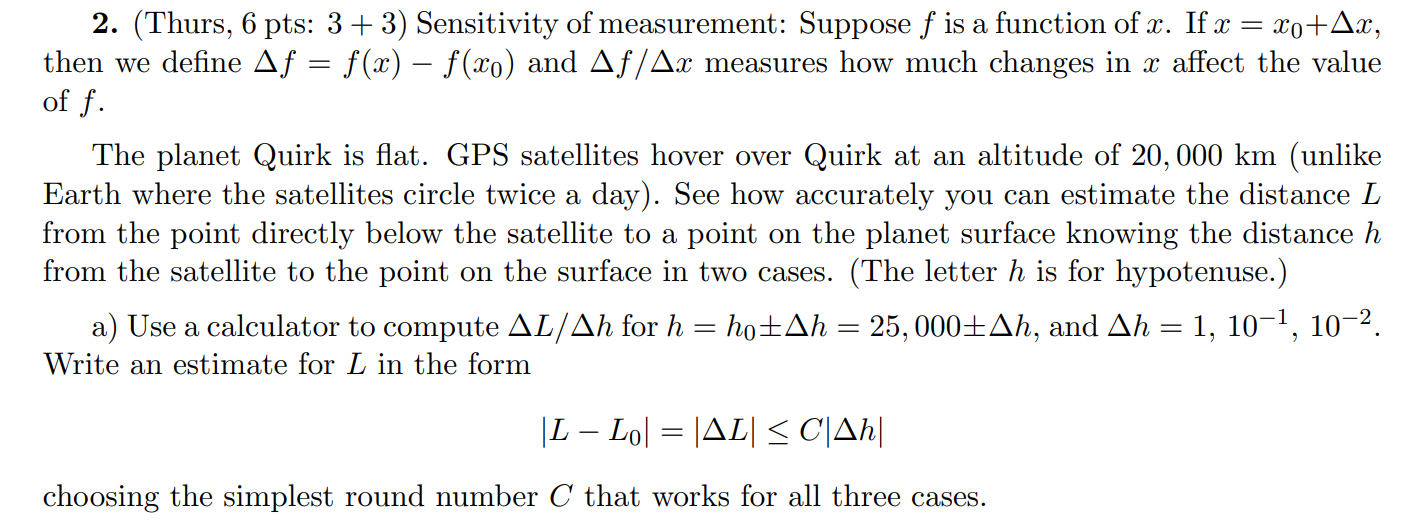
For the 2nd part of this question, I don't understand what L_0 would be
 ocean sealBOT
math
 sage pond
what is $|L - L_0|$
ocean sealBOT
math
 lone heartBOT
@sage pond Has your question been resolved?
 harsh girder
$L = f(h)$, $h_0 = 25000, L_0 = f(h_0)$
ocean sealBOT
秋水
 sage pond
ahh
I see it
is this standard notation?
I've never seen stuff like this before its very confusing
.close
lone heartBOT
Channel closed
Closed by @sage pond
Use .reopen if this was a mistake.
Available help channel!
Send your question here to claim the channel.
Remember:
• Ask your math question in a clear, concise manner.
• Show your work, and if possible, explain where you are stuck.
• After 15 minutes, feel free to ping <@&286206848099549185>.
• Type the command .close to free the channel when you're done.
• Be polite and have a nice day!
Read #❓how-to-get-help for further information on how to ask a good question, and about conduct in the question channels.
 surreal oracle
 lone heartBOT
Channel closed
Closed due to the original message being deleted
 lone heartBOT
Available help channel!
lone heartBOT
Available help channel!
Send your question here to claim the channel.
Remember:
• Ask your math question in a clear, concise manner.
• Show your work, and if possible, explain where you are stuck.
• After 15 minutes, feel free to ping <@&286206848099549185>.
• Type the command .close to free the channel when you're done.
• Be polite and have a nice day!
Read #❓how-to-get-help for further information on how to ask a good question, and about conduct in the question channels.
 supple elbow
Simpsons rule is applied here but don’t know how to get answer
 lone heartBOT
supple elbow
Simpsons rule is applied here but don’t know how to get answer
lone heartBOT
supple elbow
Simpsons rule is applied here but don’t know how to get answer
@supple elbow Has your question been resolved?
lone heartBOT
Channel closed
Closed due to timeout
Use .reopen if this was a mistake.
Available help channel!
Send your question here to claim the channel.
Remember:
• Ask your math question in a clear, concise manner.
• Show your work, and if possible, explain where you are stuck.
• After 15 minutes, feel free to ping <@&286206848099549185>.
• Type the command .close to free the channel when you're done.
• Be polite and have a nice day!
Read #❓how-to-get-help for further information on how to ask a good question, and about conduct in the question channels.
 scenic falcon
can someone help me i dont understand the question

 gray isle
no
gray isle
you seem to be lacking a lot of coordinate geo fundamentals
scenic falcon
yes
gray isle
no
gray isle
yes, the y-intercept is -10
scenic falcon
oh
gray isle
and how did you determine that
scenic falcon
okay
scenic falcon
gray isle
and how did you determine that
my eyes
gray isle
how exactly did you use your eyes? what exactly were you looking at that lead to the conclusion that this has a y-intercept of -10
scenic falcon
because it was at the end
gray isle
ok.
do you understand why the
b value in
y = mx + b
is the value of y-intercept?
other than that's what the teacher said
scenic falcon
gray isle
do you understand why the
b value in
y = mx + b
is the value of y-intercept?
no
i dont
gray isle
the y-intercept is the location the curve/line intersects the y-axis (which has an equation of x=0)
substituting x=0 into the equation gives the y-coord of that point and hence y-intercept
i.e. substituting
x= 0 into
y = mx + b
gives
y = b
similarly
the x-intercept is the location the curve/line intersects the x-axis (which has an equation of y=0)
substituting y=0 into the equation (and then solving for x) gives the x-coord of that point and hence x-intercept
lone heartBOT
@scenic falcon Has your question been resolved?
lone heartBOT
Channel closed
Closed due to timeout
Use .reopen if this was a mistake.
Available help channel!
Send your question here to claim the channel.
Remember:
• Ask your math question in a clear, concise manner.
• Show your work, and if possible, explain where you are stuck.
• After 15 minutes, feel free to ping <@&286206848099549185>.
• Type the command .close to free the channel when you're done.
• Be polite and have a nice day!
Read #❓how-to-get-help for further information on how to ask a good question, and about conduct in the question channels.
 bronze grotto
Hey, I am stuck on where to go with this problem
 bronze grotto
I tried to imagine how the map would work by putting (x,y) -> (x,0)
And then $f(z) = \frac{1}{z+i}$ so the image of (x,y) is $\frac{1}{x+(i(y+1))} * \frac{x-i(y+1)}{x-i(y+1)}$
ocean sealBOT
NightLight
 bronze grotto
And this is $\frac{x - i(y+1)}{x^2 + (y+1)^2}$ and since we are looking for the inverse image when x < 0 and y = 0 does this mean that $\frac{x - i(y+1)}{x^2 + (y+1)^2} = x$?
ocean sealBOT
NightLight
 bronze grotto
So we would need i(y+1) = 0 so the set of points where y = -1 and then the set of points where x < 0
If so, how would I write the set in set notation?
<@&286206848099549185>
 hard mountain
$$ { (x,y) \in \mathbb{C} | x < 0, y = -1 } $$
bronze grotto
hard mountain
$$ \{ (x,y) \in \mathbb{C} | x < 0, y = -1 \} $$
Ah alright, so is my working correct?
ocean sealBOT
dark knight
 hard mountain
The end result looks correct to me, but don't know enough to comment the validity of your process
bronze grotto
hard mountain
The end result looks correct to me, but don't know enough to comment the validit...
Ah alright that is fair, thank you
.close
lone heartBOT
Channel closed
Closed by @bronze grotto
Use .reopen if this was a mistake.
Available help channel!
Send your question here to claim the channel.
Remember:
• Ask your math question in a clear, concise manner.
• Show your work, and if possible, explain where you are stuck.
• After 15 minutes, feel free to ping <@&286206848099549185>.
• Type the command .close to free the channel when you're done.
• Be polite and have a nice day!
Read #❓how-to-get-help for further information on how to ask a good question, and about conduct in the question channels.
alpine sable
Can systems of inequalities be solved by elimination?
alpine sable

 hybrid terrace
you can:
add inequalities (always)
multiply inequalities(when everything is positive)
alpine sable
So would it be easier to use something like substitution or graphing instead of elimination
hybrid terrace
its up to you
 sturdy valley
Graphical method would be the easiest
alpine sable
I’m good at using elimination for systems of equations but I have a harder time with systems of inequality
 vale wigeon
multiply inequalities(when everything is positive)
when the thing you're multiplying by is of known sign (and remember to flip if you're multiplying by something negative)
vale wigeon
alpine sable
Can systems of inequalities be solved by elimination?
not really
that system of inequalities defines a region in the xy plane that really can't be described in any better way
only graphed
sturdy valley
sturdy valley
Graphical method would be the easiest
Make a rough graph
Convert the inequalities into equations
Mark the x and y intercepts of both the equations
Take origin as the arbitrary point and see if it satisfies the inequalities or not
hybrid terrace
vale wigeon
> multiply inequalities(when everything is positive)
when the thing you're _mult...
this, my bad
sturdy valley
vale wigeon
that system of inequalities defines a region in the xy plane that really can't b...
You could show the solution in set builder notation but that would be a headache tbh
alpine sable
sturdy valley
Make a rough graph
Convert the inequalities into equations
Mark the x and y int...
Sorry I’m kinda new to this but how do I convert it from an inequality to an equation
sturdy valley
alpine sable
Sorry I’m kinda new to this but how do I convert it from an inequality to an equ...
Just replace the greater than or lesser than signs with equal to sign
So that you can plot the straight line on the graph
alpine sable
K
 ebon otter
sturdy valley
Just replace the greater than or lesser than signs with equal to sign
ebon otter
sturdy valley
Just replace the greater than or lesser than signs with equal to sign
Inequality sign to equal sign
alpine sable
So in that system of inequalities above -4,6 would be a solution right?
@sturdy valley
 heady pollen
for example with a volume of 1 i get a surface area of 7.0827 for a sphere and 5.6216 for a half sphere
one sec im gonna write it nicely
alpine sable
K
heady pollen

this only proves that they are not the same
this proves that the half sphere is better

since the square root of 4 is 2, the third root of 4 is smaller than 2
lone heartBOT
@alpine sable Has your question been resolved?
lone heartBOT
Channel closed
Closed due to timeout
Use .reopen if this was a mistake.
Available help channel!
Send your question here to claim the channel.
Remember:
• Ask your math question in a clear, concise manner.
• Show your work, and if possible, explain where you are stuck.
• After 15 minutes, feel free to ping <@&286206848099549185>.
• Type the command .close to free the channel when you're done.
• Be polite and have a nice day!
Read #❓how-to-get-help for further information on how to ask a good question, and about conduct in the question channels.
 opaque smelt
how would I start with either of these questions ? The answer for 25 is 23.125 and 28 is approx 11.3, but I’m really not sure how to get there

 lone heartBOT
opaque smelt
how would I start with either of these questions ? The answer for 25 is 23.125 a...
lone heartBOT
opaque smelt
how would I start with either of these questions ? The answer for 25 is 23.125 a...
 grave cedar
yo
opaque smelt
hi
grave cedar
28
join de
and draw a perpendicular from point E to df say that point X
EX=FG
SO DX =???
opaque smelt
wha
 median dirge
Bruh explain it to him
opaque smelt
trying to see wha u mean
grave cedar
median dirge
Bruh explain it to him
I thought he will get ,u continue pls
i was just trying to help the helpers as there are lot of questions
median dirge
Sure go ahead @grave cedar
grave cedar
grave cedar
I thought he will get ,u continue pls
..
median dirge
No, I aint here helping for now
 opaque smelt
but then what
grave cedar
what is dx now?
opaque smelt
4?
opaque smelt
de is 8 and 4
opaque smelt
yeah I do
grave cedar
what type?
opaque smelt
right
opaque smelt
4^2 + 12^2
grave cedar
grave cedar
do you how to apply pythagoras
?
opaque smelt
de is 12 no?
grave cedar
yes
opaque smelt
and dx is 4
grave cedar
hm
opaque smelt
oh fuck I see
grave cedar
yeah
grave cedar
what is it?
opaque smelt
11.31
opaque smelt
yes!!
grave cedar
acc to your book
grave cedar
and 1 more thing
grave cedar
grave cedar
and 1 more thing
always try to join and see diagrams you will auto matically see tha
i these type of qa\s
grave cedar
opaque smelt
do you have any idea abt 25?
yea but there are no marking of abc
opaque smelt
I think it should look like this
 grave cedar
like what is 11
ok
now lets think
mark every point that touches the circle and intersects and send pic
opaque smelt
 opaque smelt
yes
opaque smelt
yea
opaque smelt
Yup
grave cedar
BE to be found
opaque smelt
what would we use
grave cedar
PYTHAGORAS I G
opaque smelt
with what
grave cedar
JOIN AD
opaque smelt
ok
grave cedar
AD= ?
opaque smelt
yes
grave cedar
adce
opaque smelt
yes
grave cedar
now apply any property of kite
opaque smelt
 grave cedar
to find
opaque smelt
which
opaque smelt
ok
median dirge
I dont think we have a definitive property of a kite alone, but binding the kite within a circle, or circumscribing a kite should yield interesting results here.
opaque smelt
what would be the next step
opaque smelt
would we use soh cah toa or smth
grave cedar
opaque smelt
would we use soh cah toa or smth
oh yea let me check
nah
i dont think
opaque smelt
then I’m not sure where to go from here
grave cedar
umm
opaque smelt
yes
median dirge
Stay here bruh.
grave cedar
ok
opaque smelt
question is kinda dumb 💀
grave cedar
median dirge
It is interesting
hmm
median dirge
Ill solve it anyways
grave cedar
median dirge
Ill solve it anyways
oho
opaque smelt
except we literally had no lesson on it
median dirge
Lol
grave cedar
opaque smelt
except we literally had no lesson on it
which grade?
grave cedar
its my fav actually
opaque smelt
I like it it’s just sometimes questions like this come up
opaque smelt
dae also 90
opaque smelt
U do?
grave cedar
what is ec^2 in triangle ebc
opaque smelt
wym
grave cedar
you see triangle
opaque smelt
yes
grave cedar
EBC
grave cedar
bro tell in sides
opaque smelt
 opaque smelt
yes
opaque smelt
yes
grave cedar
expand ed ^2 what u see? in 2nd eq.
opaque smelt
I think
grave cedar
if you write it goes in brain
grave cedar
opaque smelt
it’s (x+8)(x+8) no?
its (be+8)^2 yea
ur right
now expand this
be^2 gets cancelled
@opaque smelt are u writing equation on copy?🗿
opaque smelt
wym cancelled
opaque smelt
I am
opaque smelt
yea
median dirge
Lol me.
median dirge
Ig Vaibhav mightve a solution in mind
grave cedar
wait i am send pic
median dirge
Using graphing calculators isnt one of the good mathematical ways when you can solve it and have fun
opaque smelt
median dirge
Ig Vaibhav mightve a solution in mind
did you use the equation of a circle or smth
median dirge
No, I used a software
opaque smelt
oh
median dirge
I literally had pulled out a big gun if this software failed
grave cedar
 opaque smelt
wh
opaque smelt
where did the +16 BE come from
grave cedar
 median dirge
Check equation 2.
median dirge
Wait a min.
median dirge
Equation 2 is wrongly formed
opaque smelt
I think I’m confused 💀
grave cedar
median dirge
Equation 2 is wrongly formed
in next step its right
median dirge
Look uh,
opaque smelt
also I might take a sec to respond I’m in another class
grave cedar
median dirge
Look uh,
i know u mean square
yeah
2ab is left
but check 2nd step of 2nd eq
grave cedar
opaque smelt
also I might take a sec to respond I’m in another class
bro does multitasking
😂
grave cedar
opaque smelt
also I might take a sec to respond I’m in another class
also practise more algebra questions or whatever this is called think more and more do hit and try
hm
yea
lone heartBOT
@opaque smelt Has your question been resolved?
lone heartBOT
Channel closed
Closed due to timeout
Use .reopen if this was a mistake.
Available help channel!
Send your question here to claim the channel.
Remember:
• Ask your math question in a clear, concise manner.
• Show your work, and if possible, explain where you are stuck.
• After 15 minutes, feel free to ping <@&286206848099549185>.
• Type the command .close to free the channel when you're done.
• Be polite and have a nice day!
Read #❓how-to-get-help for further information on how to ask a good question, and about conduct in the question channels.
 vast mica
Hey so I need to find these out and ixl just annoys me and I’m just really tired so I would like to get some help
 lone heartBOT
vast mica
Hey so I need to find these out and ixl just annoys me and I’m just really tired...
lone heartBOT
vast mica
Hey so I need to find these out and ixl just annoys me and I’m just really tired...
 buoyant kayak
wait at least 15 minutes before pinging helpers
vast mica
Alright
buoyant kayak
the picture is already drawn..
what do you know about the proportions of similar figures?
vast mica
Yea but I gotta find out y
 sweet junco
hello
vast mica
So who can help me find y please?
vast mica
buoyant kayak
what do you know about the proportions of similar figures?
I don’t know anything basically my math teacher assigned this for no reason
 inner path
 vast mica
Gotta finish this asap tbh
inner path
oh you actually search y sorry
vast mica
Yep
buoyant kayak
if you don't know anything about the subject i recommend going over your notes
vast mica
We didn’t even learn the similar shapes
Like. It’s just a ixl recommendation given. By my teacher for no reason
So who can like help me find y?
buoyant kayak

This math video tutorial discusses similar triangles and how to use proportions to find the missing side and solve for x. This video contains plenty of examples and practice problems.
Pre-Algebra Video Playlist:
https://www.youtube.com/watch?v=WJqw-cxvKgo&list=PL0o_zxa4K1BVoTlaXWFcFZ7fU3RvmFMMG
Algebra Online Course:
https://www.udemy.com/alg...
take a look at this video
vast mica
Thanks
inner path
it's just proportion
inner path
yes np
vast mica
Appreciate it
buoyant kayak
this server is not about giving answers
vast mica
I’m aware
buoyant kayak
then why ask for answers
vast mica
But I’m watching the video rn
inner path
yes, gives your try before
 tacit arch
vast mica
While I’m watching the video can anyone tell me the answer to y?
tacit arch
vast mica
While I’m watching the video can anyone tell me the answer to y?
then why ask
buoyant kayak
then watch the video and then come back and do the problem yourself
if you are still having trouble, people here will be happy to help
vast mica
I just don’t get it
buoyant kayak
but you need to give it an attempt
saying "i don't know anything about this, give me the answer" isn't going to get you anywhere
vast mica
The thing is that if I fail that it goes from 50 to 30 that’s how ixl works so I’m too scared to give it a try
buoyant kayak
then watch the video, come back, and if you're still confused, ask questions
vast mica
Okay
buoyant kayak
the video i sent goes through multiple examples
vast mica
I’ll be back when the video ends
In case I still need help ofc
Alright so I’m back after watching the vid
I only understood that you gotta find the same side which for example is AB and then do other stuff
But I still didn’t understand how to find y
 lone heartBOT
@vast mica Has your question been resolved?
lone heartBOT
@vast mica Has your question been resolved?
vast mica
<@&286206848099549185>
 thick kiln
what
 hushed wolf
find the similarity ratio
vast mica
hushed wolf
find the similarity ratio
I did
 flat crescent
vast mica
Hey so I need to find these out and ixl just annoys me and I’m just really tired...
flat crescent
vast mica
Hey so I need to find these out and ixl just annoys me and I’m just really tired...
Sides are proportional
Similar triangles have the same proportional side lengths, so the same sine, cosine, tangent... (you don't need any trig function here tho)
So 60/32 is a ratio which is equal to the one on the other triangle
lone heartBOT
@vast mica Has your question been resolved?
lone heartBOT
Channel closed
Closed due to timeout
Use .reopen if this was a mistake.
Available help channel!
Send your question here to claim the channel.
Remember:
• Ask your math question in a clear, concise manner.
• Show your work, and if possible, explain where you are stuck.
• After 15 minutes, feel free to ping <@&286206848099549185>.
• Type the command .close to free the channel when you're done.
• Be polite and have a nice day!
Read #❓how-to-get-help for further information on how to ask a good question, and about conduct in the question channels.
alpine sable
 lone heartBOT
alpine sable
alpine sable
lone heartBOT
alpine sable
alpine sable
can anyone help with simplifying this trig question?
 fallen verge
is that cos^2
alpine sable
yes
fallen verge
!status
lone heartBOT
What step are you on?
1. I don't know where to begin
2. I have begun but got stuck midway
3. I got an answer but I'm told it's wrong
4. I got an answer and would like my work checked
5. I have a question about someone else's worked solution
6. None of the above
Show your work, and if possible, explain where you are stuck.

 alpine sable
fallen verge
you have to distribute the negative
alpine sable
fallen verge
you have to distribute the negative
wdym?
alpine sable
yeah
fallen verge
1-cos^2(x)=1-(1-sin^2(x))
 fallen verge
there you go
 idle steeple
can someone help?
 alpine sable
 fallen verge
yes you can simplify it further
alpine sable
can you give me a hint on how please?
fallen verge
you can get rid of the square root
fallen verge
yes
lone heartBOT
Channel closed
Closed by @ionic basin
Use .reopen if this was a mistake.
Available help channel!
Send your question here to claim the channel.
Remember:
• Ask your math question in a clear, concise manner.
• Show your work, and if possible, explain where you are stuck.
• After 15 minutes, feel free to ping <@&286206848099549185>.
• Type the command .close to free the channel when you're done.
• Be polite and have a nice day!
Read #❓how-to-get-help for further information on how to ask a good question, and about conduct in the question channels.
 fresh wigeon
Hey. Im confused on what this is in the red circle. They got the reduced echelon form but then what is this?
 lone heartBOT
fresh wigeon
Hey. Im confused on what this is in the red circle. They got the reduced echelon...
fresh wigeon
lone heartBOT
fresh wigeon
Hey. Im confused on what this is in the red circle. They got the reduced echelon...
fresh wigeon
also why is it infinite solutions?
 viscid pawn
i think what they are trying to say is that it's a linear combination ( which has an infinite size by itself for everything in IR ) has it been written Vect(...) ?
fresh wigeon
how did they even get that ref into that form tho
like how did they put it in that vector form
im just confused
cool pfp
 gusty gorge
basically you have free variables and not-free variables
you write the not-free variables in terms of the free variables
so in this case, c4 is the only free variable
gusty gorge
c_4 the variable corresponding to the fourth column
fresh wigeon
sorry brain is melted and im really sick so i can barely think lol.
i see 4
2
and -9
in the c4
 fresh wigeon
yes
gusty gorge
I'm guessing your question is something along the lines of "find all solutions to this system of equations"
gusty gorge
well yeah, so if it's not, then there won't be any solutions
do you recognize that the solutions will be 4-dimensional vectors?
fresh wigeon
yes
im just trying to figure out where it got its numbers from
like

this got me so confused when i saw it
gusty gorge
so we're going to use c_1, c_2, c_3, c_4 to denote each component of the solution vector
I'm trying to explain that to you
gusty gorge
c_1 corresponds to the first row of the solution vector
the first component
remember we write individual vectors as columns
you can identify the not-free variables by looking at the rref of the augmented matrix
fresh wigeon
ok so c1 is first row of solution vector
gusty gorge
it's the first number of the solution vector
the solution vector is literally just 4 rows of one number each
fresh wigeon
yeah rref right
gusty gorge
the not-free variables are given by the pivots
fresh wigeon
idk why on this they only went to ref then
gusty gorge
turns out you don't have to compute an rref
fresh wigeon
im not gonna lie im still confused... im sorry
idk why i cant figure out how they got there
gusty gorge
$\left[\begin{matrix}1 & 0 & 0 & 9 & -10\0 & 1 & 0 & -7 & 8\0 & 0 & 1 & 3 & - \frac{5}{3}\end{matrix}\right]$
ocean sealBOT
Saccharine
 gusty gorge
this is the rref
gusty gorge
so c_4 is the free variable here
we write the not-free variables c_1, c_2, c_3 in terms of c_4
gusty gorge
you can get away with something called back-substitution
gusty gorge
it's more annoying to do unless you're a computer
well that's assuming you have a computer to compute the rref for you
gusty gorge
if you're doing it by hand, you might not like having to continue to do row operations
fresh wigeon
yeah i get a ti84 lol
yeah
but how is there infinitely many solutions if there isnt a 0 in the answer column thingy
gusty gorge
so are you asking generally why linear systems might have infinitely many solutions
or why does this particular answer imply there are infinitely many solutions?
gusty gorge
do you understand what this notation means?
 fresh wigeon
solution minus c4 is the solution for one column
gusty gorge
no
it means that a vector [c1, c2, c3, c4]^T is a solution of the system of linear equations if is equal to
[-10, 8, 5/3, 0] + [-9, 7, -3, 1]c4
but another interpretation is that
you can generate all of the solutions to the system by picking some real number, which you call c4
and then multiplying it by [-9, 7, -3 1] and adding the vector [-10, 8, -5/3, 0]
fresh wigeon
so basically any number can be c4 and its still a solution since its free variables
gusty gorge
yes
fresh wigeon
lets say i have
1 0 1
no
1 0 2 10
0 1 5 25
so basically theres infinitely many solutions
cause theres 2 and 5 as a free variable
for the given solution
lone heartBOT
@fresh wigeon Has your question been resolved?
Channel closed
Closed by @fresh wigeon
Use .reopen if this was a mistake.
Available help channel!
Send your question here to claim the channel.
Remember:
• Ask your math question in a clear, concise manner.
• Show your work, and if possible, explain where you are stuck.
• After 15 minutes, feel free to ping <@&286206848099549185>.
• Type the command .close to free the channel when you're done.
• Be polite and have a nice day!
Read #❓how-to-get-help for further information on how to ask a good question, and about conduct in the question channels.
 autumn tartan
 lone heartBOT
autumn tartan
autumn tartan
lone heartBOT
autumn tartan
autumn tartan
what is this problem asking me to do?
 raven haven
do you know how a limit works
basically what they want you to do is plug in things like
5.01
5.001
5.0001
erc
and also it looks like
,tex \factoid differentiable
ocean sealBOT
 gusty gorge
why do they teach the other definition of derivative
autumn tartan
how did you know to pick a number like the 5.01 etc you showed?
and how will i know what is correct?
gusty gorge
basically lim x->5 means "as x gets arbitrarily close to 5"
autumn tartan
can we do 4.9, 4.99, 4.999 ?
gusty gorge
yes
autumn tartan
how will i know if i found the right decimal/answer?>
gusty gorge
you won't ever be right
whether you're within three decimal places? that's a little hard to decide
so just be really conservative and try something like 4.999999999999
autumn tartan
what kind of number should i be expecting to get?
gusty gorge
something like 0.2
autumn tartan
how do you know that
gusty gorge
yes it's the instantaneous slope of ln(x) at x = 5
basically the slope of the tangent line
autumn tartan
.close
lone heartBOT
Channel closed
Closed by @autumn tartan
Use .reopen if this was a mistake.
Available help channel!
Send your question here to claim the channel.
Remember:
• Ask your math question in a clear, concise manner.
• Show your work, and if possible, explain where you are stuck.
• After 15 minutes, feel free to ping <@&286206848099549185>.
• Type the command .close to free the channel when you're done.
• Be polite and have a nice day!
Read #❓how-to-get-help for further information on how to ask a good question, and about conduct in the question channels.
fresh wigeon
 lone heartBOT
fresh wigeon
fresh wigeon
lone heartBOT
fresh wigeon
fresh wigeon
where does this green area come from?
is it because w is free vairable so w=w so w=0+w so 0 + (1)w
if it is ill close this just need a yes or no, appreciate it guys
ty:D
gusty gorge
yes
lone heartBOT
@fresh wigeon Has your question been resolved?
lone heartBOT
Channel closed
Closed due to timeout
Use .reopen if this was a mistake.
Available help channel!
Send your question here to claim the channel.
Remember:
• Ask your math question in a clear, concise manner.
• Show your work, and if possible, explain where you are stuck.
• After 15 minutes, feel free to ping <@&286206848099549185>.
• Type the command .close to free the channel when you're done.
• Be polite and have a nice day!
Read #❓how-to-get-help for further information on how to ask a good question, and about conduct in the question channels.
 alpine valve
Region R is bounded by y=x^2, the y-axis, and the line y=4. Region R is rotated about the x-axis.
lone heartBOT
alpine valve
Region R is bounded by y=x^2, the y-axis, and the line y=4. Region R is rotated ...
alpine valve
what method am i supposed to use?
 median oar
lone heartBOT
median oar
lone heartBOT
@alpine valve Has your question been resolved?
alpine valve
<@&286206848099549185>
i keep getting 256/5 pi but its not an answer on my answer sheet
alpine sable
,w integral from -2 to 2 of 4^2 - (x^2)^2
ocean sealBOT


 Requested by hibyehibye#9497
alpine valve
Requested by hibyehibye#9497
alpine valve
but is that the right integral
im doing this thing called "circuit training" and 256 pi/5 is not an answer
alpine sable
gimme like 3mins ill check
 jagged cobalt
should be (4-x^2)^2 no?
alpine valve
disk method?
jagged cobalt
,w integral from 0 to 2 of (4-x^2)^2
ocean sealBOT

 alpine valve
no
jagged cobalt
hm
 versed bough
alpine valve
no
versed bough
alpine valve
no
and i took that personally
 serene junco
alpine valve
which is half of what i first got
serene junco
alpine valve
which is half of what i first got
This
You did the bounds from -2 to 2 but it should be 0 to 2
The region is bounded by the y-axis
lone heartBOT
Channel closed
Closed by @alpine valve
Use .reopen if this was a mistake.
Available help channel!
Send your question here to claim the channel.
Remember:
• Ask your math question in a clear, concise manner.
• Show your work, and if possible, explain where you are stuck.
• After 15 minutes, feel free to ping <@&286206848099549185>.
• Type the command .close to free the channel when you're done.
• Be polite and have a nice day!
Read #❓how-to-get-help for further information on how to ask a good question, and about conduct in the question channels.
alpine valve
nvm i need help again @serene junco y=x^2 and y=4x-x^2 in the first quadrant
lone heartBOT
alpine valve
nvm i need help again <@490649542077841408> y=x^2 and y=4x-x^2 in the first quad...
alpine valve
shell method??
 untold cloud
hallo
serene junco
alpine valve
nvm i need help again <@490649542077841408> y=x^2 and y=4x-x^2 in the first quad...
what is the axis of rotation?
alpine valve
oh x-axis
serene junco
Then I'd go with disks/washers
alpine valve
but the graph isn't bordering any axis
serene junco
That's okay. It wasn't bordering the x-axis in your last problem either
except at a single point
That's where the hole in the washer comes from
serene junco
yeah
alpine valve
(4x-x^2)^2 - (x^2)^2?
serene junco
yep
alpine valve
oo
okay
so i have question
how do you know when to use disk or washer
this problem can use disk too?
serene junco
Disks and washers are the same method
It's just that if one of your bounds is the line you're rotating around, there's no hole
so they call it a disk instead of a washer
🤷
Unless you mean shells
serene junco
Do you see how in this problem, you're taking cross sections that are perpendicular to the axis of rotation?
alpine valve
yes
serene junco
That's because you're using disks/washers
To do shells, you take cross sections parallel to the axis of rotation
Like if you wanted to rotate this region around the y-axis instead
Then each cross section forms a "shell" of a cylinder
alpine valve
but when i rotate around y-axis can't i still use disk/washer in terms of y
serene junco
Yes, you'd just have to change the functions to be in terms of y
x=sqrt(y) for instance
That would be a lot more work though
alpine valve
so instead of changing to y, use shell?
serene junco
Idk, maybe it's about the same
Both would definitely work
sqrts just get ugly sometimes lol
 serene junco
I'm hesitant to say "all", I'd have to think about it
Most of the time both methods work, but there's usually one that's a better choice
alpine valve
hmm i see
so for shell since cross section is parallel, if it asks you to rotate over x-axis you would solve in terms of y?
serene junco
yes
alpine valve
oh, thats confusing lol
serene junco
For disks/washers, the cross section becomes the radius of the disk, so it's perpendicular to the axis of rotation.
For shells, your cross section becomes the height of the cylindrical shell, parallel to the axis of rotation
serene junco
I was trying to find a good picture as a visual aid but I can't find anything good lol
np, go ahead
Here's a decent picture representing the shell method, rotating around the x-axis with a horizontal cross section

 serene junco
,rotate
ocean sealBOT
 alpine valve
wait
ok
its from 0 to 6
hold on
yeah ok yk what
don't look at that pic
idk what i was doing
my arithmetic is so off
alpine valve
yeahhh sorry for wasting ur time lol
i think i got most of it but im kind of careless
serene junco
You didn't, no worries
 lone heartBOT
Channel closed
Closed by @alpine valve
Use .reopen if this was a mistake.
serene junco
np 👍
lone heartBOT
Available help channel!
Send your question here to claim the channel.
Remember:
• Ask your math question in a clear, concise manner.
• Show your work, and if possible, explain where you are stuck.
• After 15 minutes, feel free to ping <@&286206848099549185>.
• Type the command .close to free the channel when you're done.
• Be polite and have a nice day!
Read #❓how-to-get-help for further information on how to ask a good question, and about conduct in the question channels.
 digital relic
How do this problem
 lone heartBOT
digital relic
How do this problem
buoyant kayak
lone heartBOT
digital relic
How do this problem
buoyant kayak
what is "the line above"
digital relic
buoyant kayak
what is "the line above"
my bad
 buoyant kayak
so it tells you the line is perpendicularto y=x+7
what does that mean its slope is?
digital relic
-1
buoyant kayak
not quite
oop
the edit is correct
so now you have a coordinate pair and the slope
what formula can you use to get the equation of a line from that?
digital relic
buoyant kayak
what formula can you use to get the equation of a line from that?
y-y1=m(x-x1)?
digital relic
buoyant kayak
then you can simplify from there
is it y=-1x+3?
buoyant kayak
,w solve for y, y-5=-(x+2)
ocean sealBOT

 Requested by a disappointing son#0540
buoyant kayak
Requested by a disappointing son#0540
buoyant kayak
looks good
digital relic
ok thx
lone heartBOT
@digital relic Has your question been resolved?
Channel closed
Closed by @digital relic
Use .reopen if this was a mistake.
Available help channel!
Send your question here to claim the channel.
Remember:
• Ask your math question in a clear, concise manner.
• Show your work, and if possible, explain where you are stuck.
• After 15 minutes, feel free to ping <@&286206848099549185>.
• Type the command .close to free the channel when you're done.
• Be polite and have a nice day!
Read #❓how-to-get-help for further information on how to ask a good question, and about conduct in the question channels.
 rotund crater
someone can help me
lone heartBOT
rotund crater
someone can help me
rotund crater
why tiends to 3
 jagged cobalt
the expression is undefined when x=-3
rotund crater
indertiminant?
rotund crater
indeterminate?
ocean sealBOT


 rotund crater
oh is that in my class it is with limits so it would be lim x-> -3
jagged cobalt
yeah, the limits have shown it tends to either + or - infinity depending on the side you approach from - meaning its value is undefined at x=-3, therefore there must be a vertical asymptote
lone heartBOT
Channel closed
Closed by @rotund crater
Use .reopen if this was a mistake.
Available help channel!
Send your question here to claim the channel.
Remember:
• Ask your math question in a clear, concise manner.
• Show your work, and if possible, explain where you are stuck.
• After 15 minutes, feel free to ping <@&286206848099549185>.
• Type the command .close to free the channel when you're done.
• Be polite and have a nice day!
Read #❓how-to-get-help for further information on how to ask a good question, and about conduct in the question channels.
 restive hearth
 lone heartBOT
restive hearth
restive hearth
lone heartBOT
restive hearth
restive hearth
How would I do this problem?
 steady tusk
Any tips/pointers how to even start using the variables separable method to find the general solution for xy' - xy = y?
 long axle
#❓how-to-get-help @steady tusk
steady tusk
Apologies
 last ether
alpine sable
limak is that the derivative of y?
last ether
alpine sable
limak is that the derivative of y?
My guy this channel is not Limak's
Help the relevant person
lone heartBOT
@restive hearth Has your question been resolved?
restive hearth
long axle
Try continuing on the path u have started
Okay

I don’t think this is accurate
lone heartBOT
Channel closed
Closed due to timeout
Use .reopen if this was a mistake.
lone heartBOT
Available help channel!
Send your question here to claim the channel.
Remember:
• Ask your math question in a clear, concise manner.
• Show your work, and if possible, explain where you are stuck.
• After 15 minutes, feel free to ping <@&286206848099549185>.
• Type the command .close to free the channel when you're done.
• Be polite and have a nice day!
Read #❓how-to-get-help for further information on how to ask a good question, and about conduct in the question channels.
 long cave
I’m trying to write this proof right now, I did the base case and found the pattern but I have no idea where to go from here. This is the first time I’m doing a proof on a recursive function
 lone heartBOT
long cave
I’m trying to write this proof right now, I did the base case and found the patt...
lone heartBOT
long cave
I’m trying to write this proof right now, I did the base case and found the patt...
@long cave Has your question been resolved?
long cave
<@&286206848099549185>
alpine sable
long cave
I’m trying to write this proof right now, I did the base case and found the patt...
Okay so you went from f(n-1)+1 to f(n-k)+k and that might just be me but that seems misguided because if n is odd then n-1 is even and you're gonna divide it by 2 next not remove 1 from it and add 1 to the result like previously
Or maybe there's a good reason but I'm just not following your reasoning
I'm not sure how to formally phrase it but I would personally work from 0 up
Like the function f here will get smaller and smaller values of n
So instead I'd work backwards
Start at f(0)=0 and see how that influences f for values of n bigger than 0
And furthermore I'd try to prove that f(0)=g(0) and see how that makes f(n)=g(n) true for other values of n
I can tell I'm not being clear, so feel free to ask for clarifications
long cave
yea for the first thing you said I just wrote it out by continually iterating the function
i checked with desmos and it does say its equivalent
alpine sable
long cave
yea for the first thing you said I just wrote it out by continually iterating th...
Which doesn't make sense
The function might be recursive but it depends on whether n is even or odd
long cave
thats true i did not take into account whether n is even or odd
alpine sable
So it won't do the same over and over again
long cave
ill have to think through it a bit thanks for your help
alpine sable
long cave
thats true i did not take into account whether n is even or odd
That's not really the issue... For example if it was f(n-2)+1 you could indeed apply the function over and over because even-2=even
Like assuming n is even/odd to begin with is fine but assuming the "new value of n" will also be even isn't
Which is the reason you can't apply f(n)=f(n-1)+1 over and over
long cave
oh ok i see
alpine sable
@long cave Are you having any roadblocks?