#help-0
1 messages · Page 148 of 1
 pseudo ice
As in explain how you’d do that one, sorry
 grim basin
ohhh
pseudo ice
If you haven’t done it yet
pseudo ice
Cool cool 
grim basin
thank you!
pseudo ice
Pasting it down here to keep track
 grim basin
kk!
pseudo ice
So like notice how when you differentiate cos, you get “kind of like” sin, yea?
(You have that cos differentiates to -sin of course!)
And that we have like a bunch of cos terms, but then that’s all multiplied by sin?
pseudo ice
So like the idea here would be to try and choose cos as our substitution, cause if we did we’d get a “ordinary” polynomial which is easy to deal with
And powers are easy to work with of course as we know how they integrate
So like if you had u=cos(x) then du/dx = -sin(x) and you know the rest
Does that help a bit?
pseudo ice
There are, but notice how they’re all powers of cos, right?
grim basin
yeah
pseudo ice
If we could make a substitution for cos, then we could replace them all at the same time
And that we would get something like u^5 - 9u^3 + u
And that’s easy to integrate with respect to u
pseudo ice
Sure thing!
grim basin
also i think i did 9 wrong? it said i did it wrong
 pseudo ice
Oh yeah, sec(u)tan(u) integrates to sec(u)
pseudo ice
Because sec(u) differentiates to sec(u)tan(u) (what I meant before here btw)
pseudo ice
Looks right to me! 
pseudo ice
Ye ye, let’s goooo
grim basin
oh that was right?


 grim basin
oh pfff
pseudo ice
Wolfie 
grim basin
lmao
pseudo ice
I’m trying to be lazy and flex here haha
pseudo ice
But yea you did the working right
grim basin
sweet!
pseudo ice
Just wanted to make sure in case I was being blind 
pseudo ice
Yep yep, the final one up there right?
grim basin
yes ma’am
pseudo ice
 pseudo ice
Aha, what did you try?
grim basin
 grim basin
i always do that
pseudo ice
Maybe a clearer sub might have been e^{8x} + 5
pseudo ice
But nonetheless the one you chose also works too!
 pseudo ice
1/8 again no?
grim basin
i need to STOP doing that
pseudo ice
Heheh you’ll get there
I mean with these ones, you’re quite lucky in that you could always differentiate and check with what you started with!
grim basin
how so?
pseudo ice
grim basin
So like with your one here, if I differentiated the 8ln|e^{8x} + 5|, if I remembered the chain rule, I would get 64e^{8x}/(e^{8x} + 5)
pseudo ice
grim basin
also i think i did 9 wrong? it said i did it wrong
The 10 here is a tiny bit more pain but it’s not the worst either to check
But like checking you get the same thing that you started with, something I liked doing to check my sanity!
pseudo ice
Yea it’s just something that I found helped me! But otherwise does all that help?
pseudo ice
Well now you know how to do them! Always a pleasure (think I haven’t worked with you for a while actually 😱)
If you ever need anything just let me know!
 pseudo ice
You too! It’s morning but I’m gonna rest a tiny bit before getting back to doing stuff haha
Catch you around
 lone heartBOT
Channel closed
Closed by @grim basin
Use .reopen if this was a mistake.
 Available help channel!
Send your question here to claim the channel.
Remember:
• Ask your math question in a clear, concise manner.
• Show your work, and if possible, explain where you are stuck.
• After 15 minutes, feel free to ping <@&286206848099549185>.
• Type the command .close to free the channel when you're done.
• Be polite and have a nice day!
Read #❓how-to-get-help for further information on how to ask a good question, and about conduct in the question channels.
 alpine sable
Help 0 exists?
lone heartBOT
alpine sable
Help 0 exists?
alpine sable
whaaa....

I'm stuck here
trying to do exponetial residual
first i found equation using least square method
Now i'm not sure what my next step to do the plot
oh wait. I have to finish
nvm 😄
.close
lone heartBOT
Channel closed
Closed by @knotty sparrow
Use .reopen if this was a mistake.
lone heartBOT
Available help channel!
Send your question here to claim the channel.
Remember:
• Ask your math question in a clear, concise manner.
• Show your work, and if possible, explain where you are stuck.
• After 15 minutes, feel free to ping <@&286206848099549185>.
• Type the command .close to free the channel when you're done.
• Be polite and have a nice day!
Read #❓how-to-get-help for further information on how to ask a good question, and about conduct in the question channels.
 lime abyss
 lone heartBOT
lime abyss
lone heartBOT
lime abyss
 north hemlock
shouldn't u be subtracting? in the columns?
north hemlock
lemme see the notes
lime abyss
 north hemlock
ah I see
so it seems good then tbh
so u get 3x^2-4x+(p-4)+(p+5)
so 3x^2-4x+2p+1
lime abyss
 lime abyss
so is this right?
north hemlock
,w expand (3x^2-4x+1)(x+1)
 ocean sealBOT


 Requested by Jukelyn#9848
north hemlock
Requested by Jukelyn#9848
north hemlock
yup
lone heartBOT
Channel closed
Closed by @lime abyss
Use .reopen if this was a mistake.
Available help channel!
Send your question here to claim the channel.
Remember:
• Ask your math question in a clear, concise manner.
• Show your work, and if possible, explain where you are stuck.
• After 15 minutes, feel free to ping <@&286206848099549185>.
• Type the command .close to free the channel when you're done.
• Be polite and have a nice day!
Read #❓how-to-get-help for further information on how to ask a good question, and about conduct in the question channels.
 austere linden
hello!
lone heartBOT
austere linden
hello!
austere linden
i have a tiny pb with a statement of a property
\int{\frac{dt}{(b-t)^a}} , a real, exists only if a < 1 right ?
oh how can i write in tex
north hemlock
$$\int{\frac{dt}{(b-t)^a}}$$ , a real, exists only if a < 1 right ?
ocean sealBOT
Jukelyn
 austere linden
nevermind, is it true that this property imply: a = 1 => the int does not exist ?
austere linden
bc it gives us the existence of the int on t=b, but the contrapositive sentence is not that the int does not exists when a!=b
it's hard to express myself in english lol
i mean
a=1 only gives us "oh you have to find another way to solve it" and this way can be "the int does not exists" but we cannot affirm it just using a=1 right ?
[ a<1 => int exists ] =/=> [ a=1 => int does not exist ]
right ? it's my question
north hemlock
I'm not sure I follow and I'm pretty sure I also misunderstood what u meant previously, hopefully somebody can follow thru tho
austere linden
haha it's hard to express myself in english sorry
my question is:
{ $$\int_a^b{\frac{dt}{(b-t)^c}}$$ \text {exists if c < 1} } \longrightarrow { $$\int_a^b{\frac{dt}{(b-t)^c}}$$ \text{does not exists if c = 1 } }
lol
my question is:
 placid swallow
b and a are bounds?
ocean sealBOT
nuh.
Compile Error! Click the  reaction for more information.
(You may edit your message to recompile.)
 austere linden
is the inclusion true ?
placid swallow
your question here is when this is integrable?
 austere linden
i know it exists on b when c<1, but if c=1, i want to know if c=1 is a sufficient result to affirm that it does not exist
placid swallow
Define exist
austere linden
i'm sorry i'm french i'm struggling in english lol
converges
in french an int exists <=> it converges
placid swallow
well according to basically every textbook a function is Riemann integrable if:
- it's bounded
- It is continuous almost everywhere in [a, b]
ocean sealBOT
nuh.
 austere linden
converging on t=1
it's equivalent to 1/(1-t) on t-->b=1
but BC it's equivalent to a Riemann function where the exposant =1, i want to know if it's a sufficient result to say it diverges
placid swallow
pretty sure this one doesn't converge
obviously when u plug 1, you end up with 0 on the denominator, so u have to split the integral in two
austere linden
oh and bc you got int(1) that diverges you can say that my int is equivalent to a divergent integral on 1 so it diverges
so i cannot stop myself to exposant=1 => diverges
placid swallow
exactly
austere linden
by exposant i mean (1-t)^1
placid swallow
the function being discontinuos at one of the bound doesn't imply that the integral doesn't converge
lone heartBOT
Channel closed
Closed by @austere linden
Use .reopen if this was a mistake.
Available help channel!
Send your question here to claim the channel.
Remember:
• Ask your math question in a clear, concise manner.
• Show your work, and if possible, explain where you are stuck.
• After 15 minutes, feel free to ping <@&286206848099549185>.
• Type the command .close to free the channel when you're done.
• Be polite and have a nice day!
Read #❓how-to-get-help for further information on how to ask a good question, and about conduct in the question channels.
 brisk totem
(x)^2=x+x+x+x______ x times. Taking derivative of both sides. 2x=1+1+1__________x times. Hence, 2x=x. Hence, 2=1. Where is the problem in this?
lone heartBOT
brisk totem
(x)^2=x+x+x+x______ x times. Taking derivative of both sides. 2x=1+1+1____...
@brisk totem Has your question been resolved?
lone heartBOT
Channel closed
Closed due to timeout
Use .reopen if this was a mistake.
lone heartBOT
Available help channel!
Send your question here to claim the channel.
Remember:
• Ask your math question in a clear, concise manner.
• Show your work, and if possible, explain where you are stuck.
• After 15 minutes, feel free to ping <@&286206848099549185>.
• Type the command .close to free the channel when you're done.
• Be polite and have a nice day!
Read #❓how-to-get-help for further information on how to ask a good question, and about conduct in the question channels.
 errant dagger
 lone heartBOT
errant dagger
errant dagger
lone heartBOT
errant dagger
errant dagger
ive done this type of question many times a long time ago but im not really remembering or figuring out how to do it
ive started iwth assuming its true
and proving by contradiction
north hemlock
hmmm... change of base or prove irrational
north hemlock
errant dagger
and proving by contradiction
this
errant dagger
but im not sure where to find the contradiction
north hemlock
this is good to prove irrational
errant dagger
i was thinking something about signage?
north hemlock
wait I saw this question in a video before
north hemlock

Mathematics Stack Exchange
Prove that $\log_2 7$ is irrational.
Book solution: Suppose $\log_2 7$ is rational. Then $\log_2 7=a/b$, where $a$ and $b$ are integers. We may assume that $a>0$ and $b>0$. We have $2^{a/b}=...
errant dagger
hmm
i see that
2^a =/= 7^b
since even times even is even and odd times odd is odd
lone heartBOT
@errant dagger Has your question been resolved?
errant dagger
.close
lone heartBOT
Channel closed
Closed by @errant dagger
Use .reopen if this was a mistake.
Available help channel!
Send your question here to claim the channel.
Remember:
• Ask your math question in a clear, concise manner.
• Show your work, and if possible, explain where you are stuck.
• After 15 minutes, feel free to ping <@&286206848099549185>.
• Type the command .close to free the channel when you're done.
• Be polite and have a nice day!
Read #❓how-to-get-help for further information on how to ask a good question, and about conduct in the question channels.
 dull lily
 lone heartBOT
dull lily
lone heartBOT
dull lily
What step are you on?
1. I don't know where to begin
2. I have begun but got stuck midway
3. I got an answer but I'm told it's wrong
4. I got an answer and would like my work checked
5. I have a question about someone else's worked solution
6. None of the above
 wind cloak
Do you mean derivative?
 pliant cedar
U must use the chain rule to differentiate this
wind cloak
And you're meant to differentiate this expression?
dull lily
so i got -1/(sqrt(1-(x^1/2))
yeah
once i get that by plugging in
the x^1/2 in for x
i have to chain rule right
pliant cedar
dull lily
so i got -1/(sqrt(1-(x^1/2))
(x^½)²
pliant cedar
dull lily
so x^1/4
No
dull lily
oh?
pliant cedar
1/2 multiplied by 2 is not 1/4
pliant cedar
dull lily
so i got -1/(sqrt(1-(x^1/2))
Shud be the denominator there
dull lily
yeah that is!
now the chain rule aprt is whats throwing me off
i have to multiply
everything we did up here
by the derivative of x^1/2
pliant cedar
Yes
dull lily
cool so i guess im having problems multiplying this problem through the two terms
the original multiplied by the derivative of x^1/2
pliant cedar
U have $-\frac{1}{\sqrt{1-x}}\times\frac{1}{2\sqrt{x}}$
ocean sealBOT
SilverSoldier
 pliant cedar
How would u multiply something like 4/5 * 2/3
pliant cedar
Yes
dull lily
2sqrtx * sqrt(1-x)
pliant cedar
dull lily
2sqrtx * sqrt(1-x)
Will be ur denominator
pliant cedar
Yes
dull lily
ohhh ok
yeah i got the concept
its just im terrible at like basic math today idk why
in any case thanks so much for your help!
i really appreicate it
.close
lone heartBOT
Channel closed
Closed by @dull lily
Use .reopen if this was a mistake.
dull lily
lol
lone heartBOT
Available help channel!
Send your question here to claim the channel.
Remember:
• Ask your math question in a clear, concise manner.
• Show your work, and if possible, explain where you are stuck.
• After 15 minutes, feel free to ping <@&286206848099549185>.
• Type the command .close to free the channel when you're done.
• Be polite and have a nice day!
Read #❓how-to-get-help for further information on how to ask a good question, and about conduct in the question channels.
 dim coral
how do i do this qn
 lone heartBOT
dim coral
how do i do this qn
wind cloak
lone heartBOT
dim coral
how do i do this qn
wind cloak
$\int_0^x \dd{x} = \int_0^3 4e^{1 - 2t}\dd{t}$
ocean sealBOT
NEONPerseus
 wind cloak
Is this what you did?
dim coral
no i didnt do the definite integral
lone heartBOT
@dim coral Has your question been resolved?
lone heartBOT
Channel closed
Closed by @dim coral
Use .reopen if this was a mistake.
Available help channel!
Send your question here to claim the channel.
Remember:
• Ask your math question in a clear, concise manner.
• Show your work, and if possible, explain where you are stuck.
• After 15 minutes, feel free to ping <@&286206848099549185>.
• Type the command .close to free the channel when you're done.
• Be polite and have a nice day!
Read #❓how-to-get-help for further information on how to ask a good question, and about conduct in the question channels.
 strong prism
Hey, I was asked to prove: $((a+|a|)/2)^2+((a-|a|)/2)^2=a^2$
ocean sealBOT
therealcain
 strong prism
The way I did was by simplifying and moving a^2 to the square root of the entire left side, and then showing a=a.
I looked at the answers and they used the properties of exponents, the properties of the absolute value and Newton's Binomial Theorem to prove it.
I wonder if the way I did is even correct after seeing that solution, is it correct to just simplify it up to the point of a=a ?
lone heartBOT
@strong prism Has your question been resolved?
lone heartBOT
@strong prism Has your question been resolved?
Channel closed
Closed by @strong prism
Use .reopen if this was a mistake.
Available help channel!
Send your question here to claim the channel.
Remember:
• Ask your math question in a clear, concise manner.
• Show your work, and if possible, explain where you are stuck.
• After 15 minutes, feel free to ping <@&286206848099549185>.
• Type the command .close to free the channel when you're done.
• Be polite and have a nice day!
Read #❓how-to-get-help for further information on how to ask a good question, and about conduct in the question channels.
 high ether
the derivative of a L(f(x)) when L is a linear function is L(f'(x)) right?
but if we apply the chain rule we get L(f(x))'=L'(f(x))*(f'(x))
and ig the derivative of a linear function is itself. so L'(f(x))=L(f(x))
what's wrong?
lone heartBOT
high ether
the derivative of a L(f(x)) when L is a linear function is L(f'(x)) right?
but i...
high ether
wind cloak
A linear function L(x) = ax + b
on any space. Like trace for example or transpose
wind cloak
Out of my range :/
high ether
wind cloak
Out of my range :/
but idc about that i am just giving examples. But yeah im telling you this so that you know i am working in the theoretical world
but ok ill just wait maybe someone else can help
high ether
Ah fuck
 mortal trellis
but that's really again just the same as L(f'(x))
mortal trellis
always the correspondence between a linear function and its matrix
high ether
so the derivative of a linear application isnt the application itself
high ether
the jacobian matrix?
high ether
whats the difference between a linear function and a matrix
high ether
mortal trellis
no
.
mortal trellis
one is a table of numbers
high ether
mortal trellis
the derivative of L(x)=Ax is the constant function L'(x)=A
.
ah
so the derivative is just a matrix, if i want to apply it to x it becomes a function ig?
mortal trellis
yes
high ether
.close
lone heartBOT
Channel closed
Closed by @high ether
Use .reopen if this was a mistake.
lone heartBOT
Available help channel!
Send your question here to claim the channel.
Remember:
• Ask your math question in a clear, concise manner.
• Show your work, and if possible, explain where you are stuck.
• After 15 minutes, feel free to ping <@&286206848099549185>.
• Type the command .close to free the channel when you're done.
• Be polite and have a nice day!
Read #❓how-to-get-help for further information on how to ask a good question, and about conduct in the question channels.
 silver drum
can someone please help me with my calculus homework?
silver drum
This is my question
An airplane is flying at 500 km/h on a heading of 078°. The wind is blowing at 35 km/h at a bearing of
164°. Determine the ground velocity of the airplane and the direction of flight
lone heartBOT
@silver drum Has your question been resolved?
lone heartBOT
Channel closed
Closed due to timeout
Use .reopen if this was a mistake.
Available help channel!
Send your question here to claim the channel.
Remember:
• Ask your math question in a clear, concise manner.
• Show your work, and if possible, explain where you are stuck.
• After 15 minutes, feel free to ping <@&286206848099549185>.
• Type the command .close to free the channel when you're done.
• Be polite and have a nice day!
Read #❓how-to-get-help for further information on how to ask a good question, and about conduct in the question channels.
 royal plank
 north stag
(2x+4y)^2+(2^2-6^2).9^2=0
north stag
(2x+4y)^2+(2^2-6^2).9^2=0
get your own help channel
what is the actual problem of this?
where does x=2a+c come from
lone heartBOT
@sly stump Has your question been resolved?
lone heartBOT
@sly stump Has your question been resolved?
lone heartBOT
@sly stump Has your question been resolved?
lone heartBOT
@sly stump Has your question been resolved?
alpine sable
Solve for A pls help
 lone heartBOT
@sly stump Has your question been resolved?
lone heartBOT
Channel closed
Closed due to timeout
Use .reopen if this was a mistake.
Available help channel!
Send your question here to claim the channel.
Remember:
• Ask your math question in a clear, concise manner.
• Show your work, and if possible, explain where you are stuck.
• After 15 minutes, feel free to ping <@&286206848099549185>.
• Type the command .close to free the channel when you're done.
• Be polite and have a nice day!
Read #❓how-to-get-help for further information on how to ask a good question, and about conduct in the question channels.
 dark spade
I need to find the area between these two curves
lone heartBOT
dark spade
I need to find the area between these two curves
dark spade

i set up the intigral

how would i solve this?
it would be the other way around as cosx is greater
but still same question
lone heartBOT
@dark spade Has your question been resolved?
Channel closed
Closed by @dark spade
Use .reopen if this was a mistake.
Available help channel!
Send your question here to claim the channel.
Remember:
• Ask your math question in a clear, concise manner.
• Show your work, and if possible, explain where you are stuck.
• After 15 minutes, feel free to ping <@&286206848099549185>.
• Type the command .close to free the channel when you're done.
• Be polite and have a nice day!
Read #❓how-to-get-help for further information on how to ask a good question, and about conduct in the question channels.
 sacred plume
I wanna make sure I'm doing this discrete math problem correctly. Idk how I would calculate the end result for a) and b) seems almost too easy... and that's all assuming that I did everything else correctly
 lone heartBOT
sacred plume
I wanna make sure I'm doing this discrete math problem correctly. Idk how I woul...
lone heartBOT
sacred plume
I wanna make sure I'm doing this discrete math problem correctly. Idk how I woul...
@sacred plume Has your question been resolved?
sacred plume
<@&286206848099549185>
 slate monolith
isnt this just probability
yeah it looks pretty simple
i cant say you're correct but the problem itself is not hard
 rose musk
sacred plume
slate monolith
i cant say you're correct but the problem itself is not hard
rose musk
sacred plume
slate monolith
i cant say you're correct but the problem itself is not hard
yeah im just starting to understand discrete math II and just wanted to make sure
 gusty gorge
you can do part a more easily as 1- P(x=5)
sacred plume
oh man T_T
gusty gorge
part b can be computed the long way: P(x = 3 or x = 4) / P(x >= 3)
or you can do it the short way by recognizing that this is basically just winning exactly one of the two remaining games
try both ways
neat way to check that your understanding is correct
sacred plume
Oooo okay, yeah idk i interpreted the question wrong on b for some reason, and how do i calculate all that
do i just throw it into a calculator?
lone heartBOT
Channel closed
Closed by @sacred plume
Use .reopen if this was a mistake.
Available help channel!
Send your question here to claim the channel.
Remember:
• Ask your math question in a clear, concise manner.
• Show your work, and if possible, explain where you are stuck.
• After 15 minutes, feel free to ping <@&286206848099549185>.
• Type the command .close to free the channel when you're done.
• Be polite and have a nice day!
Read #❓how-to-get-help for further information on how to ask a good question, and about conduct in the question channels.
 prisma phoenix
How would I start this problem? I know the form for ODEs of this sort is mx'' + cx' + kx = 0 where c is the damping constant and k is the spring constant, but I can't figure how to set this problem up.
 lone heartBOT
prisma phoenix
How would I start this problem? I know the form for ODEs of this sort is mx'' + ...
lone heartBOT
prisma phoenix
How would I start this problem? I know the form for ODEs of this sort is mx'' + ...
@prisma phoenix Has your question been resolved?
prisma phoenix
<@&286206848099549185>
prisma phoenix
we get initial values but i'm not sure how to even set up the integral in the first place
if I were to simply plug the values given into the general form, the way I did it i would have ended up getting a system of 4 equations because of c, k, c1 and c2 which while solvable doesnt seem like the right way to answer the question
lone heartBOT
@prisma phoenix Has your question been resolved?
lone heartBOT
@prisma phoenix Has your question been resolved?
lone heartBOT
@prisma phoenix Has your question been resolved?
lone heartBOT
Channel closed
Closed due to timeout
Use .reopen if this was a mistake.
Available help channel!
Send your question here to claim the channel.
Remember:
• Ask your math question in a clear, concise manner.
• Show your work, and if possible, explain where you are stuck.
• After 15 minutes, feel free to ping <@&286206848099549185>.
• Type the command .close to free the channel when you're done.
• Be polite and have a nice day!
Read #❓how-to-get-help for further information on how to ask a good question, and about conduct in the question channels.
 vestal talon
When writing a truth table for z(xy)' how does the (xz)' piece work
vestal talon
is it if xy is true then its false after the not and if xy is false then xy is true after the not?
I dont see how thats any different than (x'y')
so if its z(xy)' then that means as long as z is true and xy not is true then z(xy)' is true right
lone heartBOT
@vestal talon Has your question been resolved?
vestal talon
.close
lone heartBOT
Channel closed
Closed by @vestal talon
Use .reopen if this was a mistake.
Available help channel!
Send your question here to claim the channel.
Remember:
• Ask your math question in a clear, concise manner.
• Show your work, and if possible, explain where you are stuck.
• After 15 minutes, feel free to ping <@&286206848099549185>.
• Type the command .close to free the channel when you're done.
• Be polite and have a nice day!
Read #❓how-to-get-help for further information on how to ask a good question, and about conduct in the question channels.
alpine sable
how to solve this question ? i cant think of any identities whichi can use here
 lone heartBOT
alpine sable
how to solve this question ? i cant think of any identities whichi can use here
lone heartBOT
alpine sable
how to solve this question ? i cant think of any identities whichi can use here
 echo socket
cos(pi - x) = -cos(x)
According to this identity (and difference of squares) the product of the first and the last terms must be sin^2(pi/8)
Similar thing going on with the second and third terms
The rest should be simple
alpine sable
alpine sable
how to solve this question ? i cant think of any identities whichi can use here
You can use 1-cos²x after making the arguments same.
echo socket
You may also need to use the double angle identity for sine
alpine sable
alpine sable
You can use 1-cos²x after making the arguments same.
Now making the arguments same solely depends on you.
lone heartBOT
@alpine sable Has your question been resolved?
lone heartBOT
Channel closed
Closed due to timeout
Use .reopen if this was a mistake.
Available help channel!
Send your question here to claim the channel.
Remember:
• Ask your math question in a clear, concise manner.
• Show your work, and if possible, explain where you are stuck.
• After 15 minutes, feel free to ping <@&286206848099549185>.
• Type the command .close to free the channel when you're done.
• Be polite and have a nice day!
Read #❓how-to-get-help for further information on how to ask a good question, and about conduct in the question channels.
 scenic falcon
hello
lone heartBOT
scenic falcon
hello
scenic falcon
i need help
scenic falcon
 alpine sable
If you use the equation y = mx + c, where m is the gradient, and c is the y intercept, you can substitute in the values given to you into the question
For the first part, it’s asking you for the gradient, which is m in the equation
scenic falcon
is it 5x
 heady void
should be the coefficient tho
alpine sable
-5x
 mint wadi
and same y-intercept
alpine sable
Remember to check symbols
scenic falcon
alpine sable
-5x
oh ya true
scenic falcon
alpine sable
Remember to check symbols
yes
alpine sable
And the y intercept ?
scenic falcon
6
alpine sable
Second line of the question
scenic falcon
yea
alpine sable
The same y intercept as y = -10x - 7
scenic falcon
what do you mean
alpine sable
The question is asking you to take one part of the answer from the first equation, and look at the second equation to complete your answer
You’ve already told us that the gradient would be -5x
So far, you have y = -5x + c
To find c, and complete your answer, you need to replace c with the y intercept from the equation y = -10x - 7
scenic falcon
alpine sable
The question is asking you to take one part of the answer from the first equatio...
ohhhhhhhhhhhhh
alpine sable
U got it?
scenic falcon
yes
alpine sable
Nice
lone heartBOT
@scenic falcon Has your question been resolved?
 lone heartBOT
Channel closed
Closed due to timeout
Use .reopen if this was a mistake.
scenic falcon
.reopen
lone heartBOT
✅
alpine sable
Similar question to before
use y = mx + c again
M is the gradient
And c is the y intercept (or as it says in the question crosses the y axis at)
 rocky atlas
Gradient and slope is the same?(I am used to call m the slope in my country)
 last ether
They're the same
rocky atlas
I see, thank u for answering
last ether
A 2D gradient is a slope
rocky atlas
I see
lone heartBOT
@scenic falcon Has your question been resolved?
lone heartBOT
Channel closed
Closed due to timeout
Use .reopen if this was a mistake.
Available help channel!
Send your question here to claim the channel.
Remember:
• Ask your math question in a clear, concise manner.
• Show your work, and if possible, explain where you are stuck.
• After 15 minutes, feel free to ping <@&286206848099549185>.
• Type the command .close to free the channel when you're done.
• Be polite and have a nice day!
Read #❓how-to-get-help for further information on how to ask a good question, and about conduct in the question channels.
 wide relic
I'm really confused about binomial expansion, especially when another term is involved apart from the one with high powers, ive managed to solve the first part but not the second
 lone heartBOT
wide relic
I'm really confused about binomial expansion, especially when another term is in...
wind cloak
lone heartBOT
wide relic
I'm really confused about binomial expansion, especially when another term is in...
wind cloak
multinomial theorem 
wide relic
wind cloak
multinomial theorem <:sotrue:826971355542192148>
havent learnt that 
 wide relic
yeah its imaginary
wind cloak
I think $(1 - x(1 - x))^5$
ocean sealBOT
NEONPerseus
 wind cloak
$x(1 - x) = p$
ocean sealBOT
NEONPerseus
 wind cloak
have fun 
 lone heartBOT
Channel closed
Closed by @wide relic
Use .reopen if this was a mistake.
Available help channel!
Send your question here to claim the channel.
Remember:
• Ask your math question in a clear, concise manner.
• Show your work, and if possible, explain where you are stuck.
• After 15 minutes, feel free to ping <@&286206848099549185>.
• Type the command .close to free the channel when you're done.
• Be polite and have a nice day!
Read #❓how-to-get-help for further information on how to ask a good question, and about conduct in the question channels.
 gray oxide
Hi
lone heartBOT
gray oxide
Hi

 grave cedar
equal
grave cedar
x vertically opp
 ornate ginkgo
Alternate exterior angle, alternate interior angle, angle sum property of a triangle, vertically opposite angles.
gray oxide
I don't understand could you explain please hahaha?
gray oxide
ornate ginkgo
Alternate exterior angle, alternate interior angle, angle sum property of a tria...
Ok I'll look into these
gray oxide
grave cedar
apply vertically opp on x
Wdym by vertically op? I'm not familiar with english term
grave cedar
vertically opposite angles.
gray oxide
Ah jeez I'm hella stupid so imma just watch videos on this stuff thank you tho really appreciate it
grave cedar
ok
gray oxide
.close
lone heartBOT
Channel closed
Closed by @gray oxide
Use .reopen if this was a mistake.
Available help channel!
Send your question here to claim the channel.
Remember:
• Ask your math question in a clear, concise manner.
• Show your work, and if possible, explain where you are stuck.
• After 15 minutes, feel free to ping <@&286206848099549185>.
• Type the command .close to free the channel when you're done.
• Be polite and have a nice day!
Read #❓how-to-get-help for further information on how to ask a good question, and about conduct in the question channels.
 dense scaffold
how do i slove b
lone heartBOT
dense scaffold
how do i slove b

 green narwhal
well it appears to have been stretched in the y by a factor of 1/2
reflected in the y axis and then translated
dense scaffold
green narwhal
reflected in the y axis and then translated
is it not relflected on the x axis?
bro you can use other help channels?
green narwhal
fairly certain it’s y axis
dense scaffold
green narwhal
fairly certain it’s y axis
I think it’s also reflected on the x axis
like it looks that way
@crisp iron
green narwhal
i don’t see how that’s the case
yeah did double check
idk what language is required but
- reflect in y axis
- y axis stretch 1/2
- translate by (1,3)
lone heartBOT
@dense scaffold Has your question been resolved?
dense scaffold
.close
lone heartBOT
Channel closed
Closed by @dense scaffold
Use .reopen if this was a mistake.
Available help channel!
Send your question here to claim the channel.
Remember:
• Ask your math question in a clear, concise manner.
• Show your work, and if possible, explain where you are stuck.
• After 15 minutes, feel free to ping <@&286206848099549185>.
• Type the command .close to free the channel when you're done.
• Be polite and have a nice day!
Read #❓how-to-get-help for further information on how to ask a good question, and about conduct in the question channels.
 livid quiver
thats all the info, i have no idea how to solve things like that

 pale kestrel
<@&268886789983436800>
pale kestrel
livid quiver
thats all the info, i have no idea how to solve things like that
im not convinced the answer is unique from question constraints
If it is, then figuring out why it is constrained can help
livid quiver
pale kestrel
im not convinced the answer is unique from question constraints
what do you mean by unique?
pliant cedar
Somebody could have drawn the rectangle to be much longer than this
And an arrangement like this wouldn't have been possible
 inner path
but maybe we conserve the proportionnality of the rectangles inside
pliant cedar
inner path
but maybe we conserve the proportionnality of the rectangles inside
I was thinking that too
But then I guess we are going to need to know what the proportions are
alpine sable
I feel like the question is very overcomplicated
pliant cedar
To answer the problem
livid quiver
pliant cedar
But then I guess we are going to need to know what the proportions are
as i said, there is no more info
lone heartBOT
@livid quiver Has your question been resolved?
livid quiver
my friend also said 45 but i am not sure
inner path
ok i will review my proof and show you after, i will take a picture I come back if it was good
livid quiver
ok thanks
inner path
oh no sorry I was wrong in my calculation, I will review it but 45° sounds to be correct, I will give you my answer after I found my mistake
lone heartBOT
@livid quiver Has your question been resolved?
lone heartBOT
@livid quiver Has your question been resolved?
 forest condor
 inner path
this channel is already taken go in an another
inner path
ok I have done, it's 45°
livid quiver
inner path
ok I have done, it's 45°
do you have a solution?
 lone heartBOT
Channel closed
Closed by @livid quiver
Use .reopen if this was a mistake.
Available help channel!
Send your question here to claim the channel.
Remember:
• Ask your math question in a clear, concise manner.
• Show your work, and if possible, explain where you are stuck.
• After 15 minutes, feel free to ping <@&286206848099549185>.
• Type the command .close to free the channel when you're done.
• Be polite and have a nice day!
Read #❓how-to-get-help for further information on how to ask a good question, and about conduct in the question channels.
 viscid canopy
 lone heartBOT
viscid canopy
viscid canopy
lone heartBOT
viscid canopy
viscid canopy
plz help
north hemlock
!status
lone heartBOT
What step are you on?
1. I don't know where to begin
2. I have begun but got stuck midway
3. I got an answer but I'm told it's wrong
4. I got an answer and would like my work checked
5. I have a question about someone else's worked solution
6. None of the above
i was able to solve the 1st part. i calculated fx(x) and fy(y) and got that x and y are dependent
but i am confused how to proceed in the 2nd part (i can't use the jacobians formula coz it hasn't been taught to us in joint)
lone heartBOT
@viscid canopy Has your question been resolved?
viscid canopy
viscid canopy
but i am confused how to proceed in the 2nd part (i can't use the jacobians form...
<@&286206848099549185>
gusty gorge
what did you get for fx and fy
viscid canopy
i got fy(y) = 2e^(-y)(1-e^-y))
fx(x) = 2e^(-2x)
lone heartBOT
@viscid canopy Has your question been resolved?
lone heartBOT
@viscid canopy Has your question been resolved?
lone heartBOT
Channel closed
Closed due to timeout
Use .reopen if this was a mistake.
Available help channel!
Send your question here to claim the channel.
Remember:
• Ask your math question in a clear, concise manner.
• Show your work, and if possible, explain where you are stuck.
• After 15 minutes, feel free to ping <@&286206848099549185>.
• Type the command .close to free the channel when you're done.
• Be polite and have a nice day!
Read #❓how-to-get-help for further information on how to ask a good question, and about conduct in the question channels.
 vagrant flax
Can someone help me on question 8 please 🙏
 lone heartBOT
vagrant flax
Can someone help me on question *8* please 🙏
vagrant flax
lone heartBOT
vagrant flax
Can someone help me on question *8* please 🙏
vagrant flax
<@&286206848099549185>
lone heartBOT
@vagrant flax Has your question been resolved?
 wild shell
vagrant flax
Can someone help me on question *8* please 🙏
wild shell
vagrant flax
Can someone help me on question *8* please 🙏
mmm
vagrant flax
Looks soo confusing
wild shell
proof by contradiction
vagrant flax
As ive never done this type of specific question
wild shell
well i mean
it does say there are no INTEGER
solutions
so you could plug in the smallest whole numbers for said equation
and disprove by doing that
 vapid steppe
wild shell
to get x-y = sqrt2
vapid steppe
wild shell
to get x-y = sqrt2
no
wild shell
vapid steppe
no
yeah i know
wild shell
differences of 2 squares will always be larger each time the number goes up
1^2 - 1 ^2 =0 ... 2^2 - 1^2 = 3
etc etc
vagrant flax
Look at this
wild shell
?
 vagrant flax
Ahh right then
vagrant flax
So i can also use 3,1?
wild shell
because its the two numbers closest to 2
vagrant flax
Or 3,2
wild shell
vagrant flax
So i can also use 3,1?
i guess so yea
but its kind of pointless cause you know its gonna be more than 2
wild shell
because 2^2 -1^2 = 3
vagrant flax
wild shell
but its kind of pointless cause you know its gonna be more than 2
Ahhh o see
Ohh okay
Thankyouu sm
vagrant flax
I was trying to contemplate life cause i didnt know where tf they got these from
wild shell
but if it helped then nice
lone heartBOT
Channel closed
Closed by @vagrant flax
Use .reopen if this was a mistake.
Available help channel!
Send your question here to claim the channel.
Remember:
• Ask your math question in a clear, concise manner.
• Show your work, and if possible, explain where you are stuck.
• After 15 minutes, feel free to ping <@&286206848099549185>.
• Type the command .close to free the channel when you're done.
• Be polite and have a nice day!
Read #❓how-to-get-help for further information on how to ask a good question, and about conduct in the question channels.
 shadow canopy
Ik the next step is x-3 times 2x but how should I go about it?

 shadow canopy
2x by x-3
 high rapids
2x * (x-3) = ?
alpine sable
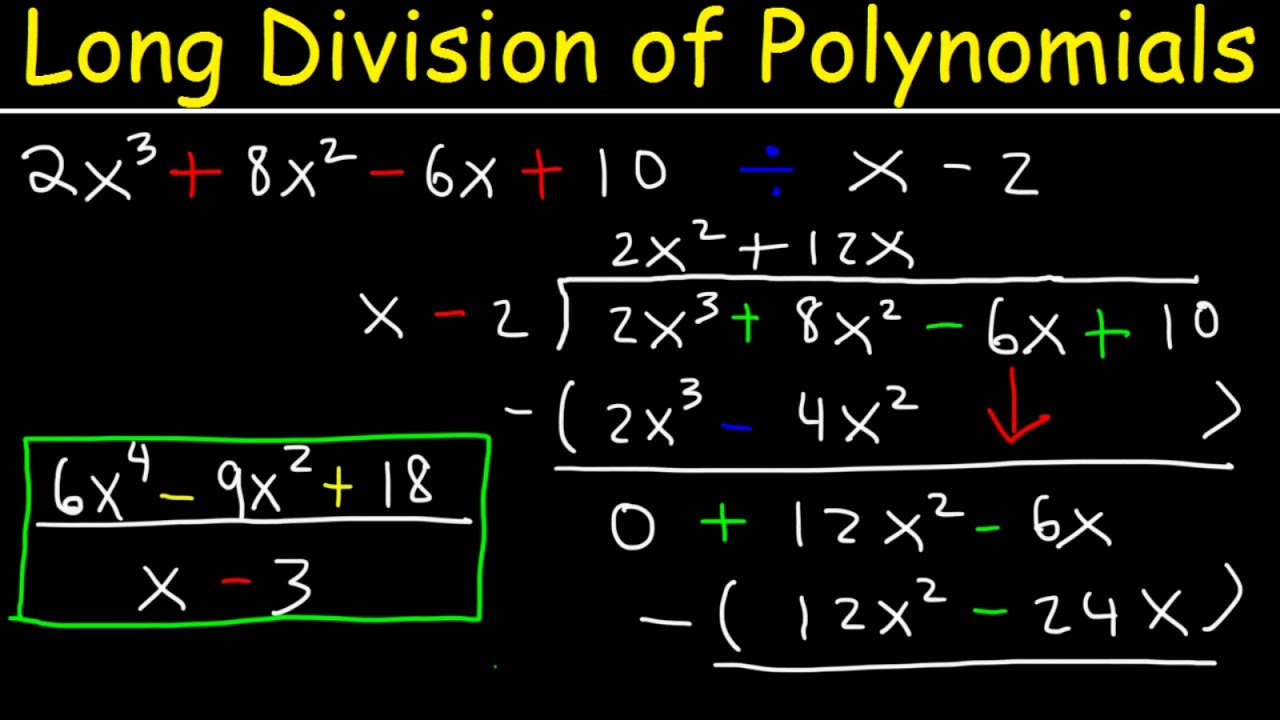
This video tutorial explains how to perform long division of polynomials with remainder and with missing terms. It's explains how to do long division easily and it provides the step by step process to get it done. Basically, there are 3 steps that you have to repeat. 1. Divide 2. Multiply 3. Subtract This video contains plenty of ex...
shadow canopy
alpine sable
https://youtube.com/watch?v=_FSXJmESFmQ&si=EnSIkaIECMiOmarE
Doesn’t help rlly cause it doesn’t tell me how I would go about doing 2x by x-3
alpine sable
what

 brisk veldt
yea
shadow canopy
Next would be dis?
shadow canopy
alpine sable
yes

 alpine sable
yes
vapid steppe
shadow canopy
Ik the next step is x-3 times 2x but how should I go about it?
just use synthetic division
shadow canopy
vapid steppe
just use synthetic division
I would if I knew how to do it lmao
vapid steppe

 weak plover
vapid steppe
weak plover
vapid steppe
however if the remainder wasn’t 0 you would write remainder/quotient at the end so just add r/(x-3) to the end of the quotient
shadow canopy
alpine sable
yes
-8x divided by x would be what? Idk how to do that negative.y
shadow canopy
vapid steppe
however if the remainder wasn’t 0 you would write remainder/quotient at the end ...
Icl I’m too slow to know what your saying 😭
vapid steppe
shadow canopy
Icl I’m too slow to know what your saying 😭
do the process in the video and then send the pic
it’ll be more clear
shadow canopy
alpine sable
-8
 shadow canopy
vapid steppe
it’ll be more clear
shadow canopy
vapid steppe
it’ll be more clear
Watching it rn
shadow canopy
alpine sable
but yeah its correct
Dis?
 alpine sable
yes
 alpine sable
yes
 shadow canopy
Lemme show u a example frommmy teacher
 alpine sable
shadow canopy
alpine sable
shadow canopy
is there a part (b) (c) etc ?
shadow canopy
alpine sable
is there a part (b) (c) etc ?
Yes
alpine sable
can u show the full question
 shadow canopy
It does
alpine sable
alpine sable
can u show the full question
.
 shadow canopy
alpine sable
.
shadow canopy
alpine sable
.
Mb thought u meant my teachers work
alpine sable
ok part (a) write your solution
alpine sable
alpine sable
2x-8 + (-19/(x-3)) ?
which is this
alpine sable
shadow canopy
F=2x-8
part b say slant asymptote here, at y=2x-8
shadow canopy
alpine sable
which is this
Write that? Not f=2x-8?cause that seems like what the teachers
 alpine sable
shadow canopy
Write that? Not f=2x-8?cause that seems like what the teachers
alpine sable
shadow canopy
Write that? Not f=2x-8?cause that seems like what the teachers
where did the teacher write that ?
shadow canopy
This is a slant asymptote at y=x-1
alpine sable
yes
shadow canopy
That part
alpine sable
thats part (b)
alpine sable
shadow canopy
part a doesnt talk about end behavior
shadow canopy
Ah
Alr ty
Ima ask her about it cause I think she got it confused as well
Since she didn’t do it either I think
alpine sable
she did write the solution
 lone heartBOT
Channel closed
Closed by @shadow canopy
Use .reopen if this was a mistake.
Available help channel!
Send your question here to claim the channel.
Remember:
• Ask your math question in a clear, concise manner.
• Show your work, and if possible, explain where you are stuck.
• After 15 minutes, feel free to ping <@&286206848099549185>.
• Type the command .close to free the channel when you're done.
• Be polite and have a nice day!
Read #❓how-to-get-help for further information on how to ask a good question, and about conduct in the question channels.
 misty forum
Okay so on a tangent function like for example y =
misty forum
y=tan2(x - (pi/2))
According to my teacher the endpoints of the interval and thus the vertical asymptotes are at kx - b = -pi/2 and kx - b = pi/2
Given that the equation is y = a*tank(kx-b)+c
so by that logic the asymptotes of y=tan2(x - (pi/2)) are at 0 and pi/2
but when I graph

the end points are at 0 and pi/2
so which way is right?
<@&286206848099549185>
<@&286206848099549185>
alpine sable
misty forum
the end points are at 0 and pi/2
no
alpine sable
misty forum
so by that logic the asymptotes of y=tan2(x - (pi/2)) are at 0 and pi/2
hm how ?
misty forum
alpine sable
2*tan ?
no
alpine sable
tan^2?
misty forum
like tan(2*(x-(pi/2)))
alpine sable
misty forum
so by that logic the asymptotes of y=tan2(x - (pi/2)) are at 0 and pi/2
.
alpine sable
misty forum
the end points are at 0 and pi/2
.
isnt that the same thing?
or is that a typo and which is which
and ur equation is confusing, could u type it in latex
 tough badge
misty forum
<@&286206848099549185>
tough badge
misty forum
<@&286206848099549185>

misty forum
alpine sable
or is that a typo and which is which
no like by endpoint i mean it's an x intercept
alpine sable
yes but read what you wrote
you said the equation gives 0 and pi/2 but you calculated it to be 0 and pi/2
which isn’t a contradiction ?
or am i missing something
misty forum
okay in the graph you can see that there are endpoints at 0 and pi/2
but according to the equaiton 0 and pi/2 are supposed to be asymptotes
misty forum
like a place where the graph intersects the x-axis
alpine sable
oh
ok so whats the equation
they gave
in latex
use $$
$y=a*tan(k(kx-b)) + c$
ocean sealBOT
hibyehibye
 lone heartBOT
Channel closed
Closed by @misty forum
Use .reopen if this was a mistake.
Available help channel!
Send your question here to claim the channel.
Remember:
• Ask your math question in a clear, concise manner.
• Show your work, and if possible, explain where you are stuck.
• After 15 minutes, feel free to ping <@&286206848099549185>.
• Type the command .close to free the channel when you're done.
• Be polite and have a nice day!
Read #❓how-to-get-help for further information on how to ask a good question, and about conduct in the question channels.
 dense wolf
How do you solve the permutation: 7P3/3!
lone heartBOT
dense wolf
How do you solve the permutation: 7P3/3!
 carmine reef
do you know 7P3?
lone heartBOT
@dense wolf Has your question been resolved?
lone heartBOT
Channel closed
Closed due to timeout
Use .reopen if this was a mistake.
Available help channel!
Send your question here to claim the channel.
Remember:
• Ask your math question in a clear, concise manner.
• Show your work, and if possible, explain where you are stuck.
• After 15 minutes, feel free to ping <@&286206848099549185>.
• Type the command .close to free the channel when you're done.
• Be polite and have a nice day!
Read #❓how-to-get-help for further information on how to ask a good question, and about conduct in the question channels.
 prime badge
🤷♂️
 placid zinc
Rich person
"Certified Public Accountant"?
Either way they just have more money than I do.
 slate kayak
placid zinc
Either way they just have more money than I do.
slate kayak
placid zinc
Either way they just have more money than I do.
10/10 definition
placid zinc
You'd expect
P(Luxury) = P(Luxury | CPA)
if they were independent.
lone heartBOT
@alpine sable Has your question been resolved?
placid zinc
What should?
You do know that 17% of them own luxury cars
And P(luxury | CPA) takes note of that
lone heartBOT
@alpine sable Has your question been resolved?
lone heartBOT
Channel closed
Closed due to timeout
Use .reopen if this was a mistake.
lone heartBOT
Available help channel!
Send your question here to claim the channel.
Remember:
• Ask your math question in a clear, concise manner.
• Show your work, and if possible, explain where you are stuck.
• After 15 minutes, feel free to ping <@&286206848099549185>.
• Type the command .close to free the channel when you're done.
• Be polite and have a nice day!
Read #❓how-to-get-help for further information on how to ask a good question, and about conduct in the question channels.
vapid steppe
hi
lone heartBOT
vapid steppe
hi
 lone heartBOT
@vapid steppe Has your question been resolved?
lone heartBOT
@vapid steppe Has your question been resolved?
lone heartBOT
Channel closed
Closed due to timeout
Use .reopen if this was a mistake.
Available help channel!
Send your question here to claim the channel.
Remember:
• Ask your math question in a clear, concise manner.
• Show your work, and if possible, explain where you are stuck.
• After 15 minutes, feel free to ping <@&286206848099549185>.
• Type the command .close to free the channel when you're done.
• Be polite and have a nice day!
Read #❓how-to-get-help for further information on how to ask a good question, and about conduct in the question channels.
 deep scroll
I want to learn statistics
lone heartBOT
deep scroll
I want to learn statistics
 shy olive
 vapid shuttle
deep scroll
I want to learn statistics
vapid shuttle
deep scroll
I want to learn statistics
these channels are mostly for specific problems. If you are looking for learning resources you should check out #probability-statistics and ask a more detailed question there. I suggest taking a statistics class as a good start
lone heartBOT
@deep scroll Has your question been resolved?
lone heartBOT
Channel closed
Closed due to timeout
Use .reopen if this was a mistake.
Available help channel!
Send your question here to claim the channel.
Remember:
• Ask your math question in a clear, concise manner.
• Show your work, and if possible, explain where you are stuck.
• After 15 minutes, feel free to ping <@&286206848099549185>.
• Type the command .close to free the channel when you're done.
• Be polite and have a nice day!
Read #❓how-to-get-help for further information on how to ask a good question, and about conduct in the question channels.
 brave plank
I need some help
 lone heartBOT
brave plank
I need some help
lone heartBOT
brave plank
I need some help
 dense blaze
brave plank
I need some help
dense blaze
brave plank
I need some help
which part
brave plank
The 3 I wasn't really able to attend those classes trying to catch up
dense blaze
i guess u can imagine it as since its discrete
an 8 sided dice
then P(X) gives u the probability it lands on side X
so u know sum of P(x) has to be = 1
that gives u part i
and part iii, mean is just the sum of P(x) * x / 9
variance u can use the formula
brave plank
dense blaze
so u know sum of P(x) has to be = 1
a+3a+5a+7a+9a+11a+13a+15a+17a = 1
so this would be my start right?
dense blaze
yes
brave plank
it's leaving me with a = 1/81
lone heartBOT
@brave plank Has your question been resolved?
Channel closed
Closed by @brave plank
Use .reopen if this was a mistake.
brave plank
.reopen
lone heartBOT
✅
brave plank
lone heart
<@968115479027793930> Has your question been resolved?
part 2 yet to be solved
brave plank
okay thank you very much
lone heartBOT
@brave plank Has your question been resolved?
lone heartBOT
Channel closed
Closed due to timeout
Use .reopen if this was a mistake.
Available help channel!
Send your question here to claim the channel.
Remember:
• Ask your math question in a clear, concise manner.
• Show your work, and if possible, explain where you are stuck.
• After 15 minutes, feel free to ping <@&286206848099549185>.
• Type the command .close to free the channel when you're done.
• Be polite and have a nice day!
Read #❓how-to-get-help for further information on how to ask a good question, and about conduct in the question channels.
 fading mauve
 lone heartBOT
fading mauve
fading mauve
lone heartBOT
fading mauve
fading mauve
so far ive gotten to this
I know the formula to find the area of a trapezoid is 1/2 multipled by the sum of the parallel sides multipled by the height. With this information, I can make this formula
20 = 1/2(2z + 3 + 6z -1)z
Combine like terms
20 = 1/2(8z + 2)z
Expand the parenthesis out
20 = (4z + 1)z
20 = 4z^2 + z
but after that idk what to do to find z
 whole shell
@fading mauve move the 20 to the other side
and you have a quadratic equation
you can use the quadratic formula
fading mauve
how do i do that
whole shell
how do you use the quadratic formula?
fading mauve
yeah
 fading mauve
i kind of have but i dont understand it at all
whole shell
the +- just means
youll have 2 values
one where thats a +
and another where its a -
fading mauve
How do i plug in the numbers to the formula I am so confused, theres still variables
am i just plugging variables into variables??
whole shell
fading mauve
How do i plug in the numbers to the formula I am so confused, theres still varia...
you have the equation
4z^2 + z - 20 = 0
a = 4
b = 1
c = -20
in this case x is z
that forumala will tell you
what 2 numbers of z
whole shell
whole shell
4z^2 + z - 20 = 0
solves that equation
whole shell
yes
x = -b + sqrt(b^2 - 4ac) /2a is one solution
and
x = -b - sqrt(b^2 - 4ac) /2a
is the other
where a = 4, b = 1, c = -20
fading mauve
can that be simplified at all? those are kinda long equations
lone heartBOT
Channel closed
Closed by @fading mauve
Use .reopen if this was a mistake.
Available help channel!
Send your question here to claim the channel.
Remember:
• Ask your math question in a clear, concise manner.
• Show your work, and if possible, explain where you are stuck.
• After 15 minutes, feel free to ping <@&286206848099549185>.
• Type the command .close to free the channel when you're done.
• Be polite and have a nice day!
Read #❓how-to-get-help for further information on how to ask a good question, and about conduct in the question channels.

 warped topaz
In the solutions it says the answer is 2^4 but I dont understand how it got that
 vale wigeon
a 2-atom truth table contains 4 rows, the output of which can be one of two things (0 or 1), so there are 2 * 2 * 2 * 2 ways you could fill it
lone heartBOT
Channel closed
Closed by @warped topaz
Use .reopen if this was a mistake.
Available help channel!
Send your question here to claim the channel.
Remember:
• Ask your math question in a clear, concise manner.
• Show your work, and if possible, explain where you are stuck.
• After 15 minutes, feel free to ping <@&286206848099549185>.
• Type the command .close to free the channel when you're done.
• Be polite and have a nice day!
Read #❓how-to-get-help for further information on how to ask a good question, and about conduct in the question channels.
 prime jacinth
does anyone know the answer to this question and how'd id go about it?
Question: Calculate the real length of each radial line and write the real lengths on the map
 lone heartBOT
prime jacinth
does anyone know the answer to this question and how'd id go about it?
`Questio...
prime jacinth
lone heartBOT
prime jacinth
does anyone know the answer to this question and how'd id go about it?
`Questio...
prime jacinth
thats probably easier to see
 pliant cedar
Is there a scale given
alpine sable
Whats the scale condom
prime jacinth
no scale was even given 😭
alpine sable
How tf
alpine sable
This stright from Google map
prime jacinth
yeah theyre making us draw boundary lines and then made us make that point the central point
and then yh
its weird af
alpine sable
Your name
prime jacinth
LMAO i resell discord tags dont ask 😭
lone heartBOT
@prime jacinth Has your question been resolved?
lone heartBOT
Channel closed
Closed due to timeout
Use .reopen if this was a mistake.
Available help channel!
Send your question here to claim the channel.
Remember:
• Ask your math question in a clear, concise manner.
• Show your work, and if possible, explain where you are stuck.
• After 15 minutes, feel free to ping <@&286206848099549185>.
• Type the command .close to free the channel when you're done.
• Be polite and have a nice day!
Read #❓how-to-get-help for further information on how to ask a good question, and about conduct in the question channels.
 lunar lintel
 lone heartBOT
lunar lintel
lunar lintel
lone heartBOT
lunar lintel
lunar lintel
how would we solve this
vapid shuttle
Use a different channel, this channel is already occupied
lunar lintel
 rigid smelt
what have you tried?
rigid smelt
what have you tried?
nothing because idk wheere to start
rigid smelt
lunar lintel
nothing because idk wheere to start
alright, can you start with finding what the antiderivative of x^pln(x) is?
 rigid smelt
just look at p as if it were a constant
lunar lintel
lunar lintel
i comapred this to 1/x^p
lunar lintel
rigid smelt
alright, can you start with finding what the antiderivative of x^pln(x) is?
ok
rigid smelt
you might be able to work it thru with comparison test, but there is a more direct way
lunar lintel
@rigid smelt just a question
rigid smelt
sure

 rigid smelt
nothing
rigid smelt
justl ike i said, treat it as a constant
so here you chose u=x^p, that means du=px^(p-1)
that's all
but anyway
you are heading in the wrong way, but you are havign the right idea
lunar lintel
i c
vapid shuttle
^ aren't you going to have to do like mad integration by parts
depending on what p is
rigid smelt
anyway, lets start again, since I really don't need you to find the antiderivative either
lunar lintel
ok
rigid smelt
so here, in order to integrate this, we'll do idp as you did
but since like austin has mentioned, choosing dv=ln(x) does not help, as it does not get rid of the ln(x)
lunar lintel
idp?