#help-0
1 messages · Page 122 of 1
 steep pike
 lone heartBOT
@steep pike Has your question been resolved?
lone heartBOT
@steep pike Has your question been resolved?
lone heartBOT
@steep pike Has your question been resolved?
lone heartBOT
Channel closed
Closed by @steep pike
Use .reopen if this was a mistake.
 Available help channel!
Send your question here to claim the channel.
Remember:
• Ask your math question in a clear, concise manner.
• Show your work, and if possible, explain where you are stuck.
• After 15 minutes, feel free to ping <@&286206848099549185>.
• Type the command .close to free the channel when you're done.
• Be polite and have a nice day!
Read #❓how-to-get-help for further information on how to ask a good question, and about conduct in the question channels.
 simple lion
Could someone help me with this probability question regarding card draws:
You draw 4 cards, one after another from a 78 card tarot deck. What are the odds of drawing the Emperor card 3 times total? (Odds of drawing the Emperor in a single draw are 1/78)
Here's what I've got:
Number of 4-card hands: (78choose4) = 1426425
Number of 4-card hands with three Emperors: 77*4 = 308
Odds of drawing 4 cards with three Emperors: 308/1426425 = 0.00021592442 =~ 0.0216%
Does this seem correct?
lone heartBOT
simple lion
Could someone help me with this probability question regarding card draws:
> Yo...
 thorny root
where did 77 come from
thorny root
multiplying that 4 doesn't seem to give you anything of sense
simple lion
wait that's a bad explanation
so how would you get the number of 4-card hands that are 3 Emperors and 1 other card
thorny root
also how can you draw 3 emporor when you have only 1
simple lion
because you draw it and put it back and then re-draw
simple lion
there's 77 different ways to have a 4 card hand that's EEEX, and then you have X in all 4 positions, so EEEX, EEXE, EXEE, XEEE; hence 77*4
E = Emperor
X = something else
thorny root
oh yeah
simple lion
just need someone to verify
thorny root
seems good
lone heartBOT
@simple lion Has your question been resolved?
Channel closed
Closed by @simple lion
Use .reopen if this was a mistake.
simple lion
thorny root
seems good
thanks
lone heartBOT
Available help channel!
Send your question here to claim the channel.
Remember:
• Ask your math question in a clear, concise manner.
• Show your work, and if possible, explain where you are stuck.
• After 15 minutes, feel free to ping <@&286206848099549185>.
• Type the command .close to free the channel when you're done.
• Be polite and have a nice day!
Read #❓how-to-get-help for further information on how to ask a good question, and about conduct in the question channels.
 barren portal
 lone heartBOT
barren portal
barren portal
lone heartBOT
barren portal
barren portal
Can you help me to see that this goes to e^-lambda ?
 echo socket
Well, it does not
barren portal
mbb
echo socket
Unless you meant -n in the exponent
 vale wigeon
if you mean this exactly as stated, then it goes to 1, not e^(-lambda).
barren portal
Yes, this going to one makes sense applying the limit properties
as n tends to infy, lambda/n tends to 0
I'm actually looking for ^n
 tacit arch
barren portal
cropped the wrong one
tacit arch
barren portal
cropped the wrong one
Just send the right screenshot then
echo socket
Substitute for -n/lambda and recall the limit definition of e

 alpine sable
Isn't this how we define e^{-\lambda} ?
barren portal
so here x=-lamda ?
alpine sable
Yeah
barren portal
To be honest, The definition I'm aware is e^x=1+x/1! +x^2/2! + .... +
are they same ?
alpine sable
Here, this is an interesting proof @barren portal
 alpine sable
barren portal
To be honest, The definition I'm aware is e^x=1+x/1! +x^2/2! + .... +
alpine sable
barren portal
To be honest, The definition I'm aware is e^x=1+x/1! +x^2/2! + .... +
That's Taylor series
alpine sable
barren portal
A glimpse of it will be helpful
Taylor series requires basic of calculus, have u done that ?
barren portal
I'm actually about to finish Calculus 3, but the college skipped power series and so
for last semester
alpine sable
barren portal
I'm actually about to finish Calculus 3, but the college skipped power series an...
Ah! Dw, there's an interesting video on Taylor series then, wait lemme pick it up from internet quick
https://youtu.be/3d6DsjIBzJ4
@barren portal

Taylor polynomials are incredibly powerful for approximations and analysis.
Help fund future projects: https://www.patreon.com/3blue1brown
An equally valuable form of support is to simply share some of the videos.
Special thanks to these supporters: http://3b1b.co/lessons/taylor-series#thanks
Home page: https://www.3blue1brown.com/
Full series: ...
alpine sable
Are u in university or something?
barren portal
Yes, 2nd year.
 lone heartBOT
Channel closed
Closed by @barren portal
Use .reopen if this was a mistake.
Available help channel!
Send your question here to claim the channel.
Remember:
• Ask your math question in a clear, concise manner.
• Show your work, and if possible, explain where you are stuck.
• After 15 minutes, feel free to ping <@&286206848099549185>.
• Type the command .close to free the channel when you're done.
• Be polite and have a nice day!
Read #❓how-to-get-help for further information on how to ask a good question, and about conduct in the question channels.
 spark prawn
Can I ask some direction help with 2b ? Trigonometric identities

 last ether
Try splitting the fraction up
spark prawn
last ether
Try splitting the fraction up
And expanding from there or factoring to lead to an identity?
 keen mason
spark prawn
And expanding from there or factoring to lead to an identity?
keen mason
spark prawn
And expanding from there or factoring to lead to an identity?
u wanna expand the left or right side?
spark prawn
keen mason
u wanna expand the left or right side?
Right side
keen mason
spark prawn
Right side
2-2sin^2 = 2cos^2 so thats the denom
(1+cot^2) = csc^2
u can do the rest now?
lone heartBOT
@spark prawn Has your question been resolved?
Channel closed
Closed by @spark prawn
Use .reopen if this was a mistake.
Available help channel!
Send your question here to claim the channel.
Remember:
• Ask your math question in a clear, concise manner.
• Show your work, and if possible, explain where you are stuck.
• After 15 minutes, feel free to ping <@&286206848099549185>.
• Type the command .close to free the channel when you're done.
• Be polite and have a nice day!
Read #❓how-to-get-help for further information on how to ask a good question, and about conduct in the question channels.
 past magnet
In a graph, is the clique cover number always greater/equal than the max independent set?
lone heartBOT
past magnet
In a graph, is the clique cover number always greater/equal than the max indepen...
past magnet
I have tried the following proof:
Given graph G=(V, E)
Let $C_{min}$ be the minimum set that contains the cliques which cover the graph G.
Let $U_{max}$ be a maximum independent set.
Assuming $|U_max| > |C_min|$:
We then have
$\exists v_i, v_j \in U^{max} : v_i, v_j \in C_i, C_i \subseteq C^{min}$
this implies that $v_i$ and $v_j$ are adjacent which then implies $v_i, v_j \notin U^{max}$
which is a contradiction.
Therefore $|U_{max}| \leq |C_{min}|$
this seems plausible but im not sure if i missed something
 ocean sealBOT
LanPodder
 lone heartBOT
@past magnet Has your question been resolved?
past magnet
<@&286206848099549185>
lone heartBOT
@past magnet Has your question been resolved?
lone heartBOT
@past magnet Has your question been resolved?
lone heartBOT
@past magnet Has your question been resolved?
lone heartBOT
Channel closed
Closed due to timeout
Use .reopen if this was a mistake.
Available help channel!
Send your question here to claim the channel.
Remember:
• Ask your math question in a clear, concise manner.
• Show your work, and if possible, explain where you are stuck.
• After 15 minutes, feel free to ping <@&286206848099549185>.
• Type the command .close to free the channel when you're done.
• Be polite and have a nice day!
Read #❓how-to-get-help for further information on how to ask a good question, and about conduct in the question channels.
 frank merlin
how did the constant move out of the exponent
 lone heartBOT
frank merlin
how did the constant move out of the exponent
lone heartBOT
frank merlin
how did the constant move out of the exponent
 outer lark
e^c is just a constant
lone heartBOT
Channel closed
Closed by @frank merlin
Use .reopen if this was a mistake.
 tacit jacinth
Hi if anyone can solve this with working steps i will send them 10 bucks on steam, Thank you so much
 lone heartBOT
Available help channel!
lone heartBOT
Available help channel!
Send your question here to claim the channel.
Remember:
• Ask your math question in a clear, concise manner.
• Show your work, and if possible, explain where you are stuck.
• After 15 minutes, feel free to ping <@&286206848099549185>.
• Type the command .close to free the channel when you're done.
• Be polite and have a nice day!
Read #❓how-to-get-help for further information on how to ask a good question, and about conduct in the question channels.
 thorny parcel
.close
lone heartBOT
Channel closed
Closed due to the original message being deleted
Available help channel!
Send your question here to claim the channel.
Remember:
• Ask your math question in a clear, concise manner.
• Show your work, and if possible, explain where you are stuck.
• After 15 minutes, feel free to ping <@&286206848099549185>.
• Type the command .close to free the channel when you're done.
• Be polite and have a nice day!
Read #❓how-to-get-help for further information on how to ask a good question, and about conduct in the question channels.
 surreal lichen
Find the number of labelled trees on 5 vertices
surreal lichen
i found three unlabelled trees
the first one i found was a path graph
so if i want to find the number of labelled path graphs on 5 vertices
is it the same as finding the number of linear arrangements of 5 objects?
lone heartBOT
@surreal lichen Has your question been resolved?
lone heartBOT
@surreal lichen Has your question been resolved?
 chilly storm
open a new ticket that's only for you
lone heartBOT
@surreal lichen Has your question been resolved?
surreal lichen
.close
lone heartBOT
Channel closed
Closed by @surreal lichen
Use .reopen if this was a mistake.
Available help channel!
Send your question here to claim the channel.
Remember:
• Ask your math question in a clear, concise manner.
• Show your work, and if possible, explain where you are stuck.
• After 15 minutes, feel free to ping <@&286206848099549185>.
• Type the command .close to free the channel when you're done.
• Be polite and have a nice day!
Read #❓how-to-get-help for further information on how to ask a good question, and about conduct in the question channels.
 indigo saddle
Why can there be infinite many solutions to this question? I thought that any homogenous system of linear equations (SLEs) of form Ax=0 will always be consistent
 lone heartBOT
indigo saddle
Why can there be infinite many solutions to this question? I thought that any ho...
lone heartBOT
indigo saddle
Why can there be infinite many solutions to this question? I thought that any ho...
 limpid turret
Unless A is singular
"singular" is quite the misnomer, as it implies there are many solutions
 indigo saddle
limpid turret
"singular" is quite the misnomer, as it implies there are many solutions
indigo saddle
limpid turret
"singular" is quite the misnomer, as it implies there are many solutions
Sorry, I don't quite get what you mean by "Singular"
limpid turret
If the determinant of a matrix is zero, then -by definition- is called singular
indigo saddle
Oh okay
limpid turret
If a matrix is singular, it can have multiple solutions
indigo saddle
limpid turret
If a matrix is singular, it can have multiple solutions
Ah, I see
limpid turret
Been a while, so I can't remember if "homogenous" means "non-singular"
indigo saddle
I think so
because if it's singular, then an inverse of A cannot exist
therefore, there isn't necessarily a unique solution to Ax=b (including Ax=0) (right)?
limpid turret
what is an "inconsistent system of equations"?
indigo saddle
limpid turret
what is an "inconsistent system of equations"?
No solutions
i.e., in ℝ³, you can have 3 parallel planes that don't intersect eachother
limpid turret
ah gotcha
Yeah I don't know this one sadly. Guess I gotta review my lin alg.
Give it 5 minutes then ping helpers if no one comes
indigo saddle
okay
indigo saddle
 pseudo ice
Consistency is having *at least* one set of solutions?
pseudo ice
Consistency is having *at least* one set of solutions?
at least one
And since we are only dealing with the ℝ³ case, we are dealing with planes
So consistency can only mean "a unique (set) of solultions" or, infinitely many (sets) of solutions

And there can only be 3 types of inconsistencies
pseudo ice
Alright fair, so could you elaborate on what's confusing, sorry?
indigo saddle
pseudo ice
Alright fair, so could you elaborate on what's confusing, sorry?
I don't get the written answer explanations that is provided to me
I thought the question is asking in terms of Ax=0, but to me, the answers seem to be answering in terms of Ax=b—as in it is explaining why Ax=b must have an infinite number of solutions
pseudo ice
indigo saddle
I thought the question is asking in terms of Ax=0, but to me, the answers seem t...
Oh fair no, they're assuming that Ax=b is inconsistent and then from that you can show there would be infinite solutions to the homogenous Ax=0
indigo saddle
pseudo ice
Oh fair no, they're assuming that Ax=b is inconsistent and then from that you ca...
oh
pseudo ice
Do you agree with this statement?
 indigo saddle
pseudo ice
Do you agree with this statement?
indigo saddle
pseudo ice
Do you agree with this statement?
yep
pseudo ice
Calm calm, does it all make sense now?
indigo saddle
so they're first deducing restrictions on A
and then using the restrictions to find what must then be true on [A|0]
pseudo ice
Yeah in particular you know A isn't full rank, else it'd be invertible and you'd have a solution to Ax = b as x = A^{-1}b
indigo saddle
yep
pseudo ice
Therefore when you REF the matrix A, you'll have somewhere "at the bottom" having a zero row
indigo saddle
pseudo ice
Therefore when you REF the matrix A, you'll have somewhere "at the bottom" havin...
Then
couldn't you just directly answer by doing:
this is true

Thus for [A|0], we will have at least one row of 0=0 in REF
And since we already know that A0=0 is consistent
i.e. we know a single case

[A|0] must have infinite solutions?
in ℝ³
why then is it necessary to state* these properties of [A|b]?
 pseudo ice
That's pretty much what I think they're trying to say
pseudo ice
indigo saddle
Thus for [A|0], we will have at least one row of 0=0 in REF
This here in particular is saying you can't "fix" one of the coordinates

As in you won't be able to restrict one of them to be a fixed value
indigo saddle
pseudo ice
This here in particular is saying you can't "fix" one of the coordinates
But how is that relevant for showing that [A|0] has infinite many solutions
pseudo ice
let's say we have like something in $\bR^3$ that turns into $\pmqty{1 & 0 & 0 \ 0 & 1 & 0 \ 0 & 0 & 0}$ on REF
ocean sealBOT
chartbit
 pseudo ice
Then that will tell you for the homogenous that x=0 and y=0
so then (x,y,z) = (0, 0, z) = z(0, 0, 1)
pseudo ice
indigo saddle
But how is that relevant for showing that [A|0] has infinite many solutions
That's effectively what the statement is trying to say
Or for $\pmqty{1 & 0 & 0 \ 0 & 0 & 0 \ 0 & 0 & 0}$ in REF, we get that $x=0$, and so $(x,y,z)= (0, y, z) = y(0, 1, 0) + z(0, 0, 1)$
ocean sealBOT
chartbit
 indigo saddle
I get it
thanks
I feel like the question
's wording is a bit confusing (to me)
pseudo ice
Yea as you have like the hom and nonhom case and they're easy to confuse I guess?
 indigo saddle
pseudo ice
Yea as you have like the hom and nonhom case and they're easy to confuse I guess...
indigo saddle
pseudo ice
Yea as you have like the hom and nonhom case and they're easy to confuse I guess...
Yeah
pseudo ice
Anyways is all of that all good?
pseudo ice
Perfect, have a good one! 
lone heartBOT
@indigo saddle Has your question been resolved?
Channel closed
Closed by @indigo saddle
Use .reopen if this was a mistake.
lone heartBOT
Available help channel!
Send your question here to claim the channel.
Remember:
• Ask your math question in a clear, concise manner.
• Show your work, and if possible, explain where you are stuck.
• After 15 minutes, feel free to ping <@&286206848099549185>.
• Type the command .close to free the channel when you're done.
• Be polite and have a nice day!
Read #❓how-to-get-help for further information on how to ask a good question, and about conduct in the question channels.
 dawn dust
 dawn dust
how do i find the x intercepts of a vertically transformed equation
and they y for horizontally
 native cloud
In order to find the x intercepts, you'll need to use the standard equation
dawn dust
yea but they will change wont they
dawn dust
like i found the roots of the original
but they will change once u transform the function
how do i find the new roots
alpine sable
find the new function first
dawn dust
so -2x+12x-4
oh yea ok that works
that gets me the right roots
wait what if it was a horizontal tranformation
how would i find the new function then
lone heartBOT
@dawn dust Has your question been resolved?
dawn dust
<@&286206848099549185> ?
dawn dust
.close
lone heartBOT
Channel closed
Closed by @dawn dust
Use .reopen if this was a mistake.
Available help channel!
Send your question here to claim the channel.
Remember:
• Ask your math question in a clear, concise manner.
• Show your work, and if possible, explain where you are stuck.
• After 15 minutes, feel free to ping <@&286206848099549185>.
• Type the command .close to free the channel when you're done.
• Be polite and have a nice day!
Read #❓how-to-get-help for further information on how to ask a good question, and about conduct in the question channels.
 long spindle
can someone help me find (f/g)(x) as well as its domain?

 wraith adder
long spindle
can someone help me find (f/g)(x) as well as its domain?
wraith adder
long spindle
can someone help me find (f/g)(x) as well as its domain?
is there anything to plug anything in?
long spindle
no im just dividing the equations as it is
i got this as the answer and it was wrong
 wraith adder
hmmm 🤔
 woven plaza
Just write it with the root
√(49-x²)/(x+4)
Now for the domain the only condition is that x shouldn't be -4 and the whole function needs to be positive inside the root
So that leaves you with 2 cases, either both the denominator and numerator are positive of they're both negative
long spindle
oh, i thought radicals weren't allowed in the denominator?
woven plaza
Well they didn't ask to simplify the function
woven plaza
,w domain √((49-x²)/(x+4))
ocean sealBOT


 Requested by Ankit#6969
woven plaza
Requested by Ankit#6969
woven plaza

lone heartBOT
@long spindle Has your question been resolved?
Channel closed
Closed by @long spindle
Use .reopen if this was a mistake.
Available help channel!
Send your question here to claim the channel.
Remember:
• Ask your math question in a clear, concise manner.
• Show your work, and if possible, explain where you are stuck.
• After 15 minutes, feel free to ping <@&286206848099549185>.
• Type the command .close to free the channel when you're done.
• Be polite and have a nice day!
Read #❓how-to-get-help for further information on how to ask a good question, and about conduct in the question channels.
 jade dagger
Can anyone correct these limits for me? I unfortunately don’t have a solution manual. If you can tell me where I went wrong and correct my mistakes, it would help me a lot. Thanks in advance 🙂
 lone heartBOT
jade dagger
Can anyone correct these limits for me? I unfortunately don’t have a solution ma...
alpine sable
lone heartBOT
jade dagger
Can anyone correct these limits for me? I unfortunately don’t have a solution ma...
alpine sable
oh i see now
alpine sable
jade dagger
Can anyone correct these limits for me? I unfortunately don’t have a solution ma...
why is $\lim_{x \to 2} x^3 = (1)^3$?
ocean sealBOT
♡Lex♡
 jade dagger
I wonder with e)
woven plaza
Pip error no brain found
echo socket
The way you did e) is weird
jade dagger
How do i approach those? I am confused
echo socket
Why'd you plug in x = 1 into x^3 if x -> 2?
jade dagger
Ah true, so which x value can I pick? i mean I can’t tell from which graph it’s coming from. Since it’s f(x) I assumed it to be from the first graph
echo socket
x = 2
 smoky adder
this is not the slayest notation
 echo socket
Yeah that too
jade dagger
echo socket
x = 2
Ahhh so as x approaches 2 x^3 is 2… right?
echo socket
x -> 2
x^3 -> 8
jade dagger
smoky adder
this is not the slayest notation
How can I correct that?
jade dagger
echo socket
x -> 2
x^3 -> 8
x^3 right?
smoky adder
jade dagger
How can I correct that?
I usually draw an arrow that the denom is zero and then say dne
lone heartBOT
Channel closed
Closed by @jade dagger
Use .reopen if this was a mistake.
jade dagger
.reopen
lone heartBOT
✅
jade dagger
echo socket
x = 2
What about the point on the graph, how will that be defined through notation?

Is it f(2)?
echo socket
The red point or the white one?
jade dagger
The red
jade dagger
Ah okay, now that’s what made me write 1 in the first place, thankyou once again! 🙏
.close
lone heartBOT
Channel closed
Closed by @jade dagger
Use .reopen if this was a mistake.
 kindred anchor
 lone heartBOT
Available help channel!
lone heartBOT
Available help channel!
Send your question here to claim the channel.
Remember:
• Ask your math question in a clear, concise manner.
• Show your work, and if possible, explain where you are stuck.
• After 15 minutes, feel free to ping <@&286206848099549185>.
• Type the command .close to free the channel when you're done.
• Be polite and have a nice day!
Read #❓how-to-get-help for further information on how to ask a good question, and about conduct in the question channels.
 lone coyote
 lone heartBOT
lone coyote
lone heartBOT
lone coyote
 lone coyote
what about the fraction?
woven plaza
simplify that fraction and you get your final answer for the fraction
lone coyote
how?
lone coyote
111/20 isn't final answer tho right?
woven plaza
yea it is
lone coyote
What about this?

We didn't get that in class, homework is totally different..
@woven plaza
<@&286206848099549185>
.close
lone heartBOT
Channel closed
Closed by @lone coyote
Use .reopen if this was a mistake.
Available help channel!
Send your question here to claim the channel.
Remember:
• Ask your math question in a clear, concise manner.
• Show your work, and if possible, explain where you are stuck.
• After 15 minutes, feel free to ping <@&286206848099549185>.
• Type the command .close to free the channel when you're done.
• Be polite and have a nice day!
Read #❓how-to-get-help for further information on how to ask a good question, and about conduct in the question channels.
 primal galleon
How do I find angle v?
 lone heartBOT
primal galleon
How do I find angle v?
primal galleon
lone heartBOT
primal galleon
How do I find angle v?
primal galleon
Could you show me?
 plush lion
primal galleon
Could you show me?
plush lion
primal galleon
Could you show me?
use the pythagoras theorem
primal galleon
Yes
primal galleon
plush lion
use the pythagoras theorem
It’s 3a^2
opp/adj
a/2a = 1/2
tan^-1(1/2)
,w atan(0.5), convert to degrees
ocean sealBOT
Wolfram Alpha doesn't understand your query!
Perhaps try rephrasing your question?
Click here to refine your query online
 Requested by dgh#0553
ocean sealBOT
Requested by dgh#0553
ocean sealBOT
Result:
0.46364760900081
,calc 0.463647*180
ocean sealBOT
Result:
83.45646
,calc 0.46364760900081*180/pi
ocean sealBOT
Result:
26.565051177078
yes that's how you convert radians to degrees
lone heartBOT
Channel closed
Closed by @primal galleon
Use .reopen if this was a mistake.
lone heartBOT
Available help channel!
Send your question here to claim the channel.
Remember:
• Ask your math question in a clear, concise manner.
• Show your work, and if possible, explain where you are stuck.
• After 15 minutes, feel free to ping <@&286206848099549185>.
• Type the command .close to free the channel when you're done.
• Be polite and have a nice day!
Read #❓how-to-get-help for further information on how to ask a good question, and about conduct in the question channels.
alpine sable
 lone heartBOT
alpine sable
lone heartBOT
alpine sable
 rocky grove
Is this a compounding problem?
alpine sable
rocky grove
Is this a compounding problem?
no
rocky grove
So it's a simple interest?
alpine sable
yeah
alpine sable
so A = (42, 500)(1 + (3/10)t)
is this what i graph?
,w plot y= (42500)(1 + (3/10)x)
 gray isle
get rid of the comma
ocean sealBOT

 Requested by Twerkingbee#7740
rocky grove
Requested by Twerkingbee#7740
rocky grove

alpine sable
.close
lone heartBOT
Channel closed
Closed by @glacial summit
Use .reopen if this was a mistake.
Available help channel!
Send your question here to claim the channel.
Remember:
• Ask your math question in a clear, concise manner.
• Show your work, and if possible, explain where you are stuck.
• After 15 minutes, feel free to ping <@&286206848099549185>.
• Type the command .close to free the channel when you're done.
• Be polite and have a nice day!
Read #❓how-to-get-help for further information on how to ask a good question, and about conduct in the question channels.
 tulip hound
 lone heartBOT
tulip hound
tulip hound
lone heartBOT
tulip hound
tulip hound
How do I solve this system
Wait I got it I think
x-3 or y-5 should be = 0
so x=3 y=5
echo socket
x = 3 or* y = 5
lone heartBOT
Channel closed
Closed by @tulip hound
Use .reopen if this was a mistake.
Available help channel!
Send your question here to claim the channel.
Remember:
• Ask your math question in a clear, concise manner.
• Show your work, and if possible, explain where you are stuck.
• After 15 minutes, feel free to ping <@&286206848099549185>.
• Type the command .close to free the channel when you're done.
• Be polite and have a nice day!
Read #❓how-to-get-help for further information on how to ask a good question, and about conduct in the question channels.
 warped topaz
 lone heartBOT
warped topaz
warped topaz
lone heartBOT
warped topaz
warped topaz
So I set x(t) to 0 and y(t) to -4, I got +3 and -3 for both x and y. but how do I know if its (-3,3) and (3,-3) or (-3,-3) and (3,3)?
pseudo ice
Those are the t values you get right? As in the point in the “track” where you have the same point?
pseudo ice
Yep, so you know that t=3 will give you that point, and also t=-3 will give you that point
But you want to find both velocity vectors for that point
Putting in those two t values will get you two different things I think?
pseudo ice
Those are your t values, remember how there was a question we had and I said that from both you needs to get the same t values?
As in you solved x(t)=0 and y(t)=-4 for the t values
Hold up didn’t we do this question 
warped topaz
pseudo ice
Hold up didn’t we do this question <:KEK:586240877358350341>
Yes im going over everything again im just stuck on this 1 part
pseudo ice
pseudo ice
As in you solved x(t)=0 and y(t)=-4 for the t values
But anyways, these will give you t values, and you want those to be the same, the ones that match for both are the t values you’d accept
So you get t=3 and t=-3
Those are what you’d use, if you get me?
warped topaz
ah so theyre not points
ok 1 moment I will try something
Ok I got the answer
thank you so much!!
❤️
.close
lone heartBOT
Channel closed
Closed by @warped topaz
Use .reopen if this was a mistake.
lone heartBOT
Available help channel!
Send your question here to claim the channel.
Remember:
• Ask your math question in a clear, concise manner.
• Show your work, and if possible, explain where you are stuck.
• After 15 minutes, feel free to ping <@&286206848099549185>.
• Type the command .close to free the channel when you're done.
• Be polite and have a nice day!
Read #❓how-to-get-help for further information on how to ask a good question, and about conduct in the question channels.
 cinder sundial
 lone heartBOT
cinder sundial
cinder sundial
lone heartBOT
cinder sundial
cinder sundial
Obviously it’s “the theorem of three perpendicular lines” and im okay with it.
but what had me confused is the teacher says if the angle that were blue circled wasn’t perpendicular, then the other two arrow-pointed angles wouldn’t be perpendicular too.
That sounds like a bullshit to me, just some imagination in mind, you would know it’s not true
Even the blue-circled isn’t perpendicular, the other twos that arrow-pointed would still be perpendicular too
 mortal trellis
well it depends in what order and how you construct the various points
if the blue angle is not perpendicular, then at least one other thing also has to change. and depending on what you change, you can probably make the other two also not perpendicular
lone heartBOT
@cinder sundial Has your question been resolved?
cinder sundial
mortal trellis
if the blue angle is not perpendicular, then at least one other thing also has t...
mortal trellis
yes that is one possible way to change it
maybe a better wording from your teacher might have been: if the blue angle is not perpendicular, then the other ones don't have to be either
imagine instead moving the black pen towards the camera
cinder sundial
mortal trellis
yes that is one possible way to change it
What I’m trying to demonstrate from the vid is, even I’d changed the “blue-circled” angle, the other twos (arrow pointed) is still perpendicular
So what the teacher is not true at all
mortal trellis
no
maybe the phrasing of your teacher wasn't perfect
but the point is, if blue is not perpendicular, then the red ones aren't necessarily perpendicular either. they can be, but don't have to
so in a general situation you do not know anything about them
cinder sundial
mortal trellis
so in a general situation you do not know anything about them
u mean a situation like this
mortal trellis
that changes one of the red angles, yes
cinder sundial
mortal trellis
but the point is, if blue is not perpendicular, then the red ones aren't necessa...
This is the true statement without any flaws, compared to my teacher that didn’t speak his word clearly and make me feel so confused
My problem is solved, Thank you so much
I luv u
.close
lone heartBOT
Channel closed
Closed by @cinder sundial
Use .reopen if this was a mistake.
lone heartBOT
Available help channel!
Send your question here to claim the channel.
Remember:
• Ask your math question in a clear, concise manner.
• Show your work, and if possible, explain where you are stuck.
• After 15 minutes, feel free to ping <@&286206848099549185>.
• Type the command .close to free the channel when you're done.
• Be polite and have a nice day!
Read #❓how-to-get-help for further information on how to ask a good question, and about conduct in the question channels.
alpine sable
hi hi how do you start getting to learn calulus ?
pseudo ice
A question better off in one of the general channels, like #discussion or something tbh
rocky grove
True
alpine sable
oh sorry idk how this server really works sorryyy
rocky grove
But I'd suggest you understand the idea of super zooming into graphs
And the idea of infinity
How to tackle it
pseudo ice
alpine sable
oh sorry idk how this server really works sorryyy
Don't worry about it  these channels here are for like homework/exercise questions, just so you know
rocky grove
And understand the idea of observing behavior of functions
alpine sable
rocky grove
And understand the idea of observing behavior of functions
hmmm okay thank you!!! :D
rocky grove
Also
alpine sable
pseudo ice
Don't worry about it <:catthumbsup:614540188747563008> these channels here are f...
oh thats good to know thank you for telling me ! :D
woven plaza
There are some good lecture series on yt
rocky grove
To tackle calculus, you need to master Algebra
Because most mistakes that happen in calculus is because of the algebra
alpine sable
rocky grove
To tackle calculus, you need to master Algebra
oh thats fun!! i love algebra ! thank you for telling me that
alpine sable
woven plaza
There are some good lecture series on yt
is there?? do you know any good channels are is it easier to search it on yt?
rocky grove
More advanced topics will cover slopes of tangent lines, derivatives, max/min, concavity, optimization, area of unfamiliar shapes, anti derivatives, etc...
woven plaza
alpine sable
is there?? do you know any good channels are is it easier to search it on yt?
Channel name - Organic chemistry tutor
He's got the BEST pre calc, calc 1 and calc 2 series
rocky grove
Also you will tackle series and sequences
alpine sable
woven plaza
Channel name - Organic chemistry tutor
thank you so much ankit!! :D ill start watching his videos soon thank you!!
alpine sable
rocky grove
Also you will tackle series and sequences
okay okay!! :D
woven plaza
Okok gl
rocky grove
alpine sable
is there?? do you know any good channels are is it easier to search it on yt?
You can check out 3 blue 1 brown for more visual intuition into Calculus
alpine sable
rocky grove
You can check out 3 blue 1 brown for more visual intuition into Calculus
okayyy thank you Vulcan for all the help!! 😁
lone heartBOT
@alpine sable Has your question been resolved?
lone heartBOT
Channel closed
Closed due to timeout
Use .reopen if this was a mistake.
Available help channel!
Send your question here to claim the channel.
Remember:
• Ask your math question in a clear, concise manner.
• Show your work, and if possible, explain where you are stuck.
• After 15 minutes, feel free to ping <@&286206848099549185>.
• Type the command .close to free the channel when you're done.
• Be polite and have a nice day!
Read #❓how-to-get-help for further information on how to ask a good question, and about conduct in the question channels.
 thorny bough
How does one express a constraint on the signage of a variable with the simplex method ?
like:
x1 >= 0
into the simplex's matrix
lone heartBOT
thorny bough
How does one express a constraint on the signage of a variable with the simplex ...
mortal trellis
well that's assumed for the simplex method
that all the variables are >= 0
if at some point one of the variables is smaller than 0 then you are out of the feasible region
but you can fix that with the dual simplex method
thorny bough
mortal trellis
if at some point one of the variables is smaller than 0 then you are out of the ...
it means that there is no solution ?
mortal trellis
not necessarily, no
thorny bough
I'm new to this stuff, so what I basically did is write down my equations on my problem
Problem: Given a list of crops (with their selling price per unit and required fertilizer per unit) and a list of stored fertilizer, find in what quantity each crop should be grown for the season
x1..x5 the quantity of each type of grain produced
p1..p5 the selling price of each type of grain
f1..f4 the amount of each type of fertilizer available
ax..ex the amount of the x fertilizer the crops needs

Maximize Z = x1*p1 + x2*p2 + x3*p3 + x4*p4 + x5*p5

Subject to:
a1*x1 + b1*x2 + c1*x3 + d1*x4 + e1*x5 <= f1
a2*x1 + b2*x2 + c2*x3 + d2*x4 + e2*x5 <= f2
a3*x1 + b3*x2 + c3*x3 + d3*x4 + e3*x5 <= f3
a4*x1 + b4*x2 + c4*x3 + d4*x4 + e4*x5 <= f4
---------------------------------------

Objective function:
  x1*-p1 + x2*-p2 + x3*-p3 + x4*-p4 + x5*-p5 + Z = 0

y1...y4 the slack variable (the unused fertilizer)

Subject to constraints:
a1*x1 + b1*x2 + c1*x3 + d1*x4 + e1*x5 + y1 = f1
a2*x1 + b2*x2 + c2*x3 + d2*x4 + e2*x5 + y2 = f2
a3*x1 + b3*x2 + c3*x3 + d3*x4 + e3*x5 + y3 = f3
a4*x1 + b4*x2 + c4*x3 + d4*x4 + e4*x5 + y4 = f4

x1  x2  x3  x4  x5  y1 y2 y3 y4 Z C
a1  b1  c1  d1  e1  1  0  0  0  0 f1
a2  b2  c2  d2  e2  0  1  0  0  0 f2
a3  b3  c3  d3  e3  0  0  1  0  0 f3
a4  b4  c4  d4  e4  0  0  0  1  0 f4
-p1 -p2 -p3 -p4 -p5 0  0  0  0  1 0
--------------------------------


Entering constants:
x1  x2  x3  x4  x5  y1 y2 y3 y4 Z C
1   0   1   0   2   1  0  0  0  0 f1
1   2   0   1   0   0  1  0  0  0 f2
2   1   0   1   0   0  0  1  0  0 f3
0   0   3   1   2   0  0  0  1  0 f4
-p1 -p2 -p3 -p4 -p5 0  0  0  0  1 0
and I get the right answer sometimes
but sometimes I get negative amounts of crops to grow
mortal trellis
well you need to add the contraints x_i >= 0
thorny bough
do I need to introduce more slack variables then ?
mortal trellis
I am assuming you are using a program?
mortal trellis
that should have a documentation
mortal trellis
the standard form of linear programming is "maximize c^Tx subject to Ax <= b and x>=0"
so I would assume that an implementation of the simplex algorithm would assume that
thorny bough

Mathematics LibreTexts
The simplex method uses an approach that is very efficient. It does not compute the value of the objective function at every point; instead, it begins with a corner point of the feasibility region …
how can I express that x_i >= 0 constraint explicitely
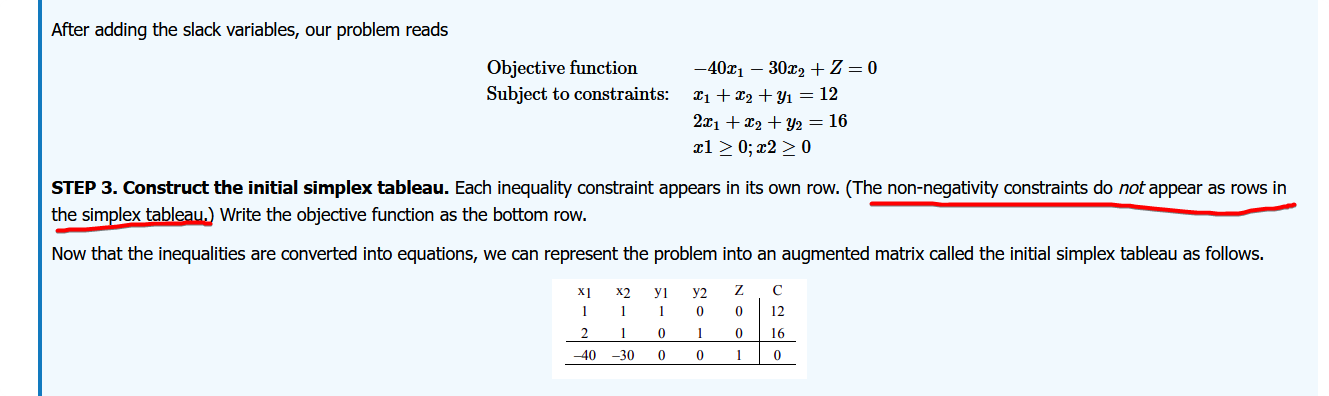 thorny bough
so I shouldn't be ending up with negatives in the C column
and I messed something up
is that right ?
mortal trellis
I am not too familiar with this specific notation of setting up the matrix
if you start in the feasible region then you shouldn't leave it
so you made a mistake there if that happens
lone heartBOT
@thorny bough Has your question been resolved?
lone heartBOT
@thorny bough Has your question been resolved?
lone heartBOT
@thorny bough Has your question been resolved?
lone heartBOT
Channel closed
Closed due to timeout
Use .reopen if this was a mistake.
Available help channel!
Send your question here to claim the channel.
Remember:
• Ask your math question in a clear, concise manner.
• Show your work, and if possible, explain where you are stuck.
• After 15 minutes, feel free to ping <@&286206848099549185>.
• Type the command .close to free the channel when you're done.
• Be polite and have a nice day!
Read #❓how-to-get-help for further information on how to ask a good question, and about conduct in the question channels.
alpine sable
Find the elements of order $6$ in $\mathbb{R}/\mathbb{Z}$.
ocean sealBOT
isomorphism
 alpine sable
$\mbb{R}/\mbb{Z} = {g + \mbb{Z} : g \in \mbb{R}}$
ocean sealBOT
isomorphism
 mortal trellis
in other words, the real numbers that you have to add 6 times to get an integer
mortal trellis
yes
alpine sable
what else though
lone heartBOT
Channel closed
Closed by @rigid kelp
Use .reopen if this was a mistake.
mortal trellis
(dont forget to check that each of them actually has order 6 and not a smaller one)
lone heartBOT
Available help channel!
Send your question here to claim the channel.
Remember:
• Ask your math question in a clear, concise manner.
• Show your work, and if possible, explain where you are stuck.
• After 15 minutes, feel free to ping <@&286206848099549185>.
• Type the command .close to free the channel when you're done.
• Be polite and have a nice day!
Read #❓how-to-get-help for further information on how to ask a good question, and about conduct in the question channels.
 naive leaf
@remote heron
lone heartBOT
naive leaf
<@331558346333224964>
 remote heron


lets pray i did this right because im way too tired to fix it now
right, lemme make a field
ocean sealBOT
Awesome_Ruler_007
 naive leaf
for horizontal one, I solve for $\frac{dv}{dt}=-kv$ as is the norm
ocean sealBOT
Awesome_Ruler_007
 remote heron
oh geez theres directions 
i may have stepped in it
okay so you want to start from the differential equation
and get to some equation for s that shows what youre expecting
naive leaf
ya, well drag should apply to both direction, but vertically the acceleration due to gravity focks it up
remote heron
where you go back to 0 as long as you start positive
naive leaf
$$
\text{Horizontal drag:} \frac{dv}{dt} = -kv \implies \frac{dv}{v} = -k\
\implies\int{\frac{dv}{v}} = \int{-k.dt} \implies \boxed{ln(|v|) = -kt+c}\
\text{Using initial conditions,} ;v=u;;t=0;;s_x=0\
\implies \boxed{c=ln(|u|)}\
\text{Thus,}; ln(|v|) - ln(|u|) = -kt \implies ln(|\frac{v}{u}|) = -kt\
\implies \frac{v}{u} = e^{-kt} \implies v = ue^{-kt}
$$
But we need it in terms of $s_x$, so we integrate it again:
$$
\frac{ds}{dt} = v \implies \int ds = \int v.dt \implies s_x = \int ue^{-kt}.dt \implies s_x = u\int e^{-kt}\
\text{Integrating:} \implies s_x=u\frac{e^{-kt}}{-k}+c;\text{, again with the same initial conditions}:s_x=0,:t=0\
\implies 0 = \frac{u}{-e^{-0}k}+c\implies c=\frac{-u}{k}\
\therefore s_x = \frac{-u}{ke^{kt}}+\frac{-u}{k} \implies s_x = \frac{-u}{k}(\frac{1}{e^{kt}}+1)\
\implies \boxed{s_x=|\frac{-u}{k}(1+e^{-kt'})|}
$$
ocean sealBOT
Awesome_Ruler_007
 naive leaf
This is how I solved that differential equation for $s_x$ incase it helps
remote heron
ill probably just look at the vertical
im not into physics
but differential equations 
naive leaf
remote heron
the second term looks great, its just the first one that's a bit odd
eq. is $\frac{dv}{dt}=-a-kv,:a=g$ for a reminder
ocean sealBOT
Awesome_Ruler_007
 naive leaf
I was given this eq. so it might be wrong
remote heron
,w y''=-g-ky
ocean sealBOT

 Requested by jan Niku#2119
remote heron
Requested by jan Niku#2119
remote heron

naive leaf
damn
remote heron
,w y''(t) = -g-k*y(t)
ocean sealBOT
 Requested by jan Niku#2119
remote heron
Requested by jan Niku#2119
remote heron

naive leaf
,w \frac{dv}{dt}=-9.8-kv
ocean sealBOT

 Requested by Awesome_Ruler_007#7922
remote heron
Requested by Awesome_Ruler_007#7922
remote heron
$s(t) = A\sin(\sqrt k t) + B \cos(\sqrt k t) - \frac gk$
ocean sealBOT
jan Niku
 remote heron
$s(0) = s_0 = B - \frac gk$
ocean sealBOT
jan Niku
 naive leaf
methinks wolfram alpha is treating g as a variable
remote heron
nope
naive leaf
which is why your solution looks a bit wonky
remote heron
wonky?
naive leaf
ocean seal
ya, see this
naive leaf
is y'' double derivative?
remote heron
yea
naive leaf
lets do one order at a time 😅
remote heron
its not necessary
naive leaf
,w y''(t) = -9.8-k*y(t)
ocean sealBOT
 Requested by Awesome_Ruler_007#7922
remote heron
Requested by Awesome_Ruler_007#7922
remote heron
it leads to a lot of extra constant wrapping
naive leaf
remote heron
it leads to a lot of extra constant wrapping
fair
remote heron
either way the theory for second order linear differential equations is straightforward enough to plonk through it IMHO even if youre clumsy with diff eqs
like me
naive leaf
,w y''(t) = -g-k*y(t), y''(0)=0
ocean sealBOT
 Requested by Awesome_Ruler_007#7922
remote heron
Requested by Awesome_Ruler_007#7922
remote heron
okay, solving for constants
naive leaf
you can give it init conditions like this right?
 naive leaf
,w y''(t) = -g-k*y(t), y''(0)=0, y'(0)=u
ocean sealBOT
 Requested by Awesome_Ruler_007#7922
naive leaf
remote heron
sure but i wouldnt let a bot do it
Requested by Awesome_Ruler_007#7922
naive leaf
remote heron
sure but i wouldnt let a bot do it
lol
ocean sealBOT
jan Niku
 remote heron
and we let $s'(0) = v_0$
ocean sealBOT
jan Niku
 remote heron
to get A
 dry latch
Hi guys. Can anyone give me another example for the second question please?
 remote heron
dry latch
Hi guys. Can anyone give me another example for the second question please?
remote heron
dry latch
Hi guys. Can anyone give me another example for the second question please?
how to get help

 remote heron
I get $s(t) = \frac{v_0}{\sqrt k}\sin(\sqrt k t) + \qty( s_0 - \frac gk) \cos ( \sqrt k t) - \frac gk$
ocean sealBOT
jan Niku
 dry latch
remote heron
how to get help
dry latch
remote heron
how to get help
I already read the rules and on the picture a person send is post my question on help-0
remote heron
dry latch
I already read the rules and on the picture a person send is post my question on...
no you need to create your own channel
naive leaf
dry latch
I already read the rules and on the picture a person send is post my question on...
go to #help-1
Check the ones with "Math Help (available)"
remote heron
ocean seal
**jan Niku**
so this is what we want, right?
naive leaf
ocean seal
That's wolframalpha's solution. Now, it if only gave a step-by-step solution in full latex...
remote heron
eh i got a small sign error in mine
i cant help you with the actual typing haha
do you understand the steps to solve
dry latch
remote heron
any open channel
So you mean like if any channel has someone’s name on it, then I suppose to pick any channel that doesn’t has a name yet
naive leaf
What amazes me is that I took 1'st order solution, solved for constants, but it back into wolfram alpha, and still got it wrong
remote heron
dry latch
So you mean like if any channel has someone’s name on it, then I suppose to pick...
oh where the hell is math help open
oh im so tired
yea you got it khai
naive leaf
dry latch
So you mean like if any channel has someone’s name on it, then I suppose to pick...
#help-1 is now your channel, since it has your name on it
remote heron
naive leaf
What amazes me is that I took 1'st order solution, solved for constants, but it ...
i love the pauls notes
have you worked with these before
the process is uhh
intimidating if you havent
naive leaf
ODE's? I've just started using them recently
remote heron
but its very well documented
naive leaf
high schooler
remote heron
you have a second order linear differential equation with constant coefficients
theres an inhomogeneity, but its a constant
naive leaf
hm? what's an imhogenity
ocean sealBOT
jan Niku
 naive leaf
I think I solved them correctly - since wolfram alpha and I get the correct eqn.
maybe I'm fucking up the constants?
remote heron
ah then youre fine
the constants are just some more work
i wouldnt do them with a bot
a bot will guess what you want
start with your general solution
so no solved constants
naive leaf
naive leaf
,w y''(t) = -g-k*y(t), y''(0)=0, y'(0)=u
that's the exact initial conditions I use
ocean sealBOT
jan Niku
 remote heron
y''0 = 0 😌
naive leaf
ya, the constants were solving out much neater
lmao where am I going wrong? I'll prolly post the whole thing here (dw its quite short) and you can take a look ig
remote heron
that makes a whole part of your solution fall away
which is nice
no no its easier to start over
naive leaf
I meant starting over, by scratch, myself and my solution
remote heron
this entire process can be completed on half a sheet of paper if you do it carefully
naive leaf
I did it in less, but multiple times cuz things were going to shite
naive leaf
let's hope for the best ig 🤞
remote heron
i will solve it too
idk if you wanna see my solution
or if youre trying to do your own thing
just lmk
naive leaf
as long as the solution is simple and doesn't use some otherworldly tricks, I'm more than happy to learn
Just to get on even ground, we're solving for:
$$
\begin{align}
\frac{dv}{dt} = g-kv, v(0)=u, s(0)=0
\end{align}
$$
ocean sealBOT
Awesome_Ruler_007
Compile Error! Click the  reaction for more information.
(You may edit your message to recompile.)
 remote heron
s(0) = 0?
i thought your intention was to see this thing fall to 0
this is too many conditions either way
naive leaf
ya, $s = \frac{dv}{dt}$. I guess I could write it 2od
ocean sealBOT
Awesome_Ruler_007
 naive leaf
yep
remote heron
but position is the derivative of velocity?
ocean sealBOT
jan Niku
 naive leaf
that's what I mean
remote heron
okay
naive leaf
oh, I wrote it wrong above. mb
remote heron
youre good
here is what im going to solve
$\dv[2]{y}{t} = g-ky$ with $y(0)=y_0$ and $y'(0) = v_0$
ocean sealBOT
jan Niku
$\dv[2]{y}{t} = g-ky$ with $y(0)=y_0$ and $y'(0) = v_0$
 remote heron
mostley equivalent
naive leaf
ya
naive leaf
ya well that was the eq. given to me
ocean sealBOT
jan Niku
 naive leaf
that's correct
naive leaf
you would, but there isn't any s term in the RHS
ocean sealBOT
jan Niku
 naive leaf
ya, so its an integral of a derivative
remote heron
$\dv[2]{y}{t} = -g-k\dv{y}{t}$ with $y(0)=y_0$ and $y'(0) = v_0$
 does this seem right
naive leaf
looks ugly
ocean sealBOT
jan Niku
 remote heron
nothing to it but to do it
naive leaf
y(0)=0 no
remote heron
does it?
naive leaf
if y is displacement
remote heron
i thought you wanted to see this thing fall
naive leaf
ya, but it hasn't moved in t=0
remote heron
oh displacement from starting
naive leaf
ya, its a projectile going up in an arc - not falling down
remote heron
well then shooting off to infinity is what you want, isnt it?
going up in an arc
okay
naive leaf
so here's the tricky bit: its $a=-g-kv$ when the object goes UP, $a=g-kv$ I guess when it goes down
ocean sealBOT
Awesome_Ruler_007
 naive leaf
but we won't worry about that for now
naive leaf
naive leaf
the solution should be looking like this - object moving in arcs
,w \frac{d^2y}{dt^2} = -g-k\frac{dy}{dt}, y(0)=0, \frac{dy}{dt}(0) = u
ocean sealBOT
 Requested by Awesome_Ruler_007#7922
naive leaf
Requested by Awesome_Ruler_007#7922
naive leaf
,w y''(t) = -g-k*y'(t), y''(0)=0, y'(0)=u
ocean sealBOT
 Requested by Awesome_Ruler_007#7922
naive leaf
Requested by Awesome_Ruler_007#7922
naive leaf

remote heron
hmm?
some kinda stupid sign error or something 
k is positive right?
i get a reasonable solution with negative initial velocity
which dont make sense
but it is what it is
lone heartBOT
@naive leaf Has your question been resolved?
naive leaf
remote heron
but it is what it is
but that wouldn't be correct
remote heron
naive leaf
I guess I'll just stick with what I have (this project's due tmrw)
many thanks for the help though
remote heron
,w y''+ky'=-g, y(0)=0, y'(0)=m
ocean sealBOT
 Requested by jan Niku#2119
remote heron
Requested by jan Niku#2119
remote heron
naive leaf
ocean seal
I tried it here
remote heron
i should just use matlab but it takes so long to boot
naive leaf
nah, leave it. don't destroy your sanity over this :berk:
 naive leaf
matlab is a hell that I wouldn't wish anyone
naive leaf
remote heron
berk?
lmao its an emoji. nvm
naive leaf
haha. well, if you can solve it then sure - but it isn't mission critical
remote heron
(g + k*v0)/k^2 - (g*t)/k - (exp(-k*t)*(g + k*v0))/k^2```$y(t) = \frac{g+kv_0}{k^2} - \frac{gt}{k} - \qty( \frac{g+kv_0}{k^2} )e^{-kt}$
ocean sealBOT
jan Niku


 ocean sealBOT
jan Niku
 naive leaf
remote heron
<@738058085083381760> hows that first part
naive leaf
remote heron
<@738058085083381760> hows that first part
honestly, I have no idea
remote heron
you are intended to solve this right
naive leaf
Not really - You can use an online calculator (this is for a modelling project) but I'd wanna learn how to solve them myself
remote heron
okay
theres a lot of theory that does the heavy lifting in these
have you taken a course in diff eq? or just seen them
its not completely un-straightforward but also day before a project IDK
you need to know i guess just
particular and homogenous solutions
principle of superposition
and the weirdness of
i mean unfortunately you also have independence of solutions here too lol
so its a lot to learn the day before
naive leaf
well, I guess that's a bit above the standard High school stuff
I do wanna learn this stuff though. any resource you recommend??
remote heron
ocean seal
**jan Niku**
say you used matlab to get to here
then solve your initial conditions by hand
thats some work on its own
remote heron
naive leaf
I do wanna learn this stuff though. any resource you recommend??
IMHO you really need a course, or at least to heavily follow a syllabus
its a very large topic and a motivated teacher is really helpful
naive leaf
remote heron
IMHO you really need a course, or at least to heavily follow a syllabus
hm. I don't think my uni would cover this
self-study and all
remote heron
any self-respecting uni will have a course on diff eq
naive leaf
I don't think its a module
remote heron
well you can self study too
its just not ideal but
you can ask in #book-recommendations
im sure theyll give you some impossible book
theres quite a few just straight up free books, too
id lean into whatever youre most comfortable with and find a resource with a guided like
list of topics
as in like, if you like physics, find one that uses a lot of physics and applications
i like coding, so theres quite a few books that take a more numerical approach
or if you are just into raw math
etc
naive leaf
here it is: https://rentry.co/foa5s

All modules 5 credits unless otherwise stated.
CS1106 Introduction to Relational Databases
CS1112 Foundations of Computer Science I
CS1113 Foundations of Computer Science II
CS1117 Introduction to Programming (15 credits)
AM1054 Mathematical Software
MA1058 Introduction to Linear Algebra
MA1059...
naive leaf
remote heron
as in like, if you like physics, find one that uses a lot of physics and applica...
no, I like deep learning mostly. So yea, math in general
remote heron
naive leaf
no, I like deep learning mostly. So yea, math in general
if you want to site something
% it was created in collaboration between YOU and N. Michaels

% declare variables symbolically
% g - gravitational constant
% k - drag coefficient
% v0 - initial velocity
syms g k v0
% declare symbolic solution and differential
syms y(t)
Dy = diff(y);

% specify initial conditions
cond1 = y(0) == 0;
cond2 = Dy(0) == v0;

% specify differential equation
ode = diff(y,t,2) == -g-k*diff(y,t,1);

% solve
s(t) = simplify( dsolve(ode,[cond1 cond2]) );```
s(t) =

(g + k*v0)/k^2 - (g*t)/k - (exp(-k*t)*(g + k*v0))/k^2```this is basically an online solver
IMHO
if youd rather solve the constants yourself
remove the initial conditions, and replace the last line
s(t) = dsolve(ode)
C1 + C2*exp(-k*t) - (g*t)/k```
Desmos
naive leaf
remote heron
if you want to site something
which site is this?
remote heron
sorry, not site
cite
this is matlab code
i wrote a script that solves either the general or entire thing
you can cite it as an online solver or give the code, if you want
naive leaf
impressive, seems like matlab isn't so bad
remote heron
its nice
naive leaf
nah, I think I'll pass on that. I don't think adding this level of complexity is a good idea the day before
naive leaf
but nice to know I can solve ODEs
remote heron
if you dont have to solve it yourself
naive leaf
yep. do want to learn it at some point
naive leaf
technically, we're taught fundamentals of ODE's at school
remote heron
no i mean
well thats the usual process of solving these kind of equations
you find two solutions
naive leaf
nah, I get what you mean - like solutions imposed on to other?
remote heron
and then add them together
naive leaf
right
remote heron
so yea you may be able to solve this its just a pain in the butt
focus on the project
im gonna go back to reading
feel free to dm if you run into something
my last day off before semester so im gonna drink tea and doze off

naive leaf
sorry for the whole thing. and thanks for the offer! I've sent you a FR
remote heron
youre good gl
naive leaf
👍 technically, I didn't need to do diff eq. (all my classmates chickened out) but I've learnt a lot about ODEs by solving the same one in 50 different ways
remote heron
well the theory builds up nicely
all the way up to solving systems of linear diff eq's
you can get into nonlinear diff eq's and dynamics/control/stability analysis
which is where the real fun is 
or pain if you dont like analysis
naive leaf
remote heron
which is where the real fun is <:thinkies:827642567775748163>
and pain, where I'll die solving anything
I've heard horror stories for solving PDEs
remote heron
you dont generally solve them
nonlinear diff eq's dont generally have solutions
you analyze them as objects in their own right
remote heron
naive leaf
I've heard horror stories for solving PDEs
you heard from losers
PDEs are fantastic
naive leaf
I've never done any analysis - looks like I'll have to find out
remote heron
if you ever get a chance to take a PDE course even if it adds some time you should jump on it
its a beautiful course and has the potential to change the way you see the world
naive leaf
tbf, I'm quite conflicted between taking an undergrad in math vs. Data science. I know I wanna research in Deep learning later on
naive leaf
says everyone. I don't know how much I'll like it
remote heron
but you will learn what you need to know to do anything
remote heron
naive leaf
says everyone. I don't know how much I'll like it
its a short period of your life
if youre willing to put in the work to specialize yourself it will pay off
naive leaf
I find math beautiful, but that sort of elegance isn't really present in uni
remote heron
but its more work than a normal degree
remote heron
you will probably gain mostly the same abstract skills
like problem solving time management etc
if you do math your specific skills like the things you pick up from classes will generalize better
but youll probably see mostly the same topics, too
like core of datasci is all stats right
so not much of an option there
naive leaf
yea, but that stats isn't really that deep
naive leaf
atleast what's employed in DL. In practice, simpler stuff works - occam's razor
naive leaf
that's an idea
remote heron
majoring in stats or applied math is a move for sure
naive leaf
mathematical sciences?
remote heron
yea although idk who would call it that
applied statistics is a super marketable degree
challenging though
it is very data science-y though
if thats what youre into
you may look at #discussion or
dont take my word for it theres a lot of ppl in secondary here
naive leaf
remote heron
if thats what youre into
I'm just into deep learning
remote heron
but if you are into machine learning and data science an applied statistics degree will satisfy you for sure
naive leaf
ya. but I wonder if a CS+data science degree is better
remote heron
up to you
reach out to more ppl
i can say
dont mull it too much
its a short period of your life
and your degree doesnt define your job etc
it is fun aesthetically but you will ultimately get to define what u get out of school ya know
anyways
naive leaf
ya, but a good course can surely accelerate my undergrad research and get better schools for masters
lone heartBOT
@naive leaf Has your question been resolved?
Channel closed
Closed by @naive leaf
Use .reopen if this was a mistake.
Available help channel!
Send your question here to claim the channel.
Remember:
• Ask your math question in a clear, concise manner.
• Show your work, and if possible, explain where you are stuck.
• After 15 minutes, feel free to ping <@&286206848099549185>.
• Type the command .close to free the channel when you're done.
• Be polite and have a nice day!
Read #❓how-to-get-help for further information on how to ask a good question, and about conduct in the question channels.
 vast arrow
I am stuck here, I have solved it 2x and got 2 different answers and now I am confused
 lone heartBOT
vast arrow
I am stuck here, I have solved it 2x and got 2 different answers and now I am co...
alpine sable
lone heartBOT
vast arrow
I am stuck here, I have solved it 2x and got 2 different answers and now I am co...
alpine sable
Can you show your work?
vast arrow
My answers were the following:
y= 3/x+5/8
and
y= -45x-225
yes
one second
its hard to read because I did it on a little note pad but should be good enough
if not let me know
alpine sable
they're both wrong


 wicked warren
@junior blade can I get fucked up at your wedding
alpine sable
When two lines are perpendicular, $m_1=-\frac{1}{m_2}$
ocean sealBOT
HPH_Bulko

 molten pivot
m = (y-b)/x
vast arrow
ocean seal
**HPH\_Bulko**
and m 1 in this case is -x/3 correct?
alpine sable
the x is not included, it's just -1/3
vast arrow
so it would just be 3
alpine sable
yes
vast arrow
which means the second lines M is = 3
alpine sable
Now you know m and the point through which it passes, so do you know the formula for this?
alpine sable
no
alpine sable
vast arrow
You actually wrote that formula at the top here
vast arrow
oh the y - y1
ocean sealBOT
HPH_Bulko
 alpine sable
(P as in Point)
vast arrow
so we would have $y-1=3(x-8)$
ocean sealBOT
Synx
 vast arrow
substituting them in
alpine sable
yes
vast arrow
and then we just solve for y
which would give us our equation
right
which would be y = 3x-23?
im guessing that is the answer
lone heartBOT
Channel closed
Closed by @vast arrow
Use .reopen if this was a mistake.
vast arrow
.reopen
lone heartBOT
✅
vast arrow
hey @alpine sable would you be free really quick to double check over another problem
 nocturne cypress
vast arrow
hey <@456226577798135808> would you be free really quick to double check over an...
nocturne cypress
vast arrow
hey <@456226577798135808> would you be free really quick to double check over an...
i can help if u dont mind
vast arrow
nocturne cypress
i can help if u dont mind
all good I just wanted to double check my answer
nocturne cypress
mhmm go on

