#help-0
1 messages · Page 116 of 1
 pliant cedar
 past current
what's that
pliant cedar
oh okay so u dont
its a rule u can use to differentiate
then maybe u shud do it wthout calculus
 limpid turret
In short, @past current, there are multiple ways to solve this. You can do it algebraically, geometrically, trigonometrically, or with calculus.
pliant cedar
or maybe u do and u dont remember?
limpid turret
We just trying to find the solution that suits what class you are in
what's the cover of your book say?
past current
pliant cedar
or maybe u do and u dont remember?
more likely than not, I know the concept but not the name for it
pliant cedar
$\frac{d}{dx}f(g(x))=f'(g(x))\cdot g'(x)$
 ocean sealBOT
SilverSoldier
 pliant cedar
ocean seal
**SilverSoldier**
pliant cedar
ocean seal
**SilverSoldier**
u know this?
past current
limpid turret
what's the cover of your book say?

and this is the practice paper name
 past current
pliant cedar
u know this?
past current
pliant cedar
u know this?
no I don't
pliant cedar
oh
limpid turret
Okay this is introductory algebra
pliant cedar
do u know how to find $\frac{d}{dx}f(g(x))$ in any way at all?
ocean sealBOT
SilverSoldier
 limpid turret
no calculus should be used here
past current
ocean seal
**SilverSoldier**
this is all I know in terms of differentiation, so, probably not
 limpid turret
Solve your circle equation in terms of y
 remote heron
toki kijeta 
limpid turret
Then set your line and circle equations equal to each other
past current
toki!
limpid turret
limpid turret
Then set your line and circle equations equal to each other
This will give you a quadratic equation
For the circle and line to just touch, the quadratic must have only one solution
past current
I've been trying to find b^2-4ac = 0 somehow
limpid turret
That is, its determinant must be 0
limpid turret
past current
I've been trying to find b^2-4ac = 0 somehow
Do it by how I just told you
past current
I'm not sure I'm getting anywhere😅
 mellow stag
will give 5$ if u help
limpid turret
@mellow stag open your own help channel and receive help for free
limpid turret
past current
I'm not sure I'm getting anywhere😅
Solve for y in the equation of your circle
Do that first
mellow stag
limpid turret
<@900900181703290920> open your own help channel and receive help for free
how
 lone heartBOT
mellow stag
how
lone heartBOT
mellow stag
how
Please read #❓how-to-get-help
 past current
oh right ok
limpid turret
Now simplify it into standard quadratic form
past current
what do I do w the m
past current
can I pull like terms together further?
limpid turret
yes
past current
without interfering w/ m
limpid turret
Ax²+Bx+C=0
Put it in that form
You have x² and (mx)²
Group them
Also group 6x and -12mx
past current
I doubt this is correct?
 limpid turret
x²+m²x² is not 2mx²
past current
2m²x² ?
limpid turret
You may wish to review how to add variables
but it's (1+m²)x²
Distribution law of algebra: ab+ac=a(b+c)
past current
limpid turret
but it's (1+m²)x²
oh wait I see how it gets there
limpid turret
good
past current
in a way, it's like factorising out x²
past current
 past current
so I just find two m values where b²-4ac = 0?
limpid turret
Now the line will "touch" the circle when there is only one solution to x
That is, only when the determinant is 0
That is, only when b²-4ac=0 (as you said)
So solve for m (as you said)
@past current how's it going?
past current
 limpid turret
Oh I see
The sign of -16 is wrong
Should be +16
Find where that happened
Then you are done
 limpid turret
yeah I missed that too
 strange sleet
Take a walk down the Stern-Brocot tree, along the red bold line up to $\frac{2}{3}$, then walk down that entire green infinite subtree and collect everything you find. That is the meaning of $ Q \cap [\frac{1}{2},1] $
 ocean sealBOT
agilepotato
 past current
I think I've done it, thank you soo much for your help and patience, @limpid turret ! <3
 limpid turret
Looks good to me
 lone heartBOT
@past current Has your question been resolved?
Channel closed
Closed by @past current
Use .reopen if this was a mistake.
 Available help channel!
Send your question here to claim the channel.
Remember:
• Ask your math question in a clear, concise manner.
• Show your work, and if possible, explain where you are stuck.
• After 15 minutes, feel free to ping <@&286206848099549185>.
• Type the command .close to free the channel when you're done.
• Be polite and have a nice day!
Read #❓how-to-get-help for further information on how to ask a good question, and about conduct in the question channels.
 stuck cape
 lone heartBOT
stuck cape
stuck cape
lone heartBOT
stuck cape
stuck cape
how do i calculate A^k
 tacit arch
Find a similarity transformation for A
stuck cape
?
 livid narwhal
is X' X^T?
stuck cape
yes
livid narwhal
stuck cape
?
have you seen $A = VDV^{-1}$ before?
ocean sealBOT
Shell
 livid narwhal
where D is a diagonal matrix and V is just a matrix?
stuck cape
ocean seal
**Shell**
nah
livid narwhal
well you need to know about that
livid narwhal
ocean seal
**Shell**
if you believe me when I say this is true
livid narwhal
then $A^k = (VDV^{-1})(VDV^{-1})...(VDV^{-1})$ k-times so $A^k = VD^kV$
ocean sealBOT
Shell
 livid narwhal
which is useful because if D is diagonal then D^k is just all the entries to the k
livid narwhal
stuck cape
but its lengthy
when has that ever stopped anyone
stuck cape
livid narwhal
when has that ever stopped anyone
maybe at some exponent it'll be zero
and if not then time wasted
 naive valley
there must be some shortcut or this problem is crazy
according to matlab the value of k is not in the single digits
stuck cape
 naive valley
just to add to the fun, -1 doesn't have full geometric multiplicity
stuck cape

naive valley
by brute force computation, the answer is k=10, perhaps that can give a clue as to how one might solve this without brute force
1 10
2 9
3 4
4 15
5 -2
6 21
7 -8
8 27
9 -14
10 33
left number = k, right number = x' A^k x
stuck cape

this is the solution
the person who made this problem is pro
but who solved is ultra pro max
thanks
lone heartBOT
Channel closed
Closed by @stuck cape
Use .reopen if this was a mistake.
lone heartBOT
Available help channel!
Send your question here to claim the channel.
Remember:
• Ask your math question in a clear, concise manner.
• Show your work, and if possible, explain where you are stuck.
• After 15 minutes, feel free to ping <@&286206848099549185>.
• Type the command .close to free the channel when you're done.
• Be polite and have a nice day!
Read #❓how-to-get-help for further information on how to ask a good question, and about conduct in the question channels.
 lilac thicket
hi everyone !
My question is: Do homomorphisms from smaller structures to bigger structures generally exist ?
lone heartBOT
lilac thicket
hi everyone !
My question is: Do homomorphisms from smaller structures to bigge...
 rocky grove
Topology 
lilac thicket
I am sorry if I am not exact on some terminology , what I mean is, if I have a graph for example with 5 nodes and 6 edges, could there be a homomorphism to a graph with 10 nodes and 9 edges
lilac thicket
rocky grove
Topology <:NervousSweat:789206248419491900>
`:D?
because from what I have seen so far the homomorphisms were always from a graph with more nodes than the graph it was mapped on.
but just from the informal definition from google I'd say such homomorphisms should be possible as the main requirement for a homomorphism is to preserve the structure
 vale wigeon
lilac thicket
I am sorry if I am not exact on some terminology , what I mean is, if I have a g...
vale wigeon
lilac thicket
I am sorry if I am not exact on some terminology , what I mean is, if I have a g...
vertex and edge counts alone cannot tell us whether such a homomorphism could exist (in this case, at least)
maybe it could, maybe it couldn't. it depends on the particular graphs you're looking at
lilac thicket
vale wigeon
maybe it could, maybe it couldn't. it depends on the particular graphs you're lo...
I just wanted to provide a rough example of what I meant
by bigger, and smaller
we could also say from a smaller set of elements to a larger set of elements
vale wigeon
i mean, yes, there DO exist graphs G and H such that G has less vertices than H and yet a homomorphism from G to H exists.
lilac thicket
Can I imagine it like this :
For every node in G where |V(G)| < |V(H)| there simply is a cycle in H ?
 vale wigeon
|V(G)| < |V(G)|???
lilac thicket
I am sorry
vale wigeon
anyway, i think you are overthinking it.
lilac thicket
could be :D
vale wigeon
a homomorphism is just a mapping of vertices to vertices and edges to edges, nothing more.
lilac thicket
yes but I just dont fully get when it is correct to build a homomorphism from a smaller to a larger structure
dont really have a great sense for homomorphism yet
so I am trying to get some examples into my brain
lilac thicket
lilac thicket
for these two I could find h: G -> H right ?
lone heartBOT
@lilac thicket Has your question been resolved?
 ruby current
lilac thicket
hi everyone !
My question is: Do homomorphisms from smaller structures to bigge...
ruby current
lilac thicket
hi everyone !
My question is: Do homomorphisms from smaller structures to bigge...
the trivial homomorphism always exists between any two structures
vale wigeon
lilac thicket
yes but I just dont fully get when it is correct to build a homomorphism from a ...
wdym by "correct"?
lone heartBOT
@lilac thicket Has your question been resolved?
lone heartBOT
Channel closed
Closed due to timeout
Use .reopen if this was a mistake.
lone heartBOT
Available help channel!
Send your question here to claim the channel.
Remember:
• Ask your math question in a clear, concise manner.
• Show your work, and if possible, explain where you are stuck.
• After 15 minutes, feel free to ping <@&286206848099549185>.
• Type the command .close to free the channel when you're done.
• Be polite and have a nice day!
Read #❓how-to-get-help for further information on how to ask a good question, and about conduct in the question channels.
 alpine sable
If a sequence has one element say 5
Does that mean it converges to 5?
Please confirm
lone heartBOT
alpine sable
If a sequence has one element say 5
Does that mean it converges to 5?
Please co...
alpine sable
Thank you!
lone heartBOT
@alpine sable Has your question been resolved?
lone heartBOT
Channel closed
Closed due to timeout
Use .reopen if this was a mistake.
Available help channel!
Send your question here to claim the channel.
Remember:
• Ask your math question in a clear, concise manner.
• Show your work, and if possible, explain where you are stuck.
• After 15 minutes, feel free to ping <@&286206848099549185>.
• Type the command .close to free the channel when you're done.
• Be polite and have a nice day!
Read #❓how-to-get-help for further information on how to ask a good question, and about conduct in the question channels.
alpine sable
Please help
Prove that the converse of part c is false by finding the sequence {xn} such that {rn} converges but xn doesn't not
lone heartBOT
alpine sable
Please help
Prove that the converse of part c is false by finding the sequence {...
alpine sable
Part a is: prove if xn -> L then rn -> L
For a given sequence xn we define its sequence of geometric mean to be rn where rn = (x1.x2.x3...xn)^1/n
naive valley
probably you mean the exponent to be 1/n instead of n?
naive valley
np
alpine sable
Fixed
naive valley
is there any constraint like the x_n's have to be strictly positive?
if they can be zero then it's easy to find a counterexample
alpine sable
Ooh yess
There are no constraints
So it can be 0 or any other number
The ans will converge to 0
Makes sense
naive valley
seems like you could just let x1 = 0 and then x2... can be any divergent sequence
naive valley
well the product will always be zero
so the geo mean will always be zero
but the sequence will do whatever you make it do
for example: 0,1,2,3,4,...
diverges to +infinity
naive valley
sure
alpine sable
.close
lone heartBOT
Channel closed
Closed by @chrome path
Use .reopen if this was a mistake.
Available help channel!
Send your question here to claim the channel.
Remember:
• Ask your math question in a clear, concise manner.
• Show your work, and if possible, explain where you are stuck.
• After 15 minutes, feel free to ping <@&286206848099549185>.
• Type the command .close to free the channel when you're done.
• Be polite and have a nice day!
Read #❓how-to-get-help for further information on how to ask a good question, and about conduct in the question channels.
 dusky kraken
 lone heartBOT
dusky kraken
dusky kraken
lone heartBOT
dusky kraken
dusky kraken
I understand how to get b c d but I do not know how to figure out what a is
dusky kraken
Ok interesting so i would assume that a is 1?
 rancid hazel
yes
 echo socket
assume
dusky kraken
So I understand that the numbers in the brackets multiplied gives the y-int but i just didn’t understand what to do with the a
 alpine sable
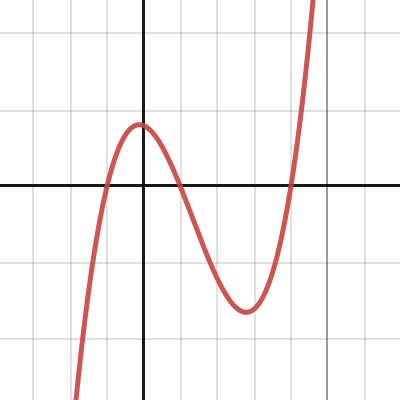
Desmos
Note that the roots are not quite enough to completely define a polynomial, since we can stretch it by some factor and still preserve the points where it crosses the x axis
lone heartBOT
@dusky kraken Has your question been resolved?
Channel closed
Closed by @dusky kraken
Use .reopen if this was a mistake.
Available help channel!
Send your question here to claim the channel.
Remember:
• Ask your math question in a clear, concise manner.
• Show your work, and if possible, explain where you are stuck.
• After 15 minutes, feel free to ping <@&286206848099549185>.
• Type the command .close to free the channel when you're done.
• Be polite and have a nice day!
Read #❓how-to-get-help for further information on how to ask a good question, and about conduct in the question channels.
 daring citrus
 lone heartBOT
daring citrus
lone heartBOT
lone heartBOT
daring citrus
lone heartBOT
Channel closed
Closed by @daring citrus
Use .reopen if this was a mistake.
Available help channel!
Send your question here to claim the channel.
Remember:
• Ask your math question in a clear, concise manner.
• Show your work, and if possible, explain where you are stuck.
• After 15 minutes, feel free to ping <@&286206848099549185>.
• Type the command .close to free the channel when you're done.
• Be polite and have a nice day!
Read #❓how-to-get-help for further information on how to ask a good question, and about conduct in the question channels.
 plain sundial
hey
lone heartBOT
plain sundial
hey

 wanton pebble
don't ping helpers
plain sundial
plain sundial
anyways the answer sheet says that the p=2 and q=16
plain sundial
i subbed that in too i don't really see what's wrong here
 frigid stream
plain sundial
if i don't ping no one's gonna come lol
frigid stream
plain sundial
if i don't ping no one's gonna come lol
I would argue that it is more likely that they come if you don't ping them right away... 😄
plain sundial
frigid stream
I would argue that it is more likely that they come if you don't ping them right...
provlem solved we're not arguing no more
plain sundial
wanton pebble
so put x=4
thats what i did
wanton pebble
okie
see its minimum value is 0 at x =4
can you make a quadratic equations whose both zeros are 4
i will be like (x-4)^2
so compare these 2
maybe it will help
plain sundial
so
the thing is
do you know
where did i go wrong
did i do the question wrongly
did i do it right
wanton pebble
your second step was worng
 plain sundial
if i do it again that way
i mean the way i did in the photo
but correctly
the answer's gonna be correct no?
oh
crap
i just realized
it's complete the square i'm supposed to write q/2p
THANKS fantastic mr. fox
.close
lone heartBOT
Channel closed
Closed by @plain sundial
Use .reopen if this was a mistake.
wanton pebble
plain sundial
the answer's gonna be correct no?
i don't know man... honestly I don't even know what did you do here
plain sundial
i was doing the complete the square thingy
lone heartBOT
Available help channel!
Send your question here to claim the channel.
Remember:
• Ask your math question in a clear, concise manner.
• Show your work, and if possible, explain where you are stuck.
• After 15 minutes, feel free to ping <@&286206848099549185>.
• Type the command .close to free the channel when you're done.
• Be polite and have a nice day!
Read #❓how-to-get-help for further information on how to ask a good question, and about conduct in the question channels.
plain sundial
wanton pebble
i don't know man... honestly I don't even know what did you do here
i forgot the b part was supposed to be divided by 2
wanton pebble
plain sundial
i forgot the b part was supposed to be divided by 2
i mean as a whole solution
cause you are solving a very simple question with such difficult way
lone heartBOT
@plain sundial Has your question been resolved?
lone heartBOT
Channel closed
Closed due to timeout
Use .reopen if this was a mistake.
Available help channel!
Send your question here to claim the channel.
Remember:
• Ask your math question in a clear, concise manner.
• Show your work, and if possible, explain where you are stuck.
• After 15 minutes, feel free to ping <@&286206848099549185>.
• Type the command .close to free the channel when you're done.
• Be polite and have a nice day!
Read #❓how-to-get-help for further information on how to ask a good question, and about conduct in the question channels.
 dim matrix
It is fine if we get two different triangular matrices from a given matrix?
lone heartBOT
dim matrix
It is fine if we get two different triangular matrices from a given matrix?
wanton pebble
what?
 feral turtle
prolly meant "is it"
 mortal trellis
If you chose a different order of the eigenvalues then the triangular matrices will look different
dim matrix
I solved this here

But when I check online calculators, I am getting a bit different answer
mortal trellis
Oh you mean rref
dim matrix

 worn fox
ah yes
mortal trellis
If you subtract the third row from the second and then flip the sign of the second row in the pic, you get your result
Bit weird that you added the third row to the second instead of the second to the third
Not wrong of course but you need to switch the rows after that
dim matrix
mortal trellis
If you subtract the third row from the second and then flip the sign of the seco...
But is it necessary to solve it further once I get a triangular?
dim matrix
mortal trellis
Bit weird that you added the third row to the second instead of the second to th...
I'm new to math 🙂
mortal trellis
Wdym. My message just shows that the screenshot and your result are equivalent
dim matrix
Always ran from it but ended up here again
dim matrix
mortal trellis
Wdym. My message just shows that the screenshot and your result are equivalent
Yeah I understood this. Just asking if I should solve it further to match the result with the online calculator, or if I don't need to solve it further.
mortal trellis
Well what is the original question
dim matrix
This one
 lone heartBOT
Channel closed
Closed by @dim matrix
Use .reopen if this was a mistake.
Available help channel!
Send your question here to claim the channel.
Remember:
• Ask your math question in a clear, concise manner.
• Show your work, and if possible, explain where you are stuck.
• After 15 minutes, feel free to ping <@&286206848099549185>.
• Type the command .close to free the channel when you're done.
• Be polite and have a nice day!
Read #❓how-to-get-help for further information on how to ask a good question, and about conduct in the question channels.
 tranquil anchor
hey
lone heartBOT
tranquil anchor
hey
wanton pebble
hy
tranquil anchor
i would like some help with a if possible

 gray isle
what have you tried?
tranquil anchor
what does it mean size like area?
tranquil anchor
ohhhhhhhhhh
wanton pebble
like can u use trigonometry?
 royal plank
ngl size does sound like area
royal plank
ah
tranquil anchor
royal plank
ngl size does sound like area
yea it does xd
gray isle
 tranquil anchor
on my screen its practically invisible
ok if its angle i got this
lemme do it and see if i got it correct xd
tranquil anchor
gray isle
i got 50 degrees
i used sin90/13 = sinx/10 and put it in my calculator it gave me 50.3
wanton pebble
tranquil anchor
i used sin90/13 = sinx/10 and put it in my calculator it gave me 50.3
what?
wanton pebble
yeah you are right
tranquil anchor
wanton pebble
yeah you are right
aight tyvm
for this one

where it says find the angle of EMD
does it mean the whole angle bc that would be 180 or the angle on the triangle on the right?
wanton pebble
 tranquil anchor
oh
wanton pebble
how
tranquil anchor
like total of both angles of M must be 180 since its a straight line
and since M2 is 110 because that would make M1 70

how do i do B here
i am questioning my life rn
.close
lone heartBOT
Channel closed
Closed by @tranquil anchor
Use .reopen if this was a mistake.
Available help channel!
Send your question here to claim the channel.
Remember:
• Ask your math question in a clear, concise manner.
• Show your work, and if possible, explain where you are stuck.
• After 15 minutes, feel free to ping <@&286206848099549185>.
• Type the command .close to free the channel when you're done.
• Be polite and have a nice day!
Read #❓how-to-get-help for further information on how to ask a good question, and about conduct in the question channels.
 stoic folio
Are radians more popular or prevalent to use over degrees?
stoic folio
I'm very surprised to learn that Microsoft chose to use radians in their [System.Math] class.
 marsh rapids
degrees are for geometry and children. Radians are for everything else
As my teachers say, "you aren't children anymore, in radians"
Except in optics in practice because it's easier to work with very small values when they're in degrees
Because no one wants 1.3e-5 rad as their angle change
But that's basically just geometry then
stoic folio
You're answer is very interesting and timely considering the article I just stumbled onto yesterday. https://www.theverge.com/tldr/2018/3/14/17119388/pi-day-pie-math-tau-circle-constant-mathematics-circumference-diameter-radius-holiday-truth
vale wigeon
actually, snipers use a unit called angular mils
which is an approximation of 0.001 radian
it is more convenient this way to adjust your aim by small increments
stoic folio
.close
lone heartBOT
Channel closed
Closed by @stoic folio
Use .reopen if this was a mistake.
Available help channel!
Send your question here to claim the channel.
Remember:
• Ask your math question in a clear, concise manner.
• Show your work, and if possible, explain where you are stuck.
• After 15 minutes, feel free to ping <@&286206848099549185>.
• Type the command .close to free the channel when you're done.
• Be polite and have a nice day!
Read #❓how-to-get-help for further information on how to ask a good question, and about conduct in the question channels.
 thick lynx
Is $\lim \sum ab = \sum \lim a \lim b$?
lone heartBOT
thick lynx
Is $\lim \sum ab = \sum \lim a \lim b$?
thick lynx
 vale wigeon
gonna need some clarification on that notation.
marsh rapids
If the sum is finite yes. If it's a series it only holds under certain conditions
marsh rapids
So clarifying your notations is necessary
thick lynx
vale wigeon
gonna need some clarification on that notation.
I have $\lim_{n \to \infty} \sum_{x = 0}^n \frac{n!}{(n - x)!n^x} \frac{1}{x!}$
 vale wigeon
ouch. x as summation index 
thick lynx
Now it would be really nice if I could pull that limit in
Since that would prove that this is e
thick lynx
vale wigeon
ouch. x as summation index <:bleak:877093280905592842>
Should've picked k, lol
vale wigeon
$\lim_{n \to \infty} \sum_{k=0}^n \frac{n!}{k!(n-k)! n^k}$
ocean sealBOT
Ann
 thick lynx
Yes
vale wigeon
i'm not sure how your interchange of limit and summation would work symbolically though
$\lim_{n \to \infty} \sum_{k=1}^n a_k b_k \overset?= \sum_{k=1}^{\infty} ....???$
ocean sealBOT
Ann
 marsh rapids
Fortunately ak and bk have limits as n goes to inf so it actually is writable
marsh rapids
Yes
thick lynx
thick lynx
$\lim_{n \to \infty} \sum_{x = 0}^n \frac{n!}{(n - x)!n^x} \frac{1}{x!} = \sum_{x = 0}^n \lim_{n \to \infty} \frac{n!}{(n - x)!n^x} \lim_{n \to \infty} \frac{1}{x!} = \sum_{x = 0}^n \frac{1}{x!} = e$ if this is valid
 lime swallow
wanton pebble
lime swallow
wanton pebble
12m 🧒
vale wigeon
$\lim_{n \to \infty} \sum_{k=1}^n a_{n,k} \overset?= \sum_{k=1}^{\infty} \lim_{n \to \infty} a_{n,k}$
ocean sealBOT
Ann
 thick lynx
 thick lynx
vale wigeon
the product thing was just a distraction
thick lynx
vale wigeon
the product thing was just a distraction
Well the limit of a product is the product of the limits
thick lynx
ocean seal
**Ann**
so we just need to prove or confirm that, yes
marsh rapids
vale wigeon
that sum is a binomial expansion of (1 + 1/n)^n isn't it
e^(n ln(1+1/n)) is linearly approximated as n -> inf by e^(n * 1/n) = e
vale wigeon
well, now i at least understand what kind of manipulation was meant
at least from a symbolic standpoint
but i am not sure whether it's always true, or what conditions could be placed on a_n,k to guarantee its truth.
marsh rapids
You can see it as a sequence of series
vale wigeon
can you...?
marsh rapids
A finite sum is a series over an almost-null sequence
Not saying it's valid though
That manipulation
vale wigeon
well, its validity is what i am doubting.
alpine sable
i think there must be an easy counterexample
a_n,k = k/n should break it
thick lynx
I just found a question about this on Math StackExchange
https://math.stackexchange.com/questions/1937534/limit-of-infinite-sum-equal-infinite-sum-of-limits

Mathematics Stack Exchange
I just asked a similar looking question, but this one is a different question.
Suppose that
$$\lim_{u \to \infty}\sum_{i=0}^{\infty}x_i(u)=L$$
where $x_i$ is a function of $u$. Then does it follow...
So it does not follow in general
Thank you
.close
lone heartBOT
Channel closed
Closed by @thick lynx
Use .reopen if this was a mistake.
Available help channel!
Send your question here to claim the channel.
Remember:
• Ask your math question in a clear, concise manner.
• Show your work, and if possible, explain where you are stuck.
• After 15 minutes, feel free to ping <@&286206848099549185>.
• Type the command .close to free the channel when you're done.
• Be polite and have a nice day!
Read #❓how-to-get-help for further information on how to ask a good question, and about conduct in the question channels.
lilac thicket
where exactly are you struggling ?
stuck cape
CHOOSE ONE OF THEM BELOW


1. did not know to find median
2. don't know statstics
3. don't know math
4. don't know your name
5. i'm dumb
6. all of above
bruh
 hard patio
stuck cape
```
CHOOSE ONE OF THEM BELOW
1. did not know to find median
2. don't know stat...
hard patio
stuck cape
```
CHOOSE ONE OF THEM BELOW
1. did not know to find median
2. don't know stat...
Woah woah woah 💀
hard patio
stuck cape
PULL REQUEST MERGED
Imagine making up that option only to end up choosing one from 1 to 5
lone heartBOT
Channel closed
Closed by @sterile pagoda
Use .reopen if this was a mistake.
 hollow sparrow
lone heartBOT
Available help channel!
hollow sparrow
lone heartBOT
Available help channel!
Send your question here to claim the channel.
Remember:
• Ask your math question in a clear, concise manner.
• Show your work, and if possible, explain where you are stuck.
• After 15 minutes, feel free to ping <@&286206848099549185>.
• Type the command .close to free the channel when you're done.
• Be polite and have a nice day!
Read #❓how-to-get-help for further information on how to ask a good question, and about conduct in the question channels.
mortal trellis
How old are you
stuck cape
CHOOSE ONE OF THEM BELOW


1. don't know to add, subtract and multiply
2. don't know english
3. don't know math
4. don't know your name
5. i'm dumb
6. all of the above
7. none of these
8. write custom range between 1 to 7
<@&268886789983436800> underaged user
tbh seems like you are either underaged or heavily trolling
so
tbh i doubt a 4 year old is on discord
mortal trellis
Obviously trolling
alpine sable
but
 gray gorge
.close
lone heartBOT
Channel closed
Closed by @gray gorge
Use .reopen if this was a mistake.
Available help channel!
Send your question here to claim the channel.
Remember:
• Ask your math question in a clear, concise manner.
• Show your work, and if possible, explain where you are stuck.
• After 15 minutes, feel free to ping <@&286206848099549185>.
• Type the command .close to free the channel when you're done.
• Be polite and have a nice day!
Read #❓how-to-get-help for further information on how to ask a good question, and about conduct in the question channels.
 vagrant meadow
Can anyone explain me in an intuitive way that why should gradient of f is parallel with gradient of g in langrage multiplier where
f is original function
g is constraint function
lone heartBOT
vagrant meadow
Can anyone explain me in an intuitive way that why should gradient of f is paral...
 last ether
Yeah so a function has an infinite number of level sets
The intuition is that you're maximizing/minimizing the level set values, and that's only the points where the constant is tangent to a level set.
Because a function has an infinite number of level sets, you're guaranteed that the constraint is tangent to at least one level set.
Gradients are orthogonal to level sets, and by extension, the constant (where they are tangent, ofc), thus their gradients are parallel
Here's a shitty drawing

The very far-reaching "parts" of the constraint is guaranteed to be tangent to some level set
Long story short, what LaGrange multipliers guarantee is that the constraint, which has to be in the same dimension as the level sets, is tangent to at least one level set, which can be a max or min.
@vagrant meadow hopes this helps
lone heartBOT
@vagrant meadow Has your question been resolved?
vagrant meadow
Now i have two questions hw do u know that constraint is tangent to atleast one set, what if there exist a case where no tangent exist
And why tangent, why not any other point
??
Ok forget the second qe, answer for the first one alone
<@&286206848099549185>
 cerulean glen
how can I study the parity of a function?
 west sentinel
bruh this doesnt work like this u cant just ask in middle of someone dbt switch over to #discussion or smt and delete these msg @cerulean glen
lone heartBOT
@vagrant meadow Has your question been resolved?
vagrant meadow
Now consider this case where 4 1 2 are the value of f level curve, now the one intersecting the curve has maximum value whereas the one touching it has neither maxima nor minima, now here won't the logic of lagrange gets defeated?

.close
lone heartBOT
Channel closed
Closed by @vagrant meadow
Use .reopen if this was a mistake.
Available help channel!
Send your question here to claim the channel.
Remember:
• Ask your math question in a clear, concise manner.
• Show your work, and if possible, explain where you are stuck.
• After 15 minutes, feel free to ping <@&286206848099549185>.
• Type the command .close to free the channel when you're done.
• Be polite and have a nice day!
Read #❓how-to-get-help for further information on how to ask a good question, and about conduct in the question channels.
 lilac iron
 lone heartBOT
lilac iron
lilac iron
lone heartBOT
lilac iron
lilac iron
help pls
 late mango
equilateral triangle
lilac iron
oh
late mango
that's isoceles
lone heartBOT
Channel closed
Closed by @lilac iron
Use .reopen if this was a mistake.
Available help channel!
Send your question here to claim the channel.
Remember:
• Ask your math question in a clear, concise manner.
• Show your work, and if possible, explain where you are stuck.
• After 15 minutes, feel free to ping <@&286206848099549185>.
• Type the command .close to free the channel when you're done.
• Be polite and have a nice day!
Read #❓how-to-get-help for further information on how to ask a good question, and about conduct in the question channels.
 idle sand
Can anybody tell me how am ment to solve this comulative distrabution function
 lone heartBOT
idle sand
Can anybody tell me how am ment to solve this comulative distrabution function
lone heartBOT
idle sand
Can anybody tell me how am ment to solve this comulative distrabution function
 plain flame
idle sand
plain flame
idle sand
yea thats why i don't understand
what the question wants from me
it already gave me the cdf of all the values of x
idle sand
idle sand
Can anybody tell me how am ment to solve this comulative distrabution function
this is the textbook answer if that helps
 lone heartBOT
@idle sand Has your question been resolved?
idle sand
yea
 desert zephyr
Well it's a piecewise function so all you have to do is take the derivative of each piece
lone heartBOT
@idle sand Has your question been resolved?
Channel closed
Closed by @idle sand
Use .reopen if this was a mistake.
Available help channel!
Send your question here to claim the channel.
Remember:
• Ask your math question in a clear, concise manner.
• Show your work, and if possible, explain where you are stuck.
• After 15 minutes, feel free to ping <@&286206848099549185>.
• Type the command .close to free the channel when you're done.
• Be polite and have a nice day!
Read #❓how-to-get-help for further information on how to ask a good question, and about conduct in the question channels.
 queen salmon
Having 5 boxes numbered 1-5 and having 5 papers numbered 1-5 in the boxes, how many possibilities are there that no paper is in the box with the same number?
lone heartBOT
queen salmon
Having 5 boxes numbered 1-5 and having 5 papers numbered 1-5 in the boxes, how m...
queen salmon
its an easy one, but i cant get the solution and im guessing the solution is wrong
but just wanted to make sure
 chilly storm
sretno
so the way it'd be good to start is seeing how many events are possible to happen
if you can get the number 1,1,3,2,2 in the box, that means those are permutations with repetition
in your case we have 5 different number on each paper, and we can mark that as n = the number of possible outcomes for each event
then we have r = the size of each permutation, which is the number of boxes you have
the formula being n to the power of r, gives you 5 to the power of five = 3125 (the number of permutations with repetition)
queen salmon
yeah thats what i got
chilly storm
and the rest i wouldn't know (how to calculate what is the possibility of having zero papers with the same number as the one on the box)
lone heartBOT
@queen salmon Has your question been resolved?
lone heartBOT
Channel closed
Closed due to timeout
Use .reopen if this was a mistake.
Available help channel!
Send your question here to claim the channel.
Remember:
• Ask your math question in a clear, concise manner.
• Show your work, and if possible, explain where you are stuck.
• After 15 minutes, feel free to ping <@&286206848099549185>.
• Type the command .close to free the channel when you're done.
• Be polite and have a nice day!
Read #❓how-to-get-help for further information on how to ask a good question, and about conduct in the question channels.
 buoyant sandal
How do you get the turning points of a quartic/cubic/quadratic equation?
lone heartBOT
buoyant sandal
How do you get the turning points of a quartic/cubic/quadratic equation?
mortal trellis
well the same way you would do it for other functions
last ether
turning points as in maxes and mins or inflections?
lone heartBOT
@buoyant sandal Has your question been resolved?
buoyant sandal
mortal trellis
well the same way you would do it for other functions
How?
buoyant sandal
last ether
turning points as in maxes and mins or inflections?
Yes
last ether
first derivative test\
buoyant sandal
The turning point for a quadratic is the minimum/maximum value with Y
How do I do so
<@&286206848099549185>
 weak bison
buoyant sandal
The turning point for a quadratic is the minimum/maximum value with Y
weak bison
buoyant sandal
The turning point for a quadratic is the minimum/maximum value with Y
you can find local min and max values of a function by taking its derivative and solving for when it = 0
weak bison
derivatives is from calculus
weak bison
what level math have you taken so far
weak bison
ok so no calculus then
for quadratic functions you will have it be of the form ax^2 + bx + c
you can find the min/max by evaluating the function at -b/(2a)
weak bison
yea it comes from part of the quadratic formula not the discriminant tho
buoyant sandal
-b/2a but you remove the +- square root of the discriminant
seems good
ty
.close
lone heartBOT
Channel closed
Closed by @buoyant sandal
Use .reopen if this was a mistake.
Available help channel!
Send your question here to claim the channel.
Remember:
• Ask your math question in a clear, concise manner.
• Show your work, and if possible, explain where you are stuck.
• After 15 minutes, feel free to ping <@&286206848099549185>.
• Type the command .close to free the channel when you're done.
• Be polite and have a nice day!
Read #❓how-to-get-help for further information on how to ask a good question, and about conduct in the question channels.
 glossy matrix
 lone heartBOT
glossy matrix
glossy matrix
lone heartBOT
glossy matrix
glossy matrix
@blissful whale can you help?
 blissful whale
Do you want to compute the limit?
glossy matrix
Yes
blissful whale
I don't think it exists
blissful whale
you can find two sequences of points that converge to different values for x/sqrt(y) but both approach 0
try to make x or y very large in comparison to the other for that
glossy matrix
I don't know if that's a valid method. Here's one method from my textbook. Can I just use x = √y curve instead of x=y line, like in this example?
 blissful whale
it's valid
but if you insist you can also pick an entire curve isntead of just some points on it
glossy matrix
blissful whale
it's valid
Oh sorry, bad wording. I meant like, it might not be valid from exam point of view. Teacher might not give me marks if the method is not in the textbook
Although I'm not really sure
blissful whale
ah
glossy matrix
Just don't wanna risk it
blissful whale
blissful whale
but if you insist you can also pick an entire curve isntead of just some points ...

glossy matrix
Ah, alright
blissful whale
c: t -> (sqrt(t), t) curve seems to work indeed
glossy matrix
So how would you write it?
The proof?
In proper mathematical terms
The textbook way is way too wordy
blissful whale
true imo 😄
well you just define two curves and say they cross 0
but they do not converge to the same trhing
when put in the function
I would simply do that and only write the conclusion from it.
Basically the lastz sentance in your solution example
lone heartBOT
@glossy matrix Has your question been resolved?
lone heartBOT
Channel closed
Closed due to timeout
Use .reopen if this was a mistake.
Available help channel!
Send your question here to claim the channel.
Remember:
• Ask your math question in a clear, concise manner.
• Show your work, and if possible, explain where you are stuck.
• After 15 minutes, feel free to ping <@&286206848099549185>.
• Type the command .close to free the channel when you're done.
• Be polite and have a nice day!
Read #❓how-to-get-help for further information on how to ask a good question, and about conduct in the question channels.
 south hamlet
Hi, can someone help me with derivatives?
lone heartBOT
south hamlet
Hi, can someone help me with derivatives?
rocky grove

south hamlet
Find the differential dy, given:
Y = -x(x²+3)
rocky grove
Okay take the derivative after simplifying
 rocky grove
Uh
south hamlet
So this is an answer to one of the problems from my tutor, but I don't know which
south hamlet
Yeah we were in a hurry
Well okay, then can you explain problem c instead then
Or any one is fine really 💀
alpine sable
Is that like $f(x) = \frac{x}{x+1}$
ocean sealBOT
♡LexQa♡
 alpine sable
For c
south hamlet
x² + 1
 left mesa
x^2
south hamlet
For the denominator
alpine sable
Apply quotient rule
alpine sable
Like if you have $\dv{x}(\frac{f(x)}{g(x)}) = \frac{f'(x)g(x) -g'(x)f(x)}{(g(x))^2}$
ocean sealBOT
♡LexQa♡

 south hamlet
Took me awhile... 🙃
So would this be correct?

Why does my answer look different

That screenshot is from chegg
Oh never mind, problem solved
 long thorn
 lone heartBOT
Channel closed
Closed by @south hamlet
Use .reopen if this was a mistake.
Available help channel!
Send your question here to claim the channel.
Remember:
• Ask your math question in a clear, concise manner.
• Show your work, and if possible, explain where you are stuck.
• After 15 minutes, feel free to ping <@&286206848099549185>.
• Type the command .close to free the channel when you're done.
• Be polite and have a nice day!
Read #❓how-to-get-help for further information on how to ask a good question, and about conduct in the question channels.
 broken pollen
 lone heartBOT
broken pollen
broken pollen
lone heartBOT
broken pollen
broken pollen
Could someone explain what it means by given that one is red whats the probability they are all red?
 oblique trail
This a test?
broken pollen
Nope Hw
oblique trail
Ok
oblique trail
broken pollen
Could someone explain what it means by given that one is red whats the probabili...
If you already know that one bead is red
What is the probability both are
Probability of a given b is probability of a intersection b/ probability of b
I think that might be what they want you to use
broken pollen
Nope
oblique trail
Huh
oblique trail
oh my bad
That’s my bad
So you need to know bayes rule I think
If you don’t know that google it I think that will make it a lot easier
 desert fractal

broken pollen
I think I understand now
I get the basic of it
but I still don't fully understand it
broken pollen
if anyone can explain please do
desert fractal
broken pollen
That would make it 15/63
well i thought this at first too
but notice that it says "at least" one of the beads is red
we can use the formula $P(A|B) = \frac{P(A\cap B)}{P(B)}$ to solve it
ocean sealBOT
edwardborn
 desert fractal
where P(B) is the probability that we draw at least 1 red bead
P(A n B) is the probability that we draw two red beads and at least one red bead
which is the same as P(A)
broken pollen
Probability of drawing 1 would be probability of p(r)+p(gr)+p(gr)
Would that make sense ?
broken pollen
If that would be the p(b) then we would get the right answer
Nope event when its 1 R
so would be just
16/64
managed to get the right answer with that but I don't understand by own logic behind it lmao
desert fractal
desert fractal
where P(B) is the probability that we draw at least 1 red bead
do you think there might be a simpler way to find this value?
broken pollen
Cant think of any
desert fractal
what if i say P(B) + P(not B) = 1
broken pollen
since i would say p(r)+p(r' and r) would give us that
broken pollen
desert fractal
what if i say P(B) + P(not B) = 1
I still dont get what your trying to say
if we add B and not B obvs it's 1
desert fractal
what's equivalent to B not happening?
broken pollen
1-p(b)
desert fractal
what about drawing no red beads?
broken pollen
That would be p(r')
desert fractal
broken pollen
Its 5/37
do you mean 5/47?
broken pollen
nope
broken pollen

sry about the trashy handwriting at the end
😓 kinda got confused my self
I did it and i think its alright
I get your method a bit but not that well
desert fractal
you got a 37/84 there which is a good sign at least
cant be pure coincidence
kinda hard to see but i guess you've calculated it directly
other way to do it is by adding the probability that one is red and that both is red
desert fractal
broken pollen
Probability of drawing 1 would be probability of p(r)+p(gr)+p(gr)
but this is only right if p(r) is the probability that both are red and p(gr) is the probability that one is red
by other words that p(r' n r) you've written on that paper should be multiplied by two
otherwise everything is correct
but yeah i'd still recommend you to find P(not B) instead. Even tho it's harder to notice, it's much easier to calculate
just gotta realize that the opposite of drawing at least one red bead is the same as drawing none at all
then you get the desired P(B) by solving P(B) = 1 - P(not B)
lone heartBOT
@broken pollen Has your question been resolved?
broken pollen
I thought about all the ways you can get 1 r
Then put down how to get 2 r over that
lone heartBOT
@broken pollen Has your question been resolved?
lone heartBOT
Channel closed
Closed due to timeout
Use .reopen if this was a mistake.
Available help channel!
Send your question here to claim the channel.
Remember:
• Ask your math question in a clear, concise manner.
• Show your work, and if possible, explain where you are stuck.
• After 15 minutes, feel free to ping <@&286206848099549185>.
• Type the command .close to free the channel when you're done.
• Be polite and have a nice day!
Read #❓how-to-get-help for further information on how to ask a good question, and about conduct in the question channels.
 knotty oracle
 lone heartBOT
knotty oracle
knotty oracle
lone heartBOT
knotty oracle
knotty oracle
Isn’t it
[ 13 4 ]
[ 12 7 ]
hollow sparrow
knotty oracle
Isn’t it
[ 13 4 ]
[ 12 7 ]
it's
knotty oracle
Thx
Just a random question I forgot how to do on a practice test for admission to high school
.close
lone heartBOT
Channel closed
Closed by @knotty oracle
Use .reopen if this was a mistake.
Available help channel!
Send your question here to claim the channel.
Remember:
• Ask your math question in a clear, concise manner.
• Show your work, and if possible, explain where you are stuck.
• After 15 minutes, feel free to ping <@&286206848099549185>.
• Type the command .close to free the channel when you're done.
• Be polite and have a nice day!
Read #❓how-to-get-help for further information on how to ask a good question, and about conduct in the question channels.
 wispy salmon
got function investigation question and they asked to draw the graph, i got a question regarding the horizontal asymptotes, can they really "split" like on the left, or the correct way to look at them is like the one on the right?
 lone heartBOT
wispy salmon
got function investigation question and they asked to draw the graph, i got a qu...
last ether
lone heartBOT
wispy salmon
got function investigation question and they asked to draw the graph, i got a qu...
last ether
It really should be |x| -> infinity before splitting
wispy salmon
yes but i cant figure out what i has to do with it splitting like that
what i need to calculate to understand how should i split it
lone heartBOT
@wispy salmon Has your question been resolved?
last ether
|x| -> infinity is like two limits
Can be split into x -> -inf, inf
That's why I said it really should be $\lim_{|x|\to\infty}$ before splitting it
ocean sealBOT
Umbraleviathan
 hollow sparrow
$\inf$ means $+\inf or -\inf$
ocean sealBOT
Mehdi_Moulati
 last ether
That's prob a regional thing
 golden stratus
hollow sparrow
$\inf$ means $+\inf or -\inf$
golden stratus
hollow sparrow
$\inf$ means $+\inf or -\inf$
u wot
last ether
For me, that's just positive infinity
-inf is negative inf,
inf is just positive inf
I've never seen +inf
hollow sparrow
last ether
I've never seen +inf
a regional thing 100% as you said
wispy salmon
why it matters? even if I split i get the same answe, 1 and -1
last ether
By definition
wispy salmon
last ether
By definition
well i guess they skipped that part because it gives the same results on this specific case when splitting.
what i still dont got is why the asymptotes split like that, as in on the left side on the graph only -1=asymptotes exsits, and on the right side only the 1=asymptotes exsits while the -1 dont
last ether
It just be like that
wispy salmon
last ether
It just be like that
as in i just need to assume from the overall data i get from the function that there is no asymptote there?
last ether
i mean when you find a horizontal asymptote, you need to test both inf and -inf
lone heartBOT
@wispy salmon Has your question been resolved?
lone heartBOT
Channel closed
Closed due to timeout
Use .reopen if this was a mistake.
Available help channel!
Send your question here to claim the channel.
Remember:
• Ask your math question in a clear, concise manner.
• Show your work, and if possible, explain where you are stuck.
• After 15 minutes, feel free to ping <@&286206848099549185>.
• Type the command .close to free the channel when you're done.
• Be polite and have a nice day!
Read #❓how-to-get-help for further information on how to ask a good question, and about conduct in the question channels.
 swift terrace
f(3) = 5 , f'(3) = 1 f'(0) > 1
lets say f(x) is a cubic that has 2 roots
if f(x-f(x)) has 3 roots, would this mean f'(-2) = 0?
lone heartBOT
swift terrace
f(3) = 5 , f'(3) = 1 f'(0) > 1
lets say f(x) is a cubic that has 2 roots
if f(x-...
 serene junco
I don't really follow the logic, can you explain how you get f'(-2) = 0?
Also can you clarify what you mean by a cubic with 2 roots? Do you mean two unique real roots? So one of them has multiplicity 2?
swift terrace
 swift terrace
serene junco
Also can you clarify what you mean by a cubic with 2 roots? Do you mean two uniq...
swift terrace
serene junco
Also can you clarify what you mean by a cubic with 2 roots? Do you mean two uniq...
yes
serene junco
okay, what is the significance of f(x-f(x)) ?
swift terrace
lets say f(x)=a(x-b)²(x-c)
since f(x-f(x)) has 3 roots
x-f(x) = b or c
so i set 2 equations
f(x)=x-b, f(x)=x-c
and surprisingly f'(3)=1
swift terrace
swift terrace
f(x)=x-b, f(x)=x-c
and those equations in total have 3 roots
serene junco
swift terrace
and those equations in total have 3 roots
That's not true in general, they could have up to six distinct real roots altogether
serene junco
oh i see
swift terrace
serene junco
That's not true in general, they could have up to six distinct real roots altoge...
also isnt it 9?
serene junco
9 roots altogether but at least three of them will have multiplicity 2
because (x-b)^2
swift terrace
yeah but i didnt solve this algebraically
serene junco
yes but if x-f(x) = b, then f(x-f(x)) has a double root
swift terrace
whats the problem
serene junco
I'm not seeing a path from here to f'(-2) = 0
serene junco
ok
swift terrace
and this means f(x) and x-b intersects somewhere
and in total
f(x)=x-b,x-c has 3 intersecting points
annnd f'(3)=1
which is the slope of x-b
so its tangent right
and f(3)=5
so 3-b=5
b=-2
serene junco
ok one sec
Okay
yeah
I agree
that means x=-2 is the double root, which means it's tangent to the x-axis
lone heartBOT
@swift terrace Has your question been resolved?
 keen plinth
f'(0) > 1 means your construction doesnt work
if f has a double root to the left of 3 then the slope will be less than 1 at 0
lone heartBOT
Channel closed
Closed due to timeout
Use .reopen if this was a mistake.
Available help channel!
Send your question here to claim the channel.
Remember:
• Ask your math question in a clear, concise manner.
• Show your work, and if possible, explain where you are stuck.
• After 15 minutes, feel free to ping <@&286206848099549185>.
• Type the command .close to free the channel when you're done.
• Be polite and have a nice day!
Read #❓how-to-get-help for further information on how to ask a good question, and about conduct in the question channels.
alpine sable
Help
lone heartBOT
alpine sable
Help
alpine sable
actually nvm-
lone heartBOT
Channel closed
Closed by @last ether
Use .reopen if this was a mistake.
Available help channel!
Send your question here to claim the channel.
Remember:
• Ask your math question in a clear, concise manner.
• Show your work, and if possible, explain where you are stuck.
• After 15 minutes, feel free to ping <@&286206848099549185>.
• Type the command .close to free the channel when you're done.
• Be polite and have a nice day!
Read #❓how-to-get-help for further information on how to ask a good question, and about conduct in the question channels.
 whole jetty
Help
lone heartBOT
whole jetty
Help
 rocky grove
Angle of straight line = 180
whole jetty
How do you find that?
whole jetty
So I just write the given numbers then = it to 180?
rocky grove
Yeah the givens are all part of 1 big angle
And it is the angle of the straight line
Btw your username reminds me of a colleague I have in my batch. He's like the 3rd now
whole jetty
3rd what
rocky grove
His last name is super similar to the last bit in your username
rocky grove
lewan
whole jetty
ohh
whole jetty
rocky grove
3rd place out of 300 students
woah thats cool
rocky grove
Yeah
Hopefully I get 1st place next 2 years

Anyways
Did you solve your question?
whole jetty
having a really hard time
rocky grove
Here's a hint
whole jetty
rocky grove
Hopefully I get 1st place next 2 years
do you participate in math competitions too?
rocky grove
30 + 4x+2 = 180
rocky grove
whole jetty
do you participate in math competitions too?
Nope
Wish I could
But I participated in a competition that made me win and go to DC
whole jetty
rocky grove
30 + 4x+2 = 180
got this one but i dont understand whats next, do you transpose?
rocky grove
Well you solve for x
whole jetty
rocky grove
But I participated in a competition that made me win and go to DC
u have any tips
rocky grove
Well the competition happened because my uni participated in a virtual exchange program
So I guess you'd have to find a college that participates in virtual exchanges hosted by the IIE and Aspen Institute
whole jetty
the 180 should always stay on the right side?
whole jetty
 burnt imp
where do you find the competitions
burnt imp
where do you find the competitions
i think you can find ones on google
or yt
rocky grove
Nah you can have any side you want as long as you keep the equation true
burnt imp
ok
rocky grove
Well
4x = 180 - 30 - 2
Is the same as
180 - 30 - 2 = 4x
Just a matter of organizing your terms in the way you see fit as long as it stays true
rocky grove
Yep
rocky grove

whole jetty
.close
lone heartBOT
Channel closed
Closed by @whole jetty
Use .reopen if this was a mistake.
Available help channel!
Send your question here to claim the channel.
Remember:
• Ask your math question in a clear, concise manner.
• Show your work, and if possible, explain where you are stuck.
• After 15 minutes, feel free to ping <@&286206848099549185>.
• Type the command .close to free the channel when you're done.
• Be polite and have a nice day!
Read #❓how-to-get-help for further information on how to ask a good question, and about conduct in the question channels.
 kindred anchor
0️⃣
lone heartBOT
kindred anchor
0️⃣


 ripe rain

rocky grove
$\sum !!!!!!!!! \int$
ripe rain
keen plinth

ripe rain

keen plinth
\ooalign{$\sum$\crcr$\int$}
ocean sealBOT
 tacit arch
keen plinth
\ooalign{$\sum$\crcr$\int$}
tacit arch
keen plinth
\ooalign{$\sum$\crcr$\int$}
hax
rocky grove
Preamble package
ripe rain

keen plinth
doesnt look right
ripe rain
,tex \csmean{ooalign}
ocean sealBOT
Compile Error! Click the  reaction for more information.
(You may edit your message to recompile.)
 ripe rain
oh wait
tacit arch
$\sum \hspace{-0.69cm} \int$
keen plinth
ooalign is ams?
ocean sealBOT
VulcanOne


 keen plinth
ripe rain
<:opencry:586078614865444865>
keen plinth
ripe rain
<:opencry:586078614865444865>

tacit arch
tacit arch
$\sum \hspace{-0.69cm} \int$
0.69 wins
kindred anchor
I should be careful to not make help channels Latex playground from next time 😭
$W_1={(a_1,a_2,a_3) \in \mathbb{R}^3 : 2a_1-7a_2+a_3=0} \
W_2= {(a_1,a_2,a_3) \in \mathbb{R}^3 : a_1-4a_2-a_3=0}$
ocean sealBOT
 rocky grove
Well you began with 0️⃣
rocky grove
ocean seal
Wow nice
kindred anchor
I want to find W_1 intersection W_2
rocky grove
kindred anchor
Those two equations are plane in R³, so their intersection must be a line
I tried solving the equations, but I couldn't get to the answer
rocky grove
You'll need analytic geometry
kindred anchor
I'm only into Introductory Linear algebra 
rocky grove
Lemme get my analytic geometry book

 ocean sealBOT
 kindred anchor
Oh yeah, I forgor
rocky grove
1:1/11:3/11 or something I have no clue
kindred anchor
So, $t(11,3,-1) \in W_1 \cap W_2$
ocean sealBOT
 kindred anchor
t is any constant.
kindred anchor
What shape in $\mathbb{R}^3$ is something like $5x^2-3y^2+6z^2=0$?
rocky grove
That's a hyperbola
ocean sealBOT
 ocean sealBOT


 Requested by hazysleet#7757
kindred anchor
Requested by hazysleet#7757
kindred anchor
How do I recognize these shapes?
rocky grove
x^2, y^2 and z^2 all positives = ellipsoid
ocean sealBOT
 keen plinth
at any particular value of y you get an ellipse in the xz-plane
so its going to be a double cone
kindred anchor

rocky grove
And paraboloid has 2 possibilities
Either elliptic or hyperbolic
For example
x^2 + y^2 = 4z
This is an elliptic paraboloid
But this
kindred anchor
I can relate this to conic sections in 2D
rocky grove
x^2 - y^2 = 4z is a hyperbolic paraboloid
rocky grove
kindred anchor
I can relate this to conic sections in 2D
Yep
kindred anchor
.close
lone heartBOT
Channel closed
Closed by @kindred anchor
Use .reopen if this was a mistake.
rocky grove
Also graph things in geogebra to get a fuller picture
lone heartBOT
Available help channel!
Send your question here to claim the channel.
Remember:
• Ask your math question in a clear, concise manner.
• Show your work, and if possible, explain where you are stuck.
• After 15 minutes, feel free to ping <@&286206848099549185>.
• Type the command .close to free the channel when you're done.
• Be polite and have a nice day!
Read #❓how-to-get-help for further information on how to ask a good question, and about conduct in the question channels.
 storm oar
not sure if this counts as maths since it's physics but it seemed worth asking:
 lone heartBOT
storm oar
not sure if this counts as maths since it's physics but it seemed worth asking:
storm oar
lone heartBOT
storm oar
not sure if this counts as maths since it's physics but it seemed worth asking:
storm oar
how do i do the underlined question?
is there a formula?
i just don't know where to start
 placid zinc
I'm confused by the question. Is the field constant everywhere?