#help-0
1 messages · Page 110 of 1
 devout spruce
 lone heartBOT
@devout spruce Has your question been resolved?
 worn fox
Probably write out its matrix and diagonalize
devout spruce
worn fox
Probably write out its matrix and diagonalize
i wrote out
but eigenvalues is float
<@&286206848099549185>
worn fox
Show your work
 tacit arch
devout spruce
but eigenvalues is float
tacit arch
devout spruce
but eigenvalues is float
^

 lone heartBOT
@devout spruce Has your question been resolved?
devout spruce
<@&286206848099549185>
tacit arch
devout spruce
okay
Show how you got the matrix
devout spruce
.close
lone heartBOT
Channel closed
Closed by @devout spruce
Use .reopen if this was a mistake.
devout spruce
.reopen
lone heartBOT
✅
lone heartBOT
@devout spruce Has your question been resolved?
Channel closed
Closed by @devout spruce
Use .reopen if this was a mistake.
lone heartBOT
 Available help channel!
Send your question here to claim the channel.
Remember:
• Ask your math question in a clear, concise manner.
• Show your work, and if possible, explain where you are stuck.
• After 15 minutes, feel free to ping <@&286206848099549185>.
• Type the command .close to free the channel when you're done.
• Be polite and have a nice day!
Read #❓how-to-get-help for further information on how to ask a good question, and about conduct in the question channels.
 mellow crane
 lone heartBOT
mellow crane
lone heartBOT
mellow crane
 violet bear
first you should cover the 25.4 meters into centimeters, then subtract diameter of the spool plus the diameter of the tape by the diameter of the spool, then divide the length of the tape by the difference of the diameters
lone heartBOT
@mellow crane Has your question been resolved?
mellow crane
so 25.4m is 2540cm
and then I do 3.6-(3.6+5.4)=5.4?
and then 2540/5.4= about 470?
but that's not a multiple choice answer?
 naive valley
mellow crane
but that's not a multiple choice answer?
naive valley
mellow crane
but that's not a multiple choice answer?
you need to work out how much tape is in each layer
for example, the first layer is at radius 3.6/2 = 1.8
what's the circumference of a circle with that radius?
mellow crane
3.6pi?
mellow crane
5.4pi?
naive valley
yep
now perhaps you could argue that on average, each layer has a circumference that is the average of those two
(it's not quite exact but maybe close enough to get the right multiple choice answer)
mellow crane
wait so do I do (3.6pi+5.4pi)/2?
naive valley
yea
that gives you the length of the average layer
(the ones closer to the spool are shorter and the ones farther out are longer)
mellow crane
wait but that average is 9/2pi which is also not in the multiple choice answers
naive valley
well that's because the question is asking how many layers, not what is the length of the average layer
but do you see how to calculate the number of layers, given the total length of the tape and the length of the average layer?
mellow crane
do I divide the total length by the number of layers?
naive valley
the number of layers is what you want to calculate, you don't know it yet
try: total length = (number of layers)(length of average layer)
mellow crane
so 2540=9.2pi*# of layers?
mellow crane
sorry, 9/2
naive valley
oh yea
mellow crane
I typed it wrong
naive valley
yep that equation is right
mellow crane
so then 2540/(9/2pi)=about 179.67 which is closest to 180?
naive valley
that's what i get
lone heartBOT
Channel closed
Closed by @mellow crane
Use .reopen if this was a mistake.
Available help channel!
Send your question here to claim the channel.
Remember:
• Ask your math question in a clear, concise manner.
• Show your work, and if possible, explain where you are stuck.
• After 15 minutes, feel free to ping <@&286206848099549185>.
• Type the command .close to free the channel when you're done.
• Be polite and have a nice day!
Read #❓how-to-get-help for further information on how to ask a good question, and about conduct in the question channels.
 vague cloak
 lone heartBOT
vague cloak
lone heartBOT
vague cloak
 lone heartBOT
@vague cloak Has your question been resolved?
lone heartBOT
@vague cloak Has your question been resolved?
lone heartBOT
Channel closed
Closed by @vague cloak
Use .reopen if this was a mistake.
lone heartBOT
Available help channel!
Send your question here to claim the channel.
Remember:
• Ask your math question in a clear, concise manner.
• Show your work, and if possible, explain where you are stuck.
• After 15 minutes, feel free to ping <@&286206848099549185>.
• Type the command .close to free the channel when you're done.
• Be polite and have a nice day!
Read #❓how-to-get-help for further information on how to ask a good question, and about conduct in the question channels.
 warped topaz
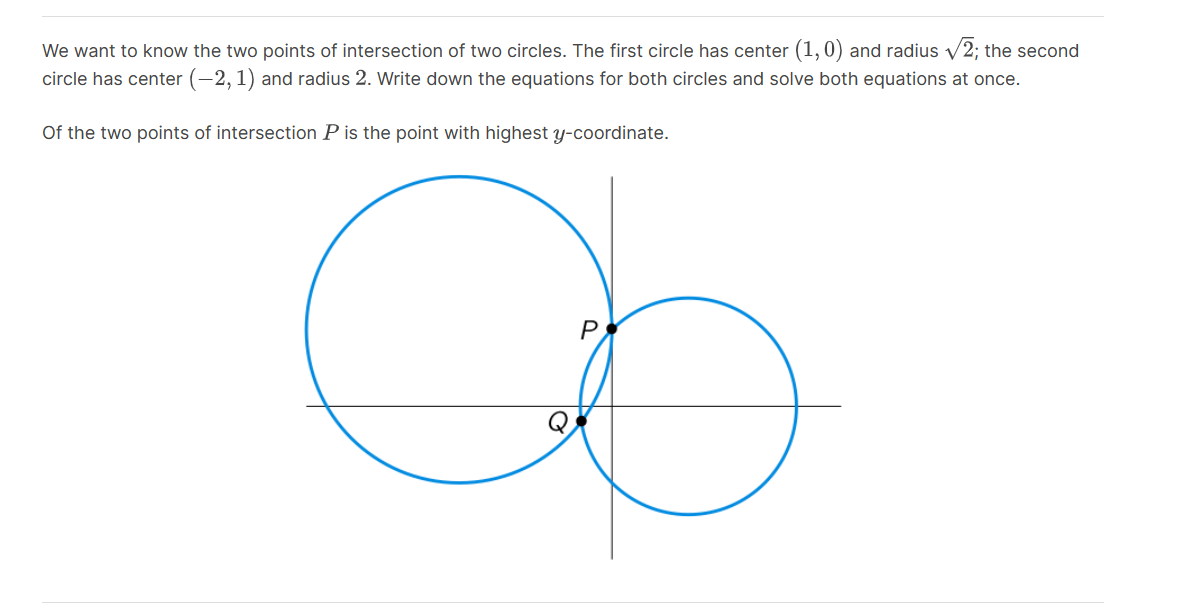
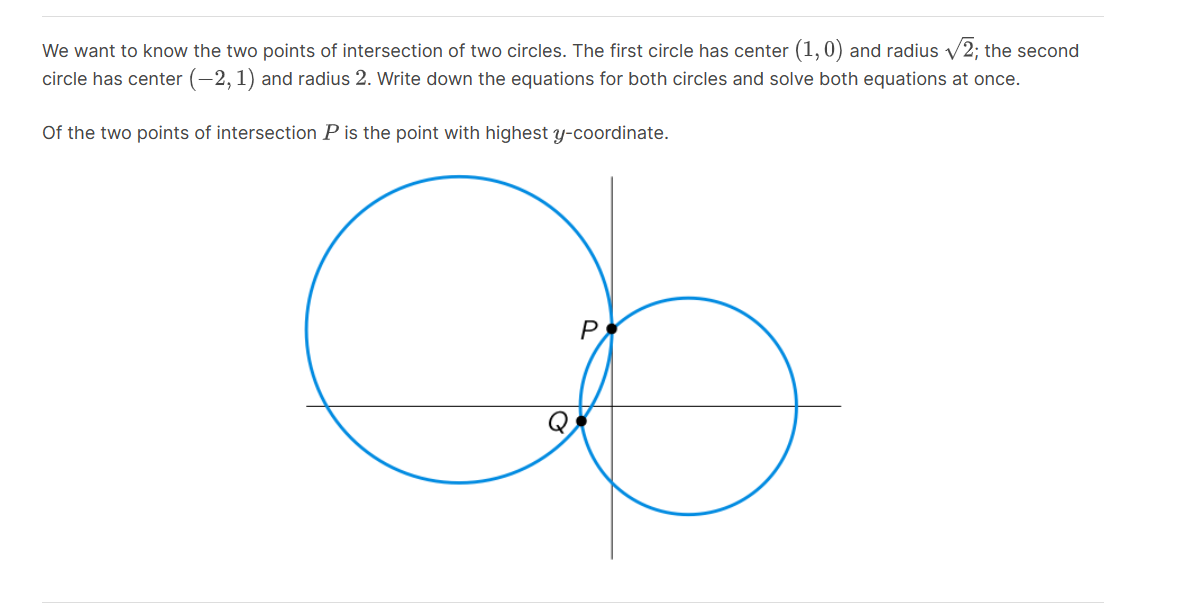 warped topaz
I need the coordinates of P and Q
 last ether
What are your circle equations
warped topaz
(x-a)^2 - (x-b)^2 = r
warped topaz
oh
last ether
$$(x-1)^2 + y^2 = 2$$
$$(x+2)^2 + (y-1)^2 = 4$$
 ocean sealBOT
Umbraleviathan
 warped topaz
hmm
last ether
So it's an annoying system of equations
last ether
Probably
I usually use a calculator for this kinda algebra tho because
Well frankly algebra kills everybody, regardless of skill, ultimately
lone heartBOT
Channel closed
Closed by @warped topaz
Use .reopen if this was a mistake.
warped topaz
.reopen
lone heartBOT
✅
warped topaz
Still stuck lol
I thought I knew what I was doing, i got both equations in the form (x-a)^2 + (x-b)^2 - r^2 then set them equal to eachother but it didnt work
I got y value for P = 0 which is clearly wrong
 radiant jasper
Did you solve It as a system of equations?
warped topaz
radiant jasper
Did you solve It as a system of equations?
What do you mean
Im not sure what a system of equations is
radiant jasper
Solve for y or x on one of the equations and then plug It In on the other
warped topaz
well I just tried for P first since I knew the x was 0
but yeah I got y = 0 which is incorrect obv
radiant jasper
Y=1
warped topaz
how did you get that
radiant jasper
$$(0-1)^2 + y^2 = 2$$
$$ 1+y^2= 2$$
ocean sealBOT
oxil764
 radiant jasper
Solve for y or x on one of the equations and then plug It In on the other
radiant jasper
radiant jasper
Solve for y or x on one of the equations and then plug It In on the other
This
radiant jasper
The other equation
radiant jasper
ocean seal
**Umbraleviathan**
This
 warped topaz
 orchid parrot
nedd steps for this
orchid parrot
nedd steps for this
go #help-3
 elfin breach
@warped topaz both the equations represent circles
plot it on a paper and find the poi
warped topaz
that feels like cheating a little bit, I need to know how to do it mathematically
elfin breach
that's not cheating dude
that's a graphical way of solving
but sure you can solve the quadratic in x by substituting y with x
the former would have been faster
warped topaz
elfin breach
but sure you can solve the quadratic in x by substituting y with x
I will try this, I think I understand you
 warped topaz
ocean seal
**Umbraleviathan**
warped topaz
ocean seal
**Umbraleviathan**
I now have (x-1)^2 + (x-1)^2 - 2 = y
am I doing this right
warped topaz
why x?
elfin breach
give me a sec
odie do you know the basics of circles?
like in coordinate geometry
elfin breach
are u aware of the equations?
warped topaz
https://cdn.discordapp.com/attachments/490557019623915520/1056795645471633519/349354952961032192.png

like this ^^ ?
elfin breach
yes
there's a method of finding poi of circles via the equations
but idk if your assignment allows you to do that
warped topaz
I think thats what im supposed to do
I already got P since I knew the x of P is 0
but I dont know any points of Q so idk how to get the coordinates
elfin breach
you need to find the eqn of common chord of the circle
and from there you'll get ur two points
warped topaz
elfin breach
you need to find the eqn of common chord of the circle
whats that
warped topaz
I just googled it, I dont think ive covered it yet
weird that I would get this question before ive covered it 
elfin breach
just ask your teacher for assistance then
warped topaz
Dont have one, I will ask youtube instead haha
Ok thank you for your help I will go watch some tutorials!!
elfin breach
👍
warped topaz
.close
lone heartBOT
Channel closed
Closed by @warped topaz
Use .reopen if this was a mistake.
warped topaz
.reopen
lone heartBOT
✅
warped topaz
is it possible to solve this without using the common chord of the circle? Cause I didnt cover it yet so there must be another way...
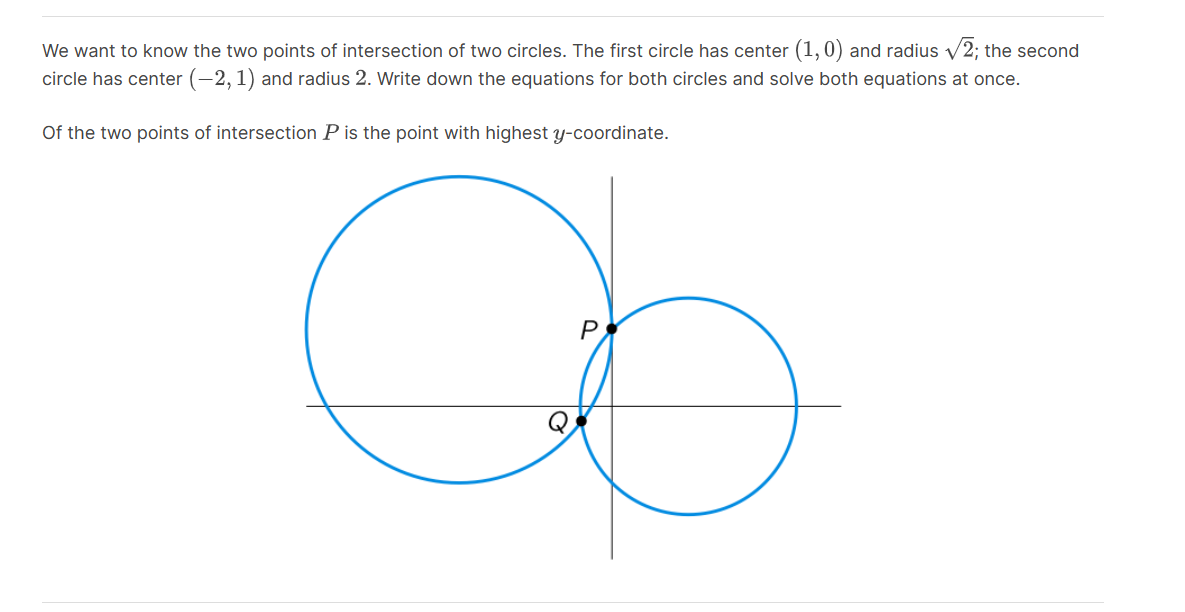
I know that P is (0,1)
but I dont have x or y of Q so idk how to get it using any of the circle equations
 alpine sable
In solving for P you had to solve a quadratic right?
warped topaz
no...
alpine sable
Couldnt you use the equations of both circles to get a system of quadratic equations?
alpine sable
warped topaz
https://cdn.discordapp.com/attachments/490557019623915520/1056795645471633519/34...
from this
warped topaz
but I still have 4 unknowns?
alpine sable
Well we know from the diagram that there are two such points that these equations are satisfied from
 pliant cedar
ur equation shall have 2 pairs of solutions, but 2 unknowns
alpine sable
Both of these are accounted for as each quadratic has 2 solutions
warped topaz
So (x-0)^2 + (y-1)^2 = 2 turns into (x^2) + (y^2 - 2y + 1) = 2 , is that what you mean?
pliant cedar
how do u know that P is 0,1
alpine sable
It lies on the y axis so its x coord is 0 solve for y
pliant cedar
alpine sable
It lies on the y axis so its x coord is 0 solve for y
is this given
alpine sable
alpine sable
It lies on the y axis so its x coord is 0 solve for y
(from either of the equations of the circles)
its implied by the diagram
but nowhere explicitly stated
pliant cedar
well we dont know that exactly
maybe its like 0.0001, 1.0002
anyway if u know that P is (0,1), then u can just find the reflection of P about the midpoint of the centers of the circles
to find Q
warped topaz
Is the problem possible to solve if we assume that P2 might not be 0?
pliant cedar
assuming P is (0,1), u can do what i said above
pliant cedar
warped topaz
Is the problem possible to solve if we assume that P2 might not be 0?
it is
can u write the equations of the two circles
alpine sable
It is 0, plugging into both circle’s equations give 1 for both the y coords
pliant cedar
alpine sable
It is 0, plugging into both circle’s equations give 1 for both the y coords
right so it just happens to work in this case
warped topaz
pliant cedar
anyway if u know that P is (0,1), then u can just find the reflection of P about...
Im not sure how to do this
warped topaz
Are we looking for the midpoint of P and Q?
alpine sable
I feel you shouldn’t use that method here as generally the coords of one point wont be given
pliant cedar
we want the midpoint of P and Q to also be the midpoint of the centers of the circles
pliant cedar
alpine sable
I feel you shouldn’t use that method here as generally the coords of one point w...
yes
pliant cedar
pliant cedar
can u write the equations of the two circles
can u do this tho
warped topaz
pliant cedar
can u do this tho
For P (x-0)^2 + (y-1)^2 = 2 for Q (x-Q1)^2 + (y-Q2)^2 = 4
is that what you mean
pliant cedar
no..
like (x-a)^2 + (y-b)^2 = r^2 is the equation of a circle with center (a,b) and radius r
warped topaz
yes
pliant cedar
so one of ur circles has center (1,0) and radius root(2)
what is its equation then
oh
warped topaz
(x-0)^2 + (y-1)^2 = 2
alpine sable
 pliant cedar
its not "for" anything, it is the equation of the circle
alpine sable
These are the equations
warped topaz
Im not sure how cause I have 2 unknowns
pliant cedar
have u learnt how to solve eqatuions with 2 unknowns?
like equations like 2x + y = 5, and x - 3y = 8
warped topaz
so like isolate x or y
pliant cedar
yes
pliant cedar
u can try subtracting the two equations
pliant cedar
how did u get that
warped topaz
Just isolating y
pliant cedar
can u like show ur work
 elfin breach
I'll tell you something
common chord eqn is pretty simple
S1-S2 = 0
just subtract the two equations of the given circles
so the second degree x and y are eliminated
pliant cedar
pliant cedar
u can try subtracting the two equations
yes
warped topaz
elfin breach
common chord eqn is pretty simple
I will learn this way too once I reach this chapter, but I want to learn this way first
pliant cedar
u dont need to know its called the "common chord eqn"
elfin breach
^
warped topaz
I have to take a break from this 😅 I will come back to it
Thank you guys for all of your help
you are so kind and patient
❤️
.close
lone heartBOT
Channel closed
Closed by @warped topaz
Use .reopen if this was a mistake.
Available help channel!
Send your question here to claim the channel.
Remember:
• Ask your math question in a clear, concise manner.
• Show your work, and if possible, explain where you are stuck.
• After 15 minutes, feel free to ping <@&286206848099549185>.
• Type the command .close to free the channel when you're done.
• Be polite and have a nice day!
Read #❓how-to-get-help for further information on how to ask a good question, and about conduct in the question channels.
 reef iris
So I'm learning discrete math atm and I know what the reverse A and E symbols mean, but I saw something about their rules and I can't really interpret it well (even with a translator)
 lone heartBOT
reef iris
So I'm learning discrete math atm and I know what the reverse A and E symbols me...
reef iris
lone heartBOT
reef iris
So I'm learning discrete math atm and I know what the reverse A and E symbols me...
reef iris
For example this is what they use for (12)

From what I understand, if a function has a valid input for all values of X, it's valid for all inputs of Y?
And if someone has a link to this topic in English, I'll gladly devour it
ocean sealBOT
SilverSoldier
 pliant cedar
might mean for all values of x, A(x) is true
pliant cedar
reef iris
For example this is what they use for (12)
can u translate what the chinese is saying
yeah
reef iris
I can't keep making AB questions like this lol
Let a range be defined for all of Z
- Where P(X): X is an even number
- And Q(X): X is divisible by 2
- Let P(X) -> Q(X) be true
"Prove"
(1) Already stipulated
(2) Already stipulated
(3) Can be found by combining (1)(2) P(X)^(P(X)->Q(X)
(4) Here's the wrong step, but I do not understand this

It's wrong because clearly you can't assume all numbers are divisble by two, but what does that symbol on the lower right corner even mean? 
Is there a rule or anything related to this I could perhaps search in English and read up on it?
The reason this confuses me so much is because in the previous powerpoint slide we had this rule explained, which states: "If A(X) is true, then all values of X in A(X) is true; when X is a independent variable and not a free variable"

/explanation
Oh I got, it was a mistranslation, abort abort. It was "If A(X) is true, then all values of X in A(X) is true; when X is a independent variable and does not appear in the front of the equation"
.close()
.close
lone heartBOT
Channel closed
Closed by @reef iris
Use .reopen if this was a mistake.
Available help channel!
Send your question here to claim the channel.
Remember:
• Ask your math question in a clear, concise manner.
• Show your work, and if possible, explain where you are stuck.
• After 15 minutes, feel free to ping <@&286206848099549185>.
• Type the command .close to free the channel when you're done.
• Be polite and have a nice day!
Read #❓how-to-get-help for further information on how to ask a good question, and about conduct in the question channels.
 ivory dew

 orchid valley
hi
ivory dew
Hello
tacit arch
This translation doesn't make much sense in English
lone heartBOT
@ivory dew Has your question been resolved?
Channel closed
Closed by @ivory dew
Use .reopen if this was a mistake.
Available help channel!
Send your question here to claim the channel.
Remember:
• Ask your math question in a clear, concise manner.
• Show your work, and if possible, explain where you are stuck.
• After 15 minutes, feel free to ping <@&286206848099549185>.
• Type the command .close to free the channel when you're done.
• Be polite and have a nice day!
Read #❓how-to-get-help for further information on how to ask a good question, and about conduct in the question channels.
 sick smelt
I solved the same question same times thrice, each time differently, only 3rd time I got the answer right.
I would like to know what I did wrong in the 1st two times I solved it.
 lone heartBOT
sick smelt
I solved the same question same times thrice, each time differently, only 3rd ti...
sick smelt
sick smelt
I solved the same question same times thrice, each time differently, only 3rd ti...
lone heartBOT
sick smelt
I solved the same question same times thrice, each time differently, only 3rd ti...
sick smelt
sick smelt
I solved the same question same times thrice, each time differently, only 3rd ti...
Question. (√6+√8)^2
sick smelt
 rocky grove
8 = 2^3
rocky grove
8 = 2^3
I feel dumb 😩
rocky grove
$(a+b)^2 = a^2 + 2ab + b^2$
ocean sealBOT
VulcanOne
 sick smelt
yea that's what I used, It just goes a bit off page
rocky grove
Not $(a+b)^2 = a^2 + 2(a+b) + b^2$
ocean sealBOT
VulcanOne
 rocky grove
sick smelt
I feel dumb 😩
rocky grove
sick smelt
I feel dumb 😩
Aww don't worry. You're pretty smart for asking for help. Others don't. When others point out your mistakes, you will learn and avoid them next time :)

rocky grove
sick smelt
If I hadn't done those mistakes would the answer have been right ?
Well try doing the question again but this time follow this rule: $(a+b)^2 = a^2 + 2ab + b^2$
ocean sealBOT
VulcanOne
 sick smelt
rocky grove
Well try doing the question again but this time follow this rule: $(a+b)^2 = a^2...
sick smelt
rocky grove
Well try doing the question again but this time follow this rule: $(a+b)^2 = a^2...
if I don't follow it, the result will still be same right ?
rocky grove
Nope
sick smelt
y ?
 molten pivot
tacit arch
sick smelt
if I don't follow it, the result will still be same right ?
molten pivot
tacit arch
sick smelt
if I don't follow it, the result will still be same right ?
Should probably follow rules of math for math classes and math grades
sick smelt
tacit arch
Should probably follow rules of math for math classes and math grades
where are the rules written/typed ?
sick smelt
like literally I'm using khan academy, text book and neither of them say what are the rules specifically
rocky grove
sick smelt
where are the rules written/typed ?
They're found in books, and you can find them by geometric intuition
sick smelt
rocky grove
They're found in books, and you can find them by geometric intuition
my school book sux
tacit arch
Maybe a previous class's book's
sick smelt
nope
tacit arch
sick smelt
my school book sux
Doesn't mean you shouldn't read it
rocky grove
Maybe search YouTube for a good proof so that you get convinced :)
rocky grove
Sure
rocky grove
Hmm
tacit arch
You shouldn't make up your own rules when it comes to arithmetic
sick smelt
the number extracted (2^5) can't be added to 14
rocky grove
Rules of square roots are missing
sick smelt
My book seriously had no rules written anywhere and neither are they on khan academy
rocky grove
sick smelt
the number extracted (2^5) can't be added to 14
You're using logarithm rules in place of square roots 
sick smelt
rocky grove
You're using logarithm rules in place of square roots <a:stressed:71830397394118...
I have no idea what logs are
rocky grove
sick smelt
My book seriously had no rules written anywhere and neither are they on khan aca...
They're on Khan Academy but you should search for them
tacit arch
sick smelt
My book seriously had no rules written anywhere and neither are they on khan aca...
You just implied you didn't read your book
 hard patio
sick smelt
if I don't follow it, the result will still be same right ?
hard patio
sick smelt
if I don't follow it, the result will still be same right ?
I mean sure if there’s another way to get there, but that one’s pretty basic
rocky grove
hard patio
I mean sure if there’s another way to get there, but that one’s pretty basic
Decimals right?
sick smelt
tacit arch
You just implied you didn't read your book
i'm not joking when I saw my book is literally the worst book for math when it comes to the entire grade, it will give like 3 examples and throw 15-20 questions which are so much more complex
sick smelt
rocky grove
They're on Khan Academy but you should search for them
u sure ?
rocky grove
 vale wigeon
the one being discussed rn
vale wigeon
the one being discussed rn
$(\sqrt{6} + \sqrt{8})^2$
ocean sealBOT
VulcanOne
 vale wigeon
yeah and what about this?
rocky grove
Applying rules that shouldn't be applied in regular arithmetic
rocky grove
sick smelt
u sure ?
Yep I'm pretty positive about it
vale wigeon
are we discussing whether it is possible to simplify this while being forbidden from using certain methods?
sick smelt
rocky grove
Yep I'm pretty positive about it
alr imma look for em
rocky grove
vale wigeon
are we discussing whether it is possible to simplify this while being forbidden ...
We're discussing why the method used to simplify was incorrect due to some misuses of certain rules.
 vale wigeon
well 8 isn't 2^4 for a start
tacit arch
sick smelt
i'm not joking when I saw my book is literally the worst book for math when it c...
Sounds like most books tbh. Either way, you need to stop lying about having read your book
sick smelt
tacit arch
Sounds like most books tbh. Either way, you need to stop lying about having read...
😔 oki, but im not lying
sick smelt
tacit arch
Sounds like most books tbh. Either way, you need to stop lying about having read...
also this chapter isn't in my book
rocky grove
And $\sqrt{a^b} \neq a^{b-1}$
ocean sealBOT
VulcanOne
 sick smelt
ocean seal
**VulcanOne**
sick smelt
ocean seal
**VulcanOne**
where did I do this?
rocky grove
sick smelt
where did I do this?
3rd step in your 2nd column
vale wigeon
rocky grove
https://cdn.discordapp.com/attachments/490557019623915520/1056836625402957844/im...
this work is full of mistakes
sick smelt
specificy more
sick smelt
vale wigeon
this work is full of mistakes
why do u think I solved it 3 times :|
I should prob stop studying this chapter till my book gets delivered or this'll be torture
or I'll break thru with sheer willpower
sick smelt
rocky grove
3rd step in your 2nd column
I seriously don't see it
rocky grove

tacit arch
vale wigeon
this work is full of mistakes
Vulcan re-uploaded sim's picture for some reason
sick smelt
rocky grove
<:sad:532803514892812288>
oh wait nvm
vale wigeon
going from line 2 to line 3 in the top-right work, i see sqrt(8) being replaced with 2^3 for no good reason.
2^3 is 8 itself, not sqrt(8).
sick smelt
√8=√2^3, I directly removed the root, it should be 2√2
vale wigeon
yes, you stripped away the root
and in the next step you apparently rewrote 2 sqrt(6) as sqrt(12), which is also wrong
sick smelt
I did 2(√6) to get √12
ocean sealBOT
Ann
 vale wigeon
i mean, think about it -- by your logic, sqrt(2) would be equal to 2.
$2 = 2 \sqrt{1} \wtfeq \sqrt{2}$
ocean sealBOT
Ann
 sick smelt
Imma just watch organic chem's vid on simplifying square roots and what ever radicals are
thx everyone for help
.close
lone heartBOT
Channel closed
Closed by @sick smelt
Use .reopen if this was a mistake.
Available help channel!
Send your question here to claim the channel.
Remember:
• Ask your math question in a clear, concise manner.
• Show your work, and if possible, explain where you are stuck.
• After 15 minutes, feel free to ping <@&286206848099549185>.
• Type the command .close to free the channel when you're done.
• Be polite and have a nice day!
Read #❓how-to-get-help for further information on how to ask a good question, and about conduct in the question channels.
 west wagon
x1, x2 and x3 are distinct non collinear points in a plane. Define an infinite sequence of points as follows: Let xN for N>=4 be the reflection of x(N-3) over x(N-1)
Show that there exists a point A such that the triangles A, xk, x(k+1), for all positive integers
k, have the same area.
 lone heartBOT
west wagon
x1, x2 and x3 are distinct non collinear points in a plane. Define an infinite s...
lone heartBOT
west wagon
x1, x2 and x3 are distinct non collinear points in a plane. Define an infinite s...
@west wagon Has your question been resolved?
lone heartBOT
@west wagon Has your question been resolved?
lone heartBOT
Channel closed
Closed due to timeout
Use .reopen if this was a mistake.
Available help channel!
Send your question here to claim the channel.
Remember:
• Ask your math question in a clear, concise manner.
• Show your work, and if possible, explain where you are stuck.
• After 15 minutes, feel free to ping <@&286206848099549185>.
• Type the command .close to free the channel when you're done.
• Be polite and have a nice day!
Read #❓how-to-get-help for further information on how to ask a good question, and about conduct in the question channels.
 spare fern
could someone help me out
lone heartBOT
spare fern
could someone help me out
spare fern
I am trying to solve this quadratic: 5x^2 -17x + 6 = 0
 gilded vessel
what have you tried
spare fern

I'm not sure how to write the answer to this in fraction form
my calculator won't do it for some reason
I'm not sure if I should round the answer
gilded vessel
you gotta put the fraction under the sqrt in one fraction first so you can take the sqrt of it
naive valley
shouldn't there be a 4ac term somewhere in that square root?
 naive valley
this method somehow removes any dependence on the leading coefficient 5?
spare fern
yes it's basically the sreedhar acharya formula rearranged
gilded vessel
this method is for quadratic in the form x^2 + Bx + C = 0
you dont have a quadratic in that form
 reef grove
its a way of using the quadratic formula without actually using the quadratic formula
gilded vessel
if you want to use this method, first reduce your quadratic to this form
tacit arch
spare fern
no I'm using Poh Shen Loh's method
That doesn't apply because of your 5
naive valley
you could put it in that form by dividing the whole equation by 5 if you want
seems uglier than just using the ordinary quadratic formula tho
spare fern
tacit arch
That doesn't apply because of your 5
Oh I see
Alright I’ll try the regular sreedhar acharya formula
gilded vessel
reef grove
its a way of using the quadratic formula without actually using the quadratic fo...
its literally just plug in a = 1 to quad formula, boom "new" method
reef grove
gilded vessel
its literally just plug in a = 1 to quad formula, boom "new" method
in Germany we actually call it p/q formula and they want us to learn this instead of the quadratic formula
spare fern
So this is correct?
 tacit arch
Fraction like needs to be longer
lone heartBOT
@spare fern Has your question been resolved?
lone heartBOT
Channel closed
Closed due to timeout
Use .reopen if this was a mistake.
Available help channel!
Send your question here to claim the channel.
Remember:
• Ask your math question in a clear, concise manner.
• Show your work, and if possible, explain where you are stuck.
• After 15 minutes, feel free to ping <@&286206848099549185>.
• Type the command .close to free the channel when you're done.
• Be polite and have a nice day!
Read #❓how-to-get-help for further information on how to ask a good question, and about conduct in the question channels.
 latent gulch
why this is true? what property are we using here?
 latent gulch
P_sigma is orthogonal (I don't know if it is relevant)
rocky grove
Well the result of det(P) and det(inverse of P) cancels out and leaves you with a net result of det(C-λI)
Edit: corrected
Wait
rocky grove

latent gulch
Thanks a lot!
lone heartBOT
@latent gulch Has your question been resolved?
lone heartBOT
Channel closed
Closed due to timeout
Use .reopen if this was a mistake.
Available help channel!
Send your question here to claim the channel.
Remember:
• Ask your math question in a clear, concise manner.
• Show your work, and if possible, explain where you are stuck.
• After 15 minutes, feel free to ping <@&286206848099549185>.
• Type the command .close to free the channel when you're done.
• Be polite and have a nice day!
Read #❓how-to-get-help for further information on how to ask a good question, and about conduct in the question channels.
 thick lynx
$\lim_{x \to \infty} \sqrt{x}(\sqrt{x + 3} - \sqrt{x - 2}) = \lim_{x \to \infty} (\sqrt{x^2 + 3x} - \sqrt{x^2 - 2x}) = \lim_{x \to \infty} \frac{x^2 + 3x - (x^2 - 2x)}{\sqrt{x^2 + 3x} + \sqrt{x^2 - 2x}} = \lim_{x \to \infty} \frac{5x}{\sqrt{x^2 + 3x} + \sqrt{x^2 - 2x}}$
How would you proceed from here?
lone heartBOT
thick lynx
$\lim_{x \to \infty} \sqrt{x}(\sqrt{x + 3} - \sqrt{x - 2}) = \lim_{x \to \infty}...

 lone heartBOT
@thick lynx Has your question been resolved?
thick lynx
.close
lone heartBOT
Channel closed
Closed by @thick lynx
Use .reopen if this was a mistake.
Available help channel!
Send your question here to claim the channel.
Remember:
• Ask your math question in a clear, concise manner.
• Show your work, and if possible, explain where you are stuck.
• After 15 minutes, feel free to ping <@&286206848099549185>.
• Type the command .close to free the channel when you're done.
• Be polite and have a nice day!
Read #❓how-to-get-help for further information on how to ask a good question, and about conduct in the question channels.
 hollow ruin
How would you do this?

 remote heron

hollow ruin
I am sorry but yeh these are the 2 questions that i have
hollow ruin
remote heron
<:KEK:586240877358350341>
Yeeeh hi there mate
alpine sable
what do you need in order to calculate the area of a triangle?
hollow ruin
alpine sable
what do you need in order to calculate the area of a triangle?
The 2 sides right?
See the problem here is that this is a non calculator question
alpine sable
what's the formula for the area of a triangle?
hollow ruin
alpine sable
what's the formula for the area of a triangle?
1/2 ab sin theta?
hollow ruin
alpine sable
ok I didn't even know there was that formula
Yeh there is that one too, for like an irregular triangle
alpine sable
and you know two sides
this leaves you with one unknown quantity in one equation, which you can solve
hollow ruin
alpine sable
are you familiar with the law of cosines?
I think so yeh?
OH
YEH
I am
hollow ruin
alpine sable
to find the length of the third side?
Ah yeh yeh i forgot that
But its non calculator based tho
lone heartBOT
@hollow ruin Has your question been resolved?
hollow ruin
.close
lone heartBOT
Channel closed
Closed by @hollow ruin
Use .reopen if this was a mistake.
lone heartBOT
Available help channel!
Send your question here to claim the channel.
Remember:
• Ask your math question in a clear, concise manner.
• Show your work, and if possible, explain where you are stuck.
• After 15 minutes, feel free to ping <@&286206848099549185>.
• Type the command .close to free the channel when you're done.
• Be polite and have a nice day!
Read #❓how-to-get-help for further information on how to ask a good question, and about conduct in the question channels.
 viral pine
Good mornin USAAA
lone heartBOT
viral pine
Good mornin USAAA

 rocky grove
You forgot the 1/2 for -1/(1-x)
vale wigeon
you misread the function being differentiated
it's $\log\paren{\sqrt{\frac{2x-1}{1-x}}}$ not $\log\paren{\frac{\sqrt{2x-1}}{1-x}}$
ocean sealBOT
Ann
 lone heartBOT
@viral pine Has your question been resolved?
lone heartBOT
@viral pine Has your question been resolved?
 small kernel
Is there any one who study in university??
lone heartBOT
Channel closed
Closed by @viral pine
Use .reopen if this was a mistake.
viral pine
.reopen
lone heartBOT
✅

 pseudo ice
...so you want two points x that give you a gradient of what they've said, and a quadratic equation?
viral pine
pseudo ice
...so you want two points x that give you a gradient of what they've said, and a...
the gradient as in
the dy/dx?
pseudo ice
Yeah, in part (a), what do the solutions of that quadratic give you?
viral pine
pseudo ice
Yeah, in part (a), what do the solutions of that quadratic give you?
(2x+1)/2(x^2+x+1)
wait
am I supposed to like factories it
factorise
pseudo ice
viral pine
factorise
No not quite
viral pine
hm
pseudo ice
I was asking for a description of what those solutions would be, if that's clear?
In other words, how did you show part a?
viral pine
ohh wait I was reading the wrong question
accidentally read 12iii
hold on
alright so I compared the dy/dx to the 1/2k gradient
as they’re the same thing
pseudo ice
I seem to be unable to read myself tbh 😂
pseudo ice
viral pine
alright so I compared the dy/dx to the 1/2k gradient
Yeah, so the solutions x to that are the points where you have the gradient 1/2k
And it's a quadratic, and they're asking for two solutions
viral pine
o
okay one sec
alright
i am still lost
could you perhaps give me the workings to obtain the answer
I think it’d be easier to understand that way
@pseudo ice
pseudo ice
I'll just say this and it should be fine from there: work out the discriminant of that quadratic
Then remember the conditions on the discriminant for the number of [real] solutions you'd want
viral pine
ahhhh
discriminants, roots, quadratic and whatnot
i forgot about them
i did too much differentiation itself that I forgot about the previous topics
oops
thanks anyway
ill make sure to revisit these things
pseudo ice
viral pine
ill make sure to revisit these things
Yep, always a good idea to go over stuff when you can (as I am learning the hard way  )
)
lone heartBOT
@viral pine Has your question been resolved?
lone heartBOT
Channel closed
Closed due to timeout
Use .reopen if this was a mistake.
Available help channel!
Send your question here to claim the channel.
Remember:
• Ask your math question in a clear, concise manner.
• Show your work, and if possible, explain where you are stuck.
• After 15 minutes, feel free to ping <@&286206848099549185>.
• Type the command .close to free the channel when you're done.
• Be polite and have a nice day!
Read #❓how-to-get-help for further information on how to ask a good question, and about conduct in the question channels.
 ornate ginkgo
How do i differentiate
$2\sqrt{cot(x^2)}$
lone heartBOT
ornate ginkgo
How do i differentiate
$2\sqrt{cot(x^2)}$
ocean sealBOT
ColdTee
 ornate ginkgo
$\frac{d}{dx}2\sqrt{cot(x^2)}$
ocean sealBOT
ColdTee
 alpine sable
use the chain rule twice
ornate ginkgo
Well that's what im confused about do i take $\sqrt{cot(x^2)}$ as x the first time then im left with 2?
ocean sealBOT
ColdTee
 alpine sable
2 is a constant, so you can take it outside the derivative
yes, you could use chain rule there, but nothing happens
alpine sable
ornate ginkgo
Well that's what im confused about do i take $\sqrt{cot(x^2)}$ as x the first ti...
take 2 out of derivative cuz its a constant
ornate ginkgo
Then im left with
${(cot(x^2))}^\frac{1}{2}$
ocean sealBOT
ColdTee
 ornate ginkgo
So first time
alpine sable
the derivative of ONLY cot(x^2) is -2 cosec(x^2) . cot(x)
ocean sealBOT
ColdTee
 ocean sealBOT
ColdTee
 lone heartBOT
@ornate ginkgo Has your question been resolved?
Channel closed
Closed by @ornate ginkgo
Use .reopen if this was a mistake.
Available help channel!
Send your question here to claim the channel.
Remember:
• Ask your math question in a clear, concise manner.
• Show your work, and if possible, explain where you are stuck.
• After 15 minutes, feel free to ping <@&286206848099549185>.
• Type the command .close to free the channel when you're done.
• Be polite and have a nice day!
Read #❓how-to-get-help for further information on how to ask a good question, and about conduct in the question channels.
 wild raven
Hi
lone heartBOT
wild raven
Hi

 plain flame
 wild raven
lol
 viscid pawn
plain flame
viscid pawn
plain flame
ahahah 😭
 wanton pebble

 ivory igloo
you dont need that?
 desert tendon
He'll need to take the log to the num so he'll do chage of base
 ivory igloo
wild raven
ivory igloo
wild raven
$\implies \frac{8}{2log_3{x}} - log_3{x} = 3\$
$say~g=log_3{x}\$
$\implies \frac{8}{2g} - g = 3\$
$\implies \frac{8}{2} - g^2 = 3g\$
$\implies 4 - g^2 = 3g\$
$\implies g^2 + 3g - 4 = 0\$
$\implies (g+4)(g-1) = 0\$
$\implies g = 1\$
ocean sealBOT
GameSwitch
 ivory igloo
$log_3{x} = 1 \implies x = 3$
ocean sealBOT
GameSwitch
 wild raven
wait how did 1/logx to the power of 3 become just log3x?
desert tendon
Where
wild raven
 ocean sealBOT
GameSwitch
 desert tendon
wild raven
wait how did 1/logx to the power of 3 become just log3x?
desert tendon
wild raven
wait how did 1/logx to the power of 3 become just log3x?
It's not to power 3
wild raven
oh wait nvm sorry i get it now
when solving log do we always have to use “let something be somethint”? or are there other ways?
ivory igloo
the assumption is used so that the equation is easier to view and solve
we can also solve without assuming
desert tendon
wild raven
when solving log do we always have to use “let something be somethint”? or are t...
Sometimes you can combine all logs into one term and solve but can't do that here
wild raven
ohhhh okay thank you sm
lone heartBOT
@wild raven Has your question been resolved?
Channel closed
Closed by @wild raven
Use .reopen if this was a mistake.
Available help channel!
Send your question here to claim the channel.
Remember:
• Ask your math question in a clear, concise manner.
• Show your work, and if possible, explain where you are stuck.
• After 15 minutes, feel free to ping <@&286206848099549185>.
• Type the command .close to free the channel when you're done.
• Be polite and have a nice day!
Read #❓how-to-get-help for further information on how to ask a good question, and about conduct in the question channels.
 quartz cave
Hello
lone heartBOT
quartz cave
Hello
quartz cave
I have a question about shapley values combined with monte carlo sampling


When we use this intuition
One would say that with n = 10 and every step between each point = 1
Then the value of the 10th agent would be 1 + 1/2 + 1/3 + 1/4 ... + 1/10
This would be a value of 2.93
However
When I try to experiment with this through monte carlo sampling I get way higher values for the 10th agent
What am I missing in this problem?
lone heartBOT
@quartz cave Has your question been resolved?
quartz cave
<@&286206848099549185>
lone heartBOT
@quartz cave Has your question been resolved?
lone heartBOT
Channel closed
Closed due to timeout
Use .reopen if this was a mistake.
Available help channel!
Send your question here to claim the channel.
Remember:
• Ask your math question in a clear, concise manner.
• Show your work, and if possible, explain where you are stuck.
• After 15 minutes, feel free to ping <@&286206848099549185>.
• Type the command .close to free the channel when you're done.
• Be polite and have a nice day!
Read #❓how-to-get-help for further information on how to ask a good question, and about conduct in the question channels.
 humble heron
Why does no one wanna help me 🥲
lone heartBOT
humble heron
Why does no one wanna help me 🥲
alpine sable
cuz u didnt ask a question ig?
 alpine sable
are those decimals?
humble heron
3.9,
alpine sable
3.9,3.7... etc ryt?
alpine sable
mean u can do ryt?
 alpine sable
wait u did the method urself and dont get it?
alpine sable
humble heron
the median is 2.7
humble heron

 alpine sable
mode is 3.7
alpine sable
humble heron
they are correct
gud job
:>
@humble heron
the median should be 2.7
u wrote 3.7
count upto the 8th term
which is 2.7
humble heron
alpine sable
which is 2.7
Don’t we have to arrange?
The data first
Also this is how we were supposed to do it XD

 alpine sable
humble heron
Don’t we have to arrange?
alpine sable
humble heron
Don’t we have to arrange?
ohh yes im sry my bad forgot
alpine sable
humble heron
Also this is how we were supposed to do it XD
u want an explanation of wts happening here?
humble heron
alpine sable
u want an explanation of wts happening here?
Yes 🐣
The median is the value of x in the middle of the interval.
That is, when x=x1+(4.4-2.6)/2=2.6+0.9=3.5. The median is me=3.5.
Especially this part
alpine sable
is frequency same as xi+1 in the chart?
alpine sable
humble heron
Also this is how we were supposed to do it XD
here to make the calculation easier they have divided the data into 6 intervals with a difference of 0.3 if u notice carefully and then for example if we take 3.5 and 3.8 then find avg between them and see what values in the original data are within that average range like (3.5 + 3.8)/2 is 3.65. Now the original data which u arranged in ascending order ( 2.7...etc) see there u have to see the numbers that lie between 3.5 and 3.8 which are 3.7, 3.7, 3.7 so since there are three numbers lying between so we write the m1 as 3
rocky grove
Yep
Also this way of arranging data is a lot less cumbersome since you deal with ranges of data and you can represent a single range by the range's mean, which helps you calculate things a lot faster
Btw quick answer to a previous question you had about computers: your MacBook is good for productivity stuff. It will handle most tasks nicely but don't expect it to do a lot of hardcore processing. But I think that if you use it for school works, then you will be good to go (Unless you wanna game on it xd)
Anyways
You get the number of intervals by taking the range (biggest number minus smallest number) then divide it by a suitable interval length. Since your range is 4.4-2.6 = 1.8, and the numbers have a tenth of a difference between them, then 0.3 should be good. 1.8/0.3 = 6.
Now you use the 0.3 interval length to create your intervals
2.6+0.3 = 2.9. So your first interval is from 2.6~2.9.
Hmm
@humble heron Did your teacher tell you to add an additional interval to the number of intervals?
Like instead of 6, you use 7 intervals
And your start will be 2.6-0.3/2 = 2.45
And the end will be 4.4+0.3/2 = 4.55
For the last interval so that you don't have any errors with the bounds
Like the points that lie exactly on the borders
But I don't think you do that with your teacher
Hmm
lone heartBOT
@humble heron Has your question been resolved?
lone heartBOT
Channel closed
Closed due to timeout
Use .reopen if this was a mistake.
Available help channel!
Send your question here to claim the channel.
Remember:
• Ask your math question in a clear, concise manner.
• Show your work, and if possible, explain where you are stuck.
• After 15 minutes, feel free to ping <@&286206848099549185>.
• Type the command .close to free the channel when you're done.
• Be polite and have a nice day!
Read #❓how-to-get-help for further information on how to ask a good question, and about conduct in the question channels.
 slender crater
 lone heartBOT
slender crater
slender crater
lone heartBOT
slender crater
slender crater
where do i go from here
 gaunt sparrow
it's not visible
 lone heartBOT
Channel closed
Closed by @slender crater
Use .reopen if this was a mistake.
Available help channel!
Send your question here to claim the channel.
Remember:
• Ask your math question in a clear, concise manner.
• Show your work, and if possible, explain where you are stuck.
• After 15 minutes, feel free to ping <@&286206848099549185>.
• Type the command .close to free the channel when you're done.
• Be polite and have a nice day!
Read #❓how-to-get-help for further information on how to ask a good question, and about conduct in the question channels.
 steady basin
 lone heartBOT
steady basin
vale wigeon
lone heartBOT
steady basin
vale wigeon
no, c is +pi/2 exactly as is written
steady basin
vale wigeon
no, c is +pi/2 exactly as is written
but if u rearrange, -arccos of 0 - arcsin of 0 is -pi/2
vale wigeon
oh
steady basin
vale wigeon
no, c is +pi/2 exactly as is written
its minus arccos not + arccos
steady basin
yh so its wrong
in the pic i sent c should be -pi/2

heres the whole thing for context
vale wigeon
well they made two sign errors which cancelled each other out yeah
-arccos(x) = arcsin(x) + c => arcsin(x)+arccos(x) = -c
= -(-pi/2) = +pi/2
if done properly
 limpid spade
? Does this contribute to SA's question?
steady basin
limpid spade
? Does this contribute to SA's question?
wdym
steady basin
 sour egret
what is SA?
sour egret
what is SA?
me
limpid spade
dont worry
steady basin
limpid spade
dont worry
why
lone heartBOT
@steady basin Has your question been resolved?
Channel closed
Closed by @steady basin
Use .reopen if this was a mistake.
lone heartBOT
Available help channel!
Send your question here to claim the channel.
Remember:
• Ask your math question in a clear, concise manner.
• Show your work, and if possible, explain where you are stuck.
• After 15 minutes, feel free to ping <@&286206848099549185>.
• Type the command .close to free the channel when you're done.
• Be polite and have a nice day!
Read #❓how-to-get-help for further information on how to ask a good question, and about conduct in the question channels.
 distant plover
if $f$ and $g$ are functions limited in the interval $I$, is it true that $\sup{|f(x)|g(x); x \in I } = \sup{|f(x)|; x \in I } \cdot \sup{g(x); x \in I }$ and $\inf{|f(x)|g(x); x \in I } = \inf{|f(x)|; x \in I } \cdot \inf{g(x); x \in I }$?
lone heartBOT
distant plover
if $f$ and $g$ are functions limited in the interval $I$, is it true that $\sup\...
ocean sealBOT
Amarinya
 distant plover
ahh alright
so that means sup{f(x)g(x)} <= sup{|f(x)g(x)|} = sup{|f(x)| * |g(x)|} <= sup{|f(x)|} * sup{|g(x)|}?
 mortal trellis
Yes
distant plover
alright so, i have f and g being integrable on [a,b], and i have to show that fg is integrable. i'm pretty sure |f| and |g| is integrable, so my idea was to show that sup{f(x)g(x)} <= sup{|f(x)|} * sup{|g(x)|} and the opposite for inf so that i could squeeze the upper area to the lower area and show that it's integrable. i'm not sure it'll work, but i'll try
i'll reopen if i have more questions
.close
lone heartBOT
Channel closed
Closed by @distant plover
Use .reopen if this was a mistake.
lone heartBOT
Available help channel!
Send your question here to claim the channel.
Remember:
• Ask your math question in a clear, concise manner.
• Show your work, and if possible, explain where you are stuck.
• After 15 minutes, feel free to ping <@&286206848099549185>.
• Type the command .close to free the channel when you're done.
• Be polite and have a nice day!
Read #❓how-to-get-help for further information on how to ask a good question, and about conduct in the question channels.
 past dagger
 lone heartBOT
past dagger
past dagger
lone heartBOT
past dagger
past dagger
not sure how to sketch this
 long axle
Is there a part of the question that u didn’t show
long axle
Send it anyways
past dagger

i dont care about how to do it for THIS question, i just dont how to sketch negativee quuadratics
long axle
Oh that’s it?
Alright so
The problem is you want to graph it, but don’t know how to?
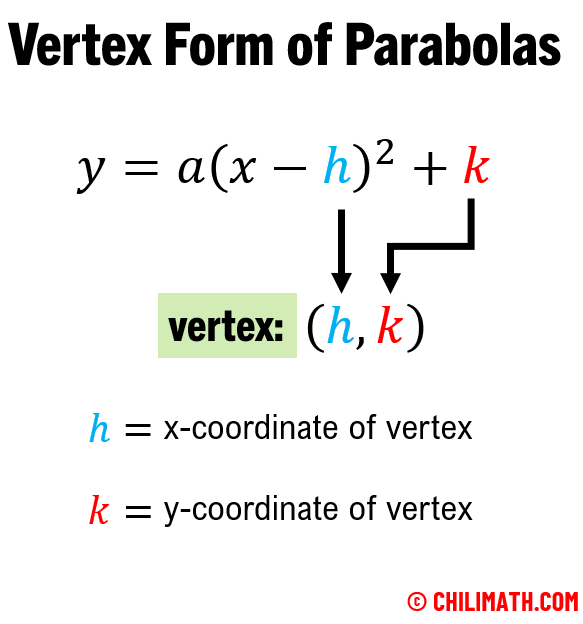
So we have: y = 6 - (x-3)^2
See if u can put that into vertex form
pseudo ice
past dagger
but i dont think its relevant
It is relevant (see the part (ii))
past dagger
nver heard of vertex form
pseudo ice
Unless you just want to sketch it in general?
past dagger
just in general
long axle
pseudo ice
Unless you just want to sketch it in general?
I think they just want this

@past dagger
pseudo ice
long axle
I think they just want this
Don’t think so - see the parametric equations that you have
past dagger
never seen this in my life
past dagger
long axle
https://www.chilimath.com/wp-content/uploads/2022/09/vertex-form-of-a-parabola.p...
.
pseudo ice
It’ll probably be some section of the y=6-(x-3)^2
long axle
Do u want to sketch the quadratic, independent of the parametric at the start? @past dagger
long axle
pseudo ice
It’ll probably be some section of the y=6-(x-3)^2
Thanks for making me clarify this, I forgot abt that
lone heartBOT
@past dagger Has your question been resolved?
lone heartBOT
Channel closed
Closed due to timeout
Use .reopen if this was a mistake.
Available help channel!
Send your question here to claim the channel.
Remember:
• Ask your math question in a clear, concise manner.
• Show your work, and if possible, explain where you are stuck.
• After 15 minutes, feel free to ping <@&286206848099549185>.
• Type the command .close to free the channel when you're done.
• Be polite and have a nice day!
Read #❓how-to-get-help for further information on how to ask a good question, and about conduct in the question channels.
 rugged dust
Hi, I'm practicing proof by induction. I'm really struggling with this one because of the x..
 lone heartBOT
rugged dust
Hi, I'm practicing proof by induction. I'm really struggling with this one becau...
rugged dust
lone heartBOT
rugged dust
Hi, I'm practicing proof by induction. I'm really struggling with this one becau...
rugged dust
Could anyone provide an approach to this?
plain flame
i wouldnt write x there
rugged dust
Why is that? c.c
 marsh rapids
Just take the equation from the hypothesis and add 1/(n+1)(n+2) to both sides, then simplify the RHS
Usually with induction you just do the operation that turns one side into what you want, and computations on the other side to get the wanted result, starting from the result from the induction hypothesis
marsh rapids
If there is no such operation, then induction might not be such a good approach (or maybe it is but you only notice it after some time looking, and do you just wrap your proof inside of an induction lol)
lone heartBOT
Channel closed
Closed by @rugged dust
Use .reopen if this was a mistake.
Available help channel!
Send your question here to claim the channel.
Remember:
• Ask your math question in a clear, concise manner.
• Show your work, and if possible, explain where you are stuck.
• After 15 minutes, feel free to ping <@&286206848099549185>.
• Type the command .close to free the channel when you're done.
• Be polite and have a nice day!
Read #❓how-to-get-help for further information on how to ask a good question, and about conduct in the question channels.
warped topaz
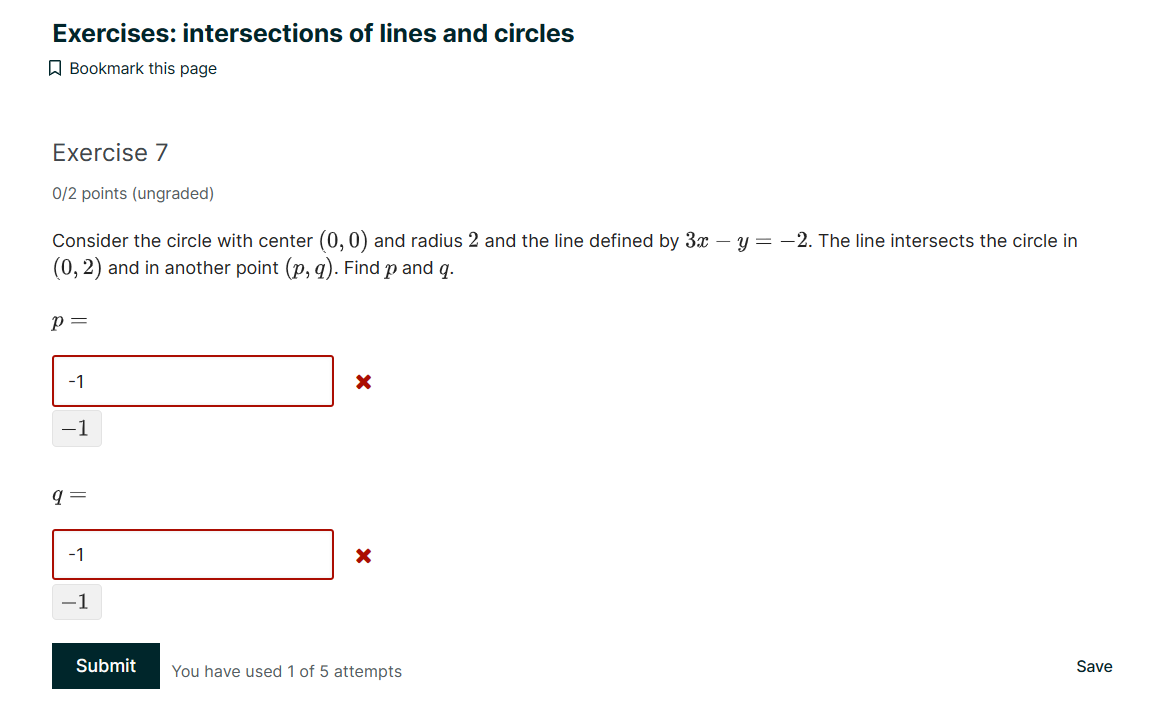 warped topaz
I hate geometry 
pseudo ice
How did you find your answer?
warped topaz
I got the equation of the circle and isolated y, then did the same for the equation of the line, then set them equal and tried to solve
 gray isle
can you show your work
warped topaz
its really messy but ok 1 moment
I couldnt find my work so I did it again and solved it lol
sry about this
.close
lone heartBOT
Channel closed
Closed by @warped topaz
Use .reopen if this was a mistake.
Available help channel!
Send your question here to claim the channel.
Remember:
• Ask your math question in a clear, concise manner.
• Show your work, and if possible, explain where you are stuck.
• After 15 minutes, feel free to ping <@&286206848099549185>.
• Type the command .close to free the channel when you're done.
• Be polite and have a nice day!
Read #❓how-to-get-help for further information on how to ask a good question, and about conduct in the question channels.
 celest storm
Hey
lone heartBOT
celest storm
Hey
celest storm
Have to determine the n-th derivative of x -> x^2n with 2 different ways

I got the first method i guess
I conjectured a k-th derivative
Then prove it ( by induction ) and replaced k by n
Then i tried using liebniz and i got to nowhere
marsh rapids
Formule de Leibniz ?
celest storm
Oui
marsh rapids
n-th derivative of a product ?
celest storm
To be honest, i tried with Liebniz because the exercice got an indication saying that we could write x^2n = x^n × x^n
Post bac
marsh rapids
J'ai vérifié en regardant ton historique
lone heartBOT
@celest storm Has your question been resolved?
lone heartBOT
Channel closed
Closed due to timeout
Use .reopen if this was a mistake.
lone heartBOT
Available help channel!
Send your question here to claim the channel.
Remember:
• Ask your math question in a clear, concise manner.
• Show your work, and if possible, explain where you are stuck.
• After 15 minutes, feel free to ping <@&286206848099549185>.
• Type the command .close to free the channel when you're done.
• Be polite and have a nice day!
Read #❓how-to-get-help for further information on how to ask a good question, and about conduct in the question channels.
 gilded marten
 lone heartBOT
gilded marten
gilded marten
lone heartBOT
gilded marten
gilded marten
can someone teach me how to get the percentiles
for d2 d6 and p32 p89
or just the formula on how to get it
lone heartBOT
@gilded marten Has your question been resolved?
 modern topaz
marsh rapids
J'ai vérifié en regardant ton historique
modern topaz
marsh rapids
J'ai vérifié en regardant ton historique
Je suis tres intelligent
modern topaz
marsh rapids
J'ai vérifié en regardant ton historique
Je aide toi 
lone heartBOT
Channel closed
Closed due to timeout
Use .reopen if this was a mistake.
Available help channel!
Send your question here to claim the channel.
Remember:
• Ask your math question in a clear, concise manner.
• Show your work, and if possible, explain where you are stuck.
• After 15 minutes, feel free to ping <@&286206848099549185>.
• Type the command .close to free the channel when you're done.
• Be polite and have a nice day!
Read #❓how-to-get-help for further information on how to ask a good question, and about conduct in the question channels.
spare fern
how would I solve these types of quadratic equations

 woven plaza
spare fern
woven plaza
spare fern
oh ok
 dim root
wait
 wary stream
spare fern
oh you mean adding 64 to both sides
wary stream
spare fern
oh you mean adding 64 to both sides
Yes
wary stream
dim root
x=8
Don't give out answers
wary stream
It's 2 * 4
wary stream
last ether
REAL?!1!1!1!1!!!!???
No, it's 5 + 5 − (5 + 5)/5
last ether
Vine boom sfx
wary stream
last ether
Vine boom sfx
(1 + 1)^(1+1+1)


 leaden igloo
The easiest (or at least most standard) way to solve this is to make a quadratic formula equal 0.
So you take 20 from each side and get (x^2 + x -20)
=0
x^2 + x -20 = 0
Then you factor out or use quadratic formula.
spare fern
oh you mean x^2 + x = 0?
wary stream
spare fern
oh you mean x^2 + x = 0?
No
wary stream
Subtract 20 on both sides
spare fern
Ax^2 + Bx + C = 0
leaden igloo
mhm
dim root
im back
leaden igloo
wb
wary stream
spare fern
Ax^2 + Bx + C = 0
Yes that's the general form for a quadratic
spare fern
so x^2 + x -20 = 0
dim root
hm
leaden igloo
spare fern
so x^2 + x -20 = 0
yes
dim root
yes
leaden igloo
Then factor or quadratic
wary stream
You can choose to factor or use the quadratic formula
spare fern
so B = x
dim root
a is 1 and b is also 1 and c is -20 rigfht
spare fern
and C = -20
dim root
?
spare fern
yeah
leaden igloo
spare fern
so B = x
b is the number next to x
wary stream
spare fern
so B = x
No
leaden igloo
ax^2 + bx + c
wary stream
You want the coefficients
dim root
u shouldnt take variable
spare fern
but isn't A = x^2?
dim root
spare fern
but isn't A = x^2?
its the coefficient of x^2
spare fern
1
dim root
yes
spare fern
oh ok
dim root
and c is the constant
spare fern
so the solutions are -5 or 4
wary stream
Yes
dim root
yea
wary stream
To check, you can plug each one back into the original problem
dim root
mhm
 raven rover
Is there a reason for that step?
dim root
spare fern
and I got x^2 = 1/6x
it should be x/6
wary stream
spare fern
6x^2 = x
A tip for you, most of the time, it's better to get all the terms on one side so it equals 0
dim root
hm'
raven rover
wary stream
A tip for you, most of the time, it's better to get all the terms on one side so...
This
spare fern
so I should subtract x?
wary stream
Yes
spare fern
ok so 6x^2 - x = 0
raven rover
Yes
dim root
yhes
spare fern
but If I want to use the formula?
wary stream
Factor by GCF is a hint for you
raven rover
Setting each respective thing to be equal to 0 will give you your solutions
raven rover
spare fern
but If I want to use the formula?
You can, but it’s a lot more work
wary stream
spare fern
but If I want to use the formula?
You can but it's not needed
dim root
factoring is quite easy
youll get the answer faster
but yes you can apply formula too
spare fern
how would I use the formula?
wary stream
Formulas, in my opinion, especially the quadratic formula is the last resort method. You should ideally factor using factoring methods, like GCF, seeing the patterns like difference of squares, since it's faster
dim root
hm
wary stream
spare fern
how would I use the formula?
If you were to use the formula, same process, identify A, B, and C
raven rover
spare fern
don't know about C
Is there a number just hanging out by itself in this equation?
spare fern
0
wary stream
That's on the same side as the other stuff
Recall that the general form is Ax^2 + Bx + C = 0
wary stream
You have 6x^2 - x = 0
Use the general form of Ax^2 + Bx + C = 0 to compare the two to determine what A, B, and C are
lone heartBOT
@spare fern Has your question been resolved?
wary stream
wary stream
You have 6x^2 - x = 0
Use the general form of Ax^2 + Bx + C = 0 to compare the t...
.
Compare the two
6x^2 - x = 0
Is there a constant?
lone heartBOT
Channel closed
Closed due to timeout
Use .reopen if this was a mistake.
Available help channel!
Send your question here to claim the channel.
Remember:
• Ask your math question in a clear, concise manner.
• Show your work, and if possible, explain where you are stuck.
• After 15 minutes, feel free to ping <@&286206848099549185>.
• Type the command .close to free the channel when you're done.
• Be polite and have a nice day!
Read #❓how-to-get-help for further information on how to ask a good question, and about conduct in the question channels.
 vale fjord
 lone heartBOT
vale fjord
lone heartBOT
vale fjord

 carmine reef