#help-0
1 messages · Page 101 of 1
 keen plinth

strange 
so if the identity works on the right and the inverse works on the right
you get them both on the left too
but if identity works on the left
the same proof doesnt work anymore
here both were specified on the left
so it does work
 pseudo ice
This is one of the times I'm starting to question all reality 
keen plinth
theres probably an intuitive reason for this
i dont see a way for left inverse right identity to work the same way
maybe they just need to be on the same side 
pseudo ice

All I'm going to conclude is that I'd rather state them with both sides when I make my group definitions 
keen plinth
nah
you state them one sided
and then make your students prove both sided
as an assignment question
pseudo ice
"trivial and left as an exercise to the reader"
keen plinth
we're the readers 
pseudo ice
There always has to be those occasions ⚰️
I wonder whether anyone's asked this question before? I'm terrible with knowing how to word what I'm looking for to make it a useful search query tho
keen plinth

pseudo ice
This question is honestly going to traumatise me 
keen plinth
dw
you'll forget it in like a month and then struggle with it all over again the next time you see it

 solid bay
I need some help with a question uhhh I feel stupid
 lone heartBOT
@strange meadow Has your question been resolved?
lone heartBOT
Channel closed
Closed due to timeout
Use .reopen if this was a mistake.
 Available help channel!
Send your question here to claim the channel.
Remember:
• Ask your math question in a clear, concise manner.
• Show your work, and if possible, explain where you are stuck.
• After 15 minutes, feel free to ping <@&286206848099549185>.
• Type the command .close to free the channel when you're done.
• Be polite and have a nice day!
Read #❓how-to-get-help for further information on how to ask a good question, and about conduct in the question channels.
 lethal root
 lone heartBOT
lethal root
lethal root
lone heartBOT
lethal root
lethal root
help pls
 serene junco
Are you meant to find the values of x such that C, D, and E can be the vertices of a triangle?
I'm guessing that's probably what the question is
What have you tried?
lone heartBOT
@lethal root Has your question been resolved?
lone heartBOT
Channel closed
Closed due to timeout
Use .reopen if this was a mistake.
Available help channel!
Send your question here to claim the channel.
Remember:
• Ask your math question in a clear, concise manner.
• Show your work, and if possible, explain where you are stuck.
• After 15 minutes, feel free to ping <@&286206848099549185>.
• Type the command .close to free the channel when you're done.
• Be polite and have a nice day!
Read #❓how-to-get-help for further information on how to ask a good question, and about conduct in the question channels.
 violet bison
hey guys can someone help me with this one
 lone heartBOT
violet bison
hey guys can someone help me with this one
lone heartBOT
violet bison
hey guys can someone help me with this one
@violet bison Has your question been resolved?
lone heartBOT
@violet bison Has your question been resolved?
lone heartBOT
Channel closed
Closed due to timeout
Use .reopen if this was a mistake.
Available help channel!
Send your question here to claim the channel.
Remember:
• Ask your math question in a clear, concise manner.
• Show your work, and if possible, explain where you are stuck.
• After 15 minutes, feel free to ping <@&286206848099549185>.
• Type the command .close to free the channel when you're done.
• Be polite and have a nice day!
Read #❓how-to-get-help for further information on how to ask a good question, and about conduct in the question channels.
 lunar lintel
how does this make sense
 lone heartBOT
lunar lintel
how does this make sense
lunar lintel
lone heartBOT
lunar lintel
how does this make sense
lunar lintel

h supposed to go to the top
and multiply 2
why is it the h multiplying the denom
 night summit

 tiny vigil
lunar lintel
tiny vigil
lunar lintel
they pulled out 1/h
that leaves you with (f(x+h) - f(x))
denominator of the original function was x+1
so f(x+h) of that denom is x+h+1, and this is below a two also due to original equation
minus the original function, since it's just minus f(x)

the third step of what you posted is wrong
cause algebra
lone heartBOT
@lunar lintel Has your question been resolved?
lone heartBOT
Channel closed
Closed due to timeout
Use .reopen if this was a mistake.
Available help channel!
Send your question here to claim the channel.
Remember:
• Ask your math question in a clear, concise manner.
• Show your work, and if possible, explain where you are stuck.
• After 15 minutes, feel free to ping <@&286206848099549185>.
• Type the command .close to free the channel when you're done.
• Be polite and have a nice day!
Read #❓how-to-get-help for further information on how to ask a good question, and about conduct in the question channels.
 gentle kelp
Hello! I'm not entirely sure how to go about solving a problem like this:
 lone heartBOT
gentle kelp
Hello! I'm not entirely sure how to go about solving a problem like this:
gentle kelp
lone heartBOT
gentle kelp
Hello! I'm not entirely sure how to go about solving a problem like this:
gentle kelp
I only have the inequalities because they were multiple choice 💀
tiny vigil
just write them out as equations

at least I hope that's what it means
I don't recall seeing this notation before
tiny vigil
it doesn't look like any kind of composing, so you should be good with that I posted
if someone tells me multiplying f and g like this is composing I will explode
gentle kelp
so does it just become 3x^4 sqrootx^5
 tribal haven
i mean they have fg and f/g in the same screenshot
it should just be f(x) * g(x) and f(x)/g(x)..
gentle kelp
👀
i think i have to format my answer something like this (this is the previous question)

.close
lone heartBOT
Channel closed
Closed by @gentle kelp
Use .reopen if this was a mistake.
Available help channel!
Send your question here to claim the channel.
Remember:
• Ask your math question in a clear, concise manner.
• Show your work, and if possible, explain where you are stuck.
• After 15 minutes, feel free to ping <@&286206848099549185>.
• Type the command .close to free the channel when you're done.
• Be polite and have a nice day!
Read #❓how-to-get-help for further information on how to ask a good question, and about conduct in the question channels.
 wind bloom
how do i know if y=3x-7 is differentiable at x=2
lone heartBOT
wind bloom
how do i know if y=3x-7 is differentiable at x=2
tiny vigil
I think if function has value at x=2 then you can d/dx it there
 neon veldt
wind bloom
how do i know if y=3x-7 is differentiable at x=2
neon veldt
wind bloom
how do i know if y=3x-7 is differentiable at x=2
if its derivative at x = 2 is a real number. in this case y' = 3
so y is differentiable for all real numbers
 strange meadow
tiny vigil
I think if function has value at x=2 then you can d/dx it there
strange meadow
tiny vigil
I think if function has value at x=2 then you can d/dx it there
isn't this wrong
wind bloom
but why is it 3 at x=2
strange meadow
isn't all of this wrong....
tiny vigil
strange meadow
isn't this wrong
wdym. if x is in domain of F, then you can get F'
neon veldt
how?
strange meadow
tiny vigil
wdym. if x is in domain of F, then you can get F'
consider y=|x| at x=0
i think the formal definition of differentiability is like the left limit and the right limit have to exist and be equal
neon veldt
wind bloom
but why is it 3 at x=2
you just substitute x = 2 if im not wrong. however in this case the function's derivative is a constant. but if you take y = x^2. dy/dx = 2x. and at x=2 it will be 4.
 carmine reef
Limit definition of a derivative?
strange meadow
im probably wrong
wind bloom
neon veldt
you just substitute x = 2 if im not wrong. however in this case the function's d...
huh??
wind bloom
strange meadow
i think the formal definition of differentiability is like the left limit and th...
yea thats what i thought
neon veldt
strange meadow
i think the formal definition of differentiability is like the left limit and th...
yes but in this case what we said works right
tiny vigil
strange meadow
consider y=|x| at x=0
fck
strange meadow
tiny vigil
fck
LOL
strange meadow
neon veldt
yes but in this case what we said works right
no because OP is talking about differentiability not the value of f'(2)
tiny vigil
yeah I think it needs to have a limit at that point
tribal haven
to show differentiability show that the limit of the derivative at that point exists
strange meadow
 carmine reef
Then the derivative exists
 carmine reef
f'(0) = infinity where f = sign(x) 
strange meadow
wtf is sign(x)
carmine reef
-1 for negative x, 0 for 0, 1 for positive x
wind bloom
ok so how do i do it...
 wind bloom
i do not get it
carmine reef
yes
wind bloom
ok so how would i do that
carmine reef
Have you learned power rule?
wind bloom
yea
carmine reef
Then with that
wind bloom
so y ' = 3
carmine reef
indeed
wind bloom
it was
strange meadow

wind bloom
my question was precisely "is the function y=3x-7 differentiable at x=2?"
carmine reef
It's fine to ask a question different then the hw one if you're curious about the answer
strange meadow
oh ok well let f(x)=3x-7
wind bloom
yes
carmine reef
You can think of power rule and any other derivative rule as saying the function is differentiable
at the point
It's not generally going to give you a derivative when it's not differentiable
The rules are pretty good about that
wind bloom
ok but what do we do w the x=2
strange meadow
$\lim_{x\to 2} \frac{f(x)-f(2)}{x-2}$
 ocean sealBOT
ed
 strange meadow
if this limit exists then the function is differentiable at x=2
carmine reef
As a note we've switched derivative definitions evidently
This is now a different one that will still give the right answer
wind bloom
strange meadow
if this limit exists then the function is differentiable at x=2
so we find left and right limits of the function?
strange meadow
wind bloom
so we find left and right limits of the function?
ignore what i said earlier
carmine reef
I think you can just find the overall limit straight away
wind bloom
strange meadow
ignore what i said earlier
abt if the limit exists?
strange meadow
$\lim_{x\to 2} \frac{3x-7-(6-7)}{x-2}$
ocean sealBOT
ed
 strange meadow
wind bloom
abt if the limit exists?
strange meadow
wind bloom
abt if the limit exists?
no the left and right limit stuff
strange meadow
$\lim_{x\to 2} \frac{3(x-2)}{x-2}$
ocean sealBOT
ed
 strange meadow
$\lim_{x\to 2} 3$
ocean sealBOT
ed
 strange meadow
$=3$
ocean sealBOT
ed
 strange meadow
the limit is equal to 3 and so f(x) is differentiable at x=2
strange meadow
wdym by that
carmine reef
ye
strange meadow
"f(x) is differentiable" is a very different statement from "f(x) is differentiable at x=a"
carmine reef
More specifically, if there's a derivative at a point then f(x) is differentiable at that point
wind bloom
oops meant to add f(x) is differentiable at x=2
carmine reef
If there's a derivative at every point, then f (x) is differentiable
wind bloom
carmine reef
More specifically, if there's a derivative at a point then f(x) is differentiabl...
ok
so i dont have to plug in 2 or anything?
carmine reef
ye
carmine reef
Know how to do it with the limit definition
Once you do, save time using the power rule
strange meadow
remember power rule, chain rule all these calculus rules are derived from limit definition
carmine reef
carmine reef
The chain rule derivation is nightmarish lul
you won't have to know it dw
wind bloom
carmine reef
The chain rule derivation is nightmarish lul
wdym
its easy
ok so
to recap
to find if the function y=3x-7 is diferentiable at x=2 i have to find the derivative of y=3x-7 and if there is a derivative then y=3x-7 is differentiable at x=2?
hi
carmine reef
Yes
wind bloom
got it
thx
wait
for y=√x+1 its not differentiable at x=2 right
cuz the derivative is 1/2(x+1)^-1/2
lone heartBOT
@wind bloom Has your question been resolved?
 rocky grove
$$\frac{1}{2\sqrt{x+1}}$$
ocean sealBOT
VulcanOne
 rocky grove
No it is differentiable
Easily differentiable at x=2
At x = -1 though, it isn't
Because then the denominator will be 0
lone heartBOT
Channel closed
Closed due to timeout
Use .reopen if this was a mistake.
Available help channel!
Send your question here to claim the channel.
Remember:
• Ask your math question in a clear, concise manner.
• Show your work, and if possible, explain where you are stuck.
• After 15 minutes, feel free to ping <@&286206848099549185>.
• Type the command .close to free the channel when you're done.
• Be polite and have a nice day!
Read #❓how-to-get-help for further information on how to ask a good question, and about conduct in the question channels.
 rugged patrol
How can i convert numbers to fractions and vice versa
 vale wigeon
what do you mean by "number" as distinct from "fraction"?
rugged patrol
I don’t understand what you mean. By numbers i mean “1” or “7”. By fractions i mean 3/5 or 6 2/5
tribal haven
any number x can be written as x/1
for example $1 = \frac{1}{1}$, $7 = \frac{7}{1}$
then if you want fractions with a specific denominator you multiply both top and bottom by the same number
ocean sealBOT
IV
 lone heartBOT
@rugged patrol Has your question been resolved?
rugged patrol
What if i wanted to convert an improper fraction?
rugged patrol
tribal haven
any number x can be written as x/1
for example $1 = \frac{1}{1}$, $7 = \frac{7}...
Can you give me an example? So if I multiply the 7/1 by 8, would it be 56/8?
tribal haven
yes
lone heartBOT
@rugged patrol Has your question been resolved?
lone heartBOT
Channel closed
Closed due to timeout
Use .reopen if this was a mistake.
lone heartBOT
Available help channel!
Send your question here to claim the channel.
Remember:
• Ask your math question in a clear, concise manner.
• Show your work, and if possible, explain where you are stuck.
• After 15 minutes, feel free to ping <@&286206848099549185>.
• Type the command .close to free the channel when you're done.
• Be polite and have a nice day!
Read #❓how-to-get-help for further information on how to ask a good question, and about conduct in the question channels.
 hollow mica
solve for x = 1+2+3+4.... infinity and proof
lone heartBOT
hollow mica
solve for x = 1+2+3+4.... infinity and proof
 pliant cedar
hollow mica
solve for x = 1+2+3+4.... infinity and proof
pliant cedar
hollow mica
solve for x = 1+2+3+4.... infinity and proof
hm this series diverges
1+2+3+4+...+n = n(n+1)/2
rocky grove

pliant cedar
as n goes to infinity so does the sum
hollow mica
oh so -1/12 is not the answer?
 clever summit
rocky grove
hollow mica
oh so -1/12 is not the answer?
Nope
hollow mica
ok thanks
rocky grove
It's infinite or divergent
Because a sum going to infinity can't logically become a finite value
hollow mica
.close
lone heartBOT
Channel closed
Closed by @hollow mica
Use .reopen if this was a mistake.
 tall topaz

lone heartBOT
Available help channel!
Send your question here to claim the channel.
Remember:
• Ask your math question in a clear, concise manner.
• Show your work, and if possible, explain where you are stuck.
• After 15 minutes, feel free to ping <@&286206848099549185>.
• Type the command .close to free the channel when you're done.
• Be polite and have a nice day!
Read #❓how-to-get-help for further information on how to ask a good question, and about conduct in the question channels.
Channel closed
Closed due to the original message being deleted
 fallow wadi

Depending on the parameters a, b ∈ Z5, determine the dimension of the space Im Aa,b,
lone heartBOT
Available help channel!
Send your question here to claim the channel.
Remember:
• Ask your math question in a clear, concise manner.
• Show your work, and if possible, explain where you are stuck.
• After 15 minutes, feel free to ping <@&286206848099549185>.
• Type the command .close to free the channel when you're done.
• Be polite and have a nice day!
Read #❓how-to-get-help for further information on how to ask a good question, and about conduct in the question channels.
 slow cargo
Hiw to find the locus of complex number z
 lone heartBOT
slow cargo
Hiw to find the locus of complex number z
lone heartBOT
slow cargo
Hiw to find the locus of complex number z
 alpine sable
the conjugate of z+i is zbar-i
slow cargo
What is zbar?
alpine sable

 queen yacht
help on number e please
 west shale
queen yacht
help on number e please
west shale
queen yacht
help on number e please
See that after expanding the first bracket you can form a exact
Hint- the exact will be y(***)
slow cargo
alpine sable
Yes i know but wheni solved it i got x=0 and y=-1
Even tho y=x-1 and y=-x-1 us also answers
?
west shale
Sorry that was for @queen yacht
alpine sable
slow cargo
Yes i know but wheni solved it i got x=0 and y=-1
show your working
slow cargo
.close
lone heartBOT
Channel closed
Closed by @slow cargo
Use .reopen if this was a mistake.
Available help channel!
Send your question here to claim the channel.
Remember:
• Ask your math question in a clear, concise manner.
• Show your work, and if possible, explain where you are stuck.
• After 15 minutes, feel free to ping <@&286206848099549185>.
• Type the command .close to free the channel when you're done.
• Be polite and have a nice day!
Read #❓how-to-get-help for further information on how to ask a good question, and about conduct in the question channels.
queen yacht
how do you intergrate sec 3x guys
lone heartBOT
queen yacht
how do you intergrate sec 3x guys
alpine sable
queen yacht
how do you intergrate sec 3x guys
Do substitution u = 3x so u just have sec(u)
Integrate by oarts
parts
Then, you either can integrate by parts or multiply with (secx+tanx)/(secx+tanx(
lone heartBOT
@queen yacht Has your question been resolved?
lone heartBOT
Channel closed
Closed by @queen yacht
Use .reopen if this was a mistake.
Available help channel!
Send your question here to claim the channel.
Remember:
• Ask your math question in a clear, concise manner.
• Show your work, and if possible, explain where you are stuck.
• After 15 minutes, feel free to ping <@&286206848099549185>.
• Type the command .close to free the channel when you're done.
• Be polite and have a nice day!
Read #❓how-to-get-help for further information on how to ask a good question, and about conduct in the question channels.
 open marten
Hi ,
I know that ✓x = x^(1/2)
Question: How can I determine the domain through the second expression of the function, why do we reject the negative domain?
lone heartBOT
open marten
Hi ,
I know that ✓x = x^(1/2)
Question: How can I determine the domain through t...
alpine sable
What real number you multiply with itself to get a negative?
 median oar
square roots of negative numbers aren't defined for real numbers
open marten
alpine sable
What real number you multiply with itself to get a negative?
mean how
 noble smelt
its sorta the same concept of x12=√x
open marten
alpine sable
What real number you multiply with itself to get a negative?
Yea like , but here is (-2)^(1/2)

Here it always positive
Why is there negative
 gray isle
what negative where?
noble smelt
wheres the negative
open marten
Here were i make it x^1/3 there is negative and positive domain
open marten
noble smelt
wheres the negative
Domain
noble smelt
its in quadrants 2
 open marten
noble smelt
its in quadrants 2
open marten
noble smelt
its in quadrants 2
Like ✓x , ✓(-2) is undefined
So how it like in the example of x^(1/2)
median oar
because there is a number you can multiply by itself 3 times to get a negative number
-1^3 = -1
gray isle
(-2)^(1/2) is also undefined in the reals
open marten
gray isle
(-2)^(1/2) is also undefined in the reals
Why?
median oar
but if u have squares only you can't get negatives with only reals
gray isle
same principle?
median oar
no real number multiplied by itself once equals -2
open marten
median oar
-1^3 = -1
Yea and x²!=-1
median oar
yes
open marten
So is the same thing with ^(1/2) ?
median oar
not quite
open marten
median oar
not quite
Why
median oar
how do you mean "the same thing"
open marten
median oar
how do you mean "the same thing"
I mean, does the same rule of squaring and cubing apply to the inverted?
median oar
what "same rule"
alpine sable
If it helps you can think of the negative sign as (-1)
open marten
median oar
what "same rule"
X² It is always not equal to a negative number
X³ It can be equal to a negative number
open marten
alpine sable
If it helps you can think of the negative sign as (-1)
(-1)^1/2 Undefined
alpine sable
Okay I am confused by what's confusing you
What's the problem that you aren't really getting?
pliant cedar
lol
open marten
 open marten
alpine sable
What's the problem that you aren't really getting?
open marten
alpine sable
What's the problem that you aren't really getting?
Why was it created on a positive domain only
pliant cedar
what y coordinate would u plot if u had to mark a point where x = -1
open marten
I guess the question is why (-1)^1/2 is Undefined
carmine reef
sqrt(x) = y means x = y^2
open marten
pliant cedar
what y coordinate would u plot if u had to mark a point where x = -1
There is no , Because he is undefined
carmine reef
sqrt(-1) = y means -1 = y^2
pliant cedar
open marten
I guess the question is why (-1)^1/2 is Undefined
(-1)^1/2 is mathematical notation for "what positive number can u multiply by itself to get -1"
pliant cedar
pliant cedar
(-1)^1/2 is mathematical notation for "what positive number can u multiply by it...
when u have no answer to give we say it is "undefined"
open marten
pliant cedar
(-1)^1/2 is mathematical notation for "what positive number can u multiply by it...
So there is no answer for it
pliant cedar
there just is no positive real number u can multiply by itself to get -1
try multiplying any real number with itself, see if u get a negative number
open marten
That's why you only accept positive values, right?
pliant cedar
open marten
That's why you only accept positive values, right?
yes
pliant cedar
pliant cedar
(-1)^1/2 is mathematical notation for "what positive number can u multiply by it...
this question only makes sense when the number inside the brackets is positive
like thats only when u can find an answer
pliant cedar
open marten
So there is no answer for it
u will learnabout complex numbers, but thats something else
open marten
pliant cedar
u will learnabout complex numbers, but thats something else
Oh ok
So last thing
x² = x*x
x^(1/2) =?
pliant cedar
open marten
So last thing
x² = x*x
x^(1/2) =?
well only when the power is an integer u can write x * x* ...
would u agree that $\sqrt{2} \cdot \sqrt{2} = 2$?
ocean sealBOT
SilverSoldier
 open marten
Yea
pliant cedar
but $2=2^1$
ocean sealBOT
SilverSoldier
 open marten
It (✓2)² = 2¹ = 2
pliant cedar
say u wanted to write $\sqrt{2}$ as a power of 2
ocean sealBOT
SilverSoldier
 pliant cedar
so u want to find a number $n$ such that $\sqrt{2} = 2^n$
ocean sealBOT
SilverSoldier
 open marten
Oh I understand
pliant cedar
open marten
It (✓2)² = 2¹ = 2
so if i replace the $\sqrt{2}$ u wrote here with $2^n$
ocean sealBOT
SilverSoldier
 pliant cedar
$\left(\sqrt{2}\right)^n = 2^1$
pliant cedar
ocean seal
**SilverSoldier**
$\left(2^n\right)^2=2^1$
ocean sealBOT
SilverSoldier
 pliant cedar
$2^{2n}=2^1$
ocean sealBOT
SilverSoldier
 pliant cedar
but this means $2n=1$, so $n=\frac{1}{2}$
ocean sealBOT
SilverSoldier
 ocean sealBOT
SilverSoldier
 lone heartBOT
@open marten Has your question been resolved?
open marten
Oh i get it
lone heartBOT
Channel closed
Closed due to timeout
Use .reopen if this was a mistake.
Available help channel!
Send your question here to claim the channel.
Remember:
• Ask your math question in a clear, concise manner.
• Show your work, and if possible, explain where you are stuck.
• After 15 minutes, feel free to ping <@&286206848099549185>.
• Type the command .close to free the channel when you're done.
• Be polite and have a nice day!
Read #❓how-to-get-help for further information on how to ask a good question, and about conduct in the question channels.
 wind cloak
\int e^{\alpha v}\sqrt{1 - v^2} dv
lone heartBOT
wind cloak
\int e^{\alpha v}\sqrt{1 - v^2} dv
wind cloak
$\int e^{\alpha v}\sqrt{1 - v^2} dv$
ocean sealBOT
NEONPerseus

 woven gull
holy moly
wind cloak
Dollars are important
woven gull
not my interest
wind cloak
Alpha is a constant
:P
Is this integrable at all
ofc there's trig sub vibes but there is also that exponential that is screwing everything up
vale wigeon
,w int exp(ax) sqrt(1-x^2) dx
ocean sealBOT


 wind cloak
Ah alright
vale wigeon
sounds like a no to me
lone heartBOT
Channel closed
Closed by @wind cloak
Use .reopen if this was a mistake.
Available help channel!
Send your question here to claim the channel.
Remember:
• Ask your math question in a clear, concise manner.
• Show your work, and if possible, explain where you are stuck.
• After 15 minutes, feel free to ping <@&286206848099549185>.
• Type the command .close to free the channel when you're done.
• Be polite and have a nice day!
Read #❓how-to-get-help for further information on how to ask a good question, and about conduct in the question channels.
alpine sable
 lone heartBOT
alpine sable
alpine sable
lone heartBOT
alpine sable
alpine sable
I have thi problem
and im supposed to calc how far he travels
this was math server hehe sorry
.close
lone heartBOT
Channel closed
Closed by @hasty pollen
Use .reopen if this was a mistake.
Available help channel!
Send your question here to claim the channel.
Remember:
• Ask your math question in a clear, concise manner.
• Show your work, and if possible, explain where you are stuck.
• After 15 minutes, feel free to ping <@&286206848099549185>.
• Type the command .close to free the channel when you're done.
• Be polite and have a nice day!
Read #❓how-to-get-help for further information on how to ask a good question, and about conduct in the question channels.
 unkempt birch
,tex \forall\ n \in \mathbb{N}: a_n = \frac{1}{2}(-n(n+3)+5*3^n-3)
\
Let\ a_0:= 1 \ and \ a_n := n^2+3a_{n-1} \ for \ all: \ n\ \in\mathbb{N}
lone heartBOT
unkempt birch
,tex \forall\ n \in \mathbb{N}: a_n = \frac{1}{2}(-n(n+3)+5*3^n-3)
\\
Let\ a_0:=...
ocean sealBOT
Summe
Compile Error! Click the  reaction for more information.
(You may edit your message to recompile.)
 unkempt birch
I have to proof this by induction.
pseudo ice
Yeah that’s what I thought it was!
pseudo ice
Cool, as usual, steps you tried/got up to?
unkempt birch
 pseudo ice
Hmmmmm why?
unkempt birch
Well my very first step was to show that its true for n = 0
pseudo ice
We have that $a_{0}= 1$ and $a_{n} := n^{2}+3a_{n-1}$ for all $n\ \in\mathbb{N}$ yea?
ocean sealBOT
chartbit
 unkempt birch
yes
pseudo ice
unkempt birch
Well my very first step was to show that its true for n = 0
You managed to show that, right?
unkempt birch
yep
pseudo ice
So, ideally, we want to assume that formula
$$
a_{n} = \frac{1}{2}(-n(n+3)+5*3^{n} -3)
$$
holds when $n$ is replaced with $(n-1)$, right?
ocean sealBOT
chartbit
 unkempt birch
I thought when its replaced with n + 1
pseudo ice
ocean seal
**chartbit**
If it makes it easier for you to do this, let's replace this to state instead $a_{n+1} := (n + 1)^{2}+3a_{n}$
ocean sealBOT
chartbit
 pseudo ice
Oh okay I get you now I think, that lost me cause I was reading from the original 
Let me check that again for you
unkempt birch
:)
pseudo ice
Still not quite, have this as $a_{n+1} = (n+1)^2 + 3a_{(n+1) - 1}$, I think that might be what you meant?
 ocean sealBOT
chartbit
 pseudo ice
If you were replacing the n's with (n+1)'s?
pseudo ice
ocean seal
**chartbit**
Cause you'd get this one
 pseudo ice
Not quite and not quite
First off, we're trying to assume that $a_{n} = \frac{1}{2}(-n(n+3)+5*3^{n} -3)$ and then prove that $a_{n+1}$ would look similar, we don't yet know that $a_{n+1}$ looks like (that's what we're trying to find!)
ocean sealBOT
chartbit
 pseudo ice
And even with that, you forgot that $(n+1)^2$ should be there too
ocean sealBOT
chartbit
 pseudo ice
Basically, you plug in $a_{n} = \frac{1}{2}(-n(n+3)+5*3^{n} -3)$ into $(n+1)^2 + 3a_{n}$
ocean sealBOT
chartbit

 pseudo ice
Yep that's our aim...
pseudo ice
pseudo ice
Basically, you plug in $a_{n} = \frac{1}{2}(-n(n+3)+5*3^{n} -3)$ into $(n+1)^2 +...
Could you show me what you get when you do this please?
unkempt birch
 alpine sable
help
 pseudo ice
alpine sable
help
pseudo ice
alpine sable
help
Please take a new "math help available" channel and not this one
unkempt birch
pseudo ice
Yep, that's cool, now I'm already spotting something promising <:catGiggle:91245...
huh
pseudo ice
Oi, I'm not telling you keep working!
Well it isn't that deep anyways, expand the bracket and you'll see what I meant soon enough...
 pseudo ice
Damn, note to self, make sure you look that there are no two "brackets"...
pseudo ice
unkempt birch
How'd you even get here tho?
pseudo ice
unkempt birch
What I meant, and my spoiler, was to ||multiply the 3 into the second bracket||
unkempt birch
 pseudo ice
Stop there

Look at the third thingy a bit more closely
The $\frac{3}{2}\cdot 5 \cdot 3^{n}$
ocean sealBOT
chartbit
 pseudo ice
unkempt birch
pseudo ice
unkempt birch
And look at what you wanted
pseudo ice
unkempt birch
I see
That was what I spotted
unkempt birch
damn
pseudo ice
A bit of lame advice, I know, but try thinking like that if you can, try to see whether you can see ways to construct what you're looking for
Anyways, replace that bottom line with what you think I want you to
 unkempt birch
Sorry I have no idea..
pseudo ice
ocean seal
**chartbit**
What do you think I was trying to get you to do here?
pseudo ice
This is the final form we want, nah?
 unkempt birch
yes
pseudo ice
ocean seal
**chartbit**
It would be nice if there was a way to convert this into something that has a $3^{n+1}$, don't you think...
ocean sealBOT
chartbit
 unkempt birch
Hm yes
pseudo ice
Can you try and see if you can do that for me then?
unkempt birch
I dont get it
pseudo ice
 shadow grove
can anyone explain square root by division method class 7 easily
shadow grove
can anyone explain square root by division method class 7 easily
Please take a "math help available" channel, not the occupied ones
pseudo ice
unkempt birch
I dont get it
Remember the stuff we did yesterday? (well, it's yday for me)
Where we wanted to prove something was divisible by a number by induction
unkempt birch
yes
pseudo ice
Do you have the steps used to do that? If so, can you post an example for what you did in them?
unkempt birch
 pseudo ice
What did we do here?
 unkempt birch
oh
pseudo ice
Do you see what I'm trying to tell you to do now?
 pseudo ice
Arrrrgghhh 😭
pseudo ice
ocean seal
**chartbit**
What I wanted was $\frac{1}{2}\cdot 5 \cdot 3^{n+1}$
ocean sealBOT
chartbit
 pseudo ice
Do you see why that’s the case?
unkempt birch
no
pseudo ice
Don’t just take my word for it, you know they say to never blindly take what people on the internet tell you…
unkempt birch
Its now 1/2 instead of 3/2
pseudo ice
unkempt birch
Its now 1/2 instead of 3/2
Yea, so where did that 3 go?
 pseudo ice
Hmmm not sure I get you…
unkempt birch
like this
unkempt birch
damn
pseudo ice
Do you at least agree though, that we have $\frac{3}{2} \cdot 5 \cdot 3^n = \frac{1}{2} \cdot 5 \cdot 3 \cdot 3^n$?
ocean sealBOT
chartbit
 unkempt birch
ocean seal
**chartbit**
unkempt birch
ocean seal
**chartbit**
Yes this makes sense
pseudo ice
Got you, then that last 3*3^n becomes…
unkempt birch
3^n+1
pseudo ice
Pretty much - as long as you meant $3^{n+1}$ and not $3^n + 1$
ocean sealBOT
chartbit
 unkempt birch
yes
pseudo ice
Hence my brackets 
unkempt birch
ye
pseudo ice
ocean seal
**chartbit**
Anyways, put it all together now, we should now get this, yea?
 pseudo ice
Nice, that’s what I wanted, now, keep that off to the side for a while and let’s work with everything else…
unkempt birch
okay 👍🏼
pseudo ice
Proof is trivial and left to the reader 
 pseudo ice
unkempt birch
pseudo ice
unkempt birch
Try keeping off the purple to the side, and focusing on
$$
(n+1)^{2} + \frac{3}{2} (-n(n+3)) - \frac{3}{2}\cdot 3
$$
...
ocean sealBOT
chartbit
 unkempt birch
ok
pseudo ice
Expand all brackets and gather like terms
Then see whether that factorises into something
 pseudo ice
Do you know how to expand $(n+1)(n+1)$ tho?
ocean sealBOT
chartbit
 pseudo ice
Cause just expand $-n(n+3)$ and then keep going
ocean sealBOT
chartbit
 pseudo ice
And you can keep that $\frac{3}{2}\cdot 3$ as $\frac{9}{2}$ like you did last time I think
ocean sealBOT
chartbit
 unkempt birch
pseudo ice
Do you know how to expand $(n+1)(n+1)$ tho?
unkempt birch
pseudo ice
Do you know how to expand $(n+1)(n+1)$ tho?
(n+1)*n + (n+1) * 1
pseudo ice
unkempt birch
(n+1)*n + (n+1) \* 1
Keep going, right track 🛤️
What can you break that into?
unkempt birch
 pseudo ice
Expand purp
 unkempt birch
 pseudo ice
Make right purp look like left purp maybe?
 unkempt birch
lol how
pseudo ice
You said that $n \cdot n = n^2$, now $-n \cdot n$ is...
ocean sealBOT
chartbit

 ocean sealBOT
chartbit
 unkempt birch
-n^2
pseudo ice
unkempt birch
-n^2
 unkempt birch
 pseudo ice
Looking better, try and simplify things in that
Gonna have to get to work so I may not be back for a while
pseudo ice
unkempt birch
Thx so much so far :)
No worries! Will try and do what I can but it may be some time before I pop back, so best of luck 😉
pseudo ice
unkempt birch
So maybe see ya tmw :D
Haha, of course have a good one!
lone heartBOT
@unkempt birch Has your question been resolved?
 lone heartBOT
Channel closed
Closed due to timeout
Use .reopen if this was a mistake.
Available help channel!
Send your question here to claim the channel.
Remember:
• Ask your math question in a clear, concise manner.
• Show your work, and if possible, explain where you are stuck.
• After 15 minutes, feel free to ping <@&286206848099549185>.
• Type the command .close to free the channel when you're done.
• Be polite and have a nice day!
Read #❓how-to-get-help for further information on how to ask a good question, and about conduct in the question channels.
 rugged ember
i know there is factorial growth after exponential. Are there any more growth rates after which are not just compositions of other rates like exponential-factorial?
 lone heartBOT
rugged ember
i know there is factorial growth after exponential. Are there any more growth ra...
pseudo ice
lone heartBOT
rugged ember
i know there is factorial growth after exponential. Are there any more growth ra...
pseudo ice
Something like $n^n$ grows faster than $n!$, I believe...
ocean sealBOT
chartbit
 pseudo ice
Does that count as one?
alpine sable
,w 10^10
ocean sealBOT


 Requested by ♡LexQa♡#5050
alpine sable
Requested by ♡LexQa♡#5050
alpine sable
,w 10!
ocean sealBOT
 Requested by ♡LexQa♡#5050
alpine sable
Requested by ♡LexQa♡#5050
alpine sable

 abstract fractal
10! = 10 * 9 * 8 * 7 * ... * 1
10¹⁰ = 10 * 10 * 10 * 10 * ... * 10
I wonder which is bigger 
 desert oyster
@abstract fractal latter one is bigger
abstract fractal
Yes I know
woven gull
..
rugged ember
pseudo ice
Something like $n^n$ grows faster than $n!$, I believe...
does this have a name?
pseudo ice
rugged ember
does this have a name?
Not sure whether it has a name like the other ones, I would have to check that for you
Basically just brought it up as it's one of the examples I think of when it comes to growth rates 😂
 abstract fractal
 twin oasis
rugged ember
pseudo ice
Basically just brought it up as it's one of the examples I think of when it come...
twin oasis
rugged ember
pseudo ice
Basically just brought it up as it's one of the examples I think of when it come...
its fine lol
abstract fractal
twin oasis
bruh idk
If you read #❓how-to-get-help , you'd know there's a set of available channels right under it
open marten
Are you done with this room?
abstract fractal
open marten
Are you done with this room?
If you're looking for an available channel, read #❓how-to-get-help
open marten
abstract fractal
If you're looking for an available channel, read <#488120190538743810>
I've been in this room before but I got out Because I went to school, so I want to continue talking if it's available
abstract fractal
open marten
I've been in this room before but I got out Because I went to school, so I want ...
Well, the name on the channel is now "bungo"
So you'll need to open a new channel
open marten
abstract fractal
So you'll need to open a new channel
Ok ty
lone heartBOT
@rugged ember Has your question been resolved?
Channel closed
Closed by @rugged ember
Use .reopen if this was a mistake.
lone heartBOT
Available help channel!
Send your question here to claim the channel.
Remember:
• Ask your math question in a clear, concise manner.
• Show your work, and if possible, explain where you are stuck.
• After 15 minutes, feel free to ping <@&286206848099549185>.
• Type the command .close to free the channel when you're done.
• Be polite and have a nice day!
Read #❓how-to-get-help for further information on how to ask a good question, and about conduct in the question channels.
 pearl glacier
How is 5 b) done
 lone heartBOT
pearl glacier
How is 5 b) done
lone heartBOT
pearl glacier
How is 5 b) done
 woeful pulsar
it uses part a to help and understanding of how to find x and y intercept
 trim wagon
points A and B r just intercepts
so to find A just plug y=0 and for B plug x=0
and for point C do u know how to find asymptotes of a function?
pearl glacier
trim wagon
and for point C do u know how to find asymptotes of a function?
No we haven't done those yet
trim wagon

u can refer to this https://youtu.be/qGCKjuhA4eQ
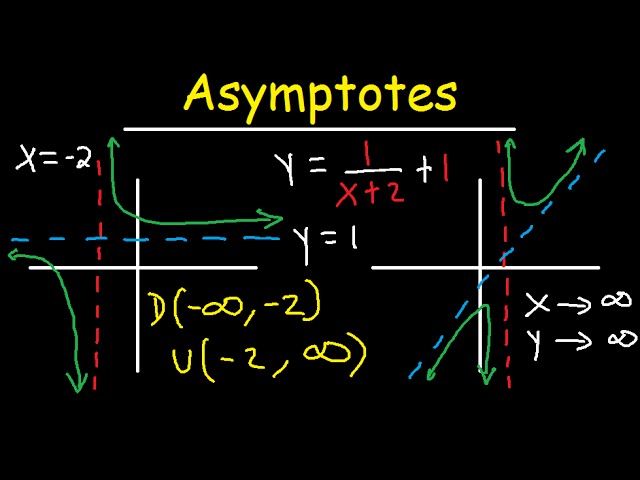
This math video tutorial shows you how to find the horizontal, vertical and slant / oblique asymptote of a rational function. This video is for students who might be taking algebra 1 or 2, precalculus or calculus in high school or those who might be taking college algebra in an university. This video contains plenty of notes, examples, and pra...
pearl glacier
Thanks much 🙏
lone heartBOT
@pearl glacier Has your question been resolved?
Channel closed
Closed by @pearl glacier
Use .reopen if this was a mistake.
Available help channel!
Send your question here to claim the channel.
Remember:
• Ask your math question in a clear, concise manner.
• Show your work, and if possible, explain where you are stuck.
• After 15 minutes, feel free to ping <@&286206848099549185>.
• Type the command .close to free the channel when you're done.
• Be polite and have a nice day!
Read #❓how-to-get-help for further information on how to ask a good question, and about conduct in the question channels.
 sudden orchid
$\sum_{k=2}^{\infty}\frac{7k}{(k+2)ln(k)}$
lone heartBOT
sudden orchid
$\sum_{k=2}^{\infty}\frac{7k}{(k+2)ln(k)}$
ocean sealBOT
Yelo
 sudden orchid
I understand that this is a limit comparison test however I forgot the steps to get there
<@&286206848099549185>

lone heartBOT
@sudden orchid Has your question been resolved?
lone heartBOT
@sudden orchid Has your question been resolved?
lone heartBOT
Channel closed
Closed by @sudden orchid
Use .reopen if this was a mistake.
Available help channel!
Send your question here to claim the channel.
Remember:
• Ask your math question in a clear, concise manner.
• Show your work, and if possible, explain where you are stuck.
• After 15 minutes, feel free to ping <@&286206848099549185>.
• Type the command .close to free the channel when you're done.
• Be polite and have a nice day!
Read #❓how-to-get-help for further information on how to ask a good question, and about conduct in the question channels.
 pure apex
How to add absolute values with non absolute values in functions?
pure apex
Also subtract, multiply, divide
 scarlet oriole
wait what
pure apex
Like I made myself the function:
|x*y| + |x+y| = 4
Given x = 2 how would I go about (dont know the word in english) 'finding' y
 alpine ore
pure apex
Given x = 2 how would I go about (dont know the word in english) 'finding' y
alpine ore
pure apex
Given x = 2 how would I go about (dont know the word in english) 'finding' y
"solving for y"
pure apex
Ah yes
alpine ore
You split the absolute into two cases
One for when the inside ≥ 0, and another for when the inside < 0
pure apex
Didnt you write just now?
alpine ore
Yeah I'm writing a long ass solution
pure apex
Ah nvm average discord shenanigans
pure apex
alpine ore
Yeah I'm writing a long ass solution
Thanks for your time, really appreciate it

alpine ore
Ok imma start sending
given x = 2, substituting that into
|xy| + |x+y| = 4
we get
|2y| + |2+y| = 4
Correct?
@pure apex
pure apex
Ya
alpine ore
Now, the value of |2y| is either +2y (if 2y is positive) or -2y (if 2y is negative)
pure apex
But isnt the absolute value always positive?
pure apex
Ye
alpine ore
So we can split the original equation into two parts:
Case 1: (2y ≥ 0)
2y + |2+y| = 4
Case 2: (2y < 0)
-2y + |2+y| = 4
pure apex
When I put it in an app it also gave me 2 other possibilities
alpine ore
Which are...?
alpine ore
So basically
?
pure apex
Yes
pure apex
++ gave me 2/3
-+ =-2
+- =6
-- =-2
alpine ore
Now you have 4 potential solutions
Substitute them into the original equation
And see which one works
pure apex
Lemme try
alpine ore
alpine ore
Substitute them into the original equation
|2y| + |2+y| = 4
alpine ore
So now you can deduce that
pure apex
Is it any important that there were 2 possibilities for -2?
pure apex
thanks so much u saved me an unsatisfied brain and leared something new
pure apex
You too
alpine ore
Would you like to know why 6 didn't?
Because it came from
- and - = 6
In which the first one is positive when 2y ≥ 0 => y ≥ 0 and the second one is negative when 2+y < 0 => y < -2
Notice something? The first one says y is bigger than 0 and the second says that y is less than -2. Which is impossible
That's why it didn't work
pure apex
Ahh I see now
Also u left out the possibility wit 2 negatives
Why was that?
Why is it the same as - +
alpine ore
Hmm
I'm not sure myself why it came out the same
Maybe something to do with the 2 factor and the +2 being the same number?
lone heartBOT
@pure apex Has your question been resolved?
pure apex
Let him write gaddamn
alpine ore
It happens whenever y = -x in |xy| + |x+y| = k
alpine ore
y = -x
|xy| + |x+y| = k
|x(-x)| + |x+(-x)| = k
|-x²| + |x-x| = k
x² + |0| = k
x² = k
in your example we had x = 2 and k = 4 which is 2²
pure apex
If anyone still wants to contribute write "1", else I'll just close the question
lone heartBOT
Channel closed
Closed by @pure apex
Use .reopen if this was a mistake.
Available help channel!
Send your question here to claim the channel.
Remember:
• Ask your math question in a clear, concise manner.
• Show your work, and if possible, explain where you are stuck.
• After 15 minutes, feel free to ping <@&286206848099549185>.
• Type the command .close to free the channel when you're done.
• Be polite and have a nice day!
Read #❓how-to-get-help for further information on how to ask a good question, and about conduct in the question channels.
 clever condor
 lone heartBOT
clever condor
clever condor
lone heartBOT
clever condor
clever condor
In what world is R transitive??
clever condor
 drowsy lake
the channel is called help 0 so I got confused
drowsy lake
the channel is called help 0 so I got confused
❤️
abstract fractal
clever condor
In what world is R transitive??
It's not saying R is transitive
It's referencing the transitive closure of R
clever condor
abstract fractal
It's referencing the transitive closure of R
What's this mean
abstract fractal
clever condor
What's this mean
Imagine you extend R by adding enough ordered pairs to make it transitive
That new relation is the transitive closure of R
clever condor
abstract fractal
Imagine you extend R by adding enough ordered pairs to make it transitive
Sorry, can you explain a little bit further?
Ohh, wait, gotcha I think
So it's really not asking if R is any of these
It's asking if the various closures of the sets are partial/total orders?
abstract fractal
Yes
lone heartBOT
Channel closed
Closed by @clever condor
Use .reopen if this was a mistake.
lone heartBOT
Available help channel!
Send your question here to claim the channel.
Remember:
• Ask your math question in a clear, concise manner.
• Show your work, and if possible, explain where you are stuck.
• After 15 minutes, feel free to ping <@&286206848099549185>.
• Type the command .close to free the channel when you're done.
• Be polite and have a nice day!
Read #❓how-to-get-help for further information on how to ask a good question, and about conduct in the question channels.
 wheat isle
What other rule/s can you use to differentiate a function that’s not raised to a constant?
lone heartBOT
wheat isle
What other rule/s can you use to differentiate a function that’s not raised to a...
wheat isle
.close
lone heartBOT
Channel closed
Closed by @wheat isle
Use .reopen if this was a mistake.
Available help channel!
Send your question here to claim the channel.
Remember:
• Ask your math question in a clear, concise manner.
• Show your work, and if possible, explain where you are stuck.
• After 15 minutes, feel free to ping <@&286206848099549185>.
• Type the command .close to free the channel when you're done.
• Be polite and have a nice day!
Read #❓how-to-get-help for further information on how to ask a good question, and about conduct in the question channels.
 spare tree
 lone heartBOT
spare tree
spare tree
lone heartBOT
spare tree
spare tree
hello I was reviewing for my exam and I was wondering why the Limit Comparison test was used instead of just the comparison test and p-series
cause i know the n^2/n^5 is larger than the first function
and through the p series test you get 1/n^3
which its 3 means it converges
but why do you need to use the limit comparison test
 merry depot
,w (n^2+3)/(n^5+2root(n)) < 1/n^3
ocean sealBOT

 Requested by Zybikron#5611
merry depot
Requested by Zybikron#5611
merry depot
looks like it's not larger.
lone heartBOT
@spare tree Has your question been resolved?
lone heartBOT
Channel closed
Closed due to timeout
Use .reopen if this was a mistake.
Available help channel!
Send your question here to claim the channel.
Remember:
• Ask your math question in a clear, concise manner.
• Show your work, and if possible, explain where you are stuck.
• After 15 minutes, feel free to ping <@&286206848099549185>.
• Type the command .close to free the channel when you're done.
• Be polite and have a nice day!
Read #❓how-to-get-help for further information on how to ask a good question, and about conduct in the question channels.
 mint gazelle
s is in R^4 and i think T is in R^2
 lone heartBOT
mint gazelle
s is in R^4 and i think T is in R^2
mint gazelle
lone heartBOT
mint gazelle
s is in R^4 and i think T is in R^2
mint gazelle
how can u tell what the sum would be
 signal bramble
what are S and T exactly?


 limpid spade
What's T
mint gazelle
im not sure but it didnt say i had to get a value for it or anything like that
limpid spade
mint gazelle
s is in R^4 and i think T is in R^2
Yes what will their sum be
mint gazelle
not sure
idk if i missed the lecture or if they didnt explain this exact problem but i cant visualise the sum of them
mint gazelle
limpid spade
Yes what will their sum be
how would a sum work of things with differrent dimensions?
lone heartBOT
@mint gazelle Has your question been resolved?
mint gazelle
<@&286206848099549185>
 mental solar
mint gazelle
mental solar
mint gazelle
.close
lone heartBOT
Channel closed
Closed by @mint gazelle
Use .reopen if this was a mistake.
lone heartBOT
Available help channel!
Send your question here to claim the channel.
Remember:
• Ask your math question in a clear, concise manner.
• Show your work, and if possible, explain where you are stuck.
• After 15 minutes, feel free to ping <@&286206848099549185>.
• Type the command .close to free the channel when you're done.
• Be polite and have a nice day!
Read #❓how-to-get-help for further information on how to ask a good question, and about conduct in the question channels.
 silver furnace
Is this unsolvable
 lone heartBOT
silver furnace
Is this unsolvable
strange meadow
lone heartBOT
silver furnace
Is this unsolvable
strange meadow
no
silver furnace
Really? Ive been on this for an hour
 weary wyvern
The 2 equations are essentially the same
So in essence there's just one equation
Any solution is just numbers satisfying that equation
And there are infinitely many
Because it's a line
lone heartBOT
Channel closed
Closed by @silver furnace
Use .reopen if this was a mistake.
Available help channel!
Send your question here to claim the channel.
Remember:
• Ask your math question in a clear, concise manner.
• Show your work, and if possible, explain where you are stuck.
• After 15 minutes, feel free to ping <@&286206848099549185>.
• Type the command .close to free the channel when you're done.
• Be polite and have a nice day!
Read #❓how-to-get-help for further information on how to ask a good question, and about conduct in the question channels.
 latent osprey
So i am trying to determine the equation for a translation of y=x^2 with zeroes 7 and 1.
lone heartBOT
latent osprey
So i am trying to determine the equation for a translation of y=x^2 with zeroes ...
latent osprey
Im coming back to math from like a 6 yeat hiatus so I've probably forgotten something vital
but this is what i have so far
Looking at the answer in the back of the textbook gave me a little hint but I'm not sure of the process to get the answer
so far i have (x-1) (x-7)
somehow i need to turn that into
y=(x-4)^2 - 9
what is the process by which that is achieved?
 royal plank
latent osprey
somehow i need to turn that into
y=(x-4)^2 - 9
royal plank
latent osprey
somehow i need to turn that into
y=(x-4)^2 - 9
where does that goal come from?
royal plank
that is the notation like you know its x^2 moved 4 to the right and 9 down
latent osprey
yes, but how do i find that with only the information of the zeros
royal plank
ah, I see now
sorry, I didn't read all
so you did a different approach
the textbook did it more analytical, they thought 'I know the function is translated, so my x^2 has no multiplier' and they calculated the middle of 7 and 1 (so 4) and then solved for x^(7-4)=0
you did it very algebraic, you directly used your knowledge of binomals to input the zeroes into roots (x-1)(x-7)
if you make it to the form x^2+bx+c you get the same result
latent osprey
so would we be able to run through it step by step? i really have forgetten almost all knowledge regarding trinomials
royal plank
what specifically?
Their approach?
latent osprey
so to clarify, is the answer in the textbook a simplified form of x^2+bx+c?
royal plank
no
they thought 'how do I have to move f(x)=x^2 to match the zeroes'
which is
4 to the right
9 down
thats their numbers
royal plank
yupp
latent osprey
so i say that X is 4, and then calculate y to be -9
thank you so much i think i understand now.
royal plank
yeah
royal plank
so they did like $(1-4)^2+c = 0$
which is $c=-3^2$
latent osprey
.closed
ocean sealBOT
Jigglyproff
 royal plank
you too
royal plank
latent osprey
.closed
its just .close 🙂
latent osprey
.close
lone heartBOT
Channel closed
Closed by @latent osprey
Use .reopen if this was a mistake.
Available help channel!
Send your question here to claim the channel.
Remember:
• Ask your math question in a clear, concise manner.
• Show your work, and if possible, explain where you are stuck.
• After 15 minutes, feel free to ping <@&286206848099549185>.
• Type the command .close to free the channel when you're done.
• Be polite and have a nice day!
Read #❓how-to-get-help for further information on how to ask a good question, and about conduct in the question channels.
 snow fractal
i need help with discrete math
lone heartBOT
snow fractal
i need help with discrete math
snow fractal
please help
 sour dove
what's the question?
snow fractal
i have a couple but this is the first
open, closed, trail, circuit, path, cycle? Explain.```
and i believe that it is a an open walk and a trail because no edge is repeated it wouldnt be a path because the vertex A,C is repeated twice am i correct? snow fractal
i just checked ur helping like a lot of ppl
sour dove
lol it's a bit quieter now
snow fractal
oh man like goodjob thats crazy
sour dove
^_^
snow fractal
logic

 sour dove
sorry my dude we're working on this problem for now. But I see you opened #help-2
somebody hopefully will stop by shortly
snow fractal
imma help him
 high scaffold
Yes
snow fractal
ik u have alot of ppl
sour dove
lol okay. Go do it in their channel if you don't mind and we can work on this one together
snow fractal
but am i correct in saying its an open walk, trail?
snow fractal
sour dove
lol okay. Go do it in their channel if you don't mind and we can work on this on...
i did
sour dove
cool
okay and just remind me about open and closed... open is when the first and last verticies are different and closed is when you end on your starting node?
sour dove
okay cool. Then yeah it should be an open walk and trail. It's open because our start and end vertices are different and it's a trail since we have repeated vertices and no repeated edges
here, A = 1, B = 2, C = 3, D = 4, E = 5

circuit and cycle are not relevant, and it's not a path since we have repeated edges
boom
snow fractal
yes ok
another question
vertices in non-increasing order. The degree sequence for four different graphs are
given below. Each graph is guaranteed to be connected. Select the degree sequence
corresponding to the graph that has an Euler trail. Explain.
a. 1, 2, 3, 3, 4, 4, 4, 5
b. 2, 2, 2, 4, 4, 4, 4
c. 2, 2, 3, 4, 4, 4, 5
d. 2, 4, 4, 4, 4, 4, 6 ```I believe it would be c
due to the fact that it has only 2 vertices that are odd
everything else doesn't fit the description of a Euler trail
sour dove
yeah that sounds logical to me
wait hold on
lemme revisit what an Euler trail is
no wait it would be c I think

tha'ts the def of an euler trail
snow fractal
ok
next question
imma gonna upload a photo of my work seeing that i can't really type this out
𝑏𝑛 = 2𝑏𝑛−1 + 3𝑏𝑛−2
𝑏0 = 1
𝑏1 = 7``` sour dove
these ones have characteristic equations yeah?
snow fractal
Yeahh depending on weather the zeros u get have a multiplicity
snow fractal
take ur time im not coming at you with easy questions
sour dove
$b_n = 2b_{n-1} + 3b_{n-2}$ has a characteristic equation of $x^2 - 2x - 3$, which is $(x - 3)(x + 1)$, so the roots are $-1, 3$. So the general solution is $b_n = C_1(-1)^n + C_2(3)^n$. Then for $b_0 = 1$, we get $1 = C_1 + C_2$ and for $b_1 = 7$, we get $7 = -C_1 + 3C_2$. Which when we solve, we get $C_2 = 2$, $C_1 = -1$, so then our equation is $b_n = -(-1)^n + 2(3)^n$
ocean sealBOT
MellowDramaLlama
 snow fractal
ok i got so many more but i will help you help ppl since iim taking most of ur time
snow fractal
ok lol
sour dove
you seem to have a good grasp on these so I'm just verifying your results. It's just taking a second because I haven't done these in a while lmao
snow fractal
𝑎^𝑛−1/𝑎−1
.```imma have to send my work for this as well

we have to assume that the right hand is is true
and we have to prove that its also try for k+1 as well
sour dove
yep that work looks right to me
snow fractal
lol are you just agreeing with me at this point
sour dove
no you're knocking these out of the park
you need more self confidence
I"ll give it a once over again though
maybe I missed something
snow fractal
i got a final tmr so i wanna make sure that i really know what im doing
sour dove
yeah fair enough
one small mistake is in your inductive step. k needs to be greater than 1, since we already checked for one, but that's a SUPER TINY nitpick lol
snow fractal
ahh your right
ok but i think i get it for the most part
Prove by induction: For all non-negative integers n, 𝑛^3 − 7𝑛 + 3 is divisible by 3
sour dove
nah it looks good to me
I'll brb (getting food)
but I"ll look at that when I get back
snow fractal
ok
lone heartBOT
@snow fractal Has your question been resolved?
lone heartBOT
@snow fractal Has your question been resolved?
lone heartBOT
@snow fractal Has your question been resolved?
lone heartBOT
Channel closed
Closed due to timeout
Use .reopen if this was a mistake.
lone heartBOT
Available help channel!
Send your question here to claim the channel.
Remember:
• Ask your math question in a clear, concise manner.
• Show your work, and if possible, explain where you are stuck.
• After 15 minutes, feel free to ping <@&286206848099549185>.
• Type the command .close to free the channel when you're done.
• Be polite and have a nice day!
Read #❓how-to-get-help for further information on how to ask a good question, and about conduct in the question channels.
alpine sable
 lone heartBOT
alpine sable
lone heartBOT
lone heartBOT
alpine sable
lone heartBOT
Channel closed
Closed by @thick oracle
Use .reopen if this was a mistake.
Available help channel!
Send your question here to claim the channel.
Remember:
• Ask your math question in a clear, concise manner.
• Show your work, and if possible, explain where you are stuck.
• After 15 minutes, feel free to ping <@&286206848099549185>.
• Type the command .close to free the channel when you're done.
• Be polite and have a nice day!
Read #❓how-to-get-help for further information on how to ask a good question, and about conduct in the question channels.
 dapper hound
 lone heartBOT
dapper hound
dapper hound
lone heartBOT
dapper hound
dapper hound
Could I get help with this
lone heartBOT
@dapper hound Has your question been resolved?
dapper hound
so wait
alpine sable
or b y(x) = 4
dapper hound
I just input 0 as x for the first question?
dont tell me the answer
I need to do this I have a test coming up
dapper hound
dapper hound
I just input 0 as x for the first question?
?
alpine sable
dapper hound
?
when x = 0 means in time 0 but when y = 0 means in Hight 0
understand?
dapper hound
no
alpine sable
for example y = 2x - 3
in x = 0 ,y = -3 means is 0 second ball in 3 hight
in x = 3/2 , y = 0 means in 3/2 second ball in 0 hight or ground
alpine sable
yes
alpine sable
dapper hound
I have to do y=0?
try to find x in h(x) = 0
alpine sable
yaahh
alpine sable
yes im onlion