#competition-math
1 messages · Page 34 of 1
 prisma python
isn't the f(x) used convex?
oh wait no it's concave, i messed up the derivatives
 vernal axle
prisma python
oh wait no it's concave, i messed up the derivatives
vernal axle
prisma python
oh wait no it's concave, i messed up the derivatives
yep, its concave for t<0 and convex for t>0.
prisma python
right, x in [0,1] is t in [-inf,0]

 ornate blade
 novel karma
Well firstly a + c = 2b
 ornate blade
novel karma
ornate blade
novel karma
Yeah so the insides of the logs must be equal
ornate blade
Hmm I don't have pen and paper with me
 sly pawn
Just solved this problem

👍
W idea
Probably should've figured it out faster though
vernal axle
novel karma
put a=b-n and c=b+n. Then you should have (b-n)(b+n+6)=(b-1)^2. Don't forget that b and n are integers and b-n>=1 and b+n+6>=1.
sly pawn
vernal axle
put a=b-n and c=b+n. Then you should have (b-n)(b+n+6)=(b-1)^2. Don't forget tha...
does that question mean log base 10?
or log any base?
vernal axle
sly pawn
does that question mean log base 10?
it doesn't matter. It can be any base.
sly pawn
vernal axle
it doesn't matter. It can be any base.
ok
sly pawn
vernal axle
it doesn't matter. It can be any base.
Ok
Well
E is wrong 😂
I found an answer through trial and error
 fickle torrent
yo i am a informatics student but want to get into comatition math for fun
sly pawn
fickle torrent
yo i am a informatics student but want to get into comatition math for fun
What is informatics?
fickle torrent
coding olympiad basicly
it is basicly imo thinking + coding
+no proof
you just need to vibeproof
like think it looks correct
sly pawn
Okay
fickle torrent
sly pawn
Okay
look at codeforces.com if you want to understand more
its basicly a collection of problems with a judge
so you submit code and it gives you a verdict
they also host contests and stuff
sly pawn
sounds fun
 near hill
sly pawn
What is informatics?
near hill
sly pawn
What is informatics?
In some countries that is the local name for computer science in general.
fickle torrent
rly?
sly pawn
fickle torrent
yo i am a informatics student but want to get into comatition math for fun
So if you already have the thinking and problem solving ability it should be pretty easy to get into comp math
It's useful to learn some theorems and methods for each subject still though
fickle torrent
ye i solved some problems given by my freinds i just dont know how to prove for shit tho
sly pawn
fickle torrent
ye i solved some problems given by my freinds i just dont know how to prove for ...
me neither 😂
fickle torrent
given a hard(ish) combinatorics problem i can get the answer but cant prove it
sly pawn
Planning on learning proof writing later because I heard it's pretty easy to prove if you can solve the problem
like format your solution into a proof I mean
fickle torrent
nah proof in general
sly pawn
Oh I see
near hill
fickle torrent
rly?
Yes, such as Informatik in German or informatique in French.
sly pawn
fickle torrent
nah proof in general
Can you give an example of a problem you would struggle proving?
fickle torrent
mostly any problem
i solved the jbmo 2025 p4 but didnt prove it
like algebra step by step i can prove
in informatics you learn to have a good intuition but not prove
sly pawn
This one?
 fickle torrent
the sol: ||a cyclic shift for 1-n so it is 1-n, 2-n 1, 3-n 1 2||
sly pawn
Do you know the types of proofs?
fickle torrent
kinda yes
sly pawn
I think this is a direct proof or induction kind of problem
just by looking at it that's what makes sense to me
fickle torrent
contradiction induction exaughtion and normal
fickle torrent
sly pawn
just by looking at it that's what makes sense to me
||that isnt correct from what i heared||
sly pawn
fickle torrent
the sol: ||a cyclic shift for 1-n so it is 1-n, 2-n 1, 3-n 1 2||
But how can you put your intuition into a proof is what you struggle with?
sly pawn
fickle torrent
||that isnt correct from what i heared||
its not direct or induction?
Ok
fickle torrent
the intuition is just a educated guess
sly pawn
fickle torrent
||that isnt correct from what i heared||
What isn't correct?
fickle torrent
it is called ||double counting||
sly pawn
The type of proof or your solution?
fickle torrent
sly pawn
The type of proof or your solution?
type of proof
sly pawn
fickle torrent
it is called ||double counting||
I don't think I've ever heard of that as a proof method
fickle torrent
idk tbh
sly pawn
Isn't that basically just the same as a direct proof
showing that two things are the same
fickle torrent
ye
double counting from what i understand is counting somthing from two different ways
fickle torrent
yes kinda
sly pawn
Hmm
fickle torrent
i did smthn similar to somthing called the exchange argument
as a intuative proof
sly pawn
Well if you struggle to prove things, maybe it's best to start with easier proof problems and work up to the harder ones
fickle torrent
ye definately
sly pawn
Or also maybe watching videos where you do the problem along with someone else is also a helpful way of getting better
fickle torrent
ill prolly just solve problems that works mostly for me when doing informatics
also you should try informatics it may improve your intuition
i am doing compatition math to improve my proofs
sly pawn
I have good intuition but I struggle with proving mostly too
Like all of the logic or puzzle problems they put on competitions I usually solve those pretty quickly
I usually struggle more with problems that require good drawing/graphing skills or problems that are super wordy
fickle torrent
sly pawn
I usually struggle more with problems that require good drawing/graphing skills ...
Informatics will help you with the wordy problems part
The problem can be pages
I once solved like a problem that was 7 pages or smthn
sly pawn
fickle torrent
Informatics will help you with the wordy problems part
That sounds good then
 twilit peak
hello
sly pawn
hi
 shadow niche
 sturdy robin
I’ve been stuck on this problem for a bit, does anyone know how to solve?
sturdy robin
I’ve been stuck on this problem for a bit, does anyone know how to solve?
just a sketch but use that fact that f(f(y)) = y to show that this function satisfies cauchy equation(?) i could be wrong
prisma python
i can do the second one but i have to assume ln(x!) is convex. is there another way to find that out except for finding the second derivative?
i think maybe it's possible to make ln(x!)=ln(1)+ln(2)+...+ln(x) so as x increases, ln(x) gets bigger so it probably has a positive second derivative but i'm not sure if that's enough of a proof
 pallid tundra
oh huh USA’s top scorer at IMO
I’ve met him at the contest I run at my uni
this is his second gold medal
goated
 maiden panther
he is goated
pallid tundra
swept all the problems we threw his way without breaking a sweat
maiden panther
the whole team is goated tbh
pallid tundra
true and real
on last year's team there was someone i had directly competed against in the past when i was still in HS
in the local leagues where he was the ONLY person from outside my school who could actually put up a fight
maiden panther
pallid tundra
on last year's team there was someone i had directly competed against in the pas...
wow
pallid tundra
then there's me who only barely made AIME my senior year of HS when i had all but given up on doing so
💀
maiden panther
pallid tundra
then there's me who only barely made AIME my senior year of HS when i had all bu...
congrats on finishing off your last year strong tho!
all achievements are worth celebrating
pallid tundra
ig lol
maiden panther
some people just spend more time on the contest stuff
pallid tundra
it feels so long ago im going into my final year of undergrad now
and my contest career consists of a whopping two (2) points on last fall's putnam 😭
maiden panther
putnam is a really weird contest tbh
it's easy to get overwhelmed with a lot of the problems in a small time interval
pallid tundra
from what i understand the top contestants are mostly just coasting off their HS olympiad training?
maiden panther
and the problems generally aren't phrased in a very unapproachable way
maiden panther
pallid tundra
from what i understand the top contestants are mostly just coasting off their HS...
yep
pallid tundra
yea i've never heard of anyone seriously studying for it LMAO
maiden panther
i think the main thing is
most hs olympiad people don't know how to think about some college math concepts in an olympiad context
so it's useful to practice the problems that are out of the scope of high school contests
pallid tundra
i look at anything analysis related my eyes glaze over in soul crushing dread
maiden panther
lol yeah
i can't see myself solving a calculus or linear algebra problem on the putnam
at least one that requires deep knowledge about the subject
becasue i dont have a deep understanding of the material yet
pallid tundra
doesnt help that my intro linalg class SUCKED
covered nothing of substance, was all just rref spam
maiden panther
aw that sucks
pallid tundra
and left out a lot of critical topics
maiden panther
mine was like that too
pallid tundra
😭
maiden panther
at least we defined a vector space at the end
pallid tundra
and did the extremely boring "verify the 10 axioms"?
maiden panther
something like that
maiden panther
yeah exactly
pallid tundra
"proofs" but i can't be arsed to actually teach smth that isn't just symbol push
maiden panther
linear algebra has so many rly cool ideas it's kind of a shame it's taught poorly in so many unversities
maiden panther
pallid tundra
"proofs" but i can't be arsed to actually teach smth that isn't just symbol push
exactly
that's why i hate high school proof classes like geometry
as well
it's all symbol pushing
pallid tundra
i need to see if i can fit in both second semester analysis and algebra my final semester 😭
otherwise i am giga cooked for grad school apps
maiden panther
are you planning to continue studying math?
maiden panther
pallid tundra
i need to see if i can fit in both second semester analysis and algebra my final...
algebra is a great subject
pallid tundra
looking at doing grad school
maiden panther
nice!
maiden panther
good luck 🙏
pallid tundra
thank 😭
sly pawn
prisma python
i can do the second one but i have to assume ln(x!) is convex. is there another ...
Ln(x!) is convex.
prisma python
yeah, i'm just wondering if my explanation is good enough
sly pawn
idk how to prove it but I know it is though
sly pawn
prisma python
yeah, i'm just wondering if my explanation is good enough
probably is good
sly pawn
prisma python
yeah, i'm just wondering if my explanation is good enough
why do you need ln(x!) to be convex though?
prisma python
it's for the Jensen's inequality
if it was concave, the sign of the inequality gets flipped
sly pawn
oh I see why
sly pawn
prisma python
it's for the Jensen's inequality
so that you can add them instead of them being multiplied?
prisma python
the ln was to turn addition to multiplication for the LHS
sly pawn
prisma python
the ln was to turn addition to multiplication for the LHS
I thought its to turn multiplication to addition
for the LHS
sly pawn
.
the LHS is multiplication initially though so wouldnt you use the ln to turn it to addition to use jensens?
vernal axle
sly pawn
.
@prisma python For the second one I used f(x)=ln(Г(x+1)) which is equal to ln(x!) for integer x. I proved that f(x) is convex by using the property of the digamma ψ-function, which is the derivative of ln(Г(x)) and which has a nice expansion into series. So, ψ'(x) is positive for x>0.
https://en.wikipedia.org/wiki/Digamma_function
 sly pawn
vernal axle
<@740215914502291507> For the second one I used f(x)=ln(Г(x+1)) which is equal t...
sly pawn
vernal axle
<@740215914502291507> For the second one I used f(x)=ln(Г(x+1)) which is equal t...
hmm ok
prisma python
vernal axle
<@740215914502291507> For the second one I used f(x)=ln(Г(x+1)) which is equal t...
would that explanation of making ln(x!) into a sum of ln(x) be good enough for a proof though? since that would apply for all integers
vernal axle
first I proved this inequality for all real x>0 using ln(Г(x+1)) and since this function is increasing we can say that ln(Г(x+1))>=ln(Г([x]+1)) if I got your question right.
sly pawn
prisma python
would that explanation of making ln(x!) into a sum of ln(x) be good enough for a...
It makes sense because the sum is increasing at an increasing rate for all x
prisma python
vernal axle
first I proved this inequality for all real x>0 using ln(Г(x+1)) and since this ...
I was asking about like how I kind of explained why ln(x!) is convex for x>0, because I didn't use the gamma function
and also since from the question, a_1,a_2,...,a_n are just positive integers
basically ln((x+1)!)-ln(x!)=ln(x+1), and so the difference between f(x+1) and f(x) is increasing since ln(x) is increasing
so since it's increasing at an increasing rate, I think it would be enough to kind of prove that ln(x!) is convex right?
and also, because I haven't learned about the digamma function, so this was what I thought of
vernal axle
prisma python
i think maybe it's possible to make ln(x!)=ln(1)+ln(2)+...+ln(x) so as x increas...
If you mean this #competition-math message explanation I don't think it is valid. I don't how to solve the problem with Jensen staying in integers only. At least you cannot apply Jensen directly, because you will have some factorial of the non-integer number. So you do have to use ln of Gamma function and it being convex is proved by Г'(x)/Г(x) properties.
prisma python
oh ok, thanks
 undone ivy
wsp, so i have an incoming olympiad this october and i feel like learning from just my notes is a horrible method of preparing for it. any websites, apps, or methods i can use?
sly pawn
undone ivy
wsp, so i have an incoming olympiad this october and i feel like learning from j...
previous olympiad problems
 thick sierra
anyone here doing the MAT this application cycle
 pure rover
thick sierra
anyone here doing the MAT this application cycle
pure rover
thick sierra
anyone here doing the MAT this application cycle
the oxford one?
thick sierra
pure rover
the oxford one?
yeh
pure rover
thick sierra
yeh
yeah i’m taking that and tmua
thick sierra
pure rover
yeah i’m taking that and tmua
nice what u applying for
 sleek ivy
I’m doing tmua and the Cambridge one
pure rover
thick sierra
nice what u applying for
maths & phil at oxford and then maths at imperial
pure rover
sleek ivy
I’m doing tmua and the Cambridge one
step?
thick sierra
pure rover
maths & phil at oxford and then maths at imperial
LMAO same bro
i've never met anyone else wanting to do maths & phil
pure rover
tbf i don’t know why i want to do it
cause i prefer applied maths but oh well
i found some pre covid data and why are the MAT score higher for phil then they are for normal maths
thick sierra
pure rover
cause i prefer applied maths but oh well
dang
i really hate applied with all my soul & love philosophy so i figured it'd be the best choice
straight maths at ox has a lot of stats so
thick sierra
pure rover
i found some pre covid data and why are the MAT score higher for phil then they ...
maths & phil is more competitive i think
pure rover
thick sierra
maths & phil is more competitive i think
it’s got a marginally higher acceptance rate, but i’m pretty sure how it works is that the maths department hold you to the same standard and they choose whether or not to accept you and then the philosophy department choose
thick sierra
pure rover
it’s got a marginally higher acceptance rate, but i’m pretty sure how it works i...
what basis would the phil department even choose on though as we don't have to do the TSA
just an interview
pure rover
yeah i think it’s just interviews
thick sierra
ok fair
and the interview for both is decided by MAT score?
have you started MAT prep yet
pure rover
yeah so the way it works is they set upper and lower bounds after everyone’s taken the MAT, everyone above that bound is automatically interviewed, everyone below the lower bound is automatically rejected and then 2/3 of people in between are interviewed, so usually it’s only if you fall between the bounds they read your personal statement
but they don’t publish what the bounds were
pure rover
thick sierra
have you started MAT prep yet
i started in march 😭, i only properly started in june though
thick sierra
pure rover
but they don’t publish what the bounds were
i heard it's around 60
upper bound
pure rover
that doesn’t seem that high tbh
thick sierra
pure rover
i started in march 😭, i only properly started in june though
damn, how many hours have you done so far
 half arrow
sleek ivy
I’m doing tmua and the Cambridge one
half arrow
sleek ivy
I’m doing tmua and the Cambridge one
Same
thick sierra
tbh i haven't started yet
pure rover
thick sierra
damn, how many hours have you done so far
honestly no idea, probably 80-100. but my natural ability is horrendous so i have to work to get to a good enough level
thick sierra
pure rover
honestly no idea, probably 80-100. but my natural ability is horrendous so i hav...
dude thats crazy
nice
i need to lock in
i doubt your natural ability is that bad
you're predicted 2 A*s in maths fm right
pure rover
like in UKMT with no revision i scrapped a silver, when i did revision i got a gold
pure rover
thick sierra
you're predicted 2 A*s in maths fm right
yeah
thick sierra
pure rover
like in UKMT with no revision i scrapped a silver, when i did revision i got a g...
yeah that's not horrendous natural ability 🙏
pure rover
thick sierra
i need to lock in
my procrastination is so bad i have to revise early otherwise ill never start as well
thick sierra
pure rover
my procrastination is so bad i have to revise early otherwise ill never start as...
i was meant to start mat prep 10 days ago and i just procrastinated and now i've done nothing
i don't think i'll get in but i'm just shooting my shot yk
have you done a full paper yet @pure rover? if so what score are you getting
sleek ivy
pure rover
step?
Yh
pure rover
thick sierra
have you done a full paper yet <@738112625774428305>? if so what score are you g...
like if it’s hard maybe 65-70, am easier paper like 70-75
pure rover
sleek ivy
Yh
good luck
thick sierra
pure rover
like if it’s hard maybe 65-70, am easier paper like 70-75
that's insane
how much were you getting when you first started
thick sierra
sleek ivy
Is it that bad
yes esp since cambridge want top grades in it
pure rover
thick sierra
how much were you getting when you first started
like 40-45
but i was quite good at the long questions and they’ve got rid of most of them now so idk how ill do in the new format
pure rover
thick sierra
thats crazy
it was right after i had been doing UKMT so problem solving was still in my head
sleek ivy
thick sierra
yes esp since cambridge want top grades in it
Eh its fine ill start prepping in like february
 stark swallow
pure rover
like in UKMT with no revision i scrapped a silver, when i did revision i got a g...
stark swallow
pure rover
like in UKMT with no revision i scrapped a silver, when i did revision i got a g...
How
pure rover
stark swallow
How
how did i revise?
stark swallow
Yes with topic wise practise
pure rover
basically i did like 6 padt papers, then i made a spreadsheet of which topics came up and then made some notes on like cheats, like fast expansions and last digit calculations
 sacred edge
Can someone check my solution to this problem please?

 near hill
I don't see how you conclude |S| > |N| at the end; even if you meant |S| < |N| that would suggest you're mistaken about cardinal arithmetic.
near hill
Instead I would say: Once you know there are infinitely many large sets, ||let K be large enough that at least 2014 of the sets A1, A2, ..., AK are large. That means those sets together contain at least K+2014 different naturals, so one of those naturals must be >= K+2014. But such a number cannot be in any of the A1, A2, ..., AK, since it would immediately make the sum of that set larger than it's allowed to be.||
 high goblet
pure rover
yeah so the way it works is they set upper and lower bounds after everyone’s tak...
high goblet
pure rover
yeah so the way it works is they set upper and lower bounds after everyone’s tak...
lmao they don't read personal statements
if ur somewhere in the middle region it'll depend on ur privilege
(i.e. if you go to a private school or not, how wealthy is ur area etc.)
or your a level results
literally most other factors will be more important than ur p.s.
high goblet
thick sierra
yes esp since cambridge want top grades in it
i mean you just need a 1,1
Cambridge is different to Oxford, ur offer will be tied to STEP
if you're interview went okay and everything else is normal, you'll probably just get an 1,1 offer
if there are extraneous circumstances then you might get offered something like S,1
pure rover
high goblet
if ur somewhere in the middle region it'll depend on ur privilege
ah ok, so wealthy area + private is not a good combo for being in those bounds?
high goblet
pure rover
ah ok, so wealthy area + private is not a good combo for being in those bounds?
yeah generally not
anyway gl on MAT, you still have like a while to prepare!
pure rover
high goblet
yeah generally not
just gotta be above the bound ig. so once you’ve got your interview, is that all that matters in giving an offer or do they combine your interview score and mat score?
high goblet
iirc i'm pretty sure that after you've got ur interview the interview is the main thing that matters
although if you do slightly below avg on the interview but you had a really strong MAT score i think they would factor that in
i mean it has been a while since i was applying to unis etc. and needed to care abt this stuff
pure rover
oh ok, cause i remember looking at score distributions and smth like 5 people got above 96 and only 4 of them were made offers. how badly do you have to mess up your interview for that to happen
high goblet
pure rover
oh ok, cause i remember looking at score distributions and smth like 5 people go...
oh it's more likely that they cheated
pure rover
high goblet
oh it's more likely that they cheated
would their score not just be discounted?
high goblet
(it's hard to prove for sure that they cheated but like if they are just completely shit at the interview then it's pretty obvious they must've cheated)
(like my sister interviewed an international who scored 97 on the MAT, but like couldn't answer any basic maths questions in the interview)
thick sierra
yeah you don’t get 96 on MAT then flop the interview that badly
high goblet
(with candidates like that, it's easier to just reject them based on their interview score than to prove that they definitively cheated)
pure rover
high goblet
(with candidates like that, it's easier to just reject them based on their inter...
oh right i see
that’s pretty cool that your sister runs interviews
high goblet
pure rover
that’s pretty cool that your sister runs interviews
lol yh i'm fairly familiar with oxbridge
ornate blade
high goblet
lol yh i'm fairly familiar with oxbridge
what kind of fuckass family do you have
your fricking sister!?
god are any of your parents or relatives academics
if so, at Oxbridge?
high goblet
ornate blade
your fricking sister!?
lol i swear u knew abt that
high goblet
ornate blade
god are any of your parents or relatives academics
nah not my parents
ornate blade
high goblet
lol i swear u knew abt that
no????
I don't know about your siblings at all
you never talk about them
ornate blade
high goblet
lol i swear u knew abt that
also I'm an only chil
I know that I haven't brought this up before
ornate blade
high goblet
nah not my parents
you have some uncle then lmao I bet at Cambridge
high goblet
ornate blade
you never talk about them
ok i swear u knew but maybe not
high goblet
ornate blade
you have some uncle then lmao I bet at Cambridge
nah my parents are chinese so like none of my extended family are oxbridge
ornate blade
high goblet
nah my parents are chinese so like none of my extended family are oxbridge
wait your parents are Chinese? hot damn
ok so you are part of the helpfuls Chinese club
welcome again!
 toxic sorrel
is this the proper place to ask how to start comp maths? i just did my a-levels so maybe it’s too late. i was always invited to math competitions by my school but turned them down everytime which i regret. So is it too late and where to start if it’s not?
or should i just study on university when i study maths in university
pure rover
high goblet
nah my parents are chinese so like none of my extended family are oxbridge
is it your order sister? cause that must have been insanely helpful
high goblet
ornate blade
welcome again!
lol ty
high goblet
toxic sorrel
is this the proper place to ask how to start comp maths? i just did my a-levels ...
i mean up to you, like they're a fun thing you can do but like if u're stressed about like prepping for i.e. uni entrance exams then you could focus on that instead and only do like a few past papers for competition maths
high goblet
pure rover
is it your order sister? cause that must have been insanely helpful
yeah older
 warm rock
 sour cobalt
Why is the proof given in this particular way? To prove this, I noted that 3, 2 are prime and 3-2=1 therefore any natural n can be decomposed into its prime factorization and then multiply 3, 2 by n to obtain n. And 3n and 2n will have the same number of prime divisors. But the given proof is more complicated - why? And for (2n)-n, doesn’t 2n have one more prime factor than n?
 near hill
sour cobalt
Why is the proof given in this particular way? To prove this, I noted that 3, 2 ...
near hill
sour cobalt
Why is the proof given in this particular way? To prove this, I noted that 3, 2 ...
It looks like they want the same number of distinct prime factors, whereas your procedure will produce the same number of prime factors with multiplicity. Those are different tasks.
sour cobalt
How does this relate to 2n-n? I expect that, breaking both down, you would find they share all prime factors but one (2) and yet still wouldn’t have the same number of them
near hill
That's for the case where n is even, so 2 is already a factor of n, so the set of primes that divide 2n is the same as the set of primes that divide n.
sour cobalt
Ok, I see - we are writing them (p_1)^a_1, (p_2)^a_2, …, (p_m)^a_m
and each p_i is considered distinct, and we don’t care if they repeat
near hill
Right.
near hill
It only became clear to me after I read the first part of the solution.
sour cobalt
As in, if we do not care about exponents, then aren’t 2n and n considered to have the same prime factors?
near hill
sour cobalt
What do you mean ‘by multiplicity’?
The multiplicities in your factorization is a_1, a_2, ..., a_m.
Your solution expresses n as a difference of numbers with the same a_1+a_2+...+a_m.
sour cobalt
I see, So we really want the same p_i, but different multiplicity
Since ‘number of prime factors’ refers to p_i which we preserve
near hill
Not necessarily the same actual primes.
sour cobalt
Right
near hill
Your solution for n=25 would be 25 = 75-50, with the factorizations 3¹5² and 2¹5², but still 1+2 = 1+2.
sour cobalt
We could have them distinct, but in the case of an even they remain the same. For odds, the given solution adds an additional 2 to the second piece, while changing the exponentiation
near hill
The book's solution would also be 75-50, but would justify it as #{3,5} = #{2,5}.
sour cobalt
I see
thank you
And is this language common?
As in, referring to prime factors without regaars to exponents?
near hill
I think "number of prime factors" is ambiguous -- it could mean either one or the other.
I initially guessed it would be your interpretation too, until I noticed it was not what would make "2n-n" work as a solution.
sour cobalt
Ok, I got it
 spring zenith
Hello
not sure if this is the right channel but struggling to show 1/a+1/b = 1/2

analytically
ive tried rationalizing the radicals but to no avail
 wicked hemlock
spring zenith
not sure if this is the right channel but struggling to show 1/a+1/b = 1/2
wicked hemlock
spring zenith
not sure if this is the right channel but struggling to show 1/a+1/b = 1/2
idk but maybe try simplying the double surds?
as in expressing surds in surds as a sum or difference of two other surds?
sacred edge
near hill
Instead I would say: Once you know there are infinitely many large sets, ||let K...
I see, this makes perfect sense. Thank you so much
ornate blade
spring zenith
ive tried rationalizing the radicals but to no avail
do you know how to denest square roots? search it up if you don't know
hmm that doesn't work here though according to WA
ornate blade
spring zenith
not sure if this is the right channel but struggling to show 1/a+1/b = 1/2
if you brute-force expand and simplify $ab$, you should get $\frac{2}{5} \left(25 + 15\sqrt5 - 6 \sqrt{75 - 30 \sqrt5} \right)$
 gilded haloBOT
south
 ornate blade
https://www.desmos.com/calculator/y97vzpu4ae
then hopefully you can follow this wording for a + b
vernal axle
spring zenith
not sure if this is the right channel but struggling to show 1/a+1/b = 1/2
Since you know the answer, which is 1/2, verifying it is much easier than actually finding it. Given the expressions for a and b, you can easily write quadratic equations (with irrational coefficients) for 1/a and 1/b. Then substitute 1/2−x into the equation for 1/a, expand, and check that you get exactly the same equation as for 1/b. It's not difficult, as it only involves multiplying expressions of the form a+b*sqrt(5) a few times.
stark swallow
can someone tell me why gap and block method in relevant in combi
how does it help
stark swallow
now in this question should not there be 6c4 x 1 x 3 x 3 x 3 x3, 4 times 3 because each question has other 3 options which leads to incorrect answer if he chooses single option correctly

 kind pulsar
stark swallow
now in this question should not there be 6c4 x 1 x 3 x 3 x 3 x3, 4 times 3 becau...
kind pulsar
stark swallow
now in this question should not there be 6c4 x 1 x 3 x 3 x 3 x3, 4 times 3 becau...
there are more than 1 combination for each 6C4
for example the correct answers are A,B,C,D,A,B
one possible combination is the first 4 questions are correct
so A,B,C,D,?,?
the first question mark cannot be A and the second question mark cannot be B
so for the first question mark there are only 4-1=3 choices which are either B,C,D
similar thing for the second question mark
so for each 6C4 there are 3×3=9 possible combinations and not just 1
A,B,C,D,B,D
A,B,C,D,C,A
...
and so on
 oblique abyss
I am entering a vedic math competition, how does one start to study for it? and what topics of mathematics usually comes up in these types of competitions? Any kind of suggestions, tips, or anything you think will help me is appreciated!
I should also add that I literally cannot do mental math and I still have not memorized the multiplication table! My understanding and memory of basic math is also bad 😀
 hushed charm
oblique abyss
I am entering a vedic math competition, how does one start to study for it? and ...
hushed charm
oblique abyss
I am entering a vedic math competition, how does one start to study for it? and ...
How old are you and what grade are you in
oblique abyss
hushed charm
How old are you and what grade are you in
This might sound bad... I'm 16 years old and 11th grade! (please don't make fun of me, I'm trying to change my ways 💔)
hushed charm
oblique abyss
This might sound bad... I'm 16 years old and 11th grade! (please don't make fun ...
no, it doesn't sound bad. when studying for math olympiads, the most important is to focus a lot on solving problems, hard problems. this can be helpful: https://blog.evanchen.cc/2014/07/27/what-leads-to-success-at-math-contests/
Try to start with regional and national olympiads, those are usually easier than international olympiads. Even though, national olympiads from some countries like usa are still really hard, so try to do what evan chen is saying in this blog, try to solve problems that are hard, but not impossible to be done by u. There are thousands of problems in this website, you are certainly going to find what you need: https://artofproblemsolving.com/community/c13_contest_collections
Eventually you might need some olympiad books, but for now, if you need help with a math topic, youtube and internet in general are probably enough, this server is really good either for getting help. Algebra, geometry, combinatorics and number theory are the most common topics in these olympiads.
I don't think there are any specific methods to study or anything like that, it just takes a lot of time and effort, but of course you have to study correctly.
oblique abyss
hushed charm
no, it doesn't sound bad. when studying for math olympiads, the most important i...
Alright, I'll be sure to check out what you recommended! Thank you for the insight and advice !! 😊💓
pure rover
@high goblet sorry for the ping but you wouldn’t happen to know how maths and philosophy admissions works at oxford? i was looking at jesus college and it said they give up to 8 offers for all maths courses per year, this leads to some years having no maths & phil, so if i was the only applicant lets say, how they differentiate between my value to maths and phil and someone else’s value to pure maths?
 torpid cairn
hushed charm
no, it doesn't sound bad. when studying for math olympiads, the most important i...
torpid cairn
hushed charm
no, it doesn't sound bad. when studying for math olympiads, the most important i...
I'm not sure this is helpful for a Vedic competition
hushed charm
torpid cairn
I'm not sure this is helpful for a Vedic competition
Maybe, in my opinion those are pretty helpful for olympiads like aime, usamo and imo, but I am not really familiarized with the vedic competition.
In that case, what do you think would be helpful for a vedic competition
Oh, I just checked it better, indeed what I said isn't going to be the best way to do it.
torpid cairn
hushed charm
Oh, I just checked it better, indeed what I said isn't going to be the best way ...
I literally had to Google the word lmao it's no worries
torpid cairn
oblique abyss
I am entering a vedic math competition, how does one start to study for it? and ...
I'm not sure what extensive prep you'd do but memorizing the multiplication chart would definitely help
 dusty mauve
oblique abyss
I am entering a vedic math competition, how does one start to study for it? and ...
dusty mauve
oblique abyss
I am entering a vedic math competition, how does one start to study for it? and ...
Oo, okay so for vedic maths, I think you can search for Vedic books pdf and you get numerous of free books which have techniques and practice questions, also look on YouTube for, "MathOGenius", he has a whole course on mental maths of around 25 videos, they can help too
But you would have to do a bit of research and buy some legit books, PDFs would help but I prefer to depend on a more liable source
dusty mauve
torpid cairn
I'm not sure what extensive prep you'd do but memorizing the multiplication char...
Yes, tables up to 30 and then squares, cubes and square root and cube root, these should be remembered atleastt
Vedic maths I think would basically be more about the time taking part, as it helps to deduct us time, time would play a big factor in it
Just get Vedic books or look for PDFs online, but I think practice is the most important, hope this helped, All the bestt!!
gilded haloBOT


 uneven inlet
,w vedic


 oblique abyss
dusty mauve
Yes, tables up to 30 and then squares, cubes and square root and cube root, thes...
oblique abyss
dusty mauve
Yes, tables up to 30 and then squares, cubes and square root and cube root, thes...
oh 😭
oblique abyss
uneven inlet
what is vedic math
I'm not entirely sure about it but my brother did participate in a vedic math competition before and he said it was fast computation 😊
 oblique abyss
dusty mauve
Oo, okay so for vedic maths, I think you can search for Vedic books pdf and you ...
oblique abyss
dusty mauve
Oo, okay so for vedic maths, I think you can search for Vedic books pdf and you ...
alright thank you for the advice and all! I really appreciate it !! ^^🌸
dusty mauve
uneven inlet
what is vedic math
Vedic maths is like ancient tricks written in the Vedas, which helps calculate problems real easilyy
Like it mostly consists of multiplication and division and basic algebra
How to multiply big numbers and stuff like that
oblique abyss
they're still not telling me when the competition is and I'm so nervous 😭. They said they'd train me but it's been 4 days and I've heard nothing from them!!
dusty mauve
That's crazyy, I thought you had like a date in mind
What do you think the rough estimate time of when the exam would be ?
oblique abyss
dusty mauve
What do you think the rough estimate time of when the exam would be ?
maybe October?
I'm not sure though... for all I know, it could be in Aug or Sept
dusty mauve
Damn, then ig you would have to plan out
I took a vedic maths course during the lockdown, it wasn't that complicated but we gotta do so much practice istgg
oblique abyss
dusty mauve
I took a vedic maths course during the lockdown, it wasn't that complicated but ...
really??? ong 😭
I'm really REALLY bad at math, I genuinely don't know why they even signed me up for it
do you have any tips in general? hell, I'm bad at memorizing
dusty mauve
oblique abyss
do you have any tips in general? hell, I'm bad at memorizing
Just write it until you have it memorised and then use the blurt method or teach imaginary people to test yourself
But for maths question practice is what the most recommended
dusty mauve
 subtle sundial
trust the process brother
subtle sundial
trust the process brother
Yess they must have signed you up for a reason, do your best and don't worry about the resulttt
 weary vortex
found this problem on a Chinese olympiad:
Let {a1, a2, a3, ..., an} be a set of integers. What is the probability that the sum of their squares is divisble by 5? Give your answer in an g(n) function format, where n is the amount of integers in a set
tried to crack this but failed miserably. any potential solution?
near hill
We'll probably have to assume that the remainders modulo 5 of each of the n integers are independent and uniformly distributed.
weary vortex
neither the assumptions nor the exceptions were provided in the description
if the author of the translation to English did not miss anything
near hill
Without some assumption about probability distributions, it is downright impossible to answer anything about probabilities,
If you do make the uniform-modulo-5 assumption, then you can (by brute force) work out the probability distribution of the sum of two squares modulo 5; you can notice something peculiar about it that should let you extend it to the sum of any even number of squares.
weary vortex
1: 1
2: 3
3: 7
4: 19
5: 53
6: 153
7: 449
8: 1331
9: 3967
10: 11859
11: 35509
12: 106417
13: 319073
14: 956931
15: 2870327
wrote a programm for this task. for values higher than 15, python takes 15000+ ms
1: 1, # Default
2: 3, # * 3
3: 7, # * 3 - 2
4: 19, # * 3 - 2
5: 53, # * 3 - 6
6: 153, # * 3 - 10
7: 449, # * 3 - 14
8: 1331, # * 3 - 16
9: 3967, # * 3 - 26
10: 11859, # * 3 - 42
11: 35509, # * 3 - 68
12: 106417, # * 3 - 110
13: 319073, # * 3 - 178
14: 956931, # * 3 - 288
15: 2870327 # * 3 - 466
There is some Fibonacci type sequence after 10 but we cant yet be sure if it continues or not
weary vortex
weary vortex
1: 1, # Default
2: 3, # * 3
3: 7, # * 3 - 2
4: 19...
took 20 minutes to compute the next 5 results. the exponential time complexity is no joke
oblique abyss
dusty mauve
But for maths question practice is what the most recommended
Thank you again!! I never thought people in this server are nice, I came here prepared to get bullied 😭. I appreciate the advice and all 🙇🏻♀️🙇🏻♀️ !!
I'm definitely gonna work hard for this comp (and in understanding math in general!)
dusty mauve
oblique abyss
Thank you again!! I never thought people in this server are nice, I came here pr...
Hehe no worries at alll
dusty mauve
oblique abyss
I'm definitely gonna work hard for this comp (and in understanding math in gener...
Good luck, rooting for you!!💖
 soft vigil
weary vortex
found this problem on a Chinese olympiad:
Let {a1, a2, a3, ..., an} be a set of...
soft vigil
weary vortex
found this problem on a Chinese olympiad:
Let {a1, a2, a3, ..., an} be a set of...
can you possibly induct
on n
because everytime you add a new a_n you add 0, 1, or 4 to the total sum of squares
weary vortex
it cant possibly be a one liner function, it has to have certain conditions for which the function will change
soft vigil
yeah
but you can do like
a_n, b_n, c_n, d_n, e_n be the probabilities you have 0, 1, 2, 3, or 4 mod 5 as the sum of squares
then you can make a big recursion and solve it
not the most fun but it works
near hill
soft vigil
not the most fun but it works
It actually turns out to be pretty nice, if one assumes independently uniform probabilities for the a_i.
For odd n it turns out the probability of 0 (mod 5) is always 1/5 exactly.
soft vigil
oh nice
near hill
For even n slightly more than that, but converging to 1/5.
 zinc tundra
yo yall think if i completed alg 2, geo and alg 1 i could js practice papers to prep for amc 10
i lowkey forget most of geo

 ivory ember
 orchid linden
Could someone send a sol to this 😭
orchid linden
Could someone send a sol to this 😭
Note that if $b$ has $d$ digits, then the integer formed is $a \cdot 10^d+b=a(10^d+1)+1$
gilded haloBOT
Civil Service Pigeon
 orchid linden
yeah like do you just memorize that
or smth
mabe in the contest its from calculator is allowed
ivory ember
orchid linden
yeah like do you just memorize that
Divisibility rule for 19 ig
Or
9 = (19-1)/2
So it’s reasonable to suspect 10^9 is -1 mod 19
That’s why I said “but annoying”
high goblet
pure rover
<@573875411365265478> sorry for the ping but you wouldn’t happen to know how mat...
sorry i've been busy! i'll reply to this later
if you have any qs feel free to just DM me directly
i'll reply when i can
maiden panther
weary vortex
found this problem on a Chinese olympiad:
Let {a1, a2, a3, ..., an} be a set of...
the answer is $\frac{5^n + 2(2w + 2w^4 + 1)^n + 2(2w^2 + 2w^3 + 1)^n}{5^{n+1}}$ where $w = e^{2i\pi/5}$
gilded haloBOT
flying_fly
 weary vortex
maiden panther
the answer is $\frac{5^n + 2(2w + 2w^4 + 1)^n + 2(2w^2 + 2w^3 + 1)^n}{5^{n+1}}$ ...
weary vortex
maiden panther
the answer is $\frac{5^n + 2(2w + 2w^4 + 1)^n + 2(2w^2 + 2w^3 + 1)^n}{5^{n+1}}$ ...
are you sure it's 5ⁿ and not 3ⁿ? x² ≡ 0; 1; 4 (mod 5). so there is only 3 possible outcomes for each independent variable
perhaps, would you like to share a solution?
maiden panther
weary vortex
are you sure it's 5ⁿ and not 3ⁿ? x² ≡ 0; 1; 4 (mod 5). so there is only 3 possib...
there are still 5 choices for x, in particlar this makes x^2 = 1 and x^2 = 4 twice as likely as x^2 = 0
so you will expect your denominator to be 5
weary vortex
maiden panther
there are still 5 choices for x, in particlar this makes x^2 = 1 and x^2 = 4 twi...
makes sense
maiden panther
weary vortex
1: 1
2: 3
3: 7
4: 19
5: 53
6: 153
7: 449
8: 1331
9: 3967
10: 11859
11: 35509
12:...
in particular these values are wrong
or, you are solving a different problem
the probability should always be 1/5 for odd n
weary vortex
maiden panther
in particular these values are wrong
the programm calculated them by force
maiden panther
weary vortex
the programm calculated them by force
your setup was wrong
you treated 0, 1, 4 as equivalent
remember that 1 and 4 are each twice as likely as 0
maiden panther
gilded halo
**flying\_fly**
btw this simplifies to $\frac{1}{5}$ if $n$ is odd and $\frac{1}{5} + \frac{4}{5^{n/2+1}}$ if $n$ is even
gilded haloBOT
flying_fly
 maiden panther
let me know if you want me to walk you through a solution and/or how to set up a correct brute force program
weary vortex
# {a1, a2, a3, ..., an} - set of integers
# What is the probability that the sum of the squares of the elements of the set is divisible by 5?

def main(r):
    exec(
    f"""
def inner_task(r):
    num = 0
    for {', '.join([f"a{i}" for i in range(1, r+1)])} in __import__("itertools").product([0, 1, 1, 4, 4], repeat={r}):
        if ({' + '.join([f"a{i}" for i in range(1, r+1)])}) % 5 == 0:
            num += 1
    return num

print(str(r) + ": " + str(inner_task(r)))
    """)

if __name__ == "__main__":
    for i in range(2, 11):
        main(i)
what seems to be wrong here?
maiden panther
what's wrong is you wrote your entire python program as a string and then used exec() wtf 😭
weary vortex
i dont feel like writing for-recursion function
ik exec() is a bad practice but its not a full prod project here, its excusable
maiden panther
weary vortex
1: 1
2: 3
3: 7
4: 19
5: 53
6: 153
7: 449
8: 1331
9: 3967
10: 11859
11: 35509
12:...
it just doesn't print these values
it prints the correct values
💀
weary vortex
maiden panther
it just doesn't print these values
i know, the code i did with that included only [0, 1, 4]
not [0, 1, 1, 4, 4]
i did not realize that key part
maiden panther
ok. well obviously i wasnt saying that your new code was wrong because i had only seen the output of your old code
but anyway glad we cleared that up
maiden panther
gilded halo
**flying\_fly**
now that your brute force program is correct you can see that this is the answer
weary vortex
maiden panther
now that your brute force program is correct you can see that this is the answer
interesting how all of the omegas cancel out leaving simple fractions
weary vortex
would appreciate that definitely
maiden panther
have you heard of a roots of unity filter?
weary vortex
maiden panther
have you heard of a roots of unity filter?
you mean zⁿ = 1 cases?
maiden panther
the main idea of the solutoin is as follows:
if you take the polynomial (1 + 2x + 2x^4)^n
and expand it out
you want to find the sum of all coefficients where the exponent of x is a multiple of 5
weary vortex
hold on, isnt this the idea of generating function?
maiden panther
yes it is
the beauty arises when you relate generating functions to roots of unity
it is one of my favorite ideas in mathematics
weary vortex
this reminded me of one 3b1b video about an olympiad discrete math problem
maiden panther
ooh which video
weary vortex
the title is something along the lines "olympiad counting"
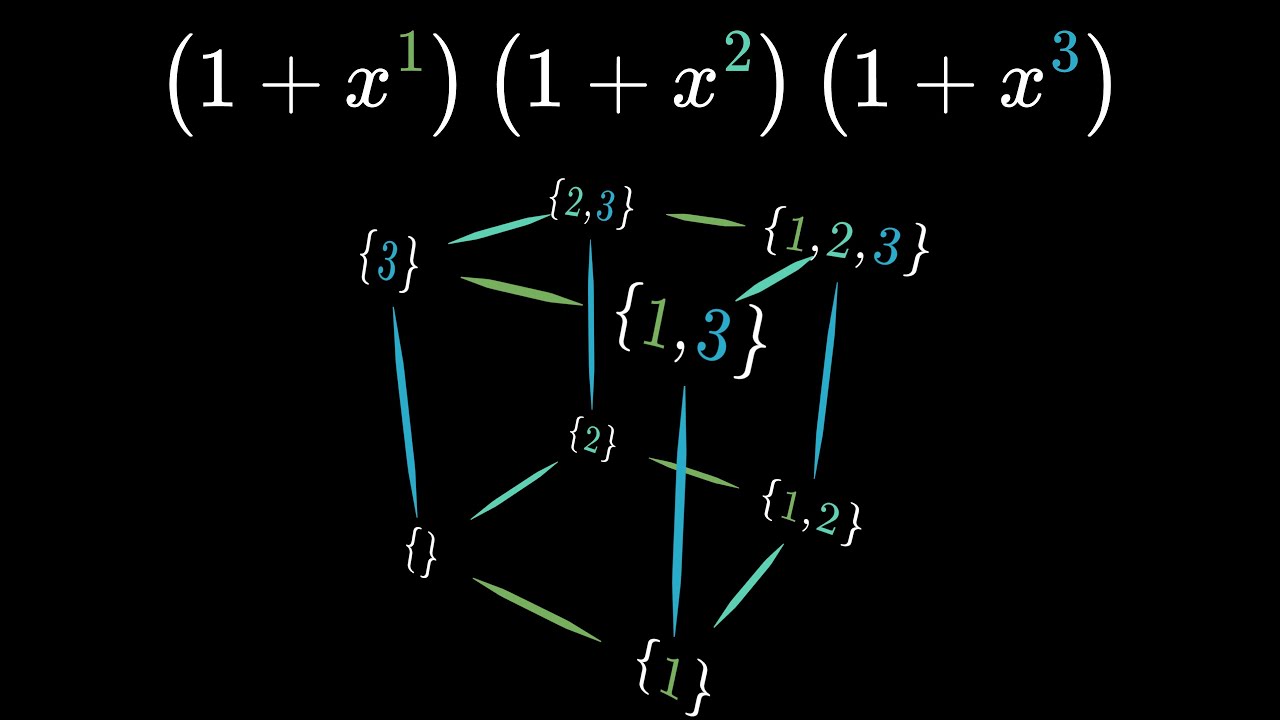
A lesson on generating functions, and clever uses of complex numbers for counting
Help fund future projects: https://www.patreon.com/3blue1brown
An equally valuable form of support is to simply share the videos.
Special thanks: https://3b1b.co/lessons/subsets-puzzle#thanks
Artwork by Kurt Burns
Music by Vince Rubinetti
Nice writeup and video g...
maiden panther
yeah
weary vortex
thanks for explaining
maiden panther
no problem, let me know if you want me to explain more of the roots of unity part
weary vortex
weary vortex
https://youtu.be/bOXCLR3Wric?si=lpVfcT-Uuu1O8VNe
got it
i remember working on this problem for different inputs and making a programming task out of it
what i soon realized, the divisor has to be prime, i think in this Chinese problem, the requirement is also that the mod has to be prime
maiden panther
i think the technique can still work if the mod/divisor isn't prime
it will just be a little more complicated
the pth roots of unity have this nice symmetry
where everything except 1 "behaves the same" in a sense
weary vortex
i dont have those papers in my hand but i remember while working with complex plane, certain points were just missing, so i had to do some tedious factoring to figure out how to compute those. it only occured in the non-prime divisor cases
weary vortex
weary vortex
i dont have those papers in my hand but i remember while working with complex pl...
by "missing", i mean when i calculated f(ζⁿ), some points just didnt come up
maiden panther
as in f(ζⁿ) is harder to calculate?
weary vortex
found it (the answer at the end is incorrect btw lol)


and its just one of the examples of my pain
maiden panther
,rotate
gilded haloBOT
 maiden panther
are you trying to find how many subsets of {1,2,...,3000} have sum divisible by 6?
weary vortex
yes
maiden panther
ah i understand
so you need [(1+1)(1+z)(1+z^2)(1+z^3)(1+z^4)(1+z^5)]^500
but you also need [(1+1)(1+z^2)(1+z^4)]^1000
and [(1+1)(1+z^3)]^1500
weary vortex
okay, prime factorization. and after i compute them, what should i do with them?
maiden panther
does it make sense where these are coming from
maiden panther
maiden panther
so you need [(1+1)(1+z)(1+z^2)(1+z^3)(1+z^4)(1+z^5)]^500
this one is equal to f(z) and f(z^5)
maiden panther
maiden panther
but you also need [(1+1)(1+z^2)(1+z^4)]^1000
this one is equal to f(z^2) and f(z^4)
maiden panther
maiden panther
and [(1+1)(1+z^3)]^1500
this one is f(z^3)
weary vortex
they are already calculated in the papers no? or i need whole different functions for them?
maiden panther
yeah i was just summarizing
your answer should be right, if you put an extra 2^3000 in the denominator
*for the probability
your answer is correct for the number of subsets
weary vortex
maiden panther
your answer is correct for the number of subsets
are you sure?
i checked smaller values by brute force using computer, the cases with non-prime divisors turned out to be incorrect
weary vortex
maiden panther
this one is f(z^3)
f(z³) = (1+1)¹⁵⁰⁰(1+z³)⁵⁰⁰
is this a problem? even tho the answer is 0 anyways
weary vortex
maiden panther
which values were incorrect?
let me see the discourse on github one moment
maiden panther
no it's not a problem you correctly found that f(z^3) = 0
weary vortex

btw all of the answers are mod 1000009
otherwise the outputs would be in thousands of digits
maiden panther
hm do you have an example with mod 6
weary vortex
not reported
weary vortex
weary vortex
found it (the answer at the end is incorrect btw lol)
i still find it hard to believe this is the right answer, maybe the requirements for the divisor is something different then
maiden panther
i think it's right
your math looks right
and i wrote a program to check
what makes you think it's wrong?
maiden panther
weary vortex
i still find it hard to believe this is the right answer, maybe the requirements...
this is a good thing to consider, but the roots of unity filter is still valid
weary vortex
maiden panther
what makes you think it's wrong?
its just that smaller cases with composite divisors always were wrong, now i doubt the higher values because it will take forever for python to compute it (the only language i know proficiently)
maiden panther
weary vortex
its just that smaller cases with composite divisors always were wrong, now i dou...
composite divisors other than 6?
weary vortex
there were some reports of 12 but they were deleted for some reason
maiden panther
im still confused as to where the issue is
i thought you only computed an answer for 6
and now you're saying it's wrong for other composite divisors
weary vortex
maiden panther
and now you're saying it's wrong for other composite divisors
not me, other people calculating them through other fast languages
maiden panther
weary vortex
not me, other people calculating them through other fast languages
but your formula is for 6
how can your formula be wrong for other composites if it's for 6?
weary vortex
thats were i got stuck
maybe there are actually whole other requirements for the divisor
maiden panther
weary vortex
thats were i got stuck
what do you mean it's where you got stuck?
you found a formula for the number of subsets with sum divisible by 6
you said it was wrong for small cases
but you didn't actually check any small cases for divisibility by 6?
weary vortex
maiden panther
but you didn't actually check any small cases for divisibility by **6**?
wait
i feel so dumb, i forgot to check it on the pc, at that time i didnt have an access to it
maiden panther
do you want me to check cases for you? i have a program
weary vortex
yes
maiden panther
or i can give you my python program
weary vortex
my head is rolling around this problem right now, i dont feel like writing python rn
weary vortex
maiden panther
but you also need [(1+1)(1+z^2)(1+z^4)]^1000
your summarization made me think. if the test cases show, that for composite divisors, there are less actual subsets than expected, maybe these are the error terms?
maiden panther
def subsets(l):
    if len(l) == 1: return [l, [0]]
    prev = subsets(l[:-1])
    return prev + [[l[-1]] + s for s in prev]

count = 0
n = 12
d = 6
for s in subsets(list(range(n))):
    count += (sum(s) % d == 0)
print(count)
n is the length of the set, d is the divisor
maiden panther
weary vortex
your summarization made me think. if the test cases show, that for composite div...
it's not less than expected im just saying
your formula for d=6 is correct
.
weary vortex
maiden panther
your formula for d=6 is correct
wow
maiden panther
maiden panther
```py
def subsets(l):
if len(l) == 1: return [l, [0]]
prev = subsets(l[:...
it's not the most efficient but it's fine for small cases
weary vortex
maiden panther
it's not the most efficient but it's fine for small cases
i was so naive setting these requirements, not realizing the task would backfire on me 😵💫
 maiden panther
lol
btw, you probably want divisor to divide n
otherwise you get weird boundary issues
weary vortex
In order to make the outputs exact, n % divisor == 0 condition holds for every test.
included that in the rules, dont worry
weary vortex
weary vortex
looking back at this, errors occur in the 2**n cases huh
maiden panther
weary vortex
looking back at this, errors occur in the 2**n cases huh
error against what though?
what formula?
weary vortex
i dont really know the notation y'all use to tell the bot to display the formula nicely to you, so sorry
(2^n + (d-1) * 2^(n/d))/d
this works for every prime divisor, that's indeed true
maiden panther
oh i see
yeah this formula is wrong lol
for d=6 you calculated your own formula and it was right
there was never an issue with your calculations, only this formula
weary vortex
maiden panther
yeah this formula is wrong lol
lol really?
maiden panther
do you want to work on other composite cases, like 4?
weary vortex
i even tried d=8


 weary vortex
maiden panther
when d=4 the answer is just 2^(n-2)
weary vortex
maiden panther
when d=4 the answer is just 2^(n-2)
so, divisor does not need to be prime in order to be solved this way?
maiden panther
weary vortex
so, divisor does not _need_ to be prime in order to be solved this way?
it doesn't
the central idea of the roots of unity filter is the following:
if $z$ is a primitive $d^{\text{th}}$ root of unity, then $1 + z^k + z^{2k} + \dots + z^{(d-1)k}$ is $d$ if $d\mid k$, and $0$ otherwise
this holds whether or not $d$ is prime
gilded haloBOT
flying_fly
 weary vortex
so i gave up on that problem just by believing the stupid formula, while the answer was in front of me?
lmfao that sounds so absurd
maiden panther
the formula was an overgeneralization from the case where d is prime
your methods for composite d were correct
HOWEVER there is a way to simplify your calculations a lot
weary vortex
maiden panther
HOWEVER there is a way to simplify your calculations a lot
i mean yeah, there has to be some
maiden panther
here is the general answer:
$\frac{1}{d}\sum_{k\mid d, k\text{ odd}} \varphi (k)2^{n/k}$
gilded haloBOT
flying_fly
 weary vortex
im assuming φ(k) is Euler's phi?
maiden panther
yep
weary vortex
gilded halo
**flying\_fly**
is there any article or video about this answer? would love to see how its done
maiden panther
maybe i should make a video on it 🙃
it's kind of long
im too tired to explain it now, sorry
weary vortex
maiden panther
im too tired to explain it now, sorry
yeah no problem
weary vortex
maiden panther
maybe i should make a video on it 🙃
in case you do, let me know
maiden panther
will do
weary vortex
thanks a lot for this conversation, i really do appreciate it
maiden panther
no problem :) always happy to help
 languid shale
,help
gilded haloBOT
A brief description and guide on how to use me was sent to your DMs!
Please use ,list to see a list of all my commands, and ,help cmd to get detailed help on a command!
languid shale
,list
gilded haloBOT
My commands!
Use ,ls to obtain a briefer listing, and use ,help <cmd>to view detailed help for a particular command, or ,help to view general help.
If you still have questions, talk to our friendly support team here.
LaTeX Rendering
Render LaTeX code and configure rendering options.
tex: Render LaTeX code.
ctan: Searches the ctan
texdoc: Searches the texdoc
autotex: Toggle whether your LaTeX is automatically rendered.
preamble: View or modify your LaTeX preamble.
texconfig: View or modify your personal LaTeX rendering options.
guildpreamble: View or modify the guild's default LaTeX preamble
Guild Admin
Guild administration
config: View and set the guild configuration.
rmrole: Deletes the provided role
disable: Disable commands in this guild.
editrole: Create or edit a server role.
autoclean: Automatic deletion of messages in the current channel.
forgetrolesfor: Forget stored persistent roles for one or all members.
Page 1/4
 gray pollen
$$ \int \left( \frac{\cos^2 x}{1 + x^2} + 1 \right) dx $$
gilded haloBOT
Glacivee Studios
 gray pollen
 sour cobalt
Hey, can someone confirm my proof to the following problem? I’ve attached the one given in the book as well, which is different
||Assume WLOG that m is odd, n is even, and that it is possible to have the conditions fulfilled when m, n have different parity. Note that the number of terms in a row and in a column will be odd. Therefore take the sum of all entries in the following way: subtract the odd number of -1’s from the even # entries in a row to obtain an odd number. Multiply this by odd m (m many rows) to obtain an odd number. Thus the sum is even. Then apply the following alternate method: subtract the odd # -1’s from the odd number of entries in a column, and multiply by even n to obtain an even number. By contradiction, m and n cannot have different parity.||
I think the stickiest part may be that I am not showing that the alternative - that they have the same parity - always works. However, the book does not prove this either so I am doubtful how necessary it is


 radiant jasper
100a+10b+c=a^b-c
a≠b≠c
a,b,c>0
a,b,c<9
torpid cairn
radiant jasper
100a+10b+c=a^b-c
a≠b≠c
a,b,c>0
a,b,c<9
no solutions
assuming theyre integers
radiant jasper
torpid cairn
assuming theyre integers
,, a,b,c \in \mathbb{N}
gilded haloBOT
! ! ¿ N Ø R T H ‽ 🌟 ^w^
 radiant jasper
as well as the other restrictions i put
torpid cairn
100a+10b+2c=a^b
LHS is even -> RHS is even -> a is even
2c is some even integer from 2 to 16 so we need to find 100a+10b - a^b to be greater than -18
casework reveals no such a= 2, 4, 6, or 8 can satisfy this
I mean I assume they can be 0 or 9 as well because this looks like a digit problem but I don't think that helps either
 haughty bolt
idk if this is the right channel but I couldn’t really approach this problem, any ideas?
 gray pollen
!help @haughty bolt
 scarlet rootBOT
To ask for mathematics help on this server, please open your own help channel or help thread. See #❓how-to-get-help for instructions.
torpid cairn
gray pollen
!help <@415187149927743489>
it's the competition math channel what else are you supposed to post here lmao
pallid tundra
haughty bolt
idk if this is the right channel but I couldn’t really approach this problem, an...
inclusion exclusion?
 civic gorge
Anyone know a good video or article that explains vietas formula?

 weary vortex
 vernal pasture
this isnt really a competition problem but sure
vernal pasture
weary vortex
this isnt really a competition problem but sure
oops sorry
weary vortex
before explaining, quick question, do you know how matrixes work in linear algebra?
vernal pasture
weary vortex
before explaining, quick question, do you know how matrixes work in linear algeb...
hmm thats not un our portiin
its fine
ill ask cahtgpt
weary vortex
vernal pasture
its fine
its not fine. youll still be clueless even after the explanation
vernal pasture
weary vortex
its not fine. youll still be clueless even after the explanation
u make it sound scary

 rough fern
you're cheating yourself out of understanding!

 weary vortex
vernal pasture
chatgpt is good explainer
weary vortex
vernal pasture
chatgpt is good explainer
fuck no
vernal pasture
weary vortex
fuck no

vernal pasture
weary vortex
fuck no
umm gemini?
weary vortex
havent used it since the last update, cant really tell much
but before, it was not a complete garbage but had several issues
vernal pasture
weary vortex
havent used it since the last update, cant really tell much
its liek chatgpt but a genaration behind
vernal pasture
weary vortex
havent used it since the last update, cant really tell much
you have done ur ug or highschool?
weary vortex
graduated hs this year
vernal pasture
oh nicee
weary vortex
next month starting uni
weary vortex
vernal pasture
oh nicee
thanks man
vernal pasture
weary vortex
next month starting uni
cool.....
vernal pasture
weary vortex
thanks man
unii in Kazakh?
vernal pasture
weary vortex
Yeah
ahh nice i have been to almaty this year
weary vortex
then move abroad to study math deeper
vernal pasture
weary vortex
then move abroad to study math deeper
that soo cool
weary vortex
vernal pasture
ahh nice i have been to almaty this year
great
rough fern
vernal pasture
umm gemini?
LLM's and AI imo shouldn't be used to teach you this stuff
 vernal pasture
rough fern
LLM's and AI imo shouldn't be used to teach you this stuff
vernal pasture
rough fern
LLM's and AI imo shouldn't be used to teach you this stuff
why not...i mean they have mostly all the info in the world
weary vortex
rough fern
LLM's and AI imo shouldn't be used to teach you this stuff
well, you should learn from them but not rely on them
thats how i see it
even the errors they make, over time, if you comprehend the given subject enough, you will find the mistake neuron network did
rough fern
idk. im just sick and tired of them and the way they are being used rn
vernal pasture
rough fern
idk. im just sick and tired of them and the way they are being used rn
that soudns lieka youn probem Drink
 weary vortex
yeah, they are definitely being misused by.. the whole god damn planet
torpid cairn
what's ur problem with ai
vernal pasture
torpid cairn
what's ur problem with ai
exactly.
rough fern
google and bing don't even give you an option to shut them off
weary vortex
i dont have a problem with AI itself
vernal pasture
ai is cool
weary vortex
i have a problem with people who rely on it
rough fern
they are making content confusing and unreliable
they require massive amounts of energy
torpid cairn
fine but why does that mean you can't use it to teach you math? (even though I wouldn't trust it with anything too complex)
torpid cairn
rough fern
they require massive amounts of energy
it's less than people make it out to be
rough fern
because i wouldnt trust it with anything complex in mathematics
even remotely
its just bad rn
weary vortex
torpid cairn
fine but why does that mean you can't use it to teach you math? (even though I w...
few months ago, it couldnt solve quadratic equations
torpid cairn
rough fern
because i wouldnt trust it with anything complex in mathematics
I don't think the pre university people in #competition math are using it for complex math
weary vortex
from that point forward, ive lost faith in it
torpid cairn
weary vortex
few months ago, it couldnt solve quadratic equations
maybe like a year ago
before reasoning models
weary vortex
torpid cairn
maybe like a year ago
nah, i checked it by the end of this winter
torpid cairn
u probably weren't using a reasoning model then
rough fern
i just don't like how unregulated it is, ig
weary vortex
rough fern
i just don't like how unregulated it is, ig
you see, they learn constantly from the content on the internet
rough fern
they start learning from themseleves lol
weary vortex
but we have SO MANY dumbasses on the internet and AI doesnt validate their content
they just take it as granted
rough fern
yea, that can cause issues
weary vortex
torpid cairn
but it has its usecases
sure, im not saying to stop using it entirely
im a CS student, I use it to debug the code sometimes
but that doesnt mean, I rely on it, cause I learn from the mistakes it points out
rough fern
im frugal when i use it. recently, i switched search engines (and browsers on mobile) to ecosia
because like i said, i dont want google and bing giving me ai answers on every single search that i make
or taking the data for training or something
torpid cairn
oh yeah that's a big one too
I stopped using twitter when the ai bot started calling itself hitler like I don't wanna contribute to this thing
rough fern
yea
i also try not to use amazon anymore
im fine going directly to the vendor and waiting a few days
weary vortex
torpid cairn
I stopped using twitter when the ai bot started calling itself hitler like I don...
"X" 🤓 ☝️
torpid cairn
weary vortex
"X" 🤓 ☝️
hell no
rough fern
simpler times when it was twitter
weary vortex
rough fern
i also try not to use amazon anymore
95% of the people in my country dont just not use it. they never even heard of amazon
rough fern
good lol
torpid cairn
what'd
rough fern
i think 100% of people have heard about it in the united states
torpid cairn
did they do something ai related
rough fern
no (not that i know of)
torpid cairn
oh
rough fern
why support them if you know they're shitty
weary vortex
rough fern
idk, its late
its literally morning for me lol
torpid cairn
weary vortex
or mods dont give a shit?
I don't think I've ever seen a mod in this channel
rough fern
haha, same, just that its 2 AM
weary vortex
gilded halo
**flying\_fly**
@maiden panther just in case you hop on the server, I'd like to ask you smth about this formula you provided
 tender spade
weary vortex
found this problem on a Chinese olympiad:
Let {a1, a2, a3, ..., an} be a set of...
tender spade
weary vortex
found this problem on a Chinese olympiad:
Let {a1, a2, a3, ..., an} be a set of...
The problem is not very good. I am curious which Chinese Olympiad it is from, though. It is just a lot of computations. Assume that each of $a_1, a_2, \dots, a_n$ is in $\mathbb{F}_5$. (This is for two reasons. It doesn't effect the answer and picking random integers in general is not a well defined process). Suppose $n_0$ of them are $0$, $n_1$ of them are $1$, etc. Then root of unity filter across [p(x) \coloneqq 2^{n_0}\cdot \left(1+x\right)^{n_1+n_4} \cdot \left(1+x^4\right)^{n_2+n_3}.] Now average these values out over possible choices of $n_k$.
gilded haloBOT
coolguy
 tender spade
oh wait u just care about the entire set, not the subsets
weary vortex
tender spade
oh wait u just care about the entire set, not the subsets
the subsets are about another entirely different problem from discrete math
tender spade
Then filter across [p(x) = \frac{1}{5^n}\left(1+ 2x + 2x^4)^n ] and you will get something like [\frac{1}{5} + O(1/5^n)]
in which case the answer is very clear
gilded haloBOT
coolguy
Compile Error! Click the  reaction for more information.
(You may edit your message to recompile.)
 near hill
tender spade
The problem is not very good. I am curious which Chinese Olympiad it is from, th...
near hill
tender spade
The problem is not very good. I am curious which Chinese Olympiad it is from, th...
The trick is to do the summing two numbers at a time. When a and b are independently uniformly distributed in F5, the distribution of a²+b² turns out to be
0 with probability 9/25
1 with probability 4/25
2 with probability 4/25
3 with probability 4/25
4 with probability 4/25
And you can get that very same distribution by a different procedure:
Roll a red d5 (with values in F5)
If it comes up 0, then the result is 0.
Otherwise, roll a green d5 and use its value.
So if you have a whole list of 2n random numbers so sum, start with rolling all the red dice. If even one of them comes up nonzero, then the end result is uniformly distributed. If they're all zero, then the result is zero.
So the probability of zero sum with 2n squares is exactly (1-(1/5)^n)·1/5 + (1/5)^n = 1/5 + (1/5)^n·4/5.
tender spade
near hill
The trick is to do the summing two numbers at a time. When a and b are independe...
Yeah that is the same thing as above once you combine like terms in the polynomial.
weary vortex
gilded halo
**flying\_fly**
the answer has been already provided
tender spade
weary vortex
the answer has been already provided
Also the 3b1b video is not very good. Read Zachary Abel's article about it. For whatever reason, 3b1b way overcomplicates the algebra.
near hill
Ah, I see. I took Coolguy's "it's just a lot of computations" to mean the simple solution had not been presented yet.
tender spade
gilded halo
**coolguy**
Compile Error! Click the <:errors:504266556054962196> reaction for m...
I think any way you do the problem, it will require lots of computations. Once you get the right polynomial it is just lots of algebra. This is the clear estimate but since the problem requires it be exact there is lots of work to be done.
weary vortex
tender spade
Also the 3b1b video is not very good. Read Zachary Abel's article about it. For ...
i've read a few articles about generating functions and their connection to complex analysis. basically the same thing Grant Anderson explained with a bit more examples
near hill
tender spade
I think any way you do the problem, it will require lots of computations. Once y...
I don't think what I did qualifies as "lots of computations".
weary vortex
i dont know if i have read Zachary Abel's one, I dont really memorize the authors
tender spade
near hill
I don't think what I did qualifies as "lots of computations".
Oh yours is nice. I didn't notice that works so well.
tender spade
weary vortex
i dont know if i have read Zachary Abel's one, I dont really memorize the author...
The zachary abel one makes it more clear why the problem does not depend on the divisor being a prime.
weary vortex
i have read an article that states that whether the divisor is prime or composite, the overall technique works but the generalized formulas differ
near hill
For 2n+1 squares, start by summing the first 2n squares. In the 1-(1/5)^n of times where the first 2n are already uniformly distributed, the last square doesn't matter. For the remaining (1/5)^n times, the result so far will be 0, and the final sum is 0 too iff the last F5 number was 0, which also has probability 1/5, so all in all the probability of success will be exactly 1/5 in the odd case.
tender spade
weary vortex
i have read an article that states that whether the divisor is prime or composit...
I don't believe they differ at all?
tender spade
What formula do you mean exactly?
I mean the [S = \frac{1}{n} \sum_{k=0}^{n-1}f(\omega^k)] one.
gilded haloBOT
coolguy
 tender spade
Because this should be true regardless of n being composite or not. I'm sure the actual output is different, but the expression is the same.
gray pollen
Can someone teach me how this is even read
S is the inverse of n multiplied by the summation of f into w to the power of k where k has 0 intervals and every number is n-1 valued
 mystic shale
No
S is the reciprocal of n multiplied by the summation of f(w^k), which is a function dependent on w^k, from k=0 to k=n-1
ornate blade
inverse of n is already wrong, as inverse refers to functions
or to matrices, same thing (linear maps)
ornate blade
gray pollen
Can someone teach me how this is even read
S is 1 over n times the summation of f of omega to the power of k, from k equals 0 to n minus 1
soft vigil
gilded halo
**coolguy**
is ts just rou filter
 astral jacinth
sour cobalt
Hey, can someone confirm my proof to the following problem? I’ve attached the on...
astral jacinth
sour cobalt
Hey, can someone confirm my proof to the following problem? I’ve attached the on...
||The product of all values is (-1)^m=(-1)^n. Then (-1)^(n-m) =1 -> n-m is even -> n has same parity as m.||
tender spade
soft vigil
is ts just rou filter
Yes. I was clarifying that it does not depend on n being prime.
 versed bobcat
guys any tips for mathcounts
?
i competed in california state competition but got absolutely crushed by some other people
soft vigil
versed bobcat
i competed in california state competition but got absolutely crushed by some ot...
Cali is cooked
Just do tests I guess
 worldly swift
versed bobcat
guys any tips for mathcounts
worldly swift
versed bobcat
guys any tips for mathcounts
Practice a lot probs
subtle sundial
true
soft vigil
versed bobcat
A bunch of practice tests
Including past nats?
versed bobcat
Well, not nats
versed bobcat
soft vigil
Including past nats?
Just state and counties
sour cobalt
astral jacinth
||The product of all values is (-1)^m=(-1)^n. Then (-1)^(n-m) =1 -> n-m is even ...
Yes, that’s the proof given by the book
pallid tundra
back when i did MATHCOUNTS (and barely missed nats qual from CT)
my preparation was
drill every state and nats test you can find
torpid cairn
wow I vastly overestimated gpt's ability to do very easy problems lmfao


these are from the same message it loves confusing itself
pallid tundra
it doesn't actually know what it's doing lmao
torpid cairn
apparently u can add 0 a bunch of times and your sum will increase by 500
 torpid cairn
pallid tundra
it doesn't actually know what it's doing lmao
torpid cairn
pallid tundra
it doesn't actually know what it's doing lmao
I knew it wasn't reliable but this is sad lmao
prisma python
i'm pretty sure gpt is like "yeah sure whatever" most of the time
subtle sundial
mhm try giving it a standard problem, and a very wrong answer
it will just agree with you most of the time
high goblet
pure rover
<@573875411365265478> sorry for the ping but you wouldn’t happen to know how mat...
sorry about the late reply!
generally joint degrees are harder because you need to be good at both the subjects u apply for
the ppl who assess ur maths abilities just assess maths
so basically like you have to be good enough to apply for just maths and just philosophy
so basically you'll be assessed on ur maths abilities just like any other maths applicant
if say, your maths was really good, good enough to get an offer but like the philosophy ppl thought it could be a little better, like you might get an offer to study just maths instead
hope that clears up ur q
hushed charm
Hello! I wrote this solution for a Brazilian math olympiad, and I’d really appreciate any feedback you can give me. Let me know what I can improve and if you notice any mistakes.


It was badly translated, sorry, Pot = Pow
zinc tundra
torpid cairn
wow I vastly overestimated gpt's ability to do very easy problems lmfao
this better not be amc 10 problems
zinc tundra
 glacial berry
just grind problems?
glacial berry
just grind problems?
yes vro
 mental rose
glacial berry
just grind problems?
mental rose
glacial berry
just grind problems?
Maybe do like 2 practice tests and like grind alcumus if you do aops
and then repeat until all practice tests go bye bye
 timid flicker
Black
 ember veldt
nahhh, do mathdash
ember veldt
can't react two t's
torpid cairn
zinc tundra
this better not be amc 10 problems
the problem itself was probably about high AMC 10 level but it was easy casework and I wanted to learn the general rule
zinc tundra
torpid cairn
the problem itself was probably about high AMC 10 level but it was easy casework...
no way I’m gonna have to learn this by November
bro I’m not even done my internship yet
shibal this💔💔
torpid cairn
you'd be fine without this lol
I can try to find the problem again it wasn't AMC 10 but it was similar difficulty
 open viper
zinc tundra
no way I’m gonna have to learn this by November
open viper
zinc tundra
no way I’m gonna have to learn this by November
oof
zinc tundra
torpid cairn
I can try to find the problem again it wasn't AMC 10 but it was similar difficul...
this finna be a problem I leave blank for that easy 1.5 points
open viper
zinc tundra
bro amc 10 had like super basic single variable algebra
amc10 algebra usually trivial
zinc tundra
bro I js finished alg 2
torpid cairn
I can't find the problem but iirc it was pretty much "john can either walk 1 step or 2 steps up a 14 step staircase, how many ways can he walk up?"
zinc tundra
am I cooked
 granite stump
I love MATHCOUNTS guys
open viper
zinc tundra
bro I js finished alg 2
intermediate?
granite stump
torpid cairn
I can't find the problem but iirc it was pretty much "john can either walk 1 ste...
Recurrence relation
open viper
granite stump
I love MATHCOUNTS guys
in what state
zinc tundra
open viper
intermediate?
wdym
granite stump
open viper
in what state
California
open viper
algebra 2 as in intermediete algebra?
torpid cairn
do they not call it algebra 2 in other places
zinc tundra
what I’m saying
open viper
granite stump
California
californias really competitive
zinc tundra
torpid cairn
I can't find the problem but iirc it was pretty much "john can either walk 1 ste...
least obvious permutation problem
 errant latch
HI
open viper
hi
granite stump
open viper
californias really competitive
Ik but I made it to states
open viper
nice
errant latch
how r you all?😙😙👴🏻😟😜😟
mental rose
hai
granite stump
zinc tundra
least obvious permutation problem
Yes but also recurrence would work just fine
mental rose
bro this is the only place I can chat without getting a 30 minute slowmode
mental rose
errant latch
how r you all?😙😙👴🏻😟😜😟
good?
errant latch
Thats good bob
zinc tundra
granite stump
Yes but also recurrence would work just fine
js use Fibonacci😓
mental rose
errant latch
Thats good bob
tanks april
errant latch
you welcome
mental rose
errant latch
you welcome
 open viper
errant latch
you welcome
open viper
errant latch
you welcome
is there not a welcome forum
zinc tundra
yall think I can do AIME qual with just math up to alg 2 and practice problems I think it’s highkey doable
mental rose
zinc tundra
yall think I can do AIME qual with just math up to alg 2 and practice problems I...
yuh?
open viper
zinc tundra
yall think I can do AIME qual with just math up to alg 2 and practice problems I...
sure but how r ur geo skills
mental rose
zinc tundra
bro im tryna prep usabo
oh dang
zinc tundra
open viper
sure but how r ur geo skills
uh I can do like all the triangle geo stuff and proofs and like trig
open viper
zinc tundra
uh I can do like all the triangle geo stuff and proofs and like trig
thats good
zinc tundra
am i cooked
with number theory
and the other weird sub topics
or should I js learn them on the way
open viper
zinc tundra
with number theory
dont be a number theory main
number theory is non existent
zinc tundra
also is there a cut off on amc past test where doing them won’t be effective
open viper
😭🙏
zinc tundra
open viper
number theory is non existent
it is light work
 meager pawn


 torpid cairn
open viper
dont be a number theory main
torpid cairn
open viper
dont be a number theory main
I thought I liked number theory but when I try the high AIME problems I honestly struggle for like 30 minutes and get nowhere it's humiliating
combinatorics>>>
 deep roost
anyone got any tips for amc 10
deep roost
open viper
mathdash i guess?
u responded quickly.
torpid cairn
why does math dash want my parent's email what is this
open viper
yea
deep roost
.
open viper
deep roost
u responded quickly.
u heard of it?
deep roost
no
open viper
sorta
open viper
its kinda fun to outscore ppl
but i think olympiad is actually fun like the questions
zinc tundra
open viper
wait whats the blue diamond next to my name
torpid cairn
pronouns
torpid cairn
wait math dash seems cool is it like live comps
deep roost
ye
zinc tundra
it’s doable
open viper
torpid cairn
wait math dash seems cool is it like live comps
no
actually sorta
theres past and live comps
but u can also train the minis
theres a discord server for mathdash i think
open viper
torpid cairn
this is cool ty
ur welcome
they also have a book
but half of it is locked unless u get premium
torpid cairn
yeah I'm not paying for this ✌️
zinc tundra
vro js grind AoPS
torpid cairn
I'm gonna run out of aops problems in the somewhat distant future it's nice to have other options
 timber hamlet
torpid cairn
I'm gonna run out of aops problems in the somewhat distant future it's nice to h...
timber hamlet
torpid cairn
I'm gonna run out of aops problems in the somewhat distant future it's nice to h...
There’s no way you run out of aops problems
high goblet
torpid cairn
I'm gonna run out of aops problems in the somewhat distant future it's nice to h...
lmao what
that's not happening
glacial berry
mental rose
Maybe do like 2 practice tests and like grind alcumus if you do aops
oh god alcumus ptsd
mental rose
glacial berry
oh god alcumus ptsd
lol
torpid cairn
high goblet
lmao what
are there really that many aime difficulty questions
 molten lotus
 glacial berry
so hypothetically, if i did amc 8 before and did so so, and now i'm getting back into competition math to try and get aime, how should i practice and is this realistic?
mental rose
glacial berry
so hypothetically, if i did amc 8 before and did so so, and now i'm getting back...
yuh totally realistic
and turns otu that doing just practice tests are not enough so try doing mathdash
its just mathdash.com
then sign in
glacial berry
alr tysm
mental rose
then it has a ton of more problems
glacial berry
lollll
mental rose
Also quick question, will knowing a ton of geometric formulas help me on the amc10?