#competition-math
1 messages · Page 28 of 1
 dapper magnet
 fresh zenith
@dapper magnet
Posted
 amber thunder
Does anyone know a good resource for learning projective geometry?(Book, website, video)
 tall lance
amber thunder
Does anyone know a good resource for learning projective geometry?(Book, website...
tall lance
amber thunder
Does anyone know a good resource for learning projective geometry?(Book, website...
 pearl holly
What's a nice fact about Telescoping series and products?
Yeah, im asking stupid stuff but I wanna know if anyone is knowledgeable about telescoping
cuz its super fun :DDD
 sleek ivy
fresh zenith
<@734370214912852018>
Posted
sleek ivy
fresh zenith
<@734370214912852018>
Posted
where
fresh zenith
@sleek ivy
#latex-help
sleek ivy
yea m8 that aint helping you just put it in the exact same format
 gilded haloBOT
HahalolXD
 sleek ivy
maybe start by finding f(x), it looks like a very simple integral
fresh zenith
Yeah
CONTINUE then
 misty torrent
you don't need to differentiate the inverse function
sleek ivy
why not
misty torrent

plus FTC
tells us we can compute the derivative of f^-1 directly from what we have already


 burnt trail
misty torrent
minimum
burnt trail
misty torrent
minimum
like, if the radius of the second circle is x^2 = (10sqrt2 - 5)^2 what happens
burnt trail
misty torrent
well almost the answer
don't get it
misty torrent
what is (x+5)^2 + (y+5)^2, geometrically?
burnt trail
the minimum distance between (x,y) and (-5,-5) after the power of two
misty torrent
burnt trail
like, if the radius of the second circle is x^2 = (10sqrt2 - 5)^2 what happens
oh, you edited it
that's correct
burnt trail
misty torrent
that's correct
what happens
misty torrent
burnt trail
like, if the radius of the second circle is x^2 = (10sqrt2 - 5)^2 what happens
that is the answer
burnt trail
idk, i don't get it
burnt trail
misty torrent
that is the answer
why do they give the first circle
burnt trail
no i totally get it now, it was simple
burnt trail
misty torrent
what do you mean
is best to think about the second expression as the power of 2 of a distance of (x,y) and (-5,-5)
burnt trail
misty torrent
it's just the square of the distance
that
my English sucks
also, if we find the minimum distance between (5,5) and (-5,-5) and we subtract the radius of the first circle we get 10sqrt2-5, which is the minimum distance between (-5,-5) and the first circle, then if we think as the second expression as the minimum distance squared between (x,y) and (-5,-5), we would need to square 10sqrt2-5 to get the smallest value of the second expression
burnt trail
misty torrent
what do you mean
they give the first circle because the minimum distance from (x,y) to (-5,-5) cannot be 0 because then (x,y)=(-5,-5), we need (x,y) to lie in the first circle , so basically it's asking for the minimum distance from a point on this circle to (-5,-5)
anyways, simple but cool problem bro
dapper magnet
fresh zenith
huh
i got pi/8 + 512/pi^3
Set $y = f^{-1}(x)$, then $x = f(y) = \int_0^y \frac{t^3}{t^4+1} , \mathrm{d}t$
gilded haloBOT
impract1cal
 dapper magnet
If $y$ is invertible, then $\frac{\mathrm{d}y}{\mathrm{d}x} = \frac{1}{\frac{\mathrm{d}x}{\mathrm{d}y}}$
gilded haloBOT
impract1cal
 dapper magnet
A fairly straightforward computation shows that y is invertible
now, $\frac{\mathrm{d}x}{\mathrm{d}y} = \frac{\mathrm{d}}{\mathrm{d}y} \int_0^y \frac{t^3}{t^4+1} , \mathrm{d}t$
gilded haloBOT
impract1cal
 dapper magnet
which is just $\frac{y^3}{y^4 + 1}$
gilded haloBOT
impract1cal
 sleek ivy
dapper magnet
i got pi/8 + 512/pi^3
sleek ivy
dapper magnet
i got pi/8 + 512/pi^3
nah his answer was right
fresh zenith
Can I get the hardest Problem to solve yet
 acoustic nova
fresh zenith
Can I get the hardest Problem to solve yet
acoustic nova
fresh zenith
Can I get the hardest Problem to solve yet
why?
acoustic nova
fresh zenith
It's fun to solve
u probably aren’t at that level
fresh zenith
How could you say ??
Explain that
acoustic nova
One sec
fresh zenith
acoustic nova
One sec
Yeah go on
 dry quartz
fresh zenith
Can I get the hardest Problem to solve yet
dry quartz
fresh zenith
Can I get the hardest Problem to solve yet
r u sure
fresh zenith
dry quartz
don't complain now
 acoustic nova
Ok. Prove or disprove: Do there exist real numbers $a_0, a_1, …, a_{2018}$ with $a_0 \neq 0$ such that the roots of the polynomial $P(x) = x^{2019} + a_{2018} x^{2018} + … + a_1 x + a 0$ are $a_0, a_1, …, a{2018}$?
dry quartz
oh hn not number theory
gilded haloBOT
hockeydude85
 fresh zenith
gilded halo
**hockeydude85**
fresh zenith
gilded halo
**hockeydude85**
I get your point
But I would try Solution Tommorow
Making an Availability for it
fresh zenith
dry quartz
don't complain now
I got your Solution
Texit is Doing it I mean its converting it
 rare bluff
man you guys should take a look on this kid
 pallid tundra
<@&268886789983436800> very off topic
 lament mist
@rare bluff please don't post off-topic images like these in math channels
rare bluff
lament mist
<@1127597457631608912> please don't post off-topic images like these in math cha...
Wait the image is a 9 years old kid that solve integral
what "off-topic" images r you guys talking about?

 soft badger
gilded halo
**hockeydude85**
soft badger
gilded halo
**hockeydude85**
nah bro there doesnt exist any numbers a0.......a2018 such that they are the roots of that polynomial
soft badger
gilded halo
**hockeydude85**
the product of its root is always equal to the the term with x^o divided by the coefficient of first term
soft badger
gilded halo
**hockeydude85**
here if we multiply all the roots that should be equal to a0
now if a0 x a1 x ....... x a2018 = a0 here this is only possible when a0 =0
but in the eqn it is given that a0 is notequal to 0
hence there doesnt exist any roots such a0......a2018
misty torrent
soft badger
now if a0 x a1 x ....... x a2018 = a0 here this is only possible when a0 =0
why can't you have something like 1, -1, 1, -1, 1, -1, etc that multiply to 1?
then a0 * 1 = a0
soft badger
misty torrent
why can't you have something like 1, -1, 1, -1, 1, -1, etc that multiply to 1?
but they all are distinct
misty torrent
sure, if you want distinct then let's do 1/2, 2/3, 3/4, 4/5. ... etc. and then the final one can be the one that makes the product 1
soft badger
misty torrent
sure, if you want distinct then let's do 1/2, 2/3, 3/4, 4/5. ... etc. and then t...
then it will equal to 1 not 1/2
misty torrent
we want it to be equal to 1
soft badger
misty torrent
we want it to be equal to 1
no you take a0 1/2 thats why it should be equal to 1\2
misty torrent
soft badger
no you take a0 1/2 thats why it should be equal to 1\2
try it with just a0 and a1, and see what happens
soft badger
misty torrent
try it with just a0 and a1, and see what happens
??
misty torrent
(x-a0)(x-a1) = x^2 + a1x + a0
 scenic sun
acoustic nova
Ok. Prove or disprove: Do there exist real numbers $a_0, a_1, …, a_{2018}$ with ...
scenic sun
acoustic nova
Ok. Prove or disprove: Do there exist real numbers $a_0, a_1, …, a_{2018}$ with ...
Where is this problem from? The answer is ||no|| since ||there doesn’t exist a real polynomial with degree 5 or higher that satisfies the property that the coefficients are it’s roots||. You can have a look at the first answer of the following link: https://math.stackexchange.com/questions/2689332/monic-polynomials-whose-roots-are-their-remaining-coefficients, which finds polynomials that work for degree 4 or less (note that there exists only one 4th degree polynomial that works which is nontrivial). As mentioned in the answer of this link, for the proof of the uniqueness of this 4th degree polynomial and the || non-existence of any polynomial with degree 5 or more ||, head over to this link: https://www.jstor.org/stable/2315341?origin=crossref, which should proof these things. However though you will need to log in through your institution there, which is why I cannot access the article
acoustic nova
scenic sun
Where is this problem from? The answer is ||no|| since ||there doesn’t exist a r...
Its from the CMC mock USAMO
this is their proof (he asked for something hard)
 sleek ivy
trivial inequality 😭
acoustic nova
what?
scenic sun
acoustic nova
Its from the CMC mock USAMO
From which year?
scenic sun
acoustic nova
this is their proof (he asked for something hard)
Okay, it’s very surprising because I understand the entirety of the proof, but thought that the solution would be actually harder than this. Indeed every step that they did is correct, and it’s a very nice proof. It’s just that I would’ve not thought about doing all these steps and using inequalities along the way, because it seems like it needs a lot of time. But again, wonderful proof, and if you are unsure about any part of the proof, I am happy to help
 near burrow
lmao imagine this situation
i thought i was gonna have till friday to study for a stupid competition
starting today
turns out the test is tomorrow
im dying
acoustic nova
soft badger
now if a0 x a1 x ....... x a2018 = a0 here this is only possible when a0 =0
yeah u completely bs'ed this no offence
 alpine steeple
does anyone have an olympiad math formula sheet /notes. I'm sitting an open book exam soon and the only thing that I really needs is circle geo ( like circumradius =abc/4A) notes and inequality notes
soft badger
ANYONE PREPARING FOR IMO
pallid tundra
NO
RECOMMEND NOT MESSAGING IN ALL CAPS
IT MAKES YOU SOUND LIKE YOU’RE SHOUTING WHEN YOU DON’T NEED TO BE
acoustic nova
soft badger
ANYONE PREPARING FOR IMO
why are u asking these questions? U didn’t solve my question
soft badger
pallid tundra
NO
sorry i will not do such things from now on
soft badger
acoustic nova
why are u asking these questions? U didn’t solve my question
i didn't understand it
can you elaborate it a little bit
acoustic nova
soft badger
i didn't understand it
Ok I’m not trying to be mean I don’t rlly understand the solution either
pearl holly
Hi!
How do I deal with Telescoping Equations?
Because I think its just the same as Telescoping Series
https://www.youtube.com/watch?v=4BwL9ye4_4E&t=1256s
Referring here atm

Mastering AMC 8 book: https://www.omegalearn.org/mastering-amc8
The book covers the most important concepts on the AMC 8 contest, and includes video lectures for every chapter, formulas for every topic, and hundreds of examples and practice problems with detailed video solutions.
Mastering AMC 10/12 book: https://www.omegalearn.org/mastering-am...
scenic sun
acoustic nova
Ok I’m not trying to be mean I don’t rlly understand the solution either
The solution you provided just before?
dry quartz
fresh zenith
I got your Solution
🤨
 glacial jolt
pearl holly
Hi!
How do I deal with Telescoping Equations?
glacial jolt
pearl holly
Hi!
How do I deal with Telescoping Equations?
Can you give a example for a telescoping equations?
dry quartz
glacial jolt
Can you give a example for a telescoping equations?
sum r = 1 to n 1/r - 1/(r+1)
glacial jolt
dry quartz
sum r = 1 to n 1/r - 1/(r+1)
Not telescopic sum but telescoping equations he is talkin about
pallid tundra
if you actually read what they were asking about you'd see that they're two different names for the same thing
glacial jolt
pallid tundra
if you actually *read what they were asking about* you'd see that they're two di...
👍 😂
glacial jolt
pearl holly
Hi!
How do I deal with Telescoping Equations?
I will say post your exact question for help!
pallid tundra
i've never heard anyone call them "telescoping equations" but "telescoping" in the context of computational contests can only really refer to one class of series problems
where almost everything cancels
glacial jolt
How are you @pallid tundra ? long time no see
glacial jolt
pallid tundra
i've never heard anyone call them "telescoping equations" but "telescoping" in t...
I see
pallid tundra
the most common lazy way to do it is partial fraction decompositions like the classic 1/n(n+1)=1/n-1/(n+1)
pallid tundra
glacial jolt
How are you <@288481533600464898> ? long time no see
endless pain and suffering 
glacial jolt
pallid tundra
the most common lazy way to do it is partial fraction decompositions like the cl...
Is there any other effective way to do that?
pallid tundra
pfd is an extremely standard technique though for some reason US schools usually delay actually teaching it until calc2
basically it's common denominators in reverse
https://en.wikipedia.org/wiki/Partial_fraction_decomposition#Procedure see the "illustration" for an example
In algebra, the partial fraction decomposition or partial fraction expansion of a rational fraction (that is, a fraction such that the numerator and the denominator are both polynomials) is an operation that consists of expressing the fraction as a sum of a polynomial (possibly zero) and one or several fractions with a simpler denominator.
The i...
how does this help us do telescoping sums? if the factors in the numerator are all linear polynomials then potentially you can get lots of cancellations to happen
glacial jolt
yeah I see
glacial jolt
pallid tundra
the most common lazy way to do it is partial fraction decompositions like the cl...
But I am asking that, Is there any other effective method to do telescopic sum as you say it's a common lazy way?
pallid tundra
partial fractions is the most common method i've seen
but there are other ways to make telescoping sums
lemme find another example
In mathematics, a telescoping series is a series whose general term
      t

        n


{\displaystyle t_{n}}
is of the form
t
…
op the Wikipedia page has a few good ones
it also mentions the fundamental theorem of calculus as an extension of that telescoping idea
 near hill
glacial jolt
But I am asking that, Is there any other effective method to do telescopic sum a...
near hill
glacial jolt
But I am asking that, Is there any other effective method to do telescopic sum a...
Are you asking how to invent a problem where there’s a sum that telescopes?
glacial jolt
near hill
Are you asking how to _invent_ a problem where there’s a sum that telescopes?
No no I am asking him for some different approach as he says pfd is a common lazy method.
near hill
Huh. Perhaps he's saying that if the problem author is lazy and want a sum that turns out to telescope, partial fractions are a common principle?
pallid tundra
yea that's what i was getting at
glacial jolt
near hill
Huh. Perhaps he's saying that if the _problem author_ is lazy and want a sum tha...
I see
 harsh apex
from imc 2024

 high goblet
harsh apex
from imc 2024
high goblet
harsh apex
from imc 2024
are you asking for advice on how to do it?
||partial summation 1log1 + 2log2 + ... + nlogn||
harsh apex
high goblet
are you asking for advice on how to do it?
thanks
harsh apex
guys try this
 glacial jolt
harsh apex
guys try this
glacial jolt
harsh apex
guys try this
😭 (for pfp)
 sleek ravine
glacial jolt
😭 (for pfp)
sleek ravine
glacial jolt
😭 (for pfp)
bro u def didnt think u were the only one with that pfp
harsh apex
glacial jolt
😭 (for pfp)
lol
harsh apex
glacial jolt
😭 (for pfp)
i love luffy so i search in google luffy and its give me this in the first one
pearl holly
How do I express the denominator?

My idea was something like n(n+1)/2 + 1.... idk why I had my intuition set to that
Update on this, nevermind
Had to take a break for a while and realized its (n+1)(n+2)/k
 calm raptor
pearl holly
My idea was something like n(n+1)/2 + 1.... idk why I had my intuition set to th...
calm raptor
pearl holly
My idea was something like n(n+1)/2 + 1.... idk why I had my intuition set to th...
you could also add +1 and -1 in the numerator and sperate it intro two terms
soft badger
pearl holly
How do I express the denominator?
option D
soft badger
pearl holly
My idea was something like n(n+1)/2 + 1.... idk why I had my intuition set to th...
yeah i did also like that
soft badger
pearl holly
How do I express the denominator?
every term will cancel out and we left with 6\210
which is 1\35
soft badger
calm raptor
you could also add +1 and -1 in the numerator and sperate it intro two terms
can you elaborate a little bit
pearl holly
soft badger
option D
correct!
 vernal axle
soft badger
every term will cancel out and we left with 6\210
vernal axle
soft badger
every term will cancel out and we left with 6\210
nope, the correct one is 1/7
it is 3/5 * 5/7 * 7/9 * ... * 19/21=3/21=1/7
so, it is (c)
scenic sun
soft badger
every term will cancel out and we left with 6\210
You need to be bit careful when reading the problem. That would’ve been right if the numerator and denominator each fraction were increased by one number from one fraction to the next, in which you can cancel like that, but the numerator and denominator keep increasing by TWO numbers each time you move on to the next fraction. For example, numerator in first fraction is 1+2+3 and the numerator in the second fraction is 1+2+3+4+5 (an additional 4+5, not 4). Same thing applies to the denominators. Use algebra to find that each fraction can be simplified to n/(n+2), only then you can cancel across and simplify
soft badger
sorry i messed up
 knotty cobalt
how do i qual to aime?
scenic sun
soft badger
sorry i messed up
all good
 pallid ginkgo
knotty cobalt
how do i qual to aime?
pallid ginkgo
knotty cobalt
how do i qual to aime?
top 2.5% in amc10 or top 5% in amc12
 untold thunder
that is around 100 in amc10 and 90 in amc12
 snow elm
How to do this? I’m stuck
 snow elm
 soft vigil
Draw AF
soft vigil
Draw AF
That didn’t work
snow elm
Nope
soft vigil
Because either of those trivialize the problem
soft vigil
snow elm
Nope
Then youre cooked
Go learn mass points
Its quite easy once you get the hang of it tbh
snow elm
untold thunder
consider [ADF]/[AFB]
I don’t know if that helps or not
untold thunder
well first do you know how to find [DFC]?
snow elm
untold thunder
well first do you know how to find [DFC]?
Use ratios
untold thunder
do it rq
snow elm
untold thunder
do it rq
32/3?
untold thunder
well the denominators right but not the numerator
how'd you get it
WAIIITI
wait
nvm
How'd you get that
snow elm
snow elm
How to do this? I’m stuck
This
untold thunder
I think I see what's happening there but I think it would only work if you had a diagram like this

Let me show you how you would find the area
untold thunder
Given that BH is the height of ABC and BCD what is the area of ABC and BCD in terms of h
 snow elm
Yeah
untold thunder
you know this?
snow elm
Have u figured out the answer?
untold thunder
ye
snow elm
What is it
untold thunder
well here's my work I do believe it's correct
snow elm
So far I get is the total area is 200/3
snow elm
untold thunder
well here's my work I do believe it's correct
But the answer is 40/3 though.
untold thunder
I made a small mistake
 snow elm
soft vigil
Then youre cooked
snow elm
soft vigil
Then youre cooked
Bro are u sure that will works?💀
untold thunder
untold thunder
I made a small mistake
But see if you know what's happening here
untold thunder
Well [CDF]=8
snow elm
untold thunder
Well [CDF]=8
But the area is not 8
untold thunder
You use 20/12= [AFB]/[ADF]
snow elm
The length is 8
untold thunder
snow elm
But the area is not 8
The problem is structured so that it is
You get [CDF] = (DC/AD) * [ADF]
That general two
When two triangles share that same height
The ratio of their areas = ratio of their bases
The reason why your method doesn't work is because ADF and CDF don't have the same height as CBA
does that make sense or should I show you why
snow elm
American maths competition is crazy geez
snow elm
untold thunder
does that make sense or should I show you why
Why u use 20/12
Not smth like 8/20
snow elm
soft vigil
Yes
Could u show me how to do that using mass points ?
I want to see multiple solutions for a question
scenic sun
snow elm
How to do this? I’m stuck
Let us call a random triangle ABC for example. Draw a line segment from B onto any point on AC and let this new point be called point D. Let us say that this divides AC into a ratio of AD:DC = x:y. Then what is the ratio of areas ABD and CBD?
snow elm
untold thunder
The problem is structured so that it is
Do u mind if I ask u to show me a full solution? It’s like 0am now my brain aren’t working, I will probably understand ur move in the morning
snow elm
scenic sun
Let us call a random triangle ABC for example. Draw a line segment from B onto a...
Okay
scenic sun
snow elm
Okay
If you need a hint for the question I asked, let me know
untold thunder
snow elm
Do u mind if I ask u to show me a full solution? It’s like 0am now my brain aren...
I think you should just following adin
He'll probably walk you through it better than I can
snow elm
Okay
snow elm
scenic sun
Let us call a random triangle ABC for example. Draw a line segment from B onto a...
9;4?
scenic sun
snow elm
9;4?
Don’t use the numbers or the original problem. I created a sub problem just so that you can understand the idea behind what we’re doing.
snow elm
scenic sun
Don’t use the numbers or the original problem. I created a sub problem just so ...
Oh.
scenic sun
untold thunder
I made a small mistake
Also this is correct
snow elm
scenic sun
Don’t use the numbers or the original problem. I created a sub problem just so ...
X^2:y^2
Ik im just trying to understand
scenic sun
snow elm
X^2:y^2
Not really
scenic sun
snow elm
Ik im just trying to understand
Yes, that’s good
scenic sun
snow elm
You don’t need to square ur scale factor?
No
scenic sun
snow elm
Then idk
I’ll give a hint. So we know that the area of any triangle is it’s base * it’s perpendicular height. Draw the perpendicular from B onto AC and let’s call this meet point E. What’s the perpendicular height of triangle ABD and CBD from AD and CD respectively same as?
scenic sun
snow elm
It’s different from applied maths ig💀
You do applied maths?
scenic sun
snow elm
Canadian applied maths
Is that in high school or a uni thing?
snow elm
I skipped 3 grades so that I can take applied maths💀
At grade 12
My school offers that
scenic sun
snow elm
At grade 12
Ah, I don’t really know the system in Canada, but skipping 3 grades is bit risky lol. But then that means that you’re capable of taking applied maths
snow elm
scenic sun
Ah, I don’t really know the system in Canada, but skipping 3 grades is bit risky...
Yeah exactly.
scenic sun
snow elm
Yeah exactly.
May I ask what are the other type of maths that they offer there?
snow elm
I didn’t do a lot of competition stuffs
snow elm
scenic sun
May I ask what are the other type of maths that they offer there?
Essential, applied and calculus
scenic sun
snow elm
I didn’t do a lot of competition stuffs
Oh, I did some competitions, so I have an idea on how to solve these problems most of the time
scenic sun
snow elm
Essential, applied and calculus
What’s the difference between taking applied and taking calculus? Sorry if I’m acting stupid
scenic sun
snow elm
Group theory ig
You get to take group theory at the end of high school?
snow elm
scenic sun
What’s the difference between taking applied and taking calculus? Sorry if I’m a...
Applied is like for solving real life problems
scenic sun
snow elm
Applied is like for solving real life problems
Ohhh ok
snow elm
scenic sun
You get to take group theory at the end of high school?
Nonnonono
I will failed
I hate that thing
scenic sun
snow elm
I hate that thing
Group theory sounds interesting, but I thought it’s only usually offered in uni though
snow elm
I will faint if I see that
Yeah but a uni teacher came to my school
And she starts teaching that
scenic sun
snow elm
And she starts teaching that
That’s really lucky. For us we have to wait until uni to start group theory
snow elm
MY SCHOOL PAID MORE THEN THE UNI PAID HER
That is all OUR MONEY NOT SCHOOLS
50k-70k per year bruh
scenic sun
snow elm
MY SCHOOL PAID MORE THEN THE UNI PAID HER
It’s honestly unfair. No wonder why they moved. Why have I heard a lot of the time that unis are underpaying their teachers/professors (that’s actually really scary cause I plan to be one)
dapper magnet
Who pinged me
scenic sun
snow elm
50k-70k per year bruh
Wow that’s a lot
scenic sun
snow elm
That is all OUR MONEY NOT SCHOOLS
Ahh okay. Wait, is your school private?
snow elm
Yeah.
scenic sun
snow elm
Yeah.
Ok makes sense now
snow elm
I’d take calculus and applied maths and physics at the same time
They connect to each other
It’s like ok for me
scenic sun
snow elm
They connect to each other
Hmmm. And btw how do you find applied math? I’m just wondering
snow elm
No pressure on that
snow elm
scenic sun
Hmmm. And btw how do you find applied math? I’m just wondering
Combination of calculus, physics and some competition maths
scenic sun
snow elm
No pressure on that
Probs a lot of pressure
snow elm
Mainly similar to physics
scenic sun
snow elm
Combination of calculus, physics and some competition maths
Wait what. All of those things are in applied math? That’s interesting
snow elm
scenic sun
Wait what. All of those things are in applied math? That’s interesting
Yeah weird stuffs
I don’t even know I can use calculus in physics
scenic sun
snow elm
Combination of calculus, physics and some competition maths
Since when is competition math part of the school curriculum? Id wish it were the same over here
snow elm
And applied maths too
snow elm
scenic sun
Since when is competition math part of the school curriculum? Id wish it were th...
Yeah
Mandatory.
scenic sun
snow elm
I don’t even know I can use calculus in physics
I’ve not really even seen calculus in physics yet. I’m waiting to though
snow elm
Only Canadian competition thou
scenic sun
snow elm
Mandatory.
That’s lucky. Competition math should be mandatory everywhere (jk)
scenic sun
snow elm
Only Canadian competition thou
I’ve seen some Canadian math comps, they look good to me
snow elm
If u are in the highest level class then it’s mandatory
scenic sun
snow elm
If u are in the highest level class then it’s mandatory
Oh ok
snow elm
scenic sun
I’ve not really even seen calculus in physics yet. I’m waiting to though
I can show u some
scenic sun
snow elm
I can show u some
Maybe in dms. That would be great
scenic sun
snow elm
It’s different from applied maths ig💀
Uh did you try the hint from the below message from the one that I’m replying to?
snow elm
scenic sun
Uh did you try the hint from the below message from the one that I’m replying to...
Idk
scenic sun
snow elm
Idk
Did you first draw the triangle and the points?
scenic sun
snow elm
Yep
So you drew triangle ABC, points D and E on AC and drew AD and AE given the definitions I gave previously? Now what do you notice about the perpendicular height of the triangles?
scenic sun
untold thunder
Given that BH is the height of ABC and BCD what is the area of ABC and BCD in te...
okay I’m going to bring up this diagram for a new reference. What is the height of triangle ACB and DCB here?
 pure yarrow
Did any one here participated in the IMO or passed it?
If there is please how was your study schedule Iean is there any daily recommended amount of time to do it
acoustic nova
pure yarrow
If there is please how was your study schedule Iean is there any daily recommend...
14 hours a day on weekdays, 16 hours on weekends and 21 hours on holidays
pure yarrow
Hahaha that's super funny
soft badger
yes pls share what study materials should we follow
pearl holly
soft badger
yes pls share what study materials should we follow
NOT AN IMO PARTICIPANT
Usually, what you want to do, is to just stop asking questions, and start grinding.
Books for competition math, starting the IMO journey, is to start with really awesome books like AoPs and MathDash!
These materials help you prepare for like AMCs, USAMO, AIME, etc. Internationally, this would also imply to other math competitions.
IMO GRINDSS
Read loads of textbooks, solve imo problems, learn how to prove, and uhh learn super advanced topics that a typical hardcore math professor would be
okay, TL;DR Just start grinding
soft badger
pearl holly
**NOT AN IMO PARTICIPANT**
Usually, what you want to do, is to just **stop** ask...
can you send pdf of books??
soft badger
pearl holly
https://tinyurl.com/ContestGuideIntlGDrive
thank you so much
pearl holly
CL to E2 are your skill levels
CL being the classroom level -- standard highschool curriculum math
A1 - E2 being the starting competition maths to IMO level
 trim vortex
Should I take notes when reading comp books or do I grind problems and those are the notes
acoustic nova
soft badger
yes pls share what study materials should we follow
Preparing for the International Mathematical Olympiad (IMO) is a significant and rewarding challenge that requires deep understanding, problem-solving skills, and consistent practice. Below is a detailed study plan, broken down by phases, topics, and weekly routines, adaptable over 6-18 months, depending on your current level.
🔍 Phase 1: Foundation Building (Months 1–3)
🎯 Goals:
Solidify core mathematical concepts.
Develop mathematical thinking and proof-writing skills.
📚 Topics:
Algebra: Equations, inequalities, polynomials, functional equations.
Number Theory: Divisibility, congruences, modular arithmetic, primes.
Geometry: Euclidean geometry, similarity, circles, angle chasing.
Combinatorics: Basic counting, Pigeonhole Principle, inclusion-exclusion.
🗓 Weekly Routine (10–15 hours/week):
Day Task
Mon Topic Lecture (e.g., Algebra) + 2 Easy Problems
Tue Solve 3 Problems from previous topic
Wed Topic Lecture (e.g., Number Theory) + 2 Easy Problems
Thu Solve 3 Problems + Review solutions
Fri Rest or light reading (e.g., problem-solving strategies)
Sat Mock test (3 problems) + Discussion of solutions
Sun Review week’s work + Fill knowledge gaps
🚀 Phase 2: Intermediate Problem Solving (Months 4–8)
🎯 Goals:
Begin solving intermediate-level olympiad problems.
Refine techniques and learn multiple approaches to problems.
📚 Topics:
Deepen understanding in all four main areas:
Algebra: Inequalities (AM-GM, Cauchy), symmetric polynomials.
Number Theory: Diophantine equations, Euler’s theorem, orders.
Geometry: Inversion, transformations, angle bisectors, Miquel Point.
Combinatorics: Graph theory basics, invariants, recursion.
🗓 Weekly Routine (15–20 hours/week):
Day Task
Mon Topic Study (1–2 hours) + 2 Problems
Tue Problem-Solving Session (2 hours, timed)
Wed Topic Study (1–2 hours) + 2 Problems
Thu Mock test (2 problems) + Self-review
sleek ivy
acoustic nova
Preparing for the International Mathematical Olympiad (IMO) is a significant and...
is this chatgpt
 mystic shale
Fr reads like it but i didnt wanna say in case it might offend them
The emojis are overkill
Especially the first sentence  i dont ever see myself saying that line
glacial jolt
sleek ivy
is this chatgpt
99.99% confirmed!
harsh apex
there is a competition math site for coding ?
 hushed charm
harsh apex
there is a competition math site for coding ?
hushed charm
harsh apex
there is a competition math site for coding ?
A website dedicated to the fascinating world of mathematics and programming
hushed charm
harsh apex
is it good for math ?
These aren't great for competitive math, but certainly are for competitive programming
harsh apex
there is math here ?
hushed charm
harsh apex
there is math here ?
Where?
harsh apex
in codeforce?
hushed charm
harsh apex
in codeforce?
Of course, a lot of math
Competitive programming has a lot of math
harsh apex
so why is not good
hushed charm
harsh apex
so why is not good
Because competitive programming involves programming, algorithms and computer science, things that doesn't appear in competitive math
harsh apex
yea i want comp prog
hushed charm
There indeed is math in competitive programming, but if you want to study for math olympiads, competitive programming aren't the best resources
hushed charm
harsh apex
yea i want comp prog
This discord server ain't really focused in competitive programming, there are certainly more focused servers
harsh apex
hushed charm
This discord server ain't really focused in competitive programming, there are c...
can you send me?
hushed charm
harsh apex
can you send me?
Don't know any at all, but with some searches you can find some certainly
untold thunder
For the problem "How many triples of three-digit palindromes have a sum that is also a three-digit palindromes?" would you use PIE to account for overcounting?
soft vigil
how would you even overcount
 gloomy sentinel
anyone planning for imo?
acoustic nova
gloomy sentinel
anyone planning for imo?
did u make imo?
or are u likely to make it?
acoustic nova
u mean the international math Olympiad?
gloomy sentinel
acoustic nova
u mean the international math Olympiad?
yeah
acoustic nova
acoustic nova
or are u likely to make it?
^
if not this is getting ridiculous. (Of course) I haven’t made it but there are way too many questions about this then
gloomy sentinel
6 people get selected from each country
untold thunder
soft vigil
how would you even overcount
If two palindromes are the same you could have P, P, Q, P, Q, P, or Q, P P
should I say unordered to clarify that
untold thunder
I can but I'd like to know if PIE is applicable
Partially because I made the problem and I don't want a messy and fallible solution
pure yarrow
I study maths in french 😭, I am really struggling with materials mentioned by you
I have a question
Is mathtraining website good
I mean I started learning and I was able to solve a national level problem on angles and triangles
It also teached me how to think like do first of all angles chasing than start to break down the problem
gloomy sentinel
mathraining is a good website, I have seen its questions and theory, I personally think it is a good website, but it is your choice. ("mathraining est un bon site web, j'ai vu ses questions et sa théorie, je pense personnellement que c'est un bon site Web, mais c'est votre choix." in french if you understand french more.)
Hope this helped you!
hushed charm

Answer:


I need help to understand why ∠EBM = ∠FDB. I haven't read the entire solution yet, just read the beginning to try to discover the other informations. But I don't understand why ∠EBM=∠FDB
vernal axle
hushed charm
I need help to understand why ∠EBM = ∠FDB. I haven't read the entire solution ye...
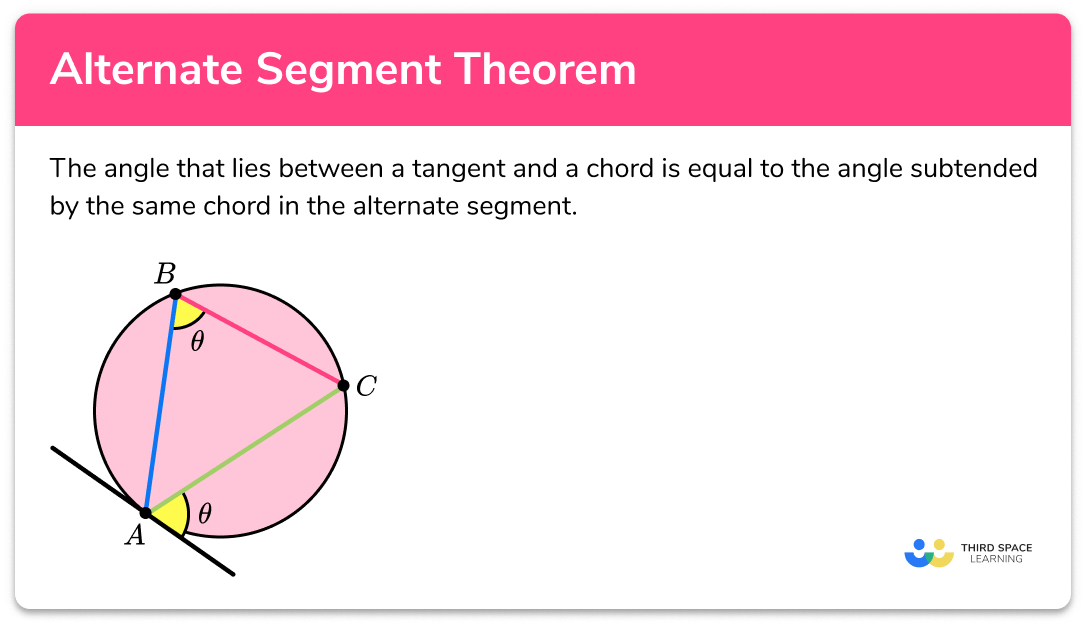
It is a standard property of the angle between a tangent and a chord to the point of tangency.
It is called alternate segment theorem
https://thirdspacelearning.com/gcse-maths/geometry-and-measure/alternate-segment/
Third Space Learning
Free alternate segment theorem GCSE maths revision guide, including step by step examples, exam questions and free worksheet.
hushed charm
vernal axle
It is a standard property of the angle between a tangent and a chord to the poin...
Dang it
I didn't about this theorem, thanks a lot
hushed charm
vernal axle
It is a standard property of the angle between a tangent and a chord to the poin...
Why is MA = MD? As it said in the end
vernal axle
hushed charm
Why is MA = MD? As it said in the end
MD is a median in the right triangle ADC
 ashen jacinth
cana nyone help me with 2021 putnam B1 ||
I drew this and got x(theta) = (1 + cos theta - sin theta)/(2 cos theta)
Then integrated the square of that expression by 0 to pi/4 and finished by multiplying by 8/pi but im getting the wrong answer, it seems that instead they just integrate the square of
(1 + cos theta - sin theta)/2
Why am i missing random cos theta factor?||
 soft vigil
theres an amc problem that looks like ts
 trim bramble
soft vigil
theres an amc problem that looks like ts
trim bramble
soft vigil
theres an amc problem that looks like ts
it was like last year right?
 soft vigil
there was another one
trim bramble
don’t remember it
near hill
trim bramble
The diagram looks similar, but the problem it accompanied is completely diffetent ...
trim bramble
yea i know

 ornate blade
 restive onyx
solve this all for me
restive onyx
solve this all for me
why bother with comp maths then
comp maths is meant for training your brain
restive onyx
 ornate blade
restive onyx
ornate blade
restive onyx
- you're in the wrong channel
- you should show what you tried if you want other people to help
- follow the instructions in:
!help
 scarlet rootBOT
To ask for mathematics help on this server, please open your own help channel or help thread. See #❓how-to-get-help for instructions.
 azure sedge
ornate blade
why bother with comp maths then
azure sedge
ornate blade
why bother with comp maths then
what’s the method to prep for amc 12
pure yarrow
Hello, is study around 3 hours maths per day, is it enough to be good in competitive mathatics
Mathematics*
 radiant jasper
imagine 2 squares side to side, now draw a random line which has to go through the 2 squares, now, what is the probability of the ratio between the areas of one of the squares split in 2 by the line, to be the same as the other?
I came up with this problem myself.
So if this is terrible you know why.
pure yarrow
 twilit patio
What are u competing in?
twilit patio
What are u competing in?
FFJM and three days ago I decided to start a journey hoping to qualify to the national Olympiad that makes me qualify to the IMO, I am from Tunisia by the way
near hill
radiant jasper
imagine 2 squares side to side, now draw a random line which has to go through t...
This happens only is the line is horizontal or passes exactly through the midpoint of the side the two squares share.
You don't say which probability distribution you're choosing your "random" line with, but if it's a reasonable, continuous distribution, the probability of "horizontal" and "passes through the midpoint" will both be 0.
hushed charm
pure yarrow
Hello, is study around 3 hours maths per day, is it enough to be good in competi...
Depends a lot on a lot of things: how long have u been studying, how much time u have, how do u study..... But it isn't really possible to say if 3h are going to be enough. Focus more on studying correctly, if u really like math, eventually u will want to study more and need to study more.
hushed charm
 empty cairn
Anyone wanna give me an integral
empty cairn
Anyone wanna give me an integral

 azure sedge
empty cairn
azure sedge
empty cairn
show me how to integrate non elementary integrals my goat
empty cairn
azure sedge
show me how to integrate non elementary integrals my goat
Which
sleek ravine
empty cairn
I'm not in college
college is uni
pre means before
so the answer was yes
empty cairn
What
sleek ravine
😂
empty cairn
who's gonna know
 vast hound
empty cairn
who's gonna know
vast hound
empty cairn
who's gonna know
you're pre ?
sleek ravine
vast hound
you're pre ?
pre birth
hushed charm
Don't know how to start
 near hill
To start with, even n are impossible, because the sum of all the numbers is 0 (mod n), but for even n, the sum of the specified column sums is n/2 (mod n).
 trim vortex
can someone help me w this problem

ik its a d=rt problem but i cannot figure out how to interpret anything
near hill
hushed charm
Don't know how to start
I think ||all odd n ought to be possible||, though.
hushed charm
near hill
To start with, even n are impossible, because the sum of _all_ the numbers is 0 ...
I don't really understand why, even though the total sum is 0 mod n, the sum of the numbers inside a line aren't necessarily 0 mod n, right? What did I miss
 drowsy leaf
hushed charm
Don't know how to start
drowsy leaf
hushed charm
Don't know how to start
it's possible to arrange the numbers to make mod for both row's and columns 0, but arranging for Distinct seems not possible
like for n=5,
hushed charm
drowsy leaf
it's possible to arrange the numbers to make mod for both row's and columns 0, b...
I tried with n = 4 and indeed it seems to be impossible, but i dont understand the relation between the sum of numers inside a line and the total sum
near hill
hushed charm
I don't really understand why, even though the total sum is 0 mod n, the sum of ...
The row sums are all required to be different, so they are exactly all the residue classes mod n. For odd n they all cancel out against their negatives, but for even n, n/2 is its own negative so doesn't cancel.
drowsy leaf
drowsy leaf
like for n=5,
1, 2, 3, 4, 5
5, 1, 2, 3, 4
4, 5, 1, 2, 3
3, 4, 5, 1, 2
2, 3, 4, 5, 1
this arrangement will give all mods as 0
hushed charm
near hill
The row sums are all required to be different, so they are exactly all the resid...
Sorry, i don't understand
near hill
drowsy leaf
1, 2, 3, 4, 5
5, 1, 2, 3, 4
4, 5, 1, 2, 3
3, 4, 5, 1, 2
2, 3, 4, 5, 1
The row and column sums are all equal there. They were required to be different modulo n.
hushed charm
What do you mean they cancel out
near hill
a + (-a) = 0
drowsy leaf
drowsy leaf
it's possible to arrange the numbers to make mod for both row's and columns 0, b...
exactly, it is possible to make the sum equal, but impossible to make it unequal
hushed charm
near hill
a + (-a) = 0
Right, but the numbers inside the board are all from 1 to n, so how is it possible to be a negative number
near hill
drowsy leaf
exactly, it is possible to make the sum equal, but impossible to make it unequal
I have a family of solution with distinct row/column sums.
drowsy leaf
would like it if you could share it
near hill
hushed charm
Right, but the numbers inside the board are all from 1 to n, so how is it possib...
It's negatives in modular arithmetics where multiples of n don't matter.
So if n=15, for example -6 = 9.
near hill
drowsy leaf
would like it if you could share it
For example, for n=7: ||```
7 6 5 4 3 2 1
6 2 3 4 5 6 7
5 3 4 5 6 7 1
4 4 5 6 7 1 2
3 5 6 7 1 2 3
2 6 7 1 2 3 4
1 7 1 2 3 4 5
Or, perhaps nicer looking: ||```
6 2 3 4 5 6 7
2 4 4 5 6 7 1
3 4 2 6 7 1 2
4 5 6 7 1 2 3
5 6 7 1 5 3 4
6 7 1 2 3 3 5
7 1 2 3 4 5 1
You can either write down a lot of equations with a lot of unknowns, or cut it down to a simpler fact: going 80 miles at the initial speed is 1 hour quicker than going the same 80 miles at the reduced speed.
Then there's just one unknown to solve for.
drowsy leaf
near hill
Or, perhaps nicer looking: ||```
6 2 3 4 5 6 7
2 4 4 5 6 7 1
3 4 2 6 7 1 2
4 5 6...
I'll have to do a check later on
drowsy leaf
trim vortex
can someone help me w this problem
@near hill in the second case is the accident occurrence considered exactly after 1 hour? (Sorry, English isn't my first language)
near hill
drowsy leaf
<@217922183169572864> in the second case is the accident occurrence considered e...
I understand it as: in the second case the speeds are the same, but the accident happens whenever the train reached 80 miles past the point where it broke down in the first scenario. Those 80 miles do not necessarily take an hour to drive.
drowsy leaf
got it
near hill
So if the track looks like
Aytown ----------- C -----80mi----- D ------- Beetown
and the accident happens either at C or D, the train spends:
Either one hour A-C then 30 minutes stopped, then C-D at reduced speed, then D-B at reduced speed.
Or one hour A-C, then C-D at full speed, then 30 minutes stopped, then D-B at reduced speed.
The one hour, 30 minutes, and D-B segment are the same in both cases, so the only thing that makes a difference for the arrival time is whether the 80 miles from C to D were run on full or reduced speed.
drowsy leaf
you are very good at explaining
near hill
Thank you.
(if my mental arithmetic is right, the train's full speed is ||20 mi/h||, which sounds pretty pitiful even by 1955 standards...)
trim vortex
i have the first case as 2 + (d/r) = (r/r) + 0.5 + (d-r)/[(4/5)r] and second case as 1 + (d/r) = (d + 80)/r + 0.5 + (d-r-80)/[(4/5)r] according to ur logic above
near hill
Sure. Now if you subtract those equations from each other, many of the terms disappear.
In the second equation, I think you mean (r + 80)/r rather than (d + 80)/r.
azure sedge
empty cairn
I'm not in college
thats frickin awesome
planning to do any amc?
i need to prep for amc 12 but feel so overwhelmed
idk where to start
have been learning number theory for a few days
trim vortex
near hill
In the second equation, I think you mean (r + 80)/r rather than (d + 80)/r.
I got 20mph tysm
radiant jasper
Why is my train moving at negative mach 17
radiant jasper
imagine a cube of cubes made up of 1000x1000x1000 cubes, and you are on top of it right in the middle, now shoot a beam right below, it will go through 1000 cubes to reach the bottom, now, if you hold the beam at an angle with respect to the initial position, it will go through more cubes, now, find a general equation on how many cubes the beam will go through, and how that amount changes as you change the angle on x and z axis.
 sharp sandal
radiant jasper
imagine a cube of cubes made up of 1000x1000x1000 cubes, and you are on top of i...
sharp sandal
radiant jasper
imagine a cube of cubes made up of 1000x1000x1000 cubes, and you are on top of i...
it will go through 4000 cubes cuz in middle means you be standing and shooting in the middle of 2x2 square
sharp sandal
try to imagine yourself standing at top in the middle of a 2x2x2 cube
radiant jasper
i will rotate it so the plane projected above it, the middle will line up with- you know what, who cares, there are 1000 cubes anyway, not 2, it's close enough.
i mean on each axis
1000x1000x1000
And no don't make the engineering joke
mystic shale
i think you've to think more along the lines of the edges of the cubes than the cubes themselves
since if it hits within one cube it is guaranteed to hit all cubes in the diagonal
hollup lemme make an illustration
radiant jasper
don't forgot about the other axis.
you not only have to account for x but also z.
sharp sandal
i was just thinking, you can rewrite it as, imagine a 1x1x1 cube, with a laser being shot from the above, vertically inside the cube. If the sum of reflections it made from above and below face = 1001, the box breaks. If the sum of reflections it made from any side face and its opposite side face = 501, the box breaks. How many reflections would it make before the box breaks?
Also find an equation for how many reflections will it make before the box breaks when shot at an angle.
mystic shale
radiant jasper
you not only have to account for x but also z.
same logic for the z-axis, but idk how to proceed with the fact i just explained
radiant jasper
it it's 2 other cubes you didn't draw
mystic shale
sharp sandal
i was just thinking, you can rewrite it as, imagine a 1x1x1 cube, with a laser b...
i don't think a reflection mechanism is mentioned.
sharp sandal
mystic shale
i don't think a reflection mechanism is mentioned.
i mean both questions are equivalent, not same but the answer to both questions is same
mystic shale
radiant jasper
it it's 2 other cubes you didn't draw
? i think those are sufficient to show my point, no?
radiant jasper
i thought about this problem myself randomly idk if it's somewhere else but it sounds like a math comp question.
But i am WAY too dumb to solve it myself.
 mystic shale
radiant jasper
it it's 2 other cubes you didn't draw
mystic shale
radiant jasper
it it's 2 other cubes you didn't draw
idk what u mean by this btw
radiant jasper
what if we try to find how many faces it will intersect? is that possible? if so we can convert it to how many cubes.
mystic shale
radiant jasper
imagine a cube of cubes made up of 1000x1000x1000 cubes, and you are on top of i...
i'm pretty sure the question you've formulated is wrong in the sense it should be 1001*1001*1001
since there is no "middle" in the current case
drowsy leaf
pearl holly
Any tips in getting better at problem solving?
you get better by solving problems, simple 😂
jkjkjk, anyway, i would recommend solving riddles, puzzles, you could find some here in ted ed https://youtube.com/playlist?list=PLJicmE8fK0EiFRt1Hm5a_7SJFaikIFW30&feature=shared

YouTube
What do giant cat armies, Leonardo da Vinci, birthday cake, and the Trojan War all have in common? They’re part of this brain-busting riddle series meant to ...
you can also learn concepts from
https://brilliant.org/

Get smarter in 15 minutes a day with thousands of interactive, bite-sized lessons in math, science, data analysis, programming, computer science, AI, and beyond.
these help improve your imagination
mystic shale
mystic shale
i'm pretty sure the question you've formulated is wrong in the sense it should b...
that said, the number of possibilities are (1001)^2. Idk how you can derive an equation in theta and xyz for the current problem since even for different values of theta or x,y,z you can have the same case happening.
glacial jolt
drowsy leaf
you get better by solving problems, simple 😂
Are you by any chance Indie?
drowsy leaf
I am preparing for GATE, and doing some courses
glacial jolt
drowsy leaf
I am preparing for GATE, and doing some courses
I see
Are you by any chance tamil?(If no nvm)
drowsy leaf
glacial jolt
Oh my 💀
why the skull?
glacial jolt
drowsy leaf
why the skull?
Can't detect anyone's level lol
maybe mathematical level
drowsy leaf
i am not tamil !! 😂 curious why you thought that tho
glacial jolt
drowsy leaf
i am not tamil !! 😂 curious why you thought that tho
Obviously your name lol
drowsy leaf
my name is of bengali origin
glacial jolt
drowsy leaf
my name is of bengali origin
I see
drowsy leaf
so, are you tamil?
drowsy leaf
you asked about JEE so...
glacial jolt
drowsy leaf
you asked about JEE so...
I see
I know someone with this name preping for JEE in my batch
that's why I asked
drowsy leaf
GL then
glacial jolt
drowsy leaf
GL then
Thank you!
Have a good night!(actually I wanna say day but it isn't sadly)
drowsy leaf
you too^^
 glacial jolt
 tired depot
<:ChiakiSmug:580570282071162880>
tired depot
<:ChiakiSmug:580570282071162880>
What the hell with your banner? lmao
 glacial jolt
I have a bad mind lol
tired depot
oh lmaoo
glacial jolt
sorry if it is not something I thought
tired depot
its not any hentai dw
glacial jolt
💀
glacial jolt
tired depot
The jee thing lol
You've cracked it?
tired depot
shii was traumatic
glacial jolt
that was?
glacial jolt
tired depot
Dunno
wrote this year?
tired depot
lastt
tired depot
had 6k in adv
glacial jolt
tired depot
i asked a lot of questionss here
lmao idk cause I am not here in those days
glacial jolt
tired depot
had 6k in adv
fr, GREAT!
tired depot
nahh
i shat
after mains
don't do tht
Had .66 in mains
Could've gotten better
But slacked
tired depot
likee
how do o say
many people after mains
Go chill
I ws one of it
don't do that
glacial jolt
oooooooooooooooooooooooooooooooooohhhhhhhhhhhhhhhhhhhhhhhhhhhhhhhhhhhhhmmmmmmmmmmmmmmmmmmmmmmmmmmmmmmmmmmmmmmmyyyyyyyyyyyyyyyyyyyyyyyyyyyyyyyyyyyyyyyyyyyyyyyygggggggggggggggggggggggggggggggggggggggoooooooooooooooooooooooooooooooooooooooodddddddddddddddddddddddddddddddddd
glacial jolt
tired depot
don't slack after mains
Sure!(I always hold words of my seniors)
wbu now?
 pure yarrow
Hello everyone I am from Tunisia and most of my time I ama struggling because I study from random websites I don't't even have a single maths book that has problems within for competitive maths, I usually find problems on random websites and try to solve them
This is a one
Let a and b be distinct natural numbers. Show that there exist infinitely many natural numbers s such that a + s and b + s are relatively prime.
Can someone rate the difficulty of this problem
I hope also my English sounds good cause most of it I learned through listening to streamers
Or reading novels
pure yarrow
pure yarrow
Let a and b be distinct natural numbers. Show that there exist infinitely many n...
Anyone please rate the difficulty of this problem
glacial jolt
pure yarrow
Let a and b be distinct natural numbers. Show that there exist infinitely many n...
How are you going to prove this goofy thing?
glacial jolt
pure yarrow
Did you do competitive maths before
Nah but going to
glacial jolt
something called JEE
glacial jolt
pure yarrow
Do you having any studying sheets or books or anything
ye
pure yarrow
Like waht
The books?
I mean the titles of books
Or the resources
I really lack them a lot
glacial jolt
pure yarrow
I mean the titles of books
It can't be bought anywhere sorry
pure yarrow
even if it is I can't right now
glacial jolt
'cause they are my Institutional books
pure yarrow
I understand
pure yarrow
There are no exams I just wanna reach level of competitors in maths so I can be at the same level, I wanna by anyway improve my life and escape from my country there is nothing good here and it is very hard to find a teacher
They really ask for huge amounts of money so they teach you for 4 or 8 sessions
The only exam I am taking is kinda of mix of games of maths and logic
glacial jolt
I see
glacial jolt
What is your math level or grade?
pure yarrow
Because Tunisia is francophone country
I am at the second year of secondary education
But you know
glacial jolt
pure yarrow
There are no exams I just wanna reach level of competitors in maths so I can be ...
What abt your school teachers?
pure yarrow
Hhhh there only 4 maths teachers
I told you they offer very expensive private lessons
glacial jolt
I see
pure yarrow
And at school is usually get full marks or 90s without even putting some effort
glacial jolt
pure yarrow
And at school is usually get full marks or 90s without even putting some effort
Is it that ez for you?
pure yarrow
Is there anyone here that did the IMO by anychance
pure yarrow
glacial jolt
Is it that ez for you?
Not that much but kinda of
because our country selection test will be the by the begining of 2026 it will be such a great achievement to do well without a teacher that guides me
Wish you all the best in JES
JEE*
glacial jolt
pure yarrow
Wish you all the best in JES
Thank you so much!
mystic shale
 why you giving them permission on behalf of someone else lmao
This is exactly what got you into trouble yesterday 
glacial jolt
mystic shale
This is exactly what got you into trouble yesterday <:opencry:586078614865444865...
I don't get any trouble lmao
what is it?
mystic shale
When you pinged tropo
glacial jolt
I ain't
mystic shale
Or shubham did idr
glacial jolt
This isn't trouble at all lmao
I am iron man lmao
I like that opencry
I feel sorry to myself for that reaction
 summer roost
glacial jolt
something called JEE
summer roost
glacial jolt
something called JEE
That is not competition math though
glacial jolt
are you doing limits?
mystic shale
summer roost
Nope
I see you came back to dc
summer roost
pure yarrow
Let a and b be distinct natural numbers. Show that there exist infinitely many n...
i am not sure if this can be counted as a proof
but we can say that there are infinitely many primes so infinitely many numbers of this form
is that correct ???
vernal axle
pure yarrow
Can someone rate the difficulty of this problem
I think it's easy
just take s=p-a, where p is any prime greater than max(b-a, a) (in case b>a)
pure yarrow
Tha ks
I want a daily schedule recommendation
Like is 2/3 hours daily goos
good*
summer roost
it doesnt really depend on the time as long as your problem solving improves
initially 2-3 hours is quite good
pure yarrow
Ok
 formal trout
Hello guys
I have this problem i’ve trynna solve
I know the answer and it’s quite obvious as we are driven by intuition to find the answer the question remains how to prove it without supposing elements in the sets
Here’s the problem i’d like you to gimee sum hints i haven’t gave up yet

Don’t use complex concepts tho
near hill
What exactly is N* there?
formal trout
near hill
What exactly is N* there?
Non zero postive integers
Well if you want answer i can say it
near hill
How about ||A=3N+1, B=3N+2, C=3N||?
formal trout
near hill
How about ||A=3N+1, B=3N+2, C=3N||?
Exactly
The question remains how to prove it
near hill
And it doesn't just want one solution, but all solutions.
The one I showed isn't the only one; at least we can swap A and B.
formal trout
near hill
And it doesn't just want one solution, but _all_ solutions.
The one I showed isn...
Swap A and C , B is stable
Otherwise you don’t have the a+c thing
near hill
No -- C is distinguished by being the numbers you can add to an a or b and not get out of A or B, respectively.
formal trout
near hill
No -- C is distinguished by being the numbers you can add to an a or b and not g...
Yeah exactly
formal trout
near hill
No -- C is distinguished by being the numbers you can add to an a or b and not g...
That’s the only two solutions btw
||(A,B,C)={(3N + 1,3N+2,3N*),(3N+2,3N+1,3N*)}||
Do you have any hints on how can i proceed to make a clean proof?
near hill
When you say
prove it without supposing elements in the sets
do you mean we can't start by saying "let c0 be the smallest element in C", for example?
formal trout
near hill
When you say
> prove it without supposing elements in the sets
do you mean we ca...
Oh no no it’s okay
I meant like we can’t say
Suppose 1 in A
near hill
I would say something like:
Let c0 be the smallest element in C.
Then 1, 2, 3, ..., c0-1 must be divided between A and B. And because we can add c0 to anything from A or B without leaving that set, this settles the fate for any number that is not a multiple of c0.
near hill
Assume without loss of generality that 1 is in A.
Then clearly the smallest number that can be in B is c0-1; otherwise the two smallest numbers in A and B would add up to something smaller than c0.
But that means (once we have excluded c0=1 or c0=2, which is easy) that c0-2 is in A, so (c0-2)+(c0-1) = 2c0-3 must be in C.
We've already seen the only numbers that can be in C are multiples of c0, so that means 3 must be a multiple of c0, which means c0=3.
And every multiple of 3 must be in C, because they can all be made as 1+(2+3+3+....+3).
formal trout
near hill
But that means (once we have excluded c0=1 or c0=2, which is easy) that c0-2 is ...
Thanks man i’ll use this smallest number thing
acoustic nova
pure yarrow
I want a daily schedule recommendation
broo i already sent u my perfect guide. every imo participant has followed it. hear it is again good sir
Preparing for the International Mathematical Olympiad (IMO) is a significant and rewarding challenge that requires deep understanding, problem-solving skills, and consistent practice. Below is a detailed study plan, broken down by phases, topics, and weekly routines, adaptable over 6-18 months, depending on your current level.
🔍 Phase 1: Foundation Building (Months 1–3)
🎯 Goals:
Solidify core mathematical concepts.
Develop mathematical thinking and proof-writing skills.
📚 Topics:
Algebra: Equations, inequalities, polynomials, functional equations.
Number Theory: Divisibility, congruences, modular arithmetic, primes.
Geometry: Euclidean geometry, similarity, circles, angle chasing.
Combinatorics: Basic counting, Pigeonhole Principle, inclusion-exclusion.
🗓 Weekly Routine (10–15 hours/week):
Day Task
Mon Topic Lecture (e.g., Algebra) + 2 Easy Problems
Tue Solve 3 Problems from previous topic
Wed Topic Lecture (e.g., Number Theory) + 2 Easy Problems
Thu Solve 3 Problems + Review solutions
Fri Rest or light reading (e.g., problem-solving strategies)
Sat Mock test (3 problems) + Discussion of solutions
Sun Review week’s work + Fill knowledge gaps
🚀 Phase 2: Intermediate Problem Solving (Months 4–8)
🎯 Goals:
Begin solving intermediate-level olympiad problems.
Refine techniques and learn multiple approaches to problems.
📚 Topics:
Deepen understanding in all four main areas:
Algebra: Inequalities (AM-GM, Cauchy), symmetric polynomials.
Number Theory: Diophantine equations, Euler’s theorem, orders.
Geometry: Inversion, transformations, angle bisectors, Miquel Point.
Combinatorics: Graph theory basics, invariants, recursion.
🗓 Weekly Routine (15–20 hours/week):
Day Task
Mon Topic Study (1–2 hours) + 2 Problems
Tue Problem-Solving Session (2 hours, timed)
Wed Topic Study (1–2 hours) + 2 Problems
acoustic nova
vernal axle
just take s=p-a, where p is any prime greater than max(b-a, a) (in case b>a)
yeah this is nice cause b cant be a multiple of a + s = p by the setup
acoustic nova
glacial jolt
are you doing limits?
like actual limits or just random computational rules?
soft vigil
acoustic nova
broo i already sent u my perfect guide. every imo participant has followed it. h...
what is this chatgpt ahh guide
highkey
you cannot do a routine for math
acoustic nova
soft vigil
you cannot do a routine for math
yeah. thats the point ||it is chatgpt (obv)||
 fast wing
soft vigil
you cannot do a routine for math
fast wing
soft vigil
you cannot do a routine for math
what do you mean by that. how we supposed to then
near hill
acoustic nova
yeah. thats the point ||it is chatgpt (obv)||
Could you not?
mystic shale
soft vigil
you cannot do a routine for math
Fr
Chatgpt just assumes peak excellence from everyone and gives you a guide that no one can follow.
glacial jolt
acoustic nova
like actual limits or just random computational rules?
limits! anyways wdym by random computational rules?
soft vigil
fast wing
what do you mean by that. how we supposed to then
Like this is the same for competitive programming
If you are trying to do a routine it wont work
Because you often fall behind with problrms that have bugs
harsh apex
soft vigil
Like this is the same for competitive programming
where can i find problems
formal trout
near hill
I would say something like:
Let c0 be the smallest element in C.
Then 1, 2, 3, ....
Can i use induction ?
near hill
formal trout
Can i use induction ?
That would be the natural choice for several of the subproofs here, yes.
formal trout
near hill
That would be the natural choice for several of the subproofs here, yes.
Okay thanks
harsh apex
ornate blade
hackerrank
i mean for comp math
hushed charm
harsh apex
i mean for comp math
Probably this is the biggest collection of competitive math problems you can find https://artofproblemsolving.com/community/c13_contest_collections
The olympiads from your country must have some sites either, where you can find past problems with solutions
drowsy leaf
anyone free?
scarlet rootBOT
drowsy leaf
anyone free?
No need to ask “Can I ask…?” or “Does anyone know about…?”—it’s faster for everyone if you just ask your question! See https://dontasktoask.com/
soft badger
drowsy leaf
anyone free?
yes i am send question
glacial jolt
drowsy leaf
anyone free?
Just talk what you want, sis!
cause these kind of questions are not liked by this server lmao
@pure yarrow You may look at schoolhouse of KA but it for precalculus
anyway check it out!
drowsy leaf
i needed to interview someone, but it's settled now
 leaden plaza
Hello, tomorrow I have a make-up exam for the entire math course. It includes Real Nouns, Fractions, Proportionality, Scales, Statistics and Probability, Algebraic Language, Grade 1 Equations, Tales, and Pythagoras. Could someone help me with this? Regards.
glacial jolt
drowsy leaf
i needed to interview someone, but it's settled now
Interview? lmao
ornate blade
leaden plaza
Hello, tomorrow I have a make-up exam for the entire math course. It includes Re...
practice on Khan Academy
the relevant sections will be in Algebra 1 and Geometry
oh wait a lot of is Prealgebra as well
glacial jolt
South, How many hours are you active on discord?
Like how many hours got you very active role
ornate blade
glacial jolt
Like how many hours got you very active role
I have no idea
but you'll get *very active soon I bet
glacial jolt
lol
ornate blade
glacial jolt
studying
undergrad but not maths
glacial jolt
ornate blade
undergrad but not maths
You studying math yourself?
glacial jolt
You're just helping with your knowledge of math you have lol
What is your major, if you don't mind?
ornate blade
glacial jolt
What is your major, if you don't mind?
sociology!
 ornate blade
there's no contradiction lol
 ornate blade
glacial jolt
<:awoo:586078682985267211>
ornate blade
glacial jolt
<:awoo:586078682985267211>
okay the story is I was doing a maths degree but switched out
there you go
glacial jolt
What a sad story in my pov!
,, \prod_{k=2}^{\infty} \left(1- \frac{1}{k^2} \right)=\frac 12 ?
gilded haloBOT
Monkey•D•Luffy
 soft vigil
glacial jolt
Like how many hours got you very active role
soft vigil
glacial jolt
Like how many hours got you very active role
do you need very active role?
glacial jolt
soft vigil
do you need very active role?
not badly If I can, I wanna
suggest me, come on!
boboblakis
toni
@soft vigil
Howdya got emeritus?
soft vigil
glacial jolt
Howdya got emeritus?
just talked
i didnt even need to get active or very active for it
ashen jacinth
gilded halo
**Monkey•D•Luffy**
yes
acoustic nova
ornate blade
okay the story is I was doing a maths degree but switched out
why
 indigo ice
the math to sociology pipeline gotta be rare
ornate blade
acoustic nova
why
Didn't enjoy having to grind STEM
soft badger
gilded halo
**Monkey•D•Luffy**
DONE should i send solution??
 hollow otter
Hello?
radiant jasper
is there a channel dedicated to putnam
radiant jasper
hollow otter
Man could you help with some maa putnam pyqs
i think the prerequisite is olympiad
radiant jasper
hollow otter
Man could you help with some maa putnam pyqs
r u on it
glacial jolt
soft badger
DONE should i send solution??
I want to let you know that sending a solution to a question to others is against this server's policy.Also I am asking that is that infinite product correct!But it is fine now(Thank yor for your consideration ❤️)
hollow otter
radiant jasper
i think the prerequisite is olympiad
Yes
soft badger
glacial jolt
I want to let you know that sending a solution to a question to others is agains...
bro i was just asking if i should send the sol or not
radiant jasper
hollow otter
Yes
okay i never did prepare for olympiad i want to solve real analysis of putnam
glacial jolt
soft badger
bro i was just asking if i should send the sol or not
I see.I appreciate your consideration! But I have understood it already!
 azure temple
gilded halo
**Monkey•D•Luffy**
azure temple
gilded halo
**Monkey•D•Luffy**
you can set this equal to something, log it, then write the argument of the log as one quotient, apply log rule, factorise, apply log rule again, and i think it will telescope
 near hill
A good start would be to find the measure of the visible angles not involving the short line between square and nonagon.
Also hint: draw this line. Notice anything in particular about the long thin triangle?
 gilded haloBOT
samuel


 foggy mountain
near hill
Also hint: draw this line. Notice anything in particular about the long thin tri...
foggy mountain
near hill
Also hint: draw this line. Notice anything in particular about the long thin tri...
Is it 85
NAHHHHH you're a genius or I'm just dumb how did you make it that easy
soft vigil
oftentimes geo problems are solved by drawing something extra
foggy mountain
soft vigil
oftentimes geo problems are solved by drawing something extra
Yeah but it was just one line away
foggy mountain
soft vigil
i dont think you even needed the line here
Nah you did
foggy mountain
I drew a shit ton of lines and then realised all the lines are equal
Which means equal angles
foggy mountain
soft vigil
you want AJ to be altitude
Where is J
soft vigil
so what if show that the altitude intersecting withTI
be the point
J'
and show that J'D is parallel to FI
and then you are done
 abstract osprey
Hi?
 quick harbor
foggy mountain
NAHHHHH you're a genius or I'm just dumb how did you make it that easy
quick harbor
foggy mountain
NAHHHHH you're a genius or I'm just dumb how did you make it that easy
can you clarify the solution?
near hill
quick harbor
can you clarify the solution?
The two triangles on each side of the red line are ||both iscosceles||.
quick harbor
ah
why though? how do we know for sure?
near hill
All chords that span 3 corners of the nonagon have the same length, and all sides of the square have the same length too.
quick harbor
oh duh
pearl holly
Hi chat!
How do you guys learn stuff intuitively by not like applying theorem, rules, etc and random stuff?
pallid tundra
how do you ask a non vacuous question?
without throwing around buzzwords that show you don’t know what you’re talking about?
“intuitive” “concept” “rigorous”
when you’re reading a math text don’t do so passively
have pencil and paper to write stuff down and work the examples and end-of-chapter problems
ask yourself “why is this true” for anything that doesn’t seem immediately obvious
it’s a slow process but rewarding
that is how you deeply build your understanding of a topic

re intuition:

having good examples to fall back on is especially important once you get into more advanced topics if you want to hone your intuition
 grand iron
hey guys quick question is it correct that there are 90 four digit palindromes?
near hill
Sounds right, if you don't allow leading zeroes.
Then the first two digits can be anything from 10 to 99, and those two digits then determine the last two digits.
grand iron
k ty 🙏
grand iron
near hill
Then the first two digits can be anything from 10 to 99, and those two digits th...
yep that's what I did
 cyan rain

 chilly elm
One message removed from a suspended account.
cyan rain
no anwer?
 😆
glacial jolt
vernal axle
bc it is B(n+1,p+1)/B(p+1,n+1)
😆
glacial jolt
vernal axle
bc it is B(n+1,p+1)/B(p+1,n+1)
Is it bernoulli number?
vernal axle
glacial jolt
Is it bernoulli number?
nope, it's Beta function
vernal axle
The numerator and denominator are just integrals of x^p (1-x)^n and x^n(1-x)^p over [0,1] (which is a definition of beta-function)
You may not even know about beta-function. Just change variables t=1-x in one of them to see that they are equal
glacial jolt
vernal axle
The numerator and denominator are just integrals of x^p (1-x)^n and x^n(1-x)^p ...
wdym by changing variables?
vernal axle
change of variables in integral
 vernal axle
glacial jolt
vernal axle
glacial jolt
yep, but in fact, you don't need this to find k.
 grizzled timber
I need some help on my mathematical conjecture
 deep field
might be too specific but anyone know about the amc?
iykyk it's coming up soon
australian math competition
 crystal rock
hushed charm
I haven't found any unseful information yet, needing a hint to start
crystal rock
hushed charm
I haven't found any unseful information yet, needing a hint to start
I know I'm like 2 days late, but to be sure, you can prove that TI is perpendicular to AD, implying that J is the orthocenter of triangle ATD.
hushed charm
crystal rock
I know I'm like 2 days late, but to be sure, you can prove that TI is perpendicu...
Indeed, I found that either, but now I have to prove that TI is tangent to (AMN). Any idea?
crystal rock
I have a solution that works, but it's kinda.. weird.
Let (I) touch BC at a point, AD intersect (ABC) at another point
Those 2 points and F are actually collinear.
We can use that fact to find the angle TID more easily
 limber vault
help pls ;-;
 near hill
Forget for a moment that the area of ABCDEF is supposed to be 1 and just concentrate on finding the ratio between the side lengths of the two hexagon.
(For this purpose it may help to pick a different scale such that the side length of the green hexagon is 1).
limber vault
bro i got
√3/3
and then some horribly complicated number that i dont want to type
but √3/3 isnt correct
near hill
Exactly what is √3/3 supposed to be? The ratio I suggested you start by finding?
limber vault
near hill
Forget for a moment that the area of ABCDEF is supposed to be 1 and just concent...
no the answer
near hill
That's not the answer I get either.
limber vault
ope
aaaaaa
hold on lemme try the ratio thing
i got √3/3 before i asked this
ok first of all the side length of the big abcdef is √(2√3/9) right
sqrt{2sqrt{3}/9}
a
how dy type latex in this
near hill
Just surround it by dollar signs.
gilded haloBOT
no stop
 near hill
You still need to type the same backslashes as you would in actual LaTeX.
near hill
Anyway, it looks like you don't like my suggestion -- which is your right -- so I'll just wish you good luck.
limber vault
wait i wanna use ur suggestion
tryna f ind the smaller hexagon's side length
i got the larger one but idk if its right
near hill
My suggestion was to set the side length of the smaller hexagon to 1.
hushed charm
$\frac{\sqrt{2} \sqrt{3}}{9}$
near hill
Indeed. And that means that the ratio between the areas of the two hexagons is ...
gilded haloBOT
samuel
 limber vault
1/3 then?
near hill
Yes.