#elementary-number-theory
1 messages · Page 80 of 1
 wispy creek
 leaden swan
Because it's more efficient
wispy creek
for any group G and an element a of G. a^|G| = e ?
leaden swan
Yes
wispy creek
welp that eulers theorem then 
with G = (Z/n)*
group theory too op
anyways thnx for the help. ill get back to the book
 bleak edge
Still don't know if arithmetic function stuff belongs here or in #advanced-number-theory, but is there a relation between $DGF(a_n)$ and $DGF(a_{n-1})$? Alternatively, a way to convert from DGFs to OGFs would help, because the transformation is trivial on ordinary generating functions.
I've tried using this formula (https://en.wikipedia.org/wiki/Generating_function_transformation#Polylogarithm_series_transformations) to convert, but it seems that is only practical in one direction.
In mathematics, a transformation of a sequence's generating function provides a method of converting the generating function for one sequence into a generating function enumerating another. These transformations typically involve integral formulas applied to a sequence generating function (see integral transformations) or weighted sums over the ...
 sterile pumiceBOT
tox
Compile Error! Click the  reaction for more information.
(You may edit your message to recompile.)

 torn escarp
if your function is multiplicative you can imagine the euler factorization breaking it up to an OGF on every prime
I don't think there's a clean relationship between a_n and a_{n-1} because you're mixing multiplication and addition
torn escarp
do you know about modular arithmetic, like the chinese remainder theorem?
 sacred junco
Nope
Nothing
Is something related to the "mod"?
Where I was at hs I sometimes searching about math (divulgation) I saw something like "5 mod 6"
Or something like that
torn escarp
yeah, I guess it's sort of hard to explain without having some experience with some basic number theory problems first
yeah, 5 mod 6 sorta stuff is sort of the starting point
sacred junco
torn escarp
yeah, I guess it's sort of hard to explain without having some experience with s...
Okay, so I guess it's better to first have more math knowledge before getting into that
torn escarp
yeah, like know a little bit like fermat's little theorem and just a little bit of time playing around with congruences, solving linear diophantine equations can't hurt
sacred junco
Okay
So that's like in Pokémon when you try accessing the league without medals. First I need the 8 medals
torn escarp
one of the first things that steps you in the direction of p-adics is learning hensel's lemma which is about solving congruences mod p^n
lol
yeah exactly like that
sacred junco
Well, let's just leave it for now. I must study first calculus because it's like the key to the rest of math
torn escarp
it turns out hensel's lemma is really newton's method from calculus
so you might be learning that normally, so don't forget about that one
sacred junco
Okay
bleak edge
torn escarp
I don't think there's a clean relationship between a_n and a_{n-1} because you'r...
Unfortunately it's not multiplicative. I was seeing if I could do anything interesting with the Dirichlet series of Mandelbrot orbits, but I guess Dirichlet series don't behave well with recursively defined sequences.
torn escarp
yeah, the recursion has to be done in a way that's relating to terms based on multiplication, not addition basically
but among powers of a prime, multiplication is just addition in the exponent, so it does look like an ordinary power series that way, but going n to n-1 breaks prime factorization so no go
bleak edge
I wonder if taking the exponential would work though, then addition becomes multiplication
torn escarp
if you want to relate a_n and a_{n-1} as coefficients on an ordinary generating function or exponential generating function, that's simple
no idea what you're really doing, I'd recommend looking at https://www2.math.upenn.edu/~wilf/gfology2.pdf
bleak edge
yeah, I've done that, but I get integral equations and I don't know what to do with those 
torn escarp
I've said as much as I can without seeing the actual problem itself I'm afraid lol
bleak edge
There isn't much of an actual problem, I'm just messing around with symbols. Just seeing if there's any interesting generating functions of the sequence z_n = z_{n-1}^2+z_0.
torn escarp
gotcha, well sounds fun
 opal falcon
how to get this?

 tacit peak
number theory go hard
 urban peak
Im trying to show that $g(x)=\lfloor x \rfloor +\lfloor x+\frac{1}{N}\rfloor +\lfloor x + \frac{2}{N} \rfloor + \ldots + \lfloor x+ \frac{N-1}{N} \rfloor=\lfloor Nx \rfloor$ is equal to $\lfoor Nx \rfloor$ via induction but Im having some trouble
sterile pumiceBOT
kingphilip77
Compile Error! Click the reaction for more information.
(You may edit your message to recompile.)
 urban peak
for base case $N=1$, I get the sum of x's + integers which isnt equal to floor(1x)=x
sterile pumiceBOT
kingphilip77

 iron surge
I think that statement you’re trying to prove is false since as you pointed out, the base case doesn’t hold. Also the floor of x is x precisely when x is an integer
@urban peak
urban peak
iron surge
I think that statement you’re trying to prove is false since as you pointed out,...
I am fairly certain it holds, instructor basically told us that
i must be doing something wrong
am i inducting on the wrong variable?
iron surge
Hmm, well if this is supposed to be true for all Natural N, you just showed that’s false. Where exactly do each of the variables live?
urban peak
iron surge
Hmm, well if this is supposed to be true for all Natural N, you just showed that...
integers
x is any real number actually
even if i fix N=1, and do base case for x=1, i get 1+2+3+...+1 = 1(1)
which is not true
 edgy nimbus
you're wrong here
for N=1 and x=1 you get 1 + 2 = 3
its the sum of n+1 terms, not x terms
but yes, the statement is false, at least if its for all n in N and all x in R
I have to find an expression for S_2 and S_3 using elementary symmetric polynomials
https://cdn.discordapp.com/attachments/373217754666500097/862055632009560064/unknown.png
cant quite find a way to prove my answer even tho the result is pretty intuitive
using this notation, S_2 would obviously be e_1² - 2e_2 and S_3 would be e_1^3 - 3e^2e_1 + ne_3
https://cdn.discordapp.com/attachments/373217754666500097/862056402146295809/unknown.png
but i'm not sure how I can prove it

 urban peak
edgy nimbus
but yes, the statement is false, at least if its for all n in N and all x in R
urban peak
edgy nimbus
but yes, the statement is false, at least if its for all n in N and all x in R
its all $N \geq 1$ and x reals
sterile pumiceBOT
kingphilip77
 iron surge
@urban peak this statement is false and another person other than me has confirmed its false. Since x is supposed to be an arbitrary real number, and you can’t induct on x. You must induct on N, but again that statement you’re trying to prove is false
urban peak
iron surge
<@490671360528482326> this statement is false and another person other than me h...
hm that is odd. what would the sum be equal to then?
iron surge
@urban peak that is a good question that I’m interested in knowing the answer to. Unfortunately I don’t know what that sum would equal. It’s possible that that equation holds for sufficiently large N, but that’s just a guess
urban peak
ok thanks ill lyk if i find anything more
iron surge
@urban peak You're welcome; awesome thanks!
 copper canyon
How do I approach this question?
x^(25)=2mod(133)
 wooden crater
133 = 19 x 7 just to save some time for anybody else. also why tf is 133 not prime that’s gross
leaden swan
Solve the simultaneous system x^25=2 mod 7 and x^25=2 mod 19
wooden crater
why just x = 2 mod 19?
leaden swan
mb
x^6=1 mod 7 for any x
So x=2 mod 7
x^18=1 mod 19 for any x
Does anyone here have a program which does extended Euclidean algorithm ?
The idea is to compute a and b such that x^(25a)=2^a and x^(25a+18b)=x=2^a
Where 25a+18b=1
wooden crater
there’s gotta be a simpler solution than resorting to a program for this
wooden crater
o
leaden swan
Anyway you use CRT to combine those 2 congruencies
And get your solution
@copper canyon
leaden swan
leaden swan
The idea is to compute a and b such that x^(25a)=2^a and x^(25a+18b)=x=2^a
You get a=-5 , which means
x=2^-5 mod 19=(10)^5 mod 19=3 mod 19
So your system is x=2 mod 7 and 3 mod 19
wooden crater
well now what
leaden swan
Now just CRT and you are done
x=2(19)(3)+3(7)(11) mod 133
x=345 mod 133
x=79 mod 133
sterile pumiceBOT
*-*

 heady basalt
The smallest number divisible by a_1 through a_n, is in particular divisible by a_n and by the smallest number divisible by a_1 through a_(n-1) (precisely because it is divisible by a_1 through a_(n-1))
Each problem has multiple facets
Some make it trivial is all
torn escarp
prime way is not too bad either since you're effectively looking at max(a,b,c)=max(max(a,b),c)
heady basalt
yeah, works too
 cloud oracle
heady basalt
The smallest number divisible by a_1 through a_n, is in particular divisible by ...
cloud oracle
heady basalt
The smallest number divisible by a_1 through a_n, is in particular divisible by ...
What about for gcd? Is $$gcd(a_1, a_2, \ldots, a_n) = gcd(gcd(a_1, a2, \ldots, a{n-1}), a_n)$$
sterile pumiceBOT
RisenSteam
 heady basalt
The largest number that divides a_1 through a_n, in particular divides a_n and the largest number that divides a_1 through a_(n-1) (precisely because it divides a_1 through a_(n-1))
Likewise, if you look at it from the prime factor standpoint, we're saying that min(a,b,c)=min(min(a,b),c)
cloud oracle
heady basalt
The largest number that divides a_1 through a_n, in particular divides a_n and t...
So yes? Sorry, i am quite new to number theory!
heady basalt
yup
cloud oracle
thank you
 weary gate
Pastebin
Pastebin.com is the number one paste tool since 2002. Pastebin is a website where you can store text online for a set period of time.
 sleek cove
pls
 stiff verge
Yes
 fiery zenith
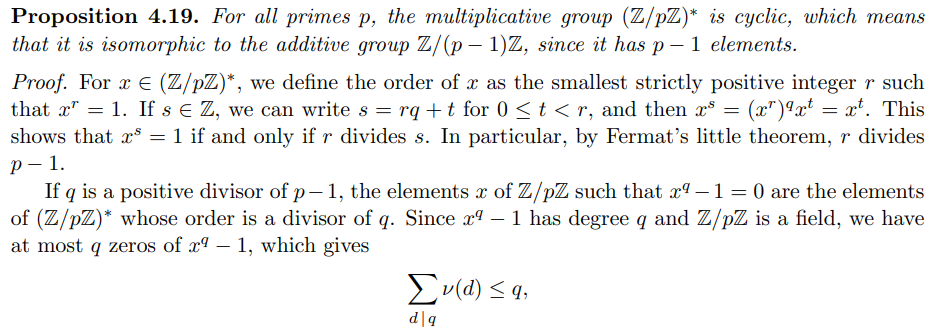
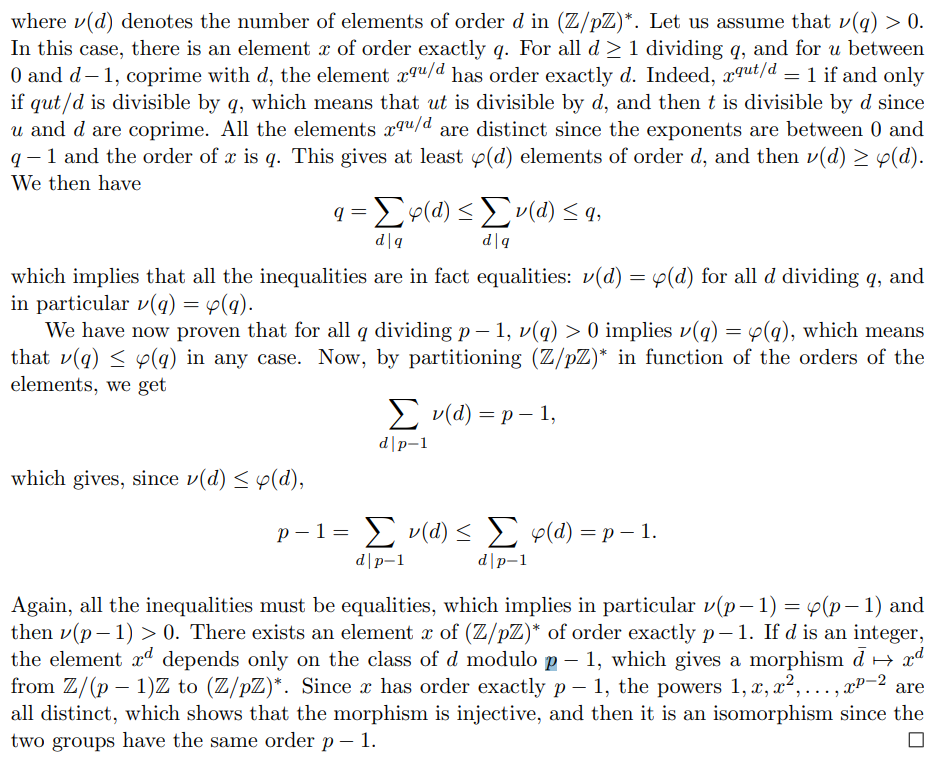
Why is this proof so... complicated
It just feels proving this is cyclic should be simple 🤔
sterile pumiceBOT
Shuri2060
 urban peak
can Fermats little theorem be used to show a number is prime? i was under impression that it didn't work in that way, only could tell us if a number was composite
 haughty lichen
no it can't
urban peak
haughty lichen
no it can't
awesome. are there any elementary tests like korselt criterion or rabin miller test that would tell me if a number was prime?
think that its same case as flt, they can only show if a number is compsoite
haughty lichen
no
urban peak
haughty lichen
no
but FLT, korselt criterion, and Rabin Miller all can show a number IS composite right?
haughty lichen
try googling (fermat)-pseudoprime, Mersenne prime and so on
urban peak
im familar with those, im just making sure my understanding of the purpose of the test is correct
haughty lichen
the purpose is that if it passes a lot of those tests then it is likely a prime
urban peak
but indepdently, those tests can only confirm that a number is composite?
haughty lichen
haughty lichen
try googling (fermat)-pseudoprime, Mersenne prime and so on
yes because there exists numbers such as these
hence the theorems aren't if and only if
urban peak
gotcha thanks
sacred junco
For what values mod a do all integers have a cubic root mod a?
All primes? Multiples of 3?
weary gate
Pastebin
Pastebin.com is the number one paste tool since 2002. Pastebin is a website where you can store text online for a set period of time.
 inner anchor
where did the mute go
weary gate
hmm
 devout furnace
urban peak
can Fermats little theorem be used to show a number is prime? i was under impres...
devout furnace
urban peak
can Fermats little theorem be used to show a number is prime? i was under impres...
I think you’re referring to the fermat primality test which is probabilistic
so you can’t use it to say a number p is prime for certain, but it can say it is “probably” prime
but there’s plenty of “fermat pseudoprimes” which pass the fermat primality test but aren’t actually prime
hence why it’s a probabilistic test and not deterministic
sleek cove
he changed his name rip lithium
sacred junco
How to show $a^{\varphi(b)}+b^{\varphi(a)} = 1 \mod ab$ whenever $\gcd(a,b)=1$?
sterile pumiceBOT
Carla_
 sacred junco
Can use Euler theorem to see a^phi(b) = 1 mod b and b^phi(a) = 1 mod a, but how to go from there?
iron surge
@sacred junco I got you
sacred junco
you got me?
iron surge
yup so since $(a,b)=1$,...
sterile pumiceBOT
logician_pdx
 iron surge
we have $b|a^{\varphi(b)}-1+b^{\varphi(a)}$ and $a|a^{\varphi(b)}-1+b^{\varphi(a)}$, so $ab|a^{\varphi(b)}-1+b^{\varphi(a)}$. By the definition of congruence, we conclude $a^{\varphi(b)}-1+b^{\varphi(a)}\equiv1\pmod{ab}$
sterile pumiceBOT
logician_pdx
 iron surge
I skipped a tiny detail, but hopefully you see that $b|b^{\varphi(b)}$ and $a|a^{\varphi(b)}$.
sterile pumiceBOT
logician_pdx
 iron surge
we also had $b|a^{\varphi(b)}-1$, so $b|a^{\varphi(b)}-1+b^{\varphi(b)}$
sterile pumiceBOT
logician_pdx
 iron surge
and similarly, for $a$
sterile pumiceBOT
logician_pdx
 iron surge
make sense @sacred junco ?
sacred junco
yea its basically what i did
sacred junco
iron surge
I skipped a tiny detail, but hopefully you see that $b|b^{\varphi(b)}$ and $a|a^...
cuz totient funcrion geq 1
torn escarp
definitely
you can get a very explicit way of writing down solutions you've solved for each mod p^n and combine them together
sacred junco
mod p^n?
torn escarp
right, if you're trying to solve something mod N you can factor N into its powers of primes, those are the smallest relatively prime things you can make
sacred junco
yea
iron surge
sterile pumice
**logician\_pdx**
this one has a typo,..
iron surge
sterile pumice
**logician\_pdx**
this one does too.
we have $b|a^{\varphi(b)}-1+b^{\varphi(a)}$ and $a|a^{\varphi(b)}-1+b^{\varphi(a)}$, so $ab|a^{\varphi(b)}-1+b^{\varphi(a)}$. By the definition of congruence, we conclude $a^{\varphi(b)}-1+b^{\varphi(a)}\equiv1\pmod{ab}$
sterile pumiceBOT
logician_pdx
 iron surge
This is the corrected version @sacred junco
The typo I had was $b^{\varphi(b)}$ instead of $b^{\varphi(a)}$
sterile pumiceBOT
logician_pdx
 sacred junco
yea i didnt even notice lol its okay
iron surge
yea, the logic is still the same tho
sacred junco
i just wanted to check if what i did was right so i asked as if i didnt solve it, not to bias someone who answers
iron surge
sacred junco
i just wanted to check if what i did was right so i asked as if i didnt solve it...
okay be careful when you do that tho, because we don't like to give answers right off the bat if no work is shown
but since you told me about what a and b each divide, I could tell you thought about this problem already
so I answered.
sacred junco
yes im aware thats why i said that xD
torn escarp
you could say this is the chinese remainder theorem
sacred junco
yea i was getting chinese reminder vibes :o
cloud oracle
urban peak
awesome. are there any elementary tests like korselt criterion or rabin miller t...
Miller Rabin is a probabilistic test. If you run enough rounds of the MR with different prospective witness numbers, none of who confirm that the number is a composite, then there is a very high degree of probability that the number is a prime.
All Composites don't have a Fermat's witness - Carmichael numbers don't have a Fermat's witness even though they are composite. However all composite numbers have multiple Miller Rabin witness for Compositeness. So if you run MR with multiple prospective witnesses, the probability that the number is a composite without being confirmed by your rounds is ignorably small.
There are also deterministic tests for Primality. The AKS tests is deterministic test which runs in polynomial time and also doesn't use any unproven conjectures like the Reimann Hypothesis. There are also other deterministic tests which use Reimann & check primality in a deterministic way.
wispy creek

how tho ?
i get one direction how x = 1 mod(12) -> x = 1 mod(2, 3, 4 and 6)
but how do i show the other direction 
devout furnace
sacred junco
Can use Euler theorem to see a^phi(b) = 1 mod b and b^phi(a) = 1 mod a, but how ...
equivalently you already showed the expression is 1 mod a and 1 mod b so by (a form of) chinese remainder theorem since (a, b) = 1 we have the expression is 1 mod ab
in general, if you’re trying to find something mod a_1 * a_2 * … * a_n, where the a_i are pairwise coprime, you can consider the solution to the system of individual congruences mod a_1, mod a_2, …, mod a_n
leaden swan
wispy creek
i get one direction how x = 1 mod(12) -> x = 1 mod(2, 3, 4 and 6)
x=1 mod 4 implies x=4k+1
x=1 mod 3 implies x=3l+1
This implies 4k=3l or 4k=12m for some m,i.e., x=12m+1
devout furnace
and this again is due to the chinese remainder theorem
leaden swan
You don't need the other 2 congruencies
wispy creek
leaden swan
x=1 mod 4 implies x=4k+1
x=1 mod 3 implies x=3l+1
This implies 4k=3l or 4k=12m f...
v clever
wispy creek
devout furnace
in general, if you’re trying to find something mod a_1 * a_2 * … * a_n, where th...
dooesnt chinese remainder theorem only guarantee a solution to 2 congruence systems ?
devout furnace
it can be extended
leaden swan
Or you can use this
wispy creek
devout furnace
it can be extended
does it extend to a stronger version of "only guarantees the existence of a solution"
devout furnace
wispy creek
does it extend to a stronger version of "only guarantees the existence of a solu...
the theorem always shows existence
it’s up to you to find a construction
wispy creek
ic
devout furnace
actually what have I been saying this whole time
wispy creek
devout furnace
in general, if you’re trying to find something mod a_1 * a_2 * … * a_n, where th...
can u link me the proof of this ?
im not sure how to use CRT here
and this sounds hella useful
devout furnace
you don’t need anything fancy to show that 1 mod a and 1 mod b implies 1 mod ab for (a, b) = 1
crt just shows existence
which here isn’t very useful
leaden swan
Do induction on this
Suppose you have x=c_1 mod a_1 ,c_2 mod a_2 and c_3 mod a_3 first find y: x=y mod a_1 a_2
Then use that to find z such that x=z mod a_1 a_2 a_3
devout furnace
oh right, the point is of the unique existence of a solution
devout furnace
devout furnace
you don’t need anything fancy to show that 1 mod a and 1 mod b implies 1 mod ab ...
so here you can say that 1 is the only solution
wispy creek
ye
leaden swan
Then this is equivalent to x=2(2)(2)+1(3)(3) mod 6, x=4 mod 5
x=5 mod 6,x=4 mod 5
Which is equivalent to x=5(5)(5)+4(6)(1) mod 30
x=29 mod 30
wispy creek
yeah ok makes sense
devout furnace
I think it’s worth emphasizing that CRT isn’t the actual algorithm used to construct the solution, rather it’s something which lets you choose two congruences whose modulo are relatively prime and combine them into one
wispy creek
in the ss example, 2, 3, 4, 6 are not pairwise coprime. how are they combining those
devout furnace
apply CRT one step at a time
first combine 2 and 3 because they’re relatively prime so CRT applies
wispy creek
aight lets say i apply it to mod 2 and mod 3, get a solution mod 6
but then 4 and 6 are not coprime
devout furnace
hmm
leaden swan
You can show x=a mod (2^2)(3) is completely determined by b and c where x=b mod(2^2) and x=c mod 3
wispy creek
true
leaden swan
Other congruencies are just extra material you check at the end
As in "does the final solution satisfy those conditions"
If not,there is no solution
If yes,There is a solution
wispy creek
this this true that "x = a mod m is equivalent to solution to the system x = a mod (all the divisor of m)"
wispy creek
yeah one direction is simple enough but the other direction im not sure how to show
devout furnace
wispy creek
this this true that "x = a mod m is equivalent to solution to the system x = a m...
prime divisors I think
well actually something like mod 36 might be weird
wispy creek
thonkery
wispy creek
leaden swan
Or you can use this
i just tried out ur thing to prove a system of n congruences has a solution and it was goddamn genius 
torn escarp
here's a way to explicitly construct a solution from the solutions mod the relatively prime numbers as an example $$x=x_a (bc)^{\varphi(a)}+x_b(ac)^{\varphi(b)} +x_c(ab)^{\varphi(c)} \mod abc$$
sterile pumiceBOT
Merosity
 torn escarp
you can see how for instance (bc)^phi(a) is 1 mod a and 0 mod b and mod c, so you're easily selecting out
but the exponent can be kinda gross, it's just nice to have
wispy creek
torn escarp
you can see how for instance (bc)^phi(a) is 1 mod a and 0 mod b and mod c, so yo...
dang thats pretty nice too
but yea not a fan of those exponents 
sterile pumiceBOT
soαρ
 sleek cove
dont tell me what to do
wispy creek

not sure how to do (c)
something something expected values ?
like given an integer n between 1 and x, the probability of n and n + 2 being prime is 1/ln^2(x). we sum up all the probabilities ranging n from 1 to x to get a total probability of x/ln^2(x) ?
but then thats the probability. the number of twin primes is x^2/ln^2(x) ?
havent done much probability 
inner anchor
first find what the probability for some a to be a prime is, and then consider a and a+2 being primes as independent events
wispy creek
inner anchor
first find what the probability for some a to be a prime is, and then consider a...
probability of a being prime is 1/ln(x). so a and a+2 being prime has the probability of 1/ln^2(x) ?
wispy creek
wow
inner anchor
this is a pretty bad bound though
inner anchor
yeah
wispy creek
inner anchor
lol
wispy creek
holy shit that was too simple
inner anchor
troll problem
i hope i havent made some stupid lapse in judgement
but it seems fine to me
sleek cove
its missing a constant 
urban peak
im trying to prove that for an odd integer k>1, there are infinitely many primes p such that at least of the intgers from 1 to p-1 has no kth root modp
not really sure how i am supposed to proceed
 prime sparrow
Well if p=ak+1 for some k, do you see why there will be an integer with no kth root mod p?
urban peak
prime sparrow
Well if p=ak+1 for some k, do you see why there will be an integer with no kth r...
why not? seems like it should work
prime sparrow
What do you mean by why not? Are you saying that all integers will have a kth root mod p?
Also here is a hint: the multiplicative group of Fp is isomorphic to Z/(p-1)Z
urban peak
prime sparrow
What do you mean by why not? Are you saying that all integers will have a kth ro...
im saying it seems like all intgers do in fact have a kth root mod p, but i guess there is not and there is flaw in my logic. im not familar with much group theory so hint doesnt help much 😦
prime sparrow
This question (or atleast the way I’m solving it) seems a little too difficult then
urban peak
hm i guess ill just keep trying then
prime sparrow
For an example of what I was saying, when k=3 look at p=7, you can then check that 2 has no cube root mod 7
urban peak
makes sense but generalizing and proceeding seems difficult
prime sparrow
Yes the generalisation is pretty hard: here is a fact that will help (it is hard to prove but take this for granted) for every prime p, there is an integer k<=p-1 such that the powers of k give you all nonzero remainders modulo p, and k^(p-1)is congruent to 1 mod p.
I realize I’ve used k for the integer here, this k has nothing to do with the k in the problem, sorry
urban peak
prime sparrow
Yes the generalisation is pretty hard: here is a fact that will help (it is hard...
is this a named theorem or just a general result? would like to look into it more if i can find something on it
torn escarp
sounds like fermat's little theorem
urban peak
think you're right didnt even realize
prime sparrow
It is called the primitive element theorem
It is a bit harder than fermat’s little theorem
urban peak
it looks like i need basic group theory just from searching it up. think i might need to take a min and just get some group theory basics since it seems anything remotely complex in nt needs it
prime sparrow
prime sparrow
It is called the primitive element theorem
Oh wait that is a different theorem, I don’t know of a name for this theorem, but it isn’t fermat’s little theorem
inner anchor
Its just the existence of a primitive root
prime sparrow
Yes
sacred junco
@wispy creek wht book is this? silverman?
wispy creek
sacred junco
<@!520647458066530304> wht book is this? silverman?
yes
 hot pond
can some help with q3?
inner anchor
probably if you posted your problem
hot pond
lol, it was in question3 chat
copper canyon
How do I solve this?
I keep getting wrong answers
 torn escarp
show your work so far
I'll walk through the answer here in a bit if you're still struggling cause it's pretty straight forward once you know
copper canyon
x = 24^101 mod 25
x = 24^101 mod 4
x = (-1)^101 mod 25
x = 0^101 mod 4
x = -1 mod 25
x = 0 mod 4
x = 4t
4t = -1 mod 25
//gcd(25,4) == 1 than
4t = t = -1 mod 25
t = -1 + 25v
x = 4(-1 +25v)
x = -4 + 100v
x = 96 + 100v
x = 96 mod 100
torn escarp
just a general tip, it's usually easier to start with the big one and go smaller
like do x=-1+25t and then look at it mod 4
but I'll keep checking your work, just got to this part
this step is wrong:
4t = t = -1 mod 25
t = -1 + 25v
4t is not t mod 25
4t=-1 mod 25 you need to find and multiply by 4^-1 on both sides
this is why starting from the bigger one is easier, since the inversion you'd end up having to do would be mod 4
only good way I see to do that here is by hensel lifting, which is just extra work that we should avoid, I can show you how to do that
basically we solve 4u=1 mod 5, then use this to solve 4u=1 mod 25
mod 5 is easy, u=4 will work
so now mod 25 we use u=4+5v and we have 4(4+5v)=1 mod 25
you can rearrange this all out to get 5*(3+v)=0 mod 25
so really we're just back down to looking at 3+v=0 mod 5
so v=2
and that determines it, u=4+5*2 = 14
oh whoops forgot to distribute the 4
5*(3+4v)=0 mod 25 becomes 3+v4=0 mod 5 and so v=3
so u=19
copper canyon
so x ends up 76?
torn escarp
hmm 74 actually but that's not right either haha
do it the other way, it's more direct, I'll check my work again, I already made a mistake while working it out so probably there's another
copper canyon
Yeah. If it wasn't the course has a test, I would just write a code to my math library and forget about it 😄
torn escarp
I just forgot what I was doing after working out the inverse
torn escarp
torn escarp
this is why starting from the bigger one is easier, since the inversion you'd en...
everything from here on down is just working out what 4t=-1 mod 25 is
you solved for t incorrectly
you need to multiply by 4^-1 on both sides
I worked out that 4^-1 = 19 so multiplying by it I get t = -19 mod 25
or I could just put t=6 since it's smaller
so x=4*6 = 24 mod 100
like I said though this is the bad way to do it
you should start from x=-1+25t mod 4
0=-1 + t mod 4 means t=1 mod 4 and so we get x=-1+25=24 mod 100 immediately
even if 25 turned out to be something else other than 1 mod 4, inverting it would still be very easy since it can only really be 3
wispy creek
cough method of successive squaring cough
torn escarp
I'll take hensel lifting any day thanks haha
to be fair, doing either of these by hand is a pain in the ass lol
wispy creek
what even hensel lifting 
 hardy kayak
heyy, I was stdying substitution cipher,I had a doubt in it. can anyone help me with it
torn escarp
in the simplest case, you can turn solving for something mod p^n into solving basically the same problem mod p, but n times
so for instance 4x=1 mod 5^2 I solved it mod 5 first to get x=4
then I plugged in x=4+5y to get 4*(4+5y)=1 mod 5^2 but it simplifies to become 5(3+4y)=0 mod 5^2
since we already have 5 there, we know to make 0 we are just solving 3+4y=0 mod 5 now
so that's the second time solving a problem mod 5, and this trick generalizes
torn escarp
yeah, so we can go a little more general to show it easier maybe
let's say f(x)=4x-1=0 is what we want to solve mod p^n
then if we can solve f(x)=0 mod p, we can use this to get the next power up, let's go a bit more general and say f is a polynomial
then the next step will be $f(x+py)=0 \mod p^2$ is what we want to solve
sterile pumiceBOT
Merosity
 torn escarp
we have x already determined mod p, so we just need to determine y mod p, think of it as determining the base p expansion of the number one digit at a time
so if we expand out the polynomial now, $$f(x+py) = \sum_{k=0}^n a_k (x+py)^k = \sum_{k=0}^n a_k (x^k +k py x^{k-1}) \mod p^2$$
sterile pumiceBOT
Merosity
 torn escarp
notice all the higher terms in the binomial expansion die out cause they are p^2 or higher
if you look at that and expand it out, it simplifies down to:
$$f(x+py) = f(x)+py f'(x) \mod p^2$$
sterile pumiceBOT
Merosity
 torn escarp
you with me so far? kind of getting weird lol
wispy creek
oh shit forgot to check. im back
torn escarp
happens to me too lol
wispy creek
sterile pumice
**Merosity**
ok yeah i followed it so far
took me like 5 tries but i got there 
not sure why the next step is to look at f(x + py) tho
seemed kinda arbitrary
torn escarp
yeah, it's cause we solved f(x)=0 mod p
and since py=0 mod p, we're basically blind to it
mod p^2 that's just the amount we have to add on to take our solution mod p and fix it up to work mod p^2
wispy creek
kk makes sense
torn escarp
sterile pumice
**Merosity**
I can explain that a bit more later, but I'll keep going from here now @wispy creek
torn escarp
So we're wanting to solve f(x+py)=0 mod p^2 and all we need to do is determine y, since we know x, so this becomes
$0=f(x)+py f'(x) \mod p^2$
sterile pumiceBOT
Merosity
 torn escarp
yeah weird haha 😛
we already know f(x)=0 mod p so it's safe to divide this by p
$$0 = p( \frac{f(x)}{p} + y f'(x)) \mod p^2$$
sterile pumiceBOT
Merosity
 torn escarp
since p*(stuff)=0 mod p^2 we know the (stuff)=0 mod p
$$0 = \frac{f(x)}{p} +yf'(x) \mod p$$
sterile pumiceBOT
Merosity
 wispy creek
oh shit
torn escarp
as long as $f'(x) \ne 0 \mod p$ we can now solve for y exactly
sterile pumiceBOT
Merosity
 torn escarp
$y= \frac{-f(x)}{p f'(x)}} \mod p$
sterile pumiceBOT
Merosity
Compile Error! Click the reaction for more information.
(You may edit your message to recompile.)
 torn escarp
so our new answer is $x+py = x-\frac{f(x)}{f'(x)}$
sterile pumiceBOT
Merosity
 torn escarp
it turns out this will always be how the step works to get new digits
$$x_{n+1}=x_n-\frac{f(x_n)}{f'(x_n)}$$
sterile pumiceBOT
Merosity
 wispy creek
wtf this looks like newtons method 
torn escarp
it is newton's method 😛
wispy creek
torn escarp
but how you measure distances between numbers is different in this topology, so this is how you do newton's method in the p-adics
so maybe try to prove the general thing now
wispy creek
aight throw the general statement at me, ill try to prove it 
torn escarp
so take your base case as $f(x_1)=0 \mod p$ and $f'(x_1) \not =0 \mod p$ and then use this to show that if you have $f(x_n)=0 \mod p^n$ then there's a unique solution to $f(x_{n+1})=0 \mod p^{n+1}$
sterile pumiceBOT
Merosity
 torn escarp
let me be a bit clear about what I mean with an example
like earlier we wanted to solve f(x)=4x-1=0 mod 5
so if I solve this, with x=4 and then evaluate f'(4) and show this is nonzero mod 5, then this means my base case is satisfied
and I'm guaranteed I can always solve f(x)=0 mod 5^n by repeatedly stepping one digit in base 5 at a time
wispy creek
aight ill try to prove it and when i come back lets talk about this "base p" thingy
torn escarp
sure, we can work some in base 10 or base 2, it might be easier
or maybe just try to work out a concrete example like
solve x^2+1=0 mod 5^4 to get a feel for it
that's kind of an interesting one because as you solve x^2+1=0 mod 5^n as n gets larger, you're computing digits of an irrational number in the 5-adics that we could call i
wispy creek
torn escarp
we already know f(x)=0 mod p so it's safe to divide this by p
actually how is it safe to divide by p ?
gcd(p^2, p) = p != 1
so the inverse doesnt exist mod p^2
torn escarp
yeah, however as an integer if we're looking at f(x)=0 mod p
this means f(x)=pm for some m
so f(x)/p = m is perfectly well defined as an integer
so we're sort of shifting perspective a bit when we write that, so it's a bit tricky @wispy creek
torn escarp
well that's just ordinary modular arithmetic
f'(x) != 0 mod p means it has an inverse
torn escarp
yeah, actually hensel's lemma is more general than what I've said too, but I didn't wanna overwhelm with details
if f'(x)=0 mod p you can still do hensel lifting, just requires your base case to involve working more, like solving f(x)=0 mod p^k for some k that depends on what power of p divides f'(x)
in terms of the p-adic absolute value it's easy to write down, |f(x)|<|f'(x)|^2 is the sufficient condition for x to lift to a unique solution
wispy creek
yea ic why u avoided details. good call
torn escarp
we could even go more general and talk about the version of hensel's lemma that's actually about polynomials
factorization of polynomials mod p lifts to factorizations mod p^n lol
wispy creek
just to check, what im trying to prove is, if f(x) = has a solution mod p, it has solution mod p^n for any n >= 1?
torn escarp
yeah, and the way to do that is by induction on n
wispy creek
oh ok that makes a lot more sense then
torn escarp
also you assume f'(x) !=0 mod p as well
wispy creek
kk
wispy creek
@torn escarp ive been trying to prove this for a while now. i was able to show x_{n+1} is a solution mod p^(k+1) given that x_n is a solution mod p^k. but got stuck on the uniqueness part
heres an example that seemingly contradicts uniqueness
f(x) = x^3 - 1
f(x) = 0 mod 3 has a solution x = 1
but f(x) = 0 mod 3^2 has 2 (or maybe more) solutions x = 1 and 4
torn escarp
yeah good question
it's unique once you fix x for the base case
the further digits you add on to whatever choice you make there are what is unique
and the uniqueness will pop out of the fact that f'(x) != 0 mod p will allow you to solve for the next digit exactly
like we did in that example mod p^2 that I showed earlier in reducing it to mod p
wispy creek
r u saying once we fix x_n, x_{n+1} is fixed and therefore unique ?
 torn escarp
nice 😎
wispy creek
thank you for enlightening me mero 
torn escarp
yeah you're welcome 😛
p-adic stuff aside this is good to have just for regular modular arithmetic problems
if you're trying to solve something mod n, the chinese remainder theorem only lets you split it into solving congruences modulo relatively prime numbers, which means distinct powers of primes
wispy creek
then i use hensel lifting to solve mod p^n
torn escarp
this thing you're proving now, hensel's lemma, lets you solve things mod p which is easier and then lift up to that
bingo
sniped me lol
torn escarp
yeah, pretty fun when calculus starts to pop up in number theory stuff lol
sterile pumiceBOT
soαρ

 proven rune
How do you solve 2^k -1 ≡ 0 (mod 4599)? I noticed that 4597 is a prime, but not sure if this fact can be exploited.
inner anchor
A tedious way is to note that k must divide phi(4599) = 2^5 × 3^4 and then just checking all of the 30 possibilities
Quite a few of those can be eliminated simply by size checks
Lol those were super wrong
proven rune
I see. This method should definitely work, but is there a smarter way to deal with the congruence? I think the problem is not intended to involve brute force checking possibilities.
inner anchor
crt stuff probably
proven rune
Is crt Chinese Remainder thm?
inner anchor
Yes
Im not 100% confident on how you combine the solutions due to the exponents being in mod phi(n)
You can probably just combine them directly
proven rune
thanks. I'll try the CRT approach and see how it goes!
inner anchor
Gl
 red gyro
# Let p be a positive integer. Consider p (not necessarily) distinct prime numbers
# such that their product is ten times their sum. What are these primes, and
# what is the value of p?

### SETUP ###
# 1) generate primes
#
# REPEAT until success ----->
# 2) check success conditions
# 3) prune responses for complexity

### PROGRAM ###

# Global Variables
primes_array = []


# Methods
def main():
    populatePrimes(2, 12)
    checkSuccess()


def populatePrimes(range_low, range_high):
    for possiblePrime in range(range_low, range_high):
        isPrime = True

        for num in range(2, possiblePrime):
            if possiblePrime % num == 0:
                isPrime = False

        if isPrime:
            primes_array.append(possiblePrime)


def checkSuccess():
    ROC_now = 0  # Rate of Change Now -----> starting value negligible

    for i in range(0, len(primes_array)):
        for j in range(0, len(primes_array)):

            # Rate of change calculation which lowers computational complexity by using the linear design of the
            # problem to prevent excess calculations after surpassing the equality convergence point

            ROC_previous = ROC_now
            ROC_now = 10 * (primes_array[i] + primes_array[j]) / (primes_array[i] * primes_array[j])

            if ROC_previous > 1 and ROC_now < 1:  # ROC_now at success should be 1
                break

            if 10 * (primes_array[i] + primes_array[j]) == (primes_array[i] * primes_array[j]):
                print("***********************Answer: ", primes_array[i], primes_array[j])
            else:
                None
                # uncomment below to see all test cases
                # print("WRONG i:" + str(primes_array[i]), "j:" + str(primes_array[j]) + "    " + str(
                #    10 * (primes_array[i] + primes_array[j])) + " = " + str(primes_array[i] * primes_array[j]))


main() ```Found a problem where two primes can be found where 10 times their sum is equal to their product
The code runs smoothly but I get to sizes of 100000 max prime range and cant find it
Is there anything blatantly wrong with my method or code?
Adjust range accordingly
 dusk coral
I don't think there's any solutions with only 2 primes. Since the product is even, 2 must be one of the primes, but then you have 10*(p+2)=2p for the other one.
red gyro
dusk coral
I don't think there's any solutions with only 2 primes. Since the product is ev...
I found this problem on a challenge from an institution... that is why I am confused
doesnt make sense, thanks for the help
torn escarp
I'm gonna change notation to make n the number of primes since I want to represent primes by $p_i$. We can write this out as $$\prod_{i=1}^n p_i = 10 \sum_{i=1}^n p_i$$ immediately we know two of the primes must be 2 and 5 so pick the last two and divide them out, $$\prod_{i=1}^{n-2}p_i = 7 + \sum_{i=1}^{n-2}p_i$$. Something concrete to work with, next you could consider maybe what happens if one of the primes is 7 or not I guess
sterile pumiceBOT
Merosity
 torn escarp
in particular for that other comment, if n=2 then we have 1=7+0 which is a contradiction, consistent with what @dusk coral is saying
my reasoning is slightly different just for 2 primes if we have pq=10(p+q) we necessarily must have p=2 and q=5 for the prime factorization to make sense at all
red gyro
I didn't even consider the fact that it could be more than two primes... However it could be only both 1) 2 and not 5 2) 2, 5, and another
but considering I have checked through 2 and 100000 for two primes you are probably right
torn escarp
pq=10(p+q) the left side has exactly 2 prime factors and the right side has 2,5,and at least one prime factor in p+q which means it has 3 or more, that's the contradiction I'm going for
red gyro
Adjusting my code now, sorry for being thick
red gyro
torn escarp
pq=10(p+q) the left side has exactly 2 prime factors and the right side has 2,5,...
Yep and there it is 2 3 5 5
You can even narrow it down to n>=4 because 10(pi+7) != (2*5)pi
Thanks John and Merosity this was nagging at me
torn escarp
👍
sleek cove
you're welcome
copper canyon
What does this mean?
 copper canyon
yeah
leaden swan
What part do you not get
copper canyon
the squigly that looks like equal sign
leaden swan
Isomorphism,I think
leaden swan
Your function maps 1 to 1
So Z/2Z is {[0],[1]} right?
Z_2 is {0,1}
The isomorphism is map [0] to 0 and [1] to 1
wispy creek
wait what
whats the the distinction between Z/2Z and Z_2 ?
is Z_2 just a nice way to represent Z/2Z ?
leaden swan
Yes
But some people define Z_2 as the set {0,1} with a+b=(a+b)%2
Practically the same thing
Where a%2 is the least positive reminder
Z/2 has equivalence classes
wispy creek
ic
copper canyon
wispy creek
whats the the distinction between Z/2Z and Z_2 ?
z/2z means odd numbers
z_2 means modulo numbers to 2
so z_2 = {0,1}
copper canyon
leaden swan
The isomorphism is map [0] to 0 and [1] to 1
right. But what would be the general definition of isomorphism for groups?
leaden swan
f(a)f(b)=f(ab)
sacred junco
Z2 and z/2z is same thing
leaden swan
f will be your isomorphism
copper canyon
f isn't the function?
leaden swan
The function is "map [1] to 1 and [0] to 0"
copper canyon
ohh
wispy creek
copper canyon
z/2z means odd numbers
z_2 means modulo numbers to 2
so z_2 = {0,1}
z/2z means odd numbers, what ?
sacred junco
Its just notation soapy
copper canyon
Z is intergers so 2Z doesn't mean even numbers?
wispy creek
sacred junco
Its just notation soapy
yeah ik
sacred junco
2z is not z_2
leaden swan
copper canyon
Z is intergers so 2Z doesn't mean even numbers?
Sir, Z\2Z is set of odd numbers
wispy creek
Z/2Z is Z quotiented out by 2Z
sacred junco
Just stop talking about this plssss
 sleek cove
Z|2Z is my favorite set
 upbeat wren
You like binary digits?
sleek cove
i like you
 frank sand
Does Z/Zp has elements of order two? Is there a nice way to find those elements?
in multiplicative group
inner anchor
Simple proof is just that x^2 -1=0 mod p iff (x-1)(x+1) = 0 mod p
copper canyon
How do I find x for
5^x = 1 (mod 7)?
torn escarp
just want an x that works, or the minimal x?
copper canyon
minimal x
torn escarp
if you just want one that works, that's easy - that's fermat's little theorem
if you want the minimal, that's pretty much impossible - that's the discrete logarithm problem
you just have to brute force it pretty much
copper canyon
minimal interger
Which I think is 6 according to fermats little theorem as you said 🙂 Thanks
torn escarp
no
it's 6, but not according to fermat's little theorem
fermat's little theorem gives you 6 which works for every number relatively prime to 7, but it's not the minimal in general
upbeat wren
You only need to test up to (p - 1)/2 for odd p. If there are no repetitions up to then and A^((p-1)/2 is -1 (mod p) you are good.
inner anchor
You only need to check the proper divisors of p-1 for a bit of extra optimization
upbeat wren
Nice.
inner anchor
Very cool yes
 shut echo
m, n are positive numbers such that 5m +n divides m + 5n.
Prove that m is factor of n.
can someone give a hint?
leaden swan
Take m+5n=k(5m+n) and do some shenanigans
shut echo
I did that and got m(5k-1)=n(5-k)
leaden swan
Oh wait m and n are positive
There is a easier way
5m+n divides (m+5n)+(5m+n)=6(m+n)
Ok,This isn't easier
shut echo
5m+n also divides 4n-4m
leaden swan

shut echo
5m+n divides 24(m+n) and also 24(n-m)
leaden swan
5m+n divides 48m
shut echo
also 48n
leaden swan
Yes
shut echo
but doesn't do much ig
upbeat wren
Still need this? @shut echo ?
shut echo
yea
upbeat wren
5km + kn = m + 5n
5m + n <= 5n + m ==> 4m <= 4n ==> m <= n
5km + kn = m + 5n (mod n) ==> (5k - 1)m == 0 (mod n)
5km + kn = m + 5n ==> 0 == (5-k)n (mod m)
m | (5 - k)n and n | (5k - 1)m and I am lost.
I wanna say gcd(5 - k, 5k - 1) = 1 and that helps?
But it isn’t for k = odd so blah.
leaden swan
Maybe assume m doesn't divide n and do something with that
wispy creek

not really following this line
another q
does this proof work ?

im proving p cannot be written as the sum of 2 squares when p = 3 mod 4
wispy creek
inner anchor
Seems alright
what about the red underlined part tho
torn escarp
well this shows a,b aren't in the multiplicative group, but 0 is the only thing not in the multiplicative group so it must be the solution
torn escarp
well you just showed that a^2 = -b^2 mod p has no solution when a,b are nonzero mod p
so they must be 0, it's the only option left
torn escarp
lol
wispy creek
thnx for the help guys 
torn escarp
you're welcome
torn escarp
shut echo
m, n are positive numbers such that 5m +n divides m + 5n.
Prove that m is factor...
We can divide out common factors of $m,n$ so without loss of generality we can assume $m,n$ are relatively prime, this turns the problem into proving $m=1$. Since $m+5n \ge 5m+n$ we also know $n \ge m$. Further we can look at $m+5n=k(5m+n) \mod m$ to get $k=5+mt$, plugging $k$ back in we get, $0=24+(5m+n)t$. Since $m,n$ are positive this means $t$ is negative. This restricts what $k,m$ can be to finitely many cases to check.
sterile pumiceBOT
Merosity
 torn escarp
lemme know if you run into any issues
shut echo
Plugging in k, we get $0 \equiv 24m+5m^2t+mnt \mod m$
sterile pumiceBOT
Schrödinger's cat
 shut echo
The RHS is already 0 mod m so why are we dividing by m and then again equating it to 0 @torn escarp
torn escarp
don't plug in mod m, just plug in normally
$$m+5n=k(5m+n)$$
$$m+5n=(5+mt)(5m+n)$$
$$m+5n=25m+5n+5m^2t+mtn$$
$$m=25m+5m^2t+mtn$$
$$1=25+5mt+tn$$
$$0=24+(5m+n)t$$
sterile pumiceBOT
Merosity
 shut echo
Oh okay
torn escarp
since this makes t negative, k=5+mt is a pretty harsh condition since k is also positive, m is going to be small so that when we subtract a multiple of m from 5, it's still positive
shut echo
yeah I get it, thanks a lot
torn escarp
cool
let me know what you do to finish it, since it seems kind of annoying to finish
shut echo
Ig there are only 4 cases
m,k>0 implies t=-1 so (m,n)=(4,4),(3,9)(2,14)(1,19)
t=-2,-3,-4 is also possible
when t=-2, 5m+n=12 so (m,n)=(1,7),(2,2)
t=-3, 5m+n=8, (m,n)=(1,3)
t=-4, 5m+n=6, (m,n)=(1,1)
In all of these m|n so we're done
torn escarp
I guess since we only care about when m is not 1, we just need to do t=-2 and m=2
shut echo
yeah right
torn escarp
kind of weird problem, seems like it'd be easier
seems like it'd be fun to generalize to am+bn being divisible by bm+an with a<b, show that m divides n
shut echo
yep
 spark shuttle
How can i find solutions for $f(x)$ in the congruence $f(x)(x^2-1)\equiv x^2+x-2\pmod{x^3-1}$
sterile pumiceBOT
ben49
 spark shuttle
just dividing x^2+x-2 by x^2-1 to solve for f, but then theres a remainder term and stuff that I couldnt figure out how to get rid of
iron surge
well one place to start might be by noticing that $x^2+x-2=(x+2)(x-1)$ So dividing by $x-1$ gives $f(x)(x+1)\equiv x+2\pmod{x^3-1}$
sterile pumiceBOT
logician_pdx

 primal moss
Well, we can’t multiply by the inverse of $x-1$ modulo $x^3-1$ since those are not coprime.
sterile pumiceBOT
Green4Applez
 primal moss
But, we can divide everything, including the modulus, by x-1.
So we would get $$f(x)(x+1) \equiv x+2 \pmod{x^2+x+1}$$
sterile pumiceBOT
Green4Applez
 primal moss
Then, multiplying by $x$ on both sides gives $$f(x)(x^2+x) \equiv x^2+2x \pmod{x^2+x+1}.$$ Then since $x^2+x \equiv -1 \pmod{x^2+x+1}$, we get $$-f(x)\equiv x^2+2x \pmod{x^2+x+1}.$$
sterile pumiceBOT
Green4Applez
 primal moss
So, $$f(x) \equiv -x^2-2x \pmod{x^2+x+1}$$
sterile pumiceBOT
Green4Applez
 iron surge
primal moss
Well, we can’t multiply by the inverse of $x-1$ modulo $x^3-1$ since those are n...
iron surge
primal moss
Well, we can’t multiply by the inverse of $x-1$ modulo $x^3-1$ since those are n...
Ah, yes; good point! I forgot that rule still holds for polynomials!
wispy creek
im confused about the name "primitive root"
the "root" part makes sense but what does the "primitive" part signify
prime sparrow
Well, its powers generate all the roots mod p, so it is “primitive” in a sense
wispy creek
oh yea that does make sense
primal moss
@spark shuttle does the explanation above make sense?
The solutions for f(x) follow from the final congruence
urban peak
how can i porve that for integer m, if m is even and m/2 is 1mod4, m can be written as a sum of two squares m=a^2+b^2 with coprime a,b
prime sparrow
I don’t think this is true, 18 is even and 9 is one mod 4, but the only way it is expressible as a sum of squares is 9+9
urban peak
prime sparrow
I don’t think this is true, 18 is even and 9 is one mod 4, but the only way it i...
sorry copied the question wrong. if m is even and m/2 is odd and if every prime diviiding m/2 is 1mod4, prove that m can be written as a sum of two squares m=a^2+b^2 coprime a,b
spark shuttle
primal moss
The solutions for f(x) follow from the final congruence
yah this makes sense. thank u sm!
primal moss
Awesome!
wispy creek
urban peak
sorry copied the question wrong. if m is even and m/2 is odd and if every prime ...
i can show u that m can be written as a sum of 2 squares but i cant prove the coprime part
for smth like m=2*5 *5 =50, it can be written as 25 + 25 and also 49 + 1
the first doesnt have coprime a, b
sleek cove
what are u talking ab soap
wispy creek
representing a number as a sum of 2 squares 
sleek cove
but all u do is give an example
wispy creek
sleek cove
but all u do is give an example <:holothink:595992719633940482>
as i said, i couldnt prove the coprime part. but the existence of square representation part i can prove like a champ 😎
urban peak
wispy creek
as i said, i couldnt prove the coprime part. but the existence of square represe...
The square part is fine it’s just the gcd part in which I am having trouble
wispy creek
ic. i couldnt make the gcd part work out either
sleek cove
i cant tell if ur meming or not

 proven cypress
it depends on your convention. Here they mean linear in the size of the input, where size is measured in bits rather than by absolute value/magnitude of the quantity
wispy creek
proven cypress
it depends on your convention. Here they mean linear in the *size* of the input,...
ah makes sense. thanks
sacred junco
I have a question about this problem, when it says that 3 | m^2 + n^2, is it possible to split it into 3 | m^2 and 3 | n^2? If not I'm unsure how to approach this
 sacred junco
is it the additive property?
sacred junco
The additive property is not true in general, for example 6 | 2+4, but 6 doesnt divide 2 or 4.
To prove the exercise, first note that 3 | m² + n², this means that there exists an integer k s.t.
i) 3k = m² + n²
Now do division with remainder of m and n by 3, which gives you
ii) n = 3a + r
iii) m = 3b + s
If you can show that r = s = 0 you are done. You can show that by squaring ii) and iii), then adding them together so you have an expression for m² + n², now compare coefficients with i) and conclude that r=s=0. Here its important that the remainders r and s can only be numbers from {-2,-1,0,1,2}
torn escarp
your set of remainders can be made much smaller, just {0,1,2}. If you square every one of these possibilities mod 3, you get the set {0,1} since 2 is not a square mod 3. Now the problem becomes looking at m^2+n^2 mod 3 as being, can we make 0 mod 3 by a combination of two numbers in this set where they're not both 0? The answer is no, since 0+1, 1+0, and 1+1 are all nonzero mod 3, so it must mean 0+0 is the only possibility.
sacred junco
I do have a follow up question , while the additive property is not true in general, isn't it true in this case? Since we are trying to prove that 3 | m and 3 | n
torn escarp
probably not a good idea to think of it as some kind of property since it doesn't really hold in any generality
at best I'd say if p divides a+b then we know either p divides neither of them or both of them, but never only one of them
you could try to prove that, since that's pretty close to what you want, I'll help if you want
sacred junco
Isn't that euclids lemma? I wrote up a proof but I'm unsure if its really logical tbh, I can DM you a picture of it if youre up for it
torn escarp
not quite, since euclid's lemma is the product not sum
plus this is sort of saying the opposite, p doesn't ever divide just one, it either divides both or neither
not quite, not really meaningful to compare them like that though
sacred junco
Ah I see
Could we use the fact that since 3 divides m and n, that m/n can take the value of either 3k, 3k+1, or 3k+2? i.e 3 different cases?
torn escarp
I don't follow, are you talking about your old problem or this new one
sacred junco
exercise 4.3
torn escarp
you can't assume 3 divides m and n, that's what you're trying to prove
if 3 does divide m and n, it doesn't mean m/n can take those values either
m=3, n=9 you have m/n=1/3 which doesn't work for example
sacred junco
Ah i see
I also have a question about this. Why is it valuable to mention that ab-bc = 1? Is there something that I can infer from that statement
 leaden swan
Yes,that allows you to prove this using bezout
sacred junco
To be honest, never heard of bezouts identity
sleek cove
have you heard of eden identity?
wispy creek
sacred junco
To be honest, never heard of bezouts identity
do u still need help with that ?
 atomic gale
I'm a bit confused here. What exactly is a complete set of residues?
Like I have this and my book says it's a complete set but what makes it that?

<@&286206848099549185>
primal moss
In this context, a complete set of residues means that you have all the possible residues mod 11
so every integer between 0 and 10 inclusive
@atomic gale Wait just to be clear, you know what a residue is correct?
primal moss
Awesome!

 gilded jacinth
its a lot of bezouts identity shenanigans
wispy creek
 red drift
can someone teach me how to get started on this problem?
red drift
can someone teach me how to get started on this problem?
for the first one lets say, u can start by assuming gcd(a, 1) = d. so d divides a and 1. but the largest number that can divide 1 is 1, and 1 also divides a. so d = gcd(a, 1) = 1
 dusty dragon
Hi guys! If I fix an odd prime $p$, is there a way to generate another integer $n$ such that $\varphi(n) = \varphi(p) = p - 1$ where $\varphi$ is the Euler totient function
sterile pumiceBOT
opengangs
 dusty dragon
If you want the question directly

Oh wait, I think n = 2p would work
phi(2p) = phi(2) phi(p) = (2 - 1)(p - 1) = p - 1
red drift
wispy creek
for the first one lets say, u can start by assuming gcd(a, 1) = d. so d divides ...
thank you!!!
red drift
wispy creek
for the first one lets say, u can start by assuming gcd(a, 1) = d. so d divides ...
is that literally the answer to part a?
wispy creek
yea
red drift
wispy creek
yea
do we need to any more then that? i feel like we do
wispy creek
sure, u can go ahead and make it more rigorous, but thats pretty much all there is to it.
red drift
wispy creek
sure, u can go ahead and make it more rigorous, but thats pretty much all there ...
okay, so for part b, i see how you did part a but for part b, i cant make an integer divisble by 0
so how would that work
wispy creek
u dont want an integer to be divisible by 0, u want 0 to be divisible by an integer
what integer(s) divide 0 ?
red drift
none lol, but thats how i interpreted it
wispy creek
why not ?
red drift
ok, so.... could i say assume gcd(a,0) = f, f an element of all integers, f divides 0 and a and the largest number that can divide a is a and 0 divides a so f = gcd(a,0) = a?
@wispy creek
red drift
no because there are greater values that can divide -5?
wispy creek
yeah and what is the biggest one ?
red drift
5a? because a could be any integer and multiplied by 5, it can be divide -5?
wispy creek
a divides b and b divides a are very different things. ur mixing up these two
red drift
this is so confusing 😭
wispy creek
im asking u, what is the biggest number, such that -5 is divisible by that number
red drift
wispy creek
im asking u, what is the biggest number, such that -5 is divisible by that numbe...
oh well, there is no biggest number right?
wispy creek
ok try this then, write -5 = AB, maximize A and minimize B
wispy creek
red drift
oh well, there is no biggest number right?
why not ?
maybe this will help, -5 = 5 * (-1)
red drift
wispy creek
maybe this will help, -5 = 5 * (-1)
so u just took the absolute value of -5?
wispy creek
just factored it, but sure u can think about it like that too
anyways all this was to point out that if a is negative then a has a larger factor than a, namely -a
if a is non-negative then a is the largest factor of a
both cases can be summed up nicely using absolute values
red drift
oh, so all u did was just factor 5?
i thought u were talking about all numbers that can be divided by 5
lol
red drift
@wispy creek , how does this answer sound, Assume gcd(a,0) = f, f is an element of all integers. So f divides 0 and a and the largest that can divide a is a. If a is negative, then +a will be the greatest divisor of -a. So f = gcd(a,0) = a?
wispy creek
the largest that can divide a is a
thats not true
If a is negative, then +a will be the greatest divisor of -a
+a is literally the same thing as a
and then why are u considering -a when a is already negative ?
red drift
hm okay, but what is true then for the first statement you said?
wispy creek
we discussed this earlier that if a is negative then a is not the largest factor of a
-5 is a factor of -5 but we can do better, like how 1 is a factor of -5
and the largest we can do is when we say 5 is a factor of -5
red drift
ohh so |a| is the greatest divisor of a?
wispy creek
yes
wispy creek
its easier to refer to the gcd that way but u can do without too ig
red drift
oh okay
red drift
@wispy creek for c, i said Assume gcd(a, a+1) = g, g an element for all integers. G divides a and a+1 and the largest number that can divide a+1 is simply 1. For example, a = 7 then the gcd(7,8) would be 1 because 7 and 8 dont share common divisors. This works in the negative direction as a = -7, then the gcd(-7,-6) is 1 because -7 and -6 dont share common divisors. So g = gcd(a,a+1) = 1
wispy creek
largest number that can divide a+1 is simply 1.
why is that ?
if i let a = 3 then a + 1 = 4 is divisible by 2 for example
red drift
wispy creek
if i let a = 3 then a + 1 = 4 is divisible by 2 for example
but 2 is not divisible by 3
wispy creek
u mean to say 2 doesnt divide a = 3?
in any case, why should i care if 2 doesnt divide 3 ? ur telling me in ur proof that a + 1 is only divisible by 1 but i just found an example where a + 1 is divisible by 2
red drift
wispy creek
in any case, why should i care if 2 doesnt divide 3 ? ur telling me in ur proof ...
i thought the point of the gcd(x,y) is that both numbers have to have common divisors and whatever number is the greatest divisor makes it true
wispy creek
yes but ur proof is not saying that
red drift
i need to explicitly state that?
wispy creek
no thats not what im saying, i mean ur proof is asserting something false
red drift
oh
wispy creek
in ur proof, ur saying "a + 1 is only divisible by 1 where a is an integer"
that is clearly false, as i already gave u an example
for this problem u have get a bit clever
heres a hint: if d divides a and b then d also divides a - b (in fact d would divide am + bn for any integer m, n)
and im going sleep sleep  😪
😪
red drift
wispy creek
and im going sleep sleep <:isleep:586078769685594112> 😪
oh okay, thanks for the hint
leaden swan
You could find all the possible square roots using CRT and it doesn't like there is a better alternative for this
Suppose n is of form ${p_1}^{k_1} {p_2}^{k_2}...{p_l}^{k_l}$ where each prime is odd,there are $l^2$ solutions
sterile pumiceBOT
Buncho Dragons
 leaden swan
I guess you can predict the behaviour of 2 too, but that would be a bit more work
You reduce this to solving a system of CRT equations
And x^2-1=0(mod p^k) always has 2 solutions when p is odd
And 2 solutions if p is 2 and k is not 3
And 3 solutions if p is 2 and k is 3
Is any one of them 2?
Ok,there should exactly be 8 solutions
You can enumerate them
Mathematica can solve CRT problems right?
Let p_1,p_2 and p_3 be your primes
Is the number just p_1 p_2 p_3?
Or are there powers
Ok,solve 8 equations
- x=1 mod p_1 ,x=1 mod p_2, x=1 mod p_3
2)x=-1 mod p_1,x=1 mod p_2 and x=1 mod p_3
3)x=1 mod p_1 ,x=-1 mod p_2 and x=1 mod p_3
The other 5 equations are similar to this with position of -1 and 1 changing
leaden swan
leaden swan
Suppose n is of form ${p_1}^{k_1} {p_2}^{k_2}...{p_l}^{k_l}$ where each prime is...
2^l mb
 compact walrus

how can i achieve this by the principle of complementation?
my process is:
- count all possible numbers between 3000 and 6000 which is 3 * 9 * 8 * 7 = 1512
- then count all the possible numbers lower than 3456 which should be, 1 * 4 * 4 * 4 = 64, am I missing anything here?
then 1512 - 44 = 1448 which is not the desired result. 😦
haughty lichen
compact walrus
my process is:
1. count all possible numbers between 3000 and 6000 which is 3 *...
Yes if your 2nd number is less than 4 then 3rd and 4th can be any number
For example 3289 is valid
So split it up if 2nd number is {0,1,2,3} or if 2nd number is 4 - and do the same for the following digits
compact walrus
okay let me try..
so lower from 3456 should be:
- 3 {0,1,2,3} {0-9} {0-9} = 1 * 3 * 8 * 7 = 168
- 3 4 {0, 1, 2, 3, 4} {0-9} = 1 * 1 * 3 * 7 = 21
- 3 4 5 {0, 1, 2, 3, 4, 5} = 1 * 1 * 1 * 3 = 3
so 1512 -( 168 + 21 + 3) = 1320
I am off by one 1 from the answer...
is my calculation correct?
haughty lichen
Well you want lower or equal to 3456
compact walrus
oh okay...right...i want equal to be deducted to get get higher than 3456. Thank you very much.
shut echo
can someone help me with this?

I started with the fact that a^2-a must belong to S
Since a(a-1) belongs to S and gcd(a,a-1)=1=gcd(a-2,a-3) a-1 should also belong to S
using the same logic I can go on- a-2, a-3... Belongs to S
Is this approach correct? And how to get to the bigger elements (positive infinity)
torn escarp
oh interesting
I think I found it
no nevermind lol
I missed a sign when simplifying a^2 - (a^2-a) and thought I got -a
I suppose we just need to get arbitrarily large elements, we can take x^2-y and pick x to have the largest absolute value in our set so far and y to be the most negative element, I think we can always push this larger
shut echo
Ahh yeah i think that works
torn escarp
it's possible I misunderstand your conditions on a since I didn't really read what you wrote I just took your result and ran with it
shut echo
Ig you should read once cause I'm not sure if I can use the first condition the way I did
torn escarp
hmm I don't think that works
even though we know we have a and a^2-a we can't say a-1 is in the set because of that
shut echo
yeah i kind of used the converse
torn escarp
I wonder if we can do something like take f(x,y)=x^2-y and then do some sort of induction on what we can get to with iterating it in different ways, but somehow requiring part a) as the base case
ok, what numbers actually satisfy gcd(a,b)=gcd(a-2,b-2)=1?
I feel like this is a kind of harsh restriction
shut echo
Consecutive odd numbers and consecutive numbers
There could be others too actually
Like (7,11 or 13)
torn escarp
hmm
shut echo
Can we manipulate a^2-b and b^2 -a to get something nice
torn escarp
I was playing with that earlier but just kinda felt like it was endless but maybe we should play with that
like once we have a^2-b we can look at b^2 - (a^2-b) = (b+a)(b-a)+b maybe
shut echo
yeah
torn escarp
also was sort of hoping that f(x)=x^2-x could be iterated f(f(x)), f(f(f(x))), etc and get some nice closed form out of that but
nothing stood out to me
shut echo
But how can we construct the set of integers since we gotta keep track of what numbers we're getting and whether we're missing out any number
torn escarp
hmm
shut echo
Like can we show that 1 or 0 belongs to S
torn escarp
maybe a piece of it is showing that we can take f(x,y)=x^2-y and pick numbers so that this converges to 1 or 0 or something
shut echo
yeah
torn escarp
like a decreasing sequence and then from there we can use f to build up anything I think, well ok let's see here
if we have 0, then we can construct -x from x by doing 0^2-x
if you have 1 or -1 as well then we can put in 1^2 - (-x) = x+1
shut echo
yup
torn escarp
so maybe we do just need to show from condition a) we can descend with x^2-y to 0 and 1 or something
just trying to establish what we really need to get there
shut echo
yeah
torn escarp
kind of feels like a funky version of the euclidean algorithm now
shut echo
Can you explain how you're using euclidean algorithm
torn escarp
well I'm not using it, just saying by analogy it's sort of similar feeling
like when you start with say, (35, 11) = (35 - 3*11, 11) = (2, 11) = ...
shut echo
oh i get what you mean
torn escarp
kind of imagining this process but with x^2-y
so ok, here's one way to back track, to get 0 we need 0=x^2-y so y=x^2
clearly x and y are not relatively prime unless x=1
but this is nice, getting 1 gets us 0
torn escarp
so let's see, 1=x^2-y so I guess rearrange this to make y=(x+1)(x-1)
idk if this is better or worse, but maybe we can show we can get something that can go into this from the gcd condition... 😬
alternatively y+1-n^2 = (x+n)(x-n)
y=(x+n)(x-n) + (n+1)(n-1)
just praying that writing something down will resemble something on the other end with a,b hmm
shut echo
btw i have another idea: since a is in S can we express a as d^2-b or d^2-d or b^2-d and say that d belongs to S?
ig in this method too we cannot keep track of what numbers we get systematically
showing 1 is in S seems really hard tho
torn escarp
yeah, I'm playing with inequalities trying to see if there's a way to pick x,y so that |x^2-y|< min(|x|,|y|)
shut echo
okay
torn escarp
or something like that, since that can't exactly hold as strict inequality always ofc
something maybe,
$\gcd(a^2-b, b^2-a) = \gcd(a^2-b-b^2+a, b^2-a) = \gcd((a+b-1)(a-b), b^2-a)$
sterile pumiceBOT
Merosity
 torn escarp
just trying to get the gcd condition to relate to the x^2-y condition in any way at all, since we need them to interact somehow
shut echo
Okay
Can we not assume that a and b are odd such that it satisfies (a) and then see how to get 0 or 1
hmm it doesn't really work
gcd(a,b)=1 means there exists k such that we get to gcd(a-kb,1)
torn escarp
hmm
another kind of weird thing maybe
we know there's x,y and u,v such that ax+by=1 and (a-2)u+(b-2)v=1
shut echo
Yes
torn escarp
shut echo
gcd(a,b)=1 means there exists k such that we get to gcd(a-kb,1)
I think that gives me an idea
we can suppose a>b and write a=b+c
then we have gcd(a,b)=gcd(b+c,b) = gcd(c,b)=1
and gcd(a-2, b-2)=gcd(b+c-2, b-2) = gcd(c, b-2)=1
this is nice because it means c is just any number that's relatively prime with b and b-2 is a possibility
gives me a better view of it, I'm gonna head out for a bit maybe think about it tomorrow
shut echo
sure I'm falling asleep :/
torn escarp
maybe you'll find a solution in your dream and we won't have to think about it tomorrow
maybe you'll find a solution in your dream and we won't have to think about it tomorrow
shut echo
haha yeah
torn escarp
lol later
sleek cove
maybe you'll find a solution in your dream and we won't have to think about it tomorrow
sacred junco
Wait this problem isn’t true right or am I missing something?
Problem 3

Like just try q=3 and p=5
You get (1-1/p^s)(1+1/p^s) = 1/(1-p^2s)???
 light flicker
@sacred junco yeah that seems wrong. I think it should be correct if the right hand side is 1 - 1/p^(fs) raised to the gth power
shut echo
didn't have any dreams😓
sacred junco
I have a question, if 31 | ab, and 31c^2 = d^2, then how would I prove that 31 | d?
sacred junco
I'm not sure what u mean that 31 | d^2 clearly
is it because d^2 is equal to 31c^2
Actually i see what you mean
If thats the case, how could I prove that 31 | c?
is it the same method
leaden swan
You know d has 31 in its prime factorization
So d^2=(31)^2 k for some k
(31)^2 k=31 c^2 implies (31)k=c^2
Now do the same thing as before
wooden crater
sacred junco
I have a question, if 31 | ab, and 31c^2 = d^2, then how would I prove that 31 |...
another perhaps simpler way:
if p is prime and p | ab, then p | a or p | b.
since 31 is prime and 31 | d^2, then 31 | d or 31 | d. so 31 | d, clearly.


 leaden swan
The set {n_2+1,n_3+1,n_4+1} is {3,5,7}
compact walrus
the divisor count of n is (n_1+1)(n_2+1)...(n_k+1) and as it has 105 divisors, then it can be written as
(n_1+1)(n_2+1)...(n_k+1) = 105
or, (n_1+1)(n_2+1)...(n_k+1) = 3.5.7
after that how the k=4 or the missing p_1, hence n_1 =0 affects the reasoning?
k=4 , n_1=0 is only applicable for the number 105 so the factors of 105 can be written into, (n_2+1)(n_3+1)...
there is a reasoning, the 105 number has only p_2 = 3, p_3 = 5, p_4 = 7 primes ...they are scaling the degrees up to find a factor @leaden swan
hence the n_1 = 0
leaden swan
They are also applying n_2>1 ,n_3>1 and n_4>1 condition I think
compact walrus
yes true.
leaden swan
You have to pick 3 (n_k) s such that n_k+1=3,5 and 7
compact walrus
oh i think i kinda get it now...
but this technique could be a little verbose...
thanks @leaden swan
atomic gale
Hey so I'm confused here as to how they jump through the 2 listed steps.

Like I get everything else but those 2 I marked in red I don't get.
atomic gale
<@&286206848099549185>
sacred junco
They just used exponent rules
atomic gale
sacred junco
They just used exponent rules
How so?
atomic gale
I know that 11^(12n+6) = 11^12n*11^6
sacred junco
yes
atomic gale
So wouldn't this only work though if both sides were 1?
sacred junco
you know 11^12 = 1 by FLT
 regal aspen
@sacred junco Hey hobo
sacred junco
yo
red drift
@wispy creek so what i have for this is,
Let a be arbitrary and b,c,d, an element of integers such that
a+b = c gcd(a^2 - b^2 + 1, a + b)
a^2 - b^2 + 1 = d gcd(a^2 - b^2 + 1, a + b)
am i on the right direction?
