#elementary-number-theory
1 messages · Page 20 of 1
 surreal tangle
I just skipped the q is prime condition when reading the statement for some reason
 runic token
lmfao
surreal tangle
Thanks 👍
runic token
tbf usually it would be p here
not sure why they picked q but ig it's still fairly common
 cursive girder
can anyone explain how to solve this

 unkempt void
This is very cool
I think I have another combinatorial method but probably the same lol
like ||I claim there's an action of G := (S_n)^(n^2) \semidirectprod (S_(n^2)) on the n x n x n cube. Think of the cube as a prism with cross section n^2 and length n. The first factor G acts on the cube by rearranging it "length"-wise i.e. moving points along the length of the prism. The second factor acts by changing the cross section.
This action embeds G in S_(n^3). Now apply Lagrange's theorem
||
I quite like that lol unless I have made an error
||Then you can do the same argument the other way round by viewing the cube as n^2 x n rather than n x n^2||
@ancient crow wdy think?
Oh wait yes it is the exact same argument lol as my cube corresponds to the "space" of people in your analogy
and I didn't even read your answer properly 😭 But makes sense
Very cool.
 teal pelican
if we have a lattice point in R^2 how do we write its residue class
like the lattice point (n+1, n+2) is in the residue class of [1,2] mod n?
need some help with formal math language, thanks in advance!
 ancient crow
unkempt void
<@701370150711984159> wdy think?
ancient crow
unkempt void
<@701370150711984159> wdy think?
ah this is nice! yeah this is equivalent but a cool perspective
 thick panther
could i get a hint for this please? my line of thought went along the following:
|| the gcd(a,N) = 1 suggests that probably euler's theorem is used in some way or another, so i decided to calculate phi(N), and its in fact the product of the p_i - 1 since the N cancels
but we are trying to look at the lcm, and the p_i - 1 are not necessarily coprime (eg 7 -1, 13-1 are not coprime)|| so i'm not sure how to piece this together
i tried || looking at maybe using ab = lcm * gcd || but this doesn't particularly help either, or at the very least i cannot see how it would

 west glade
you are trying to show that a^lambda(N)-1 is divisible by N
can you show that it is divisible by all the p_i ?
thick panther
ohhhhh
so its just || FLT + CRT ||
thank you
i don;t know why that didn't cross my mind
west glade
well CRT is a bit overkill. its just normal divisibility stuff on Z
runic token
i think fermat's last thm is a bit much as well
surreal tangle
Abbreviation confusion 
unkempt void
i write flt for fermat's lil theorem and FLT for the big boi
just write "lagrange's theorem"
:chad:
 normal heart
unkempt void
i write flt for fermat's lil theorem and FLT for the big boi
normal heart
unkempt void
i write flt for fermat's lil theorem and FLT for the big boi
I write FlT for lil lol
surreal tangle
Euler's theorem also works
 still flare
You could call it FLiT :3
unkempt void
euler's theorem is too vague xd
surreal tangle
Suffering from success
 unique cypress
Euler's theorem? Huh what WHICH ONE??
thick panther
unkempt void
euler's theorem is too vague xd
hahahaha yeah i have Gauss' lemma in my course but for two different things
the polynomial one and the qr one
 nova vine
can someone help me with this proof please

 primal pewter
@nova vine I have two solutions, one using the hint, and the other one without the hint
Extra hint for solution 1: ||use the order modulo p||
Solution 1: ||Deduce that the order of n modulo p is 3. By Fermat, n^(p-1)=1 (mod p), so 3 must divide p-1.||
Hint for solution 2: ||p | (2n+1)^2 +3||
Solution 2: ||so -3 is a quadratic residue modulo p. Using quadratic reciprocity, one easily shows that this happens iff p=1 (mod 3)||
nova vine
primal pewter
Extra hint for solution 1: ||use the order modulo p||
Solution 1: ||Deduce that ...
I understand this. Thanks for the hint!!
 rancid tartan
Notationally is it ok to drop constants when you have a O term? ie. if you have something that's like h(x)=log(x)^2+x+13+O(1) can you just say h(x)=log(x)^2+x+O(1) since 13 can fit under the bound?
 dusty dragon
yes that’s fine
basically the big-oh absorbs constants and functions of a smaller magnitude
 weary rune
the "if" direction is the so called tHeOrEM 4.9 which i have proven but i don't see how to approach the "only if" direction
 weary rune
nvm, figured it out
 twin forum
currently doing a paper on the history of fermats last theorem
does anyone have a good website for how the failed proofs of fermats last theorem helped advance math?
 spare frigate
Is this true: If $p > 3$ is prime then $(p + 1) \mid p!$?
 sterile pumiceBOT
sxbuto
 normal heart
Note p+1=2*(p+1)/2
normal heart
of course you need to check 2 =/= (p+1)/2 and (p+1)/2<p, but they are both easy to check
spare frigate
yep i see i think i had a brain fart
also, this is a notation question
is $\ZZ/p\ZZ$ denoted as the group of integers modulo p under addition
or is it also the set of integers modulo p
 sacred junco
spare frigate
ohh and (p+1)/2 is going to be in p!
sacred junco
spare frigate
ohh and (p+1)/2 is going to be in p!
Why is that?
west glade
spare frigate
is $\ZZ/p\ZZ$ denoted as the group of integers modulo p under addition
sometimes its also the ring of integers mod p. but either way, its the same set, just maybe with some operation on it
spare frigate
sacred junco
Why is that?
(p+1)/2 < p right so it’s in the factorial of p
sacred junco
spare frigate
(p+1)/2 < p right so it’s in the factorial of p
My question was why it's in the factorial
normal heart
(p+1)/2 is an integer and less than p, and by definition p! is a product of positive integers less than or equal to p
 minor axle
how do you prove the distrobution of prime numbers to infinity?
sacred junco
minor axle
how do you prove the distrobution of prime numbers to infinity?
Do you mean, to prove there are an infinite number of primes?
twin forum
minor axle
how do you prove the distrobution of prime numbers to infinity?
depends, choose a natural number between 2 and infinity and I can show you a way to prove infinite primes 
sacred junco
Whats a simple example of a number field with class number >1 that embeds into a number field with class number 1?
 noble obsidian
if you have a prime p not 2
can the prime factorization of p^n - 1 be determined partially in some way
its obviously even.
I am trying to find the amount of elements relatively prime to p^n - 1
primal pewter
usually prime factorizations are completely unpredictable
noble obsidian
do you have any idea how one would prove this?
Given a field of char p look at its multiplicative cyclic group of order p^n - 1 the only elements of the kernel x \mapsto x^2 is +- 1.
+- 1 obviously satisfies this but I am trying to show no other element has this property.
primal pewter
so you want those x's that satisfy x^2=1
noble obsidian
yes
primal pewter
the polynomial x^2-1 has at most two roots, so you are done
noble obsidian
i am missing something easy i feel
but we are dealing with a group
addition makes no sense here
under this hom
primal pewter
I know, but it makes sense in the original field
noble obsidian
oh really thats it
 rare barn
very fun problem, pretty easy though

 sonic urchin
How would I show that 2ⁿ does not divide 3ⁿ-1 for n ≠ 1,2,4?
primal pewter
sonic urchin
How would I show that 2ⁿ does not divide 3ⁿ-1 for n ≠ 1,2,4?
you can use LTE (lifting the exponent)
so for n>=2 you have 4 | 3^n - 1, which implies that n is even
rare barn
induction, perhaps?
primal pewter
so we can apply LTE (remark: we need n to be even to apply LTE in the special case p=2)
v_2(3^n - 1)=v_2(3-1)+v_2(3+1)+v_2(n)-1=2+v_2(n)
On the other hand 2^n | 3^n - 1 implies v_2(3^n - 1) >= n
combining, we get v_2(n) >= n-2
and finally, since v_2(n) <= log_2(n), we have log_2(n) >= n-2, which can only happen for finitely many n's, so the rest is just checking
sonic urchin
primal pewter
combining, we get v_2(n) >= n-2
Woah this is a really cool proof, thank you!
sonic urchin
rare barn
induction, perhaps?
I considered that for a while. The issue is that the naive induction hypothesis would not work because this divisibility relation does hold for n=3 and then not for n=4, so you'd probably have to strengthen the induction hypothesis in order to apply it. Once that happens, who knows what the correct induction hypothesis is 
rare barn
could you not have the base case be n = 5, and then just manually check that n = 3 also isnt divisible
or you could prove it for n + 2 assuming n as a base case, and show that it works for 1 and 6
or wait it doesnt work for 1
nvm ignore me im being dumb
sonic urchin
Yeah the issue I had was that the naive induction hypothesis of "if this is true for n then this is true for n+1" is clearly not gonna work because if it did work for n ≥ 5 then it probably would for n ≥ 3 too since the induction hypothesis itself doesn't assume anything about n. Maybe the n+2 thing would work as you said. That's kinda what's happening in Filip's proof.
sacred junco
Let $c_r(n)= \sum_{\substack{j=1 \ gcd(j,r)=1}}^r e\left(\frac{nj}{r}\right)\$
Show that (c_.(n) \ast \iota^0)(r)= \sum_{j=0}^r e\left(\frac{nj}{r}\right)$ where $e(z)= e^{2 \pi i z}$ and $(a \ast b) (r)$ is the dirichlet convolution and $\iota^s(r)=r^s$.
I need some help. Already tried möbius inversion formula, but that doesn't help
sterile pumiceBOT
Plazzi
Compile Error! Click the  reaction for more information.
(You may edit your message to recompile.)
 runic token
minor axle
how do you prove the distrobution of prime numbers to infinity?
runic token
minor axle
how do you prove the distrobution of prime numbers to infinity?
look up "erdos prime number theorem elementary proof" or something
 latent tusk
I want to prove the following statement:
If n is a positive integer which is not a perfect square, then √n is irrational.
So if I assume that √n is rational then √n = p/q , where gcd(p,q)=1.
So n=p^2/q^2 it implies that nq^2=p^2 which implies that n| p^2 and p^2| n (because gcd(p,q)=1 ) so n=p^2, which contradicts that n is not a perfect square.
Is it correct?
 open mist
I don't understand why you say p^2 | n
primal pewter
open mist
I don't understand why you say p^2 | n
it's because p^2 and q^2 are coprime, so if you think about prime factorization, p^2 and q^2 have no common prime factors, so the only way p^2 could divide nq^2 is if it divides n
primal pewter
latent tusk
I want to prove the following statement:
If n is a positive integer which is no...
it's correct
latent tusk
primal pewter
it's correct
Okay thank you
 sonic wharf
I'm unsure where to begin with proving that infinite continued fractions are irrational, any hints?
primal pewter
@sonic wharf use contraposition
rare barn
i got 127 but that feels so wrong

but i also cant figure out where i might have went wrong
primal pewter
rare barn
i got 127 but that feels so wrong
I also got 127
rare barn
what the hell
thats so cursed
1 less avalible digit and the available numbers are cut by 95%
normal heart
It's not that surprising, log_3(1992) is around 7, and the probability of a digit having a particular digit in base 3 is around 2/3, so you'd expect the probability of an integer from 1 to 1992 to not have that digit in base 3 would be (2/3)^7 which is around 5%
ofc this is too idealistic but you can see it's not incredibly surprising
rare barn
this is my first number theory book im not very experienced in all the patterns and what is normal
weary rune
it helps to have good general “number sense” which is a bit harder to describe
I think since this is the AoPS book there is a brief chapter on it?
rare barn
theres a chapter on number sense at the end iirc
id like to think i have decent number sense for the most part i think its just since this is my first time dealing with different bases
 fallow dirge
what i have so far for part a is that since n and a are relatively prime, gcd(a,n)=1. let {x1,...,x_n} be any CRS, so multiplying the CRS by a would mean that the CRS is still a CRS since a and n are relatively prime. And then we can add U for any integer to the CRS and it would also still be a CRS.


does that sound right for part a?
for part b, im kinda stuck.
 ebon shell
fallow dirge
for part b, im kinda stuck.
ebon shell
fallow dirge
for part b, im kinda stuck.
for both part a and b, a is a generator of the additive group modulo n ,,, which is the CRS. there should be something you can leverage from additive groups.
latent tusk
I want to prove that if 2^n -1 is prime then n is prime.
So if I let n be a composite number so n=ab , where 1 < a,b < n.
Now I have one result,
a^n -b^n = (a-b)( b^(n-1) + ab^(n-2) +.......+a^(n-2)b + a^(n-1) ), for all positive integers n.
So I can write now, 2^n-1 = 2^( ab ) -1 and 2^n-1 = (2^a)^b - 1^b.
So, here it can be equal to (2^a-1)( (2^a)^(b-1) +.....+1) since b > 1 so ( (2^a)^(b-1) +.....+1) this can not be 1 so 2^n -1 can written as product of two positive integer and no of them is 1. So 2^n -1 is composite.
Is it correct?
surreal tangle
latent tusk
I want to prove that if 2^n -1 is prime then n is prime.
So if I let n be a com...
Yes
latent tusk
surreal tangle
Yes
Sure? Because you give a reply very fast
surreal tangle
Because I have seen this proof before
latent tusk
surreal tangle
Because I have seen this proof before
Okay thank you
surreal tangle
latent tusk
Okay thank you
You should also say why 2^a-1 isn't 1
Its the same reasoning as the (2^a)^(b-1)+...+1 part though so it shouldn't be a problem. You have the correct idea
latent tusk
surreal tangle
You should also say why 2^a-1 isn't 1
Yes, because 2^a= 2 only when a = 1 but a>1 so 2^a-1>0.
surreal tangle
Well you can improve the lower bound
surreal tangle
Yeah
 tribal palm
So I've been working on a paper about prime number.
I end up deriving a function that generates every prime number in the sequence.
The function takes the form of a quadratic and the roots of the quadratic are the next prime number.
I show that there are two formulas that are required to generate the sequence of the primes.

This is just a list of the prime numbers.

Now this is the result I get in my paper. I show that there are two formulas needed to capture all of the primes.
The formulas themselves are locked down with a special recursion function that generate an RNG value (random number generation). However you can "hack" this by capturing all of the RNG data from this function and replace it with an alternative.
For this system, you are not allowed to predict a single prime, but they come in pairs with a random probability of the next prime being one of the two numbers.
I do this to predict the next prime which is 101 in this example.

The number that the formulas predict is 100.79 which is very close to 101.
This shows that these formulas actually work in predicting the next prime.
The paper is attached.
Any feedback is welcomed.
For any theory, its all about making good predictions, my claim is that this is the best prediction that you can make to predict the next prime.
 native monolith
Have you tested it for high values using Python?
latent tusk
How can I show that well ordering of positive integers?
 quaint gate
induction
weary rune
all the prime generating algorithms we know of fail for sufficiently high values
latent tusk
quaint gate
induction
Okay thank you
surreal tangle
weary rune
all the prime generating algorithms we know of fail for sufficiently high values
CP willans wants to talk to you
There are a bunch of formulas for the nth prime actually, but all of them in essence involve checking every number till you get to the nth prime
sacred junco


does anyone have intuition for this proof?
like. i understand every step. but how the fuck does someone come up with a proof like this? all the steps seem so arbitrary
unique cypress
sacred junco
like. i understand every step. but how the fuck does someone come up with a proo...
That's how it goes with proofs in elem NT
sacred junco
unique cypress
That's how it goes with proofs in elem NT
someone must have come up with it. how did they come up with it?
unique cypress
Just getting used to the type of proofs?
sacred junco
how to get used to this? i dont see any sense of direction in this proof. feels like a bunch of random manipulations that end up somehow working
there has to be a better way to try to prove things like this than just trying random stuff until something works
Tell me you are doing elem NT without telling me you are doing elem NT
sacred junco
sacred junco
I don't even get how they got x^N-a^2 q
sacred junco
sacred junco
I don't even get how they got x^N-a^2 q
wym by got?
Why q divides this expression?
because q divides N
that means N = qd no?
yeah so x²N-a²q = q(x²d-a²)
so q divides it
Oh x^2 qd - a^2 q
@wooden remnant
unique cypress
sacred junco
how to get used to this? i dont see any sense of direction in this proof. feels ...
Well you start with what's given and see if you can play around to get the result
sacred junco
i tried but i wasnt able to prove this on my own
And i dont feel like i learn anything looking at this proof
unique cypress
At first it might seem daunting but it will feel natural as you get used to it
unique cypress
sacred junco
And i dont feel like i learn anything looking at this proof
Do something similar and see if you can imitate
sacred junco
Often proofs seem to have a direction to them, at least ones i see
There is a motivation for each step
unique cypress
Yeah the direction is not obvious in this one?
sacred junco
Not at all to me
idk why theyd consider x²N-a²q
Seems like a strange quantity to consider
unique cypress
It relates the sum of two squares and the fact that it has q as a factor
You see the hypothesis says N is sum of two relatively prime squares and you have some q which acts as a prime divisor of N
So the expression is natural to consider
primal pewter
they wanted to get some things cancelled out
it's the same trick you would perform if you wanted to calculate something like gcd(2n+1,5n+3)
unique cypress
Yeah
sacred junco
primal pewter
it's the same trick you would perform if you wanted to calculate something like ...
Tbf idk how id do that. i prob should try it ig
To this day I still don't understand how they got the binom
 primal pewter
sacred junco
To this day I still don't understand how they got the binom
primal pewter
sacred junco
To this day I still don't understand how they got the binom
when all the exponents are 0, mu(...)=1 (and there is one case)
when only one exponent is 1, mu(...)=-1 (and there are (r choose 1) cases)
when exactly two exponent are 1, mu(...)=1 (and there are (r choose 2) cases)
etc.
unique cypress
sacred junco
To this day I still don't understand how they got the binom
This needs a bit of combinatorics argument. They are just writing out all the possible ways of using the mobius function. For example the C(r,1) case simply counts how many mu(p_k) you have with the sign being -1 because you have odd number of primes and so on
The ordering if mu(p_1)+mu(p_2)+...+mu(p_k) doesn't matter so this should give you a hint that it's a combination problem
sacred junco
primal pewter
when all the exponents are 0, mu(...)=1 (and there is one case)
when only one ex...
huh
sacred junco
unique cypress
The ordering if mu(p_1)+mu(p_2)+...+mu(p_k) doesn't matter so this should give y...
OHHHH THISSS
I feel so dumb
primal pewter
sacred junco
huh
I was just running through all the cases: no 1s, one 1, two 1s, and so on
sacred junco
I was always wondering where the heck the binomial coefficient comes from
Thank you guys
Youre welcome
 wooden remnant
sacred junco
<@974367784169525260>
wooden remnant
sacred junco
<@974367784169525260>
holy shit
 trim jungle
 primal pewter
calculate the first few sums and you will notice a pattern
or wait a second, I misread
I think I figured it, but I don't really have time to write in full details now
the pattern is odd, even, odd, odd, even, odd, odd, even, ...
the even terms are F[2], F[5], F[8], ...
the only way I can think of for finding the largest F[3k+2] <= 4*10^6 is by using the formula of the n-th Fibonacci term
and the formula would also help us evaluate F[2]+F[5]+F[8]+... (we get two geometric sums)
 prisma folio
What I asked in #proofs-and-logic also fits here
 ashen talon
I'm trying to understand the proof of Dirichlet's approximation theorem.
This theorem states that for all real \alpha and N (N here real, not integral, yes it's bad notation), with 1<=N, there exists integer p,q with q<=N such that |q \alpha - p| \le 1/N
This proof is by Minkowski's lattice theorem, which states that if you have a lattice with fundamental volume V in R^n, and a convex symmetric (about the origin, that is, x|->-x) set S with volume > 2^n V, then S contains a lattice point. The lattice we'll use will just be Z^2 in R^2 and the set S will be
{(x,y) : -N - 1/2 <= x <= N + 1/2, |x \alpha - y| \le 1/N}.
Now, clearly this is symmetric. It's also easy to see that it's convex. But why does it have volume > 4?
ancient crow
ashen talon
I'm trying to understand the proof of Dirichlet's approximation theorem.
This t...
do you want a hint as to how to prove minkowksi in R^2 with Z^2?
but it's clear how to make counterexamples for any area <4
just make something convex that hugs the square with vertices at +-1,+-1
primal pewter
@ashen talon A strategy for calculating volumes like that is to use linear transformations.
if f is a linear transformation, then vol(f(S))=|det(f)|*vol(S)
Consider the following rectangle:
C={(x,y): -N - 1/2 <= x <= N + 1/2, -1/N <= y <= 1/N}
we have vol(C)=4
and now consider the linear transformation phi:R^2-->R^2 given by phi(x,y)=(x,ax-y)
Notice that S=phi^(-1)(C)
so if we let f=phi^(-1), we have vol(S)=|detf|*vol(C)
finally, the matrix of phi is
a -1
so |det(f)|=|det(phi)|^(-1) = 1
so vol(S)=4
there's no problem that it's equal to 4; Minkowski's theorem has this version that if the body is closed, than the theorem works with ">=" instead of ">"
ashen talon
ancient crow
just make something convex that hugs the square with vertices at +-1,+-1
I understand minkowski's theorem (i like it, personally)
ashen talon
primal pewter
<@363718156377784321> A strategy for calculating volumes like that is to use lin...
Oh! I see. Thank you.
ashen talon
primal pewter
there's no problem that it's equal to 4; Minkowski's theorem has this version th...
Yeah, because if the quotient map by 2L was injective, local area preserving become global area preserving would still mean that you fill up the entire fundamental volume, and thus you at least have density, so that if closed you can take a two limits that get you congruent points, and then continue with the proof.
primal pewter
yes, or you can apply Minkowski's theorem for the sequence of bodies (1 + 1/n)C, thus obtaining a lattice point (x_n,y_n) in each of them
and all these points lie in 2C, so they are finitely many, so one of them belongs to infinitely many bodies, and we pass to the limit for this point
tribal palm
There is a sequence listed here:
They list like 3 different formulas for it, but I can't make sense out of it. When I try and recreate the sequence using one of their formulas it doesn't make the sequence.
Also I have no idea what a "Little Hankel" transform is.
primal pewter
I see two formulas, and they are identical
p[n+1]^2 - p[n][n+2]
where p[k] is the k-th prime
tribal palm
I think I figured it out, it was (Pn+1)^2-(Pn)(Pn+2)
but I also don't understand the:
"little Hankel" transform that sends [c_0, c_1, ...] to [d_0, d_1, ...] where d_n = c_n^2 - c_{n+1}*c_{n-1}.
formula listed on the page
Oh its just a sequence, but why are we sending from c to d?
primal pewter
yeah, it's just a sequence sent to another sequence
the letters don't matter
 smoky cape
okie
every?
you mean with denom < n and in that range right?

not "prove". we know that by induction hypothesis
okie so let me formalize what we're proving
we want to show S = Q n [1/2, 1]
what we prove is: given n > 0,
every m/n such that 1/2 <= m/n <= 1, lies in S.
let's call that statement P(n)
P(1) is true, because only rational in [1/2, 1] with denom = 1 is 1/1 which lies in S
doing an induciton means, you're assuming P(1), P(2), ... P(n-1) are true
and from this you conclude P(n) is true
so by induction we would know P(n) woudl be true for every n > 0
so yep. we assume P(q) is true for q < n.
and now we want to check P(n)
so we pick m/n in the range [1/2, 1]
since we already know 1/2, 1 in S, we may assume strict inequality 1/2 < m/n < 1
okie, i'll let you write then
.<

try explaining me >.<
smoky cape
smoky cape
since we already know 1/2, 1 in S, we may assume strict inequality 1/2 < m/n < 1
how do you know this m/n is also in S
yee ofc
right
yep
and i suggested to take a = floor(n/2)/m and b = ceil(n/2)/m
smoky cape
smoky cape
and i suggested to take a = floor(n/2)/m and b = ceil(n/2)/m
clearly a,b are rationals with denominator m
if we show a, b in [1/2, 1] we're done right
because floor(n/2) + ceil(n/2) = n
lets take cases
if n is even
we know 1 < n/m < 2
oops
so a = b = n/2m lies in [1/2, 1]
and if n is odd,
we want to show 1/2 <= (n-1)/2m <= (n+1)/2m <= 1
that's the induction hypothesis. a, b are rationals with denominator = m which is less than n
we assumed that P(m) is true
smoky cape
smoky cape
we want to show 1/2 <= (n-1)/2m <= (n+1)/2m <= 1
that is, we want to show
n-1 >= m
n+1 <= 2m
and this is obvious because we assumed 1/2 < m/n < 1, which is same as n > m and n < 2m
n > m implies n-1 >= m
and n < 2m implies n+1 <= 2m
so we're done :3
so in summary:
we picked m/n in (1/2, 1)
proved a = floor(n/2)/m and b = ceil(n/2)/m lie in [1/2, 1]
by P(m) we knew a, b in S
so 1/(a+b) = m/n in S
this shows P(n) is true
prisma folio
#help-13 message also fits here
sacred junco
Can someone review this
 spice pelican
ur handwriting is perfect lol
 meager remnant
Hey guys, I'm a computer science student and I really like to solve coding challenges on project euler, leetcode, etc, and I feel like I could improve a lot on my abilities with number theory
Do you have a book or course you can recommend me?
I have more free time now, and would love to adquire knowledge
rare barn
I’m using AoPS intro to number theory book but idk if that’s the most comprehensive or best for what you’re looking for
meager remnant
rare barn
I’m using AoPS intro to number theory book but idk if that’s the most comprehens...
Thanks, I will check it out
oh, yeah, I know :)
It's great
but I'm looking for a more structured approach, using a book or course
instead of just reading the solutions that use techniques that I don't know yet
but both are important
ooh
ok!
Thanks
I see!
thank you
smoky cape
hm?
so the same 1/(a+b)?
yee so since 2 is bigger i would think the range this time is [1/4, 2]
but we're also allowed sqrt3
so one guess would be Q(sqrt(3)) ∩ [1/4, 2]
then i'll try to prove/disprove that
rationals
Q(sqrt(3)) = {a + bsqrt(3) : a, b in Q}
idk, haven't thought much
i'm not so sure even about this.
if we just start with 2 (and ignore sqrt3 for now)
i'm not sure we get everything in Q n [1/4, 2]
last time, we specifically used that m/n < 1, so m < n
this time we would only have m < 2n
so obvious induction doesn't seem to go anywhere
the best technique is called "numerical examples"
try analyzing all fractions with small enough denominator and see what shit goes right or wrong
for the last one i tried till 4 and realized what was to be done
if the initial values are too complicated, maybe i'll think more about what other conditions are implied by that 1/(a+b)
for example, a, b in S then 1/(a+b) in S, so 1/(1/(a+b) + 1/(a+b)) = (a+b)/2 in S
well just knowing the examples doesn't always tell the thing
smoky cape
smoky cape
well just knowing the examples doesn't always tell the thing
while computing stuff by hand you notice a few patterns which might be useful in the proof.
i don't see 1/1 in that, so it suggests that the guess [1/4, 2] ∩ Q might be wrong
weary rune

for part a, the "if" direction seems trivial, but not sure how to proceed without using prime factorizations for "only if"
primal pewter
weary rune
for part a, the "if" direction seems trivial, but not sure how to proceed withou...
refer to coprimality:
d_1 is a divisor of m
m is coprime to n
these together imply that d_1 is coprime to n, so in particular it is coprime to d_2'
and then use this in the given equality to conclude that ||d_1 | d_1'|| ||and prove similarly that d_1' | d_1||
weary rune
aight thanks
and for b how exactly do we apply multiplicativity of tau?
is it a counting argument to count the divisors in two ways or smth?
or am i off track?
"since tau(mn)=tau(m)tau(n) we see combinatorially that each divisor of mn is a divisor of m times a divisor of n, by part (a) the choice of constituent divisors is unique for each divisor of mn"
weary rune
wow that's crazy 😱
<@&268886789983436800> off topic spam across multiple channels, 🔨?
weary rune
weary rune
"since tau(mn)=tau(m)tau(n) we see combinatorially that each divisor of mn is a ...
^?
 verbal cedar
weary rune
"since tau(mn)=tau(m)tau(n) we see combinatorially that each divisor of mn is a ...
verbal cedar
weary rune
"since tau(mn)=tau(m)tau(n) we see combinatorially that each divisor of mn is a ...
what is tau?
weary rune
counts the number of divisors
i've read some more direct proofs that don't use that
so idk how to fit it in here
primal pewter
weary rune
is it a counting argument to count the divisors in two ways or smth?
yeah, it's a counting argument:
m has tau(m) divisors
n had tau(n) divisors
so there are tau(m)tau(n) products d_1d_2 with d_1 a divisor of m and d_2 a divisor of n
according to part a), all these product are distinct, and it's clear that they are divisors of mn
||we know that tau(m)tau(n)=tau(mn), so we found tau(mn) distinct divisors of mn, but mn has tau(mn) divisors, so this means we found ALL the divisors of mn||
weary rune
ah yea i think that last part was what i was missing
that we count all of them
thanks!
 fleet bone
ya its for high school olympiads
very popular book
may u share the prob : )
nvm i found it
fleet bone
fleet bone
nvm i found it
i think a nice thing to observe is if a,b is in G a+b/2 is in G
for 1/(a+b) is in G so just use 1/(a+b) twice
so for any two numbers firstly u also have their average
can we show
all numbers of form 1-1/n are in G[not necesarilly the entire set]
fleet bone
fleet bone
all numbers of form 1-1/n are in G[not necesarilly the entire set]
all of form 1-1/(2^k) are in there
prisma folio
#help-24 message also fits here
runic token
prisma folio
https://discord.com/channels/268882317391429632/903481109420048385/1219251029619...
ill js write out the combo proof for your future reference and because im bored:
claim: one of the first 173 elements in the sequence 1, 11, 111.. is divisible by 173.
proof: assume otherwise for contradiction. then divide the first 173 elements by 173. then each will have a remainder in between (inc) 1 and 172. by php we have that there are at least two w the same remainder, let's say $a_j$ and $a_i$. wlog let $j>i$. by euclidian algo we have $a_j=173k_j+r$, $a_i = 173k_i + r$ for appropriate $k_l,r$. then $a_j-a_i=173(k_j-k_i)$ so $173|(a_j-a_i)$. note that we have $a_j-a_i=a_{j-i}\cdot10^i$ and since $gcd(10,173)=1$ we have $173|a_{j-i}$ and we are done.
note: this proof is constructive in the sense that if we run a division algorithm with $a = a_n$ for $1\leq n \leq 173$ and $b=173$ we are guaranteed to find an $a_n$ for which $173|a_n$
sterile pumiceBOT
valley
 rare barn
Anyone mind taking a look at this proof

 white lion
rare barn
Anyone mind taking a look at this proof
white lion
rare barn
Anyone mind taking a look at this proof
what are you proving?
 leaden stream
rare barn
Anyone mind taking a look at this proof
leaden stream
rare barn
Anyone mind taking a look at this proof
without knowing the assumptions given in the question, it's impossible to tell you if this is correct or not.
With the right assumptions, this works. with other assumptions this is false.
rare barn
leaden stream
without knowing the assumptions given in the question, it's impossible to tell y...
The only assumption is that a is congruent with b mod m, and I’m trying to prove that for any positive integer n, a^n will be congruent with b^n
Probably extremely convoluted compared to what I could’ve done but I want to make sure my logic is sound
leaden stream
it looks like you're starting the proof with a^n is congruent to b^n
rare barn
I’m doing induction
Assuming it works for the base case of n = 1, it will work for 2, and 3, and so on
Is what mine says
primal pewter
@rare barn it's unclear, but it looks like you are simplifying things there, which is not always possible modulo
for example 2*5=4*5 (mod 10), but 2=/=4 (mod 10)
rare barn
primal pewter
for example `2*5=4*5 (mod 10)`, but `2=/=4 (mod 10)`
We’re assuming congruence between a_1^n and a_2^(n-1)
Wait no we’re assuming congruence between that and a_2^n and a_1^n-1
And since those are congruent multiplying by (a_1 *a_2) maintains congruency
Which is the induction argument
And yes I know that’s overly complicated but I just want to make sure my logic is sound
 rare barn
Yes
primal pewter
check the example I gave above
primal pewter
yeah, when working with congruences we can only simplify with things that are coprime with the modulo number
rare barn
How did I not see that fuck
I feel like one of the assumptions would take care of it though
primal pewter
no, any scenario is possible here
but you can just do classical induction
P(n) => P(n+1), rather than P(n-1),P(n) => P(n+1)
rare barn
?
primal pewter
what I mean is that you tried to use both a^(n-1)=b^(n-1) and a^n=b^n assumptions to prove a^(n+1)=b^(n+1)
but it's enough to work with a^n=b^n
 primal pewter
it's perfect
rare barn
Wow that is like infinitely simpler than what I did lol
I way overthought my first one
thick panther
hey :) is there a nice / efficient way of doing c? i can't really think of anything
 thick panther
nvm i got it!
 fair vale
Can this be proven just using the fundermental theorem of arithmetic with the well-ordering theorem on the natural? since it would just be a set of primes which are all natural when greater than 1? Or do i need to find another way?
 west glade
this is the fundamental theorem of arithmetic...
 west glade
well I mean its basically the same statement
it should be quite clear that you can write them in ascending order
fair vale
well thats why i mentioned the well ordering... but is it sufficient?
primal pewter
if you want all the details, then you also want that multiplication is commutative
fair vale
primal pewter
if you want all the details, then you also want that multiplication is commutati...
Oh yeah! good point.
 summer parrot
fair vale
Oh yeah! good point.
summer parrot
fair vale
Oh yeah! good point.
And associativity
But one nevers does stuff in such a detail
The point is that if you wanted to do it you could
But omitting the details is the only reasonable way to go about it
primal pewter
summer parrot
And associativity
associativity is pre-assumed, since otherwise the product would not be well defined
summer parrot
primal pewter
associativity is pre-assumed, since otherwise the product would not be well defi...
Yeah my point is that proving stuff in such a detail is overkill
If you can't conclude that you can order the primes in ascendent order immediately from the statement of the FTA then you're never going to be able to proof anything
And any proof would be pages and pages long
Specially when you start doing higher level math
primal pewter
that's true
but it might be the case that the book was really asking for a proof starting from the axioms
otherwise I have no idea why the proof was left as an exercise
or why the corollary was even mentioned
 potent patrol
How can one prove that as p -> infty, the period of the decimal expansion of 1/p also tends to infinity?
p prime
<@&286206848099549185>
runic token
potent patrol
<@&286206848099549185>
!help
 rotund gustBOT
potent patrol
<@&286206848099549185>
rotund gustBOT
potent patrol
<@&286206848099549185>
To ask for mathematics help on this server, please open your own help channel or help thread. See #❓how-to-get-help for instructions.
nova vine
how do I prove this?
 weary rune
is this just the general case of mobius inversion?
nova vine
weary rune
is this just the general case of mobius inversion?
i think its the dirichlet convolution of "number of divisors function" and "euler's totient function"
dunno where to begin
unique cypress
nova vine
i think its the dirichlet convolution of "number of divisors function" and "eule...
Start with phi * 1 = Id then convolve 1 on both sides
Where Id(n) = n and 1(n) = 1
potent patrol
potent patrol
How can one prove that as p -> infty, the period of the decimal expansion of 1/p...
Could anyone help with this?
I know the period is just the order of 10 mod p but where does that get me
primal pewter
@potent patrol if 1/p has period length n, then 1/p = k/(10^n - 1), where k is a number with n digits
so 10^n - 1 = kp, so p divides 10^n - 1
therefore, there are finitely many primes p for which 1/p has period length n (because 10^n - 1 has finitely many divisors)
potent patrol
primal pewter
therefore, there are finitely many primes p for which 1/p has period length n (b...
Thanks. can you help with this one #help-30
tribal palm
Here is my attempt at solving the Goldbach Conjecture.
Constructive criticism is welcomed. If anyone wants to proof read it.
\
west glade
a graphical representation of the first 100 numbers proves nothing
tribal palm
read page 6
west glade
that page is essentially nonsense
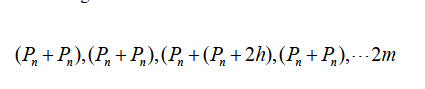
you are using P_n here for half a dozen of different numbers
tribal palm
Its an infinite sequence.
west glade
that makes no sense
tribal palm
its in general
west glade
thats not how that works
tribal palm
you can test this construct to make any even number and its possible.

a prime plus a prime times a special function, and the special function has two options.
west glade
another thing, you are claiming that the practical numbers together with doubles of the primes, make up all even numbers. thats false. even 102 already isnt in either list
tribal palm
Hmmmm. I will have to look into that.
102=97+5
This does not fall under either case that I have presented.
you are correct, there is one other hidden sequence at play that I guess I overlooked.
44,50,52,68,70,76,92,98,102,110,114,116.......
well hang on, its true that 102 is not in either sequence, however 102 = 5 + 97, this falls under the even shift case.
So I think the only part that was incorrect was to assume two sequences to make up the even numbers, now there are 3 sequences.
Here is the update, the only thing that changes was that now there is a 3rd sequence needed to make the full set of even numbers.
rare barn
But how have you proven that every single even number works
tribal palm
By showing that there are only 2 functions which satisfy the formula.

there is a constant function, think
f(x)=1
And f(x)=1+(x/Pn)
The case of 1 is trivial, the case of the other, because there is a variable h or x it is flexible to generate an even number with this or should I say, an even shift.
Each time.
rare barn
You should maybe bring this to a more advanced NT channel, I’m not qualified to find the flaw in your proof
 patent acorn
tribal palm
Here is the update, the only thing that changes was that now there is a 3rd sequ...
patent acorn
tribal palm
Here is the update, the only thing that changes was that now there is a 3rd sequ...
here's the incorrect step

you just claim this without proving it at all
this is also wrong

44 is the sum of 3 and 41, which are prime numbers that are 38 apart, but it is not in A005153
rare barn
Thx bee
 weary ivy
Study of the integers using elementary techniques: Prime numbers and divisibility, modular arithmetic, congruences
Includes: Simple Diophantine equations, reciprocity, number bases, results on number theoretic functions (Euler's totient function, the prime counting function, etc.), the rings ℤ/nℤ, etc.
Questions requiring analytic techniques (e.g. limits, complex calculus) do not belong here; try a channel in the "Advanced" section.
weary ivy
sacred junco
Same as the bridges problemm
That's graph theory
So the Chinese Remainder Theorem is number theory
weary ivy
sacred junco
Could i manage to do these?
With enough study yes, you just need time
And effort
 whole oracle
can i ask questions in this room?
: give n be natural number show that there is positive number of a,b so that 4a^2 + 9b^2 -1 can be divided by n
 wind juniper
please can someone help me prove the wilson's theorem
i am stuck at some point
like i understood most of the way
west glade
it would help to say where you are stuck
wind juniper
when how can this guy say that every number has an inverse in that range?

i understood all the proof
but i can't get why does every number have an inverse in that range
 half yacht
Since p is a prime, then every number from 2 to p-1 is relatively prime to p. Hence, each of them has an inverse
half yacht
Wait, I don't get why we have to assume that the inverse is smaller than p.
wind juniper
like is it an already acquired information?
half yacht
In the provided proof, there were no assumptions about having an inverse smaller than p
Since we are already working modulo p, which guarantees it being smaller than p
(about this last sentence i said, don't take it so seriously, I am not sure about it. Just my intuition)
wind juniper
because when the guy ordered all the numbers he assumed that every number multiplied in (p-1)! has an inverse that is also multiplied?
still flare
As stated, remember we are working modulo p. So for example 15 == 2 modulo 3.
wind juniper
why is that?
half yacht
Well, we listed all numbers from 1 to p-1. Since every number less than p has an inverse (mod p), then it must be found on that list
still flare
wind juniper
because when the guy ordered all the numbers he assumed that every number multip...
Because every number not congruent to 0 mod p has an inverse modulo p, when p is prime. You are hopefully familiar with this fact because I don't want to rehash number theory.
half yacht
We just don't know what it is, but we definitely know it exists there
wind juniper
so every number not congruent to 0 mod p has always an inverse mod p that is also always in the product of (p-1)! ?
still flare
Yes
wind juniper
OK thank you so much
i am not that good with number theory because i am still in high school and the teacher gave us homework to prove the wilson's theorem
and we didn't get that deep into number theory
sacred junco
From the following system of equations:
$$
\begin{pmatrix}
d_1 r_1 - r_2 =0\
r_1 + d_2 r_2 - r_3 =0\
-r_2 + d_3 r_3 =0\
\end{pmatrix}
$$
How do I determine how $r_i \mid r_j$? For instance, from Equations (1) and (3), it is clear that $r_1 \mid r_2$ and $r_3 \mid r_2$, but what can I gather from the second equation?
sterile pumiceBOT
gian
Compile Error! Click the reaction for more information.
(You may edit your message to recompile.)
 primal pewter
sacred junco
From the following system of equations:
$$
\begin{pmatrix}
d_1 r_1 - r_2 =0\\
...
primal pewter
sacred junco
From the following system of equations:
$$
\begin{pmatrix}
d_1 r_1 - r_2 =0\\
...
from the second one alone you can't get much information, but you can combine equations
for example, from (2) you get r_1 | d_2r_2 - r_3
but since you have r_1 | r_2 from the first one, it follows r_1 | r_3
and using a similar reasoning you can find r_3 | r_1, which combined with the above relation yields r_3 = +/- r_1
sacred junco
Okay I see
Thank you!
Do you happen to know any software that would be able to do this for me?
primal pewter
no, I don't know
but maybe wolfram alpha could solve the system
although it's not hard to do it by hand
I mean solve without the constraint that the numbers are integers
sacred junco
I agree that it's not hard to do by hand but it gets much harder the more equations you have. For instance:
\begin{pmatrix}
r_1 - r_2 - r_3 - r_4 =0\
-r_1 + d_2 r_2 - r_3 =0\
-r_1 - r_2 + d_3 r_3 =0\
-r_1 + d_4 r_4 - r_5 =0\
- r_4 + d_5 r_5 =0\
\end{pmatrix}
sterile pumiceBOT
gian
Compile Error! Click the reaction for more information.
(You may edit your message to recompile.)
 sacred junco
Is pretty nasty to figure out
unique cypress
sacred junco
I agree that it's not hard to do by hand but it gets much harder the more equati...
are you comfortable with R, MATLAB or anything?
rare barn
This problem is kicking my ass and the people in the help channels told me to go here
 rare barn
Citrus you’ve been typing for like 30 minutes are you ok
 serene sinew
rare barn
Citrus you’ve been typing for like 30 minutes are you ok
serene sinew
rare barn
Citrus you’ve been typing for like 30 minutes are you ok
i know nothing about number theory but:
if the number of repeating digits is m, and 1/3^n is x, then:
10^m * x - x = x(10^m - 1) is a whole number, call that whole number y
that means y = (10^m - 1), which is just m 9s, must be a multiple of 3^n
so y mod (3^n) = 0
and m is the smallest natural number that satisfies that equation (cuz if there was a smaller m, the number of repeating digits would just be that m instead)
also, any number made up of just 9s must be divisible by 9, so if we divide everything by 9 we have:
y/9 mod (3^(n-2)) = 0
y/9 is just m 1s, so the sum of its digits is m. say y/9 = z, so z is divisible by 3^(n-2)
in order for z = m 1s to be divisible by 3^(n-2), it needs to be divisible by 3, and we see that for a number to be divisible by 3, its digits must sum to a multiple of 3, and the smallest possible multiple of 3 is 3
in general, we have that in order for a number to be divisible by 3^(n-2), we have to be able to divide it by 3 n-2 times. say you do that and get a number q, which is no longer divisible by 3. thus:
q * 3 = z / 3^(n - 3) must have digits summing to a multiple of 3
q * 3 * 3 = z / 3^(n - 4) must have digits summing to a multiple of 3 * 3
q * 3 * 3 * 3 = z / 3^(n - 5) must have digits summing to a multiple of 3 * 3 * 3
...
q * 3^(n-2) = z must have digits summing to 3^(n-2)
since z is m 1s, the smallest number of digits that would do this is when the number of digits is m = 3^(n-2)
rare barn
I don’t just want the answer
serene sinew
idk how to help sorry 😭 i know nothing about number theory
i just decided to have a go at it myself
rare barn
Does a single person in this discord know anything about number theory
rare barn
rare barn
Does a single person in this discord know anything about number theory
Istg no one does
I have an idea that i feel is on the cusp of working
 topaz raptor
Number theory is... just kinda over done ngl
I personally don't want to do it
topaz raptor
rare barn
This problem is kicking my ass and the people in the help channels told me to go...
ig u can use induction
rare barn
I have an idea to use induction but I’m not sure it’s rigorous
topaz raptor
ah, i see, ill tell u if i get anywhere
topaz raptor
you did? awesome
what did u try?
rare barn
So the base case is 1/9, which is 0.111…
To divide this by 3^n, there must be 3^n total division steps due to divisibility rules for powers of 3
So it must take 3 steps to get to 1/27 since 1+1+1 is the first that leaves a remainder of 0
And that goes for any power of 3
topaz raptor
i was just exploring this too! good job!
serene sinew
👏
congrats
a much better proof than my "proof" lol
(ive never done proofs before tbh, thats why it took me 30 minutes of typing, tryna formulate my thoughts into words)
rare barn
That was probably my biggest brain blast ever
serene sinew
waow
topaz raptor
rare barn
That was probably my biggest brain blast ever
are u doing comp math?
rare barn
My books I’m using have problems from comps but I’m not actively participating in any atm no
I do want to soon though
Also the book used this but I prefer my solution
 topaz raptor
yep, yours is concise, what book are you using btw?
rare barn
AoPS introduction to number theory
topaz raptor
oh, I have to do AoPS, gonna try math comps again this year, thanks
rare barn
GL!
weary rune
undergrad NT books are too bogged down in symbol pushing formalisms
that's why i like aops books bc they cut out all the bullshit and get straight to the point
rare barn
God that was an amazing problem
Kicked my ass for like an hour only got me to have a single insight that instantly cracked it wide open
weary rune
weary rune
that's why i like aops books bc they cut out all the bullshit and get straight t...
i may or may not have bought their entire line of books in middle school, i still read them even as an undergrad now - they're that good with lots of interesting problems to chew on
rare barn
Pre algebra and intro to algebra
weary rune
nice
well going through the whole series will give you a great math foundation, much better than what you'd get in a standard curriculum
rare barn
Indeed
weary rune
i wish they'd publish an intermediate NT or intermediate geo text tho 😔
rare barn
I’m excited for the geometry book
weary rune
oh yeah geo is really fun too
people in the contest circuit usually hop to evan chen's euclidean geometry in mathematical olympiads once they've mastered the basics (basically the content of intro geo + a bit more)
weary rune
they have some structural issues in some places but their approach of having you try the problems first works so well
especially when they guide you through some of the bigger proofs
rare barn
Ikr
weary rune
lets you see the motivation for them better
rare barn
I’m prob better at what math I’ve learned than my college educated mom
weary rune
i have a really old beaten up copy of volume 2 that i studied religiously in early high school lmao
not all majors require very much math :)
rare barn
True
weary rune
in the US the standard seems to be calc 2 or 3 for non math STEM majors
and either calc 1 or stats for everyone else
rare barn
She was a psychology major tho so I assume she’s taken stats
weary rune
yea
sacred junco
unique cypress
are you comfortable with R, MATLAB or anything?
I'm comfortable with Mathematica
I'm kinda comfortable with MATLAB and Sage
 mint dew
Sorry, I'm an absolute beginner... Can I ask for recommendations for the best number theory book ..?
I've decided to learn number theory to support my cryptography class... so I have no idea about this branch:(
white lion
mint dew
Sorry, I'm an absolute beginner... Can I ask for recommendations for the best nu...
an elementary introduction to number theory by calvin t long
half yacht
if you want to speedrun number theory, there's that article by Sato from AOPS
white lion
he also has a crytpography section in the 3rd edition I believe. I think it is out of print but it's a wonderful book and worth picking up IMO (they might have it in your schools library)
 urban dust
mint dew
Sorry, I'm an absolute beginner... Can I ask for recommendations for the best nu...
weary rune
urban dust
mint dew
Sorry, I'm an absolute beginner... Can I ask for recommendations for the best nu...
weary rune
not sure how to work with the "less than 4 solutions" condition here
 primal pewter
weary rune
not sure how to work with the "less than 4 solutions" condition here
primal pewter
weary rune
not sure how to work with the "less than 4 solutions" condition here
basically you have to prove that if p=1 (mod 4), then the equation has 4 solutions
weary rune
so in that case, $4\mid\phi(p)$
sterile pumiceBOT
elrichardo1337
 weary rune
since $p-1\equiv 0\pmod{4}$
sterile pumiceBOT
elrichardo1337
 weary rune
how do we connect that to the congruence having 4 sols
primal pewter
are you familiar with quadratic residues?
primal pewter
it can be done without them
firstly, x^4-1=(x^2+1)(x^2-1)
two solutions are 1 and -1 and we want to get other two from x^2+1=0 (mod p)
weary rune
oh d'oh factoring
primal pewter
in other words we want -1 to be a quadratic residue, but we avoid this
we just want to construct a solution
weary rune
is this where $p\equiv 1\pmod{4}$ comes in
sterile pumiceBOT
elrichardo1337
 primal pewter
and then if x is a solution, -x is another solution
yes
it's related to Wilson's theorem
weary rune
hmm how so
primal pewter
(p-1)! = -1 (mod p)
so 1*2*3*...*(p-1)/2 * (p+1)/2 * ... * (p-1) = -1 (mod p)
and from the second half use k = k-p (mod p)
weary rune
so our solutions would be of the form $1\cdot 2\cdot\cdots\cdot \frac{p-1}{2}?$
sterile pumiceBOT
elrichardo1337
 primal pewter
yes
weary rune
hmm aight
weary rune
it seems like this would just be fermat

but i'm not sure about the cases where $p\mid a$
sterile pumiceBOT
elrichardo1337
 weary rune
oh wait that wouldn't matter would it?
we would reduce the base mod p first then apply fermat, and clearly $p$ does not divide any of ${0,1,\dots,n-1}$
sterile pumiceBOT
elrichardo1337
 primal pewter
yeah, I guess they want to use a^p=a (mod p) to reduce degrees
this implies a^(pk+r)=a^r (mod p)
weary rune
yea
primal pewter
but induction doesn't really seem to be necessary
primal pewter
and in fact the problem has a one line solution using Euclidean division
weary rune
and clearly all terms must be reducible to degree less than p
primal pewter
we can divide f by X^p-X and take the remainder
weary rune
is the following an acceptable proof that $\gcd(a,mn)=1$ implies $\gcd(a,m)=\gcd(a,n)=1?$
since $\gcd(a,mn)=1,$ there exist integers $x,y$ such that $xa+ymn=1=xa+(ym)n=xa+(yn)m$
but that means there also exist integers $x,y_1=ym,y_2=yn$ such that $xa+y_1n=xa+y_2m=1,$ so that $\gcd(a,m)=\gcd(a,n)=1$
sterile pumiceBOT
elrichardo1337
 topaz raptor
weary rune
is the following an acceptable proof that $\gcd(a,mn)=1$ implies $\gcd(a,m)=\gcd...
topaz raptor
weary rune
is the following an acceptable proof that $\gcd(a,mn)=1$ implies $\gcd(a,m)=\gcd...
Yup, it works
weary rune
aight
sacred junco
What is the use of the elementary number theory, can someone please brief it for me please.
I am in high school so this is the first time i ever saw this.
weary rune

LetMeGoogleThat.com
For all those people that find it more convenient to bother you with their question than to google it for themselves.
at a basic level, number theory deals with divisibility, primes, factorizations, modular arithmetic, and other things
 silver oak
sacred junco
What is the use of the elementary number theory, can someone please brief it for...
silver oak
sacred junco
What is the use of the elementary number theory, can someone please brief it for...
if you heard gcd, you were learning this
fleet bone
silver oak
if you heard gcd, you were learning this
i mean
at school level its not rigorous at all
sacred junco
silver oak
if you heard gcd, you were learning this
Nope
K is nothing related to it
Know*
fleet bone
they assume that factorization is unique
and stuff
[though any formal oly course in India pretty sure doesnt care proving the uniqueness too lmao]
fleet bone
sacred junco
Nope
ur school didnt even teach what greatest common divisor is
💀
its called HCF in some curriculums
sacred junco
fleet bone
its called HCF in some curriculums
Yes HCF
I was confused about what GMD was
 lime oar
sacred junco
What is the use of the elementary number theory, can someone please brief it for...
lime oar
sacred junco
What is the use of the elementary number theory, can someone please brief it for...
A lot of current encryption technology relies on prime number stuff which comes out of number theory. Hth.
sacred junco
lime oar
A lot of current encryption technology relies on prime number stuff which comes ...
Oh, is it primarily for computing or is there any other use for it in terms of maths?
lime oar
sacred junco
Oh, is it primarily for computing or is there any other use for it in terms of m...
I think the Wikipedia article on the topic has a good summary. I’m no expert. It’s certainly applicable to most aspects of modern communications and computation (networking, error correction, memory management). Anything to do with randomness. I’m sometimes unsure of the boundaries between number theory and combinatorics. I’ve heard it applies to physics also but I’ve not studied that aspect.
sacred junco
lime oar
I think the Wikipedia article on the topic has a good summary. I’m no expert. It...
Ahh I see, I will look into it then.
lime oar
sacred junco
Ahh I see, I will look into it then.
I believe there’s also been a bunch of connections between number theory and analysis that have yielded really profound results. The structure of Andrew Wiles’s proof of Fermat’s Last Theorem, for instance, pulled together a bunch of analysis, algebra and number theory in ways I don’t fully understand but look like they’d be really cool to learn about :)
lime oar
sacred junco
Ahh I see, I will look into it then.
There’s also “numerical analysis,” where number theory is applied to continuous objects that are otherwise intractable https://www.mathworks.com/discovery/numerical-analysis.html
https://www.reddit.com/r/math/comments/10aetmr/what_actually_is_numerical_analysis/
Personally number theory is my current favourite math, because it’s often easy to describe problems, and I’m interested in Paul Erdős :)
primal pewter
wait what? numerical analysis is not related to number theory
lime oar
primal pewter
wait what? numerical analysis is not related to number theory
Fair. I was not being precise, and like I said, I’m no expert. I meant in the sense that it involves application of numerical and computational methods.
patent acorn
"numerical methods" and "number theory" are different meanings of number
number theory is natural numbers/integers, continuous objects if they're "numbers" would usually be real or complex numbers
the word "number" is honestly pretty vague
sterile pumiceBOT
Godspell
 nova vine
this is a legendre symbol and p>7 is a prime. I dont understand what the statement is asking me to find
 fleet bone
nova vine
this is a legendre symbol and p>7 is a prime. I dont understand what the stateme...
fleet bone
nova vine
this is a legendre symbol and p>7 is a prime. I dont understand what the stateme...
basically find (7/p) in terms of p mod 28
nova vine
fleet bone
basically find (7/p) in terms of p mod 28
dont get it
fleet bone
nova vine
dont get it
ok so basically
given p mod 28
they want u to determine (7/p)
like similar to how u find critetnions of (3/p),(2/p),... and stuff
or (-1/p)
if ur solving any book those prolly would be given before
nova vine
fleet bone
ok so basically
do I need to find if 7 is a quadratic residue?
fleet bone
nova vine
do I need to find if 7 is a quadratic residue?
what does (7/p) mean in first place lmao
finding (7/p) is same as that [as p>7]
lime oar
patent acorn
the word "number" is honestly pretty vague
This. Thank you. I was just reading the introduction to a number theory book that traces the historical evolution of number as a concept. Pretty wild stuff.
 meager sand
Guys, how can I proof 2²⁰²³ == 8 (mod 10)?
weary rune
“prove” not “proof”
look at the units digits for smaller powers of 2, and try to notice a pattern
white lion
meager sand
Guys, how can I proof 2²⁰²³ == 8 (mod 10)?
use the fact that a^phi(n) = 1 (mod n)
 round swift
white lion
use the fact that a^phi(n) = 1 (mod n)
round swift
white lion
use the fact that a^phi(n) = 1 (mod n)
you can't use that
2 is not coprime to 10
white lion
oops you're right, rookie mistake.
so you're going to have to just good ol basic modular simplifcation
note that 2^5 = 2 (mod 10)
that should be enough
 heavy plover
🚀
sacred junco
Is my solution to the problem correct? Please let me know 🙏

I am not sure if the solution is correct or not
But would like to know if there are some mistakes
primal pewter
sacred junco
I am not sure if the solution is correct or not
it's wrong
this conclusion is false

if you have ab=cd, this does not imply a=c or a=d
 patent acorn
well $y \in \mathbb{Q}$ contradicts the assumption that $y \not\in \mathbb{Q}$
sterile pumiceBOT
bee [it/its]

 distant sandal
👍
sacred junco
primal pewter
if you have ab=cd, this does not imply a=c or a=d
Then it seems you haven't seen the conditions I used after that.
Even though, There at that conclusion of ab = cd I am trying to say that 'a' may be equal to c or 'a' may also be equal to d.
And if a = c then b = d or
If a = d then b = c
primal pewter
@sacred junco 12*30=15*24
sacred junco
primal pewter
<@456226577798135808> `12*30=15*24`
Hmmm....
sacred junco
primal pewter
<@456226577798135808> `12*30=15*24`
Then in this case we cannot say that a = c or a = d
But the problem which I was trying to solve had given an equation
Wait wait
I got what's wrong
Okay
 novel locust
Hi there, can someone explain how could I visualize the regions this proof describes? I don't get how their area is $(2n+1)^2$. I understand the rest of the proof well enough, including the conclusion. By the way, here $\Lambda$ is just the set of point with integral coordinates. Thanks in advance
 sterile pumiceBOT
lazur__
 novel locust
I was thinking of something like this, the conclusion would make sense but that region wouldn't have area (2n+1)^2... can someone help me?
 primal pewter
@novel locust you have (2n+1)^2 identical regions that do not overlap, and the area of a region is delta
therefore the total area is (2n+1)^2 * delta
for visualization, it's something like this (not necessarily circles, but this was easier for me to draw)

 unkempt magnet
primal pewter
<@1149340680884326430> you have (2n+1)^2 identical regions that do not overlap, ...
unkempt magnet
primal pewter
<@1149340680884326430> you have (2n+1)^2 identical regions that do not overlap, ...
How can I know there are (2n+1)² regions though? What does n depict? and why do we make it approach infinity?
No, wait. Nevermind I'm dumb
Thanks a lot, that makes a lot of sense
 wheat patio
Hello hello! I'm trying to figure out this proof, but I feel like I'm missing something. Does anyone have any ideas of where I would go with this proof?

 coral venture
if ab divides c then a divides c
west glade
what does n|a-b mean
wheat patio
west glade
what does n|a-b mean
N divides a-b, so there exists an integer y such that ny=a-b
wheat patio
coral venture
if ab divides c then a divides c
Oh okay so it is okay to conclude that m|a-b and thus a is congruent to b mod n? I didn't think I had enough proof yet since we don't know if it would be m or x that divides a-b.
Wait that wouldn't matter
wheat patio
coral venture
if ab divides c then a divides c
I see this is correct now
So this would be enough for the proof right?
 wheat patio
primal pewter
yes, but you can even skip the mx=n part
wheat patio
primal pewter
yes, but you can even skip the mx=n part
I could, but I don't want to run the risk of my prof docking points if I don't show I know why I can skip that part. Duly noted though, I'll check with my TA and see what they think I should do.
primal pewter
wheat patio
I could, but I don't want to run the risk of my prof docking points if I don't s...
you technically still skipped it
coral venture
wheat patio
Oh okay so it is okay to conclude that m|a-b and thus a is congruent to b mod n?...
m and x both divide a-b if mx divides a-b
primal pewter
the short argument is that the divisibility relation is transitive
which you tacitly used when you concluded that mx | a-b implies m | a-b
wheat patio
primal pewter
you technically still skipped it
True
wheat patio
wheat patio
I see this is correct now
@coral venture ^ thank you though! Appreciate you making the effort to clarify further
coral venture
No problem
 turbid fable
hi
heavy plover
🚀
sterile pumiceBOT
Plazzi
 sacred junco
v_p is the p-adic valuation
primal pewter
@sacred junco the point is that if you use binomial expansion for (1+p)^(p^(n-1)), then you have 1 + (...), where the remaining terms are multiples of p^n
 frail swift
What are the solutions of this equation $9a^3 +10b^3 + 11c^3 = 0$?
sterile pumiceBOT
Abir
 frail swift
<@&286206848099549185>
primal pewter
@frail swift work modulo 9
||infinite descent||
tribal palm
I am working on the Goldbach conjecture. The paper is attached.
The main thing I have to prove is this:

 cinder linden
we claim to prove the goldbach conjecture, which states that the sum of two prime numbers is always an even number
uh
patent acorn
ok yeah that's false and also isn't the goldbach conjecture
cinder linden
patent acorn
ok yeah that's false and also isn't the goldbach conjecture
at least the paper doesn’t try to prove the statement in the abstract
patent acorn
i think it might in section 4? but i can't actually understand that well enough to work out what it's supposedly a proof of
section 3 states that the goldbach conjecture is true, and claims to have thereby proven the goldbach conjecture
cinder linden
tribal palm
I am working on the Goldbach conjecture. The paper is attached.
The main thing...
can i ask why you’re trying to prove it?
since the combined sequence represents the set of all even numbers
i think listing that it works for the first 50 even numbers is not a proof that it works for all even numbers
 pale lagoon
Let $a_n$ be the number of positive divisors of $n!$ for all $n$, and $(u_n)$ defined for all $n$ by $u_n=\frac{a_{n+1}}{a_n}$. Can you help me to show that the subsequential limits of $(u_n)$ are 1 and the $\frac{k+1}{k}$ with $k\in\mathbb{N}^*$ please ?
sterile pumiceBOT
TimourX
 pale lagoon
Don't hesitate to ping me
unique cypress
tribal palm
Are you serious rn?
 void abyss
tribal palm
void abyss
tribal palm
Isn’t 44 in the green sequence?

It’s hard to point out exactly what things are wrong since the entire structure of the proof doesn’t make sense to me. But at least I can tell you that this step is wrong. P_n will be different for each natural number

 gleaming dome
hi i m new in this server
cinder linden
gleaming dome
hi i m new in this server
hello!
 errant otter
theorem 112: if p is prime, then x^(p-1) -1 = (x-1)(x-2) ... (x-p+1) mod p. if we compared the constant terms, we obtain a new proof of wilson, and if we compared the coefficients of x^(p-2), x^(p-3), ..., x, we obtain:
theorem 113: if p is an odd prime, 1 <= l < p-1, and A_l is the sum of the product of l different numbers of the set 1, 2, ..., p-1, then A_l = 0 mod p
I'm unsure as to the definition of A_l here, it feels vague. Could anyone elaborate?
"sum (over how many?) of the product of (any?) l different numbers of the set {1, 2, ..., p-1}"
sum over all possible ways to pick l numbers from the set?
errant otter
ah, okay, so it is (alternatively it A_l = the coefficient of x^(p-l-1) for the polynomial (x-1)(x-2) ... (x-p+1))
.... now I'm having trouble understanding why this is true
nova vine
How do I calculate 55125 by using its given prime factors since our function uses the divisors of 55125?
 runic token
$\sum_{d|n}$ is summing over the divisors of $n$. in this case, prime factorization is $3,3,5,5,5,7,7$
nova vine
there are 35 divisors of 55125, i think there is some trick
sterile pumiceBOT
valley
 nova vine
<@&286206848099549185>
runic token
don't ping helpers in topic channels
 neat harness
nova vine
How do I calculate 55125 by using its given prime factors since our function use...
neat harness
nova vine
How do I calculate 55125 by using its given prime factors since our function use...
think it's just writing it out, using properties of jacobi symbol and grouping things up that repeat
nova vine
but writing out all 35 divisors is a bit tedious innit
neat harness
well that's the part where grouping things up that repeat would come in
since (-1/ab) = (-1/a)(-1/b) you could do a counting argument of how many (-1/3)'s, (-1/5) and (-1/7)'s show up
nova vine
hmm interesting
neat harness
not sure if it's the intended approach  but can't think of any tools that give you a faster answer off the top of my head
nova vine
wouldnty that get exponentially long since I'll be splitting up almost every divisor
nova vine
neat harness
not sure if it's the intended approach <:shreg:879075446493425734> but can't thi...
yea
neat harness
well no because (-1/3) = -1, (-1/5) = 1, and (-1/7) = -1
nova vine
oh yes i overlooked that
neat harness
and jacobi symbol is a multiplicative function
so when you come across the term, say (-1/ (3 ^2 * 5 * 7^2))
nova vine
neat harness
and jacobi symbol is a multiplicative function
but the "numerator" has to be from natural numbers for it to be multiplicative
neat harness
you could use the fact that it's (-1/5) * (-1/(3^2 * 7^2)) where in the second jacobi symbol should have already been computed earlier
neat harness
nova vine
but the "numerator" has to be from natural numbers for it to be multiplicative
nop
the denom is positive odd
numerator can be any integer
nova vine
 neat harness
ok well it's also true for integers
nova vine
i see
neat harness
if t were negative, you can just shift by some multiple of m so it lies within [0, ... , m - 1]
nova vine
neat harness
if t were negative, you can just shift by some multiple of m so it lies within [...
okay hear me out
if the jacobi is multiplicative, then the whole f(n) is multiplicative, and we can put our primes from the prime factorisation in the function like, f(p_1)f(p_2)...
is this correct?
significantly reduces the tediousness
nova vine
neat harness
mobius inversion theorem
yea but i dont see how i can use that here
neat harness
ok yes sorry, i misremembered the statement
neat harness
nova vine
if the jacobi is multiplicative, then the whole f(n) is multiplicative, and we c...
uh but as for this
how do you combine sums of jacobi symbols
nova vine
neat harness
how do you combine sums of jacobi symbols
i tried, but it seems that even if one symbol becomes 0 then everything becomes zero. Since (-1/1)=1 and (-1/3)=-1 and adding them gives zero. I think this is why the "numerator" is restricted
neat harness
huh
nova vine
theyre multiplicative, and I got f(3)=0
but the answer should be 1, as I checked by brute force
unless im wrong
neat harness
oh yes
uh
just double checking you did
f(3)^2 * f(5)^ 3 * f(7) ^ 2
and f(3) = 0
neat harness
nova vine
but the answer should be 1, as I checked by brute force
wdym you checked by brute force
wait im stupid
it should be
f(3^2) * f(5^3) * f(7^2)
the exponents don't get factored out
nova vine
1, 3, 5, 7, 9, 15, 21, 25, 35, 45, 49, 63, 75, 105, 125, 147, 175, 225, 245, 315, 375, 441, 525, 735, 875, 1125, 1225, 1575, 2205, 2625, 3675, 6125, 7875, 11025, 18375
trhese are all the divisors
1 is 1
3 is -1
5 is 1
7 is -1
and so on
neat harness
neat harness
f(3^2) * f(5^3) * f(7^2)
this is answer
neat harness
no
nova vine
how
neat harness
gcd(3,3) != 1
neat harness
if f is multiplicative, f(ab) = f(a)f(b) only when a,b are coprime
nova vine
yes youre right
neat harness
yes sorry it's been a long time since elementary number theory and im tired
completely forgot sum of multiplicative function over its divisors is itself a multiplicative function
nova vine
hahaha no worries, I appreciate your effort
 calm sparrow
Hello everyone! I'm a mathematics enthusiast, and I've recently delved into studying an introductory book on number theory. I'd appreciate some assistance along the way. 😁
I aim to prove that the cancellation law of multiplication in the set of integers Z (if a.c = b.c then a = b) need not be accepted as an axiom. It can instead be derived as a theorem from a proposition ensuring that for any integers a, b, and c, if a > b and c > 0, then ac > bc, and if a > b and c < 0, then ac < bc. However, I'm struggling to devise a strategy; transitioning from a strict inequality to an equality seems daunting. The book has equipped me with the fundamental laws of addition and multiplication operations (closure, commutativity, associativity, etc.), a theorem on the unique existence of the additive inverse, a.0 = 0, and the axiom of good ordering. Nonetheless, I'm open to any suggestions or tips to get started.
spare frigate
Assume ac=bc, then show that a is not greater nor less than b
so then it must be equal
calm sparrow
spare frigate
Assume ac=bc, then show that a is not greater nor less than b
Great, I'll try it here 😁
calm sparrow
spare frigate
Assume ac=bc, then show that a is not greater nor less than b
I've outlined the proof here and stopped at 4 cases to be checked, all of which lead to contradicting the adopted hypothesis that ac = bc. After verifying these cases, I could then use the law of trichotomy to conclude that it must be the case that a = b. Does that seem okay? Is there a more "intelligent" way to avoid checking all these cases?
 spare frigate
No that’s a pretty good way of doing it.
I would do it that way it’s simple enough
I would however group the cases where c>0 together and c<0 together
But that’s a proof writing choice rather than a detail
calm sparrow
Thank you very much! 😀
 errant shore

Suppose $a$ has order $d mod p$. So, we can write $a^{d} \equiv 1 mod p.$ Similarly, suppose $a^{b}$ has order $d$. So, we can write $(a^{b})^{d}\equiv 1 (mod p)$. For the sake of the argument, suppose $gcd(b,d)>1$. Let $gcd(b,d)=k$, such that $k>1$. Since $gcd(b,d)=k$, we can use Bezout's identity and write $bx+dy=k$, for some $x,y\epsilon\mathbb{Z}$.
sterile pumiceBOT
Matt.Rey
 errant shore
This is my draft so far. I'm generally confused if this is correct or if I'm far off the mark
primal pewter
@errant shore if gcd(b,d)=k, then (a^b)^(d/k)=1
rare barn
That doesn’t sound true
primal pewter
it is true, but I meant to say =1 (mod p)
rare barn
Ah
 quartz crater
$\pmod{p}$ :(
sterile pumiceBOT
ethan
 quartz crater
does anyone have opinions on Stillwell or Silverman for nt?
runic token
silverman is fine as an intro
quartz crater
thanks!
 zealous swift
sacred junco
zealous swift
sacred junco
Me too I need help
How can I prove the product of 3 continuous integers is divisible by 6
rare barn
sacred junco
How can I prove the product of 3 continuous integers is divisible by 6
What numbers must at least one of 3 consecutive integers have as a prime factor
sacred junco
2?
rare barn
That is one of them yes
 ashen stump
sacred junco
How can I prove the product of 3 continuous integers is divisible by 6
ashen stump
sacred junco
How can I prove the product of 3 continuous integers is divisible by 6
Given three numbers n, n + 1, and n + 2, it is easy to prove that at least one of them is divisible by 3
sacred junco
Sorry I am completely new w number theory 😭
 acoustic shale
I have a theory and I don't know where to post it so I'll just post here.
In short I've come up with a way to enumerate any number of infinite sets to the set of natural numbers. I don't see any flaws here but I'm told it should not be possible so I'm curious.
Suppose we need to map the set of even numbers, the set of odd numbers and the set of prime numbers to the set of natural numbers.
Take the natural set and pick apart the even positions. Map the whole of even numbers to those even position. We will still be left with odd positions. Separate the odd positions and write them down in assending order in a new set.
New set =[1,3,5,7,9,11...]
Now break those odd positions down further into even-odd positions and odd-odd positions
Even-odd positions will be the numbers like 3,7,11 etc that are by themselves odd but occupy the even positions of our new set. Likewise will be the odd-odd positions.
Now map the Even-odd positions with the odd set and finally map prime numbers with odd-odd positions.
In this was we can map an infinite amount of infinite series of numbers to just 1 set of natural numbers.
We can use the formula
(2^k)n - (2^k) - 1
To find the place of nth number of our kth series on Natural set of series.
patent acorn
yep, this is an example of a pairing function https://en.wikipedia.org/wiki/Pairing_function
In mathematics, a pairing function is a process to uniquely encode two natural numbers into a single natural number.Any pairing function can be used in set theory to prove that integers and rational numbers have the same cardinality as natural numbers.
i don't think that formula is quite right but the idea is sound
whoever told you that this isn't possible was either wrong, or they actually said something different
acoustic shale
patent acorn
i don't think that formula is quite right but the idea is sound
I did check the formula upto 3 series, it's fine upto that point atleast
acoustic shale
patent acorn
yep, this is an example of a pairing function https://en.wikipedia.org/wiki/Pair...
Wait so I did not discover anything ground breaking 🗿
patent acorn
acoustic shale
I did check the formula upto 3 series, it's fine upto that point atleast
k=1, n=5 and k=2, n=3 both produce 7
acoustic shale
Wait what
patent acorn
acoustic shale
Wait so I did not discover anything ground breaking 🗿
yeah no, in fact i would not be surprised if this exact construction has already been found previously
acoustic shale
patent acorn
k=1, n=5 and k=2, n=3 both produce 7
Also how did you find this our so quickly I'm impressed
patent acorn
patent acorn
whoever told you that this isn't possible was either wrong, or they actually sai...
probably the thing it was supposed to be referring to was cantor's theorem, which implies you can't enumerate all infinite sets using the natural numbers - as in, an assignment like "even numbers = 0, odd numbers = 1, prime numbers = 2, non-prime numbers = 3, all numbers except six = 4, ..." must miss some set
patent acorn
acoustic shale
Also how did you find this our so quickly I'm impressed
well it's the same as (n-1)2^k - 1
the -1s don't affect much so it's kind of just "is n2^k a pairing function"
and it isn't, because if you halve n and add one to k those cancel out and the answer doesn't change
so something like 2*2^1 and 1*2^2 are both 4
(2n+1)2^k-1 is a pairing function and i suspect that that's what the correct formula is for your construction
patent acorn
hm
i don't think it's really about particular knowledge? i just have more practice at mathematical thinking in general
...or i guess in this case it was the particular knowledge i had about the existence of pairing functions and what the correct statement of cantor's theorem is, but that's more just "you asked about something i happen to know about"
patent acorn
although, here's one generally useful trick: if you seem to have two proofs that prove opposite things, you can often run them against each other to see what happens
like, if you think you've found a bijection between the set of natural numbers and the set of sets of natural numbers, you can apply cantor's theorem to the bijection and it will actually give you a set that you missed
acoustic shale
Idk about cantors theorem and biejction yet but I'll watch a vid on it today, too curious now
 severe ermine
is it good for the start?

 dark tiger
I am taking a look at the theory of continued fractions. For a number $\alpha$ in the interval $[0,1]$ there corresponds a unique sequence $(a_1, a_2, \ldots)$ of natural numbers which may be thought of as the continued fraction of $\alpha$. If we think of each $a_n = a_n(\alpha)$ as a function of $\alpha$, is there an explicit formula for $a_n$?
sterile pumiceBOT
mdc
 patent acorn
i think just, $a_1 = \lfloor\alpha\rfloor$, $a_2 = \left\lfloor\frac1{{\alpha}}\right\rfloor$, $a_3 = \left\lfloor\frac1{\left{\frac1{{\alpha}}\right}}\right\rfloor$, etc
sterile pumiceBOT
bee [it/its]
 patent acorn
where $\lfloor x \rfloor$ is the floor of $x$, and ${x}$ is the fractional part of $x$, or $x - \lfloor x \rfloor$
sterile pumiceBOT
bee [it/its]
 dark tiger
patent acorn
i think just, $a_1 = \lfloor\alpha\rfloor$, $a_2 = \left\lfloor\frac1{\{\alpha\}...
dark tiger
patent acorn
i think just, $a_1 = \lfloor\alpha\rfloor$, $a_2 = \left\lfloor\frac1{\{\alpha\}...
Do you have a reference for this that I can check?
patent acorn
no
but it's kind of just implied by the way you compute a continued fraction
you first split the number up as $\lfloor\alpha\rfloor + {\alpha}$, an integer and a fractional part
sterile pumiceBOT
bee [it/its]
 patent acorn
then you write it as a reciprocal, $\lfloor\alpha\rfloor + \frac1{\frac1{{\alpha}}}$
sterile pumiceBOT
bee [it/its]
 patent acorn
then you split that, $\lfloor\alpha\rfloor + \frac1{\left\lfloor\frac1{{\alpha}}\right\rfloor + \left{\frac1{{\alpha}}\right}}$
sterile pumiceBOT
bee [it/its]
 sterile pumiceBOT
bee [it/its]
 patent acorn
just because of how the process is iterated
dark tiger
Makes sense. Thanks
 dusk ore
Let $d = gcd(s, n)$, where $s$ is integer and $n$ is natural. $\varepsilon_i$ is a complex primitive root of unity of degree $n$. $\mu(n)$ is Mobius function, $\varphi(n)$ is Euler Totient function.
Prove that $$\sum_{i=1}^{\varphi(n)} \varepsilon_i^s = \frac{\varphi(n)}{\varphi(\frac{n}{d})} \mu \left(\frac{n}{d}\right)$$
I'm not quite sure if this topic is a proper place to post this problem because of complex numbers but it suits better than others I guess... I know a plenty of properties of Mobius and Totient function as well as about roots of unity, but the equation is so clumbersome it's hard to apply anything.
sterile pumiceBOT
Moonlight
 dusk ore
There was a task about the fact that $\sum_{i=1}^{n} \varepsilon_i = \mu(n)$ which seems to be a special case of the fact above, but it's hard to generalize this
sterile pumiceBOT
Moonlight


 dusk ore
Can you use quadratic reciprocity law here?
dusk ore
It just looks like you can easily make a step from mod p^2 to mod p using it
flipping the Legendre symbols
 lethal cedar
is x (mod y) and congruence related in some way?
 proud lodge
well congruence mod k is... what it sounds like
ex. 1 and 11 and 21 and etc. are congruent to 1 mod 10
1 mod 10 == 11 mod 10 == 21 mod 10
wheat patio
What would I do to prove this? I included what I was able to come up with, but I don't know if it's any good considering I don't know where to go from here

Sry bout the double message, discord mobile is... discord mobile
wheat patio
neat harness
then what is a(x0 + nk) ?
Is that what I'm supposed to have formatted it as? That a(x0+nk) = b?
I had that at one point but I didn't think it was right
wait how would you get an a to the nk to allow factoring out that a?