#elementary-number-theory
1 messages · Page 5 of 1
 drifting imp
 wooden glen
The domain is the set of things you can use as input to the entire composition.
drifting imp
wooden glen
The domain is the set of things you can use as input to the entire composition.
Right so the set would just be the co domain no?
wooden glen
The codomain of f is neither the domain nor the codomain of g o f.
wooden glen
Therefore those things are neither the input to g o f nor the output from it.
wooden glen
Yes.
drifting imp
And the codomain would be the codomain of g?
wooden glen
Yes.
drifting imp
I see
I was thinking of the two functions separately
But f has to be valid before it can be put into g so the domain must be from f
wooden glen
Suppose $f:\bN\to\bR$ and $g:\bR\to\bC$. You can't use an arbitrary real number as input to $g\circ f$, so $\bR$ cannot be the domain. Neither can you be sure that the output fo $g\circ f$ will always be real, so $\bR$ cannot be the codomain either.
 sterile pumiceBOT
Troposphere

 verbal cedar
for a given $a\in\bZ$ and $n\in\bN$, is there a name for or way to indicate the integer $\alpha$ satisfying
$$\alpha\equiv a\pmod{n},\quad 0\leq\alpha<n$$
sterile pumiceBOT
nilpotent nix
 verbal cedar
i have an expression which gives a difference of integers (z2-z1), but what i really need is the least nonnegative congruent integer of that difference. is there a compact way to notate that? like [z2-z1] or something idk
 dusty dragon
You can use the equivalence notation $[a]$ to indicate $[a] = { a + nk : k \in \mathbb Z }$. So you can say that $\alpha \in [a]$ to mean that $\alpha \equiv a \pmod n$
sterile pumiceBOT

 still flare
sterile pumice
**nilpotent nix**
still flare
sterile pumice
**nilpotent nix**
That's called the remainder.
wooden glen
It's sometimes written as $a \bmod n$, though some feel that is to computer-sciencey to be used in serious math.
sterile pumiceBOT
Troposphere

 sleek spire
I am not sure whether this is the right channel for this, but how do I show that there exists no $x \in \bQ$ such that $\sqrt[3]{2}^2 x \in \bQ$?
sterile pumiceBOT
rectangle cube
 still flare
You are asking whether or not the cubed root of 2 is rational. Have a look at the proof that the square root of 2 is irrational, and try and generalise it to arbitrary roots of 2.
wooden glen
sleek spire
I am not sure whether this is the right channel for this, but how do I show that...
But there is: x=0 satisfies that.
sleek spire
still flare
You are asking whether or not the cubed root of 2 is rational. Have a look at th...
oke thanks!
 tacit heart
Which theorem goes along these lines? : $(1 + n)^{p^r} \equiv 1 + n^{p^r} \pmod{p}$
still flare
This is known as the freshman's dream
tacit heart
what
still flare
I'm not joking
tacit heart
oh
sterile pumiceBOT
kappa
 tacit heart
Aren't these different?
still flare
No
tacit heart
"A related theorem states that if p is prime then (x + 1)p ≡ xp + 1 in the polynomial ring {\displaystyle \mathbb {Z} _{p}[x]}{\displaystyle \mathbb {Z} _{p}[x]}."
still flare
If you're referring to how one doesn't have a power of r, that comes from repeated powers of p. It follows from induction.
tacit heart
Yea but what's the related theorem's specific name?
still flare
It is called the freshman's dream
that is the name
they talk about the proof there
wooden glen
I don't think the corollary where the exponent is p^r rather than p has a name of its own.
tacit heart
Ok thanks!
 torn escarp
I'd suggest asking #competition-math instead
 fluid steppe
 polar ruin
Isn’t this number theory though?
polar ruin
Isn’t this number theory though?
pretty big overlap between the 2 ngl
torn escarp
I wouldn't say this is nt, this isn't really about integers or rational numbers it's more about an inequality of real numbers
polar ruin
Ah mb
torn escarp
it's not too serious, there is a lot of overlap, it's just I thought you might get better results asking there
polar ruin
I see thanks
 white lion
hey anyone know whats wrong here? it's related to pythagorean triples
so we have here (s,t) = (3,4) => (x,y,z) = (2st, t^2 - s^2, t^2+s^2) = (24,7,25)
there is a result that states that 3|y for all y
but here in this case y=7 and 7 isn't a multiple of a 3 obviously
what am I missing here?
but 24^2+7^2=25^2 is a true statement
torn escarp
I guess since 3 | 24 you have flipped x and y
I'm not familiar with the result you describe but from this form it's not hard to show at least one of x or y must be divisible by 3. If s and t are not divisible by 3, then y=t^2-s^2 is divisible by 3. If one of s or t is divisible by 3, then x=2st is divisible by 3.
this means only exactly one of x or y is always divisible by 3, but you could always rearrange them so that y was the one that's divisible by 3 if you wanted
white lion
@torn escarp but y is always equal to t^2-s^2 (and t>s always because y>0) and that would be 7
 torn escarp
white lion
<@622029249053982720> but y is always equal to t^2-s^2 (and t>s always because ...
torn escarp
white lion
<@622029249053982720> but y is always equal to t^2-s^2 (and t>s always because ...
this says 3 | x in the first line
torn escarp
yeah you're welcome 👍
white lion
what about in the case of (3,4,5)
we know that x=2st
2st=3 doesn't make sense though that would mean s or t isn't an integer
torn escarp
white lion
2st=3 doesn't make sense though that would mean s or t isn't an integer
yeah, the formula generates primitive pythagorean triples, but that doesn't mean you can go backwards by picking them and working out what s and t are
3=s^2-t^2, 4=2st, 5=s^2+t^2 with s=2 and t=1 is what would generate this one
torn escarp
Fix an integer $n$, are there integers $a,b$ with $1\le a \le n-1$ such that $a^2-b^2(1+n^2)=\pm 1$? My guess is no, and I verified this up to n=10,000 by computer (unless I made an error in my code). If that guess is correct, it should prove $n-\sqrt{1+n^2}$ is always a fundamental unit in $\bZ[\sqrt{1+n^2}]^\times$.
sterile pumiceBOT
mOwOsity
 torn escarp
actually I think there's a trick for showing a solution is minimal for pell's equation
 fervent grove
[any] unit a + b*sqrt(n^2-1) with minimal [nonzero] |b| should be [fundamental], right?
I'm pretty sure taking powers uniformly increases the height of the coefficients here
or something
torn escarp
oh yeah good point, since I'm already at |-1|=1 it should be minimal, N(n-sqrt(n^2+1)) = -1 should be a unit then
powers will only raise it, that was conveniently easy haha
thanks
verbal cedar
given that $n\geq3$ is an odd integer, and
$$k\equiv 1\pmod{n},\quad k\equiv d_0\pmod{2}$$
is there a way to solve for $k$?
sterile pumiceBOT
nilpotent nix
 verbal cedar
ik a solution exists by the Chinese remainder theorem, but not how to find it
 stiff rivet
why not just check for d_0 = 0, 1
dusty dragon
Let $k = 1 + nt$. Then $1 + nt \equiv d_0 \pmod 2$ or equivalently $nt \equiv d_0 + 1 \pmod 2$. But this implies that $t \equiv n^{-1} (d_0 + 1) \pmod 2$. You now have an expression for $t$ so you have an expression for $k$
sterile pumiceBOT
 dusty dragon
In particular, you can write $t = n^{-1}(d_0 + 1) + 2m$, which implies that $k = 1 + (d_0 + 1) + 2mn$. In other words, $k \equiv d_0 + 2 \pmod{2n}$
sterile pumiceBOT
 torn escarp
Well, if k is a positive integer, the smallest k could be is 1 just by looking at k=1 mod n. Now if d_0=1 mod 2, then it agrees there too. If d_0=0 however, then because n is odd, we can say k=1+n.
we could package this up nicely as k=1+n(1-d_0)
since that's the minimal positive k, you could just add any arbitrary multiple of 2n to it
torn escarp
verbal cedar
ik a solution exists by the Chinese remainder theorem, but not how to find it
oh as far as this is concerned, you can use the CRT to find the answer explicitly, let me give an example. Let's say you know n=a mod p, n=b mod q, and n=c mod r for distinct primes p, q, r.
Now we know by fermat's little theorem that $(qr)^{p-1}$ will be 1 mod p but it's also 0 mod q and 0 mod r. This trick lets us combine all the solutions without them interfering with each other
sterile pumiceBOT
mOwOsity
 torn escarp
So hopefully it's clear, $$n=a(qr)^{p-1} + b(pr)^{q-1}+c(pq)^{r-1} \mod pqr$$
If you reduce this, say, mod r, you can see it'll recover where you came from
$$n=a0 + b0+c*1 \mod r$$
sterile pumiceBOT
mOwOsity
 torn escarp
admittedly this might not be the best route to take, but at least I wish someone had shown me this when I first learned it
 pine badge
For a positive integer m how could I find all values c such that
c = m - (n*a)
Where:
n is a positive integer < m
a is a positive integer <= floor((2m+1)/2)
And c is any integer + or -, from (n+1)^2 mod 3 to n(n-1)/2, that is even if n mod 4 is in {0,1} and odd if in {2,3}.
My way has been to make a matrix with columns a, rows n, and entries c. Then just check if values of c meet the criteria for c.
 covert finch
sorry I misworded this question
is this statement true?
if a^n = 1 (mod b) for some n, then a and b must be relatively prime
basically, euler's theorem's converse
and if so how would you prove it
 sacred junco
covert finch
and if so how would you prove it
sacred junco
covert finch
and if so how would you prove it
you can use bezouts lemma with a direct proof i think
bezouts lemma states that gcd(a, b) = as + bp for a certain s, p in integers
with mod proofs, try putting it into equation form
covert finch
alr so I have
a^n = bt + 1 for some t
a^n - bt = 1
a(a^(n-1)) + (-t)b = 1
it would be convenient if I could show that a^(n-1) and -t are s and p, somehow
but s and t can only be some integers, not all
dusty dragon
It might be helpful to note that a^n = a * a^{n - 1}, which implies that a is a multiplicative unit in Z_b. But this is true iff gcd(a, b) = 1
sacred junco
covert finch
but s and t can only be some integers, not all
but you showed the existence of such integers that form a linear combination to yield the gcd
which is enough for bezout i believe
covert finch
dusty dragon
It might be helpful to note that a^n = a * a^{n - 1}, which implies that a is a ...
what does multiplicative unit mean?
I don't really see how a^{n-1} is relatively prime to b
dusty dragon
covert finch
what does multiplicative unit mean?
A multiplicative unit is an element that basically has a multiplicative inverse. In other words, we say that a is a unit of Z_n if there exist some b in Z_n such that ab = 1 (mod n)
dusty dragon
We prove that a is a unit of Z_b iff gcd(a, b) = 1.
(=>) Suppose that a is a unit of Z_b. Then, for some c in Z_b, ac = 1 (mod b). But this implies that there exist some y such that ac - by = 1. But, if a and b have a common divisor, then it must consequently divide 1. You can see this because any common divisor of a and b can be factored and since we are working over the integers, the common divisor must divide 1. But this only happens when the common divisor is exactly 1 (or -1). Therefore, gcd(a, b) = 1.
(<=) Suppose that gcd(a, b) = 1. Then, by Bezout’s lemma, there exist integers x, y such that ax + by = 1. But this implies that ax = 1 - by, which is equivalent to ax = 1 (mod b). Hence, a is a unit of Z_b
sacred junco
covert finch
I don't really see how a^{n-1} is relatively prime to b
You just showed via bezouts lemma
You showed that a(a^(n - 1) + (-t)b = 1, which means you found two integers a, -t that make a linear combination of a^(n - 1) and b. Bezouts essentially shows that the gcd must divide all linear combinations. since the gcd divides 1 it must be 1 . You can prove bezouts using the well ordering property to all positive linear combinations of a and b for (gcd(a,b) = as + pb).
Now you can say because $a = p_1^{q_1} * p_2^{q_2} * ..., b = m_1^{n_1} * ...$ for their prime factorizations, you can find $a^{n-1} = p_1^{(n-1)q_1} * p_2^{(n-1)q_2} * ...$ Because $a^{n-1}, b$ are prime, they must have different prime factors, so it leads to $gcd(a, b) = 1$. Then you can show $a^n, b$ are relatively prime.
sterile pumiceBOT
JOKER
 covert finch
sacred junco
You showed that a(a^(n - 1) + (-t)b = 1, which means you found two integers a, -...
covert finch
sacred junco
You showed that a(a^(n - 1) + (-t)b = 1, which means you found two integers a, -...
Bezouts essentially shows that the gcd must divide all linear combinations
this was the key part I was missing, thanks
covert finch
dusty dragon
We prove that a is a unit of Z_b iff gcd(a, b) = 1.
(=>) Suppose that a is a uni...
this also helped, thanks
sacred junco
covert finch
> Bezouts essentially shows that the gcd must divide all linear combinations
thi...
http://ramanujan.math.trinity.edu/rdaileda/teach/s20/m3326/lectures/bezout_handout.pdf this should resolve any doubts about this
covert finch
right that makes sense, since if you let gcd(a,b) = d, then d divides a and b, so for all ma + nb, you can write a and b as rd and sd for some r and s, so ma + nb = mrd + nsd = d(mr + ns) which is clearly divisible by d
sacred junco
yep
torn escarp
pine badge
For a positive integer m how could I find all values c such that
c = m - (n*a)
...
I don't quite understand the last part "And c is any integer + or -, from (n+1)^2 mod 3 to n(n-1)/2" are you taking (n+1)^2 mod 3 then reducing to something in {0, 1, 2}? But that kind of means c will always be positive, but you said it could be negative, so doesn't seem quite right to me
also floor((2m+1)/2) = floor(m + 1/2) = m since m is an integer, so you can simplify that part slightly
 green linden
hi guys. is this solution to this question correct?


PS: Please tag me incase anyone answers
torn escarp
green linden
hi guys. is this solution to this question correct?
not quite, two gaussian integers are associate if they differ by a unit. It looks like you found the units, but there are more elements that are nonunits that differ by a unit. Maybe look at u*(a+bi)=a-bi and pick u from {1,-1,i,-i} and see what constraints this places on a, b to make it true.
hint: ||there are infinitely many||
 fervent crest
torn escarp
not quite, two gaussian integers are associate if they differ by a unit. It look...
fervent crest
torn escarp
not quite, two gaussian integers are associate if they differ by a unit. It look...
Oh this is so much easier than what I did, which was by writing out (a+bi)/(a-bi) and seeing when is this even a gaussian integer
torn escarp
actually I find it easier to think about geometrically cause complex conjugation is reflection and units give 90 degree rotations, this makes it kind of obvious to me that the only lines fixed are along the + and X
fervent crest
Yeah
pine badge
torn escarp
I don't quite understand the last part "And c is any integer + or -, from (n+1)...
Sorry my definition made no sense,
Maybe better way to say is
r = (n(n-1))/2
c is any odd integer from -r to r if r is odd and any even integer from -r to r if r is even.
pine badge
torn escarp
also floor((2m+1)/2) = floor(m + 1/2) = m since m is an integer, so you can simp...
The floor bit is not too important as I beleive using values of a outside this range will never land in the desired c range.
pine badge
torn escarp
I don't quite understand the last part "And c is any integer + or -, from (n+1)...
So can be:
For a positive integer m how could I find all values c such that
c = m - (n*a)
Where:
n is a positive integer < m
a is a positive integer < m
And c is any odd integer from -r to r if r is odd and any even integer from -r to r if r is even.
Where r = (n(n-1))/2
This does ignore the obvious c=0 when a=m and n=1.
torn escarp
nothing jumps out at me, maybe working out some stuff by computer would make a pattern more obvious idk
what's this for btw
pine badge
torn escarp
nothing jumps out at me, maybe working out some stuff by computer would make a p...
Ok, thanks for thinking about it, this is for trying to find some expression for the number of compositions of m where the differences of adjacent parts is in {-1,1}.
torn escarp
oh you want to count the number of c values, not necessarily describe them with a formula?
or wait, what's a composition, some kind of ordered partition, like 6=1+2+3 would be an example but 6=1+3+2 doesn't since 1 and 3 are more than 1 apart kind of thing?
pine badge
Yea
torn escarp
at least, I'm wondering about making a generating function for it unless you already have one
or maybe simpler, a recurrence relation
pine badge
No I don't have a generating function, for the number of compositions
But for the c values, I want to know which values of c work with which n and a. So more than just count
torn escarp
I guess some crude upper bound is the number of ordered partitions is we can imagine n stones with n-1 dividers between them, that gives us 2^{n-1} ordered partitions. We can then look at divisors of n, since for instance 4=2+2=1+1+1+1 correspond to the 3 divisors of 4, tau(4), although the single number n itself is fine, so 2^{n-1} - tau(n)+1 >= c_n I guess
idk probably there are better bounds lol
but you want to have them explicitly I see
pine badge
Oh that's a nice way to remove compositions with the same parts
torn escarp
there's also gonna be a symmetry with like, 2+1 and 1+2 but you have self-symmetric cases like 1+2+1
trying to work out a recurrence relation by thinking about how to make them, I think something like looking at breaking it into k parts and considering that first, then adding all those easier cases up maybe
pine badge
Also think the a needs to be bounded lower than <m.
Yes, this is why I look at the c values for n and a. n is the number of parts minus one and a is the first part of the composition
torn escarp
at least, that corresponds to how to get the numbers explicitly too
pine badge
I think it works by checking a matrix of all c values with columns aand rows n in the desired ranges.
Then r gives a desired range of c for each row.
If a row has a value c in that range, that corresponds to one or more valid composition.
Then to find out how many valid compositions for that c value, there is another process geekotechy, came up with in the combinatoric structures page
But this process is long and confusing lol
torn escarp
I would just brute force them with a python program lol
pine badge
Brute force I thought this was a math server
torn escarp
haha
pine badge
There is an oeis entry. Others have brute forced to large m
torn escarp
I think I have a fairly simple way that might be similar to yours, for finding them. Basically for breaking it into k parts, you have some equation like n=x+(x+1)+(x+2)+(x+1)+(x+2)+(x+3)+... where you stop at k terms and each constant in each term is incremented or decremented by 1, so really it becomes n=kx + a, where a is this aggregate number independent of n and x, only dependent on k
because there are k-1 choices to make for +1 or -1, this means there are 2^{k-1} different "paths" to take, which is kind of large I guess, although it's symmetrical so we can halve it to 2^{k-2}
main thing is having these aggregate numbers 'a' lets us check if n-a = 0 mod k
if yes, then it's a composition
so I'm thinking brute force these 2^{k-2} different a values with n... for each k<inverse function of (n(n+1)/2)
probably there are better ways, but that's best I got for now lol
the fact that these a numbers are independent kind of seems neat to me, but maybe this is a red herring
pine badge
But once you get to a 1 there is only one choice
torn escarp
oh I might be over counting by letting in negative values or 0 or something hmm
link me the oeis
pine badge
Ok let me find the number
torn escarp
I imagine we're not gonna be able to do much better than they have done, so if they say stuff like "equivalent to the euler-ramanujan numbers divided by the erdos-bernoulli numbers squared"
torn escarp
yeah, I guess it's too tightly packed or something
addition and multiplication are both sorta creeping into compositions, seems really difficult
they're pretty rigid too, like at first I was thinking we could make a recurrence relation by trying to make compositions from the smaller compositions, but that's not really so easy cause each composition depends on what numbers are on the left and right ends
pine badge
So each number m can be composed into 1s and 2s, this is the longest length form. Then each odd has a one of length two, even has a length three.
torn escarp
yeah, this is sorta how I was looking at the "aggregate numbers" earlier relating to the modular arithmetic aspect
although I was being a bit too reckless and that would allow non positive numbers
like 1s and 2s corresponds to m=x + (x+1) + x + (x+1) + ... sort of case
I guess our perspectives on the same case are slightly different though hmm
pine badge
How so?
torn escarp
I was looking modulo the number of terms appearing, you're looking modulo m, the number itself
torn escarp
I think my a value is different than yours I think
I should have used a different letter lol
gonna think more about this
pine badge
Hmm, as m gets large the way you were thinking about the space of possible compositions being symmetric is valid. For small m the compositions are mostly in the non symmetric space involving 1s and 2s.
Maybe the compositions could be split into one's coming from The symmetric tree space of choices . And some other kind.
torn escarp
I was able to come up with a recurrence relation if I split it apart a bunch
define $C_n$ to be the number of compositions of n, then define $C_{n,k}$ to be the number of compositions of n that have their last number k. Then it's clear that $C_n=\sum_{k\ge 1} C_{n,k}$. Now -
sterile pumiceBOT
mOwOsity
 torn escarp
we can make $C_n$ alternateively from the smaller parts by looking at $C_{n-k,k\pm 1}$, since taking a composition of $n-k$ that ends in $k-1$ or $k+1$ will let us add $k$ to it to make $n-k+k=n$, so: $$C_n=\sum_{k \ge 1} C_{n-k,k-1}+C_{n-k,k+1}$$ with the convention that $C_{n,0}:=0$ for the edge case, since 0 is never the last number.
sterile pumiceBOT
mOwOsity
 torn escarp
well maybe recurrence relation is the wrong thing, but a bit more playing around probably can turn this into a recurrence relation or generating function
the key fact is $C_n$ is being made out of $C_{m,k}$ with $m<n$
sterile pumiceBOT
mOwOsity
 torn escarp
or actually I could refine it into a recurrence relation by writing it as $$C_{n,k} = C_{n-k,k-1}+C_{n-k,k+1}$$ since I'm making a term that ends in k, ok cool
sterile pumiceBOT
mOwOsity
 torn escarp
after I eat I think this could be turned into a generating function with two variables and maybe something can be thrown at it like snake oil
pine badge
Oh wow, I will also look at this more after lunch
 junior swallow
im a bit confused about this corollary from pascal's identity
it states that for any fixed integer n greater than or equal to 1 and n greater than or equal to k, 2 * (n choose k) is equal to (n + 1 choose k).
however pascal's identity states that (n choose k) + (n choose k -1) = (n +1 choose k)
but from 2 * (n choose k), wouldn't we have 2 * (n choose k) = (n choose k) + (n choose k) which is not equal to (n choose k) + (n choose k - 1)
fervent crest
I don't think that's true, can you send a full screenshot of what the statement is?
@junior swallow
junior swallow
fervent crest
I don't think that's true, can you send a full screenshot of what the statement ...
oh LMFAO I posted it to chat gpt 😭😭😭
And it said it was true
Ayo @cunning plinth what’s good lmao
 cunning plinth
hi
fervent crest
Chat gpt is not good at doing math
junior swallow
Yea now that I look at the proof it gave it’s not completely true….
fervent crest
Yeah cause like you pointed out
$\binom{n+1}{k}=\binom{n}{k}+\binom{n}{k-1}$ so if $2\binom{n}{k}=\binom{n+1}{k}$ then $\binom{n}{k}=\binom{n}{k-1}$ which is not just true
sterile pumiceBOT
Whoever
 fervent crest
It's saying consecutive numbers on the pascal triangle are the same
 dense scroll
for b, I understand that I have to see if gcd(n,7) = 1, but I'm lost as to how I should do that
 still flare
Hint: gcd(n, 7) = 1 if and only if gcd(n + 7k, 7) = 1, where k is any whole number
torn escarp
idk if I'm saying the same thing or not, but since gcd(3,7)=1 you can apply fermat's little theorem, so determine what the exponent is mod 6. hint: ||there are easy divisibility by 2 and 3 tests you can do to determine it||
 fervent grove
there are a couple ways to do this
I really like this question, so I'll give you a few paths:
- use the fact that every prime has a primitive root
- use Newton's sums on the equation x^{p-1}-1. namely, what are the roots of this polynomial?
- let
abe an element whose order does not dividek. multiply the entire sum bya^k.
 native monolith
Okay thank you
 uncut pumice
Why is this true?
$$∑_{d=1}^∞\frac{μ(d)}{d²} = \frac{1}{ζ(2)}$$
where $μ$ is the Möbius function, $ζ$ is the zeta function
sterile pumiceBOT
Mattuwu
 torn escarp
uncut pumice
Why is this true?
$$∑_{d=1}^∞\frac{μ(d)}{d²} = \frac{1}{ζ(2)}$$
where $μ$ is th...
torn escarp
uncut pumice
Why is this true?
$$∑_{d=1}^∞\frac{μ(d)}{d²} = \frac{1}{ζ(2)}$$
where $μ$ is th...
More generally this follows from the Euler factorization for zeta(s) at any s, not just s=2
$$\frac{1}{\zeta(s)} = \prod_p \left( 1 + \frac{-1}{p^s}\right)$$
sterile pumiceBOT
mOwOsity
 torn escarp
if you imagine expanding this out, the coefficients on 1/n^s can only come from when n is square free, since only p occurs, and when they do occur, there's a -1 so the number of primes in the number is what gives the same thing in the mobius function
If you're not very familiar with dirichlet series, I'll give an example, if we look at the n=6 term, it will come exactly from (-1/2^s)*(-1/3^s) = 1/6^s
if you look at the n=4 term, since -1/2^s only appears once, there is no other term with 2^s in the denominator to multiply with it, it means 0/4^s is what we have
if you're not sure where the euler factorization comes from, I think there's a decent derivation on wikipedia, it's basically factoring the zeta function like the sieve of eratosthenes
uncut pumice
@torn escarp Thanks!
I get how the factorisation is equivalent to the dirichlet series of 𝜇 now
torn escarp
cool
yeah, it's pretty important that this works out, by analogy with regular power series the zeta function and dirichlet series of the mobius function play the same role as partial sums and finite differences with them cancelling out as telescoping series, which is really all mobius inversion is doing
tacit heart
$\text{If} \ k^a \equiv k^b \pmod{n}, \text{then} \ a \equiv b \pmod{\varphi(n)}.$
sterile pumiceBOT
kappa
 tacit heart
Why is this true?
verbal cedar
suppose $n$ is even, but the following equation does have a solution
$$2k\equiv c\pmod{n}$$
is there a way to get a formula or expression for $k$?
sterile pumiceBOT
nilpotent nix
 verbal cedar
<@&286206848099549185>
 wraith hull
A closed expression?
verbal cedar
wraith hull
A closed expression?
yeah
wraith hull
K is a natural?
verbal cedar
is it possible for a specific even n? preferably, I'd like a solution for arbitrary even n, but idk what's possible.
verbal cedar
wraith hull
K is a natural?
k is an unknown integer
wraith hull
Aight
 loud moon
@verbal cedar if c is odd then there is no solution, because the lhs and rhs have different parities. depending on the factorization of n there is potentially more than one solution for k (modulo n), but a generic one is, uninterestingly, k = c / 2 (mod n). what specific solution are you after?
in general if 2k = c (mod n) and n = 2m, i.e. is even, and c is even by necessity, then k = c/2 (mod n/2), the proof is easy: if 2k = c (mod n), then 2k = un + c for some integer u, so dividing through by 2, k = u(n/2) + (c/2), so k = c/2 (mod n/2). that should give you a full set of solutions for k, that is, k = c/2 + u(n/2) for all integers u
verbal cedar
loud moon
<@196803594576592896> if c is odd then there is no solution, because the lhs an...
yes, thank you. it's observations like this that I'm looking for.
the full system I'm working with is
\begin{gather*}
k_1\equiv d\pmod{2}\
2k_2\equiv m_1-d\pmod{n}\
k_1+4k_3\equiv d+m_0-m_1\pmod{n}\
2k_4\equiv c\pmod{n}
\end{gather*}
sterile pumiceBOT
nilpotent nix
 verbal cedar
i can get explicit solutions for the k's when n is odd no problem. but I'm wondering if it's also possible when n is even (and assuming a solution does exist)
verbal cedar
sterile pumice
**nilpotent nix**
(c,d,m0,m1 are all given constants)
loud moon
@verbal cedar we can see that m0 and m1 must have the same parity, since if you take the third equation mod 2 (which is valid since n is even) then we get k1 = d + m0 - m1 (mod 2), and since k1 = d (mod 2) we get m0 = m1 (mod 2).
that means that you can freely set k3 = 0, and just let k1 = d + m0 - m1 (mod n) and you are done. you can see this is not in contradiction with the first congruence
basically the system is underdetermined
but if you want a non-zero k3, then it's straightforward to observe that you can just pick any k3 and adjust k1 accordingly to satisfy congruence (3), it won't affect the parity of k1 and therefore won't break congruence (1) and you are good to go
uncut pumice
Let 𝑝ᵢ be the 𝑖-th prime number with 𝑝₁ = 2, 𝑝₂=3 ..., How do you show that ∀ 𝑛, 𝑝ₙ ≥ 𝑛 + 1 ?
still flare
Note that p_i is odd for all i>1, so p_i >= 2i-1 > i for all i>1.
uncut pumice
still flare
Note that p_i is odd for all i>1, so p_i >= 2i-1 > i for all i>1.
oh no, so elegant, thanks!
just realized that's kinda a dumb question. with 𝑝₁ = 2, because primes only take integer values and is increasing, the rest of the primes have to be at least 1 or more larger than the subscript.
sacred junco
x = 10 (mod 12) and x = 4 (mod 5) so 10 + 12a = 4 + 5b. If we look at this equation mod 4, then we get b = 2 (mod 4), but this gives x = 14 + 20k for some integer k
That is not the solution, why?
uncut pumice
uncut pumice
just realized that's kinda a dumb question. with 𝑝₁ = 2, because primes only ta...
More generally, let 𝑎: ℕ → ℕ be an strictly increasing sequence, if 𝑎(𝑚) = 𝑛 for some 𝑚, 𝑛, then ∀ 𝑙>𝑚, 𝑎(𝑙) ≥ 𝑙+(𝑛-𝑚)
torn escarp
uncut pumice
Let 𝑝ᵢ be the 𝑖-th prime number with 𝑝₁ = 2, 𝑝₂=3 ..., How do you show that ...
fun, trying to think of how to do better like Boytjie's, p_{3+2n} >= 5+6n and p_{4+2n} >= 7 + 6n since we know primes must be 1 or 5 mod 6 after 2, 3
I guess this could just be done arbitrarily further out by sieving further but it gets grosser
sacred junco
Can anyone please explain I'm really blanking on it
torn escarp
sacred junco
x = 10 (mod 12) and x = 4 (mod 5) so 10 + 12a = 4 + 5b. If we look at this equat...
your final answer should be something up to a multiple of 60 since 12*5=60, you sorta picked mod 4 arbitrarily which is part of being a necessary condition
sacred junco
The real answer is x = 34 (mod 60)
sacred junco
torn escarp
your final answer should be something up to a multiple of 60 since 12*5=60, you ...
I didn't pick it arbitrarily, I picked it because it makes the coefficient of b 1, and it gets rid of a
torn escarp
yeah, and 34=14 mod 20, you just stopped short
yeah, but in doing so you've not really solved the full problem, you haven't solved for them all the way
sacred junco
torn escarp
yeah, but in doing so you've not really solved the full problem, you haven't sol...
Why not?
I understand that I didn't but I don't know why
torn escarp
oh I think I see the nature of your misunderstanding
we're trying to combine something mod 12 with something mod 5, so you should be reducing your equation mod 12 or mod 5
I'd recommend mod 5
sacred junco
But why can't I use 4? 4 gets rid of the 12 too
torn escarp
4 divides 12, but it leaves an extra "3" unaccounted for
you could then go through and reduce mod 3 by what you plug in and that will finish it too
like say b=2+4c and plug that in 10+12a = 4+5(2+4c) now reduce mod 3 and solve for c
this is not the most efficient way, but hopefully seeing it this way helps show how to fill in the gap
uncut pumice
uncut pumice
More generally, let 𝑎: ℕ → ℕ be an strictly increasing sequence, if 𝑎(𝑚) = 𝑛...
Fun, I just realized this is just an analogous of the mean value theorem, and the fact that the "derivative" of an increasing sequence of integers is lower bounded by 1
torn escarp
what do you get
sacred junco
So suppose we do that. Then we get 10 + 12m = 2 + 4n, looking at it mo 3, we get n = 2 + 3g
torn escarp
I'll show what I get, maybe this will help
I ended up getting c=1 mod 3
so I plug in:
x = 4+5(2+4c) = 4+5(2+4(1+3d)) = 34 + 60d
sacred junco
No you should get c = 2 mod 3?
torn escarp
show your work
sacred junco
10 + 12a = 2 + 4c so 1 + 0 = 2 + c (mod 3) => -1 = c (mod 3) => 2 = c (mod 3)
torn escarp
ah, no, you've plugged in b wrong, you need the rest of the equation there
x = 10+12a = 4+5b
x = 10+12a = 4+5(2+4c)
sacred junco
Oh okay I see, got it
torn escarp
cool
sacred junco
Thanks
torn escarp
You're welcome
in general though it's faster to do reduction mod 5 directly here
or you could do mod 12 directly too rather than breaking it up into mod 4 and mod 3
uncut pumice
torn escarp
fun, trying to think of how to do better like Boytjie's, `p_{3+2n} >= 5+6n` and ...
Note that p_n >= p_{n-1} + 1, repeated use this:
p_n >= p_{n-1} + 1 >= p_{n-2} + 1 + 1 >= p_{n-3} + 1 + 1 + 1 ... = p_k + n - k
In particular, we have: p_n >= p_1 + n - 1 = n + 1
torn escarp
yeah I understand that argument, I was trying to do a better linear lower bound
uncut pumice
👍
torn escarp
for p>3 all primes are 1 or 5 mod 6, so if they were close together as possible it would mean 5, 7, 5+6, 7+6, 5+12, 7+12, etc are all prime
it's basically taking Boytjie's idea of primes p>2 are 1 mod 2, so 3, 3+2, 3+4, 3+6, etc would be the closest possible spacing
uncut pumice
But I guess linear bounds are ultimately not interesting because p_n ~ n log n
torn escarp
yeah
tacit heart
fervent grove
take `n=7` and `k=1` and `a=0` and `b=1`
That’s because log base 1 isn’t defined
fervent grove
yes
your response does not make the statement you gave true
I think the correct statement is k^a = k^b (mod n) <=> a = b (mod order of k)
uncut pumice
Let $𝑝_𝑖$ be the 𝑖-th prime with $𝑝₁=2, 𝑝₂=3, 𝑝₃=5 ...$,
how do I show for all positive integer 𝑛,
$$
∏_{𝑖=1}ⁿ \frac{𝑝_𝑖}{𝑝_𝑖-1} ≤ 𝑛+1
$$
sterile pumiceBOT
Mattuwu
 uncut pumice
I'm trying induction but I got stuck at the induction step
torn escarp
I'm guessing something like $\frac{p_i}{p_i-1} = 1+\frac{1}{p_i-1} \le 1+\frac{1}{i}$ from the inequality earlier is useful
sterile pumiceBOT
Merosity
 torn escarp
idk maybe not
uncut pumice
Ohh, you are totally right, cuz the it telescopes:
$$
∏_{i=1}ⁿ \frac{p_i}{p_i-1}
$$
sterile pumiceBOT
Mattuwu
 torn escarp
oh nice
uncut pumice
yeah I won't bother typesetting, thanks!
torn escarp
yeah you're welcome
verbal cedar
loud moon
<@196803594576592896> we can see that m0 and m1 must have the same parity, sinc...
i see, thank you! yeah i slightly modified it, and didn't realize that my modification made k3 inconsequential. it was also late at night so i copied the conditions wrong lol, but i was able to get a solution
k1=d+m0-m1
k2=(m1-d)/2
k4=c/2
with the necessary assumptions that k1,d,m0,m1 all have the same parity.
verbal cedar
at least, i think lol
 bronze cypress
Keep unrelated stuff out of the topics channels please... 1 hour mute
 faint dust
I don't see how the congruence follows from the expansion of (1 + 4k)^2
 torn escarp
faint dust
I don't see how the congruence follows from the expansion of (1 + 4k)^2
torn escarp
faint dust
I don't see how the congruence follows from the expansion of (1 + 4k)^2
you could put $k=2^su$ with $u=1\mod 2$ and that gets you $$(1+2^{s+2}u)^2 = 1+2^{3+s}u(1+2^{s+1}u)$$ and it kind of makes the induction argument for what to do with powers of $2$ easier since you're getting $$(1+2^kv)^2 = 1+2^{k+1}w$$ for $v=w=1\mod 2$.
sterile pumiceBOT
Merosity
 torn escarp
at least, induction is how I'd normally think of trying to prove a more general sort of thing looking at lifting the p-1 roots of unity to mod p^k.
faint dust
That makes sense, thank you. I'll try it with other primes p as well
torn escarp
p=2 is kind of weird, should be easier and also you can sorta just truncate the binomial theorem I think should be good to see that if w^{p-1}=1 mod p^k then u = w^p satisfies u^{p-1} mod p^{k+1}
faint dust
Right, I was trying binomial expansion at first because that seemed to work for odd primes
torn escarp
I guess the main sticking point for 2 is $$(1+2n)^2 = 1+8 \frac{n(n+1)}{2}$$
sterile pumiceBOT
Merosity
 torn escarp
all odd squares are 1 mod 8
or maybe that doesn't matter, does (a+pn)^p always have this same kind of issue for gcd(a,p)=1? haha
 vast dove

 fervent grove
the first term is O(N^2 * 1/N) = O(N), and the second term is O(N log N)
so yes
it's not too hard to do these computations by just using the integral test for the bounds
 fervent crest
$\sum_{m>N}\frac{1}{m^2}\leq\sum_{m>N}\frac1{(m-1)m}$
sterile pumiceBOT
Whoever
 fervent crest
Second sum is pretty obvious
sacred junco
How do i solve question number 4? I tried doing it using induction but it did not work out.
 torn escarp
sacred junco
How do i solve question number 4? I tried doing it using induction but it did no...
torn escarp
sacred junco
How do i solve question number 4? I tried doing it using induction but it did no...
you can plug in directly, for instance $$t_{9n+4}=\frac{(9n+4)(9n+4+1)}{2}$$
sterile pumiceBOT
Merosity

 brisk skiff
Why is ord$_p(g) = p-1$ always true? (for a prime $p$)
sterile pumiceBOT
TurkishNutcase
 fervent grove
this is the definition of what it means for g to be a primitive root (mod p)
brisk skiff
fervent grove
this is the definition of what it means for g to be a primitive root (mod p)
right sorry mb lmao thx
 normal sedge
how do you prove that a primitive root always exists mod p where p is prime?
 west glade
maybe a bit overkill for p prime but here is a proof for general finite fields https://i.imgur.com/qJcnTdJ.png
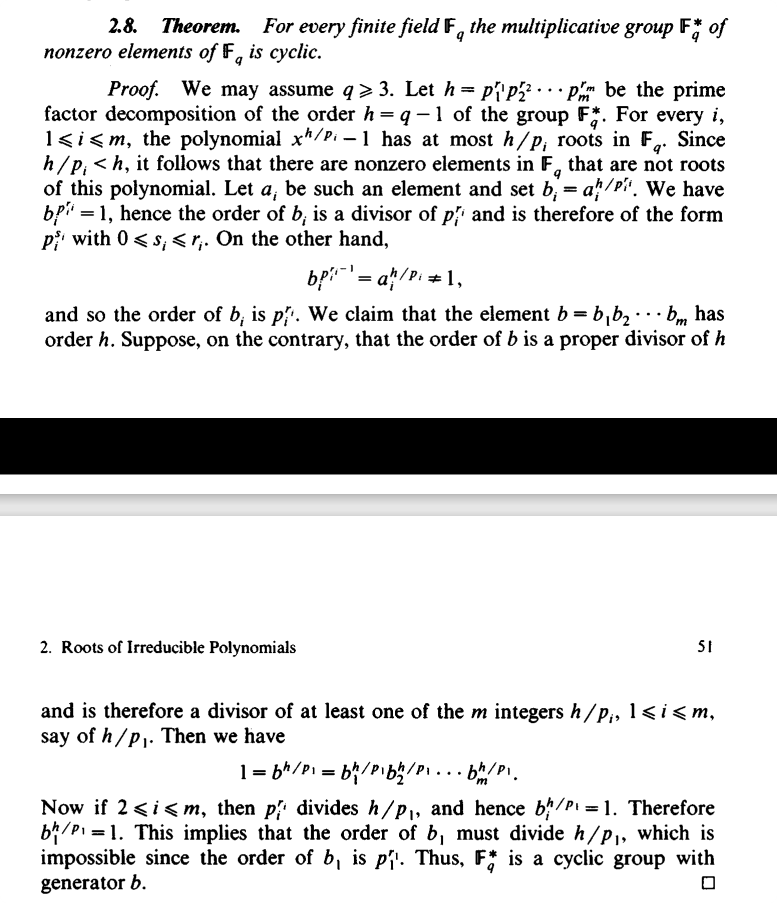
 slim vortex
I'm going through a proof that the ring of gaussian integers Z[i] is euclidean
for a, b in Z[i], I have to verify there exist q, r in Z[i] such that a = qb + r and |r|^2 < |b|^2
the book I'm reading says "It clearly suffices to find q in Z[i] such that |a/b - q| < 1."
and then moves on
I don't see why that clearly suffices 😦
 unkempt void
Basically just division by b
But yes if |a/b - q| < 1 then take r = a - bq and you can see it is what you want
Since then |r| = |b| |a/b - q|
slim vortex
I see it now, thanks!
unkempt void
np
verbal cedar
feel stupid asking this. but parity (congruence mod 2) is preserved mod n if n is even, but not necessarily when n is odd. i can see why that is, but it seems to be the result of a much more basic/general property of modular arithmetic. would it be something like if a divides b, and x is congruent to y mod a, then z congruent to x mod b implies z congruent to y mod a?
 swift shard
@verbal cedar
I think you're talking Chinese Remainder Theorem
Oh wait no. You care about the even case hol' up
verbal cedar
swift shard
<@196803594576592896>
I think you're talking Chinese Remainder Theorem
yeah i thought that was when the modulos are coprime. but I'm more wondering about when one divides the other/they're not coprime
swift shard
Indeed CRT doesn't relate
I can explain it using quotient groups, that work?
Basically you can reduce a mod to anything that divides that mod.
We can generalize this to other mods. Anything divisible by 3, in any mod divisible by 3, remains divisible by 3 when reduced.
 leaden swan
a=kb+r, if c divides b
a=(k(b/c))c+floor(r/c)c+(r mod c) = lc +(r mod c)
So if r were 0 initially,it will end up being 0
swift shard
verbal cedar
feel stupid asking this. but parity (congruence mod 2) is preserved mod n if n i...
No you've got it backwards. b has to divide a.
Can always reduce the modulo.
x = y (mod a)
x = y + ai for some i
Take both sides by mod b, keeping in mind that b | a,
x = y (mod b)
Keep in mind that doing this loses information about x
verbal cedar
swift shard
No you've got it backwards. b has to divide a.
hmm. but I'm looking more for the other direction. like i was thinking my original example was a=2 and b=n (n is even). the only thing i care about is the parity of x.
x+kn mod 2=x mod 2
so as long as z is congruent to x mod n, then z has the same parity as x.
but yeah i think we're saying the same thing
dense scroll
Does anyone have a hint for the forward direction of d?

 brittle root
dense scroll
Does anyone have a hint for the forward direction of d?
brittle root
dense scroll
Does anyone have a hint for the forward direction of d?
have you tried induction and if so how far have you gotten
dense scroll
brittle root
have you tried induction and if so how far have you gotten
I was trying to prove it with divisibility and congruence. I’m not sure how I would write out n=1mod3 for the inductive step
dense scroll
Yeah that doesn’t work
dusty dragon
Suppose that 3 | g_n. Then (19 * 10^n - 1)/9 = 3k <=> 19 * 10^n - 1 = 27k. In other words, we require that 19 * 10^n = 1 (mod 27). A quick check shows that this is equivalent to 10^n = 10 (mod 27). Since gcd(10, 27) = 1, Euler's theorem says that 10^{phi(27)} = 1 (mod 27). In other words, 10^18 = 1 (mod 27). This implies that the order of 10 divides 18 and it's not too hard to check that 10^3 = 1 (mod 27). Therefore, 10^{3m} = 1 (mod 27). Therefore, 10^{3m + 1} = 10 (mod 27) which implies that n = 3m + 1 or n = 1 (mod 3)
verbal cedar
just a quick question: if i'm talking about something like a mod 2 and b mod 5, then what word would you use for 2 and 5? "modulos"? "moduluses"?
torn escarp
modulus is singular and moduli is plural I believe
verbal cedar
torn escarp
modulus is singular and moduli is plural I believe
great, thank you
torn escarp
you're welcome
west glade
<@&268886789983436800>
 shell minnow
west glade
<@&268886789983436800>
shell minnow
west glade
<@&268886789983436800>
what happened
west glade
spam
dense scroll
dusty dragon
Suppose that `3 | g_n`. Then `(19 * 10^n - 1)/9 = 3k <=> 19 * 10^n - 1 = 27k`. I...
This makes sense, thank you!
So I'm trying to find integers such that a^2 * x+ b^2 * y = 42. Using the fact that gcd(a^2,b^2) | 42, I've figured out that a,b have to be some combination of 1, 2, 3, 7. I'm not sure how to determine x,y
Ah, so I just brute forced it and found that 9*2 + 4*6 works, but is there a smarter way to find that?
west glade
Extended euclidean algorithm
sacred junco
Hello. My online friends and I have some (tricky? / interesting?) question and thus are seeking insight.
We are trying to write programs that do such kind of task: Given a positive integer m, compute (and output) 1st term to m-th term of the positive integer sequence S(n), where S(n) is defined by satisfying that the strings of both S(n) and S(n)*2 are consisted of the same set of digits.
Currently, our approaches are basically "brute-force checking": We have computed that S(1) = 10255, however, it takes more than 8 seconds long to compute merely that S(3200) = 4857912 on Ideone.
[Question] Could someone give us some insight of necessary and / or sufficient conditions for a positive integer such that the strings of both it and its double are consisted of the same set of digits?
west glade
the only rule that n plays is that S(n) has to be the n'th smallest such number?
problems that depend on the chosen base (so 10 here) often aren't very nice
sacred junco
Yes. S(1) = 10255 is the smallest positive integer satisfying that
wooden glen
The two things after "then" don't make sense.
Can you state them in words instead of in symbols?
drifting imp
 drifting imp
wooden glen
The two things after "then" don't make sense.
drifting imp
wooden glen
The two things after "then" don't make sense.
I also thought this
Since a|4 means 4 mod a = 0
Not sure what a|4 = 1 means
wooden glen
It must be a typo for "a mod 4 = 1 and b mod 4 = 3, or vice versa".
wooden glen
They are the only possibilities for an odd number modulo 4.
And you can try all combinations of which of them each of a and b are, and find that the only ones that make the sum modulo 4 be 0 are that one of a and b is 1 and the other is 3.
drifting imp
Couldn't you use something like 7 and 5
wooden glen
By definition ".... mod 4" always produces something in {0,1,2,3}.
drifting imp
O wait ye I see
How would I start proving this? If 6 | a and 8 | b, then 12 | (a · b)
Only thing I see is 8x6 is 48 and if it divides 48 it also divides 12 maybe
wooden glen
Yeah.
drifting imp
Can I just multiply two divides together?
Or mods
Not sure how I would write it
a mod 6 = 0 * b mod 8 = 0 ?
torn escarp
drifting imp
Can I just multiply two divides together?
yeah, x|y means y=xz for some z. So if you also have r|s then s=rt and combining you get xr=yszt so xr|ys
another thing you might want to prove is that if u|v and v|w then u|w
 torn escarp
seems fine to me
you could also pull in 9=4*2+1 when you factor the 4 out to get 4(n^2+3n+2) + 1
 dapper topaz
Do you know what is 2 + 2 ?
native monolith
brittle root
it is clearly 0
2+2 = 5 bro ??????? Idk how u got 0 bro clearly it cant be 0 because 2 > 0 so 2+2 > 0 smh
 regal ore
native monolith
2+2 = 5 bro ??????? Idk how u got 0 bro clearly it cant be 0 because 2 > 0 so 2...
regal ore
native monolith
2+2 = 5 bro ??????? Idk how u got 0 bro clearly it cant be 0 because 2 > 0 so 2...
why 2>0 pls proof
brittle root
im assuming its a joke but you can use peano arithmetic for this
since 2 = S(1) = S(0) and S(n) > n so
 scarlet idol
$p > q$ two primes, $a \in \mathbb{N}$, $ a \equiv 1 \mod{q}$, $a \mid pq$ and $q\nmid (p-1)$, then $a = 1$ ?
sterile pumiceBOT
Espio
 west glade
yes. a=p would be the only other choice, but then a-1 = 0 mod q, so q | a-1 = p-1 so that doesn't work
oh and I guess a=pq or a=q would be another choice but then a=0 mod q
drifting imp
How would i start this

Just know that a,99 are coprime and a,100 are coprime
I also don't see any way to get 6655 from 99 and 100
 patent robin
Their factors show a connection
patent robin
I meant, if 99 = 3² • 11, that means 'a' must not contain those factors (for it to be coprime)
Same with 100 = 2² • 5².
Then we have 6655 = 11³ • 5
Then, definitely 'a' has no common factor with 6655 since that number consists of numbers that 'a' will not have anything to do with.
drifting imp
I see
Second part, is it that 101 is prime and 98 is 7^2 * 2. So a must have factors of 101 and 7 but not 2
dusty dragon
Well, gcd(a, 100) = 1 implies that 2 is not a factor of a. Furthermore, 98 = 2 * 49 = 2 * 7^2. Therefore, if gcd(a, 98) ≠ 1, then 7 must divide a. Similarly, since gcd(a, 101) ≠ 1 and 101 is prime, 101 must divide a. Since gcd(7, 101) = 1, then a must have factors, 101 and 7 implying that a must have a factor of 101 * 7 > 100 * 7 = 700. Therefore, a > 700
drifting imp
dusty dragon
Well, `gcd(a, 100) = 1` implies that 2 is not a factor of a. Furthermore, `98 = ...
This is what I said right
dusty dragon
Yes just a bit fleshed out
 woven oracle
dapper topaz
Do you know what is 2 + 2 ?
woven oracle
dapper topaz
Do you know what is 2 + 2 ?
2 + 2 = 0 mod 4 😎
sacred junco
So, I was solving this particular puzzle, and the answer I got was 105263157894736842, which seems to be correct.
Then I tried doing a different variation where 3(n1 n2 ... nk-1 nk)=(nk n1 n2 ..... nk-1),essentially the same question but with 3x instead of 2x,
I found the answer to be 1034482758620689655172413793, which weirdly enough was the recurring digits of 3/29. Any ideas as to why this correlation showed up out of nowhere?
 sacred junco
So, I was solving this particular puzzle, and the answer I got was `105263157894...
sacred junco
sacred junco
So, I was solving this particular puzzle, and the answer I got was `105263157894...
btw the answer has exactly 29 digits
west glade
well the first number are the digits of 1/95. in general I'm not surprised that you end up with the digits of some repeating decimal
cause well they exactly satisfy that if you take a multiple of them then you get a rotation of the digits
why 1/95 and 3/29 in particular? no clue
sacred junco
west glade
why 1/95 and 3/29 in particular? no clue
yeah
west glade
95 is surprisingly high but 29 isn't that big if you consider the extra constraints that you need that it has to be specifically only one rotation
sacred junco
west glade
95 is surprisingly high but 29 isn't that big if you consider the extra constrai...
i think it's 9.5 to be exact, since 1/95 skips one 0 after the decimal point
but 3/29 was just screaming out, because well, 3n and 29 digits
maybe just a coincidence
west glade
well quite often will 1/n have n repeating digits
something something primitive root
I think the 3 is here more because 3/29 is bigger than 0.1
it's very likely that your number starts with a 1 if it is the smallest
west glade
sacred junco
i think it's 9.5 to be exact, since 1/95 skips one 0 after the decimal point
yes good point
 west glade
well quite often will 1/n have n repeating digits
west glade
west glade
well quite often will 1/n have n repeating digits
uhm I meant n-1 repeating digits. but same thing
if n is prime then the possible repeats is a divisor of n-1
sacred junco
ohh
west glade
you can work out how it relates to the powers 10^k mod n
west glade
sacred junco
which'll be 2/19
ah yes 19 is much smaller. way better
would be interesting if the next is 4/39
39 isn't prime tho so that might ruin it
4/39 = 0.102564... and 102564 indeed works for 4*n. but not sure if it's the smallest
5/49 also works for 5*n. 42 digits this time. so yeah there is definitely a pattern
west glade
west glade
if n is prime then the possible repeats is a divisor of n-1
(in general its a divisor of phi(n))
sacred junco
west glade
(in general its a divisor of phi(n))
i had no idea this pattern actually was a thing
An n-parasitic number (in base 10) is a positive natural number which, when multiplied by n, results in movement of the last digit of its decimal representation to its front. Here n is itself a single-digit positive natural number. In other words, the decimal representation undergoes a right circular shift by one place.
For example:
4•128205=...
just checked

had a hunch
west glade
figured that somebody else already did that
sacred junco
so the pattern to find such numbers is essentially:
a/(n*10-1)
where a can go from a=n to a=(n*10-1)
 brazen python

Hello
I don't understand how m and n being coprime leads to a being a multiple of n
brittle root
suppose alpha is not a multiple of n then
brazen python
if alpha is not a multiple of n then m and n are not coprime
brittle root
well there is a faster (albeit unrigorous way) to see it
brazen python
yes pls
brittle root
theres no way to make beta copies of n without having some km
because m and n are coprime
if alpha is not a multiple of n alpha < n
suppose WLOG n < m
do you see whats wrong
dusty dragon
The result is a generalisation of Euclid’s lemma
brazen python
brittle root
do you see whats wrong
no, sry
brittle root
alpha m = beta n
since we wlog n < m and we said for contradiction alpha is not a multiple of n
to have them being equal
ok you know im making this overcomplicated sorry
just divide
alpha m / n = beta
the left side is clearly not an integer
brittle root
brittle root
since we wlog n < m and we said for contradiction alpha is not a multiple of n
my apologies, we dont even need this WLOG
brazen python
brittle root
the left side is clearly not an integer
this makes sense
so since beta is not an integer, alpha (integer) must be a multiple of n?
dusty dragon
Use the fact that m and n are coprime
Therefore, if alpha * m/n is an integer, then alpha/n is an integer
brittle root
dusty dragon
Use the fact that m and n are coprime
^^ this is a lot cleaner than mine
nice and unnecessary contradiction I created lmfao
i should probably sleep i am literally sick
 brittle root
ty!
covert finch
if you know 7^10 = 24 or -1 mod 25, is there an easy way to evaluate 7^9 mod 25 based on that fact?
fervent grove
I mean 7^2 = -1 (mod 25), which should make the computation doable
covert finch
oh true lol
still flare
You know that $7^9 = (7^2)^4 \times 7^1$. Use this fact.
sterile pumiceBOT
Boytjie
 covert finch
yea yea
dusty dragon
If you want to use the fact that 7^{10} = -1 (mod 25), then note that 7^9 = 7^{10} * 7^{-1} = -1 * 18 (mod 25) = 7
tacit heart
An integer $n$ can satisfy the equation $n=x^2+y^2$ where $x,y \in \mathbb{Z} $\iff$ every prime $p \equiv 3 \pmod{4}$ that divides $n$ occurs in $n$’s prime factorization with an even exponent.
sterile pumiceBOT
kappa
Compile Error! Click the  reaction for more information.
(You may edit your message to recompile.)
 tacit heart
Why is this true?
stiff rivet
this is called the sum of squares theorem, im sure you can find a proof if you google that
tacit heart
Oh thanks
sacred junco
torn escarp
you can plug in directly, for instance $$t_{9n+4}=\frac{(9n+4)(9n+4+1)}{2}$$
Thank you for your help.
torn escarp
you're welcome
 analog onyx
at this point i should apply the fact that p is prime

but i dont really know what that does for me
like what is the next step since p is prime
brittle root
mn/p = k
analog onyx
maybe p divides mn
brittle root
k is an integer
dusty dragon
When you get a problem where they ask you to show "x or y", one strategy you can employ is to assume that x doesn't hold and show that y must hold true
analog onyx
but since p is prime, it either divides one or the other or both of m and n
gotcha okay
dusty dragon
So here, we know that p | mn. Let's suppose that p does not divide m. What you now want to show is that p | n
brittle root
(all good I covered it)
dusty dragon
yes
analog onyx
gotcha okay
dusty dragon
that's a direct corollary of the problem you proved
(it might be useful to think about why p is required to be prime)
analog onyx
uh well the problems before were working with relatively prime numbers
i think its all building upon itself
dusty dragon
ah the relatively prime version is a generalisation of this
analog onyx

feel like the order of them is methodical
maybe except for the set stuff at the top
brittle root
1.4 proof: trivial
dusty dragon
the proof for 1.3 feels like it's missing steps lmao
I don't see how k = mn/p is an integer immediately implies p | m or p | n using the fact that p is prime
I mean, it's true but that's what you want to prove
analog onyx
since p is prime and it divides a product of numbers
it must divide either one of those numbers
like it makes sense to me
dusty dragon
that's what you want to prove
analog onyx
but i dont know how to explain it
dusty dragon
you've basically used what you want to prove to prove it
analog onyx
its one of those things that is trivial but idk how to describe what needs to be done to show it
yeah i see your point
what would you recommend
dusty dragon
have you seen the fundamental theorem of arithmetic?
analog onyx
every number can be written into a prime factorization
dusty dragon
yup, so since p | mn, what can you say about the prime factorisation of mn
analog onyx
so mn's prime factorization but have something divisible by p
dusty dragon
yeah so one of the primes must be p. Now what you can do is to decompose m and n into their prime factorisations as well
Let $m = p_1^{a_1} p_2^{a_2} \dots p_{k}^{a_{k}}$ and $n = q_1^{b_1} q_2^{b_2} \dots q_{\ell}^{b_{\ell}}$. Then $mn = \left(p_1^{a_1} p_2^{a_2} \dots p_{k}^{a_{k}}\right) \left(q_1^{b_1} q_2^{b_2} \dots q_{\ell}^{b_{\ell}}\right)$
sterile pumiceBOT
 analog onyx
well like okay but
since p divides mn, we know that p exists in the prime factorization of either m or n
so then im done
dusty dragon
yeah that's the basic idea
analog onyx
or is that not rigourous enough
dusty dragon
p must appear in the prime factorisation in either m or n (or both)
analog onyx
yes
dusty dragon
we just need to get to that conclusion
analog onyx
the way youre showing it seems overkill for the proof of this though, as in the level of it
compared to everything else
im glad youre showing it to me but i dont think that level is my expectation if that makes sense
dusty dragon
it's actually not that overkill
you just look at each prime factorisation
and the conclusion falls out directly from FTA
there are other elementary ways using bezout's lemma
you could also argue by contradiction
analog onyx
im familiar with that
analog onyx
this is going to require bezouts lemma?
dusty dragon
ok here's a more elementary proof.
Suppose that p | mn and p does not divide m. We will show that p | n. Since p does not divide m, then gcd(p, m) = 1 and so there exist integers a, b such that ap + bm = 1 (this is Bezout's lemma). Multiplying both sides by n, we have that n = (ap)n + bmn. But since p | mn, we can write mn = pk to get n = (an)p + (bk)p = p[an + bk]. But this implies that p | n.
analog onyx
that seems really similar to my proof of euclids lemma
dusty dragon
this is euclid's lemma
 dusty dragon
yeah, this is an alternative formulation of euclid's lemma
analog onyx
the one i have written here or 1.3
dusty dragon
both
they are equivalent
(Lemma 2) <=> (1.3) and the proof for either follows pretty much the same way
dusty dragon
yes
dusty dragon
the argument is symmetric
analog onyx
i think the first way with the prime factorizaiton makes the most sense intuitvely
but i like this proof better its more elementary and similar to what ive done before
dusty dragon
it's nice to have different proofs in mind when you encounter a result
and depending on what you've been taught, you can sorta hack your way to the result using results you've already proven/seen
i.e. if you've never seen bezout's lemma, it might be hard to just suddenly use it in the proof of euclid's lemma
analog onyx
i havnt taken a formula NT course
just an intro to proof course where we learned the different techniques and how to write a little but
but the content was all over the place in terms of the proofs
but ive worked with bezouts identity on my capstone project i did on diophantine equations
for 1.5, im doing by contradiction
ive gotten to the point where s^2p = r^2
and so p | r^2 and hence p | r by the previous problem
just not sure where this contradiction comes in, maybe with p | s
wait
dusty dragon
yup that's right so far
so p | r, use the definition of | to re-express r in terms of p
analog onyx
yeah thats why i said wait
dusty dragon
also you may assume that r and s are relatively prime; otherwise, just keep dividing by their common factor
dusty dragon
yeah that's right
dusty dragon
analog onyx
pt=r
once you have this, you basically have the contradiction
dusty dragon
here are the pieces of information you have right now:
randsare relatively prime.pt = rs^2p = r^2
analog onyx
duh okay
dusty dragon
what's the most natural progression you can make using these three pieces of information?
analog onyx
well its obvious now
dusty dragon
👍
analog onyx
if i went back and looked at what i have previously wrote
i feel like im so close to being able to do these on my own but im always missing something subtle and then obvious once pointed out
dusty dragon
takes practice
it's very common for students starting out to tunnel vision themselves into getting stuck
and the more practice you do, the better you'll get at picking up what information you have that's relevant
analog onyx
this is gonna lead me to p | s right
dusty dragon
yup
analog onyx
which is a contradiction since gcd(r,s)=1
dusty dragon
nice!
analog onyx
i have like p^2t^2 = ps^2
so pt^2 = s^2
and then apply the previous problem since p | s^2.
dusty dragon
👍
analog onyx
is there any special way to write a composite number
like for rationals we write r/s where s/=0
dusty dragon
n = ab where 1 < a, b < n
analog onyx
or is composite just like prime where we cant express it any special way
 loud maple
analog onyx
is there any special way to write a composite number
loud maple
analog onyx
is there any special way to write a composite number
One could write a composite number as n=pq where neither p nor q is 1
analog onyx
okay i can buy that
loud maple
analog onyx
but ive worked with bezouts identity on my capstone project i did on diophantine...
What is a capstone project?
Is it a research paper you published?
analog onyx
it was just like a research project
it wasnt a requirement to get published but mine is in the process of being published i hope
loud maple
Nice, so you have proved new theorems?
analog onyx
it was sent to a journal i guess were still waiting on it to be reviewed
i mean i guess theyre new, wouldnt be much worth publication otherwise i suppose
dusty dragon
that's pretty impressive
analog onyx
its gonna be trivial to you i feel like
but it was fun to do
i feel like i really understand it, i loved presenting about it because ive worked with it for so long it makes perfect sense to me now
i wrote a python program to apply the algorithm as well
dusty dragon
one of my current research projects is to find potentially new results to the union-closed sets conjecture, perhaps proving the conjecture for other families of sets
loud maple
analog onyx
its gonna be trivial to you i feel like
How can something be both trivial and worth publishing?
analog onyx
well worth publishing and trivial are subjective person to person anyway
like maybe to someone this method is obvious and not worth publication i suppose
i just feel like theres plenty of people that couldve came up with this
i could be being humble but i doubt it since im sitting here getting help with elementary number theory lol
loud maple
analog onyx
i just feel like theres plenty of people that couldve came up with this
But you came up with it first
So that is nice
analog onyx
well like i said
someone probably know this works and its so obvious to them they never thought twice ab it
but i guess so, yeah
if either of you read it, let me know what you think or if you have any feedback
dusty dragon
a lot of things are 'obvious' in retrospect
analog onyx
the professor i worked on it with has sent it off for review but we havnt heard anything
id like some feedback on it though
analog onyx
dusty dragon
a lot of things are 'obvious' in retrospect
yes like the whole thing is trivial to me now lol
dusty dragon
i'll have a look at it when i'm free
analog onyx
feel free to tag or dm me whenever youre done with it
if either of you are interested in the program i can send that as well, i had so much fun writing that lol
 dusty dragon
The last two can be done quite easily since gcd(157, 253) = gcd(28, 253) = 1, so you can appeal to Euler’s theorem to simplify the power. The first one is a bit more fiddly and I can’t really think of a way that’s faster than just brute forcing all powers of 66 (mod 253)
 coarse carbon
But the power is smaller than 220 which is euler’s indicator
torn escarp
since 5=2+3 you can immediately say 253=11*23 so maybe it's simple to do with the CRT
caus 66=0 mod 11
 sudden swift
does lcm distribute over gcd?
stiff rivet
consider prime factorizations
sudden swift
stiff rivet
consider prime factorizations
i guess they're sort of like union and intersection
of prime factorisations as multisets
stiff rivet
it reduces to case of whether min/max distributes over max/min
(which should both be true)
 fierce nymph
dusty dragon
one of my current research projects is to find potentially new results to the un...
fierce nymph
dusty dragon
one of my current research projects is to find potentially new results to the un...
are you thinking about the information theoretic approach?
dusty dragon
I’ve been considering perhaps slightly more elementary means, trying to characterise the lattice of a union-closed family of sets and perhaps saying something meaningful about that
Clearly any family of sets that have a “long enough” chain satisfies the conjecture
fierce nymph
I see, I ask because there was a lot of hype online recently after the quanta article
dusty dragon
So I’m considering looking at families whose chains are not long enough
dusty dragon
fierce nymph
I see, I ask because there was a lot of hype online recently after the quanta ar...
Yeah that was a pretty nice read, some interesting insight into the lower bounds
fierce nymph
seems like maybe the approach is stuck at .38, so perhaps new ideas are needed to get to 0.5
dusty dragon
I’ve thought of something interesting and I’m going to bring it up with my supervisor to maybe flesh out some of the groundwork of it
If my ideas are correct, then it might be possible to flesh it out to a full proof
fierce nymph
oh nice, are you a phd student?
dusty dragon
Nope, undergrad but I’m in my honours year which is effectively a year-long research year
fierce nymph
that would certainly make you famous if you managed to prove it!
dangerous problem to work on though, gets stuck in your head and you feel compelled to throw hours at it
dusty dragon
That’s what’s been happening to me hahaha
I’ve spent a few days in a row thinking about the problem
fierce nymph
that was my fav quote from the quanta article, when Mike Saks was like "please don't make me think about this problem again"
that's the sound of someone who has lost some significant time to it hah
sleek spire
what are some strats to solving diophantine equations
torn escarp
sleek spire
what are some strats to solving diophantine equations
check out this has some strategies https://cs.uwaterloo.ca/~cbruni/pdfs/Techniques of Diophantine Equations.pdf

sleek spire
lol I read the first thing and it sounded promising
then it started doing some modular form stuff which was just like
besides the point
I want some elementary strategies
torn escarp
one sort of common trick, idk if it's in there or not, is if you have ab=c^n and you can show gcd(a,b)=1 then a=ux^n and b=vy^n with units so that uv=1
and you can sorta alter this slightly
torn escarp
do you have a specific diophantine equation you're wanting to solve right now
sleek spire
I'm trying the no solution one right now
sleek spire
torn escarp
do you have a specific diophantine equation you're wanting to solve right now
yes
torn escarp
which one, post it here
sleek spire
,, x^2 + y^2 + z^2 - xy - yz - zx = 3
sterile pumiceBOT
 torn escarp
showing something has no solutions tends to be easier
torn escarp
like seeing a square and 3 and three terms makes me think look mod 2, 4, 3 or 9
sleek spire
okay yeah lol
 sleek spire
torn escarp
like seeing a square and 3 and three terms makes me think look mod 2, 4, 3 or 9
sleek spire
torn escarp
like seeing a square and 3 and three terms makes me think look mod 2, 4, 3 or 9
I'll try Z4
or wait
Z9
 sour rivet
Hey, I was taking number theory a couple years ago and there was this thing that looked like a fraction but it wasn't a fraction. Anyone know what that might be?
it was used for I think... solving modular systems of equations or something?
sleek spire
sour rivet
Hey, I was taking number theory a couple years ago and there was this thing that...
can you draw it?
torn escarp
legendre symbol maybe
sour rivet
that's it merosity, thank you
torn escarp
you're welcome
sour rivet
residues, it's all coming back lol
torn escarp
cool 😎
torn escarp
sleek spire
I'll try Z4
2, 4, 3, 9 won't work (I just brute forced it on computer)
sleek spire
how did you brute force it?
torn escarp
three nested for loops
torn escarp
lol
sleek spire
put another for loop around it to see what works
torn escarp
looks like nothing up to 10, actually thinking there's probably always a solution
if I recall correctly, if you check a quadratic in 3 variables mod 8, then it automatically has a solution mod p^n for all n
there might be some slight caveats that I'm not considering but effectively quadratics mod p when p !=2 have no problem hensel lifting, at least when they're homogeneous, but I think when they're not we can just diagonalize them anyways to make them a quadratic form
sleek spire
are you sure 2 doesn't work
torn escarp
reducing mod 2 you have two kinds of solutions, two even one odd or one even and two odd
torn escarp
basically the reason this won't work is Hasse-Minkowski local-global theorem for quadratic forms is in our way
this has rational solutions, so it has a solution mod n for all n
sleek spire
ah
regal ore
sterile pumice
Multiply both sides by 2
LHS becomes
(x-y)^2 + (y-z)^2 + (z-x)^2
torn escarp
sleek spire
okay yeah lol
so basically wolfram alpha was just wrong lol
sleek spire
regal ore
Multiply both sides by 2
LHS becomes
(x-y)^2 + (y-z)^2 + (z-x)^2
so one of them is 4 and the other ones are 1
then it's just a linear system
right
ok thanks
ok well all of those linear systems are inconsistent
so it has no solution
(checked using rouche capelli)
regal ore
sleek spire
ok well all of those linear systems are inconsistent
Don't forget the negatives btw
sleek spire
right
torn escarp
sleek spire
ok well all of those linear systems are inconsistent
no they're linearly dependent, not inconsistent, you have an infinite family of solutions
x=n-1, y=n, z=n+1 all workd
set n=0 or n=1 to see the simplest solutions work out
sleek spire
torn escarp
no they're linearly dependent, not inconsistent, you have an infinite family of ...
yeah I wasn't considering negatives
torn escarp
negatives have nothing to do with it, x=1, y=2, z=3 works just fine
sleek spire
then y - z is negative
that's what I meant basically I was only checking for the differences being positive
sorry if I wasn't clear
torn escarp
oh I see what you meant now, my bad
analog onyx
Any other way to do this? maybe by contradiction?

I dont think this is right looking at it again since I assumed p | n
The wording made me think that was given to me but rereading it again I don't think so
torn escarp
I think you can reword it slightly to say because it's composite there's some p which divides n
also if p|a it doesn't mean p < a could be p=a though so probably should have p <= a
I don't think that breaks anything, but I'm not looking too close either
analog onyx
torn escarp
I think you can reword it slightly to say because it's composite there's some p ...
by the fundamental theorem of arithmetic right?
torn escarp
well I'm just going by definition of composite integer
analog onyx
my professor was showing me another way to show this result without using the increasing property of the square root function
and i liked his way better but I cant remember it
torn escarp
but you could say that I guess too to be safe
torn escarp
analog onyx
my professor was showing me another way to show this result without using the in...
I feel like I've seen a better way too, I'll try to remember or come up with one too, sounds fun
I'm thinking something roughly like, take a divisor d, if its <= sqrt(n) you're basically done, otherwise look at n/d and that's <= sqrt(n)
analog onyx
i think it was something like that
fervent grove
isn't this basically the same proof, once you label a = min{d,n/d}
analog onyx
oh here wait
it was like assume a > sqrt(n) and b > sqrt(n)
then ab > n which isnt true obv
torn escarp
fervent grove
isn't this basically the same proof, once you label a = min{d,n/d}
yeah, probably
analog onyx
so then either a <= sqrt(n) and or b <= sqrt(n)
just gonna pick the case of a <= sqrt(n), then there exists a prime p such that p | a, and so p <= a <= sqrt(n)
so then p | ab, or p | n
does that work?
regal ore
analog onyx
Any other way to do this? maybe by contradiction?
As n is composite hence there exist prime q and integer k >= 2 that n = qk. Let p be minimum such q and let m be the resulting value of k
all prime factors of m are more than or equal to p so n = pm >= p^2 hence p <= sqrt(n)
analog onyx
p is the minimum of q?
regal ore
q is any prime divisible by n. Let p be the one with lowest value
analog onyx
what do you think of the outline of the proof i typed where i assumed a,b >= sqrt(n)?
native monolith
So I know this means $n^2-5\equiv 0 \mod{p}$ ie. $5$ is a QR mod p. So then you use QRL but I can't figure out the last trick. Showing $1=(\frac{p}{5})(-1)^{\frac{p-1}{2}}$ if and only if $p\equiv \pm 1 \mod{5}$ without using a really long winded method (testing for each value mod 5)
 sterile pumiceBOT
Max..

 lusty dew
not sure if this is the right channel but i dont get how option two is correct, wouldn't the cos part of the equation not cancel out due to the constants of the two being reciprocals of each other?
 loud maple
lusty dew
not sure if this is the right channel but i dont get how option two is correct, ...
loud maple
lusty dew
not sure if this is the right channel but i dont get how option two is correct, ...
'constants' as in?
lusty dew
Like this
 native monolith
lusty dew
not sure if this is the right channel but i dont get how option two is correct, ...
native monolith
lusty dew
not sure if this is the right channel but i dont get how option two is correct, ...
I mean it's not the right channel this is more #calculus or #real-complex-analysis
dw about that tho
$$e^{iz}=cos(z)+isin(z)$$ $$e^{-iz}=cos(z)-isin(z)$$ In the second we have used the fact $cos(z)=cos(-z)$ and $sin(z)=-sin(-z)$. Subtract $e^{-iz}$ from $e^{iz}$ and we get $e^{iz}-e^{-iz}=2isin(z)$
sterile pumiceBOT
Max..
Compile Error! Click the reaction for more information.
(You may edit your message to recompile.)
 torn escarp
native monolith
So I know this means $n^2-5\equiv 0 \mod{p}$ ie. $5$ is a QR mod p. So then you ...
torn escarp
native monolith
So I know this means $n^2-5\equiv 0 \mod{p}$ ie. $5$ is a QR mod p. So then you ...
you can use quadratic reciprocity directly, $$1=\left(\frac{5}{p}\right) = (-1)^{\frac{p-1}{2}\frac{5-1}{2}} \left(\frac{p}{5}\right) =\left(\frac{p}{5}\right)$$
sterile pumiceBOT
Merosity
 torn escarp
since p is a QR, it means it can only be +-1 mod 5
I think you just missed the extra exponent
the way I think of it is really just to flip the sign if both primes are 3 mod 4, otherwise it's exactly the same. So as long as one of the primes is 1 mod 4, you don't have to worry what the other prime is mod 4
sleek spire
torn escarp
since p is a QR, it means it can only be +-1 mod 5
(QR?)
torn escarp
for what it's worth, I only ever really remembered this after proving QR several times over the course of my life and it just eventually stuck when proving by gauss sums and seeing the -1 comes from a (-1/p) legendre symbol to a power which is literally (-1)^((p-1)/2) as well
torn escarp
sleek spire
(QR?)
quadratic residue
sleek spire
ah
torn escarp
also NR usually stands for nonresidue
brisk skiff
Just to double check:
the numbers in the system $4\mathbb{Z}_{12}$ are $0$, $4$, and $8$, right?
sterile pumiceBOT
TurkishNutcase
 still flare
This depends on how you define it exactly. When you see quotient groups, you will define it differently. However for now this is an adequate definition.
brisk skiff
brittle root
is Z_12 = {0, 1, 2, ... , 11}
yeah
brittle root
assuming you define 4Z_12 as {4n mod 12 | n in Z_12} then yes
brisk skiff
brittle root
assuming you define 4Z_12 as {4n mod 12 | n in Z_12} then yes
alright so if we have the algebraic property '' If $2x =0$, then $x=0$ '', this system wouldn't satisfy that correct? Because $2$ does not even exist in that system
sterile pumiceBOT
TurkishNutcase
 fervent crest
Well 2x can also be interpreted as x + x
drifting imp
native monolith
So I know this means $n^2-5\equiv 0 \mod{p}$ ie. $5$ is a QR mod p. So then you ...
Maybe split it into (n+5)(n-5) ?
brisk skiff
fervent crest
Well 2x can also be interpreted as x + x
oh yeah...thx
 blissful vessel
how can i show that for some prime $p$, that the product $(p - k)(p - j)$ for some $k,j \in \mathbb{N}_{>0}$ is not divisible by $p$?
sterile pumiceBOT
MarkusG
 fervent crest
Well remember two facts: if a prime divides a product then it divides one of the factor in the product, then if p is a prime and 1<i<p then i does not divide p
blissful vessel
is there a proof for the second part
fervent crest
It’s the definition of prime
blissful vessel
i'm being required to do number theory without any prior knowledge of number theory 😔
oh ok neat
sacred junco
Let $a,b \in \mathbb{N}$ and $\bar{Q}(n)$ be the iterated digit sum function, meaning that the digit sum is repeatedly taken until only one digit remains. For example, $\ \bar{Q}(1516)=4 \$ How can I show that $\ \bar{Q}(a+b)=\bar{Q}\left( \bar{Q}(a)+ \bar{Q}(b) \right)\$ Is this true for all numbers? At least for all numbers I have tried, it seems to hold.
sterile pumiceBOT
Plazzi
 loud maple
the function in question preserves the remainder modulo 9, and takes values in the set {1,2,...,9}
From here it is trivial to prove the required result.
sacred junco
Got it thanks
 scenic onyx
.
native monolith
torn escarp
you can use quadratic reciprocity directly, $$1=\left(\frac{5}{p}\right) = (-1)^...
Ah yes thank you, I forgot the powers were multiplied not added 🤭 ty
verbal cedar
stupid modular arithmetic question... if x mod 4=y, will x mod 2=y mod 2?
brittle root
there are 4 cases to check yeah?
(im sure theres a more clever way but)
0 mod 4 = 0 yes
1 mod 4 = 1 yes
2 mod 4 = 2 yes
3 mod 4 = 3 yes
dusty dragon
Suppose that y = x (mod 4). Then we can write y = 4k + x for some integer k. But note that this is equivalent to y = 2(2k) + x
verbal cedar
brittle root
0 mod 4 = 0 yes
1 mod 4 = 1 yes
2 mod 4 = 2 yes
3 mod 4 = 3 yes
my brain is so fried by this problem i can't believe i didn't even think to just check all the cases lmfao.
thank god it's true, i might be able to salvage all this work with a few minor adjustments from mod 2 to mod 4...
verbal cedar
dusty dragon
Suppose that y = x (mod 4). Then we can write y = 4k + x for some integer k. But...
or that. how did i not see something so obvious...? lmao stupid question confirmed
thank you both ❤️
brittle root
dusty dragon
Suppose that y = x (mod 4). Then we can write y = 4k + x for some integer k. But...
this is better, thank you
sleek spire
how do I derive the discriminant formula for cubics?
I suppose using vieta but I'm not sure how I'd do it
stiff rivet
what is your notion of discriminant?
sleek spire
stiff rivet
what is your notion of discriminant?
,, \prod_{i < j} (\alpha_i - \alpha_j)^2
where alpha_n are the roots
how do I show that this is equivalent to the formula that uses the polynomial's coefficients
sterile pumiceBOT
 stiff rivet
eh, its very annoying i think
you reduce to the case of the depressed cubic and use some properties of symmetric polynomials
 opal obsidian
why is the prime factorization of natural numbers not completely proven?
stiff rivet
opal obsidian
why is the prime factorization of natural numbers not completely proven?
what?
 eternal wraith
if gcd of (a,b) = d then there exists x,y such that ax + by = d
how do i find the x and y?
torn escarp
eternal wraith
how do i find the x and y?
the process is called the extended euclidean algorithm
in short, it's just the regular euclidean algorithm, but you keep track of what you do at each step of the way down to get a bunch of things to substitute in
torn escarp
that's easy since you just need to solve ax+by=0, which has the simple solution of x=b, y=-a
every integer multiple of this added to your single solution will be a solution
 wild summit
ah nice
sleek spire
stiff rivet
you reduce to the case of the depressed cubic and use some properties of symmetr...
uh
basically
I have to calculate the discriminant of some random polynomial for my algebra homework
and the roots take up 2 lines each in wolframalpha
stiff rivet
use a CAS
 stiff rivet
i mean you have the coefficients, you can compute the discriminant in terms of that
thats like the whole point of the thing
sleek spire
yeah but I don't think my ta will be ok with me doing that without proving the equivalence
eternal wraith
torn escarp
that's easy since you just need to solve ax+by=0, which has the simple solution ...
Sorry for the late reply, but how do we know that this will cover all possible solutions and not just some of them?
opal obsidian
stiff rivet
what?
sorry I just got confused. It is, but there isn't an algorithm for it (or atleast not yet?).
west glade
not an efficient algorithm
there is an algorithm. just check every number. but that clearly takes ages
(and of course there are smarter approaches. but nothing fast)
unkempt void
sleek spire
yeah but I don't think my ta will be ok with me doing that without proving the e...
Proving the equivalence will still be faster tbf
I can't imagine a prof wanting you to actually compute w these roots right bruh
 dark maple
I got all numbers from 1 to 100, but one number is missing. What is the fastest way to find that number?
 umbral bridge
5050 - (sum of numbers you have) = number you want
If these numbers are on computers then you can use hash maps but it'd be the same time complexity as summing the numbers you have
 sleek geode
Hello everyone
I'm interested in solving this problem
But instead of finding the exact number, I want to find the sum directly
Let A=1vwxyz, A'=vwxyz1, S the sum digit (for both of them)
Since A'=3A, it is divided by 3 thus S is divided of 3
That implies also A is divided by 3 due to them sharing the same digit
So A' is divided by 9, implying again S is divided by 9.
First note that from the given, we can clearly see v≥3 and z=7
From this 11≤S≤46
Finally we have 3 candidate for S {18, 27, 36} (obviously we can't take 45 since that means A'=999991)
I'm stuck here, and can't deduce it further. What do you guys think ?

 sterile pumiceBOT
 analog onyx
for 1.3, can’t i just say something like First, suppose that p | mn, if p | m we’re done. Now, suppose that p does not divide m ….
i was just missing the fact that if p | m it’s obvious and we’re done
analog onyx
thats what i figured, thanks
how would you would that if you were writing the proof? i don't necessarily like the way i worded it
dusty dragon
I think it’s fine the way that you’ve written it
analog onyx
okay thanks
dusty dragon
I’d probably do:
Suppose that p | mn. If p | m, then we’re done. We may now assume that p does not divide m.
analog onyx
i like that
pine badge
How do you prove that if the gcd(a,b) = 1 and c divides a, then gcd(c,b) = 1.
I understand that since a and b share no divisors other than 1, so unless a=0 c<a c can't have any divisors that a didn't have.
brittle root
your understanding is correct
the proof does follow quite directly
alternatively try contradiction and it also follows quickly
pine badge
What do you mean by follows directly?
Oh that's it lol
If gcd(c,b) did not equal 1, then gcd(a,b) =1 would be a contradiction.
I guess I was trying to show this with equations
d = ax + by and a = c*a1
brittle root
just fill in the details
pine badge
So, then gcd(c*a1,b) = 1 how can I get rid of a1?
torn escarp
brittle root
you know that gcd(a1, b)=1 too
how? that's what you have to prove