#help-4
1 messages · Page 71 of 1
 ebon glade
you are too late for proper learning anyway
ebon glade
make sure you get enough sleep tonight
 jolly ledge
and have a proper breakfast before the exam starts
also, check whatever equipment you have and make sure they're all in working order, if you have not
 vale dockBOT
@open thistle Has your question been resolved?
 merry crystal
give up
 midnight pier
merry crystal
give up
midnight pier
merry crystal
give up
david goggins mindset
jolly ledge
merry crystal
give up
did linalg finally do you in or smth
vale dockBOT
Channel closed
Closed due to timeout
Use .reopen if this was a mistake.
 Available help channel!
Send your question here to claim the channel.
Remember:
• Ask your math question in a clear, concise manner.
• Show your work, and if possible, explain where you are stuck.
• Do not immediately ping people or roles. After 15 minutes, feel free to ping <@&286206848099549185> once.
• Type the command .close to free the channel when you're done.
• Be polite and have a nice day!
Read #❓how-to-get-help for further information on how to ask a good question, and about conduct in the question channels.
 muted imp
yo
vale dockBOT
muted imp
yo
muted imp

i did this exercise with my tutor, but he didnt explain properly how do i know how to sketch this correctly
cuz i dont have the r
at first i just assume to sketch them on their standard appearance, i know the cone has a 45º angle, and i assume a r of 1 for the sphere
i just want to know how do i figure out how to draw this based on only this information, the rest i know how to solve and convert to the other coordinates
 ivory valley
You can complete the square for z and get x²+y²+(z-1/2)²=(1/2)², so radius of sphere is 1/2 with center (0,0,1/2)
For the cone, z=sqrt(x²+y²), you can draw some level curves
vale dockBOT
@muted imp Has your question been resolved?
muted imp
so the radius is 0,5, and the cone starts at origin
ivory valley
Yes
vale dockBOT
Channel closed
Closed by @muted imp
Use .reopen if this was a mistake.
vale dockBOT
Available help channel!
Send your question here to claim the channel.
Remember:
• Ask your math question in a clear, concise manner.
• Show your work, and if possible, explain where you are stuck.
• Do not immediately ping people or roles. After 15 minutes, feel free to ping <@&286206848099549185> once.
• Type the command .close to free the channel when you're done.
• Be polite and have a nice day!
Read #❓how-to-get-help for further information on how to ask a good question, and about conduct in the question channels.
 heady idol
I have to proof f is equal to h, I know this means i have to transform f into h with reverseable actions. I just dont know where to start and why? How do i get a solid approach to questions like this?
 vale dockBOT
heady idol
I have to proof f is equal to h, I know this means i have to transform f into h ...
vale dockBOT
heady idol
I have to proof f is equal to h, I know this means i have to transform f into h ...
 midnight iris
heady idol
I have to proof f is equal to h, I know this means i have to transform f into h ...
midnight iris
heady idol
I have to proof f is equal to h, I know this means i have to transform f into h ...
is there any way u can get rid of the square root in denominator of h(x) 
heady idol
multiplying both sides by 1+sqrt(x+1)?
midnight iris
are u sure about the +
 severe moon
heady idol
I have to proof f is equal to h, I know this means i have to transform f into h ...
severe moon
heady idol
I have to proof f is equal to h, I know this means i have to transform f into h ...
if you see, the the f(x) function's denominator is rationalised, but h(x) one isn't. so think about how you will get a rational number under the denominator for h(x)
heady idol
midnight iris
are u sure about the +
i was but now im not
heady idol
severe moon
if you see, the the f(x) function's denominator is rationalised, but h(x) one is...
So this is always your first step?
midnight iris
heady idol
i was but now im not
remeber the formula (a+b)(a-b) = a^2-b^2?
apply that here
heady idol
Why?
midnight iris
heady idol
Why?
this is concept is rationalization
heady idol
So thatd made the denominator root(x+1)^2-1^2 "
Thus turning h(x) into 2/x
midnight iris
heady idol
So thatd made the denominator root(x+1)^2-1^2 "
Thus turning h(x) into 2/x
if u multiply something in denominator
u need to multiply it in numerator too
heady idol
right we multiplied by the negative
my fault
Because i got the plus in my head from earlier haha
midnight iris
its okayy lmo
heady idol
(2(1-root(x+1))/x
heady idol
Im so confused
midnight iris
u are missing a negative
heady idol
ah
So now ive got h= 2(1-root(x+1))/-x
Yet f is (2(-1+root(x+1))/x
the only diffirence is h has a negative x. How do i ever proof these two are equal then?
heady idol
oh
i looked at my notes and realised that infact the numerator is not the same
yeah theyre offset by a negative haha
midnight iris
happens
heady idol
So
Whenever i see a root in the denominator i should know that (a+b)(a-b) usually solves my issue there
midnight iris
heady idol
Whenever i see a root in the denominator i should know that (a+b)(a-b) usually s...
exactly
vale dockBOT
Channel closed
Closed by @heady idol
Use .reopen if this was a mistake.
vale dockBOT
Available help channel!
Send your question here to claim the channel.
Remember:
• Ask your math question in a clear, concise manner.
• Show your work, and if possible, explain where you are stuck.
• Do not immediately ping people or roles. After 15 minutes, feel free to ping <@&286206848099549185> once.
• Type the command .close to free the channel when you're done.
• Be polite and have a nice day!
Read #❓how-to-get-help for further information on how to ask a good question, and about conduct in the question channels.
 slim rampart
I need to prove the involution lemma and I’m out of ideas. I’ve spent so much time on this already. At the last step I would have to use the idempotence law to make it make sense but I don’t think I’m allowed to use it. I don’t even think until that point I did it right. Please help me !
 vale dockBOT
slim rampart
I need to prove the involution lemma and I’m out of ideas. I’ve spent so much ti...
vale dockBOT
slim rampart
I need to prove the involution lemma and I’m out of ideas. I’ve spent so much ti...
 rose night
What you've written is circular anyway since you start by assuming what you want to prove
 keen tundra
this looks fine
keen tundra
rose night
What you've written is circular anyway since you start by assuming what you want...
how is this circular?
rose night
How is it not
slim rampart
Yeah I can see its circular but I’m at a loss Idk what to do
rose night
Show that the two sets have the same elements: x is in A complement complement if and only if... [chain of statements] if and only if x is in A
This is precisely what it means for two sets to be equal
slim rampart
By chain of statements you mean the whole procedure with the laws and stuff? I’m not sure what you mean, the way to prove it that I saw in class was something like this but I did it wrong
rose night
I'm not sure which procedure you mean
slim rampart
This is the example we saw but wouldn’t that also be circular?
 slim rampart
rose night
I'm not sure which procedure you mean
slim rampart
rose night
I'm not sure which procedure you mean
Basically what I did in the first picture trying to prove it by using other laws
rose night
Ok you can probably do something like that too
Uh I would note that in the example you just send they don't start with an unproven statement, but a specific use of one of the laws
So you might want to start with something like (I don't know if this leads anywhere) A = A n U = A n (A u A complement) = ... justifying each = sign separately
slim rampart
Ah they took the identity law and replaced A with A U A to prove it works too, I didn’t understand that until now
Okay so what you suggest is I do the same only with each side separately and then look that I obtain the same result to prove they’re equal?
rose night
Yes you can do that: if you show each side is equal to something then the two sides must be equal as well
(If x = z and y = z then x = y)
vale dockBOT
Channel closed
Closed by @slim rampart
Use .reopen if this was a mistake.
vale dockBOT
Available help channel!
Send your question here to claim the channel.
Remember:
• Ask your math question in a clear, concise manner.
• Show your work, and if possible, explain where you are stuck.
• Do not immediately ping people or roles. After 15 minutes, feel free to ping <@&286206848099549185> once.
• Type the command .close to free the channel when you're done.
• Be polite and have a nice day!
Read #❓how-to-get-help for further information on how to ask a good question, and about conduct in the question channels.
 opal pendant
 vale dockBOT
opal pendant
opal pendant
vale dockBOT
opal pendant
opal pendant
they lie in the same plane
so i used coplanar condition
where determinant a,b,c vector = 0
and i got beta = 2alpha - 4
and a bisect angle between b and c
so i did (a.b)/b = (a.c)/c
and i got alpha + 4 = 2 beta
from these 2 conditions i get alpha = beta = 4
which dosent match any option
where did i go wrong
 quasi valve
opal pendant
and i got beta = 2alpha - 4
quasi valve
opal pendant
and i got beta = 2alpha - 4
double check this, i don't think it's right
opal pendant
quasi valve
double check this, i don't think it's right
sorry i typed it wrong
beta = 2 alpha -4
quasi valve
ok i agree with that
opal pendant
so why isnt any option matching
quasi valve
i got the same
opal pendant
yeah
quasi valve
looks like the answer key is wrong
 marsh narwhal
Maybe it's supposed to be -4 on B?
quasi valve
yea that's what i meant
opal pendant
marsh narwhal
Maybe it's supposed to be -4 on B?
nope
cross checked with multiple sources
marsh narwhal
Weird
 opal pendant
whose solutions
marsh narwhal
Wait so you have the answer key but no sol?
marsh narwhal
Fair. this's what I did btw
 wraith quarry
bro, none of the answers are correct
opal pendant
wraith quarry
bro, none of the answers are correct
in the question itself or from what we have discussed in the chat
wraith quarry
 marsh narwhal
I find unit vectors with direction b and c, sum of these two vectors have direction of vector a then I multiply it to match the coefficient
wraith quarry
I might be wrong tho, if so, please rectify
marsh narwhal
No it's right
wraith quarry
opal pendant
yes this is exactly what i did
how? I mean how is the answer d
opal pendant
marsh narwhal
I find unit vectors with direction b and c, sum of these two vectors have direct...
hm but sum of b and c gives is
2i+0j+5k
marsh narwhal
unit vectors with diretion b and c
opal pendant
wraith quarry
how? I mean how is the answer d
thats what i opened the help channel for 😭
opal pendant
marsh narwhal
**unit vectors with diretion b and c**
oh sorry
wraith quarry
marsh narwhal
I find unit vectors with direction b and c, sum of these two vectors have direct...
jesus, who works so hard
but if u get ur answer
then its okay
quasi valve
looks like you now have 4 people (including yourself) who found alpha = beta = 4
marsh narwhal
wraith quarry
jesus, who works so hard
Actually it's less calculation
quasi valve
the options are just wrong, it wouldn't be the first time an exam has an error
wraith quarry
quasi valve
the options are just wrong, it wouldn't be the first time an exam has an error
I have the same opinion
which coaching btw
allen thing?
(oops, might be personal, its okay if u dont respond)
opal pendant
wraith quarry
allen thing?
yes allen
opal pendant
quasi valve
the options are just wrong, it wouldn't be the first time an exam has an error
but some websites have justified the soln
i saw this one rn

and i cant understand this so ill need someone to explain
wraith quarry
opal pendant
OHHHHHH
opal pendant
why have they taken a = u(b-c)?
wraith quarry
he just mirrored it ig
opal pendant
and also why is my approach not considering that part of the soln
wraith quarry
like, opposite angles got bisected
our mistake man, if options dont match, we have to take the other pair of bisectors
opal pendant
wraith quarry
our mistake man, if options dont match, we have to take the other pair of bisect...
but even if its the other pair wont these conditions be the same
 wraith quarry
opal pendant
but even if its the other pair wont these conditions be the same
wraith quarry
opal pendant
but even if its the other pair wont these conditions be the same
no
there are 2 pairs of bisectors
for any two lines
this technique only gets u one
opal pendant
yes acute angled and obtuse angled
wraith quarry
probably the acute one ig
opal pendant
wraith quarry
this technique only gets u one
yes but im asking why
cause even with the obtuse one we use cos theta = a.c/ac = a.b/ab
quasi valve
opal pendant
b and c don't have the same length, are the angle bisectors really (b+c) and (b-c) in that case?
opal pendant
quasi valve
b and c don't have the same length, are the angle bisectors really (b+c) and (b-...
idk 😔
marsh narwhal
a=-i+2j-2k this should be the other bisect
quasi valve
oh wait they normalized them, so only the formulas on the first line are wrong
opal pendant
i can probably understand what they did but first can someone tell me why my approach only gave me one of the bisectors
HELLO?? 😭
opal pendant
opal pendant
i can probably understand what they did but first can someone tell me why my app...
^
marsh narwhal
marsh narwhal
I find unit vectors with direction b and c, sum of these two vectors have direct...
.
b hat and c hat are unit vectors of b and c
opal pendant
yes ill do what u did in the future
opal pendant
opal pendant
i can probably understand what they did but first can someone tell me why my app...
but ^
marsh narwhal
That's what they did
opal pendant
DUDE
marsh narwhal
In the sols you gave us
quasi valve
opal pendant
i can probably understand what they did but first can someone tell me why my app...
their approach is also finding the "exterior" bisector, which is a bisector of an exterior angle of the triangle formed by these vectors
but does it really answer the question?
they ask for the vector to bisect the angle between b and c
there's only one vector (up to scaling) that does this, that's the one you found
quasi valve
yes, i would move on if i were you
vale dockBOT
Channel closed
Closed by @opal pendant
Use .reopen if this was a mistake.
quasi valve
gl!
vale dockBOT
Available help channel!
Send your question here to claim the channel.
Remember:
• Ask your math question in a clear, concise manner.
• Show your work, and if possible, explain where you are stuck.
• Do not immediately ping people or roles. After 15 minutes, feel free to ping <@&286206848099549185> once.
• Type the command .close to free the channel when you're done.
• Be polite and have a nice day!
Read #❓how-to-get-help for further information on how to ask a good question, and about conduct in the question channels.
 terse wyvern
Hi,
So I've been stuck on this integral for a week and tbh I'm out of ideas 😅 It says to calculate the integral using integration by parts but it leads me to nothing I always stuck here
Can anyone help me please ?
 vale dockBOT
terse wyvern
Hi,
So I've been stuck on this integral for a week and tbh I'm out of ideas 😅 ...
vale dockBOT
terse wyvern
Hi,
So I've been stuck on this integral for a week and tbh I'm out of ideas 😅 ...
 ocean bloom
i'll give it a try 🫠
terse wyvern
👍
wraith quarry
u can take x^2=tan theta
terse wyvern
yeaahh you're right
I'll try ot
it*
I don't think it works, now it's integral of t ( I used t instead of theta ) over 2 square root of tan t
I can't use Ipp in this case
ocean bloom
yeh it's not working
it's looping 🫠
ocean bloom
well one thing can be done
you can replace
x^2 by 1-x^2
by king's or queen's rule or whatever we say
it will help ig
as it's definite
terse wyvern
hmmm
 pearl nacelle
I checked a calculator because Im a cheater and it doesn’t seem like there’s an elementary anti derivative
ocean bloom
terse wyvern
by the way, in my lvl king's/queen's rule is not accepted in exams ;(
where are you from
pearl nacelle
Not every function has an elementary anti derivative
terse wyvern
ocean bloom
where are you from
morocco
ocean bloom
terse wyvern
morocco
okay right
i was answering from INDIA's POV
pearl nacelle
Meaning it cant be expressed as a function using trig exponents roots etc
ocean bloom
sorry let me think of another approach
terse wyvern
ocean bloom
sorry let me think of another approach
it's fine
terse wyvern
pearl nacelle
Meaning it cant be expressed as a function using trig exponents roots etc
So any idea ?
ocean bloom
okay so do you know the property of arctan(x) - arctan(y) ?
pearl nacelle
terse wyvern
So any idea ?
Well it means there’s no answer
terse wyvern
ocean bloom
okay so do you know the property of arctan(x) - arctan(y) ?
what is it abt ?
ocean bloom
oh damn
no no
it wont work
sorry my bad
terse wyvern
alr
terse wyvern
pearl nacelle
Well it means there’s no answer
Here's the answer i think ...
ocean bloom
can you check once if the whole numerator & denominator is in arctan or not
terse wyvern
nope it isn't
pearl nacelle
terse wyvern
Here's the answer i think ...
I checked with an integral calculator
It doesn’t exist
ocean bloom
terse wyvern
nope it isn't
okayy
ocean bloom
pearl nacelle
I checked with an integral calculator
they fail sometimes
terse wyvern
spent 2 weeks on this 💀
 upper ember
pearl nacelle
It doesn’t exist
upper ember
pearl nacelle
It doesn’t exist
What do you mean it doesn't exist?
pearl nacelle
No, it gave an answer just not an elementary derivative
pearl nacelle
upper ember
What do you mean it doesn't exist?
Not every integral has an elementary anti derivative
upper ember
This is not the same thing as not existing
ocean bloom
terse wyvern
spent 2 weeks on this 💀
valid
pearl nacelle
upper ember
This is not the same thing as *not existing*
I know, but in this context he was told to get the answer using integration by parts
terse wyvern
I got an idea
pearl nacelle
So for all intents and purposes, an answer doesn’t exist
terse wyvern
how about we do t= arctan(x²)
pearl nacelle
Of course you can use numerical methods
upper ember
pearl nacelle
So for all intents and purposes, an answer doesn’t exist
Once again, what do you mean by an answer doesn't exist?
Your choice of word here is doubtful
pearl nacelle
I just explained
“Evaluate this integral using integration by parts” Im not making a mathematical statement by saying it doesnt exist
Im saying it cant be answered
upper ember
Are you sure?
Can integration by parts be only used when the integrand has an elementary antiderivative?
ocean bloom
🫠
pearl nacelle
upper ember
Can integration by parts be *only* used when the integrand has an elementary ant...
Im making an assumption based on the level of math
But Im honestly not sure in general
upper ember
terse wyvern
didn't work for me as well
It would be better if you could take a picture/screenshot of the original problem, just to make sure we all start from the same starting point!
terse wyvern
upper ember
It would be better if you could take a picture/screenshot of the original proble...
I don't have it sorry
it's just a friend who gave it to me
pearl nacelle
Because if it were x*arctan(x^2)/(1+x^2) it would be fine
upper ember
pearl nacelle
Im making an assumption based on the level of math
No problem! But I would recommend to always be cautious before replying it can't be answered using [...]
terse wyvern
the exercise was about solving integrals so yeah that's the only question there is
pearl nacelle
upper ember
No problem! But I would recommend to always be cautious before replying *it can'...
I was under the assumption that the answer was no though
ocean bloom
pearl nacelle
Because if it were x*arctan(x^2)/(1+x^2) it would be fine
or maybe whole thing in arctan 🫠
terse wyvern
ocean bloom
or maybe whole thing in arctan 🫠
Idk
I'll ask him just to be sure it's right ( he's not gonna reply directly ...... )
upper ember
terse wyvern
it's just a friend who gave it to me
Here we go, I think the odds are high that you are not even solving the right question. 😄 Math isn't a guessing game so you should wait for a clear picture/problem
terse wyvern
Alright I'll confirm it just to be sure
upper ember
pearl nacelle
I was under the assumption that the answer was no though
Well I think the answer is no, even though I never did it personally
pearl nacelle
Well surely it is no
upper ember
terse wyvern
Alright I'll confirm it just to be sure
Ask him a picture
ocean bloom
terse wyvern
Alright I'll confirm it just to be sure
please once 🫠
pearl nacelle
Because if you could solve it by parts then it woukd have an elementary antiderivative
ocean bloom
well i am loving solving it
ruined 4 pages till yet 😂 😅 🫠
upper ember
pearl nacelle
Well surely it is no
We might have a misunderstanding, I was claiming you can use integration by parts even though an integrand doesn't admit an elementary antiderivative
ocean bloom
well i will move on from this question
sorry @terse wyvern wasnt a great help
upper ember
Yes
vale dockBOT
Channel closed
Closed by @terse wyvern
Use .reopen if this was a mistake.
vale dockBOT
Available help channel!
Send your question here to claim the channel.
Remember:
• Ask your math question in a clear, concise manner.
• Show your work, and if possible, explain where you are stuck.
• Do not immediately ping people or roles. After 15 minutes, feel free to ping <@&286206848099549185> once.
• Type the command .close to free the channel when you're done.
• Be polite and have a nice day!
Read #❓how-to-get-help for further information on how to ask a good question, and about conduct in the question channels.
 scarlet hill
I have a programming problem I thought of solving mathematically. My math has been getting somewhat rusty over the years so I'm not sure if I'm doing this right. Following problem:
I have an object in 2d-space that travels a from a starting position horizontally until it reaches the right edge. Our object starts at an unknown position x1 and moves to the right edge x2 which is equal to the width of the container.
width = 1920
We have a global speed variable described as follows:
speed = 14
The object moves by a fraction of the speed every frame. This is the update logic moving the object:
x += speed * x / width
speed -= speed / (4 * 60)
There are constant 60 frames per second and the whole logic runs for 4 seconds (240 frames). The speed is linearly decreased, so that it reaches 0 after exactly 4 seconds.
So the speed of the object changes and increases as further the object moves, while the global speed references itself gets smaller.
What I want to calculate is the starting position x1, so that the object stops exactly at the right edge x=1920 after 4s (240 frames).
I think I'm in differential equations territory, but the recursiveness of the task is giving me headaches. Am I right in assuming that I can solve this problem only numerically really?
vale dockBOT
scarlet hill
I have a programming problem I thought of solving mathematically. My math has be...
scarlet hill
I tried to mathematically write down the logic and I have something like this, but I am not really able to solve for x1 directly

 near ridge
What do you mean by "the speed is linearly decreased" but then in the next sentence you write that the speed increases further the object moves?
scarlet hill
Ah yes this is confusing sorry. What I mean is that the global speed reference that is used to calculate the movement of the object decreases. However the object by itself would accelerate based on the position it is on. If you'd ignore the manipulation of the global speed variable, the objects speeds up exponentially.
ocean bloom
scarlet hill
I have a programming problem I thought of solving mathematically. My math has be...
might help
near ridge
speed -= speed / (4*60) doesn't reach 0 after 4 seconds, in fact it never reaches 0. Maybe you meant speed -= 14 / (4*60)?
 jade ivy
Ignoring most of your modeling, I don't understand why you are having trouble solving for x_1.
Your equation is linear in x_1
scarlet hill
near ridge
`speed -= speed / (4*60)` doesn't reach 0 after 4 seconds, in fact it never reac...
yep you're right, sorry that was a paste error.
near ridge
but then I don't understand why you're saying the speed of the object is increasing? Since speedis linearly decreasing, the acceleration should be a negative constant
hmm wait, the position is multiplied by the position at each step... so that makes it a bit harder
or I mean, the increment is multiplied by the position
scarlet hill
Let's say I comment-out the logic of the speed manipulation.
x += speed * x / width
//speed -= 14 / (4*60)
Now the object accelerates based on its position. So my thought was, as soon as I add the speed manipulation logic back in, the object will first keep on accelerating for a little, before getting brake tested by the dwindling speed reference 😄
near ridge
so as far as I can tell, the recurrence you're interested in is $x_n = (14 - 14n / 240) x_{n-1} / 1920$, where $x_n$ is the position after n frames, and $x_0$ is the initial position
 rocky lotusBOT
sheddow
 near ridge
this is a first order difference equation, and I think it's possible to find a closed form for x_n in terms of x_0 and n. Then you just set n = 240 and x_n = 1920 and solve for x_0 to find the desired starting position
vale dockBOT
@scarlet hill Has your question been resolved?
scarlet hill
Hm ok thx for now, I think I have something to dive into 🙂
vale dockBOT
Channel closed
Closed by @scarlet hill
Use .reopen if this was a mistake.
Available help channel!
Send your question here to claim the channel.
Remember:
• Ask your math question in a clear, concise manner.
• Show your work, and if possible, explain where you are stuck.
• Do not immediately ping people or roles. After 15 minutes, feel free to ping <@&286206848099549185> once.
• Type the command .close to free the channel when you're done.
• Be polite and have a nice day!
Read #❓how-to-get-help for further information on how to ask a good question, and about conduct in the question channels.
 mellow shale
 vale dockBOT
mellow shale
mellow shale
vale dockBOT
mellow shale
mellow shale
I don't know if its just the phrasing of the question but I genuinely do not know what to do here? do I just take the limit as (x,y) -> 0????
ebon glade
yes
mellow shale
then it would just be this identity no? lim a->0 (sin(a))/a =1 right?
ebon glade
and then K has to equal that limit
well the problem with 2d is that you can approach the point in multiple directions
mellow shale
ah
ebon glade
so you first have to show that the limit even exists
mellow shale
do I take the limit along x then along y first?
and see if its equal? to see if the limit exists
ebon glade
you have to consider all possible directions
not just along a line
for exmaple you can imagine moving along the graph of y=x^2
mellow shale
@ebon glade so how would I go about seeing if the limit exists?
is there l'hopitals rule for multivariable functions?
wraith quarry
mellow shale
is there l'hopitals rule for multivariable functions?
uum, ig. as both of them are approaching 0, so the sum of their squares would also approach 0, so u can just omit the sin function
coz small angles
mellow shale
I'm super confused now
jade ivy
There is a Lhopital's rule for multivariable functions but you don't need it
wraith quarry
mellow shale
I'm super confused now
see, x and y are both going to 0, let them be 0.00001 and 0.00002 so, when u square them they get more small
jade ivy
The limit needs to exist for the question to make any sense, so just take a limit along any path you want
wraith quarry
technically, u can just omit sin function when theta is lesser than 4 degrees
wraith quarry
jade ivy
The limit needs to exist for the question to make any sense, so just take a limi...
yeah, coz it asks to find K, doesnt ask for verification
mellow shale
idk if my calc 3 professor is gonna believe that I know this
I just thought it was an application of this

where x= x^2 + y^2 in this case
idk what I'm doing anymore

jade ivy
If you don't want to use what I told you then use polar coordinates
mellow shale
.close
vale dockBOT
Channel closed
Closed by @mellow shale
Use .reopen if this was a mistake.
vale dockBOT
Available help channel!
Send your question here to claim the channel.
Remember:
• Ask your math question in a clear, concise manner.
• Show your work, and if possible, explain where you are stuck.
• Do not immediately ping people or roles. After 15 minutes, feel free to ping <@&286206848099549185> once.
• Type the command .close to free the channel when you're done.
• Be polite and have a nice day!
Read #❓how-to-get-help for further information on how to ask a good question, and about conduct in the question channels.
 long sentinel
is it correct to use l'hopital's rule for lim x->0 sinx/x
 cinder creek
What do you expect sinx and x be when x->0, respectively?
 steady charm
well the question is, "how would you know what the derivative of sin x is, if you didn't already know what this limit is"
long sentinel
cinder creek
What do you expect sinx and x be when x->0, respectively?
0/0
steady charm
because finding the derivative of sin x involves finding this limit somewhere along the way, usually
quasi valve
yea this is almost certainly circular reasoning
long sentinel
steady charm
well the question is, "how would you know what the derivative of sin x is, if yo...
cosx
steady charm
long sentinel
cosx
but how can you prove that?
long sentinel
because d/dx sinx = cosx
steady charm
that's just saying the same thing again
"the derivative or sin x is cos x because the derivative of sin x is cos x"
quasi valve
how to do this properly depends on how you have defined sin
long sentinel
steady charm
"the derivative or sin x is cos x because the derivative of sin x is cos x"
yea
steady charm
you can claim anything is true with that logic
what if i told you "the derivative of sin x is tan x, because the derivative of sin x is tan x"? it's the same method of reasoning
long sentinel
no because
the derivative of sinx is not tanx
what would the proper way to do this be anyway
steady charm
long sentinel
the derivative of sinx is not tanx
and i used the same exact line of reasoning for both, so it must be the line of reasoning that is flawed
steady charm
long sentinel
what would the proper way to do this be anyway
usually you would find the derivative of sin x by putting it into the limit definition of the derivative, and then calculating that limit
 light saddle
by definition, $\sin'(0) = \lim_{x \rightarrow 0} \frac{\sin x - 0}{x - 0}$
rocky lotusBOT
bloubbloub
 long sentinel
steady charm
usually you would find the derivative of sin x by putting it into the limit defi...
long sentinel
steady charm
usually you would find the derivative of sin x by putting it into the limit defi...
oh yeah makes sense
light saddle
so if you know this, there is no need to use l'hopital's rule...
quasi valve
and in order to know this, you can't use l'hopital's rule
probably the best "almost rigorous" geometric argument i've seen is this one https://math.stackexchange.com/a/75151

Mathematics Stack Exchange
How can one prove the statement
$$\lim_{x\to 0}\frac{\sin x}x=1$$
without using the Taylor series of $\sin$, $\cos$ and $\tan$? Best would be a geometrical solution.
This is homework. In my math c...
steady charm
so usually when you do this limit, you do some angle addition formula stuff (you can google the details) but the important part is that in an intermediate calculation step you end up needing to know what this (sin x)/x limit is
quasi valve
but to do it rigorously you need a rigorous definition of the sin function, either as a power series or as the solution of a particular differential equation
steady charm
so you need to know this limit before you can even find out what the derivative of sin x is
long sentinel
steady charm
so usually when you do this limit, you do some angle addition formula stuff (you...
yeah im pretty sure a friend of mine showed me something similar
just thought using l'h was much more convenient and he got mad
thank y'all anyway
vale dockBOT
@long sentinel Has your question been resolved?
Channel closed
Closed by @long sentinel
Use .reopen if this was a mistake.
vale dockBOT
Available help channel!
Send your question here to claim the channel.
Remember:
• Ask your math question in a clear, concise manner.
• Show your work, and if possible, explain where you are stuck.
• Do not immediately ping people or roles. After 15 minutes, feel free to ping <@&286206848099549185> once.
• Type the command .close to free the channel when you're done.
• Be polite and have a nice day!
Read #❓how-to-get-help for further information on how to ask a good question, and about conduct in the question channels.
 cinder ibex
 cinder ibex
<@&286206848099549185>
yall i calculated 209
heard someone else say a different answer...
cinder ibex
they said it was 220
cinder ibex
e
cinder ibex
okay so

1

3

6

10
to count easier
i fill in the two missing lines in the gaps
its a sum of consecutive triangular terms
1+3+6+10+15+21+28+36+45+55
(1)+(1+2)+(1+2+3)+(1+2+3+4)... and so on

the number show the amount of unique paths that branch of from that specific point
that sums to 220
and just subtract the paths that get removed from the gap
which is 11
and you get 209
im just not sure if im correct
 shut cobalt
how did you find the paths that go through the gap?
cinder ibex
yeah
11 total paths go through the gap
uhh
oh HOW
lol


so you count 5
thats for the first missing line

you count 6 (For the second missing line)
5+6=11
shut cobalt
just going through it roughly i get at least 24 paths
and that's not counting every path
cinder ibex
shut cobalt
just going through it roughly i get at least 24 paths
how
shut cobalt

when you go through the hole you end up either of those locations
with a bunch going through both
cinder ibex
oh bruh i forgot
shut cobalt
from the top one every time you get there there is one path to get to the end
and from the bottom there are 4
so that allows us to calculate easier
by just focusing on the start bit
for example there are all the paths that go to the top circle through the bottom

which are 6
which is how i got 24
by going from that top one to the right
and multiply by 4
cinder ibex
why dont u multiply 5 by 6

there are 6 possible paths in the beginning (before it travels to the gap)
and 5 possible paths after it travels through the gap
and then for the second gap
you do 5 times 6 again?
so then you have 60 total paths removed???
cinder ibex
so the answer is 160?
cinder ibex
how
shut cobalt
i get 50
but when i do it without those in there i get 1 more than if i use 220 - 50
which i'm actually kinda confused about myself
cinder ibex
D:
shut cobalt
so my first way of counting was to think of the ways to get somewhere and then see if it made sense to add
and i thought it did but i don't think so anymore :D

see what you can find wrong with this because it is wrong as the same way counting all the ways through the middle 2 beams gave me 77 with this system
i'm stupid
i counted wrong
i'm stupid

you were completely right
160
cinder ibex
yay
shut cobalt
sorry for doubting you :D
i had a wrong thing in my head
i for some reason started counting at 10 in the centre
these should've all been 10

sorry not the last one
the 11 and 12 should've been 10
cinder ibex
ohh
shut cobalt
idk why i decided they should get an extra way from the aether
an extra path from new mexico if you know what i mean
anyway
good job
vale dockBOT
Channel closed
Closed by @cinder ibex
Use .reopen if this was a mistake.
vale dockBOT
Available help channel!
Send your question here to claim the channel.
Remember:
• Ask your math question in a clear, concise manner.
• Show your work, and if possible, explain where you are stuck.
• Do not immediately ping people or roles. After 15 minutes, feel free to ping <@&286206848099549185> once.
• Type the command .close to free the channel when you're done.
• Be polite and have a nice day!
Read #❓how-to-get-help for further information on how to ask a good question, and about conduct in the question channels.
 pine prairie
If $\phi \in \mathcal D$ does this mean $\phi’ \in \mathcal D$?
rocky lotusBOT
frosst
 pine prairie
Here D is the test functions
It looks plausible right? The derivatives of 𝜙 on each end would go to 0 since it flattens out

This is the problem I’m trying to do


Wait this is wrong
I gave wrong conditions for h_n
vale dockBOT
@pine prairie Has your question been resolved?


 rocky lotusBOT
frosst
 pine prairie
maybe this is straightforward. A test function $\phi \in \mathcal D$ must be identitically 0 outside of some open and bounded set $\Omega\subset \bR^n$, so then clearly $\phi' = 0$ on $\bR^n \setminus \Omega$, now inside $\Omega$, $\phi$ should be smooth and analytic, so then its derivative must also be smooth and analytic?
rocky lotusBOT
frosst
 pine prairie
i feel like that mustn't be true, what if i have like a vertical slope at some point
oh wait that cant be true cos \phi is differentiable
pine prairie
rocky lotus
**frosst**
maybe that's already it?
 blazing sinew
sighh i wish i can help but im only in grade 11
 shut lion
Your gifs might get in the way for folks who want to help.
blazing sinew
sorry ill dlete
shut lion
Thanks!
vale dockBOT
@pine prairie Has your question been resolved?
vale dockBOT
@pine prairie Has your question been resolved?
 fresh hare
pine prairie
https://cdn.discordapp.com/attachments/1430726429028515952/1430746958947155998/2...
fresh hare
pine prairie
https://cdn.discordapp.com/attachments/1430726429028515952/1430746958947155998/2...
i think you should not assume this of h_n
Let me think for a sec
pine prairie
it gives an example of doing this for δ and δ'
and i think im just doing it for H to H'
fresh hare
they are using the compact support of test functions. h_n need not have compact support
pine prairie
oh H clearly doesn't
it's 1 on the right
well but surely i can approximate H with functions whose derivatives have compact support
fresh hare
hmm
We should aim to be agnostic about any conditions on the h_n because the problem does not give any
pine prairie
i need to apply the given condition to h' right?
fresh hare
All they say is that h_n converges to H
pine prairie
yeah but then idk what to use
fresh hare
in the sense of distributions i mean
ok try this
So we know that <hn, phi> converges to <H,phi>
fresh hare
ye
pine prairie
ok i have an idea
@fresh hare i got it!!


!!!
wait what am i doing
false alarm im afraid
surely i can use this

$\lim_{n\to\infty}\int_\bR h_n'(x)\phi(x),dx = \lim_{n\to\infty}\left(\underbrace{h_n(x)\phi(x)\vert_{-\infty}^\infty}{0}-\int\bR h_n(x)\phi'(x),dx\right)$
rocky lotusBOT
frosst
 pine prairie
the right side is just $-\langle H, \phi'\rangle = \phi(x)\vert_{x=0}^{x=\infty} = \phi(0) = \langle \delta, \phi \rangle$
rocky lotusBOT
frosst
 fresh hare
Yes
fresh hare
rocky lotus
**frosst**
This is what i wanted very good
vale dockBOT
@pine prairie Has your question been resolved?
vale dockBOT
Channel closed
Closed by @pine prairie
Use .reopen if this was a mistake.
pine prairie
Yippee!!
vale dockBOT
Available help channel!
Send your question here to claim the channel.
Remember:
• Ask your math question in a clear, concise manner.
• Show your work, and if possible, explain where you are stuck.
• Do not immediately ping people or roles. After 15 minutes, feel free to ping <@&286206848099549185> once.
• Type the command .close to free the channel when you're done.
• Be polite and have a nice day!
Read #❓how-to-get-help for further information on how to ask a good question, and about conduct in the question channels.
midnight pier
what is parent functions?
vale dockBOT
midnight pier
what is parent functions?
 hollow rune
Its the most basic shape some family of functions can take
From the parent, you can form all other similar functions / graphs by doing shifts, stretches, etc...
For example, for parabolas, the parent functions is y = x^2
For lines its y = x, etc...
jolly ledge
(sorry to intrude, but it may help helpers if you show where you got the term from, because some terms may have more than one meaning.)
vale dockBOT
Channel closed
Closed by @ebon widget
Use .reopen if this was a mistake.
jolly ledge
in the future anyway
midnight pier
jolly ledge
in the future anyway
!occupied
vale dockBOT
jolly ledge
in the future anyway
Someone else is already using this help channel. If you need help with a question, please open your own help channel/thread (see #❓how-to-get-help for instructions).
jolly ledge
i'm not asking a question
 tawny moon
midnight pier
!occupied
tawny moon
midnight pier
!occupied
.swooping in for a clarification, but that factoid is for people asking their own question in your channel, not for helpers coming in to give you clarification
vale dockBOT
Available help channel!
Send your question here to claim the channel.
Remember:
• Ask your math question in a clear, concise manner.
• Show your work, and if possible, explain where you are stuck.
• Do not immediately ping people or roles. After 15 minutes, feel free to ping <@&286206848099549185> once.
• Type the command .close to free the channel when you're done.
• Be polite and have a nice day!
Read #❓how-to-get-help for further information on how to ask a good question, and about conduct in the question channels.
 vocal zenith
Hi ! How do I demontrate that n+2<= 2^n by induction ?
vocal zenith
I used k but I am stick here

 candid bolt
,rccw
rocky lotusBOT
 vocal zenith
candid bolt
(btw it doesnt hold for n=1)
vocal zenith
candid bolt
(btw it doesnt hold for n=1)
Yeah with n>= 2
candid bolt
rocky lotus
ok so you assume its true for n=k
vocal zenith
Yeah
vocal zenith
But I struggle here, idk what I can do
candid bolt
candid bolt
you just have to prove 2^k + 1 <= 2^(k+1)
can you simplify this inequality
(like cancel some things)
candid bolt
yes
vocal zenith
So am I done with this form ?
candid bolt
so can you use what you just found to finish your proof
candid bolt
vocal zenith
So am I done with this form ?
form?
vocal zenith
Idk I don’t have the word in English lol
candid bolt
yeah you're done
vocal zenith
candid bolt
so can you use what you just found to finish your proof
Alright I understand now, thank youu
candid bolt
welcome
vale dockBOT
@vocal zenith Has your question been resolved?
Channel closed
Closed by @vocal zenith
Use .reopen if this was a mistake.
Available help channel!
Send your question here to claim the channel.
Remember:
• Ask your math question in a clear, concise manner.
• Show your work, and if possible, explain where you are stuck.
• Do not immediately ping people or roles. After 15 minutes, feel free to ping <@&286206848099549185> once.
• Type the command .close to free the channel when you're done.
• Be polite and have a nice day!
Read #❓how-to-get-help for further information on how to ask a good question, and about conduct in the question channels.
 rustic knoll
Find all constant k so that there exists a triangle with side lengths a,b,c satisfying a²+b²+c²=a+b+c=k
vale dockBOT
rustic knoll
Find all constant k so that there exists a triangle with side lengths a,b,c sati...
rustic knoll
I tried applying the triangle inequality to get boundaries:
2(a²+b²+c²+ab+bc+ca)>k>2(a²+b²+c²-ab-bc-ca)
Oh a²+b²+c²≥(a+b+c)²/3 so a+b+c=k≤3
What's the lowest k can get though?
 hazy pivot
vale dockBOT
hazy pivot
vale dockBOT
@rustic knoll Has your question been resolved?
vale dockBOT
Channel closed
Closed due to timeout
Use .reopen if this was a mistake.
Available help channel!
Send your question here to claim the channel.
Remember:
• Ask your math question in a clear, concise manner.
• Show your work, and if possible, explain where you are stuck.
• Do not immediately ping people or roles. After 15 minutes, feel free to ping <@&286206848099549185> once.
• Type the command .close to free the channel when you're done.
• Be polite and have a nice day!
Read #❓how-to-get-help for further information on how to ask a good question, and about conduct in the question channels.
 tranquil sedge
So, I was doing my homework and after doing Bhaskara I found myself questioning how to divide ±2√15/-2, and now I dont know how to proceed, because I don't know if -1 for the answer of x¹ goes to the side or becomes a fraction with √15
 vale dockBOT
tranquil sedge
So, I was doing my homework and after doing Bhaskara I found myself questioning ...
tranquil sedge
vale dockBOT
tranquil sedge
So, I was doing my homework and after doing Bhaskara I found myself questioning ...
tranquil sedge
I know It is kinda silly but google dont want to give me a clear answer
 sleek nebula
tranquil sedge
So, I was doing my homework and after doing Bhaskara I found myself questioning ...
sleek nebula
tranquil sedge
So, I was doing my homework and after doing Bhaskara I found myself questioning ...
both are mathematically correct
your teacher should accept both
i would write the -1 in the fraction personally
tranquil sedge
sleek nebula
both are mathematically correct
Okay, thank you very much!
sleek nebula
tranquil sedge
Okay, thank you very much!
np
sleek nebula
tranquil sedge
Okay, thank you very much!
if youre done you can close the channel or i can do it for you

tranquil sedge
 safe fulcrum
cause -1 * x = -x
safe fulcrum
cause -1 * x = -x
Oh, okay
tranquil sedge
sleek nebula
if youre done you can close the channel or i can do it for you
Yes, please, I dont know how to close the channel yet
safe fulcrum
but there are some situations where it would help to write 1x, so that you don't slip up when doing Gaussian elimination or synthetic division for example
 stiff lily
also what was the original quadratic equation
safe fulcrum
I think your $\pm$ vanished
stiff lily
that initial result seems suspicious
rocky lotusBOT
south
 tranquil sedge
stiff lily
also what was the original quadratic equation
tranquil sedge
stiff lily
also what was the original quadratic equation
0±√69/-2
sleek nebula
safe fulcrum
I think your $\pm$ vanished
no hes okay
he wrote x_1
that implies existence of a x_2
tranquil sedge
sleek nebula
that implies existence of a x_2
Yeah
safe fulcrum
stiff lily
also what was the original quadratic equation
.
tranquil sedge
This was the original formula, how I am used to using x, I use X and if I need to say that it was y later, I swich with the letter
 safe fulcrum
tranquil sedge
This was the original formula, how I am used to using x, I use X and if I need t...
safe fulcrum
tranquil sedge
This was the original formula, how I am used to using x, I use X and if I need t...
oh okay, so how did you solve this problem?
tranquil sedge
safe fulcrum
oh okay, so how did you solve this problem?
√y+10 - √2y-5=0
√y+10=√2y-5
(√y+10)²=(√2y-5)²
y+10=2y-5
y-2y+10+5=0
-y+15=0
0²-4×-1×15=∆
safe fulcrum
-y + 15 = 0, yes
tranquil sedge
60=∆
safe fulcrum
you're one step away from finding y
I think studying too much on quadratics has rotted your brain
 stark wedge
tranquil sedge
√y+10 - √2y-5=0
√y+10=√2y-5
(√y+10)²=(√2y-5)²
y+10=2y-5
y-2y+10+5=0
-y+15=0
stark wedge
tranquil sedge
√y+10 - √2y-5=0
√y+10=√2y-5
(√y+10)²=(√2y-5)²
y+10=2y-5
y-2y+10+5=0
-y+15=0
-y+15=0 is not a quadratic 
safe fulcrum
yes cause the y^2 term is 0, so a = 0
when you divide by 2a in the quadratic formula, you would be dividing by 0
stark wedge
like where is the y^2
sleek nebula
@tranquil sedge you can only use the quadratic formula
IF the x^2 term is nonzero
Otherwise it wont work
tranquil sedge
Sorry🙏
tranquil sedge
sleek nebula
Want me to close
Yeah please
sleek nebula
.close
vale dockBOT
Channel closed
Closed by @sleek nebula
Use .reopen if this was a mistake.
sleek nebula
Have a nice day
vale dockBOT
Available help channel!
Send your question here to claim the channel.
Remember:
• Ask your math question in a clear, concise manner.
• Show your work, and if possible, explain where you are stuck.
• Do not immediately ping people or roles. After 15 minutes, feel free to ping <@&286206848099549185> once.
• Type the command .close to free the channel when you're done.
• Be polite and have a nice day!
Read #❓how-to-get-help for further information on how to ask a good question, and about conduct in the question channels.
 calm badger
hello
i have attempted ts qn, but i am not sure if my solution is "acceptable" or even right 😭 ...
 vale dockBOT
calm badger
hello
i have attempted ts qn, but i am not sure if my solution is "acceptable" o...
vale dockBOT
calm badger
hello
i have attempted ts qn, but i am not sure if my solution is "acceptable" o...
 dapper dagger
calm badger
hello
i have attempted ts qn, but i am not sure if my solution is "acceptable" o...
dapper dagger
calm badger
hello
i have attempted ts qn, but i am not sure if my solution is "acceptable" o...
if you're concerned about your solution, you should post your solution
calm badger
wth
dapper dagger
missing subscript in sum
 calm badger
yh idk if there is any other way to make this "cleaner/acceptable" or ts being even right to begin with
uh yh sure gimme a sec
might be messy tho
safe fulcrum
,w y'' - xy' + y = 0
I thought this would have a neat non-series solution, but apparently not
dapper dagger
it's been forever since I've done this, is this the method where you assume y is some kind of series?
as a sum of a_kx^k's?
safe fulcrum
yeah I believe you found one possible series only
I'm too tired to be able to check your pages of working, cause this is horrendous (I've done these in the past)
you should get this
 dapper dagger
and you can determine each of the a_k's I guess
calm badger
mi bombo 😭
calm badger
safe fulcrum
you should get this
ok so
erm i got everything from x^4... in a different form, but i see how they got that so same thing
safe fulcrum
also yes, it's homogenous, as in when you replace $y(x) \mapsto c y(x)$ you get the same equation
rocky lotusBOT
south
 calm badger
a_0 and a_1 were arbitrary
hmm
i see
ibr
i trust in myself getting the recurrence right but
safe fulcrum
so y = x is a solution, plus the other series solution basically
the linear combination of those two
calm badger


I will just send the part where I gotta find the sigma notation form
i just wanna check ig if i wrote the summation properly
safe fulcrum
ah, that looks right with c2 = -1/2 here
I think you wrote the summation/product part wrong actually
calm badger
which k are we talking abt?
safe fulcrum
maybe you just typed it in a rush and it's supposed to be the product of 2(k + 1)?
safe fulcrum
calm badger
k = 3 here
calm badger
safe fulcrum
maybe you just typed it in a rush and it's supposed to be the product of 2(k + 1...
nah i wrote what i wrote
its because the numerator for each fractions is:
3, 5(3), 7(5)(3), 9(7)(5)(3), 11(9)(7)(5)(3), etc...
safe fulcrum
hmm idk then
calm badger
thats fine... by any chance, do yk how double factorials work?
vale dockBOT
@calm badger Has your question been resolved?
safe fulcrum
calm badger
thats fine... by any chance, do yk how double factorials work?
yeah they're just n * (n - 2) * (n - 4) ... before you get 0 or a negative integer
calm badger
interesting cuz i was wondering if i can write that for my summation
does that effect whether n is odd or even
wait it does...
🤯
vale dockBOT
@calm badger Has your question been resolved?
Channel closed
Closed by @calm badger
Use .reopen if this was a mistake.
Available help channel!
Send your question here to claim the channel.
Remember:
• Ask your math question in a clear, concise manner.
• Show your work, and if possible, explain where you are stuck.
• Do not immediately ping people or roles. After 15 minutes, feel free to ping <@&286206848099549185> once.
• Type the command .close to free the channel when you're done.
• Be polite and have a nice day!
Read #❓how-to-get-help for further information on how to ask a good question, and about conduct in the question channels.
 covert marsh
guys, could anyone help me please, i don't know how newton's method works.
vale dockBOT
covert marsh
guys, could anyone help me please, i don't know how newton's method works.
 wild bobcat
covert marsh
guys, could anyone help me please, i don't know how newton's method works.
wild bobcat
covert marsh
guys, could anyone help me please, i don't know how newton's method works.
which specifically?
covert marsh
wild bobcat
which specifically?
The geometric idea of using the tangent line to find the root. I know the formula and how to apply it but i don't know why and how can the newton's method really works.
wild bobcat
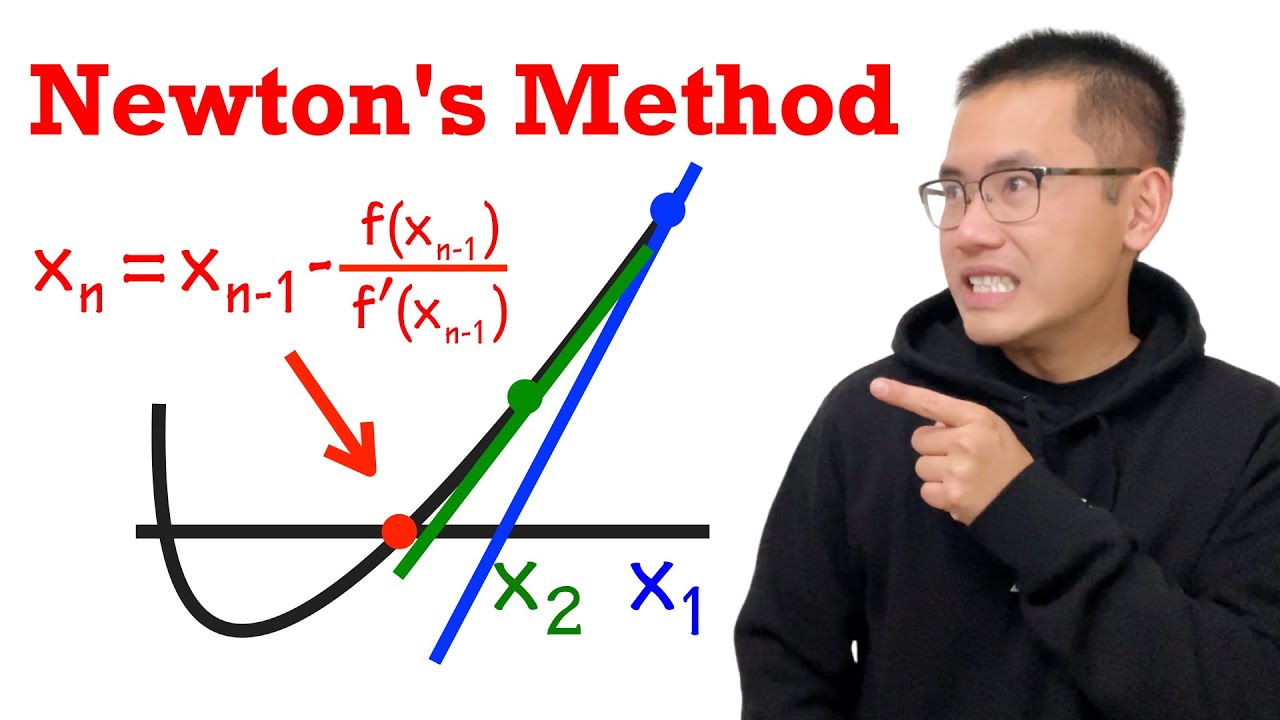
Learn more than just Newton's method on Brilliant 👉 https://brilliant.org/blackpenredpen/ (20% off with this link!)
Using Newton’s method to solve a quintic equation! Newton's method is one of the must-know topics in calculus 1 and the concept is just based on using the equations of the tangent lines.
Check out my playlist on @bprpcalcul...
you can refer to this video it's really helpful
vale dockBOT
@covert marsh Has your question been resolved?
covert marsh
wild bobcat
you can refer to this video it's really helpful
oh okay, thanks
vale dockBOT
Channel closed
Closed by @covert marsh
Use .reopen if this was a mistake.
Available help channel!
Send your question here to claim the channel.
Remember:
• Ask your math question in a clear, concise manner.
• Show your work, and if possible, explain where you are stuck.
• Do not immediately ping people or roles. After 15 minutes, feel free to ping <@&286206848099549185> once.
• Type the command .close to free the channel when you're done.
• Be polite and have a nice day!
Read #❓how-to-get-help for further information on how to ask a good question, and about conduct in the question channels.
Please don't occupy multiple help channels.
Channel closed
Channel closed due to the original message being deleted.
If you did not intend to do this, please open a new help channel,
as this action is irreversible, and this channel may abruptly lock.
 honest stone

wild bobcat
.close
honest stone
it’s closed.
wild bobcat
mb
vale dockBOT
Available help channel!
Send your question here to claim the channel.
Remember:
• Ask your math question in a clear, concise manner.
• Show your work, and if possible, explain where you are stuck.
• Do not immediately ping people or roles. After 15 minutes, feel free to ping <@&286206848099549185> once.
• Type the command .close to free the channel when you're done.
• Be polite and have a nice day!
Read #❓how-to-get-help for further information on how to ask a good question, and about conduct in the question channels.
 gusty compass
 vale dockBOT
gusty compass
vale dockBOT
gusty compass
 hollow sage
gusty compass
hollow sage
gusty compass
What have you tried so far?
stark wedge
gusty compass
do you know what it means to prove that a certain function satisfies a certain DE
gusty compass
hollow sage
What have you tried so far?
Personally I haven't tried any method on my own. I was looking for its solution on Google, YouTube and ChatGPT. But I couldn't find. Than one of my friend told me about this server. So I just came hare with the hope.
gusty compass
stark wedge
do you know what it means to prove that a certain function satisfies a certain D...
That the function is a root of the DE. I am not sure actually
hollow sage
gusty compass
That the function is a root of the DE. I am not sure actually
if f(x) is a solution of the differential equation, then plugging in f(x) would satisfy the right hand side of the DE
gusty compass
hollow sage
if f(x) is a solution of the differential equation, then plugging in f(x) would ...
Yeah yeah. Thats what I actually meant
hollow sage
So to start you should define y:= f(x)
then try plugging it into the de to see if it satisfies the right side of the equation
gusty compass
Oh ok ok. Thank you so much. I was just confused about the "Let y =". Thank you thank you.
hollow sage
gusty compass
Oh ok ok. Thank you so much. I was just confused about the "Let y =". Thank you ...
y and f(x) are usually equivalent statements
vale dockBOT
Channel closed
Closed by @gusty compass
Use .reopen if this was a mistake.
vale dockBOT
Available help channel!
Send your question here to claim the channel.
Remember:
• Ask your math question in a clear, concise manner.
• Show your work, and if possible, explain where you are stuck.
• Do not immediately ping people or roles. After 15 minutes, feel free to ping <@&286206848099549185> once.
• Type the command .close to free the channel when you're done.
• Be polite and have a nice day!
Read #❓how-to-get-help for further information on how to ask a good question, and about conduct in the question channels.
 fallow silo
.
 ivory tree
x, y, z are positive real numbers such that xyz=1/12
the minimum value of that expression can be stated as the 2nd expressions in terms of a, find a^a
 vale dockBOT
ivory tree
x, y, z are positive real numbers such that xyz=1/12
the minimum value of that e...
vale dockBOT
ivory tree
x, y, z are positive real numbers such that xyz=1/12
the minimum value of that e...
 bright wind
x,y,z are positive number so you might want to try either AM-GM or Cauchy-Schwartz
You could see that it's kind of symmetrical
So you might also want to predict when the maximum hold as well
ivory tree
i think i just make like x^2y^2=1/144z^2 from the first condition
 slate folio
hmm let m = 2y and n = 3z
then the first expression turns into:
x^2 + m^2 + n^2 + (xm)^2 + (mn)^2 + (nx)^2
that should help a little
xmn = 1/2
and then just use AM-GM and you can find the minimum
ivory tree
so the minimum is 3
 ruby sleet
small caveat that you have to make sure the minimum is attained by using AM-GM
that is, all terms need to be equal...
ivory tree
so cbrt(1/a)+cbrt(1/4a)=1
ivory tree
ruby sleet
small caveat that you have to make sure the minimum is attained by using AM-GM
so x=m=n=cbrt(1/2)? that's a bit weird
 somber arch
ivory tree
x, y, z are positive real numbers such that xyz=1/12
the minimum value of that e...
somber arch
ivory tree
x, y, z are positive real numbers such that xyz=1/12
the minimum value of that e...
my brain is collapsing aft seeing this
slate folio
somber arch
idk wht kind of maths u guyz study
go into discussion channels please
ruby sleet
somber arch
idk wht kind of maths u guyz study
if you're here for discussion, go to #discussion. Help channels are not a place to go off topic
ruby sleet
ivory tree
so x=m=n=cbrt(1/2)? that's a bit weird
but it doesn't work
somber arch
k
slate folio
oh yeah it doesnt quite work
ruby sleet
you need x^2 = m^2 = n^2 = (xm)^2 = ...
somber arch
sorry for disturbance
ruby sleet
ALL the terms in the sum need to be equal
ivory tree
oh
ruby sleet
for AM GM inequality to have an equality case
and so 3 is a lower bound, but not the minimum
ivory tree
in another approach i did x^2y^2=1/144z^2
and it led me to x^2+1/4x^2+4y^2+1/16y^2+9z^2+1/36z^2
ivory tree
slate folio
(1+x^2)(1+m^2)(1+n^2) - 5/4
it's possible to use cauchy schwarz on 3 series?
ivory tree
yeah if i use it like cauchy with 3 terms i get the minimum is equal to 1
which isn't possible
ivory tree
bright wind
How did you get 3?
using AM-GM on all the terms but i dont think it works
slate folio
the equality doesnt hold
bright wind
Try AM-GM first 3 and last 3 separately
vale dockBOT
Channel closed
Closed by @ivory tree
Use .reopen if this was a mistake.
vale dockBOT
Available help channel!
Send your question here to claim the channel.
Remember:
• Ask your math question in a clear, concise manner.
• Show your work, and if possible, explain where you are stuck.
• Do not immediately ping people or roles. After 15 minutes, feel free to ping <@&286206848099549185> once.
• Type the command .close to free the channel when you're done.
• Be polite and have a nice day!
Read #❓how-to-get-help for further information on how to ask a good question, and about conduct in the question channels.
 small fable
Hi
vale dockBOT
small fable
Hi
small fable
Is 25 in ioqm a good score? First attempt, 10th grader
candid bolt
small fable
Is 25 in ioqm a good score? First attempt, 10th grader
bruh this is not a math question
candid bolt
yeah its a personal question
small fable
so/
candid bolt
.close
vale dockBOT
Channel closed
Closed by @candid bolt
Use .reopen if this was a mistake.
vale dockBOT
Available help channel!
Send your question here to claim the channel.
Remember:
• Ask your math question in a clear, concise manner.
• Show your work, and if possible, explain where you are stuck.
• Do not immediately ping people or roles. After 15 minutes, feel free to ping <@&286206848099549185> once.
• Type the command .close to free the channel when you're done.
• Be polite and have a nice day!
Read #❓how-to-get-help for further information on how to ask a good question, and about conduct in the question channels.
 hard dust
hello. can someone help me to start understanding integral calculus?
 mild kernel
hard dust
hello. can someone help me to start understanding integral calculus?
mild kernel
hard dust
hello. can someone help me to start understanding integral calculus?
what questions did you have about it
hard dust
wait i can send you what i dont know
i have a question ,,why in integral calculus we use dx" and basiclly im not good in calcus
mild kernel
hard dust
i have a question ,,why in integral calculus we use dx" and basiclly im not good...
have you seen riemann sums?
the rectangles that you lay along the curve and add up
 lyric sundial
Do you have a (very) good knowledge of derivatives?
 hard dust
lyric sundial
Do you have a (very) good knowledge of derivatives?
hard dust
lyric sundial
Do you have a (very) good knowledge of derivatives?
this is my problem. i have integrals in my school but i wasnt at school when my class was doing derivatives
so i need help with that basiclly
i dont know what i should do to start with that
lyric sundial
You certainly have to start with derivatives
hard dust
and this is what I should start with in calculus?
 short solar


 hard dust
becasuse im quite nice in algebra but in calculus i dont know anything
 wraith heart
hard dust
becasuse im quite nice in algebra but in calculus i dont know anything
wraith heart
hard dust
becasuse im quite nice in algebra but in calculus i dont know anything
follow the order they said above^ read this in order, maybe skipping applications if you want to https://tutorial.math.lamar.edu/Classes/CalcI/CalcI.aspx
Here is a set of notes used by Paul Dawkins to teach his Calculus I course at Lamar University. Included are detailed discussions of Limits (Properties, Computing, One-sided, Limits at Infinity, Continuity), Derivatives (Basic Formulas, Product/Quotient/Chain Rules L'Hospitals Rule, Increasing/Decreasing/Concave Up/Concave Down, Related Rates, ...
hard dust
thank you so much guys. i hope this will help me in my situation. youre so good. thx
.close
vale dockBOT
Channel closed
Closed by @hard dust
Use .reopen if this was a mistake.
 sinful fern
hi gyes iam in 9th grade i know about quntum physics and another kinds of physics but my maths is weak can some1 help me
i have deep physics knoledge
 obtuse willow
sinful fern
hi gyes iam in 9th grade i know about quntum physics and another kinds of physic...
obtuse willow
sinful fern
hi gyes iam in 9th grade i know about quntum physics and another kinds of physic...
!help
vale dockBOT
sinful fern
hi gyes iam in 9th grade i know about quntum physics and another kinds of physic...
To ask for mathematics help on this server, please open your own help channel or help thread. See #❓how-to-get-help for instructions.
sinful fern
whats that''
vale dockBOT
Available help channel!
Send your question here to claim the channel.
Remember:
• Ask your math question in a clear, concise manner.
• Show your work, and if possible, explain where you are stuck.
• Do not immediately ping people or roles. After 15 minutes, feel free to ping <@&286206848099549185> once.
• Type the command .close to free the channel when you're done.
• Be polite and have a nice day!
Read #❓how-to-get-help for further information on how to ask a good question, and about conduct in the question channels.
 tiny torrent
A set of positive integers who's sum is $k \in \mathbb{Z}^+$ is called a partition of $k$, that is if $k$ can be written as [k = n_1 + n_2 + \cdots + n_t]
how many partitions of $k$ are there?
vale dockBOT
tiny torrent
A set of positive integers who's sum is $k \in \mathbb{Z}^+$ is called a partiti...
rocky lotusBOT
Branshi
 tiny torrent
I was reading my algebra book on the fundamental theorem of abelian groups and they introduced this and I was wondering how could we prove there are k many partitions of k

its not really related to the book but I was just wondering
tried myself but couldnt really think of anything
could it be like a pascal triangle thing or something
 vapid orbit
tiny torrent
I was reading my algebra book on the fundamental theorem of abelian groups and t...
vapid orbit
tiny torrent
I was reading my algebra book on the fundamental theorem of abelian groups and t...
there are more than k many partitions of k.
 gritty sinew
there's already at least 5 partitions for 4 on your pic
vapid orbit
it's just asking you for all the ways to sum up to k, but in fancy math terms
vapid orbit
yes
tiny torrent
let me try doing 5 and see if I see any patterns
I got 7 ways
maybe it has something to do with how many ways we can group 1 + 1 + ... + 1
hmm let me try doing something with that and see if I get anywhere
gritty sinew
tiny torrent
is there some formula for the number of ways to break up k?
there ain't really any closed-form formula no
but a ton of things have been said about that function
tiny torrent
oh
ok let me not waste my time trying to figure it out then 😭
thanks for the help and information
.solved
vale dockBOT
Channel closed
Closed by @tiny torrent
Use .reopen if this was a mistake.
vapid orbit
tiny torrent
ok let me not waste my time trying to figure it out then 😭
i wouldn't say it's a waste of time, you just can't compute the number in constant time complexity (and you'd want to write a small program to do it instead of doing it by hand)
vale dockBOT
Available help channel!
Send your question here to claim the channel.
Remember:
• Ask your math question in a clear, concise manner.
• Show your work, and if possible, explain where you are stuck.
• Do not immediately ping people or roles. After 15 minutes, feel free to ping <@&286206848099549185> once.
• Type the command .close to free the channel when you're done.
• Be polite and have a nice day!
Read #❓how-to-get-help for further information on how to ask a good question, and about conduct in the question channels.
 tough temple
how to find distinct congruency classes in S4?
tough temple
Symmetric group
 jovial scarab
like the conjugacy classes?
tough temple
yeah
jovial scarab
a convenient thing about conjugate elements in symmetric groups is that they have the same cycle sizes
so e.g. (1) (2) (34) and (1) (3) (24) are conjugate
tough temple
jovial scarab
a convenient thing about conjugate elements in symmetric groups is that they hav...
yeah i saw that somewhere but im using the S4 conjugacy classes in a proof so i was wondering if i would need to prove that?
jovial scarab
hmm probably, but it's not difficult to prove i think
tough temple
oh thats annoying
jovial scarab
it's easy to verify that two group elements with the same cycle structure are conjugate
to show that any two conjugate elements must have the same cycle structure, you could maybe make an argument about the frequency of period length for each element
tough temple
I was going to use the distinct conjugacy class sizes to show that they cannot add up to a specific number tho
jovial scarab
well that’s just using the result to prove whatever you want to prove, that should be irrelevant to whether or not you need to prove that conjugate elements have the same cycle structure
vale dockBOT
@tough temple Has your question been resolved?
vale dockBOT
Channel closed
Closed due to timeout
Use .reopen if this was a mistake.
Available help channel!
Send your question here to claim the channel.
Remember:
• Ask your math question in a clear, concise manner.
• Show your work, and if possible, explain where you are stuck.
• Do not immediately ping people or roles. After 15 minutes, feel free to ping <@&286206848099549185> once.
• Type the command .close to free the channel when you're done.
• Be polite and have a nice day!
Read #❓how-to-get-help for further information on how to ask a good question, and about conduct in the question channels.
 near coyote
i dont understand how this isnt a valid fraction
 gritty sinew
why don't you evaluate the bottom of the fraction
near coyote
do you mean put as x^2+10x+21?
 pallid gyro
could be yes
near coyote
ive tried that
pallid gyro
but its then weird
near coyote
so, theres nothing i can do?
near coyote
nope
pallid gyro
ok, then could be system error
gritty sinew
near coyote
do you mean put as x^2+10x+21?
no
I mean actually plug in -6 inside that
and compute
near coyote
I got the key and the answers 3
how do i plug in and compute?
oh im stupid
i get it
i left the x in the denominator, when i should have substituted in -6 for all the x's not just the top one
thx
vale dockBOT
@near coyote Has your question been resolved?
Channel closed
Closed by @near coyote
Use .reopen if this was a mistake.
Available help channel!
Send your question here to claim the channel.
Remember:
• Ask your math question in a clear, concise manner.
• Show your work, and if possible, explain where you are stuck.
• Do not immediately ping people or roles. After 15 minutes, feel free to ping <@&286206848099549185> once.
• Type the command .close to free the channel when you're done.
• Be polite and have a nice day!
Read #❓how-to-get-help for further information on how to ask a good question, and about conduct in the question channels.
 terse chasm
I'm trying to understand this proof by induction exercise, what do the square brackets mean? What occurs between that step and the previous one?
 vale dockBOT
terse chasm
I'm trying to understand this proof by induction exercise, what do the square br...
terse chasm
vale dockBOT
terse chasm
I'm trying to understand this proof by induction exercise, what do the square br...
terse chasm
Yeah I got that far
 pure mirage
Left side is exactly the sum up to k + 1, not just to k
terse chasm
They add that to make the k+1 case
pure mirage
(that's the reason exactly this was added)
And for the right, you just simplify
Factor out 1/3(k+1)(k+2)
terse chasm
Hmmm, can you walk me through it a bit? I've done factorization a lot but it never gets intuitive
pure mirage
$\frac 13 k{\color{red} (k+1)(k+2)} + {\color{red} (k+1)(k+2)}$
rocky lotusBOT
Kepe

 exotic grove
 pure mirage
exotic grove
pure mirage
exotic grove
!occupied
vale dockBOT
exotic grove
Someone else is already using this help channel. If you need help with a question, please open your own help channel/thread (see #❓how-to-get-help for instructions).
pure mirage
rocky lotus
**Kepe**
\li \ So you can write this as: [\frac 13 k{\color{red} (k+1)(k+2)} + {\color{red} (k+1)(k+2)} = {\color{red} (k+1)(k+2)} \Big(\frac 13k + 1\Big)]
rocky lotusBOT
Kepe
 terse chasm
Right
pure mirage
You can also pull out a factor of 1/3