#help-4
1 messages · Page 50 of 1
 woeful oxide
 rare wharf
oh they are the same? delta=discriminant okok just making sure (i had to look up spell aswell )
 humble chasm
the discriminant being
$b^2 - 4ac$
 rocky lotusBOT
9k
 woeful oxide
^
rare wharf
yes yes
woeful oxide
rare wharf
oh they are the same? delta=discriminant okok just making sure (i had to look up...
delta = change but in this context delta is the discrimanent
now
plug in your values
humble chasm
remember that the square root is not actually a part of the discriminant, but instead, what’s under the square root. some people mix that up.
woeful oxide
that you got from before
but dont solve yet
just plug them in and show me what you got
humble chasm
so when you think of this, think,
“taking the square root of the discriminant”
not
“the discriminant is the square root of b^2 - 4ac”
rare wharf
(4)^2-4(1)(-12)
woeful oxide
rare wharf
(4)^2-4(1)(-12)
it should be -4
 errant gyro
i recommend putting the - in b as well because your b is actually negative
while, yes, it doesn't change the value, it ingrains in you the habit of remembering your signs
woeful oxide
lol i remember i was mid precalc final and i forgot about my signs halfway thru
errant gyro
because otherwise you get the habit of being super sloppy with them
and then when they actually matter, you get a wrong answer
rocky lotusBOT
haku
 rare wharf
(4)2=16
humble chasm
ur thinking of 4 squared
rocky lotusBOT
haku
 woeful oxide
so $16 - 4(1)(-12)$
rocky lotusBOT
haku
 rare wharf
mb for the confusion i ment (4)^2 = 16 then -4 * 1 is -4 -4*-12 = 48
woeful oxide
okay hold on
lets take things
one at a time
wait no hes right
what is the final answer
rare wharf
then 16+48 =64
errant gyro
no
woeful oxide
no
humble chasm
rocky lotus
**haku**
no
humble chasm
this is -4*-12 which is 48
16 - 48
-32
woeful oxide
$16 -4(-12)$
rocky lotusBOT
haku
 humble chasm
oh
woeful oxide
$16 + 48$
rocky lotusBOT
haku
 humble chasm
wait maybe even i messed up HAHA
woeful oxide
lol happens to the best of us
humble chasm
no u gotta think of it like this
humble chasm
$16-(-48)$
rocky lotusBOT
9k
 humble chasm
and then double slash
which means , slash through both negative signs
so $16 + (+48)$
rocky lotusBOT
9k
 woeful oxide
rocky lotus
**9k**
woeful oxide
rocky lotus
**9k**
yeah
rocky lotusBOT
9k
 humble chasm
i a prefer to write
woeful oxide
honestly i use my head for all of precalc
humble chasm
$-(b)$
rocky lotusBOT
9k
 woeful oxide
like i graph all of the functions in my head
rocky lotusBOT
9k
 errant gyro
let's refocus on the problem, folks
rare wharf
$4+-8/2
woeful oxide
uhh
very wrong format
but like ur pretty much right
that would give you
$4 +- 8/2$
rocky lotusBOT
haku

 tidal swift
$\frac{4 \pm 8}{2}$
rocky lotusBOT
Seia
 rare wharf
my first time trna use that comand haha
rare wharf
no way she knows the +- to
tidal swift
rare wharf
no way she knows the +- to
are you referring to me?
tidal swift
ah ok
rare wharf
tidal swift
are you referring to me?
yes
woeful oxide
yk what uhh
humble chasm
refocus please
woeful oxide
yeah yeah exactly
tidal swift
let's not use OP's channel as a #latex-testing substitute
humble chasm
rocky lotus
**Seia**
so we have this so far
rare wharf
combine like terms?
woeful oxide
rare wharf
combine like terms?
what terms would you combine?
just
acc wait
i think i used the wrong saying
anyways
woeful oxide
rocky lotus
**Seia**
how do you simplify this
humble chasm
ok
OP
when you have a plus or minus sign, think of it as two different problems you have to solve

so this
is actually
$4+8/2$
woeful oxide
he should probaby simplify first
rocky lotusBOT
9k
 woeful oxide
makes the equation a lot easier to visualize
rocky lotusBOT
9k
 humble chasm
so u gotta solve both of those
 tawny moon
$\frac{4+8}{2}$ and $\frac{4-8}{2}$
rocky lotusBOT
Hanako
 woeful oxide
im quitting latex too many sweats
 errant gyro
correct!
 tidal swift
signs!!!
rare wharf
tidal swift
signs!!!
where am i missing?
woeful oxide
rare wharf
where am i missing?
signs
rare wharf
humble chasm
that would turn into positive 48. not negative.
aw ok
humble chasm
op, can i teaxh you a trick that will really help you with problems like this ?
rare wharf
woeful oxide
signs
yea where
tidal swift
 woeful oxide
rare wharf
yea where
woeful oxide
rare wharf
yea where
-4 times -12 will never be negative
a negative times a negative is ALWAYS positive
tidal swift
humble chasm
-4(1)(-12) right here
humble chasm
has any of your math teachers ever taught you about the double slash technique ?
woeful oxide
nope
humble chasm
it makes it really easy. i’d love to show you
woeful oxide
i look at it and im like hmm cool cool and i do it in my head and call it a day
humble chasm
so if i have something like
$-a(-b)$
rocky lotusBOT
9k
 humble chasm
basically i like to keep the first negative sign as is and treat a as if its positive
so if i do that, i get
$-(-ab)$
rocky lotusBOT
9k
 humble chasm
following so far?
now just kinda…”SLASH” through both the negative signs.
like literally slash through them
so you get
$+(+ab)$
rocky lotusBOT
9k
 humble chasm
and that’s just positive ab 🙂
errant gyro
somehow OP did 16+48 but wrote 16-48
 gloomy sorrel
errant gyro
somehow OP did 16+48 but wrote 16-48
gloomy sorrel
errant gyro
somehow OP did 16+48 but wrote 16-48
It's ✨magic ✨
rare wharf
6 and 2 is wrong on the websight
errant gyro
16-48 gives us problems under the square root anyway, so something would have gone very wrong there
woeful oxide
rare wharf
6 and 2 is wrong on the websight
try 2, 6
woeful oxide
dude work on ur signs 😭
humble chasm
i can’t wait to show you factoring by grouping 😭
rare wharf
yay its right
woeful oxide
humble chasm
i can’t wait to show you factoring by grouping 😭
dawg hes going to hate it
that is like ONLY signs
humble chasm
alright can i show u factoring by grouping now
rare wharf
okok 9k how would u do this problem a lot faster
errant gyro
tidal swift
print this out and paste this above your PC lol
humble chasm
rare wharf
okok 9k how would u do this problem a lot faster
alright
rare wharf
errant gyro
print this out and paste this above your PC lol
brah lmao
 rare wharf
okok
humble chasm
$x^2-4x=12$
rocky lotusBOT
9k
 woeful oxide
wait a minute
humble chasm
factoring by grouping is a really easy way to solve this problem.
sometimes factoring by grouping doesn’t work
in the cases where it doesn’t work, we have the quadratic formula as a backup.
woeful oxide
isnt this just
humble chasm
that’s how i look at it.
humble chasm
following so far ?
rare wharf
also rq define factoring im kinda confused when poeple ask me to do it
woeful oxide
rare wharf
also rq define factoring im kinda confused when poeple ask me to do it
breaking down numbers into different numbers
uhh basically like
rare wharf
humble chasm
factoring by grouping is a really easy way to solve this problem.
sometimes fac...
do you know before hand when its not going to work
humble chasm
factoring is the process of breaking a big expression into a product of smaller pieces
woeful oxide
the whole point is exploiting equations
humble chasm
rare wharf
do you know before hand when its not going to work
no, you kinda just discover it as you try it, at least that’s how i look at it
woeful oxide
you do more of that in gr 11
humble chasm
anyways let’s refocus ok
rare wharf
okok
humble chasm
so there’s a few things you need to understand for this to work
have you ever heard of the zero product property?
it’s very easy.
rare wharf
yes
humble chasm
if you haven’t, i’ll teach you it
rare wharf
i just leaned it
humble chasm
great!
rare wharf
but yk i have not used it alot
rare wharf
but i have it in my book here
rocky lotusBOT
9k
 humble chasm
$A or B must equal 0$
rocky lotusBOT
9k
 rocky lotusBOT
9k
 rare wharf
a being 1 and b being -4
humble chasm
first thing you’re gonna wanna do is set the entire equation equal to 0. you know how to do that right ?
rocky lotusBOT
9k
 rare wharf
A=1 and B= -4
rare wharf
okok
humble chasm
what does this look similar to?
rare wharf
umm
humble chasm
focus on the left side
forget about the =0 for now. we’ll come back to that later
this is a quadratic equation in its general form
$ax^2+bx+c$

 humble chasm
see?
rare wharf
i remember something the teacher said about we have to change add something to make it a aquare number?
woeful oxide
rare wharf
i remember something the teacher said about we have to change add something to m...
thats for an entirly different equation
humble chasm
yeah here just focus on this
humble chasm
rocky lotus
**9k**
.
rare wharf
woeful oxide
thats for an entirly different equation
dayum ok
errant gyro
rare wharf
i remember something the teacher said about we have to change add something to m...
you're possibly talking about completing the square, which is not happening here
humble chasm
rocky lotus
**9k**
.
rare wharf
im with you
humble chasm
do u see
ok
now remember what i said about factoring.
it’s.
taking a bigger equation -> breaking it down into smaller products

 rare wharf
i see how this equation is a quadratic is its genral form
humble chasm
what is a, b, and c in your equation here
rare wharf
a=1 b=-4 c=-12
humble chasm
close
you’re just missing c
nice
ok
now in order to factor by grouping you’re gonna start by multiplying ac
what is ac here?
humble chasm
no
rare wharf
1*-4
humble chasm
that’s ab
humble chasm
nice!
now
we are looking for two numbers which:
multiply to ac (-12)
and add up to b (-4)
rare wharf
i see now
humble chasm
so what two numbers add up to b and multiply to ac?
rare wharf
-6 and -2
humble chasm
close again, that adds up to 4.
rare wharf
oh adds
humble chasm
you’re looking for something that adds to -4
and multiplies to -12
you’re so close
just oneeee small change
rare wharf
hm
rare wharf
i wana say -6 and 2
humble chasm
what’s making you question yourself here?
-6 and 2:
multiply together to -12
and add up to -4
no?
rare wharf
didnt i say that?
rare wharf
rare wharf
i wana say -6 and 2
humble chasm
no u said -6 and 2
rare wharf
i see
rocky lotusBOT
9k
 humble chasm
isn’t that the same as
$x^2 -6x + 2x - 12$
rocky lotusBOT
9k
 humble chasm
because when you combine -6x and 2x you just get -4x, which is the same thing as the original, right?
rare wharf
are those the same?
humble chasm
yeah, look at -6x and 2x
what happens when you combine them?
just brings u right back to -4x, right?
here let me put this in forms of PEMDAS so maybe it’ll make it easier to see
isn’t that the same as
$x^2 (-6x + 2x) - 12$
rocky lotusBOT
9k
 rocky lotusBOT
9k
 humble chasm
follow pemdas. parenthesis first
see how it just brings u back to -4x?
which is what your original equation was
$x^2-4x-12$
rocky lotusBOT
9k
 rare wharf
i see
rare wharf
can we try my next problem on here?
rocky lotusBOT
9k
 rare wharf
solve with factoring?
humble chasm
yeah
rare wharf
yes
humble chasm
but think of the + sign in the middle as sort of like
a wall that divides the first half of that equation from the second
well then we have
$x^2 -6$
rocky lotusBOT
9k
 rocky lotusBOT
9k
 humble chasm
following so far ?
rare wharf
yea
humble chasm
ok so
humble chasm
rocky lotus
**9k**
let’s focus on this one
btw
that’s supposed to be 6x not 6
my apologies
$x^2-6x$
rocky lotusBOT
9k
 humble chasm
well this is the same as
$x(x-6)$
rocky lotusBOT
9k
 humble chasm
see how i’ve just factored x out of it?
i took a bigger equation and broke it down into 2 smaller products
rare wharf
yea
rare wharf
2(x-12)?
humble chasm
close!
rare wharf
or x(2-12)
humble chasm
that would break your equation because 2*-12 is 24.
-24*
you can’t factor x out of it
because -12 doesn’t have an x
rare wharf
hm i dont know how else i would do it
humble chasm
$2x-12$
rocky lotusBOT
9k
 humble chasm
you’re looking for:
“how can i break this into something where AB = (2x-12)”
rocky lotusBOT
9k
 humble chasm
i broke it down to
$x(x-6)$
rocky lotusBOT
9k
 humble chasm
the reason i was able to take x out of that is because x^2 is just x times x.
-6x is just x times -6
humble chasm
rocky lotus
**9k**
so i’ve essentially turned this
into
$AB = x(x-6), A = x, B = (x-6)$
rocky lotusBOT
9k
 humble chasm
does that make sense?
rare wharf
rocky lotus
**9k**
ab = (2+x) -12?
humble chasm
no 🙁
rare wharf
sorry im a little lost on the logic here
rocky lotusBOT
9k
 humble chasm
do you see how that is the same as $2x-12$
rocky lotusBOT
9k
 humble chasm
because if you were to multiply out 2(x-6), you’d end up with 2x-12
go do it on a piece of paper if you’re curious
rare wharf
woeful oxide
yall its been like
im on question 4 so at my current pace il be done in 62 hours
humble chasm
rocky lotus
**9k**
do u see it :p
rare wharf
humble chasm
go do it on a piece of paper if you’re curious
i am this method does seam faster then doing a quadratic formula
humble chasm
rocky lotus
**9k**
we have this
humble chasm
rocky lotus
**9k**
and we have this
humble chasm
rocky lotus
**9k**
remember this ? @rare wharf
rare wharf
yes
humble chasm
$x(x-6) + 2(x-6)$
rocky lotusBOT
9k
 humble chasm
do you see what i did
humble chasm
rocky lotus
**9k**
when u remember what we did when we factored
$x^2 - 6x = x(x-6), 2x-12= 2(x-6)$
rocky lotusBOT
9k
 rare wharf
yea i see
humble chasm
yeah, i kinda just swapped the original with their factored versions
$x(x-6) + 2(x-6)$
rocky lotusBOT
9k
 rocky lotusBOT
9k
 humble chasm
and that leaves u with $x+2$
rocky lotusBOT
9k
 humble chasm
see it?
rocky lotusBOT
9k
 humble chasm
rocky lotus
**9k**
humble chasm
rocky lotus
**9k**
because in order to understand it, i want u to actually see that when u multiply that out, u will end up with your original equation, which was this
so go multiply those out and lmk when you’re done
so u can actually see it in action
cuz i feel like that’s the best way to grasp what ive just showed u
ping me when you’re finished multiplying it out
rare wharf
ok
rare wharf
is foil a different thing then pendmas
humble chasm
rocky lotus
**9k**
it’s just a trick u can remember when multiplying stuff like this
humble chasm
rocky lotus
**9k**
these are called binomials
you’re multiplying two binomials together
rare wharf
i really apricate your help but i have to go, when i come back i will try it and see if i can get the same awsner
thanks for sticking with me 😭 @humble chasm
and @woeful oxide
humble chasm
you’re good man, good luck!
rare wharf
.close
 vale dockBOT
Channel closed
Closed by @rare wharf
Use .reopen if this was a mistake.
 Available help channel!
Send your question here to claim the channel.
Remember:
• Ask your math question in a clear, concise manner.
• Show your work, and if possible, explain where you are stuck.
• After 15 minutes, feel free to ping <@&286206848099549185>.
• Type the command .close to free the channel when you're done.
• Be polite and have a nice day!
Read #❓how-to-get-help for further information on how to ask a good question, and about conduct in the question channels.
 nova lance
For question 19, I don't understand why the answer is A, x-7 should be a horizontal translation 7 units to the right.

 vale dockBOT
nova lance
For question 19, I don't understand why the answer is A, x-7 should be a horizon...
vale dockBOT
nova lance
For question 19, I don't understand why the answer is A, x-7 should be a horizon...
 vale dockBOT
Channel closed
Closed by @nova lance
Use .reopen if this was a mistake.
vale dockBOT
Available help channel!
Send your question here to claim the channel.
Remember:
• Ask your math question in a clear, concise manner.
• Show your work, and if possible, explain where you are stuck.
• After 15 minutes, feel free to ping <@&286206848099549185>.
• Type the command .close to free the channel when you're done.
• Be polite and have a nice day!
Read #❓how-to-get-help for further information on how to ask a good question, and about conduct in the question channels.
 severe lodge
I need help with finding Vo and Io
 vale dockBOT
severe lodge
I need help with finding Vo and Io
severe lodge
vale dockBOT
severe lodge
I need help with finding Vo and Io
severe lodge
for Io i thought maybe i need to find the voltages after R1 and R2 and use that to find the current but that doesnt make sense
I have Kcl Kvl Voltage Divider and Current Divider that I can use
Kcl all current in = All current out
Kvl all voltage in = All voltage out
Votlage Divider Vo = Vin * (R2/ R1 + R2)
Voltage Divider VR1 = Vin * (R1/ R1 + R1)
Current Divider = IR1 = Iin (R2/ R1 + R1)
Use voltage divider with a voltage source feeding series resistors.
Use current divider with a current source feeding parallel resistors.
Don’t use either if there’s a bridge/extra connection between the divider nodes (that breaks pure series/parallel).

 jovial edge
Yeah that's wrong, Vs is the voltage R4 and R3 or R4+R3 since they're parallel
severe lodge
oh wait so i was kinda close right just wrong voltage
severe lodge
jovial edge
Yeah that Vt should the th voltage R1, R2 and R1&R2
its over R1+R2 isnt it
jovial edge
Okay, so should know how to combine two parallel res into one resistance
jovial edge
Yeah so we combine R1 and R2 into one
severe lodge
k
jovial edge
severe lodge
but if you do that doesnt it remove the connection that is I0?
We'll get to that later
severe lodge
k
jovial edge
Do the same for R3&4
severe lodge
k
jovial edge
Then you will have a series of 2 res
severe lodge
yep
jovial edge
Could you find the voltages of both res?
jovial edge
VR12 is also VR1 and VR2
VR34 is also VR3 and VR4 or Vo
Now you have all the voltages you can start to find the current
And using that node rule which I forget its name
To do the last part
Sorry have to be quick since Imma have a test in an hour
severe lodge
jovial edge
VR12 is also VR1 and VR2
when you say this VR12 = VR1 + VR2 ?
severe lodge
jovial edge
Sorry have to be quick since Imma have a test in an hour
all good thank you so much
jovial edge
VR12=VR1=VR2
 jovial edge
Bro you said series
severe lodge
misinput all good
severe lodge
good luck
vale dockBOT
@severe lodge Has your question been resolved?
vale dockBOT
Channel closed
Closed due to timeout
Use .reopen if this was a mistake.
Available help channel!
Send your question here to claim the channel.
Remember:
• Ask your math question in a clear, concise manner.
• Show your work, and if possible, explain where you are stuck.
• After 15 minutes, feel free to ping <@&286206848099549185>.
• Type the command .close to free the channel when you're done.
• Be polite and have a nice day!
Read #❓how-to-get-help for further information on how to ask a good question, and about conduct in the question channels.
 unborn locust
 vale dockBOT
unborn locust
vale dockBOT
unborn locust
 flat locust
consider total distance D
ajay starts from A and vijay starts from B
in the first meeting They meet 500 m away from A
and time is same
so velocity of Ajay / velocity of vijay = 500 / D - 500
do the same for second meeting
you can equate the ratios because speed is constant and find out the distance b/w them
first do this
vale dockBOT
Channel closed
Closed by @unborn locust
Use .reopen if this was a mistake.
vale dockBOT
Available help channel!
Send your question here to claim the channel.
Remember:
• Ask your math question in a clear, concise manner.
• Show your work, and if possible, explain where you are stuck.
• After 15 minutes, feel free to ping <@&286206848099549185>.
• Type the command .close to free the channel when you're done.
• Be polite and have a nice day!
Read #❓how-to-get-help for further information on how to ask a good question, and about conduct in the question channels.
 swift ermine
yo
vale dockBOT
swift ermine
yo

 hot tide
split it into two sums
hot tide
why not
swift ermine
it gave me a different value
hot tide
send your work
swift ermine
aight
hot tide
$\sum_{r=1}^{15} 2^r + 12 \sum_{r=1}^{15} r$
rocky lotusBOT
artemetra

 reef adder
rocky lotus
**artemetra**
reef adder
rocky lotus
**artemetra**
Lmfao
hot tide
reef adder
Lmfao
what?
 dire cloud
hot tide
what?
dire cloud
hot tide
what?
no thats right idk what shes laughing for
hot tide
xd
 hot tide
huh
dire cloud
yeah no the question seems wrong
swift ermine
no it the exact question i got in the test
hot tide
swift ermine
you get that answer if you have -12r
swift ermine
i remember
hot tide
instead
reef adder
the statement is wrong
 steady charm
,w sum 2^r + 12r from 1 to 15
rocky lotusBOT


 Requested by cloudedhorizons
 fossil mulch
swift ermine
i remember
fossil mulch
swift ermine
i remember
Maybe you didn't
hot tide
,w sum 2^r - 12r from 1 to 15
rocky lotusBOT

 Requested by arte_m_etra
hot tide
Requested by arte_m_etra
hot tide
possibly
swift ermine
is there some other way i could solve it
hot tide
no this is the right way
swift ermine
without splitting it
reef adder
swift ermine
is there some other way i could solve it
no just split the sums
swift ermine
reef adder
no just split the sums
ok
reef adder
you did
vale dockBOT
Channel closed
Closed by @swift ermine
Use .reopen if this was a mistake.
vale dockBOT
Available help channel!
Send your question here to claim the channel.
Remember:
• Ask your math question in a clear, concise manner.
• Show your work, and if possible, explain where you are stuck.
• After 15 minutes, feel free to ping <@&286206848099549185>.
• Type the command .close to free the channel when you're done.
• Be polite and have a nice day!
Read #❓how-to-get-help for further information on how to ask a good question, and about conduct in the question channels.
 ripe sapphire
I understand the idea of concavity is that the graph curves up (could "hold water") but I don't see how to pick the points for that on the graph. Like would it concave up between (-2,0) and (2,-1) or how does that work?
vale dockBOT
ripe sapphire
I understand the idea of concavity is that the graph curves up (could "hold wate...
ripe sapphire

 pine prairie
Yes
The way I think about it is like this
If someone asks you why at (-2, 0) the first derivative is negative
How would you explain that?
ripe sapphire
pine prairie
How would you explain that?
I'd be confused
Aren't derivatives taught in calc? I'm just starting precalc.
pine prairie
…
Wtf
Concavity is defined by the second derivative
😭
Here I’ll give you a visual intuition for it
ripe sapphire
pine prairie
Concavity is defined by the second derivative
Oops, my teacher didn't explain it beyond how it looks and holding water lol.
 pliant nova
ripe sapphire
I understand the idea of concavity is that the graph curves up (could "hold wate...
pliant nova
ripe sapphire
I understand the idea of concavity is that the graph curves up (could "hold wate...
it asks what INTERVALS not points
ripe sapphire
pliant nova
it asks what INTERVALS not points
So hypothetically i.e. [-2,2] ?
pine prairie
 pliant nova
i think theyd be open so (-2, 2)
pine prairie
Consider the purple function
Look at the red dot and the red line
If you zoom in a lot to the red dot, the purple function looks like the red line
Would you agree?
ripe sapphire
Yes
pliant nova
dont really need to teach them derivatives right now they can just learn that properly in a calc class
pine prairie
We call the red line the tangent (straight) line at the red point
Now if we try to approximate our function instead of a linear straight line
Maybe we try, what parabola is the “closest” to the purple line at the red point
(Picture coming)
(Yes I moved the point for clarity)

At that point do you agree that this red parabola looks very similar to the purple function?
ripe sapphire
yep
 ripe sapphire
it does not..
pine prairie
As you move around the red point the red function is so far away from the purple function!
pine prairie
pine prairie
(Yes I moved the point for clarity)
This is better!
ripe sapphire
so is the red dot an inflection point (for the purple function)?
pine prairie
Consider the “best” parabolic approximation to the purple function at the red point
The concavity of this parabolic approximation is the concavity of the red point on the purple function
pine prairie
ripe sapphire
so is the red dot an inflection point (for the purple function)?
Inflection points are where both concave up and concave down parabolas approximate the function equally well
Let me give you an example
 silver birch
if you want to know in broad terms without going into derivatives for concavity, it's concave up if the rate at which the function changes is going up, and it's concave down if the rate at which the function changes is going down
basically an "acceleration" of the function
 ripe sapphire
silver birch
if you want to know in broad terms without going into derivatives for concavity,...
ripe sapphire
silver birch
if you want to know in broad terms without going into derivatives for concavity,...
so in the graph, it's concave up from [-0.5,4] and [6,inf]?
pine prairie
pine prairie
Here both the yellow and blue parabolic approximations sort look just as good as each other
That’s an inflection point
Kinda
(To be more specific, on the 2 sides of a point, the concavity of the best parabolic approximation needs to have different signs)
So for example, in f(x) = 0
At 0 (and every other point as well), both concave up and down parabolas approximate f(x) equally good
But it’s not an inflection point because the concavity doesn’t change signs (ie the best parabolic approximation doesn’t change concavity on either side of 0)
silver birch
ripe sapphire
so in the graph, it's concave up from [-0.5,4] and [6,inf]?
actually from (-2, 4)
you don't want to know if the function is decreasing or increasing, moreso the rate at which the function is changing values
pine prairie
Tbh geometrically my explanation is as correct as the algebraic ones, slope and concavity are defined by the “best linear and quadratic approximations” which are precisely the straight and parabolic lines ive been drawing
silver birch
but the parabolic approximation is a good enough method for knowing if a function is concave up or down
pine prairie
So I’m not cheating the explanation, it’s a very well argued and correct interpretation of concavity
silver birch
it is indeed
 analog herald
if f''(x) < 0 its concave downward; if f''(x) > 0 is concave upward
pine prairie
Yes but they haven’t learned calculus yet
analog herald
oops
if it concave up, the slope is increasing as you move left to right
(im not sure if its called monotonicity)
for concave down, the slope is decreasing as you move left to right
,w graph y = x^2
rocky lotusBOT

 Requested by lxysgp_85443
analog herald
Requested by lxysgp_85443
analog herald
this is concave up
pine prairie
Yes but then you need to know what the slope is
Which if you haven’t done calculus you probably don’t know either
analog herald
i didnt do calculus but like cuz i do geom so i know lol
like its a tangent line to slope
 pine prairie
Yes but you’re not really helping the OP
ripe sapphire
analog herald
if it concave up, the slope is increasing as you move left to right
I understand this definition in theory. In practice, does that mean that it includes the part of a graph from the left that initially slopes downward?
Like in the given graph from my assignment question, would we define [-2,2] as concave up because it forms the upward-facing parabola or just [-,05,2] since that's the range where the slope is actually increasing?
pine prairie
ripe sapphire
I understand this definition in theory. In practice, does that mean that it incl...
First one
Think of the parabolas
It is precisely what concavity is so you won’t be fooled
I’ve secretly swept the calculus theory under the rug of “best approximation”
But you can visually interpret and see what best approximation should look like so I don’t feel a need to expand on that
ripe sapphire
ah
so concave up at [-2,2], and would the second one be concave up [5,8] or [5,inf]
and concave down at [2,5] and the first one would be [inf,-2] or [-6,-2]?
pine prairie
(5, inf)
Don’t include the end points
The end points are inflection points, their concavity is 0
0 is neither positive nor negative
So a concavity of 0 is neither up nor down
And (-inf, -2) for the concave down
It might look crazy but it’s still slightly curving up/down when it goes high/low
So the best approximations are still on the same side as the intervals you’ve otherwise suggested
vale dockBOT
@ripe sapphire Has your question been resolved?
vale dockBOT
Channel closed
Closed due to timeout
Use .reopen if this was a mistake.
vale dockBOT
Available help channel!
Send your question here to claim the channel.
Remember:
• Ask your math question in a clear, concise manner.
• Show your work, and if possible, explain where you are stuck.
• After 15 minutes, feel free to ping <@&286206848099549185>.
• Type the command .close to free the channel when you're done.
• Be polite and have a nice day!
Read #❓how-to-get-help for further information on how to ask a good question, and about conduct in the question channels.
 bleak grail
i'm trying to understand the discrete fourier transform. when you take your samples and transform them, i understand that the numbers that pop out represent the amplitude and phase shift of a particular frequency, but what frequencies are they exactly?
if i have a vector x of samples, and then i get a vector X thats been transformed, what do the numbers in X represent
 vale dockBOT
bleak grail
i'm trying to understand the discrete fourier transform. when you take your samp...
flat locust
vale dockBOT
bleak grail
i'm trying to understand the discrete fourier transform. when you take your samp...
flat locust
claim another channel
 tame osprey
flat locust
claim another channel
tame osprey
flat locust
claim another channel
Idk which one to go to
tame osprey
Okay thank you
vale dockBOT
@bleak grail Has your question been resolved?
vale dockBOT
@bleak grail Has your question been resolved?
Channel closed
Closed by @bleak grail
Use .reopen if this was a mistake.
Available help channel!
Send your question here to claim the channel.
Remember:
• Ask your math question in a clear, concise manner.
• Show your work, and if possible, explain where you are stuck.
• After 15 minutes, feel free to ping <@&286206848099549185>.
• Type the command .close to free the channel when you're done.
• Be polite and have a nice day!
Read #❓how-to-get-help for further information on how to ask a good question, and about conduct in the question channels.
 midnight pier
how do i approach this?
 vale dockBOT
midnight pier
how do i approach this?
vale dockBOT
midnight pier
how do i approach this?
 molten trellis
midnight pier
how do i approach this?
molten trellis
midnight pier
how do i approach this?
Put x=2
You will get E
Then differentiate
And put x=2 again
You will get D
midnight pier
can i do this without caculous pls
molten trellis
Or you can use binomial theorem
 distant galleon
||Divide the left hand side by (x-2) to get E. Then, (LHS-E)/(x-2) leaves a remainder of D when divided by (x-2). etc.||
 midnight pier
distant galleon
||Divide the left hand side by (x-2) to get E. Then, (LHS-E)/(x-2) leaves a rema...
midnight pier
distant galleon
||Divide the left hand side by (x-2) to get E. Then, (LHS-E)/(x-2) leaves a rema...
ok ill try this
midnight pier
distant galleon
||Divide the left hand side by (x-2) to get E. Then, (LHS-E)/(x-2) leaves a rema...
how do u know 2 is a root of the function
oh nvm its given
i get remainder 524/x-2
is that correct for E?
distant galleon
,w 2x^4 - 9x^3 +145 x^2 - 9x + 2, x=2
rocky lotusBOT

 Requested by civil_service_pigeon
distant galleon
midnight pier
is that correct for E?
Requested by civil_service_pigeon
distant galleon
midnight pier
is that correct for E?
$E=524$, not $\frac{524}{x-2}$.
rocky lotusBOT
Civil Service Pigeon

 distant galleon
midnight pier
how so?
distant galleon
midnight pier
how so?
You divided both sides by $x-2$, remember?
rocky lotusBOT
Civil Service Pigeon
 distant galleon
midnight pier
i forgot
distant galleon
midnight pier
i forgot
Can you do the rest yourself now?
midnight pier
distant galleon
Can you do the rest yourself now?
ill try
midnight pier
distant galleon
Can you do the rest yourself now?
i got D = 261
its not correct tho right?
distant galleon
!show
vale dockBOT
Show your work, and if possible, explain where you are stuck.
midnight pier
 distant galleon
||Divide the left hand side by (x-2) to get E. Then, (LHS-E)/(x-2) leaves a rema...
distant galleon
distant galleon
||Divide the left hand side by (x-2) to get E. Then, (LHS-E)/(x-2) leaves a rema...
Divide the left hand side by (x-2) to get E. Then, (LHS-E)/(x-2) leaves a remainder of D when divided by (x-2) etc.
you only found (LHS-E)/(x-2)
you never actually found the remainder (D) when it's divided by (x-2)
midnight pier
so I do it again?
distant galleon
$f(x)=2x^4-9x^3+145x^2-9x+2$. Then $$f(x)=A(x-2)^4+B(x-2)^3+C(x-2)^2+D(x-2)+E$$ $$f(x)-E=A(x-2)^4+B(x-2)^3+C(x-2)^2+D(x-2)$$ $$\frac{f(x)-E}{x-2}=A(x-2)^3+B(x-2)^2+C(x-2)+D$$
rocky lotusBOT
Civil Service Pigeon
 rocky lotusBOT
Civil Service Pigeon
 distant galleon
cause if you use the remainder theorem, you still have to do the division again after anyway
distant galleon
!show
vale dockBOT
Show your work, and if possible, explain where you are stuck.
midnight pier
 midnight pier
it needs +5 to become 261
distant galleon
-266 + 5 is -261, which is not 261
midnight pier
distant galleon
-266 + 5 is -261, which is not 261
how so
distant galleon
mhm
Imma go now, but as a check, your values of $A$, $B$, $C$, $D$, and $E$ should add to $1199$.
rocky lotusBOT
Civil Service Pigeon
 midnight pier
.close
vale dockBOT
Channel closed
Closed by @woeful minnow
Use .reopen if this was a mistake.
Available help channel!
Send your question here to claim the channel.
Remember:
• Ask your math question in a clear, concise manner.
• Show your work, and if possible, explain where you are stuck.
• After 15 minutes, feel free to ping <@&286206848099549185>.
• Type the command .close to free the channel when you're done.
• Be polite and have a nice day!
Read #❓how-to-get-help for further information on how to ask a good question, and about conduct in the question channels.
 urban raft
Any tips on how I should simplify this? I think I need to change the second term so that there is a constant factor inside the square root.
 vale dockBOT
urban raft
Any tips on how I should simplify this? I think I need to change the second term...
vale dockBOT
urban raft
Any tips on how I should simplify this? I think I need to change the second term...
 stark wedge
well you can (and probably should) use $\sqrt{a^2} = |a|$, but can you also give some more context for this?
rocky lotusBOT
Ann
 stark wedge
i am suspicious of the way this is presented and would like to know if there's any other info or instructions here
urban raft
Well I am told to simplify it when x = pi / 4, but it is said that it needs to be simplified earlier and it should be simplfied to ()+()-()
stark wedge
ok right x=pi/4
this means x is in the first quadrant and so some of the headache is gone-ish
although
stark wedge
urban raft
Well I am told to simplify it when x = pi / 4, but it is said that it needs to b...
send me a screenshot please.
i would like to see it directly instead of retold.
urban raft
Well it's not in English
 stark wedge
ok can you give me a literal translation of these bits

i dont speak finnish unfortunately
urban raft
Let's simplify the expression in a common form before making the substitution. First and third term are already in their simplified form, so we can only look into the second term. When the term is changed so that only the constant factor is inside the square root will the expression be simplified to ()+()-()
stark wedge
ok, so it says to keep the first and last terms as-is.
and it also tells you to keep the constant factor (the eight) under the root.
so the middle term needs to be rewritten
and because $x$ is in the first quadrant, $\sin(x)$ and $\cos(x)$ are both positive, and so you dont need the modulus bars when cancelling out a square inside a square root.
rocky lotusBOT
Ann
 urban raft
Yeah
stark wedge
so do it
urban raft
So then the middle term would be sqrt(8) * 2sin(x) * cos(x) * sin(x)?
stark wedge
indeed
urban raft
Oh wait it's correct xd it said that it doesn't allow sin or cos before, so I was a bit confused
I think I can finish this on my own hopefully
Thankies for the help!
.close
vale dockBOT
Channel closed
Closed by @urban raft
Use .reopen if this was a mistake.
Available help channel!
Send your question here to claim the channel.
Remember:
• Ask your math question in a clear, concise manner.
• Show your work, and if possible, explain where you are stuck.
• After 15 minutes, feel free to ping <@&286206848099549185>.
• Type the command .close to free the channel when you're done.
• Be polite and have a nice day!
Read #❓how-to-get-help for further information on how to ask a good question, and about conduct in the question channels.
 lament hazel
 vale dockBOT
lament hazel
lament hazel
vale dockBOT
lament hazel
lament hazel
i think i understand a
u can take out 3 from the second vector, so u get:
[ 1
2
3]
so the same vector, which would be a line
for b and c, im a bit confused though, mainly deciding if its a plane or if it takes up all of R^3
 drifting hornet
for (b), there are only 2 vectors
lament hazel
yeah
drifting hornet
https://www.youtube.com/watch?v=k7RM-ot2NWY
Skip to 5:50
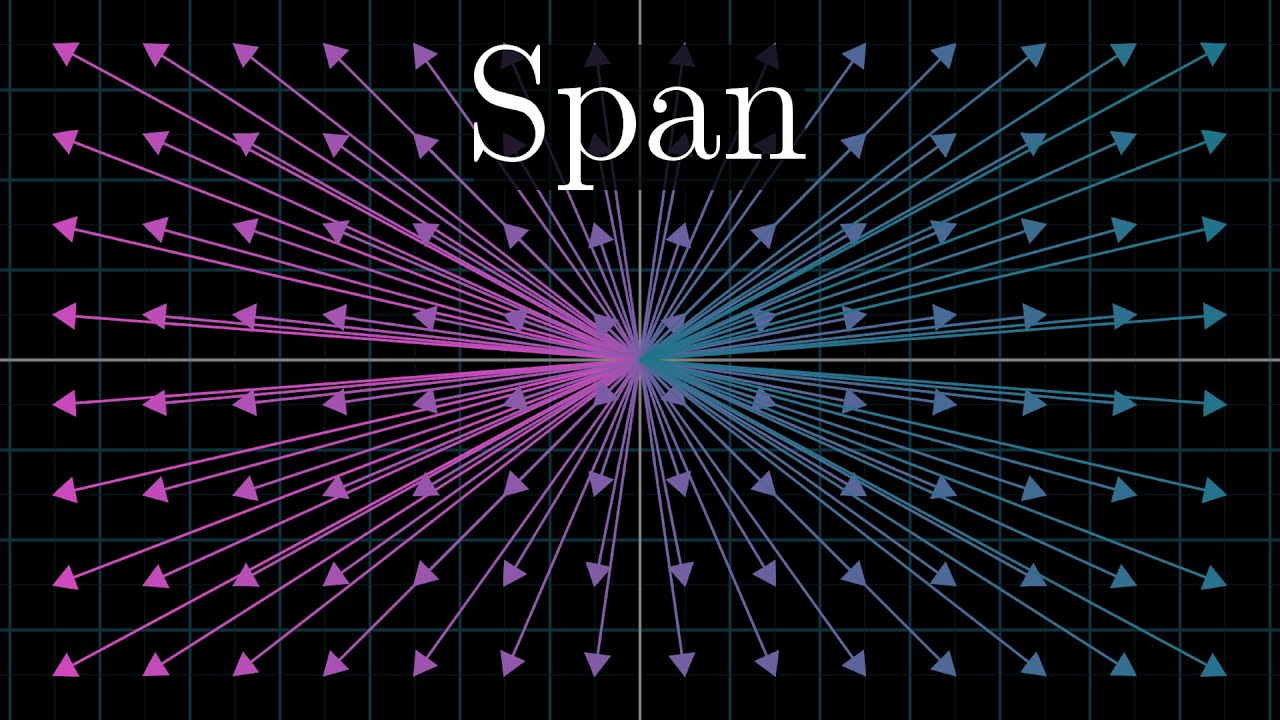
The fundamental concepts of span, linear combinations, linear dependence, and bases.
Help fund future projects: https://www.patreon.com/3blue1brown
Thanks to Elo Marie Viennot and Ambros Gleixner from HTW Berlin (www.htw-berlin.de) for contributing German translations and dubbing.
Thanks to these viewers for their contributions to translations...
I dont think i can explain it better than this
lament hazel
ok thank you
drifting hornet
(in general, if you have n vectors, they span at most n-dimensional space, spanning exactly n-dimensional space iff they're linearly independent)
vale dockBOT
Channel closed
Closed by @lament hazel
Use .reopen if this was a mistake.
vale dockBOT
Available help channel!
Send your question here to claim the channel.
Remember:
• Ask your math question in a clear, concise manner.
• Show your work, and if possible, explain where you are stuck.
• After 15 minutes, feel free to ping <@&286206848099549185>.
• Type the command .close to free the channel when you're done.
• Be polite and have a nice day!
Read #❓how-to-get-help for further information on how to ask a good question, and about conduct in the question channels.
 soft cape
does anyone know what #latex-testing even is
 cinder creek
A channel for you to test/write out your latex code.
 keen tundra
Code that allows to write mathematical symbols
rocky lotusBOT
ExpertSqueeSQUEE
 soft cape
wha-
 spring jackal
https://www.latex-project.org/ for ur reference :)
LaTeX is a high-quality typesetting system; it includes features designed for the production of technical and scientific documentation.
soft cape
thx
spring jackal
$\Q = \left{ \frac ab : a,b, \in \mathbb{Z}, ; \gcd(a,b) = 1 \right}$
rocky lotusBOT
haseeb
 spring jackal
sorry bout that, but there's an example of how you'd write latex and what it would look like
keen tundra
I had no good idea on what to write
keen tundra
I would write some things I studied recently but I am on my phone
 feral sapphire
soft cape
whats latex code?
feral sapphire
soft cape
whats latex code?
It's a markup language for documentation that is inclusive of generating scientific and mathematical symbols. Here it s used for generating math images.
feral sapphire
If you've ever opened any type of math or science textbook, they likely used LaTeX to create the text and images.
soft cape
oh nice
vale dockBOT
@soft cape Has your question been resolved?
vale dockBOT
Channel closed
Closed due to timeout
Use .reopen if this was a mistake.
Available help channel!
Send your question here to claim the channel.
Remember:
• Ask your math question in a clear, concise manner.
• Show your work, and if possible, explain where you are stuck.
• After 15 minutes, feel free to ping <@&286206848099549185>.
• Type the command .close to free the channel when you're done.
• Be polite and have a nice day!
Read #❓how-to-get-help for further information on how to ask a good question, and about conduct in the question channels.
 stoic portal
how would i go about starting this? i found the direction vector and thought about using the negative reciprocal to get a perpendicular direction vector but idk if that's fully right for this problem
 vale dockBOT
stoic portal
how would i go about starting this? i found the direction vector and thought abo...
distant galleon
stoic portal
how would i go about starting this? i found the direction vector and thought abo...
vale dockBOT
stoic portal
how would i go about starting this? i found the direction vector and thought abo...
distant galleon
stoic portal
how would i go about starting this? i found the direction vector and thought abo...
yes that is relevant
stoic portal
ok slay
distant galleon
From that, you can also determine the fact that <a,b> and <-b,a> are perpendicular
stoic portal
what would that be useful for? just in general for future reference?
distant galleon
stoic portal
what would that be useful for? just in general for future reference?
I mean
here for one?
distant galleon
yes
stoic portal
i originally used the point <-5,3> in my previous attempts, does that work here still? (looking at when t=0)
distant galleon
stoic portal
i originally used the point <-5,3> in my previous attempts, does that work here ...
read the question again
stoic portal
what am i missing besides (-2,-5)?
stoic portal
distant galleon
read the question again
yeah i'm still not seeing things i feel lost
distant galleon
stoic portal
what am i missing besides (-2,-5)?
Yes that’s it
You need to use that point
Not (-5,3)
stoic portal
ok that's what was confusing me bc you said "yeah" when i asked if i should find another point besides the given point (-2,-5). sorry if that wasn't clear lol
ok i got it now tho
thanks!
.close
vale dockBOT
Channel closed
Closed by @stoic portal
Use .reopen if this was a mistake.
vale dockBOT
Available help channel!
Send your question here to claim the channel.
Remember:
• Ask your math question in a clear, concise manner.
• Show your work, and if possible, explain where you are stuck.
• After 15 minutes, feel free to ping <@&286206848099549185>.
• Type the command .close to free the channel when you're done.
• Be polite and have a nice day!
Read #❓how-to-get-help for further information on how to ask a good question, and about conduct in the question channels.
 torpid knot
how to solve question 4 i came to 7.85cm idk if its right tho
 vale dockBOT
torpid knot
how to solve question 4 i came to 7.85cm idk if its right tho
vale dockBOT
torpid knot
how to solve question 4 i came to 7.85cm idk if its right tho
@torpid knot Has your question been resolved?
errant gyro
for future helpers: could you please translate the problem roughly into English?
torpid knot
errant gyro
for future helpers: could you please translate the problem roughly into English?
From a rectangular piece of cardboard (length l = 60 , \text{cm}; width b = 40 , \text{cm}), a simple rectangular box is to be folded.
For this purpose, a square piece (side length x = 7 , \text{cm}) is cut out of each corner, and the side parts are folded up along the dashed line.
⸻
1.) Determine the dimensions a, b, c of the folded box.
2.) Calculate the volume of the box.
V = a \cdot b \cdot c
3.) Set up a formula for the volume V of the box so that the volume can be calculated for a given x.
V = (60 - 2x) \cdot (40 - 2x) \cdot x
4.) For different values of x, different-sized boxes are obtained.
Determine the box with the largest volume.
i need 4.)
errant gyro
you're not allowed to use calculus, i suppose?
torpid knot
we are
errant gyro
in that case, you can use the first derivative of V to find the turning point(s) of V. if one is obtained, that should be your max
if you get two, use the second derivative test to find which one the maximum is
this should be your attack plan, though would need checking from other helpers
vale dockBOT
@torpid knot Has your question been resolved?
vale dockBOT
@torpid knot Has your question been resolved?
 wintry oxide
You don’t like the derivative answer ?
errant gyro
hi OP, if you are still around and would like a second opinion, you may ping helpers
vale dockBOT
@torpid knot Has your question been resolved?
vale dockBOT
Channel closed
Closed due to timeout
Use .reopen if this was a mistake.
Available help channel!
Send your question here to claim the channel.
Remember:
• Ask your math question in a clear, concise manner.
• Show your work, and if possible, explain where you are stuck.
• After 15 minutes, feel free to ping <@&286206848099549185>.
• Type the command .close to free the channel when you're done.
• Be polite and have a nice day!
Read #❓how-to-get-help for further information on how to ask a good question, and about conduct in the question channels.
 toxic narwhal
how to solve this in desmos? i dont even know where to start... i tried regression but didnt give me the correct answer
 vale dockBOT
toxic narwhal
how to solve this in desmos? i dont even know where to start... i tried regressi...
vale dockBOT
toxic narwhal
how to solve this in desmos? i dont even know where to start... i tried regressi...
 vale dockBOT
@toxic narwhal Has your question been resolved?
 proper pike
toxic narwhal
how to solve this in desmos? i dont even know where to start... i tried regressi...
proper pike
toxic narwhal
how to solve this in desmos? i dont even know where to start... i tried regressi...
lemme take a look
Still here @toxic narwhal
toxic narwhal
proper pike
Still here <@543969390358560779>
yes
proper pike
toxic narwhal
yes
I used to struggle with questions like these so I feel your pain lmao
But let me start with the fact I do not think you need desmos to solve this
Do you know the answer already
toxic narwhal
if i remember correctly i think its 33
proper pike
Yeah that’s what I got
Alright then
The question tells you this is a line
What forms of line equations do you know
toxic narwhal
linear quadratic and exponential
proper pike
If it specifies it’s a line, it’s linear
Quadratic and exponential isn’t a line as lines are, well, straight lmao
toxic narwhal
ah ok didnt catch that
proper pike
So you know this is a linear function now
What form should you probably use based on the question
proper pike
You’re definitely given two points, but this question specifically gives you the intercept
You should use intercept form as the last term is what you want to solve for
But no matter what form you use
You don’t know the slope
toxic narwhal
-4
toxic narwhal
b is -5
proper pike
how did you get -5 ?
toxic narwhal
desmos
proper pike
B is supposed to be the answer to the question, and I think we both got 33
toxic narwhal
oh
proper pike
Remember b is the y intercept
toxic narwhal
yes
proper pike
Okay, let’s stick to point slope if you used that instead then