#help-4
1 messages · Page 28 of 1
 jovial edge
 tidal swift
these two are dependent equations and will give you the same solutions
 north scarab
depenent equations?
tidal swift
let's focus on your work first
north scarab
okay
tidal swift
jovial edge
nah, there's a better way
i agree with alexis here that there is a better way
can you explain your logic first?
north scarab
who me?
tidal swift
yes
north scarab
what do i explain
tidal swift
this
north scarab
made x
the subject
and y the subject
and i know that the range
i have visualised it
top half
bottom half
from the 0 degree
so the range has to be in between
tidal swift
i mean the range is already given by the question, but alright
tidal swift
separate sin and cos, then try expressing one side as a tangent
 river shale

north scarab
and im also confused of what u mean by express one side as a tangent?
tidal swift
yes
north scarab
okay
north scarab
tidal swift
yes
 tidal swift
don't do the second step
instead, divide both sides by cos and look at what happens to the right
north scarab
did I already do the second step?
north scarab
alr
north scarab
tidal swift
don't do that
 tidal swift
now what common angle has that tangent?
tidal swift
yes

 rocky lotusBOT

 wraith heart
Why 60 degrees
tidal swift
tangent is not negative in Q1
tidal swift
wdym
north scarab
tidal swift
tangent is not negative in Q1
Tan is negative in q2 and q4
tidal swift
uhuh
north scarab
tidal swift
tangent is not negative in Q1
Did the question ask to find it for q1
tidal swift
ask what
 stark wedge
which functions are positive or negative in which quadrant is something you know independently of any questions btw
north scarab
the angle
tidal swift
no but you provided a Q1 answer for a negative tan
tidal swift
no
north scarab
I prob was finding the reference angle
tidal swift
finding the reference angle is correct
but arctan(-sqrt(3)) is now set in stone
you need to find other angles that correspond to this negstive tan
not make it positive
north scarab
I might be confused what the q is asking me to solve
tidal swift
the q is asking you to find all theta that solves the equation
we are solving for the theta
north scarab
okay
tidal swift
you are already there in terms of solving when you wrote theta = arctan(-sqrt(3))
you also know that tan 60 = sqrt(3)
but now that sqrt(3) is negative
so you need to take your reference angle of 60 degrees and find the same values in quadrants where tan is negative
tidal swift
120 is one of the two answers
but 300 degrees is out of range
however, 300 degrees can be expressed as a negative angle
wraith heart
north scarab
-60 degrees
.
tidal swift
got both answers now?
tidal swift
i just said it's correct kek
north scarab
There’s two there’s in the trig functions
north scarab
tidal swift
i just said it's correct kek
true mb
tidal swift
well if you don't trust the values (which is a good sign)
throw the values into the thetas one at a time and find out the values the LHS gives out
if it's 0, congrats
north scarab
north scarab
There’s two there’s in the trig functions
So if there’s two thetas
There’s two solutions
north scarab
tidal swift
throw the values into the thetas one at a time and find out the values the LHS g...
Yep
tidal swift
then there you go
tidal swift
yes
tidal swift
north scarab
I don’t even understand how I even solved the qs
then look back at the steps you made and try to explain each one
north scarab
tidal swift
then look back at the steps you made and try to explain each one
okay
Il do it after
one more question I’m stuck with

witht this question, what is it asking me to do
im confused about the "independent" part
tidal swift
i believe that they're asking you to show that no matter what you put in as theta, you will always get the same answer
 normal hollow
Doesnt independent mean that there wont be any theta in the expression
normal hollow
north scarab
witht this question, what is it asking me to do
Simplify the expression as in convert everything into sin and cos and then Simplify
tidal swift
normal hollow
Doesnt independent mean that there wont be any theta in the expression
yes, but kinda want him to realize directly what independent of theta means first
he should deduce that the final answer must not have a single theta in it
normal hollow
tidal swift
yes, but kinda want him to realize directly what independent of theta means firs...
Oh sorry for intervening
tidal swift
nono, it's fine!
tidal swift
normal hollow
Simplify the expression as in convert everything into sin and cos and then Simpl...
i second this method
north scarab
do i like
tidal swift
would be much easier on you, but be careful of your fractions
north scarab
simplify the expression?
tidal swift
yes
tidal swift
yes, put that aside first
north scarab
put aside what
tidal swift
the independent part, by the end you should be able to cancel out those trig terms
so focus on simplifying the fractions first
north scarab
okk
tidal swift
tidal swift
would be much easier on you, but **be careful of your fractions**
quick reminder to be careful of your fractions and signs
btw @normal hollow if you want to you can check him in case i'm not around later
 rocky lotusBOT
 north scarab
am I on the right track
normal hollow
north scarab
am I on the right track
Convert cot and tan in sin and cos ,that way u can eliminate stuffs
north scarab
Did I mess up
north scarab
normal hollow
Convert cot and tan in sin and cos ,that way u can eliminate stuffs
alright

,rotate
rocky lotusBOT
 north scarab
like this?
normal hollow
 north scarab
rocky lotus
north scarab
rocky lotus
I’ll just continue from here
normal hollow
north scarab
I’ll just continue from here
Alr
normal hollow
rocky lotus
But u could hv done it here too
north scarab
rocky lotus
What’s the best approach
normal hollow
north scarab
yeah dw
Take the sin and cos to numerator
Basically do the frac division
normal hollow
Yea
north scarab
But with the first fractions
fraction
I need to add 1
With a common denominator
which is sin x
do I do that
?
or division should come first
normal hollow
north scarab
or division should come first
Division

Divide these 2 fracs
Similarly the other term
normal hollow
Yes
normal hollow
Multiply the 1 and cos/sin by sin now
normal hollow
north scarab
The whole fraction
Yes
north scarab
,rotate
rocky lotusBOT
Couldn't find an attached image in the last 10 messages.
 rocky lotusBOT

 rocky lotusBOT

 normal hollow
Careful there should be a negative b4 sin
north scarab
Where
normal hollow
 north scarab
How
normal hollow
Put what u got from both fracs in brackets and then do the subtraction

 normal hollow
 normal hollow
north scarab
So the answer is 0
normal hollow
north scarab
So the answer is 0
Yep
And 0 is free of theta i.e. independent of theta
There is no theta,is there any?
normal hollow
That's what it meant
Independent or free of theta means there wont be any theta in the required expression
And that's what u were asked to prove
 normal hollow
Um i dont know abt this that if u subbed any value of theta ,it would be same or not,lemme check
But when u see that after simplifying ur answer has no theta in it ,u can call it independent of theta
tidal swift
technically any value of theta other than those making any of them undefined should produce one answer
in this case, it looks like the answer is 0
normal hollow
north scarab
https://cdn.discordapp.com/attachments/409596215697866773/1399984838165004321/im...
Placing 90 directly here gives u undefined
But in simplified form,u still get 0
tidal swift
yeah that's fair, also a great way to show how domains of a function can still be affected by cancelled out terms
but that's for another day
 vale dockBOT
@north scarab Has your question been resolved?
vale dockBOT
Channel closed
Closed due to timeout
Use .reopen if this was a mistake.
vale dockBOT
 Available help channel!
Send your question here to claim the channel.
Remember:
• Ask your math question in a clear, concise manner.
• Show your work, and if possible, explain where you are stuck.
• After 15 minutes, feel free to ping <@&286206848099549185>.
• Type the command .close to free the channel when you're done.
• Be polite and have a nice day!
Read #❓how-to-get-help for further information on how to ask a good question, and about conduct in the question channels.
 worldly pagoda
hi guys im not too sure how to start with this question
 vale dockBOT
worldly pagoda
hi guys im not too sure how to start with this question
vale dockBOT
worldly pagoda
hi guys im not too sure how to start with this question
@worldly pagoda Has your question been resolved?
vale dockBOT
@worldly pagoda Has your question been resolved?
vale dockBOT
Channel closed
Closed due to timeout
Use .reopen if this was a mistake.
Available help channel!
Send your question here to claim the channel.
Remember:
• Ask your math question in a clear, concise manner.
• Show your work, and if possible, explain where you are stuck.
• After 15 minutes, feel free to ping <@&286206848099549185>.
• Type the command .close to free the channel when you're done.
• Be polite and have a nice day!
Read #❓how-to-get-help for further information on how to ask a good question, and about conduct in the question channels.
 flint kindle
Hi just bored but how would you map a complex number to another complex number and represent that on a plane or something
vale dockBOT
flint kindle
Hi just bored but how would you map a complex number to another complex number a...
flint kindle
Since you’re mapping a 2 dimensional number to a 2 dimensional number, you would need 4 dimensions?
stark wedge
what exactly are you asking here
 pine prairie
Yeah if you wanted to graph it you’d need 4 dimensions
 distant pulsar
color to indicate direction and luminance to indicate magnitude
stark wedge
are you asking what visuals can be used for functions C -> C
pine prairie
Usually we use colour yeah
 tidal terrace

Complex functions are 4-dimensional: its input and output are complex numbers, and so represented in 2 dimensions each, so how do we visualize complex functions if we are living in a 3D world? There are actually 5 different ways to visualize a complex function, and this video is going to explore a bit about each of them.
Some of you commented t...
flint kindle
Colour in a 3D plane?
tidal terrace
i remember seeing this video
stark wedge
graphing C -> C the same way that we do R -> R would require 4 spatial dimensions, yes
distant pulsar
distant pulsar
color to indicate direction and luminance to indicate magnitude
e.g.
 flint kindle
so if the z axis was going straight up, would the x and y axis be used to represent the input (x+iy) and the output would be the z axis + colour
pine prairie
It depends there are various ways to visualise a C -> C function
flint kindle
I’m just trying to understand because I want to learn contour integration just for my own interest but don’t have the basics down
What prerequisites do I need
distant pulsar
methods contour integration itself has very few prerequisites aside from single-variable calculus
and i guess some basic facts from complex analysis
if all you're interested in is "how to do contour integration" in reality you don't need much
 sharp whale
the barrier for knowing how to contour integrate (not even understand it) is essentially:
- u-substitution
- you can integrate across a path
- what an analytic function is
- if the path loops around an analytic function, the contour integral is 0
- if the path loops around a function that is analytic for all but a couple of points, there is a method to find this contour integral
- you can calculate seemingly impossible integrals by writing them as part of a loop then calculating the loop instead
distant pulsar
this is a very barebones introduction to contour integration that should be accessible to high schoolers https://artofproblemsolving.com/community/c2532359h3075016
vale dockBOT
@flint kindle Has your question been resolved?
flint kindle
I’ve read the first page, the only thing I do not understand is why certain functions are assigned certain contours or paths. For example for e^z, they’ve created a ‘pacman’ contour but like is there any reason for that
stark wedge
!occupied
vale dockBOT
Someone else is already using this help channel. If you need help with a question, please open your own help channel/thread (see #❓how-to-get-help for instructions).
vale dockBOT
Please do not ping individual helpers unprompted.
flint kindle
I also don’t really understand if there is any geometric or deeper meaning to the value obtained when solving complex values integrals, but I don’t think I need to tbh
distant pulsar
flint kindle
I’ve read the first page, the only thing I do not understand is why certain func...
no it's just an example to show what would happen if you integrated over a contour like that
 wooden frigate
weird
river shale
It’s not gonna work
wooden frigate
sorry about that
river shale
……
 raw hollow
lmao what the hell
river shale
yes it is
raw hollow
as is seen by the "occupied" category into which it is classified
river shale
You should ask them
Just stop
Yes, just drop it. Let’s not distract OP and her helper.
vale dockBOT
Channel closed
Closed due to timeout
Use .reopen if this was a mistake.
river shale
.reopen
vale dockBOT
✅
flint kindle
Wait so in order to ‘remove a singularity’ do you just multiply the function by (z-c) where z=c is the undefined point
Ok yeah this doesn’t seem bad at all.
Gonna need to save that link
.close
vale dockBOT
Channel closed
Closed by @flint kindle
Use .reopen if this was a mistake.
 neat jewel
If rank(A) is 2 and rank(AB) is 3, then
Select an option
a) rank(B) = 3
b) rank(B) <= 3
c) rank(B) >= 3
d) data insufficient
is this qn wrong?
rank(AB) must be <= min(rank(A), rank(B)) right?
vale dockBOT
Available help channel!
Send your question here to claim the channel.
Remember:
• Ask your math question in a clear, concise manner.
• Show your work, and if possible, explain where you are stuck.
• After 15 minutes, feel free to ping <@&286206848099549185>.
• Type the command .close to free the channel when you're done.
• Be polite and have a nice day!
Read #❓how-to-get-help for further information on how to ask a good question, and about conduct in the question channels.
 vast comet
does anyone know how i can close the box so the edge isnt going off the screen
 vale dockBOT
vast comet
does anyone know how i can close the box so the edge isnt going off the screen
vale dockBOT
vast comet
does anyone know how i can close the box so the edge isnt going off the screen
 dapper dagger
vast comet
does anyone know how i can close the box so the edge isnt going off the screen
dapper dagger
vast comet
does anyone know how i can close the box so the edge isnt going off the screen
try wrapping the tikzpicture with \resizebox{\textwidth}{!}{...}
and maybe put that in like, its own figure?
\begin{figure}
\centering
\resizebox{\textwidth}{!}{%
\begin{tikzpicture}
...
\end{tikzpicture}
}
\end{figure}
@vast comet Has your question been resolved?
vale dockBOT
Channel closed
Closed due to timeout
Use .reopen if this was a mistake.
vale dockBOT
Available help channel!
Send your question here to claim the channel.
Remember:
• Ask your math question in a clear, concise manner.
• Show your work, and if possible, explain where you are stuck.
• After 15 minutes, feel free to ping <@&286206848099549185>.
• Type the command .close to free the channel when you're done.
• Be polite and have a nice day!
Read #❓how-to-get-help for further information on how to ask a good question, and about conduct in the question channels.
 hasty sinew
 vale dockBOT
hasty sinew
vale dockBOT
hasty sinew
 glass kelp
what ya tryna solve
river shale
hi hi hi, what is this?
 slate folio
f(x)-phobia?
hasty sinew
hey, it says that if this function is continuous for x=-1 does it mean that f is also continuous for f(-1)?
@glass kelp @slate folio @river shale
slate folio
!noping
vale dockBOT
Please do not ping individual helpers unprompted.
vale dockBOT
Please show the original problem, exactly as it was stated to you, with the entire original context. A picture or screenshot is best. If the original problem is not in English, then post it anyway! The additional context might still be helpful. Do your best to provide a translation.

 cunning peak
hasty sinew
hey, it says that if this function is continuous for x=-1 does it mean that f i...
cunning peak
hasty sinew
hey, it says that if this function is continuous for x=-1 does it mean that f i...
Try to substitute f(x) for a function that isn't continuous at x = -1 and check
hasty sinew

i basically gave an example that shows that f(-1) is necessarily continuous for f(-1)
river shale
hasty sinew
hey, it says that if this function is continuous for x=-1 does it mean that f i...
The above function is continuous for x = -1, meaning that f(-1) must be a real number aside from zero. Yes
hasty sinew
the question is actually in hebrew so english isnt my mother tongue sry if im saying something which isnt accurate
 hasty sinew
river shale
The above function is continuous for x = -1, meaning that f(-1) must be a real n...
hasty sinew
river shale
The above function is continuous for x = -1, meaning that f(-1) must be a real n...
there is f(-1)
but it doesnt necssarily means that f(-1) is continuous
river shale
hasty sinew
but it doesnt necssarily means that f(-1) is continuous
wdym by this, can you elaborate?
hasty sinew
hasty sinew
i showed an example that shows that both limits arent the same
cunning peak
hasty sinew
Ay yup there you have it, g(-1) is continuous at x=-1 but f isn't
hasty sinew
cunning peak
Ay yup there you have it, g(-1) is continuous at x=-1 but f isn't
so my example is good ?
i guess it is then
 candid bolt
hasty sinew
candid bolt
hasty sinew
one minute how did you prove g(x) is continuous
hasty sinew
cuz they said that g(-1) is continuous
hasty sinew
hasty sinew
.
candid bolt
well that doesnt mean g(x) is continous for any f(x)
by saying g(-1) is continuous that puts a restriction on f(x)
i mean you are right that there is a counterexample
but it can be better
hasty sinew
candid bolt
by saying g(-1) is continuous that puts a restriction on f(x)
f(-1) must be "alive"
and also not zero
candid bolt
the counter example is such that g(x) is provably continuous at -1 but f(x) must be discontinuous at -1
hasty sinew
hasty sinew
so they told me to give an example which i did that shows that f(-1) exists but isnt continuous @candid bolt
hasty sinew
candid bolt
the counter example is such that g(x) is provably continuous at -1 but f(x) must...
ye
candid bolt
hasty sinew
so they told me to give an example which i did that shows that f(-1) exists but ...
yeah you satisfied that part
but g(x) has to be provably continuous at -1 too
hasty sinew
yep they said it
i didnt have to prove that
so am i alright then?
and thx for help
candid bolt
but you just assumed g(x) is continuous at -1 tho
lets talk about your counterexample:
f(x) = 1 for x<=-1 and 2 for x>-1
that means g(x) = x+1 for x<=-1 and (x+1)/2 for x>-1
the counteraxmple is right
but the way you can prove it is sby taking left hand and right hand limits
cunning peak
candid bolt
well that doesnt mean g(x) is continous for any f(x)
No, but they're only talking about x=-1
The counterexample is enough
candid bolt
cunning peak
No, but they're only talking about x=-1
yeah thats what i mean
candid bolt
hasty sinew
the counterexample is right but the way they proved its continuous at -1 is lacking
i mean they kinda assumed g(x) is continuous at -1 here
cunning peak
candid bolt
the counterexample is right but the way they proved its continuous at -1 is lack...
g continuous at -1 is given, you don't have to prove it
It isn't always true, even. Take f(x) = 1+x, then g isn't continuous at -1 (it isn't even defined)
candid bolt
cunning peak
g continuous at -1 is given, you don't have to prove it
The question statement is g(x) = (x+1)/f(x). g is continuous at -1. Is f necessarily continuous at -1.
Our goal is to prove the statement false
In order to find a counterexample we have to find a function f which is discontinuous at -1 and prove that g(x) is continuous at -1
right?
cunning peak
Ah I see, right
candid bolt
hasty sinew
but the way they prove g(x) is continuous at -1 is kinda confusing
cunning peak
Yeah, no need to split the limits in 2. Just substitute the values 1 and 2 using your definition of f(x)
candid bolt
exactly
wait
g(-1) = 0
we have to show that the limit x->-1 g(x) =0
but the best way to do that is with left hand and right hand limits
candid bolt
cunning peak
Yeah, no need to split the limits in 2. Just substitute the values 1 and 2 using...
i dont get how just substituting values helps
cunning peak
candid bolt
i dont get how just substituting values helps
The left limit is 0/1 and the right limit is 0/2
Both equal to 0
candid bolt
candid bolt
but the best way to do that is with left hand and right hand limits
the left hand limit of g(x) is lim x->-1 x+1 = 0 and the right hand limit is x->-1 (x+1)/2 = 0
cunning peak
Yup
candid bolt
we need this intermedietary step
in such a proving question we cant just "substitute values" right
we gotta use known properties
cunning peak
candid bolt
the left hand limit of g(x) is lim x->-1 x+1 = 0 and the right hand limit is x->...
We're doing the same thing, you and I substituted 1 and 2 in the denominator
Depending on whether it's the right or left limit
slate folio
@candid bolt I remember you asked some question about ∆ABC with altitude AD and 3 intersecting cevians right?
candid bolt
slate folio
<@1090652946615771167> I remember you asked some question about ∆ABC with altitu...
new help channel?
slate folio
did you solve it yet?
candid bolt
no i gave up
slate folio
open a new channel
I solved it but it was too late
I was preparing dinner at the time
vale dockBOT
@hasty sinew Has your question been resolved?
vale dockBOT
Channel closed
Closed due to timeout
Use .reopen if this was a mistake.
vale dockBOT
Available help channel!
Send your question here to claim the channel.
Remember:
• Ask your math question in a clear, concise manner.
• Show your work, and if possible, explain where you are stuck.
• After 15 minutes, feel free to ping <@&286206848099549185>.
• Type the command .close to free the channel when you're done.
• Be polite and have a nice day!
Read #❓how-to-get-help for further information on how to ask a good question, and about conduct in the question channels.
 viscid swift
hey guys, i need help explaining this lin alg problem
viscid swift
so the solution here is [2,3]

but i just dont get why its supposed to be in that order

when i solved it, i thought putting the compb2v as the one on the top or the x variable would make more sense and the compb1v as the one on the bottom as the y variable since the b1 vector is on the top
is there a reason for it being 2,3 other than b1 being labeled as the first and b2 being labeled as the second
viscid swift
viscid swift
is there a reason for it being 2,3 other than b1 being labeled as the first and ...
nvm i have a feeling this is the reason 😓
 manic cairn
Yes I think so too
vale dockBOT
Channel closed
Closed by @viscid swift
Use .reopen if this was a mistake.
 sinful obsidian
that question made sense
vale dockBOT
Available help channel!
Send your question here to claim the channel.
Remember:
• Ask your math question in a clear, concise manner.
• Show your work, and if possible, explain where you are stuck.
• After 15 minutes, feel free to ping <@&286206848099549185>.
• Type the command .close to free the channel when you're done.
• Be polite and have a nice day!
Read #❓how-to-get-help for further information on how to ask a good question, and about conduct in the question channels.
 violet valve
is anyone able to help me with trig and geometry hw
river shale
Just post your question 🙂
violet valve
mb
i iwll

this is the blank one
and the manager made a map but we need to make a better one

the task
is
we have to make a transponder system
connecting all sites
in under 11 poles
and in a way so that if one goes out, there is still a full circuit of transponders
on each pole there will be 2 transponders
idk if i explained it well
sharp whale
whats the maximum range for a transponder
vale dockBOT
@violet valve Has your question been resolved?
sharp whale
so you can place the transponders on any elevation, or does it need to be on the path?
violet valve
you can place them anywhere
however
they cant be obstructed
so there cant be a peak between too poles
or the signal is blocked by the mountain
 violet valve
just 3 poles?
violet valve
wym
sharp whale
right now youre going around the bottom mountain
violet valve
draw on blank one the managers things are confusing me
wait let me show you what my rough idea is
sharp whale
do sites A, B, and C also have transponders on them?
violet valve
 violet valve
sharp whale
do sites A, B, and C also have transponders on them?
violet valve
sharp whale
do sites A, B, and C also have transponders on them?
yesyes
sharp whale
oh right, only the manager is not allowing you to build on the peak
sharp whale
ok I see
youre allowed to build on the peak, you just cant have two poles where the elevation rises in the area between the poles
violet valve
yeah
i cant explain properly
mb
is there a way we can do this with 7 poles?
somone 😭
violet valve
srry
sharp whale
@violet valve having them form a loop is a great idea
based on that, Ive found this

you can see all the square roots are < sqrt(100) = 10
sharp whale
youre asking how to calculate the distance between 2 points?
violet valve
how you used square roots to find that out
sharp whale
when you need to find the distance between two points,

you first find out how much you go left/right and up/down to get from one point to another

next, you do: sqrt((left or right)^2 + (up or down)^2)
the ^2 means to square
to find the distance from one point to another
this is because the triangle here is a right triangle

so for example here, 2^2 + 1^2 = c^2
so here c = sqrt(2^2 + 1^2)
we can take this as another example

you can see that left or right is 8 and up or down is 5
 sinful obsidian
i think they're asking how you knew all the square root values were below 10, not sure tho
sharp whale
...bigger values lead to bigger square roots?
so if you have sqrt(39)
itd be smaller than sqrt(100)
because 39 < 100
and since sqrt(100) is 10,
that means sqrt(39) < sqrt(100) = 10
all the square roots are 2 digit numbers
sinful obsidian
yes
sharp whale
so theyre less than sqrt(100)
violet valve
sinful obsidian
i think they're asking how you knew all the square root values were below 10, no...
nah
other thing
violet valve
sharp whale
you can see that left or right is 8 and up or down is 5
i get it
sinful obsidian
ah ok :p
violet valve
pythag
violet valve
sinful obsidian
ah ok :p
ty though
sharp whale
sharp whale
you can see that left or right is 8 and up or down is 5
so the distance is sqrt(8^2 + 5^2) = sqrt(64 + 25) = sqrt(89)
sharp whale
violet valve
are all those exactly 10?
theres a lot wrong with doing things this way, look at the scenario and realize that we cant have all of them be 10
for one, the distance from A to B, or from B to C, or from A to C, isnt a multiple of 10
so if youre going to connect transponders between them, one of them isnt going to be 10
thats just inevitable
sharp whale
sharp whale
second, you can see that all the square roots here are less than sqrt(100)
so theyre all less than 10
none of the square roots are "exactly 10" as otherwise theyd have a 10 next to them
the only 10 I could fit in was to cross the gap from the top mountain to the bottom mountain
as far as I see it, thats the best amount of 10s you can have
any more than this and youre moving the poles too far away from each other, or not making any significant improvement on the pole placement
violet valve
i wanted to estimate
the real distance
if we look at this in 3d
we are looking at distance
but if we look at the height
cant we make it triangle
and use pythag to find the real distance
sharp whale
violet valve
if we look at this in 3d
bro you didnt tell me that
you said a transponder works if theyre 10 squares apart
violet valve
 sharp whale
that means youre placing them on the grid and Im counting it purely horizontally
violet valve
sharp whale
you said a transponder works if theyre 10 squares apart
😭 ik
the teacher told us
to first make ilke
a rough idea
then refine it
by calculating it
precisly
violet valve
huh
sharp whale
despite what you said, we're still pretty close to a better design

if you think about it,
we need a minimum of two poles to connect B to C
violet valve
yeah
sharp whale
one pole to connect A to B
and one pole to connect A to C
so already we're pretty close to the minimum number of poles, designing it this way
violet valve
?
sharp whale
you dont have to consider how hard it is to fix one of these poles right
sinful obsidian
sharp whale
despite what you said, we're still pretty close to a better design
why are there 2 poles on the north peak
violet valve
sharp whale
you dont have to consider how hard it is to fix one of these poles right
i thought that too, but my teacher didint mention it
violet valve
sinful obsidian
why are there 2 poles on the north peak
to make a loop
so if one goes ou
out
theres still connection
sharp whale
yea its a math problem, dont worry about it
imagine having to scale two mountains just because a few students went "lets gooo one pole less"
sinful obsidian
violet valve
theres still connection
okk i see
make sure to bring a lot of water for this
violet valve
sinful obsidian
make sure to bring a lot of water for this
what 😭
sinful obsidian
people never bring enough water into the wilderness
violet valve
oh
wait
nah its ok
look at the managers plan
all the poles are next to the road
ah its ok ill just ask teacher
ty mtt
.close
vale dockBOT
Channel closed
Closed by @violet valve
Use .reopen if this was a mistake.
sharp whale
np
vale dockBOT
Available help channel!
Send your question here to claim the channel.
Remember:
• Ask your math question in a clear, concise manner.
• Show your work, and if possible, explain where you are stuck.
• After 15 minutes, feel free to ping <@&286206848099549185>.
• Type the command .close to free the channel when you're done.
• Be polite and have a nice day!
Read #❓how-to-get-help for further information on how to ask a good question, and about conduct in the question channels.
north scarab
 vale dockBOT
north scarab
north scarab
vale dockBOT
north scarab
north scarab

I just want to know why my graph looks
slightly different

and yes i know 1/1 should be going down
but yeah it doesnt really make sense
(-1,-4)
typo
 north scarab
let me give u full context of the question, im doing 13. d

 hot tide
north scarab
hot tide
north scarab
how did you get f'(1) = 0
tidal terrace
also f(-1) is not -4 nor -6
vale dockBOT
@north scarab Has your question been resolved?
vale dockBOT
Channel closed
Closed due to timeout
Use .reopen if this was a mistake.
Available help channel!
Send your question here to claim the channel.
Remember:
• Ask your math question in a clear, concise manner.
• Show your work, and if possible, explain where you are stuck.
• After 15 minutes, feel free to ping <@&286206848099549185>.
• Type the command .close to free the channel when you're done.
• Be polite and have a nice day!
Read #❓how-to-get-help for further information on how to ask a good question, and about conduct in the question channels.
 frigid widget
Can someone help me with part b, thanks
 vale dockBOT
frigid widget
Can someone help me with part b, thanks
frigid widget
vale dockBOT
frigid widget
Can someone help me with part b, thanks
frigid widget
yes i did lol but i left and didn't see the reply
glass kelp
do similar thing that u did with a
frigid widget
sorry
i tried already, but i couldnt get the right answers
i got pi/6, 11pi/6, 13pi/6
i took the inverse of both sides
glass kelp
,calc (11pi)/6 * (pi)/180
rocky lotusBOT
Result:
0.10052374852961
pardon?
glass kelp
frigid widget
i got pi/6, 11pi/6, 13pi/6
how did u get this
frigid widget
cos2x = 1/2
arccos 1/2 = 2x
x = (arccos 1/2) / 2
x = pi/6
so thats the first answer
then
2pi - x = 11pi / 6
which is the 2nd
2pi + x = 13pi/6
idk what i did wrong
glass kelp
frigid widget
2pi - x = 11pi / 6
where does this come from
frigid widget
because in the last quadrant cosine in positive
glass kelp
but u skipped some ans
frigid widget
glass kelp
they are correct
they are?
glass kelp
i suggest u do smth like
${2x = \frac{\pi}{3} + 2\pi k }$ where ${k \in \mathbb{Z}}$. So, ${x = \frac{\pi}{6} + \pi k}$.
rocky lotusBOT
k
 glass kelp
rocky lotus
**k**
glass kelp
rocky lotus
**k**
but this one is right tho
frigid widget
well where is pi/3 from
glass kelp
what is arccos(1/2)
frigid widget
pi/3
glass kelp
oh shi
frigid widget
im so dumb
glass kelp
${2x = -\frac{\pi}{3} + 2\pi k }$ where ${k \in \mathbb{Z}}$. So, ${x = -\frac{\pi}{6} + \pi k}$.
is also right
rocky lotusBOT
k
 glass kelp
do u agree that for ${x}$ restricted to ${[-\pi/2,\pi/2]}$, there are two values for which ${\cos x = 1/2}$ which are ${\frac{\pi}{3}}$ and ${-\frac{\pi}{3}}$
glass kelp
frigid widget
also how do u type the math like that
latex
rocky lotusBOT
k
 glass kelp
rocky lotus
**k**
glass kelp
rocky lotus
**k**
now the rest of the answers for js coterminal to either of this?
do u agree?
frigid widget
uhh
glass kelp
?
glass kelp
cool
so
we want
to solve
[ \cos(2x) = \frac{1}{2}]
therefore, either ${2x = \frac{\pi}{3} + 2\pi k}$ or ${2x = -\frac{\pi}{3} + 2\pi k}$ for all integers ${k}$
rocky lotusBOT
k
 frigid widget
right
rocky lotusBOT
k
 glass kelp
okie
vale dockBOT
@frigid widget Has your question been resolved?
Channel closed
Closed by @frigid widget
Use .reopen if this was a mistake.
vale dockBOT
Available help channel!
Send your question here to claim the channel.
Remember:
• Ask your math question in a clear, concise manner.
• Show your work, and if possible, explain where you are stuck.
• After 15 minutes, feel free to ping <@&286206848099549185>.
• Type the command .close to free the channel when you're done.
• Be polite and have a nice day!
Read #❓how-to-get-help for further information on how to ask a good question, and about conduct in the question channels.
 tepid anchor
In this question, i know that there cant be 1 root between 1 and 2 of my following work, but i dont understand why cant there be 2 roots.
 vale dockBOT
tepid anchor
In this question, i know that there cant be 1 root between 1 and 2 of my followi...
tepid anchor
vale dockBOT
tepid anchor
In this question, i know that there cant be 1 root between 1 and 2 of my followi...
tepid anchor

oh wait, i am not sure if f(1) and f(2) are individually positive or negative, can we say they are individually positive or negative?
vale dockBOT
@tepid anchor Has your question been resolved?
tepid anchor
.close
vale dockBOT
Channel closed
Closed by @tepid anchor
Use .reopen if this was a mistake.
Available help channel!
Send your question here to claim the channel.
Remember:
• Ask your math question in a clear, concise manner.
• Show your work, and if possible, explain where you are stuck.
• After 15 minutes, feel free to ping <@&286206848099549185>.
• Type the command .close to free the channel when you're done.
• Be polite and have a nice day!
Read #❓how-to-get-help for further information on how to ask a good question, and about conduct in the question channels.
 grave kernel
$\frac{2}{x^4}+\frac{1}{x^2}=6$
vale dockBOT
grave kernel
$\frac{2}{x^4}+\frac{1}{x^2}=6$
rocky lotusBOT
Tan
 grave kernel
so what im thinking
 rustic crown
what is dy/dx of
x^{y}=y^{x}
 final adder
derivative 😅
rustic crown
grave kernel
whats dy/dx
differentiate wrt to x
grave kernel
we havent learned calculus
rustic crown
grave kernel
we havent learned calculus
what why?
grave kernel
rustic crown
what why?
??????
final adder
rustic crown
differentiate wrt to x
could you post your question in another help channel?
glass kelp
rustic crown
what is dy/dx of
x^{y}=y^{x}
!occupied
vale dockBOT
rustic crown
what is dy/dx of
x^{y}=y^{x}
Someone else is already using this help channel. If you need help with a question, please open your own help channel/thread (see #❓how-to-get-help for instructions).
grave kernel
i took 1/x^2=y
final adder
mhm
grave kernel
but how is 2/x^4 gonna sub for y
grave kernel
2/x^4=(1/x^2)^2??
final adder
check your denominator
grave kernel
x^4
final adder
so the first term written in terms of y would be
grave kernel
oops
final adder
so now its just a quadratic in terms of y
grave kernel
$2y^2+y=6\2y^2+y-6=0\$
rocky lotusBOT
Tan


 grave kernel
$2y^2+4y-3y-6=0\2y(y+2)-3(y+2)=0\(y+2)(2y-3)=0\y=-2 or y=3/2$
rocky lotusBOT
Tan
 final adder
yes thats right :D
grave kernel
$\frac{1}{x^2}=-2$
rocky lotusBOT
Tan
 final adder
mhm
grave kernel
how do i..
final adder
did the problem specify real x or any x
grave kernel
x^2=-1/2??
final adder
yea so x is imaginary if so
grave kernel
"Find the real values of x satisfying the following equations"
final adder
ah
grave kernel
final adder
yea so x is imaginary if so
we havent been taught that
final adder
ok
just know that if the problem mentions "real" and you get x^2 is negative, reject it
so pretty much reject this solution
final adder
mhm
grave kernel
lets try 3/2
final adder
mhm
final adder
well 1/anything is just taking its reciprocal
final adder
yea
final adder
thats your answer
grave kernel
where did we go wrong
final adder
grave kernel
its =-√2/3
hmm, it should say $\pm\sqrt{\frac{2}{3}}$
grave kernel
is there a concept im missing here
rocky lotusBOT
Frances
 grave kernel
yes
it says that
=-
+-
sorry
i forgot to press shift so it just said = instead of +
final adder
grave kernel
i thought the reciprocal of 1/3/2 would be 3/2/1 which is just 3/2
well you have $\frac{1}{\frac{3}{2}}$
rocky lotusBOT
Frances
 final adder
so you multiply top and bottom by 2
grave kernel
1*2=2
final adder
obtaining $\frac{2}{3}$
rocky lotusBOT
Frances
 grave kernel
3/2*2=6/2=3
ohhh
i see
why do we multiply by 2 tho
to get rid of the denominator??
final adder
yes
grave kernel
i see
final adder
usually we dont like nested fractions
grave kernel
thank you very much
final adder
np!
grave kernel
.close
vale dockBOT
Channel closed
Closed by @grave kernel
Use .reopen if this was a mistake.
vale dockBOT
Available help channel!
Send your question here to claim the channel.
Remember:
• Ask your math question in a clear, concise manner.
• Show your work, and if possible, explain where you are stuck.
• After 15 minutes, feel free to ping <@&286206848099549185>.
• Type the command .close to free the channel when you're done.
• Be polite and have a nice day!
Read #❓how-to-get-help for further information on how to ask a good question, and about conduct in the question channels.
 supple jetty
Hello, how do I do number 5
 vale dockBOT
supple jetty
Hello, how do I do number 5
hot tide
vale dockBOT
supple jetty
Hello, how do I do number 5
hot tide
,rccw
rocky lotusBOT

 red tulip
You know the slope and have a point
So you can find the y intercept by kind of tracing backwards
supple jetty
I’m not too good at tracing it backwards
red tulip
On the line, the y value goes down by 3/4 for each x value
So since -2, 4 is 2 from the y axis
You just subtract 2(3/4) from 4
final adder
does the line have to be in a specific form?
red tulip
Not necessarily ig
final adder
bc there is a so-called point-slope form of a line
where you dont even need the y intercept
supple jetty
red tulip
You just subtract 2(3/4) from 4
I’m sorry could you quickly sketch what your trying to say
red tulip
Is that where the a and b are the perpendicular line
supple jetty
Also I’m p sure the professor taught an actual equation to find the y axis this way
red tulip
$m=\frac{y2-y1}{x2-x1}$
rocky lotusBOT
ImOakley
 red tulip
You know y1 and x1 (4 and -2)
red tulip
Yes
supple jetty
Or do you want me to apply the slope to the given point.c and then do this equation with the new point I find?
red tulip
I was going to ask if this was the equation the professor gave for finding y intercept
supple jetty
red tulip
I was going to ask if this was the equation the professor gave for finding y int...
Normally yes, but I don’t think that was for this problem
supple jetty
supple jetty
Or do you want me to apply the slope to the given point.c and then do this equat...
Unless this would work
red tulip
@supple jetty are you supposed to have it in y=mx+c?
red tulip
rocky lotus
**ImOakley**
I would use this formula to find b assuming b is y2 and x2 is 0, plugging in the slope and the coordinates of the given point
supple jetty
Sorry I don’t follow, I’d really like if you drew it out, are you saying apply the slope to the given function, then use the formula for the 2 points ?
Cause rn -2,4 is the only point
red tulip
Im typing on a phone rn this might be tricky
 stiff lily
given a point and the slope
i'd recommend starting with point-slope form (literally describes what its used for)
and then rearange to the desired form using algebra
supple jetty
Again, I’m
Not understanding, im sorry, I really need to see it done. This is a review question for the test, he went over it yesterday but I don’t remember
 viral idol
red tulip
$m=\frac{y2-y1}{x2-x1}$
viral idol
red tulip
$m=\frac{y2-y1}{x2-x1}$
you can do $y_2$, $y_1$ and stuffs
rocky lotusBOT
1 divided by 0 equals Infinity
 viral idol
so that the number is under the variable
red tulip

Red dot is -2, 4
At the y intercept x is 0
And the slope of the line is the change in y over the change in x
red tulip
viral idol
you can do $y_2$, $y_1$ and stuffs
Thanks
rocky lotusBOT
1 divided by 0 equals Infinity
 viral idol
but we don't care
anyways
since you have a point already
you can plot that on the graph
supple jetty
All I need is the y intercept for this, y=-3/4x+b
viral idol
since your slope is $\frac{-3}{4}$
rocky lotusBOT
1 divided by 0 equals Infinity
 viral idol
this means that every time you increment $x$ by 1, the $y$ decreases by $\frac{3}{4}$
rocky lotusBOT
1 divided by 0 equals Infinity
 red tulip
supple jetty
If I go down 3 and left 4, wouldn’t I get 4,1
red tulip
supple jetty
If I go down 3 and left 4, wouldn’t I get 4,1
It doesnt have to be integers
 wicked heart
rocky lotus
wicked heart
rocky lotus
point slope form\
viral idol
so by going left 4 in $x$
rocky lotusBOT
1 divided by 0 equals Infinity
 viral idol
you increase $3$ in $y$
rocky lotusBOT
1 divided by 0 equals Infinity
 supple jetty
red tulip
It doesnt have to be integers
supple jetty
red tulip
It doesnt have to be integers
I’m doing this test on paper tho and that’s how he taught us
wicked heart
$x$
red tulip
supple jetty
If I go down 3 and left 4, wouldn’t I get 4,1
Also the slope is negative so its down and right
supple jetty
I meant right
red tulip
3/4 is a ratio
red tulip
So you dont have to go down exactly 3 and right exactly 4
You can take 1.5 down and 2 right
red tulip
Yes but you cant find the y intercept by finding the integer slope values
viral idol
red tulip
So you dont have to go down exactly 3 and right exactly 4
i wonder what's the $x$ intercept btw
rocky lotusBOT
1 divided by 0 equals Infinity
 red tulip
This is why the slope formula is useful bruh
Change in y over change in x
The new x is 0
So its easy to find where the y intercept is
viral idol
rocky lotus
**1 divided by 0 equals Infinity**
so anyways plug in we get $\frac{3}{4} = \frac{4 - 0}{-2 - x_1}$
rocky lotusBOT
1 divided by 0 equals Infinity
 viral idol
aka $\frac{3}{4} = \frac{-4}{x_1 + 2}$
rocky lotusBOT
1 divided by 0 equals Infinity
 viral idol
cross multiplying we get $-16 = 3x_1 + 6$
rocky lotusBOT
1 divided by 0 equals Infinity
 red tulip
rocky lotus
**1 divided by 0 equals Infinity**
red tulip
rocky lotus
**1 divided by 0 equals Infinity**
Its the x that should be 0 and also the slope is negative
viral idol
or $3x_1 = -22$ which ain't an integer
rocky lotusBOT
1 divided by 0 equals Infinity
 viral idol
red tulip
Its the x that should be 0 and also the slope is negative
viral idol
red tulip
Its the x that should be 0 and also the slope is negative
y = 0 means that you intersect with the x axis
red tulip
viral idol
y = 0 means that you intersect with the x axis
But were finding the y intercept
viral idol
im finding the x intercept
red tulip
The query here is finding the line equation
viral idol
rocky lotus
**1 divided by 0 equals Infinity**
plugging again for y-intercept we get $\frac{3}{4} = \frac{4 - y_1}{-2}$
red tulip
So x intercept is irrelevant
rocky lotusBOT
1 divided by 0 equals Infinity
 viral idol
red tulip
So x intercept is irrelevant
viral idol
red tulip
So x intercept is irrelevant
i thought he needs to graph 😭
viral idol
red tulip
So x intercept is irrelevant
so he needs to find the equation?
I THOUGHT HE NEEDS TO GRAPH 😭
red tulip
Kk sorry
viral idol
we don't need the slope formula 😭
red tulip
But the slope is negative
viral idol
$y = ax + b$
rocky lotusBOT
1 divided by 0 equals Infinity
 red tulip
Im dumb lol
viral idol
rocky lotus
**1 divided by 0 equals Infinity**
this is one of the forms of a line equation
and even if you need to graph
if you have the equation
it's easy for you to graph
red tulip
I cant believe i overlooked that
viral idol
red tulip
I cant believe i overlooked that
lmao
vale dockBOT
@supple jetty Has your question been resolved?
vale dockBOT
Channel closed
Closed due to timeout
Use .reopen if this was a mistake.
Available help channel!
Send your question here to claim the channel.
Remember:
• Ask your math question in a clear, concise manner.
• Show your work, and if possible, explain where you are stuck.
• After 15 minutes, feel free to ping <@&286206848099549185>.
• Type the command .close to free the channel when you're done.
• Be polite and have a nice day!
Read #❓how-to-get-help for further information on how to ask a good question, and about conduct in the question channels.
supple jetty
It was y-y1 = m(x-x1) or something like that
supple jetty
Oh my test kinda started about 50 mins ago
I went with what you guys told me before
final adder
howd it go?
red tulip
supple jetty
It was y-y1 = m(x-x1) or something like that
Yeah thats right
vale dockBOT
@supple jetty Has your question been resolved?
vale dockBOT
Channel closed
Closed due to timeout
Use .reopen if this was a mistake.
Available help channel!
Send your question here to claim the channel.
Remember:
• Ask your math question in a clear, concise manner.
• Show your work, and if possible, explain where you are stuck.
• After 15 minutes, feel free to ping <@&286206848099549185>.
• Type the command .close to free the channel when you're done.
• Be polite and have a nice day!
Read #❓how-to-get-help for further information on how to ask a good question, and about conduct in the question channels.
 slim robin
Hi, Is there anyway to find out the answer without going through the hassle of counting every possible combination?
 vale dockBOT
slim robin
Hi, Is there anyway to find out the answer without going through the hassle of c...
supple jetty
final adder
howd it go?
vale dockBOT
slim robin
Hi, Is there anyway to find out the answer without going through the hassle of c...
supple jetty
final adder
howd it go?
The slip was z-1/2 but it didn’t go evenly so I halved it, I did 0.5, 1
And I got a y of 0.5
 opal pendant
slim robin
Hi, Is there anyway to find out the answer without going through the hassle of c...
opal pendant
slim robin
Hi, Is there anyway to find out the answer without going through the hassle of c...
2f(a)+3f(c)+f(d)=f(b)
it shouldnt be too hard to go through the combinations
slim robin
yeah im lazy lol
opal pendant
slim robin
yeah im lazy lol
hm its good that u want a faster way but in this case i dont think there is any
vale dockBOT
Channel closed
Closed by @slim robin
Use .reopen if this was a mistake.
vale dockBOT
Available help channel!
Send your question here to claim the channel.
Remember:
• Ask your math question in a clear, concise manner.
• Show your work, and if possible, explain where you are stuck.
• After 15 minutes, feel free to ping <@&286206848099549185>.
• Type the command .close to free the channel when you're done.
• Be polite and have a nice day!
Read #❓how-to-get-help for further information on how to ask a good question, and about conduct in the question channels.
 opal osprey
I'm doing some data science work and am trying to understand skew and normal distributions. At what point is my data too skewed for something like Pearson's correlation (which assumes a normal distribution)?
I haven't been able to find much information on detereming when my data is acceptable, when it's too skewed, etc. Any tips or ideas?
vale dockBOT
opal osprey
I'm doing some data science work and am trying to understand skew and normal dis...
wraith heart
you can calculate the skewness
https://en.wikipedia.org/wiki/Skewness
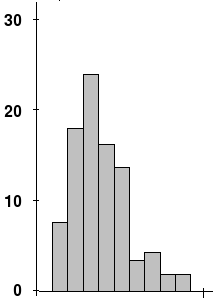
In probability theory and statistics, skewness is a measure of the asymmetry of the probability distribution of a real-valued random variable about its mean. The skewness value can be positive, zero, negative, or undefined.
For a unimodal distribution (a distribution with a single peak), negative skew commonly indicates that the tail is on the l...
 opal osprey
I have the skewness
column_a    0.055673
column_b    1.515880
What I don't know is when is it too much? 0.05? 0.1? 100.23710?
How do I determine that?
wraith heart
the answer is data/domain dependent
opal osprey
So... if the assignment lacks details, I just have to guess?
I just can't find a way to justify using this test but none of the columns I have are completely normal and I have to use a parametric test
vale dockBOT
@opal osprey Has your question been resolved?
vale dockBOT
@opal osprey Has your question been resolved?
opal osprey
.close
vale dockBOT
Channel closed
Closed by @opal osprey
Use .reopen if this was a mistake.
vale dockBOT
Available help channel!
Send your question here to claim the channel.
Remember:
• Ask your math question in a clear, concise manner.
• Show your work, and if possible, explain where you are stuck.
• After 15 minutes, feel free to ping <@&286206848099549185>.
• Type the command .close to free the channel when you're done.
• Be polite and have a nice day!
Read #❓how-to-get-help for further information on how to ask a good question, and about conduct in the question channels.
tidal terrace
Separate it into two arithmetic sums
 dire cloud
have you studied arithmetic progressions?
like the sum of a series such as 2,5,8,11,.. etc.
tidal terrace
(1000+998+996….+2)- (999+997+995….+1)
dire cloud
make an AP of the positive terms and a separate one of the negative terms
 scenic peak
tidal terrace
Separate it into two arithmetic sums
scenic peak
tidal terrace
Separate it into two arithmetic sums
Isn't there a quicker observation here?
dire cloud
scenic peak
Isn't there a quicker observation here?
oh yeah there is
tidal terrace
scenic peak
Isn't there a quicker observation here?
This is the quickest I could get
dire cloud
take 2 terms at a time
tidal terrace
Didn’t see that 😭
vale dockBOT
Channel closed
Closed by @merry oracle
Use .reopen if this was a mistake.
vale dockBOT
Available help channel!
Send your question here to claim the channel.
Remember:
• Ask your math question in a clear, concise manner.
• Show your work, and if possible, explain where you are stuck.
• After 15 minutes, feel free to ping <@&286206848099549185>.
• Type the command .close to free the channel when you're done.
• Be polite and have a nice day!
Read #❓how-to-get-help for further information on how to ask a good question, and about conduct in the question channels.
 deft condor

