#help-4
1 messages · Page 2 of 1
 ruby sleet
 cloud coral
are you sure you aren't missing any extra conditions?
ruby sleet
that requires at least a and n being coprime
otherwise your proof is not worth anything
cloud coral
well strictly, it's worth a lesson
ruby sleet
well I was saying the proof is not valid
cloud coral
fair
ruby sleet
here's an even tamer result
taking n = 10 and a = 4
say b = 0 just for the sake of it
then x = 1 and x = 6 result in the same value of ax+b mod n
as soon as a and n are not coprime
the statement is null
now the reason why your proof doesn't work: you try to simplify by "a"
in modular arithmetic, that makes no sense unless a has a modular inverse mod n
meaning some u such that ua = 1 mod n
that only happens when a and n are coprime
because when they are, then bezout theorem =>
$au + nv = 1$ for some $u,v$ integers
 rocky lotusBOT
rafilou is not not born in 2003
 ruby sleet
then $au \equiv 1 \mod n$
rocky lotusBOT
rafilou is not not born in 2003
 ruby sleet
(this is even an equivalence)
 rocky lotusBOT
rafilou is not not born in 2003

 gritty carbon
but the converse is not true
ruby sleet
the converse is indeed not always true
which is why we need the existence of $u$ such that $uk \equiv 1 \mod n$
if we do, then having $ka \equiv kb \mod n$
rocky lotusBOT
rafilou is not not born in 2003
 ruby sleet
then $uka \equiv ukb \mod n$
rocky lotusBOT
rafilou is not not born in 2003
 ruby sleet
so $a \equiv b \mod n$


 vale dockBOT
Channel closed
Closed by @gritty carbon
Use .reopen if this was a mistake.
vale dockBOT
 Available help channel!
Send your question here to claim the channel.
Remember:
• Ask your math question in a clear, concise manner.
• Show your work, and if possible, explain where you are stuck.
• After 15 minutes, feel free to ping <@&286206848099549185>.
• Type the command .close to free the channel when you're done.
• Be polite and have a nice day!
Read #❓how-to-get-help for further information on how to ask a good question, and about conduct in the question channels.
 small crystal
do I use arc length here or smth? I don't know how sum is gon give the length
 vale dockBOT
small crystal
do I use arc length here or smth? I don't know how sum is gon give the length
vale dockBOT
small crystal
do I use arc length here or smth? I don't know how sum is gon give the length
 sharp knot
small crystal
do I use arc length here or smth? I don't know how sum is gon give the length
sharp knot
small crystal
do I use arc length here or smth? I don't know how sum is gon give the length
Do you remember the formula for arc lenght?
sharp knot
Do you see it now?
small crystal
so i do sum to find f'(x) over the interval?
sharp knot
small crystal
so i do sum to find f'(x) over the interval?
The arc length formula is in terms of an integral. You estimate the integral with a reimann sum.
small crystal
i know the int a to b sqrt (1 + (dy/dx)^2 ) dx
but i dont get how im solving this problem
sharp knot
small crystal
i know the int a to b sqrt (1 + (dy/dx)^2 ) dx
You're given the dy/dx at the points you need. It is the same as other reimann sum problems, you just use sqrt (1 + (dy/dx)^2 ) as the function you're integrating.
small crystal
do i have to do sum for all three f' and add that together?
sharp knot
small crystal
do i have to do sum for all three f' and add that together?
Can you try setting it up? I'll let you know if I agree with what you have.
small crystal
would it be like this? I used the interval instead of integral for sum
 sharp knot
small crystal
would it be like this? I used the interval instead of integral for sum
sharp knot
small crystal
would it be like this? I used the interval instead of integral for sum
Yes, exactly
wait
why do you have f'(7) for the last one? It should be f'(5).
small crystal
I wrote it wrong 😭 but I plugged correct value
sharp knot
Ah, I think you see the idea, though.
vale dockBOT
Channel closed
Closed by @small crystal
Use .reopen if this was a mistake.
sharp knot
np
vale dockBOT
Available help channel!
Send your question here to claim the channel.
Remember:
• Ask your math question in a clear, concise manner.
• Show your work, and if possible, explain where you are stuck.
• After 15 minutes, feel free to ping <@&286206848099549185>.
• Type the command .close to free the channel when you're done.
• Be polite and have a nice day!
Read #❓how-to-get-help for further information on how to ask a good question, and about conduct in the question channels.
 balmy iris
i need some help with how to start this
 vale dockBOT
balmy iris
i need some help with how to start this
vale dockBOT
balmy iris
i need some help with how to start this
 daring basalt
current student in quantum physics coop placemnet needing imediate help on fixing this quantum wave equation:

 stark wedge
daring basalt
current student in quantum physics coop placemnet needing imediate help on fixin...
stark wedge
daring basalt
current student in quantum physics coop placemnet needing imediate help on fixin...
!occupied
vale dockBOT
daring basalt
current student in quantum physics coop placemnet needing imediate help on fixin...
Someone else is already using this help channel. If you need help with a question, please open your own help channel/thread (see #❓how-to-get-help for instructions).
daring basalt
but mine needs attension pls
stark wedge
this is someone else's channel. get your own.
 dapper osprey
cold
balmy iris
thanks ann
daring basalt
I am sorry about the difficult situatino however these tought times call for important leadership decisions one of qhich should be adressing myproblem imediatly.
stark wedge
daring basalt
I am sorry about the difficult situatino however these tought times call for imp...
<@&268886789983436800> this is a troll.
stark wedge
@balmy iris am i off base or like... doesn't the fourier sine transform simply involve taking the integral of f(x) sin(xi*x) dx
balmy iris
stark wedge
this channel has your name on it
okay
daring basalt
anna is right
stark wedge
@daring basalt can and should open his own channel
daring basalt
let me find a different one
balmy iris
stark wedge
<@1274813355428937738> am i off base or like... doesn't the fourier sine transfo...
oh wait yeah ur right
thank you ann idk why im slow
vale dockBOT
@balmy iris Has your question been resolved?
Channel closed
Closed by @balmy iris
Use .reopen if this was a mistake.
vale dockBOT
Available help channel!
Send your question here to claim the channel.
Remember:
• Ask your math question in a clear, concise manner.
• Show your work, and if possible, explain where you are stuck.
• After 15 minutes, feel free to ping <@&286206848099549185>.
• Type the command .close to free the channel when you're done.
• Be polite and have a nice day!
Read #❓how-to-get-help for further information on how to ask a good question, and about conduct in the question channels.
vale dockBOT
Channel closed
Channel closed due to the original message being deleted.
If you did not intend to do this, please open a new help channel,
as this action is irreversible, and this channel may abruptly lock.
 sturdy niche
.close
vale dockBOT
Available help channel!
Send your question here to claim the channel.
Remember:
• Ask your math question in a clear, concise manner.
• Show your work, and if possible, explain where you are stuck.
• After 15 minutes, feel free to ping <@&286206848099549185>.
• Type the command .close to free the channel when you're done.
• Be polite and have a nice day!
Read #❓how-to-get-help for further information on how to ask a good question, and about conduct in the question channels.
small crystal
how do I solve this? I'm not given int f(x)

 safe fulcrum
Integration by parts
small crystal
oh
lemme try
im getting f(x)g'(x) - int f'(x)g'(x)
is this correct?
do i plug in the bounds
safe fulcrum
small crystal
do i plug in the bounds
Yes
 leaden cobalt
you also could find f(x) if you wanted lol
small crystal
hmmm yea for IBP do i plug in bound for both parts?
safe fulcrum
small crystal
hmmm yea for IBP do i plug in bound for both parts?
Yep
small crystal
for f'(x) inside the integral i js treat it as constant and pull out right?
leaden cobalt
yeah, and if you want you can just replace it with "3"
leaden cobalt
leaden cobalt
ri?
ri short for right 💀
vale dockBOT
Channel closed
Closed by @small crystal
Use .reopen if this was a mistake.
 stone aspen
!help
vale dockBOT
To ask for mathematics help on this server, please open your own help channel or help thread. See #❓how-to-get-help for instructions.
Available help channel!
Send your question here to claim the channel.
Remember:
• Ask your math question in a clear, concise manner.
• Show your work, and if possible, explain where you are stuck.
• After 15 minutes, feel free to ping <@&286206848099549185>.
• Type the command .close to free the channel when you're done.
• Be polite and have a nice day!
Read #❓how-to-get-help for further information on how to ask a good question, and about conduct in the question channels.
 blazing rover
Can f(x) ^ g(x) ever diverge as x goes to infinity if the limit as x goes to infinity of g(x) is 0?
vale dockBOT
blazing rover
Can f(x) ^ g(x) ever diverge as x goes to infinity if the limit as x goes to inf...
blazing rover
.close
vale dockBOT
Channel closed
Closed by @blazing rover
Use .reopen if this was a mistake.
vale dockBOT
Available help channel!
Send your question here to claim the channel.
Remember:
• Ask your math question in a clear, concise manner.
• Show your work, and if possible, explain where you are stuck.
• After 15 minutes, feel free to ping <@&286206848099549185>.
• Type the command .close to free the channel when you're done.
• Be polite and have a nice day!
Read #❓how-to-get-help for further information on how to ask a good question, and about conduct in the question channels.
 mild parcel
I'm having an extremely tough time figuring out this problem
 mild parcel
I only got to the poiint where I found the intersection points
but I don't understand which method i should use
safe fulcrum
mild parcel
but I don't understand which method i should use
the outer volume would be given by x + y = 2 or y = 2 - x
and the inner volume by x = y^2 or y = sqrt(x)
one sec

ah that's nasty: okay so you need one integral for 0 < x < 1
and another integral for 1 < x < 4
safe fulcrum
mild parcel
i think i found the lower and upper bounds
but you need to split it into two integrals
and actually yeah disk/washer method works better
mild parcel
that means theres an inner and outer radius
safe fulcrum
mild parcel
that means theres an inner and outer radius
yes
so what you need to do is to find the outer distance, so the distance between the bottom part of the red curve and y = 1
and then the inner distance
for example, the inner distance between the blue line and y = 1 is (2 - x) - 1 = 1 - x
(or x - 1, it doesn't matter if you square it)
(technically it's |x - 1| = |1 - x|)
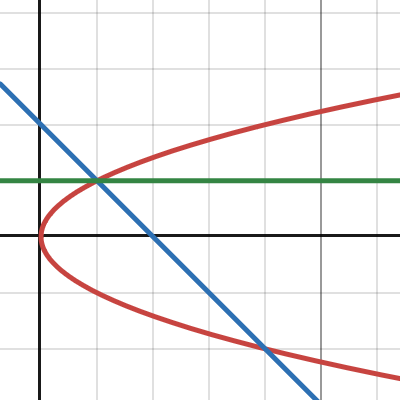
Desmos
okay I'll just post this
vale dockBOT
@mild parcel Has your question been resolved?
vale dockBOT
Channel closed
Closed due to timeout
Use .reopen if this was a mistake.
vale dockBOT
Available help channel!
Send your question here to claim the channel.
Remember:
• Ask your math question in a clear, concise manner.
• Show your work, and if possible, explain where you are stuck.
• After 15 minutes, feel free to ping <@&286206848099549185>.
• Type the command .close to free the channel when you're done.
• Be polite and have a nice day!
Read #❓how-to-get-help for further information on how to ask a good question, and about conduct in the question channels.
 spare pawn
can anyone help me with this question
 vale dockBOT
spare pawn
can anyone help me with this question
vale dockBOT
spare pawn
can anyone help me with this question
@spare pawn Has your question been resolved?
vale dockBOT
Channel closed
Closed due to timeout
Use .reopen if this was a mistake.
vale dockBOT
Available help channel!
Send your question here to claim the channel.
Remember:
• Ask your math question in a clear, concise manner.
• Show your work, and if possible, explain where you are stuck.
• After 15 minutes, feel free to ping <@&286206848099549185>.
• Type the command .close to free the channel when you're done.
• Be polite and have a nice day!
Read #❓how-to-get-help for further information on how to ask a good question, and about conduct in the question channels.
 slow stone
 vale dockBOT
slow stone
slow stone
vale dockBOT
slow stone
slow stone
me and my friend are having a conflict wether we subtract them or not since they arent points but vectors
slow stone
 heady pawn
For this I always remember AB, so we have to do b - a
heady pawn
For this I always remember AB, so we have to do b - a
Isnt that in the case if theyre points
slow stone
So do I just solve it as if theyre 2 points?
 crimson yoke
Yep
slow stone
100% sure?
crimson yoke
Yes
heady pawn
not entirely
slow stone
alr thank youu
slow stone
heady pawn
not entirely
what
heady pawn
a - b is not the same as b - a
slow stone
i know that part i meant subtraction or addition
crimson yoke
heady pawn
a - b is not the same as b - a
That's not what she meant
heady pawn
just be carefull XD
vale dockBOT
Channel closed
Closed by @slow stone
Use .reopen if this was a mistake.
vale dockBOT
Available help channel!
Send your question here to claim the channel.
Remember:
• Ask your math question in a clear, concise manner.
• Show your work, and if possible, explain where you are stuck.
• After 15 minutes, feel free to ping <@&286206848099549185>.
• Type the command .close to free the channel when you're done.
• Be polite and have a nice day!
Read #❓how-to-get-help for further information on how to ask a good question, and about conduct in the question channels.
 pine spire
Can someone explain example 2? How did they evaluate it?

 glass kelp
 crimson yoke
pine spire
Can someone explain example 2? How did they evaluate it?
crimson yoke
pine spire
Can someone explain example 2? How did they evaluate it?

Try applying this there too
pine spire
Got that but how did they evaluate (x+1) and (x-1)
crimson yoke
x² - 1 = (x+1)(x-1)
crimson yoke
There's an identity
vale dockBOT
Channel closed
Closed by @pine spire
Use .reopen if this was a mistake.
pine spire
.reopen
vale dockBOT
✅
pine spire
pls explain
 crimson yoke
Which step?
pine spire
the 3rd step
crimson yoke
$(x^2-x+1)(x+1)$
rocky lotusBOT
Suika
 rocky lotusBOT
Suika
 pine spire
Cant I cancel x^2 over here?
 crimson yoke
Yes u can
pine spire
alr thanks
crimson yoke
But there is another x² here, it remains
crimson yoke
pine spire
pls explain
 pine spire
yep got the answer thanks
crimson yoke
Okay
pine spire
.close
vale dockBOT
Channel closed
Closed by @pine spire
Use .reopen if this was a mistake.
vale dockBOT
Available help channel!
Send your question here to claim the channel.
Remember:
• Ask your math question in a clear, concise manner.
• Show your work, and if possible, explain where you are stuck.
• After 15 minutes, feel free to ping <@&286206848099549185>.
• Type the command .close to free the channel when you're done.
• Be polite and have a nice day!
Read #❓how-to-get-help for further information on how to ask a good question, and about conduct in the question channels.
vale dockBOT
 atomic pewter
can someone explain how to do this question please
idk what to do
mb wait
wrong one
 vale dockBOT
Channel closed
Channel closed due to the original message being deleted.
If you did not intend to do this, please open a new help channel,
as this action is irreversible, and this channel may abruptly lock.

 mild kernel
Can you get the area of the pentagon?
Let's say the inner grey circle wasn't there
are you allowed to look up the formula?
atomic pewter
well we could just devide it into 3 triangles find the area of on and times it by 3
mild kernel
three?
mild kernel
atomic pewter
well we could just devide it into 3 triangles find the area of on and times it b...
why 3?
how about 5
alternatively, we could just use the formula
if you're allowed
atomic pewter
cuz there are 3 triangles in the pentagon
mild kernel
can you draw what you mean
atomic pewter
mild kernel
if you're allowed
idk if am allowed
 vale dockBOT
Available help channel!
vale dockBOT
Available help channel!
Send your question here to claim the channel.
Remember:
• Ask your math question in a clear, concise manner.
• Show your work, and if possible, explain where you are stuck.
• After 15 minutes, feel free to ping <@&286206848099549185>.
• Type the command .close to free the channel when you're done.
• Be polite and have a nice day!
Read #❓how-to-get-help for further information on how to ask a good question, and about conduct in the question channels.
mild kernel
oh, geez
vale dockBOT
mild kernel
oh, geez
mild kernel
I didn't see that
mild kernel
atomic pewter
have you found these areas?
this seems suboptimal to me
i think youre going to need to further split things here to make progress
atomic pewter
yea
I got 30.433.......
so just 30
for the area of one triangle
so the area of the pentagon is 90
mild kernel
atomic pewter
so the area of the pentagon is 90
I can tell you this is wrong
atomic pewter
how
mild kernel
because I know the answer
atomic pewter
how do you do it then
atomic pewter
how
 nova thicket
atomic pewter
nova thicket
atomic pewter
hey! you are on the right track 😄 the area of the two of the 108° triangles combined is 8x8xsin(108)
but the middle triangle is not the same area as the other two!
nova thicket
atomic pewter
how
draw lines from the center, to each vertex 😄
mild kernel
yea
then draw a line from the center to the center of each side
you get 10 identical triangles
atomic pewter
nova thicket
hey! you are on the right track 😄 the area of the two of the 108° triangles com...
ohhh I see
mild kernel
they're all right
atomic pewter
that makes more sense
nova thicket
atomic pewter
ohhh I see
you can correct your approach, by finding the length of the unknown sides of the middle triangle by using the cosine rule 😄
the cosine rule says that cos(108) = (8^2 + 8^2 - EC^2)/(2x8x8). So now you can find EC, and similarly EB. then you can calculate the area of the middle triangle, since you know all three of its sides!!
atomic pewter
but dont you need an angle for that
nova thicket
what do you mean,?
atomic pewter
to find the area you need 2 sides and one angle
nova thicket
if you know all three sides, you dont need any angle 😄
atomic pewter
how
nova thicket
are you aware of herons formula?
 nova thicket
yes 😄
atomic pewter
I meant like the letters in the formula
of the cosine rule
so now ill find out the area
48.9
so 108.9 for the area of the pentagon
nova thicket
its supposed to be around 110, but i think its because you rounded the two triangle areas to 30
atomic pewter
yea I did
nova thicket
dont do that, first add up the areas and then round it
nova thicket
🤔 still not sure how you got that, because its approximately 110.11
atomic pewter
you can round up to 110 for mine and round down to 110 for yours
I think I rounded the triangle in the middle
nova thicket
dont do any rounding after calculating the areas of the triangles!! add them up without rounding
nova thicket
the answer is supposed to be upto 3 sigfigs, why are you rounding at all in the first place?
lets keep everything unrounded. lets move onto finding the radius of the circle so we can calculate its area
 nova thicket
but then you should have followed jan-nikus suggestion from the beginning
atomic pewter
then times it by 5
nova thicket
all this area calculation was useless
nova thicket
we can simply find the radius of the big circle, and subtract the area of the pentagon from the big circle
atomic pewter
how do we find the radius of the big circle
nova thicket
cosine rule, again
this time draw lines from the center, connecting to each vertex of the pentagon
atomic pewter
ohhh
nova thicket
so the more efficient approach to this problem would have been:
calculate radius of the big circle
find sector area
multiply by 5
atomic pewter
oh we can use the circle therom to work out the angle in the middle
andgle in the middle twice angle at circumference

so 36 x 2
so the angle in the middle is 72
nova thicket
well, more simple would be that 360/5 = 72
but this is also fine
now find the radius using cosine rule
find the area of the sector
multiply by 5
 nova thicket
why? cos(72) = 2r^2 - 8^2/(2r^2)
atomic pewter
it seemed easier
nova thicket
okay, sure 😄
now find the area of the sector and multiply by 5
or, find the area of the circle and subtract the pentagon area
atomic pewter
yea ill do the area of the circle
is quicker
cuz am doing this to practice for my exams
cuz I got paper 2 and 3 gcses in 2 weeks
paper 1 was abit hard so am practicing more
nova thicket
then what we just did was not the best method! i continued with it because you had already done some work in it, but let us keep in mind the fastest method:
find radius
find area of sector
multiply by 5
atomic pewter
ohhh
I need to do more of these questions to get to think more of finding the fastest methods cuz I dont have much time in the exam
nova thicket
anyways, let us get back to the problem
atomic pewter
so the area of the circle is
136.847776
so 136.85
136.85-110.11
26.74
what do I do now
nova thicket
so you need to find the radius of the small circle
dont forget what the problem asked for
nova thicket
atomic pewter
which is 6.6 ........
by the way, this is supposed to be around 6.805
anyways, you know the area of the smaller circle, its 26.74
so you can find the radius
by making pi * r^2 = 26.74
then once you find r, you are finished 😄
vale dockBOT
@mild kernel Has your question been resolved?
atomic pewter
nova thicket
then once you find r, you are finished 😄
alright
is it 2.92
@nova thicket
 spark sluice
atomic pewter
is it 2.92
spark sluice
atomic pewter
is it 2.92
The correct answer is closer to 3.34, but this error seems to be because of the small errors which have been pointed out in your estimates for the areas. The method is fine, though
atomic pewter
alright thank you very much
spark sluice
For example you found the pentagon area = 109.8, but in reality its closer to 110.11
The big circle radius is closer to 6.80, but you got 6.6
atomic pewter
yea
spark sluice
atomic pewter
yea
If you find the radius of the small circle using these correct values, you get around 3.34
,calc sqrt((pi6.86.8-110.11)/pi)
rocky lotusBOT
Result:
3.345280023003
As you can see
vale dockBOT
@mild kernel Has your question been resolved?
vale dockBOT
Channel closed
Closed due to timeout
Use .reopen if this was a mistake.
Available help channel!
Send your question here to claim the channel.
Remember:
• Ask your math question in a clear, concise manner.
• Show your work, and if possible, explain where you are stuck.
• After 15 minutes, feel free to ping <@&286206848099549185>.
• Type the command .close to free the channel when you're done.
• Be polite and have a nice day!
Read #❓how-to-get-help for further information on how to ask a good question, and about conduct in the question channels.
 knotty musk
 vale dockBOT
knotty musk
knotty musk
vale dockBOT
knotty musk
knotty musk
i have done a really similar question where the degree of P(x) was specified and p(x) was x/x+1
so i was able to define a g(x) = (x+1)P(x) - x and then figure out P(-1)
but in this case i dont know how to determine the degree
knotty musk
knotty musk
so i was able to define a g(x) = (x+1)P(x) - x and then figure out P(-1)
i tried this same approach with g(x) = (x+1)(x+2)P(x) - x
and i assumed g(x) is a 11 degree polynomial
but then i realised that it doesnt satisfy g(-1) = 1 and g(-2) = 2
so thats where i got stuck
<@&286206848099549185> help pls 
vale dockBOT
@knotty musk Has your question been resolved?
 tame wolf
knotty musk
tame wolf
knotty musk
Are you allowed to use a calculator or some software?
This is extremely tedious otherwise
knotty musk
tame wolf
Are you allowed to use a calculator or some software?
no but i can leave the answer as a sum of fractions
thats what is shown in the answer key
tame wolf
Oh alright
You can use Lagrange interpolation for this

In numerical analysis, the Lagrange interpolating polynomial is the unique polynomial of lowest degree that interpolates a given set of data.
Given a data set of coordinate pairs
    (

      x

        j


    ,

      y

        j
...
So at each point (0, 1, 2, ...) there is a polynomial which evaluates to 1 at that point and 0 at the others
knotty musk
tame wolf
You can use Lagrange interpolation for this
is there an easier way to do it? because this is meant to be solved with high school math
tame wolf
tame wolf
So at each point (0, 1, 2, ...) there is a polynomial which evaluates to 1 at th...
For example for 2 it is the following polynomial:
$$\frac{x-0}{2-0}\times\frac{x-1}{2-1}\times\frac{x-3}{2-3}\times\frac{x-4}{2-4}\times\dots\times\frac{x-10}{2-10}$$
Notice how it is a polynomial (with degree 10), such that when $x=2$, the product is exactly 1 (because each fraction becomes 1), but when it is any other number, one of the numerators is 0 and so the whole product becomes 0
rocky lotusBOT
d
 tame wolf
knotty musk
is there an easier way to do it? because this is meant to be solved with high sc...
tame wolf
knotty musk
is there an easier way to do it? because this is meant to be solved with high sc...
I'm not aware of an easier way
knotty musk
rocky lotus
**d**
yeah this makes sense
so we write those polynomials for 0, 1, .. 10 and then add them?
tame wolf
knotty musk
is there an easier way to do it? because this is meant to be solved with high sc...
Actually the answer is a fraction of five-digits numbers so I wouldn't expect an easier solution to exist
tame wolf
knotty musk
so we write those polynomials for 0, 1, .. 10 and then add them?
Well, there's one more detail
knotty musk
tame wolf
Actually the answer is a fraction of five-digits numbers so I wouldn't expect an...

this is the answer key
tame wolf
knotty musk
so we write those polynomials for 0, 1, .. 10 and then add them?
That would evaluate to 1 at each point
tame wolf
knotty musk
That's interesting
tame wolf
knotty musk
is there an easier way to do it? because this is meant to be solved with high sc...
But is it a high school math question, or a math olympiad question which only requires high school math?
knotty musk
tame wolf
But is it a high school math question, or a math olympiad question which only re...
high school math question
as a matter of fact, this is from our first math chapter which is called fundamentals of math
tame wolf
Maybe you have a book which contains some relevant piece of theory
A theorem or something
knotty musk
there was a question before this which was similar, perhaps that could help in solving this
knotty musk
knotty musk
there was a question before this which was similar, perhaps that could help in s...
can i send it here?
tame wolf
Yes
 knotty musk
knotty musk
knotty musk
heres the solution for this (sorry for the bad handwriting)
 tame wolf
knotty musk
this was solved by taking g(x) = (x+1)f(x) - x
tame wolf
knotty musk
this was solved by taking g(x) = (x+1)f(x) - x
So that g is a 51 degree polynomial with 51 zeroes, hence g = 0 (?)
tame wolf
tame wolf
So that g is a 51 degree polynomial with 51 zeroes, hence g = 0 (?)
Wait this makes no sense, you need 52 zeroes
knotty musk
tame wolf
Wait this makes no sense, you need 52 zeroes
why? isnt g 51 degree
and 0,1,2, .... , 50 are zeroes
so u can write g as Kx(x-1)(x-2)..(x-50)
tame wolf
Yes, I mean if g had 52 zeroes then g would be 0
But I tried to apply that property with 51 instead of 52
knotty musk
ah ok
knotty musk
knotty musk
heres the solution for this (sorry for the bad handwriting)
i meant g(u-1) wherever g(u) is written
tame wolf
knotty musk
and i assumed g(x) is a 11 degree polynomial
In this case g(x) would have degree 12
So g(x) = kx(x-1)...(x-10)(x-a)
For some k,a
knotty musk
tame wolf
In this case g(x) would have degree 12
how did you determine that?
tame wolf
knotty musk
how did you determine that?
Well maybe we have to prove it
But what is clear is that it is at most 12
knotty musk
tame wolf
But what is clear is that it is at most 12
can you tell me your reasoning though? this was the part where i was stuck so i dont get it
tame wolf
knotty musk
There are 11 points so you can find a polynomial P with degree 10 or less
If you choose n numbers (here n=11) and want a polynomial which evaluates to some specific values at those numbers (in this case the values were 0/(0^2 + 3 0 + 2), 1/(1^2 + 3 1 + 2),...), then there is a polynomial with degree n-1 or less
tame wolf
tame wolf
If you choose n numbers (here n=11) and want a polynomial which evaluates to som...
This is a well known theorem and I don't think you aren't allowed to use it
tame wolf
rocky lotus
**d**
To see why you can actually use these things
tame wolf
tame wolf
If you choose n numbers (here n=11) and want a polynomial which evaluates to som...
But just assume it
So in this case deg(P) <= 10 and g(x) = (x^2+3x+2)P(x)+x so deg(g) = 2 + deg(P) <= 12
knotty musk
tame wolf
If you choose n numbers (here n=11) and want a polynomial which evaluates to som...
hmm ok
tame wolf
tame wolf
Well maybe we have to prove it
Actually g(0), g(1), g(2),... g(10) must all be zero
So we can do something
If deg(g) < 11 then g = 0
So that means (x^2 + 3x + 2) P(x) = x, this is impossible
Therefore deg(g) is 11 or 12
knotty musk
ok that makes sense
tame wolf
Oh wait
If we define g like that, when we choose x = -1 the equation becomes g(-1) = 0 P(-1) + (-1), g(-1) = -1 and we lose the P(-1)!
So we want another g
knotty musk
tame wolf
If we define g like that, when we choose x = -1 the equation becomes g(-1) = 0 P...
g(-1) becomes 1 but yes we lose the P
but i think we can work around that using the same logic as that other question
the main problem was determining the degree
tame wolf
knotty musk
but i think we can work around that using the same logic as that other question
I think there is something more, because now the denominator vanishes at the points where you want to find P
tame wolf
tame wolf
If we define g like that, when we choose x = -1 the equation becomes g(-1) = 0 P...
That's why this happens
Maybe choosing g(x) = (x+2) P(x) + some fraction helps
knotty musk
tame wolf
I think there is something more, because now the denominator vanishes at the poi...
the sub u = x + 1 helped with that last time
because the constant terms would cancel out and u can collect the coefficient of u
and the rest would become zero
but i guess itll be harder to apply that here since we're dividing by u(u+1)
tame wolf
knotty musk
because the constant terms would cancel out and u can collect the coefficient of...
I see
tame wolf
knotty musk
but i guess itll be harder to apply that here since we're dividing by u(u+1)
And there's also the (x-a)
tame wolf
tame wolf
So g(x) = kx(x-1)...(x-10)(x-a)
(This one)
knotty musk
tame wolf
And there's also the (x-a)
i found a to be -11/5
tame wolf
How?
knotty musk
im working it out right now
knotty musk
tame wolf
How?
we know g(-1) is 1 and g(-2) is 2
and we have 2 unknowns, k and a
so we can solve for both
knotty musk
yeah
tame wolf
knotty musk
we know g(-1) is 1 and g(-2) is 2
Just do this, but now there are 2 equations and 1 unknown (k)
Hopefully there is no solution
knotty musk
tame wolf
Just do this, but now there are 2 equations and 1 unknown (k)
k is -10/12!
i think from here it is just tedious calculation
tame wolf
knotty musk
k is -10/12!
You mean in the case deg(g)=11 or deg(g)=12?
tame wolf
But why is g(-1) = 1?
knotty musk
g(x) = (x+1)(x+2)P(x) - x
tame wolf
knotty musk
k is -10/12!
It's correct, I get the same
tame wolf
knotty musk
i think from here it is just tedious calculation
Yes it seems so
knotty musk
alright i still cant work it out
i guess ima give up on this one for now
thanks a lot for your help though @tame wolf
.close
vale dockBOT
Channel closed
Closed by @knotty musk
Use .reopen if this was a mistake.
Available help channel!
Send your question here to claim the channel.
Remember:
• Ask your math question in a clear, concise manner.
• Show your work, and if possible, explain where you are stuck.
• After 15 minutes, feel free to ping <@&286206848099549185>.
• Type the command .close to free the channel when you're done.
• Be polite and have a nice day!
Read #❓how-to-get-help for further information on how to ask a good question, and about conduct in the question channels.
small crystal
for part (a) i dont get why my setup are not giving the right answer

 vale dockBOT
small crystal
for part (a) i dont get why my setup are not giving the right answer
vale dockBOT
small crystal
for part (a) i dont get why my setup are not giving the right answer
@small crystal Has your question been resolved?
 wraith heart
your limits are incorrect
small crystal
wait why? idk where i got it wromg
wraith heart


in general for areas of polar curves, your angle should never be outside of [0, 2pi]
small crystal
but this is also wrong
 rocky lotusBOT
riemann
 wraith heart
have you learned that yet?
your limits on the first integral is correct. it should be the same for the second integral
wraith heart
the bounds on the second integral should be the same as the first integral's bounds
small crystal
i did that but the area is wrong


 vale dockBOT
Channel closed
Closed by @small crystal
Use .reopen if this was a mistake.
vale dockBOT
Available help channel!
Send your question here to claim the channel.
Remember:
• Ask your math question in a clear, concise manner.
• Show your work, and if possible, explain where you are stuck.
• After 15 minutes, feel free to ping <@&286206848099549185>.
• Type the command .close to free the channel when you're done.
• Be polite and have a nice day!
Read #❓how-to-get-help for further information on how to ask a good question, and about conduct in the question channels.
 quick tartan
 vale dockBOT
quick tartan
quick tartan
vale dockBOT
quick tartan
quick tartan
Can someone help me with this
I used chebyshev's but then realized it was the lower bound
P(40<X<60) >= .75
Is it just 1 then?
 viscid spade
May we see your work
viscid spade
I see nothing wrong
quick tartan
It wants the upper
viscid spade
quick tartan
Is it just 1 then?
If yes the question is really useless
Thats not chebychev at start
 jaunty briar
oh wait nvm
viscid spade
Chenychev is <= V(x) / eps²
jaunty briar
my bad
quick tartan
Okay i think it might just be 1 then
lol
idk what else it migh tbe
Cuz this hw unit is literally markov and cheby
viscid spade
Maybe they ask for lower bound and they typo also
quick tartan
yehh maybe
viscid spade
Ask them next time
vale dockBOT
Channel closed
Closed by @quick tartan
Use .reopen if this was a mistake.
vale dockBOT
Available help channel!
Send your question here to claim the channel.
Remember:
• Ask your math question in a clear, concise manner.
• Show your work, and if possible, explain where you are stuck.
• After 15 minutes, feel free to ping <@&286206848099549185>.
• Type the command .close to free the channel when you're done.
• Be polite and have a nice day!
Read #❓how-to-get-help for further information on how to ask a good question, and about conduct in the question channels.
 real summit
So
vale dockBOT
real summit
So
real summit
About limits and shiz
 plush crater
yuh what ab em
real summit
I read about the epsilon delta definition
And it say something like, it a limit if you can go far enough out into the sequence so that the distance between ANY (?) number you find (after some particular N) and the proposed limit, is smaller than that epsilon
Wait
Oh wait
 pine prairie
that's pretty close
the definition is talking about the existence of such an N
but you start with the epsilon. Given any positive epsilon, there exists an N such that bla bla bla
we need to actually be able to find this N
we need to show that for any epsilon > 0, we can find a suitable N such that so and so holds
the so and so is the ANY (?) number you find (after some particular N) and the proposed limit, is smaller than that epsilon
also ANY (?) number you find should be replaced with any term after the Nth one
real summit
So if i keep coming across a number in the sequence whose distance to the proposed limit is NOT less than epsilon, call em s_big, and i keep on finding such numbers, EVEN THOUGH most numbers that surround those s_big ARE less than epsilon, and in fact they get smaller and smaller-- because i cant find an appropriate N such that ANY term with n>N yields an appropriate distance, i can't call the sequence converging and it diverges
pine prairie
yes
so for example, if i have a sequence 1/n
clearly we know this converges to 0 right?
real summit
Yes
pine prairie
okay if i tell you
when n is even, the sequence is 1/n
when n is odd, the sequence is 2
this will not converge
because no matter how big you look for this N
all the odd terms after will not be less than 2 away from 0
so if you picked any epislon to be less than 2
you will fail to find convergence to 0
which means there is an epsilon you can pick that breaks it, meaning you don't have "for all epsilon > 0"
it could still possibly converge to something else, not 0, but we know that isn't the case
real summit
Is that kind of the same as this?
:

What i drew is like
So you do keep finding numbers that do get closer and closer to the limit, but ALSO sporadically there are numbers far away
So then you cant say it converges
pine prairie
yep
from the perspective of a drawing, convergence means that if you label those points, any (open) shape you draw around that limit point will contain the entire sequence, save a finite amount at the beginning
real summit
Oh yeah
pine prairie
so maybe you need to throw away the first 5 points or first 100 points
but everything afterwards will be inside the shape
for any shape you draw
well, any open shape containing the limit point
open as in dotted lines for the boundary (an open set)
real summit
So if the points that are far away is infinite, then that means the entire sequence isnt contained within like say a circle around the limit point
pine prairie
that too
real summit
But then what does it even mean to converge because an infinite part of the sequence does get arbitrarily close right or no
pine prairie
you need so that any circle you draw around the limit point, however small, will contain all but a finite number of points in the sequence
real summit
Oh yeah
pine prairie
real summit
But then what does it even mean to converge because an infinite part of the sequ...
you can say that a subsequence converges to that point
pine prairie
but the sequence itself will not because there are circles that exclude infinitely many points
real summit
Rigt
real summit
pine prairie
you can say that a *subsequence* converges to that point
I'm not at that paragraph yet
pine prairie
there is a cool theorem about bounded sequences always having convergent subsequences but that's further down the line
real summit
But a subsequence converging does have the same 'weight' as a sequence converging?
pine prairie
it's a completely different thing
pine prairie
👍
real summit
.close
vale dockBOT
Channel closed
Closed by @real summit
Use .reopen if this was a mistake.
vale dockBOT
Available help channel!
Send your question here to claim the channel.
Remember:
• Ask your math question in a clear, concise manner.
• Show your work, and if possible, explain where you are stuck.
• After 15 minutes, feel free to ping <@&286206848099549185>.
• Type the command .close to free the channel when you're done.
• Be polite and have a nice day!
Read #❓how-to-get-help for further information on how to ask a good question, and about conduct in the question channels.
small crystal
why C? idk how to deal with limit with composite function

 storm perch
small crystal
why C? idk how to deal with limit with composite function
storm perch
small crystal
why C? idk how to deal with limit with composite function
Check left and right hand limit
Notice what happens
small crystal
i tried -0.11111 and +0.11111 and it does give same value but the graph is different ?
 frozen ledge
don’t do that
small crystal
wot 😭
storm perch
small crystal
i tried -0.11111 and +0.11111 and it does give same value but the graph is diffe...
Wdym
frozen ledge
just notice that whether you approach from the right or left that 1 - x^2 approaches 1 from below
small crystal
storm perch
Wdym
isnt that how you check it 😭
frozen ledge
so you’re really looking for lim x -> 1^- of f(x)
storm perch
That was what I was trying to point at
frozen ledge
small crystal
isnt that how you check it 😭
don’t use numbers
it’s a waste of time
and leads to mistakes honestly
storm perch
small crystal
isnt that how you check it 😭
Not really, you can "plug in" 0^- and 0^+ or just check for evenness of the function
small crystal
ive been taught to use acutal numbers when its conusing 😭
glass kelp
1-x^2 < 1 for x ≠ 0
frozen ledge
frozen ledge
just notice that whether you approach from the right or left that 1 - x^2 approa...
note that x^2 is always positive so if x -> 0^+ or 0^-, -x^2 will always approach 0^-
frozen ledge
small crystal
ive been taught to use acutal numbers when its conusing 😭
this is a bad sign
small crystal
so we ignoring x and we js looking at f(1)?
small crystal
cuz its gonna be same doenst matter we going from right or left
frozen ledge
be careful
frozen ledge
frozen ledge
note that x^2 is always positive so if x -> 0^+ or 0^-, -x^2 will always approac...
^
small crystal
frozen ledge
this is a bad sign
test in is thurday and im hella cooked
frozen ledge
this implies 1 - x^2 approaches 1^-
small crystal
so it approach 0 in same sides?
frozen ledge
what
small crystal
ummm
frozen ledge
maybe it’s easier to do what k said
1 - x^2 < 1 for x ≠ 0
so when you approach 0, 1 - x^2 approaches 1
but from below
small crystal
oh so its like its not actually 0 and somewhat zero so if we do when its not zero its gonna approach from less then that to 0
glass kelp
small crystal
oh so its like its not actually 0 and somewhat zero so if we do when its not zer...
That’s the point of a limit 😭
I approach something close to that thing
But not actually be there
small crystal
but i didnt thought of its gonna approach from one side
frozen ledge
it only does that here because of how x^2 behaves
small crystal
im failing this exam 🔥
frozen ledge
there’s like one limit question tops
small crystal
yea cuz it cancels the sign
frozen ledge
you need like a 65% for a 5
small crystal
i suck at mcq
im really slow at solving problem
anyways
thank for helping!
.close
vale dockBOT
Channel closed
Closed by @small crystal
Use .reopen if this was a mistake.
Available help channel!
Send your question here to claim the channel.
Remember:
• Ask your math question in a clear, concise manner.
• Show your work, and if possible, explain where you are stuck.
• After 15 minutes, feel free to ping <@&286206848099549185>.
• Type the command .close to free the channel when you're done.
• Be polite and have a nice day!
Read #❓how-to-get-help for further information on how to ask a good question, and about conduct in the question channels.
 hoary needle
Is a marginal distribution of a bivariate distribution = to the actual distribution of one of the variables
vale dockBOT
hoary needle
Is a marginal distribution of a bivariate distribution = to the actual distribut...
hoary needle
let me phrase this better, if I have p(x,y) and p(y) is some function defined over 0 to 5 and p(x) is somefunction defined over 0-10 now if we compute the marginal which is often written as
p(x)=∫p(x,y)dy
p(x)=∫p(x∣y)p(y)dy
right so even if i integrate over x's domain (0-10) the values (5-10) would just go to 0 bcz p(y) is not defined there
so we sort of "lose" p(x) from 5-10 right so the marginal p(x) is NOT equal to the actual p(x) yes or no?
vale dockBOT
@hoary needle Has your question been resolved?
wraith heart
the first equation is the right definition.

where

the slides here cover when to handle the p(y) = 0 cases
https://math.mit.edu/~sheffield/440/Lecture24.pdf
vale dockBOT
@hoary needle Has your question been resolved?
vale dockBOT
Channel closed
Closed by @hoary needle
Use .reopen if this was a mistake.
Available help channel!
Send your question here to claim the channel.
Remember:
• Ask your math question in a clear, concise manner.
• Show your work, and if possible, explain where you are stuck.
• After 15 minutes, feel free to ping <@&286206848099549185>.
• Type the command .close to free the channel when you're done.
• Be polite and have a nice day!
Read #❓how-to-get-help for further information on how to ask a good question, and about conduct in the question channels.
 hybrid torrent
 vale dockBOT
hybrid torrent
hybrid torrent
vale dockBOT
hybrid torrent
hybrid torrent
im familiar with the inclusion-exclusion principle but not in this form, I would love some clarity
 vocal tusk
numbers from 1 to n
hybrid torrent
what is r then
vocal tusk
the I is basically to pick sets from A_1, ..., A_n
I formalizes which of these elements to pick
vocal tusk
hybrid torrent
what is r then
r is just any number 1 to n
which will be the size of I
like u can't write I = {1, ..., r}
cuz the numbers could be different
example:
N_n = {1, ..., n}
I = {1, 2, n}
i1 = 1, i2 = 2, i3 = n
r = 3
hybrid torrent
ok so I is an random subset of N_n, and we use the elements of I to pick sets to find an intersection with?
vocal tusk
hybrid torrent
ok so I is an random subset of N_n, and we use the elements of I to pick sets to...
yes
hybrid torrent
ok that part makes sense now
thank u
as for the second line
oh ok
it makes sense now that i fully understand that
thank you so much
vocal tusk
np
hybrid torrent
.close
vale dockBOT
Channel closed
Closed by @hybrid torrent
Use .reopen if this was a mistake.
hybrid torrent
.reopen
vale dockBOT
✅
hybrid torrent
@vocal tusk sorry to ask smth again but
for the base case for the proof
n=1
only subset of N_n, I, would be just a single element
so its one set A_1, for example, that makes up A_I
nvm typing it out
made me figure it out
lol
.close
vale dockBOT
Channel closed
Closed by @hybrid torrent
Use .reopen if this was a mistake.
vale dockBOT
Available help channel!
Send your question here to claim the channel.
Remember:
• Ask your math question in a clear, concise manner.
• Show your work, and if possible, explain where you are stuck.
• After 15 minutes, feel free to ping <@&286206848099549185>.
• Type the command .close to free the channel when you're done.
• Be polite and have a nice day!
Read #❓how-to-get-help for further information on how to ask a good question, and about conduct in the question channels.
 crystal wing
ok, im trying to figure out a critical region for a test X~B(50,0.25).
null hypothesis is p=0.25, and alt hypothesis is p is not 0.25.
now here's where i'm confused because im supposed to get P(X<=a)<=0.025 (since it's a two tailed test), and i got that area under the curve from looking at a cumulative binomial distribution table and finding n=50, and p=0.25, which is 0.237
but if i try to get P(X<=b-1)>=0.975 (a value that's barely larger than 0.975, i don't know where to look because the table i was looking at only has one value for n=50 and p=0.25, which is the critical value for the lower tail.
vale dockBOT
crystal wing
ok, im trying to figure out a critical region for a test X~B(50,0.25).
null hypo...
crystal wing
here's the table i was using
 vale dockBOT
@crystal wing Has your question been resolved?
vale dockBOT
@crystal wing Has your question been resolved?
 uneven oracle
.open
vale dockBOT
Channel closed
Closed due to timeout
Use .reopen if this was a mistake.
Available help channel!
Send your question here to claim the channel.
Remember:
• Ask your math question in a clear, concise manner.
• Show your work, and if possible, explain where you are stuck.
• After 15 minutes, feel free to ping <@&286206848099549185>.
• Type the command .close to free the channel when you're done.
• Be polite and have a nice day!
Read #❓how-to-get-help for further information on how to ask a good question, and about conduct in the question channels.
 jade verge
my current thouht process was the sum of the two small triangles have a "base" of 10 and so i could merge them to form a triangle with base 10 height 10 giving me an area of 50. Idk if thats right or not but anyway i cannot figure out how to get the big triangle, i didnt know whether or not to try a huge triangle and just minus the area of the square or split it up
 vale dockBOT
jade verge
my current thouht process was the sum of the two small triangles have a "base" o...
vale dockBOT
jade verge
my current thouht process was the sum of the two small triangles have a "base" o...
 drifting hornet
jade verge
my current thouht process was the sum of the two small triangles have a "base" o...
drifting hornet
jade verge
my current thouht process was the sum of the two small triangles have a "base" o...
the big triangle has base 20, can you figure out the height?
jade verge
yeah thats what i was thinking first
geometry doesnt come very intuivtively to me though so i couldnt see anything instantly on how to find the height
drifting hornet

it takes 10 units to get from "height" 20 to "height" 10
how many units do you think it will take to get from "height" 10 to the vertex ("height" 0)?

you can also use similar triangles if you want to
the big triangle is similar to the small triangle (which is 2x smaller)
these 2 triangles are similar to be exact

@jade verge you here?
jade verge
drifting hornet
<@1203756112625537146> you here?
oh damm sorry, that makes sense ill give it a go thanks
.close
vale dockBOT
Channel closed
Closed by @jade verge
Use .reopen if this was a mistake.
vale dockBOT
Available help channel!
Send your question here to claim the channel.
Remember:
• Ask your math question in a clear, concise manner.
• Show your work, and if possible, explain where you are stuck.
• After 15 minutes, feel free to ping <@&286206848099549185>.
• Type the command .close to free the channel when you're done.
• Be polite and have a nice day!
Read #❓how-to-get-help for further information on how to ask a good question, and about conduct in the question channels.
 normal swan
Hello, id like help understanding this part of a proof, its a part of a proof that uniform convergence "carries over" riemann integrability, i know how to continue after this point, its just this one part
Maybe theres some clever trick with suprema you can do that i dont quite get
 vale dockBOT
normal swan
Hello, id like help understanding this part of a proof, its a part of a proof th...
normal swan
vale dockBOT
normal swan
Hello, id like help understanding this part of a proof, its a part of a proof th...
normal swan
the closest i got was that the abs of the difference of their suprema would be smaller than the suprema of the abs of all their possible differences on that interval, which isnt enough, im assuming it will use the supremum of the abs of their differences at each point as thats what we know will be less than epsilon
wraith heart
can you just show the whole proof and explain which line you don't understand first
normal swan
well, its this one, how do we show that the abs of the differences of their suprema is less than or equal to epsilon if, at each point, the abs of their difference is less than epsilon
once i have that, i can show that for any partition the difference of upper integral sums of f(x) and fn(x) will be smaller than epsilon times the lenght of the interval, and a similar inequality will have to be shown for the difference of their infima if i want to compare the lower integral sums, but i might be able to do that one on my own once i understand this one, for the suprema
wraith heart
can you just show the whole proof
stark wedge
wraith heart
> can you just show the whole proof
well he ain't doing it so 
wraith heart

 karmic bloom
normal swan
Hello, id like help understanding this part of a proof, its a part of a proof th...
karmic bloom
normal swan
Hello, id like help understanding this part of a proof, its a part of a proof th...
you have fn-f < epsilon
first, using that just try proving sup(fn) - sup(f) <= epsilon
no modulus
 hard panther
normal swan
well, its this one, how do we show that the abs of the differences of their supr...
hard panther
normal swan
well, its this one, how do we show that the abs of the differences of their supr...
Just show the entire proof, people here can better understand with the full context. Its rarely possible to only have parts of a proof and understand the logic from that.
normal swan
This is it, i know how to do the rest
 hard panther
even if its a sketch
 midnight pier
normal swan
Hello, id like help understanding this part of a proof, its a part of a proof th...
midnight pier
normal swan
Hello, id like help understanding this part of a proof, its a part of a proof th...
Hint:
|f_n(x) - f(x)|<e <=> -e < f_n(x) - f(x) < e <=> f(x) - e < f_n(x) < f(x) + e
normal swan
midnight pier
Hint:
|f_n(x) - f(x)|<e <=> -e < f_n(x) - f(x) < e <=> f(x) - e < f_n(x) < f(x) ...
i see
so if i were to apply the supremum to this inequality, id get that sup(f(x) - e) <= sup(f_n(x)) <= sup(f(x) + e) right?
and then i should be able to break apart the outer suprema
and then just subtract sup of f(x)
i think i see
alright that makes sense, thank you
and i think if i were to apply the infimum to that inequality i should be able to get the same thing but for the infima
midnight pier
Yes
midnight pier
Welcome. Have a great day
normal swan
.close
vale dockBOT
Channel closed
Closed by @normal swan
Use .reopen if this was a mistake.
Available help channel!
Send your question here to claim the channel.
Remember:
• Ask your math question in a clear, concise manner.
• Show your work, and if possible, explain where you are stuck.
• After 15 minutes, feel free to ping <@&286206848099549185>.
• Type the command .close to free the channel when you're done.
• Be polite and have a nice day!
Read #❓how-to-get-help for further information on how to ask a good question, and about conduct in the question channels.
 jolly stream
need help with series
n cannot be a incomplete number so how am i wrong?
 vale dockBOT
jolly stream
need help with series
`n` cannot be a incomplete number so how am i wrong?
vale dockBOT
jolly stream
need help with series
`n` cannot be a incomplete number so how am i wrong?
 crisp flare
yo guys pppllllllssssssss dm me help me to understand powers must talk frensh but its ok if its english
wraith heart
!original
vale dockBOT
Please show the original problem, exactly as it was stated to you, with the entire original context. A picture or screenshot is best. If the original problem is not in English, then post it anyway! The additional context might still be helpful. Do your best to provide a translation.
jolly stream
if i solve the equation this way then i get the correct answer but how do the two different ways make a difference? they are both correct ways to solve equations😑


 wraith heart
,calc (201 - 13)/4
rocky lotusBOT
Result:
47
you did 4(n-1) = 4n - 1
jolly stream
ooh it was supposed to be -4
but still, in that case i get n=48

but the answer is 47
 rancid oxide
maybe the answer is 47 because you need to add 47 steps to d
wraith heart
yea if the first term is indexed by n=0 and last term is n=47, then there are n+1 = 48 terms.
13, 13 + 4, 13 + 4 * 2, ..., 13 + 4 * (48 - 1)
,calc 13 + 4 * (48 - 1)
rocky lotusBOT
Result:
201
i would answer the same, i think the provided answer is wrong tbh
the instruction was "Find how many terms in the series if known"
jolly stream
rancid oxide
i would answer the same, i think the provided answer is wrong tbh
interesting
its only a video who gave me the problem and answer
also chatgpt calculated n=48
wraith heart
show the video
jolly stream
oh wait no i'm an idiot,
the video at the end shows n=48
i only focused on the 47 before the final answer

so sorry guys but thanks for helping
.close
vale dockBOT
Channel closed
Closed by @jolly stream
Use .reopen if this was a mistake.
vale dockBOT
Available help channel!
Send your question here to claim the channel.
Remember:
• Ask your math question in a clear, concise manner.
• Show your work, and if possible, explain where you are stuck.
• After 15 minutes, feel free to ping <@&286206848099549185>.
• Type the command .close to free the channel when you're done.
• Be polite and have a nice day!
Read #❓how-to-get-help for further information on how to ask a good question, and about conduct in the question channels.
 wet tundra
 vale dockBOT
wet tundra
wet tundra
vale dockBOT
wet tundra
wet tundra
what does b mean by yz plane
 peak edge
wet tundra
what does b mean by yz plane
peak edge
wet tundra
what does b mean by yz plane
the y-z plane is the set of all points where the x coordinate is 0
wet tundra
oh ok
peak edge
so if you evaluate |x(t)|
wet tundra
do u have anhy idea holw to do dis question
wet tundra
peak edge
so if you evaluate |x(t)|
wat
peak edge
wet tundra
wat
so the x component of $s(t)$ should be $t^2-8t+18$ right
rocky lotusBOT
nilo
 peak edge
if you find the minimum of x(t) you should get the minimum distance to the y-z plane
wet tundra
peak edge
so the x component of $s(t)$ should be $t^2-8t+18$ right
wait how u know dis
wet tundra
ph
oh
wait minimum distance from y-z plane
i would thinkk we have to use the yz plane
not the x
vale dockBOT
@wet tundra Has your question been resolved?
 sleek nebula
safe fulcrum
<@491595139966566400> can't wait for you to trash our server with uni maths
sleek nebula
safe fulcrum
<@491595139966566400> can't wait for you to trash our server with uni maths
fr
vale dockBOT
Channel closed
Closed due to timeout
Use .reopen if this was a mistake.
Available help channel!
Send your question here to claim the channel.
Remember:
• Ask your math question in a clear, concise manner.
• Show your work, and if possible, explain where you are stuck.
• After 15 minutes, feel free to ping <@&286206848099549185>.
• Type the command .close to free the channel when you're done.
• Be polite and have a nice day!
Read #❓how-to-get-help for further information on how to ask a good question, and about conduct in the question channels.
 zenith pier
based on what i know, you do the opposite of what is being done to x. so why is it 6x-6x, and done to the opposite side too? yes you have to make that disappear but i dont get it, why its 6x-6x
 vale dockBOT
zenith pier
based on what i know, you do the opposite of what is being done to x. so why is ...
vale dockBOT
zenith pier
based on what i know, you do the opposite of what is being done to x. so why is ...
 lyric sundial
Because you need to bring the things containing x on one side (of the equation) only, in this case the LHS
In other words, you should rearrange your first degree equation in this form:
something with x = something without x
 cold salmon
zenith pier
based on what i know, you do the opposite of what is being done to x. so why is ...
cold salmon
zenith pier
based on what i know, you do the opposite of what is being done to x. so why is ...
in order to solve this question, just solve it
lyric sundial
lyric sundial
In other words, you should rearrange your first degree equation in this form:
s...
Formally ax = b
lyric sundial
zenith pier
based on what i know, you do the opposite of what is being done to x. so why is ...
How else would you have solved it?
Did you want to bring the -11x to the RHS? That could have been a perfectly valid option, if you were wondering about that
 cyan jacinth
This happened because in the explanation 6x was subtracted from both the sides to maintain equality
vale dockBOT
@zenith pier Has your question been resolved?
vale dockBOT
Channel closed
Closed due to timeout
Use .reopen if this was a mistake.
Available help channel!
Send your question here to claim the channel.
Remember:
• Ask your math question in a clear, concise manner.
• Show your work, and if possible, explain where you are stuck.
• After 15 minutes, feel free to ping <@&286206848099549185>.
• Type the command .close to free the channel when you're done.
• Be polite and have a nice day!
Read #❓how-to-get-help for further information on how to ask a good question, and about conduct in the question channels.
 wanton sinew
hi, im trying to solve a 2nd order differential equation, i found the roots from the characteristic equation and they are both imaginary, i and -i. so my general homogenous equation would be Ce^(ix) + De^(-ix)
vale dockBOT
wanton sinew
hi, im trying to solve a 2nd order differential equation, i found the roots from...
wanton sinew
but how would I go about finding the particular solution?
this is the first time i get imaginary roots
the problem looks like this:
y'' + 100y = e^x
should i just guess that the particular solution is Ae^x?
 hot tide
wanton sinew
hot tide
wanton sinew
ok if i try Ae^x first I would get Ae^x(101) = e^x
weird way to write it
101Ae^x = e^x
so A would have to be 1/101
 torn jungle
hallooooo i am new here
wanton sinew
hi new here
this channel is occupied but there are other help channels if you look above, it will say Math Help (Available)
you can ask your questions there
also welcome
torn jungle
well i am here to improve my math cuz maths in my country is extra dumb and i love maths for that o am here
wanton sinew
nice this is definitely the right place to improve your maths i would say!
torn jungle
thanks 🌟
vale dockBOT
Channel closed
Closed by @wanton sinew
Use .reopen if this was a mistake.
vale dockBOT
Available help channel!
Send your question here to claim the channel.
Remember:
• Ask your math question in a clear, concise manner.
• Show your work, and if possible, explain where you are stuck.
• After 15 minutes, feel free to ping <@&286206848099549185>.
• Type the command .close to free the channel when you're done.
• Be polite and have a nice day!
Read #❓how-to-get-help for further information on how to ask a good question, and about conduct in the question channels.
 karmic wave
hi, im trying to get a remainder for something, but the number is too big, i can solve it with exponentiation with powers of 2 but the format of the number isnt right and i have no clue what to do, for context i was solving a RSA decryption example, which was
(25760^26633) mod 41567
i used exponentiation for this and at the end got
(27539 × 24167 × 565 × 35935 × 25760) mod 41567
but as u can see this number is also too big, im stuck here. what im thinking of is shrinking this number to a power and redo exponentiation on it, but idk how and if that would even work
the answer to this should be 28.
vale dockBOT
karmic wave
hi, im trying to get a remainder for something, but the number is too big, i can...
karmic wave
,w 348083040473900732000 mod 41567
rocky lotusBOT


 vale dockBOT
@karmic wave Has your question been resolved?
Channel closed
Closed by @karmic wave
Use .reopen if this was a mistake.
Available help channel!
Send your question here to claim the channel.
Remember:
• Ask your math question in a clear, concise manner.
• Show your work, and if possible, explain where you are stuck.
• After 15 minutes, feel free to ping <@&286206848099549185>.
• Type the command .close to free the channel when you're done.
• Be polite and have a nice day!
Read #❓how-to-get-help for further information on how to ask a good question, and about conduct in the question channels.
 lapis meteor
Numerical Integration (my clg taught this in the class when i was outside of the country and when i returned back they were on a new chapter😭) need help learning it.
vale dockBOT
lapis meteor
Numerical Integration (my clg taught this in the class when i was outside of the...
 maiden isle
lapis meteor
Numerical Integration (my clg taught this in the class when i was outside of the...
maiden isle
lapis meteor
Numerical Integration (my clg taught this in the class when i was outside of the...
Whats the question
 polar oxide
lapis meteor
Numerical Integration (my clg taught this in the class when i was outside of the...
polar oxide
lapis meteor
Numerical Integration (my clg taught this in the class when i was outside of the...
if you have a question , go ahead and ask it , i dont think channels are meant for teaching someone an entire chapter
maiden isle
Send here a question we will help

 odd jackal
,rccw
rocky lotusBOT
 maiden isle
 maiden isle
Yes
lapis meteor
OKKK
( I am solving by composite trapezodial rule )Alr so i wrote vakues of y0 y1 and y3 and i am thinking it is because it is divied into 3 equal parts and the difference (h) is 1?

is there a formula or u can just assume
Its also saying estimate the error how do i do that?
i got 4

its saying 9 😭
Wait
The equal value difference is supposed to be for x
mb
i got it
still havent found error yet
vale dockBOT
@lapis meteor Has your question been resolved?
vale dockBOT
@lapis meteor Has your question been resolved?
vale dockBOT
Channel closed
Closed by @lapis meteor
Use .reopen if this was a mistake.
vale dockBOT
Available help channel!
Send your question here to claim the channel.
Remember:
• Ask your math question in a clear, concise manner.
• Show your work, and if possible, explain where you are stuck.
• After 15 minutes, feel free to ping <@&286206848099549185>.
• Type the command .close to free the channel when you're done.
• Be polite and have a nice day!
Read #❓how-to-get-help for further information on how to ask a good question, and about conduct in the question channels.
 noble saffron
Hello all, I'm new in the server!
I just posted this on Computational Science Stack Exchange, but decided to try my luck here as well.
I am solving the heat-equation $\frac{\partial u}{\partial t} = \alpha\nabla^2 u$ on the domain $\Omega = [0,1]^2$ and interval $t\in[0,1\times10^{-2}]$ with homogeneous Dirichlet boundary conditions in 2D. I am using a central finite-difference method to discretize in space and the forward Euler method to discretize in time, and end up with a scheme like:
\begin{equation}
u^{n+1} = u^n + \delta t\alpha L u^n,
\end{equation}
where $u^n$ are the nodal values of the numerical solution and $L$ is the discrete analog of the Laplacian operator in 2D.
If I compute the relative global error as $e \colon = \frac{||u^T-u^\text{exact}(t_f)||_2}{||u^\text{exact}(t_f)||_2}$ and plot it against the mesh spacing $h$, I get the following plots for $\delta t = 5\times 10^{-4}$ and $\delta t = 1\times 10^{-4}$ (plots in the attached figures)
The red dots correspond to simulations done outside the CFL stability condition $dt \leq \frac{1}{4\alpha h^2}$.
I have two questions about these graphs.
Question 1
Why isn't the error blowing up sooner (for larger $h$) in the case of $\delta t = 5\times 10^{-4}$, since the points in red all violate the CFL condition? Might it be a sign of a problem in my implementation?
Question 2
I find this to be weird behaviour since I would expect the error to be a monotonic increasing function of $h$, instead it seems that there is an optimal $h$ for which the error is minimal.
An explanation I found for this behaviour is that, as $h$ decreases, the condition number of $L$ increases, namely $\frac{\lambda_\text{max}}{\lambda_\text{min}} \approx h^{-2}$. This causes the ODE system to become increasingly stiffer, and thus the local truncation error for an explicit method, such as the Euler method, becomes increasingly large. Is this the correct explanation for this behaviour? If so, can someone give me a more quantitative explanation? In specific, can I predict where the "inverted peak" will happen?

 vale dockBOT
noble saffron
Hello all, I'm new in the server!
I just posted this on Computational Science S...
vale dockBOT
noble saffron
Hello all, I'm new in the server!
I just posted this on Computational Science S...
 boreal quartz
 rocky lotusBOT
Rui Martins
 vale dockBOT
@noble saffron Has your question been resolved?
vale dockBOT
@noble saffron Has your question been resolved?
vale dockBOT
Channel closed
Closed due to timeout
Use .reopen if this was a mistake.
Available help channel!
Send your question here to claim the channel.
Remember:
• Ask your math question in a clear, concise manner.
• Show your work, and if possible, explain where you are stuck.
• After 15 minutes, feel free to ping <@&286206848099549185>.
• Type the command .close to free the channel when you're done.
• Be polite and have a nice day!
Read #❓how-to-get-help for further information on how to ask a good question, and about conduct in the question channels.
 formal storm
Hi! I was wondering if someone could help me solve for x?

 vestal gyro
We will guide you.
formal storm
I'm pretty sure it has to do with pythagorean theorem but don't know exactly how to solve 
vestal gyro
Do thou know similarity?
formal storm
pardon?
vestal gyro
Similarity.
formal storm
Ah yes
vestal gyro
Triangle ADE is similar to triangle ABC.
 vale dockBOT
Channel closed
Closed by @formal storm
Use .reopen if this was a mistake.
vale dockBOT
Available help channel!
Send your question here to claim the channel.
Remember:
• Ask your math question in a clear, concise manner.
• Show your work, and if possible, explain where you are stuck.
• After 15 minutes, feel free to ping <@&286206848099549185>.
• Type the command .close to free the channel when you're done.
• Be polite and have a nice day!
Read #❓how-to-get-help for further information on how to ask a good question, and about conduct in the question channels.
polar oxide
trying to solve :
$n\geq 2 , (E)_n = (z-1)^n-e^{2i\theta}=0$
rocky lotusBOT
<rajel />
 polar oxide
$z = e^{\left(\frac{2\theta}{n} + \frac{2k\pi}{n}\right)} + 1$
thats what i did , and im not sure if its correct
rocky lotusBOT
<rajel />
 polar oxide
ruby sleet
but looks ok
polar oxide
ruby sleet
but looks ok
alr , the qustion is to find the solutions to the equation
so i should take some values for n ?
polar oxide
alr , so i keep taking values for until it get periodic
like the values start to repeat
ruby sleet
sure, but you should already know that without "trying values until it repeats"
polar oxide
ruby sleet
sure, but you should already know that without "trying values until it repeats"
0<k<n-1
so for k=n-1 it would repeat ?
im just guessing , how would to know it without plugin values
<@&286206848099549185>
@ruby sleet sorry to disturb
is what i said correct
.close
vale dockBOT
Channel closed
Closed by @polar oxide
Use .reopen if this was a mistake.
vale dockBOT
Available help channel!
Send your question here to claim the channel.
Remember:
• Ask your math question in a clear, concise manner.
• Show your work, and if possible, explain where you are stuck.
• After 15 minutes, feel free to ping <@&286206848099549185>.
• Type the command .close to free the channel when you're done.
• Be polite and have a nice day!
Read #❓how-to-get-help for further information on how to ask a good question, and about conduct in the question channels.
 summer heath
 vale dockBOT
summer heath
summer heath
vale dockBOT
summer heath
summer heath
is there any property or trick to solve this or i have to multiply them and subtract only?
 worn hemlock
Do you know about row transformations
 next vortex
hm, my first instinct might be to use row operations 
 dusky pulsar
You could use row manipulation
viscid spade
Apply the formula 🗿
summer heath
viscid spade
Apply the formula 🗿
yeah but i don't think that should be used as it will take lot of time
 autumn lantern
after using the det formula yes
 ebon glade
I would have written 7579 as x and then everything else as x+(something small), then multiply out and it probably simplifies nicely
dusky pulsar
viscid spade
There is probably manipulation such as factorisation
Same thing tho yeah works
summer heath
ebon glade
I would have written 7579 as x and then everything else as x+(something small), ...
Oh Thanks
viscid spade
Yeah factorisation is working after det formula
vale dockBOT
@summer heath Has your question been resolved?
vale dockBOT
Channel closed
Closed due to timeout
Use .reopen if this was a mistake.
vale dockBOT
Available help channel!
Send your question here to claim the channel.
Remember:
• Ask your math question in a clear, concise manner.
• Show your work, and if possible, explain where you are stuck.
• After 15 minutes, feel free to ping <@&286206848099549185>.
• Type the command .close to free the channel when you're done.
• Be polite and have a nice day!
Read #❓how-to-get-help for further information on how to ask a good question, and about conduct in the question channels.
 errant parrot
hi, i dont understand why there are i and j values for the normal force and friction?

oh this channel is bugged
vale dockBOT
errant parrot
hi, i dont understand why there are i and j values for the normal force and fric...
errant parrot
errant parrot
hi, i dont understand why there are i and j values for the normal force and fric...
and why the normal force is cos60?
 cinder creek
i and j represents the x- and y-axis (horisontal and vertical). Since normal force and friction is not vertical to the ground (if so, there are no horisontal component, only vertical), you need to decompose the forces into components.
errant parrot
cinder creek
i and j represents the x- and y-axis (horisontal and vertical). Since normal for...
how come normal force is not vertical to the ground?
lyric sundial
Normal means perpendicular to the plane of contact
In this case the inclined plane surface
cinder creek
If you see the gravity, it's vertical to the ground. If the normal force is vertical to the ground, it need to point opposite to gravity.
 clever sentinel
Normal force is vertical to the base at which the object is placed.
Here, the base is elevated 30° above ground so the normal force's angle with ground is also increased by 30°.
So angle between normal force and ground = 90°+30°=120°
 twilit elk
.