
#precalculus
1 messages · Page 309 of 1

 tight compass
 mental steeple
What are trying to show?
Trying to show what you have is equal to something?
tight compass
mental steeple
Just simplify
Try what I suggested.
You need end up with something nice.
mental steeple
okay
mental steeple
tight compass
Hmm try to get sin^2x + cos^2x in there.
Not sure how I do that
tight compass
Observe you have sinx/cosx + cosx/sinx.
mental steeple
Yes
tight compass
What should you do to get sin^2x + cos^2x?
mental steeple
Multiply?
tight compass
Yes.
mental steeple
And divide all that by 1/sin^2x
tight compass
Yes. Also what does sin^2x + cos^2x equal to?
tight compass
Huh? That is not right.
mental steeple
how would I add that
tight compass
Try to recall pythagorean theorem.
mental steeple
Then divide?
tight compass
Yep.
 tight compass
So what are you left with?
mental steeple
sin x cosx
mental steeple
Did I divide wrong
tight compass
Yes sort of.
mental steeple
what did I do wrong
tight compass
a/b * c/ d = ac/bd.
mental steeple
Oh yea
tight compass
That is how I got that up top.
mental steeple
tight compass
You have sin^2x/(cosxsinx).
Btw for this it would be sinx * sinx / cosx *sin x
Right
tight compass
Yes.
mental steeple
Tanx?
tight compass
mental steeple
Btw for this it would be sinx * sinx / cosx *sin x
So what is the final answer?
Yes.
tight compass
Not sure how your teacher got 1, unless they evaluate tan(x) at x = pi/4.
mental steeple
 tight compass
Hmm 🤔.
tight compass
Ok I don’t see anything wrong with his solution.
I can’t seem to find anything wrong with ours.
tight compass
Checking again.
mental steeple
👍🏼
tight compass
@mental steeple I found his error. In the last line tanx from previous line is not equal to sin^2x/cos^2x.
mental steeple
Yea I saw that to
Not sure where he got the cos2x from
And sun
sin
So we are right correct?
tight compass
mental steeple
So we are right correct?
Yes we are.
mental steeple
Nice I’ll tell my teacher about it rn
mental steeple
tight compass
Yes we are.
The 2 confuses me for this one
 tight compass
mental steeple
The 2 confuses me for this one
tight compass
mental steeple
The 2 confuses me for this one
Expand what each trig function means.
mental steeple
?
tight compass
Like express it in terms of cos and sin.
mental steeple
Ik that cot^2 = cos^2x/sin^2x
tight compass
Yes.
tight compass
What about csc^2(x)?
mental steeple
1/sin^2x
tight compass
Ok what do you do think we should do now?
mental steeple
Divide?
tight compass
Yes.
mental steeple
2Cos^2x
tight compass
Close.
tight compass
It should be cos^2(x)/2.
tight compass
Next time be patient and work it out first before asking for help.
mental steeple
Just the 2 threw me off
Otherwise it’s easy
Also quick question if something was 1/cos^2x + sin^2x / cos^2x would that equal 1+sin^2x / cos^ 2x = cos^2x /cos^2x = 1
tight compass
mental steeple
Also quick question if something was 1/cos^2x + sin^2x / cos^2x would that equal...
Yes you can add it since the denominator are equal. Generally a/d + b/d = (a+b)/d. But 1 + sin^2x is not equal to cos^2x. It’s 1-sin^2x = cos^2x.
It follows from sin^2x + cos^2x = 1.
mental steeple
Okay ty
 spiral crescent
you guys got a good math problem?
 sterile steppe
I need some help evaluating a problem(top of the page)
When I can evaluate it jn 2 different ways(right and left side) I just don’t which one is correct

Btw I just graphed the angles at the bottom of each one
This is the correct picture

My bad
 hushed sphinx
Note that tanx=1 happens for x=kpi+pi/4, and those x also give sinx=±sqrt(1/2).
However on the left-hand side you also get some spurious solutions caused by the squaring early on -- that is, x=kpi-pi/4 also gives you sinx=±sqrt(1/2) but don't satisfy the original equation.
sterile steppe
hushed sphinx
Note that tanx=1 happens for x=kpi+pi/4, and those x also give sinx=±sqrt(1/2).
wait the x values also give it as +-?
I thought it was just positive
oh wait nvm forget that
ohhh ok this makes sense now
thank you
 umbral willow
hushed sphinx
Set f(x)/g(x)=1.
umbral willow
hushed sphinx
Set f(x)/g(x)=1.
let me try that
umbral willow
hushed sphinx
Set f(x)/g(x)=1.
thanks it worked
 velvet star
question, how many point(s) does a tangent line intersects a curve of a function?
 steel tulip
hushed sphinx
steel tulip
hushed sphinx
You need to figure out exactly what "intersect" means to you first. Of particular relevance: Does the point of tangency automatically count as an "intersection"?
 sharp mist
What does p represent in the way of graphing conics in polar equations represent?
ep/1-ecos(theta)
 ancient bloom
Does anyone mind helping with a hw problem?
\

this is the math problem
when I factor it I get 131^2 k^2 t^2 -168t+48
17161+k^2 t^2-168t+48
my professor said I need to use the quadratic formula for this problem
But I'm still very confused

 willow bear
@brittle ice do you still need help with this
 brittle ice
yeah
willow bear
if $z$ is such that $p(z) = 0$ then what is $p(\bar{z})$?
 obsidian monolithBOT
Ann

 regal harness
hello, Im confused on this question. Is there an identity to use or something?

 drowsy elm
willow bear
if $z$ is such that $p(z) = 0$ then what is $p(\bar{z})$?
drowsy elm
willow bear
if $z$ is such that $p(z) = 0$ then what is $p(\bar{z})$?
Use properties of conjugates and the definition of a polynomial to show that $p(\overline{z}) = \overline{p(z)}$
obsidian monolithBOT
Eevee Trainer
 willow bear
i was addressing this question to jef
drowsy elm
regal harness
hello, Im confused on this question. Is there an identity to use or something?
Just figure out the θ that makes the first equation true, in the fourth quadrant. Then find sine & cosine of that angle
drowsy elm
willow bear
i was addressing this question to jef
Oh sorry 
drowsy elm
drowsy elm
Just figure out the θ that makes the first equation true, in the fourth quadrant...
In particular perhaps consider using inverse tangent
 gentle bolt
is this all the topics that should be covered in pre-calc?
 gentle bolt
is this all the topics that should be covered in pre-calc?
gentle bolt
gentle bolt
is this all the topics that should be covered in pre-calc?
deciding on if I should use these lessons or this one https://www.youtube.com/watch?v=FkUEsP9efFg&list=PLDesaqWTN6ESsmwELdrzhcGiRhk5DjwLP&index=2
Support: https://professor-leonard.myshopify.com/
Cool Mathy Merch: https://professor-leonard.myshopify.com/
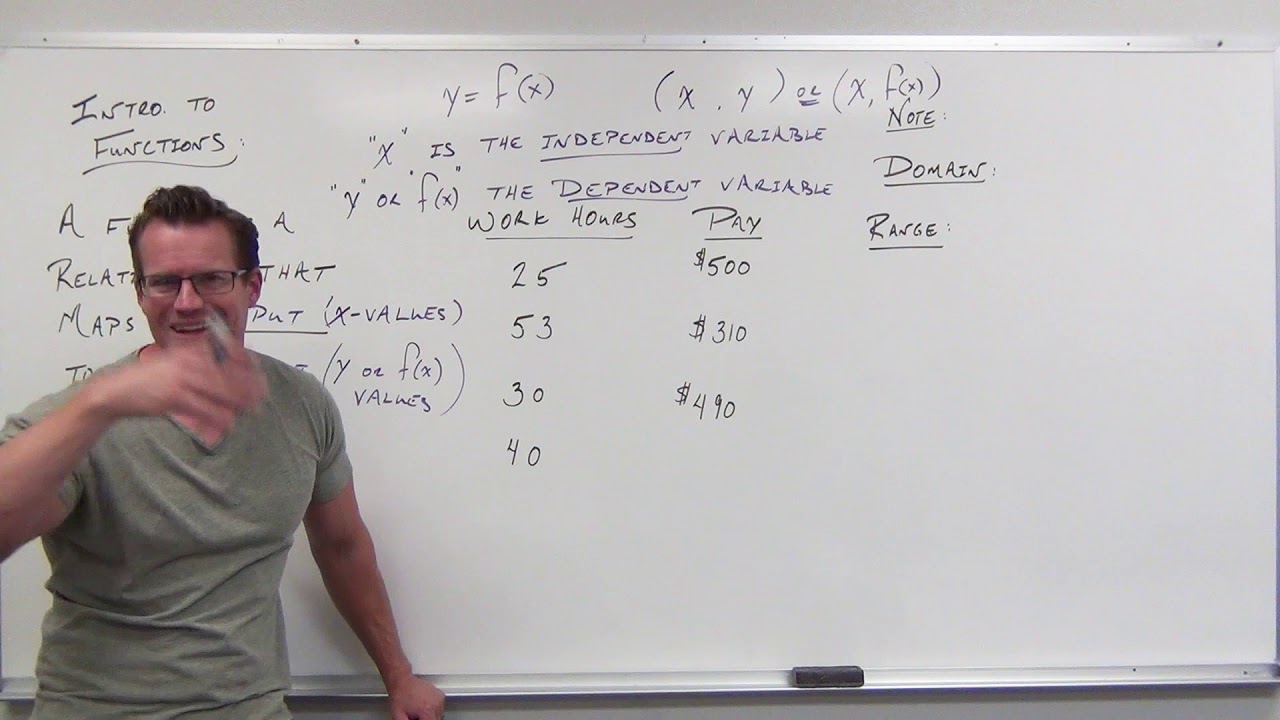
What Functions are and how we can determine when a relationship is a function and when it is not.
gentle bolt
gentle bolt
deciding on if I should use these lessons or this one https://www.youtube.com/wa...
this one seems like the better course to watch right
 ionic sparrow
Hii can anyone confirm if this is correct

 vapid plaza
ionic sparrow
Hii can anyone confirm if this is correct
vapid plaza
ionic sparrow
Hii can anyone confirm if this is correct
I think you want to check (i) again
ionic sparrow
Oh
The second one I think it might be is 2 because it matches based on the y-axis Bht it’s also similar the choice answer #1
vapid plaza
ionic sparrow
The second one I think it might be is 2 because it matches based on the y-axis B...
?
ionic sparrow
Like it could be choice two but idk the difference between choice 1 and 2
vapid plaza
You need to know the difference between (i) and (ii).
In (i) x approaches -4 from the left
In (ii) x approaches -4 from the right
tight compass
gentle bolt
is this all the topics that should be covered in pre-calc?
Usually system of equation, partial fraction decomposition, trig is covered in precalc. At least where I am from.
 quick harbor
Need some help, I can send an image of the work
Domain and range of relations and functions
 vestal rock
quick harbor
Need some help, I can send an image of the work
vestal rock
quick harbor
Need some help, I can send an image of the work
Lemme see if I can help, is it ok if you send the image regarding the problem?
 flat falcon
Hello, I wanted to know what I should know to start deriving functions?
 crisp palm

YouTube
The goal here is to make calculus feel like something that you yourself could have discovered.
great series to watch to help understand calculus
 full pagoda
differentiate
vestal rock
crisp palm
<@300450451411828757> https://www.youtube.com/playlist?list=PLZHQObOWTQDMsr9K-rj...
I'm pretty sure what he asked isn't in precalc at all
full pagoda
no i'm pretty sure you interpreted it correctly lol
i'm like 98% sure they meant differentiating
but everyone always says deriving
 obsidian hinge
^^^
vestal rock
full pagoda
but everyone always says deriving
pretty sure that's how its called when I started learning calculus.
full pagoda
deriving does not mean differentiating lmao
if you know calculus you should definitely know that
vestal rock
ik
vestal rock
full pagoda
if you know calculus you should ***definitely*** know that
no i did not know the difference by the time I finished calculus AB
vestal rock
pretty sure the former if in #precalculus
 rare canyon
Hello, I'm in need of help for a differentiation proving question I'm stuck at, I can send the question and what my working is so far, hoping someone could help me with where I went wrong/where I'm stuck at?
At the side it says k is a constant


 rare canyon
is that how I'm supposed to differentiate x²k?
rare canyon
Product rule
rare canyon
Ack... That's all I wrote man, I'm not even sure what I'm doing so...
 uncut mulch
how exactly did you apply the product rule?
it looks like you skipped stuff and./or didn't apply it properly
and also applying product rule to this is a bit overkill
rare canyon
like the whole equation, I'm supposed to use quotient rule to differentiate it, right? So I took the denominator multiplied by the first derivative of numerator,
but am I not supposed to use product rule to differentiate x²k?
uncut mulch
well to differentiate you fraction you could apply the quotient rule
but the issue with what you did is that you didn't differentiate x^2*k properly
you "can" apply the product rule if you want, but you'd need to apply it properly
rare canyon
oh wait
k is a constant
so it's essentially kx² right?
damn I didn't need to use the product rule
nvm I get it now, thanks for the help!!
hushed sphinx
That's not PREcalculus
 pallid summit
Although it's differential stuff, I am happy to help. Why don't you try to differentiate it partially,if you know. Otherwise, I can give you a solution. I think the answer is a set of points which satisfy the condition above.
pallid summit
Good to know
 viscid thistle
thanks
pallid summit
No problem:)
 short saddle
$P(X)$ is a real polynomial such that $P(X+1)-P(X)=X^{2022}$. Prove that $P(2/3) \geq P(0)$.
obsidian monolithBOT
erictheeonicpizhao

 vale escarp

how do i do this?
<@&286206848099549185>
do i find the magnetitude of each vector?
 steel aurora
What is it asking for
vale escarp
it diodnt specify
 blissful stone
rare canyon
At the side it says k is a constant
blissful stone
rare canyon
At the side it says k is a constant
is this about finding the discriminant?
short saddle
To locate a whale, two microphones are placed 6000 feet apart in the ocean. One microphone picks up a whale's sound 0.5 second after the other microphone picks up the same sound. The speed of sound in water is about 5000 feet per second.
a. Find the equation of the hyperbola that describes the possible locations of the whale
b. What is the shortest distance that the whale could be to either microphone?
ig draw a diagram but i can't visualise
 fair cave
short saddle
To locate a whale, two microphones are placed 6000 feet apart in the ocean. One ...
fair cave
short saddle
To locate a whale, two microphones are placed 6000 feet apart in the ocean. One ...
still need help?
short saddle
fair cave
still need help?
yes
fair cave
ok could ya get the diagram?
short saddle
i'm literally going to sleep
 cursive estuary

ok so 😂 how tf do u do this 😭 maybe im just not getting it but why is the f(x)= equation so huge ??
this is an example I got from trying to solve a hoemwork questions but I don't understand the instructions
 hybrid pewter
cursive estuary
ok so 😂 how tf do u do this 😭 maybe im just not getting it but why is the f(x)...
hybrid pewter
cursive estuary
ok so 😂 how tf do u do this 😭 maybe im just not getting it but why is the f(x)...
f(x) in the explanation is a general rational function, a polynomial over another polynomial
the goal is to find the horizontal asymptote, if it exists, or to say one doesnt exist
to do this they are splitting the general rational function into 3 cases depending on the degrees of the two polynomials that compose it
so 18/(4x^2 + 5) is case (1) where the degree of the numerator is less than the degree of the denominator
 chrome haven
A spherical zorb with a radius of 1.5m is being filled with water at a rate at 100π cm^3/s. At what rate is the height of the water increasing when the water is 20cm high??
Need HELP!
 rocky wind
chrome haven
A spherical zorb with a radius of 1.5m is being filled with water at a rate at 1...
rocky wind
chrome haven
A spherical zorb with a radius of 1.5m is being filled with water at a rate at 1...
you may wanna try any one of the math help channels
chrome haven
rocky wind
you may wanna try any one of the math help channels
cheers
 median oasis
chrome haven
A spherical zorb with a radius of 1.5m is being filled with water at a rate at 1...
median oasis
chrome haven
A spherical zorb with a radius of 1.5m is being filled with water at a rate at 1...
still need help?
i believe the area of the circle in at 20cm is .56pi m^2
or 56 pi cm^2
and (100pi cm^3/s)/(56pi cm^2) = 25/14 cm per second
median oasis
median oasis
i believe the area of the circle in at 20cm is .56pi m^2
if ur wondering how i did this i used Pythagorean theorem
 viscid thistle
woah
median oasis
viscid thistle
woah
?
viscid thistle
your handwriting is terrible
viscid thistle
from what i gather the radius is 1.5
median oasis
i was writing on notes on my phone 😆
i am talking about radius of the circle cross section
at the waterline
viscid thistle
the length of the chord?
median oasis
idk damn know
median oasis
🤨🤨

 stable yacht
Besides that being a very recognizable ratio, the interval of [0, 2π) is nothing special.
stable yacht
What do you mean by which quadrant? You mean to physically draw the triangle?
 haughty robin
no, after you get the inverse you are supposed to figure out what quadrant it came from
cos^-1(4/5) = 0.64
then you need to find the reference angle
but idk what quadrant equation for reference angle im supposed to use
chrome haven
median oasis
answer in the book iis 1/56cm per second
median oasis
chrome haven
answer in the book iis 1/56cm per second
idk how that's possible
ru sure
it should be 100/56 cm
or 1/56 m
median oasis
haughty robin
can someone help explain this?
it says the interval 0-2pi so it's all 4 quadrants
obsidian monolithBOT
AstroRP

 thin raft
How do I partition this?
willow bear
you can't, unless you're willing to go into complex number shit
this is already an elementary partial fraction though
thin raft
willow bear
you can't, unless you're willing to go into complex number shit
and how would that look like
because wolframalpha doesn't show anything (real or complex)
willow bear
$\frac{1}{(x-2i)^2(x+2i)^2}$
obsidian monolithBOT
Ann
 willow bear
,w partial fractions 1/((x-2i)^2(x+2i)^2)
obsidian monolithBOT


 willow bear
it gets something done
i guess you'll end up with complex logarithms which are going to be hell to work with
but it gets something done
thin raft
ah nice ty
 mellow tapir
Friend was doing sequences, find explicit formula
$\frac{-6}{5}, \frac{7}{15}, \frac{-8}{45}, \frac{1}{15}, \frac{-2}{81}, \dots$
obsidian monolithBOT
! Brontochad (RYC4blushysully)
 willow bear
...19, 19, 19, 19, 19, ...
mellow tapir
Turns out if you write the bottom as a geometric sequence it works super nicely
1/15 = 9/135 so it continues the arithmetic sequence on top
 vagrant crown
hello
i am new
i was bored today so i made piecewise functions with a single equation

it doesn't support >=, <=, =, or != in the domains though
willow bear
vagrant crown
i was bored today so i made piecewise functions with a single equation
you know desmos can already do that, right? :P
{condition1: formula1, condition2: formula2, ...}
 willow bear
some of the issue appears to be in your handwriting, which messes up the equation(s) you're working with
also plugging things in incorrectly in some places
just in the first line alone:
- why does the
-bterm appear not to be part of the fraction? the fraction bar should extend clearly to cover it. - the stuff under the root is b^2 - 4ac, which in your case should be 6^2 + (-4)(9)(7), not 9^2 + (-4)(9)(7) as you wrote.

it all went downhill from there
 steel fern
lol
ok
steel fern
Where am I going wrong @willow bear
 steel fern
Hold on
willow bear
willow bear
just in the first line alone:
1. why does the `-b` term appear not to be part of...
.
read this again
steel fern
I didn't see it lol
willow bear

willow bear
why are you doing math at 4 in the morning
willow bear
quiz?
we won't do your homework for you.
ok then posting this here is pointless
everyone here has their own problems to deal with
nobody gives a shit about yours
median oasis
steel fern
So I'm solving the problem 9x^2-6x+7=0
after b^2 it should be - not +
 supple owl
war was here
 grizzled orchid
b&
willow bear
thank you
supple owl
guys can you reminde me by the binomial theorem ?
willow bear
$(x+y)^n = \sum_{k=0}^n \binom{n}{k} x^{n-k}y^k$
obsidian monolithBOT
Ann
 supple owl
$what do \binom{n}{k} mean$
obsidian monolithBOT
MRme001
 willow bear
binomial coefficient, a.k.a. "n choose k"
$\binom{n}{k}$ is defined as $\frac{n!}{k! (n-k)!}$
obsidian monolithBOT
Ann
 supple owl
thanks
 pale solstice
in the function 4/(x^2+x) why is there a graph under the x axsis?

i understand that x goes to ifinity when x approches -1 from the left and 0 from the right
i think it is because x is defined between -1 and 0, should i take the derivitive and look for when the derivitive is 0 to determent when x is defined between -1 and 0 ?
willow bear
pale solstice
in the function 4/(x^2+x) why is there a graph under the x axsis?
it's part of the same graph, the function is just negative there
pale solstice
willow bear
it's part of the same graph, the function is just negative there
should i take the derivative and the look for max point to determine when that part of the graph starts?, in this case its -16
willow bear
do you mean the highest point of that part?
if so then yes
...your phrasing is hard to parse
pale solstice
yes
yea im not the best with either math terms and explaining math in english, but thanks for the help!
 final saddle
pale solstice
in the function 4/(x^2+x) why is there a graph under the x axsis?
final saddle
pale solstice
in the function 4/(x^2+x) why is there a graph under the x axsis?
drawing 1/4*(x^2+x) might help u visualise that graph
that's a reciprocal of parabola
pale solstice
final saddle
drawing 1/4*(x^2+x) might help u visualise that graph
ill try thanks for the tip
final saddle
final saddle
drawing 1/4*(x^2+x) might help u visualise that graph
zeros of this graph will be a vert asym of the reciprocal graph
and loc min will become loc max
hence the "max point" of that particular part
final saddle
final saddle
zeros of this graph will be a vert asym of the reciprocal graph
cuz u can't divide by 0 so it will be undef so asym
final saddle
final saddle
and loc min will become loc max
cuz as y becomes larger, the reciprocal becomes smaller
pale solstice
final saddle
cuz as y becomes larger, the reciprocal becomes smaller
thanks for the help, ill keep that in mind
willow bear
final saddle
drawing 1/4*(x^2+x) might help u visualise that graph
missing parentheses
 silk fjord
⬇️ 
 valid parrot
I don’t know how to prove this, can someone help ?
 median oasis
i don't think that's precalc
 dusky bramble
valid parrot
I don’t know how to prove this, can someone help ?
dusky bramble
valid parrot
I don’t know how to prove this, can someone help ?
are you sure this is correct ?
If you multiple the square root by M
the M^2 is canceled out, leaving you with
$\sqrt{P^2+4\cdot{pi^2}\cdot{n^2}\cdot{M^2}}$
and as M approached infinity, this entire expression does the same
obsidian monolithBOT
Deus_Vult
 steel fern
 steel fern
Ok
 onyx gorge
i guess it applies to any math, but i’m in precalc rn.
does undefined = undefined? or does it not equal anything bc it’s… undefined
 astral apex
technically the word 'undefined' has no business showing up in a proper equation
but people do it all the time in math classes and it's understood what they mean
like there will be a function, say f(x) = 1/x
and people will write "f(0) = 1/0 = undefined"
what they really mean is f(0) is undefined
vapid plaza
1/0 “is” undefined, but not that 1/0 “is equal to” undefined
astral apex
right
onyx gorge
astral apex
technically the word 'undefined' has no business showing up in a proper equation
i’m solving trig equations and such and i’m checking my solutions. and i had to find out the cot of pi
so it popped up in that context
astral apex
cot(pi) is undefined
sometimes people may write cot(pi) = undefined, which is sloppy, but it's generally understood
onyx gorge
wait let me write out what i remember
cos^2(pi) * cot(pi) = cot(pi)
would those two expressions equal each other?
astral apex
I see
I mean, both sides are undefined
I see the point is you can erase cos^2(pi), since it's 1
but you could even just say "cos^2(pi) * cot(pi) is undefined" and stop there without using an equation
onyx gorge
would they equal each other though
that’s all i’m worried about because my math core was on that
same exact problem
astral apex
I assume they mean for you to say yes
onyx gorge
OH THANK FUCK
astral apex
kind of a sketchy problem though
onyx gorge
yea i may have solved it wrong but i checked it over twice
unlikely but very much possible
 opaque berry
is precalc hard learning it for the first time? I'm in algebra 2 right now and I hear it's like a whole new concept in math so I wanteed to hear other people's opinions on it
obsidian hinge
nah it's not bad
precalc is pretty easy
calc is the first bit of real actual math you get to see
opaque berry
algebra 2 or precalc which one do you think is harder learning for the first time
obsidian hinge
equal tbh
precalc builds off algebra 2 just like algebra 2 builds off algebra 1
again, calc is where you first see math
opaque berry
alr cool thx
astral apex
precalc has the unit circle and common trig values, it can be a lot to take in
obsidian hinge
trig makes sense as an extension
he'll be fine
it's not bad
as long as you understand em
and why it works the way it does
obsidian hinge
hm fair
opaque berry
i don't remember anything from trig because it was during quarantine and I was playing valorant during all the zoom classes...
damn
astral apex
some students find all the factoring degree 4 polynomials and crap from algebra 2 harder than anything in precalc
really depends on what you're stronger in
obsidian hinge
gods i forgot we had to do that lmfao
onyx gorge
opaque berry
algebra 2 or precalc which one do you think is harder learning for the first tim...
same concepts, different lingo
learning sines, cosines, csc, and all that jazz is like learning a new language but once you get the hang of it, it’s super easy
opaque berry
👍
onyx gorge
is fifth degree polynomials in precalc?
astral apex
not really, but algebra 2
onyx gorge
i do not remember learning that in alg 2
oh wait, p’s and q’s and synthetic division?
astral apex
they even do descartes' rule of signs
opaque berry
i wish i'm that one kid in the back of class that pays no attention in class and is always watching youtube videos in class but still somehow knows all the math and is a genius
astral apex
it's done because you have to guess a root, and you might get unlucky and not try the right one until the last possible one
onyx gorge
opaque berry
i wish i'm that one kid in the back of class that pays no attention in class and...
used to be me until this year
opaque berry
same for me
astral apex
possible but would take some trial and error
opaque berry
i dont even know anything about calc but i already hate it
onyx gorge
my friend’s taking it rn and she said just know the unit circle by heart
 rose basin
Basically this question asks me to find the vertical intercept and I'm wondering if I solved it properly using this equation that I did here.


Answer is b = 8,000
hushed sphinx
Is the second of your images part of the problem or your answer?
hushed sphinx
Can you state a concrete formula for profit as a function of items sold?
Plug 2000 and 3000 into that and verify that you get 24000 and 32000 out.
viscid thistle
onyx gorge
my friend’s taking it rn and she said just know the unit circle by heart
It's better to learn how to derive or recall it again and agaon
Learn quadrant one, there are three values, 1/2, sqrt 2 /2 and sqrt 3 / 2
the pi values in quadrant 1 are more obvious on inspection. Add pi to move half a unit circle to quadrant 3, add pi/2 to move a quarter a unit circle to quadrant 2
onyx gorge
true true
 karmic zephyr
brooo
its 1am
and i just got to vectors
and this shit is tripping
like, why i gotta find out how to represent it in how many one unit movements it made
 willow bear
you don't "gotta" do shit if you're so repulsed by it
but this is the decomposition of a vector in the standard basis
and especially in linear algebra one is often interested in looking at vectors through a different basis than the standard one
to say it in a highly abridged manner that skips over most of the details
karmic zephyr
not repulsed, just dazed and confused xD
 fringe raft
karmic zephyr
fringe raft
karmic zephyr
because think of the cartesian coordinates as an incomplete quantity and you want something to tell you about the direction of functions and curves
 hollow elk
what are all the topics i have to learn before studying precalulus?
hollow elk
i learned trig
what about exponentials
are polynomials used in precalc?
how
ok
how advanced should my polynomial skills be?
what does 3rd degree include eg. algabraic geometry
simplifying dividing and multiplying then i can move on to precalculus?
ok thanks i might be able to do that in a couple of days
no prior knowledge tho
possibly
thanks
ik what to study now
 tired pilot
I have this complex analysis problem but I'm pretty sure it's just a geometry/precalc problem about hyperbolas. I have $z\in\mathbb{C}$ where $z-1=r_{1}e^{i\theta_1}$ and $z+1=r_{2}e^{i\theta_2}$. I need to show the region described by the conditions $r_1 > 0, 0 < \theta_1 + \theta_2 \leq \frac{\pi}{2}$ is the region between the unit hyperbola $x^2 - y^2 =1$ and the x axis in the first quadrant. I'm stuck showing how z satisfying the constraints involving $r_1$ and $\theta_1 , \theta_2$ imply z is in the region described above, I think I see how to show the opposite inclusion.
obsidian monolithBOT
DootDooter
 tired pilot
Geometrically we should have something roughly like this:

The last thing I could think to try was to solve for z in terms of $r_1,r_2,\theta_1,\theta_2$ and then try to sub into $x^2-y^2\geq 1$ looking for some nice angle relationship.
obsidian monolithBOT
DootDooter
 tired pilot
That got me here:

Assuming I didn't make some super dumb algebra or trig mistake, which I might have because my brain is currently kinda fried.
But I don't see any nice relationship that is useful from here. If anybody sees any way to proceed ping me.
Wait maybe I see it
$z+1-(z-1)=2$ so $r_2 cos(\theta_2) - r_1 cos(\theta_1) = 2$ also. So, $r_1 r_2 cos(\theta_1+\theta_2)\geq 0$.
obsidian monolithBOT
DootDooter
 tired pilot
Pretty sure picking theta one and two in the interval I need and reversing my steps in that last image will get me the identities that I need. 
 misty gulch

 cedar harness
ok sorry
misty gulch
cedar harness
ok sorry
ask your question, just don't ask to ask
 bronze pendant
hey guys do you mind helping me with the one i got wrong? (i got my answer for the 1st one by doing <340cos40, 340sin40> )
 willow bear
the wind is blowing southeast while your vector is pointing east
 spring tendon
$$ \begin{aligned} &y \geq-2\ &y \geq x+3 \end{aligned} $$
rose basin
Anyone here know how to solve this problem? I don't understand how to solve it.

 abstract lodge
rose basin
Anyone here know how to solve this problem? I don't understand how to solve it.
abstract lodge
rose basin
Anyone here know how to solve this problem? I don't understand how to solve it.
if u take the natural logarithm of e^anynumber, theres a power rule that allows u to cancel the e and move the exponent down
so take ln of both sides

look at the top example
so u can just ln both sides and isolate x
rose basin
Alright thanks for the help
hollow elk
i am gonna study logarithms
i am a begginer but i do however know the very very basic concept such as what the function does
could someone give me recommendations on what to learn
abstract lodge
hollow elk
i am a begginer but i do however know the very very basic concept such as what t...
what grade are you in?
abstract lodge
hollow elk
could someone give me recommendations on what to learn
i would suggest getting a strong understanding in normal algebra first
like use khan academy or some other source to learn basic algebra then move on from there
 safe stump
anyone have other alternative step-by-step solution without prior knowledge of L'Hospital Rule?

I want to know why that limit become natural logarithm, using theorems and such
zoomed in graph can show me the value, but still not satisfied with that one
tight compass
safe stump
anyone have other alternative step-by-step solution without prior knowledge of L...
This is what they had. We have an indeterminate form of 0/0 when we take the limit as x->0. So taking the derivative wrt x for the top and bottom of (2^x - 1)/x we have it's ln(2)2^x. Now take the limit as x->0 we have it's ln(2).
As for an alternate proof, maybe graphing the function in desmos and zooming in to seem what values it's you think it's converging to and the using the definition of a limit to prove the function converges to that.
I can't think of anything else right now.
safe stump
tight compass
This is what they had. We have an indeterminate form of 0/0 when we take the lim...
Have done with graphing proof and i saw the irregular shape after zoomed in the graph. However, the algebraic solution that u told me or from the pic above is kinda recursive. I just curious whether there is algebraic way to solve it without prior knowledge of derivative itself. Assume that equation is just an algebraic equation and as a people without calculus knowledge, i want to solve it just using algebra
 safe stump
Maximum means something with differential. Open your book
for 9a, use the limit definition of derivatives and the derivative law of trigonometry
safe stump
yeahh what else do u think??
viscid thistle
Ohh I got it
safe stump
if you know what is sec(x) means, then everrything's trivial
 safe stump
ur welcome
 sonic merlin
let's say I start investing 160 dollars at the start and i don't add anymore money and every week I earn 5% profit, what's the equation for this scenario?
 woven valley
160(1.05)^w where w is every week after investing that 160

Pic unrelated
Oh wait
Are we reinvesting this money
“Compounding interest”
If we are then the equation above is fine
hushed sphinx
If you're offered an investment that will give you 5% profit each week, it's a scam, no ifs or buts. Run.
sonic merlin
hushed sphinx
If you're offered an investment that will give you 5% profit _each week_, it's a...
its a hypothetical question, wasnt offered anything
woven valley
Bruh=moment
sonic merlin
woven valley
“Compounding interest”
yeah its compounding interest
woven valley
Yeah we’re good then, the standard form for compound interest would be a(b)^t where a is the original investment, b is the increase (this number should always be greater than 1 to represent an increase) and t represents integer unit for measuring time, like 2 weeks or 5 months.
 lucid current
can i get a quick rundown on why a certain thing is the way it is? I'm in calculus but ive completely forgotten about sin, cos and tan related stuff

i cant remember how to actually reach this result
astral apex
apply arctan to both sides
 astral apex
the way you take minus signs out of the parentheses is no good
 honest gorge
Wait why isn’t a negative leading term
obsidian monolithBOT
ManifoldCuriosity
 astral apex
$-(x^2 + 4x) - 5$
obsidian monolithBOT
ManifoldCuriosity
 astral apex
when you take out a minus sign in situations like this, you have to flip the sign of everything inside the parentheses
honest gorge
Oh I did that
astral apex
oh I see, you do it in the next step
just so you know, the equation where you didn't do it yet is technically wrong
honest gorge
So I should do it early?
obsidian monolithBOT
ManifoldCuriosity
 honest gorge
Oh okay but I dont think I solved it correctly
astral apex
you correctly write + 4 inside the parentheses
but then you balance it with -4 outside
which would be right if it weren't for the negative sign in front of the parentheses
honest gorge
I did that because -4/2^2=4
honest gorge
I thought we do that to both add the -4 to both sides
astral apex
that minus sign in front of the parentheses means you're really doing -4 to your expression
so you have to balance that with the opposite, +4
should be:
$-(x^2-4x+4)+4-5$
obsidian monolithBOT
ManifoldCuriosity
 astral apex
now somehow you do end up with -1 below that
which is right
but it doesn't follow from what you wrote
in the end your answer is right
but the work has several mistakes
honest gorge
So I got the right answer but my steps are confusing?
astral apex
yeah
honest gorge
Alr I’ll fix it
astral apex
you seem to know how to do it, just not written up in a usual way
honest gorge
What if I did it by equaling the equation to 0
astral apex
you can do it all the same way
honest gorge
Ok Alr Ty
astral apex
sure thing
 astral apex
fixed some things, but you forgot about x for a few lines
you wrote x^2 - 4 + 4 in the parentheses
instead of x^2 - 4x + 4
also you should have a + before your 4 after the parentheses
honest gorge
Can someone explain this to me?
 honest gorge
No
uncut mulch
consider looking it up first
honest gorge
Okay so I have to substitute both values in the equation?
uncut mulch
yes, (separately)
 viscid thistle
There is a zero, it goes down, then stop, then goes down
 viscid thistle
honest gorge
There’s no number between -3 and -4
viscid thistle
honest gorge
There’s no number between -3 and -4
It like this but going down instead
 uncut mulch
Wait but they are both negative so is there no zero?
not necessarily, depending on the function, there could be a zero in the given interval
the IVT can't be used to conclude that there no zeros
so in this case since both are negative, IVT cannot be used to determine if there's a zero in that interval
stable yacht
 grand vigil
help
grand vigil
help
It’s an equilateral triangle. You know the angles.
And you have an altitude.
grand vigil
hm
 civic sierra
honest gorge
Wait but they are both negative so is there no zero?
civic sierra
honest gorge
Wait but they are both negative so is there no zero?
Have you learnt about derivatives?
grand vigil
wait i will give a sum it's impossilbe to do
civic sierra
honest gorge
A little bit
So you havent been taught what they represent right? And their use?
honest gorge
I have but it’s really confusing to me
uncut mulch
if the signs were different, IVT guarantees that there will be at least one zero
otherwise it doesn't do much
the IVT can't be used to conclude that there no zeros
so in this case since both are negative, IVT cannot be used to determine if there's a zero in that interval
civic sierra
You'd have to show that there exists/doesn't exist a zero using derivatives, I can't think of another way

 civic sierra
uncut mulch
if the signs were different, IVT guarantees that there will be at least one zero...
civic sierra
uncut mulch
if the signs were different, IVT guarantees that there will be at least one zero...
This is in accordance to 
Do you have an example where the signs are the same?
honest gorge
This is the only one that was given
civic sierra
uncut mulch
> the IVT can't be used to conclude that there no zeros
> so in this case since...
I guess since it specifically requires using IVT your answer is that it cannot be determined then
honest gorge
Oh okay alright Ty
viscid thistle
I need help please
 stable yacht
viscid thistle
I need help please
stable yacht
viscid thistle
I need help please
“Least productive” should be when P = 0. You should be able to set the equation equal to 0 and solve.
viscid thistle
can i have help pls

 agile sable
Can you be more specific?
viscid thistle
all the answers that i entered are incorrect
stable yacht
viscid thistle
can i have help pls
The question is worded really awkwardly, but from how I understand it, most of your answers are correct.
C is incorrect simply because (0, 2) falls on the circumference of a circle with a center at (2, 2) and a radius of 2.
It also looks like D is not asking what it intends to ask. Your answer is correct, but I think there might have been an error with the question.
agile sable
Do monsters have width?
hushed sphinx
uncut mulch
> the IVT can't be used to conclude that there no zeros
> so in this case since...
We can use the IVT to prove that there is a zero in (-1000,0), and that there is a zero in (0,3) and that there is a zero in (4,1000). If we then also know that a polynomial of degree 3 can have at most three zeroes, then arguably we have determined that there is no zero in [3,4] "using the intermediate value theorem".
 fast monolith
Can I borrow some help to get this started please?

 fallow quiver
fast monolith
Can I borrow some help to get this started please?
fallow quiver
fast monolith
Can I borrow some help to get this started please?
The ball in is air for as long as there's vertical motion.
The objective starts from y = h_0 and ends up at y = -h_0 finally again, when that happens it's finally not in air.
Use those facts.
 glacial mirage
agile sable
Do monsters have width?
glacial mirage
agile sable
Do monsters have width?
I think it’s asking to find whether a point lies within or on a circle given the origin and radius
 hazy dust

hey this one has been driving me bonkers, i think i have to use implicit dif/related rates but i’m losing my mind some help would be appreciated
willow bear
would you like the slightly cheaty but legit solution, or the solution your teacher likely expects from you?
hazy dust
both would be good to be honest
i’d like to learn the proper solution but seeing the cheaty solution could help speed me up on an exam
willow bear
cheaty: the radius and height of your cylinder are given by r(t) = 5 + t and h(t) = 8 - 4t, and the volume is V(t) = pi * r(t)^2 * h(t) as you wrote. in all this, t=0 is the moment in time that is of interest to us. your goal is to find V'(0), which you can do by expanding out V(t) and applying little more than the power rule.
'proper': same thing except you differentiate V wrt t symbolically, treating r and h as functions of t (which they are) and ending up with a mess of r, h, dr/dt and dh/dt into which you then plug the numbers. no mention is made of any specific point in time
hazy dust
ah thank you
i think my mistake was not interpreting r and h as functions of t
which totally makes sense now but i just got confused since the usual style of questions doesn’t normally give 2 values (ie radius and height) and couldn’t figure out how to apply it
cheers man 🙂
viscid thistle
Why do we turn terms into smaller with '
like
x' = (x - 1)
whats wrong with x -1 ?
agile sable
X-prime, as its called is a way of saying its different but similar to x
x = (x - 1) isn't valid
vapid plaza
It’s all a matter of notation
x’ is just a symbol or letter used in math, similar to a or b
And it meaning in use depends on context:
In calculus it usually means the derivative of x
In other places it probably just means the new value of x after some change


 chrome scarab
<@&286206848099549185>
 shut jewel
chrome scarab
shut jewel
chrome scarab
uhm sry but what is the question asking? I dont really comprehend this
hazy dust
i’ve been given a relation and am calculating the dy/dx using implicit, but it is asking for it in terms of s only how do i find without y?
find dy/dx in terms of only x

that’s what i got

<@&286206848099549185>
 past meadow
sorry for the late response, but you can solve the implicit equation for y explicitly since y>0
@hazy dust
Then, you can either take the derivative of that directly, or substitute what you got for y into the implicit derivative you've already found.
 tranquil haven
How would I differentiate this?

I need to get a general formula for displacement based on gravity and it's altitude
$\rho(t)$ needs to be substituted later based on the position then
obsidian monolithBOT
sentinel

 stable forge
Could someone help me with my last few problems, there’s some proving Identitys, a double angle problem, and a few other things
 rocky wind
tranquil haven
How would I differentiate this?
rocky wind
tranquil haven
How would I differentiate this?
the last term in the denominator is $(\rho(t))^2$ since you're squaring the denominator of the previous fraction.
obsidian monolithBOT
vin100

 hot reef

 spiral locust
 stable yacht
What question are you asking? That is just an expression.

 patent beacon
There's only sin/cos on the left, so convert everything to sin/cos on the right
 full pagoda
why'd you turn sec^2(x) into cos^2(x)
mental steeple
Wdym
onyx gorge
you have this in the denominator right?
 mental steeple
Yes
mental steeple
I think
onyx gorge
does 1/cos^2(x) = 1?
mental steeple
no
onyx gorge
so how could you change the 1 so that the denominator is cos^2(x) and would still equal 1
mental steeple
Can’t you do cos2x/1 then cross multiply which the cos2x cancels out then your left with sin2x-1 which equals -cos2x
onyx gorge
you mind writing out the work and taking a picture of that?
mental steeple
ok
onyx gorge
my mind is dying
 mental steeple
:(
onyx gorge
would you ever do this?
 mental steeple
No
onyx gorge
same concept, you can only cross out if it’s multiplication
mental steeple
So we are subtracting right
onyx gorge
lookey
 mental steeple
Oh I was thinking of that didn’t know I could do that
onyx gorge
it’s way harder to figure out sometimes because it’s letters and not numerical
yea, that’s valid
onyx gorge
yes yes
mental steeple
Wouldn’t the top =1
onyx gorge
yep, for the denominator of the entire expression
 mental steeple
Ok
onyx gorge
and now it’s just division!
 mental steeple
what where did you get the 1/cos^2x
onyx gorge
 mental steeple
Thank you
mental steeple
Got it
onyx gorge
what the kronk is that?
 ebon barn
It’s just saying if the graph is at a relative minimum or maximum
 young peak
yow just a simple question, is integration the inverse process of differentiation or the reverse process?
dunno if reverse and inverse are the same
 heavy sonnet
I don't think reverse is a formal description
They're inverse operations
Though they take functions as parameters not singular number.
(although a constant could be thought of as a function that returns the same number independent of the input)
viscid thistle
Is it always the case that if g(f(x)) is one to one this implies f(x) is also one to one and it g(f(x)) is onto then this implies g(y) is also onto? Prove whether the statement is true or not
 stuck lark
@viscid thistle if u agree then prove it, if not give a counterexample
viscid thistle
stuck lark
<@456226577798135808> if u agree then prove it, if not give a counterexample
The problem is I don't know whether it's true or not .
I feel like it may be true but I don't know how to prove it
stuck lark
u can try getting an idea of whether its true by playing with examples
if ur proving, it helps to unpack definitions (in this case those of 1 to 1 & onto)
 clever gazelle
Someone can help me with this problem
-3x(2x+3)>-(-3+4x)
 worthy idol
clever gazelle
Someone can help me with this problem
-3x(2x+3)>-(-3+4x)
worthy idol
clever gazelle
Someone can help me with this problem
-3x(2x+3)>-(-3+4x)
-6x²-9x > 3-4x
4x-6x²-9x > 3
-6x²-5x-3 > 0
6x²+5x+3 < 0
Solving 6x²+5x+3 = 0:
D = b²-4ac = 25-24×3 = 25-72 = -47 => x∈Ø => there are no solutions for -3x(2x+3) > -(-3+4x).
x∈Ø.
ebon barn
Should I factor when simplifying
Just look at the last two lines

The answer key says I don’t need to factor out the h but I feel like I should
I mean, doesn’t that make it…simpler?
stable yacht
It depends on what you are doing with it.
If you are finding zeroes, trying to factor saves you time over the quadratic formula.
Especially if one of the zeroes is 0.
 gritty crane
- Let "F" be a function of Real variable, defined by f(x)=mx+b /(this bar means such that) 2f(2) + f(4) = 21 and f(-3) -f (1 ) = -16. Find 1/3 f(1)
- If f(x) = ax^2 +bx +c ; f(-1) +f(1/2)= 15/4 ; f(-1)=0 ; f(1) = 8 . Find f(5)
 ebon barn
stable yacht
It depends on what you are doing with it.
ebon barn
stable yacht
It depends on what you are doing with it.
Not doing anything with it. So I guess it doesn’t matter either way.
But yeah I get what you’re saying it would definitely be smart to factor if you are doing pretty much anything with it.
 stoic crater
 stoic crater
 bitter drift
Any questions?
bitter drift
Any questions?
Yeah lol
bitter drift
I think you have learnt This right r.n - a.n
Where r is your general point and n is the normal vector
stoic crater
bitter drift
I think you have learnt This right r.n - a.n
I don't think my precalc class taught that
what is an?
a is a specific point, right?
bitter drift
Yh
 plucky slate
sin^2 x = sin x^2 ???
 old isle
that is an identity
not an equation
every real number is a solution to that
oh wait
sin^2x and sinx^2 are the same thing right?
unless you mean sin(x^2)
stable yacht
,,sin^2(x) = sin(x)^2
obsidian monolithBOT
Lidoh
 stable yacht
I think that was what was being asked. But it is a bit confusing when you don’t use parenthesis for the argument of sin.
 raw python
$\frac{a - bx - 16}{\sqrt{3}x(\sqrt{a - bx} + 4)} = \frac{a}{\sqrt{3}x} + \frac{-bx}{(\sqrt{a - bx} + 4)} + \frac{-16}{(\sqrt{a-bx} +4)^{2}}$
obsidian monolithBOT
texaspb
 raw python
is this expansion correct?
viscid thistle
no
i dont think so just by looking at it you can add all those and get a common base from those partial fractions
obsidian monolithBOT
Preetham

 obsidian monolithBOT

 slate reef
uuh I don't get it
why is there 2 prices of apple pies
viscid thistle
no clue:(
slate reef
@viscid thistle hmm I think i understand now
so
f(p) has linear relationship therefore it is in the form ax + b
a and b are constants and x is the amount of pies bought
if you substitute those values given you get a system of equations
3000 = 500*a + b
2300 = 325* a + b
and then you solve for a and b
viscid thistle
ohhhh
slate reef
in this case a will be the price of each unit of pie
and b will be a constant that means something like "the price of starting the production of pies"
viscid thistle
omg thank u sm u are a lifesaver
slate reef
you are welcome!
 winged spire
i cannot figure out sum and difference formulas for the life of me
and manipulating sin/cos waves, will post an example soon


If someone knows a trick to look at them differently, but i cannot figure out the proper way to break down cos(x) into a sum and difference formula to solve it
 lone tendon
Anyone how to find all solutions for the following equation: sin(-3x)=0.5? Only found one solution so far which is: (2*pi/3)n + 7pi/18
slate reef
lone tendon
Anyone how to find all solutions for the following equation: sin(-3x)=0.5? Only ...
sin(X) = 0.5 only for X = 30 ° (pi/6) or X = 150° (5pi/6)
however that is true only for the first lap in the unit circle so you need to add 2pi*n to your solutions (where n is a natural number that represents the numbers of laps around the unit circle)
lone tendon
slate reef
sin(X) = 0.5 only for X = 30 ° (pi/6) or X = 150° (5pi/6)
however that is tr...
I did it but there seems to be a second solution taking n into account in the soln as well which I have not been able to find out how to write from the eq above
slate reef
lone tendon
I did it but there seems to be a second solution taking *n* into account in the ...
yeah so
for examploe : sin(pi/6) = 0.5
so : -3x = pi/6 --> x = -pi/18
but thats only for the first lap around the circle
so your answer in this case should be
x = -pi/18 + 2*n*pi (n is natural)
the other solution is when -3x = 5pi/6
that also contains the + 2 n pi
lone tendon
ooh ok
 brave heron
 viscid thistle
le haut c trop compliqué pour comprendre
mais en bas je crois que c 48 et après 192
viscid thistle
slate reef
yeah so
for examploe : sin(pi/6) = 0.5
so : -3x = pi/6 --> x = -pi/18
it should be -3x = pi/6 + (2pi)n
viscid thistle
winged spire
cos(165)=cos(120+45)
past meadow
For the first one, you'll notice that the numerator is a factor of the denominator
so if you can factorise the denominator, the numerator should cancel and you might be left with something cleaner
something similar is true for each of the rest.
 inner copper
someone pls help it’s related rates

 plain sable
inner copper
someone pls help it’s related rates
plain sable
inner copper
someone pls help it’s related rates
Can u send the diagram if they gave it in the question ?
inner copper
they didnt attach a diagram unfortunately
plain sable
Oh ok

 low slate

How would I solve the top equation, can someone please help with this I’m stuck with what identities I need to use
<@&286206848099549185>
 fast oxide
,rotate
obsidian monolithBOT
 fast oxide
sin(x+y)/cos(x)sin(y)=1+cos(x)tan(y)?
fast oxide
low slate
How would I solve the top equation, can someone please help with this I’m stuck ...
.
viscid thistle
Question on Set Theory and describing Rational Numbers (it’s in my pre calc text, apologies if this should be asked elsewhere).
 viscid thistle
So thr first line is incorrect and my second line is correct?
 vivid void
yes
viscid thistle
That is disconcerting. The first one is how it’s written in my text. The second is what made more sense to me.
So now I wonder how much else is wrong in thr textbook
low slate
fast oxide
sin(x+y)/cos(x)sin(y)=1+cos(x)tan(y)?
Yes
 low slate
I’m not sure the identities I need to use @fast oxide
slate reef
 tawny dirge
if you put this imaginary number in polar form you can do it easily
 wooden lily
I am not sure on how to solve this question. can anyone help me?
 viscid thistle
wooden lily
I am not sure on how to solve this question. can anyone help me?
viscid thistle
wooden lily
I am not sure on how to solve this question. can anyone help me?

f(α+β)=tan(α+β)
Using the figures, tanα = -1/x and tanβ = -3y
Then you can simplify to get the final answer
Oh wait
tanα = 1/sqrt(3) and tanβ = -2sqrt(2) (since x=-sqrt(3) and y=2sqrt(2)/3)
wooden lily
Thx Alot i love you. What math does a mf
viscid thistle
Help. I'm stuck converting the trig function into exact form.
I've derived the function to -cos(5pi/6)
I have checked the marking guides and it is equal to root/2
What's the process for getting from the function to the esact value/ratio?
 viscid thistle
So I finally figured that bit out but now I have to put it into the gradient formula y-y1=m(x-x1)

I did similar except instead of using pi/6, I made it 1/2 exact ratio since sin pi/6 exact ratio is 1/2, or am I not supposed to do that and leave it as pi/6 because you can't convert it as it is a point and not part of the sin function?
(Also I'm most farmiliar with slope intercept form over general form so that makes working backwards that little bit harder)
Also I see questions happening in both places. In future is it better to just go straight to a "help" room?
viscid thistle
<@&286206848099549185>
 spare cobalt
wrong channel
viscid thistle
Hi
So the question is Given f(x^2)=f(x)+x^2 find f'(1)
I don't want the answer
but a hint
I'm stuck
tight compass
Take the derivative of both sides.
 river jasper
Dont if you put x=1 you get 1=0?
river jasper
river jasper
Dont if you put x=1 you get 1=0?
?
tight compass
river jasper
Dont if you put x=1 you get 1=0?
It's f'(1) not f(1).
river jasper
In f(x^2)=f(x)+x^2
tight compass
river jasper
In f(x^2)=f(x)+x^2
wdym?
river jasper
If you put x=1 in that you get f(1)=f(1)+1