 arctic galleon

#precalculus
1 messages · Page 298 of 1
 viscid thistle
hey man what program is this that you're using, would be greatly appreciated if you told me 😄
 kindred grove
viscid thistle
hey man what program is this that you're using, would be greatly appreciated if ...
kindred grove
viscid thistle
hey man what program is this that you're using, would be greatly appreciated if ...
good notes
5
good notes 5 i think
viscid thistle
is it possible to add 24 functions at once?
 patent beacon
Sure
viscid thistle
I don't find any examples on the internet, other than adding only two functions ;_;
 restive hound
Hello, what should I do to get rid of negative 12? Because if I divide everything by -12 there will still be a negative number even if I multiply it everything by -1/12

 glacial lantern

 steady imp
can anyone help me for my pre calculus?
restive hound
steady imp
can anyone help me for my pre calculus?
If it is about circle, ellipses, and parabola, I can try
 willow bear
@steady imp don't ask to ask, just ask
i.e. post your problems so that any potential helpers can know if they can help you

 steady imp
restive hound
If it is about circle, ellipses, and parabola, I can try
steady imp
restive hound
If it is about circle, ellipses, and parabola, I can try
yeahhhh exactly
restive hound
On number 2, I think number 4 is a parabola. Because on my pre-calculus book on chapter 1 it has a picture of an antenna with the description saying “A parabolic antenna has the capability of receiving and reflecting radio waves to one focal point etc…”
 restive hound
Ah yes, I had online class too and we didn’t use our books that much
steady imp
i see. Help me please
restive hound
Okay, I will try. From the first part, where you have to identify what type of conic section that each general equation will produce. First, I think you have to be familiar with the standard form of a circle, ellipse, parabola, and a hyperbola. Because in ellipse, there are two right? Like if the smaller number is under x squared and the bigger number is under y squared then you will expect a vertical ellipse, and it’ll be a horizontal one if the bigger one is under x and the smaller one under y. And if you were given an equation of an ellipse in standard form, you will know it is an ellipse based on the type of standard form it is. You know what I mean? In the standard form of a circle, its standard form is (x-h)^2 - (y-k)^2 = r^2. So if you get this kind of answer with this form then you’ll know it is a circle. If you get the answer with either of these form (x-h)^2/a^2 - (y-k)^2/b^2 =1 or (x-h)^2/b^2 - (y-k)/a^2 = 1, you know it’s an ellipse. So I think you should be really familiar with the standard form of each conic section. From what I know, since you’re given the general equation. Turning them into standard form is quite similar for all the conic sections. In letter a, rearrange the equation. Put the +1 on the right side and everything on the left, rearrange them, place all the x and y together. So x^2-2x+y^2-4y= -1. Here, I think you’ll either expect a circle or an ellipse @steady imp
@steady imp

With the architectural designs and where you have to identify what conic section it is, remember the type of graph that each conic section will produce.
Visualize
steady imp
restive hound
Okay, I will try. From the first part, where you have to identify what type of c...
can u do the solution? A , B , C and D?
you can send me on private message
viscid thistle
kindred grove
good notes
thanks man really appreciate it 🙏
restive hound
Hello, how can I add x^2 to 1/4x^2?
 uncut mulch
$x^2 + \frac14x^2$
?
 obsidian monolithBOT
ℝamonov
 restive hound
What does it mean?
uncut mulch
is that your question?
restive hound
Yes
uncut mulch
have you ever combined like terms before?
restive hound
Oh yes! But I don’t know with fractions 😅
uncut mulch
then this seems like a case of expressing
$$1 + \frac14$$
as an improper fraction
obsidian monolithBOT
ℝamonov
 uncut mulch
would you be able to do that?
restive hound
Ah okay so will it be 6/4x^2? Because there’s 1 in x^2, so it’s like adding 1x^2 to 1/4x^2?
6/4 and improper fraction
restive hound
I supposed that x^2 has a coefficient of 1, so if I combine like terms then I would add 1x^2 to 1/4x^2 and when I calculated in the calculator I did 1 + 1/4
uncut mulch
what exactly did you to with
1 + 1/4 to get 6/4
because 1 + 1/4 isn't 6/4
 craggy furnace

Hello, I am struggling with an online homework, I believe my answer is right but its marking it wrong. Can someone tell me if they think my answer should be different? I should be writing the Domain in the top text box, in interval notation, and the range in the bottom text box

 uncut mulch
was any other information given
viscid thistle
How do i solve this
 craggy furnace
No just *If your graph continues to infinity, drag the edge of your rectangle to the end of the graph paper
uncut mulch
where's -3.44 coming from
viscid thistle
I know how to address 4/3/x but not 4/(3/x)-1
craggy furnace
the orange point on the x axis
uncut mulch
how do you know it's -3.44
craggy furnace
the endpoint
uncut mulch
are you told that it's -3.44?
craggy furnace
yes
uncut mulch
I asked you if any other information was given and you said no...
craggy furnace
Ahh sorry!
uncut mulch
is there anything else you aren't telling me
craggy furnace
The orange end points show -3.44 and 3
The green dot at the end of the green shaded area shows -3.22
That is all I know
uncut mulch
then the values you gave seem alright
craggy furnace
Ok, Ill just accept this one is marked wrong and move on
 uncut mulch
what have you tried?
viscid thistle
uncut mulch
what have you tried?
i dont even know how to approach it
Wait a minute
viscid thistle
uncut mulch
what have you tried?
Can i solve for x in the denominator and use that value when dividing with the numerator
i think i figured out how to solve the problem
Yes i did
I did
By “solving for x” I meant making the denominator equal to 0
And i didnt realize that i would be dividing by 0 so disregard that “dividing with the numerator”
What would the domain and range be for: ln(-x-1) and sqrt((ln(1-x^2)+2)
what do you know about the behaviour of the function ln?
@viscid thistle
 jovial bridge
-
Domain of any log function is a>0, in this case a=-x-1
Range of any log function is always positive -
domain of any sqrt function is positive numbers. And since log function is always positive we would just need the domain of the inside log. Inside the log 1-x^2 > 0, which is -1 < x < 1
Range of the sqrt function is always positive
viscid thistle
Ohh so then 1. D: X > -1, R: x>0 and 2. D: (-1,1), R: x>0?
Ln can’t be negative, so x>-1
@jovial bridge @viscid thistle
jovial bridge
viscid thistle
Ohh so then 1. D: X > -1, R: x>0 and 2. D: (-1,1), R: x>0?
correct
viscid thistle
no
viscid thistle
jovial bridge
1. Domain of any log function is a>0, in this case a=-x-1
Range of any log fun...
this is very incorrect in a lot of places.
viscid thistle
viscid thistle
Ohh so then 1. D: X > -1, R: x>0 and 2. D: (-1,1), R: x>0?
and no to this too.
-x-1>0 isn't x>-1. recall that you have a -x not an x on the left hand side.
viscid thistle
jovial bridge
correct
and for example the domain of 2 isn't correct either. that is wrong. recall that you are dealing with sqrt(log(1-x^2)+2) and not just log(1-x^2)
viscid thistle
@flat goblet this channel is occupied at this moment.
please use an unoccupied one. and read #❓how-to-get-help
 flat goblet
thanks
viscid thistle
I’m still here, just seeing that you’re typing so I will wait to see what you’re typing
viscid thistle
jovial bridge
1. Domain of any log function is a>0, in this case a=-x-1
Range of any log fun...
and now onto this, regarding "the range of any log function is always positive", is wrong by itself, take a simple counterexample f(x)=log(x), the range of f is R.
viscid thistle
as well as "any sqrt is positive numbers", non-negative numbers, since 0 is also included
jovial bridge
viscid thistle
Ohh so then 1. D: X > -1, R: x>0 and 2. D: (-1,1), R: x>0?
Hey, this is actually wrong I went wrong with my concepts. The domains are correct, but the range for 1 should be all numbers, and the range of 2 should be all positive numbers including 0
is that right?
viscid thistle
no, it isn't still
viscid thistle
viscid thistle
-x-1>0 **isn't** x>-1. recall that you have a -x not an x on the left hand side.
look at what i wrote here
viscid thistle
but the bigger issue comes with the "since log function is always positive we would need the domain of the inside log", that is wrong as well, you do need to investigate on solving log(1-x^2)+2>=0.
jovial bridge
i messed up
viscid thistle
So what the interval notation? (-1, infinity) for domain for 1?
viscid thistle
viscid thistle
Ohh so then 1. D: X > -1, R: x>0 and 2. D: (-1,1), R: x>0?
so nothing of this is correct.
jovial bridge
im gonna rework this
viscid thistle
viscid thistle
So what the interval notation? (-1, infinity) for domain for 1?
Wait that can’t be
Has to be non negative
viscid thistle
viscid thistle
Has to be non negative
no, non-negative is for sqrt. ln can't take values like 0
unlike sqrt(0)=0
so essentially, you want to solve -x-1>=0, as you want the argument to be non-negative
jovial bridge
- D: x<-1 R: all real numbers
viscid thistle
also avoid just giving away the answers. it goes against the purpose of the server
viscid thistle
it was explained incorrectly
jovial bridge
but our convo fixed it
viscid thistle
But how can we get a value for x that doesn’t give a negative value since it’s -x - 1
viscid thistle
jovial bridge
but our convo fixed it
that doesn't guarantee that they understand it
Ohhh
jovial bridge
viscid thistle
that doesn't guarantee that they understand it
im going to explin things in one piece afterword
so do you understand the 1st one?
the domain and range?
viscid thistle
So for domain for 1. Is x>-1
jovial bridge
yup
viscid thistle
Then the range.. (0, infinity)?
viscid thistle
+- infinity
jovial bridge
yes

because a is the out come of our log
and exponents can be any number
- $D: -\sqrt{1-1/e^2}<=x<=\sqrt{1-1/e^2}$
viscid thistle
Okay and now 2.
obsidian monolithBOT
DR
 jovial bridge
can you re write your original question
incase i wrote the question wrong
but i believe that that is the domain
viscid thistle
So I’m trying to understand the rules/limitations for domain and range for sqrt((ln(1-x^2)+2)
jovial bridge
ok
so the first thing we need to do is evaluate the domain of a sqrt function
as we know the domain of a sqrt(x) is x>=0
viscid thistle
Yes
jovial bridge
x is what is inside of the sqrt function
but we have a another function inside of the sqrt function
so we have to say $\ln({1-x^2})+2>=0$
viscid thistle
Oh okay
obsidian monolithBOT
DR
 jovial bridge
after that
we need to solve for x
im not sure if you learned this but we have to raise e to both powers
so then we could get rid of the log function
viscid thistle
No
obsidian monolithBOT
DR
 jovial bridge
we do this because one of the propeties of the logs

the top part of the image explains what are are doing
where a = e
after that
we would simplify
$1-x^2>=1/e^2$
obsidian monolithBOT
DR
 jovial bridge
$x^2<=1-1/e^2$
obsidian monolithBOT
DR
 jovial bridge
yup
jovial bridge
viscid thistle
`\frac{}{}` for fractions.
oh i know but i feel that 1/e^2 isn't neccasary for that
ok so
once we have that thing simplified
we just need to find this domain
which in return would give us
- $D: -\sqrt{1-1/e^2}<=x<=\sqrt{1-1/e^2}$
obsidian monolithBOT
DR
 viscid thistle
\leq as well for <=.
viscid thistle
Ohh because x is +- what we solved for
jovial bridge
yeah
jovial bridge
ok so the range of would be pretty simple
can you tell me the range of a sqrt function is?
any sqrt function
viscid thistle
Non negative
jovial bridge
you are missing a small detail
viscid thistle
0 to infinity
viscid thistle
Yay! Thank you both! Lol I will be back again soon
jovial bridge
no problemo, thank you to al3dium for correcting me xD
viscid thistle
jovial bridge
but you are right on that
if by this you mean that the range of 2 is (0,inf), it's once again not correct either.
 kind arrow
how does linear factorization theorem apply to perfect square trinomials?
jovial bridge
viscid thistle
if by this you mean that the range of 2 is (0,inf), it's once again *not* correc...
;-; it would include 0
viscid thistle
jovial bridge
;-; it would include 0
that's not correct either.
you keep having the missundestanding of "if one function of sqrt has range [0,inf), then every sqrt function has range [0,inf)".
and that's not true.
how do i find the domain

as long as a function is above the x axis its considered positive right?
like if part of the function is at the top left that is positive or is it negative since thats the negative quadrant
 kindred panther

 dusk elm
viscid thistle
how do i find the domain
dusk elm
viscid thistle
how do i find the domain
The domain is all the possible x values. Since it is a rational function, you have all real numbers as the domain other than the values in which the denominator equals 0 because you can’t decide by 0
dusk elm
viscid thistle
as long as a function is above the x axis its considered positive right?
Yes the function takes on positive output values above the x axis. In other words, f(x)>0
dusk elm
kindred panther
Try solving for y
jovial bridge
kindred panther
once you solve for y, you can act like the amplitude became 1/2
viscid thistle
how do you know if a function is not even or odd
 sick steppe
viscid thistle
how do you know if a function is not even or odd
sick steppe
viscid thistle
how do you know if a function is not even or odd
if $f(-x)\neq \pm f(x)$ then it's neither even nor odd
obsidian monolithBOT
Mosh

 flint night
 restive hound
Hello, how can I get the square root of y^2 = 2x^2+1?
 steel venture
is there more to the question @restive hound
 warm forum
restive hound
Hello, how can I get the square root of y^2 = 2x^2+1?
warm forum
restive hound
Hello, how can I get the square root of y^2 = 2x^2+1?
wdym
steel venture
sorry for the late response
restive hound
It’s okay, wait I’ll show you
I’m solving systems of nonlinear equations and this is the question I have. I’m planning to do the substitution method because I don’t think elimination method would work. So I chose to isolate y^2 in y^2 - 2x^2 = 1. But I don’t think I could substitute y^2 = 2x^2 + 1 to the y^2 in the first equation @steel venture @warm forum
 steel venture
why couldn't you?
restive hound
What do you mean? So I could substitute y^2 = 2x + 1 in the y^2 on the first equation?
steel venture
yeah, i don't see why not
restive hound
Oh okay
Also, how could I solve if the given two equations are a standard form of an ellipse and a circle?
Still systems of nonlinear equations
Here

I made them both to general form but looks like I’m wrong, then I tried removing the denominator on the 1st equation and did elimination but I can’t because the (y-k) aren’t the same
warm forum
restive hound
$y^2=1+2x^2\implies 9x^2+2(1+2x^2)=54$
obsidian monolithBOT
Muzan Jackson
 warm forum
yep
restive hound
Thank you guys
restive hound
restive hound
Here
How about this one? 😭 I’m not sure what to do
I turned them both to general form but when I did elimination it looks wrong, then when I removed the denominator for the first equation and did elimination I can’t eliminate the y because their value of k aren’t the same, only x
 somber sigil
restive hound
Here
somber sigil
restive hound
Here
(x+3)²=16{1-[(y-4)²/9]}
16{1-[(y-4)²/9]}+(y-7)²=25
restive hound
Thank you very much @somber sigil but how did it became like that? 😮
 manic lantern
Hello my fellow smart people
viscid thistle

can someone explain why this is from the left now
like how does it become x->6 from the left
sick steppe
x^2 is slightly more than 9, so 15-x^2 is slightly less than 6
 small wyvern
does anyone have basic questions on local maxima, local minima, global minima and global maxima
dusk elm
small wyvern
does anyone have basic questions on local maxima, local minima, global minima an...
Like example problems?
 merry chasm
Is this true?

 mild swan
No it is not
mild swan
Square both sides and see what you get
You'll have to expand the right side out using foil
merry chasm
Ah I see
 mild swan
 gleaming nebula
Not enough context for that
mild swan
You stopped it mid sentence
gleaming nebula
Not really that's just it
It says for the measurement of length: 1km ± 50m and expected value is 1100m, find the relative error.
gleaming nebula
Damn, no one's been able to solve this so far.
mild swan
What did Google come up with when you looked up relative error?
gleaming nebula
Wait
 mild swan
Not sure what the ± 50 m indicates now knowing the definition of relative error
mild swan
Yes I get that
But I don't see its purpose in the problem
You can probably just do |1000 - 1100|/1100
 mild swan
Just start with a diagram - step by step
mild swan
Once you get your first graphical piece of information, put that down into a diagram
 raven kindle
okay thank you
small wyvern
dusk elm
Like example problems?
yep about 10 probs
 mild sluice

getting confused on this one, wondering which step im messing up
could anyone help real quick?
im normally super good with inverses and theyre never a problem, but this one is tripping me up
 hollow lance
mild sluice
hollow lance
mild sluice
What did you try so far?
mild sluice
i’m writing out a way to do it that i think may be right rn
i may solve it in a minute i’ll get back to you

i hope you can somewhat follow what i was getting at, its hard for me to not do these sorts of problems in my head
just realized i put both as root 5, the inside is supposed to be 3
 hollow lance
you should probably write it again more cleanly and step by step, it's reverse actually
hollow lance
Yeah, my personal preference is to put positive numbers inside a root first so I'd write it as 8 - (x)^(1/5)
but it is fine like that as well
 viscid thistle
what does it mean when someone asks you to "state the finite differences that will be constant"
for example if im given f(x) = x2 +3x -1
 rancid jolt
viscid thistle
for example if im given f(x) = x2 +3x -1
rancid jolt
viscid thistle
for example if im given f(x) = x2 +3x -1
do you know first differences
second differesnces
etc.
viscid thistle
Guys
restive hound
Hello, I’m learning about Mathematical Induction. I was just wondering how he factored out k^2(k+1)^2 + 4(k+1)^3 ? He said he’ll take the GCF, how?
 uncut mulch
a^3 = a^2 * a
restive hound
uncut mulch
a^3 = a^2 * a
How? 😅 is it when I simplify 4(k+1)^3?
uncut mulch
(k+1)^3 = (k+1)^2(k+1)
restive hound
ah ok so from what I understood, that's when you factor (k+1)^3? but what will happen to the 4 next to it? and the k^2 next to (k+1)^2? because he said that he will get the GCF and factor the (k+1)
 lucid flame
hey y'all I know how to find the Domain and Range, but I'm not entirely sure what the other values are for or what I'm supposed to do with them

ah sorry it's sideways
dusk elm
lucid flame
hey y'all I know how to find the Domain and Range, but I'm not entirely sure wha...
The domain is just all the possible x values for the function and the range is all the possible y values. For example f(x)=x^2 has a domain of all real numbers with a range of [0, infinity)
lucid flame
I know that I'm just a bit confused about the other values that are given from a-d on each problem
dusk elm
lucid flame
I know that I'm just a bit confused about the other values that are given from a...
That is just asking what the function is equal to at those x values. So f(-1) is just asking what is the y value corresponding to x=-1 on the graph
 silent cave
i dont know how to do this but my hw asks for the zeros of f(x) =(3x-5)/(x-4)
viscid thistle
I don't know what I just saw but today I was doing this problem

Did as it asked me to

The fun part starts here
So I was playing around a bit with the numbers
I took points from a line
convert them into ln
And then draw a graph of those points
Everything in this graph looks like they line up

Went to wolfram alpha to check if they are actually all on a line
So anyway, I did it again but for y=x^2

And then tried it for x^3 and it works too
What I want to know is why do they form a line?
Nevermind found the answer

 ocean stirrup

 undone girder
Hi
willow bear
kahree appears to have left.
warm forum
This is what I did xD

 trim hemlock
oh wow, thats quite some dedication. Erm I dont know how i should put this but i should have said that the problem is solved
but erm i think i might look through your solution
tho the intended solution is much much shorter
warm forum
trim hemlock
oh wow, thats quite some dedication. Erm I dont know how i should put this but i...
that's fine
warm forum
trim hemlock
tho the intended solution is much much shorter
I also use derivative but it ended up useless :v
trim hemlock
hmm it looks like you are following the direction of a cardano-like formula?
heres the intended direction if you are curious

so basically they acquired the function x^3-9x^2+ax-b from the given information
and then proceed to take the derivative
warm forum
yep
trim hemlock
what was the special thing of this solution is that they used the behaviour of cubic equations
so they conclude that in order for f(x) to have 3 roots in [-1,5] then f'(x) must have 2 roots in that interval
because as we know a cubic function can only have 3 roots when it has 2 critical points
warm forum
yes
trim hemlock
so that was their catch which was pretty cool
the rest is just solving so yeah
i mean i was quite close to the answer too, what i messed up is that i thought they meant 3 distinct roots
whereas it was never mentioned in the question
gotta note that to myself and not make that mistake again
warm forum
trim hemlock
so they conclude that in order for f(x) to have 3 roots in [-1,5] then f'(x) mus...
so it uses inequalities?
trim hemlock
not really
warm forum
hmmm
trim hemlock
i mean kind of
well of course in order to get a minimum value of a we must have some kind of inequality in terms of a
warm forum
trim hemlock
so they conclude that in order for f(x) to have 3 roots in [-1,5] then f'(x) mus...
I also did this but I used inequalities a lot
trim hemlock
but the main thing is the conclusion where the derivative must have two roots in [-1,5]
warm forum
trim hemlock
but the main thing is the conclusion where the derivative must have two roots in...
yeah
trim hemlock
warm forum
I also did this but I used inequalities a lot
yeah i have noticed
that was actually pretty nice too
all in all that was quite tricky i have to admit
viscid thistle
$$\boxed{\cos 2x = \cos ^2 x - \sin ^2 x}$$
$$\boxed{\sin 2x = 2\sin x \cos x}$$
obsidian monolithBOT
Spica
 viscid thistle
it'll sort out
 unique sierra
is somebody available to help me understand better Quadratic Functions and Applications on a vc?
mild swan
unique sierra
is somebody available to help me understand better Quadratic Functions and Appli...
Just ask a question in chat and people will do their best to help you
 dreamy siren
^
restive hound
Hello, is it possible if I move the 1 next to secant and the tan to the right hand side? So it could be sec^2 data - 1 = tan^2 data?

 past meadow
restive hound
past meadow
restive hound
Ah okay, thank you !
steel venture
restive hound
Hello, is it possible if I move the 1 next to secant and the tan to the right ha...
make sure you understand that you're not just "moving" stuff, but you're subtracting 1 from both sides, and adding tan^2(theta) to both sides
restive hound
steel venture
make sure you understand that you're not just "moving" stuff, but you're subtrac...
Ah yes okay, what do you mean by adding tan^2 (theta) to both sides? So if I add it on the left side it would cancel out and on the right side, the tan^2 (theta) would be positive. And at the same you said I should subtract 1 from both sides. So on the right hand side, it’ll cancel out and on the left side I’ll have -1. Like that?
steel venture
exactly like that
sin^2(x) - tan^2(x) = 1
sin^2(x) - tan^2(x) + tan^2(x) = 1 + tan^2(x)
sin^2(x) - 0 = 1 + tan^2(x)
that's one example
then -1 on both sides will yield the result you wanted
restive hound
Ah okay, thank you very much
Oh yeah, if I multiply cos^2 (theta) and sec^2(theta) that would give me 1 right? Because cos multiplied by sec is 1?
 steel venture
yup
and that's because $\sec = \frac{1}{\cos} \implies \sec \cdot \cos = \frac{1}{\cos} \cdot \frac{\cos}{1}= \frac{\cos}{\cos} = 1$
obsidian monolithBOT
maximo
 restive hound
Ahh okay! thank you very very much!
restive hound
steel venture
make sure you understand that you're not just "moving" stuff, but you're subtrac...
Thank you too for reminding me this
steel venture
no problem. so many teachers gloss over it that a ton of people just don't recognize what's going on
restive hound
Yeah, it is important to know
restive hound
What will happen if I were to add sec(theta) and sec(theta) together? Would it just be sec(theta)+sec(theta)?
restive hound
Ah okay, but what if I would add a different one like cos(theta)? And what if it was subtraction?
 civic furnace
247how do I prove that if a and b are of the same sign then
a/b +b/a >= 2
I have
(a^2 +b^2)/ab -2 >= 0, so I'd have to prove that
(a^2 +b^2)/ab >= 2
civic furnace
'An integer indivisible by 3 is of the form 3n +1 or 3n-1'
say n = 1
3n+1 = 4
3n-1 = 2
1 is also not divisible by 3, yet it is not included?
likewise 5 isn't divisible by 3, and it is also not included
thus, wouldn't be a form of an integer indivisible by 3 be
3n+1 or 3n-1 or 3n+2, or 3n -2
likewise, for all integers a number indivisible by an integer x is of the form
xn +- x-(x-1) = xn +- (x-x+1) = xn +- 1
or
xn +- x-(x-2) = xn +- (x-x+2) =xn +- 2
and so on until for y = x,
xn +- x-(x-y) = xn +- (x-x+y) = xn +- y = x(n +- 1), which is divisible by x
Am I making some mistake or is the solution to this problem false:
"Show that the square of an integer indivisible by 3 during the division by 3 gives the remainder 1"
The solution: (3n+-1)^2 is of the form 3k +1
???
 dense saffron
civic furnace
'An integer indivisible by 3 is of the form 3n +1 or 3n-1'
say n = 1
3n+1 = 4
3n...
dense saffron
civic furnace
'An integer indivisible by 3 is of the form 3n +1 or 3n-1'
say n = 1
3n+1 = 4
3n...
I think you need to put n=0,n=2 over there for example at n=0 3n+1=1 and at n=2 3n-1=5. Hope that helps
civic furnace
oh right
what's wrong with
likewise, for all integers a number indivisible by an integer x is of the form
xn +- x-(x-1) = xn +- (x-x+1) = xn +- 1
or
xn +- x-(x-2) = xn +- (x-x+2) =xn +- 2
and so on until for y = x,
xn +- x-(x-y) = xn +- (x-x+y) = xn +- y = x(n +- 1), which is divisible by x
?
what's the form of all integers indivisible by x if not this
willow bear
i think you're overcomplicating this
a lot
if you're allergic to the form nx + r where n ∈ Z and 1 ≤ r ≤ |x|-1, or if you really want that plus-minus symmetry, you could instead do nx ± s for 1 ≤ s ≤ |x|/2
dense saffron
civic furnace
what's wrong with
> likewise, for all integers a number indivisible by an integ...
I don't think this is the pattern cause if you try putting 7 into the equation xn-+1 it would yield only 6 and 8 as indivisible
I think you should follow remainder theorem basically that @willow bear suggested
civic furnace
i meant that all the number indivisible are of either of these forms
willow bear
you meant what?
civic furnace
for 7, are all the number indivisible by it
7n+-1
7n+-2
...
7n+-6
willow bear
some of those are redundant
you only need to go up to 7n ± 3
any number of the form 7n + 5 can also be expressed as 7n' - 2 for example
civic furnace
makes intuitive sense, but what's the proof
willow bear
the proof for what
dense saffron
civic furnace
makes intuitive sense, but what's the proof
Dd = DQ+R and max remainder = divisor-1
And for 5/7 either remainder can be 5 or -2 but generally I think 5 is preferred because division theorem says remainder can't be negative but half remainder theorem states that remainder can be negative
 willow bear
consider also this: https://www.wikiwand.com/en/Euclidean_division

Wikiwand
In arithmetic, Euclidean division – or division with remainder – is the process of dividing one integer by another , in a way that produces a quotient and a remainder smaller than the divisor.[1] A fundamental property is that the quotient and the remainder exist and are unique, under some conditions. Because of this uniqueness, Euclidean di...
even though you chose not to help me know what exactly it was that you wanted proof of
civic furnace
my question has been answered
 shut totem
civic furnace
247how do I prove that if a and b are of the same sign then
a/b +b/a >= 2
I have...
shut totem
civic furnace
247how do I prove that if a and b are of the same sign then
a/b +b/a >= 2
I have...
multiply and then bring the 2ab to the other side
uncut mulch
what's the question asking for
 mild sluice
nvm figured it out with long division, still having trouble with synthetic tho
 tidal ferry
need some help heheh

from calculus
I always mess up the domain and range
I feel like for 1, there should be no value for which it's undefined right? so range -inf, inf, and domain R?
idk
dreamy siren
tidal ferry
I feel like for 1, there should be no value for which it's undefined right? so r...
Correct, #1 has domain of -inf, inf
dreamy siren
Domain is asking “what x value doesn’t break the function?”
tidal ferry
I really can't tell the difference between domain and range, it seems they're the same at times
dreamy siren
Typically something / x will break it because then you can’t have x=0 for example
tidal ferry
yee
dreamy siren
Range is asking “what values of y are possible for the entire function”
tidal ferry
but if it's defined for all x's, what would the range be? cuz I feel like that too is -inf, to inf
AHa o
hmmmmmmm
dreamy siren
If you look at the graph of the function, it’ll be easier to explain
dreamy siren
tidal ferry
it's a parabola, so it can't be -inf to inf, but something to inf
Exactly. Because it’s not a downward parabola
dreamy siren
Exactly
dreamy siren
[1, inf)
dreamy siren
Because you can include 1
tidal ferry
u think I'm allowed to use a graph calculator for calculus?
like idk, it doesn't say so idk if I'm doing it correctly hahah
dreamy siren
Idk ask your teacher lol
tidal ferry
oh wait oh wait
so [0,2] means 0 and 2 and all inbetween
whereas (0,2) means values between 0,2 but not 0 and 2
dreamy siren
Looking at graphs is helpful in the beginning to build your understanding. But it isn’t necessary once you get the hang of it
dreamy siren
tidal ferry
whereas (0,2) means values between 0,2 but not 0 and 2
Correct
tidal ferry
its a half parabola
laying down LOL
it's a weird one
lemmme see
4
and anything negative right?
dreamy siren
What about x=5?
tidal ferry
wouldn't be allowed
dreamy siren
Why?
 dreamy siren
Yeah
So I like to look at these problems and think “hm, what can break?”
“Oh, I see a square root. I know that will break if I take the square root of something negative. When will the inside be negative?”
dreamy siren
Then you can begin digging into the answer
tidal ferry
ik x<5
dreamy siren
So follow my thought process
You agree it breaks if the inside of the sqrt is negative right?
tidal ferry
yeah
dreamy siren
Solve that inequality and tell me what you get
tidal ferry
it's -inf<x<4
dreamy siren
Because I divided by a negative
dreamy siren
So with that, we know it breaks if x is bigger than 4
tidal ferry
yee ik it's undefined for all x>4
dreamy siren
Now to check the boundary, will it break if x Equals 4?
dreamy siren
Plug x=4 into the function and tell me what you get
tidal ferry
sqrt(0)
tidal ferry
I mean I think, it's not allowed
dreamy siren
Try it on your calculator
dreamy siren
So as long as it isn’t bigger than 4, the function is okay
So our domain is (-inf, 4]
tidal ferry
AH
tidal ferry
I thought sqrt(0) was the same as x/0
dreamy siren
No
dreamy siren
Since the function is sqrt(something) then yes we will never get an answer that’s negative
Otherwise it’s okay
[0, inf) is exactly right
dreamy siren
Yes
tidal ferry
duude tysm
dreamy siren
Yw
tidal ferry
thx! have a good day ^^
dreamy siren
Take care
 keen beacon
can someone explain how i got this wrong

 fresh hearth
what is
-2i * 2i
would it be
(-2)(2)(1)
so like
-4
?
or -5
or 5
?
my calculator says 4
but it's 5
 visual hinge
how so?
its 4
wait no
its negative 4
hold on
you cant get the subgroups of a negative sqrt so I am wrong
hold on
I have all these different ideas
but they dont work
the negatives when you multiply them cancel out'
 hardy mango
can someone help solve this

 slow marten
Hi can someone tell me what the domain and range is for this graph
 visual hinge
is domain basically y intercept
my brain incinerated half of everything I know in math overnight os I wouldn't know
visual hinge
ok
uncut mulch
far from it
visual hinge
good to know
 foggy thunder
domain is all the values x can take while allowing the equation to be able to plotted on the cartesian plane (for example, plotting -1 for x into f(x)=sqrt x would not make sense, so -1 is not in f's domain)
 restive bridge
I don't quite understand the rationale behind this proof. Currently reviewing geometric sequences:
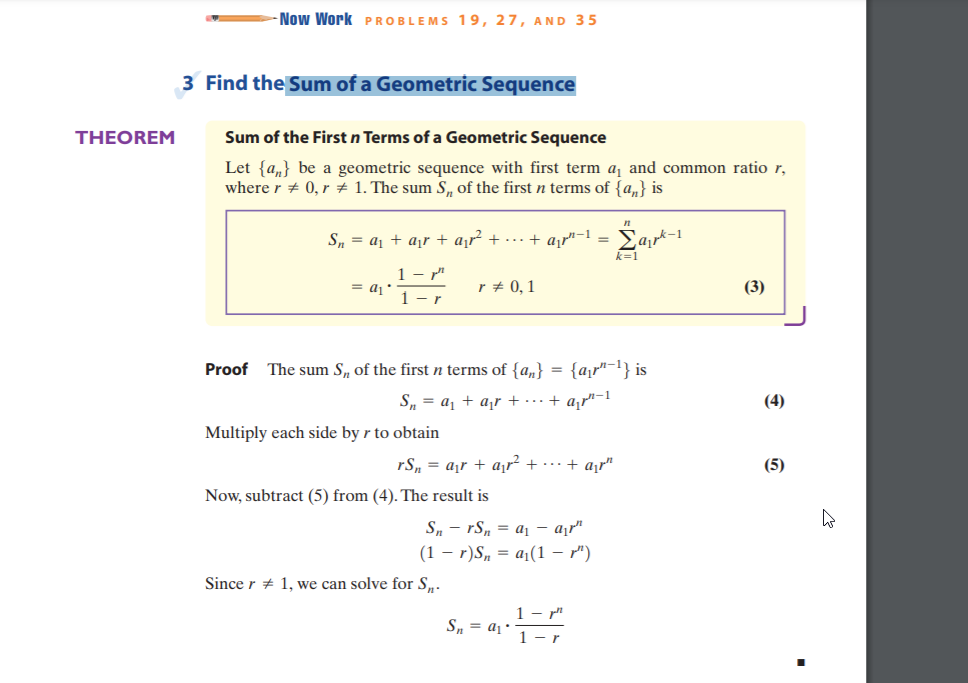
Why do they substract Sn - rSn?
Wouldn't that lead to a negative output?
restive bridge
How does subtracting rSn from Sn of eventually lead you to knowing the sum of the geometric sequence?
Let's say that r = 2 and the first term of the Geometric Sequence was 2.
If we add up to the Nth term, that would be a 14.
14 - 28 = -14
So then how would combine these two factors allow you to un--
I get it now
trim hemlock
Translation: Given f(x) such that its derivative f'(x)=(given below). How many extremas are there?

so just one thing im really curious, what is a good way to make sure that some of the roots of f'(x) isnt an inflection point
i mean i could do the second derivative and test to see if its an inflection point or not, but that is way too rigorous
sick steppe
trim hemlock
so just one thing im really curious, what is a good way to make sure that some o...
extrema occur when the 1st derivative changes sign
by 1st derivative test.
trim hemlock
oh right...
sick steppe
also it's a multiple choice question, who's telling you to be rigorous?
trim hemlock
ehhh i was too hot-tempered with the question then
trim hemlock
sick steppe
also it's a multiple choice question, who's telling you to be rigorous?
i mean since its a multiple choice question, i would always try to go with the fastest route, you know to save time. This is in the form of a national test, so im trying to have my mindset in that position.
tho yeah, i was thinking too complicated, 1st derivative test should just do it right
sick steppe
yeah, you just see which roots have odd multiplicity in f'
trim hemlock
yep

 willow bear
x^2
 ionic summit
willow bear
x^2
ionic summit
willow bear
x^2
is it cuz we should not see the 2 as sin(sin(f(x)))?
but it's (sin(f(x)))^2
but is there times where sin^2(x) would be sin(sin(x))?
willow bear
ionic summit
is it cuz we should not see the 2 as sin(sin(f(x)))?
yes
if you want sin(sin(x)) then write sin(sin(x))
the different meanings of ^2 and ^-1 are the result of history and bad conventions
if you ask me this is why you should write arcsin and not sin^-1
ionic summit
willow bear
if you ask me this is why you should write arcsin and not sin^-1
oh okay i see
so for trigo the power is abit different
thanks!
 narrow lion
slow marten
Hi can someone tell me what the domain and range is for this graph
narrow lion
slow marten
Hi can someone tell me what the domain and range is for this graph
Domain: Reals \ {-3}
Range: y>1
 jolly raven
so how do you even notate the domain and range of int(x) or floor(x)?
willow bear
Z
jolly raven
oh ok
cool
so just like s(x) E Z
E being the element of sign
bruh it said the domain of int(x) is (-inf, inf)
 uncut hollow
willow bear
jolly raven
E being the element of sign
uncut hollow
willow bear
jolly raven
E being the element of sign
just say "in" lol
jolly raven
Oh ok
ionic summit
hi can i ask if all absolute extremas are considered local extremas?

for the domain [a, b], is point 1 considered absolute max and local max, point 2 considered abs min and local min?
willow bear
yes all absolute extrema are also local extrema
also it's extremum in the singular
one extremum, two extrema.
 high hornet
 viscid thistle
how is f(x) = -7x ^4 +2x^3-3x^2+4 from quadrants 2 - 4
the degree is even but the leading co is negative
scrap that i was looking at the wrong answer key
hbdsjkal;;'
SORRY
 thin dune
yooow help me plsss find the seats only
 ionic summit
willow bear
yes all absolute extrema are also local extrema
ionic summit
willow bear
yes all absolute extrema are also local extrema
oh ok thx
 sharp hollow
 restive bridge
To prove that Log is an inverse of an exponential function, do I need to know how to use ln?
willow bear
no, to prove that log_a is the inverse of x ↦ a^x you need only know the definition of log_a
because that's literally it
restive bridge
Yeah, remembering the definition is simple enough. It's more about really just making sure my understanding is solid.
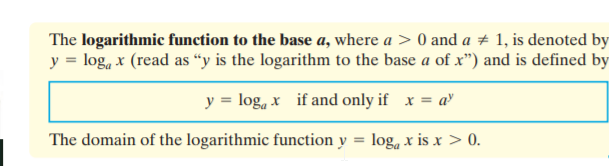
To test if a function is an inverse, we would normally be able to do: f^-1(f(x)) = x. No? @willow bear
What's bugging me is that I don't know how to use that method to subsequent get x.
restive bridge
I just don't get why they would use that format. It bugs me that I just have to take the definition and run with it. Granted it does make sense. Y = 3^4 ---> (4, 81). so it makes sense that the inverse is (81, 4). But gosh, that bugs me.
Oh well, I'll just take the definition and go with it.
restive hound
Hello, where did that minus sign come from?
 willow bear
expanding (csc(θ)+cot(θ))(csc(θ)-cot(θ))
restive hound
Ohhh okay, thank you
If I multiply sin(theta) to sin(theta)/cos(theta), that would give me sin^2(theta)/cos(theta) right?
willow bear
of course
restive hound
Ah but what if I multiply sec^2(theta) to sec^2(theta), that would be sec^4(theta) right? 😅
willow bear
yes
restive hound
Where did the cos^2(theta) in sin^2(theta) - cos^2(theta) x sin^2(theta) / cos^2(theta) come from? And was sin^2(theta) there because it was multiplied by sin^2(theta) / 1?
 willow bear
parentheses!!! and also do not use x for multiplication.
 echo wagon
^ it comes from creating a common denominator for the two terms
So you are writing sin^2( θ) as sin^2(θ)cos^2(θ)/cos^2(θ)
restive hound
echo wagon
^ it comes from creating a common denominator for the two terms
Ah so sin^2(theta) was multiplied by cos^2(theta)/cos^2(theta)?
echo wagon
Yes
restive hound
Oh okay thank you very much! Thanks for the reminder too Ann !
Oh wait, did it become (1-cos^2(theta)) because it is equal to sin^2(theta)? If so, what will happen to the two sin^2(theta)?
echo wagon
The 1 -cos^2(theta) came from taking out sin^2(theta) as a common factor
 echo wagon
Brackets
And it should all still be over sin^2(theta)
I mean, it's kind of exactly like they wrote it
Wait
restive hound
Ah okay
restive hound
Ohh okay, thank you very much!
 timber bear
sorry my mouse double clicks
restive hound
Is it possible to separate 1+sec(theta)/1-sec^2(theta) to [1+sec(theta)/1-sec(theta)] [1+sec(theta)/1-sec(theta)]?
willow bear
please i am begging you
viscid thistle
(sin(x)+cos(x))^2 = 1 + sin(2x)
willow bear
no gain that's not what made me cry just now
what made me cry is your continued lack of parentheses where they belong
restive hound
Ahhh whoops… where should it be then? 😅
willow bear
you meant $\frac{1-\sec(\theta)}{1-\sec^2(\theta)}$, yes?
obsidian monolithBOT
Ann
 willow bear
that's (1-sec(θ))/(1-sec^2(θ)).
viscid thistle
the denominator, can be factored in difference of squares
a^2-b^2 = (a-b)(a+b)
sec(theta)=1/cos(theta)
restive hound
willow bear
you meant $\frac{1-\sec(\theta)}{1-\sec^2(\theta)}$, yes?
Oh yes but the numerator is plus not minus
Ah so if the denominator can be factored in difference of squares then it will be 1-sec(theta) and 1+sec(theta)?
willow bear
the denominator here factors into (1-sec)(1+sec)
restive hound
Ohh okay thank you guys very much!
viscid thistle
hello, can someone help me with this problem?
2x (x + 9) = x (x – 2)
i need to transform it to a quadratic
 civic sierra
What have you tried?
viscid thistle
tbh i dont know where to start
im trying to distribute the variables outside the parentheses
viscid thistle
2x^2 + 18x = x^2 - 2x
civic sierra
yep
viscid thistle
then what technique should i use to get the roots?
civic sierra
Whichever one you want
here you can just take the square roor
root
though it does give you complex solutions
viscid thistle
umm using the zero property i got 0 and -20, is that correct?
im betting its correct. thx for the guidance
viscid thistle
oh yea thx
restive hound
What does conjugate mean when proving trigonometric identities?
hollow lance
restive hound
What does conjugate mean when proving trigonometric identities?
A useful identity you'll come across a ton is (a+b)(a-b) = a^2 - b^2
Whenever you have a fraction that looks something along the following lines
obsidian monolithBOT
peaceGiant
 restive hound
Ah thank you very much @hollow lance !
Btw, since we can manipulate pythagorean identities.. if I were to manipulate sin^2(theta) + cos^2(theta) = 1, I could get sin^2(theta) = 1-cos^2(theta) and cos^2(theta) = 1-sin^2(theta). But is it not possible for me to have 1+cos^2(theta)? Or possible?
hollow lance
restive hound
Btw, since we can manipulate pythagorean identities.. if I were to manipulate si...
From that identity alone, the best you could do is 1 + cos^2(x) = sin^2(x) + 2cos^2(x) which might not be very useful, instead you can consider cos^2(x) = 1/2 + 1/2 * cos(2x) though it really depends on the question
 willow bear
$\frac{\sin(x)}{1 + \cos(x)} = \frac{\sin(x) (1 - \cos(x))}{(1 + \cos(x))(1 - \cos(x))} = \frac{\sin(x)(1-\cos(x))}{1 - \cos^2(x)}$
obsidian monolithBOT
Ann
 restive hound
Ah (a-b)(a+b) was used here?
willow bear
yes, i used the difference-of-squares identity.
restive hound
Ah okay then foil method was used in the denominator on the middle right? Then combine like terms?
restive hound
What do you mean?
willow bear
what i mean is idk about you but i feel no need to include any intermediate step between (1-t)(1+t) and 1 - t^2
if you do not see why these are the same then you can of course do the expansion the long way
i.e. using the distributive property
but i do recommend practicing some normal algebra for some time until things like this are automatic
it's kind of like the multiplication table
it's good to get really practiced with algebraic moves like this so that you don't have to slow down every time you see one of them being made
restive hound
Okay, I’ll do. Thank you very much, I’ve learned a lot today
 glacial monolith
 mild swan
Damn - those remainders are so stupid lmao
 fathom seal
Hi precalc
 full pagoda
restive hound
full pagoda
restive hound
Hello, I was wondering if what I did was right? So I could prove that the right side is equal to the left? I stopped at sin^2(theta)sec(theta)+sin(theta). I’m wondering what I could do from there, should I get one of their quotient identities or reciprocal? Also I made the denominator as one because when I multiplied sec(theta) to cos(theta) it equals to 1
 restive hound
<@&286206848099549185>
 rough parrot
im not sure about what you did, but here's how i approached this. i hope it helps:
1. Expand both sides:
sin0 + sin0tan0 = tan0sin0 + tan0cos0
sin0 + sin0tan0 = sin0tan0 + sin0

2. Subtract sin0tan0 from both sides: (Not really needed haha)
sin0 = sin0

Hence proved
i used 0 to represent theta
restive hound
rough parrot
im not sure about what you did, but here's how i approached this. i hope it help...
Oh okay but I need to make tanx(sinx+cosx) to sinx(1+tanx) though but thank you, it’ll help !
rough parrot
uncut mulch
(or x) if you don't have access to greek symbols
noted!
restive hound
Is it possible to combine these denominators? Or it has to be cot^2x too?

 placid knot
please be respectful to others
openly making others uncomfortable can lead to consequences (muting, banning) depending on the intent
willow bear
the intent is made very clear by considering the message he replied to is from 2 years ago.
restive hound
Thank you @trim hemlock !
 vivid moth
@miyorumi#5370 willing to help you can Dm.
restive hound
If sec(theta) multiplied by cot(theta) is csc(theta), then if I multiplied cot^2(theta) to sec(theta), does that give me csc^2(theta)?
uncut mulch
do you mean
multiplied cot^2(theta) to sec**^2**(theta)
willow bear
$\frac{1}{\cos(\theta)} \cdot \frac{\cos(\theta)}{\sin(\theta)} = \frac{1}{\sin(\theta)}$
obsidian monolithBOT
Ann
 restive hound
Ah nope, I mean cot^2(theta) to sec(theta). The secant doesn’t have a square @uncut mulch
Wait, if 1 is multiplied to cos(theta) how did cos(theta) multiplied by sin(theta) equal to sin?
uncut mulch
$\frac{\cos(\theta)}{\cos(\theta)} = , ?$
willow bear
\cos
obsidian monolithBOT
ℝamonov
 willow bear
restive hound
Wait, if 1 is multiplied to cos(theta) how did cos(theta) multiplied by sin(thet...
willow bear
restive hound
Wait, if 1 is multiplied to cos(theta) how did cos(theta) multiplied by sin(thet...
it's basic fraction simplification. since you're clearly having trouble with it, you would do well to practice doing it without trigonometric shit getting in the way.
remind yourself of how to multiply fractions.
seriously, i've seen you stumble on basic algebraic things here a lot
it's a bit concerning that you keep trying to do things with trig when algebra is clearly where your gap in knowledge is
restive hound
I understand now why it was 1/sin(theta). And yep you’re right, I actually forget but practicing could make up for it. Thanks for reminding me, can you give me advice on what algebra methods or ways I could use when proving trigonometric identities? Aside from factoring, foil, the difference of squares identity
willow bear
just about everything algebraic
there really isn't much you learn in algebra that doesn't also apply to trig
restive hound
Okay thank you very much, I’ll try to always keep that in mind

 harsh oxide
manic lantern
harsh oxide
manic lantern
To solve for m, you have to first get rid of the square root. What's the reverse of a square root?
manic lantern
squared
harsh oxide
Good. The first thing to do is square both sides to get rid of the square root
 harsh oxide
Not quite. There's also a negative branch to consider. For example, when x = -5, you get 25>4, which is definitely true
manic lantern
harsh oxide
Good. The first thing to do is square both sides to get rid of the square root
100= m/100
harsh oxide
Not quite. The 10 in the denominator is also in the square root, so you don't have to square it to 100
Well, not just don't have to, you shouldn't
manic lantern
1000?
harsh oxide
Is that your answer for m or...?
manic lantern
uhh
 dark ingot
manic lantern
uhh
dark ingot
manic lantern
uhh
By squaring both sides you get:
10^2 = m/10
If you multiply again by 10, you get:
10^3 = m
or
m = 1000
——
This is basic algebra and does not belong in the pre-calculus channel. If you are attempting to learn calculus or even trig for that matter, fundamentals in algebra is a necessity.
restive hound
Hello, I was wondering if what I did was right? In number one, I used the pythagorean identity for sin^2x and combined like terms for the two -cos^2x. In number two, since there’s 2cos^2x, I separated them and made it cos^2x + cos^2x. Because from what I know, when you combine these two, it’ll be 2cos^2x. Then for sin^2x, I used the pythagorean identity so (1-cos^2x). Then I cancelled out cos^2x and -cos^2x.
 trim hemlock
yes both are correct, but for the second one, you might want to erase the second line because when presented like that, it creates confusion
if you do want to have that intermediate step, you should write it out as an equation, because you started with an equation
restive hound
trim hemlock
if you do want to have that intermediate step, you should write it out as an equ...
Oh okay, on what part? which line? Also, if I got cos^2x+1 that’s just the same as 1+cos^2x right? I could just rearrange it?
trim hemlock
from the first line to the second line of problem 2
 trim hemlock
restive hound
Oh okay, on what part? which line? Also, if I got cos^2x+1 that’s just the same ...
trim hemlock
restive hound
Oh okay, on what part? which line? Also, if I got cos^2x+1 that’s just the same ...
yes, those are equivalent
restive hound
Ah! Okay so you said that if I want to have that intermediate step, I should write it out as an equation because I started out with an equation which is 2cos^2x+sin^2x? So I could write it as 2cos^2x + (1-cos^2x) and cancel out the -cos^2x from (1-cos^2x) and the cos^2x from 2cos^2x, which will leave me with cos^2x + 1 which is the same?
trim hemlock
no what i meant is, basically you should have an equation in the second line, i.e 1+cos^2(x)=cos^2(x) + cos^2(x) + (1 - cos^2(x) )
or if you want to write that as a note or sth, then you should write it to the side of the question, or write it out clearly that this is a note
the reason you should not put the second line there right below the question is because readers will infer that the second line is equivalent to the question, which it is not since the question is an equation.
i mean i might be too pedant here but thats just representation-wise
restive hound
Ah! Okay, I see. Thank you !
somber sigil
 still comet
u have to consider the -2, so x²-4>0, factorise so (x+2)(x-2)>0. use sign analysis or a graph to get the range of values of x
trim hemlock
Translation: Given f(x)=(in picture) satisfying (given conditions in picture). How many extremas are there in y=|f(x)-2019|?

so i have to say, im stuck here
tho i have a picture of what i should be doing, so basically i should first find how many extrema f(x)-2019 can have, and then i have to find how many roots f(x)-2019 can have, and then just add them together and i should have the amount of extremas for |f(x)-2019|
but the problem arises when trying to find the roots and extremas of f(x)-2019
i have also tried to use the given conditions, but im not sure how i should apply it
hollow lance
trim hemlock
Translation: Given f(x)=(in picture) satisfying (given conditions in picture). H...
Do you perhaps have the answer key?
||I suspect it is 5, but I might be wrong||
||You need to use the inequalities, along with the argument that the cubic has a leading coefficient of 1. It means to the left (-inf) it goes down, and to the right it goes up, so it certainly crosses the x-axis once, the inequalities should tell you that it must cross it 3 times, from there it's easy||
^ hint
trim hemlock
hollow lance
Do you perhaps have the answer key?
i dont, but i should have it soon enough, ill take a look at the hint
hollow lance
And by extremes I think you are referring to local extremes, since there would be only one global one
trim hemlock
hmmm why does a+b+c-2018<0 implies that f(x)-2019 should have 3 roots?
trim hemlock
hollow lance
And by extremes I think you are referring to local extremes, since there would b...
yeah, local ones
the question just speaks in general and we just all assume so
hollow lance
I don't want to spoil most of it away, however those inequalities have something to do with f, perhaps maybe for some specific x the inequality happens
trim hemlock
hmmm
hollow lance
Or another way to think of it, rewrite the inequalities in terms of f
trim hemlock
its just that im having a bit of trouble to connect the a and b in the inequality to the a and b in the function
lemme just wrap my head around that for a bit
hollow lance
Yeah, think about what you need to do to f, so you can work with a and b.
I'll be afk for a bit, I'll return in 15 minutes or so
trim hemlock
sure
thanks for the hint btw
ohhhhh
i see where we are going with this
ah alright, this problem is solved. Channel is open
hollow lance
trim hemlock
ah alright, this problem is solved. Channel is open
Great, yeah the problem boils down to showing that the new function f(x)-2019 is positive at x=0 and negative at x=1, so going from left to right we have three roots on the interval
(-inf, 0), (0, 1), (1, inf), We make a quick sketch and use the absolute value
hollow lance
Of course, anytime
 ocean spire
Anyone wanna help?? Im so incredibly confused
 obsidian monolithBOT
codemonkey
 viscid thistle
this is from problem The length is twice as long as the width. The height is 2 inches greater than the width. The volume is 192 cubic inches.
but not sure how to approach it at all
$(x^3+2x^2) = 96$
obsidian monolithBOT
codemonkey
 viscid thistle
$2(x^3+2x^2) = 96$
obsidian monolithBOT
codemonkey
 viscid thistle
meant to put this my compupter is laggy sorry
 dusk edge
Do you need to solve for x?
 cedar bramble
how do i factor this?
$(x^2-4)(x+3)^1/2 - (x^2-4)(x+3)^3/2
$(x^2-4)(x+3)^1/2-(x^2-4)(x+3)^3/2
viscid thistle
$(x^2-4)(x+3)^1/2 - (x^2-4)(x+3)^3/2
uh
$(x^2-4)(x+3)^1/2-(x^2-4)(x+3)^3/2
hm
 uncut mulch
identify common factors in both terms
also consider that (x+3)^(3/2) = (x+3)*(x+3)^(1/2)
 forest otter
anyone know how to discern if the function is continuous?

 pine oracle
How can I find Sn?
 mild swan
That's a telescoping series
So write out the first few terms and see if you can recognize a pattern
 visual brook
My teacher says when taking limits of composite functions you keep taking limits no matter if the functions are continuous at the previous functions' limit??
Is this untrue
This is what he did

Isn't this wrong
hollow lance
f isn't defined at x=1, but that doesn't mean the limit (x->1) f(x) doesn't exist
so in this case (the limit from left and right is the same) we can compute that limit
visual brook
Some definitions I've seen online point out that f should be continuous at lim(x->0) g(x) in this case in order for the limit to exist
Oh nvm I just understood
visual brook
hollow lance
so in this case (the limit from left and right is the same) we can compute that ...
Thank you
 ornate island
can someone explain the frequency of a sinusoidal function
 dusk elm
forest otter
anyone know how to discern if the function is continuous?
dusk elm
forest otter
anyone know how to discern if the function is continuous?
Polynomial functions are continuous every. Since this is a piecewise function you just need to test the point x=0 to ensure that the function isn’t discontinuous at that point
 thin dune
dusk elm
You have no variables defined from the graph. What is a, b, c, and d?
thin dune
dusk elm
You have no variables defined from the graph. What is a, b, c, and d?
yeah thats y m confused
dusk elm
I would recommend asking your professor for clarification or consult your notes
Like this?

 proud raven
multiply by the lefthand denominator
then if you dont have eagle eyes and a brain of steel you have to distribute and start the equating
dusk elm
Yeah what he said, after you distribute I would collect all the like terms and you will get 4 equations in which you can solve for A, B, C, and D
proud raven
i can give you a big hint
turn your paper sidewise so you dont have to use multiline equations in a few steps

viscid thistle
how do you do the question, "for each polynomial, determine the value of K ig the remainder is 3" (kx^2 +3x +1) / (x+2)
dusk elm
viscid thistle
how do you do the question, "for each polynomial, determine the value of K ig th...
try out some long/synthetic division
viscid thistle
do i not use factortheorum?
dusk elm
i would recommend distributing the right side then collect like terms. This will give you 4 equations
4 equations and 4 variables means you can solve it
https://www.storyofmathematics.com/multiplying-polynomials this might help
Multiplying Polynomials – Explanation & Examples Many students will find the lesson of multiplication of polynomials a bit challenging and boring. This article will help you to understand how different types of polynomials are multiplied. Before jumping into multiplying polynomials, let’s recall what monomials, binomials, and polynomials are. A ...
ornate island
ornate island
can someone explain the frequency of a sinusoidal function
<@&286206848099549185>


 frail sun

 valid badger
plug in 5
 wet knoll
 sharp fiber
Is it differentiation
dusk elm
sharp fiber
(4(x+h)-4x)/h
You should see some really nice cancellation and simplification
fresh hearth
HIiiiiiii

How would I go about this problem
I'm stuck on this part

So the part where I would do
7^-x = 2401
How would I evaluate that??
<@&286206848099549185>
proud raven
fresh hearth
How would I evaluate that??
just in the same
fresh hearth
so like