#precalculus
1 messages · Page 292 of 1

 patent beacon
@tranquil haven
i is the unit vector (1,0)
j is the unit vector (0,1)
These are common notations
So b1 can also be expressed as (100, 10)
 drowsy trellis
How to do this?

 willow bear
you're missing parentheses, it should be cos(A) = (b^2 + c^2 - a^2)/(2bc), etc
also those three formulas are all redundant, and assume the triangle is called ABC with its sides labeled a, b and c
which is not the case in your picture anyway
in any case: when finding an angle using the law of cosines, you care about which sides are incident to your angle (there will be two) and which side is opposite.
- in the numerator, you add the squares of the incident sides and subtract the square of the opposite.
- in the denominator, you multiply the incident sides.
@drowsy trellis
drowsy trellis
Hey! I finally got to meet you! @willow bear
Thanks! But I was wondering how do you determine which one u use to find the angle? @willow bear
willow bear
you don't
these are literally all the same formula
just with letters shuffled around
i literally just told you how to determine which side goes where
willow bear
willow bear
in any case: when finding an angle using the law of cosines, you care about whic...
does this make sense to you or not?
drowsy trellis
What is an incident angle? @willow bear
willow bear
i never said the words "incident angle"
i said
... which sides are incident to your angle ...
please read what i say carefully
also, you do not need to ping me every time you say something
👻
 willow bear
have you made any progress so far?
 merry musk
Any ideas?
 patent beacon
@merry musk
It's easier to count how many teams DON'T contain both a boy and a girl
patent beacon
Which is?
patent beacon
I don't know what those numbers are, haha
patent beacon
- So in general, you can make 16C6 teams.
- You can make 9C6 teams that only have boys.
- You can make 7C6 teams that only have girls.
merry musk
thats what i was thinking yeah
patent beacon
That means, of the 16C6 teams, 9C6 "don't work" and 7C6 "don't work"
 sage lake
`Find the indicated roots. Express answers in trignometric form.
- The square roots of 4(cos90+isin90)`
Help por favor
patent beacon
@sage lake
Still looking for it?
sage lake
yeah
patent beacon
One answer is 2(cos(45) + isin(45))
Note that √4 = 2
And by Demoivre's theorem, you can put a 1/2 into the sin and cos, rather than take the √
The other answer comes from doing the same thing to 4(sin(450) + isin(450))
450 being the same angle as 90 on the unit circle
 ocean garden
hi i wanted to ask
if this is true or false

its so weird i cant put my finger on how to solve this
willow bear
write this as a riemann sum honestly
ocean garden
ngl i dont know how
if it was a reimun sum i could have applied one of the test but i cant figure out which function is the real one
n/n^2+x^2 ?
its n/2n^2 aint it
why am i so stupid
patent beacon
There's a few pieces of info you want to find out:
-
For a given n, how many rectangles are there? That is, how many terms?
-
What are the endpoints?
-
How wide are the rectangles?
-
What is the function we're putting rectangles under?
willow bear
parentheses!!!
\verb|n/n^2+x^2| reads as $\frac{n}{n^2} + x^2$, not as $\frac{n}{n^2 + x^2}$
 obsidian monolithBOT
Ann
 obsidian monolithBOT
Ann
 willow bear
you can write this as $\sum_{k=1}^n \frac1n \cdot \frac{1}{1 + (k/n)^2}$ with some algebra
obsidian monolithBOT
Ann
 willow bear
@ocean garden
 storm mango
 hollow solstice
,w d/dx cos(sin2x)
obsidian monolithBOT


 Requested by mist#7100
obsidian monolithBOT
Requested by mist#7100
obsidian monolithBOT
 Requested by mist#7100
 distant sierra
hi can someone check a few problems here for me? Its a canvas "quiz" but its just the way our teachers are doing homework since we STILL haven't gone back in person 😫
 stuck lark
@mild swan ping mods for future reference
 mild swan
Yeah, I was going to but I never got around to doing it since I had other stuff to do
I was trying to see if I could squeak that out of him and I did 😉
 vagrant sedge
does anyone here know how to graph an ellipses
 knotty oak
can anyone help me ?

 arctic trail
No
knotty oak
please i really don't know the answer
arctic trail
public class Answer{
    public static void main(String[] args){
        public static int int1 = 1;
        public static int int2 = 1;
        System.out.println(int1-int2);
    }
}
Put this in a java compiler
Tell me what it does
c;
mild swan
doesn't it print 0.0000000000000000000003 or something
 merry chasm
Refreshing some math fundamentals since it's been a while, and I had 2 questions regarding the quadratic formula:
-
Regarding the radicand, are you multiplying b^2 by -4ac or are you subtracting 4ac from b^2?
-
To graph quadratics, it helps to find the line of symmetry, which is expressed by -b/2a, which I'm guessing is from the QF. How does the radicand part of the formula simplify to zero?
willow bear
1: you are subtracting 4ac from b^2
2: it doesn't "simplify to zero"; the QF itself gives you the x-intercepts, if any. the line of symmetry is halfway between those.
merry chasm
willow bear
2: it doesn't "simplify to zero"; the QF itself gives you the _x-intercepts_, if...
I guess what I don't understand (and maybe it's obvious but I'm not recognizing it cause it's super late) is why is it just -b/2a and not the entire formula?
willow bear
are you ok with the fact that the line of symmetry is halfway between the two roots?
merry chasm
willow bear
are you ok with the fact that the line of symmetry is halfway between the two ro...
I think so, assuming that there are two x intercepts
willow bear
i mean
ok wait
the assumption isnt necessary
but establishing the line of symmetry without it will take a different route
are you familiar with completing the square?
merry chasm
Is that the thing where you find what multiplies to get C and adds to get B?
willow bear
no
merry chasm
Ah, I think I know what you're talking about
willow bear
it's when, for example, you write x^2 + 4x - 10 as (x+2)^2 - 14
for equations of parabolas this is also called vertex form
merry chasm
Yea, I remember it vaguely
willow bear
because if so, i could tell you that y = ax^2 + bx + c can be written as y = a(x + b/(2a))^2 + (4ac-b^2)/(4a)
and working this out is just a matter of going through the motions for completing the square
merry chasm
Ok, I understand where you're coming from. I need to refresh myself on completing the square though.
Thx for the explanation :)
 winter sail
Ok so, I have to find the intersection point between a cubic equation and a sinusoidal.
So I decided to set them equal to each other right
2x^3-10x+3=-5sin(2x/3)+2
But no matter what I did, I couldn't get rid of the x^3 term...
How do you solve this without using a graphing calculator?
It was a classwork problem and it was the only problem on the classwork review for the final that I just couldn't get (without the use of a graphing calculator but that was kind of cheating). So I just got it wrong :P
willow bear
i don't think this is possible without a graphing calculator unfortunately
winter sail
A friend of mine told me that you can use the Taylor series to do it but seeing as that's a Calculus topic not an Algebra 2 one...yeah no I feel like my teacher just lied to me.
Ah well...
If anybody has a solution, ping me and please explain. Would be greatly appreciated ❤️
Genuinely curious how you solve it
 tranquil haven
Hey why is an ellipse equation always equal to 1 ?
 drowsy totem
tranquil haven
Hey why is an ellipse equation always equal to 1 ?
drowsy totem
tranquil haven
Hey why is an ellipse equation always equal to 1 ?
You need to read the derivation of equation of an ellipse for that
 limpid rampart
is there a general approach to eliminating the parameter
for a parametric equations
 rough carbon
Hmmm sometimes you do have to play around with them, esp if you can’t get t(or whatever else the parameter is) =
If there’s trig it’s often good to square both sides
Use a cos^2 t + sin^2 t =1 somewhere
Sometimes adding the x and y can help
Eg x= 2t + 2/t
y =2t -2/t
Add x and y and multiply by x-y
The t’s cancel
 west blade
Does anyone know how to calculate revenue using an exponential function?
Im trying to find maximum profit
using this function
P(x) =15000((x-5)^2 )(e^(x-5))+1
sage lake
Sketch the graph of each polar equation
r=2θ for θ in radians
The book says the graph on desmos is wrong
 willow bear
can you show exactly what the book says
sage lake
It just says "Sketch the graph of each polar equation
willow bear
The book says the graph on desmos is wrong
i mean this part
the graph you're showing here looks correct to me.
but you claim the book denounces it as incorrect.
sage lake
47
 willow bear
ah
sage lake
Confuse
willow bear
they simply draw it over a bigger range of values for theta.
something like -4pi to 4pi.
somehow they chose not to specify that range tho
sage lake

I have it up to 12 pi
Still don't know how the book has it shaped like that
Hope this doesn't show up on the final tmr
sage lake
willow bear
something like -4pi to 4pi.
oh it went negative
prof only had us going 0 up so I'm not doing neg
 empty bronze
willow bear
empty bronze
willow bear
@empty bronze do you still need help with any of these? if so, which one(s)?
 gritty rampart
What happens to the slope if you take the reciprocal of a function?
patent beacon
Are you asking in terms of derivatives?
willow bear
$\sqb{\frac{1}{f(x)}}' = -\frac{f'(x)}{f(x)^2}$
obsidian monolithBOT
Ann
 gritty rampart
Yup @willow bear I got my question answered. Thanks anyways!
 copper vigil
whew
 placid cairn
 cerulean cedar
Wait . . . Desmos has dark theme?
cerulean cedar
Wait . . . Desmos has dark theme?
also whats desmos
willow bear
 viscid thistle
 copper vigil
-1 -4 DNE -1

 runic locust

Given any conversation between two mathematicians in which π is discussed, sooner or later, Euler’s number e comes up. In this video, we want to address the question of whether Euler’s number admits a geometric interpretation. That is, in the sense that π is geometric, is Euler’s number geometric?
Timestamps
0:00 Introductory Chit Chat
1:22 Re...
obsidian monolithBOT
xion

 slow quartz
I know you arent supposed to pay for tests, but its not worth anything and its just a pretest
 echo wagon
@slow quartz what's a pretest lol?
slow quartz
Its a teat you take in the beginning of the year
And then you take a test at the end of the year
slow quartz
slow quartz
Its a teat you take in the beginning of the year
Test*
I really cant spell
slow quartz
slow quartz
Its a teat you take in the beginning of the year
@echo wagon
echo wagon
<@&268886789983436800>
stuck lark
is a pretest meant to be diagnostic
stuck lark
@slow quartz
slow quartz
stuck lark
is a pretest meant to be diagnostic
No
But he knows literally nothing, and if he doesnt get a certain % on it he has to go for another month
willow bear
"he"?
 sick steppe
the plot thickens 
stuck lark
@slow quartz seeking outside help on such a test defeats its purpose and is academic dishonesty. while you may ask for help on reviewing topics, please don't ask for help on this test, and don't offer cash in return for help on this server
slow quartz
stuck lark
<@!604445725601824786> seeking outside help on such a test defeats its purpose a...
Again, its not worth anything
It has 0 academic value
I asked in #discussion and everyone said it should be fine to ask that question
Because its just a pretest
@stuck lark
echo wagon
slow quartz
But he knows literally nothing, and if he doesnt get a certain % on it he has to...
This seems to suggest it has value. And it also seems like you just want someone to do it for you.
slow quartz
Its literally just to determine how long you stay
:p
If I cant ask for help on the pretest then I'll delete the question
stuck lark
it'd be unreasonable to ask for help on a test whose purpose is to measure how well you've learned the material to decide how much more time you need to learn it
slow quartz
It isnt tk measure what we've learned
Its called a pre test
As in
Before you do anything
 uncut mulch
regardless the purpose is to measure how much you know
go through the entire thing yourself first
and given the context, you'll learn what's needed through the course
sick steppe
yeah... so do it yourself
stuck lark
then i can't distinguish this from any other final
seeking help on it is academic dishonesty. don't seek help on it and in general don't offer cash for help
uncut mulch
It isnt tk measure what we've learned
Its just reviewing what we elarned during the school year
...
 hushed onyx
Question
I'm on the algebra part of trig and i'm wondering if I should understand why each formula works, or memorize each formula (such as 2pi/b) and understand how they fit in in different dircumstances / problems
 plucky gulch
its better to understand, cuz its hard to memorize everything
hushed onyx
Understand each formula?
hushed onyx
What do you mean by "where they come from"?
plucky gulch
how did we get them
plucky gulch
?
hushed onyx
Like, can you give an example of a formula, and what "understanding" it would mean?
plucky gulch
hmmm what about
$sin^2 (x) + cos^2 (x) = 1$
obsidian monolithBOT
Herels
 hushed onyx
well for me
plucky gulch
did you know that we can prove it by using Pythagore theorem ?
plucky gulch
Thats the spirit
hushed onyx
sin is y and cos is x, and x^2 + y^2 is radius, and unit circle radius is 1, so yeah
plucky gulch
well, everyone doesnt think of something in the same way
we think of the easiest way we can understand
sorry if my english is bad
plucky gulch
hushed onyx
sin is y and cos is x, and x^2 + y^2 is radius, and unit circle radius is 1, so ...
that works too
hushed onyx
But how do you understand that the asymptotes of a tangent function are pi/2b + (pi)n/b
plucky gulch
what is n and what is b ?
plucky gulch
,wolf graph tan x
obsidian monolithBOT

 Requested by Herels#2593
plucky gulch
hushed onyx
b is what the function is being stretched / compressed by
Requested by Herels#2593
plucky gulch
hushed onyx
b is what the function is being stretched / compressed by
hmm I dont get it
plucky gulch
oh
well you get the asymptotes by looking at the limits
if lim tan(bx) when x goes to pi/2b is infinity, they x=pi/2b is an asymptote
hushed onyx
I didn't cover limits yet
plucky gulch
you just cant start talking about asymptote without learning about limits
that's bullshit
plucky gulch
you need to learn about limits before asymptote
hushed onyx
When are limits usually taught
 earnest jackal
i learned asymptotes in algebra 1
west blade
hey guys Im having trouble calculating this derivative could someone help
y=ln^4(1-3x)^3
 zealous rampart
 hushed onyx
plucky gulch
you need to learn about limits before asymptote
hushed onyx
plucky gulch
you need to learn about limits before asymptote
yeah i think you learn asymptotes before limits
plucky gulch
nah
I don't know where you are from but limits are necessary to understand asymptotes
hushed onyx
plucky gulch
I don't know where you are from but limits are necessary to understand asymptote...
nah
i get the concept of an asymptote
maybe it adds another dimension
but i think in the us curriculumn they teach asymptotes first
 polar pasture

 charred rock
hey guys! sorry if this doesnt constitute as precal? but its in my precal module and just wanted some really quick help (in voice chat if possible) with long division
i get most of it, im just stuck on one small part
hushed onyx
post the problem
charred rock
i actually figured it out Mug thanks though
 visual brook
hushed onyx
but i think in the us curriculumn they teach asymptotes first
visual brook
hushed onyx
but i think in the us curriculumn they teach asymptotes first
I think everyone is taught asymptotes before limits everywhere
viscid thistle

 slender copper
viscid thistle
slender copper
viscid thistle
do you need help with that
viscid thistle
ye
slender copper
k
there's a limit when x approches 3
and when there's a limit, you know that the limit when x approaches 3 from the left and right is the same
so when we look, the limit when x approaches 3 is -5, if i am looking correctly
so that means the answer for the first 3 blanks is -5
and since at x=3, there is an open circle, it means that the function isn't defined for f(3) meaning that the answer to the last blank is "undefined"
viscid thistle
slender copper
so when we look, the limit when x approaches 3 is -5, if i am looking correctly
how do u see that tho
slender copper
hmm
sick steppe
the graph clearly approaches y=-5 as x approaches 3... it's just something you look at and recognize
slender copper
^
 slender copper
yeah i don't know that, i've only just started learning this kind of stuff
if i'm correct tho, I think that you have to find the derivative of that function, and then plug in x=pi/3
don't take my word for it tho

 timber pawn
That's the value of f(3)
But the question is asking for f(3-)
So the answer should be the value the left side of 3 approaches to
 slender copper
viscid thistle
slender copper
viscid thistle
think about it this way, when you're narrowing in on 3, don't take you pencil off the paper
slender copper
 faint nest
 viscid thistle
slender copper
think about it this way, when you're narrowing in on 3, don't take you pencil of...
viscid thistle
slender copper
think about it this way, when you're narrowing in on 3, don't take you pencil of...
wat would it be then
slender copper
viscid thistle
wat would it be then
bro, just approach x=3 without taking your pencil off the paper, it should be pretty simple
if you can't solve this, then may be you're going to need a refresher on the basics of limits
viscid thistle
-4?
sick steppe
viscid thistle
what about this
told you this already... just plug the stuff into first principles
viscid thistle
so would it be 0
viscid thistle
for which
slender copper
huh?
slender copper
viscid thistle
this one
viscid thistle
ohk
viscid thistle
sick steppe
told you this already... just plug the stuff into first principles
d/dx(5sec(pi/3)) right?
is pre-calculus hard
sick steppe
no
viscid thistle
calculus*
sick steppe
viscid thistle
d/dx(5sec(pi/3)) right?
you dont want to differentiate a constant. . .
you also didn't even read what I wrote, given I said first principles
slender copper
viscid thistle
calculus*
it's hard until you start learning it
it's alright
like it looks really confusing
viscid thistle
istg im so streesed on what to pick for next year
 viscid thistle
slender copper
but once you start learning it's not
viscid thistle
slender copper
but once you start learning it's not
we have statistics, algebra III/trigonomentory, and Pre-calculus
slender copper
faint nest
wait i figured it out but i cant figure out the asymptotes
the equation for the asymtotes were also on the pictire i sent you
viscid thistle
for next year, idk what to choose
slender copper
hmm
viscid thistle

 outer inlet
I have to utilize that h is approaching 0, anyone know what to do?
 sick steppe
outer inlet
I have to utilize that h is approaching 0, anyone know what to do?
sick steppe
outer inlet
I have to utilize that h is approaching 0, anyone know what to do?
so via first principles..?
faint nest
is it y=-36/64? @slender copper
viscid thistle
can someone help me for some time on what to pick for next year
slender copper
viscid thistle
we have statistics, algebra III/trigonomentory, and Pre-calculus
statistics is really boring, pre calc you can learn by yourself, I would go with alg III
sick steppe
outer inlet
I guess
it's a yes or no.
viscid thistle
slender copper
statistics is really boring, pre calc you can learn by yourself, I would go with...
wdym learning by yourself?
sick steppe
outer inlet
f^1(x)= those
f^1(x)??
sick steppe
you just differentiate w/ first principles
idk why you're doing redundant things like raising a function to the 1st power
sick steppe
no
outer inlet
hmm
sick steppe
it's first principles
outer inlet
so the first is 2x
sick steppe
$f'(x)=\lim_{h\to 0}\frac{f(x+h)-f(x)}{h}$
obsidian monolithBOT
Mosh
 outer inlet
so its that
sick steppe
that's first principles.... yes
 slender copper
viscid thistle
wdym learning by yourself?
slender copper
viscid thistle
wdym learning by yourself?
khan academy
outer inlet
how would you do that one
outer inlet
x^2 gets plugged in the x+h
viscid thistle
slender copper
khan academy
ok but i mean in school lol
slender copper
viscid thistle
ok but i mean in school lol
yeah, statistics imo is boring, pre calc you'll learn on your own time, alg III you'll learn at school
slender copper
which one
viscid thistle
pre calc
outer inlet
I don't know where to put this h
slender copper
viscid thistle
pre calc

Khan Academy
The Precalculus course, often taught in the 12th grade, covers Polynomials; Complex Numbers; Composite Functions; Trigonometric Functions; Vectors; Matrices; Series; Conic Sections; and Probability and Combinatorics. Khan Academy's Precalculus course is built to deliver a comprehensive, illuminating, engaging, and Common Core aligned experience!
viscid thistle
oh so these things are in order right?
slender copper
yeah pretty much, khan academy does the work of organizing the material
viscid thistle
like you gotta go first with complex numbers and then polynomials and so on?
viscid thistle
oh alr
slender copper
i guess that's recommended
and also
even tho khan is great
you should also consult other sources
viscid thistle
 viscid thistle
i need some advices mate
i need some time to think about it
i mean im taking algebra II atm and my average is alright
slender copper
ok here's the thing
viscid thistle
like in the 80%
slender copper
i don't know what alg III is all about
i'm just basing my opinion off of a quick search online
viscid thistle
its like algebra II but a bit more detailed ig?
slender copper
you should talk to your teacher about it
slender copper
oh, i'm pretty much done with it
i'm doing the calc AB course rn
i just started
viscid thistle
you mean AP calc?
slender copper
ok but going back to course selection, a 9th grader who's never taken those courses officialy won't be able to help you much
slender copper
viscid thistle
but like you need pre calc to do ap calc right?
it's helpful to learn pre calc
viscid thistle
what grade are you?
slender copper
9th
 wet oar
Dang 9 grade
viscid thistle
 slender copper
LOL
wet oar
How long did it take for you to learn pre calc bro
viscid thistle
like a grade 9 studying ap can destroy a grade 11
but in our school AP classes are for grade 12 only
wet oar
What it usually is for 11th grade too
viscid thistle
kinda
slender copper
wet oar
How long did it take for you to learn pre calc bro
i knew most of pre calc, stuff like conics and matricies was new
viscid thistle
why my name is blank
wet oar
Oh
viscid thistle
alr cya
wet oar
See ya
viscid thistle
why tf my name is blank
wet oar
I think it’s your nickname for this server
You can change it
Go to the three dots when looking at channels then you should see it
viscid thistle
lmao i dont have perms
no lol some moderator changed my nickname cuz i dont have a name
if you press on my pfp
i dont have a name
wet oar
Oh lmao
viscid thistle
 wet oar
Nice
viscid thistle
what grade are you?
wet oar
Going into 11
wet oar
This year I took pre calc, pre-ap chem, statistics, world history, sports, and Spanish
viscid thistle
oh no pre ap chem is my nightmare
wet oar
I’m scared for AP chem next year yeah
wet oar
Ok
viscid thistle
 wet oar
Those are good options
viscid thistle
ig
wet oar
Like Good amount of aps and honors
wet oar
I went in school most of the year
Some days we did zoom meeting in like November and December
viscid thistle
and when you went for pre calc, did you think it was hard?
wet oar
Not really you just have to know the concepts and practice a lot
The kids who struggled did not study or know the formulas
wet oar
Like 1 hour every school day after class
viscid thistle
oh
ok here's a question
im taking algebra II rn and about to finish school in like 2 weeks, do you think i should go with trigo or pre calc?
wet oar
Pre calc
viscid thistle
hmm
viscid thistle
do you take any type of geometry lessons in pre calc?
outer inlet
@sick steppe I got these using the method of skipping them but idk

are these using the second principle and should I redo them
sick steppe
what's the 2nd principle?
 sick steppe
no clue, I'm not checking a bunch of questions you can check yourself
wet oar
viscid thistle
do you take any type of geometry lessons in pre calc?
Most of it is just building on the concepts in geometry with more trig stuff
 median ivy
 median ivy
do we also count the x intercepts as solutions?
patent beacon
@median ivy
A solution of the system happens when the blue and green intersect
There's visibly 4 intersections, but there's infinitely many solutions to the system; whenever cos(2θ) = 1.
copper vigil
0<=theta<2pi
presumably
we make a cut along the positive x axis
just because
it's like taking the input theta modulo 2pi
@patent beacon
it's like a clock for instance. after 12 o clock comes 1 o clock
instead of 13
but clocks are weird since we start at 1 instead of 0
it should really be 0 to 11
and not 1 to 12
0:30 pm
 barren hatch
Hey could I get some help?
copper vigil
k
barren hatch
I’m stuck on this problem. I’m supposed to find the exact cube roots of the complex number, no decimals, and I’m supposed to use radians and leave my answer in polar form -4sqrr(2)(1-i) I’m horrible at these and don’t know where to start
barren hatch
Yes
copper vigil
consider a circle.
now divide it into 3 equal parts.
at what angles, 0<=x<360, will the trisections of the circle occur?
barren hatch
3pi/4, 17pi/12, 25pi/12
copper vigil
are you sure?
the first section is made at 0
i should have clarified that
0, 120, 240
convert those into radians
barren hatch
Oh ok I was way overthinking it
barren hatch
0,2pi/3,4pi/3
copper vigil
yep
now just multiply your original number by e^(i*theta)
where theta must be each of those values
so you will have 3 solutions
gg
barren hatch
Ok thanks
copper vigil
wait no i'm sorry
viscid thistle
 barren hatch
Ok sounds good thank you
viscid thistle
lmao
obsidian monolithBOT
EndTimes
 copper vigil
where f(x) = 5secx
and c = pi/3
this is called a difference quotient
"RISE OVER RUN"
maybe you have heard that phrase before
it's just asking what the slope is over a very small interval
very small in this case meaning infinitesimally small
viscid thistle
is it still over h
 copper vigil
ok let's review some notation conventions
if i tell you that f(x) = x^2
and i ask you for f(5)
what is that?
viscid thistle
10
copper vigil
5^2 = 10?
viscid thistle
plugged in 5 for x
copper vigil
yes
so do you see your error now
i gave you the general formula for any f(x)
but the question is telling you that f(x) = 5sec(x)
viscid thistle
oh ok
copper vigil
so try that again
viscid thistle
idk actually
obsidian monolithBOT
EndTimes
 copper vigil
what is f(x)?
viscid thistle
5secx
viscid thistle
f(pi/3 +h) idk

 viscid thistle
o ok
 mellow tapir
yeah
obsidian monolithBOT

 Requested by EndTimes#8053
copper vigil
Requested by EndTimes#8053
copper vigil
good job.
mellow tapir
lol
mellow tapir
viscid thistle
so what is this quesion asking for
copper vigil
but it was given that you did not have to simplify
literally to just write the limit
copper vigil
yes
mellow tapir
i c
viscid thistle
isnt it 5sec(pi/3)*tan(pi/3) cuz the derivative of 5 sec(x) is 5 sec(x)*tan(x)
mellow tapir
yeah but u don't have to worry about the derivative
cuz ur using the limit definition of the derivative
it says, "You do NOT have to simplify this answer."
so it wants you to just plug in x/3 for c
$\frac{f(c+h)-f(c)}{h}$
into this
obsidian monolithBOT
rohan!
 obsidian monolithBOT
rohan!
 viscid thistle
 viscid thistle
 mellow tapir
viscid thistle
mellow tapir
viscid thistle
same thing
$\frac{4(x+h)^4+2(x+h)^5-4x^4-2x^5}{h}$
i might've done it wrong b/c i tried to do it kinda fast
but it should be something like that
viscid thistle
wouldnt u use the definiton of derivative for it
obsidian monolithBOT
rohan!

 mellow tapir
yeah just like tha
viscid thistle
is the answer written as that then?
mellow tapir
yeah
i think either of them work
but urs is prob more right
b/c it says not to simplify
viscid thistle
ye
barren hatch

I just wanna check if two of my answers are right
I know they’re should be three
Could you help?
- 8(cos 135+isin135)
2.8(cos(-45+isin(-45))
willow bear
calculus is a big subject with a lot of things that one might have a hard time understanding
youre gonna have to be a little more specific
and we might actually want to move to #calculus for obvious reasons
@polar wharf
 polar wharf
Differentiation and intergration
polar wharf
willow bear
<@708961240575246346>
What are we doing when we're integrating...
willow bear
ok so it's a conceptual thing youre stuck on
in some sense, $\int f(x) \dd{x}$ could be viewed as the answer to the question ``The derivative of what function is $f(x)$?''
obsidian monolithBOT
Ann
 willow bear
in this sense, integration is to differentiation what square roots are to squaring
there are, of course, more geometric/visual meanings you could ascribe to integration
i don't know if those were what you were looking for
patent beacon
@barren hatch
You also have to take the cube root of the 8. The question asks for radians. I'll use the common cis(t) for cos(t) + isin(t).
8cis(3π/4) gives 2cis(π/4)
8cis(11π/4) gives 2cis(11π/12)
8cis(19π/4) gives 2cis(19π/12)
Those are the three cube roots
 autumn solar
how would you solve this? I tried getting the derivative abut im not sure where to go from there

i think i may have done derrivative wrong as well bc i got 2x+3+h but im unsure
I think the slope is 5 but idk how to go from there to find the rest of the equation
 trim hemlock
is (1,3) the tangent point?
seems like (1,3) lies on f(x)
welp supposed its the tangent point, you found the slope, and then plug in the tangent coordinates back into the point-slope form to find the tangent line
autumn solar
Ohhh wait
autumn solar
Is it h+5?
autumn solar
trim hemlock
dont know how you got the slope correct
Oh I was looking at the answer key on the worksheet
But I didn’t know what to do after the derivative
trim hemlock
the slope is indeed 5
but the derivative is not 2x+3+h
check your derivative rule again
autumn solar
I think I just forgot to plug in 1 for x
trim hemlock
no
again its not 2x+3+h
the "h" is where you messed up
i dont know where you got that h from
autumn solar
 trim hemlock
h is supposed to be appraoching 0
and that looks extremely wrong
write it out carefully and as a limit
dont try to shortcut it
your simplification was all correct, only one thing is thats not how you differentiate
autumn solar
I was talking to a friend earlier and he got this

Would it be correct (if you plug in 0 for h)
At the end
autumn solar
How so?
trim hemlock
there is supposed to be a limit notation after the = sign each line
to represent that this is a limit
and not some random simplification
 lyric stratus
@trim hemlock
trim hemlock
Can you please stop trying to ping me and get my attention
Its late and i need to rest
If you just have some kidn of questions just leave it here and ask someone else
sick steppe
lyric stratus
<@!271133126728613896>
dont ping random users, especially when you havent asked a question in almost a month
 sick steppe
is it a test?
sick steppe
ok..... what have you tried then?
lyric stratus
wait
im all done
can someone just make sure they are correct?
just say I and I will dm u
 chilly belfry

 mild swan
viscid thistle
would this be correct
mild swan
viscid thistle
would this be correct
This looks good to me
viscid thistle
ye it was thx
mild swan
👍
 vapid mica
A raffle drawing contains all the 15 Edison baseball players including 1 captain and 1 vice captain. If three names are drawn one after the other without replacement, what is the probability that neither captains will be selected?
would this be 13/15 * 12/14 * 11/13?
 main cedar
 wooden rock
what does expanding it mean

 vital girder
does anyone know where to start for this precalc question

 storm crane
vital girder
does anyone know where to start for this precalc question
storm crane
vital girder
does anyone know where to start for this precalc question
what do you mean by where to start? question a? do you know what domain is?
vital girder
i know what it is but im not sure how to find any of this info on a graph
i usually solve it through equations
storm crane
vital girder
does anyone know where to start for this precalc question
domain just means the range of all possible x values
vital girder
right so is it 5,-5 then for the graph
storm crane
zeros is a way of saying x-intercepts
'cause usually to find them you set the equation equal to zero, like
y = x ^ 2
0 = x ^ 2
vital girder
oh okay and the once u get the x intercepts are u able to formulate an equation to sub in f(x)
for d and 3
e
storm crane
this is not a continuous function, you're doing trying to find the equation
you just need to look at the graph and see where the function crosses the x axis
similar with d, you just need to look at the graph at x = 2 and find the y value
 wispy cedar
lyric stratus
wispy cedar
lyric stratus
y - 0 = d/dx(cos(2x)) (x-pi/4)
 gleaming pier
Hey can anyone help me out with this? I got cosx=-4/41 but the answer has a radical of 41 on the numerator. Why is that? I’m doing 4c.

 storm crane
gleaming pier
Hey can anyone help me out with this? I got cosx=-4/41 but the answer has a radi...
storm crane
gleaming pier
Hey can anyone help me out with this? I got cosx=-4/41 but the answer has a radi...
did the answer you got have a radical on the bottom instead?
gleaming pier
No the answer I got was just 41 at the bottom
storm crane
gleaming pier
No the answer I got was just 41 at the bottom
i'm thinking you did pythagorean theorem wrong and forgot to square roote
gleaming pier
Okay so I’m supposed to square root the 41
storm crane
gleaming pier
Okay so I’m supposed to square root the 41
yes but do you understand?
sick steppe
wooden rock
what does expanding it mean
more linear algebra, but with laplace expansion you can evaluate determinants along any row or column and get the same value
gleaming pier
Sorry I’m still a bit confused
storm crane
gleaming pier
Sorry I’m still a bit confused
how did you calculate the hypotenuse? where did you get the 41 from?
gleaming pier
I did x^2 +y^2=r^2 then I plugged in the numbers giving me 41 however I didn’t square root it because it would have given me a decimal
storm crane
gleaming pier
I did x^2 +y^2=r^2 then I plugged in the numbers giving me 41 however I didn’t s...
yeah you don't need to calculate the exact number, you just leave it as squareroot(41)
gleaming pier
So then what steps would I have to take to insert 41 on the numerator as well being seen as a radical
storm crane
it's called rationalizing, you just multiply the top and the bottom of the fraction by squarroote(41)
 plucky rampart
Excuse me, what was the formula to get theta with a point on the Cartesian plane?
Nvm
mellow tapir
arctan(x/y)?
viscid thistle
maybe this is a better place to ask? #help-2 message
viscid thistle
It's funny how this is the quietest Channel on this server
mild swan


 wet jackal
I swear I hate half angle identities
 unborn blade
can someone explain why this is negative? pls ping me
 storm crane
unborn blade
can someone explain why this is negative? pls ping me
storm crane
unborn blade
can someone explain why this is negative? pls ping me
when i factor out -16(x^2-4), i get:
x^2-4 + (4x^2),
which simplifies to x^2 - 4 + 4x^2
so yeah it should be a plus
unborn blade
damn
so this is from the answer key to a practice test
and theres like 4 of these kinds of mistakes in there
:/
 ivory pendant

 fleet yew
-m(cost, sint)
(-kmcos^2t)+(-kmsin^2t) = -km(cos^2t+sin^2t) = -km
@ivory pendant
qed
uncut mulch
what don't you understand about it?
willow bear
did you mean #3 and not #4 then?
willow bear
anyway, there are many ways to arrive at the expansion of (2+h)^3
 opal estuary
what formula can you follow for it?
willow bear
one is to apply the formula (a+b)^3 = a^3 + 3a^2b + 3ab^2 + b^3
but if you do not remember that, treat it as (2+h)*(2+h)^2
you know how to expand a square, right?
opal estuary
i dont understand how she got 2^3 + 3(2^2)h+3(2)h^2+h^3
ye i do know for multiplying binomials
uncut mulch
one is to apply the formula (a+b)^3 = a^3 + 3a^2b + 3ab^2 + b^3
binomial theorem
or go the long way
 toxic flame

 quaint citrus
toxic flame
<:JustAsk:371662163489718273>
quaint citrus
toxic flame
<:JustAsk:371662163489718273>
Can I send it to u?
toxic flame
just ask in here
quaint citrus
Could someone help with this please

 toxic flame
like, all of it?
quaint citrus
if u told me how to do it generally I could maybe figure it out👉👈
Parametric equations
I’ll take what I can get
toxic flame
@quaint citrus ok. so for the first problem, you want to write these two functions as one by trying to get rid of the t.
so multiply the second equation by 2 and add it to the first
see what happens to the t
quaint citrus
Y=-4?
quaint citrus
toxic flame
see what happens to the t
It gets canceled out
toxic flame
right
quaint citrus
To both?
toxic flame
did you end up with 2y+x=-4?
quaint citrus
Yea
quaint citrus
Y wouldn’t x be negative
toxic flame
because i messed up. nice catch
for the third question, you can substitute $\pm\sqrt(x)=t$ into the equation with $y$.
obsidian monolithBOT
coycoy
 quaint citrus
So y=2 +_ sqrt(x)-1
quaint citrus
toxic flame
your final answer should be y=(x-4)/2
Y=(-x-4)/2 correct?
toxic flame
yes
quaint citrus
To both?
quaint citrus
Gotcha
toxic flame
cool
quaint citrus
For number 3 I have y=2 +_ sqrt(x)-1
toxic flame
right. depending on your instructor, they may or may not accept that as an answer
it is technically not a function unless you choose a sign. i would list both and say that it could be one or the other
quaint citrus
Okk I see
 frigid sonnet
i need help with "Find the zeros of the function algebraically" i need someone to break down this for me.
toxic flame
is there a specific function you want to find the zeros of?
frigid sonnet
@toxic flame you dont have to do this exact problem but this one is mine i just need to learn how to do this

i know i need to make f(x) = 0 but i dont know the formula for this
 river mortar
 river mortar
frigid sonnet
i know i need to make f(x) = 0 but i dont know the formula for this
river mortar
frigid sonnet
i know i need to make f(x) = 0 but i dont know the formula for this
Maybe it'll help
obsidian monolithBOT
 frigid sonnet
@river mortar thanks checking now
 jolly fern
How do I simplify (sinx - cosx)^2
 hallow thunder
jolly fern
How do I simplify (sinx - cosx)^2
hallow thunder
jolly fern
How do I simplify (sinx - cosx)^2
i would expand it out first and see if any trig identities appear
jolly fern
yea, sin^2 + cos^2 and sin2x appear
so I tried 1-sin2x and it said that answer and it said it was wrong
jolly fern
thats what I thought too
uncut mulch
did you use appropriate parentheses?
jolly fern
yes
uncut mulch
did you try not applying the double angle identity too?
 unborn pawn
yeah try applying double angle
uncut mulch
NOT applying
 nocturne jacinth
river mortar
nocturne jacinth
river mortar
The top also could have been factored instead of using quad formula. (X-3)(X-7)
 indigo delta
whatever is harder
uncut mulch
what's integerated math 3
"integrated math" is vague
is there a course description
indigo delta
personally, i think pre calc is pretty useless
if integrated is algebra 2 and pre calc in one, do pre calculus and do algebra 2 over the summer
pre calc is just trig functions
which are hard but can be self taught
uncut mulch
different places structure their math courses differently
so i don't have any idea what you're actually being taught atm
uncut mulch
pre-calc is mostly functions, graphing, intro to logs and exponentials,
which may also be part of an intermediate algebra course
its a fine line between the two
chilly belfry
 viscid thistle
pls help
 plucky gulch
You can take the derivative of f
plucky gulch
true
willow bear
you are given that f(kx) = f(x) for all k >= 1 and x in R
from here it is not hard to show f is constant on (0, +infty) and on (-infty, 0)
viscid thistle
ohh ok
arigato gozaimas
tranquil haven
Hey when something approaches one but is undefined at one, would it be good to describe it as 1 - 1/infinity
tranquil haven
How would I describe it?
willow bear
idk, your current description is too vague
viscid thistle
tranquil haven
Hey when something approaches one but is undefined at one, would it be good to d...
are you referring to asymptotes
 ancient rampart
How do i do 8?
 plucky gulch
,rotate
obsidian monolithBOT
 uncut mulch
yes, that's how you'd start
then expand the (x+h)^4 using binomial theorem or otherwise
unborn blade
Hi, can someone explain this

im confused on the second step
how is xy' all of a sudden negative
(btw this is from a practice test answer key, this isn't a real test...)
nvm im gonna assume it's a typo
willow bear

how about this: let $a, b, x$ be positive real numbers not equal to 1, and assume also that $ab \neq 1$. find an expression for $\log_{ab}(x)$ in terms of $\log_a(x)$ and $\log_b(x)$.
obsidian monolithBOT
Ann
 willow bear
@wooden rock
 small tree
i want to study precalc can u plz recomd me resources and a good textbook that i can follow
 fluid acorn
small tree
i want to study precalc can u plz recomd me resources and a good textbook that i...
fluid acorn
small tree
i want to study precalc can u plz recomd me resources and a good textbook that i...
I would recommend use either Khan or the website Art of Problem Solving, they have some pretty cool e-books
viscid thistle
small tree
i want to study precalc can u plz recomd me resources and a good textbook that i...
This site is great: https://tutorial.math.lamar.edu/
Welcome to my math notes site. Contained in this site are the notes (free and downloadable) that I use to teach Algebra, Calculus (I, II and III) as well as Differential Equations at Lamar University. The notes contain the usual topics that are taught in those courses as well as a few extra topics that I decided to include just because I wante...
 dusk edge
small tree
i want to study precalc can u plz recomd me resources and a good textbook that i...
dusk edge
small tree
i want to study precalc can u plz recomd me resources and a good textbook that i...
For textbook I would recommend Stewart’s calculus
Idk what precalc is but this is real calculus
It’s got a lot of exercises so it’s suitable for self study
Also pretty easy to follow
sick steppe
dusk edge
Idk what precalc is but this is real calculus
precalc is the course before calc..
 worn crest
Would anyone here be able to hop on a call and help me study for a test I have in a few hours? There's some practice problems I want to run through and would greatly appreciate it if someone could
dusk edge
sick steppe
precalc is the course before calc..
So what topics does it include then?
Like trig and stuff?
sick steppe
likely logs, trig, the stuff to prep for calc
sick steppe

Support: https://www.patreon.com/ProfessorLeonard
Cool Mathy Merch: https://professor-leonard.myshopify.com/
How the Precalculus Series will be filmed and what it will entail.
 restive bridge
Reviewing summations as I prepare for Calculus.
On Chegg, it gave one of these answers to the booklet questions:
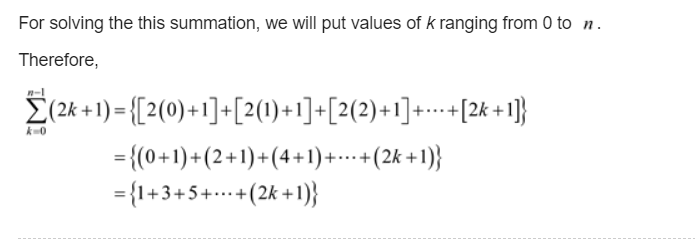

Wouldn't the answer actually:
1 + 3 + 5 + . . . +[2(n-1)+1]
Which would become 2n-1
No?
Nevermind that's wrong
No wait, I think I'm right.
Would love to hear a second opinion
sick steppe
yes it should be 2(n-1)+1
sick steppe
or just.. dont use Chegg in the first place
restive bridge
Chegg got all of the answers for even numbers.
sick steppe
so?
restive bridge
I use the even numbers to reinforce my knowledge.
How else am I to double check the answers for even numbers?
restive bridge
Oh dope, I'll check those out.