#precalculus
1 messages · Page 289 of 1
 leaden jewel
 echo wagon
But if you are doing precalc, the limit definition should be sufficient...
echo wagon
But if you are doing precalc, the limit definition should be sufficient...
If it explains how the function is differentiable at zero
 willow bear
not once did i mention epsilon or delta
(f(x)-f(0))/x has a limit as x goes to zero and that limit is 0
leaden jewel
I don't get it
how do you get that limit for the function bounces from one point to the other
willow bear
you can apply the squeeze theorem
that's the easiest way to show that this limit exists
leaden jewel
okay i'll see that
 noble plume

does anyone know how to do this?
I know how to do it with just the arcsin, but I'm confused now that arccos was added it
*in
 sick steppe
$\tan(\theta-\varphi)$ and use compound angle
 obsidian monolithBOT
moshill1
 sick steppe
@noble plume
 kindred bluff
With the arccos function, you can refer to that as if it was a cosine function but instead of the angle being the value, you just put the adjacent over the hypotenuse ratio.
noble plume
sick steppe
<@!561077787847294976>
I'm kind of confused
tan(theta - p) and use compound angle?
sick steppe
yes
noble plume
kindred bluff
With the arccos function, you can refer to that as if it was a cosine function b...
would the triangle be in quadrant 4
sick steppe
since you can easily find what tan(sin^1(4/5)) and tan(cos^-1(5/13)) is
kindred bluff
It really depends on the angle
noble plume
sick steppe
since you can easily find what tan(sin^1(4/5)) and tan(cos^-1(5/13)) is
so am I supposed to find those two separately and subtract??
sick steppe
yes, then use compound angle for tan(A-B)
$\tan(A-B)=\frac{\tan(A)-\tan(B)}{1+\tan(A)\tan(B)}$
obsidian monolithBOT
moshill1
 noble plume
sick steppe
yes, then use compound angle for tan(A-B)
noble plume
sick steppe
yes, then use compound angle for tan(A-B)
I'll try it 🙂
leaden jewel
noble plume
I'll try it 🙂
If you construct the triangles you'll see that this holds true
$\arcsin \frac{4}{5}=\arctan \frac{4}{3}$
obsidian monolithBOT
osmium
 leaden jewel
$\arccos \frac{5}{13}=\arctan \frac{12}{13}$
obsidian monolithBOT
osmium
 leaden jewel
$\arctan(A)-\arctan(B)=\arctan\frac{A-B}{1+AB}$
obsidian monolithBOT
osmium
 leaden jewel
then you can apply this formula which you can derive by yourself
and since both the angles lie in first quadrant you can simply plug in the values
just letting you know this

 grave tartan
Draw a diagram for 6
For 7, Solve for sin(θ) and use double angles
- Split cos^2(2x) into cos(2x)*cos(2x)
- Use half angles
@noble plume if you don’t know there identities you should learn them
noble plume
grave tartan
<@561077787847294976> if you don’t know there identities you should learn them
I solved #7 for now 🙂
a,b, and c
trying to do 8 atm
grave tartan
Good work
noble plume
grave tartan
Good work
ty 🙂
I'm sorry for bothering u, but do you have any idea what property I need to look up for #8?
I've been searching, and still can't find it rip
grave tartan
It’s all good
Do you know any double angles?
Double angles are just nice angle sum ones
Like $\cos^2{2x}$ is just $\cos{2x}\cdot\cos{2x}$
obsidian monolithBOT
AyeWaddup
 grave tartan
And $\cos{2x}=\cos{(x+x)}$
obsidian monolithBOT
AyeWaddup
 grave tartan
Plug that into the cos sum identity you get $\cos^2(x)-\sin^2(x)$
obsidian monolithBOT
AyeWaddup
 grave tartan
Which can also be written as $2\cos^2(x)-1$ or $1-2\sin^2(x)$
obsidian monolithBOT
AyeWaddup
 grave tartan
Using the Pythagorean trig identity
noble plume
tysm!
noble plume
grave tartan
Using the Pythagorean trig identity
so 2cos^2(x) or 1-2sin^2(x) is the answer?
isn't the cos supposed to be to the first power
 viscid thistle
Yo anyone in here able to help me with a question
 dim rampart
If you had posted the question, sure.
 pure dragon
hate to ask, but does anyone understand limits with square roots lol?
i can't seem to understand when the sign is supposed to be positive or negative depending on the where the square root is and which infinite its going to
@here

i believe i can break it down to:
sqrt ( 1 - 0 ) divided by 3 + 0
but i don't understand how to radical affects the sign of the equation as well as the limit to infinity
 bitter nova
for square roots just apply it to the highest term
so like the top is approximately x^4
because sqrt(x^8)
pure dragon
sqrt(x^8) = x^4
bitter nova
yea
pure dragon
how come sometimes it becomes like: x^2 = - sqrt (x^4)
let me see if i can find an example

@bitter nova
even tho x^5 = sqrt(x^10) --> why does it become negative?? is that because we're finding the limit to negative infinity
bitter nova
that's a really weird way lol
x^5= - sqrt(x^10) because the square root is always positive
and a negative to the 5th power is negative, so you add a minus to make the signs the same
I'd look at it as a minus sign from the x^5 on top, even though that explanation puts it on the bottom
pure dragon
by adding a negative in front of the sqrt, it makes it negative i understand, but ig my question is why am i adding the negative
because the sqrt is in the denom??
bitter nova
uh it's trying to divide by x^5
and to convert it to something similar to the bottom you make it like sqrt(x^10)
pure dragon
because they're equal
bitter nova
but x^5 is negative so you add a minus sign
pure dragon
is there a rule as to why x^5 is negative? would x to the power of an even make it positive?
bitter nova
x^5 is negative because it's a limit to negative infinity
and 5 is odd
square root is sort of ambiguous because like 2 times 2 equals -2 times -2
pure dragon
then how come in the previous example i posted it was to the negative infinite but i didn't make the sqrt neative
bitter nova
but we chose the sqrt(x) notation to always be positive
the one before had a 3x^4
this one is x^5
like in the end all you need to know is the sign of the final limit
so like x^5/sqrt(...) is negative for x-> -inf
pure dragon
 bitter nova
and sqrt(...)/3x^4 is positive for x-> -inf
yea x^5 goes negative for x<0
x,x^3,x^5,x^7... work like that
pure dragon
thats a pattern i noticed, when x < 0 ... the y was negative
when the power was odd
so when the power is odd and i'm going to the negative infinite, then my sqrt will be negative
right?
pure dragon
x^13 going to negative infinite would give a negative sign in the fraction because x<0 gives negative values for y
but if the exponent is even then any value would be positive, keeping the fraction positive
bitter nova
yea
 fleet yew
grave tartan
fleet yew
grave tartan
Specific Keyboard
 granite crescent
hi
um i need help with a question
so i have to determine the value of x
for sin 8pi/23 =sinx
however the catch is that x≠8pi/23
so idk how to solve that
pure dragon
gotcha

 dark sky
i dont know how to do this

 late mica
@noble plume Do you know about power reducing formulas? The power reduction for cos is (1+cos(2x))/2
noble plume
late mica
<@!561077787847294976> Do you know about power reducing formulas? The power redu...
yeah, I think I know that, but I can't imply it into the cos^2(2x) 😦
noble plume
late mica
<@!561077787847294976> Do you know about power reducing formulas? The power redu...
actually, I didn't know that

would this just be cos(5.3), or is the angle something different?
late mica
@noble plume I'm not quite sure what that one is asking...It just looks like something that would need to be evaluated, so I'm not really sure. Maybe it's talking about trigonometric form?
noble plume
maybe, I don't know either rip
late mica
@granite crescent This seems like a rotational type of question...For example, say you're solving sin π = sin x, but x can't equal π. If you simply add a full rotation, you're now at 3 π (because a full rotation is 2 π). So, x = 3 π in this case, which would make it at the same angle, but rotationally different so not actually π. Does this help?
viscid thistle
can someone help me convert r=6cos(2θ)sin(2θ) to rectangular form and explain the process?
i know how to convert polar to rectangular but the 2θ is really getting me
sick steppe
noble plume
would this just be cos(5.3), or is the angle something different?
yes 4.1+1.2=5.3

 steel venture
for 6 you can use sohcahtoa
noble plume
steel venture
for 6 you can use sohcahtoa
could you please elaborate
steel venture
yes
the arcsin(x/y) means that sin(theta) where theta has sides x and y as opposite and hypotenuse (respectively)
so in this case
 narrow helm
I have a question : how can I find the derivative of the cubic function from the square function ?
steel venture
4 is the side opposite and 5 is the hypotenuse
so 3 would be the final leg
and so we have a 345 right triangle
which have specific angles
the same idea holds for arccos(5/13)
so for sohcahtoa we have cah
so arccos(x/y) yields x as the adjacent and y as the hypotenuse
so we have a 5 12 13 triangle
which has specific angles which you can find
obsidian monolithBOT
visual of Petter's ascendance
 noble plume
steel venture
which has specific angles which you can find
noble plume
steel venture
which has specific angles which you can find
ok, I'll try to understasnd what you just said
noble plume
steel venture
are you allowed to use a calculator at all?
no, he said no calculator
steel venture
yeah so what i just said probably wont work hold on
noble plume
rip 😭
noble plume
I'm not using a right triangle to solve it if I do that though right
viscid thistle
what is this called in math ? An amount ?${−2≤x≤2,−2≤y≤4}$
obsidian monolithBOT
zeffs
 steel venture
noble plume
I'm not using a right triangle to solve it if I do that though right
steel venture
noble plume
I'm not using a right triangle to solve it if I do that though right
shit you're right
steel venture
obsidian monolith
**zeffs**
an interval?
 jolly raven
viscid thistle
what is this called in math ? An amount ?$\{−2≤x≤2,−2≤y≤4\}$
jolly raven
viscid thistle
what is this called in math ? An amount ?$\{−2≤x≤2,−2≤y≤4\}$
Inequality?
narrow helm
jolly raven
<@403168504267931659> like $x^3$?
Yes
jolly raven
narrow helm
Yes
Well you can use the definition of a derivative to find it, $\dv{x} f(x) =\lim_{h\to 0}\frac{f(x+h) - f(x)}{h}$$
obsidian monolithBOT
visual of Petter's ascendance
Well you can use the definition of a derivative to find it, $\dv{x} f(x) =\lim_{h\to 0}\frac{f(x+h) - f(x)}{h}$$
```Compilation error:```! Missing $ inserted.
<inserted text>
$
l.56 \end{document}
I've inserted something that you may have forgotten.
(See the <inserted text> above.)
With luck, this will get me unwedged. But if you
really didn't forget anything, try typing `2' now; then
my insertion and my current dilemma will both disappear.``` pure dragon
lim x—>5
((2/x+3)-1/4)/x-5

I can find it with a calculator easily ig but I wanna know why it equals -1/32
Algabraically
 viscid thistle
really don't know what you did
pure dragon
Ik
viscid thistle
but do you have any ideas on how you can algebraically manipulate the numerator in any way?
pure dragon
I can’t plug in the limit because it equals out to 0/0
I mean “direct substitution”
I’ll use the right terminology
viscid thistle
yeah that's the first thing you usually want try out when encountering a limit.
but i'm not talking about that
i'm talking about algebraic manipulation.. are you able to come up with any ideas to algebraically manipulate the numerator?
pure dragon
 viscid thistle
,rccw
obsidian monolithBOT
 pure dragon
When I multiply 2/x+3, does that multiply the denominator by (x+3) as well?

Honestly, I think I’m probably going about this the wrong way.
Bots...
 stuck lark
ty
pure dragon
Ty guys
pure dragon
Nvm
viscid thistle
no, you want to make mathematically valid steps, and you can't just multiply $\frac{2}{x+3}-\frac14$ by $x+3$ just because you want to. yes, the idea you had is what we want, to do common denominator, but that is not how we want to do it. instead of pulling out a $(x+3)$ in the numerator out of nowhere, think of multiplying essentially by 1, which is mathematically valid step as you are not changing the value of the expression by multiplying it by 1. Focusing only on the numerator we have: $$\frac{2}{x+3}\cdot \overbrace{\color{green}{\frac44}}^{1}-\frac14\cdot \overbrace{\color{blue}{\frac{x+3}{x+3}}}^{1}$$ and this way you can use $\frac{a}{b}+\frac{c}{b}=\frac{a+c}{b}$ to do common denominator.
pure dragon
2-1 over (x-5)(x+3)(4)
obsidian monolithBOT
Al𝟛dium
 pure dragon
I’ve never really been good at working with fractions like that. Where you have multiple fractions in the same equation
But thank you for taking the time to explain it to me
Making the numerator have common denominators makes more sense to me anyways than what my friend tried to explain
viscid thistle
i'm glad to hear
now, are you able to simplify: $$\frac{2}{x+3}\cdot {\color{green}{\frac44}}-\frac14\cdot {\color{blue}{\frac{x+3}{x+3}}}$$
obsidian monolithBOT
Al𝟛dium
 viscid thistle
good job.
but use proper parenthesis () to indicate what's the numerator and denominator, like this:
8/( 4x+12***)*** -( x+3***)/(*** 4x+12***)***
in plain text, \verb|a+b/c| actually implies $a+\frac{b}{c}$ instead of $\frac{a+b}{c}$
obsidian monolithBOT
Al𝟛dium
 viscid thistle
and now, try to simplify further from: $$\frac{8}{4x+12}-\frac{x+3}{4x+12}$$ considering once again $\frac{a}{c}+\frac{b}{c}=\frac{a+b}{c}$
obsidian monolithBOT
Al𝟛dium
 pure dragon
It’d be (8 - x + 3) / (4x + 12)
viscid thistle
almost.
viscid thistle
be very careful with the $\color{red}{-}$ in front of the second fraction, this is actually a very common mistake in algebra and you may want to start avoiding it now: $$\frac{8}{4x+12}{\color{red}{-}}\frac{x+3}{4x+12}$$ $$\frac{8{\color{red}{-}}(x+3)}{4x+12}$$
your mistake was not putting () around x+3, in short.
obsidian monolithBOT
Al𝟛dium
 pure dragon
Now it turns into: (8-(x+3)) ÷ (4x² -8x - 60)
viscid thistle
wait why is it 4x²-8x-60?
pure dragon
Doesn’t this still have the x - 5 underneath it?
Because we only make the numerators have common denominators
pure dragon
obsidian monolith
**Al𝟛dium**
.
viscid thistle
pure dragon
Doesn’t this still have the x - 5 underneath it?
yeah we do.
$\lim_{x\to 5}\frac{\frac{8-(x+3)}{4x-12}}{x-5}$
obsidian monolithBOT
Al𝟛dium
 pure dragon
 viscid thistle
pure dragon
Because we only make the numerators have common denominators
viscid thistle
pure dragon
Because we only make the numerators have common denominators
yeah but the common denominator is 4x-12 not any other
when writing up the actual steps remember to always add the "lim" part until you've actually evaluated the limit.
viscid thistle
obsidian monolith
**Al𝟛dium**
but yeah, this is what we are at right now.
are you able to simplify 8-(x+3)?

 viscid thistle
ok i see what you're doing, whenever you are doing simplification, usually you want to keep it as (x-5)(4x+12).
pure dragon
ok, so i shouldn't simplify that much
viscid thistle
no, it's about leaving it in the form that is more easily simplifiable.
viscid thistle
viscid thistle
are you able to simplify 8-(x+3)?
can you please answer my questions?
pure dragon
viscid thistle
are you able to simplify 8-(x+3)?
it's not +5
it's 8 - (x+3) with x being 5 which simplifies to zero.
viscid thistle
yeah. +3
pure dragon
8 - (5+3) ==> 0
viscid thistle
don't go too quick.
pure dragon
ok
pure dragon
Ahhhh
it turns into 8-x+3 because there is a -1 in front of the parenthesis
i completely forgot about that lol
is that what you're talking about
so it's -x +5
viscid thistle
no, be aware of distributing - properly, 8-(x+3)=8-x-3=5-x
viscid thistle
pure dragon
so it's -x +5
yeah.
reminding you what we have right now:
$\lim_{x\to 5}\frac{\color{green}{-x+5}}{{\color{green}{(x-5)}}(4x+12)}$
pure dragon
(-x+5)/((x-5)(4x+12))
obsidian monolithBOT
Al𝟛dium
 pure dragon
idk how to write in the language for the bot
viscid thistle
can you notice something?
pure dragon
they're going to cancel out aren't they
viscid thistle
yeah, it will end up cancelling but right now we can't.
(-x+5)/(x-5) isn't exactly 1
can you algebraically manipulate (-x+5) in a certain way so that we can cancel it with (x-5)?
let me emphasise this:
pure dragon
-1(x-5)
pure dragon
Whoops, wrong sign
viscid thistle
are you able now to cancel and plug in 5?
pure dragon
Sorry for taking sm time and having you guide me thru it but it really means a lot to me
viscid thistle
for the record, i'd recommend reviewing algebra specifically fractions/manipulating them, you are going to need them.
don't be sorry for taking time, that's totally fine, you're welcome.
 noble plume
noble plume
noble plume
also, I solved #9, but I'm not sure if the sin, cos, and tan are + or -
viscid thistle
is complex numbers regarding modulus and argument considered precalculus?
stuck lark
yes
noble plume

These are what I got for 8 and 9
I'm not sure if I got either one correct, actually think I got both incorrect
 tired star
hi i really need help i’m failing my math class rn and there’s 3 weeks left of school and i’m a senior and it’s the only thing that’s gonna stop@me from graduating
does anyone have a help video or soemthing that can help me with this
 sick steppe
Quiz 2 
tired star
yeah i’m not asking anyone to do it for me i just need a tutorial video or something so i can do it myself
if it matters that much i’ll just send a different problem on a hw assignment
 lone acorn
 boreal crag
So for the quotation rule right?
in the formula of

Can you use v and u interchangeably
forexample for the question such as

can x-1 be v as well instead of x+1
Wait so in the proof, it was using turning the denominator into v(x)^-1 which means that the denominator must be the v
 serene heath
yes the bottom function is v
 muted steeple
hey, can anyone help me figure out how to get the equation for the parabola from the graph?
willow bear
can you show the graph?
 daring drum
muted steeple
hey, can anyone help me figure out how to get the equation for the parabola from...
daring drum
muted steeple
hey, can anyone help me figure out how to get the equation for the parabola from...
I'd use vertex form, y = a(x - h)^2 + k. You know where the vertex is, at the point (h, k). You know where a is positive or negative based on whether the parabola curves upwards or downwards respectively. The only annoying part is figuring out a, which you can do by plugging in x = h+1 (whatever h is). You know which y value this should be equal to from the graph, and you'll get a very nice equation which tells you a in terms of y and k.
(then if you need to convert from vertex form back to standard ax^2 + bx + c form, just FOIL (x-h)^2 and simplify)
viscid thistle


 potent drift
any self-learnining course you know is good? edx, coursera, udemy?
 clever pecan
I personally like coursera
it has a lot of free courses
(not everything is free though)
udemy has more paid courses than coursera, but the quality is good
however, I'm not familiar with edx, I'll check it out
@potent drift
potent drift
I have signed up for two in EdX - algebra-like there seem to be more (or at least more structured!) - let me know if you see any interesting @clever pecan pls
thx for the suggestion
pure dragon

Do the negative three in the numerator and denominator cancel out first?
Plugging in equals zero so direct substitution doesn’t work
<@&286206848099549185>

 mild swan
pure dragon
I need to take the derivative first but can someone explain the how and why?
mild swan
pure dragon
I need to take the derivative first but can someone explain the how and why?
you get a 0/0 situation
This leads to L'Hopital's Rule
Note: when differentiating the numerator, expand the polynomial and use the power rule
@pure dragon this help?
sick steppe
pure dragon
you dont actually need L'hopital like it suggests
 solemn flame
How can I graph this
 jolly raven
First I'd find x intercepts and y intercept
 bold fiber

Can anyone help with this please?

I tried evaluating it and trying to simplify it but its even more complicated, any tips?
mild swan
not legible unfortunately
bold fiber
@mild swan it's the limit as x approaches infinity of $$x^2\left(e^{2/x}-e^{2/(x+1)}\right)$$
obsidian monolithBOT
nas
 mild swan
∞ * 0 situation i see
maybe bring the x^2 in the numerator into a 1/x^2 in the denominator and try lhopitals
bold fiber
mild swan
maybe bring the x^2 in the numerator into a 1/x^2 in the denominator and try lho...
that would definitely work, sadly lhopitals is not accepted in our education system
mild swan
rip
hmm
can you maybe look at the exponents, create common denominators, and then factor?
bold fiber
mild swan
can you maybe look at the exponents, create common denominators, and then factor...
I didn't really understand your point
mild swan
if you try to rewrite 2/x and 2/(x+1) so they have the same denominator, then maybe you can factor something out
like rewrite 2/x as $\frac{2x+2}{x^2 + x}$
obsidian monolithBOT
Lighthearted Sand Crab
 mild swan
and like rewrite 2/(x+1) as $\frac{2x}{x^2 + x}$
obsidian monolithBOT
Lighthearted Sand Crab
 mild swan
Maybe you can factor out an $e^{\frac{1}{x^2+x}}$
obsidian monolithBOT
Lighthearted Sand Crab
 mild swan
i have no idea
lemme try this myself
wait, what if you split it up into two limits
distribute the x^2
not working for me
bold fiber
Same! this is really confusing
mild swan
idk which grows/decreases faster: x^2 or e^(1/x)
tempted to use lhopitals or desmos bu there's gotta be a way
what was the original problem?
got a picture?
wait nvm lol it was just evaluate the limit
were you given any other information?
Anyway, the result will definitely be positive since $e^{\frac{1}{x}} > e^{\frac{1}{x+1}}$ as x goes to infinity.
obsidian monolithBOT
Lighthearted Sand Crab
 bold fiber
from desmos, the limit equals 2 but i can't figure out any way to come up with such result
bold fiber
mild swan
were you given any other information?
not at all
mild swan
oof
probably lhopitals
that's the only way i can think of doing this limit
try asking in maybe #calculus
 past meadow
double angle formula for sin in reverse
dim rampart
3sin(10x), you should then get.
 tough robin
what is the square root of -1+\sqrt(3i)
tough robin
 viscid thistle
tough robin
viscid thistle
tough robin
so there are two ways you could do this:
#1 set sqrt( -1+ sqrt(3)i ) = a+bi, square both sides, match real and imaginary parts to make a system of equations, and solve for a and b
#2 convert -1+sqrt(3)i to polar form, then halve the argument and take the square root of the modulus to get a new number in polar form which you then convert back to rectangular (a+bi) form
past meadow
ugh thats ugly you'll have to figure out sqrt(3i) in rectangular form first
viscid thistle
past meadow
ugh thats ugly you'll have to figure out sqrt(3i) in rectangular form first
its not that ugly since the angle of -1+sqrt(3)i is pretty nice
viscid thistle
oh
past meadow
i was calling the question ugly
past meadow
so yeah the method is to use one of dans methods to get sqrt(3i) then you have sqrt(-1+whatever that is) which you'll have to use one of those methods again to find
 rich grotto
 sick steppe
,rotate
obsidian monolithBOT

 late gull
guys i need help on a simple problem https://i.gyazo.com/thumb/1200/5dc1f5a8c99ccd716f0878c452d725bf-png.jpg


 red sky

 lime sequoia
@late gull do you know the sum angle formulas?
late gull
no i forget
viscid thistle
anyone in here able to help me with a question
willow bear
 viscid thistle
 willow bear
okay this algebra so far is correct
except, since it looks like you want the \textbf{general} solution, you'll need to write $$3x = \tan^{-1}(2) + k\pi, \quad k \in \bZ$$
viscid thistle
I dont know how to find all the x's
obsidian monolithBOT
Ann
 viscid thistle
I understand that
viscid thistle
but there are multiple x's
willow bear
yes, and?
does that somehow create a magical forcefield in front of you that's stopping you from dividing both sides by 3?
 steel raft


 faint basin
f(3+x)=(3+x)^2= 9+6x+x^2 f(3)=9 => the limit goes to 0 is (6x+x^2)/x
that is 0/0, we can apply l'hopital and we get lim 6+2x/1 which is 6
 faint basin
 stray hedge
how would u solve this?
stray hedge
how would u solve this?
integration
integrating the second derivative will get you the first order derivative and you can find the constant as you have those conditions there
after you found the first derivative you integrate again, find the constant and thats ur f(x)
integration goes brr
faint basin
np
 echo condor


I have something like this but i feel that tan7theta does not equal y/x because that would be tan theta
serene heath
try multiplying both sides of that equation by r then converting to cartesian @echo condor
echo condor
so rtanr=rtan7theta
serene heath
i meant r=7theta
serene heath
sorry for some reason i thought that was sin theta on the right there
youre kinda almost there youll have sqrt(x^2+y^2) on the left and u know theta is arctan(y/x)+kpi, cuz tan is periodic
echo condor
serene heath
youre kinda almost there youll have sqrt(x^2+y^2) on the left and u know theta i...
yeah but tan7theta cant be y/x cause tantheta is y/x
 quartz inlet
Given (x-1) (x-3) ^2(x-k) <=0. Find sum of all values of k such that this inequality has exactly 20 integer solutions.
I am getting the answer as 2 but the answer given is 3 . Can someone please tell how to solve this
viscid thistle
quartz inlet
Given (x-1) (x-3) ^2(x-k) <=0. Find sum of all values of k such that this inequa...
was this the original problem?

or this

 jolly raven
which base is larger?
 harsh cipher
log(x)
harsh cipher
if you graph it it's the opposite?
jolly raven
ln x will grow faster bc it takes quicker to get to 2.5ish than 10
jolly raven
harsh cipher
if you graph it it's the opposite?
?
harsh cipher
ln(x) increase faster?
jolly raven
yeah
think about it like this
e^x grows slower than 10^x right?
since e is smaller than 10
harsh cipher
Yes
jolly raven
logarithms are inversions of exponential functions
so you invert almost everything about the function
since first its that e^x is slower
and we invert it
its now that ln(x) grows quicker
harsh cipher
Ok maybe I didn't understand over the interval (0,1)
jolly raven
wait
over (0,1) might be a different story then
i think the inversion rule really only applies for a positive y
but when its negative u itd change
ah
alright
well now we gotta think about it like this
harsh cipher
okay
jolly raven
so we said that 10 is bigger than e right?
harsh cipher
Yes
jolly raven
but remember than when we have a negative as the expoenent its a fraction
harsh cipher
Yes
jolly raven
so taking reciprocals is the same
if 10 is bigger than e and we take the reciprocal
then 1/10 is smaller than 1/e
harsh cipher
Ok
jolly raven
but overall 1/10 is farther from 10 than 1/e is from e
so 1/10 would have to grow faster to reach 10 at the same point as 1/e
so then log(x) grows quicker over that domain
but then for the (1, infty) part u just do the one i talked about earlier
so that should be all u need
jolly raven
I'd look at how the numbers are being added successively
 gusty glade
Does anyone know the best book on Integral calculus?
gusty glade
 lone fulcrum
what are the numbers?
lone fulcrum
what are the numbers?
42, 47, 52
gusty glade
why?
jolly raven
+3 +5 +3 pattern
Last iteration was the last +3
So you would continue from the top
past meadow
jolly raven
+3 +5 +3 pattern
that doesn't work for every term in the sequence
23, 26, 29
oh i get you
gusty glade
jolly raven
+5 +3 +3 is there
hmm ok bro my bad
jolly raven
gusty glade
hmm ok bro my bad
Nah ur good
gusty glade
jolly raven
Nah ur good
actually i thought there was a repetition of 5
wrong answer tho
i will try to focus on my thinking again
gusty glade
no pal actually i felt in confusion
even that was a basic.
 fringe raft
gusty glade
Does anyone know the best book on Integral calculus?
fringe raft
gusty glade
Does anyone know the best book on Integral calculus?
Depends on which country and the topics you need
gusty glade
fringe raft
Depends on which country and the topics you need
anywhere and on integration
fringe raft
Definite integral or indefinite,Are you clear with indefinite ?
gusty glade
fringe raft
Definite integral or indefinite,Are you clear with indefinite ?
both will be good!
is there any book like that?
gusty glade
fringe raft
Definite integral or indefinite,Are you clear with indefinite ?
not pretty good with indefinite
fringe raft
gusty glade
both will be good!
is there any book like that?
Joseph edwards integral calculus is a good book which you can try
gusty glade
fringe raft
Joseph edwards integral calculus is a good book which you can try
sure, thanks!
A Treatise On The Integral Calculus With Applications, Examples And Problems
Joseph Edwards
this one?
@fringe raft
fringe raft
There’s another book titled integral calculus for beginners you can look into that if you’ve not enough practice
gusty glade
ok bro thanks!
 stone temple
Hey
Not sure is this fits here but
Is good understanding of algebra I and some basic trig enough for precalc then calc?
willow bear
probably.
stone temple
Okay thanks
 echo wagon
You can use the rational roots theorem to get the roots originally
muted steeple
i know nothing about that
echo wagon
But since they give you solutions, you could just plug in to see which ones are solutions
muted steeple
neither did this course said anything about it.
yeah i was thinking the same but then what's the point of this exercise?
echo wagon
I'm surprised that you would get this question without having done RRT
That's the usual way for solving cubics
Use RRT to find one rational root, then do long division to get the quadratic factor, then find the solutions of the quadratic
 echo wagon
Yes, that's right
The rational roots theorem just tells you which numbers to try at the start
muted steeple
is an advanced concept?
echo wagon
No
Google to see it in action
Basically it tells you something about all rational roots of a polynomial
muted steeple
ok
echo wagon
So that it limits the numbers you have to check to those that satisfy the condition
For all rational roots p/q, p divides the constant term and q divides the leading coefficient
So you can just write out the factors of the constant term and leading coeff, and then divide them one by one and test all those numbers.
All other rational numbers won't be roots so you don't have to try them
muted steeple
looking at the wiki atm.
 muted steeple
it's an intro course to calculus on coursera
it had a lot of good reviews
so i decided to try it
echo wagon
If you don't eliminate any numbers to test, there are infinitely many to try. With RRT, you limit yourself to a finite number of numbers to test
What's the course?
muted steeple

Coursera
Offered by The University of Sydney. The focus and themes of the Introduction to Calculus course address the most important foundations for ... Enroll for free.
this one*
i really want to get to week 3 with good base understanding.
echo wagon
I will audit it now to check the content lol
I'm sure it's fine
Just learn the RRT to help yourself
echo wagon
Two integers are relatively prime if their gcd is 1
It means they don't share any factors except 1 and -1 which are always common factors of any 2 numbers.
 echo wagon
No
muted steeple
okay so the leading coefficient in my case is not 1.
so i need to find factors of p and q that are relatively prime?
and that's all the numbers i should be plugging to find the root?
oh wow that worked like a charm lmao
amazing stuff.
thank you.
it works for all degrees of polynomials?
echo wagon
Yep
All degrees
Ofc there can still be irrational roots (or complex roots), but this will give you all rational roots
 woeful island
Could I check my answer I got for a question here, or should I go to the questions section?
(because the question section is pretty packed)
woeful island
just #7, had to find the value of K
 woeful island

willow bear
i know i'm several hours late because sleep
but the problem statement is incomplete. you want to find the value of k under what conditions?
woeful island
its ok, i got a friend to help me out lol
 daring wolf
Im so scared to take pre calculus next year
 calm vine
It's not too bad don't worry
 loud marsh
whats the notation for x is the element of all real numbers such that x cannot equal (more than one number)
i know for one number it would be
{XER|x=/=(whatever number)}
loud marsh
ya but i mean when there is more than one number that x cannot equal
like lets say x cant be a or b
how do you write that
obsidian monolithBOT
moshill1
 sick steppe
x cant be a or b, and a and b arent the same
ie x cant be 2 distinct values, but can be everything else in R
loud marsh
okay so what if it was like x cannot equal 1 and 2
you dont need to say 1 and 2 arent the same right
loud marsh
it would just be {xer|x=/=1,2}?
loud marsh
sick steppe
so just ignore the 2nd condition of what I wrote
okok
sick steppe
yes
 grizzled blade
hey!
im in desperate need

of help with this question
this is a no calculator
question
for the record
obsidian monolithBOT
moshill1
 grizzled blade
yeah
i got that far
but how do i find the values for those logs?
thats what im stuck on
sick steppe
3=6/2
grizzled blade
i see
sick steppe
and you know what log 6 and log 2 are
obsidian monolithBOT
moshill1
 sick steppe
where did you get 1.3?
grizzled blade
oopd
o mean
sorry i was looking at the wrong one
so log7^3 is 0.45
and log 7^8 is
1.4?
sick steppe
grizzled blade
so log7^3 is 0.45
?
sick steppe
$\log_7{4}\approx 0.7$
obsidian monolithBOT
moshill1
 sick steppe
right?
sick steppe
reading
obsidian monolithBOT
moshill1
 sick steppe
but by log laws, $0.5\log_7{4}=\log_7(4^{0.5})$
obsidian monolithBOT
moshill1
 grizzled blade
yes
obsidian monolithBOT
moshill1
 sick steppe
so you need log_7(8)
but 8 = 2^3
so multiply both sides by 3
$\log_7{8}\approx 1.05$
obsidian monolithBOT
moshill1
 sick steppe
same logic of multiplying both sides by 0.5
cause I can use log laws to get 2^3 inside the log
$\log_7{2}\approx 0.35\implies 3\log_7{2}\approx 1.05$
obsidian monolithBOT
moshill1
 grizzled blade
i see
ok that makes sense
so how does this help us find the orginial values we need to find
grizzled blade
we found log_7(8) correct
sick steppe
$\log_7{3}=\log_7\left(\frac{6}{2}\right)=\log_7{6}-\log_7{2}\approx .9-.35$
obsidian monolithBOT
moshill1
 sick steppe
you already have log_7(8)
grizzled blade
sorry bro this shit
is like
a forigen language
to me
its just this one problem on my entire damn worksheet
do you think you could write this all down on a piece of paper so i can see your work?
its juts so confusing tracking all of this
im sorry man
sick steppe
it's basically how can you make numbers out of 6 4 and 11 given multiplication and division
grizzled blade
yeah
ill try it again
thank you for your help
i have the answer
but
im still figuring out
how she got it
(my teacher)
sick steppe
yeah no worries
grizzled blade
im gonna try it again
ill lyk if i need help, thank you man
hmm so i went and did the entire thing @sick steppe
my final answer was -0.35
i got log7(3) is 0.7
log7(2) is 0.35
sick steppe
how did you get that?
sick steppe
yes
grizzled blade
ok so
from there
i did log7(2) + log 7(3) = 1.05
i know the value of log 7^2 is 0.35
sick steppe
2*3 isnt 8
sick steppe
yeah, so you'd get 3log_7(2)=1.05, which is back where we started
sick steppe
$\log_7{3}=\log_7{6}-\log_7{2}$ as I previously said
obsidian monolithBOT
moshill1
 sick steppe
and you know both log 6 and log 2
sick steppe
cause 6/2=3
grizzled blade
i see
sick steppe
and log laws
sick steppe
so $\log_7{3}\approx 0.55$
obsidian monolithBOT
moshill1
 sick steppe
yes
sick steppe
,w calculate log_7(3/8)
obsidian monolithBOT


 Requested by moshill1#9771
grizzled blade
Requested by moshill1#9771
grizzled blade
i just get confused witth log rules
thank you
yo
@sick steppe

could you go through this one with me as well
im sorry
sick steppe
yes
sick steppe
cbrt(8)=2, but yes
grizzled blade
so log 2 is 0.3
sick steppe
yes
sick steppe
yes
grizzled blade
ok yes that worked
sick steppe
,w calculate log_9(4)
obsidian monolithBOT
 Requested by moshill1#9771
grizzled blade
Requested by moshill1#9771
grizzled blade
thank you
@sick steppe hey so

i thought i had this one
but i was clsoe
i don't know where my mistake is so im just gonna tell you what i did
first thing i did was find log(3)
i got 0.55
after that i noticed 2^5 is 32
so i went to find log(2)
i got 0.35 for log(2)
i then multipled that by 5
and got 1.75
and from there did 1.75 - 0.55
and got 1.2
but the answer is 1.1
@sick steppe you have any idea where i went wrong?
grizzled blade
,w calculate log_8(2)
obsidian monolithBOT

 Requested by Flame#0004
grizzled blade
Requested by Flame#0004
grizzled blade
,w calculate log_8(11)
obsidian monolithBOT
 Requested by Flame#0004
grizzled blade
Requested by Flame#0004
grizzled blade
,w calculate log_8(3)
obsidian monolithBOT
 Requested by Flame#0004
grizzled blade
Requested by Flame#0004
grizzled blade
,w calculate log_8(2)
obsidian monolithBOT
 Requested by Flame#0004
viscid thistle
Requested by Flame#0004
viscid thistle
Is this a place I can find someone to help me understand concepts I am trying to learn in my course?
jolly raven
It's more like you can ask for homework help.


 plain turtle
Determine which quadrant the terminal side would lie given the following information: sin(theta) = -21/29; cot(theta) < 0
^ can someone help with this?
Would appreciate
 somber yew
@plain turtle What have you thought so far?
 willow bear
i mean...
1 + 1/2 + 1/3 + 1/4 + ... is a divergent series
that's the issue
you're subtracting infinity from infinity
and even the alternating harmonic series, ie what you start with, isn't absolutely convergent, so extra care needs to be taken in manipulating those
@vale basin
 vale basin
I found the answer already but still thanks 😉
 stone vortex
my class is actually calculus, not precalculus but i feel like this is a pretty basic concept and #calculus is busy lol so..

i did a FORTY rectangle approximation and its not close enough to the answer, in the calculator it calculated 7021.7143 for me
is there a better algebraic way to solve this instead of rectangle approximation? i didnt really pay enough attention in class and my finals tomorrow 😬
 ebon sorrel
obsidian monolithBOT
ebon sorrel
obsidian monolithBOT
Wew Lads Tbh
 stone vortex
well another issue there
we're not allowed to use calculators, we have to do everything in excel
ill figure out how to put it in excel ig
jolly raven
But integrating it is so easy
stone vortex
ive prob opened the textbook twice the whole semester tbh i just figured stuff out on trial and error
ik its stupid but
im lazy and its been working
jolly raven
$\int x^n \dd{x} = \frac{x^{n+1}}{n+1}$
obsidian monolithBOT
visual of Petter's ascendance
 jolly raven
If u have a coefficient before the exponent u just multiply the answer by it since it isn't affected by x
@stone vortex so u should just integrate it
sick steppe
jolly raven
$\int x^n \dd{x} = \frac{x^{n+1}}{n+1}$
assuming n!=-1
 hasty plinth
 obsidian monolithBOT
jolimath

 zealous cosmos
Try 0, 90, 180, 270 to start ...
 verbal shell
<@&286206848099549185> this problem was never answered
 fringe raft
verbal shell
<@&286206848099549185> this problem was never answered
fringe raft
verbal shell
<@&286206848099549185> this problem was never answered
f” tells us about the concavity of the curve if it’s >0 then it’s concave and if it’s <0 it’s convex. The derivative tells about the slope at a particular point
verbal shell
fringe raft
f” tells us about the concavity of the curve if it’s >0 then it’s concave and i...
wait which one is concave up and concave down
jolly raven
sick steppe
assuming n!=-1
What
fringe raft
verbal shell
wait which one is concave up and concave down
For concave up f” >0
Think of it looking at a cup from the top Concave up looks like a cup
 blissful peak
the question is, say there are 5 break out rooms, 4 people per break out rooms, and you have 9 friends. whats the probability of getting into a break out room with one or more of your friends.
i got ~83% and i just want to know if its correct or wrong
 viscid thistle
blissful peak
the question is, say there are 5 break out rooms, 4 people per break out rooms, ...
viscid thistle
blissful peak
the question is, say there are 5 break out rooms, 4 people per break out rooms, ...

so ~83% would be wrong
P(room with one or more of your friends)=1-P(room with none of your friends)
each room has 4 people
20 people in the class
10 non-friends, you, and 9 friends
so lets say you're in some room, there will be 3 other people
19 choose 3 total ways to choose 3 other people to form the room
10 choose 3 ways to choose 3 non-friends so that you end up in a room with none of your friends
P(room with none of your friends) =(10C3)/(19C3)
P(room with one or more of your friends)= 1-(10C3)/(19C3)
sick steppe
jolly raven
What
If n is -1, the integral doesn't follow reverse power rule
 storm plume
Hey guys, Im a highschool student, and i current am struggling at vector geometry. I was wondering had some recommendations on where i could go to get harder geometry vector geometry?
viscid thistle
if you are struggling then shouldn't you actually learn the basics ? 
storm plume
i have lern't the basic....i just need to ensure that by doing harder questions i can ensure that i am prepared for everything in the exam
somber yew
That doesn't sound like an effective learning strategy.
Try working out your basics first.
If it's a school exam, work through the contents covered in your class through the prescribed textbook.
Khan Academy could be a useful supplement.
jolly raven
sick steppe
If n is -1, the integral doesn't follow reverse power rule
I was confused bc I thought u were saying n factorial
sick steppe
n!=1
jolly raven
Yeah
sick steppe
!= means not equal
sick steppe
yes
blissful peak
viscid thistle
oh yea i get it now thank you
 civic sierra
$\int \frac{2ax+b}{ax^2+bx+c}\dd{x} = \ln{|ax^2+bx+c|} + C$
obsidian monolithBOT
.itsjustnai
 civic sierra
Is this correct?
I assume it is because I've seen it used in a couple of problems, but can someone show me how they got it?
nvm i figured it out
viscid thistle
In vectors, How can directions be in degrees
sick steppe
viscid thistle
In vectors, How can directions be in degrees
cause angles can be measured in degrees
viscid thistle
sick steppe
cause angles can be measured in degrees
so degrees replaces left and right
right?
sick steppe
cartesian vectors can be defined by a distance and a rotation
so you rotate however much to look at the destination, then extend there
for example if you want the vector [1,1], you rotate 45 degrees CCW from the pos x axis, then extend to be sqrt(2) away

 sly osprey
 viscid thistle
relearn what irrationals mean
and how to find one between 2 numbers
full context of that ?
 willow bear
@pseudo furnace how familiar are you with angle sum, angle difference, and double-angle identities?
 pseudo furnace
Not very
It’s a new unit
This isn’t even for a grade tho, I just don’t want my teacher to think I’m an idiot lol
@willow bear
willow bear
hrm
okay. let's see.
since i'd like to know exactly where your knowledge gap lies, here's a simpler question:
cos(t) = 0.6 and t is in quadrant 4; find the value of sin(t)
would you be able to do this one?
pseudo furnace
Unfortunately no
willow bear
mkay
okay, are you at least familiar with the pythagorean identity?
i.e. sin^2(x) + cos^2(x) = 1
pseudo furnace
Ya
willow bear
okay
why don't you try applying it to this question i posted then
you'll need to learn how to do it in order to tackle the more complicated ones you've posted above.
willow bear
...welp
pseudo furnace
Sry:(
willow bear
i mean, ok, you can look up the relevant trig identities on your own time since i gave you their names
willow bear
willow bear
<@462414436246749184> how familiar are you with angle sum, angle difference, and...
in this message
 blazing raven
Just multiply two arbitrary, length 1 complex numbers.
Real parts a, c are cosine and then b, d are sine.
Ditto for the expression after multiplying.
(a + bi)(c + di) = (ac - bd) + (ad + bc)i
-->
x = (ac - bd)
cos(r + t) = cos(r)cos(t) - sin(r)sin(t)
&
yi = (ad + bc)i
sin(r + t) = cos(r)sin(t) + sin(r)cos(t)
willow bear
i doubt that they're familiar with complex numbers at this point
blazing raven
Eh fair enough.
viscid thistle
yeah no i am not sure where the 43 comes from
someone else should be able to help
 shut shuttle
Is a continuous and decreasing/increasing function f always a bijective function?
I think it has to be strictly monotonic and then only it can be a bijection
Can someone confirm?
stuck lark
@shut shuttle don't really need continuous. just strictly monotone is sufficient
shut shuttle
Okay thanks
echo wagon
@shut shuttle when you say a bijection, what are you using as the codomain?
It's definitely injective
But it depends on what your codomain is whether it is subjective
For example, $f: \bR \to \bR, f(x) = e^x$ is strictly increasing but not bijective because the codomain $\bR$ does not equal the range. If you instead made it $\bR \to (0, \infty)$ then it would be bijective.
obsidian monolithBOT
Lunasong the Supergay


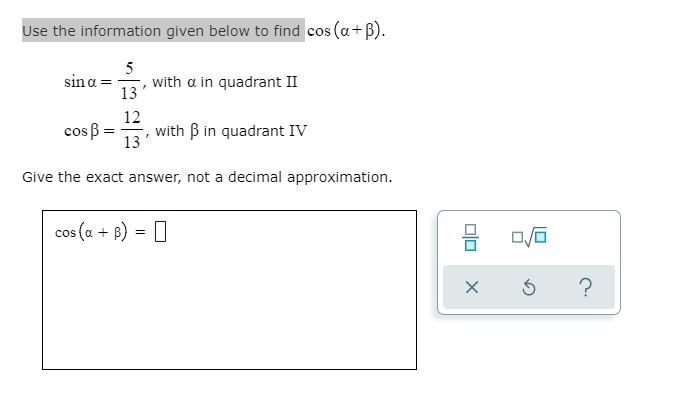
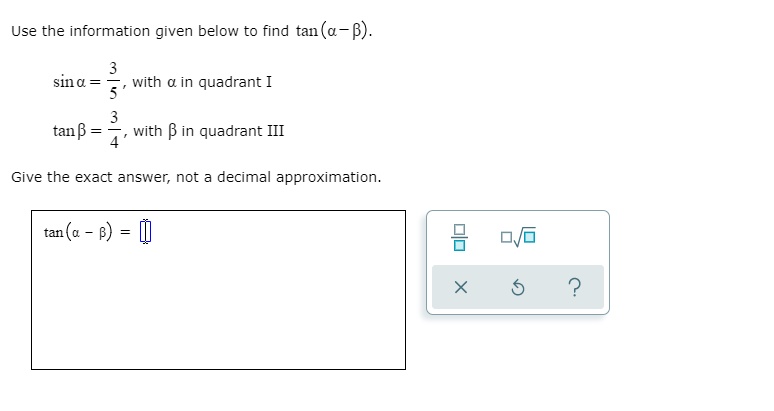
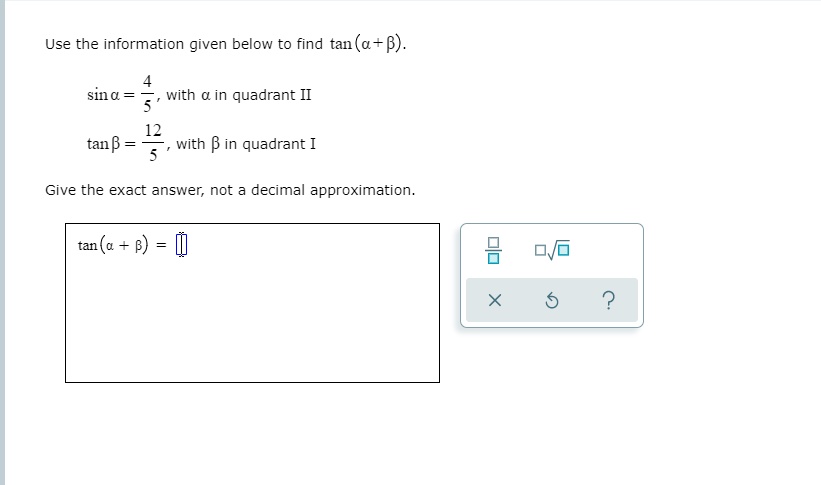 echo wagon
Looks good
muted steeple
no way to isolate x tho?
echo wagon
... Can you isolate x in 2x = x + 1?
Here 2 is just replaced with ln(6) but you do the same thing
shut shuttle
I don't know what the codomain is, I just know that the range is R and f is a continuous and decreasing function. Can I deduce that f is a bijective function?
echo wagon
You know that the range is R?
shut shuttle
$f: \bR \to \bR$
echo wagon
And by range do you mean image
obsidian monolithBOT
Schrödinger's cat
