#precalculus
1 messages · Page 288 of 1
 viscid thistle
 lilac storm
how is that in y=mx+b form?
 dim rampart
She is right though
viscid thistle

I got the first two derivatives
And from it I got that inflection points 2,2/e^2
lilac storm
yes i have that
viscid thistle
And then you have to find the derivative f'(2)
dim rampart
$y=-\frac{1}{e^2}x+\frac{4}{e^2}$ should be the answer
 obsidian monolithBOT
168995235206721
 viscid thistle
Yeah that’s right
dim rampart
But seriously, how isn't this calculus? American education system is weird...
viscid thistle
It’s calculus tho
dim rampart
then why are we in pre calc
viscid thistle
I have it now in calculus lol
dim rampart
channel
viscid thistle
Idk
lilac storm
ok, thank you so much fro your time and help, i really appreciate it
viscid thistle
dim rampart
channel
But I’m pretty sure it’s calc
 normal night
viscid thistle
But I’m pretty sure it’s calc
normal night
viscid thistle
But I’m pretty sure it’s calc
why in the world would u name yourself pretty girl
😔
people these days
viscid thistle
Why lol??
normal night
im gonna name myself pretty boy now
Guys
i need help
how can i be good at math?
viscid thistle
Study well
normal night
viscid thistle
Study well
didnt help at all
 dusk edge
 final cypress
for vectors?
final cypress
for vectors?
what do you need
dusk edge
normal night
how can i be good at math?
read math books, you'll get interested, you'll get better
viscid thistle
hii im a junior at highschool and im wondering where should i start learning calculus? someone told me here so im asking for resources & guides
dusk edge
viscid thistle
hii im a junior at highschool and im wondering where should i start learning cal...
mit opencourseware
viscid thistle
thanks
viscid thistle
dusk edge
mit opencourseware
also
is there like something i need to understand before going to calculus
viscid thistle
ok
dusk edge
you'll see what you don't understand and than you should watch a seperate vid on that topic
viscid thistle
no i was asking when do...like... change? idk how to say it, english is not my first language. but when do i like change from precalculus to calculus
dusk edge
viscid thistle
no i was asking when do...like... change? idk how to say it, english is not my f...
im sorry idk know what precalc is im not from america
all i know is like calculus is just what they teach at universities
dusk edge
u just need to know your algebra and trigonometry
viscid thistle
i know that
dusk edge
then you should follow the calc course on mit ocw
its on yt
and for stuff you don't understand you should watch seperate vids on that
dusk edge
good luck with your studies!
 solemn flame
Partial fraction decomposition

 placid ledge
solemn flame
Partial fraction decomposition
placid ledge
solemn flame
Partial fraction decomposition
is that just simplifying the fraction?
solemn flame
I have to make a new fraction and solve for A and B once I set it up
dusk edge
factor the denominator
 strong ermine

 acoustic harbor
sin x is always less than or equal to 1

 lilac storm
oh, ok
dusk edge
lilac storm
can anyone please help me start off this question?
U sub
lilac storm
yes i know but i just need helping starting it off?
lilac storm
do you mean dx= du/6x^2?
dusk edge
Yes
lilac storm
and by the way, i already have this
dusk edge
How do you mean?
lilac storm
yeah so let u = 2x^3 - 1, took the derivative of it which is 6x^2 and then rearranged it to get dx = du/6x^2, but now i am stuck?
dusk edge
So 3x^2 is half 6x^2
lilac storm
sorry, what?
dusk edge
3x^2 is the half of 6x^2 right?
lilac storm
oh, ok
lilac storm
i have 1/2 du?
dusk edge
And then use powerrule
dusk edge
lilac storm
i have 1/2 du?
You forgot the u^4
lilac storm
so i have 3x^2 times du/6x^2, how do you get u^4 from this?
dusk edge
You set u = 2x^3 - 1 right
lilac storm
yes
lilac storm
so when setting it up, is it 3x(u)^4 times du/6x^2?
lilac storm
yes, my bad
lilac storm
so from here i have 1/2 (u)^4 du, is this correct?
lilac storm
yeah so do i have 1/2 times u^5/5?
dusk edge
Yes
lilac storm
then i substitute for u
lilac storm
sorry what is FTC1?
dusk edge
Look it up
lilac storm
then i just plug in 1 and -1 and subtract them to get the answer, right?
dusk edge
Yes
lilac storm
ok, thank you so much for your help, i really appreciate it
dusk edge
Don’t mind me asking but how old are you
dusk edge
lilac storm
ok, thank you so much for your help, i really appreciate it
Oh yeah no problem
 stiff yew
wait why is the slant asymptotic wrong? how is it x+8?
 obsidian monolithBOT
uosɹǝdʎddɐɥʎɹǝʌ
 dim rampart
yes
stiff yew
What type of function has no Vertical asymptote? Like what does it need to have?
Trying to do this

 unborn blade
Hi am I doing this right?

 past meadow
looks right, up until the eq in the last line
you got its slope right but the y intercept is wrong
past meadow
still seems wrong
past meadow
it is not b=4
unborn blade
8
past meadow
yes
past meadow
april foolsing me


 astral mantle
 fallow hinge
hey guys, I'm learning de moivre's theorem, and I'm struggling on solving the solutions
when z^n = equation,
I understood up until the part where
the teacher wants us to substitute k values with -1, 0, 1
or like -2, -1, 0, 1 depending on n value

why do we do that?
 willow bear
you see how you've expressed the angle inside the cis as 15+90k?
you will want all integer values of k that will make 15+90k lie between -180 and +180.
also it's "z^n = number" rather than z^n = equation
@fallow hinge
does this make sense to you?
. . .
fallow hinge
Uhh
but why specifically near 0?
sorry abt the late response I'm still working on that
willow bear
what do you mean by "near 0"?
fallow hinge
notice how the k values are near 0
-2, -1, 1, 2
so the values inputted into k are near 0 and 0
willow bear
well, that's only a consequence of your angles having to be between -180 and 180.
if your range for angles was 0 to 360, your k would always go from 0 to n-1
fallow hinge
I understand now, thank you
obsidian monolithBOT
datboi

 dark furnace
the question is modified from (https://tutorial.math.lamar.edu/Classes/CalcI/TrigEquations_CalcI.aspx example 5).. sorry i kept deleting, doubting my question 
wait... i think (a) is wrong, from the website he only added (pi)(n), instead of (2)(pi)(n).. but regardless.. is (b) still correct thoe
i did get the right solutions using (b) but it might be idiots luck
 uncut mulch
b) should use pi * n too
also bad notation on the end
if you plan to use = like that, don't write those braces
or just write $n \in \bZ$
obsidian monolithBOT
ℝamonov
 dark furnace
i see, so im assuming b) is one of the solutions (but pi * n give all solutions), but i need to find the other angle also if i were to use 2*pi * n.. thanks!
 vague nymph
hello there
lilac storm


so for b, the answer that i get by hand is 0.68 but when i check my answer for b in geogebra in c, the answer is showing 1.46, can anyone please help me out with like what mistake i have made?

 mild swan
viscid thistle
I'm pretty damn sure this is wrong, but I don't know where
mild swan
viscid thistle
I'm pretty damn sure this is wrong, but I don't know where
What have you tried?
Note: You can use Desmos to check your answer, but make sure you know how to do the problem.
viscid thistle
mild swan
What have you tried?
This. I think the error comes from the evaluation for 1 and 0 but I don't know where
viscid thistle
mild swan
Note: *You can use Desmos to check your answer, but* **make sure you know how to...
What's desmos?
mild swan
viscid thistle
This. I think the error comes from the evaluation for 1 and 0 but I don't know w...
Oh rip - thought those were possible answers, but the possible answers are right below the question lol
mild swan
viscid thistle
What's desmos?
Probably the most broken online graphing calculator there is
viscid thistle
Never heard of it...


 viscid thistle
Is it like geogebra?
mild swan
yup
mild swan
viscid thistle
Okay now I know for sure it is wrong, but I can't spot the error
Error lies in simple subtraction

It's a small error
viscid thistle
🤣
obsidian monolithBOT
Plant Man
 viscid thistle
Not really no...no comments.
mild swan
ah gotcha
viscid thistle
Casually forgets rules learnt like a year or 2 ago...
viscid thistle
Definetly not ready for MAT then
viscid thistle
Mistakes like these are just... Especially when you have homework on these for the next day...
Imma have to go through what I wrote lmao
Man there were like 2 pages of the stuff too...
But thanks bro
Really appreciate it
lilac storm
anyone there to help?
 sick steppe
lilac storm
anyone there to help?
sick steppe
lilac storm
anyone there to help?
no, no one's here. . .
lilac storm
sick steppe
no, no one's here. . .
can you help me out?
viscid thistle
lilac storm
anyone there to help?
Where?
sick steppe
I can totally help you with that well worded question you posted
Dont ask to ask
just ask.
lilac storm
ok
viscid thistle
Dw bro I managed to forget how adding fractions worked, no-one will make fun of you🤣


 lilac storm
sick steppe
just ask.
viscid thistle
lilac storm
https://discord.com/channels/268882317391429632/363224154469826562/8283790840857...
lilac storm
sick steppe
just ask.
viscid thistle
lilac storm
https://discord.com/channels/268882317391429632/363224154469826562/8283790840857...
Oof I feel bad for missing that now
But sorry, I don't know, that's way beyond what I know how to do
lilac storm
sick steppe
just ask.
are you there?
lilac storm
anyone there to help?
i posted a question a while ago and i still haven't received any help for it so is there anyone there that can please help me out?
lilac storm
anyone there?
mild swan
@lilac storm repost it - people probably won't want to scroll up or try to following your messages
lilac storm
mild swan
<@!735330764861866016> repost it - people probably won't want to scroll up or tr...
oh, ok


 lilac storm
mild swan
<@!735330764861866016> repost it - people probably won't want to scroll up or tr...
lilac storm
mild swan
<@!735330764861866016> repost it - people probably won't want to scroll up or tr...
is it possible if you can help me?
mild swan
What's the question?
Got a specific question to ask?
Idk if I wanna look over all of your work for you - but if you send one problem at a time, then I may be willing to go through it with you @lilac storm
lilac storm
yeah so my specific question is that, for b when solving by hand, i get 0.68 but when checking my answer in geogebra, it is showing 1.46 as the answer so if you could just have a look at my hand written solution to see if i made a mistake?
lilac storm
yeah i can very quicky tell you what i have done
so i first used the delta x = b-a/n formula which gave me 0.5
then i solved for the integral using the trapezoidal rule
which gave me the answer of 0.68
but when i check in geogebra, the answer that it is giving is 1.46
 lilac storm
yes
 mild swan
👍
Trapezoidal Rule - having trouble remembering it
it's basically creating trapezoids with x = -1, -0.5, 0, 0.5, 1, and the bases of y = 0 and a slant of the segment that connects f(-1) with f(-0.5), f(-0.5) and f(0), etc.?
lilac storm

 lilac storm
but i am still getting 0.68?
 harsh cipher
Hi
I have question about cubic regression function.
I'm given cubic regression function how do I find the value of dependent variable when I know the value of independent variable is 75?
Ill take a screenshot of the equation.

 jolly raven
would independent variable be x and dependent variable be f(x)
harsh cipher
tbh not sure for cubic regression.
jolly raven
thats what i would assume it is since in science that typically what they are
input vs output, x vs f(x)
well i see one thing you could do
harsh cipher
It is
jolly raven
id set f(x) to 75 like instructed
only issue is that it wants one value of x
and there should be 3
is there a parameter for what x should be? like above 0 or something
jolly raven
yeah... yeah it is
so i was stupid
and u should set x to 75
and solve
so that should answer the whole thing
sorry for my mix up about what a dependent variable is
jolly raven
no problem!
harsh cipher
I think I got it. I just plug in the equation in my calculator and trace x = 75
dependent variable is x. you were correct.
jolly raven
hm

 pliant locust
Correct
 dark sky
you would just bring the k down to get: klogb(x) right?
 willow bear
yes
 velvet blade
I can't find this log division proof
dividing two logarithms
$\frac{\log_a b}{\log_a c} = \log_c b$
obsidian monolithBOT
Researcher in Pre-algebra

 lean thistle
if f(x) = 2^x + x^2 - 2x
obsidian monolithBOT
Ramboo
how would i find $(f^{-1})’’ (4)$
```Compilation error:```! Double superscript.
<recently read> ^

l.55 how would i find $(f^{-1})’’
                                      (4)$
I treat `x^1^2' essentially like `x^1{}^2'.

Preview: Tightpage -1310720 -1310720 1310720 1310720
[1{/usr/local/texlive/2020/texmf-var/fonts/map/pdftex/updmap/pdftex.map}]
(./354585240515248128.aux) )
Here is how much of TeX's memory you used:``` obsidian monolithBOT
Ann
 willow bear
try to differentiate that twice with the chain and product rules
and youll have an expression for g''(x)
@lean thistle
lean thistle
yeah
willow bear
i was thinking of the derivative at the same time and i was thinking about how x differentiates to 1 under what i suggested
sorry. cant think 100% straight rn.
 stark fulcrum
hey guys, what’s the derivative of -2xe^-0.1x^2 ?
viscid thistle
do you know the chain rule?
stark fulcrum
yes am I supposed to use that ?
mild swan
$-2xe^{-0.1x^2}$
obsidian monolithBOT
Plant Man
 mild swan
?
 lilac storm
anyone there to help?
lilac storm
 gray path
ill send in a moment
gray path
ill send in a moment
ok, thank you
gray path
its pretty simple, just keep track of variable names
lilac storm
so that's it
gray path
only took a couple seconds
lilac storm
so that's it for the question?
lilac storm
ok, thank you so much once again
 flint bloom

Im just lost on what the problem wants.
I know it will take a little over 45 years for $850 to compound t0 $5,000 with r= 0.039, n=4, and solving for t
but like it says use years 1-5 which isnt gonna get me anywhere close
flint bloom
<@&286206848099549185>
viscid thistle
Could someone please help me out with this one? I dont understand what to do with the square root

 opaque current
Are you supposed to use integration?
sick steppe
viscid thistle
Could someone please help me out with this one? I dont understand what to do wit...
u sub
opaque current
or reverse chain rule
 steel flare

Would someone be able to give me an example of when a cubic function will have a global maximum but no minimum point
I'm trying to solve one of the communication questions from my homework but I don't understand how this situation can work out
willow bear
@steel flare i have a feeling they're expecting you to give a cubic function w/ a restricted domain
such as f(x) = x - x^3 for x in [0,infty)
if you don't restrict the domain you won't have a global max NOR a global min
steel flare
willow bear
such as f(x) = x - x^3 for x in [0,infty)
will this give me a situation where the function will have no global min but will have a global maximum?
@willow bear
steel flare
 lilac storm
find the domain of the function.

so is the answer for this question just f(s,t) is defined for s^2+t^2 is greater than equal to 0, therefore the Domain=all points (s,t) in the st-plane such that s^2+t^2 is greater than or equal to 0?
 mild coral
lilac storm
so is the answer for this question just f(s,t) is defined for s^2+t^2 is greater...
mild coral
lilac storm
so is the answer for this question just f(s,t) is defined for s^2+t^2 is greater...
The domain for this function would be All Real Numbers since s and t are being squared, any negative numbers will become positive.
You will never get a negative number in that function because each variable is being squared
Now, if one of the variables was not being squared, say the 't' then the domain would be >=0

The range of the function is >=0 however
For part b, use the equation: Vf=Vi+at, so it will be: Vf=0-9.8(2)
It is negative since going down
For part A, it should be the same since it is just falling and no other forces presumably are acting on the ball.
Should be yeah, least for part b
I would assume the same answer
You don't really have any sort of distance so we have to assume it is at free fall, started with 0 velocity and that there is no air resistance
So for part A, I would put the same answer as for part b
Do this:
[f(x)f-f(x)i]/xf-xi
Taking the final function - the initial function and dividing that by the final-initial

@woeful yoke
No pm
But I can help sure
Take the derivative of that function and input for x
Have you done derivatives yet?
Sounds right
You've done derivatives in Pre-calc? Interesting
Write it as: f'(4)=-24
Since we are finding the instant rate of change, we want to use the derivative of that function since f(4) does not equal -24
Yes
That little quote is showing it is the first derivative
So f''(x) is the second derivative
after 4, we just use numerical values
Indeed
The domain should be [-5,2]
Since in this piece wise function, the lowest number it goes is -5 and the heighest is 2
Any number smaller than -5 or larger than 2 can't be counted for in this since there is no function represented for those values
If it is asking for the domain then yes
Shouldn't be
Then yeah, [-5,2]
You know why it is closed brackets?
Good
Yes
Closed means included, open means excluded
Good
Get the X and Y values for each integer and draw the graph
Plot the points then I would say make it look like a right rectangle as best as possible

Like this
But like
Only from the lowest Y to highest Y
So don't go lower 0
Since 3 and 0x values are both 0
Highest Y value will be 2

So, something like this
Yeah
I assume it means calculate the area of it
So just do 2*3
yup
ok
No clue about integrals
We begin that this week
Why the hell is precalc learning integrals? XD
Not your teacher
US Private school?
Makes sense
It is your school
 mild coral
Yeah my precalc book doesn't even go through integrals
Allow me to look, I would post the integral question in #calculus
For this problem, since it is an absolute value problem, you will need to calculate 2 areas and add them. So 1/2bh

Sounds probable
Same thing as the previous problem except with a cubic function instead of an absolute value function
Just sounds like you need to make a lot of small rectangles
I would think that since they are teaching you integrals, they would just make you guys use those for the area under the curve
yeah
Graph the function
It will make sense
that is the function
That entire area from x=0 to x=2
and make 20 rectangles to approximate the area
calculate it.
yup
of course
Nahh
🙂
viscid thistle
@echo meadow no they didn't "forget" about anything.
obsidian monolithBOT
Al𝟛dium
 viscid thistle
sin(π)=0. the whole term will be 0 as well.
there's a typo.
\begin{align} y'&=12\sec²(π-2x)\ &=12\frac{1²}{\cos²(π-2x)}\ &=12\frac{1}{\underbrace{(\cos(π-2x))²}{\cos({\color{green}{\alpha}}-{\color{blue}{\beta}})=\cos({\color{green}{\alpha}})\cos({\color{blue}{\beta}})+\sin({\color{green}{\alpha}})\sin({\color{blue}{\beta}})}} \&=12\frac{1}{(\ \cancelto{-1}{\cos(π)}\cos(2x)+\cancelto{0}{\underbrace{\sin(π)}{0}\sin(2x)}\ )²} \ &=12\frac{1}{(-\cos(2x)+0)²} \ &=12\frac{1}{(-\cos(2x))²}\ &=12\frac{1}{\cos²(2x)} \ &=12\sec²(2x)\end{align}
obsidian monolithBOT
Al𝟛dium
 viscid thistle
@echo meadow now it's fixed. any more doubts? there are more methods to simplify this, but this may be more natural to you as it simply uses the addition/substraction formulas.
also please avoid asking in 2 channels at the same time
mild swan
viscid thistle
\begin{align} y'&=12\sec²(π-2x)\\ &=12\frac{1²}{\cos²(π-2x)}\\ &=12\frac{1}{\und...
I wish I was this good at latex
 echo meadow
viscid thistle
<@825857164446400523> now it's fixed. any more doubts? there are more methods to...
echo meadow
viscid thistle
<@825857164446400523> now it's fixed. any more doubts? there are more methods to...
thank you !
echo meadow
viscid thistle
also please avoid asking in 2 channels at the same time
oh stupid past me
 ancient horizon
@viscid thistle Are you able to help me with a binomial theory question?
mild coral
ancient horizon
<@456226577798135808> Are you able to help me with a binomial theory question?
What's the question?
ancient horizon

 dense oar
How do I find the rectangular form of
r = 4 csc(θ)
ancient horizon
ancient horizon
Sorry I forgot to ping @mild coral
mild coral
 mild coral
ancient horizon
Sorry I forgot to ping <@778174553552715776>
mild coral
ancient horizon
Sorry I forgot to ping <@778174553552715776>
It was easier to explain it this way
Follow this, use Pascal's triangle
uncut mulch
look up binomial theorem
mild coral
You perform the binomial theorem
Look at the image I sent and view the (a+b)^4
I don't like the way the question is worded
mild coral
Granted, I do have comprehension issues sometimes
ancient horizon
Or where does the (2x-11)^9 go
mild coral
Well, (2x-11)=(a+b)
ancient horizon
So 2x is a and -11 is b?
mild coral
Yes
mild coral
mild coral
^
ancient horizon
Yes I’m using that and I’m plugging everything in now but I didn’t add the superscript of 9 anywhere
mild coral
Cause you don't need to
That exponent is signifying it is, say, the 9th expansion of it using the theorem
In the question, you replace the 9 for the 4
Just focus on (a+b)^4
ancient horizon
Okay wonderful tysm!! Are u familiar with arithmetic and geometric sequences? I’ve done my work for them I and I know what I did wrong, I just need a little guidance to fix them
uncut mulch
whut no
you don't just replace the 9 for 4
that is NOT what the question is asking for
uncut mulch
look up binomial theorem
ancient horizon
Ok. I was still a little confused but I have a different question that’s in another format so I don’t have to replace any superscripts
 uncut mulch
$(a+b)^n = \sum_{k=0}^{n} \binom n k a^{n-k}b^k$
obsidian monolithBOT
ℝamonov
 mild coral
uncut mulch
you don't just replace the 9 for 4
mild coral
uncut mulch
you don't just replace the 9 for 4
I was trying to explain what to do in a simple way, when I meant replace the 4 and 9, I meant like perform the expansion in terms of the exponent 4 for the theorem
uncut mulch
k=0 gets you the first term
k =1 gets you the second term
etc
mild coral
I am not the best with explaining but I try
uncut mulch
it was far from what you're supposed to do
mild coral
Sounds false but I disliked the question format anyways
uncut mulch
there's nothing wrong with the question
mild coral
Sounds false again
but I will agree to disagree
Perhaps I had misinterpreted the question.
sick steppe
you did
mild coral
 uncut mulch
they were being asked about something being raised to the power of 9 specifically
doesn't make sense to ignore that number completely and replace it with a number of your choice
 sick steppe
You said do (a+b)^4
sick steppe
mild coral
Just focus on (a+b)^4

mild coral
I was trying to relate to the theorem
sick steppe
It might not have been what you meant, but it's what you said
 sick steppe
yeah, that means jack shit for (a+b)^9
since it's a completely different row of pascal's
mild coral
They were asking for the 4th expansion of it however
Again, like stated previously, perhaps I had misinterpreted the question.
sick steppe
yeah.. they wanted the Ax^4 term of the expansion
mild coral
Alright.
That is the first part of the expansion I referenced, I unfortunately forgot to mention it though
solemn flame
Hi can someone help me clear the first and second pivot I already wrote out the matrix
 mild coral
solemn flame
Hi can someone help me clear the first and second pivot I already wrote out the ...
mild coral
solemn flame
Hi can someone help me clear the first and second pivot I already wrote out the ...
Are you solving for each variable? If so, do systems of equations
solemn flame
@mild coral my teacher specifically wants us to do it in matrix form but o really don’t understand it
mild coral
solemn flame
<@778174553552715776> my teacher specifically wants us to do it in matrix form b...
Show me the matrix you created
solemn flame
@mild coral
 mild swan
solemn flame
<@778174553552715776>
mild swan
solemn flame
<@778174553552715776>
should be 5 -2 1 7 for the bottom row
 lofty mulch
/frac{sec(x)tan(x)+csc(x)}{sec(x)+cot(x)(csc(x)}
$/frac{sec(x)tan(x)+csc(x)}{sec(x)+cot(x)(csc(x)}
how do you use the bot on here?
anyone could help out in getting the answer tan(x) as the answer?
 mild coral
mild swan
should be 5 -2 1 7 for the bottom row
mild coral
mild swan
should be 5 -2 1 7 for the bottom row
It should be 5 -2 1 7 for the bottom, I believe that is a Z
mild swan
lofty mulch
anyone could help out in getting the answer tan(x) as the answer?
i would start with rewriting everything in terms of sin and cos, then clearing the complex fraction
lofty mulch
I have a picture of it but I get cot(x)

I forget my arithmetic, multiplying by 1/cos(x) * sin(x)/cos(x) should equal sin(x)/cos^2(x)
mild swan
lofty mulch
I have a picture of it but I get cot(x)
Are you able to send a larger picture?
lofty mulch
I could attempt
mild swan
gotcha

i think you have to multiply the leftmost term by sin(x)

otherwise the common denominator isn't cos^2(x) sin(x)
@lofty mulch
 lofty mulch
thanks I'm gonna retry it
mild swan
👍
mild swan
well - me is not where you're going to find it
XD
other people here are much better at just about everything than i am
i'm only in high school - and in this server lie college professors
so
i'll let you decide who's more reliable
 hollow moat
anyone know quadratics?
mild swan

 hushed vine
hollow moat
anyone know quadratics?
hushed vine
hollow moat
anyone know quadratics?
 placid ledge
hollow moat
anyone know quadratics?
placid ledge
hollow moat
anyone know quadratics?

Music video by John Mayer performing Say. (C) 2007 Aware Records LLC
#JohnMayer #Say #Vevo
 sick steppe
$\frac{11}{12}=\frac{3}{12}+\frac{8}{12}$
obsidian monolithBOT
moshill1
 sick steppe
@faint nest
hushed vine
 faint nest
hi does anyone know if this is right
faint nest
hi does anyone know if this is right
I don't think it is.
Do you know what $\tan{\frac{11\pi}{12}}$ is?
obsidian monolithBOT
Spaceship
 mild coral
faint nest
i put another answer last time and it was wrong
mild coral
faint nest
i put another answer last time and it was wrong
Use the values from the unit circle: 3pi/4 and pi/6. They both add up to be 11pi/12
mild swan
@faint nest you got it?
faint nest
Yes thank u
unborn blade

im a bit confused about the variables
it says h represents the height of the cone
but then dh/dt is the change in water level
same with V, it says V is the volume of the cone
but dV/dt is the volume of water
i cant see the connection for some reason
 crystal osprey
Do you understand what d/dt actually means?
Well technically it already gives you the definitions there
Basically, they're all variables that are rates in respect to time.
h is a variable that represents the height of the cone in cm. So we've established that the unit for distance in this case is centimetres, which has to be consistent throughout all the variables if you want a related rate. We've also established that the unit for time here is in minutes.
Now we're not actually given any values for time. But that's fine, because the point here is that if all of these variables actually relate to each other, then their values will change in a specific rate after a certain amount of time passes. This means that given the equation for the volume of a cone and finding the derivative in respect to time, you can actually relate all the variables with each other to find their values.
unborn blade
yeah I think I understand most of that
crystal osprey
Going back to the the variable 'h' and its relation to dh/dt as your original question was. In this case, dh/dt is the change in rate (or growth) that 'h' goes through at a specific point in time. The units is cm/min.
unborn blade
but the height of the cone doesnt change right?
crystal osprey
The height of the cone during let's say 5 minutes will always be a fixed value if that's what you're asking
But dh/dt at 5 minutes shows how fast the height is changing at that instantaneous moment
unborn blade
I think that parts confusing to me just because of the wording
because if we know the height of the cone cant change, and h represents the height of the cone, how does dh/dt give the change in water level with respect to time
im still really new to calculus
so i probably got some fundamental concepts not fully cemented in my brain yet
which is why im confused
crystal osprey
No worries, it's normal to be really confused especially when it comes to related rates
Let's imagine an easier scenario. When you have a car accelerating at a random constant value, you'll have a total distance traveled over time... correct?
Let's say that it's been 20 seconds since your car started accelerating. You would have traveled a certain distance from your starting point. But that distance changes constantly, because your car has a different speed at any place in time due to acceleration.
But with related rates, what we're saying is that all these variables actually relate to each other. The distance traveled by the car, the speed of the car. But what are they in relation to? In this case, time. Time is the independent variable that defines the distance traveled at that minute, or the speed at that minute.
It might be difficult to imagine dh/dt to give the change in water level, but it's no different with the speed of the car. In fact, if I wrote 'h' as the variable for distance covered by the car, then dh/dt would be the speed of the car.
Because distance over time is exactly what speed is. If distance in this case is measured in miles, and time in this case is measured in hour, then my speed would be miles per hour, or mph as you're probably more used to seeing.
So let's say you've been driving at a certain acceleration for this amount of time. If you look at your speedometer, you'll see the speed that you're going at in that very instant. Let's say 60mph. But maybe 1 minute later, it becomes 75mph. That's how dh/dt can be different. This is of course, assuming that there's something that actually made the rate change in the first place. In this case, it's your car's acceleration that is making your speed change at every instant.
Now in the case for the water rising in the cone specifically, you've got realize WHY the rate of the height changes. If it was a cube, then the rate of the water rising won't ever change, because the volume of the cube will always be uniform throughout. But you're given a cone. The volume of the tip of the cone is smaller than the volume of the bottom, since that's where it's widest. So when you're finding the dh/dt or the rate of change in the height of the cone, it will change at every instant. If you were to pour the water into the cone uniformly, it'll take faster to fill the bottom since it's narrow, and slower to fill near the top since it's larger in volume. This is why the change in height will gradually get lower as you go higher and higher, does that make sense?
unborn blade
yes that makes perfect sense
crystal osprey
aight that's great!
unborn blade
i think that initial car acceleration example was a moment of clarity for me
that was really useful
crystal osprey
That's good to hear!
 modest palm
,w number of primes below 100000
obsidian monolithBOT


 Requested by Wind0₹#9519
 civic sierra
So when we have a fraction with a polynomial in the numerator and denominator, then if the degree of the polynomial in the numerator is bigger by 1 than the degree of the polynomial in the denominator that means that there exists a slant/oblique asymptote?
Or so I think... my question is: Is there a rule for the existence of a slant asymptote in rational functions?
(ping me)
 viscid thistle


aaa okok.
how do i solve this, analytically?
i tried substituting in β/2=π-α in the trig part but it just spits out a big mess
it goes like $$\frac{\cos ^2 (\alpha/2)+\cos(\frac{\pi}{3})}{\sin^2(\alpha/2)}=\frac{\cos^2(\alpha)+\cos(\frac{2\pi}{5})}{\sin^2(\alpha)}$$
obsidian monolithBOT
asteris !!
 viscid thistle
which looks clean, but idk how i should go about it
viscid thistle
nvm nvm i figured it out
 earnest barn
Earlier, I had to sketch the following curve

Two properties about the curve:
- It is symmetrical about y = x
- 2 <= x + y <= 4 since (x + y)^2 - 2^(x + y) >= 0 and (x+y)^2 and 2^(x+y) intersect at 2 and 4, by considering the graphs of each function
I tried drawing in where the curve was bounded so that I could sketch it, but I found it very hard to sketch this curve
When I looked into the answers, the curve was a closed loop
I did not deduce that the curve was a closed loop
Questions:
- How could I have deduced that the curve was a closed loop given the information I worked out?
- How could I approach sketching this curve?
earnest barn
<@&286206848099549185>
 dusky spindle
based on the degree what kind of polynomial is this? (-x^2)+(2x)-5
sick steppe
what's the degree of it?
dusky spindle
2
sick steppe
so what type of polynomial has degree 2?
dusky spindle
parabola?
sick steppe
yes
dusky spindle
sick steppe
yes
it was quadratic. rip
jolly raven
dusky spindle
it was quadratic. rip
Same thing???
Parabola is the output of a quadratic function
On a real graph
 gritty wing
is there a way to simplify this into an expression without the root?
 gritty wing
can ya break it down for me?
 opaque olive
gritty wing
can ya break it down for me?
opaque olive
gritty wing
can ya break it down for me?
maybe its nicer to keep the square root
gritty wing
if I keep it in the root, I can't do the u sub
if you want context, here's what a computer thinks it comes out to be

but uh
opaque olive
$\frac{(x^4 + \sqrt{2}x^2 + 1)(x^4 - \sqrt{2}x^2 + 1) }{x^4}$
obsidian monolithBOT
Yes
 gritty wing
yea...
opaque olive
is that what you wanted
gritty wing
obsidian monolith
**Yes**
I could theoretically integrate that but boi what a mess
opaque olive
one sec
so yeah just initially expand, and keep x^8 on the bottom to get that form
$\sqrt{(x^4 + \frac{1}{x^4})^2 + 4} = \sqrt{x^8 + \frac{1}{x^8} + 2} = \sqrt{\frac{x^{16} + 2x^8 +1}{x^8}} = \frac{\sqrt{(x^8 + 1)^2}}{\sqrt{(x^4)^2}} = \frac{x^8 + 1}{x^4}$
obsidian monolithBOT
Yes
 gritty wing
that's much nicer :D
 charred rock

Okay so I went and taught myself set and interval notation, anyone mind telling me if I am understanding it? 🙂
 rigid beacon
Everything is correct @charred rock
just some style things you'll see more often than the way you've written it
wait no there is one mistake
your range on the last thing
it should be
$$( -\infty, 0 ]$$
obsidian monolithBOT
Spamakin🎷
 rigid beacon
that order
charred rock
oh really? I was always confused as to the order of the range
rigid beacon
smallest to the left, larger to the right
rigid beacon
yea it doesn't matter
interval notation in general
smallest goes on the left
ok next just style things
rather than
$$ { x | x \in \mathbb{R}} $$
obsidian monolithBOT
Spamakin🎷
 obsidian monolithBOT
Spamakin🎷
 charred rock
oh i suppose mine is redundant
rigid beacon
we only use set notation with | if we need to be more specific
yea
so then for example with the range in the first problem
rather than
$$ { y | y \in \mathbb{R},~ y \geq 0}$$
obsidian monolithBOT
Spamakin🎷
 obsidian monolithBOT
Spamakin🎷
 rigid beacon
so like if you need to do specification (like y >= 0)
charred rock
does that then apply for range in c as well?
rigid beacon
you'll write the more general over arching set and then after the | (which is read as "such that") you'll add the specification
yea
what you wrote isn't wrong tho
anyone reading it would understand it
charred rock
thank you so much for telling me this, it is great to learn these things early
i really appreciate your help!
i went ahead and fixed that error and updated my style
 restive bridge
I am having trouble understanding this proof.

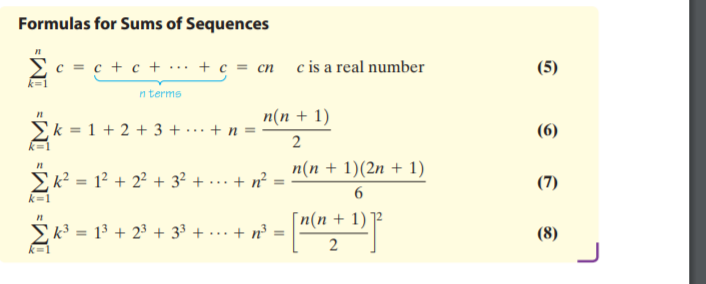
This is the formula cited. What's giving trouble is when they use formula 6.
Why is it:
N(N-1)/2?
I can see that as opposed to formula 6, the value ends at 1 less than N, as opposed to ending at N itself - but I'm confused as to why that changes the outcome for the formula really.
viscid thistle
If you want a written proof and you have studied AP , then notice that 1,2,3...n is an AP .
Now Write $$S_n = 1 + 2+ 3 + 4 + ... + n$$
and again flip it to write $$ S_n = n + (n - 1) + .... + 1$$
Now for an AP , the formula for a sum with the first and last element is $ Sum = \frac{n}{2} (a + t_n)$
write this for both of our $S_n$ and then add them to get $$ 2 S_n = [\frac{n}{2} (1 + n)] + [\frac{n}{2}(n+1)] $$
Solving for $S_n$ gives what we need , namely $$S_n = \frac{n}{2}(n +1)$$ @restive bridge
obsidian monolithBOT
xi64
 hushed vine

 viscid thistle
i would actually suggest giving a re-read for the definition of a one sided limit / a limit in general if you are that confused
hushed vine
you cna ping helpers after 15 minutes right
 cursive birch
like I think the limit as x approaches three from the right of f of x is 3 but im not sure if thats correct or not
hushed vine
i think yes but isn't the problem looking for the left side limit?
hushed vine
hushed vine
been almost 30 minutes so <@&286206848099549185>
 fresh breach
do you know in general how to take roots of complex numbers
what techniques do you already know and what did you try
cursive birch
cursive birch
<@&286206848099549185>
hushed vine
fresh breach
what techniques do you already know and what did you try
Nevermind I got it. I wasn't using the 2nd smallest
stupid me
fresh breach
yeah nilla what is your specific questions
question
so it got cleared up that the limit should be coming from the left
what does that mean to you
cursive birch
since its asking for the limit from the left side would that make it 1
fresh breach
yes
when it's asking for a limit from a specific direction
the value at the point is irrelevant
and the behavior elsewhere is irrelevant
cursive birch
ooh ok thanks
fresh breach
np
 strange pewter
 stuck lark
go ahead

 blissful ridge
Exploit odd and even properties of definite integrals
sick steppe
Meme math 
dense oar
How do I find the polar equation for
x - 4y + 2 = 0 ?
dense oar
<@&286206848099549185>
fresh breach
what do you already know about converting to polar form
do you know how x and y each convert individually
fresh breach
ok thats great
restive bridge
viscid thistle
If you want a written proof and you have studied AP , then notice that 1,2,3...n...
I apologize, Idon't quite follow. Would it be possible to explain just this part?

in your explanation, it shows n+1. I'm just not getting why we have n-1 in the end result
restive bridge
OOOOHH
I got it, thanks bro.
So originally formula 6 is: (n +1)n/2
You substitute the formula in this case: [(n-1+1)(n-1)]/2 ---> n(n-1)/2
@sick steppe
TY
sick steppe
yes
 white idol
can someone please help me with this
 willow bear
what's giving you trouble here?
 fleet yew
willow bear
fleet yew
willow bear
@white idol seems to have disappeared
white idol
willow bear
what's giving you trouble here?
im not exactly sure where to start
I first tried finding the derivative of the equation and realized that I don't know what to do with that
willow bear
maybe converting the curve to cartesian parametric equations would help
white idol
then i tried converting it to rectangular and realized that didnt work
white idol
i got it in terms of x and y
if i reformat it as amd did, would i get (3+8sintheta)sintheta?
 ashen wren
so we just finished our verifying identities lesson and I gotta say I'm really having a hard time figuring out where to begin on some of the questions the teacher assigned to us
I'm struggling with this one

I'm having trouble determining which side to start in
blissful ridge
I mean it's not very intuitive to start on the RHS
ashen wren
alrighty then
sick steppe
1+tan^2(x)=sec^2(x) would be where I start probably
 somber yew
Or if you're familiar with compound angle identities
Maybe this would be a major hint so 😛
viscid thistle
heyy, can someone please help me with this problem
 sick steppe
viscid thistle
heyy, can someone please help me with this problem
sick steppe
viscid thistle
heyy, can someone please help me with this problem
slope of the secant on [-pi/6,pi/6]
viscid thistle
sick steppe
slope of the secant on [-pi/6,pi/6]
thank you!
 plush scroll
can someone explain how this works?

I dont want a direct answer, i just need an explanation on how to get the answer...
sick steppe
is it (x+1)^3 in the integrand?
plush scroll
no ^2
somber yew
Can you evaluate (x+1)^2?
plush scroll
wdym? @somber yew
plush scroll
I dont think we do that
obsidian monolithBOT
Manan.
 plush scroll
the teacher never expanded a question when he was explaining it to me, this is the first question in this form i got
somber yew
I mean
You're not always constrained to do what has been taught in class
Also, this is precalc knowledge so it is assumed in a calculus course
plush scroll
i know..its why i came here, am a bit troubled with focusing in class, i am working on that though
somber yew
No worries.
plush scroll
lemme try working on it, and send a picture to where i end, then maybe u can correct after
somber yew
Sure!
I wouldn't be around here for long, it's getting late for me. But you can send your work here.
plush scroll
its okay, thanks
somber yew
Take a look at the original expression again.
Cross-check against the given options. Do you notice something?
hushed vine
@viscid thistle When else is this denominator 0?
 plush scroll
somber yew
Cross-check against the given options. Do you notice something?
plush scroll
somber yew
Cross-check against the given options. Do you notice something?
lets do ur way...with expanding
(x+1) (x+1)
x^2+x+1
integration of (x^2 + 2x + 1) is going to be (X^3/3 + 2x^2/2 + 1x) = 7/3
(X^3/3 + 2x^2/2 + 1x) = 7/3 {we need to remove the denominators so we multiply it all by 3}
[2x^2/2] the denominator cancels the 2 from 2x^2, and 3 is multiplied to the x making it 3x^2
then its gonna be (X^3 + 3x^2 + 3x) = 7
^^^^^^^^^^^^^^^^^^^^^^^^^^^^^^^^^^^^^^^^^^^^^^^^^^^^^^^^^^^^^^^^^^^^^^^^^^^^^^^^^^
This is what i came up with...i am like 80% sure its wrong so could u help me out if it is wrong
somber yew
This sounds right. Good job!
plush scroll
Wait...fr? that works???
plush scroll
omg..wow ...alr..ig i do pay attention in class a bit
thanks for verifying, i'd be stuck on it for another hour if i wasnt sure

 fleet ferry
ello
does anyone know where to start learning calculus?
i have a basic understanding of limits, and its applications on physics
but thats it
 hollow hatch
Books and Youtube video ofc
 rose gull
fleet ferry
does anyone know where to start learning calculus?
rose gull
fleet ferry
does anyone know where to start learning calculus?
khan academy

 onyx wharf
Equations that show a proportional relationship are of the form y = kx
There is no constant added
 scenic hollow
Can you example more
viscid thistle
@scenic hollow please read #❓how-to-get-help , rule 3.
 tender questBOT
From
Rule 3
Stick to one channel and don't post the same question in multiple channels. Please don't ask for help in other channels if no one is responding in the one you have posted your question in.
viscid thistle
scenic hollow
Can you example more
do you know what proportionality is?
unborn blade
Can someone help me figure out where I'm going wrong?

I'm trying to find the second derivative using chain rule and quotient rule
omg im so stupid
nevermind
 kindred bluff
It’s the very last part mate, you forgot to multiply the -3x^2 by 4
 tender lotus
can someone tell me what i'm doing wrong?

for y i multiplied 5 by 2 over the square root of 3
obsidian monolithBOT

 Requested by veryhappyperson#1152
kindred bluff
tender lotus
for y i multiplied 5 by 2 over the square root of 3
Requested by veryhappyperson#1152
kindred bluff
tender lotus
for y i multiplied 5 by 2 over the square root of 3
It should be square root of 3 over 2
That’s the cosine of 30 degrees
tender lotus
so I did put the cos of 30 as square root of 3 over 2 but when I cross multiply I am still getting the wrong answer
kindred bluff
cos(30)=y/10
Sqrt(3)/2=y/10
10*sqrt(3)/2=y
Try that
I crossed multiplied, as you did
tender lotus
I got 8.66 again and its still being marked as wrong
kindred bluff
Weird, maybe try and type in 5sqrt(3)?
kindred bluff
kindred bluff
Weird, maybe try and type in 5sqrt(3)?
This worked?
tender lotus
but why did I have to change it back if it never asked for that
yes the 5sqrt3
so its just simplified
kindred bluff
tender lotus
but why did I have to change it back if it never asked for that
I have no clue whatsoever
tender lotus
I guess if it can be simplified I have to leave it that way, thank you
kindred bluff
You’re welcome!
 ocean temple

 dark sky
help i dont know how to do 2

my guess is 17(0.7)^t
is that right ?
when i plugged in 37 to calculator, i dont end up with 4.5
harsh cipher
Hello
I'm curious about something which is related questions on a exam.
I just took a test that had 7-8 questions that were not taught in the chapter lessons.
Should I contact my instructor and explain this to him? He doesn't seem to care very much since he has not bothered to email me back about a different question.
jolly raven
hm
thats annoying to deal with
well i would but idk how he would respond
best of luck to you mirrion
 clear sundial
How would I write the trig form of a complex number like -16i? I said that -16i=0-16i, meaning that a=0 and b=-16 but then solving for theta doesn't work because you'd be dividing by zero (since tan(theta)=b/a
clear sundial
only thing i got is that if arctan(b/a) is undefined it must be 3pi/2 since the arctan of that is also undefined?
but idk if that's true
jolly raven
isnt arctan of pi/2 + pi*n where n is an integer undefined for tan or arctan?
willow bear
jolly raven
isnt arctan of pi/2 + pi*n where n is an integer undefined for tan or arctan?
arctan has the whole real number line as its domain
you're thinking of tan.
 willow bear
there is one point where it's differentiable.
 leaden jewel
how so?


 leaden jewel
just completed my school
leaden jewel
willow bear
zero
but it needs to be continuous in the epsilon neighbourhood to be differentiable right?
leaden jewel
viscid thistle
you're 19?
18
willow bear
it is continuous at 0
viscid thistle
i am 15
leaden jewel
willow bear
it is continuous at 0
What does it even mean to be continous at a point
leaden jewel
viscid thistle
phi
??
willow bear
you haven't seen the definition?
stuck lark
@viscid thistle keep offtopic away from the help channels
viscid thistle
stuck lark
<@456226577798135808> keep offtopic away from the help channels
sorry
leaden jewel
willow bear
you haven't seen the definition?
I did see the epsilon delta definition but they aren't zero are they?
willow bear
who are "they"
leaden jewel
epsilon and delta
 echo wagon
Look harder