#precalculus
1 messages · Page 282 of 1
 median moss
median moss
median moss
Thank you
Question about identity and self inverse functions. Here I have the definitions of both functions;
**Identity function:**A function which does not change the output
Self inverse function: A function in which its inverse, is its original function
Would it be correct if I wanted to prove that any function is an identity/self if I did
$$f(x)=x$$
 obsidian monolithBOT
Mist
median moss
$$f(x)=f^{-1}(x)$$
 neon mural
{-1}
obsidian monolithBOT
Mist
median moss
I just have a terrible teacher so I have to self teach pre cal, cal 1 and half of cal 2 in like 4 months
neon mural
other than that, not too bad
median moss
its doomed for me
neon mural
yeah idk what that means i don't do american syllabus
median moss
what country r u form
median moss
It's methods + specialist plus first maths at uni
neon mural
yeah
median moss
So its the maths you take for the highest maths in hsc plus the mandatory one if you take the highest one, plus first year uni cal kinda
hsc is like nsw maths right
neon mural
it is
but nsw maths is harder than vic maths
so idk if you can compare it like that
but sure maybe
median moss
I do an international program so I just compare it with the us system lol
median moss
i shall try my best sir
neon mural
havent had experience with uni maths
median moss
wait how does maths work in nsw
median moss
r we gonna get banned for talking about this
neon mural
so you have genny 1 and genny 2
median moss
in this channel
neon mural
mmmm
median moss
XD
neon mural
yeah take it to chill
 grave tartan
Oh yeah just another form, the standard makes it easier to define as a function
 bronze canyon
Ramming my head against a wall here. Anyone have a quick proof of this for a,b,c,d suitable reals
bronze canyon
Oh it’s not true that’s why 💀
bronze canyon
Denominators need to be positive it turns out
 viscid thistle
Hello, can anyone show me the how to get from A to B by factoring and simplifying? Appreciate it
,rccw
obsidian monolithBOT
 pliant locust
viscid thistle
Hello, can anyone show me the how to get from A to B by factoring and simplifyin...
pliant locust
viscid thistle
Hello, can anyone show me the how to get from A to B by factoring and simplifyin...
Let $$t=(49-x^2)$$
Also we know,
$$t^{1/2} = t^1 * t^{-1/2}$$
$$t^1 = t^{3/2} *t^{-1/2}$$
Then $$\frac{(49-x^2)^\frac{1}{2} + 3x^2 (49-x^2)^{-\frac{1}{2}}}{49-x^2}=$$
$$\frac{t^{1/2} + 3x^2 t^{-1/2}}{t}= $$
$$\frac{t^{-1/2}(t + 3x^2)}{t^{-1/2}*t^{3/2}}=\frac{(t + 3x^2)}{t^{3/2}}=$$
$$\frac{49-x^2+3x^2}{(49-x^2)^{3/2}}$$
obsidian monolithBOT
ds.b16rts
viscid thistle
Broooo thanks ! 🙏
 robust nest
need help with this problem and several others like it
 sick steppe
robust nest
need help with this problem and several others like it
sick steppe
robust nest
need help with this problem and several others like it
Start on RHS then use double angles to simplify num and denom, then simplify, then re-expand with double angle
robust nest
@sick steppe have no idea what any of those are. We are supposed to do this purely with trig identities
sick steppe
ok then LHS and write everything in terms of sine and cosine
robust nest
sorry, what is LHS
left hand side?
ok if thats what you mean then I turned tan on top into sin/cos, then 1 became sin^2+cos^2 and -tan^2 became -sin^2/cos^2
grave tartan
$\frac{\frac{\sin{\theta}}{\cos{\theta}}}{\frac{cos^2{x}-sin^2{x}}{cos^2{\theta}}}$
obsidian monolithBOT
AyeWaddup
grave tartan
thank god no errors
robust nest
ah so multiply now? i can flip the bottom right
grave tartan
dwai
robust nest
i have another one that i may need help on if you dont mind
grave tartan
send
robust nest
grave tartan
do you know any double angle formulas
robust nest
nope
robust nest
nope we arent supposed to know them for this
grave tartan
hmmm
robust nest
only trig identities and thats it
grave tartan
those are identities lmao
but I wont use them
yeah okay
write the numerator as one fraction
and the denominator as one fraction
lmk if you have trouble
robust nest
ok one second
grave tartan
oh sorry I meant like
one fraction
ok first
split tan and cot into their respective sin and cos representations
robust nest
ok so -tan becomes -sin/cos, -cot becomes -cos/sin
grave tartan
$\frac{\sin^2{\theta}-\frac{\sin{\theta}}{\cos{\theta}}}{\cos^2{\theta}-\frac{\cos{\theta}}{\sin{\theta}}}$
obsidian monolithBOT
AyeWaddup
grave tartan
is that what you got
robust nest
yes
grave tartan
now right the squared trig functions as fractions with common denominators as the other fractions on their respective line
sorry if that doesn't make sense
I meant just express sin^2 as an equivalent fraction with denominator cos
and same for the bottom portion
lmk when youre good
robust nest
kk so on top i got
(sin^2*cos)-sin/cos
on bottom (cos^2*sin)-cos/sin
@grave tartan
grave tartan
Ok so
The final sin on the bottom
You can bring to the very top of the fraction
And the denominator below that
You can bring to the new bottom
Because of how fractions work
I can explain more in depth later but i dont have the time rn lol
grave tartan
its basically just $\frac{a}{\frac{b}{c}} = \frac{ac}{b}$
obsidian monolithBOT
AyeWaddup
robust nest
yes
grave tartan
wait imma read
robust nest
i moved sin to the top and cos to the bottom and distributed them
grave tartan
im gonna copy and paste rq
$\frac{\sin^2{\theta}-\frac{\sin{\theta}}{\cos{\theta}}}{\cos^2{\theta}-\frac{\cos{\theta}}{\sin{\theta}}}$
obsidian monolithBOT
AyeWaddup
grave tartan
$\frac{\frac{\sin^2{\theta}\cos{\theta}-\sin{\theta}}{\cos{\theta}}}{\frac{\cos^2{\theta}\sin{\theta}-\cos{\theta}}{\sin{\theta}}}$
obsidian monolithBOT
AyeWaddup
grave tartan
so then
$\frac{\sin^3{\theta}\cos{\theta}-\sin^2{\theta}}}{\cos^3{\theta}\sin{\theta}-\cos^2{\theta}}$
obsidian monolithBOT
AyeWaddup
$\frac{\sin^3{\theta}\cos{\theta}-\sin^2{\theta}}}{\cos^3{\theta}\sin{\theta}-\cos^2{\theta}}$
```Compilation error:```! Argument of \frac  has an extra }.
<inserted text>
                \par
l.55 ...sin^3{\theta}\cos{\theta}-\sin^2{\theta}}}
                                                  {\cos^3{\theta}\sin{\theta...
I've run across a `}' that doesn't seem to match anything.
For example, `\def\a#1{...}' and `\a}' would produce
this error. If you simply proceed now, the `\par' that
I've just inserted will cause me to report a runaway
argument that might be the root of the problem. But if
your `}' was spurious, just type `2' and it will go away.```what happened here lol
grave tartan
no clue I can see it rn lmao
robust nest
sin^3*cos-sin^2/cos^3*sin-cos^2 was this correct?
grave tartan
good!
robust nest
thanks
grave tartan
np man
just work with manipulating the expression using the identities you know
and you'll be good for future problems
in this one we took apart tan and cot
and then made equivalent fractions
robust nest
hm alright its kinda hard for me to understand where to go and what direction but I think by practicing it itll eventually be natural
grave tartan
my best advice is be suspicious
always be suspicious
that tan and cot messes everything up here right
if they weren't there we'd have a nice expression
I just mess around with it in my head to see if it goes anywhere
 mild swan
If you want to prove this identity, I'd start with clearing out the embedded complex fraction
grave tartan
oh no we just did it
robust nest
lmaoo
grave tartan
I sent it again for reference
robust nest
real quick question
grave tartan
yeah wassup
robust nest
what does - do to a natural log again
grave tartan
like subtraction?
robust nest
like a negative natural log
grave tartan
oh so the same log rules apply
robust nest
wait so
grave tartan
but saying $log_{\frac{1}{e}}{x}$ is weird
obsidian monolithBOT
AyeWaddup
robust nest
nah its just parenthesis
grave tartan
yeah it works both ways lmao
robust nest
interesting
robust nest
thanks hope you have a nice rest of your day
grave tartan
Np and ty will do
 clever pecan
hi
 bold meadow
yep
 bold osprey
thanks!
 blissful kayak
grave tartan
blissful kayak
grave tartan
I literally had to do that exact same expression in my Precalc class....
It's a messy process though
But try rewriting everything in terms of just sine and cosine
That's how I was able to do it
But again, it's messy
grave tartan
Oh yeah no I got it eventually it just took me till 3:00 cause I was already tired
 leaden stratus
The protocol of a medical treatment says that a particular medicine should be in infusion for a long time. The model that describes the concentration C of the medicine in blood (μmol/L) in function of time t (in hours) is this expression: see picture.
To get an efficient result, the concentration should be stationary at circa 16 μmol/L. Can this treatment be efficient? When will the concentration goes past 15 μmol/L? The book says that yes, it's efficient and that goes past 15 μmol/L after 28 hours circa.
pliant locust
leaden stratus
The protocol of a medical treatment says that a particular medicine should be in...
Picture is to to get time for when c(t) is 15.
As to answering the question about efficiency I just determine the limit of e^-t/10 is 0 when t approaches infinity so the infusion is stable.
leaden stratus
@pliant locust thanks a lot. Why is it stable when the limit is 0?
pliant locust
$$e^x \to 0 \text{when} x\to -\infty$$
I cba to latex, maybe there is a way to show it is stabile without using limits but ull explain
obsidian monolithBOT
ds.b16rts
leaden stratus
Actually, if you plug -infty, gives infty @pliant locust
But if you plug +infty is 0
But of course, we choose +infty
So this means 16(1-0)
And it's always stable to 16
pliant locust
Yes!
I know you got it but might aswell upload the pic since I already took it
,r
leaden stratus
Ok, thanks again!
 lost onyx
Can anyone explain finding the vertical asymptote of some equation like this
neon mural
can you factorise the denominator for me? @lost onyx
basically, once you've factorised the denominator, you let that equal to zero
so for example, if i had
obsidian monolithBOT
lofi hip hop radio
neon mural
i could factorise that to
neon mural
you arrive at the conclusion that x=-1 and -2
but since that's the denominator, and the denominator cannot be zero, your vertical asymptotes are -1 and -2
@lost onyx
 errant nest
?
 worn scaffold
Factoring the inequality gives us (2x+1)(x-4), meaning we use -1/2 and 4 as our intervals. To figure out when the inequality is true you can just plug in values of x around the intervals. For example plugging in 0 would not work, as that would yield 0 is greater than or equal to four, but a values like -1/2 or 4 would work. Hopefully this is all the proof you need.
bold meadow
@errant nest I think I saw that solved in another thread
lost onyx
@neon mural thanks i appreciate it
neon mural
:)
pliant locust
errant nest
I dont get the second part
If f(x) approaches a limit when x approaches x=4 then you have a hole. If f(x) approaches infinity either from left, right or both then you have a vertical asymptote.
In other words, define you function so that its limit is not infinity when x approaches x=4.
 pine turtle
 past meadow
factorial
 jagged sun
What does it do?
past meadow
$n!=n \times (n-1) \times (n-2)... \times 2 \times 1$
obsidian monolithBOT
Sneaky
past meadow
so for instance $5!=54321=120$
obsidian monolithBOT
Sneaky
jagged sun
Oh
So root ten factorial
is
root 10 * root 9 * root 8 * root 7 * root 6 * root 5 * root 4 * root 3 * root2 *root 1
past meadow
well that ends up being correct, but its not actually (sqrt(10))! its sqrt(10!)
(sqrt(10))! doesnt make any sense, factorial is only defined for whole numbers
jagged sun
Oh I see
past meadow
so its $\sqrt{109...21}$
obsidian monolithBOT
Sneaky
past meadow
which is actually the same as you said since you can split the sqrt up
past meadow
no worries
 iron acorn
past meadow
(sqrt(10))! doesnt make any sense, factorial is only defined for whole numbers
iron acorn
past meadow
(sqrt(10))! doesnt make any sense, factorial is only defined for whole numbers
the factorial can be represented by the gamma or pi functions so not just whole numbers but yeah
past meadow
yeah ur right
i should teach the gamma function to the precalculus student
i understand the gripe lol thats a joke
but the gamma function is more of an extension of the factorial, the general definition i'm gonna give to a kid in precalc is just the one for naturals lol
 candid prawn
Would anyone be able explain this to me?
worn scaffold
Switch the places of x and y. For example, y=x+1 would be x=y+1 or y=x-1 in the inverse.
 bright grail
i get that
but i have to also find f-(3)
so i need to factor this
no idea on how to factor
worn scaffold
I'm not too sure about how to go about factoring that but since a point (a,b) in inverse would be (b,a) finding what value of x makes y=3 in the orginal equation would give you the answer, and looking at it x=1 works. This probably isn't the right way to go about this, because its just guessing.
worn scaffold
 round fossil
how to solve for x in thsi case
round fossil
how to solve for x in thsi case
Is there any other information?
round fossil
no
@worn scaffold
I'm very confused
its trigomonetry
this is supposed to be a right triangle
worn scaffold
oh
 latent palm
@round fossil he is confused
worn scaffold
-infinity to 0
 brazen tundra
how do u solve this?
 fading token
Find a system of linear equations that describe the problem
fading token
Yeah
 lucid owl
Can anyone help with the steps for condensing
1/2 log (9x) + 3/2 log (4x^3)
 ancient vale
can anyone help me solve these two problems
pliant locust
brazen tundra
 subtle ruin
Is there a way to go from vertex form to standard
pliant locust
lucid owl
Can anyone help with the steps for condensing
1/2 log (9x) + 3/2 log (4x^3)
Assuming x is always positive
 uncut mulch
factorisation
uncut mulch
that would be the most efficient route
 vivid comet
ancient vale
vivid comet
ancient vale
@pliant locust awesome thanks!!
pliant locust
ancient vale
<@778846013829152781> awesome thanks!!
I made a correction, uploading
pliant locust
ancient vale
<@778846013829152781> awesome thanks!!
uncut mulch
consider expressing everything in terms of sin and cosine, then simply by getting rid of the nested fractions
uncut mulch
yeh
mild swan
@robust nest you can also graph it on desmos.com
 thorn moat
I need help interpeting compression and stretch of graphs, for this graph the functions is f(x)=x^2. i know that graph pictured is -(x-2)-1 but im not sure how to interpet the strech and compression part
 neat iron
i guess you meant $-(x-2)^2-1$?
obsidian monolithBOT
Uchigawa
sick steppe
vivid comet
find sin then find csc
vivid comet
ye sin is just 25/7 how do i convert that to csc tho
sick steppe
how did you get sine?
pliant locust
vivid comet
ye sin is just 25/7 how do i convert that to csc tho
Draw the unit circle, find sine using geometry and then you have it.
 lime sequoia
Or just a triangle
Cosine is adj/hypotenuse
Find the opposite side by using pythagorean theorem
Then find cosecant = hypotenuse/opposite
 velvet granite
@bright grail so your top 2 sections look correct
but when you added in e
you didn't get the correct factors
adding in an e takes away the ln which is what you did correctly
so now all you should have is x^2+1/x^3=2
bright grail
i didnt use an e
i just moved x^3 to the other side
and then let it equal 0
to find the roots
velvet granite
then how did u cancel out the lns?
velvet granite
thats true, but only with an e
you have the correct idea tho
anyway i think your final answer is correct so good job
👍
bright grail
but how do u factor
i know its x =1 because that'll let it equal 0
but i want to know how u do it algebraically
velvet granite
youd have to multiply a and c then find the factors that give your the value of b
bright grail
can you show me
sick steppe
x=1 -> the function = 0 means x-1 is a factor
so long/synthetic divide to get a quadratic factor * (x-1)
bright grail
i realize that
but how do u factor properly
w/o realizing that x-1 will make it equal to 0
sick steppe
RZT requires a slight bit of guess and check to find p(a)=0
once you find a factor then you just long/synthetic divide
bright grail
i see, thanks homie
ancient vale
i got the first blank right but what do i type in the calculator for the (pi/2)+0.1
obsidian monolithBOT
sick steppe
ancient vale
i got the first blank right but what do i type in the calculator for the (pi/2)+...
just plug in x = pi/2 + .1
 lunar axle
someone plz help!!
 astral mantle
velvet granite
astral mantle
velvet granite
@lunar axle you need to get rid of the fraction
 inner sand
If a function is continuous, it does not have limits right? so the lim of x^2 as x approaches 2 does not exist
 serene heath
no that's not what continous means
grave tartan
No I think they know what continuous means, they must have the wrong understanding of limits
mild swan
@lunar axle did you get it?
pliant locust
lunar axle
someone plz help!!
Write the sum in numerator as same fraction.
Turn the numerator into 2(x+2) and then cancel out x+2.
 rare zephyr
 simple urchin
I need help understanding the binomial theorem. How do you compute the () columns? Like is it a 2X1 matrix?
I understand that it is a power expansion, but the vertical columns, I just don't see the use for them.
 novel creek
simple urchin
novel creek
simple urchin
LOLOLOL, yeah i know that from probability. so you are saying that these two are the same?
This is the same formula from probability and also the same formula in the binomial theorem. WOW
I never thought is was the same thing.
 rich saddle
Yeah, it's typically referred to as the binomial coefficient.
That () notation is read "n choose k" just like the nCk you've probably seen in counting/probability.
clever pecan
,rotate 360
obsidian monolithBOT
 hoary adder
,rotate 1080
obsidian monolithBOT
 fiery ridge
ooh how to do
obsidian monolithBOT
( ͡° ͜ʖ ͡°)
$\binom{n}{k}=\frac{n!}{k! \cdot (n-k)!}$
,rotate 129600
obsidian monolithBOT
 onyx gazelle
can anyone help me with system of equations no matter how much i try to figure this out i always end up on square one
 echo wagon
Well, what is it and what have you tried?
onyx gazelle
I have an idea of where to start
You multiply one of the equations so you can cancel out a variable
but then thats where it gets confusing for me
echo wagon
Well, do that and tell me what you get
echo wagon
Check the second term
onyx gazelle
You need a second equation right?
echo wagon
No
Because you have 2 equations and 3 unknowns, you don't have one solution but infinitely many
So you will have a free variable
echo wagon
Sure, go for it
onyx gazelle
z= -5/2x +13/2
echo wagon
No
onyx gazelle
3x+y-5/2(x)+13/4=8
echo wagon
5/4
onyx gazelle
Right
7/4(x)-19/4=-y
and than inverse all positives/negts
and then you get y
y=-7/4(x)+19/4
echo wagon
Looks right
onyx gazelle
Than do the same for x?
echo wagon
What do you want to do for x?
onyx gazelle
solve for x
echo wagon
echo wagon
Because you have 2 equations and 3 unknowns, you don't have one solution but inf...
.
Isn't x your free variable?
echo wagon
I don't know what you mean by in terms of z
onyx gazelle
Im just restating something to myself
echo wagon
Have you heard the term free variable before?
echo wagon
There are infinitely many solutions. So you say one of your variables is free and can take on any value, say x. So x can be any number. And for each value of x, we get one value of y and z. So x in free, and y and z depend on the value of x.
onyx gazelle
Makes sense
onyx gazelle
So whats the in terms of z in the question than?
echo wagon
If you choose a specific value of x, then you can find the corresponding y and z values
Oh, didn't read that
You were supposed to make z the free variable, and find x and y in terms of z
echo wagon
No. If you cancel out the z, then you can't solve for the other variables in terms of z.
You need to cancel out one of the others, say x, then you have y and z left. Then you solve for y in terms of z.
onyx gazelle
So instead of solving for z you solve forx?
onyx gazelle
-5x-2z=-13
ok
-2/5(Z)+13/5
that should be the x equation
Than you plug it in for y?
echo wagon
Why is it -2z again?
onyx gazelle
thats the original equation we got when we did elimination
echo wagon
No
echo wagon
Yes
echo wagon
Yes
onyx gazelle
Plug it in for y?
no no
x
-7/5(z)+39/5+y=8
-1/5
-7/5(z)-1/5=-y
y=7/5+1/5
7/5(z)
So then, z is free
y=7/5(z)+1/5
and x=-4/5(Z)+13/5
echo wagon
👍
onyx gazelle
So thats good?
than with this would you skip the elimination
and just use the -4x+9y=7 equation?
echo wagon
Yes
onyx gazelle
Alright sounds easy enough
so then you would want to solve for y with the equation because its asking for x to be the free variable
echo wagon
Yes
onyx gazelle
y=4/9y +7/9
echo wagon
x*
echo wagon
Yes
onyx gazelle
x-3y+4/9z +7/9
3y=x+4/9(x)+7/9
13/9x+7/9
/3
13/27(x)+7/27
z=13/27(x)+7/27
and y=4/9y +7/9
so than x is free
Easier now that I know what to do but thats all of math is it not
Well thank you @echo wagon
echo wagon
No problem!
viscid thistle
https://cdn.discordapp.com/attachments/407563152100818954/802471500737150976/20210123_163451.jpg
hey guys, what step am I making a mistake in? Trying to use the property of equality for complex numbers however it's not working out for me

 lilac pier
@viscid thistle Last line is wrong
lunar axle
could someone verify if these are correct for me??
bright grail
and if so, what rule is that
obsidian monolithBOT
Al𝟛dium
bright grail
been stuck here for a while
the inverses become 1/cos or whatever
but how do u evaluate
sick steppe
bright grail
been stuck here for a while
cos inverse is not 1/cos
$\cos{x} = c \iff x = \cos^{-1}{c}$
obsidian monolithBOT
moshill1
bright grail
so what is it equivalent too
sick steppe
cos(x) = -1, what's x?
pliant locust
bright grail
so what is it equivalent too
If you have a hard time remembering trig values I can recommend memorizing the following picture. All you have to picture is an equilateral triangle which has all angles of pi/3 and all sides are of equal length. Just knowing drawing an equilateral triangle as a start and pythagoras you can derive all trig values, for 45 degree is the exception which is just a right triangle with side length 1.
If you know the values but still can’t solve cos(x)=-1 or cos(x)=-1/2 then I suggest you do more exercises regarding the unit circle in trigonometry.
 novel cargo
what is it you have problem with?
 lilac storm
so i have typed in the eq N(x) = 1.42x(t) into geogebra, but i don't understand the next instruction under the N(x) = 1.42x(t) eq
and have i typed in the first eq N(x) = 1.42x(t), is this correct?
are you there?
lilac storm
oh, ok
novel cargo
I tried to put in X(t) first and then N(x) but geogebra won't accept
this is maybe bc they changed their interface and your instructions are obsolete
what you can do tho is to put in X(t) first
that's the longer equations
then put in N(x), which references X(t)
the problem right now is that when you put in N(x) first, it references X(t) and since you haven't entered it yet, the program doesn't accept
you got that?
lilac storm
i think so.
lilac storm
sorry, i'm not getting what is happening, so i can see the eqs but how did you get each eq after the first one in the picture?
novel cargo
you see the arrow on the bottom part of the second and third equation?
lilac storm
yes
novel cargo
what comes after that arrow is what geogebra calculates
what comes before the arrow is what I typed in
geogebra puts those together
lilac storm
oh, ok
novel cargo
when I say N(x) = 1.42 * X(x)
it will plug in X(x) from the previous cell and write it out
lilac storm
so for (a), it says find an expression for the number of jobs created (in millions) per year in the next t months, so is the answer the computed geogebra eq (the arrow one)?
novel cargo
yes
lilac storm
so basically your just multiplying the 1.42 of the N(x) eq with the expression in the X(t) eq, right?
novel cargo
yes, basically each housing construction creates 1.42 jobs
lilac storm
ok
so for part (b), when it asks finding how many jobs will be created in 6 and 12 months so do i just sub in 6 and 12 into the eq that we just got?
novel cargo
yes, I think so
lilac storm
yeah so i get it till here and then after that i am confused again that what i have to do?
lilac storm
cas mode
novel cargo
Ahh, OK, I just realized that your homework functions in CAS mode
the steps that they gave
it actually works if you do the step by step they gave
define N2(t) = N(x)
Then write Substitute... like instructed
lilac storm
so i subbed in 6 and 12 to find the answers so when i sub in 6, the answer i got is 2.24 and for 12 i got 2.48, is this correct?
lilac storm
and that's it for the question, right?
novel cargo
I think so
lilac storm
ok, thank you so much.
novel cargo
you welcome
 dark acorn
I need some help with this (pls let me know if i sent this to the wrong channel)
novel cargo
the denominator must not become zero
dark acorn
i got it, its A, but thx
dark acorn
i need help
serene heath
what have u tried
dark acorn
idk where to start
 green kernel
dark acorn
idk where to start
green kernel
dark acorn
idk where to start
square both sides
green kernel
show working
dark acorn
green kernel
that’s not the working but aight
dark acorn
no
green kernel
you need to keep in mind that when you square both sides, it can generate incorrect solutions
dark acorn
i just wanted to show my answer sheet
green kernel
so if you solve the thing and it gives you a solution which is wrong then you need to discard it
dark acorn
x+3 = 2x+8
-5=x
this is what i did after sqauring it
dark acorn
where?
green kernel
you get sqrt(-5 + 3) on the left hand side which is not defined (square rooot of negative number)
green kernel
yes, because squaring both sides can introduce solutions which don’t solve the original equation
dark acorn
so to solve that issue
dark acorn
you just plug the answer into x and redo it?
viscid thistle
@dark acorn there's nothing more to do in the reals
You just noticed how the solution was extraneous, there's no x in R that satisfies the eqn.
uncut mulch
first two are wrong,
you didn't screenshot the full answer for the last one
combination of poor notation and errors in signs for the first one,
you chucked a freshman's dream in the second one
viscid thistle
 kindred grove
1
kindred grove
1
isn't that calculus?
 strong ermine
@onyx gazelle In a graph?
onyx gazelle
I figured it out
strong ermine
Awesome.
onyx gazelle
I had a massive brain fart
strong ermine
It happens to the best of us.
Just recently I couldn't remember that the cube root of 1 is 1.
viscid thistle
i'm not sure if this is precalc but, i have no clue how to this, can someone help please
onyx gazelle
Im pretty sure thats physics
viscid thistle
onyx gazelle
Im pretty sure thats physics
i knoww, but i got given this question for integration homework so idek what's going on
onyx gazelle
#old-network message @viscid thistle
wait shit

Discord Science Network
An independent network of academic and professional Discord servers for discussion of advanced topics in science, technology, engineering, and mathematics.
there
join that
viscid thistle
onyx gazelle
https://discord.com/channels/268882317391429632/406129911992942593/4880375791204...
thanks sm
onyx gazelle
np
kindred grove
hey guys i snored cocaine and now i am programming the next Facebook
who wants to hop on the project ?
strong ermine

 strong ermine
When I look at this I think system of equations.
onyx gazelle
That would make sense
thats what we are going over
I just cant figure out the equation
onyx gazelle
I was thinking of ratios but I dont think that would work
than I thought a Linear equation
and graph the equations to figure out where the two would intersect
strong ermine
Yes.
Take a look at Linear Programming.

This precalculus video tutorial provides a basic introduction into linear programming. It explains how to write the objective function and constraints of linear programming word problems. It discusses how to find all of the corner points including the point of intersection where you have to solve the system of linear inequalities. It discusse...
strong ermine
There are several examples they show.
Just take a look at one.
Skip to 7:50
I think this one might help you.
onyx gazelle
a;right
onyx gazelle
@strong ermine I have found three equations so far and not sure if i need more
I got x+y less than or equal to 40
5x+15y= points
and 5y+x less than or equal to 60
60 for an hour
and 40 for the amount of questions
onyx gazelle
Anyone else able to help i got like 3 questions i need to do that i cant figure out
that involve systems
strong ermine
pliant locust
Ops, this was apparently a math channel sorry abt that
strong ermine

onyx gazelle
anyone able to help me with this
It just doesnt make sense to me to begin with
are you looking for the gradual climb of amount of time spent
 somber beacon
this makes no sense to me
sick steppe
somber beacon
this makes no sense to me
complementary angles add up to 90 degrees = pi/2 radians
somber beacon
sick steppe
complementary angles add up to 90 degrees = pi/2 radians
okay, so how would I do this
90-65 for the first one, right?
somber beacon
what
sick steppe
what
somber beacon
is the first one 25?
sick steppe
yes.. 25+65=90
somber beacon
and how would I go about doing the second one
let me try it first
is this anywhere near correct @sick steppe
and then for supplementary that means the same thing except it's 180 degrees or pi radians
right?
sick steppe
yes
somber beacon
did I do it right
sick steppe
yes
somber beacon
oh okay it makes sense now
thank you
wait I have two more questions for you @sick steppe
how do I do these
somber beacon
why is it adding 2pi radians in the top one but subtracting in the bottom one?
velvet granite
sick steppe
cause they're both co-terminal
somber beacon
oh, I can do either
velvet granite
yeah
sick steppe
it's just showing that +/- a rotation is co-terminal
sick steppe
no it asks for a co-terminal
sick steppe
then yeah do both
somber beacon
@sick steppe @velvet granite how do I do the angle drawing? like how would I do 5 and 7
velvet granite
do you know how to convert radians to degrees?
somber beacon
yes
velvet granite
then convert it for the necessary ones
somber beacon
no that comes in the next unit
somber beacon
yes
I just googled a pic of the unit circle i'll just use that for reference
but where would -185 degrees be @velvet granite
velvet granite
you start from your x side and go clockwise
because positive angles are counterclockwise
somber beacon
so right here?
velvet granite
yes
somber beacon
oh okay thats simple
velvet granite
since Pi is equal to 180 on the unit circle
somber beacon
yes
velvet granite
yep
somber beacon
wait
one more question
how do I do these?
I have no idea what degrees-minutes-seconds are
velvet granite
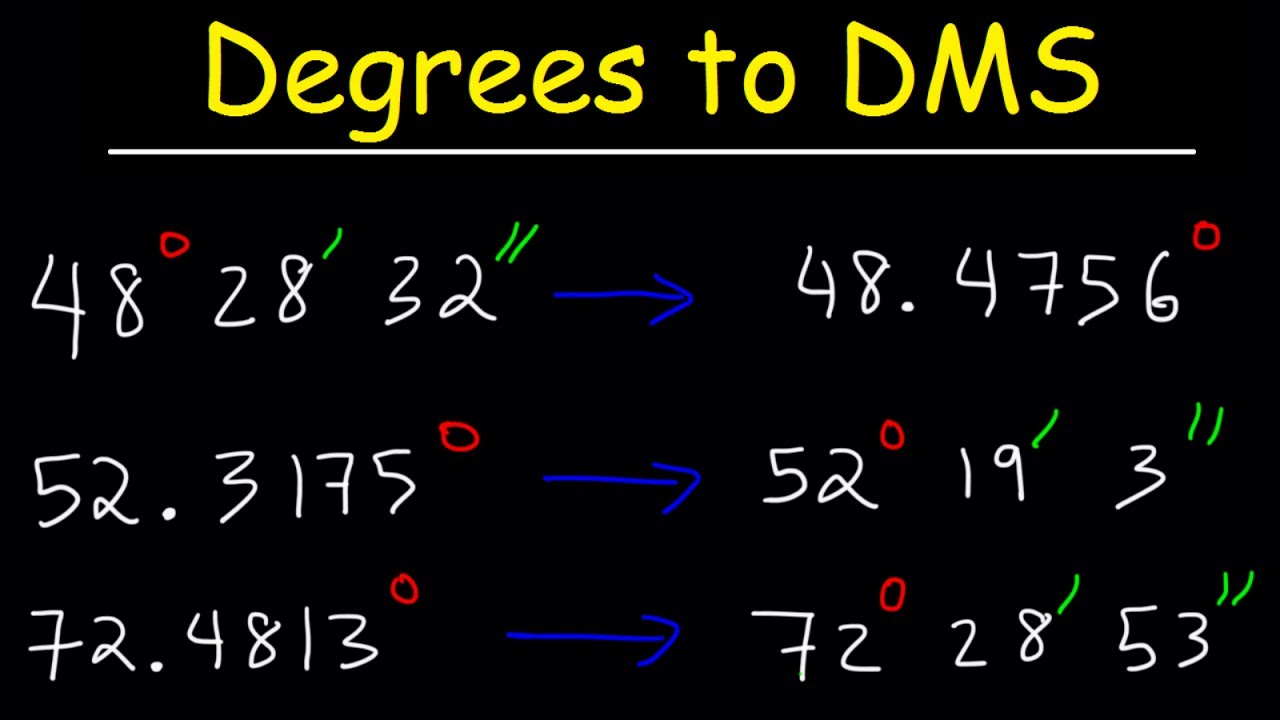
This trigonometry video tutorial explains how to convert decimal degrees to DMS. It also explains the process of converting DMS degrees minutes and seconds to decimal degrees. This video contains plenty of examples and practice problems for you to master the concept.
My Website: https://www.video-tutor.net
Patreon Donations: https://www.pat...

Learn how to convert angles from decimal forms to DMS forms. DMS means Degree, Minutes and Seconds. Minutes is represented by single apostrophe (') while seconds is represented with double apostrophe ("). 60 seconds = 1 minute and 60 minutes = 1 degree.
To convert an angle from the decimal form to the DMS form, we retain the whole number part o...
@somber beacon
somber beacon
oh so its just the number + the next number /60 + the next number /3600
 ripe adder
I dont see how I am wrong
grave tartan
Is there a vertical shift on that graph?
 ancient rampart
is a vector with 0 magnitude still a vector
serene heath
the zero vector is a vector yes
obsidian monolithBOT
moshill1
ancient rampart
o
 wispy aurora
Sub x = y^2
lilac storm
i have started this question and i know how to solve it but i've just gotten stuck in one of the first steps so if anyone can help me
so i started by rationalizing the numerator and denominator
wispy aurora
ghost ping not appreciated 😦
Oh yeah ig that works too?
BRUH
Who's ghost pinging me
viscid thistle
idk
viscid thistle
yoo
wispy aurora
Did you catch who the ghost pinger was?
I wanna kill him
and unfriend him if I'm friends with him
And never talk to him agian
XD
wispy aurora
So stealthy eh?
wispy aurora
lilac storm
so i started by rationalizing the numerator and denominator
Where did that get you
lilac storm
so in the denomiator i am left with x-25
wispy aurora
right
lilac storm
but the little confusion that i have is that how do i multiply out the numerator
wispy aurora
Well what did you multiply the denominator by?
lilac storm
(sqrt x - 5) times (sqrt x + 5)
wispy aurora
Right
lilac storm
which leaves me with x-25
wispy aurora
so you get (x-25)(sqrt(x)+5)/(x-25) correct?
lilac storm
exactly
wispy aurora
Can you see the next step?
lilac storm
what i am thinking is now i have to first multiply out the numerator as well
wispy aurora
but you don't
lilac storm
oh, ok
wispy aurora
there's a cancellation you can do
You don't need to multiply things out usually
leaving them as is is usually pretty good
lilac storm
i can't believe it, i didn't even see that
lilac storm
so the answer i got is 10
wispy aurora
yup
lilac storm
is this correct
lilac storm
ok thank you so much
ripe adder
I am trying to find the general form of a sine wave
this is the wave
how do I use the 5pi/8 to find the phase shift
sick steppe
ripe adder
how do I use the 5pi/8 to find the phase shift
where does the 1st valley to the right of x=0 occur on the regular cos(x) graph?
actually scratch that, do you have the horizontal dilation?
sick steppe
maybe
ripe adder
you said horizontal dialation
which in this one, I need to shift it pi/3 to the right
and have it end at 7pi/3
sick steppe
dilation is compression / stretch
phase shift is translation
ripe adder
So I need to translate this pi/3 to the right, and then after that make it 7pi/3 wide?
or vice versa
sick steppe
but you can note that the distance along the x-axis is 7pi/3 - pi/3 = 2pi so there isnt a dilation
ripe adder
ah
sick steppe
dilation isnt translation
the 7pi/3 isnt anything to do with the period
pi/3 and 7pi/3 are "like" points due to the periodicity, so the distance b/w them will be the period
pi(7/3 - 1/3) = 6pi/3 = 2pi
sick steppe
so the period is 2pi which is typical
ripe adder
and its been shifted upwards 1
sick steppe
yep since the axis of symmetry is at y=1
ripe adder
so would I just say 2sin(x-pi/3)+1 ?
sick steppe
you want to move pi/3 to the right
sick steppe
and horizontal changes have the sign reversed from what you get for vertical
yeah that looks right
,w graph y=2sin(x - pi/3) + 1 on the interval [pi/3,7pi/3]
obsidian monolithBOT


 Requested by moshill1#9771
sick steppe
Requested by moshill1#9771
sick steppe
yes it's right
ripe adder
oh I see
I hate doing these where the midline isnt 0
makes it so hard to see if my points are correct
thanks @sick steppe
 wicked tendon
so if there are question channels already. Is this for funneling them?
strong ermine
This channel is used to discuss precalculus/get help
But using questions is better
sick steppe
wicked tendon
so if there are question channels already. Is this for funneling them?
More for targeted questions; pre-calc questions go here or the general question channels
wicked tendon
Thanks for clarifying because i was seeing if any question channel was open so someone can explain rational number problems
sick steppe
just post the question
and no clue why you pinged me
$\omega$ is how fast it takes to rotate
obsidian monolithBOT
moshill1
sick steppe
so it will cover a full rotation (2pi) in 60 seconds
ok so you agree $\omega = \frac{\pi}{30} \frac{rad}{s}$?
obsidian monolithBOT
moshill1
sick steppe
so angular speed is the change of the angle, linear speed is the change of the distance. so it'll go a distance of 1 revolution (the circumference, think of it like a track) in 60 seconds
$v = \frac{2 \pi r}{60} = \frac{\pi}{30} r = \omega r$
obsidian monolithBOT
moshill1
sick steppe
so what's v in inches/s?
wr is omega (angular speed) times r (radius)
8 inches, yes
what's omega?
pi/30 yes
what's r?
so what's $\omega r$ ?
yes
$v = \frac{4 \pi}{15} \frac{inches}{s}$
obsidian monolithBOT
moshill1
sick steppe
v is linear speed
since its units are distance over time
also, if something doesnt make sense, say so.. dont say "that makes sense" to just ask about what it means later
yes that's what i just said
$v = \frac{2 \pi r}{t}$
obsidian monolithBOT
moshill1
sick steppe
distance / time
yes, and units
what?
v = 10pi meters?
what are units of speed?
,calc 16/40
obsidian monolithBOT
Result:
0.4
well 40 seconds is 2/3 of a minute, so it'll have moved 2/3 of the circumference
so $d = \frac{2}{3} \cdot 2 \pi r$
obsidian monolithBOT
moshill1
sick steppe
idfk you keep changing the question
you also havent finished 1b
no, you found v in inches/s
it asks for it in miles/h
this is why units are important
.05 mph yes
your engineer friend should be able to help if they're an engineer
ok well you know the speed of the hand (v), so use regular distance formula
$v = \frac{d}{t}$
obsidian monolithBOT
moshill1
sick steppe
yes, or times v by t, making sure the units match
cause that's the definition of linear speed.. distance / time (3rd time saying it btw)
apply what we went through
$\omega$ is the time to do 1 revolution
obsidian monolithBOT
moshill1
sick steppe
30 rev / minute = 1 rev / (1/30) min
1min = 60 sec -> (1/30)min = 60/30 sec = 2 sec
I'm not going to hold someone's hand through multiple questions... use the previous question as scaffold
viscid thistle
is the answer to this 0.99 (2 dp)
because theta = acos(-1/4) so
cos(2theta) = 1 - 2sin^2(theta)
=> cos(2theta) = 1 - 2sin^2[acos(-1/4)]
sick steppe
viscid thistle
use a different version of the double angle
 cunning obsidian
 jolly gust
How would I simplify (sin x+ cos x)^2/(1+2 sin x*cos x)
jolly gust
How would I simplify (sin x+ cos x)^2/(1+2 sin x*cos x)
this is the first step, can you see what to do next
the green is a hint
jolly gust
make that equal to 1
cunning obsidian
yes, and then its the same on the top and bottom, so it's equal to...
jolly gust
thanks my guy
cunning obsidian
no problem
 strange brook
can someone please help me i've been to 4 different hw servers
lilac pier
@strange brook what's the question asking for? value of alpha?
sick steppe
strange brook
can someone please help me i've been to 4 different hw servers
use compound angle on the LHS
strange brook
its asking to find the sum or difference identity for sine to prove each identity
sick steppe
yeah.. so what's the issue?
strange brook
umm you have to get the left side to equal the right side????