#precalculus
1 messages · Page 281 of 1
 obsidian monolithBOT
 gloomy swallow
this one
gloomy swallow
i cant understand how to do the method with poly nomials
 astral mantle
like what do you need to multiply by x-1 to get a term with x^4 and so on
gloomy swallow
x^3
astral mantle
yeah exactly I think you're overcomplicating it
gloomy swallow
uhuh
gloomy swallow
oh
 uncut mulch
very similar to division with numbers,
instead of units, tens, hundreds, etc.. columns
you have powers of x
gloomy swallow
idk where ill find examples
astral mantle
the internet has a vast quantity of knowledge
just google "polynomial long division"
 grim idol
astral mantle
grim idol
astral mantle

 valid echo
could anyone help me asap?
 mystic umbra
@valid echo do you need help?
 bold meadow
in exam prolly
mystic umbra
yup
 quick kelp
can anyone help me with this rational/logarithm practice problem? I'm quite stuck
A bank offers an annual interest rate r compounded semi-annually that triples money every 12 years. Determine r.
bold meadow
$3P = P(1+R%)^{T}$
obsidian monolithBOT
usernamephobic
Compile Error! Click the  reaction for more information.
(You may edit your message to recompile.)
 rare galleon
Alright
 misty imp
but i dont know how to find the coefficient of x
i guess and checked it but idk hoiw to do it with algebra
rare galleon
Have you tried this? x=-e^{y}
 sick steppe
it's not e
 clever pecan
misty imp
clever pecan
misty imp
YO
 odd folio
bsd gang 😔
misty imp
hold up
odd folio
DUDE LOGS ARE SO HARD PLEASE
misty imp
what school
odd folio
bhs
odd folio
van dyke p 1
odd folio
LMFAO IVE BEEN TRYING TO DO THIS SINCE LAST NIGHT
odd folio
😔 im just dum
misty imp
i sleepe every class
misty imp
samw bruh
odd folio
but please help bro im so confused i don't know how to solve this aha 🤡
misty imp
1 sec cuz idk how to do it but ill send u the questions from my attempt 1
or 2 idk
cuz i got full score on that tupe of question i think
odd folio
omgomg tysm sir
misty imp
i stull gotta do that same test tho
 viscid thistle
What's going on here??
sick steppe
2 people from the same school found each other and are, what looks like from skimming, cheating
you cant make this shit up i swear
sick steppe
one of you openly admitted that it was a formative
viscid thistle
odd folio
we're learning from each other
learning isn't giving away each others the answers.
misty imp
neither of us have answers 🤡
viscid thistle
misty imp
1 sec cuz idk how to do it but ill send u the questions from my attempt 1
...
viscid thistle
Are these like graded tests
misty imp
well the ones that i sent were from a long time ago
so they r already graded
im justl ooking back at my old test cuz i frogot how to do it
misty imp
uh well im still finishing up on one of them so no thank u
 livid carbon
viscid thistle
livid carbon
viscid thistle
@livid carbon still stuck?
 lofty mulch
I passed this class with an A+ and took a year off and now struggling xdxdjsfdsgsgs
viscid thistle
<@&286206848099549185> can a plane be perpendiculer to both i and j?
 royal siren
what are i and j
 errant fern
@viscid thistle Not possible in 3 dimensons
viscid thistle
royal siren
what are i and j
unit vectors
viscid thistle
errant fern
<@456226577798135808> Not possible in 3 dimensons
oh okay
yeah i visualized it and thought the same
royal siren
ah, using the i, j, k form. I haven't seen that in a while
 odd shell
hey guys im just curious whether the limit x->0 exists for this graph I made
because the left AND right side both approach 0
so I am a little confused if it should exist or not
sick steppe
odd shell
the limit equals 0
left hand = right hand means the double sided exists and equals left hand and/or right hand
the function just isnt continuous there
 mint geyser
can someone tell me how to find the reciprocal function of this graph?
mint geyser
<@&286206848099549185>
 velvet jungle
sick steppe
the function just isnt *continuous* there
velvet jungle
sick steppe
the function just isnt *continuous* there
It is continuous
oh wait
I didn't see the x=1
viscid thistle
@arctic kestrel do you need help with finding which function is it
velvet jungle
Removable discontinuities aren't very exciting though......
 arctic kestrel
yeah i just need to find the function for this @viscid thistle
viscid thistle
??
arctic kestrel
my bad
viscid thistle
Wrong person? 
arctic kestrel
yeah lol
viscid thistle
You’re good
@arctic kestrel ok what are your thoughts on this?
ie what have you tried so far/thought of so far
arctic kestrel
To be honest
This is a very simple equation
I'm currently a junior in high school, but due to corona my motivation to learn math has trembled ever since trig mixed with algebra thus making pre calc
sick steppe
They didnt ask for your backstory, they asked what you had tried
arctic kestrel
well
so far
i've thought about using an equation i saw
2pi/b
but i don't necessarily know where to put it tbh
I do know however that it's most likely a micro function and that it's flipped vertically
sick steppe
micro function?
arctic kestrel
I assume it's a micro function since it's using division + pi ?
I don't know really what it's supposed to be used to measure honestly
algebra 2 was more understanding
sick steppe
not sure what you mean by micro function, but the basic shape is a sinusoidal
arctic kestrel
i know there's something it's measuring but it's not something i understand necessarily
sick steppe
so which sinusoid goes through (0,0); sine or cosine?
arctic kestrel
sine according to the graph up there right?
sick steppe
yes, so you know the eqn is going to be of the form y=Asin(kx)
viscid thistle
Kinda forgot ab this i went to help another person lol.
arctic kestrel
true but I only knew that thanks to the help of @viscid thistle
but now with your help aswell I do
welcome back
viscid thistle
Lol @sick steppe can keep on going if you want
arctic kestrel
brb gonna research what sinusoid is
viscid thistle
Idc
sick steppe
I mean i always fuck up period lmfao
viscid thistle
Lmao
sick steppe
My teacher was eccentric when she taught it is all ill say
arctic kestrel
oh it's the name of the function as in sine, quad, linear etc
is pre cal really needed for cal?
arctic kestrel
but do I have to understand it understand it now
for me to pass?
pre algebra wasn't necessarily a big help in algebra or algebra 2 tbh
is it okay if i pass over it or is it a special prerequisite?
pass over it as in understand basic concepts but not head deep?
sick steppe
I mean.. you should understand trig when you can cause it's used so much in physics / calc / etc
sick steppe
Only time ive used trig in LinAl explicitly is rotation matrices
arctic kestrel
hmm
also
if t is a real number and p =(x, y) on a point in a circle corresponded to t wouldn't x be sine and y be cosine
since you said sine graphs go through 0
viscid thistle
i'd recommend looking something up about sinousoidal functions if you don't know much ab it
Before continuing with your question
sick steppe
No?
arctic kestrel
or do sine and cosines get a special treatment since they're trig?
as in the form you write them
sick steppe
Trig is trig, polynomials are polynomials
arctic kestrel
f(x)=ax+y etc
sick steppe
that would be a line..
arctic kestrel
f(x) = a(sin2x)+y?
viscid thistle
arctic kestrel
f(x) = a(sin2x)+y?
Is that an attempt to your question
Bc the argument of sin is indeed 2x lol
arctic kestrel
my real real question that i can probably use google to find but i'd rather here from experts is
what do trig functions measure?
sick steppe
depends
arctic kestrel
that polynomials can't
sick steppe
SHM is the simplest example
arctic kestrel
shm?
sick steppe
$\ddot{x} = -\omega^2 x \implies x(t) = A\cos{(\omega t + \phi)}$
obsidian monolithBOT
moshill1
sick steppe
Simple Harmonic Motion 
sick steppe
yes, cause sound is a wave
arctic kestrel
wait i was actually right?
sick steppe
pretty much
arctic kestrel
i thought you were being sarcastic but that's lit
that's cool how math can measure sound sort of
 paper zenith
I think you'll find Fourier transforms even cooler @arctic kestrel if you look into it. This guy on youtube 3B1B does really good videos
 median moss
Whats the definition of an arithmetic and geometric sequence? @faint sun
IF you didn't know:
arithmetic: A sequence in which each term differs from the previous term by a constant number (common difference)
geometric: A sequence in which each term can be obtained by multiplying the previous term by a same number (common ratio)
Use that the aid you for the first part of the question (determining if the given sequence is either, arithmetic, geometric or neither)
median moss
Set up an equation @faint sun
 faint sun
how
median moss
You're given term 1 and the common ratio
The formula you should be looking to be using, is the geometric sequence for the nth term
$$g_n=g_1\times r^{n-1}$$
faint sun
what am i supposed to find
median moss
Okay, the question wants you to find the value of n when tn is equal to 1/25
obsidian monolithBOT
Yolobro117
Compile Error! Click the reaction for more information.
(You may edit your message to recompile.)
median moss
Yes, its known as the geometric sequence for the nth term
obsidian monolithBOT
Mist
median moss
g1 is term 1 and r is the common ratio, which you are both given in the question
faint sun
so its 124
median moss
No, but can you show me your working please?
median moss
That's what we are trying to find, n
So you have the equation
$$g_n=625\times(\frac{1}{5})^{n-1}$$
obsidian monolithBOT
Mist
faint sun
yeah
median moss
As given in the question, tn, or in this case I used gn (it doesnt matter). We can equate the two equations
If we equate the two, we will get
$$\frac{1}{25}=625\times(\frac{1}{5})^{n-1}$$
obsidian monolithBOT
Mist
faint sun
oh
median moss
Everything okay up to this point?
median moss
What's your working?
faint sun
well i dont have my phone with me right now
and i dont know latex
so i gotta type it
median moss
haha it's fine
faint sun
so do i multiply 625 by 1/5 forst?
first
i have huge math knowledge gaps
can you show me how you did it
obsidian monolithBOT
Mist
faint sun
oh ok now i get it
median moss
So what I did here, was. I try to isolate (1/5)^n-1 so I divide both sides by 625
Which is the same as multiplying both sides by 1/625
faint sun
$625\left(\frac{1}{5}\right)^{n-1}=\frac{1}{25}$
obsidian monolithBOT
Yolobro117
faint sun
$\frac{625\left(\frac{1}{5}\right)^{n-1}}{625}=\frac{\frac{1}{25}}{625}$
obsidian monolithBOT
Yolobro117
median moss
Yep
faint sun
$\left(\frac{1}{5}\right)^{n-1}=\frac{1}{15625}$
obsidian monolithBOT
Yolobro117
faint sun
$-(n-1)=-6$
obsidian monolithBOT
Yolobro117
faint sun
so n=7
faint sun
i just found a converter
faint sun
well now i got it, thank you for the formula
median moss
do you know the arithmetic one
faint sun
no
median moss
well if you're doing sequences for arithmetic and geometric you should
$$a_n=a_1+d(n-1)$$
obsidian monolithBOT
Mist
median moss
a1 is first term and d is common difference
If you remember the definitions I give you, you can deduce the formulas quickly
faint sun
ty
median moss
all good
median moss
Yeah okay wanna do it together?
faint sun
ye
median moss
arithmetic: A sequence in which each term differs from the previous term by a constant number (common difference)
geometric: A sequence in which each term can be obtained by multiplying the previous term by a same number (common ratio)
median moss
yep
faint sun
how do i find the formula for the nth term of this sequnce?
median moss
That's a very good question, I haven't been taught this within my syllabus for my curriculum but I have some idea
give me a moment
I think it has something to do with quadratics
median moss
Answer to the previous question is 2^n+1, but I brute forced it and used intuition so I can't tell you a direct methodology
median moss
I brute forced it
3,5,9,17 and the difference is 2,4,8. If I took the difference of those it would give me 2,4. If I took the difference again it would be 2
So it told me it had something to do with 2^n
I noticed the terms were also odd, so I would have to add or subtract something
So I played with it until I got to the formula 2^n+1, where n is the nth term
faint sun
how do i find the 5th term?
 gaunt mason
Do you know the general formula for the geometric sequence?
median moss
Isn't that a geometric series?
gaunt mason
series is the sum of all terms of the geometric sequence
So series would be 4+(-20)+100+....
faint sun
median moss
3,5,9,17 and the difference is 2,4,8. If I took the difference of those it would...
so 3,5,9,17 -> +2,+4+8, --> x2,x2 thats what i got
median moss
Try plugging in the values for 2^n+1
t1 = 2^1+1 = 3
t2 = 2^2+1 = 5
t3 = 2^3+1 = 9
t4 = 2^4+1=17
t5 = 2^5+1=33
And so on
I think you would have to be specific and like verify if it continues
gaunt mason
You need to find the coefficients from the general geometric sequence formula
median moss
Probably some math trick you have to do, which I haven't been taught yet. But I'm just assuming
faint sun
2^n+1 is right i just want to know how you found it thats all
gaunt mason
You know the first 3 a_n terms, you don't know a nor r
As you have only two unknowns, a and r only 2 terms from the sequence are sufficient, so third is not needed.
a_1 = a * r^(1-1) a_2 = a * r^(2-1)
a1= 4, a2=-20
4=a from the first equation
-20=4*r from the second equation, so r=-5
So 5th term: a_5 = a * r^(5-1) = 4 * (-5)^4 = 4 * 25^2 = 4*625 = 2500 (?)
median moss
What question is vrafaeli helping you with
faint sun
5th term
gaunt mason
faint sun
help
gaunt mason
You always need to post your attempt
You cannot just spam related problems one after another. 🙂
 patent beacon
What does arithmetic mean? What does geometric mean? Does this follow either of those?
paper zenith
bruh your past 3 questions have been literaly the same thing. You need to learn how to solve it yourself mate
 mild bone
I'm looking for someone who's willing to spend a few hours every other night teaching me pre calc, if you know someone or willing to do so please DM me asap, really in need for someone next semester🙏
 trim hemlock
mild bone
trim hemlock
mild bone
I mean yeah I could, I tried that last year but it just messed me up even more
sick steppe
mild bone
I mean yeah I could, I tried that last year but it just messed me up even more
If you have questions post them.. that's the point of the server
mild bone
sick steppe
If you have questions post them.. that's the point of the server
Yeah ik, I'm aware
gaunt mason
@mild bone You paying? I mean you can just go through the book, and ask what is uncertain here, and you should be fine.
mild bone
gaunt mason
<@!530318734347206656> You paying? I mean you can just go through the book, and ...
I'm not paying. I guess I can do that but it's just much easier for me to have someone there ready for me to ask a question
gaunt mason
If something is unclear, you can post the question here, and go take a break until someone responds.
mild bone
Mhm
gaunt mason
I mean you can ask for math learning "pair" or something 🙂
astral mantle
Seems pretty unreasonable to have someone teach you precalc a few hours every other night for free 
 harsh cipher
Hi
can someone explain how convert annual interest rate of 4.35% compounded semi-annually to a monthly rate?
sick steppe
harsh cipher
can someone explain how convert annual interest rate of 4.35% compounded semi-an...
is semi-annual twice a year?
sick steppe
ok so 4.35% semi is 8.7% annually, so then 8.7% / 12 is monthly
0.725% a month
Unless Im dumb and doing it wrong, that is always a possibility
harsh cipher
umm that's not correct
We must convert interest rate from compounded semi annually to compounded monthly
you prob calculated interest rate for simple interest
sick steppe
$A = P\left(1 + \frac{r}{n}\right)^{nt}$
obsidian monolithBOT
moshill1
sick steppe
that's what im going off of with compounding and interest rate
harsh cipher
hmm
sick steppe
cause I dont see how you lose only 0.04% by *6 the number of interests
harsh cipher
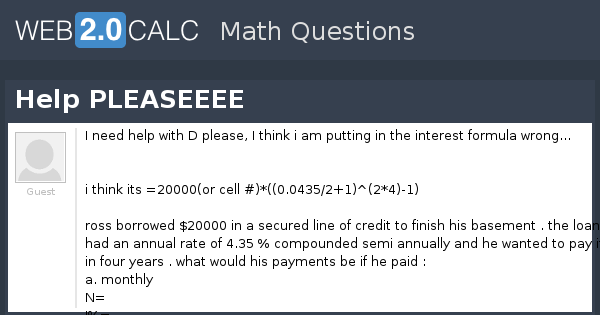
I need help with D please, I think i am putting in the interest formula wrong... i think its =20000(or cell #)((0.0435/2+1)^(24)-1)
Can someone tell me how the compounded monthly became 4.311 %?
 naive prism
im kinda confused how to start this
ik how to do it given the h.a, v.a., and intercepts
but idk how to do it to satisfy the condition of the singularity and the oblique asymptote
 crimson steppe
I'm lying down rn so I can't really write out a very complete solution
but if you know limits
f(x) should approach x + 2 as x approaches infinity
harsh cipher
nm figured it out
 round quest
how do i do this
 last tinsel
round quest
how do i do this
last tinsel
round quest
how do i do this
using the unit circle and knowing basic trigonometry would help
well
it should
round quest
ok
 lunar axle
can someone plz double check any of these for me?? i got one wrong and i’m not sure which one that was
 hard hornet
is this a test where they tell you how many wrong you have
 dark acorn
i need some help on my unit review, idk how to do this, can someone explain pls
dark acorn
<@&286206848099549185> pls help its been past 15 mins, and i need to understand this one
ik the answer is c from the answer sheet but how would i do it
i need this one
sick steppe
 robust nest
common denominator for the denominator of the main fraction
sick steppe
yes, what's secy?
sick steppe
yes.. so get a common denominator
robust nest
ah ok
let me try that
ok so the bottom becomes cosy/cosy + 1/cosy
which is just cosy+1/cosy
got the answer now
uncut mulch
what have you tried?
robust nest
@uncut mulch i made them have a common denominator cosx(1+sinx)
uncut mulch
question is in u not x but w/e
and then?
robust nest
so it became
(1+sinu)(1+sinu)/(cosx*1+sinx) - (cosx)(cosx)/(cosx*1+sinx)
i foiled for the 1+sinu
uncut mulch
parentheses around the whole denominator please
for convenience, you can use:
s for sin(u) and c for cos(u)
robust nest
kk
uncut mulch
where did you go from there?
uncut mulch
consider Pythagorean trig identities
uncut mulch
yes
uncut mulch
combine like terms
robust nest
ah wait
one second
so that becomes 2s^2+2s/(c(1+s))
and I can take out the 2
2(s^2+s)
for the numerator
uncut mulch
yeh
robust nest
tysm
 woeful shoal

 queen shadow
the general solution for ax^2+bx+c>=0 with a positive and the discriminant also being positive is x<=r or x>=s where r and s are the solutions of the equation ax^2+bx+c=0 and s>r
 lilac pier
@jaunty rampart x^3 > 0 means that x > 0 and y^3 < 0 means y < 0
so you have a point (x,y) such that x > 0 and y < 0
which quadrant is that point in?
 outer imp
 jaunty rampart
4 quadrant
viscid thistle
jaunty rampart
if x^3 > 0, then x > 0. if y^3 < 0, then y < 0
 lilac kayak
Should be fine
 stuck lark
@viscid thistle just be careful you know what you're talking about. there's a definition if a limit has a finite value but there's another definition if we assign infty to it (with its usual definition there's no need to think of extended reals)
viscid thistle
Have you tried anything so far?
robust nest
no not really yet. On the other problems I knew where to start instantly but im kinda confused on what direction to go in
is there a specific way to find out
this is ahead of my current class rn, im just doing it now because I have lots of other classes to study for today
uncut mulch
start with the side that feels more complicated to you
and these types of problems primarily involve factorisation and pythagorean trig identities
robust nest
i managed to get it after using factorization
then I used trig identities and bam ended up with tan^2 theta which is the same as tan*tan which is the same as sec^2 times sin^2
thanks
viscid thistle
The graph of the function y =sin x is transformed by vertically expanding it by a factor of 2, reflecting it in the y-axis, horizontally compressing it by a factor of 1/4, horizontally translating it 𝜋/ 4 units to the left, and vertically translating it 3 units down. Write the equation of the resulting function
y = 2 sin(-4 (x + π/4)) - 3 is that right?
 rancid crest
viscid thistle
rancid crest
viscid thistle
Please don't multipost. Give a read to #❓how-to-get-help @rancid crest
rancid crest
i didnt mean to post it in the trignometry area
round quest
how do i find these
sick steppe
round quest
how do i find these
is cosine an even or odd function?
round quest
even
sick steppe
so what's cos(-t)?
sick steppe
what does being an even function mean?
round quest
the points
sick steppe
$f(-x) = f(x)$ or $f(-x)=-f(x)$?
obsidian monolithBOT
moshill1
sick steppe
which of those means f is even?
round quest
2
sick steppe
no, that's odd
round quest
so 1
round quest
4/3
sick steppe
cos(-t) = cos(t) = 3/4
round quest
-3/4
sick steppe
no minus, cause cos is even not odd
round quest
so 3/4
round quest
so -4/3
viscid thistle
 sick steppe
gotta remember things I just said 1 minute ago
round quest
?
sick steppe
@round quest cos(-t)=cos(t)
round quest
3/4
sick steppe
yes, so what's 1/cos(-t)?
round quest
1/3/4
round quest
4/3
sick steppe
yes
sick steppe
well based on cost = 3/4, the answers should be positive
 lucid verge
can someone explain what im looking at
its pretty easy i think i was just zoning out when the teacher explained it
 tame fractal
lucid verge
tame fractal
lucid verge
to isolate theta u need to take the inverse sin (or arcsin) of both sides. inverse sin of 1/2 is pi/6 and 5pi/6
viscid thistle
hey quick question
isnt d the conjugate?
why did it mark my answer wrong
i dont see why it would be c
tame fractal
viscid thistle
isnt d the conjugate?
to undo a cube root u need a power to the third degree under that third root. so if you had 2x x 4x^2 under the cube root, you would have the cube root of 8x^3 which cancels out the cube root.
viscid thistle
thanks shorty
tame fractal
yw here's a visual
 pliant locust
How do I find inverse of e^(2sin(x)) x in first qadrannt not equal to 0 and pi/2.
sick steppe
$y=e^{2\sin{x}} \to x=e^{2\sin{y}}$
obsidian monolithBOT
moshill1
sick steppe
@pliant locust isolate for y in the 2nd eqn
pliant locust
How did you switch place between y and x there?
sick steppe
the inverse of a function is found by reflecting f(x) across y=x
which algebraically is just swapping x and y
the x=f(y) line is the inverse, but we want it in the form y=
obsidian monolithBOT
viscid thistle
why "it gets worse"?
pliant locust
I want x alone on left side, it is inside a sinus. Dunno that is how they taught us to get the inverse when we know the function has an inverse
viscid thistle
you are one step behind, though the final answer isn't nice to be exact
sick steppe
Going in you could anticipate ln and arcsin would show up
pliant locust
Do I just arcsin both sides? Lol
sick steppe
yep
pliant locust
Ty
round quest
how do i graph cos 4 on a unit circle
sick steppe
round quest
how do i graph cos 4 on a unit circle
4 degrees or 4 radians?
round quest
it just says 4
 strong ermine
If that's the case, I believe it's radians.
 thorn moat
in composition functions when talking about domain its my understanding that if x is undefined in g(x) then it must also be considered undefined in f(g(x)) but if x makes f(g(x)) undefined its excluded? does this sound right could some one possibly clairify this?
uncut mulch
why did you use the word "but"
thorn moat
not sure just trying still trying to understand it
uncut mulch
values of x where g(x) or f(g(x)) are undefined are excluded from the domain
viscid thistle
Could somone confrim I would appreciate it, thx
uncut mulch
5 is wrong
viscid thistle
Ohh thxs for checking it’s DNE correct?
uncut mulch
yeh
 whole vessel
Yeah I can help you with that @viscid thistle
strong ermine
Feel free to send them.
whole vessel
Ok, so first of all it is like graphing each function separately. So you would first focus on x + 3, then 8, then -x +2. So starting with the first piece of the piecewise, you can see it is restricted to the domain -2 <= x < 1. Plug in the x values that are in that domain into the equation x + 3. Make sure you plug in the endings of the domain (-2 and 1), other than that just plug in as many as you need to. In this case though, since you can tell it is just a line, you only need two points to define it. Then you indicate on the endings of the line whether it is inclusive or exclusive. An open circle means exclusive, and happens if there is a < or > , rather than a <= or >=. Inclusive is a closed circle, which happens with <= and >=.
You can picture it as 3 equations:
y = x + 3
y = 8
y = -x + 2
So for the first one, when you plug in -2, it is y = (-2) + 3 = 1
So the first point on the line is (-2, 1)
And because it is less than or equal to, not just less than, that point is included (closed circle)
np
The second one will always be y = 8, no matter what you try to plug in as x
viscid thistle
I believe I have my domain and range incorrect could someone check, thx
pliant locust
viscid thistle
I believe I have my domain and range incorrect could someone check, thx
Csc(x) = 1/cos(x) which is not defined for x=pi/2 since it yields division by zero. 1/cos(x) approaches infinity when x approaches pi/2 + npi.
Graphing two cycles implies 4 vertical asymptotes at
x1 = pi/2
x2 =3pi/2
Respectively
x=-x1
x=-x2 since cos is periodic
 bitter sandal
Hey, just a some quick confirmation. Is "-f(x)" the reflection of a given polynomial function across the x-axis?
pliant locust
My inuition says yes because that is the case for most polynomials I can think of but I myself havent seen the proof of the general case.
sick steppe
bitter sandal
Hey, just a some quick confirmation. Is "-f(x)" the reflection of a given polyno...
y=-f(x) -> -y=f(x), so all y values get negated. so Yes, it's reflection in x-axis
 brazen tundra
hey idk how to start this problem or to solve it i’m clueless
<@&286206848099549185>
brazen tundra
you need help too?
 severe knoll
yes
sceen shot this in your phone and tell me the answer I don't have a phone
pls
I only have computer
 echo wagon
Huh? Why do you need a screenshot of it?
severe knoll
for anwer
brazen tundra
this is precalculus
echo wagon
Still don't understand why you need a screenshot of it. You literally have a picture of the question.
And yes, this is not the right channel
severe knoll
BEcause I have a test and I need asnwer
plus, even if I post this on google I wouldn't receive the correct answer
severe knoll
I don't know and I have little time
brazen tundra
you need to ask the right channel
this is precalculus not geometry
<@&286206848099549185>
are any helpers there
 jaunty siren
same ^
strong ermine
viscid thistle
Still need help?
 high prawn
$\frac{d}{dx} (x)^n = n(x)^{n-1}$
obsidian monolithBOT
username1
high prawn
$\frac{d}{dx} (f)(g) = [(f’)(g)] + [(f)(g’)]$
obsidian monolithBOT
username1
viscid thistle
$\dd[x]$
obsidian monolithBOT
pain au chocolat
 jagged glade
$\dv{y}{x}$
obsidian monolithBOT
Biscuit
viscid thistle
$a^2 + 2ab + b^2$
 grave tartan
brazen tundra
hey idk how to start this problem or to solve it i’m clueless
grave tartan
brazen tundra
hey idk how to start this problem or to solve it i’m clueless
Do you still want help for this?
 subtle ruin
ok so I'm trying to get good at calculus before I take it next year
but I've never been taught secant lines
or tangents
I'd there any good explanations I can't find any
viscid thistle
Try with Khan Academy, not 100% sure it contains that but it should.
 fossil crownBOT
From
Rule 4
If your question has not been answered for a minimum of 15 minutes, you may use the Helpers tag once. Please do not try to bump your question using this ping unnecessarily. Do not abuse this ping. Do not individually ping users with the Helpers tag without their express permission.
uncut mulch
ignore what they got, how do you think the cost for that should be calculated?
jaunty rampart
I would say 0.25x+35.00
uncut mulch
not quite
recall that the $0.25/minute only applies to the time exceeding 350 minutes
jaunty rampart
oh instead of the $0.10/min
so once it exceed 350minutes
it changes to $0.25/min
uncut mulch
performing that multiplication alone? no.
uncut mulch
only doing that doesn't quite get you what you want.
since you shouldn't be applying the $0.25/min rate to the 350 which is what's being applied above
the above is what the 25c/min applies to
uncut mulch
and then you'll still need to add the cost for the first 350 minutes.
uncut mulch
since that only calculates for the cost for the minutes exceeding the first 350
jaunty rampart
I love you
 lilac storm
The percentage of obese children aged 12-19 years in the United States is approximately
P(t) = 0.04t + 4.6 if 0 ≤ t < 10
−0.01005t^2 + 0.945t − 3.4 if 10 ≤ t ≤ 30
where t is measured in years, with t = 0 corresponding to the beginning of 1970. What was the percentage of obese children aged 12–19 at the beginning of 1977? At the beginning of 1988? At the beginning of 1991?† (Round your answers to two decimal places.)
1977 ?%
1988 ?%
1991 ?%
can someone please help me with this question.
 magic mantle
Just fill in t=7, t=18 and t=21
lilac storm
sorry, where did the 7, 18, 21 come from and where do i fill it?
magic mantle
t=0 corresponds to the year 1970. So t=7 for 1977, t=18 for 1988 and t=21 for 1991
So,
P(7) = 0.04•7+4.6 = 4.81
And you do that for the other 2 values for t aswell.
lilac storm
ok, i got it it, thank you so much
Enclosing an Area Patricia wishes to have a rectangular garden in her backyard. She has 92 ft of fencing with which to enclose her garden.
Letting x denote the width of the garden, find a function f in the variable x giving the area of the garden.
f(x) =
What is its domain? (Enter your answer using interval notation.)
can anyone help me with this question as well.
anyone there to help
lilac storm
sorry, i didn't understand
 normal night
lilac storm
normal night
lilac storm
yes
 novel cargo
OK, if x denotes the width of the garden
what is the perimeter of the garden?
we know that perimeter equals 92
lilac storm
right.
novel cargo
perimeter is 2 * width + 2 * length
width was x
can we say that (92 - 2 * width) = 2 * length?
lilac storm
yes
novel cargo
then length = (92 - 2 * width)/2
or length = (92 - 2x)/2
now, Area = width * length
lilac storm
so it would be area=x times (92-2x)/2
novel cargo
nice
lilac storm
ok, thank you
novel cargo
no problem
lilac storm
and how would i write the domain for this in interval notation?
novel cargo
first think about what the domain is
novel cargo
what are possible values for width?
lilac storm
is it like (92 - 2* length)/2
novel cargo
the domain is the possible values that you can put for x
since x represents the width
of a rectangular fence
and you know the maximum length of the fence
there is only an interval of possible values for x (aka width)
think about it the other way around
what are impossible values for x?
say -10
lilac storm
is it Domain: {xER, x is less than or equal to 46}
lilac storm
because 92 is the total, length + the width
novel cargo
theoretically, the width of the garden can be almost as long as 92 and the length almost as small as zero
this isn't practical
but there aren't any other constraints in the problem
or are there?
maybe I've missed them
lilac storm
no, you didn't miss any information
novel cargo
now express the domain in interval notation like we did yesterday
lilac storm
so is it (0, x) U (x, 92)
novel cargo
it's just (0, 92)
lilac storm
ok
novel cargo
is this a test?
novel cargo
what have you tried?
rancid crest
well it would sin1/2x = 1
novel cargo
yes
novel cargo
yes
rancid crest
i have trouble with the intervals
novel cargo
so, look, you're almost there
novel cargo
yes, it would
rancid crest
ye
novel cargo
,w plot sin(1/2x) - 1 = 0
obsidian monolithBOT


 rancid crest
?
novel cargo
just confirmation
rancid crest
ah ok
novel cargo
the red point is pi
rancid crest
yea i assumed
novel cargo
also consider the other solutions in the given interval
novel cargo
so you consider all ns for wich n * pi/2 < 3pi
rancid crest
yes?
novel cargo
n * pi/2 is the general solution for sin(x) = 1 where n is a natural number > 0
now, you need to do one thing
rancid crest
mhm
novel cargo
constraint that to the interval given by your problem
so that it doesn't go over 3pi
rancid crest
right
novel cargo
then take all the natural numbers that fit in this constraint and put them in that equation of yours and solve for the xes
which you don't even need to do for eveyone
bc there is a pattern
and you gonna see it
rancid crest
so i got 2pi/2, 3pi/2, 4pi/2, and 5pi/2
so overall i got
crap
i think its just 2pi/2 and 3pi/2
novel cargo
yeah, which is pi D
rancid crest
shit
novel cargo
dw
novel cargo
let us know if it explodes
novel cargo

 rancid crest
ok
 neon mural
rancid crest
neon mural
rancid crest
hmm
hello
add root 2 to both sides
2sin4x=sqrt2
then divide by 2
sin4x=root 2/2
do inverse that on a calculator
4x=pi/4, 4x=3pi/4, etc.
divide by 4 to find answers
rancid crest
@neon mural wa
obsidian monolithBOT
lofi hip hop radio
rancid crest
oh ye ofc
neon mural
$2\sin{4x}=\sqrt{2}$
rancid crest
divide by 2
neon mural
right?
obsidian monolithBOT
lofi hip hop radio
neon mural
div by 2
neon mural
$\sin4x=\frac{\sqrt{2}}{2}$
obsidian monolithBOT
lofi hip hop radio
neon mural
table of exact values, find that $4x=\frac{\pi}{4},~\frac{3\pi}{4},~\text{etc.}$
obsidian monolithBOT
lofi hip hop radio
neon mural
and then divide all those answers by 4, and you've got your x values
rancid crest
is that it?
neon mural
should be more
viscid thistle
I had a question of restricitions in log equations
for example how do you determine the restrictions of x in the following equation
log_4(3x-5) = log_4(2x+5)
viscid thistle
okok
neon mural
alright here's a clue @rancid crest
if i add 360 degrees onto 45 degrees
what is it
neon mural
yeah
neon mural
you just add 2pi on
and divide by 4
if it doesn't work
you know that doesn't work
also
wait wtf
no
but like
keep in mind that
obsidian monolithBOT
lofi hip hop radio
neon mural
viscid thistle
I had a question of restricitions in log equations
for example how do you determ...
you can't take the logarithm of 0
rancid crest
if i add 2pi wouldnt it exceed 3
viscid thistle
so how do i detrimne the restricitions of x in that equation
neon mural
try it, if it doesn't work, then you know that it isn't the answer
try make the part with the variable in it be equal to zero
so for example, if i had log {3x-15}, i know that x cannot be 5
neon mural
so x cannot be 5/3 and -5/2
alright if you think about it, that means that graphically, those are the asymptotes, if you know what they are
so you could solve graphically
or if you know change of base, it's really easy
obsidian monolithBOT
lofi hip hop radio
neon mural
so basically right now, you have $\frac{\log{3x-5}}{\log{4}}=\frac{\log{2x+5}}{\log{4}}$
multiply both sides by log 4
obsidian monolithBOT
lofi hip hop radio
neon mural
so log 3x-5=log2x+5
remove log on both sides
3x-5=2x+5
x=10
but as for the part about restrictions, know that the thing you're taking the logarithm of
log_x (b)
the b part
cannot be zero
viscid thistle
ah so its just x>5/3
neon mural
the other log is defined
where x<5/3
but it's undefined at x=-5/2
so between 5/3 and -5/2, theres still one log that's defined
but as for your question, both logs are defined for x>5/3
viscid thistle
y=1/2 log_2(4-x)-1 the transformations on this graph is just that vertical compression by 1/2, horizontal reflection in y axis, horizontal shift right 4 unis and vertical shift down 1 unit correct?
@neon mural
viscid thistle
oops i did not mean to @ you my b
viscid thistle
so is my anwser right then?
neon mural
yep, but here's a tip for you
for checking
if you don't have graphing software
go to desmos and plot out your steps one by one
viscid thistle
okok
also one more question
In 2001, the population of Toronto was approximately 414,284 residents. City council has reasoned that they will need to expand the train line when the population reaches 940,000. If the population increases by approximately 8.2% every 5 years, when will the train need to be expanded?
I got 2053 for the answer can you confirm?
@neon mural
viscid thistle
okok
neon mural
how did you do this?
viscid thistle
?
neon mural
og
oml
used the wrong formula
i used geometric sum
ooops
yeah
2053
bruh i havent done this topic in ages
but yeah i got your answer @viscid thistle
viscid thistle
okok thank you
 midnight wolf
no clue what this is supposed to be (mathematical induction stuff)
 upbeat bone
You have $s_{n}=\frac{n(n+1)}{2}$, from there, by substituting n=k+1, what'll you get?
obsidian monolithBOT
Wilston Lynx
upbeat bone
That's basically what the bottom box asked you for
 robust star
How do I find the equation of this graph?
grave tartan
Well it seems to be a inversely proportional graph where the product of x and y is sum number
xy = k
Some*
Find if there’s a relationship
Aka the product
That’s your k
neon mural
grave tartan
xy = k
woah
i've never seen it written like that before
usually we just y=k/x